PUBLISHER: Global Market Insights Inc. | PRODUCT CODE: 2109255

PUBLISHER: Global Market Insights Inc. | PRODUCT CODE: 2109255
Adult Diaper Market Opportunity, Growth Drivers, Industry Trend Analysis, and Forecast 2026 - 2035
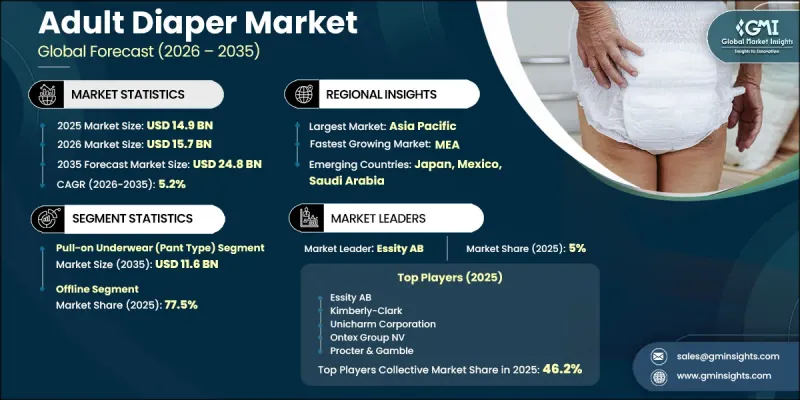
The Global Adult Diaper Market was valued at USD 14.9 billion in 2025 and is estimated to grow at a CAGR of 5.2% to reach USD 24.8 billion by 2035.
The market continues to expand as demographic changes increase the number of adults requiring incontinence care products. Rising life expectancy is steadily enlarging the aging population, resulting in higher demand for reliable and comfortable incontinence management solutions. Healthcare providers, caregivers, and consumers are placing greater emphasis on products that improve comfort, hygiene, and quality of life. The growing adoption of adult incontinence products across long-term care facilities, rehabilitation centers, and home healthcare settings is creating a stable and recurring demand pattern. Institutional purchasing is also increasing as healthcare organizations prioritize patient care standards and dependable product availability. At the same time, manufacturers are focusing on product innovation by improving absorbency, comfort, skin protection, and discretion to address evolving consumer expectations. Expanding awareness of incontinence management and the increasing acceptance of these products are further supporting market growth. These long-term demographic and healthcare trends are expected to sustain the expansion of the global adult diaper market throughout the forecast period.
| Market Scope | |
|---|---|
| Start Year | 2025 |
| Forecast Year | 2026-2035 |
| Start Value | $14.9 Billion |
| Forecast Value | $24.8 Billion |
| CAGR | 5.2% |
The pull-on underwear (pant type) segment generated USD 6.1 billion in 2025 and is anticipated to reach USD 11.6 billion by 2035. The segment continues to lead the market because its underwear-like design offers convenience, comfort, and discretion for everyday use. Consumers increasingly prefer this product format because it provides greater confidence, ease of wear, and improved mobility while supporting effective daily incontinence management, contributing to strong repeat purchasing patterns.
The offline distribution channel accounted for 77.5% share in 2025, making it the dominant sales channel. Physical retail outlets continue to maintain a competitive advantage by allowing consumers and caregivers to examine product quality, material softness, packaging, and overall suitability before purchasing. Personalized assistance from retail staff and immediate product availability further strengthen consumer preference for offline purchasing.
United States Adult Diaper Market held 74.8% share. Market growth is supported by a steadily aging population, increasing awareness of incontinence management, and rising demand for high-quality personal care products. Growing acceptance of adult incontinence products, supported by expanding consumer education and brand marketing efforts, continues to encourage product adoption across the region while strengthening long-term market demand.
Key players operating in the adult diaper market include Abena Group, Attindas Hygiene Partners, Because Market, Confitex, Daio Paper Corporation, Drylock Technologies, Essity AB, Fippi SpA, First Quality Enterprises, Hayat Kimya, Hengan International Group, Kimberly-Clark, LiveDo Corporation, Medline Industries, Nobel Hygiene Pvt. Ltd., Ontex Group NV, Paul Hartmann AG, Principle Business Enterprises (PBE), Procter & Gamble, TZMO SA, and Unicharm Corporation. Companies operating in the adult diaper market are strengthening their market position by expanding premium product portfolios, investing in research and development, and enhancing product performance through improved absorbency, comfort, skin protection, and ergonomic design. Manufacturers are introducing innovative materials and advanced production technologies to improve user experience while addressing changing consumer preferences. Strategic partnerships with healthcare providers, distributors, and retail networks are helping companies broaden their customer reach and strengthen market penetration. Businesses are also expanding manufacturing capacity, improving supply chain efficiency, and increasing investments in sustainable materials and environmentally responsible production practices.
Table of Contents
Chapter 1 Methodology & Scope
- 1.1 Research approach
- 1.2 Quality Commitments
- 1.2.1 GMI AI policy & data integrity commitment
- 1.2.1.1 Source consistency protocol
- 1.2.1 GMI AI policy & data integrity commitment
- 1.3 Research Trail & Confidence Scoring
- 1.3.1 Research Trail Components
- 1.3.2 Scoring Components
- 1.4 Data Collection
- 1.4.1 Partial list of primary sources
- 1.5 Data mining sources
- 1.5.1 Paid sources
- 1.5.1.1 Sources, by region
- 1.5.1 Paid sources
- 1.6 Base estimates and calculations
- 1.6.1 Base year calculation for any one approach
- 1.7 Forecast model
- 1.7.1 Quantified market impact analysis
- 1.7.1.1 Mathematical impact of growth parameters on forecast
- 1.7.1 Quantified market impact analysis
- 1.8 Research transparency addendum
- 1.8.1 Source attribution framework
- 1.8.2 Quality assurance metrics
- 1.8.3 Our commitment to trust
Chapter 2 Executive Summary
- 2.1 Industry 360° synopsis
- 2.2 Key market trends
- 2.2.1 Regional
- 2.2.2 Product type
- 2.2.3 Category
- 2.2.4 Absorbency level
- 2.2.5 Material
- 2.2.6 Size
- 2.2.7 Price range
- 2.2.8 Consumer group
- 2.2.9 Care setting
- 2.2.10 Packaging quantity
- 2.2.11 Distribution channel
Chapter 3 Industry Insights
- 3.1 Industry ecosystem analysis
- 3.1.1 Supplier landscape
- 3.1.2 Profit margin
- 3.1.3 Value addition at each stage
- 3.1.4 Factor affecting the value chain
- 3.2 Industry impact forces
- 3.2.1 Growth drivers
- 3.2.1.1 Aging global population & rising geriatric demographic
- 3.2.1.2 Increasing prevalence of urinary incontinence & chronic health conditions
- 3.2.1.3 Growing healthcare expenditure & expanding insurance coverage for incontinence products
- 3.2.2 Industry pitfalls & challenges
- 3.2.2.1 Intense price competition from private-label & unbranded local alternatives
- 3.2.2.2 Regulatory compliance requirements for material safety & skin-contact standards
- 3.2.3 Opportunities
- 3.2.3.1 Untapped demand in high-growth emerging markets
- 3.2.3.2 Product innovation in sustainable, biodegradable & skin-friendly adult diapers
- 3.2.1 Growth drivers
- 3.3 Growth potential analysis
- 3.4 Regulatory framework
- 3.5 Major market trends and disruptions
- 3.6 Technology/innovation landscape
- 3.6.1 Current trends
- 3.6.2 Emerging trends
- 3.7 Pricing Analysis (driven by primary research)
- 3.7.1 Historical price trend analysis (driven by primary research)
- 3.7.2 Pricing strategy by player type (premium / value / cost-plus) (driven by primary research)
- 3.8 Future market trends
- 3.9 Trade data analysis (driven by paid database) (HS Code- 9619.00)
- 3.9.1 Import/export volume & value trends (driven by primary research)
- 3.9.2 Key trade corridors & tariff impact (driven by primary research)
- 3.10 Impact of AI & Generative AI on the Market
- 3.10.1 AI-driven disruption of existing business models
- 3.10.2 Gen-AI use cases & adoption roadmap by segment
- 3.10.3 Risks, limitations & regulatory considerations
- 3.11 Porter’s analysis
- 3.12 PESTEL analysis
- 3.13 Distribution infrastructure & channel penetration landscape (driven by primary research)
- 3.13.1 Channel coverage by region & format (modern vs. traditional trade) (driven by primary research)
- 3.13.2 Last-mile infrastructure gaps & emerging channel shifts (driven by primary Research).
- 3.14 Consumer behaviour analysis
- 3.14.1 Purchasing patterns
- 3.14.2 Preference analysis
- 3.14.3 Regional variations in consumer behaviour
- 3.14.4 Impact of e-commerce on buying decisions
Chapter 4 Competitive landscape, 2025
- 4.1 Introduction
- 4.2 Company market share analysis
- 4.2.1 By region
- 4.2.1.1 North America
- 4.2.1.2 Europe
- 4.2.1.3 Asia Pacific
- 4.2.1.4 Latin America
- 4.2.1.5 Middle East and Africa
- 4.2.1 By region
- 4.3 Company matrix analysis
- 4.4 Competitive analysis of major market players
- 4.5 Competitive positioning matrix
- 4.6 Key developments
- 4.6.1 Mergers & acquisitions
- 4.6.2 Partnerships & collaborations
- 4.6.3 New product launches
- 4.6.4 Expansion plans
Chapter 5 Market Estimates & Forecast, By Product Type, 2022 - 2035 (USD Billion, Units)
- 5.1 Key trends
- 5.2 Tab-style briefs (tape type)
- 5.2.1 Disposable tab-style briefs
- 5.2.2 Reusable tab-style briefs
- 5.3 Pull-on underwear (pant type)
- 5.3.1 Disposable pull-on underwear
- 5.3.2 Reusable pull-on underwear
- 5.4 Booster pads and incontinence guards (pad type)
- 5.5 Flat underpads and bed protectors (chux)
Chapter 6 Market Estimates & Forecast, By Category, 2022 - 2035 (USD Billion, Units)
- 6.1 Key trends
- 6.2 Disposable
- 6.2.1 Standard disposable
- 6.2.2 Eco-friendly/biodegradable disposable
- 6.3 Reusable/cloth-based
- 6.3.1 Cotton-based reusable
- 6.3.2 Microfiber reusable
Chapter 7 Market Estimates & Forecast, By Absorbency Level, 2022 - 2035 (USD Billion, Units)
- 7.1 Key trends
- 7.2 Light (stress and urge incontinence)
- 7.3 Moderate (mixed incontinence)
- 7.4 Heavy/overnight (severe and functional incontinence)
Chapter 8 Market Estimates & Forecast, By Material, 2022 - 2035 (USD Billion, Units)
- 8.1 Key trends
- 8.2 Nonwoven fabric (polypropylene/polyethylene)
- 8.3 Cotton
- 8.4 Microfiber
- 8.5 Fluff pulp
- 8.6 Others (bamboo, bio-based, hybrid composite)
Chapter 9 Market Estimates & Forecast, By Size, 2022 - 2035 (USD Billion, Units)
- 9.1 Key trends
- 9.2 Small
- 9.3 Medium
- 9.4 Large
- 9.5 Extra large (XL)
Chapter 10 Market Estimates & Forecast, By Pricing, 2022 - 2035 (USD Billion, Units)
- 10.1 Key trends
- 10.2 Low
- 10.3 Medium
- 10.4 High
Chapter 11 Market Estimates & Forecast, By Consumer Group, 2022 - 2035 (USD Billion, Units)
- 11.1 Key trends
- 11.2 Women
- 11.3 Men
- 11.4 Unisex
Chapter 12 Market Estimates & Forecast, By Care Setting, 2022 - 2035 (USD Billion, Units)
- 12.1 Key trends
- 12.2 Home care
- 12.3 Hospitals and acute care
- 12.4 Nursing homes and long-term care facilities
- 12.5 Ambulatory and rehabilitation centers
Chapter 13 Market Estimates & Forecast, By Packaging Quantity, 2022 - 2035 (USD Billion, Units)
- 13.1 Key trends
- 13.2 Small pack (1–25 units)
- 13.3 Mid pack (26–100 units)
- 13.4 Bulk pack (100+ units)
Chapter 14 Market Estimates & Forecast, By Distribution Channel, 2022 - 2035 (USD Billion, Units)
- 14.1 Key trends
- 14.2 Online
- 14.2.1 E-commerce
- 14.2.2 Company websites
- 14.3 Offline
- 14.3.1 Supermarkets/hypermarket
- 14.3.2 Specialty retail stores
- 14.4 Others (independent retailer etc.)
Chapter 15 Market Estimates & Forecast, By Region, 2022 – 2035 (USD Billion, Units)
- 15.1 Key trends
- 15.2 North America
- 15.2.1 U.S.
- 15.2.2 Canada
- 15.3 Europe
- 15.3.1 Germany
- 15.3.2 UK
- 15.3.3 France
- 15.3.4 Spain
- 15.3.5 Italy
- 15.4 Asia Pacific
- 15.4.1 China
- 15.4.2 Japan
- 15.4.3 India
- 15.4.4 Australia
- 15.4.5 South Korea
- 15.5 Latin America
- 15.5.1 Brazil
- 15.5.2 Mexico
- 15.5.3 Argentina
- 15.6 MEA
- 15.6.1 South Africa
- 15.6.2 Saudi Arabia
- 15.6.3 UAE
Chapter 16 Company Profiles
- 16.1 Global Companies
- 16.1.1 Abena Group
- 16.1.2 Essity AB
- 16.1.3 Kimberly-Clark
- 16.1.4 Ontex Group NV
- 16.1.5 Paul Hartmann AG
- 16.1.6 Procter & Gamble
- 16.1.7 Unicharm Corporation
- 16.2 Regional Companies
- 16.2.1 Attindas Hygiene Partners
- 16.2.2 Daio Paper Corporation
- 16.2.3 First Quality Enterprises
- 16.2.4 Hayat Kimya
- 16.2.5 LiveDo Corporation
- 16.2.6 Nobel Hygiene Pvt. Ltd.
- 16.2.7 TZMO SA
- 16.3 Emerging Companies
- 16.3.1 Because Market
- 16.3.2 Confitex
- 16.3.3 Drylock Technologies
- 16.3.4 Fippi SpA
- 16.3.5 Hengan International Group
- 16.3.6 Medline Industries
- 16.3.7 Principle Business Enterprises (PBE)

