PUBLISHER: Global Market Insights Inc. | PRODUCT CODE: 2109258

PUBLISHER: Global Market Insights Inc. | PRODUCT CODE: 2109258
Angle Grinder Market Opportunity, Growth Drivers, Industry Trend Analysis, and Forecast 2026 - 2035
The Global Angle Grinder Market was valued at USD 3.2 billion in 2025 and is estimated to grow at a CAGR of 4.6% to reach USD 5 billion by 2035.
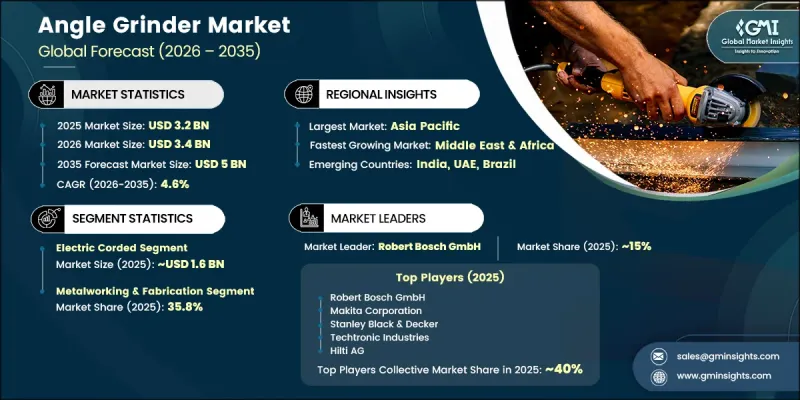
Growth across the angle grinder industry is driven by continuous advancements in cordless power tool technology, rising investments in infrastructure development, and increasing manufacturing activity associated with next-generation vehicle production. Improvements in lithium-ion battery performance, combined with the growing adoption of brushless motor technology, have significantly enhanced the efficiency, durability, and productivity of cordless angle grinders, making them increasingly suitable for professional applications. Expanding investments in construction, industrial development, and manufacturing modernization are further supporting demand for high-performance cutting and grinding equipment across multiple industries. At the same time, fluctuations in raw material prices continue to influence manufacturing costs and industry profitability, encouraging producers to focus on operational efficiency and product innovation. Ongoing capital investments in infrastructure and industrial expansion across major economies continue to create favorable growth opportunities for the global angle grinder market. These long-term investment trends, together with continuous technological improvements in power tools, are expected to sustain market expansion throughout the forecast period.
| Market Scope | |
|---|---|
| Start Year | 2025 |
| Forecast Year | 2026-2035 |
| Start Value | $3.2 Billion |
| Forecast Value | $5 Billion |
| CAGR | 4.6% |
The electric corded segment generated USD 1.6 billion in 2025 and is anticipated to grow at a CAGR of 2.8% between 2026 and 2035. This segment continues to maintain a significant market presence because corded angle grinders provide consistent power output for demanding applications requiring extended operation. Their dependable performance under heavy workloads makes them a preferred choice for industrial environments where uninterrupted power and high operating efficiency remain essential.
The metalworking & fabrication segment accounted for 35.8% share in 2025 and is projected to grow at a CAGR of 4.3% during 2026-2035. Continued growth in manufacturing activities and industrial capacity expansion are supporting increased demand for angle grinders within this segment. Ongoing investments in production facilities and industrial development continue to strengthen equipment demand, contributing to sustained market growth over the coming years.
U.S. Angle Grinder Market reached USD 770 million in 2025, and is expected to register a CAGR of 3.9% from 2026 to 2035. Market growth is supported by strong demand for premium-quality power tools and consistent purchasing activity from professional users. Continued investment in infrastructure development and commercial construction projects is further driving product adoption, while sustained demand from industrial and professional applications continues to reinforce the country's leadership within the regional market.
Major companies operating in the global angle grinder market include Robert Bosch GmbH, Makita Corporation, Stanley Black & Decker, Techtronic Industries, Hilti Corporation, Koki Holdings Co., Metabo, Jiangsu DongCheng M&E Tools Co., C. & E. Fein GmbH, FLEX-Elektrowerkzeuge GmbH, Chervon Group, Atlas Copco, Positec Tool Corporation, Sparky Group, Ingco Holdings Ltd., Kress-Elektrik GmbH & Co., AGP Power Tools, Yongkang Kimo Power Tools Co., KPT Industries, GISON Machinery Co. Ltd., and Karuvi. Companies participating in the angle grinder market are strengthening their competitive position through continuous investment in product innovation, advanced motor technologies, and battery-powered tool development. Manufacturers are focusing on improving power efficiency, operating performance, durability, ergonomics, and user safety to address evolving customer requirements. Many organizations are expanding manufacturing capacity, strengthening regional distribution channels, and enhancing after-sales service capabilities to improve customer satisfaction and market reach. Strategic partnerships, technology collaborations, and sustained research and development investments remain key approaches for accelerating innovation and expanding product portfolios. Companies also reinforce their market foothold by introducing application-specific solutions, optimizing production processes, enhancing product quality, and improving operational efficiency while addressing the changing needs of industrial and professional users.
Table of Contents
Chapter 1 Research methodology
- 1.1 Research approach
- 1.2 Quality Commitments
- 1.2.1 GMI AI policy & data integrity commitment
- 1.2.1.1 Source consistency protocol
- 1.2.1 GMI AI policy & data integrity commitment
- 1.3 Research trail & confidence scoring
- 1.3.1 Research trail components
- 1.3.2 Scoring components
- 1.4 Data Collection
- 1.4.1 Partial list of primary sources
- 1.5 Data mining sources
- 1.5.1 Paid sources
- 1.5.1.1 Sources, by region
- 1.5.1 Paid sources
- 1.6 Base estimates and calculations
- 1.6.1 Base year calculation
- 1.7 Forecast model
- 1.7.1 Quantified market impact analysis
- 1.7.1.1 Mathematical impact of growth parameters on forecast
- 1.7.1 Quantified market impact analysis
- 1.8 Research transparency addendum
- 1.8.1 Source attribution framework
- 1.8.2 Quality assurance metrics
- 1.8.3 Our commitment to trust
Chapter 2 Executive Summary
- 2.1 Industry 360° synopsis
- 2.2 Business trends
- 2.3 Regional
- 2.4 Power source
- 2.5 Disc size
- 2.6 Application
- 2.7 End-user
- 2.8 Distribution channel
Chapter 3 Industry Insights
- 3.1 Industry ecosystem analysis
- 3.1.1 Supplier landscape
- 3.1.2 Manufacturers
- 3.1.3 Distributors
- 3.1.4 Retailers
- 3.1.5 Profit margin analysis
- 3.1.6 Value addition at each stage
- 3.1.7 Factor affecting the value chain
- 3.2 Industry impact forces
- 3.2.1 Growth drivers
- 3.2.1.1 Cordless technology maturation
- 3.2.1.2 Global infrastructure investment surge
- 3.2.1.3 Automotive & EV manufacturing retooling
- 3.2.2 Industry pitfalls & challenges
- 3.2.2.1 Price sensitivity and Chinese OEM commoditization
- 3.2.2.2 Raw material and battery supply chain risks
- 3.2.3 Opportunities
- 3.2.1 Growth drivers
- 3.3 Growth potential analysis
- 3.4 Technology and innovation landscape
- 3.4.1 Current technological trends
- 3.4.2 Emerging technologies
- 3.5 Pricing analysis (driven by primary research)
- 3.5.1 Historical price trend analysis by product category
- 3.5.2 Pricing strategy by player type (premium / value / cost-plus)
- 3.6 Trade data analysis (based on paid database)
- 3.6.1 Import/export volume & value trends
- 3.6.2 Key trade corridors & tariff impact
- 3.7 Regulatory landscape
- 3.7.1 Standards and compliance requirements
- 3.7.2 Regional regulatory frameworks
- 3.7.3 Certification standards
- 3.8 Porter’s analysis
- 3.9 PESTEL analysis
- 3.10 Impact of AI & generative AI on the market
- 3.10.1 AI-driven disruption of existing business models
- 3.10.2 GenAI use cases & adoption roadmap by segment
- 3.10.3 Risks, limitations & regulatory considerations
Chapter 4 Competitive Landscape, 2025
- 4.1 Introduction
- 4.2 Company market share analysis
- 4.2.1 By Region
- 4.2.1.1 North America
- 4.2.1.2 Europe
- 4.2.1.3 Asia Pacific
- 4.2.1.4 Latin America
- 4.2.1.5 Middle East & Africa
- 4.2.1 By Region
- 4.3 Company matrix analysis
- 4.4 Competitive analysis of major market players
- 4.5 Competitive positioning matrix
- 4.6 Key developments
- 4.6.1 Mergers & acquisitions
- 4.6.2 Partnerships & collaborations
- 4.6.3 New product launches
- 4.6.4 Expansion plans
Chapter 5 Market Estimates & Forecast, By Power Source, 2022 – 2035, (USD Billion) (Units)
- 5.1 Key trends
- 5.2 Electric Corded
- 5.3 Cordless (Battery-Powered)
- 5.4 Pneumatic (Air-Powered)
Chapter 6 Market Estimates & Forecast, By Disc Size, 2022 – 2035, (USD Billion) (Units)
- 6.1 Key trends
- 6.2 Small (≤125 mm)
- 6.3 Medium (150–180 mm)
- 6.4 Large (≥230 mm)
Chapter 7 Market Estimates & Forecast, By Application, 2022 – 2035, (USD Billion) (Units)
- 7.1 Key trends
- 7.2 Metalworking & Fabrication
- 7.3 Construction & Infrastructure
- 7.4 Automotive & Repair
- 7.5 Aerospace, Marine & Shipbuilding
- 7.6 Woodworking
- 7.7 Others
Chapter 8 Market Estimates & Forecast, By End-User, 2022 – 2035, (USD Billion) (Units)
- 8.1 Key trends
- 8.2 Industrial
- 8.3 Commercial
- 8.4 Residential
Chapter 9 Market Estimates & Forecast, By Distribution Channel, 2022 – 2035, (USD Billion) (Units)
- 9.1 Key trends
- 9.2 Online
- 9.2.1 E-Commerce Platforms
- 9.2.2 Company Websites
- 9.3 Offline
- 9.3.1 Specialty Stores
- 9.3.2 Retailers
- 9.3.3 Others
Chapter 10 Market Estimates & Forecast, By Region, 2022 – 2035, (USD Billion) (Units)
- 10.1 Key trends
- 10.2 North America
- 10.2.1 U.S
- 10.2.2 Canada
- 10.3 Europe
- 10.3.1 Germany
- 10.3.2 UK
- 10.3.3 France
- 10.3.4 Italy
- 10.3.5 Spain
- 10.3.6 Sweden
- 10.3.7 Netherlands
- 10.4 Asia Pacific
- 10.4.1 China
- 10.4.2 India
- 10.4.3 Japan
- 10.4.4 South Korea
- 10.4.5 Australia
- 10.4.6 Indonesia
- 10.5 Latin America
- 10.5.1 Brazil
- 10.5.2 Mexico
- 10.5.3 Argentina
- 10.6 Middle East and Africa
- 10.6.1 Saudi Arabia
- 10.6.2 UAE
- 10.6.3 South Africa
Chapter 11 Company Profiles
- 11.1 Global Players
- 11.1.1 Robert Bosch GmbH
- 11.1.2 Makita Corporation
- 11.1.3 Stanley Black & Decker
- 11.1.4 Techtronic Industries
- 11.1.5 Hilti Corporation
- 11.1.6 Koki Holdings Co
- 11.1.7 Metabo
- 11.2 Regional Players
- 11.2.1 Jiangsu DongCheng M&E Tools Co.
- 11.2.2 C. & E. Fein GmbH
- 11.2.3 FLEX-Elektrowerkzeuge GmbH
- 11.2.4 Chervon Group
- 11.2.5 Atlas Copco
- 11.2.6 Positec Tool Corporation
- 11.2.7 Sparky Group
- 11.3 Emerging Players & Innovators
- 11.3.1 Ingco Holdings Ltd.
- 11.3.2 Kress-Elektrik GmbH & Co.
- 11.3.3 AGP Power Tools
- 11.3.4 Yongkang Kimo Power Tools Co.
- 11.3.5 KPT Industries
- 11.3.6 GISON Machinery Co Ltd
- 11.3.7 Karuvi

