PUBLISHER: Global Market Insights Inc. | PRODUCT CODE: 2109266

PUBLISHER: Global Market Insights Inc. | PRODUCT CODE: 2109266
Tunnel Automation Market Opportunity, Growth Drivers, Industry Trend Analysis, and Forecast 2026 - 2035
The Global Tunnel Automation Market was valued at USD 5.1 billion in 2025 and is estimated to grow at a CAGR of 8.2% to reach USD 11.2 billion by 2035.
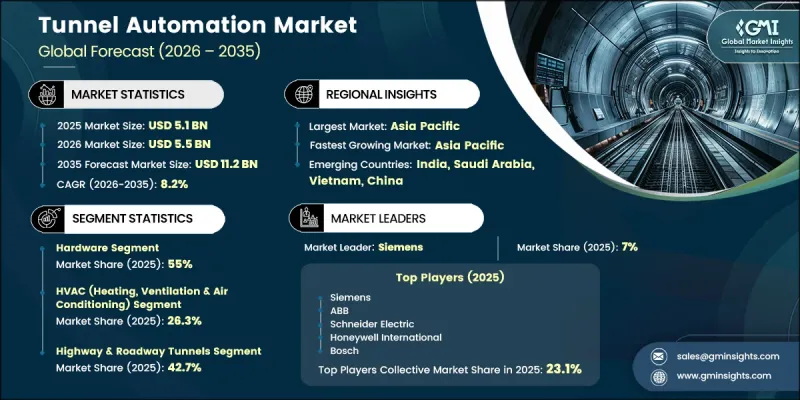
The tunnel automation industry is experiencing momentum as governments continue investing heavily in underground transportation infrastructure across major economies. Increasing expenditure on new tunnel construction, combined with the modernization of existing infrastructure, is creating sustained demand for advanced automation technologies over the long term. Aging tunnel networks require comprehensive upgrades to electrical, communication, monitoring, and control systems to comply with evolving operational and safety requirements, further accelerating market growth. In addition, stricter infrastructure regulations and higher expectations for operational efficiency are encouraging tunnel operators to adopt advanced automation solutions that improve reliability and system performance. Continuous advancements in digital technologies and intelligent monitoring systems are enabling more efficient tunnel operations while supporting preventive maintenance and improved asset management. The growing deployment of advanced sensing technologies and integrated automation platforms is also strengthening infrastructure resilience and enhancing overall operational safety. These factors, together with long-term infrastructure investments, are expected to support consistent expansion of the global tunnel automation market throughout the forecast period.
| Market Scope | |
|---|---|
| Start Year | 2025 |
| Forecast Year | 2026-2035 |
| Start Value | $5.1 Billion |
| Forecast Value | $11.2 Billion |
| CAGR | 8.2% |
Regulatory compliance continues to play a significant role in shaping purchasing decisions across the tunnel automation market. The increasing availability of advanced, durable, and cost-effective sensing technologies is allowing infrastructure operators to deploy more comprehensive monitoring systems while reducing installation costs. Continuous improvements in intelligent monitoring equipment are enhancing operational visibility, supporting faster incident detection, and improving overall tunnel safety. The widespread adoption of connected automation technologies is also enabling more efficient infrastructure management and optimized system performance.
The hardware segment accounted for a 55% share in 2025 and is expected to grow at a CAGR of 6.7% from 2026 to 2035. Hardware remains the core component of tunnel automation systems, providing the essential infrastructure required for sensing, control, communication, power management, and life-safety functions. This segment includes equipment designed to support monitoring, automation, electrical distribution, lighting, emergency response, communication, and operational control, making it fundamental to modern tunnel infrastructure.
The highway and roadway tunnels segment held a 42.7% share in 2025, making it the largest application segment within the tunnel automation industry. Extensive transportation tunnel infrastructure continues to drive demand for integrated automation solutions that improve traffic management, ventilation, lighting, surveillance, emergency communications, power management, and centralized operational control. Increasing investments in transportation infrastructure modernization are expected to further strengthen demand across this segment.
China Tunnel Automation Market accounted for a 57% share, generating USD 1.3 billion in 2025. The country remains the largest regional market and one of the fastest-growing markets globally, supported by continuous investments in transportation, utility, railway, metro, and underground infrastructure development. Ongoing expansion of tunnel networks and rapid urban infrastructure development continue to increase demand for advanced automation technologies that enhance operational efficiency, safety, monitoring, communications, and integrated infrastructure management.
Major companies operating in the global tunnel automation market include Siemens, ABB, Schneider Electric, Honeywell International, Bosch, Kapsch TrafficCom, Indra Sistemas, Eaton Corporation, Rockwell Automation, and FlaktGroup. Companies operating in the tunnel automation market are strengthening their competitive position through continuous investments in digital technologies, automation platforms, and intelligent infrastructure solutions. Manufacturers are expanding their product portfolios by developing advanced monitoring, communication, and control systems that improve operational efficiency and infrastructure safety. Many companies are increasing research and development investments to enhance system integration, real-time data analytics, and predictive maintenance capabilities. Strategic partnerships with infrastructure developers, transportation authorities, and engineering firms are also helping businesses expand their project pipelines and regional presence. In addition, companies are focusing on software integration, energy-efficient technologies, lifecycle service offerings, and customized automation solutions to address evolving customer requirements.
Table of Contents
Chapter 1 Research Methodology
- 1.1 Research approach
- 1.2 Quality Commitments
- 1.2.1 GMI AI policy & data integrity commitment
- 1.2.1.1 Source consistency protocol
- 1.2.1 GMI AI policy & data integrity commitment
- 1.3 Research Trail & Confidence Scoring
- 1.3.1 Research Trail Components
- 1.3.2 Scoring Components
- 1.4 Data Collection
- 1.4.1 Partial list of primary sources
- 1.5 Data mining sources
- 1.5.1 Paid sources
- 1.5.1.1 Sources, by region
- 1.5.1 Paid sources
- 1.6 Base estimates and calculations
- 1.6.1 Base year calculation for any one approach
- 1.7 Forecast model
- 1.7.1 Quantified market impact analysis
- 1.7.1.1 Mathematical impact of growth parameters on forecast
- 1.7.1 Quantified market impact analysis
- 1.8 Research transparency addendum
- 1.8.1 Source attribution framework
- 1.8.2 Quality assurance metrics
- 1.8.3 Our commitment to trust
Chapter 2 Executive Summary
- 2.1 Industry 360° synopsis, 2022 – 2035
- 2.2 Key market trends
- 2.2.1 Regional
- 2.2.2 Offering
- 2.2.3 Component
- 2.2.4 Tunnel
- 2.2.5 Automation Level
- 2.2.6 Application
- 2.3 TAM Analysis, 2026-2035
- 2.4 CXO perspectives: Strategic imperatives
Chapter 3 Industry Insights
- 3.1 Industry ecosystem analysis
- 3.1.1 Supplier landscape
- 3.1.2 Profit margin analysis
- 3.1.3 Cost structure
- 3.1.4 Value addition at each stage
- 3.1.5 Factor affecting the value chain
- 3.1.6 Disruptions
- 3.2 Industry impact forces
- 3.2.1 Growth drivers
- 3.2.1.1 Surge in Global Tunnel Infrastructure Investment
- 3.2.1.2 Stringent Government Safety Mandates Driving System Integration Across Tunnel Types
- 3.2.1.3 Rising Adoption of IoT, SCADA, & Edge Computing in Tunnel Operations
- 3.2.1.4 Energy Efficiency Imperatives & Sustainability Targets Among Tunnel Operators
- 3.2.2 Industry pitfalls and challenges
- 3.2.2.1 High Upfront Capital Expenditure for Full Automation System Deployment
- 3.2.2.2 Complex Integration Challenges with Aging & Legacy Tunnel Infrastructure
- 3.2.3 Market opportunities
- 3.2.3.1 Untapped Automation Potential in Utility, Water & Mining Tunnel Segments
- 3.2.3.2 AI-Powered Predictive Maintenance as a Value-Added Services Growth Lever
- 3.2.3.3 Retrofitting Demand from Decades-Old European & North American Tunnel Networks
- 3.2.3.4 Public-Private Partnership Models Unlocking Capital for Emerging Market Tunnels
- 3.2.1 Growth drivers
- 3.3 Growth potential analysis
- 3.4 Technology and innovation landscape
- 3.4.1 Current technological trends
- 3.4.2 Emerging technologies
- 3.5 Pricing Analysis (Driven by primary research)
- 3.5.1 Historical Price Trend Analysis
- 3.5.2 Pricing Strategy by Player Type
- 3.6 Regulatory landscape
- 3.6.1 North America
- 3.6.1.1 U.S. National Tunnel Inspection Standards
- 3.6.1.2 NFPA 502 Standard for Road Tunnels, Bridges, and Other Limited Access Highways
- 3.6.1.3 NIST SP 800-82 Rev. 3 Guide to Operational Technology Security
- 3.6.1.4 Canada International Bridges and Tunnels Act
- 3.6.1.5 Canada Railway Safety Act and Passenger Rail Security Regulations
- 3.6.2 Europe
- 3.6.2.1 Directive 2004/54/EC on Minimum Safety Requirements for Tunnels in the Trans-European Road Network
- 3.6.2.2 Safety in Railway Tunnels Technical Specification for Interoperability
- 3.6.2.3 EU Intelligent Transport Systems Directive
- 3.6.2.4 Network and Information Security Directive 2
- 3.6.2.5 EU Cyber Resilience Act
- 3.6.3 Asia Pacific
- 3.6.3.1 China JTG D70/2-2014 Highway Tunnel Design Standard
- 3.6.3.2 China Highway Tunnel Maintenance Standards
- 3.6.3.3 Japan Road Structure Ordinance Tunnel Requirements
- 3.6.3.4 Japan Technical Regulatory Standards on Railways
- 3.6.3.5 Singapore Code of Practice for Fire Precautions in Road Tunnels
- 3.6.3.6 Singapore Code of Practice for Fire Precautions in Rapid Transit Systems
- 3.6.3.7 India Metro Railways General Rules and Underground Metro Safety Requirements
- 3.6.4 Latin America
- 3.6.4.1 Brazil ABNT NBR 15661 Fire Protection in Road and Urban Tunnels
- 3.6.4.2 Brazil ABNT NBR 5181 Tunnel Lighting
- 3.6.4.3 Mexico Manual for the Design and Construction of Road Tunnels
- 3.6.4.4 Mexico Intelligent Road Tunnel and Control Centre Standards
- 3.6.4.5 Chile Ministry of Public Works Road Tunnel Safety and Concession Requirements
- 3.6.5 Middle East & Africa
- 3.6.5.1 UAE Fire and Life Safety Code of Practice
- 3.6.5.2 UAE Information Assurance Regulation
- 3.6.5.3 Saudi Operational Technology Cybersecurity Controls
- 3.6.5.4 Saudi Critical Systems Cybersecurity Controls
- 3.6.5.5 South Africa Mine Health and Safety Act and Regulations
- 3.6.1 North America
- 3.7 Porter’s analysis
- 3.8 PESTEL analysis
- 3.9 Patent analysis (Driven by primary research)
- 3.9.1 Patent Filing Trends by Technology Area (HVAC Automation, Fire Detection, Signalization)
- 3.9.2 Leading Patent Holders & Innovation Concentration
- 3.10 Cost breakdown analysis
- 3.11 Impact of AI and Generative AI on the Market
- 3.11.1 AI Driven Disruption of Existing Business Models
- 3.11.2 GenAI Use Cases and Adoption Roadmap by Segment
- 3.11.3 Risks Limitations and Regulatory Considerations
- 3.12 Capacity & Production Landscape (Driven by Primary Research)
- 3.12.1 Installed Production Capacity by Region & Key Manufacturer
- 3.12.2 Capacity Utilization Rates & Expansion Pipelines Among Leading Suppliers
- 3.13 Forecast assumptions & scenario analysis (Driven by Primary Research)
- 3.13.1 Base Case- Key Macro & Industry Variables Driving CAGR
- 3.13.2 Optimistic Scenarios- Favorable macro and industry tailwinds
- 3.13.3 Pessimistic Scenario - Macroeconomic slowdown or industry headwinds
Chapter 4 Competitive Landscape, 2025
- 4.1 Introduction
- 4.2 Company market share analysis
- 4.2.1 North America
- 4.2.2 Europe
- 4.2.3 Asia Pacific
- 4.2.4 LATAM
- 4.2.5 MEA
- 4.3 Competitive analysis of major market players
- 4.4 Competitive positioning matrix
- 4.5 Key developments
- 4.5.1 Mergers & acquisitions
- 4.5.2 Partnerships & collaborations
- 4.5.3 New Product Launches
- 4.5.4 Expansion Plans and funding
- 4.6 Company tier benchmarking
- 4.6.1 Tier classification criteria & qualifying thresholds
- 4.6.2 Tier positioning matrix by revenue, geography & innovation
Chapter 5 Market Estimates & Forecast, By Offering, 2022 - 2035 (USD Bn)
- 5.1 Key trends
- 5.2 Hardware
- 5.2.1 Sensors & Detectors
- 5.2.2 Actuators & Controllers
- 5.2.3 Control Panels & HMI Units
- 5.2.4 Cameras & Imaging Devices
- 5.3 Software
- 5.3.1 SCADA & Tunnel Management Platforms
- 5.3.2 AI-Based Analytics & Decision Support Software
- 5.3.3 Cybersecurity & OT Security Software
- 5.3.4 Asset Management & Maintenance Software
- 5.4 Services
- 5.4.1 Professional Services
- 5.4.2 Managed Services
Chapter 6 Market Estimates & Forecast, By Component, 2022 - 2035 (USD Bn)
- 6.1 Key trends
- 6.2 HVAC (Heating, Ventilation & Air Conditioning)
- 6.3 Lighting & Power Supply
- 6.4 Signalization
- 6.5 Fire Detection & Suppression
- 6.6 Surveillance & Monitoring
- 6.7 Communication Systems
- 6.8 Others
Chapter 7 Market Estimates & Forecast, By Tunnel, 2022 - 2035 (USD Bn)
- 7.1 Key trends
- 7.2 Railway Tunnels
- 7.3 Highway & Roadway Tunnels
- 7.4 Utility & Water Tunnels
- 7.5 Mining Tunnels
Chapter 8 Market Estimates & Forecast, By Automation Level, 2022 - 2035 (USD Bn)
- 8.1 Key trends
- 8.2 Semi-Automated
- 8.3 Fully-Automated
Chapter 9 Market Estimates & Forecast, By Application, 2022 - 2035 (USD Bn)
- 9.1 Key trends
- 9.2 Traffic Management
- 9.3 Safety & Security & Monitoring
- 9.4 Ventilation & Environmental Control
- 9.5 Communication & Operations Management
Chapter 10 Market Estimates & Forecast, By Region, 2022 - 2035 (USD Bn)
- 10.1 Key trends
- 10.2 North America
- 10.2.1 US
- 10.2.2 Canada
- 10.3 Europe
- 10.3.1 Germany
- 10.3.2 UK
- 10.3.3 France
- 10.3.4 Italy
- 10.3.5 Spain
- 10.3.6 Russia
- 10.3.7 Norway
- 10.3.8 Netherlands
- 10.3.9 Sweden
- 10.4 Asia Pacific
- 10.4.1 China
- 10.4.2 India
- 10.4.3 Japan
- 10.4.4 Australia
- 10.4.5 South Korea
- 10.4.6 Singapore
- 10.4.7 Thailand
- 10.4.8 Indonesia
- 10.4.9 Vietnam
- 10.5 Latin America
- 10.5.1 Brazil
- 10.5.2 Mexico
- 10.5.3 Argentina
- 10.6 MEA
- 10.6.1 South Africa
- 10.6.2 Saudi Arabia
- 10.6.3 UAE
- 10.6.4 Turkey
Chapter 11 Company Profiles
- 11.1 Global Players
- 11.1.1 Siemens AG
- 11.1.2 ABB Ltd.
- 11.1.3 Schneider Electric SE
- 11.1.4 Honeywell International Inc.
- 11.1.5 Bosch Security Systems
- 11.1.6 Johnson Controls International plc
- 11.1.7 Eaton Corporation plc
- 11.1.8 Rockwell Automation Inc.
- 11.1.9 FlaktGroup
- 11.1.10 Systemair AB
- 11.1.11 SICK AG
- 11.1.12 Phoenix Contact GmbH & Co. KG
- 11.1.13 Egis Group
- 11.1.14 Parsons Corporation
- 11.1.15 Indra Sistemas S.A.
- 11.2 Regional Players
- 11.2.1 China Railway Signal & Communication Corporation
- 11.2.2 CASCO Signal Ltd.
- 11.2.3 Kapsch TrafficCom AG
- 11.2.4 SWARCO AG
- 11.2.5 Q-Free ASA

