PUBLISHER: Global Market Insights Inc. | PRODUCT CODE: 2109270

PUBLISHER: Global Market Insights Inc. | PRODUCT CODE: 2109270
Residential Space Heater Market Opportunity, Growth Drivers, Industry Trend Analysis, and Forecast 2026 - 2035
The Global Residential Space Heater Market was valued at USD 6.2 billion in 2025 and is estimated to grow at a CAGR of 6.8% to reach USD 12 billion by 2035.
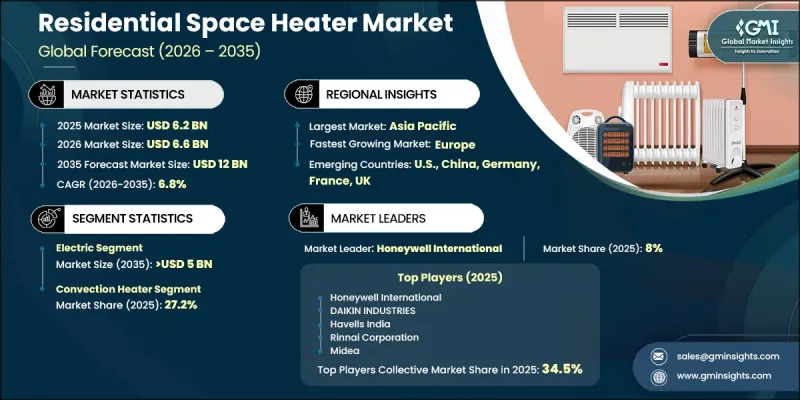
The market is witnessing steady growth due to increasing consumer demand for efficient and convenient indoor heating solutions. Rising urbanization, expanding residential construction activities, and growing awareness regarding energy-saving home appliances are contributing to higher product adoption. Improving household living standards and increasing focus on indoor comfort are further supporting market development. Consumers are increasingly seeking heating solutions that provide flexibility, lower operating costs, and improved energy performance. Technological advancements, including smart connectivity, enhanced safety features, and automated controls, are transforming residential space heaters into more efficient and user-friendly appliances. The growing preference for home automation, combined with rising environmental awareness and the need for cost-effective heating alternatives, is expected to create additional opportunities for the residential space heater industry during the forecast period.
| Market Scope | |
|---|---|
| Start Year | 2025 |
| Forecast Year | 2026-2035 |
| Start Value | $6.2 Billion |
| Forecast Value | $12 Billion |
| CAGR | 6.8% |
Residential space heaters are compact heating devices designed to deliver warmth to selected areas within homes. These products are commonly used as supplementary heating solutions alongside existing heating systems or for maintaining comfortable temperatures in specific residential spaces. Modern space heaters have evolved with advanced safety technologies, including automatic shut-off functions, protection against overheating, and stability controls to improve user safety. Increasing consumer focus on environmental sustainability and energy conservation is encouraging demand for advanced heating products. Market growth is further supported by population expansion and the integration of smart technologies into residential appliances. Features such as remote operation, adjustable heating schedules, programmable temperature controls, and compatibility with connected home ecosystems are increasing product adoption. Additionally, rising interest in automated homes and environmentally responsible solutions is strengthening the market outlook.
The electric residential space heater market is expected to reach USD 5 billion by 2035. Increasing attention toward energy-efficient heating solutions, sustainability goals, and the affordability of electricity-based heating systems is creating favorable market conditions. Electric space heaters are gaining popularity due to features such as programmable thermostats, remote-control functionality, and improved safety designs. The growing transition toward renewable energy sources, along with increasing household purchasing power, is expected to further support industry expansion. Consumers are increasingly selecting electric heating products that combine convenience, efficiency, and reduced environmental impact.
The convection heater segment accounted for a 27.2% share in 2025. Convection heaters are becoming increasingly preferred across apartments, independent homes, and residential communities because they provide consistent indoor heating while operating with minimal noise. Growing urban development, increased use of supplemental heating devices, and rising emphasis on improving residential comfort levels are driving demand for convection heating systems. Their ability to maintain balanced room temperatures continues to support their adoption among residential users.
U.S. Residential Space Heater Market was valued at USD 1,035.1 million in 2025. Increasing demand for compact, portable, and convenient heating devices, combined with changing household structures, is supporting market growth. Continuous technological advancements are leading to the introduction of more efficient and environmentally conscious heating solutions, including electric and infrared-based models. These developments are attracting consumers who prioritize energy efficiency and sustainability, creating significant opportunities for industry expansion in the United States.
Major players operating in the global residential space heater industry are Dyson, Honeywell, Midea, Lasko Products, Vornado Air, DAIKIN INDUSTRIES, Rinnai Corporation, Duraflame, Inc., Sunbeam Products, Inc., Havells India, Twin Star Home, Dr. Infrared Heater, Mill, OPOLAR, Optimus Enterprise, Inc., SUNHEAT International, Energy Wise Solutions, Crane - USA, ComDomus, and Wayfair. Companies operating in the residential space heater market are adopting strategies focused on product innovation, smart technology integration, energy efficiency improvements, and expansion of distribution networks to strengthen their market position. Manufacturers are developing advanced heating solutions with improved safety features, connected controls, and enhanced performance to meet changing consumer preferences. Businesses are also investing in research and development to introduce environmentally friendly products with lower energy consumption. Strategic partnerships, broader retail presence, and stronger online distribution channels are helping companies reach a wider customer base. Market participants are emphasizing customized solutions, improved designs, and competitive pricing to increase adoption.
Table of Contents
Chapter 1 Methodology & Scope
- 1.1 Research approach
- 1.2 Quality commitments
- 1.2.1 GMI AI policy & data integrity commitment
- 1.2.1.1 Source consistency protocol
- 1.2.1 GMI AI policy & data integrity commitment
- 1.3 Research trail & confidence scoring
- 1.3.1 Research trail components
- 1.3.2 Scoring components
- 1.4 Data collection
- 1.4.1 Partial list of primary sources
- 1.5 Data mining sources
- 1.5.1 Paid sources
- 1.5.1.1 Sources, by region
- 1.5.1 Paid sources
- 1.6 Base estimates and calculations
- 1.6.1 Base year calculation for any one approach
- 1.7 Market estimates & forecasts parameters
- 1.8 Forecast model
- 1.8.1 Quantified market impact analysis
- 1.8.1.1 Mathematical impact of growth parameters on forecast
- 1.8.1 Quantified market impact analysis
- 1.9 Research transparency addendum
- 1.9.1 Source attribution framework
- 1.9.2 Quality assurance metrics
- 1.9.3 Our commitment to trust
- 1.10 Market definitions
Chapter 2 Executive Summary
- 2.1 Industry synopsis, 2022 - 2035
- 2.1.1 Business trends
- 2.1.2 Product trends
- 2.1.3 Technology trends
- 2.1.4 Energy source trends
- 2.1.5 Regional trends
Chapter 3 Industry Insights
- 3.1 Industry ecosystem analysis
- 3.1.1 Raw material availability & sourcing analysis
- 3.1.2 Manufacturing capacity assessment
- 3.1.3 Supply chain resilience & risk factors
- 3.1.4 Distribution network analysis
- 3.2 Industry impact forces
- 3.2.1 Growth drivers
- 3.2.2 Industry pitfalls & challenges
- 3.3 Regulatory landscape
- 3.4 Growth potential analysis
- 3.5 Porter's analysis
- 3.5.1 Bargaining power of suppliers
- 3.5.2 Bargaining power of buyers
- 3.5.3 Threat of new entrants
- 3.5.4 Threat of substitutes
- 3.6 PESTEL analysis
- 3.6.1 Political factors
- 3.6.2 Economic factors
- 3.6.3 Social factors
- 3.6.4 Technological factors
- 3.6.5 Legal factors
- 3.6.6 Environmental factors
- 3.7 Cost structure analysis of residential space heater
- 3.8 Emerging opportunities & trends
- 3.9 Digitalization & IoT integration
- 3.10 Investment analysis & future prospects
- 3.11 Price trend analysis (USD/Unit) (Driven by Primary Research)
- 3.11.1 By region (Driven by Primary Research)
- 3.11.2 By product (Driven by Primary Research)
- 3.12 Impact of AI & Generative AI on the market (Driven by Primary Research)
- 3.12.1 AI-Driven production optimization (Driven by Primary Research)
- 3.12.2 Predictive maintenance & fault detection (Driven by Primary Research)
Chapter 4 Competitive Landscape, 2026
- 4.1 Introduction
- 4.2 Company market share analysis, by region, 2025
- 4.2.1 North America
- 4.2.2 Europe
- 4.2.3 Asia Pacific
- 4.2.4 Middle East & Africa
- 4.2.5 Latin America
- 4.3 Competitive analysis of major market players
- 4.4 Competitive positioning matrix
- 4.5 Key developments
- 4.5.1 Mergers & acquisitions
- 4.5.2 Partnerships & collaborations
- 4.5.3 New product launches
- 4.5.4 Expansion plans & funding
- 4.6 Company tier benchmarking
- 4.6.1 Tier classification criteria & qualifying thresholds
- 4.6.2 Tier positioning matrix by revenue, geography & innovation
Chapter 5 Market Size and Forecast, By Product, 2022 - 2035 (USD Million & '000 Units)
- 5.1 Key trends
- 5.2 Convection heater
- 5.3 Ceramic heater
- 5.4 Radiant & infrared heater
- 5.5 Fan heater
- 5.6 Oil filled heater
- 5.7 Others
Chapter 6 Market Size and Forecast, By Technology, 2022 - 2035 (USD Million & '000 Units)
- 6.1 Key trends
- 6.2 Portable
- 6.3 Surface-mounted
Chapter 7 Market Size and Forecast, By Energy Source, 2022 - 2035 (USD Million & '000 Units)
- 7.1 Key trends
- 7.2 Electric
- 7.3 Gas
Chapter 8 Market Size and Forecast, By Region, 2022 - 2035 (USD Million & '000 Units)
- 8.1 Key trends
- 8.2 North America
- 8.2.1 U.S.
- 8.2.2 Canada
- 8.2.3 Mexico
- 8.3 Europe
- 8.3.1 Germany
- 8.3.2 Italy
- 8.3.3 France
- 8.3.4 Netherlands
- 8.3.5 Spain
- 8.3.6 Norway
- 8.3.7 UK
- 8.3.8 Sweden
- 8.4 Asia Pacific
- 8.4.1 China
- 8.4.2 Japan
- 8.4.3 India
- 8.4.4 Australia
- 8.4.5 South Korea
- 8.4.6 Thailand
- 8.4.7 Singapore
- 8.4.8 Malaysia
- 8.4.9 Philippines
- 8.4.10 Vietnam
- 8.4.11 Indonesia
- 8.5 Middle East & Africa
- 8.5.1 Saudi Arabia
- 8.5.2 UAE
- 8.5.3 Iran
- 8.5.4 Iraq
- 8.5.5 Turkey
- 8.5.6 South Africa
- 8.6 Latin America
- 8.6.1 Brazil
- 8.6.2 Chile
- 8.6.3 Argentina
Chapter 9 Company Profiles
- 9.1 ComDomus
- 9.2 Crane - USA
- 9.3 DAIKIN INDUSTRIES
- 9.4 Dr. Infrared Heater
- 9.5 Duraflame, Inc.
- 9.6 Dyson
- 9.7 Energy Wise Solutions
- 9.8 Havells India
- 9.9 Honeywell
- 9.10 Lasko Products
- 9.11 Midea
- 9.12 Mill
- 9.13 OPOLAR
- 9.14 Optimus Enterprise, Inc.
- 9.15 Rinnai Corporation
- 9.16 Sunbeam Products, Inc.
- 9.17 SUNHEAT International
- 9.18 Twin Star Home
- 9.19 Vornado Air
- 9.20 Wayfair

