PUBLISHER: Global Market Insights Inc. | PRODUCT CODE: 2109276

PUBLISHER: Global Market Insights Inc. | PRODUCT CODE: 2109276
Computer Microchips Market Opportunity, Growth Drivers, Industry Trend Analysis, and Forecast 2026 - 2035
The Global Computer Microchips Market was valued at USD 30.7 billion in 2025 and is estimated to grow at a CAGR of 10.7% to reach USD 84.7 billion by 2035.
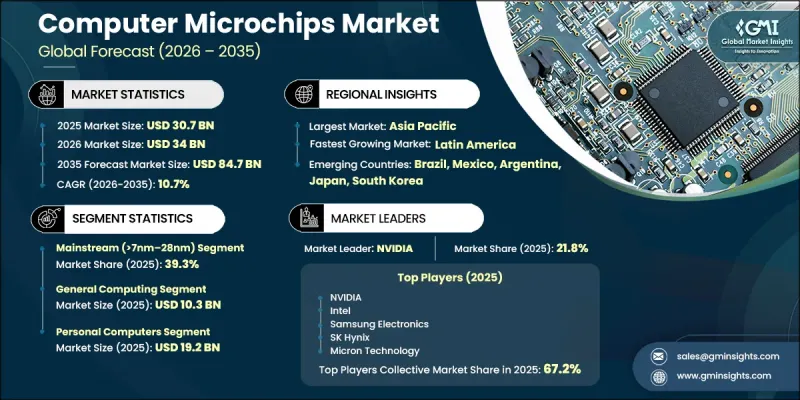
The market is expanding rapidly as demand for advanced computing technologies continues to increase across multiple industries. Rising investments in artificial intelligence infrastructure, expanding hyperscale data center capacity, supportive semiconductor manufacturing policies, and growing semiconductor content in next-generation vehicles are creating significant growth opportunities. Continuous advancements in semiconductor manufacturing technologies are also improving chip performance, power efficiency, and processing capabilities, further supporting market expansion. Businesses are increasing investments in advanced computing platforms to meet the growing need for high-performance processing, while governments continue to encourage domestic semiconductor production through strategic initiatives that strengthen manufacturing capacity and supply chain resilience. At the same time, increasing adoption of cloud computing, data-intensive applications, and digital transformation initiatives is driving sustained demand for advanced microchips. These combined factors are reinforcing the long-term outlook for the computer microchips industry, positioning it as a critical component of the global technology ecosystem over the forecast period.
| Market Scope | |
|---|---|
| Start Year | 2025 |
| Forecast Year | 2026-2035 |
| Start Value | $30.7 Billion |
| Forecast Value | $84.7 Billion |
| CAGR | 10.7% |
The computer microchips market continues to gain momentum as organizations accelerate investments in artificial intelligence, cloud computing, and high-performance computing infrastructure. Growing computational workloads are encouraging semiconductor manufacturers to expand production capacity in response to increasing demand from enterprise technology providers and advanced computing platforms. Continued investment in domestic semiconductor manufacturing, research capabilities, workforce development, and supply chain resilience is further strengthening industry growth. Public and private sector initiatives aimed at expanding fabrication capacity and advancing semiconductor innovation are supporting long-term market development while improving the availability of advanced computing technologies across global industries.
The mainstream (>7nm-28nm) segment accounted for 39.3% share in 2025. Demand for these semiconductor technologies continues to grow across industrial automation, automotive electronics, consumer devices, enterprise systems, and edge computing applications. Ongoing investments in established wafer manufacturing facilities and increasing semiconductor adoption across a broad range of electronic products are supporting continued expansion of this segment. Growing demand for reliable, cost-effective semiconductor solutions is expected to maintain strong market momentum throughout the forecast period.
The personal computers segment reached USD 19.2 billion in 2025. Demand remains strong as advanced microprocessors continue to power desktops, laptops, notebooks, and commercial computing systems worldwide. Ongoing device replacement cycles, rising adoption of productivity software, expanding digital learning environments, and the continued shift toward hybrid work models are supporting sustained demand for personal computing devices. These trends continue to reinforce the importance of semiconductor technologies within the personal computer segment and are expected to drive further market growth over the coming years.
North America Computer Microchips Market accounted for a 27.7% share in 2025, supported by increasing investments in artificial intelligence, high-performance computing, cloud infrastructure, and advanced server technologies. Government initiatives that encourage semiconductor manufacturing and strengthen domestic production capabilities are further accelerating market expansion. Rising investment in digital transformation projects, expanding enterprise cloud adoption, and increasing demand for advanced processors, graphics processing technologies, and artificial intelligence accelerators continue to support strong regional growth.
Prominent companies operating in the global computer microchips market include Altera Corporation, AMD, Broadcom Inc., Cerebras Systems, Groq, Infineon Technologies, Intel Corporation, Kioxia Holdings, Lattice Semiconductor, Marvell Technology, MediaTek, Micron Technology, NVIDIA Corporation, Qualcomm, Samsung Electronics, SiFive, SK Hynix, STMicroelectronics, Tenstorrent, and Texas Instruments. Companies operating in the computer microchips market are strengthening their competitive position through continuous investment in advanced semiconductor technologies, manufacturing capacity expansion, and product innovation. Industry participants are increasing research and development efforts to improve chip performance, energy efficiency, and processing capabilities while supporting next-generation computing applications. Strategic collaborations with cloud service providers, enterprise technology companies, and automotive manufacturers are helping expand market opportunities and accelerate product commercialization. Many companies are also investing in advanced fabrication facilities, supply chain resilience, and packaging technologies to improve production efficiency and address growing global demand.
Table of Contents
Chapter 1 Methodology and Scope
- 1.1 Market scope and definition
- 1.2 Research design
- 1.2.1 Research approach
- 1.2.2 Data collection methods
- 1.3 Data mining sources
- 1.3.1 Global
- 1.3.2 Regional/Country
- 1.4 Base estimates and calculations
- 1.4.1 Base year calculation
- 1.4.2 Key trends for market estimation
- 1.5 Primary research and validation
- 1.5.1 Primary sources
- 1.6 Forecast model
- 1.7 Research assumptions and limitations
Chapter 2 Executive Summary
- 2.1 Industry 360° synopsis, 2022 – 2035
- 2.2 Key market trends
- 2.2.1 Chip type trends
- 2.2.2 Instruction set architecture (ISA) trends
- 2.2.3 Technology node trends
- 2.2.4 Application trends
- 2.2.5 End-use platform trends
- 2.2.6 Regional trends
- 2.3 TAM Analysis, 2026-2035
- 2.4 CXO perspectives: Strategic imperatives
Chapter 3 Industry Insights
- 3.1 Industry ecosystem analysis
- 3.1.1 Supplier Landscape
- 3.1.2 Profit Margin
- 3.1.3 Cost structure
- 3.1.4 Value addition at each stage
- 3.1.5 Factor affecting the value chain
- 3.1.6 Disruptions
- 3.2 Industry impact forces
- 3.2.1 Growth drivers
- 3.2.1.1 Rising AI and High-Performance Computing (HPC) chip demand
- 3.2.1.2 Government semiconductor manufacturing incentive programs (CHIPS Acts and national semiconductor policies)
- 3.2.1.3 Rapid expansion of cloud data centers and hyperscale infrastructure
- 3.2.1.4 Growing automotive semiconductor demand driven by EVs and ADAS
- 3.2.1.5 Increasing adoption of advanced manufacturing nodes and chiplet/advanced packaging technologies
- 3.2.2 Industry pitfalls and challenges
- 3.2.2.1 High capital investment and fabrication costs
- 3.2.2.2 Geopolitical tensions and semiconductor supply chain disruptions
- 3.2.3 Market opportunities
- 3.2.3.1 Expansion of AI-specific chips and edge AI computing
- 3.2.3.2 Advanced packaging, chiplets, and heterogeneous integration
- 3.2.1 Growth drivers
- 3.3 Growth potential analysis
- 3.4 Regulatory landscape
- 3.4.1 North America
- 3.4.2 Europe
- 3.4.3 Asia Pacific
- 3.4.4 Latin America
- 3.4.5 Middle East & Africa
- 3.5 Porter’s analysis
- 3.6 PESTEL analysis
- 3.7 Technology and Innovation landscape
- 3.7.1 Current technological trends
- 3.7.2 Emerging technologies
- 3.8 Price trends
- 3.8.1 By region
- 3.8.2 By product
- 3.9 Pricing Strategies
- 3.10 Emerging Business Models
- 3.11 Compliance Requirements
- 3.12 Patent and IP analysis
Chapter 4 Competitive Landscape, 2025
- 4.1 Introduction
- 4.2 Company market share analysis
- 4.2.1 By region
- 4.2.1.1 North America
- 4.2.1.2 Europe
- 4.2.1.3 Asia Pacific
- 4.2.1.4 Latin America
- 4.2.1.5 Middle East & Africa
- 4.2.2 Market concentration analysis
- 4.2.1 By region
- 4.3 Competitive benchmarking of key players
- 4.3.1 Financial performance comparison
- 4.3.1.1 Revenue
- 4.3.1.2 Profit margin
- 4.3.1.3 R&D
- 4.3.2 Product portfolio comparison
- 4.3.2.1 Product range breadth
- 4.3.2.2 Technology
- 4.3.2.3 Innovation
- 4.3.3 Geographic presence comparison
- 4.3.3.1 Global footprint analysis
- 4.3.3.2 Service network coverage
- 4.3.3.3 Market penetration by region
- 4.3.4 Competitive positioning matrix
- 4.3.4.1 Leaders
- 4.3.4.2 Challengers
- 4.3.4.3 Followers
- 4.3.4.4 Niche players
- 4.3.5 Strategic outlook matrix
- 4.3.1 Financial performance comparison
- 4.4 Key developments
- 4.4.1 Mergers and acquisitions
- 4.4.2 Partnerships and collaborations
- 4.4.3 Technological advancements
- 4.4.4 Expansion and investment strategies
- 4.4.5 Digital transformation initiatives
- 4.5 Emerging/ startup competitors landscape
Chapter 5 Market Estimates and Forecast, By Chip Type, 2022 – 2035 (USD Million)
- 5.1 Key trends
- 5.2 Central processing units (CPUs)
- 5.3 Graphics processing units (GPUs)
- 5.4 Memory ICs
- 5.5 FPGAs (Field-Programmable Gate Arrays)
- 5.6 ASICs (Application-Specific Integrated Circuits)
- 5.7 SoCs & Chipsets
- 5.8 Others
Chapter 6 Market Estimates and Forecast, By Instruction Set Architecture (ISA), 2022 – 2035 (USD Million)
- 6.1 Key trends
- 6.2 x86 / x86-64
- 6.3 ARM (Advanced RISC Machine)
- 6.4 RISC-V
- 6.5 Others
Chapter 7 Market Estimates and Forecast, By Technology Node, 2022 – 2035 (USD Million)
- 7.1 Key trends
- 7.2 Advanced (≤7nm)
- 7.3 Mainstream (>7nm–28nm)
- 7.4 Mature & legacy (>28nm)
Chapter 8 Market Estimates and Forecast, By Application, 2022 – 2035 (USD Million)
- 8.1 Key trends
- 8.2 General Computing
- 8.3 Gaming & Content Creation
- 8.4 AI & Machine Learning
- 8.5 Edge & Embedded Computing
- 8.6 Data Center & Cloud Infrastructure
- 8.7 HPC & Scientific Research
Chapter 9 Market Estimates and Forecast, By End-Use Platform, 2022 – 2035 (USD Million)
- 9.1 Key trends
- 9.2 Personal computers
- 9.3 Servers & data centers
- 9.4 Embedded computing systems
- 9.5 Others
Chapter 10 Market Estimates and Forecast, By Region, 2022 – 2035 (USD Million)
- 10.1 Key trends
- 10.2 North America
- 10.2.1 U.S.
- 10.2.2 Canada
- 10.3 Europe
- 10.3.1 Germany
- 10.3.2 UK
- 10.3.3 France
- 10.3.4 Spain
- 10.3.5 Italy
- 10.3.6 Russia
- 10.4 Asia Pacific
- 10.4.1 China
- 10.4.2 India
- 10.4.3 Japan
- 10.4.4 Australia
- 10.4.5 South Korea
- 10.4.6 Taiwan
- 10.5 Latin America
- 10.5.1 Brazil
- 10.5.2 Mexico
- 10.5.3 Argentina
- 10.6 Middle East and Africa
- 10.6.1 South Africa
- 10.6.2 Saudi Arabia
- 10.6.3 UAE
Chapter 11 Company Profiles
- 11.1 Global Key Players
- 11.1.1 NVIDIA
- 11.1.2 Intel
- 11.1.3 Samsung Electronics
- 11.1.4 SK Hynix
- 11.1.5 Micron Technology
- 11.2 Regional key players
- 11.2.1 North America
- 11.2.1.1 AMD
- 11.2.1.2 Broadcom Inc.
- 11.2.1.3 Qualcomm
- 11.2.1.4 Texas Instruments
- 11.2.1.5 Marvell Technology
- 11.2.2 Asia Pacific
- 11.2.2.1 MediaTek
- 11.2.2.2 Kioxia Holdings
- 11.2.3 Europe
- 11.2.3.1 STMicroelectronics
- 11.2.3.2 Infineon Technologies
- 11.2.1 North America
- 11.3 Niche Players/Disruptors
- 11.3.1 Altera Corporation
- 11.3.2 SiFive
- 11.3.3 Tenstorrent
- 11.3.4 Cerebras Systems
- 11.3.5 Groq
- 11.3.6 Lattice Semiconductor

