PUBLISHER: Global Market Insights Inc. | PRODUCT CODE: 2109279

PUBLISHER: Global Market Insights Inc. | PRODUCT CODE: 2109279
Baler Market Opportunity, Growth Drivers, Industry Trend Analysis, and Forecast 2026 - 2035
The Global Baler Market was valued at USD 4.9 billion in 2025 and is estimated to grow at a CAGR of 5.2% to reach USD 8.4 billion by 2035.
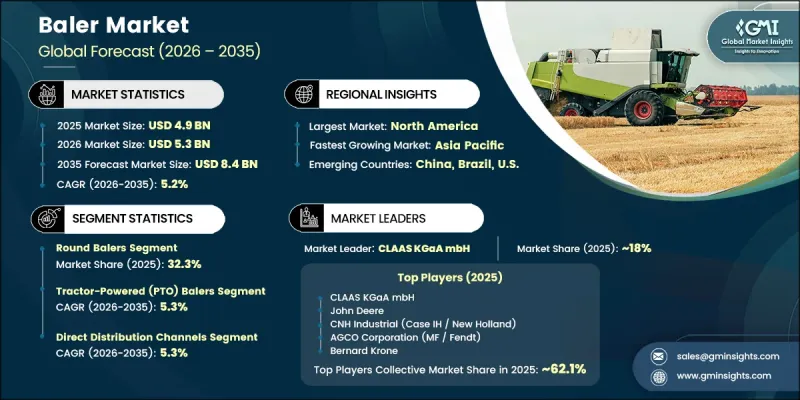
Market growth is driven by rising demand from agricultural mechanization, industrial waste management, and biomass handling applications across both developed and emerging economies. The industry is supported by two primary demand streams: agricultural operations requiring efficient baling of forage and crop residue, and recycling and waste management facilities seeking effective material compaction solutions. Increasing labor shortages in rural areas, driven by demographic changes and ongoing urban migration, are encouraging farmers to replace labor-intensive baling practices with mechanized equipment. The expansion of average farm sizes, particularly across developed agricultural regions, continues to strengthen the economic advantages of investing in baling equipment. Rising labor costs, combined with the need to improve operational productivity, are prompting farms of various sizes to adopt advanced balers that enhance efficiency, reduce dependence on manual labor, and optimize crop handling. This trend is steadily expanding the addressable market beyond large commercial farms to include mid-sized agricultural operations focused on improving productivity through equipment modernization.
| Market Scope | |
|---|---|
| Start Year | 2025 |
| Forecast Year | 2026-2035 |
| Start Value | $4.9 Billion |
| Forecast Value | $8.4 Billion |
| CAGR | 5.2% |
The round baler segment accounted for 32.3% share in 2025 and is anticipated to grow at a CAGR of 5.2% through 2035. Round balers remain the preferred choice for handling hay, straw, and silage because they offer versatility across multiple crop types, competitive acquisition costs, and compatibility with a wide range of tractor power capacities. Variable-chamber round balers continue to gain wider adoption due to their operational flexibility and ability to produce bales of different sizes, while fixed-chamber models remain popular among cost-conscious users seeking dependable performance for routine agricultural applications.
The tractor-powered power take-off (PTO) balers segment held 54.3% share in 2025. Their strong market position is supported by the widespread use of tractors as the primary power source for agricultural equipment. Compatibility with standardized 540 rpm and 1,000 rpm PTO systems allows these balers to integrate easily with existing tractor fleets, making them a practical and efficient solution for mechanized farming operations across both established and developing agricultural markets.
North America Baler Market held 32.9% share, and is expected to grow at a CAGR of 5% between 2026 and 2035. The region benefits from large-scale commercial farming operations, well-developed agricultural equipment financing programs, and a consistent replacement cycle for farm machinery. Continued consolidation of farming operations and increasing demand for efficient forage and crop residue management solutions are supporting steady investment in advanced baling equipment throughout the region.
The competitive landscape of the baler market includes companies such as John Deere, AGCO Corporation (Massey Ferguson / Hesston / Fendt), CLAAS KGaA mbH, Vermeer Corporation, CNH Industrial (Case IH / New Holland), Kuhn Group, Kubota Corporation, Bernard Krone (Krone Group), Lely Industries, Harris Equipment, International Baler Corporation (IBC), Orkel AS, HSM GmbH + Co. KG, Pottinger Landtechnik GmbH, and several regional manufacturers. Companies operating in the baler market are focusing on product innovation, technological advancements, and geographic expansion to strengthen their competitive positions. Leading manufacturers are investing in automation, precision farming integration, and smart monitoring technologies to improve machine productivity and operational efficiency. Businesses are expanding their distribution networks, enhancing after-sales service capabilities, and introducing fuel-efficient, high-performance balers to meet changing customer requirements. Strategic partnerships with dealers, agricultural equipment suppliers, and industrial waste management companies are helping expand market reach. Companies are also increasing investments in research and development, manufacturing capacity, and digital service platforms while offering customized equipment solutions to improve customer satisfaction, strengthen brand loyalty, and support long-term growth across global agricultural and industrial markets.
Table of Contents
Chapter 1 Methodology and Scope
- 1.1 Market scope and definition
- 1.2 Research design
- 1.2.1 Research approach
- 1.2.2 Data collection methods
- 1.3 Data mining sources
- 1.3.1 Global
- 1.3.2 Regional/Country
- 1.4 Base estimates and calculations
- 1.4.1 Base year calculation
- 1.4.2 Key trends for market estimation
- 1.5 Primary research and validation
- 1.5.1 Primary sources
- 1.6 Forecast model
- 1.7 Research assumptions and limitations
Chapter 2 Executive Summary
- 2.1 Industry 360° synopsis
- 2.2 Key market trends
- 2.2.1 Regional
- 2.2.2 Baler type
- 2.2.3 Power source
- 2.2.4 Application
- 2.2.5 Distribution channel
Chapter 3 Industry Insights
- 3.1 Industry ecosystem analysis
- 3.1.1 Raw material & component suppliers
- 3.1.2 OEM manufacturers
- 3.1.3 Dealers, distributors & rental networks
- 3.1.4 End-users & after-sales service providers
- 3.1.5 Value chain margin analysis by node
- 3.1.6 Profit margin
- 3.1.7 Value addition at each stage
- 3.1.8 Factor affecting the value chain
- 3.2 Industry impact forces
- 3.2.1 Growth drivers
- 3.2.1.1 Rising agricultural mechanization & labor cost inflation driving baler adoption
- 3.2.1.2 Tightening waste management regulations accelerating recycling baler demand
- 3.2.1.3 Growth in bioenergy & renewable feedstock baling creating new application demand
- 3.2.2 Pitfalls & Challenges
- 3.2.2.1 High initial capital expenditure limiting adoption among small & marginal farmers
- 3.2.2.2 Seasonal demand fluctuations & crop cycle dependence creating revenue volatility
- 3.2.3 Opportunities
- 3.2.4 IoT-enabled smart balers predictive maintenance & remote monitoring premium segment
- 3.2.5 Electrification of baling equipment aligned with farm decarbonization mandates
- 3.2.1 Growth drivers
- 3.3 Growth potential analysis
- 3.4 Technology and innovation landscape
- 3.4.1 Fixed-chamber vs. Variable-chamber baling technology
- 3.4.2 Automation & precision baling systems
- 3.4.3 Iot integration & telematics in modern balers
- 3.4.4 Emerging technologies electric & autonomous balers
- 3.5 Regulatory framework
- 3.5.1 EPA Tier 4 final emissions standards (North America)
- 3.5.2 EU Stage V engine emissions regulations (Europe)
- 3.5.3 Waste management & recycling mandates by region
- 3.5.4 Farm mechanization incentive programs & subsidies
- 3.6 Pricing analysis (driven by primary research)
- 3.6.1 Historical price trend analysis by product category
- 3.6.2 Pricing strategy by player type (premium / value / cost-plus)
- 3.7 Supply chain analysis
- 3.7.1 Key raw materials
- 3.7.2 Supplier concentration & single-source dependency risks
- 3.7.3 Semiconductor shortage impact on baler production timelines
- 3.7.4 Nearshoring & supply chain resilience strategies
- 3.8 Trade data analysis (driven by paid database) (HS code- 8479899565)
- 3.8.1 Import/export volume & value trends by product category
- 3.8.2 Key trade corridors & tariff impact
- 3.9 Impact of AI & generative AI on the market
- 3.9.1 AI-driven disruption of existing business models
- 3.9.2 GenAI use cases & adoption roadmap by segment
- 3.9.3 Risks, limitations & regulatory considerations
- 3.10 Capacity & production landscape (driven by primary research)
- 3.10.1 Installed manufacturing capacity by region & key OEM producer (driven by primary research)
- 3.10.2 Capacity utilization rates & expansion pipelines among top baler manufacturers (driven by primary research)
Chapter 4 Competitive Landscape, 2025
- 4.1 Introduction
- 4.2 Company market share analysis
- 4.2.1 By region
- 4.2.1.1 North America
- 4.2.1.2 Europe
- 4.2.1.3 Asia Pacific
- 4.2.1.4 Latin America
- 4.2.1.5 Middle East and Africa
- 4.2.1 By region
- 4.3 Company matrix analysis
- 4.4 Competitive analysis of major market players
- 4.5 Competitive positioning matrix
- 4.6 Key developments
- 4.6.1 Mergers & acquisitions
- 4.6.2 Partnerships & collaborations
- 4.6.3 New product launches
- 4.6.4 Expansion plans
Chapter 5 Market Estimates and Forecast, By Baler Type, 2022 - 2035 (USD Billion) (Thousand Units)
- 5.1 Key trends
- 5.2 Round balers
- 5.2.1 Fixed-chamber round balers
- 5.2.2 Variable-chamber round balers
- 5.2.3 Mini round balers
- 5.3 Square balers
- 5.3.1 Small square balers
- 5.3.2 Large square balers
- 5.4 Horizontal balers
- 5.4.1 Single-ram horizontal balers
- 5.4.2 Two-ram horizontal balers
- 5.4.3 Continuous/closed-door horizontal balers
- 5.5 Vertical balers
- 5.5.1 Low-density vertical balers
- 5.5.2 High-density vertical balers
- 5.6 Specialty balers
- 5.6.1 Cotton balers
- 5.6.2 Silage balers
- 5.6.3 Hemp & biomass balers
- 5.7 Others
Chapter 6 Market Estimates and Forecast, By Power Source, 2022 - 2035 (USD Billion) (Thousand Units)
- 6.1 Key trends
- 6.2 Tractor-powered (PTO-driven) balers
- 6.2.1 Below 100 HP tractor-compatible balers
- 6.2.2 Above 100 HP tractor-compatible balers
- 6.3 Self-propelled balers
- 6.4 Electric/hydraulic balers
- 6.4.1 Fully electric balers
- 6.4.2 Hydraulic-powered stationary balers
- 6.5 Others
Chapter 7 Market Estimates and Forecast, By Application, 2022 - 2035 (USD Billion) (Thousand Units)
- 7.1 Key trends
- 7.2 Agriculture
- 7.2.1 Hay & forage baling
- 7.2.2 Straw & crop residue baling
- 7.2.3 Cotton baling
- 7.2.4 Silage & bioenergy feedstock baling
- 7.3 Recycling & waste management
- 7.3.1 Cardboard & OCC (old corrugated containers)
- 7.3.2 Plastics baling
- 7.3.3 Metal scrap baling
- 7.3.4 Mixed solid waste baling
- 7.4 Retail & distribution
- 7.4.1 Supermarkets & big-box retail
- 7.4.2 Warehousing & fulfillment centers
- 7.5 Industrial manufacturing
- 7.5.1 Textile & apparel waste baling
- 7.5.2 Rubber & foam baling
- 7.5.3 Paper & pulp industry baling
- 7.6 Others
Chapter 8 Market Estimates and Forecast, By Distribution Channel, 2022 - 2035 (USD Billion) (Thousand Units)
- 8.1 Key trends
- 8.2 Direct
- 8.3 Indirect
Chapter 9 Market Estimates and Forecast, By Region, 2022 - 2035 (USD Billion) (Thousand Units)
- 9.1 Key trends
- 9.2 North America
- 9.2.1 U.S.
- 9.2.2 Canada
- 9.3 Europe
- 9.3.1 Germany
- 9.3.2 UK
- 9.3.3 France
- 9.3.4 Italy
- 9.3.5 Spain
- 9.4 Asia Pacific
- 9.4.1 China
- 9.4.2 Japan
- 9.4.3 India
- 9.4.4 Australia
- 9.4.5 South Korea
- 9.5 Latin America
- 9.5.1 Brazil
- 9.5.2 Mexico
- 9.5.3 Argentina
- 9.6 Middle East and Africa
- 9.6.1 South Africa
- 9.6.2 Saudi Arabia
- 9.6.3 UAE
Chapter 10 Company Profiles
- 10.1 Global players
- 10.1.1 John Deere
- 10.1.2 CLAAS
- 10.1.3 CNH (Case IH / NH)
- 10.1.4 AGCO (MF / Fendt)
- 10.1.5 Bernard Krone
- 10.1.6 Vermeer
- 10.1.7 Kuhn Group
- 10.1.8 Kubota
- 10.1.9 McHale Engineering
- 10.1.10 Zoomlion
- 10.1.11 Foton Lovol
- 10.1.12 Bollegraaf
- 10.2 Regional players
- 10.2.1 Harris American
- 10.2.2 HSM GmbH
- 10.2.3 Orkel AS
- 10.2.4 Bramidan A/S
- 10.2.5 Minos Agri
- 10.3 Emerging players
- 10.3.1 Abbriata Srl
- 10.3.2 IHI Star Machinery
- 10.3.3 Goweil Maschinenbau
- 10.3.4 Brantner / SITREX

