PUBLISHER: Global Market Insights Inc. | PRODUCT CODE: 2109281

PUBLISHER: Global Market Insights Inc. | PRODUCT CODE: 2109281
Towel Market Opportunity, Growth Drivers, Industry Trend Analysis, and Forecast 2026 - 2035
The Global Towel Market was valued at USD 19.5 billion in 2025 and is estimated to grow at a CAGR of 5% to reach USD 31.4 billion by 2035.
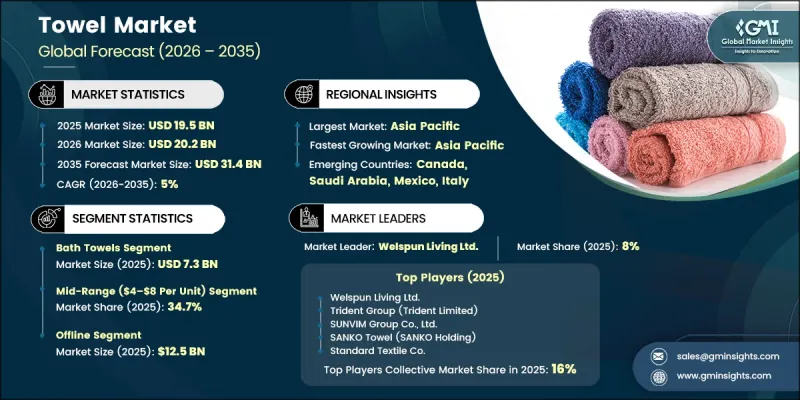
The market continues to grow as increasing awareness of personal hygiene, ongoing growth in the hospitality sector, and rising demand for sustainable textile products support long-term industry development. Market growth is being fueled by two major trends. Emerging economies are witnessing higher towel ownership as disposable incomes continue to improve, while developed markets are experiencing value-driven growth through consumer preference for premium-quality products. Consumers are increasingly choosing towels that offer superior durability, comfort, and enhanced performance, contributing to higher average selling prices across the industry. Continuous product innovation in sustainable materials, advanced fabric technologies, and improved functional characteristics is creating new growth opportunities while strengthening the premium segment. At the same time, sustainability has become a key purchasing consideration across both consumer and institutional markets, encouraging manufacturers to develop environmentally responsible products that meet evolving quality expectations. As consumer preferences continue to evolve, the Towel Market is becoming increasingly focused on product differentiation, premium quality, and sustainable manufacturing practices across retail and commercial distribution channels.
| Market Scope | |
|---|---|
| Start Year | 2025 |
| Forecast Year | 2026-2035 |
| Start Value | $19.5 Billion |
| Forecast Value | $31.4 Billion |
| CAGR | 5% |
The bath towels segment generated USD 7.3 billion in 2025. Its leading position is supported by consistent demand across residential, hospitality, and healthcare applications, with replacement purchases from households and ongoing commercial procurement contributing to stable market performance. Consumers are increasingly favoring premium-quality towels with enhanced softness, greater absorbency, and longer product life, further supporting growth within this segment.
The mid-range (USD 4-USD 8 per unit) segment accounted for 34.7% share in 2025, representing the largest pricing category. This segment continues to serve a broad customer base through mass-market retail channels while maintaining strong sales volumes. Although demand remains stable, manufacturers continue to face competitive pressure from lower-priced alternatives as well as increasing consumer migration toward premium product offerings.
United States Towel Market held an 82.1% share, generating USD 4.3 billion in 2025. The country's leadership is supported by strong consumer demand, a well-established hospitality and healthcare sector, and increasing adoption of premium and sustainably manufactured home textile products. Continued preference for high-quality towels and frequent replacement demand across commercial and residential applications are expected to sustain market growth throughout the forecast period.
Key companies operating in the global towel market include Welspun Living Ltd., Trident Group (Trident Limited), SANKO Towel (SANKO Holding), Standard Textile Co., 1888 Mills LLC, SUNVIM Group Co., Ltd., WestPoint Home (Bahrain), Sorema S.A., Noman Terry Towel Mills Ltd. (NTTML), Hursan Bath & Home (Hursan Havlu), Abyss & Habidecor (Celso de Lemos), Coyuchi Inc., Boll & Branch LLC, Nandan Terry Limited, and Mosobam LLC. Companies operating in the towel market are strengthening their market position by expanding premium product portfolios, investing in sustainable manufacturing processes, and introducing innovative textile technologies that enhance product quality and performance. Manufacturers are focusing on research and development to improve fabric durability, absorbency, softness, and environmental sustainability while meeting changing consumer preferences. Strategic partnerships with retailers, distributors, and institutional buyers are helping companies broaden their market reach and strengthen brand visibility. Businesses are also increasing production capacity, optimizing supply chain operations, and expanding their presence in high-growth regional markets.
Table of Contents
Chapter 1 Methodology and Scope
- 1.1 Market scope & definitions
- 1.2 Research design
- 1.2.1 Research approach
- 1.2.2 Data collection methods
- 1.3 Base estimates and calculations
- 1.3.1 Base year calculation
- 1.3.2 Market estimates & forecasts parameters
- 1.4 Forecast Model
- 1.4.1 Key trends for market estimates
- 1.4.2 Quantified market impact analysis
- 1.4.2.1 Mathematical impact of growth parameters on forecast
- 1.4.3 Scenario analysis framework
- 1.5 Primary research and validation
- 1.5.1 Some of the primary sources (but not limited to)
- 1.6 Data mining sources
- 1.6.1 Paid Sources
- 1.7 Primary research and validation
- 1.7.1 Primary sources
- 1.8 Research Trail & confidence scoring
- 1.8.1 Research trail components
- 1.8.2 Scoring components
- 1.9 Research transparency addendum
- 1.9.1 Source attribution framework
- 1.9.2 Quality assurance metrics
- 1.9.3 Our commitment to trust
Chapter 2 Executive Summary
- 2.1 Industry 360° synopsis
- 2.2 Key market trends
- 2.2.1 Regional
- 2.2.2 Product type
- 2.2.3 Fibre type
- 2.2.4 Price
- 2.2.5 End use
- 2.2.6 Distribution channel
Chapter 3 Industry Insights
- 3.1 Industry ecosystem analysis
- 3.1.1 Supplier landscape
- 3.1.2 Profit margin
- 3.1.3 Value addition at each stage
- 3.1.4 Factor affecting the value chain
- 3.2 Industry impact forces
- 3.2.1 Growth drivers
- 3.2.1.1 Growing hospitality and tourism industry
- 3.2.1.2 Rising consumer awareness about personal hygiene
- 3.2.1.3 Increasing demand for sustainable and eco-friendly products
- 3.2.2 Industry pitfalls & challenges
- 3.2.2.1 Volatility in raw material prices
- 3.2.2.2 High competition and market saturation
- 3.2.3 Opportunities
- 3.2.3.1 Eco-friendly product innovation
- 3.2.3.2 Premium & designer towels
- 3.2.1 Growth drivers
- 3.3 Growth potential analysis
- 3.4 Regulatory framework
- 3.4.1 Fiber content labeling requirements: US FTC regulations, EU textile labeling directives, Japan JIS standards
- 3.4.2 Eco-certification frameworks: GOTS, OEKO-TEX Standard 100, Bluesign, fair trade
- 3.4.3 US tariff structure on towel imports (HTS codes 6302.60) by origin country
- 3.4.4 EU import duties and preferential trade agreements for textile exporters
- 3.4.5 Consumer product safety regulations by major geography
- 3.4.6 Regulatory trends: extended producer responsibility for textiles in Europe
- 3.5 Pricing analysis (driven by primary research)
- 3.5.1 Historical price trend analysis (2022-2025)
- 3.5.2 Pricing strategy by player type (premium / value / cost-plus)
- 3.6 Trade data analysis (driven by paid database)
- 3.6.1 Import/export volume & value trends by product category
- 3.6.2 Key trade corridors & tariff impact on pet grooming products
- 3.7 Impact of AI & generative AI on the market
- 3.7.1 AI-driven disruption of existing business models
- 3.7.2 GenAI use cases & adoption roadmap by segment
- 3.7.3 Risks, limitations & regulatory considerations for AI in pet care
- 3.8 Distribution infrastructure & channel penetration landscape (driven by primary research)
- 3.8.1 Channel coverage by region & format (online vs. offline penetration rates)
- 3.8.2 Last-mile infrastructure gaps & emerging channel shifts
Chapter 4 Competitive Landscape, 2025
- 4.1 Introduction
- 4.2 Company market share analysis
- 4.2.1 By region
- 4.2.1.1 North America
- 4.2.1.2 Europe
- 4.2.1.3 Asia Pacific
- 4.2.1.4 Latin America
- 4.2.1.5 Middle East and Africa
- 4.2.1 By region
- 4.3 Company matrix analysis
- 4.4 Competitive analysis of major market players
- 4.5 Competitive positioning matrix
- 4.6 Key developments
- 4.6.1 Mergers & acquisitions
- 4.6.2 Partnerships & collaborations
- 4.6.3 New product launches
- 4.6.4 Expansion plans
Chapter 5 Market Estimates and Forecast, By Product Type, 2022 – 2035 (USD Billion) (Million Units)
- 5.1 Key trends
- 5.2 Bath towels
- 5.2.1 Standard bath towels
- 5.2.2 Premium/luxury bath towels
- 5.2.3 Quick-dry & performance bath towels
- 5.3 Face towels
- 5.4 Hand towels
- 5.5 Beach & pool towels
- 5.5.1 Standard beach towels
- 5.5.2 Oversized & lightweight travel towels
- 5.6 Sports & gym towels
- 5.6.1 Standard sports towels
- 5.6.2 Anti-microbial & quick-dry sports towels
- 5.7 Kitchen & household cleaning towels
- 5.8 Others (baby towels, hair towels, spa wraps)
Chapter 6 Market Estimates and Forecast, By Fiber Type, 2022 – 2035 (USD Billion) (Million Units)
- 6.1 Key trends
- 6.2 Cotton
- 6.3 Synthetic
- 6.4 Bamboo & bamboo-blended
- 6.5 Blended fibers
- 6.6 Others (linen, hemp, recycled PET)
Chapter 7 Market Estimates and Forecast, By Price, 2022 – 2035 (USD Billion) (Million Units)
- 7.1 Key trends
- 7.2 Premium (>$15 per unit)
- 7.3 Mid-Premium ($8–$15 per unit)
- 7.4 Mid-Range ($4–$8 per unit)
- 7.5 Economy / Value (<$4 per unit)
Chapter 8 Market Estimates and Forecast, By End Use, 2022 – 2035 (USD Billion) (Million Units)
- 8.1 Key trends
- 8.2 Residential / household
- 8.3 Hospitality
- 8.4 Healthcare & institutional
- 8.5 Spa, Wellness & fitness centers
- 8.6 Commercial laundry & linen rental services
Chapter 9 Market Estimates and Forecast, By Distribution Channel, 2022 – 2035 (USD Billion) (Million Units)
- 9.1 Key trends
- 9.2 Offline
- 9.2.1 Hypermarkets, supermarkets & general merchandise stores (GMS)
- 9.2.2 Specialty home & textile stores
- 9.2.3 Department stores
- 9.2.4 Convenience stores
- 9.2.5 Others
- 9.3 Online
- 9.3.1 E-commerce websites
- 9.3.2 Company websites
Chapter 10 Market Estimates and Forecast, By Region, 2022 – 2035 (USD Billion) (Million Units)
- 10.1 Key trends
- 10.2 North America
- 10.2.1 U.S.
- 10.2.2 Canada
- 10.3 Europe
- 10.3.1 Germany
- 10.3.2 UK
- 10.3.3 France
- 10.3.4 Italy
- 10.3.5 Spain
- 10.4 Asia Pacific
- 10.4.1 China
- 10.4.2 Japan
- 10.4.3 India
- 10.4.4 Australia
- 10.4.5 South Korea
- 10.5 Latin America
- 10.5.1 Brazil
- 10.5.2 Mexico
- 10.5.3 Argentina
- 10.6 Middle East and Africa
- 10.6.1 South Africa
- 10.6.2 Saudi Arabia
- 10.6.3 UAE
Chapter 11 Company Profiles
- 11.1 Global players
- 11.1.1 Welspun Living Ltd.
- 11.1.2 Trident Group (Trident Limited)
- 11.1.3 SANKO Towel (SANKO Holding)
- 11.1.4 Standard Textile Co.
- 11.1.5 1888 Mills LLC
- 11.2 Regional players
- 11.2.1 SUNVIM Group Co., Ltd.
- 11.2.2 WestPoint Home (Bahrain)
- 11.2.3 Sorema S.A.
- 11.2.4 Noman Terry Towel Mills Ltd. (NTTML)
- 11.2.5 Hursan Bath & Home (Hursan Havlu)
- 11.3 Emerging players
- 11.3.1 Abyss & Habidecor (Celso de Lemos)
- 11.3.2 Coyuchi Inc.
- 11.3.3 Boll & Branch LLC
- 11.3.4 Nandan Terry Limited
- 11.3.5 Mosobam LLC

