PUBLISHER: Global Market Insights Inc. | PRODUCT CODE: 2109284

PUBLISHER: Global Market Insights Inc. | PRODUCT CODE: 2109284
Lipid Nanoparticles Market Opportunity, Growth Drivers, Industry Trend Analysis, and Forecast 2026 - 2035
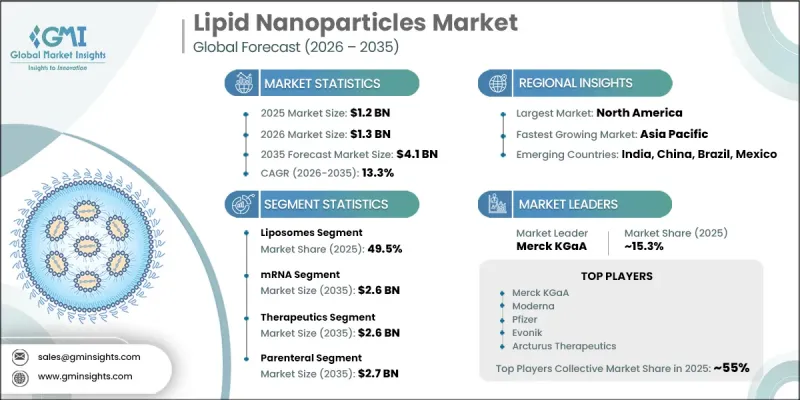
The Global Lipid Nanoparticles Market was valued at USD 1.2 billion in 2025 and is estimated to grow at a CAGR of 13.3% to reach USD 4.1 billion by 2035.
Growth across the lipid nanoparticles industry is fueled by the increasing prevalence of infectious diseases and cancer, along with rising demand for advanced drug delivery technologies that improve the stability, bioavailability, and therapeutic effectiveness of pharmaceutical formulations. Lipid nanoparticles are nanoscale delivery systems engineered to encapsulate and transport therapeutic compounds, including nucleic acid-based therapies, vaccines, and small-molecule drugs, directly to targeted cells within the body. Typically ranging from 10 to 1,000 nanometers in size, these lipid-based carriers play a critical role in enhancing the efficiency and precision of modern drug delivery. The market is also benefiting from expanding investments in nanomedicine research, RNA-based therapeutics, and next-generation pharmaceutical technologies. Growing financial support from pharmaceutical companies, research institutions, and government organizations is accelerating innovation in lipid nanoparticle platforms while strengthening the development of advanced therapeutic solutions. Continued progress in precision medicine, targeted drug delivery, and novel therapeutic formulations is expected to create significant growth opportunities for the global lipid nanoparticles market throughout the forecast period.
| Market Scope | |
|---|---|
| Start Year | 2025 |
| Forecast Year | 2026-2035 |
| Start Value | $1.2 Billion |
| Forecast Value | $4.1 Billion |
| CAGR | 13.3% |
The global lipid nanoparticles industry continues to expand as research and development activities surrounding advanced drug delivery systems gain momentum. Increasing focus on improving treatment efficiency, reducing systemic side effects, and enhancing therapeutic performance is encouraging broader adoption of lipid nanoparticle technologies across pharmaceutical development. Ongoing innovation in formulation techniques is improving delivery performance, expanding application potential, and supporting the commercialization of advanced therapeutic products. Rising investment in precision medicine and next-generation pharmaceutical technologies is further reinforcing long-term market growth.
The liposomes segment accounted for a 49.5% share in 2025. Its dominant position is supported by its ability to improve drug encapsulation, optimize pharmacokinetic performance, and enhance the stability and bioavailability of therapeutic compounds. The structural characteristics of liposomes enable efficient delivery of multiple types of therapeutic agents while supporting long-term clinical applications. Continuous advancements in liposomal formulation technologies have improved drug-loading efficiency, minimized systemic toxicity, and enhanced circulation time through advanced surface modification techniques, strengthening the segment's leadership across the market.
The pharmaceutical and biotechnology companies segment generated USD 747.4 million in 2025. Growth within this segment is driven by extensive utilization of lipid nanoparticle platforms for clinical development, commercial-scale manufacturing, and advanced drug delivery applications. Continued investment in research and development aimed at improving delivery efficiency for nucleic acid-based therapeutics and targeted treatment solutions is supporting broader market adoption. In addition, increasing collaboration with contract development and manufacturing organizations is improving production scalability, regulatory compliance, manufacturing quality, and commercialization capabilities, further reinforcing the segment's dominant market position.
North America Lipid Nanoparticles Market accounted for a 41.6% share in 2025 and is expected to experience notable growth throughout the forecast period. Regional expansion is being supported by the growing prevalence of cancer and other chronic diseases, which continues to increase demand for advanced targeted drug delivery technologies. Strong research capabilities, substantial pharmaceutical investment, expanding clinical development activities, and continued innovation in advanced therapeutic platforms are further strengthening the region's leadership within the global lipid nanoparticles industry.
Major companies operating in the global lipid nanoparticles market include ABP Biosciences, Acrotech Biopharm, Alnylam Pharmaceuticals, Arcturus Therapeutics, Ascendia Pharmaceuticals, Bayer Pharmaceuticals, Boehringer Ingelheim, Cayman Chemicals, Creative Biostructure, Diant Pharma, Evonik, Merck KGaA, Moderna, Pfizer, Sigma-Tau Pharmaceuticals, Teva Pharmaceuticals, and Thermo Fisher Scientific. Companies participating in the lipid nanoparticles industry are strengthening their market position by investing heavily in research and development, advanced formulation technologies, and scalable manufacturing capabilities. Many organizations are expanding production capacity while improving lipid nanoparticle performance, stability, and delivery efficiency to address the growing demand for precision therapeutics. Strategic collaborations with pharmaceutical companies, research organizations, and contract manufacturing partners are accelerating product development and commercialization. Businesses are also focusing on regulatory compliance, quality assurance, and process optimization to support large-scale manufacturing and global market expansion.
Table of Contents
Chapter 1 Research Methodology
- 1.1 Research approach
- 1.2 Quality commitments
- 1.2.1 GMI AI policy & data integrity commitment
- 1.2.1.1 Source consistency protocol
- 1.2.1 GMI AI policy & data integrity commitment
- 1.3 Research trail & confidence scoring
- 1.3.1 Research trail components
- 1.3.2 Scoring components
- 1.4 Data collection
- 1.4.1 Partial list of primary sources
- 1.5 Data mining sources
- 1.5.1 Paid sources
- 1.5.1.1 Sources, by region
- 1.5.1 Paid sources
- 1.6 Base estimates and calculations
- 1.6.1 Base year calculation
- 1.7 Forecast model
- 1.7.1 Quantified market impact analysis
- 1.7.1.1 Mathematical impact of growth parameters on forecast
- 1.7.1 Quantified market impact analysis
- 1.8 Research transparency addendum
- 1.8.1 Source attribution framework
- 1.8.2 Quality assurance metrics
- 1.8.3 Our commitment to trust
Chapter 2 Executive Summary
- 2.1 Industry 360° synopsis
- 2.2 Key market trends
- 2.2.1 Regional trends
- 2.2.2 Product type trends
- 2.2.3 Molecule trends
- 2.2.4 Application trends
- 2.2.5 Route of administration trends
- 2.2.6 End use trends
- 2.3 CXO perspectives: Strategic imperatives
Chapter 3 Industry Insights
- 3.1 Industry ecosystem analysis
- 3.2 Industry impact forces
- 3.2.1 Growth drivers
- 3.2.1.1 Rising prevalence of infectious diseases and cancer
- 3.2.1.2 Growing demand for improved stability and bioavailability drug formulations
- 3.2.1.3 Expanding research funding and activities
- 3.2.1.4 Growing expansion in mRNA therapeutics
- 3.2.2 Industry pitfalls and challenges
- 3.2.2.1 Stringent regulatory requirements
- 3.2.2.2 High cost of raw materials
- 3.2.3 Opportunities
- 3.2.3.1 Rising adoption of personalized and precision medicine
- 3.2.1 Growth drivers
- 3.3 Growth potential analysis
- 3.4 Regulatory landscape
- 3.5 Pricing trend analysis (Driven by Primary Research)
- 3.6 Technology and innovation landscape (Driven by Primary Research)
- 3.6.1 Current technological trends
- 3.6.2 Emerging technologies
- 3.7 Future market trends (Driven by Primary Research)
- 3.8 Impact of AI & Generative AI on the Market (Driven by Primary Research)
- 3.9 Porter's analysis
- 3.10 PESTEL analysis
Chapter 4 Competitive Landscape, 2025
- 4.1 Introduction
- 4.2 Company matrix analysis
- 4.3 Company market share analysis (Driven by Primary Research)
- 4.3.1 Global
- 4.3.2 North America
- 4.3.3 Europe
- 4.3.4 Asia Pacific
- 4.3.5 LAMEA
- 4.4 Competitive analysis of major market players
- 4.5 Competitive positioning matrix
- 4.6 Key developments
- 4.6.1 Mergers & acquisitions
- 4.6.2 Partnerships & collaborations
- 4.6.3 New product launches
- 4.6.4 Expansion plans
Chapter 5 Market Estimates and Forecast, By Product Type, 2022 - 2035 ($ Mn)
- 5.1 Key trends
- 5.2 Liposomes
- 5.3 Solid lipid nanoparticles
- 5.4 Nanostructured lipid carriers
- 5.5 Other product types
Chapter 6 Market Estimates and Forecast, By Molecule, 2022 - 2035 ($ Mn)
- 6.1 Key trends
- 6.2 siRNA
- 6.3 mRNA
- 6.4 Other molecules
Chapter 7 Market Estimates and Forecast, By Application, 2022 - 2035 ($ Mn)
- 7.1 Key trends
- 7.2 Therapeutics
- 7.2.1 Cancer
- 7.2.2 Fungal disease
- 7.2.3 Analgesics
- 7.2.4 Vaccines
- 7.2.5 Immunosuppressants
- 7.2.6 Other applications
- 7.3 Research
Chapter 8 Market Estimates and Forecast, By Route of Administration, 2022 - 2035 ($ Mn)
- 8.1 Key trends
- 8.2 Oral
- 8.3 Parenteral
- 8.4 Topical
- 8.5 Other routes of administration
Chapter 9 Market Estimates and Forecast, By End Use, 2022 - 2035 ($ Mn)
- 9.1 Key trends
- 9.2 Pharmaceutical and biotechnology companies
- 9.3 Research institutes
- 9.4 Other end users
Chapter 10 Market Estimates and Forecast, By Region, 2022 - 2035 ($ Mn)
- 10.1 Key trends
- 10.2 North America
- 10.2.1 U.S.
- 10.2.2 Canada
- 10.3 Europe
- 10.3.1 Germany
- 10.3.2 UK
- 10.3.3 France
- 10.3.4 Spain
- 10.3.5 Italy
- 10.3.6 Netherlands
- 10.4 Asia Pacific
- 10.4.1 China
- 10.4.2 Japan
- 10.4.3 India
- 10.4.4 Australia
- 10.4.5 South Korea
- 10.5 Latin America
- 10.5.1 Brazil
- 10.5.2 Mexico
- 10.5.3 Argentina
- 10.6 MEA
- 10.6.1 South Africa
- 10.6.2 Saudi Arabia
- 10.6.3 UAE
Chapter 11 Company Profiles
- 11.1 ABP Biosciences
- 11.2 Acrotech Biopharm
- 11.3 Alnylam Pharmaceuticals
- 11.4 Arcturus Therapeutics
- 11.5 Ascendia Pharmaceuticals
- 11.6 Bayer Pharmaceuticals
- 11.7 Boehringer Ingelheim
- 11.8 Cayman Chemical
- 11.9 Creative Biostructure
- 11.10 Diant Pharma
- 11.11 Evonik
- 11.12 Merck KGaA
- 11.13 Moderna
- 11.14 Pfizer
- 11.15 Sigma-Tau Pharmaceuticals
- 11.16 Teva Pharmaceuticals
- 11.17 Thermo Fisher Scientific

