PUBLISHER: Global Market Insights Inc. | PRODUCT CODE: 2109287

PUBLISHER: Global Market Insights Inc. | PRODUCT CODE: 2109287
Collateral Ligament Stabilizer System Market Opportunity, Growth Drivers, Industry Trend Analysis, and Forecast 2026 - 2035
The Global Collateral Ligament Stabilizer System Market was valued at USD 3 billion in 2025 and is estimated to grow at a CAGR of 6.6% to reach USD 5.6 billion by 2035.
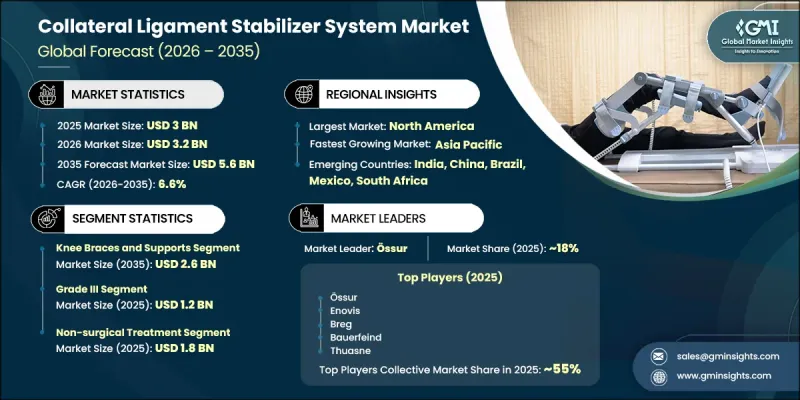
Market expansion is driven by continuous progress in orthopedic technologies, increasing participation in physical activities, and the rising number of elective orthopedic procedures. Collateral ligament stabilizer systems are specialized orthopedic support solutions that provide joint stability, protection, and controlled movement for patients experiencing ligament-related injuries or joint instability. These systems are extensively used in conservative treatment as well as post-operative rehabilitation to support recovery, improve mobility, minimize discomfort, and enhance overall joint function. The growing aging population is also contributing to market growth, as older individuals are more susceptible to ligament injuries due to declining bone strength, reduced muscle mass, and a greater likelihood of falls. In addition, the rising preference for minimally invasive orthopedic procedures is accelerating the adoption of ligament stabilizer systems, as healthcare providers increasingly incorporate advanced bracing solutions into rehabilitation protocols to improve patient outcomes and support faster functional recovery.
| Market Scope | |
|---|---|
| Start Year | 2025 |
| Forecast Year | 2026-2035 |
| Start Value | $3 Billion |
| Forecast Value | $5.6 Billion |
| CAGR | 6.6% |
The knee braces and supports segment accounted for 43.8% share in 2025, making it the leading product category. Growth in this segment is supported by the increasing number of knee ligament injuries associated with greater participation in physically demanding activities. Knee braces provide essential joint stabilization, reduce stress on injured ligaments, and support safe movement throughout the recovery process. Their expanding role in rehabilitation following orthopedic procedures is further strengthening demand and contributing to continued segment growth.
The hospitals segment held a 44.2% share in 2025. Market growth within this segment is primarily driven by the increasing number of orthopedic procedures involving ligament repair and reconstruction performed in hospital settings. Collateral ligament stabilizer systems are widely utilized before and after surgical intervention to promote proper healing, improve recovery outcomes, and minimize the likelihood of reinjury. Rising patient volumes requiring treatment for ligament damage, joint instability, and other orthopedic conditions continue to support demand across hospitals.
North America Collateral Ligament Stabilizer System Market held significant share in 2025. Regional growth is supported by the high incidence of musculoskeletal disorders and ligament-related injuries, combined with increasing participation in physical activities and a steadily growing aging population. Lifestyle-related health concerns and the expanding demand for orthopedic treatment solutions continue to strengthen the adoption of collateral ligament stabilizer systems across the region, supporting sustained market growth.
Prominent companies operating in the global collateral ligament stabilizer system market include 3M, BAUERFEIND, BREG, DARCO, DeRoyal, Enovis, Essity, HELY & WEBER, medi, MEDLINE, Mueller Sports Medicine, Ossur, Ottobock, THUASNE, and ZAMST. Companies operating in the collateral ligament stabilizer system market are strengthening their market position by expanding product portfolios, investing in advanced orthopedic technologies, and developing innovative stabilizer systems that improve comfort, durability, and clinical performance. Manufacturers are prioritizing research and development to enhance product design, optimize patient outcomes, and meet evolving healthcare requirements. Strategic collaborations with healthcare providers, distributors, and medical institutions are helping companies broaden their market reach and reinforce customer relationships. Businesses are also expanding their global distribution networks, improving manufacturing capabilities, and increasing investments in regulatory compliance to support international growth.
Table of Contents
Chapter 1 Research Methodology
- 1.1 Research approach
- 1.2 Quality commitments
- 1.2.1 GMI AI policy & data integrity commitment
- 1.2.1.1 Source consistency protocol
- 1.2.1 GMI AI policy & data integrity commitment
- 1.3 Research trail & confidence scoring
- 1.3.1 Research trail components
- 1.3.2 Scoring components
- 1.4 Data collection
- 1.4.1 Partial list of primary sources
- 1.5 Data mining sources
- 1.5.1 Paid sources
- 1.5.1.1 Sources, by region
- 1.5.1 Paid sources
- 1.6 Base estimates and calculations
- 1.6.1 Base year calculation for any one approach
- 1.7 Forecast model
- 1.7.1 Quantified market impact analysis
- 1.7.1.1 Mathematical impact of growth parameters on forecast
- 1.7.1 Quantified market impact analysis
- 1.8 Research transparency addendum
- 1.8.1 Source attribution framework
- 1.8.2 Quality assurance metrics
- 1.8.3 Our commitment to trust
Chapter 2 Executive Summary
- 2.1 Industry 360° synopsis
- 2.2 Key market trends
- 2.2.1 Regional trends
- 2.2.2 Product trends
- 2.2.3 Ligament type trends
- 2.2.4 Injury type trends
- 2.2.5 Treatment type
- 2.2.6 End use trends
- 2.3 CXO perspectives: Strategic imperatives
Chapter 3 Industry Insights
- 3.1 Industry ecosystem analysis
- 3.2 Industry impact forces
- 3.2.1 Growth drivers
- 3.2.1.1 Increasing incidence of sports injuries
- 3.2.1.2 Rise in number of surgical procedures
- 3.2.1.3 Technological advancements in product design
- 3.2.1.4 Growing investments in healthcare infrastructure
- 3.2.2 Industry pitfalls and challenges
- 3.2.2.1 High cost associated with advanced stabilizers
- 3.2.2.2 Risk of skin irritation and discomfort
- 3.2.3 Market opportunities
- 3.2.3.1 Untapped potential in Asia Pacific and Latin America
- 3.2.3.2 Growth of sports medicine and athletic performance markets
- 3.2.1 Growth drivers
- 3.3 Growth potential analysis
- 3.4 Regulatory landscape (Driven by primary research)
- 3.4.1 North America
- 3.4.2 Europe
- 3.4.3 Asia Pacific
- 3.4.4 Latin America
- 3.4.5 MEA
- 3.5 Technology landscape
- 3.5.1 Current technological trends
- 3.5.2 Emerging technologies
- 3.6 Pricing trend analysis (Driven by primary research)
- 3.7 Future market trends
- 3.8 Porter's analysis
- 3.9 PESTEL analysis
- 3.10 Impact of AI and Generative AI on the market (Driven by primary research)
- 3.11 Patent analysis
- 3.12 Treatment infrastructure & clinical adoption landscape
- 3.13 Gap analysis
Chapter 4 Competitive Landscape, 2025
- 4.1 Introduction
- 4.2 Company matrix analysis
- 4.3 Company market share analysis (Driven by primary research)
- 4.3.1 Global
- 4.3.2 North America
- 4.3.3 Europe
- 4.3.4 Asia Pacific
- 4.4 Competitive positioning matrix
- 4.5 Competitive analysis of major market players
- 4.6 Key developments
- 4.6.1 Mergers & acquisitions
- 4.6.2 Partnerships & collaborations
- 4.6.3 New product launches
- 4.6.4 Expansion plans
Chapter 5 Market Estimates and Forecast, By Product, 2022 - 2035 ($ Mn)
- 5.1 Key trends
- 5.2 Knee braces and supports
- 5.3 Foot and ankle braces and supports
- 5.4 Wrist braces and supports
- 5.5 Other products
Chapter 6 Market Estimates and Forecast, By Ligament Type, 2022 - 2035 ($ Mn)
- 6.1 Key trends
- 6.2 Medial collateral ligament (MCL)
- 6.3 Lateral collateral ligament (LCL)
- 6.4 Other ligament types
Chapter 7 Market Estimates and Forecast, By Injury Type, 2022 - 2035 ($ Mn)
- 7.1 Key trends
- 7.2 Grade I
- 7.3 Grade II
- 7.4 Grade III
Chapter 8 Market Estimates and Forecast, By Treatment, 2022 - 2035 ($ Mn)
- 8.1 Key trends
- 8.2 Non-surgical treatment
- 8.3 Surgical treatment
Chapter 9 Market Estimates and Forecast, By End Use, 2022 - 2035 ($ Mn)
- 9.1 Key trends
- 9.2 Hospitals
- 9.3 Orthopedic clinics
- 9.4 Ambulatory surgical centers
- 9.5 Other end users
Chapter 10 Market Estimates and Forecast, By Region, 2022 - 2035 ($ Mn)
- 10.1 Key trends
- 10.2 North America
- 10.2.1 U.S.
- 10.2.2 Canada
- 10.3 Europe
- 10.3.1 Germany
- 10.3.2 UK
- 10.3.3 France
- 10.3.4 Spain
- 10.3.5 Italy
- 10.3.6 Netherlands
- 10.4 Asia Pacific
- 10.4.1 China
- 10.4.2 Japan
- 10.4.3 India
- 10.4.4 Australia
- 10.4.5 South Korea
- 10.5 Latin America
- 10.5.1 Brazil
- 10.5.2 Mexico
- 10.5.3 Argentina
- 10.6 Middle East and Africa
- 10.6.1 South Africa
- 10.6.2 Saudi Arabia
- 10.6.3 UAE
Chapter 11 Company Profiles
- 11.1 3M
- 11.2 BAUERFEIND
- 11.3 BREG
- 11.4 DARCO
- 11.5 DeRoyal
- 11.6 Enovis
- 11.7 Essity
- 11.8 HELY & WEBER
- 11.9 medi
- 11.10 MEDLINE
- 11.11 Mueller Sports Medicine
- 11.12 Ossur
- 11.13 Ottobock
- 11.14 THUASNE
- 11.15 ZAMST

