PUBLISHER: Global Market Insights Inc. | PRODUCT CODE: 2109293

PUBLISHER: Global Market Insights Inc. | PRODUCT CODE: 2109293
Serum-free Media Market Opportunity, Growth Drivers, Industry Trend Analysis, and Forecast 2026 - 2035
The Global Serum-Free Media Market was valued at USD 2.1 billion in 2025 and is estimated to grow at a CAGR of 11.2% to reach USD 5.9 billion by 2035.
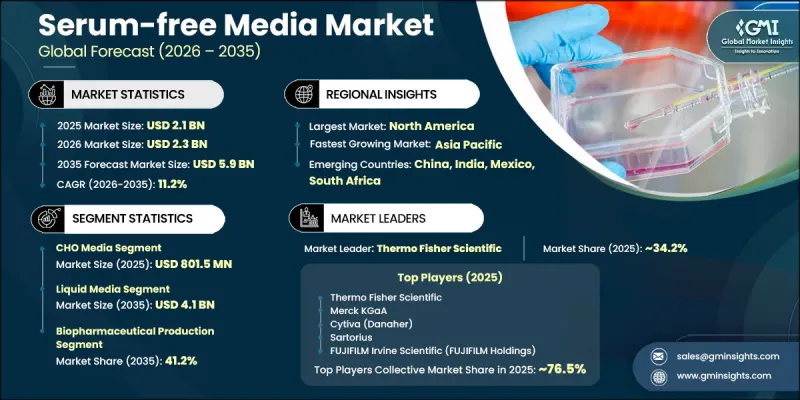
Market expansion is fueled by the rising demand for biopharmaceutical manufacturing, regenerative medicine, vaccine research, and expanding cell and gene therapy applications. The increasing prevalence of chronic diseases, including autoimmune disorders, cancer, and rare genetic conditions, continues to create strong demand for advanced biologics and cell-based treatments, supporting the adoption of serum-free media. Serum-free media are specialized cell culture formulations developed without animal serum and instead contain carefully defined nutrients, hormones, growth factors, and supplements that support cell growth under controlled laboratory conditions. These formulations are extensively utilized in biologics production, tissue engineering, stem cell research, vaccine manufacturing, and cell and gene therapy development because they offer consistent performance, improved product safety, and greater compatibility with regulatory requirements. Another important trend influencing the serum-free media market is the accelerating transition from conventional serum-containing formulations to serum-free and chemically defined alternatives. This shift is being driven by the need for greater manufacturing consistency, enhanced reproducibility, improved scalability, reduced contamination risks, and stronger regulatory compliance. As a result, manufacturers are increasingly adopting serum-free media to standardize production processes and improve manufacturing efficiency for biologics and advanced therapeutic products.
| Market Scope | |
|---|---|
| Start Year | 2025 |
| Forecast Year | 2026-2035 |
| Start Value | $2.1 Billion |
| Forecast Value | $5.9 Billion |
| CAGR | 11.2% |
The CHO media segment generated USD 801.5 million in 2025. Its strong market position is supported by the extensive use of CHO cell lines in producing monoclonal antibodies, recombinant proteins, vaccines, and a broad range of biologic products. CHO cells continue to be widely preferred for commercial biopharmaceutical manufacturing because they provide high protein productivity, reliable scalability, and consistent manufacturing performance in large-scale production environments. Furthermore, the growing pipeline of biologics and biosimilars entering clinical development and commercial production continues to strengthen demand for advanced serum-free CHO media formulations.
The biopharmaceutical production segment accounted for 41.2% share in 2025, representing the largest application category. Growth within this segment is supported by the continued expansion of the global biopharmaceutical industry and the increasing commercialization of biologics, including monoclonal antibodies, recombinant proteins, vaccines, and cell and gene therapies. Rising healthcare needs associated with chronic diseases and the growing demand for precision medicines are encouraging pharmaceutical companies to expand biologics production, creating sustained demand for high-quality serum-free media that deliver reliable manufacturing performance and regulatory compliance.
North America Serum-Free Media Market captured 38.9% share in 2025. The region benefits from a highly advanced biotechnology ecosystem, well-established pharmaceutical manufacturing capabilities, strong life sciences investments, and sophisticated research infrastructure. Continued financial support for biomedical research, combined with ongoing investments across the biotechnology and pharmaceutical sectors, continues to strengthen regional market growth while supporting innovation and commercial development within the serum-free media industry.
Prominent companies operating in the global serum-free media market include Thermo Fisher Scientific, Sartorius, Cytiva, Corning, Lonza, Merck KGaA, FUJIFILM Irvine Scientific, ACROBiosystems, Sino Biological, Miltenyi Biotec, Biowest, PromoCell, PAN-Biotech, MP Biomedicals, Cellplus Bio, JSBio, Elabscience, and Eminence Scientific. Companies operating in the serum-free media market are strengthening their market position by expanding product portfolios with chemically defined and application-specific media formulations tailored for biopharmaceutical production and advanced therapies. They are investing heavily in research and development to improve media performance, scalability, and manufacturing consistency while meeting evolving regulatory standards. Strategic collaborations with biotechnology firms, contract development and manufacturing organizations, and research institutions are helping accelerate product innovation and commercial adoption. Manufacturers are also increasing production capacity, strengthening global distribution networks, and enhancing technical support services to serve growing customer demand.
Table of Contents
Chapter 1 Methodology and Scope
- 1.1 Market scope and definition
- 1.2 Research approach
- 1.3 Quality commitments
- 1.3.1 GMI AI policy and data integrity commitment
- 1.3.1.1 Source consistency protocol
- 1.3.1 GMI AI policy and data integrity commitment
- 1.4 Research trail and confidence scoring
- 1.4.1 Research trail components
- 1.4.2 Scoring components
- 1.5 Data collection
- 1.5.1 Partial list of primary sources
- 1.6 Data mining sources
- 1.6.1 Paid sources
- 1.6.1.1 Sources, by region
- 1.6.1 Paid sources
- 1.7 Base estimates and calculations
- 1.7.1 Revenue share analysis
- 1.7.2 Base year calculation
- 1.8 Forecast model
- 1.8.1 Quantified market impact analysis
- 1.8.1.1 Mathematical impact of growth parameters on forecast
- 1.8.1 Quantified market impact analysis
- 1.9 Research transparency addendum
- 1.9.1 Source attribution framework
- 1.9.2 Quality assurance metrics
- 1.9.3 Our commitment to trust
Chapter 2 Executive Summary
- 2.1 Industry 360° synopsis
- 2.2 Key market trends
- 2.2.1 Regional trends
- 2.2.2 Product type trends
- 2.2.3 Form trends
- 2.2.4 Application trends
- 2.2.5 End use trends
- 2.3 CXO perspectives: Strategic imperatives
Chapter 3 Industry Insights
- 3.1 Industry ecosystem analysis
- 3.2 Industry impact forces
- 3.2.1 Growth drivers
- 3.2.1.1 Rising demand for biologics and biosimilars
- 3.2.1.2 Increasing adoption of cell and gene therapies
- 3.2.1.3 Rising incidence of chronic diseases
- 3.2.1.4 Advancements in chemically defined media formulations
- 3.2.2 Industry pitfalls & challenges
- 3.2.2.1 High cost of specialized serum-free formulations
- 3.2.2.2 Complex optimization requirements for different cell lines
- 3.2.2.3 Regulatory and quality compliance challenges
- 3.2.3 Market opportunities
- 3.2.3.1 Growth in contract development and manufacturing organizations (CDMOs)
- 3.2.3.2 Technological advancements in media optimization and automation
- 3.2.1 Growth drivers
- 3.3 Growth potential analysis
- 3.4 Regulatory landscape (Driven by Primary Research)
- 3.4.1 North America
- 3.4.2 Europe
- 3.4.3 Asia Pacific
- 3.4.4 Latin America
- 3.4.5 Middle East & Africa
- 3.5 Technology and innovation landscape (Driven by Primary Research)
- 3.5.1 Current technologies
- 3.5.2 Emerging technologies
- 3.6 Pricing analysis, 2025 (Driven by Primary Research)
- 3.6.1 Historical price trend analysis
- 3.6.2 Pricing strategy, by product type
- 3.7 Porter’s analysis
- 3.8 PESTEL analysis
- 3.9 Future market trends
- 3.10 Impact of AI and Gen AI on the market
Chapter 4 Competitive Landscape, 2025
- 4.1 Introduction
- 4.2 Company market share analysis
- 4.2.1 North America
- 4.2.2 Europe
- 4.2.3 Asia Pacific
- 4.3 Company matrix analysis
- 4.4 Competitive analysis of major market players
- 4.5 Competitive positioning matrix
- 4.6 Key developments
- 4.6.1 Merger and acquisition
- 4.6.2 Partnership and collaboration
- 4.6.3 New product launches
- 4.6.4 Expansion plans
Chapter 5 Market Estimates and Forecast, By Product Type, 2022 - 2035 ($ Mn)
- 5.1 Key trends
- 5.2 CHO media
- 5.3 HEK 293 media
- 5.4 BHK media
- 5.5 VERO cell media
- 5.6 Insect cell media
- 5.7 Immune cell media
- 5.8 Other serum-free media
Chapter 6 Market Estimates and Forecast, By Form, 2022 - 2035 ($ Mn)
- 6.1 Key trends
- 6.2 Liquid media
- 6.3 Semi-solid and solid media
Chapter 7 Market Estimates and Forecast, By Application, 2022 - 2035 ($ Mn)
- 7.1 Key trends
- 7.2 Biopharmaceutical production
- 7.3 Vaccine production
- 7.4 Drug discovery & development
- 7.5 Stem cell research & therapy
- 7.6 Tissue engineering & regenerative medicine
- 7.7 Other applications
Chapter 8 Market Estimates and Forecast, By End Use, 2022 - 2035 ($ Mn)
- 8.1 Key trends
- 8.2 Pharmaceutical & biotechnology companies
- 8.3 Clinical research organizations (CROs)
- 8.4 Academic & research institutions
- 8.5 Other end users
Chapter 9 Market Estimates and Forecast, By Region, 2022 - 2035 ($ Mn)
- 9.1 Key trends
- 9.2 North America
- 9.2.1 U.S.
- 9.2.2 Canada
- 9.3 Europe
- 9.3.1 Germany
- 9.3.2 UK
- 9.3.3 France
- 9.3.4 Spain
- 9.3.5 Italy
- 9.3.6 Netherlands
- 9.4 Asia Pacific
- 9.4.1 Japan
- 9.4.2 China
- 9.4.3 India
- 9.4.4 Australia
- 9.4.5 South Korea
- 9.5 Latin America
- 9.5.1 Brazil
- 9.5.2 Mexico
- 9.5.3 Argentina
- 9.6 Middle East and Africa
- 9.6.1 South Africa
- 9.6.2 Saudi Arabia
- 9.6.3 UAE
Chapter 10 Company Profiles
- 10.1 ACROBiosystems
- 10.2 Biowest
- 10.3 Corning
- 10.4 Cytiva
- 10.5 Cellplus Bio
- 10.6 Elabscience
- 10.7 Eminence Scientific
- 10.8 FUJIFILM Irvine Scientific
- 10.9 JSBio
- 10.10 Lonza
- 10.11 Merck KGaA
- 10.12 Miltenyi Biotec
- 10.13 MP Biomedicals
- 10.14 PromoCell
- 10.15 PAN-Biotech
- 10.16 Sartorius
- 10.17 Sino Biological
- 10.18 Thermo Fisher Scientific

