PUBLISHER: Global Market Insights Inc. | PRODUCT CODE: 2109295

PUBLISHER: Global Market Insights Inc. | PRODUCT CODE: 2109295
Precision Planting Market Opportunity, Growth Drivers, Industry Trend Analysis, and Forecast 2026 - 2035
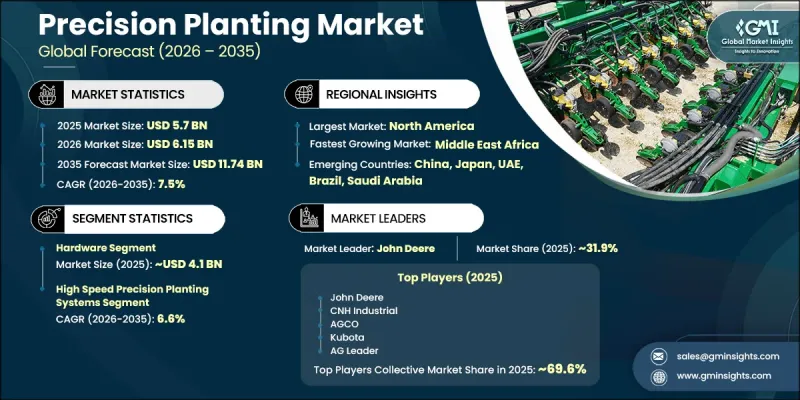
The Global Precision Planting Market was valued at USD 5.7 billion in 2025 and is estimated to grow at a CAGR of 7.5% to reach USD 11.74 billion by 2035.
The market is undergoing a significant transformation as artificial intelligence becomes increasingly integrated into precision planting technologies. Modern planting systems utilize extensive agronomic datasets, including soil characteristics, historical field performance, crop information, and real-time field conditions, to automatically optimize planting operations with greater accuracy and efficiency. This evolution is enabling intelligent systems to make agronomic decisions during planting, improving productivity while enhancing resource utilization. The market is moving beyond conventional precision agriculture by shifting from operator-controlled processes to machine-driven decision-making supported by advanced analytics and automation. AI-powered planting technologies are improving seed placement accuracy, optimizing planting parameters, and supporting more consistent field performance. Growing adoption of digital agriculture, connected farming equipment, and intelligent planting technologies is encouraging producers to modernize operations while improving operational efficiency and crop performance. Continued investment in automation, precision farming technologies, and data-driven agricultural solutions is expected to sustain long-term growth in the global precision planting market.
| Market Scope | |
|---|---|
| Start Year | 2025 |
| Forecast Year | 2026-2035 |
| Start Value | $5.7 Billion |
| Forecast Value | $11.74 Billion |
| CAGR | 7.5% |
The hardware segment generated USD 4.1 billion in 2025 and is anticipated to grow at a CAGR of 5.9% from 2026 to 2035. Hardware continues to represent the largest component of the precision planting market because it provides the essential infrastructure required for advanced planting operations. Continued adoption of intelligent sensors, control units, guidance systems, and precision planting equipment is supporting steady demand across modern agricultural operations.
The high-speed precision planting systems segment accounted for a 38% share in 2025 and is projected to grow at a CAGR of 6.6% between 2026 and 2035. The segment continues to gain momentum as agricultural producers seek planting systems capable of maintaining high accuracy while operating at faster field speeds. Improved operational efficiency, greater planting consistency, and enhanced productivity continue to support widespread adoption of these advanced planting solutions.
North America Precision Planting Market held a 39% share in 2025, generating USD 2.2 billion, and is forecast to reach USD 4.3 billion by 2035. The region is expected to remain the largest market by value throughout the forecast period, supported by widespread adoption of precision agriculture technologies, advanced farming equipment, and continued investment in digital farming solutions that improve agricultural productivity and operational efficiency.
Key players operating in the global precision planting market include Deere & Company (John Deere), CNH Industrial N.V., AGCO Corporation, Precision Planting LLC, Kubota Corporation, AG Leader Technology Inc., Kinze Manufacturing Inc., Vaderstad Group AB, Horsch Maschinen GmbH, Bourgault Industries Ltd., Kuhn Group, Kverneland Group, Crucianelli S.A., Stara S/A, XAG Co. Ltd., SZ DJI Technology, Hylio Inc., Weichai LOVOL Intelligent Agricultural Technology, Mahindra & Mahindra Farm Equipment Sector, Hexagon Agriculture, and Agrisem International SAS. Companies operating in the precision planting market are strengthening their competitive position by investing in artificial intelligence, automation, and advanced precision agriculture technologies that improve planting accuracy and operational efficiency. Manufacturers are expanding research and development activities to enhance intelligent planting equipment, advanced hardware, digital analytics, and connected farming platforms. Strategic collaborations with agricultural technology providers, equipment manufacturers, and distribution partners are helping companies expand their market reach while accelerating technology adoption. Businesses are also focusing on integrating cloud connectivity, real-time monitoring, data analytics, and smart decision-support capabilities into precision planting solutions.
Table of Contents
Chapter 1 Methodology & Scope
- 1.1 Research approach
- 1.2 Quality Commitments
- 1.2.1 GMI AI policy & data integrity commitment
- 1.2.2 Source consistency protocol
- 1.3 Research Trail & Confidence Scoring
- 1.3.1 Research Trail Components
- 1.3.2 Scoring Components
- 1.4 Data Collection
- 1.4.1 Partial list of primary sources
- 1.5 Data mining sources
- 1.5.1 Paid sources
- 1.5.1.1 Sources, by region
- 1.5.1 Paid sources
- 1.6 Base estimates and calculations
- 1.6.1 Base year calculation
- 1.7 Forecast model
- 1.7.1 Quantified market impact analysis
- 1.7.1.1 Mathematical impact of growth parameters on forecast
- 1.7.1 Quantified market impact analysis
- 1.8 Research transparency addendum
- 1.8.1 Source attribution framework
- 1.8.2 Quality assurance metrics
- 1.8.3 Our commitment to trust
Chapter 2 Executive Summary
- 2.1 Industry 360° synopsis
- 2.2 Key market trends
- 2.2.1 Region
- 2.2.2 Offering
- 2.2.3 System Type
- 2.2.4 Crop Type
- 2.2.5 Farm size
Chapter 3 Industry Insights
- 3.1 Industry ecosystem analysis
- 3.1.1 Supplier landscape
- 3.1.2 Profit margin
- 3.1.3 Value addition at each stage
- 3.1.4 Factor affecting the value chain
- 3.2 Industry impact forces
- 3.2.1 Growth drivers
- 3.2.1.1 Rising Global Food Demand Driving Need for Higher Yield Efficiency
- 3.2.1.2 Government Subsidies & Policy Support for Precision Agriculture Adoption
- 3.2.1.3 Technological Advances in GPS, IoT & AI-Integrated Planting Systems
- 3.2.1.4 Growing Environmental Sustainability Mandates Reducing Seed & Fertilizer Waste
- 3.2.1.5 4.1.5. Expansion of Large Commercial Farming Operations Globally
- 3.2.2 Industry pitfalls & challenges
- 3.2.2.1 High Upfront Capital Investment & Limited Financing Access
- 3.2.2.2 Technical Complexity & Skilled Operator Shortage
- 3.2.3 Opportunities
- 3.2.3.1 Expanding Adoption in Emerging Agricultural Economies (India, Brazil, Southeast Asia)
- 3.2.3.2 Rise of Autonomous & Drone-Based Seeding Platforms as Disruptive Alternatives
- 3.2.3.3 Aftermarket Retrofit Kit Opportunity for Existing Equipment Upgrades
- 3.2.3.4 Software-as-a-Service (SaaS) Monetization Models in Farm Data Management
- 3.2.1 Growth drivers
- 3.3 Growth potential analysis
- 3.4 Supply Chain Analysis
- 3.4.1 Key Input Materials (Steel, Electronics, Sensors, Semiconductors)
- 3.4.2 Supply Chain Vulnerabilities & Disruption Risk Assessment
- 3.4.3 Nearshoring & Localization Trends in Agricultural Equipment
- 3.5 Future market trends
- 3.6 Technology and innovation landscape
- 3.6.1 Core Enabling Technologies (GPS, VRT, IoT, Machine Vision)
- 3.6.2 Emerging Technology Trajectories (Electric Drives, Autonomous Systems)
- 3.6.3 Technology Readiness Level (TRL) Assessment by System Type
- 3.7 Regulatory landscape
- 3.7.1 Global Agricultural Equipment Safety & Emissions Standards
- 3.7.2 Precision Agriculture Policy & Subsidy Programs by Region
- 3.7.3 Data Privacy & Farm Data Governance Regulations
- 3.7.4 Drone Regulations Impacting Aerial Seeding Operations
- 3.8 Trade data analysis
- 3.8.1 Import/Export Volume & Value Trends by Equipment Type (Driven by Primary Research)
- 3.8.2 Key Trade Corridors & Tariff Impact on Precision Planting Equipment (Driven by Primary Research)
- 3.9 Impact of AI & Generative AI on the market
- 3.9.1 AI-Driven Disruption of Existing Planting & Farm Management Models
- 3.9.2 GenAI Use Cases & Adoption Roadmap by Segment (Prescription Maps, Real-Time Agronomic Guidance)
- 3.9.3 Risks, Limitations & Regulatory Considerations for AI in Precision Planting
- 3.10 Pricing Analysis
- 3.10.1 Historical Price Trend Analysis (2019–2024) (Driven by Primary Research)
- 3.10.2 Pricing Strategy by Player Type (Premium / Value / Cost-plus) (Driven by Primary Research)
- 3.11 Porter’s analysis
- 3.12 PESTEL analysis
Chapter 4 Competitive Landscape, 2025
- 4.1 Introduction
- 4.2 Company market share analysis
- 4.3 Company matrix analysis
- 4.4 Competitive analysis of major market players
- 4.5 Competitive positioning matrix
- 4.6 Key developments
- 4.6.1 Mergers & acquisitions
- 4.6.2 Partnerships & collaborations
- 4.6.3 New product launches
- 4.6.4 Expansion plans
Chapter 5 Market Estimates & Forecast, By Offering, 2022 – 2035, (USD Billion)
- 5.1 Key Trends
- 5.2 Hardware
- 5.2.1 Planters & Seed Drills
- 5.2.1.1 Row Crop Planters
- 5.2.1.2 Air Seeders & Air Drills
- 5.2.2 Planting Attachments & Add-Ons
- 5.2.2.1 Downforce Control Systems
- 5.2.2.2 Seed Meters & Seed Tubes
- 5.2.2.3 Row Shutoff & Variable-Rate Drive Units
- 5.2.3 Seed Monitoring & Sensing Units
- 5.2.3.1 Seed Population Monitors
- 5.2.3.2 Depth & Spacing Sensors
- 5.2.4 Drones & Autonomous Seeding Equipment (Hardware)
- 5.2.1 Planters & Seed Drills
- 5.3 Software & Platforms
- 5.3.1 Farm Management Software (FMS)
- 5.3.2 Variable Rate Technology (VRT) Prescription Tools
- 5.3.3 Data Analytics, Yield Mapping & Field Monitoring Platforms
- 5.3.4 Remote Sensing & Satellite Imagery Integration Platforms
- 5.4 Services
- 5.4.1 Installation & Calibration Services
- 5.4.2 Maintenance & After-Sales Support
- 5.4.3 Agronomic Consulting & System Integration Services
- 5.4.4 Managed Data & Subscription-Based Services
Chapter 6 Market Estimates & Forecast, By System Type, 2022 – 2035, (USD Billion)
- 6.1 Key Trends
- 6.2 High-Speed Precision Planting Systems
- 6.2.1 Electric Drive
- 6.2.2 Hydraulic Drive
- 6.3 Precision Air Seeders
- 6.3.1 Electric Drive
- 6.3.2 Hydraulic Drive
- 6.4 Planting Retrofit Kits & Attachments
- 6.4.1 Seed Monitor Retrofit Kits
- 6.4.2 Electric Drive Conversion Kits
- 6.4.3 Downforce & Row Control Retrofit Systems
- 6.5 Drones & Autonomous Seeding Systems
- 6.5.1 Multi-Rotor Drones
- 6.5.2 Fixed-Wing Drones
- 6.5.3 Ground-Based Autonomous Seeding Robots
Chapter 7 Market Estimates & Forecast, By Crop Type, 2022 – 2035, (USD Billion)
- 7.1 Key Trends
- 7.2 Row Crops
- 7.2.1 Corn/Maize
- 7.2.2 Soybean
- 7.2.3 Cotton
- 7.2.4 Sunflower
- 7.3 Cereals & Grains
- 7.3.1 Wheat
- 7.3.2 Barley
- 7.3.3 Rice
- 7.3.4 Sorghum & Other Cereals
- 7.4 Oilseeds & Pulses
- 7.4.1 Canola/Rapeseed
- 7.4.2 Flaxseed
- 7.4.3 Lentils, Chickpeas & Other Pulses
- 7.5 Fruits, Vegetables & Horticulture
- 7.5.1 Vegetables (Field-Grown)
- 7.5.2 Fruits & Orchard Crops
- 7.5.3 Greenhouse & Controlled Environment Farming
- 7.6 Forestry
- 7.6.1 Commercial Forestry Planting
- 7.6.2 Reforestation & Ecosystem Restoration
Chapter 8 Market Estimates & Forecast, By Farm Type, 2022 – 2035, (USD Billion)
- 8.1 Key Trends
- 8.2 Small & Medium Farms (Below 400 Ha)
- 8.2.1 Smallholder Farms (Below 50 Ha)
- 8.2.2 Medium Farms (50–400 Ha)
- 8.3 Large Commercial Farms (Above 400 Ha)
- 8.3.1 Large Farms (400–1,000 Ha)
- 8.3.2 Industrial-Scale Farms (Above 1,000 Ha)
Chapter 9 Market Estimates & Forecast, By Region, 2022 – 2035, (USD Billion)
- 9.1 Key Trends
- 9.2 North America
- 9.2.1 U.S.
- 9.2.2 Canada
- 9.3 Europe
- 9.3.1 Germany
- 9.3.2 France
- 9.3.3 UK
- 9.3.4 Italy
- 9.3.5 Spain
- 9.4 Asia Pacific
- 9.4.1 China
- 9.4.2 Japan
- 9.4.3 India
- 9.4.4 Australia
- 9.4.5 South Korea
- 9.5 Latin America
- 9.5.1 Brazil
- 9.5.2 Mexico
- 9.5.3 Argentina
- 9.6 MEA
- 9.6.1 Saudi Arabia
- 9.6.2 UAE
- 9.6.3 South Africa
Chapter 10 Company Profiles
- 10.1 Global Leaders
- 10.1.1 Deere & Company (John Deere)
- 10.1.2 CNH Industrial N.V.
- 10.1.3 AGCO Corporation
- 10.1.4 Precision Planting LLC
- 10.1.5 Kubota Corporation
- 10.1.6 AG Leader Technology Inc.
- 10.1.7 Kinze Manufacturing Inc.
- 10.2 Regional Players
- 10.2.1 Vaderstad Group AB
- 10.2.2 Horsch Maschinen GmbH
- 10.2.3 Bourgault Industries Ltd.
- 10.2.4 Kuhn Group
- 10.2.5 Kverneland Group
- 10.2.6 Crucianelli S.A.
- 10.2.7 Stara S/A
- 10.3 Emerging players
- 10.3.1 XAG Co. Ltd.
- 10.3.2 SZ DJI Technology
- 10.3.3 Hylio Inc.
- 10.3.4 Weichai LOVOL Intelligent Agricultural Technology
- 10.3.5 Mahindra & Mahindra Farm Equipment Sector
- 10.3.6 Hexagon Agriculture
- 10.3.7 Agrisem International SAS

