PUBLISHER: Global Market Insights Inc. | PRODUCT CODE: 2109304

PUBLISHER: Global Market Insights Inc. | PRODUCT CODE: 2109304
Crane Mats Market Opportunity, Growth Drivers, Industry Trend Analysis, and Forecast 2026 - 2035
The Global Crane Mats Market was valued at USD 745.1 million in 2025 and is estimated to grow at a CAGR of 4.5% to reach USD 1.16 billion by 2035.
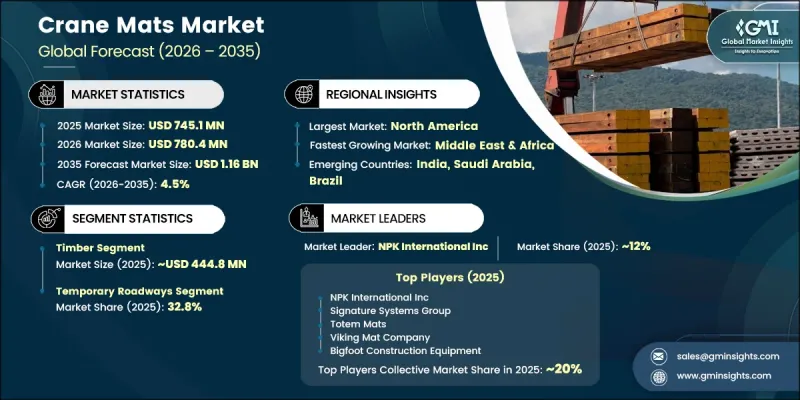
The global crane mats market is witnessing steady growth, supported by rising investments in infrastructure development, expanding renewable energy projects, and increasing demand for reliable ground protection solutions across construction and industrial operations. Long-term infrastructure modernization initiatives and growing capital expenditure on utility, transportation, and energy projects are creating sustained demand for crane mats in temporary access roads and heavy equipment support applications. In addition, the market is benefiting from the growing preference for composite materials, which offer improved durability, lower maintenance requirements, and enhanced cost efficiency in applications involving repeated use. Increasing environmental awareness and stricter workplace safety regulations are encouraging contractors to adopt advanced matting solutions that minimize ground disturbance while improving operational safety. Continuous investments in renewable energy installations, including large-scale wind power projects, are further strengthening product demand. As construction activities expand globally and project developers seek durable, reusable, and high-performance ground protection systems, the outlook for the global crane mats market remains positive across both infrastructure development and industrial construction applications.
| Market Scope | |
|---|---|
| Start Year | 2025 |
| Forecast Year | 2026-2035 |
| Start Value | $745.1 Million |
| Forecast Value | $1.16 Billion |
| CAGR | 4.5% |
The timber segment generated USD 444.8 million in 2025 and is expected to grow at a CAGR of 3.1% between 2026 and 2035. Timber crane mats continue to maintain a strong position in the market due to their widespread use in temporary access roads, pipeline construction projects, and general heavy equipment support applications. Their broad availability, dependable load-bearing capabilities, and suitability for demanding site conditions continue to make timber mats a preferred solution across multiple regions. Consistent demand from infrastructure, construction, and energy projects is expected to support the segment's steady growth throughout the forecast period.
The temporary roadways segment accounted for 32.8% share in 2025 and is projected to grow at a CAGR of 4.3% from 2026 to 2035. The segment is experiencing continued growth as infrastructure development projects increasingly require stable temporary access routes for heavy construction equipment operating in challenging terrain. Rising investments in transportation, utility, and energy infrastructure are creating additional opportunities for temporary roadway applications, supporting long-term demand for crane mat solutions.
U.S. Crane Mats Market was valued at USD 240 million in 2025. Strong infrastructure investment, expanding energy sector activities, and increasing expenditures on utility transmission and grid modernization projects continue to support demand for crane mats across the country. Growing construction activity and ongoing investments in large-scale industrial developments are expected to reinforce the U.S. market's leading position during the forecast period.
Major companies operating in the global crane mats market include Beasley Group, Signature Systems Group, Viking Mat Company, Quality Mat Company, NPK / Newpark Resources, VM Group, Spartan Mat, DICA, Northern Mat & Bridge, Crane Mats Industries, Welex Group, Ko-Mats GmbH, Buckeye Mats, The Crane Mat Company, Totem Mats, Universal Crane Mats Ltd., Boone Valley Forest Products, Sterling Crane Mats, Pioonier GmbH, Raptor Tech Inc., and Calumet Harbor Lumber. Companies operating in the crane mats market are strengthening their market presence by expanding product portfolios with durable timber, composite, and engineered mat solutions designed for demanding construction and industrial environments. Manufacturers are investing in advanced materials, product innovation, and manufacturing improvements to enhance load-bearing capacity, product lifespan, and operational efficiency. Strategic collaborations with construction contractors, infrastructure developers, and energy companies are helping businesses secure long-term supply agreements and broaden their customer base. Companies are also expanding production facilities and distribution networks to improve product availability across key regional markets. In addition, investments in sustainable manufacturing practices, equipment rental services, customized mat solutions, and comprehensive after-sales support are enabling market participants to improve customer satisfaction, strengthen competitive positioning, and increase long-term market share in the global crane mats market.
Table of Contents
Chapter 1 Research methodology
- 1.1 Research approach
- 1.2 Quality Commitments
- 1.2.1 GMI AI policy & data integrity commitment
- 1.2.1.1 Source consistency protocol
- 1.2.1 GMI AI policy & data integrity commitment
- 1.3 Research trail & confidence scoring
- 1.3.1 Research trail components
- 1.3.2 Scoring components
- 1.4 Data Collection
- 1.4.1 Partial list of primary sources
- 1.5 Data mining sources
- 1.5.1 Paid sources
- 1.5.1.1 Sources, by region
- 1.5.1 Paid sources
- 1.6 Base estimates and calculations
- 1.6.1 Base year calculation
- 1.7 Forecast model
- 1.7.1 Quantified market impact analysis
- 1.7.1.1 Mathematical impact of growth parameters on forecast
- 1.7.1 Quantified market impact analysis
- 1.8 Research transparency addendum
- 1.8.1 Source attribution framework
- 1.8.2 Quality assurance metrics
- 1.8.3 Our commitment to trust
Chapter 2 Executive Summary
- 2.1 Industry 360° synopsis
- 2.2 Business trends
- 2.3 Regional
- 2.4 Material
- 2.5 Application
- 2.6 End use industry
- 2.7 Distribution channel
Chapter 3 Industry Insights
- 3.1 Industry ecosystem analysis
- 3.1.1 Supplier landscape
- 3.1.2 Manufacturers
- 3.1.3 Distributors
- 3.1.4 Retailers
- 3.1.5 Profit margin analysis
- 3.1.6 Value addition at each stage
- 3.1.7 Factor affecting the value chain
- 3.2 Industry impact forces
- 3.2.1 Growth drivers
- 3.2.1.1 Global oil & gas upstream Capex expansion
- 3.2.1.2 U.S. IIJA and global infrastructure investment
- 3.2.1.3 Renewable energy construction expansion
- 3.2.2 Industry pitfalls & challenges
- 3.2.2.1 Energy transition risk moderating pipeline application growth
- 3.2.2.2 Timber supply chain volatility and sustainability pressure
- 3.2.3 Opportunities
- 3.2.1 Growth drivers
- 3.3 Growth potential analysis
- 3.4 Technology and innovation landscape
- 3.4.1 Current technological trends
- 3.4.2 Emerging technologies
- 3.5 Pricing analysis (driven by primary research)
- 3.5.1 Historical price trend analysis by product category
- 3.5.2 Pricing strategy by player type (premium / value / cost-plus)
- 3.6 Trade data analysis (based on paid database)
- 3.6.1 Import/export volume & value trends
- 3.6.2 Key trade corridors & tariff impact
- 3.7 Regulatory landscape
- 3.7.1 Standards and compliance requirements
- 3.7.2 Regional regulatory frameworks
- 3.7.3 Certification standards
- 3.8 Porter’s analysis
- 3.9 PESTEL analysis
- 3.10 Impact of AI & generative AI on the market
- 3.10.1 AI-driven disruption of existing business models
- 3.10.2 GenAI use cases & adoption roadmap by segment
- 3.10.3 Risks, limitations & regulatory considerations
Chapter 4 Competitive Landscape, 2025
- 4.1 Introduction
- 4.2 Company market share analysis
- 4.2.1 By Region
- 4.2.1.1 North America
- 4.2.1.2 Europe
- 4.2.1.3 Asia Pacific
- 4.2.1.4 Latin America
- 4.2.1.5 Middle East & Africa
- 4.2.1 By Region
- 4.3 Company matrix analysis
- 4.4 Competitive analysis of major market players
- 4.5 Competitive positioning matrix
- 4.6 Key developments
- 4.6.1 Mergers & acquisitions
- 4.6.2 Partnerships & collaborations
- 4.6.3 New product launches
- 4.6.4 Expansion plans
Chapter 5 Market Estimates & Forecast, By Material, 2022 – 2035, (USD Million) (Units)
- 5.1 Key trends
- 5.2 Timber
- 5.3 Composite/plastic
- 5.4 Steel
- 5.5 Others
Chapter 6 Market Estimates & Forecast, By Application, 2022 – 2035, (USD Million) (Units)
- 6.1 Key trends
- 6.2 Temporary roadways
- 6.3 Bridge decking
- 6.4 Excavation support
- 6.5 Pipeline construction
- 6.6 Others
Chapter 7 Market Estimates & Forecast, By End Use Industry, 2022 – 2035, (USD Million) (Units)
- 7.1 Key trends
- 7.2 Oil & gas
- 7.3 Construction
- 7.4 Renewable energy
- 7.5 Mining and heavy industry
- 7.6 Telecommunication
- 7.7 Others
Chapter 8 Market Estimates & Forecast, By Distribution Channel, 2022 – 2035, (USD Million) (Units)
- 8.1 Key trends
- 8.2 Direct Sales
- 8.3 Indirect Sales
Chapter 9 Market Estimates & Forecast, By Region, 2022 – 2035, (USD Million) (Units)
- 9.1 Key trends
- 9.2 North America
- 9.2.1 U.S
- 9.2.2 Canada
- 9.3 Europe
- 9.3.1 Germany
- 9.3.2 UK
- 9.3.3 France
- 9.3.4 Italy
- 9.3.5 Spain
- 9.3.6 Sweden
- 9.3.7 Netherlands
- 9.4 Asia Pacific
- 9.4.1 China
- 9.4.2 India
- 9.4.3 Japan
- 9.4.4 South Korea
- 9.4.5 Australia
- 9.4.6 Indonesia
- 9.5 Latin America
- 9.5.1 Brazil
- 9.5.2 Mexico
- 9.5.3 Argentina
- 9.6 Middle East and Africa
- 9.6.1 Saudi Arabia
- 9.6.2 UAE
- 9.6.3 South Africa
Chapter 10 Company Profiles
- 10.1 Global Players
- 10.1.1 Beasley Group
- 10.1.2 NPK / Newpark Resources
- 10.1.3 Quality Mat Company
- 10.1.4 Spartan Mat
- 10.1.5 Viking Mat Company
- 10.1.6 VM Group
- 10.1.7 Signature Systems Group
- 10.1.8 DICA
- 10.2 Regional Players
- 10.2.1 Northern Mat & Bridge
- 10.2.2 Crane Mats Industries
- 10.2.3 Welex Group
- 10.2.4 Ko-Mats GmbH
- 10.2.5 Buckeye Mats
- 10.2.6 The Crane Mat Company
- 10.2.7 Totem Mats
- 10.3 Emerging Players & Innovators
- 10.3.1 Universal Crane Mats Ltd.
- 10.3.2 Boone Valley Forest Products
- 10.3.3 Sterling Crane Mats
- 10.3.4 Pionier GmbH
- 10.3.5 Raptor Tech Inc.
- 10.3.6 Calumet Harbor Lumber

