PUBLISHER: Global Market Insights Inc. | PRODUCT CODE: 2109306

PUBLISHER: Global Market Insights Inc. | PRODUCT CODE: 2109306
Asia Pacific Water Heater Market Opportunity, Growth Drivers, Industry Trend Analysis, and Forecast 2026 - 2035
Asia Pacific Water Heater Market was valued at USD 11 billion in 2025 and is estimated to grow at a CAGR of 6.3% to reach USD 19.8 billion by 2035.
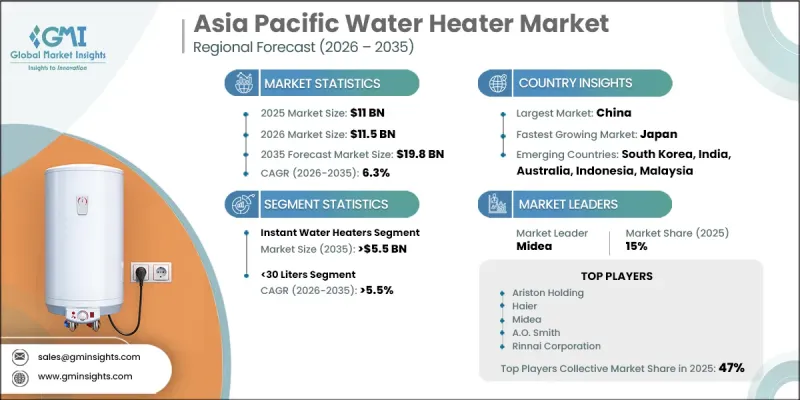
Market growth is driven by rapid urbanization, expanding residential construction, rising disposable incomes, and increasing consumer preference for energy-efficient water heating solutions. Across Asia Pacific, improving living standards and growing awareness of hygiene and household comfort are accelerating the adoption of modern water heaters in both residential and commercial applications. Governments across the region are also promoting energy-efficient appliances through stringent building regulations, energy labeling programs, and initiatives aimed at reducing greenhouse gas emissions, encouraging consumers to replace conventional systems with advanced electric and smart water heaters. The growing penetration of smart homes, digital connectivity, and IoT-enabled appliances is further reshaping the industry, with manufacturers introducing products featuring Wi-Fi connectivity, app-based controls, remote temperature management, energy monitoring, and predictive maintenance. Rising investments in housing projects, electrification, and premium home appliances across emerging economies such as India, Vietnam, Indonesia, and the Philippines are creating significant opportunities for manufacturers. At the same time, developed markets including Japan, South Korea, Australia, and New Zealand continue to witness demand for premium storage systems offering higher efficiency, superior insulation, and enhanced safety features. Collectively, these factors are expected to sustain robust market growth over the forecast period.
| Market Scope | |
|---|---|
| Start Year | 2025 |
| Forecast Year | 2026-2035 |
| Start Value | $11 Billion |
| Forecast Value | $19.8 Billion |
| CAGR | 6.3% |
The storage water heaters segment reached USD 14 billion by 2035. The segment continues to maintain its leadership owing to its ability to provide a continuous supply of hot water across multiple outlets, making it highly suitable for family homes, premium apartments, hotels, hospitals, and commercial establishments. Storage water heaters remain particularly popular in colder countries such as China, Japan, South Korea, Australia, and New Zealand, where larger households and lower ambient temperatures require greater hot water availability. Manufacturers are increasingly incorporating thicker insulation, corrosion-resistant tanks, intelligent temperature management systems, and energy-efficient heating elements to reduce standby heat losses and improve operating efficiency. Growing consumer inclination toward premium appliances, increasing construction of luxury residential projects, and stricter energy-efficiency regulations are also encouraging the replacement of conventional storage systems with technologically advanced models.
The <30 liters water heater segment is projected to grow at a CAGR of 5.5% by 2035, driven by rising urbanization, modern home designs, and the growing preference for compact living solutions. Increasing demand for space-efficient appliances has encouraged consumers to adopt small-capacity water heaters featuring sleek designs, attractive aesthetics, and convenient installation options for everyday use. As lifestyles continue to prioritize efficiency, flexibility, and convenience, the adoption of compact water heaters is expected to witness steady growth in the coming years.
China Water Heater Market reached USD 6.2 billion in 2025. The country's leadership is supported by its massive urban population, strong residential construction activity, extensive manufacturing ecosystem, and widespread adoption of modern household appliances. Continuous urban redevelopment, rising household incomes, and increasing demand for premium smart home products are driving replacement of traditional water heaters with energy-efficient electric and intelligent storage systems. China also serves as the manufacturing hub for many global and regional water heater brands, benefiting from well-established supply chains, technological expertise, and economies of scale. Government initiatives promoting energy-efficient appliances, strict efficiency standards, and environmental sustainability continue to stimulate consumer demand for advanced products featuring smart connectivity, energy monitoring, and intelligent temperature control.
Leading companies operating in the Asia Pacific Water Heater Market include A.O. Smith, Ariston Holding, Rinnai Corporation, Rheem Manufacturing Company, Stiebel Eltron, Bradford White Corporation, Viessmann, Bosch Thermotechnology, Haier Smart Home, Havells India, Panasonic Holdings, Racold, Jaquar India, Toshiba Corporation, Ferroli, Groupe Atlantic, Thermex Corporation, Thermann, State Water Heaters, Hubbell Heaters, JOVEN Electric, Bajaj Electricals, Aquamax Australia, Linuo Ritter, and Vaillant Group. Manufacturers operating in the Asia Pacific Water Heater Market are strengthening their market position through continuous product innovation, manufacturing expansion, strategic acquisitions, partnerships, and localization initiatives. Companies are increasingly investing in smart and energy-efficient water heaters equipped with Wi-Fi connectivity, IoT-enabled monitoring, mobile application control, digital temperature management, predictive maintenance capabilities, and advanced safety technologies to differentiate their product portfolios. Several leading players are expanding manufacturing capacity across high-growth markets such as India and Southeast Asia to reduce production costs, improve supply-chain resilience, and address rising regional demand. Businesses are also pursuing acquisitions and strategic collaborations to broaden their product offerings and strengthen their distribution networks.
Table of Contents
Chapter 1 Methodology & Scope
- 1.1 Research design
- 1.2 Quality commitment
- 1.2.1 GMI AI policy & data integrity commitment
- 1.2.1.1 Source consistency protocol
- 1.2.1 GMI AI policy & data integrity commitment
- 1.3 Research trail & confidence scoring
- 1.3.1 Research trail components
- 1.3.2 Scoring components
- 1.4 Data collection
- 1.4.1 Partial list of primary sources
- 1.5 Data mining sources
- 1.5.1 Paid sources
- 1.5.1.1 Sources, by region
- 1.5.1 Paid sources
- 1.6 Base estimates and calculations
- 1.6.1 Base year calculation for any one approach
- 1.7 Forecast model
- 1.8 Research transparency addendum
- 1.8.1 Source attribution framework
- 1.8.2 Quality assurance metrics
- 1.8.3 Our commitment to trust
- 1.9 Market definitions
Chapter 2 Executive Summary
- 2.1 Industry synopsis, 2022 - 2035
- 2.2 Business trends
- 2.3 Product trends
- 2.4 Capacity trends
- 2.5 Application trends
- 2.6 Energy Source trends
- 2.7 Country trends
Chapter 3 Industry Insights
- 3.1 Industry ecosystem
- 3.1.1 Raw material availability & sourcing analysis
- 3.1.2 Manufacturing capacity assessment
- 3.1.3 Supply chain resilience & risk factors
- 3.1.4 Distribution network analysis
- 3.2 Regulatory landscape
- 3.3 Industry impact forces
- 3.3.1 Growth drivers
- 3.3.2 Industry pitfalls & challenges
- 3.4 Growth potential analysis
- 3.5 Porter's analysis
- 3.5.1 Bargaining power of suppliers
- 3.5.2 Bargaining power of buyers
- 3.5.3 Threat of new entrants
- 3.5.4 Threat of substitutes
- 3.6 PESTEL analysis
- 3.6.1 Political factors
- 3.6.2 Economic factors
- 3.6.3 Social factors
- 3.6.4 Technological factors
- 3.6.5 Legal factors
- 3.6.6 Environmental factors
- 3.7 Price trends analysis
- 3.7.1 By product
- 3.7.2 By country
- 3.8 Emerging opportunities & trends
- 3.9 Digitalization & IoT integration
- 3.10 Investment analysis and future outlook
Chapter 4 Competitive landscape, 2026
- 4.1 Introduction
- 4.2 Company market share analysis, by country, 2025
- 4.2.1 China
- 4.2.2 Japan
- 4.2.3 South Korea
- 4.2.4 India
- 4.2.5 Australia
- 4.2.6 Indonesia
- 4.2.7 Malaysia
- 4.2.8 Singapore
- 4.2.9 Thailand
- 4.2.10 New Zealand
- 4.2.11 Philippines
- 4.2.12 Vietnam
- 4.3 Competitive analysis of major market players
- 4.4 Competitive positioning matrix
- 4.5 Key developments
- 4.5.1 Mergers & acquisitions
- 4.5.2 Partnerships & collaborations
- 4.5.3 New product launches
- 4.5.4 Expansion plans & funding
- 4.6 Company tier benchmarking
- 4.6.1 Tier classification criteria & qualifying thresholds
- 4.6.2 Tier positioning matrix by revenue, geography & innovation
Chapter 5 Market Size and Forecast, By Product, 2022 - 2035 (USD Million, '000 Units)
- 5.1 Key trends
- 5.2 Instant
- 5.3 Storage
Chapter 6 Market Size and Forecast, By Capacity, 2022 - 2035 (USD Million, '000 Units)
- 6.1 Key trends
- 6.2 <30 liters
- 6.3 30-100 liters
- 6.4 100-250 liters
- 6.5 250-400 liters
- 6.6 >400 liters
Chapter 7 Market Size and Forecast, By Application, 2022 - 2035 (USD Million, '000 Units)
- 7.1 Key trends
- 7.2 Residential
- 7.2.1 Shower
- 7.2.2 Dishwashing
- 7.2.3 Washing Machine
- 7.2.4 Others
- 7.3 Commercial
- 7.3.1 College/University
- 7.3.2 Office Buildings
- 7.3.3 Government Buildings
- 7.3.4 Others
Chapter 8 Market Size and Forecast, By Energy Source, 2022 - 2035 (USD Million, '000 Units)
- 8.1 Key trends
- 8.2 Electric
- 8.3 Gas
- 8.3.1 Natural Gas
- 8.3.2 LPG
Chapter 9 Market Size and Forecast, By Country, 2022 - 2035 (USD Million, '000 Units)
- 9.1 Key trends
- 9.2 China
- 9.3 Japan
- 9.4 South Korea
- 9.5 India
- 9.6 Australia
- 9.7 Indonesia
- 9.8 Malaysia
- 9.9 Singapore
- 9.10 Thailand
- 9.11 New Zealand
- 9.12 Philippines
- 9.13 Vietnam
Chapter 10 Company Profiles
- 10.1 AQUAMAX AUSTRALIA
- 10.2 Ariston Holding
- 10.3 Bajaj Electricals
- 10.4 Bosch Thermotechnology Corp.
- 10.5 Bradford White Corporation
- 10.6 FERROLI
- 10.7 GE Appliances
- 10.8 Groupe Atlantic
- 10.9 Haier
- 10.10 Havells India
- 10.11 Hubbell Heaters
- 10.12 Jaquar India
- 10.13 JOVEN Electric
- 10.14 Linuo Ritter
- 10.15 Midea
- 10.16 Panasonic Holding Corporation
- 10.17 Racold
- 10.18 Rheem Manufacturing Company
- 10.19 Rinnai Corporation
- 10.20 State Water Heater
- 10.21 Stiebel Eltron
- 10.22 Toshiba Corporation
- 10.23 Vaillant Group
- 10.24 Viessmann

