PUBLISHER: Global Market Insights Inc. | PRODUCT CODE: 2109310

PUBLISHER: Global Market Insights Inc. | PRODUCT CODE: 2109310
Precision Gearbox Market Opportunity, Growth Drivers, Industry Trend Analysis, and Forecast 2026 - 2035
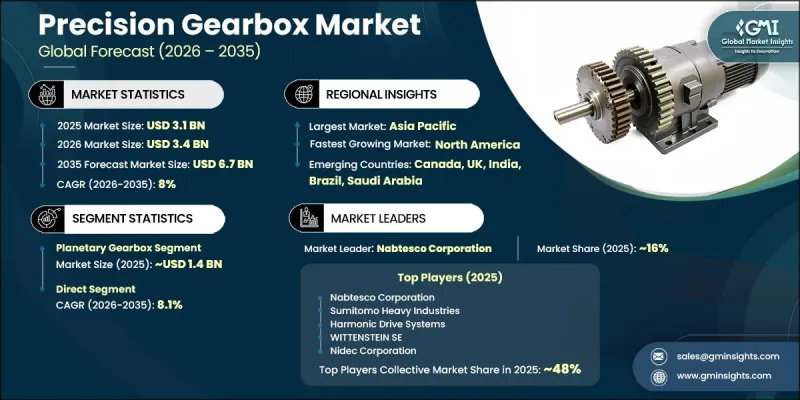
The Global Precision Gearbox Market was valued at USD 3.1 billion in 2025 and is estimated to grow at a CAGR of 8% to reach USD 6.7 billion in 2035.
The increasing deployment of industrial robots and collaborative robots (cobots) across manufacturing industries is a key factor supporting market growth. Companies in automotive, electronics, metal processing, food production, packaging, warehousing, and logistics are increasingly integrating robotic automation to improve operational efficiency, enhance production consistency, reduce dependence on manual labor, and enable continuous manufacturing processes. Precision gearbox technologies, including harmonic, planetary, and cycloidal systems, play an essential role in robotic mechanisms by providing accurate motion control, high torque transfer, minimal backlash, and strong torsional performance. These capabilities support demanding automation functions where speed, precision, and repeatability are critical for improving manufacturing output and quality. The growing adoption of cobots among small and medium-sized enterprises is further creating new opportunities for precision gearbox suppliers, as these systems provide easier integration, flexible deployment options, and efficient automation capabilities compared with traditional robotic solutions.
| Market Scope | |
|---|---|
| Start Year | 2025 |
| Forecast Year | 2026-2035 |
| Start Value | $3.1 Billion |
| Forecast Value | $6.7 Billion |
| CAGR | 8% |
The planetary gearbox segment generated USD 1.4 billion in 2025 and is expected to grow at a CAGR of 7.9% from 2026 to 2035. Planetary gearboxes are widely preferred across automated industrial applications because they provide high torque density, compact construction, low mechanical backlash, and excellent positioning accuracy. Their integration into robotic systems, machine tools, packaging equipment, semiconductor production machinery, automated guided vehicles (AGVs), autonomous mobile robots (AMRs), and servo-based automation platforms continues to increase as industries accelerate digital transformation and automation adoption. The growing use of robotic and automated technologies across manufacturing, electronics, automotive, and logistics sectors is strengthening demand for planetary gearboxes, particularly in applications requiring precise movement control and reliable performance.
The direct distribution channel accounted for a 60.4% share in 2025, and is projected to grow at a CAGR of 8.1% from 2026 to 2035. The dominance of this channel is linked to the specialized engineering requirements and customized nature of precision gearbox solutions. Many end users prefer direct engagement with manufacturers to obtain application-specific support, technical expertise, and optimized product configurations. Industries requiring advanced motion-control solutions often need gearboxes designed according to specific torque, speed, accuracy, and performance requirements. Direct sales channels allow manufacturers to provide detailed product guidance, engineering assistance, installation support, and post-sales services, helping customers achieve reliable operation and improved system performance.
U.S. Precision Gearbox Market reached USD 541 million in 2025 and is expected to grow at a CAGR of 8.2% from 2026 to 2035. Increasing installation of industrial robots and collaborative robots across manufacturing facilities is driving demand for advanced gearbox technologies, including planetary, harmonic, and cycloidal systems. These precision transmission solutions are essential for achieving accurate movement control, consistent positioning, and efficient torque management in automated equipment. In addition, expanding semiconductor manufacturing activities supported by investments in domestic production facilities are generating further opportunities for precision gearbox suppliers. The requirement for highly accurate motion-control components in semiconductor processing and inspection equipment is contributing to market expansion throughout the country.
Key players operating in the global precision gearbox industry include Harmonic Drive LLC / Harmonic Drive Systems Inc., Nabtesco Corporation, WITTENSTEIN SE, Nidec-Shimpo Corporation, Sumitomo Drive Technologies, SEW-EURODRIVE GmbH & Co KG, Apex Dynamics, Inc., Neugart GmbH, Stober Antriebstechnik GmbH & Co. KG, Bonfiglioli Riduttori S.p.A., Parker Hannifin Corporation, Cone Drive, Spinea s.r.o., GAM Enterprises, Inc., and Framo Morat GmbH & Co. KG. Companies operating in the precision gearbox market are focusing on innovation, product customization, strategic partnerships, and manufacturing improvements to strengthen their competitive position. Manufacturers are investing in advanced gearbox designs that offer higher efficiency, improved durability, reduced backlash, and enhanced motion accuracy to meet rising automation requirements. Companies are also expanding their engineering capabilities to provide customized solutions for robotics, semiconductor equipment, medical technologies, and industrial automation applications. Strengthening direct customer relationships, improving distribution networks, and enhancing technical support services are additional strategies being adopted to increase market presence.
Table of Contents
Chapter 1 Methodology & Scope
- 1.1 Market scope and definition
- 1.2 Research design
- 1.2.1 Research approach
- 1.2.2 Data collection methods
- 1.3 Base estimates and calculations
- 1.3.1 Base year calculation
- 1.3.2 Market estimates & forecasts parameters
- 1.4 Forecast Model
- 1.4.1 Key trends for market estimates
- 1.4.2 Quantified market impact analysis
- 1.4.2.1 Mathematical impact of growth parameters on forecast
- 1.4.3 Scenario analysis framework
- 1.5 Data mining sources
- 1.5.1 Paid Sources
- 1.6 Primary research and validation
- 1.6.1 Primary sources
- 1.7 Research Trail & confidence scoring
- 1.7.1 Research trail components
- 1.7.2 Scoring components
- 1.8 Research transparency addendum
- 1.8.1 Source attribution framework
- 1.8.2 Quality assurance metrics
- 1.9 Our commitment to trust
Chapter 2 Executive Summary
- 2.1 Industry 360° synopsis
- 2.2 Key market trends
- 2.2.1 Regional
- 2.2.2 Gear technology
- 2.2.3 Product configuration
- 2.2.4 Precision level
- 2.2.5 Torque capacity
- 2.2.6 Application
- 2.2.7 End-use industry
- 2.2.8 Distribution channel
Chapter 3 Industry Insights
- 3.1 Industry ecosystem analysis
- 3.1.1 Supplier landscape
- 3.1.2 Profit margin
- 3.1.3 Value addition at each stage
- 3.1.4 Factor affecting the value chain
- 3.2 Industry impact forces
- 3.2.1 Growth drivers
- 3.2.1.1 Rapid expansion of industrial robotics & collaborative robot (cobot) deployments
- 3.2.1.2 Growing adoption of CNC machine tools in Asia Pacific manufacturing
- 3.2.1.3 Rising demand from surgical robotics & medical device sector
- 3.2.1.4 Emergence of humanoid robots creating ultra-high-precision gearbox demand
- 3.2.2 Industry pitfalls & challenges
- 3.2.2.1 Raw material price volatility (high-grade alloy steel, specialty bearings)
- 3.2.2.2 Geopolitical tensions & trade tariffs disrupting supply chains
- 3.2.2.3 Threat of substitution from direct-drive actuators & linear motor systems
- 3.2.3 Opportunities
- 3.2.3.1 Semiconductor equipment expansion driving demand for ultra precision (≤1 arcmin) units
- 3.2.3.2 Defense & aerospace modernization programs fueling specialized gearbox procurement
- 3.2.3.3 Ev & next-generation automotive assembly automation investments
- 3.2.3.4 Adoption of smart/connected gearboxes in industry 4.0 environments
- 3.2.1 Growth drivers
- 3.3 Growth potential analysis
- 3.4 Future market trends
- 3.5 Technology and innovation landscape
- 3.5.1 Current technological trends
- 3.5.2 Emerging technologies
- 3.6 Regulatory landscape
- 3.6.1 Standards and compliance requirements
- 3.6.2 Regional regulatory frameworks
- 3.6.3 Certification standards
- 3.7 Trade data analysis (HS Code 8483.40)
- 3.7.1 Import/export volume & value trends
- 3.7.2 Key trade corridors & tariff impact
- 3.8 Pricing analysis
- 3.8.1 Historical price trend analysis (driven by primary research)
- 3.8.2 Pricing strategy by player type (premium / value / mass market)
- 3.9 Impact of AI & generative AI on the market
- 3.9.1 AI-driven disruption of existing business models
- 3.9.2 GenAI use cases & adoption roadmap by segment
- 3.9.3 Risks, limitations & regulatory considerations
- 3.10 Porter’s analysis
- 3.11 PESTEL analysis
- 3.12 Consumer buying behavior analysis
- 3.12.1 Demographic trends
- 3.12.2 Factors affecting buying decisions
- 3.12.3 Consumer product adoption
- 3.12.4 Preferred distribution channel
Chapter 4 Competitive Landscape, 2025
- 4.1 Introduction
- 4.2 Company market share analysis
- 4.2.1 By Region
- 4.2.1.1 North America
- 4.2.1.2 Europe
- 4.2.1.3 Asia Pacific
- 4.2.1.4 Latin America
- 4.2.1.5 Middle East & Africa
- 4.2.1 By Region
- 4.3 Company matrix analysis
- 4.4 Competitive analysis of major market players
- 4.5 Competitive positioning matrix
- 4.6 Key developments
- 4.6.1 Mergers & acquisitions
- 4.6.2 Partnerships & collaborations
- 4.6.3 New product launches
- 4.6.4 Expansion plans
Chapter 5 Market Estimates & Forecast, By Gear Technology, 2022 – 2035, (USD Billion) (Thousand Units)
- 5.1 Key trends
- 5.2 Planetary gearbox
- 5.3 Harmonic drive (strain wave) gearbox
- 5.4 Cycloidal gearbox
- 5.5 Bevel gearbox
- 5.6 Others (spur, worm & emerging architectures)
Chapter 6 Market Estimates & Forecast, By Product Configuration, 2022 – 2035, (USD Billion) (Thousand Units)
- 6.1 Key trends
- 6.2 Inline / coaxial
- 6.3 Right angle
- 6.4 Parallel shaft
Chapter 7 Market Estimates & Forecast, By Precision Level, 2022 – 2035, (USD Billion) (Thousand Units)
- 7.1 Key trends
- 7.2 Standard precision (Backlash > 8 arcmin; Grade 6)
- 7.3 Medium precision (Backlash 3–8 arcmin; Grade 5)
- 7.4 High precision (Backlash 1–3 arcmin; AGMA Grade 4)
- 7.5 Ultra precision (Backlash ≤ 1 arcmin; Grade 3)
Chapter 8 Market Estimates & Forecast, By Torque Capacity, 2022 – 2035, (USD Billion) (Thousand Units)
- 8.1 Key trends
- 8.2 Less than 50 Nm
- 8.3 50 Nm – 200 Nm
- 8.4 200 Nm – 500 Nm
- 8.5 500 Nm – 1,000 Nm
- 8.6 Above 1,000 Nm
Chapter 9 Market Estimates & Forecast, By Application, 2022 – 2035, (USD Billion) (Thousand Units)
- 9.1 Key trends
- 9.2 Robotics
- 9.3 Machine tools
- 9.4 Material handling
- 9.5 Packaging
- 9.6 Medical
- 9.7 Aerospace & defense
- 9.8 Food & beverage
- 9.9 Semiconductor equipment
- 9.10 Others (construction, agriculture, energy, railways)
Chapter 10 Market Estimates & Forecast, By End-Use Industry, 2022 – 2035, (USD Billion) (Thousand Units)
- 10.1 Key trends
- 10.2 Automotive & electric vehicles (EV)
- 10.3 Electronics & semiconductor
- 10.4 Healthcare & life sciences
- 10.5 Aerospace & defense
- 10.6 Industrial machinery & automation
- 10.7 Food, beverage & packaging
- 10.8 Energy (wind turbine pitch/yaw, solar tracking)
- 10.9 Others (agriculture, construction, railways)
Chapter 11 Market Estimates & Forecast, By Distribution Channel, 2022 – 2035, (USD Billion) (Thousand Units)
- 11.1 Key trends
- 11.2 Direct sales
- 11.3 Indirect sales
Chapter 12 Market Estimates & Forecast, By Region, 2022 – 2035, (USD Billion) (Thousand Units)
- 12.1 Key trends
- 12.2 North America
- 12.2.1 U.S.
- 12.2.2 Canada
- 12.3 Europe
- 12.3.1 Germany
- 12.3.2 UK
- 12.3.3 France
- 12.3.4 Italy
- 12.3.5 Spain
- 12.4 Asia Pacific
- 12.4.1 China
- 12.4.2 India
- 12.4.3 Japan
- 12.4.4 South Korea
- 12.4.5 Australia
- 12.4.6 Indonesia
- 12.4.7 Malaysia
- 12.5 Latin America
- 12.5.1 Brazil
- 12.5.2 Mexico
- 12.5.3 Argentina
- 12.6 MEA
- 12.6.1 Saudi Arabia
- 12.6.2 UAE
- 12.6.3 South Africa
Chapter 13 Company Profiles
- 13.1 Top Global Players
- 13.1.1 Harmonic Drive LLC / Harmonic Drive Systems Inc.
- 13.1.2 Nabtesco Corporation
- 13.1.3 WITTENSTEIN SE
- 13.1.4 Nidec-Shimpo Corporation
- 13.1.5 Sumitomo Drive Technologies
- 13.1.6 SEW-EURODRIVE GmbH & Co KG
- 13.1.7 Apex Dynamics, Inc.
- 13.2 Regional Champions
- 13.2.1 Neugart GmbH
- 13.2.2 Stober Antriebstechnik GmbH & Co. KG
- 13.2.3 Bonfiglioli Riduttori S.p.A.
- 13.2.4 Parker Hannifin Corporation
- 13.2.5 Cone Drive
- 13.3 Emerging Players
- 13.3.1 Spinea s.r.o.
- 13.3.2 GAM Enterprises, Inc.
- 13.3.3 Framo Morat GmbH & Co. KG

