PUBLISHER: Global Market Insights Inc. | PRODUCT CODE: 2121111

PUBLISHER: Global Market Insights Inc. | PRODUCT CODE: 2121111
Mobile Phone Power Management IC (PMIC) Market Opportunity, Growth Drivers, Industry Trend Analysis, and Forecast 2026 - 2035
The Global Mobile Phone Power Management IC Market was valued at USD 6.1 billion in 2025 and is estimated to grow at a CAGR of 7.1% to reach USD 12.1 billion by 2035.
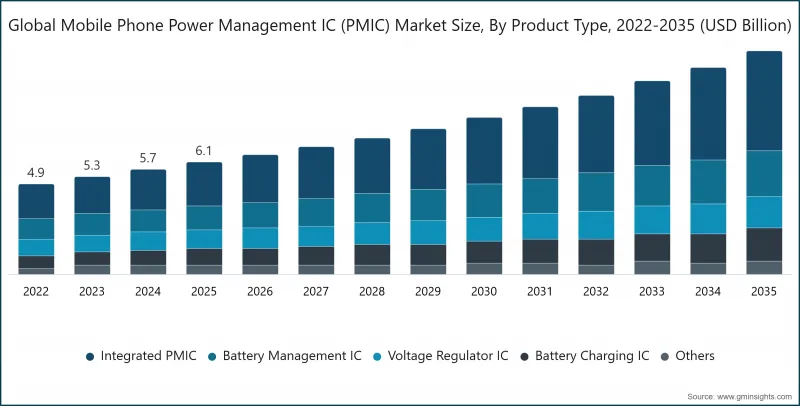
The mobile phone power management IC industry is benefiting from the continued expansion of smartphone manufacturing and the growing integration of advanced technologies into mobile devices. The increasing use of 5G connectivity, artificial intelligence, and high-performance processors is raising the need for sophisticated power management solutions capable of supporting demanding device architectures. Consumers are also placing greater emphasis on extended battery life and improved energy efficiency, encouraging manufacturers to adopt more advanced PMIC technologies. At the same time, semiconductor and electronics manufacturing is expanding with support from government initiatives, creating favorable conditions for PMIC suppliers. The rapid adoption of fast-charging solutions and sophisticated battery management systems is further increasing demand for highly integrated and efficient power management components. As smartphone functionality continues to advance, manufacturers require PMICs that can efficiently manage power distribution while supporting performance, safety, and thermal requirements. These trends are encouraging continued innovation in mobile power management technologies and supporting steady expansion of the global mobile phone power management IC market through 2035.
| Market Scope | |
|---|---|
| Start Year | 2025 |
| Forecast Year | 2026-2035 |
| Start Value | $6.1 Billion |
| Forecast Value | $12.1 Billion |
| CAGR | 7.1% |
The smartphone segment captured USD 1.6 billion in 2025. Modern smartphones require PMICs to manage a broad range of power-related functions, including battery charging, voltage regulation, power sequencing, thermal monitoring, and energy-efficiency optimization. Increasing adoption of 5G-enabled smartphones and devices equipped with AI-powered processors is raising the complexity of power architectures. The integration of high-resolution and high-refresh-rate displays, multiple camera configurations, and high-speed charging capabilities is also increasing the amount of PMIC functionality required in each device. These developments are contributing to stronger demand for advanced power management IC solutions within the smartphone segment.
The integrated PMIC segment accounted for 39.5% share in 2025. Its strong market position is supported by the ability to consolidate multiple power management functions onto a single semiconductor die. Integrated PMIC solutions can combine voltage management, battery charging control, power sequencing, thermal monitoring, and system safety functions within one component. This high level of integration can support more efficient power architectures while helping manufacturers address space and performance requirements within increasingly sophisticated mobile devices.
North America Mobile Phone Power Management IC Market held a 16.3% share in 2025. The regional market is supported by the strong presence of major semiconductor suppliers, continued demand for premium smartphones, and rapid adoption of 5G and AI-enabled mobile devices. Increasing research and development spending across semiconductor technologies, advanced chipsets, and energy-efficient chip solutions is also contributing to market development. These investments are supporting the advancement of next-generation PMIC technologies designed to meet the increasingly demanding power requirements of advanced and flagship smartphones.
Prominent companies operating in the global mobile phone power management IC market include Qualcomm Technologies, Texas Instruments, Analog Devices (ADI), MediaTek, Infineon Technologies, NXP Semiconductor, Renesas Electronics, Monolithic Power Systems (MPS), STMicroelectronics, onsemi (ON Semiconductor), ROHM Co., Ltd., Samsung System LSI, Toshiba Electronic Devices & Storage, Awinic Technology (Shanghai Awinic), Silergy Corp, NuVolta Technologies, SGMICRO (SG Micro), Silicon Mitus, Southchip Semiconductor Technology, and CoreMile Semiconductor (Xinmai Semiconductor). Companies in the global mobile phone power management IC market are strengthening their positions through semiconductor innovation, product integration, research and development, strategic collaborations, and portfolio expansion. Manufacturers are investing in advanced PMIC architectures that improve power efficiency, charging performance, thermal management, and system reliability. Companies are also developing highly integrated solutions capable of supporting increasingly complex smartphone platforms while optimizing component size and energy consumption. Strategic partnerships with smartphone manufacturers, chipset developers, and semiconductor ecosystem participants are helping companies accelerate product development and strengthen customer relationships. Market participants are expanding their product portfolios to address different device categories and performance requirements. Continued investment in 5G, AI, fast-charging, and energy-efficient semiconductor technologies is enabling suppliers to respond to changing mobile device architectures. Companies are also focusing on improving manufacturing capabilities and technology scalability to support rising demand. These strategies are helping PMIC manufacturers enhance product differentiation, expand their customer base, and secure stronger positions in the global mobile phone power management IC market.
Table of Contents
Chapter 1 Methodology and Scope
- 1.1 Market scope and definition
- 1.2 Research design
- 1.2.1 Research approach
- 1.2.2 Data collection methods
- 1.3 Data mining sources
- 1.3.1 Global
- 1.3.2 Regional/Country
- 1.4 Base estimates and calculations
- 1.4.1 Base year calculation
- 1.4.2 Key trends for market estimation
- 1.5 Primary research and validation
- 1.5.1 Primary sources
- 1.6 Forecast model
- 1.7 Research assumptions and limitations
Chapter 2 Executive Summary
- 2.1 Industry 360° synopsis, 2022 – 2035
- 2.2 Key market trends
- 2.2.1 Product type trends
- 2.2.2 Phone type trends
- 2.2.3 Semiconductor process technology trends
- 2.2.4 Regional trends
- 2.3 TAM Analysis, 2026-2035
- 2.4 CXO perspectives: Strategic imperatives
Chapter 3 Industry Insights
- 3.1 Industry ecosystem analysis
- 3.1.1 Supplier Landscape
- 3.1.2 Profit Margin
- 3.1.3 Cost structure
- 3.1.4 Value addition at each stage
- 3.1.5 Factor affecting the value chain
- 3.1.6 Disruptions
- 3.2 Industry impact forces
- 3.2.1 Growth drivers
- 3.2.1.1 Rising global smartphone production and expansion of electronics manufacturing
- 3.2.1.2 Growing integration of 5G, AI, and high-performance mobile processors
- 3.2.1.3 Increasing consumer demand for longer battery life and energy-efficient smartphones
- 3.2.1.4 Rapid adoption of fast-charging technologies and advanced battery management systems
- 3.2.1.5 Expansion of semiconductor manufacturing and government support for chip ecosystems
- 3.2.2 Industry pitfalls and challenges
- 3.2.2.1 Increasing design complexity of highly integrated PMICs
- 3.2.2.2 Supply chain disruptions and semiconductor manufacturing constraints
- 3.2.3 Market opportunities
- 3.2.3.1 Development of AI-enabled and ultra-low-power PMIC architectures
- 3.2.3.2 Expansion of fast-charging technologies and next-generation battery platforms
- 3.2.1 Growth drivers
- 3.3 Growth potential analysis
- 3.4 Regulatory landscape
- 3.4.1 North America
- 3.4.2 Europe
- 3.4.3 Asia Pacific
- 3.4.4 Latin America
- 3.4.5 Middle East & Africa
- 3.5 Porter’s analysis
- 3.6 PESTEL analysis
- 3.7 Technology and Innovation landscape
- 3.7.1 Current technological trends
- 3.7.2 Emerging technologies
- 3.8 Price trends
- 3.8.1 By region
- 3.8.2 By product
- 3.9 Pricing Strategies
- 3.10 Emerging Business Models
- 3.11 Compliance Requirements
- 3.12 Patent and IP analysis
Chapter 4 Competitive Landscape, 2025
- 4.1 Introduction
- 4.2 Company market share analysis
- 4.2.1 By region
- 4.2.1.1 North America
- 4.2.1.2 Europe
- 4.2.1.3 Asia Pacific
- 4.2.1.4 Latin America
- 4.2.1.5 Middle East & Africa
- 4.2.2 Market concentration analysis
- 4.2.1 By region
- 4.3 Competitive benchmarking of key players
- 4.3.1 Financial performance comparison
- 4.3.1.1 Revenue
- 4.3.1.2 Profit margin
- 4.3.1.3 R&D
- 4.3.2 Product portfolio comparison
- 4.3.2.1 Product range breadth
- 4.3.2.2 Technology
- 4.3.2.3 Innovation
- 4.3.3 Geographic presence comparison
- 4.3.3.1 Global footprint analysis
- 4.3.3.2 Service network coverage
- 4.3.3.3 Market penetration by region
- 4.3.4 Competitive positioning matrix
- 4.3.4.1 Leaders
- 4.3.4.2 Challengers
- 4.3.4.3 Followers
- 4.3.4.4 Niche players
- 4.3.5 Strategic outlook matrix
- 4.3.1 Financial performance comparison
- 4.4 Key developments
- 4.4.1 Mergers and acquisitions
- 4.4.2 Partnerships and collaborations
- 4.4.3 Technological advancements
- 4.4.4 Expansion and investment strategies
- 4.4.5 Digital transformation initiatives
- 4.5 Emerging/ startup competitors landscape
Chapter 5 Market Estimates and Forecast, By Product Type, 2022 – 2035 (USD Million)
- 5.1 Key trends
- 5.2 Integrated PMIC
- 5.3 Battery management IC
- 5.4 Voltage regulator IC
- 5.5 Battery charging IC
- 5.6 Others
Chapter 6 Market Estimates and Forecast, By Phone Type, 2022 – 2035 (USD Million)
- 6.1 Key trends
- 6.2 Smartphone
- 6.3 Feature phone
- 6.4 Rugged mobile phone
- 6.5 Satellite mobile phone
Chapter 7 Market Estimates and Forecast, By Semiconductor Process Technology, 2022 – 2035 (USD Million)
- 7.1 Key trends
- 7.2 CMOS
- 7.3 BiCMOS
- 7.4 BCD (Bipolar-CMOS-DMOS)
Chapter 8 Market Estimates and Forecast, By Region, 2022 – 2035 (USD Million)
- 8.1 Key trends
- 8.2 North America
- 8.2.1 U.S.
- 8.2.2 Canada
- 8.3 Europe
- 8.3.1 Germany
- 8.3.2 UK
- 8.3.3 France
- 8.3.4 Spain
- 8.3.5 Italy
- 8.4 Asia Pacific
- 8.4.1 China
- 8.4.2 India
- 8.4.3 Japan
- 8.4.4 Australia
- 8.4.5 South Korea
- 8.5 Latin America
- 8.5.1 Brazil
- 8.5.2 Mexico
- 8.5.3 Argentina
- 8.6 Middle East and Africa
- 8.6.1 South Africa
- 8.6.2 Saudi Arabia
- 8.6.3 UAE
Chapter 9 Company Profiles
- 9.1 Global Key Players
- 9.1.1 Qualcomm Technologies
- 9.1.2 MediaTek
- 9.1.3 Samsung System LSI
- 9.1.4 Renesas Electronics
- 9.1.5 Texas Instruments
- 9.2 Regional key players
- 9.2.1 North America
- 9.2.1.1 Monolithic Power Systems
- 9.2.1.2 onsemi (ON Semiconductor)
- 9.2.1.3 Analog Devices (ADI)
- 9.2.1.4 NXP Semiconductors
- 9.2.2 Asia Pacific
- 9.2.2.1 Silergy Corp.
- 9.2.2.2 Silicon Mitus
- 9.2.2.3 SGMICRO (SG Micro)
- 9.2.2.4 ROHM Co., Ltd.
- 9.2.2.5 Toshiba Electronic Devices & Storage
- 9.2.3 Europe
- 9.2.3.1 STMicroelectronics
- 9.2.3.2 Infineon Technologies
- 9.2.1 North America
- 9.3 Niche Players/Disruptors
- 9.3.1 NuVolta Technologies
- 9.3.2 CoreMile Semiconductor
- 9.3.3 Southchip Semiconductor Technology
- 9.3.4 Awinic Technology

