PUBLISHER: Global Market Insights Inc. | PRODUCT CODE: 2121114

PUBLISHER: Global Market Insights Inc. | PRODUCT CODE: 2121114
Cryogenic CMOS Quantum Control Electronics Market Opportunity, Growth Drivers, Industry Trend Analysis, and Forecast 2026 - 2035
The Global Cryogenic CMOS Quantum Control Electronics Market was valued at USD 15 million in 2025 and is estimated to grow at a CAGR of 33.7% to reach USD 409.9 million by 2035.
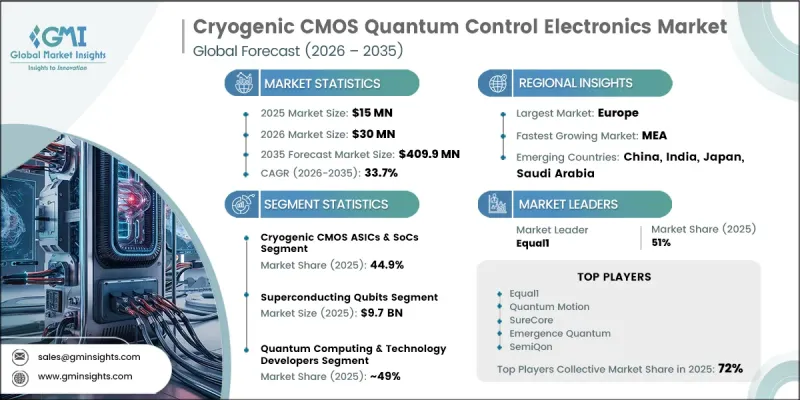
The market is gaining significant momentum as investments in quantum computing research and national quantum programs continue to increase worldwide. Demand is also rising for scalable qubit control architectures capable of supporting the development of fault-tolerant quantum computers. Ongoing progress in cryogenic CMOS semiconductor technology is improving low-power and low-latency performance, creating further opportunities for market expansion. Integrated control electronics are becoming increasingly important because they can simplify system architecture while reducing wiring requirements and thermal loads within dilution refrigerators. At the same time, the expanding use of superconducting and silicon-based quantum processors is increasing the requirement for advanced cryogenic control and readout solutions. As quantum computing platforms become more sophisticated, manufacturers are focusing on developing compact, efficient, and high-performance electronics capable of operating reliably at extremely low temperatures.
| Market Scope | |
|---|---|
| Start Year | 2025 |
| Forecast Year | 2026-2035 |
| Start Value | $15 Million |
| Forecast Value | $409.9 Million |
| CAGR | 33.7% |
The cryogenic CMOS ASICs & SoCs segment captured 44.9% share in 2025. The segment is benefiting from the ability of cryogenic CMOS ASICs and SoCs to consolidate control functions for multiple quantum operations onto a single cryogenic chip. This approach can improve system connectivity while supporting more compact control architectures. The integration of multiple control functions at the chip level is also helping address the growing requirements of quantum computing systems as manufacturers work toward scalable and efficient architectures.
The superconducting qubits segment recorded USD 9.7 million in 2025. Continued improvements in fabrication processes, together with high gate fidelity and rapid operating speeds, supported the segment's leading position in overall semiconductor market sales. Advanced superconducting qubit platforms require accurate and rapid cryogenic CMOS control electronics to achieve lower-latency gate control and high-speed data acquisition and measurement. These electronics can also substantially reduce wiring complexity and wiring density within dilution refrigeration systems, supporting more efficient system architectures and contributing to the continued adoption of cryogenic control technologies.
North America Cryogenic CMOS Quantum Control Electronics Market held a 32.9% share in 2025. The regional industry is benefiting from strong public and private funding for quantum computing research, continued government backing for national quantum initiatives, and the presence of established quantum computing companies and semiconductor manufacturers. These factors support technology development and commercialization across the regional quantum ecosystem. Increasing investment in quantum hardware and semiconductor technologies is also creating favorable conditions for suppliers of cryogenic CMOS control electronics, strengthening North America's position in the global market.
Prominent companies operating in the global cryogenic CMOS quantum control electronics market include IBM Corporation, Intel Corporation, Emergence Quantum, Google LLC (Alphabet Inc.), SemiQon, Microsoft Corporation, Equal1 Semiconductor, Silicon Quantum Computing, IceCirc GmbH, Quantum Motion Technologies, FrostByte, SemiWise Ltd., and SureCore Ltd. Companies in the global cryogenic CMOS quantum control electronics market are adopting technology development, product innovation, strategic collaboration, and capacity expansion to strengthen their market positions. Market participants are investing in research and development to improve low-power operation, reduce latency, and enhance the performance of cryogenic control electronics. Companies are also developing more integrated ASIC and SoC solutions to address the growing need for scalable quantum control architectures. Strategic partnerships with quantum computing and semiconductor organizations are helping participants expand technical capabilities and accelerate commercialization. Product development is increasingly focused on reducing wiring requirements, thermal loads, and system complexity while maintaining reliable control and readout performance. Companies are also working to strengthen their presence across emerging quantum computing applications by expanding technology portfolios and improving compatibility with different processor architectures. Continued investment in semiconductor engineering and cryogenic technologies is enabling market participants to improve product performance and establish stronger positions within the rapidly developing quantum computing ecosystem.
Table of Contents
Chapter 1 Methodology and Scope
- 1.1 Market scope and definition
- 1.2 Research design
- 1.2.1 Research approach
- 1.2.2 Data collection methods
- 1.3 Data mining sources
- 1.3.1 Global
- 1.3.2 Regional/Country
- 1.4 Base estimates and calculations
- 1.4.1 Base year calculation
- 1.4.2 Key trends for market estimation
- 1.5 Primary research and validation
- 1.5.1 Primary sources
- 1.6 Forecast model
- 1.7 Research assumptions and limitations
Chapter 2 Executive Summary
- 2.1 Industry 360° synopsis, 2022 – 2035
- 2.2 Key market trends
- 2.2.1 Integration level trends
- 2.2.2 Qubit technology compatibility trends
- 2.2.3 End-user trends
- 2.2.4 Regional trends
- 2.3 TAM Analysis, 2026-2035
- 2.4 CXO perspectives: Strategic imperatives
Chapter 3 Industry Insights
- 3.1 Industry ecosystem analysis
- 3.1.1 Supplier Landscape
- 3.1.2 Profit Margin
- 3.1.3 Cost structure
- 3.1.4 Value addition at each stage
- 3.1.5 Factor affecting the value chain
- 3.1.6 Disruptions
- 3.2 Industry impact forces
- 3.2.1 Growth drivers
- 3.2.1.1 Increasing government investments in quantum computing infrastructure
- 3.2.1.2 Growing need for scalable qubit control and cryogenic integration
- 3.2.1.3 Advancements in low-power Cryogenic CMOS semiconductor technologies
- 3.2.1.4 Rising demand for real-time quantum error correction and low-latency control
- 3.2.1.5 Increasing adoption of superconducting and silicon-based quantum processors
- 3.2.2 Industry pitfalls and challenges
- 3.2.2.1 Advancement of fault-tolerant quantum computing architectures
- 3.2.2.2 Complex cryogenic integration and thermal management
- 3.2.3 Market opportunities
- 3.2.3.1 Development of metamaterials for superior acoustic dampening
- 3.2.3.2 Development of highly integrated cryogenic system-on-chip (Cryo-SoC) solutions
- 3.2.1 Growth drivers
- 3.3 Growth potential analysis
- 3.4 Regulatory landscape
- 3.4.1 North America
- 3.4.2 Europe
- 3.4.3 Asia Pacific
- 3.4.4 Latin America
- 3.4.5 Middle East & Africa
- 3.5 Porter’s analysis
- 3.6 PESTEL analysis
- 3.7 Technology and Innovation landscape
- 3.7.1 Current technological trends
- 3.7.2 Emerging technologies
- 3.8 Price trends
- 3.8.1 By region
- 3.8.2 By product
- 3.9 Pricing Strategies
- 3.10 Emerging Business Models
- 3.11 Compliance Requirements
- 3.12 Patent and IP analysis
Chapter 4 Competitive Landscape, 2025
- 4.1 Introduction
- 4.2 Company market share analysis
- 4.2.1 By region
- 4.2.1.1 North America
- 4.2.1.2 Europe
- 4.2.1.3 Asia Pacific
- 4.2.1.4 Latin America
- 4.2.1.5 Middle East & Africa
- 4.2.2 Market concentration analysis
- 4.2.1 By region
- 4.3 Competitive benchmarking of key players
- 4.3.1 Financial performance comparison
- 4.3.1.1 Revenue
- 4.3.1.2 Profit margin
- 4.3.1.3 R&D
- 4.3.2 Product portfolio comparison
- 4.3.2.1 Product range breadth
- 4.3.2.2 Technology
- 4.3.2.3 Innovation
- 4.3.3 Geographic presence comparison
- 4.3.3.1 Global footprint analysis
- 4.3.3.2 Service network coverage
- 4.3.3.3 Market penetration by region
- 4.3.4 Competitive positioning matrix
- 4.3.4.1 Leaders
- 4.3.4.2 Challengers
- 4.3.4.3 Followers
- 4.3.4.4 Niche players
- 4.3.5 Strategic outlook matrix
- 4.3.1 Financial performance comparison
- 4.4 Key developments
- 4.4.1 Mergers and acquisitions
- 4.4.2 Partnerships and collaborations
- 4.4.3 Technological advancements
- 4.4.4 Expansion and investment strategies
- 4.4.5 Digital transformation initiatives
- 4.5 Emerging/ startup competitors landscape
Chapter 5 Market Estimates and Forecast, By Integration Level, 2022 – 2035 (USD Million)
- 5.1 Key trends
- 5.2 Cryogenic CMOS ASICs & SoCs
- 5.3 Discrete cryogenic CMOS ICs
- 5.4 Cryogenic control modules & subsystems
Chapter 6 Market Estimates and Forecast, By Qubit Technology Compatibility, 2022 – 2035 (USD Million)
- 6.1 Key trends
- 6.2 Superconducting qubits
- 6.3 Semiconductor spin qubits
- 6.4 Others & emerging qubit technologies
Chapter 7 Market Estimates and Forecast, By End-User, 2022 – 2035 (USD Million)
- 7.1 Key trends
- 7.2 Quantum computing & technology developers
- 7.3 National laboratories & government research centers
- 7.4 Universities & academic research groups
- 7.5 Defense & national security agencies
Chapter 8 Market Estimates and Forecast, By Region, 2022 – 2035 (USD Million)
- 8.1 Key trends
- 8.2 North America
- 8.2.1 U.S.
- 8.2.2 Canada
- 8.3 Europe
- 8.3.1 Germany
- 8.3.2 UK
- 8.3.3 France
- 8.3.4 Russia
- 8.3.5 Italy
- 8.4 Asia Pacific
- 8.4.1 China
- 8.4.2 India
- 8.4.3 Japan
- 8.4.4 Australia
- 8.4.5 South Korea
- 8.5 Latin America
- 8.5.1 Brazil
- 8.5.2 Mexico
- 8.5.3 Argentina
- 8.6 Middle East and Africa
- 8.6.1 South Africa
- 8.6.2 Saudi Arabia
- 8.6.3 UAE
Chapter 9 Company Profiles
- 9.1 Global Key Players
- 9.1.1 Equal1
- 9.1.2 Quantum Motion
- 9.1.3 SureCore
- 9.1.4 Emergence Quantum
- 9.1.5 SemiQon
- 9.2 Regional key players
- 9.2.1 North America
- 9.2.1.1 Intel Corporation
- 9.2.1.2 IBM Corporation
- 9.2.1.3 Google LLC (Alphabet Inc.)
- 9.2.1.4 Microsoft Corporation
- 9.2.2 Asia Pacific
- 9.2.2.1 Silicon Quantum Computing
- 9.2.3 Europe
- 9.2.3.1 SemiWise Ltd.
- 9.2.3.2 IceCirc GmbH
- 9.2.1 North America
- 9.3 Niche Players/Disruptors
- 9.3.1 FrostByte

