PUBLISHER: Global Market Insights Inc. | PRODUCT CODE: 2121116

PUBLISHER: Global Market Insights Inc. | PRODUCT CODE: 2121116
CNC Turning Centers Market Opportunity, Growth Drivers, Industry Trend Analysis, and Forecast 2026 - 2035
The Global CNC Turning Centers Market was valued at USD 14.5 billion in 2025 and is estimated to grow at a CAGR of 4.9% to reach USD 23.6 billion by 2035.
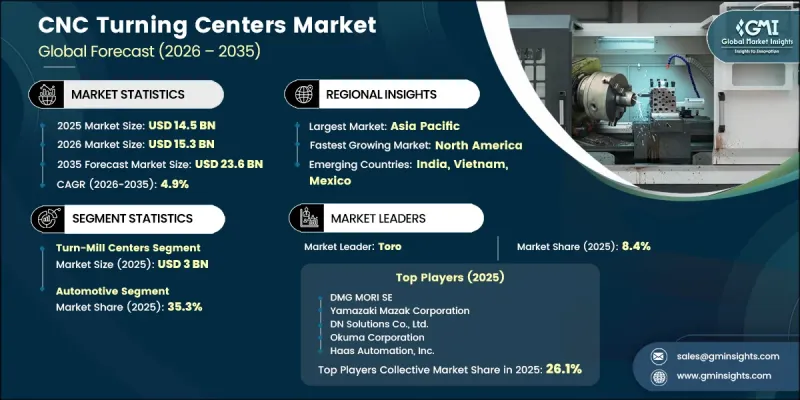
Manufacturers increasingly rely on CNC turning centers to achieve accurate, repeatable, and efficient machining across demanding production environments. These computer-controlled systems use rotating workpieces and precision cutting tools to manufacture cylindrical, conical, and intricate components while maintaining tight production tolerances. Advanced machine configurations now combine multiple machining functions, automated tool systems, additional axes, secondary spindle operations, cooling technologies, and inspection capabilities within integrated production platforms. Demand continues to rise as manufacturers pursue higher productivity, reduced manual intervention, improved machining consistency, and shorter production cycles. Automotive manufacturing remains a major source of demand, while aerospace, medical equipment, energy, and broader industrial production also support market expansion. The growing adoption of connected manufacturing technologies is further changing how companies operate CNC equipment by enabling improved monitoring, maintenance planning, and production control. At the same time, investment in domestic manufacturing capacity and the broader recovery of industrial production in key economies are creating additional opportunities for CNC turning center suppliers.
| Market Scope | |
|---|---|
| Start Year | 2025 |
| Forecast Year | 2026-2035 |
| Start Value | $14.5 Billion |
| Forecast Value | $23.6 Billion |
| CAGR | 4.9% |
The market continues to benefit from steady demand for precision-manufactured components across a wide range of industries. Advances in CNC control systems, including greater connectivity, edge-based processing, and IoT-enabled monitoring, are helping manufacturers improve equipment utilization and identify maintenance requirements before unexpected downtime occurs. The strengthening of industrial activity across major manufacturing economies is also supporting investment in equipment. Automotive production is undergoing significant changes as manufacturers transition to electrified powertrains, creating new machining requirements and increasing the need for equipment capable of producing components with high accuracy. Meanwhile, expanding aircraft production and rising output in the medical manufacturing sector are sustaining demand for advanced multi-axis and integrated turning and milling equipment. These systems allow manufacturers to achieve tighter dimensional and geometric requirements while limiting the need for repeated workpiece handling and additional production stages.
The turn-mill centers segment generated USD 3 billion in 2025. Manufacturers continue to favor these systems because they combine turning and milling functions within a single machining environment. This configuration provides greater production flexibility for components that require several machining processes and complex geometries. Completing multiple operations without repeatedly transferring the workpiece between machines can reduce setup requirements, minimize alignment-related inaccuracies, and shorten overall production schedules. These advantages make turn-mill centers particularly suitable for manufacturers that handle diverse production requirements while maintaining stringent precision standards. Their ability to consolidate machining processes also supports more efficient workflows for both specialized production operations and larger manufacturing environments.
The automotive industry accounted for a 35.3% share in 2025. Automotive manufacturers continue to represent a substantial source of CNC turning center demand because modern vehicle production requires large volumes of accurately machined components. The transition toward electric vehicles is further expanding the range of parts that require high-precision machining and is encouraging manufacturers to update their production equipment. Automotive production centers across major manufacturing countries continue to maintain and upgrade their CNC machine inventories to achieve required quality standards, improve machining consistency, and meet targeted production cycle times. Ongoing investments in vehicle manufacturing capacity, combined with changing component designs and evolving production requirements, are expected to maintain strong demand for CNC turning centers from the automotive sector.
United States CNC Turning Centers Market accounted for 92.9% in 2025. The country represents the primary demand center for CNC turning equipment in the region, supported by its broad manufacturing base and high level of industrial capital investment. Manufacturers in the United States are also increasing their focus on bringing production capacity closer to domestic markets and strengthening local supply chains. Federal policy support has encouraged additional investment in manufacturing infrastructure and production capabilities. Major initiatives, including the CHIPS and Science Act, the Inflation Reduction Act, and the Infrastructure Investment and Jobs Act, are contributing to a favorable environment for industrial investment.
Major companies operating in the global CNC turning centers market include Nexturn Co., Ltd., Citizen Machinery Co., Ltd., DMG MORI SE, EMCO Group GmbH, Yamazaki Mazak Corporation, Victor Taichung Machinery Works Co., Ltd., Okuma Corporation, Star Micronics Co., Ltd., Haas Automation, Inc., Tornos SA, DN Solutions Co., Ltd., Tsugami Corporation, JTEKT Corporation, Murata Machinery Ltd. (Muratec), EMAG GmbH & Co. KG, Hyundai WIA Corporation, Nakamura-Tome Precision Industry Co., Ltd., INDEX-Werke GmbH & Co. KG, Lakshmi Machine Works Ltd. (LMW), Shenyang Machine Tool Co., Ltd. (SMTCL), and Hwacheon Machine Tool Co., Ltd. Companies in the CNC turning centers market are strengthening their market positions by investing in advanced machine designs, automation, digital connectivity, and integrated manufacturing solutions. Manufacturers are expanding product portfolios to address different production volumes, machining requirements, and precision levels across end-use industries. Strategic collaborations and long-term customer relationships help companies improve market access and secure recurring equipment demand. Businesses are also incorporating smart manufacturing capabilities that support remote monitoring, production analytics, predictive maintenance, and more efficient machine utilization. Product innovation remains another important strategy, with manufacturers improving machining speed, accuracy, flexibility, energy efficiency, and automated operation. Companies are also increasing their presence in emerging manufacturing regions through distribution networks, local partnerships, service infrastructure, and production investments.
Table of Contents
Chapter 1 Methodology
- 1.1 Research approach
- 1.2 Quality Commitments
- 1.2.1 GMI AI policy & data integrity commitment
- 1.2.1.1 Source consistency protocol
- 1.2.1 GMI AI policy & data integrity commitment
- 1.3 Research Trail & Confidence Scoring
- 1.3.1 Research Trail Components
- 1.3.2 Scoring Components
- 1.4 Data Collection
- 1.4.1 Partial list of primary sources
- 1.5 Data mining sources
- 1.5.1 Paid sources
- 1.5.1.1 Sources, by region
- 1.5.1 Paid sources
- 1.6 Base estimates and calculations
- 1.6.1 Base year calculation for any one approach
- 1.7 Forecast model
- 1.7.1 Quantified market impact analysis
- 1.7.1.1 Mathematical impact of growth parameters on forecast
- 1.7.1 Quantified market impact analysis
- 1.8 Research transparency addendum
- 1.8.1 Source attribution framework
- 1.8.2 Quality assurance metrics
- 1.8.3 Our commitment to trust
Chapter 2 Executive Summary
- 2.1 Industry snapshot
- 2.2 Business trends
- 2.3 By Machine Type
- 2.4 By Axis Configuration
- 2.5 By Automation Level
- 2.6 By End Use
- 2.7 By Distribution Channel
- 2.8 Regional trends
Chapter 3 Industry Insights
- 3.1 Industry ecosystem and value chain analysis
- 3.1.1 Industry ecosystem & value chain analysis
- 3.1.2 Raw material & component suppliers (spindles, ball screws, CNC controllers)
- 3.1.3 Machine tool manufacturers
- 3.1.4 System integrators & automation partners
- 3.1.5 Distributors, dealers & service networks
- 3.1.6 End-user industries
- 3.2 Industry impact forces
- 3.2.1 Market Driver
- 3.2.2 Market challenges/pitfalls
- 3.2.3 Market opportunities
- 3.3 Growth potential analysis
- 3.4 Technology & innovation landscape
- 3.4.1 CNC controller technology evolution (FANUC, Siemens, Mitsubishi)
- 3.4.2 Live tooling & Y-axis advancements
- 3.4.3 Thermal compensation & vibration damping technologies
- 3.4.4 Digital twin integration in turning centers
- 3.4.5 IoT-enabled condition monitoring & predictive maintenance
- 3.5 Regulatory framework
- 3.5.1 CE marking & EU Machinery Directive (2006/42/EC)
- 3.5.2 OSHA machine safety standards (USA)
- 3.5.3 ISO 230 series: Machine tool test codes
- 3.5.4 Environmental regulations: Energy efficiency & coolant disposal
- 3.5.5 Country-specific import/export controls & dual-use regulations
- 3.6 Supply chain analysis
- 3.6.1 Key component sourcing landscape (ball screws, linear guides, spindle motors)
- 3.6.2 Supply chain disruption risk assessment
- 3.6.3 Nearshoring & regionalization trends in machine tool supply chains
- 3.7 Pricing analysis (driven by primary research)
- 3.7.1 Historical price trend analysis (2019-2024) (driven by primary research)
- 3.7.2 Pricing strategy by player type (premium/value/cost-plus) (driven by primary research)
- 3.7.3 Price benchmarking by machine type & axis configuration
- 3.7.4 Impact of raw material costs on machine pricing
- 3.8 Porter’s Analysis
- 3.9 PESTEL Analysis
- 3.10 Trade data analysis (driven by primary research) (HS Code: 8427)
- 3.10.1 Import/export volume & value trends by HS code (HS 8458, 8457) (driven by primary research)
- 3.10.2 Key trade corridors & tariff impact (US-China, EU-Asia, Intra-Asia) (driven by primary research)
- 3.11 Impact of AI and generative AI on the market
- 3.11.1 AI-driven disruption of existing CNC programming & toolpath generation
- 3.11.2 GenAI use cases & adoption roadmap by segment (conversational CAM, AI-assisted process optimization)
- 3.11.3 Risks, limitations & regulatory considerations in AI-integrated machine tools
- 3.12 Capacity & production landscape (driven by primary research)
- 3.12.1 Installed manufacturing capacity by region & key producer (driven by primary research)
- 3.12.2 Capacity utilization rates & expansion pipelines (2024-2034) (driven by primary research)
Chapter 4 Competitive Landscape, 2025
- 4.1 Introduction
- 4.2 Company market share analysis
- 4.2.1 North America
- 4.2.2 Europe
- 4.2.3 APAC
- 4.2.4 LATAM
- 4.2.5 MEA
- 4.3 Company matrix analysis
- 4.4 Competitive analysis of major market players
- 4.5 Competitive positioning matrix
- 4.6 Key developments
- 4.6.1 Mergers & acquisitions
- 4.6.2 Partnerships & collaborations
- 4.6.3 New product launches
- 4.6.4 Expansion plans
Chapter 5 Market Estimates and Forecast, By Machine Type, 2022 – 2035 ($ Billion) (Thousand Units)
- 5.1 Key trends
- 5.2 Standard Horizontal Turning Centers
- 5.3 Vertical Turning Centers (VTL)
- 5.4 Swiss-Type / Sliding Headstock Turning Centers
- 5.5 Multi-Spindle Turning Centers
- 5.6 Turn-Mill / Multi-Tasking Centers
Chapter 6 Market Estimates and Forecast, By Axis Configuration, 2022 – 2035 ($ Billion) (Thousand Units)
- 6.1 Key trends
- 6.2 2-Axis
- 6.3 3-Axis
- 6.4 4-Axis
- 6.5 5-Axis & Above
Chapter 7 Market Estimates and Forecast, By Automation Level, 2022 – 2035 ($ Billion) (Thousand Units)
- 7.1 Key trends
- 7.2 Conventional CNC (Manual Loading)
- 7.3 Semi-Automatic
- 7.4 Fully Automatic / Robot-Integrated
Chapter 8 Market Estimates and Forecast, By End Use, 2022 – 2035 ($ Billion) (Thousand Units)
- 8.1 Key trends
- 8.2 Automotive & Commercial Vehicles
- 8.3 Aerospace & Defense
- 8.4 Medical Devices & Dental
- 8.5 Electronics & Semiconductor Equipment
- 8.6 Oil & Gas & Energy
- 8.7 General Manufacturing & Job Shops
- 8.8 Others
Chapter 9 Market Estimates and Forecast, By Distribution Channel, 2022 – 2035 ($ Billion) (Thousand Units)
- 9.1 Key trends
- 9.2 Direct sales
- 9.3 Indirect sales
Chapter 10 Market Estimates and Forecast, By Region, 2022 – 2035 ($ Billion) (Thousand Units)
- 10.1 Key trends
- 10.2 North America
- 10.2.1 US
- 10.2.2 Canada
- 10.3 Europe
- 10.3.1 Germany
- 10.3.2 UK
- 10.3.3 France
- 10.3.4 Italy
- 10.3.5 Spain
- 10.4 Asia Pacific
- 10.4.1 China
- 10.4.2 India
- 10.4.3 Japan
- 10.4.4 Australia
- 10.4.5 South Korea
- 10.5 Latin America
- 10.5.1 Brazil
- 10.5.2 Mexico
- 10.6 Middle East and Africa
- 10.6.1 South Africa
- 10.6.2 Saudi Arabia
- 10.6.3 UAE
Chapter 11 Company Profiles
- 11.1 Global Players
- 11.1.1 DMG MORI SE
- 11.1.2 Yamazaki Mazak Corporation
- 11.1.3 Okuma Corporation
- 11.1.4 Haas Automation, Inc.
- 11.1.5 DN Solutions Co., Ltd.
- 11.1.6 JTEKT Corporation
- 11.1.7 EMAG GmbH & Co. KG
- 11.2 Regional Players
- 11.2.1 Hyundai WIA Corporation
- 11.2.2 Nakamura-Tome Precision Industry Co., Ltd.
- 11.2.3 INDEX-Werke GmbH & Co. KG
- 11.2.4 Lakshmi Machine Works Ltd. (LMW)
- 11.2.5 Shenyang Machine Tool Co., Ltd. (SMTCL)
- 11.2.6 Hwacheon Machine Tool Co., Ltd.
- 11.2.7 EMCO Group GmbH
- 11.2.8 Victor Taichung Machinery Works Co., Ltd.
- 11.2.9 Murata Machinery Ltd. (Muratec)
- 11.3 Niche & Specialist Players
- 11.3.1 Citizen Machinery Co., Ltd.
- 11.3.2 Tsugami Corporation
- 11.3.3 Tornos SA
- 11.3.4 Star Micronics Co., Ltd.
- 11.3.5 Nexturn Co., Ltd.

