PUBLISHER: Global Market Insights Inc. | PRODUCT CODE: 2121122

PUBLISHER: Global Market Insights Inc. | PRODUCT CODE: 2121122
PEM Electrolyzer Catalyst Materials Market Opportunity, Growth Drivers, Industry Trend Analysis, and Forecast 2026 - 2035
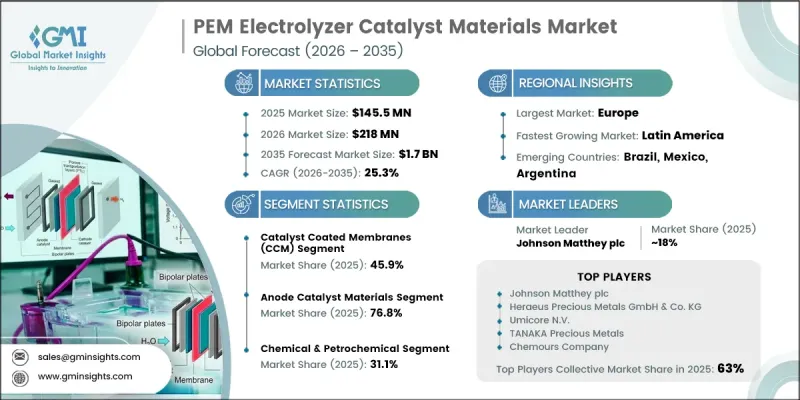
The Global PEM Electrolyzer Catalyst Materials Market was valued at USD 145.5 million in 2025 and is estimated to grow at a CAGR of 25.3% to reach USD 1.7 billion by 2035.
The market is gaining momentum as countries and industries accelerate the transition toward green hydrogen and low-carbon energy systems. PEM electrolyzers rely on catalyst materials to facilitate the electrochemical reaction that separates water into hydrogen and oxygen. Manufacturers continue to focus on catalyst performance, durability, efficiency, and material utilization as electrolyzer deployment expands. Iridium-based materials continue to support anode applications, while platinum-based materials remain important for cathode applications because of their catalytic performance, operational efficiency, and stability under acidic operating conditions. Growing investments in hydrogen production capacity, improvements in electrolyzer technology, and increasing efforts to reduce emissions are creating favorable conditions for catalyst material suppliers. As hydrogen projects move toward larger-scale deployment, demand for reliable and high-performance catalyst materials is expected to increase across the global PEM electrolyzer catalyst materials industry.
| Market Scope | |
|---|---|
| Start Year | 2025 |
| Forecast Year | 2026-2035 |
| Start Value | $145.5 Million |
| Forecast Value | $1.7 Billion |
| CAGR | 25.3% |
Catalyst coated membranes (CCM) held a 45.9% share in 2025. Market participants continue to balance large-scale manufacturing requirements with efficient catalyst utilization and the practical requirements associated with electrolyzer stack assembly. Different OEM production configurations require suppliers to maintain flexibility in catalyst delivery formats, manufacturing processes, and integration methods. This dynamic continues to influence purchasing decisions and competitive positioning across the catalyst delivery form segment.
The chemical & petrochemical segment captured 31.1% share in 2025. Companies across the chemical and petrochemical industries are increasingly adopting green hydrogen as part of their efforts to lower carbon emissions and advance sustainability targets. The expanding use of hydrogen in industrial operations is also supporting market growth as industries seek cleaner production pathways and greater alignment with decarbonization objectives. Rising investment in hydrogen-based industrial processes continues to create additional opportunities for PEM electrolyzer catalyst material suppliers.
North America PEM Electrolyzer Catalyst Materials Market captured 28% share in 2025. The regional market continues to benefit from increased investment in green hydrogen infrastructure and government-supported clean energy initiatives. Growing attention toward hydrogen production, clean technology deployment, and emissions reduction is encouraging investment throughout the hydrogen value chain. These developments are creating favorable conditions for catalyst material manufacturers and suppliers seeking to expand their presence in the North American market.
Prominent companies operating in the global PEM electrolyzer catalyst materials market include TANAKA Precious Metals, Umicore N.V., Advent Technologies Holdings Inc., Johnson Matthey plc, HyPlat (Pty) Ltd, Chemours Company, Heraeus Precious Metals GmbH & Co. KG, Magneto / Elicron, Clariant AG, Ningbo Zhongke Kechuang, Greenerity GmbH, and Elchemtech Co., Ltd. Companies in the global pem electrolyzer catalyst materials market are strengthening their market position by expanding catalyst production capabilities, improving material efficiency, and investing in research and development. Manufacturers are focusing on enhancing catalyst performance while reducing material requirements and improving operational durability. Strategic collaborations and technology development initiatives allow companies to address the evolving requirements of electrolyzer manufacturers. Market participants are also working to expand production capacity as demand for PEM electrolyzer systems increases globally. Regional expansion remains another important strategy, with companies seeking stronger access to emerging hydrogen markets and large-scale clean energy projects. Suppliers are also emphasizing product consistency, manufacturing scalability, and integration compatibility to build long-term relationships with electrolyzer and stack manufacturers. These strategies help companies improve their competitive position while supporting the broader commercialization and deployment of PEM electrolyzer technology.
Table of Contents
Chapter 1 Methodology & Scope
- 1.1 Research approach
- 1.2 Quality Commitments
- 1.2.1 GMI AI policy & data integrity commitment
- 1.2.1.1 Source consistency protocol
- 1.2.1 GMI AI policy & data integrity commitment
- 1.3 Research Trail & Confidence Scoring
- 1.3.1 Research Trail Components
- 1.3.2 Scoring Components
- 1.4 Data Collection
- 1.4.1 Partial list of primary sources
- 1.5 Data mining sources
- 1.5.1 Paid sources
- 1.5.1.1 Sources, by region
- 1.5.1 Paid sources
- 1.6 Base estimates and calculations
- 1.6.1 Base year calculation for any one approach
- 1.7 Forecast model
- 1.7.1 Quantified market impact analysis
- 1.7.1.1 Mathematical impact of growth parameters on forecast
- 1.7.1 Quantified market impact analysis
- 1.8 Research transparency addendum
- 1.8.1 Source attribution framework
- 1.8.2 Quality assurance metrics
- 1.8.3 Our commitment to trust
Chapter 2 Executive Summary
- 2.1 Industry 360° synopsis
- 2.2 Key market trends
- 2.2.1 Regional
- 2.2.2 Catalyst material
- 2.2.3 Product
- 2.2.4 Application
- 2.2.5 End user industry
Chapter 3 Industry Insights
- 3.1 Industry ecosystem analysis
- 3.1.1 Supplier landscape
- 3.1.2 Profit margin
- 3.1.3 Value addition at each stage
- 3.1.4 Factor affecting the value chain
- 3.1.5 Disruptions
- 3.2 Industry impact forces
- 3.2.1 Growth drivers
- 3.2.2 Industry pitfalls and challenges
- 3.2.3 Market opportunities
- 3.3 Growth potential analysis
- 3.4 Regulatory landscape
- 3.4.1 North America
- 3.4.2 Europe
- 3.4.3 Asia Pacific
- 3.4.4 Latin America
- 3.4.5 Middle East & Africa
- 3.5 Porter’s analysis
- 3.6 PESTEL analysis
- 3.7 Price trends
- 3.7.1 By region
- 3.7.2 By crop type
- 3.8 Future market trends
- 3.9 Technology and innovation landscape
- 3.9.1 Current technological trends
- 3.9.2 Emerging technologies
- 3.10 Patent Landscape
- 3.11 Trade statistics (HS code)
- 3.11.1 Major importing countries
- 3.11.2 Major exporting countries
- 3.12 Sustainability and environmental aspects
- 3.12.1 Sustainable practices
- 3.12.2 Waste reduction strategies
- 3.12.3 Energy efficiency in production
- 3.12.4 Eco-friendly initiatives
- 3.13 Carbon footprint consideration
Chapter 4 Competitive Landscape, 2025
- 4.1 Introduction
- 4.2 Company market share analysis
- 4.2.1 By region
- 4.2.1.1 North America
- 4.2.1.2 Europe
- 4.2.1.3 Asia Pacific
- 4.2.1.4 LATAM
- 4.2.1.5 MEA
- 4.2.1 By region
- 4.3 Competitive analysis of major market players
- 4.4 Competitive positioning matrix
- 4.5 Key developments
- 4.5.1 Mergers & acquisitions
- 4.5.2 Partnerships & collaborations
- 4.5.3 New Product Launches
- 4.5.4 Expansion Plans
Chapter 5 Market Estimates and Forecast, By Catalyst Material, 2022–2035 (USD Billion) (Kilo Tons)
- 5.1 Key trends
- 5.2 Anode catalyst materials (OER)
- 5.2.1 Iridium-based catalysts
- 5.2.2 Ruthenium-based catalysts
- 5.2.3 Non-precious metal anode
- 5.3 Cathode catalyst materials (HER)
- 5.3.1 Platinum-based catalysts
- 5.3.2 Non-precious metal cathode
Chapter 6 Market Estimates and Forecast, By Product, 2022–2035 (USD Billion) (Kilo Tons)
- 6.1 Key trends
- 6.2 Unsupported catalyst powders
- 6.3 Carbon-supported catalyst powders
- 6.4 Catalyst inks & dispersions
- 6.5 Catalyst coated membranes (CCM)
- 6.6 Catalyst coated substrates / Porous transport electrodes (PTE)
Chapter 7 Market Estimates and Forecast, By Application, 2022–2035 (USD Billion) (Kilo Tons)
- 7.1 Key trends
- 7.2 Green H₂ for industrial feedstock
- 7.3 Power-to-gas & grid-scale energy storage
- 7.4 Mobility & transportation H₂ supply
- 7.5 Distributed & on-site H₂ generation
Chapter 8 Market Estimates and Forecast, By End User Industry, 2022–2035 (USD Billion) (Kilo Tons)
- 8.1 Key trends
- 8.2 Energy & power generation
- 8.3 Chemical & petrochemical
- 8.4 Oil refining & steel production
- 8.5 Automotive & mobility
- 8.6 Research, government & defense
Chapter 9 Market Estimates and Forecast, By Region, 2022–2035 (USD Billion) (Kilo Tons)
- 9.1 Key trends
- 9.2 North America
- 9.2.1 U.S.
- 9.2.2 Canada
- 9.3 Europe
- 9.3.1 Germany
- 9.3.2 UK
- 9.3.3 France
- 9.3.4 Spain
- 9.3.5 Italy
- 9.3.6 Rest of Europe
- 9.4 Asia Pacific
- 9.4.1 China
- 9.4.2 India
- 9.4.3 Japan
- 9.4.4 Australia
- 9.4.5 South Korea
- 9.4.6 Rest of Asia Pacific
- 9.5 Latin America
- 9.5.1 Brazil
- 9.5.2 Mexico
- 9.5.3 Argentina
- 9.5.4 Rest of Latin America
- 9.6 Middle East and Africa
- 9.6.1 Saudi Arabia
- 9.6.2 South Africa
- 9.6.3 UAE
- 9.6.4 Rest of Middle East and Africa
Chapter 10 Company Profiles
- 10.1 Advent Technologies Holdings Inc.
- 10.2 Chemours Company
- 10.3 Clariant AG
- 10.4 Elchemtech Co., Ltd.
- 10.5 Greenerity GmbH
- 10.6 Heraeus Precious Metals GmbH & Co. KG
- 10.7 HyPlat (Pty) Ltd
- 10.8 Johnson Matthey plc
- 10.9 Magneto / Elicron
- 10.10 Ningbo Zhongke Kechuang
- 10.11 TANAKA Precious Metals
- 10.12 Umicore N.V.

