PUBLISHER: Global Market Insights Inc. | PRODUCT CODE: 2121128

PUBLISHER: Global Market Insights Inc. | PRODUCT CODE: 2121128
Water Quality Monitoring Market Opportunity, Growth Drivers, Industry Trend Analysis, and Forecast 2026 - 2035
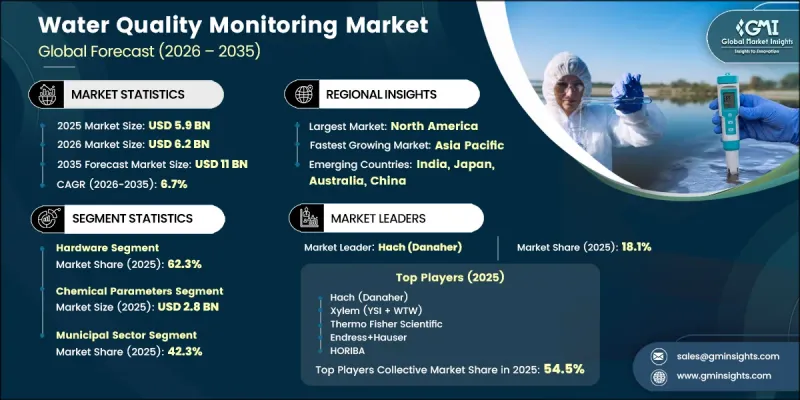
The Global Water Quality Monitoring Market was valued at USD 5.9 billion in 2025 and is estimated to grow at a CAGR of 6.7% to reach USD 11 billion in 2035.
The market is experiencing sustained growth as governments, utilities, and industrial organizations continue to prioritize effective water resource management and environmental protection. Strengthening regulatory frameworks related to water safety, coupled with rising concerns surrounding water contamination and emerging pollutants, are driving broader adoption of advanced monitoring solutions across global markets. Increasing investment in drinking water infrastructure and wastewater management systems is further supporting long-term industry expansion. In addition, rapid technological progress is transforming the water quality monitoring industry by integrating connected monitoring platforms, smart sensing technologies, and automated data collection systems, thereby improving operational efficiency and decision-making. The growing emphasis on continuous environmental surveillance, resource conservation, and public health protection is creating additional demand for reliable monitoring technologies. As regulatory compliance requirements become more rigorous and digital transformation accelerates across water management operations, the global water quality monitoring market is expected to witness consistent growth throughout the forecast period.
| Market Scope | |
|---|---|
| Start Year | 2025 |
| Forecast Year | 2026-2035 |
| Start Value | $5.9 Billion |
| Forecast Value | $11 Billion |
| CAGR | 6.7% |
The water quality monitoring market continues to benefit from increasingly stringent regulatory policies aimed at protecting water resources and maintaining high water quality standards. Rising government support and ongoing initiatives focused on improving water safety are encouraging greater adoption of advanced monitoring technologies across municipal, industrial, and environmental applications. Expanding regulatory requirements for monitoring multiple categories of water contaminants are driving demand for more accurate and efficient analytical solutions. At the same time, water utilities and industrial operators are incorporating artificial intelligence, cloud-based platforms, and predictive analytics into monitoring systems to strengthen operational performance. These advanced digital technologies enable continuous data collection, improve anomaly detection, support predictive maintenance, and accelerate response times while reducing operating expenses and improving overall system efficiency.
The hardware segment held a 62.3% share in 2025. The segment maintains its leading position because monitoring equipment remains an essential component of water quality assessment across municipal utilities, industrial facilities, environmental organizations, and wastewater treatment operations. Growing regulatory requirements for continuous measurement of critical water quality indicators, combined with rising investment in intelligent water management infrastructure, continue to stimulate demand for advanced monitoring devices. Ongoing modernization of water systems and increased deployment of automated monitoring technologies are expected to further strengthen growth opportunities for the hardware segment over the forecast period.
The chemical parameters segment captured USD 2.8 billion in 2025. Strong demand for comprehensive analysis of essential water quality indicators across drinking water, wastewater, industrial processing, and environmental monitoring applications continues to support segment growth. Increasingly rigorous compliance requirements, expanding industrial wastewater generation, and heightened awareness regarding evolving water quality concerns are encouraging greater investment in advanced chemical parameter monitoring solutions worldwide, reinforcing the segment's dominant market position.
North America Water Quality Monitoring Market accounted for 32.3% share in 2025. Regional growth continues to be supported by stronger environmental compliance requirements, sustained investments in water and wastewater infrastructure, and increasing attention toward improving long-term water resource management. Rising regulatory expectations have encouraged municipalities, utility providers, and industrial organizations to deploy advanced real-time monitoring technologies to strengthen operational reliability and maintain compliance with evolving water quality standards. Continuous infrastructure modernization and greater emphasis on digital monitoring capabilities are expected to sustain regional market expansion throughout the forecast period.
Prominent companies operating in the global water quality monitoring market include ABB, Agilent, Badger Meter, Emerson, Endress+Hauser, Focused Photonics (FPI), Hach (Danaher), Hanna Instruments, HORIBA, In-Situ Inc., KUNTZE Instruments, Mettler-Toledo, PerkinElmer, Shimadzu, Teledyne ISCO, Thermo Fisher Scientific, Xylem (YSI + WTW), and Yokogawa. Companies participating in the water quality monitoring market are strengthening their market position by expanding product portfolios with advanced monitoring technologies, digital platforms, and intelligent sensing solutions. Many organizations are investing in research and development to improve measurement accuracy, system reliability, and operational efficiency while meeting evolving regulatory requirements. Strategic collaborations, distribution partnerships, and geographic expansion remain key approaches for increasing customer reach and strengthening regional presence. Manufacturers are also enhancing software capabilities through cloud connectivity, automation, and data analytics to provide greater value for utilities and industrial customers.
Table of Contents
Chapter 1 Methodology and Scope
- 1.1 Market scope and definition
- 1.2 Research design
- 1.2.1 Research approach
- 1.2.2 Data collection methods
- 1.3 Data mining sources
- 1.3.1 Global
- 1.3.2 Regional/Country
- 1.4 Base estimates and calculations
- 1.4.1 Base year calculation
- 1.4.2 Key trends for market estimation
- 1.5 Primary research and validation
- 1.5.1 Primary sources
- 1.6 Forecast model
- 1.7 Research assumptions and limitations
Chapter 2 Executive Summary
- 2.1 Industry 360° synopsis, 2022 – 2035
- 2.2 Key market trends
- 2.2.1 Offering trends
- 2.2.2 Monitoring technology trends
- 2.2.3 Parameter type trends
- 2.2.4 Application trends
- 2.2.5 End-user trends
- 2.2.6 Regional trends
- 2.3 TAM Analysis, 2026-2035
- 2.4 CXO perspectives: Strategic imperatives
Chapter 3 Industry Insights
- 3.1 Industry ecosystem analysis
- 3.1.1 Supplier Landscape
- 3.1.2 Profit Margin
- 3.1.3 Cost structure
- 3.1.4 Value addition at each stage
- 3.1.5 Factor affecting the value chain
- 3.1.6 Disruptions
- 3.2 Industry impact forces
- 3.2.1 Growth drivers
- 3.2.1.1 Stringent water quality regulations and compliance standards
- 3.2.1.2 Growing investments in safe drinking water and wastewater infrastructure
- 3.2.1.3 Rapid adoption of IoT-enabled smart water monitoring systems
- 3.2.1.4 Increasing water pollution and emergence of new contaminants
- 3.2.1.5 Expansion of environmental monitoring and climate resilience initiatives
- 3.2.2 Industry pitfalls and challenges
- 3.2.2.1 High cost of advanced water quality monitoring systems
- 3.2.2.2 Sensor fouling, calibration, and data reliability issues
- 3.2.3 Market opportunities
- 3.2.3.1 Expansion of smart water networks and digital water management
- 3.2.3.2 Increasing investments in water reuse, desalination, and climate resilience projects
- 3.2.1 Growth drivers
- 3.3 Growth potential analysis
- 3.4 Regulatory landscape
- 3.4.1 North America
- 3.4.2 Europe
- 3.4.3 Asia Pacific
- 3.4.4 Latin America
- 3.4.5 Middle East & Africa
- 3.5 Porter’s analysis
- 3.6 PESTEL analysis
- 3.7 Technology and Innovation landscape
- 3.7.1 Current technological trends
- 3.7.2 Emerging technologies
- 3.8 Price trends
- 3.8.1 By region
- 3.8.2 By product
- 3.9 Pricing Strategies
- 3.10 Emerging Business Models
- 3.11 Compliance Requirements
- 3.12 Patent and IP analysis
Chapter 4 Competitive Landscape, 2025
- 4.1 Introduction
- 4.2 Company market share analysis
- 4.2.1 By region
- 4.2.1.1 North America
- 4.2.1.2 Europe
- 4.2.1.3 Asia Pacific
- 4.2.1.4 Latin America
- 4.2.1.5 Middle East & Africa
- 4.2.2 Market concentration analysis
- 4.2.1 By region
- 4.3 Competitive benchmarking of key players
- 4.3.1 Financial performance comparison
- 4.3.1.1 Revenue
- 4.3.1.2 Profit margin
- 4.3.1.3 R&D
- 4.3.2 Product portfolio comparison
- 4.3.2.1 Product range breadth
- 4.3.2.2 Technology
- 4.3.2.3 Innovation
- 4.3.3 Geographic presence comparison
- 4.3.3.1 Global footprint analysis
- 4.3.3.2 Service network coverage
- 4.3.3.3 Market penetration by region
- 4.3.4 Competitive positioning matrix
- 4.3.4.1 Leaders
- 4.3.4.2 Challengers
- 4.3.4.3 Followers
- 4.3.4.4 Niche players
- 4.3.5 Strategic outlook matrix
- 4.3.1 Financial performance comparison
- 4.4 Key developments
- 4.4.1 Mergers and acquisitions
- 4.4.2 Partnerships and collaborations
- 4.4.3 Technological advancements
- 4.4.4 Expansion and investment strategies
- 4.4.5 Digital transformation initiatives
- 4.5 Emerging/ startup competitors landscape
Chapter 5 Market Estimates and Forecast, By Offering Type, 2022 – 2035 (USD Million)
- 5.1 Key trends
- 5.2 Hardware
- 5.3 Software
- 5.4 Services
Chapter 6 Market Estimates and Forecast, By Monitoring Technology, 2022 – 2035 (USD Million)
- 6.1 Key trends
- 6.2 Online/continuous monitoring systems
- 6.3 Portable/field monitoring systems
- 6.4 Laboratory-based monitoring systems
- 6.5 Remote/telemetry monitoring systems
Chapter 7 Market Estimates and Forecast, By Parameter Type, 2022 – 2035 (USD Million)
- 7.1 Key trends
- 7.2 Physical parameters
- 7.3 Chemical parameters
- 7.4 Biological parameters
Chapter 8 Market Estimates and Forecast, By Application, 2022 – 2035 (USD Million)
- 8.1 Key trends
- 8.2 Drinking water monitoring
- 8.3 Wastewater monitoring
- 8.4 Surface water monitoring (rivers, lakes, reservoirs)
- 8.5 Groundwater monitoring
- 8.6 Industrial process water monitoring
- 8.7 Aquaculture monitoring
- 8.8 Environmental monitoring
- 8.9 Recreational water monitoring
Chapter 9 Market Estimates and Forecast, By End-User, 2022 – 2035 (USD Million)
- 9.1 Key trends
- 9.2 Municipal Sector
- 9.3 Industrial Sector
- 9.4 Environmental & Research Sector
- 9.5 Commercial Sector
Chapter 10 Market Estimates and Forecast, By Region, 2022 – 2035 (USD Million)
- 10.1 Key trends
- 10.2 North America
- 10.2.1 U.S.
- 10.2.2 Canada
- 10.3 Europe
- 10.3.1 Germany
- 10.3.2 UK
- 10.3.3 France
- 10.3.4 Spain
- 10.3.5 Italy
- 10.4 Asia Pacific
- 10.4.1 China
- 10.4.2 India
- 10.4.3 Japan
- 10.4.4 Australia
- 10.4.5 South Korea
- 10.5 Latin America
- 10.5.1 Brazil
- 10.5.2 Mexico
- 10.5.3 Argentina
- 10.6 Middle East and Africa
- 10.6.1 South Africa
- 10.6.2 Saudi Arabia
- 10.6.3 UAE
Chapter 11 Company Profiles
- 11.1 Global Key Players
- 11.1.1 Hach (Danaher)
- 11.1.2 Xylem (YSI + WTW)
- 11.1.3 Thermo Fisher Scientific
- 11.1.4 Endress+Hauser
- 11.1.5 HORIBA
- 11.2 Regional key players
- 11.2.1 North America
- 11.2.1.1 Emerson
- 11.2.1.2 Agilent
- 11.2.1.3 Badger Meter
- 11.2.1.4 Teledyne ISCO
- 11.2.1.5 PerkinElmer
- 11.2.2 Asia Pacific
- 11.2.2.1 Shimadzu
- 11.2.2.2 Yokogawa
- 11.2.2.3 Focused Photonics
- 11.2.3 Europe
- 11.2.3.1 ABB
- 11.2.3.2 Mettler-Toledo
- 11.2.3.3 Hanna Instruments
- 11.2.3.4 KUNTZE Instruments
- 11.2.1 North America
- 11.3 Niche Players/Disruptors
- 11.3.1 In-Situ Inc.

