PUBLISHER: Global Market Insights Inc. | PRODUCT CODE: 2121130

PUBLISHER: Global Market Insights Inc. | PRODUCT CODE: 2121130
On-body Injector Market Opportunity, Growth Drivers, Industry Trend Analysis, and Forecast 2026 - 2035
The Global On-body Injector Market was valued at USD 1.2 billion in 2025 and is estimated to grow at a CAGR of 16.4% to reach USD 5.2 billion by 2035.
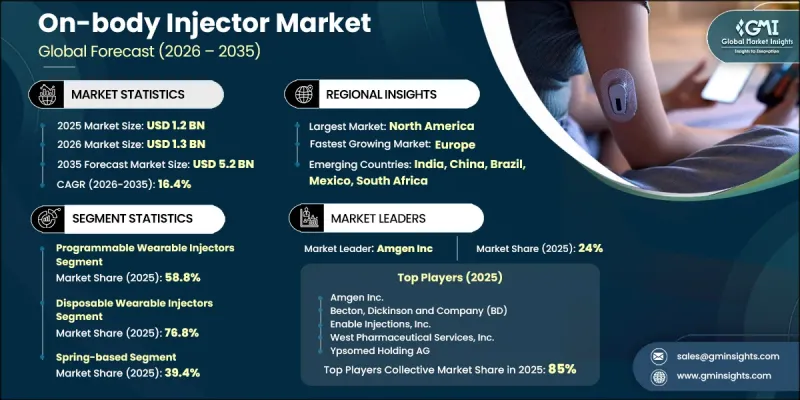
The market is gaining significant momentum as healthcare delivery continues to move toward convenient, patient-centered treatment models. Rising rates of chronic conditions, increasing preference for home-based care, and expanding use of biologic medicines are creating stronger demand for wearable drug delivery technologies. On-body injectors provide a wearable approach to subcutaneous drug administration by delivering medication over a defined period after the device is placed on the patient's body. The expanding use of biologics is particularly supporting market development because these therapies often require reliable and controlled delivery methods. As treatment protocols become more personalized and long-term therapies become increasingly common, healthcare providers and patients are seeking drug delivery systems that can improve convenience, treatment adherence, and administration efficiency. Technological progress in wearable devices, programmable delivery mechanisms, connectivity, and device miniaturization is also creating new opportunities for manufacturers. In addition, the growing emphasis on reducing dependence on conventional healthcare settings is encouraging the development and adoption of self-administration technologies. These trends are expected to support sustained expansion of the On-body Injector Market through 2035.
| Market Scope | |
|---|---|
| Start Year | 2025 |
| Forecast Year | 2026-2035 |
| Start Value | $1.2 Billion |
| Forecast Value | $5.2 Billion |
| CAGR | 16.4% |
The programmable wearable injectors segment captured 58.8% share in 2025. Demand for these devices is increasing as healthcare providers place greater emphasis on individualized treatment and accurate medication delivery. Programmable systems allow users or healthcare professionals to establish specific delivery rates, administration schedules, and dosage parameters according to therapy requirements. This flexibility makes the technology particularly valuable for treatments involving complex biologic formulations or controlled medication delivery over extended periods. Continued improvements in device programming, automation, dose accuracy, and user interfaces are expected to enhance the functionality of programmable wearable injectors. Growing demand for convenient administration and greater control over treatment regimens is also likely to strengthen adoption across healthcare applications.
The homecare settings segment accounted for 46.2% share in 2025. The segment is expanding as healthcare systems increasingly emphasize patient-centric treatment models and care delivery outside traditional clinical environments. On-body injectors provide patients with an alternative method for receiving prescribed therapies while supporting treatment continuity in home-based settings. Their wearable design can improve convenience by reducing the need for repeated visits to healthcare facilities for medication administration. Growing demand for self-administration, increasing healthcare costs, and the need for long-term treatment management are encouraging providers and patients to consider more flexible drug delivery options. Continued innovation in wearable injector design, ease of use, and administration reliability is expected to further support the adoption of on-body delivery technologies in homecare settings.
North America On-body Injector Market recorded a 51.3% share in 2025 and is forecast to grow at a CAGR of 16.4% from 2026 to 2035. Strong regional growth is being supported by the increasing prevalence of chronic conditions and the resulting need for long-term medication management. Rising utilization of biologic therapies is also increasing demand for advanced drug delivery systems that can provide controlled and convenient administration. North America's established healthcare infrastructure, high adoption of medical technologies, and growing emphasis on home-based treatment are creating favorable conditions for on-body injector adoption. Continued investments in innovative drug delivery platforms, patient-focused healthcare solutions, and wearable medical technologies are expected to further strengthen regional demand throughout the forecast period.
Prominent companies operating in the global on-body injector market include Amgen Inc., Becton, Dickinson and Company (BD), Eitan Medical, Enable Injections, Inc., Gerresheimer AG, Insulet Corporation, Medtronic plc, Roche Holding AG, scPharmaceuticals Inc., Sensile Medical AG, Sorrel Medical (LTS Device Technologies), Stevanato Group, Tandem Diabetes Care, Inc., West Pharmaceutical Services, Inc., and Ypsomed Holding AG. Companies in the global on-body injector market are strengthening their market presence through product innovation, strategic partnerships, manufacturing expansion, and investments in advanced wearable drug delivery technologies. Leading participants are focusing on improving device usability, delivery accuracy, reliability, and patient convenience to support broader adoption. Companies are also developing programmable and digitally enabled injector platforms that provide greater control over medication administration. Strategic collaborations with pharmaceutical companies, healthcare providers, and technology developers are helping manufacturers accelerate device development and expand commercial opportunities. Businesses are investing in production capabilities, automation, quality systems, and scalable manufacturing processes to address increasing demand. Portfolio expansion is another important strategy, with companies developing different device configurations to accommodate varied therapeutic and administration requirements. Market participants are also strengthening regulatory capabilities and expanding geographic distribution networks to improve commercialization. Continued investments in research and development, patient-centric design, connectivity, and device miniaturization are helping companies differentiate their offerings, strengthen customer relationships, and establish a stronger foothold in the global on-body injector market.
Table of Contents
Chapter 1 Research Methodology
- 1.1 Research approach
- 1.2 Quality commitments
- 1.2.1 GMI AI policy and data integrity commitment
- 1.2.1.1 Source consistency protocol
- 1.2.1 GMI AI policy and data integrity commitment
- 1.3 Research trail and confidence scoring
- 1.3.1 Research trail components
- 1.3.2 Scoring components
- 1.4 Data collection
- 1.4.1 Partial list of primary sources
- 1.5 Data mining sources
- 1.5.1 Paid sources
- 1.5.1.1 Sources, by region
- 1.5.1 Paid sources
- 1.6 Base estimates and calculations
- 1.6.1 Base year calculation for any one approach
- 1.7 Forecast model
- 1.7.1 Quantified market impact analysis
- 1.7.1.1 Mathematical impact of growth parameters on forecast
- 1.7.1 Quantified market impact analysis
- 1.8 Research transparency addendum
- 1.8.1 Source attribution framework
- 1.8.2 Quality assurance metrics
- 1.8.3 Our commitment to trust
Chapter 2 Executive Summary
- 2.1 Industry 3600 synopsis
- 2.2 Key market trends
- 2.2.1 Device type trends
- 2.2.2 Usage type trends
- 2.2.3 Technology trends
- 2.2.4 Application trends
- 2.2.5 End use trends
- 2.2.6 Regional trends
- 2.3 CXO perspectives: Strategic imperatives
Chapter 3 Industry Insights
- 3.1 Industry ecosystem analysis
- 3.2 Industry impact forces
- 3.2.1 Growth drivers
- 3.2.1.1 Growing incidence of chronic conditions
- 3.2.1.2 Shift towards home-based healthcare
- 3.2.1.3 Increasing demand for biologics
- 3.2.1.4 Global aging population
- 3.2.2 Industry pitfalls and challenges
- 3.2.2.1 High cost of wearable injectors
- 3.2.2.2 Technical and design challenge
- 3.2.3 Market opportunities
- 3.2.3.1 Rising preference for at-home care & remote monitoring
- 3.2.1 Growth drivers
- 3.3 Growth potential analysis
- 3.4 Regulatory landscape (Driven by primary research)
- 3.4.1 North America
- 3.4.2 Europe
- 3.5 Technology landscape (Driven by primary research)
- 3.5.1 Current technological trends
- 3.5.2 Emerging technologies
- 3.6 Future market trends (Driven by primary research)
- 3.7 Impact of AI and Generative AI on the market (Driven by primary research)
- 3.8 Patent analysis
- 3.9 Pricing trend analysis (Driven by primary research)
- 3.10 Porter’s analysis
- 3.11 PESTEL analysis
Chapter 4 Competitive Landscape, 2025
- 4.1 Introduction
- 4.2 Company market share analysis
- 4.2.1 Global
- 4.2.2 North America
- 4.2.3 Europe
- 4.3 Company matrix analysis
- 4.4 Competitive analysis of major market players
- 4.5 Competitive positioning matrix
- 4.6 Key developments
- 4.6.1 Mergers and acquisitions
- 4.6.2 Partnerships and collaborations
- 4.6.3 New product launches
- 4.6.4 Expansion plans
Chapter 5 Market Estimates and Forecast, By Device Type, 2022 – 2035 ($ Mn)
- 5.1 Key trends
- 5.2 Programmable wearable injectors
- 5.3 Non-programmable wearable injectors
Chapter 6 Market Estimates and Forecast, By Usage Type, 2022 – 2035 ($ Mn)
- 6.1 Key trends
- 6.2 Disposable wearable injectors
- 6.3 Reusable wearable injectors
Chapter 7 Market Estimates and Forecast, By Technology, 2022 – 2035 ($ Mn)
- 7.1 Key trends
- 7.2 Motor-driven
- 7.3 Spring-based
- 7.4 Expanding battery
- 7.5 Rotary pump
- 7.6 Other technologies
Chapter 8 Market Estimates and Forecast, By Application, 2022 – 2035 ($ Mn)
- 8.1 Key trends
- 8.2 Oncology
- 8.3 Cardiovascular disease
- 8.4 Autoimmune disease
- 8.5 Infectious disease
- 8.6 Diabetes
- 8.7 Other applications
Chapter 9 Market Estimates and Forecast, By End Use, 2022 – 2035 ($ Mn)
- 9.1 Key trends
- 9.2 Hospitals
- 9.3 Homecare settings
- 9.4 Specialty clinics & ambulatory surgery centers
Chapter 10 Market Estimates and Forecast, By Region, 2022 – 2035 ($ Mn)
- 10.1 Key trends
- 10.2 North America
- 10.2.1 U.S.
- 10.2.2 Canada
- 10.3 Europe
- 10.3.1 Germany
- 10.3.2 UK
- 10.3.3 France
- 10.3.4 Spain
- 10.3.5 Italy
- 10.3.6 Netherlands
- 10.4 Rest of World
Chapter 11 Company Profiles
- 11.1 Amgen Inc.
- 11.2 Becton, Dickinson and Company (BD)
- 11.3 Eitan Medical
- 11.4 Enable Injections, Inc.
- 11.5 Gerresheimer AG
- 11.6 Insulet Corporation
- 11.7 Medtronic plc
- 11.8 Roche Holding AG
- 11.9 scPharmaceuticals Inc.
- 11.10 Sensile Medical AG
- 11.11 Sorrel Medical (LTS Device Technologies)
- 11.12 Stevanato Group
- 11.13 Tandem Diabetes Care, Inc.
- 11.14 West Pharmaceutical Services, Inc.
- 11.15 Ypsomed Holding AG

