PUBLISHER: Global Market Insights Inc. | PRODUCT CODE: 2121132

PUBLISHER: Global Market Insights Inc. | PRODUCT CODE: 2121132
Software as a Medical Device (SaMD) Market Opportunity, Growth Drivers, Industry Trend Analysis, and Forecast 2026 - 2035
The Global Software as a Medical Device (SaMD) Market was valued at USD 5.8 billion in 2025 and is estimated to grow at a CAGR of 13.9% to reach USD 21.1 billion by 2035.
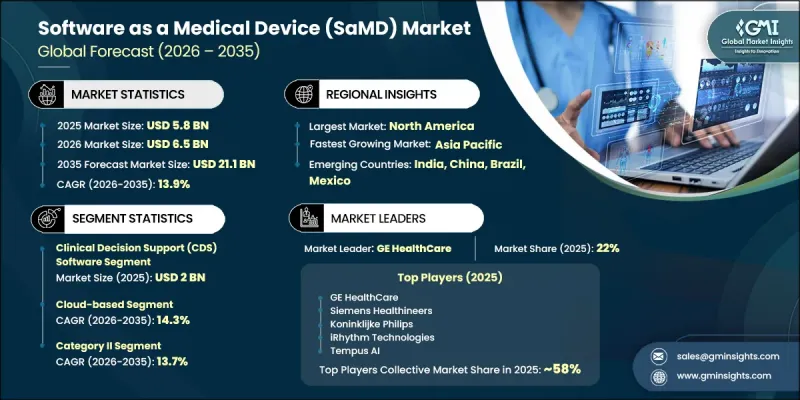
Healthcare providers and technology developers continue to accelerate the adoption of software-based medical solutions as digital healthcare becomes more integrated into clinical workflows. Expanding reimbursement support for remote patient monitoring, favorable regulatory developments for digital therapeutics, and growing use of digital health technologies are creating new opportunities across the market. AI-powered diagnostic software is also gaining attention as developers improve clinical performance, analytical capabilities, and decision-making support. Advances in artificial intelligence and machine learning are expanding the functionality of SaMD platforms, while growing penetration across emerging healthcare markets is opening additional avenues for commercialization. Developers are also increasing their focus on software designed for mental health management, personalized care, predictive healthcare, and data-driven clinical workflows.
| Market Scope | |
|---|---|
| Start Year | 2025 |
| Forecast Year | 2026-2035 |
| Start Value | $5.8 Billion |
| Forecast Value | $21.1 Billion |
| CAGR | 13.9% |
The clinical decision support (CDS) software segment captured USD 2 billion in 2025. Healthcare organizations are increasingly adopting CDS platforms to strengthen diagnostic processes, improve treatment planning, and support more informed clinical decisions. These software solutions process patient information, clinical guidelines, laboratory findings, and historical medical data to generate evidence-based recommendations for healthcare professionals. Increasing demand for efficient clinical workflows, improved diagnostic support, and data-driven treatment decisions continues to encourage healthcare providers to incorporate CDS software into their digital infrastructure.
The hospitals and clinics segment held a 48.1% share in 2025. Hospitals and clinics continue to represent a major source of demand because healthcare facilities require software solutions for clinical monitoring, diagnosis, and decision support across multiple stages of patient care. Increasing digitization of healthcare operations is encouraging providers to adopt software platforms that improve workflow efficiency, data accessibility, and clinical coordination. Growing demand for personalized treatment, predictive healthcare capabilities, and integrated digital health infrastructure is also supporting SaMD adoption across hospitals and clinics. As healthcare organizations continue to modernize their technology environments, the need for scalable and clinically relevant software solutions is expected to increase.
North America Software as a Medical Device (SaMD) Market recorded a 40% share in 2025. The region benefits from advanced healthcare infrastructure, high adoption of digital technologies, and increasing demand for personalized, data-driven approaches to patient care. Healthcare providers across North America are expanding the use of software-based medical solutions to improve clinical workflows, patient monitoring, diagnostics, and treatment management. The growing prevalence of chronic diseases is also increasing demand for continuous monitoring and technology-enabled care. In addition, stronger integration between SaMD platforms and electronic health records (EHRs) is improving access to patient information and supporting more connected healthcare delivery. Continued investments in healthcare technology, AI-enabled medical software, and digital infrastructure are expected to further support regional market expansion.
Prominent companies operating in the global software as a medical device (SaMD) market include Aidoc Medical, Brainlab AG, Butterfly Network, Canon Medical Systems, Fujifilm Holdings, GE HealthCare, Huma Therapeutics, iRhythm Technologies, Koninklijke Philips, Medtronic, PathAI, Qlarity Imaging, Roche Diagnostics, Siemens Healthineers, Tempus AI, and Viz.ai. Companies operating in the global software as a medical device (SaMD) market are strengthening their market positions through product development, artificial intelligence integration, strategic collaborations, and expansion into new healthcare applications. Leading companies are investing in research and development to improve software accuracy, usability, interoperability, and clinical performance. Businesses are also developing AI-powered diagnostic and decision-support capabilities to address the growing demand for efficient digital healthcare solutions. Strategic partnerships with healthcare providers, technology companies, and research organizations help companies expand their customer networks and accelerate the adoption of SaMD platforms. Companies are further strengthening their presence by integrating software with electronic health records, expanding regulatory capabilities, and developing solutions for remote monitoring, personalized care, and digital therapeutics. Geographic expansion, portfolio diversification, continuous platform upgrades, and stronger cybersecurity capabilities also help market participants improve competitiveness and establish a broader foothold in the global software as a medical device (SaMD) market.
Table of Contents
Chapter 1 Methodology and Scope
- 1.1 Market scope and definition
- 1.2 Research design
- 1.2.1 Research approach
- 1.2.2 Data collection methods
- 1.3 Data mining sources
- 1.3.1 Global
- 1.3.2 Regional/Country
- 1.4 Base estimates and calculations
- 1.4.1 Base year calculation
- 1.4.2 Key trends for market estimation
- 1.5 Primary research and validation
- 1.5.1 Primary sources
- 1.6 Forecast model
- 1.7 Research assumptions and limitations
Chapter 2 Executive Summary
- 2.1 Industry 360° synopsis
- 2.2 Key market trends
- 2.2.1 Regional trends
- 2.2.2 Software type trends
- 2.2.3 Deployment mode trends
- 2.2.4 IMDRF risk category trends
- 2.2.5 End use trends
- 2.3 CXO perspectives: Strategic imperatives
Chapter 3 Industry Insights
- 3.1 Industry ecosystem analysis
- 3.2 Industry impact forces
- 3.2.1 Growth drivers
- 3.2.1.1 Rising adoption of digital health technologies
- 3.2.1.2 Expansion of remote patient monitoring reimbursement codes
- 3.2.1.3 AI-powered diagnostic SaMD demonstrating superior clinical sensitivity in comparison with traditional methods
- 3.2.1.4 Regulatory support for digital therapeutics and software-based solutions
- 3.2.2 Industry pitfalls and challenges
- 3.2.2.1 Cybersecurity and data privacy concerns
- 3.2.2.2 Challenges in clinical validation and evidence generation
- 3.2.3 Market opportunities
- 3.2.3.1 Integration of SaMD with wearables and IoMT devices for continuous real-world evidence
- 3.2.3.2 Growing adoption of digital therapeutics (DTx)
- 3.2.1 Growth drivers
- 3.3 Growth potential analysis
- 3.4 Regulatory landscape
- 3.4.1 North America
- 3.4.2 Europe
- 3.4.3 Asia Pacific
- 3.4.4 Latin America
- 3.4.5 Middle East and Africa
- 3.5 Technological advancements
- 3.5.1 Current technological trends
- 3.5.2 Emerging technologies
- 3.6 Pricing trend analysis (Driven by primary research)
- 3.7 Future market trends (Driven by primary research)
- 3.8 Porter's analysis
- 3.9 PESTEL analysis
- 3.10 Gap analysis
- 3.11 Impact of AI and Generative AI on the market (Driven by primary research)
Chapter 4 Competitive Landscape, 2025
- 4.1 Introduction
- 4.2 Company matrix analysis
- 4.3 Company market share analysis (Driven by primary research)
- 4.3.1 Global
- 4.3.2 North America
- 4.3.3 Europe
- 4.3.4 Asia Pacific
- 4.4 Competitive positioning matrix
- 4.5 Competitive analysis of major market players
- 4.6 Key developments
- 4.6.1 Mergers & acquisitions
- 4.6.2 Partnerships & collaborations
- 4.6.3 New product launches
- 4.6.4 Expansion plans
Chapter 5 Market Estimates and Forecast, By Software Type, 2022 - 2035 ($ Mn)
- 5.1 Key trends
- 5.2 Diagnostic and imaging software
- 5.3 Clinical decision support (CDS) software
- 5.4 Remote patient monitoring (RPM) software
- 5.5 Digital therapeutics (DTx)
- 5.6 Surgical planning and navigation software
- 5.7 Other software types
Chapter 6 Market Estimates and Forecast, By Deployment Mode, 2022 - 2035 ($ Mn)
- 6.1 Key trends
- 6.2 Cloud-based
- 6.3 On-premise
Chapter 7 Market Estimates and Forecast, By IMDRF Risk Category, 2022 - 2035 ($ Mn)
- 7.1 Key trends
- 7.2 Category I
- 7.3 Category II
- 7.4 Category III
- 7.5 Category IV
Chapter 8 Market Estimates and Forecast, By End Use, 2022 - 2035 ($ Mn)
- 8.1 Key trends
- 8.2 Hospitals and clinics
- 8.3 Diagnostic centers and radiology
- 8.4 Home care settings
- 8.5 Research and academic institutions
- 8.6 Other end users
Chapter 9 Market Estimates and Forecast, By Region, 2022 - 2035 ($ Mn)
- 9.1 Key trends
- 9.2 North America
- 9.2.1 U.S.
- 9.2.2 Canada
- 9.3 Europe
- 9.3.1 Germany
- 9.3.2 UK
- 9.3.3 France
- 9.3.4 Spain
- 9.3.5 Italy
- 9.3.6 Netherlands
- 9.4 Asia Pacific
- 9.4.1 China
- 9.4.2 India
- 9.4.3 Japan
- 9.4.4 Australia
- 9.4.5 South Korea
- 9.5 Latin America
- 9.5.1 Brazil
- 9.5.2 Mexico
- 9.5.3 Argentina
- 9.6 Middle East and Africa
- 9.6.1 Saudi Arabia
- 9.6.2 South Africa
- 9.6.3 UAE
Chapter 10 Company Profiles
- 10.1 Aidoc Medical
- 10.2 Brainlab AG
- 10.3 Butterfly Network
- 10.4 Canon Medical Systems
- 10.5 Fujifilm Holdings
- 10.6 GE HealthCare
- 10.7 Huma Therapeutics
- 10.8 iRhythm Technologies
- 10.9 Koninklijke Philips
- 10.10 Medtronic
- 10.11 PathAI
- 10.12 Qlarity Imaging
- 10.13 Roche Diagnostics
- 10.14 Siemens Healthineers
- 10.15 Tempus AI
- 10.16 Viz.ai

