PUBLISHER: Global Market Insights Inc. | PRODUCT CODE: 2121179

PUBLISHER: Global Market Insights Inc. | PRODUCT CODE: 2121179
Construction Worker Safety Market Opportunity, Growth Drivers, Industry Trend Analysis, and Forecast 2026 - 2035
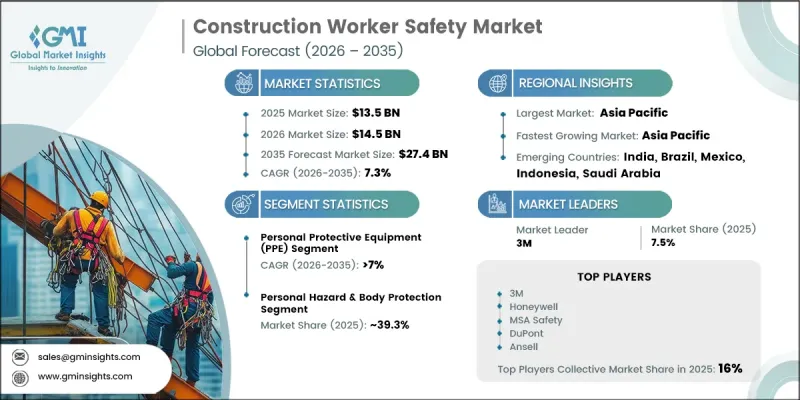
The Global Construction Worker Safety Market was valued at USD 13.5 billion in 2025 and is estimated to grow at a CAGR of 7.3% to reach USD 27.4 billion by 2035.
Construction companies increasingly use digital technologies to strengthen workplace protection, improve hazard visibility, and support faster safety responses. AI-enabled risk identification, connected-worker technologies, and centralized safety platforms are changing how contractors manage workplace risks. Advances in compact sensor technology and cloud-based software allow safety teams to collect and review information from multiple sources through integrated systems. These capabilities help companies monitor worker conditions, identify potential hazards, verify safety compliance, and respond to incidents more efficiently. The market is also moving beyond conventional protective equipment toward connected safety ecosystems that combine physical protection with digital monitoring and analytics. Manufacturers are developing integrated hardware and software solutions that can operate across diverse safety environments, reducing dependence on isolated systems. At the same time, growing interest in wearable robotic technologies for reducing physical strain is expanding the scope of construction safety solutions. The emergence of new technologies is also encouraging regulators and industry stakeholders to establish clearer frameworks for their use, supporting further development of the construction worker safety market.
| Market Scope | |
|---|---|
| Start Year | 2025 |
| Forecast Year | 2026-2035 |
| Start Value | $13.5 Billion |
| Forecast Value | $27.4 Billion |
| CAGR | 7.3% |
The construction worker safety market continues to benefit from the increasing integration of artificial intelligence, connected devices, and centralized safety management platforms. Companies can now bring information from different safety technologies into unified digital environments, allowing safety teams to evaluate workplace conditions and worker-related risks more efficiently. Improvements in sensor design and cloud infrastructure have also expanded the ability to collect safety information continuously without relying on multiple disconnected systems. This shift is encouraging construction companies to adopt broader connected-worker solutions instead of depending solely on individual protective products. Manufacturers are increasingly combining sensor-enabled equipment, digital dashboards, and incident-management functions into integrated safety ecosystems. Interoperability has become an important consideration as contractors seek solutions that can work across different equipment and technology environments. Meanwhile, greater adoption of exoskeleton technology for reducing musculoskeletal stress is demonstrating the potential for wearable robotics to support workers in large-scale construction operations. The development of regulatory frameworks for emerging safety technologies is also helping create a more structured environment for market expansion.
The personal protective equipment segment held a 55.6% share, and is projected to grow at a CAGR of 7% through 2035. Construction companies continue to treat PPE as the essential physical layer of workplace protection. Protective equipment provides direct coverage against common occupational risks and remains a fundamental requirement within construction safety programs. Employers rely on properly selected and fitted equipment to protect workers from physical hazards and exposure risks encountered during construction activities. Because PPE directly protects workers at the point of exposure, companies continue to prioritize it even as digital monitoring and connected-worker technologies gain traction. Monitoring platforms, training programs, and other technology-based safety solutions generally complement physical protection rather than replace it.
The personal hazard and body protection segment accounted for a 39.3% share in 2025 and is expected to register a CAGR of 6.7% between 2026 and 2035. Personal and body protection products form a central component of construction PPE because they address a broad range of workplace protection requirements. Contractors can deploy these products without requiring extensive digital infrastructure, making them accessible to businesses operating across projects of different sizes. Their established role in workplace safety, straightforward procurement requirements, and widespread adoption continue to support segment growth. Construction safety programs consistently prioritize personal protection because workers require physical safeguards as part of routine site operations. The category also remains an important focus for major safety equipment manufacturers, which continue to develop products, certifications, and protection technologies around changing workplace requirements.
United States Construction Worker Safety Market accounted for an 84.3% share in 2025. The country represents the primary market for construction safety solutions in North America because of its mature construction industry, established workplace safety practices, and strong emphasis on regulatory compliance. Construction companies continue to invest in protective equipment and safety technologies to meet workplace requirements and improve worker protection. The presence of major safety equipment manufacturers within the country also supports product availability, technology development, and industry adoption. Domestic manufacturers have developed product portfolios and certification capabilities that closely address the requirements of U.S. construction operations.
Major companies operating in the global construction worker safety market include MSA Safety, 3M, Honeywell, Ansell, Blackline Safety, DuPont, Dragerwerk AG & Co. KGaA, Lakeland Industries, and Crowcon Detection Instruments. Companies in the construction worker safety market are strengthening their positions through product innovation, technology integration, portfolio expansion, strategic partnerships, and improvements in distribution and service capabilities. Manufacturers are developing protective products that combine enhanced comfort, durability, functionality, and compliance to address evolving jobsite requirements. Businesses are also investing in connected safety technologies, sensor integration, digital monitoring, and cloud-based platforms to expand beyond conventional PPE offerings. Expanding product portfolios allows companies to serve different construction environments and address a broader range of worker protection requirements. Strategic collaborations can help manufacturers accelerate technology development, strengthen distribution networks, and reach new customer groups. Companies are also increasing investments in research and development to improve wearable safety technologies and connected-worker solutions.
Table of Contents
Chapter 1 Methodology
- 1.1 Research approach
- 1.2 Quality Commitments
- 1.2.1 GMI AI policy & data integrity commitment
- 1.2.1.1 Source consistency protocol
- 1.2.1 GMI AI policy & data integrity commitment
- 1.3 Research Trail & Confidence Scoring
- 1.3.1 Research Trail Components
- 1.3.2 Scoring Components
- 1.4 Data Collection
- 1.4.1 Partial list of primary sources
- 1.5 Data mining sources
- 1.5.1 Paid sources
- 1.5.1.1 Sources, by region
- 1.5.1 Paid sources
- 1.6 Base estimates and calculations
- 1.6.1 Base year calculation
- 1.7 Forecast Model
- 1.7.1 Quantified market impact analysis
- 1.7.1.1 Mathematical impact of growth parameters on forecast
- 1.7.1 Quantified market impact analysis
- 1.8 Research transparency addendum
- 1.8.1 Source attribution framework
- 1.8.2 Quality assurance metrics
- 1.8.3 Our commitment to trust
Chapter 2 Executive Summary
- 2.1 Industry 360° synopsis, 2022 – 2035
- 2.2 Key market trends
- 2.2.1 Regional
- 2.2.2 Product
- 2.2.3 Application
- 2.2.4 Construction Type
- 2.2.5 End Use
- 2.2.6 Sales Channel
- 2.3 TAM Analysis, 2026-2035
- 2.4 CXO perspectives: Strategic imperatives
Chapter 3 Industry Insights
- 3.1 Industry ecosystem analysis
- 3.1.1 Supplier landscape
- 3.1.2 Profit margin analysis
- 3.1.3 Cost structure
- 3.1.4 Value addition at each stage
- 3.1.5 Factor affecting the value chain
- 3.1.6 Disruptions
- 3.2 Industry impact forces
- 3.2.1 Growth drivers
- 3.2.1.1 Stringent OSHA & Global Occupational Safety Regulations Mandating PPE & Fall Protection Compliance
- 3.2.1.2 Rising Construction Fatality & Injury Rates Driving Proactive Safety Investment
- 3.2.1.3 Surge in Global Infrastructure Spending by Government & Private Sector
- 3.2.1.4 Growing Adoption of Smart Safety Technologies (IoT, AI, Wearables) Across Job Sites
- 3.2.2 Market Restraints
- 3.2.2.1 High Initial Cost of Advanced Safety Equipment & Technology Implementation
- 3.2.2.2 Supply Chain Disruptions & Raw Material Price Volatility (Aramid Fiber, Steel, Polymers)
- 3.2.3 Market Opportunities
- 3.2.3.1 Integration of AI, IoT & Wearable Sensors in Next-Generation PPE & Monitoring Systems
- 3.2.3.2 Expanding Rental & Leasing Models for High-Cost Safety Equipment Lowering SME Adoption Barriers
- 3.2.1 Growth drivers
- 3.3 Growth potential analysis
- 3.4 Technology and Innovation landscape
- 3.4.1 Current technological trends
- 3.4.2 Emerging technologies
- 3.5 Pricing analysis (driven by primary research)
- 3.5.1 Historical price trend analysis
- 3.5.2 Pricing strategy by player type (premium / value / cost-plus)
- 3.6 Regulatory guidelines
- 3.6.1 North America
- 3.6.1.1 OSHA Construction Industry Standards (29 CFR 1926), including Subpart M Fall Protection
- 3.6.1.2 OSHA Hazard Communication Standard (29 CFR 1910.1200)
- 3.6.1.3 CSA Z1000 / Canadian Provincial OHS Acts (e.g., Ontario OHSA, WorkSafeBC)
- 3.6.1.4 Mexico NOM-017-STPS (Personal Protective Equipment)
- 3.6.2 Europe (EU)
- 3.6.2.1 Regulation (EU) 2016/425 on Personal Protective Equipment
- 3.6.2.2 Directive 89/656/EEC — Use of PPE at the Workplace
- 3.6.2.3 Framework Directive 89/391/EEC (OSH Framework Directive)
- 3.6.2.4 CEN/CENELEC Harmonized Standards for PPE Certification
- 3.6.3 Asia Pacific (APAC)
- 3.6.3.1 India Occupational Safety, Health and Working Conditions (OSH) Code, 2020
- 3.6.3.2 China GB (Guobiao) National Standards for Occupational Safety
- 3.6.3.3 Australia Work Health and Safety (WHS) Act & Model WHS Regulations
- 3.6.3.4 Japan Industrial Safety and Health Act (ISHA)
- 3.6.4 Latin America (LA)
- 3.6.4.1 Brazil Normas Regulamentadoras (NR-18 Construction Safety, NR-6 PPE)
- 3.6.4.2 Mexico NOM-031-STPS (Construction Safety Conditions)
- 3.6.4.3 Colombia Sistema de Gestion de Seguridad y Salud en el Trabajo (SG-SST)
- 3.6.4.4 Chile Ley 16.744 and DS 594
- 3.6.5 Middle East & Africa (MEA)
- 3.6.5.1 Saudi Arabia OSHAD / HCIS Guidelines
- 3.6.5.2 UAE OSHAD-SF (Abu Dhabi) & Dubai Municipality Code of Construction Safety Practice
- 3.6.5.3 South Africa Occupational Health and Safety Act (OHSA) & Construction Regulations 2014
- 3.6.5.4 GCC Standardization Organization (GSO) Technical Regulations
- 3.6.1 North America
- 3.7 Porter’s analysis
- 3.8 PESTEL analysis
- 3.9 Patent landscape (driven by primary research)
- 3.10 Capacity & production landscape (driven by primary research)
- 3.10.1 Installed capacity by region & key producer
- 3.10.2 Capacity utilization rates & expansion pipelines
- 3.11 Impact of AI & Generative AI on the market (driven by primary research)
- 3.11.1 AI-driven disruption of existing business models
- 3.11.2 GenAI use cases & adoption roadmap by segment
- 3.11.3 Risks, limitations & regulatory considerations
- 3.12 Sustainability and environmental aspects
- 3.12.1 Sustainable practices
- 3.12.2 Waste reduction strategies
- 3.12.3 Energy efficiency in production
- 3.12.4 Eco-friendly initiatives
- 3.12.5 Carbon footprint considerations
- 3.13 Forecast assumptions & scenario analysis (driven by primary research)
- 3.13.1 Base case - key macro & industry variables driving CAGR
- 3.13.2 Optimistic scenarios - favourable macro and industry tailwinds
- 3.13.3 Pessimistic scenario - macroeconomic slowdown or industry headwinds
Chapter 4 Competitive Landscape, 2025
- 4.1 Introduction
- 4.2 Company market share analysis, 2022-2025
- 4.2.1 North America
- 4.2.2 Europe
- 4.2.3 Asia Pacific
- 4.2.4 Latin America
- 4.2.5 MEA
- 4.3 Competitive analysis of major market players
- 4.4 Competitive positioning matrix
- 4.5 Key developments
- 4.5.1 Mergers & acquisitions
- 4.5.2 Partnerships & collaborations
- 4.5.3 New product launches
- 4.5.4 Expansion plans and funding
- 4.6 Company tier benchmarking
- 4.6.1 Tier classification criteria & qualifying thresholds
- 4.6.2 Tier positioning matrix by revenue, geography & innovation
Chapter 5 Market Estimates & Forecast, By Product, 2022 - 2035 ($Bn)
- 5.1 Key trends
- 5.2 Personal protective equipment (PPE)
- 5.2.1 Head protection (hard hats & helmets)
- 5.2.2 Eye & face protection (goggles & face shields)
- 5.2.3 Respiratory protection (masks & respirators)
- 5.2.4 Hand protection (safety gloves)
- 5.2.5 Foot & leg protection (safety boots & shin guards)
- 5.2.6 Hearing protection (earmuffs & earplugs)
- 5.2.7 High-visibility & protective apparel (vests & coveralls)
- 5.3 Fall protection systems
- 5.3.1 Personal fall arrest systems
- 5.3.2 Guardrails & safety barriers
- 5.3.3 Safety nets
- 5.3.4 Scaffolding safety systems
- 5.4 Environmental monitoring & detection systems
- 5.4.1 Gas & chemical detection systems
- 5.4.2 Noise & vibration monitoring devices
- 5.4.3 Dust & air quality monitoring systems
- 5.4.4 Temperature, weather & structural monitoring
- 5.5 On-site safety management systems
- 5.5.1 EHS safety management software
- 5.5.2 Site surveillance & video monitoring
- 5.5.3 Wearable sensor & IoT integration platforms
- 5.6 Safe access & emergency equipment
Chapter 6 Market Estimates & Forecast, By Application, 2022 - 2035 ($Bn)
- 6.1 Key trends
- 6.2 Fall prevention & height safety
- 6.3 Personal hazard & body protection
- 6.4 Environmental & site hazard monitoring
- 6.5 Safety training, compliance & management
Chapter 7 Market Estimates & Forecast, By Construction Type, 2022 - 2035 ($Bn)
- 7.1 Key trends
- 7.2 Residential construction
- 7.3 Commercial construction
- 7.4 Industrial construction
- 7.5 Infrastructure & civil construction
Chapter 8 Market Estimates & Forecast, By End Use, 2022 – 2035 ($Bn)
- 8.1 Key trends
- 8.2 General contractors
- 8.3 Specialty trade contractors
- 8.4 Government & municipal bodies
- 8.5 Independent contractors & safety consultants
Chapter 9 Market Estimates & Forecast, By Sales Channel, 2022 – 2035 ($Bn)
- 9.1 Key trends
- 9.2 Direct sales
- 9.2.1 General contractors
- 9.2.2 Specialty trade contractors
- 9.2.3 Government & municipal bodies
- 9.2.4 Independent contractors & safety consultants
- 9.3 Indirect sales
- 9.3.1 General contractors
- 9.3.2 Specialty trade contractors
- 9.3.3 Government & municipal bodies
- 9.3.4 Independent contractors & safety consultants
Chapter 10 Market Estimates & Forecast, By Region, 2022 - 2035 ($Bn, Units)
- 10.1 Key trends
- 10.2 North America
- 10.2.1 US
- 10.2.2 Canada
- 10.3 Europe
- 10.3.1 Germany
- 10.3.2 UK
- 10.3.3 France
- 10.3.4 Italy
- 10.3.5 Spain
- 10.3.6 Russia
- 10.3.7 Denmark
- 10.3.8 Netherlands
- 10.3.9 Sweden
- 10.4 Asia Pacific
- 10.4.1 China
- 10.4.2 India
- 10.4.3 Japan
- 10.4.4 ANZ
- 10.4.5 South Korea
- 10.4.6 Indonesia
- 10.4.7 Thailand
- 10.4.8 Vietnam
- 10.5 Latin America
- 10.5.1 Brazil
- 10.5.2 Mexico
- 10.5.3 Argentina
- 10.6 MEA
- 10.6.1 South Africa
- 10.6.2 Saudi Arabia
- 10.6.3 UAE
Chapter 11 Company Profiles
- 11.1 Global Players
- 11.1.1 Honeywell International Inc.
- 11.1.2 3M Company
- 11.1.3 DuPont de Nemours Inc.
- 11.1.4 Kimberly-Clark Professional
- 11.1.5 MSA Safety Incorporated
- 11.1.6 Dragerwerk AG & Co. KGaA
- 11.1.7 Ansell Limited
- 11.1.8 Crowcon Detection Instruments
- 11.1.9 Petzl
- 11.1.10 Portwest
- 11.2 Regional Players
- 11.2.1 Lakeland Industries Inc.
- 11.2.2 Uvex Safety Group
- 11.2.3 Bullard Company
- 11.2.4 Blackline Safety Corp.
- 11.2.5 Pyramex Safety
- 11.2.6 Ergodyne (Tenacious Holdings)
- 11.2.7 Radians Inc.
- 11.2.8 MCR Safety
- 11.2.9 Alpha Pro Tech Ltd.
- 11.2.10 Cresto Safety AB

