PUBLISHER: Global Market Insights Inc. | PRODUCT CODE: 2121180

PUBLISHER: Global Market Insights Inc. | PRODUCT CODE: 2121180
Language Translation Device Market Opportunity, Growth Drivers, Industry Trend Analysis, and Forecast 2026 - 2035
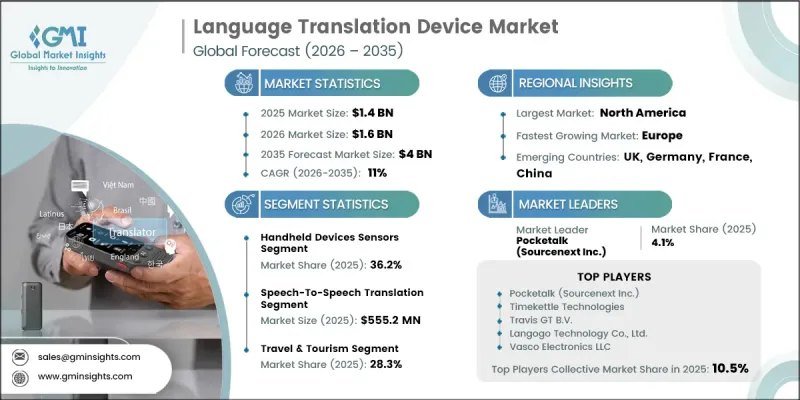
The Global Language Translation Device Market was valued at USD 1.4 billion in 2025 and is estimated to grow at a CAGR of 11% to reach USD 4 billion by 2035.
The language translation devices industry is witnessing robust growth as demand for seamless multilingual communication continues to increase across business, travel, healthcare, education, and public service environments. Rising international tourism, growing cross-border business activities, and the expansion of global e-commerce are encouraging the adoption of dedicated translation devices that provide instant and reliable language support. Organizations are increasingly investing in portable translation technologies to improve customer engagement, workplace collaboration, and communication efficiency across multilingual environments. Continued advancements in artificial intelligence, speech recognition, machine learning, and neural language processing are significantly enhancing translation speed, contextual understanding, and overall accuracy, making dedicated translation devices more reliable for both personal and professional applications. Growing demand for multilingual customer support, increasing globalization of businesses, and expanding digital communication needs are further accelerating market growth. In addition, the broader adoption of intelligent translation solutions across institutional and commercial settings is strengthening the long-term outlook for the market by enabling more efficient communication while reducing language barriers in diverse operational environments.
| Market Scope | |
|---|---|
| Start Year | 2025 |
| Forecast Year | 2026-2035 |
| Start Value | $1.4 Billion |
| Forecast Value | $4 Billion |
| CAGR | 11% |
The language translation device market continues to benefit from rising global mobility and increasing demand for multilingual communication solutions across multiple industries. Growing adoption within healthcare and emergency service environments is creating additional opportunities for market expansion as organizations seek more effective communication with diverse populations. Regulatory emphasis on language accessibility in healthcare has further encouraged the implementation of translation technologies that support improved communication and service quality. At the same time, continuous innovation in artificial intelligence-powered speech translation is improving the precision, responsiveness, and reliability of real-time translation devices. These technological advancements are increasing user confidence in dedicated translation hardware while expanding adoption across commercial, institutional, and professional applications worldwide.
The handheld devices segment accounted for a 36.2% share in 2025. This segment maintained its leadership due to the portability, convenience, and high translation accuracy offered by handheld devices. Their ability to deliver instant speech and text translation in real time makes them well suited for multilingual communication across a broad range of professional and personal applications. Increasing preference for compact and easy-to-use translation solutions is encouraging broader adoption among organizations and individual users seeking efficient communication without language barriers.
The travel and tourism segment held a 28.3% share in 2025. Strong growth in international travel, expanding multilingual service requirements, and increasing focus on enhancing visitor experiences continue to drive demand within this segment. Translation devices enable faster and more effective communication between travelers and service providers, improving customer satisfaction while supporting greater accessibility across tourism-related operations. The continued recovery and expansion of global travel activities are expected to sustain demand throughout the forecast period.
North America Language Translation Device Market accounted for a 37.5% share in 2025. The region maintains its leadership position due to the widespread adoption of artificial intelligence-powered translation technologies, a highly diverse multilingual population, and strong demand for international business and travel. Organizations across multiple industries are increasingly implementing real-time language solutions to improve communication, operational efficiency, and customer engagement. The growing adoption of portable and wearable translation devices across commercial enterprises, educational institutions, healthcare organizations, and public sector services continues to support market expansion throughout the region.
Major companies operating in the global language translation device market include Anfier Technology Co. Ltd., Birgus (Shenzhen Birgus International), Cheetah Mobile Inc., ECTACO Inc., Jarvisen (iFLYTEK), Langogo Technology Co., Ltd., Lingmo International Ltd., Mymanu (CEH Tech Ltd), Poliglu Translator, Pocketalk (Sourcenext Inc.), Timekettle Technologies, Travis GT B.V., Vasco Electronics LLC, Waverly Labs Inc., and Xiaomi Corporation. Companies operating in the language translation device market are strengthening their competitive position by investing in artificial intelligence, machine learning, neural language processing, and speech recognition technologies to improve translation accuracy and real-time performance. Market participants are continuously enhancing hardware capabilities, expanding language support, and integrating cloud-based services to deliver more reliable and intelligent communication solutions. Strategic collaborations with technology providers, enterprise customers, and distribution partners are helping companies broaden market reach and accelerate product adoption. Businesses are also focusing on product innovation, software updates, ergonomic device designs, and improved battery performance to enhance user experience.
Table of Contents
Chapter 1 Methodology and Scope
- 1.1 Market scope and definition
- 1.2 Research design
- 1.2.1 Research approach
- 1.2.2 Data collection methods
- 1.3 Data mining sources
- 1.3.1 Global
- 1.3.2 Regional/Country
- 1.4 Base estimates and calculations
- 1.4.1 Base year calculation
- 1.4.2 Key trends for market estimation
- 1.5 Primary research and validation
- 1.5.1 Primary sources
- 1.6 Forecast model
- 1.7 Research assumptions and limitations
Chapter 2 Executive Summary
- 2.1 Industry 360° synopsis, 2022 – 2035
- 2.2 Key market trends
- 2.2.1 Sensor type trends
- 2.2.2 Product type trends
- 2.2.3 Translation capability trends
- 2.2.4 Connectivity type trends
- 2.2.5 Technology trends
- 2.2.6 Application trends
- 2.2.7 Regional trends
- 2.3 TAM Analysis, 2026-2035
- 2.4 CXO perspectives: Strategic imperatives
- 2.4.1 Executive decision points
- 2.4.2 critical success factors
- 2.5 Future outlook and strategic recommendations
Chapter 3 Industry Insights
- 3.1 Industry ecosystem analysis
- 3.1.1 Supplier Landscape
- 3.1.2 Profit Margin
- 3.1.3 Cost structure
- 3.1.4 Value addition at each stage
- 3.1.5 Factor affecting the value chain
- 3.1.6 Disruptions
- 3.2 Industry impact forces
- 3.2.1 Growth drivers
- 3.2.1.1 Growth in international tourism and cross-border travel
- 3.2.1.2 Rising multilingual workplace communication requirements
- 3.2.1.3 Expansion of global e-commerce and customer support services
- 3.2.1.4 Increased adoption in healthcare and emergency response settings
- 3.2.1.5 Accuracy improvements in neural speech-to-speech engines
- 3.2.2 Industry pitfalls and challenges
- 3.2.2.1 Accuracy limitations in low-resource and regional languages
- 3.2.2.2 Competition from free smartphone translation applications
- 3.2.3 Market opportunities
- 3.2.3.1 Expansion of portable and wearable sensing devices
- 3.2.3.2 Wearable translators for hands-free professional applications
- 3.2.1 Growth drivers
- 3.3 Growth potential analysis
- 3.4 Regulatory landscape
- 3.4.1 North America
- 3.4.2 Europe
- 3.4.3 Asia Pacific
- 3.4.4 Latin America
- 3.4.5 Middle East & Africa
- 3.5 Porter’s analysis
- 3.6 PESTEL analysis
- 3.7 Technology and Innovation landscape
- 3.7.1 Current technological trends
- 3.7.2 Emerging technologies
- 3.8 Price trends
- 3.8.1 By region
- 3.8.2 By product
- 3.9 Pricing Strategies
- 3.10 Emerging Business Models
- 3.11 Compliance Requirements
- 3.12 Patent and IP analysis
- 3.13 Geopolitical and trade dynamics
Chapter 4 Competitive Landscape, 2025
- 4.1 Introduction
- 4.2 Company market share analysis
- 4.2.1 By region
- 4.2.1.1 North America
- 4.2.1.2 Europe
- 4.2.1.3 Asia Pacific
- 4.2.1.4 Latin America
- 4.2.1.5 Middle East & Africa
- 4.2.2 Market concentration analysis
- 4.2.1 By region
- 4.3 Competitive benchmarking of key players
- 4.3.1 Financial performance comparison
- 4.3.1.1 Revenue
- 4.3.1.2 Profit margin
- 4.3.1.3 R&D
- 4.3.2 Product portfolio comparison
- 4.3.2.1 Product range breadth
- 4.3.2.2 Technology
- 4.3.2.3 Innovation
- 4.3.3 Geographic presence comparison
- 4.3.3.1 Global footprint analysis
- 4.3.3.2 Service network coverage
- 4.3.3.3 Market penetration by region
- 4.3.4 Competitive positioning matrix
- 4.3.4.1 Leaders
- 4.3.4.2 Challengers
- 4.3.4.3 Followers
- 4.3.4.4 Niche players
- 4.3.5 Strategic outlook matrix
- 4.3.1 Financial performance comparison
- 4.4 Key developments
- 4.4.1 Mergers and acquisitions
- 4.4.2 Partnerships and collaborations
- 4.4.3 Technological advancements
- 4.4.4 Expansion and investment strategies
- 4.4.5 Digital transformation initiatives
- 4.5 Emerging/ startup competitors landscape
Chapter 5 Market Estimates and Forecast, By Product Type, 2022 – 2035 (USD Million)
- 5.1 Key trends
- 5.2 Handheld translation devices
- 5.3 Pocket translators
- 5.4 Wearable translation devices
- 5.5 Specialized form factors
Chapter 6 Market Estimates and Forecast, By Translation Capability, 2022 – 2035 (USD Million)
- 6.1 Key trends
- 6.2 Speech-to-speech translation
- 6.3 Speech-to-text translation
- 6.4 Text-to-text translation
- 6.5 Image-to-text translation (OCR & camera)
Chapter 7 Market Estimates and Forecast, By Connectivity Type, 2022 – 2035 (USD Million)
- 7.1 Key trends
- 7.2 Online (cloud-based) translation devices
- 7.3 Offline translation devices
- 7.4 Hybrid (online + offline) devices
Chapter 8 Market Estimates and Forecast, By Technology, 2022 – 2035 (USD Million)
- 8.1 Key trends
- 8.2 AI & neural machine translation (NMT) devices
- 8.3 Rule-based translation devices
- 8.4 Hybrid translation systems
Chapter 9 Market Estimates and Forecast, By Application, 2022 – 2035 (USD Million)
- 9.1 Key trends
- 9.2 Travel & tourism
- 9.3 Business & corporate communication
- 9.4 Healthcare & medical communication
- 9.5 Education & training
- 9.6 Government & public services
- 9.7 Hospitality & customer service
- 9.8 Immigration & border control
- 9.9 Others
Chapter 10 Market Estimates and Forecast, By Region, 2022 – 2035 (USD Million)
- 10.1 Key trends
- 10.2 North America
- 10.2.1 U.S.
- 10.2.2 Canada
- 10.3 Europe
- 10.3.1 Germany
- 10.3.2 UK
- 10.3.3 France
- 10.3.4 Spain
- 10.3.5 Italy
- 10.3.6 Russia
- 10.4 Asia Pacific
- 10.4.1 China
- 10.4.2 India
- 10.4.3 Japan
- 10.4.4 Australia
- 10.4.5 South Korea
- 10.5 Latin America
- 10.5.1 Brazil
- 10.5.2 Mexico
- 10.5.3 Argentina
- 10.6 Middle East and Africa
- 10.6.1 South Africa
- 10.6.2 Saudi Arabia
- 10.6.3 UAE
Chapter 11 Company Profiles
- 11.1 Global Key Players
- 11.1.1 Pocketalk (Sourcenext Inc.)
- 11.1.2 Jarvisen (iFLYTEK)
- 11.1.3 Langogo Technology Co., Ltd.
- 11.1.4 Timekettle Technologies
- 11.1.5 Vasco Electronics LLC
- 11.1.6 Waverly Labs Inc.
- 11.2 Regional key players
- 11.2.1 North America
- 11.2.1.1 ECTACO Inc.
- 11.2.1.2 Cheetah Mobile Inc.
- 11.2.1.3 Travis GT B.V.
- 11.2.2 Asia Pacific
- 11.2.2.1 Lingmo International Ltd.
- 11.2.2.2 Xiaomi Corporation
- 11.2.2.3 Anfier Technology Co. Ltd.
- 11.2.3 Europe
- 11.2.3.1 Mymanu (CEH Tech Ltd)
- 11.2.3.2 Birgus (Shenzhen Birgus International)
- 11.2.1 North America
- 11.3 Niche Players/Disruptors
- 11.3.1 Poliglu Translator

