PUBLISHER: Global Market Insights Inc. | PRODUCT CODE: 2121190

PUBLISHER: Global Market Insights Inc. | PRODUCT CODE: 2121190
Analog Front-End (AFE) IC Market Opportunity, Growth Drivers, Industry Trend Analysis, and Forecast 2026 - 2035
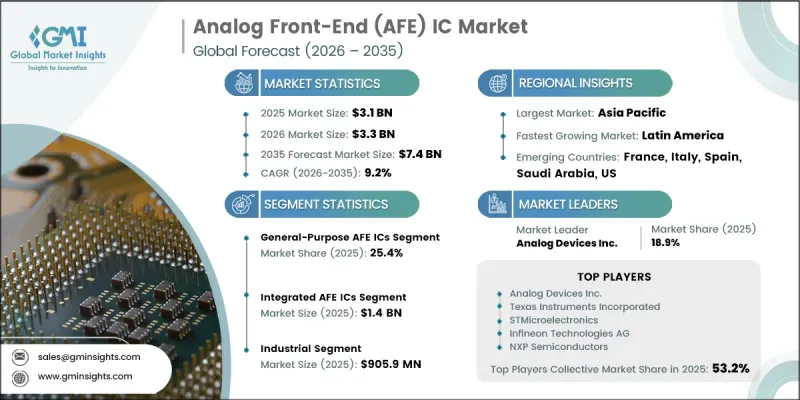
The Global Analog Front-End IC Market was valued at USD 3.1 billion in 2025 and is estimated to grow at a CAGR of 9.2% to reach USD 7.4 billion by 2035.
Rising semiconductor demand across connected and automated technologies is creating new growth opportunities for analog front-end IC manufacturers. Increasing adoption of intelligent industrial systems, electric mobility, advanced healthcare electronics, edge computing devices, and emerging wireless technologies is supporting market expansion. Analog front-end ICs play an important role in electronic systems by receiving raw analog signals and preparing them for further digital processing. These chips can perform functions such as signal conditioning, amplification, filtering, and analog-to-digital conversion, helping electronic systems process sensor-generated information accurately. As manufacturers develop smaller, smarter, and more energy-efficient devices, demand is increasing for AFE solutions that can provide reliable signal acquisition while supporting compact system designs. Continued investments in automation, electrification, connected devices, and advanced electronics are expected to strengthen the adoption of analog front-end ICs across multiple applications.
| Market Scope | |
|---|---|
| Start Year | 2025 |
| Forecast Year | 2026-2035 |
| Start Value | $3.1 Billion |
| Forecast Value | $7.4 Billion |
| CAGR | 9.2% |
The analog front-end IC market is gaining momentum from the expansion of industrial automation, connected industrial environments, and digital manufacturing systems that require accurate sensing and real-time signal acquisition. The growing use of portable and wearable electronic equipment is also creating additional opportunities for AFE technology, particularly as healthcare applications increasingly depend on continuous and accurate electronic data collection. Wider acceptance of digital healthcare practices and supportive initiatives from healthcare regulators and public health organizations are expected to encourage demand for low-power and high-precision solutions used for biological signal acquisition. At the same time, increasing deployment of electric vehicles and energy storage technologies is expanding the requirement for accurate monitoring and control electronics. Battery management systems represent an important application area for high-accuracy AFE ICs because they require precise measurement and processing of electrical parameters. The continued development of electrified transportation and energy storage infrastructure is therefore expected to provide steady growth opportunities for the AFE IC market.
The general-purpose AFE ICs held a 25.4% share in 2025. Their broad functionality and versatility have supported adoption across a diverse range of electronic applications. Manufacturers and system developers use these components where multiple analog signal processing requirements must be addressed without relying on highly specialized architectures. General-purpose AFE ICs provide functions such as signal conditioning, signal amplification, and analog-to-digital conversion within cost-effective solutions. Their ability to support different system requirements has encouraged their use across industrial equipment, electronic products, vehicle systems, health-related monitoring equipment, and communications infrastructure. The combination of functional flexibility and relatively economical implementation continues to make general-purpose AFE ICs an attractive option for applications that require reliable analog signal processing without excessive system complexity.
The integrated AFE ICs segment generated USD 1.4 billion in 2025 supported by the ability to combine several analog functions within a single semiconductor device. Depending on the system architecture, integrated AFE solutions can incorporate signal conditioning, amplification, filtering, analog-to-digital conversion, power management, and other supporting functions. Combining these capabilities helps reduce the amount of circuit board space required while also lowering overall system costs, energy consumption, and design complexity. These benefits are encouraging designers to select integrated AFE architectures for compact and sophisticated electronic systems. Demand remains particularly strong across industrial automation, vehicle electronics, medical equipment, and telecommunications hardware, where manufacturers increasingly seek solutions that deliver multiple functions while maintaining efficient system layouts and power consumption.
North America Analog Front-End IC Market accounted for a 31.8% share in 2025. The regional market is benefiting from the presence of a well-established semiconductor ecosystem and continued public and private investment in advanced technologies. Government support for industrial automation, electric mobility, and artificial intelligence-enabled technologies is contributing to the expansion of electronics manufacturing and related component demand. Semiconductor manufacturers are also developing increasingly intelligent sensing solutions that support the deployment of connected and automated equipment. The growing adoption of Industry 4.0 technologies across manufacturing and other sectors is creating additional demand for precision sensing and signal-processing components.
Prominent companies operating in the global analog front-end IC market include Renesas Electronics Corp., Analog Devices Inc., ROHM Co., Ltd., Infineon Technologies AG, Cirrus Logic, Inc., Texas Instruments, ams-OSRAM AG, STMicroelectronics, NXP Semiconductors, Microchip Technology Inc., Onsemi, Asahi Kasei Microdevices Corp., Nisshinbo Micro Devices Inc., Hycon Technology Corp., and SINOWEALTH Electronic Ltd. Companies in the analog front-end IC market are strengthening their competitive positions through continuous product innovation, portfolio expansion, strategic partnerships, and investments in advanced semiconductor technologies. Manufacturers are developing AFE solutions with improved accuracy, lower power requirements, greater integration, and enhanced signal-processing capabilities to address evolving application requirements. Expanding product portfolios across industrial, automotive, healthcare, communications, and consumer electronics applications allows companies to reach broader customer groups. Businesses are also focusing on advanced manufacturing capabilities and semiconductor research to improve performance and maintain technological differentiation. Strategic collaborations with equipment manufacturers and technology developers help companies expand application opportunities and establish stronger customer relationships.
Table of Contents
Chapter 1 Methodology and Scope
- 1.1 Market scope and definition
- 1.2 Research design
- 1.2.1 Research approach
- 1.2.2 Data collection methods
- 1.3 Data mining sources
- 1.3.1 Global
- 1.3.2 Regional/Country
- 1.4 Base estimates and calculations
- 1.4.1 Base year calculation
- 1.4.2 Key trends for market estimation
- 1.5 Primary research and validation
- 1.5.1 Primary sources
- 1.6 Forecast model
- 1.7 Research assumptions and limitations
Chapter 2 Executive Summary
- 2.1 Industry 360° synopsis, 2022 – 2035
- 2.2 Key market trends
- 2.2.1 Product type trends
- 2.2.2 Architecture trends
- 2.2.3 End-use trends
- 2.2.4 Channel configuration trends
- 2.2.5 Regional trends
- 2.3 TAM Analysis, 2026-2035
- 2.4 CXO perspectives: Strategic imperatives
Chapter 3 Industry Insights
- 3.1 Industry ecosystem analysis
- 3.1.1 Supplier Landscape
- 3.1.2 Profit Margin
- 3.1.3 Cost structure
- 3.1.4 Value addition at each stage
- 3.1.5 Factor affecting the value chain
- 3.1.6 Disruptions
- 3.2 Industry impact forces
- 3.2.1 Growth drivers
- 3.2.1.1 Growing adoption of industrial automation and smart sensors
- 3.2.1.2 Rising electric vehicle (EV) production and battery management systems (BMS)
- 3.2.1.3 Expansion of wearable medical devices and healthcare electronics
- 3.2.1.4 Increasing deployment of AI edge computing and IoT devices
- 3.2.1.5 Continuous investment in advanced semiconductor manufacturing and communication infrastructure
- 3.2.2 Industry pitfalls and challenges
- 3.2.2.1 High design complexity and development costs for precision AFE ICs
- 3.2.2.2 Supply chain constraints and semiconductor manufacturing dependencies
- 3.2.3 Market opportunities
- 3.2.3.1 Growing adoption of AI edge devices and intelligent sensing applications
- 3.2.3.2 Expansion of electric vehicles, renewable energy, and advanced battery management systems
- 3.2.1 Growth drivers
- 3.3 Growth potential analysis
- 3.4 Regulatory landscape
- 3.4.1 North America
- 3.4.2 Europe
- 3.4.3 Asia Pacific
- 3.4.4 Latin America
- 3.4.5 Middle East & Africa
- 3.5 Porter’s analysis
- 3.6 PESTEL analysis
- 3.7 Technology and Innovation landscape
- 3.7.1 Current technological trends
- 3.7.2 Emerging technologies
- 3.8 Price trends
- 3.8.1 By region
- 3.8.2 By product
- 3.9 Pricing Strategies
- 3.10 Emerging Business Models
- 3.11 Compliance Requirements
- 3.12 Patent and IP analysis
Chapter 4 Competitive Landscape, 2025
- 4.1 Introduction
- 4.2 Company market share analysis
- 4.2.1 By region
- 4.2.1.1 North America
- 4.2.1.2 Europe
- 4.2.1.3 Asia Pacific
- 4.2.1.4 Latin America
- 4.2.1.5 Middle East & Africa
- 4.2.2 Market concentration analysis
- 4.2.1 By region
- 4.3 Competitive benchmarking of key players
- 4.3.1 Financial performance comparison
- 4.3.1.1 Revenue
- 4.3.1.2 Profit margin
- 4.3.1.3 R&D
- 4.3.2 Product portfolio comparison
- 4.3.2.1 Product range breadth
- 4.3.2.2 Technology
- 4.3.2.3 Innovation
- 4.3.3 Geographic presence comparison
- 4.3.3.1 Global footprint analysis
- 4.3.3.2 Service network coverage
- 4.3.3.3 Market penetration by region
- 4.3.4 Competitive positioning matrix
- 4.3.4.1 Leaders
- 4.3.4.2 Challengers
- 4.3.4.3 Followers
- 4.3.4.4 Niche players
- 4.3.5 Strategic outlook matrix
- 4.3.1 Financial performance comparison
- 4.4 Key developments
- 4.4.1 Mergers and acquisitions
- 4.4.2 Partnerships and collaborations
- 4.4.3 Technological advancements
- 4.4.4 Expansion and investment strategies
- 4.4.5 Digital transformation initiatives
- 4.5 Emerging/ startup competitors landscape
Chapter 5 Market Estimates and Forecast, By Product Type, 2022 – 2035 (USD Million)
- 5.1 Key trends
- 5.2 General-purpose AFE ICs
- 5.3 Medical & biosignal AFE ICs
- 5.4 Industrial measurement & data acquisition AFE ICs
- 5.5 Battery management AFE ICs
- 5.6 Communication & RF AFE ICs
- 5.7 Imaging & optical AFE ICs
- 5.8 Sensor interface AFE ICs
Chapter 6 Market Estimates and Forecast, By Architecture, 2022 – 2035 (USD Million)
- 6.1 Key trends
- 6.2 Standalone AFE ICs
- 6.3 Integrated AFE ICs
- 6.4 AFE system-on-chip (SoC)
Chapter 7 Market Estimates and Forecast, By End-use, 2022 – 2035 (USD Million)
- 7.1 Key trends
- 7.2 Industrial
- 7.2.1 Process automation & control systems
- 7.2.2 Robotics & motion systems
- 7.2.3 Energy & power monitoring systems
- 7.2.4 Industrial data acquisition & instrumentation
- 7.2.5 Others
- 7.3 Automotive & Transportation
- 7.3.1 ADAS
- 7.3.2 Ev battery management systems
- 7.3.3 In-vehicle infotainment & telematics
- 7.3.4 Motor control & powertrain
- 7.3.5 Others
- 7.4 Medical & Healthcare
- 7.4.1 Patient monitoring equipment
- 7.4.2 Diagnostic imaging systems
- 7.4.3 Implantable & wearable medical devices
- 7.4.4 Laboratory & clinical instrumentation
- 7.4.5 Others
- 7.5 Telecom & Communication
- 7.5.1 Wireless infrastructure
- 7.5.2 Optical communication modules
- 7.5.3 Wired communication equipment
- 7.5.4 Network test & measurement
- 7.5.5 Others
- 7.6 Consumer Electronics & Wearables
- 7.6.1 Audio & voice processing
- 7.6.2 Imaging & camera modules
- 7.6.3 Health & fitness wearables
- 7.6.4 Smart home & iot devices
- 7.6.5 Others
- 7.7 Aerospace & Defense
- 7.7.1 Radar & electronic warfare systems
- 7.7.2 Avionics & flight control systems
- 7.7.3 Secure communication systems
- 7.7.4 Navigation & positioning systems
- 7.7.5 Others
- 7.8 Others
Chapter 8 Market Estimates and Forecast, By Channel Configuration, 2022 – 2035 (USD Million)
- 8.1 Key trends
- 8.2 Single-channel AFE ICs
- 8.3 Dual-channel AFE ICs
- 8.4 Quad-channel AFE ICs
- 8.5 Octal-channel AFE ICs
- 8.6 16-channel & above AFE ICs
Chapter 9 Market Estimates and Forecast, By Region, 2022 – 2035 (USD Million)
- 9.1 Key trends
- 9.2 North America
- 9.2.1 U.S.
- 9.2.2 Canada
- 9.3 Europe
- 9.3.1 Germany
- 9.3.2 UK
- 9.3.3 France
- 9.3.4 Spain
- 9.3.5 Italy
- 9.4 Asia Pacific
- 9.4.1 China
- 9.4.2 India
- 9.4.3 Japan
- 9.4.4 Australia
- 9.4.5 South Korea
- 9.5 Latin America
- 9.5.1 Brazil
- 9.5.2 Mexico
- 9.5.3 Argentina
- 9.6 Middle East and Africa
- 9.6.1 South Africa
- 9.6.2 Saudi Arabia
- 9.6.3 UAE
Chapter 10 Company Profiles
- 10.1 Global Key Players
- 10.1.1 Analog Devices Inc.
- 10.1.2 Texas Instruments Incorporated
- 10.1.3 STMicroelectronics
- 10.1.4 Infineon Technologies AG
- 10.1.5 NXP Semiconductors
- 10.2 Regional key players
- 10.2.1 North America
- 10.2.1.1 Cirrus Logic, Inc.
- 10.2.1.2 Microchip Technology Inc.
- 10.2.1.3 Onsemi
- 10.2.2 Asia Pacific
- 10.2.2.1 Hycon Technology Corp
- 10.2.2.2 Nisshinbo Micro Devices Inc.
- 10.2.2.3 Renesas Electronics Corp.
- 10.2.2.4 ROHM Co., Ltd.
- 10.2.2.5 SINOWEALTH Electronic Ltd.
- 10.2.3 Europe
- 10.2.3.1 ams-OSRAM AG
- 10.2.1 North America
- 10.3 Niche Players/Disruptors
- 10.3.1 Asahi Kasei Microdevices Corp.

