PUBLISHER: Global Market Insights Inc. | PRODUCT CODE: 2121192

PUBLISHER: Global Market Insights Inc. | PRODUCT CODE: 2121192
Electrical Wiring Interconnection System (EWIS) Market Opportunity, Growth Drivers, Industry Trend Analysis, and Forecast 2026 - 2035
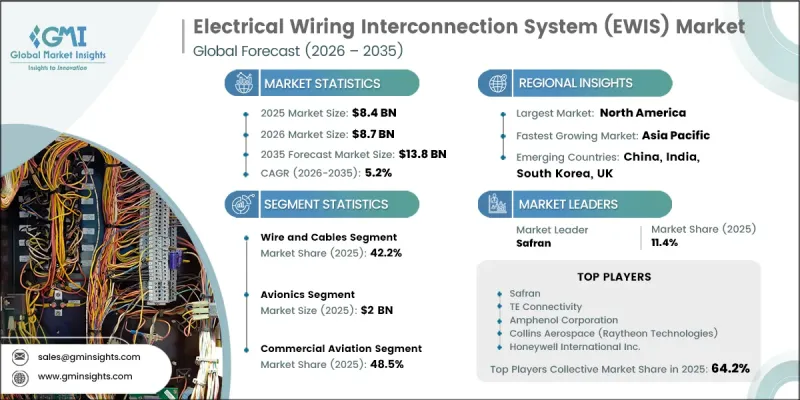
The Global Electrical Wiring Interconnection System Market was valued at USD 8.4 billion in 2025 and is estimated to grow at a CAGR of 5.2% to reach USD 13.8 billion by 2035.
The market is gaining momentum as aircraft manufacturers and operators place greater emphasis on electrical system safety, reliability, weight reduction, and performance. More rigorous aviation safety requirements are encouraging the adoption of improved wiring architectures, while rising aircraft production is creating additional demand for EWIS components and systems. Fleet renewal and aircraft retrofit activities are also supporting market development as operators upgrade electrical infrastructure on aging platforms. The continued shift toward more electrically powered aircraft systems and increasingly sophisticated avionics is further expanding wiring requirements. Modern aircraft rely on complex electrical architectures that must support growing power loads and high-speed data transmission while maintaining operational reliability. At the same time, manufacturers are seeking lightweight and durable wiring solutions that can contribute to improved aircraft efficiency and safe operation. These combined factors are expected to sustain demand for advanced EWIS solutions across the aviation industry throughout the forecast period.
| Market Scope | |
|---|---|
| Start Year | 2025 |
| Forecast Year | 2026-2035 |
| Start Value | $8.4 Billion |
| Forecast Value | $13.8 Billion |
| CAGR | 5.2% |
The electrical wiring interconnection system market is receiving strong support from increasingly demanding global requirements governing aircraft electrical wiring safety and certification. Regulatory authorities continue to establish rigorous standards to ensure that aircraft wiring systems meet required levels of reliability and airworthiness throughout their operating life. In the United States, the Federal Aviation Administration established EWIS certification requirements under 14 CFR Part 25, Subpart H, within the airworthiness standards applicable to airplanes. Meanwhile, the aviation industry's transition toward greater electrical system integration is changing aircraft architecture and increasing the role of electrically operated systems. Aircraft manufacturers are progressively replacing certain hydraulic and pneumatic functions with electrical alternatives, resulting in more extensive and complex wiring networks. As aircraft incorporate additional electrically powered functions, manufacturers require EWIS solutions capable of managing higher system complexity while maintaining reliability, safety, and efficient use of available aircraft space.
The wire and cable segment held a 42.2% share in 2025. Wire and cable products form a fundamental part of aircraft electrical architectures because they enable power delivery and signal transmission throughout the aircraft. Modern aviation applications require wiring products that combine low weight with flexibility, thermal resistance, and protection against electromagnetic interference. These characteristics allow wire and cable systems to support electrical connections throughout critical aircraft functions and onboard electronic architectures. As aircraft systems become more electrically intensive and data requirements increase, demand for dependable wiring capable of handling diverse operating conditions continues to rise. Manufacturers are therefore focusing on wire and cable solutions that provide reliable electrical performance while helping aircraft designers manage weight, space, and installation requirements.
The avionics segment generated USD 2 billion in 2025. Increasing reliance on advanced onboard electronics is creating substantial requirements for wiring harnesses, connectors, and other interconnection components used throughout aircraft avionics architectures. Modern aviation platforms depend on increasingly sophisticated electronic systems to support flight operations, navigation, communications, monitoring, and mission-related functions. As avionics architectures become more complex, aircraft manufacturers require EWIS solutions capable of delivering dependable power distribution and high-speed data transmission. At the same time, the aviation industry's focus on improving operational performance, situational awareness, and flight safety is encouraging continued investment in advanced avionics.
North America Electrical Wiring Interconnection System Market accounted for 37.8% share in 2025. The region benefits from a well-established aerospace manufacturing ecosystem, the presence of major aircraft producers and suppliers, and stringent aviation safety requirements enforced by regulatory authorities. Significant investment across commercial and defense aviation is also supporting demand for modern electrical architecture and advanced aircraft technologies. Increasing aircraft production and fleet modernization programs are creating additional requirements for electrical power distribution equipment and interconnection solutions. Aerospace manufacturers and government organizations are also directing investment toward emerging aviation technologies that depend on increasingly sophisticated electrical systems. The development of electrically powered aircraft architectures, autonomous aviation platforms, digital aviation technologies, and sustainability-focused aerospace initiatives is expected to further increase the need for advanced EWIS solutions.
Prominent companies operating in the global electrical wiring interconnection system market include Leonardo, Amphenol Corporation, Honeywell International Inc., TE Connectivity, Boeing, Safran (Safran Electrical & Power), Molex (Koch Industries), Collins Aerospace (RTX), W. L. Gore & Associates, Ducommun Incorporated, Elektro Metall Export GmbH (EME), Pic Wire & Cable (Angelus Corporation), InterConnect Wiring, kSARIA Corporation (including CIA&D), and E.I.S. Electronics GmbH. Companies in the electrical wiring interconnection system market are strengthening their market positions through technology development, portfolio expansion, strategic partnerships, production investments, and long-term relationships with aircraft manufacturers and aerospace suppliers. Manufacturers are developing lighter, more durable, and higher-performance wiring products to address increasingly demanding aircraft electrical architectures. Businesses are also expanding capabilities in advanced connectors, wiring harnesses, cable assemblies, and integrated interconnection solutions to serve a broader range of aerospace requirements. Investment in research and development allows companies to improve thermal performance, electromagnetic protection, reliability, and installation efficiency. Strategic agreements with aerospace OEMs and defense organizations help suppliers secure long-term programs and strengthen customer relationships.
Table of Contents
Chapter 1 Methodology and Scope
- 1.1 Market scope and definition
- 1.2 Research design
- 1.2.1 Research approach
- 1.2.2 Data collection methods
- 1.3 Data mining sources
- 1.3.1 Global
- 1.3.2 Regional/Country
- 1.4 Base estimates and calculations
- 1.4.1 Base year calculation
- 1.4.2 Key trends for market estimation
- 1.5 Primary research and validation
- 1.5.1 Primary sources
- 1.6 Forecast model
- 1.7 Research assumptions and limitations
Chapter 2 Executive Summary
- 2.1 Industry 360° synopsis, 2022 – 2035
- 2.2 Key market trends
- 2.2.1 Component trends
- 2.2.2 Wire protection material trends
- 2.2.3 Application trends
- 2.2.4 Aircraft type trends
- 2.2.5 End-user trends
- 2.2.6 Regional trends
- 2.3 TAM Analysis, 2026-2035
- 2.4 CXO perspectives: Strategic imperatives
Chapter 3 Industry Insights
- 3.1 Industry ecosystem analysis
- 3.1.1 Supplier Landscape
- 3.1.2 Profit Margin
- 3.1.3 Cost structure
- 3.1.4 Value addition at each stage
- 3.1.5 Factor affecting the value chain
- 3.1.6 Disruptions
- 3.2 Industry impact forces
- 3.2.1 Growth drivers
- 3.2.1.1 Stringent aircraft safety regulations and mandatory EWIS certification
- 3.2.1.2 Growing adoption of More Electric Aircraft (MEA) and aircraft electrification
- 3.2.1.3 Fleet modernization and aging aircraft retrofit programs
- 3.2.1.4 Increasing integration of advanced avionics and digital aircraft systems
- 3.2.1.5 Rising commercial and defense aircraft production worldwide
- 3.2.2 Industry pitfalls and challenges
- 3.2.2.1 High cost of lightweight, aerospace-grade EWIS components
- 3.2.2.2 Complex installation, maintenance, and inspection requirements
- 3.2.3 Market opportunities
- 3.2.3.1 Growing adoption of More Electric Aircraft (MEA) and hybrid-electric aviation
- 3.2.3.2 Development of lightweight, high-speed, and smart EWIS technologies
- 3.2.1 Growth drivers
- 3.3 Growth potential analysis
- 3.4 Regulatory landscape
- 3.4.1 North America
- 3.4.2 Europe
- 3.4.3 Asia Pacific
- 3.4.4 Latin America
- 3.4.5 Middle East & Africa
- 3.5 Porter’s analysis
- 3.6 PESTEL analysis
- 3.7 Technology and Innovation landscape
- 3.7.1 Current technological trends
- 3.7.2 Emerging technologies
- 3.8 Price trends
- 3.8.1 By region
- 3.8.2 By product
- 3.9 Pricing Strategies
- 3.10 Emerging Business Models
- 3.11 Compliance Requirements
- 3.12 Patent and IP analysis
Chapter 4 Competitive Landscape, 2025
- 4.1 Introduction
- 4.2 Company market share analysis
- 4.2.1 By region
- 4.2.1.1 North America
- 4.2.1.2 Europe
- 4.2.1.3 Asia Pacific
- 4.2.1.4 Latin America
- 4.2.1.5 Middle East & Africa
- 4.2.2 Market concentration analysis
- 4.2.1 By region
- 4.3 Competitive benchmarking of key players
- 4.3.1 Financial performance comparison
- 4.3.1.1 Revenue
- 4.3.1.2 Profit margin
- 4.3.1.3 R&D
- 4.3.2 Product portfolio comparison
- 4.3.2.1 Product range breadth
- 4.3.2.2 Technology
- 4.3.2.3 Innovation
- 4.3.3 Geographic presence comparison
- 4.3.3.1 Global footprint analysis
- 4.3.3.2 Service network coverage
- 4.3.3.3 Market penetration by region
- 4.3.4 Competitive positioning matrix
- 4.3.4.1 Leaders
- 4.3.4.2 Challengers
- 4.3.4.3 Followers
- 4.3.4.4 Niche players
- 4.3.5 Strategic outlook matrix
- 4.3.1 Financial performance comparison
- 4.4 Key developments
- 4.4.1 Mergers and acquisitions
- 4.4.2 Partnerships and collaborations
- 4.4.3 Technological advancements
- 4.4.4 Expansion and investment strategies
- 4.4.5 Digital transformation initiatives
- 4.5 Emerging/ startup competitors landscape
Chapter 5 Market Estimates and Forecast, By Component, 2022 – 2035 (USD Million)
- 5.1 Key trends
- 5.2 Wire and cables
- 5.3 Connectors
- 5.4 Electrical grounding and bonding devices
- 5.5 Electrical splices
- 5.6 Clamps
- 5.7 Pressure seals
- 5.8 Others
Chapter 6 Market Estimates and Forecast, By Wire Protection Material, 2022 – 2035 (USD Million)
- 6.1 Key trends
- 6.2 Traditional shielding materials
- 6.2.1 Copper braid
- 6.2.2 Nickel-copper (NiCu) braid
- 6.3 Lightweight shielding materials
- 6.3.1 Composite shielding materials
- 6.3.2 Carbon nanotube (CNT) shielding
- 6.3.3 Metalized polymer shielding
- 6.3.4 Hybrid shielding solutions
- 6.4 Conduit, sleeving & jacketing
- 6.5 Others
Chapter 7 Market Estimates and Forecast, By Application, 2022 – 2035 (USD Million)
- 7.1 Key trends
- 7.2 Avionics
- 7.3 Flight control systems
- 7.4 Power distribution & transfer
- 7.5 Data & communication systems
- 7.6 Cabin & interior systems
- 7.7 Propulsion systems
- 7.8 Airframe
- 7.9 Others
Chapter 8 Market Estimates and Forecast, By End-User, 2022 – 2035 (USD Million)
- 8.1 Key trends
- 8.2 Commercial aviation
- 8.2.1 Narrowbody aircraft
- 8.2.2 Widebody aircraft
- 8.2.3 Very large aircraft
- 8.2.4 Regional aircraft
- 8.3 Military aircraft
- 8.4 Business & general aviation
- 8.5 Unmanned aerial vehicles (UAV)
- 8.6 Spacecraft
Chapter 9 Market Estimates and Forecast, By End-User, 2022 – 2035 (USD Million)
- 9.1 Key trends
- 9.2 OEM
- 9.3 Aftermarket
Chapter 10 Market Estimates and Forecast, By Region, 2022 – 2035 (USD Million)
- 10.1 Key trends
- 10.2 North America
- 10.2.1 U.S.
- 10.2.2 Canada
- 10.3 Europe
- 10.3.1 Germany
- 10.3.2 UK
- 10.3.3 France
- 10.3.4 Spain
- 10.3.5 Italy
- 10.3.6 Netherlands
- 10.4 Asia Pacific
- 10.4.1 China
- 10.4.2 India
- 10.4.3 Japan
- 10.4.4 Australia
- 10.4.5 South Korea
- 10.5 Latin America
- 10.5.1 Brazil
- 10.5.2 Mexico
- 10.5.3 Argentina
- 10.6 Middle East and Africa
- 10.6.1 South Africa
- 10.6.2 Saudi Arabia
- 10.6.3 UAE
Chapter 11 Company Profiles
- 11.1 Global Key Players
- 11.1.1 Safran
- 11.1.2 TE Connectivity
- 11.1.3 Amphenol Corporation
- 11.1.4 Collins Aerospace (Raytheon Technologies)
- 11.1.5 Honeywell International Inc.
- 11.2 Regional key players
- 11.2.1 North America
- 11.2.1.1 Boeing
- 11.2.1.2 Ducommun Incorporated
- 11.2.1.3 Molex (Koch Industries)
- 11.2.1.4 W. L. Gore & Associates
- 11.2.2 Europe
- 11.2.2.1 Leonardo
- 11.2.1 North America
- 11.3 Niche Players/Disruptors
- 11.3.1 kSARIA Corporation (including CIA&D)
- 11.3.2 InterConnect Wiring
- 11.3.3 Pic Wire & Cable (Angelus Corporation)
- 11.3.4 E.I.S. Electronics GmbH
- 11.3.5 Elektro Metall Export GmbH (EME)

