PUBLISHER: Global Market Insights Inc. | PRODUCT CODE: 2121195

PUBLISHER: Global Market Insights Inc. | PRODUCT CODE: 2121195
Lab Automation and Robotics Market Opportunity, Growth Drivers, Industry Trend Analysis, and Forecast 2026 - 2035
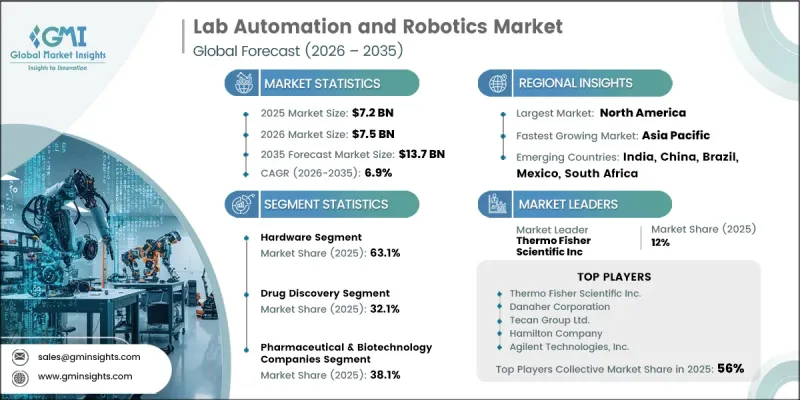
The Global Lab Automation and Robotics Market was valued at USD 7.2 billion in 2025 and is estimated to grow at a CAGR of 6.9% to reach USD 13.7 billion by 2035.
The laboratory automation and robotics industry is experiencing steady expansion as healthcare organizations, research institutions, and life sciences companies continue to modernize laboratory operations through advanced automation technologies. Rising demand for faster laboratory workflows, improved testing efficiency, and enhanced operational accuracy is encouraging widespread implementation of automated laboratory systems. Growing investment in healthcare infrastructure, increasing research activities, and the continued expansion of pharmaceutical development are further supporting market growth. Automation technologies enable laboratories to improve productivity while minimizing manual intervention, enhancing workflow consistency, and reducing operational complexity. Integrated platforms that combine robotics, software, automation hardware, and digital data management are transforming laboratory operations by improving sample processing, workflow coordination, testing efficiency, and information management. The increasing volume of diagnostic testing worldwide continues to accelerate market demand as laboratories seek scalable solutions capable of processing larger workloads while maintaining consistent performance. Greater emphasis on early disease detection, precision medicine, and preventive healthcare is also contributing to the adoption of intelligent laboratory automation systems that improve turnaround times, maximize resource utilization, and support higher operational efficiency across healthcare and life sciences environments.
| Market Scope | |
|---|---|
| Start Year | 2025 |
| Forecast Year | 2026-2035 |
| Start Value | $7.2 Billion |
| Forecast Value | $13.7 Billion |
| CAGR | 6.9% |
The hardware segment accounted for a 63.1% share in 2025, making it the largest revenue-generating segment. Hardware remains the core component of laboratory automation infrastructure because every automated workflow depends on reliable physical systems to perform laboratory operations with precision and consistency. Increasing demand for high-volume laboratory processing, improved productivity, and greater operational accuracy is encouraging healthcare organizations, research laboratories, and life sciences companies to invest in advanced automation equipment. Continued modernization of laboratory facilities and growing implementation of intelligent automation technologies are expected to sustain strong demand for hardware throughout the forecast period.
The pharmaceutical and biotechnology companies segment held a 38.1% share in 2025, representing the largest end-user category. Ongoing investment in pharmaceutical research, biologics development, quality assurance, and laboratory innovation continues to support strong adoption of automated laboratory technologies within this segment. As research programs become increasingly complex and development timelines become more demanding, organizations are implementing advanced automation solutions to improve laboratory productivity, optimize operational efficiency, accelerate scientific workflows, and maximize resource utilization. The continued expansion of life sciences research is expected to reinforce the segment's leading position over the coming years.
North America Lab Automation and Robotics Market accounted for a 39% share in 2025. The region continues to maintain a leading position due to significant investment in pharmaceutical innovation, biotechnology research, and advanced healthcare infrastructure. Strong demand for next-generation laboratory technologies is encouraging organizations to expand the adoption of automated workflows that improve research productivity, laboratory efficiency, and operational performance. Increasing emphasis on accelerating scientific discovery, improving data quality, and supporting complex research initiatives is driving continued deployment of robotics and automation technologies throughout laboratories across the region, strengthening long-term market growth.
Major companies operating in the global lab automation and robotics market include Agilent Technologies, Inc., Becton, Dickinson and Company (BD), Bio-Rad Laboratories, Inc., Danaher Corporation (Beckman Coulter Life Sciences), Eppendorf SE, Hamilton Company, HighRes Biosolutions, Hudson Robotics, Inc., QIAGEN N.V., Revvity, Inc., Roche Diagnostics, Siemens Healthineers AG, SPT Labtech Ltd., Tecan Group Ltd., and Thermo Fisher Scientific Inc. Companies operating in the lab automation and robotics market are strengthening their competitive position by expanding investments in advanced robotics, intelligent automation platforms, artificial intelligence, and digital laboratory management technologies. Market participants are focusing on continuous research and development to enhance automation capabilities, improve software integration, and deliver more flexible laboratory solutions that support evolving customer requirements. Strategic collaborations with pharmaceutical companies, biotechnology firms, healthcare organizations, and research institutions are accelerating product adoption while expanding commercial opportunities. Companies also enhancing cloud connectivity, data analytics, workflow management, and system interoperability to improve laboratory efficiency and customer value.
Table of Contents
Chapter 1 Research Methodology
- 1.1 Research approach
- 1.2 Quality commitments
- 1.2.1 GMI AI policy and data integrity commitment
- 1.2.1.1 Source consistency protocol
- 1.2.1 GMI AI policy and data integrity commitment
- 1.3 Research trail and confidence scoring
- 1.3.1 Research trail components
- 1.3.2 Scoring components
- 1.4 Data collection
- 1.4.1 Partial list of primary sources
- 1.5 Data mining sources
- 1.5.1 Paid sources
- 1.5.1.1 Sources, by region
- 1.5.1 Paid sources
- 1.6 Base estimates and calculations
- 1.6.1 Base year calculation for any one approach
- 1.7 Forecast model
- 1.7.1 Quantified market impact analysis
- 1.7.1.1 Mathematical impact of growth parameters on forecast
- 1.7.1 Quantified market impact analysis
- 1.8 Research transparency addendum
- 1.8.1 Source attribution framework
- 1.8.2 Quality assurance metrics
- 1.8.3 Our commitment to trust
Chapter 2 Executive Summary
- 2.1 Industry 360° synopsis
- 2.2 Key market trends
- 2.2.1 Component trends
- 2.2.2 Application trends
- 2.2.3 End use trends
- 2.2.4 Regional trends
- 2.3 CXO perspectives: Strategic imperatives
Chapter 3 Industry Insights
- 3.1 Industry ecosystem analysis
- 3.2 Industry impact forces
- 3.2.1 Growth drivers
- 3.2.1.1 Increasing adoption in drug discovery and development
- 3.2.1.2 Increasing need for optimizing clinical workflow
- 3.2.1.3 Rising investment in healthcare infrastructure
- 3.2.1.4 Rising clinical diagnostic testing volumes
- 3.2.2 Industry pitfalls and challenges
- 3.2.2.1 High cost of robotic systems
- 3.2.2.2 Complex integration with existing laboratory infrastructure
- 3.2.3 Market opportunities
- 3.2.3.1 Expansion of precision medicine and genomics research
- 3.2.1 Growth drivers
- 3.3 Growth potential analysis
- 3.4 Regulatory landscape (Driven by primary research)
- 3.4.1 North America
- 3.4.2 Europe
- 3.4.3 Asia Pacific
- 3.4.4 Latin America
- 3.4.5 Middle East and Africa
- 3.5 Technology landscape (Driven by primary research)
- 3.5.1 Current technological trends
- 3.5.2 Emerging technologies
- 3.6 Future market trends (Driven by primary research)
- 3.7 Impact of AI and Generative AI on the market (Driven by primary research)
- 3.8 Patent analysis
- 3.9 Pricing trend analysis (Driven by primary research)
- 3.10 Porter’s analysis
- 3.11 PESTEL analysis
Chapter 4 Competitive Landscape, 2025
- 4.1 Introduction
- 4.2 Company market share analysis
- 4.2.1 Global
- 4.2.2 North America
- 4.2.3 Europe
- 4.2.4 Asia Pacific
- 4.3 Company matrix analysis
- 4.4 Competitive analysis of major market players
- 4.5 Competitive positioning matrix
- 4.6 Key developments
- 4.6.1 Mergers and acquisitions
- 4.6.2 Partnerships and collaborations
- 4.6.3 New product launches
- 4.6.4 Expansion plans
Chapter 5 Market Estimates and Forecast, By Component, 2022 – 2035 ($ Mn)
- 5.1 Key trends
- 5.2 Hardware
- 5.2.1 Automated liquid handling systems
- 5.2.2 Robotic arms and collaborative lab robots
- 5.2.3 Automated plate handlers, microplate readers, and washers
- 5.2.4 Automated storage and retrieval systems
- 5.3 Software and informatics
- 5.3.1 LIMS (Laboratory Information Management Systems)
- 5.3.2 Other software and informatics
- 5.4 Services
Chapter 6 Market Estimates and Forecast, By Application, 2022 – 2035 ($ Mn)
- 6.1 Key trends
- 6.2 Drug Discovery
- 6.3 Genomics
- 6.4 Proteomics
- 6.5 Clinical diagnostics
- 6.6 Other applications
Chapter 7 Market Estimates and Forecast, By End Use, 2022 – 2035 ($ Mn)
- 7.1 Key trends
- 7.2 Pharmaceutical & biotechnology companies
- 7.3 Diagnostic labs
- 7.4 Research & academic institutes
- 7.5 Contract research organizations & contract development manufacturing
- 7.6 Other end users
Chapter 8 Market Estimates and Forecast, By Region, 2022 – 2035 ($ Mn)
- 8.1 Key trends
- 8.2 North America
- 8.2.1 U.S.
- 8.2.2 Canada
- 8.3 Europe
- 8.3.1 Germany
- 8.3.2 UK
- 8.3.3 France
- 8.3.4 Spain
- 8.3.5 Italy
- 8.3.6 Netherlands
- 8.4 Asia Pacific
- 8.4.1 China
- 8.4.2 Japan
- 8.4.3 India
- 8.4.4 Australia
- 8.4.5 South Korea
- 8.5 Latin America
- 8.5.1 Brazil
- 8.5.2 Mexico
- 8.5.3 Argentina
- 8.6 Middle East and Africa
- 8.6.1 South Africa
- 8.6.2 Saudi Arabia
- 8.6.3 UAE
Chapter 9 Company Profiles
- 9.1 Agilent Technologies, Inc.
- 9.2 Becton, Dickinson and Company (BD)
- 9.3 Bio-Rad Laboratories, Inc.
- 9.4 Danaher Corporation (Beckman Coulter Life Sciences)
- 9.5 Eppendorf SE
- 9.6 Hamilton Company
- 9.7 HighRes Biosolutions
- 9.8 Hudson Robotics, Inc.
- 9.9 QIAGEN N.V.
- 9.10 Revvity, Inc.
- 9.11 Roche Diagnostics
- 9.12 Siemens Healthineers AG
- 9.13 SPT Labtech Ltd.
- 9.14 Tecan Group Ltd.
- 9.15 Thermo Fisher Scientific Inc.

