PUBLISHER: Global Market Insights Inc. | PRODUCT CODE: 1928959

PUBLISHER: Global Market Insights Inc. | PRODUCT CODE: 1928959
Industrial Boiler Market Opportunity, Growth Drivers, Industry Trend Analysis, and Forecast 2026 - 2035
The Global Industrial Boiler Market was valued at USD 12.1 billion in 2025 and is estimated to grow at a CAGR of 5.4% to reach USD 20.7 billion by 2035.
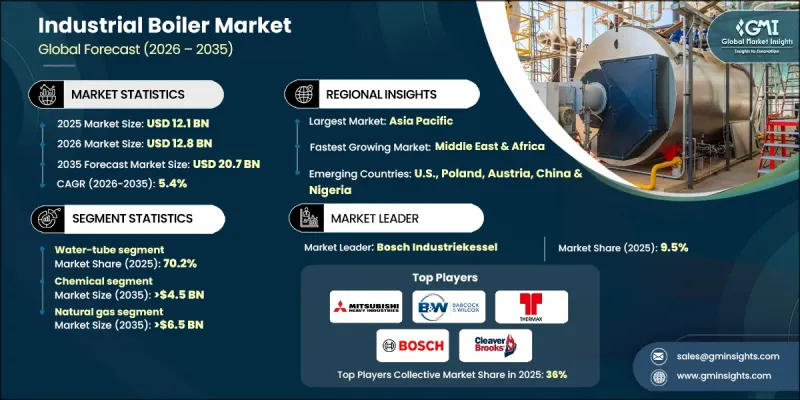
Growth is fueled by rising demand for process heat across industries such as chemicals, food & beverage, pulp & paper, and metals, along with increasing throughput targets in continuous-process operations. Companies are investing in modern, high-efficiency fired boilers with digitized combustion control and O2 trim systems, which are enhancing energy management and operational reliability. Industrial boilers are large, enclosed vessels designed to produce steam or hot water by applying heat to water, commonly used for manufacturing, power generation, and chemical processing. Replacing aging fire-tube units with compact water-tube and hybrid designs, supported by reliability-centered maintenance, is accelerating market adoption. Stricter emissions regulations for SOx, NOx, PM, and CO2, coupled with permitting scrutiny, are driving demand for advanced burners, selective catalytic reduction systems, flue-gas recirculation, and high-ash-tolerant designs. Volatile fuel prices and gas supply uncertainty are encouraging the adoption of multi-fuel capable units and rapid fuel-switching systems to optimize lifecycle cost and operational risk.
| Market Scope | |
|---|---|
| Start Year | 2025 |
| Forecast Year | 2026-2035 |
| Start Value | $12.1 Billion |
| Forecast Value | $20.7 Billion |
| CAGR | 5.4% |
The water-tube industrial boiler segment accounted for 70.2% share in 2025. Rising demand for high-pressure steam in chemical, petrochemical, and metal processing industries is propelling growth, while upgrading existing water-tube systems with advanced superheaters, economizers, and automated combustion controls is further accelerating adoption.
The food processing industrial boiler market is expected to grow at a CAGR of 5.5% by 2035. Growth is driven by increasing consumption of processed and packaged foods alongside strict hygiene standards. The rising adoption of natural gas and biomass-fired boilers, aimed at reducing carbon footprints and meeting sustainability objectives, is also supporting market expansion.
North America Industrial Boiler Market held an 82.4% share in 2025, generating USD 1.8 billion. Growth is driven by investments in energy-efficient, low-emission technologies and digital monitoring systems. Ongoing emphasis on sustainability and adherence to stringent emission standards is reinforcing demand for advanced combustion solutions and operationally efficient boiler systems.
Leading companies operating in the Global Industrial Boiler Market include Bosch Industriekessel, Viessmann Climate Solutions, Babcock & Wilcox Enterprises, California Boiler, Clayton Industries, Doosan Enerbility, Cleaver-Brooks, Hoval, Miura America, Walchandnagar Industries, John Cockerill, Bharat Heavy Electricals, Thermodyne Engineering Systems, FONDITAL, Rentech Boiler Systems, John Wood Group, Sofinter, Hurst Boiler & Welding, FERROLI, Fonderie Sime, Fulton, Groupe Atlantic, HME Boilers, Thermmax, Cochran, and Victory Energy Operations. Companies in the Global Industrial Boiler Market are employing multiple strategies to strengthen their foothold and expand market presence. They are investing heavily in research and development to enhance energy efficiency, emissions control, and digital integration. Strategic partnerships with industrial users, EPC contractors, and energy service companies help expand customer access. Firms are introducing multi-fuel, hybrid, and compact boiler designs to meet evolving regulatory requirements and operational challenges. Geographic expansion into emerging regions with high industrial growth potential is a key focus.
Table of Contents
Chapter 1 Methodology & Scope
- 1.1 Research approach
- 1.2 Quality commitments
- 1.2.1 GMI AI policy & data integrity commitment
Source consistency protocol
- 1.3 Research trail & confidence scoring
- 1.3.1 Research trail components
- 1.3.2 Scoring components
- 1.4 Data collection
- 1.4.1 Partial list of primary sources
- 1.5 Data mining sources
- 1.5.1 Paid sources
- 1.5.1.1 Sources, by region
- 1.5.1 Paid sources
- 1.6 Base estimates and calculations
- 1.6.1 Base year calculation for any one approach
- 1.7 Market estimates & forecasts parameters
- 1.8 Forecast model
- 1.8.1 Quantified market impact analysis
- 1.8.1.1 Mathematical impact of growth parameters on forecast
- 1.8.1 Quantified market impact analysis
- 1.9 Research transparency addendum
- 1.9.1 Source attribution framework
- 1.9.2 Quality assurance metrics
- 1.9.3 Our commitment to trust
- 1.10 Market definitions
Chapter 2 Executive Summary
- 2.1 Industry synopsis, 2022 - 2035
- 2.2 Business trends
- 2.3 Product trends
- 2.4 Capacity trends
- 2.5 Application trends
- 2.6 Technology trends
- 2.7 Fuel trends
- 2.8 Regional trends
Chapter 3 Industry Insights
- 3.1 Industry ecosystem analysis
- 3.1.1 Raw material availability & sourcing analysis
- 3.1.2 Manufacturing capacity assessment
- 3.1.3 Supply chain resilience & risk factors
- 3.1.4 Distribution network analysis
- 3.2 Regulatory landscape
- 3.3 Industry impact forces
- 3.3.1 Growth drivers
- 3.3.2 Industry pitfalls & challenges
- 3.4 Growth potential analysis
- 3.5 Porter';s analysis
- 3.5.1 Bargaining power of suppliers
- 3.5.2 Bargaining power of buyers
- 3.5.3 Threat of new entrants
- 3.5.4 Threat of substitutes
- 3.6 PESTEL analysis
- 3.6.1 Political factors
- 3.6.2 Economic factors
- 3.6.3 Social factors
- 3.6.4 Technological factors
- 3.6.5 Legal factors
- 3.6.6 Environmental factors
- 3.7 Cost structure analysis of industrial boiler
- 3.8 Price trend analysis
- 3.8.1 By product
- 3.8.2 By region
- 3.9 Emerging opportunities & trends
- 3.10 Digitalization and IoT integration
- 3.11 Investment analysis & future outlook
Chapter 4 Competitive Landscape, 2025
- 4.1 Introduction
- 4.2 Company market share analysis, by region, 2025
- 4.2.1 North America
- 4.2.2 Europe
- 4.2.3 Asia Pacific
- 4.2.4 Middle East & Africa
- 4.2.5 Latin America
- 4.3 Strategic dashboard
- 4.3.1 Key partnerships & collaborations
- 4.3.2 Major M&A activities
- 4.3.3 Product innovations & launches
- 4.3.4 Market expansion strategies
- 4.4 Strategic initiatives
- 4.5 Competitive benchmarking
- 4.6 Innovation & technology landscape
Chapter 5 Market Size and Forecast, By Product, 2022 - 2035 (USD Million, MMBTU/hr & Units)
- 5.1 Key trends
- 5.2 Fire-tube
- 5.2.1 By capacity
- 5.2.1.1 < 10 MMBTU/hr
- 5.2.1.2 10 - 25 MMBTU/hr
- 5.2.1.3 25 - 50 MMBTU/hr
- 5.2.1.4 50 - 75 MMBTU/hr
- 5.2.1.5 75 - 100 MMBTU/hr
- 5.2.1.6 100 - 175 MMBTU/hr
- 5.2.1.7 175 - 250 MMBTU/hr
- 5.2.1.8 > 250 MMBTU/hr
- 5.2.2 By application
- 5.2.2.1 Food processing
- 5.2.2.2 Pulp & paper
- 5.2.2.3 Chemical
- 5.2.2.4 Refinery
- 5.2.2.5 Primary metal
- 5.2.2.6 Others
- 5.2.3 By technology
- 5.2.3.1 Condensing
- 5.2.3.2 Non-condensing
- 5.2.4 By fuel
- 5.2.4.1 Natural gas
- 5.2.4.2 Oil
- 5.2.4.3 Coal
- 5.2.4.4 Others
- 5.2.1 By capacity
- 5.3 Water-tube
- 5.3.1 By capacity
- 5.3.1.1 < 10 MMBTU/hr
- 5.3.1.2 10 - 25 MMBTU/hr
- 5.3.1.3 25 - 50 MMBTU/hr
- 5.3.1.4 50 - 75 MMBTU/hr
- 5.3.1.5 75 - 100 MMBTU/hr
- 5.3.1.6 100 - 175 MMBTU/hr
- 5.3.1.7 175 - 250 MMBTU/hr
- 5.3.1.8 > 250 MMBTU/hr
- 5.3.2 By application
- 5.3.2.1 Food processing
- 5.3.2.2 Pulp & paper
- 5.3.2.3 Chemical
- 5.3.2.4 Refinery
- 5.3.2.5 Primary metal
- 5.3.2.6 Others
- 5.3.3 By technology
- 5.3.3.1 Condensing
- 5.3.3.2 Non-condensing
- 5.3.4 By fuel
- 5.3.4.1 Natural gas
- 5.3.4.2 Oil
- 5.3.4.3 Coal
- 5.3.4.4 Others
- 5.3.1 By capacity
Chapter 6 Market Size and Forecast, By Capacity, 2022 - 2035 (USD Million, MMBTU/hr & Units)
- 6.1 Key trends
- 6.2 < 10 MMBTU/hr
- 6.3 10 - 25 MMBTU/hr
- 6.4 25 - 50 MMBTU/hr
- 6.5 50 - 75 MMBTU/hr
- 6.6 75 - 100 MMBTU/hr
- 6.7 100 - 175 MMBTU/hr
- 6.8 175 - 250 MMBTU/hr
- 6.9 > 250 MMBTU/hr
Chapter 7 Market Size and Forecast, By Application, 2022 - 2035 (USD Million, MMBTU/hr & Units)
- 7.1 Key trends
- 7.2 Food processing
- 7.3 Pulp & paper
- 7.4 Chemical
- 7.5 Refinery
- 7.6 Primary metal
- 7.7 Others
Chapter 8 Market Size and Forecast, By Technology, 2022 - 2035 (USD Million, MMBTU/hr & Units)
- 8.1 Key trends
- 8.2 Condensing
- 8.3 Non-condensing
Chapter 9 Market Size and Forecast, By Fuel, 2022 - 2035 (USD Million, MMBTU/hr & Units)
- 9.1 Key trends
- 9.2 Natural gas
- 9.3 Oil
- 9.4 Coal
- 9.5 Others
Chapter 10 Market Size and Forecast, By Region, 2022 - 2035 (USD Million, MMBTU/hr & Units)
- 10.1 Key trends
- 10.2 North America
- 10.2.1 U.S.
- 10.2.2 Canada
- 10.2.3 Mexico
- 10.3 Europe
- 10.3.1 France
- 10.3.2 UK
- 10.3.3 Poland
- 10.3.4 Italy
- 10.3.5 Spain
- 10.3.6 Austria
- 10.3.7 Germany
- 10.3.8 Sweden
- 10.3.9 Russia
- 10.4 Asia Pacific
- 10.4.1 China
- 10.4.2 India
- 10.4.3 Philippines
- 10.4.4 Japan
- 10.4.5 South Korea
- 10.4.6 Australia
- 10.4.7 Indonesia
- 10.5 Middle East & Africa
- 10.5.1 Saudi Arabia
- 10.5.2 Iran
- 10.5.3 UAE
- 10.5.4 Nigeria
- 10.5.5 South Africa
- 10.6 Latin America
- 10.6.1 Brazil
- 10.6.2 Argentina
- 10.6.3 Chile
Chapter 11 Company Profiles
- 11.1 Babcock & Wilcox Enterprises
- 11.2 Bharat Heavy Electricals
- 11.3 Bosch Industriekessel
- 11.4 California Boiler
- 11.5 Clayton Industries
- 11.6 Cleaver-Brooks
- 11.7 Cochran
- 11.8 Doosan Enerbility
- 11.9 FERROLI
- 11.10 Fonderie Sime
- 11.11 FONDITAL
- 11.12 Forbes Marshall
- 11.13 Fulton
- 11.14 Groupe Atlantic
- 11.15 HME Boilers
- 11.16 Hoval
- 11.17 Hurst Boiler & Welding
- 11.18 John Cockerill
- 11.19 John Wood Group
- 11.20 Mitsubishi Heavy Industries
- 11.21 Miura America
- 11.22 Rentech Boiler Systems
- 11.23 Sofinter
- 11.24 Thermax
- 11.25 Thermodyne Engineering Systems
- 11.26 Victory Energy Operations
- 11.27 Viessmann Climate Solutions
- 11.28 Walchandnagar Industries

