PUBLISHER: MarketsandMarkets | PRODUCT CODE: 1881223

PUBLISHER: MarketsandMarkets | PRODUCT CODE: 1881223
Connected Worker Market by Offering, Technology, Application and Vertical - Global Forecast to 2030
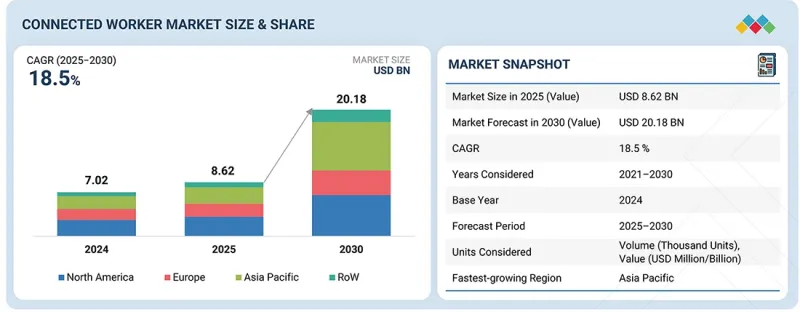
The global connected worker market is expected to grow from USD 8.62 billion in 2025 to USD 20.18 billion by 2030, at a CAGR of 18.5% during the forecast period. The expansion of remote and hybrid work models has transformed how field and frontline workers collaborate and manage their tasks. These models blend in-office, remote, and on-the-go work, allowing employees to be productive from various locations rather than confined to a single physical workspace. This shift necessitates the use of advanced collaborative digital tools that enable seamless communication across distributed teams, ensuring that workers remain connected regardless of where they are working.
| Scope of the Report | |
|---|---|
| Years Considered for the Study | 2021-2030 |
| Base Year | 2024 |
| Forecast Period | 2025-2030 |
| Units Considered | Value (USD Billion) |
| Segments | By Offering, Technology, Connectivity, Application and Region |
| Regions covered | North America, Europe, APAC, RoW |
For frontline and field workers, such tools facilitate real-time information sharing, remote troubleshooting, and task coordination that would otherwise rely on face-to-face interactions. Hybrid work also requires flexible task management systems that adapt to different schedules and environments, supporting solitary remote work and coordinated team efforts at the workplace. These technologies help maintain productivity, enhance worker engagement, and ensure operational continuity by bridging communication gaps, providing remote expert support, and enabling dynamic scheduling and reporting. As a result, connected worker platforms have become critical in supporting hybrid workforce strategies, empowering frontline employees to work efficiently while maintaining strong collaboration and safety standards.
"Industrial Internet of Things (IIoT) segment accounted for the largest market share in 2024"
In 2024, the Industrial Internet of Things (IIoT) held the largest share of the connected worker market due to its pivotal role in enhancing operational efficiency, safety, and productivity across industries. IIoT-enabled solutions integrate wearable devices, sensors, rugged mobile equipment, and head-mounted displays to provide real-time data and connectivity for workers in the field. IIoT applications are particularly significant in manufacturing, enabling predictive maintenance and minimizing downtime. In construction, it improves safety compliance and workflow efficiency, while in energy and utilities, it supports equipment monitoring and sustainable practices. With industries increasingly embracing digital transformation, IIoT-driven connected worker solutions are expected to continue shaping the market, fostering innovation, and enhancing workforce productivity and safety.
"Software offering segment is projected to register the highest CAGR from 2025 to 2030"
The software segment within the connected worker market is projected to experience the highest CAGR during the forecast period. Software solutions are pivotal in enabling real-time monitoring, analytics, and integration with wearable devices and IoT sensors, which are essential for enhancing workforce safety, productivity, and operational efficiency. Advancements in technologies such as artificial intelligence (AI), machine learning, and big data analytics further enhance the capabilities of connected worker software, providing actionable insights into worker performance and safety. This trend is particularly evident in industries such as manufacturing, construction, and energy, where the demand for digital transformation and smart workforce solutions is accelerating. As organizations increasingly adopt cloud-based platforms for scalability and cost-effectiveness, the software segment is poised for significant growth, contributing substantially to the overall expansion of the connected worker market.
"China is likely to dominate the Asia Pacific connected worker market during the forecast period"
China is expected to dominate the Asia Pacific connected worker market from 2025 to 2030 due to its rapid industrial automation, strong government initiatives, including "Made in China 2025," and heavy investment in industrial IoT and digital infrastructure. The large manufacturing base, rising labor costs, and skills gap drive the adoption of connected worker solutions to improve productivity, efficiency, and safety. Additionally, advancements by local technology providers and a focus on regulatory compliance further accelerate the deployment of wearable devices, software platforms, and real-time monitoring systems, positioning them as the primary driver in the region.
Breakdown of Primaries
Various executives from key organizations operating in the connected worker market were interviewed in-depth, including CEOs, marketing directors, and innovation and technology directors.
- By Company Type: Tier 1-45%, Tier 2-30%, and Tier 3-25%
- By Designation: C-level Executives-25%, Directors-35%, and Others-40%
- By Region: North America-35%, Europe-30%, Asia Pacific-25%, and RoW-10%
The connected worker market is dominated by globally established players, such as Zebra Technologies Corp. (US), Honeywell International Inc (US), Microsoft (US), Hexagon AB (Sweden), PTC (US), SymphonyAI (US), Innovapptive (US), ProGlove (Germany), Siemens (Germany), RealWear (US), Redzone (US), Schneider Electric (France), Tulip Interfaces, Inc. (US), POKA Inc. (Canada), Librestream Technologies (Canada), Taqtile, Inc. (US), Plutomen (India), Aatmunn (US), Augmentir, Inc. (US), VSight UAB (Lithuania), Vuzix Corporation (US), ThirdEye Gen, Inc. (US), Kopin (US), Atheer, Inc. (US), and Treedis (Israel). The study includes an in-depth competitive analysis of these key players in the connected worker market, with their company profiles, recent developments, and key market strategies.
Study Coverage
The report segments the connected worker market and forecasts its size by offering, technology, connectivity, application, vertical, and region. The report also discusses the drivers, restraints, opportunities, and challenges pertaining to the market. It gives a detailed view of the market across four main regions-North America, Europe, Asia Pacific, and RoW. The report includes a value chain analysis of the key players and their competitive analysis of the connected worker ecosystem.
Key Benefits of Buying the Report
- Analysis of key drivers (Integration of IoT, AI, AR/VR, and 5G), restraints (High initial costs, complexity in integrating connected worker solutions with legacy systems), opportunities (Collaborative robotics and exoskeleton integration), and challenges (Lack of user adoption and workforce resistance) influencing the growth of the connected worker market
- Products/Solution/Service Development/Innovation: Detailed insights into upcoming technologies, research, and development activities in the connected worker market
- Market Development: Comprehensive information about lucrative markets-the report analyses the connected worker market across varied regions.
- Market Diversification: Exhaustive information about new hardware, software, services, untapped geographies, recent developments, and investments in the connected worker market
- Competitive Assessment: In-depth assessment of market shares and growth strategies and offerings of leading players, such as Honeywell International Inc (US), Microsoft (US), Siemens (Germany), Schneider Electric (France), PTC (US), among others.
TABLE OF CONTENTS
1 INTRODUCTION
- 1.1 STUDY OBJECTIVES
- 1.2 MARKET DEFINITION
- 1.2.1 MARKETS COVERED AND REGIONAL SCOPE
- 1.2.2 INCLUSIONS AND EXCLUSIONS
- 1.2.3 YEARS CONSIDERED
- 1.2.4 CURRENCY CONSIDERED
- 1.2.5 UNIT CONSIDERED
- 1.3 LIMITATIONS
- 1.4 STAKEHOLDERS
2 RESEARCH METHODOLOGY
- 2.1 RESEARCH DATA
- 2.1.1 SECONDARY AND PRIMARY RESEARCH
- 2.1.2 SECONDARY DATA
- 2.1.2.1 List of key secondary sources
- 2.1.2.2 Key data from secondary sources
- 2.1.3 PRIMARY DATA
- 2.1.3.1 Key data from primary sources
- 2.1.3.2 List of primary interview participants
- 2.1.3.3 Breakdown of primaries
- 2.1.3.4 Key industry insights
- 2.2 MARKET SIZE ESTIMATION METHODOLOGY
- 2.2.1 BOTTOM-UP APPROACH
- 2.2.1.1 Approach to derive market size using bottom-up analysis
- 2.2.2 TOP-DOWN APPROACH
- 2.2.2.1 Approach to derive market size using top-down analysis
- 2.2.1 BOTTOM-UP APPROACH
- 2.3 MARKET SHARE ESTIMATION
- 2.4 DATA TRIANGULATION
- 2.5 RESEARCH ASSUMPTIONS
- 2.6 RESEARCH LIMITATIONS
- 2.7 RISK ASSESSMENT
3 EXECUTIVE SUMMARY
4 PREMIUM INSIGHTS
- 4.1 ATTRACTIVE OPPORTUNITIES FOR PLAYERS IN CONNECTED WORKER MARKET
- 4.2 CONNECTED WORKER MARKET, BY APPLICATION
- 4.3 CONNECTED WORKER MARKET, BY CONNECTIVITY
- 4.4 CONNECTED WORKER MARKET, BY REGION
5 MARKET OVERVIEW
- 5.1 INTRODUCTION
- 5.2 MARKET DYNAMICS
- 5.2.1 DRIVERS
- 5.2.1.1 Integration of IoT, AI, AR/VR, and 5G
- 5.2.1.2 Growing regulatory requirements for data traceability, safety standards, and digital documentation in manufacturing and logistics
- 5.2.1.3 Increasing demand for operational efficiency through real-time task management and remote assistance
- 5.2.1.4 Expansion of cloud infrastructure supporting scalable, secure connected worker platforms
- 5.2.1.5 Growing emphasis on sustainability and ESG compliance
- 5.2.2 RESTRAINTS
- 5.2.2.1 High initial costs and complexity in integrating connected worker solutions with legacy systems
- 5.2.2.2 Data security and privacy concerns related to extensive workforce monitoring
- 5.2.3 OPPORTUNITIES
- 5.2.3.1 Integration of connected worker platforms with collaborative robotics and exoskeleton technologies
- 5.2.3.2 Next-generation bio-sensing wearables
- 5.2.3.3 Integration of quantum-enhanced analytics for workforce optimization
- 5.2.4 CHALLENGES
- 5.2.4.1 Lack of user adoption and workforce resistance
- 5.2.4.2 Battery life limitations and device reliability in harsh environments
- 5.2.1 DRIVERS
- 5.3 TRENDS AND DISRUPTIONS IMPACTING CUSTOMER BUSINESS
- 5.4 PRICING ANALYSIS
- 5.4.1 AVERAGE SELLING PRICE TREND OF HANDHELD MOBILE COMPUTERS, BY REGION
- 5.4.2 AVERAGE SELLING PRICE TREND OF CONNECTED WORKER HARDWARE DEVICES, BY KEY PLAYER
- 5.5 SUPPLY CHAIN ANALYSIS
- 5.6 ECOSYSTEM ANALYSIS
- 5.7 TECHNOLOGY ANALYSIS
- 5.7.1 KEY TECHNOLOGIES
- 5.7.1.1 Wearable devices & smart PPE
- 5.7.1.2 Industrial internet of things (IIoT) & sensors
- 5.7.1.3 Mobile applications & digital workflows
- 5.7.1.4 Artificial intelligence & predictive analytics
- 5.7.2 COMPLEMENTARY TECHNOLOGIES
- 5.7.2.1 Blockchain
- 5.7.2.2 Cybersecurity solutions
- 5.7.2.3 Human-machine interfaces
- 5.7.3 ADJACENT TECHNOLOGIES
- 5.7.3.1 Industrial automation & robotics
- 5.7.3.2 Enterprise resource planning & workforce management software
- 5.7.1 KEY TECHNOLOGIES
- 5.8 PATENT ANALYSIS
- 5.9 TRADE ANALYSIS
- 5.9.1 EXPORT SCENARIO
- 5.9.2 IMPORT SCENARIO
- 5.10 KEY CONFERENCES AND EVENTS
- 5.11 CASE STUDY ANALYSIS
- 5.11.1 ELECTROLUX DRIVES OPERATIONAL EXCELLENCE THROUGH STANDARDIZED INDUSTRIAL CONNECTIVITY WITH PTC
- 5.11.2 VOLKSWAGEN TRANSFORMED VEHICLE MAINTENANCE EFFICIENCY AND SUSTAINABILITY WITH REALWEAR AND ATHEER CONNECTED WORKER SOLUTIONS
- 5.11.3 COLGATE-PALMOLIVE ENHANCED MANUFACTURING EFFICIENCY AND REDUCED TRAVEL COSTS WITH REALWEAR CONNECTED WORKER TECHNOLOGY
- 5.12 INVESTMENT AND FUNDING SCENARIO
- 5.13 TARIFF AND REGULATORY LANDSCAPE
- 5.13.1 TARIFF ANALYSIS
- 5.13.2 REGULATORY BODIES, GOVERNMENT AGENCIES, AND OTHER ORGANIZATIONS
- 5.13.3 KEY REGULATIONS
- 5.14 PORTER'S FIVE FORCES ANALYSIS
- 5.14.1 INTENSITY OF COMPETITIVE RIVALRY
- 5.14.2 BARGAINING POWER OF SUPPLIERS
- 5.14.3 BARGAINING POWER OF BUYERS
- 5.14.4 THREAT OF SUBSTITUTES
- 5.14.5 THREAT OF NEW ENTRANTS
- 5.15 KEY STAKEHOLDERS AND BUYING CRITERIA
- 5.15.1 KEY STAKEHOLDERS IN BUYING PROCESS
- 5.15.2 BUYING CRITERIA
- 5.16 IMPACT OF ARTIFICIAL INTELLIGENCE ON CONNECTED WORKER MARKET
- 5.17 IMPACT OF 2025 US TARIFF - CONNECTED WORKER MARKET
- 5.17.1 INTRODUCTION
- 5.17.2 KEY TARIFF RATES
- 5.17.3 PRICE IMPACT ANALYSIS
- 5.17.4 IMPACT OF COUNTRY/REGION
- 5.17.4.1 US
- 5.17.4.2 Europe
- 5.17.4.3 Asia Pacific
- 5.17.5 IMPACT ON VERTICAL
6 CONNECTED WORKER MARKET, BY OFFERING
- 6.1 INTRODUCTION
- 6.2 HARDWARE
- 6.2.1 WEARABLE DEVICES
- 6.2.1.1 Smart glasses & AR headsets
- 6.2.1.1.1 Need to enhance industrial efficiency and safety to drive market
- 6.2.1.2 Wristbands
- 6.2.1.2.1 Growing adoption of smart wristbands to drive market
- 6.2.1.3 Helmets and body sensors
- 6.2.1.3.1 Real-time monitoring of environmental hazards and biometric parameters to propel demand
- 6.2.1.4 Smart gloves
- 6.2.1.4.1 Reduced errors and faster inventory management cycles to drive adoption
- 6.2.1.5 Other wearable devices
- 6.2.1.1 Smart glasses & AR headsets
- 6.2.2 HANDHELD DEVICES
- 6.2.2.1 Handheld mobile computers
- 6.2.2.1.1 Support real-time workflow management, asset tracking, and seamless data exchange with enterprise systems
- 6.2.2.2 Other handheld mobile computers
- 6.2.2.1 Handheld mobile computers
- 6.2.3 INDUSTRIAL IOT SENSORS & EDGE DEVICES
- 6.2.3.1 Enable real-time safety, predictive maintenance, and Industry 4.0 workflows
- 6.2.4 COMMUNICATION & CONNECTIVITY DEVICES
- 6.2.4.1 Empower real-time collaboration and safety in connected worker ecosystem
- 6.2.5 ROBOTICS & AUTOMATION HARDWARE
- 6.2.5.1 AI-driven robotics and automation hardware augment human capabilities for digitally connected workforce
- 6.2.1 WEARABLE DEVICES
- 6.3 SOFTWARE
- 6.3.1 CLOUD-BASED SOFTWARE
- 6.3.1.1 Enable enterprises to centralize data and streamline digital workflows
- 6.3.2 ON-PREMISES SOFTWARE
- 6.3.2.1 Provide comprehensive digital workflow management, audit trail maintenance, and real-time process monitoring
- 6.3.1 CLOUD-BASED SOFTWARE
- 6.4 SERVICES
- 6.4.1 CONSULTING & ADVISORY SERVICES
- 6.4.1.1 Enable smooth digital workforce transformation
- 6.4.2 TRAINING & SUPPORT SERVICES
- 6.4.2.1 Accelerate adoption and maximize workforce efficiency in connected workplaces
- 6.4.3 MAINTENANCE & UPGRADES
- 6.4.3.1 Ensure reliability, continuity, and long-term performance of connected worker systems
- 6.4.4 OTHER SERVICES
- 6.4.1 CONSULTING & ADVISORY SERVICES
7 CONNECTED WORKER MARKET, BY CONNECTIVITY
- 7.1 INTRODUCTION
- 7.2 WI-FI
- 7.2.1 SUPPORTS DIGITAL WORKFLOWS, DATA STREAMING, AND COLLABORATION TOOLS FOR CONNECTED WORKER SOLUTIONS
- 7.3 5G
- 7.3.1 ULTRA-FAST DATA TRANSFER AND SUPPORT FOR HIGH DEVICE DENSITY TO DRIVE MARKET
- 7.4 LPWAN
- 7.4.1 EXTENSIVE RANGE AND EFFICIENCY TO PROPEL MARKET
- 7.5 BLUETOOTH
- 7.5.1 ENABLES PROXIMITY SERVICES AND WEARABLE INTEGRATION
- 7.6 RFID & NFC
- 7.6.1 NEED TO IMPROVE SAFETY COMPLIANCE AND PREVENT EQUIPMENT LOSS TO DRIVE MARKET
- 7.7 OTHER CONNECTIVITIES
8 CONNECTED WORKER MARKET, BY APPLICATION
- 8.1 INTRODUCTION
- 8.2 REMOTE ASSISTANCE & COLLABORATION
- 8.2.1 ENHANCED FIELD EFFICIENCY AND EQUIPMENT UPTIME TO DRIVE MARKET
- 8.3 WORKFORCE SAFETY & COMPLIANCE
- 8.3.1 FOCUS ON REDUCING RISKS AND ENSURING ADHERENCE TO REGULATORY STANDARDS IN INDUSTRIES TO PROPEL MARKET
- 8.4 TRAINING & SKILL DEVELOPMENT
- 8.4.1 NEED TO REDUCE ONBOARDING COSTS TO SUPPORT MARKET GROWTH
- 8.5 TASK MANAGEMENT & PRODUCTIVITY OPTIMIZATION
- 8.5.1 HIGHER THROUGHPUT AND OPERATIONAL EXCELLENCE TO PROPEL MARKET
- 8.6 PREDICTIVE MAINTENANCE
- 8.6.1 PREVENTING FAILURES AND OPTIMIZING ASSET LIFE CYCLES- KEY FACTORS DRIVING MARKET
- 8.7 INVENTORY & ASSET MANAGEMENT
- 8.7.1 ENHANCEMENT OF OPERATIONAL EFFICIENCY AND COST CONTROL TO DRIVE MARKET
- 8.8 OTHER APPLICATIONS
9 CONNECTED WORKER MARKET, BY TECHNOLOGY
- 9.1 INTRODUCTION
- 9.2 AUGMENTED REALITY & VIRTUAL REALITY
- 9.2.1 IMMERSIVE AR AND VR TECHNOLOGIES TRANSFORM CONNECTED WORKER TRAINING AND SUPPORT
- 9.3 ARTIFICIAL INTELLIGENCE & MACHINE LEARNING
- 9.3.1 DRIVE PREDICTIVE INSIGHTS AND PERSONALIZED WORKFLOWS FOR CONNECTED WORKERS
- 9.4 INDUSTRIAL INTERNET OF THINGS
- 9.4.1 REAL-TIME DATA AND SAFETY INTELLIGENCE TO DRIVE MARKET
- 9.5 EDGE COMPUTING
- 9.5.1 DECENTRALIZED ANALYTICS ENHANCE WORKER SAFETY AND EFFICIENCY
- 9.6 OTHER TECHNOLOGIES
10 CONNECTED WORKER MARKET, BY VERTICAL
- 10.1 INTRODUCTION
- 10.2 MANUFACTURING
- 10.2.1 ENSURES EFFICIENCY, PRECISION, AND SAFETY ACROSS FACTORY FLOORS AND ASSEMBLY LINES
- 10.3 OIL & GAS
- 10.3.1 NEED FOR WORKFORCE SAFETY WHILE MAINTAINING OPERATIONAL CONTINUITY TO DRIVE MARKET
- 10.4 CONSTRUCTION
- 10.4.1 NEED TO IMPROVE SITE SAFETY, ENHANCE COLLABORATION, AND DELIVER PROJECTS ON SCHEDULE TO PROPEL MARKET
- 10.5 HEALTHCARE & PHARMACEUTICAL
- 10.5.1 INSTANT ALERTS IN EMERGENCIES TO PROPEL ADOPTION
- 10.6 AUTOMOTIVE
- 10.6.1 NEED TO ENHANCE ASSEMBLY LINE EFFICIENCY, IMPROVE WORKFORCE SAFETY, AND INCREASE OPERATIONAL AGILITY TO DRIVE MARKET
- 10.7 AEROSPACE & DEFENSE
- 10.7.1 ENHANCED MISSION-CRITICAL WORKFORCE PERFORMANCE IN DEFENSE TO PROPEL ADOPTION
- 10.8 MINING
- 10.8.1 CONNECTED WORKER PLATFORMS REVOLUTIONIZING HAZARD MANAGEMENT IN MINING
- 10.9 RETAIL & WAREHOUSING
- 10.9.1 GROWTH IN GLOBAL E-COMMERCE TO DRIVE MARKET
- 10.10 TRANSPORTATION & LOGISTICS
- 10.10.1 GROWTH OF GLOBAL TRADE AND E-COMMERCE TO DRIVE ADOPTION
- 10.11 UTILITIES & ENERGY
- 10.11.1 INTEGRATING DIGITAL WORKER PLATFORMS FOR SAFER ENERGY AND UTILITY SERVICES TO DRIVE MARKET
- 10.12 OTHER VERTICALS
11 CONNECTED WORKER MARKET, BY REGION
- 11.1 INTRODUCTION
- 11.2 NORTH AMERICA
- 11.2.1 MACROECONOMIC OUTLOOK FOR NORTH AMERICA
- 11.2.2 US
- 11.2.2.1 Rapid commercialization of AR remote assistance to drive market
- 11.2.3 CANADA
- 11.2.3.1 Expansion of telecom infrastructure and industry digitalization programs to drive market
- 11.2.4 MEXICO
- 11.2.4.1 Advancing workforce digitization and safety innovation to propel market
- 11.3 EUROPE
- 11.3.1 MACROECONOMIC OUTLOOK FOR EUROPE
- 11.3.2 GERMANY
- 11.3.2.1 Adoption of Industry 4.0 and Industry 5.0 initiatives to support market growth
- 11.3.3 UK
- 11.3.3.1 Increasing digitalization in manufacturing, pharmaceutical, and logistics sectors to propel market
- 11.3.4 FRANCE
- 11.3.4.1 Government regulations to support market growth
- 11.3.5 SPAIN
- 11.3.5.1 Advanced wearable diagnostics and geofencing technologies to drive market
- 11.3.6 ITALY
- 11.3.6.1 Aging workforce and need to bridge skill gaps in high-value industries to support market growth
- 11.3.7 POLAND
- 11.3.7.1 AI-driven automation and IoT in manufacturing and logistics to drive market
- 11.3.8 NORDIC COUNTRIES
- 11.3.8.1 Integration of private 5G networks with bio-integrated wearables to propel market growth
- 11.3.9 REST OF EUROPE
- 11.4 ASIA PACIFIC
- 11.4.1 MACROECONOMIC OUTLOOK FOR ASIA PACIFIC
- 11.4.2 CHINA
- 11.4.2.1 AI-driven industrial upgrades in high-tech manufacturing hubs to propel market
- 11.4.3 JAPAN
- 11.4.3.1 Aging manufacturing workforce to drive adoption
- 11.4.4 SOUTH KOREA
- 11.4.4.1 Accelerating smart worker adoption via 5G and AI innovation to drive market
- 11.4.5 INDIA
- 11.4.5.1 Workforce augmentation in diverse manufacturing sectors to propel market
- 11.4.6 AUSTRALIA
- 11.4.6.1 Rising deployment of IoT sensors and satellite-integrated wearable technologies to drive market
- 11.4.7 INDONESIA
- 11.4.7.1 Digital transformation in ICT and e-commerce sectors to propel market
- 11.4.8 MALAYSIA
- 11.4.8.1 Integrating connected worker platforms with multicultural workforce dynamics to drive growth
- 11.4.9 THAILAND
- 11.4.9.1 Integration of AR and biometrics via Bio-Circular-Green Model to drive market
- 11.4.10 VIETNAM
- 11.4.10.1 Workforce digitalization to accelerate industrial transition
- 11.4.11 REST OF ASIA PACIFIC
- 11.5 ROW
- 11.5.1 MACROECONOMIC OUTLOOK FOR ROW
- 11.5.2 MIDDLE EAST
- 11.5.2.1 Bahrain
- 11.5.2.1.1 Emerging hub for smart worker solutions amid digital transformation
- 11.5.2.2 Kuwait
- 11.5.2.2.1 Rise in industrial digitization to drive market
- 11.5.2.3 Oman
- 11.5.2.3.1 Increasing investments in digital workforce solutions to drive growth
- 11.5.2.4 Qatar
- 11.5.2.4.1 Government policies aimed at scaling digital workforce technologies to propel market
- 11.5.2.5 Saudi Arabia
- 11.5.2.5.1 Focus on industrial automation and workforce digitalization to propel market
- 11.5.2.6 United Arab Emirates
- 11.5.2.6.1 Robust digital infrastructure and policies prioritizing workforce connectivity and safety to drive market
- 11.5.2.7 Rest of Middle East
- 11.5.2.1 Bahrain
- 11.5.3 AFRICA
- 11.5.3.1 South Africa
- 11.5.3.1.1 Digitizing workforce safety in mining and manufacturing to drive growth
- 11.5.3.2 Rest of Africa
- 11.5.3.1 South Africa
- 11.5.4 SOUTH AMERICA
- 11.5.4.1 Industrial growth, regulatory support, and technological innovation to drive market
12 COMPETITIVE LANDSCAPE
- 12.1 OVERVIEW
- 12.2 KEY PLAYER STRATEGIES/RIGHT TO WIN, 2021-2025
- 12.3 REVENUE ANALYSIS, 2022-2024
- 12.4 MARKET SHARE ANALYSIS, 2024
- 12.5 COMPANY VALUATION AND FINANCIAL METRICS
- 12.5.1 COMPANY VALUATION
- 12.5.2 FINANCIAL METRICS
- 12.6 PRODUCT COMPARISON
- 12.7 COMPANY EVALUATION MATRIX: KEY PLAYERS, 2024
- 12.7.1 STARS
- 12.7.2 EMERGING LEADERS
- 12.7.3 PERVASIVE PLAYERS
- 12.7.4 PARTICIPANTS
- 12.7.5 COMPANY FOOTPRINT: KEY PLAYERS, 2024
- 12.7.5.1 Company footprint
- 12.7.5.2 Regional footprint
- 12.7.5.3 Offering footprint
- 12.7.5.4 Technology footprint
- 12.7.5.5 Connectivity footprint
- 12.7.5.6 Application footprint
- 12.8 COMPANY EVALUATION MATRIX: STARTUPS/SMES, 2024
- 12.8.1 PROGRESSIVE COMPANIES
- 12.8.2 RESPONSIVE COMPANIES
- 12.8.3 DYNAMIC COMPANIES
- 12.8.4 STARTING BLOCKS
- 12.8.5 COMPETITIVE BENCHMARKING: STARTUPS/SMES, 2024
- 12.8.5.1 Detailed list of key startups/SMEs
- 12.8.5.2 Competitive benchmarking of key startups/SMEs
- 12.9 COMPETITIVE SCENARIO
- 12.9.1 PRODUCT LAUNCHES
- 12.9.2 DEALS
13 COMPANY PROFILES
- 13.1 INTRODUCTION
- 13.2 KEY PLAYERS
- 13.2.1 HONEYWELL INTERNATIONAL INC.
- 13.2.1.1 Business overview
- 13.2.1.2 Products/Solutions/Services offered
- 13.2.1.3 Recent developments
- 13.2.1.3.1 Product launches
- 13.2.1.3.2 Deals
- 13.2.1.3.3 Others
- 13.2.1.4 MnM view
- 13.2.1.4.1 Key strengths/Right to win
- 13.2.1.4.2 Strategic choices
- 13.2.1.4.3 Weaknesses/Competitive threats
- 13.2.2 MICROSOFT
- 13.2.2.1 Business overview
- 13.2.2.2 Products/Solutions/Services offered
- 13.2.2.3 Recent developments
- 13.2.2.4 MnM view
- 13.2.2.4.1 Key strengths/Right to win
- 13.2.2.4.2 Strategic choices
- 13.2.2.4.3 Weaknesses/Competitive threats
- 13.2.3 SIEMENS
- 13.2.3.1 Business overview
- 13.2.3.2 Products/Solutions/Services offered
- 13.2.3.3 Recent developments
- 13.2.3.4 MnM view
- 13.2.3.4.1 Key strengths/Right to win
- 13.2.3.4.2 Strategic choices
- 13.2.3.4.3 Weaknesses/Competitive threats
- 13.2.4 SCHNEIDER ELECTRIC
- 13.2.4.1 Business overview
- 13.2.4.2 Products/Solutions/Services offered
- 13.2.4.3 Recent developments
- 13.2.4.3.1 Product launches
- 13.2.4.3.2 Deals
- 13.2.4.4 MnM view
- 13.2.4.4.1 Key strengths/Right to win
- 13.2.4.4.2 Strategic choices
- 13.2.4.4.3 Weaknesses/Competitive threats
- 13.2.5 PTC
- 13.2.5.1 Business overview
- 13.2.5.2 Products/Solutions/Services offered
- 13.2.5.3 Recent developments
- 13.2.5.4 MnM view
- 13.2.5.4.1 Key strengths/Right to win
- 13.2.5.4.2 Strategic choices
- 13.2.5.4.3 Weaknesses/Competitive threats
- 13.2.6 ZEBRA TECHNOLOGIES CORP.
- 13.2.6.1 Business overview
- 13.2.6.2 Products/Solutions/Services Offered
- 13.2.6.3 Recent developments
- 13.2.6.3.1 Product launches
- 13.2.6.3.2 Deals
- 13.2.7 SYMPHONYAI
- 13.2.7.1 Business overview
- 13.2.7.2 Products/Solutions/Services offered
- 13.2.7.3 Recent developments
- 13.2.8 HEXAGON AB
- 13.2.8.1 Business overview
- 13.2.8.2 Products/Solutions/Services offered
- 13.2.8.3 Recent developments
- 13.2.9 INNOVAPPTIVE
- 13.2.9.1 Business overview
- 13.2.9.2 Products/Solutions/Services offered
- 13.2.9.3 Recent developments
- 13.2.9.3.1 Deals
- 13.2.10 REALWEAR INC.
- 13.2.10.1 Business overview
- 13.2.10.2 Products/Solutions/Services offered
- 13.2.10.3 Recent developments
- 13.2.10.3.1 Product launches
- 13.2.10.3.2 Deals
- 13.2.1 HONEYWELL INTERNATIONAL INC.
- 13.3 OTHER PLAYERS
- 13.3.1 PROGLOVE
- 13.3.2 REDZONE
- 13.3.3 TULIP INTERFACES, INC.
- 13.3.4 POKA INC.
- 13.3.5 LIBRESTREAM TECHNOLOGIES
- 13.3.6 TAQTILE, INC.
- 13.3.7 PLUTOMEN
- 13.3.8 AATMUNN
- 13.3.9 AUGMENTIR, INC.
- 13.3.10 VSIGHT UAB
- 13.3.11 VUZIX CORPORATION
- 13.3.12 THIRDEYE GEN, INC.
- 13.3.13 KOPIN
- 13.3.14 ATHEER, INC.
- 13.3.15 TREEDIS
14 APPENDIX
- 14.1 INSIGHTS FROM INDUSTRY EXPERTS
- 14.2 DISCUSSION GUIDE
- 14.3 KNOWLEDGESTORE: MARKETSANDMARKETS' SUBSCRIPTION PORTAL
- 14.4 CUSTOMIZATION OPTIONS
- 14.5 RELATED REPORTS
- 14.6 AUTHOR DETAILS
List of Tables
- TABLE 1 CONNECTED WORKER MARKET: RESEARCH ASSUMPTIONS
- TABLE 2 CONNECTED WORKER MARKET: RISK ASSESSMENT
- TABLE 3 AVERAGE SELLING PRICE TREND OF HANDHELD MOBILE COMPUTERS, BY REGION, 2020-2024 (USD)
- TABLE 4 AVERAGE SELLING PRICE TREND OF CONNECTED WORKER HARDWARE DEVICES, BY KEY PLAYER, 2020-2024 (USD)
- TABLE 5 ROLE OF KEY PLAYERS IN CONNECTED WORKER ECOSYSTEM
- TABLE 6 LIST OF KEY PATENTS IN CONNECTED WORKER MARKET, 2023-2025
- TABLE 7 COUNTRY-WISE EXPORT DATA FOR HS CODE 8517-COMPLIANT PRODUCTS, 2020-2024 (USD MILLION)
- TABLE 8 COUNTRY-WISE IMPORT DATA FOR HS CODE 8517-COMPLIANT PRODUCTS, 2020-2024 (USD MILLION)
- TABLE 9 CONNECTED WORKER MARKET: KEY CONFERENCES AND EVENTS, 2025-2026
- TABLE 10 MFN TARIFF FOR HS CODE 8517-COMPLIANT PRODUCTS EXPORTED BY CHINA, 2025
- TABLE 11 NORTH AMERICA: REGULATORY BODIES, GOVERNMENT AGENCIES, AND OTHER ORGANIZATIONS
- TABLE 12 EUROPE: REGULATORY BODIES, GOVERNMENT AGENCIES, AND OTHER ORGANIZATIONS
- TABLE 13 ASIA PACIFIC: REGULATORY BODIES, GOVERNMENT AGENCIES, AND OTHER ORGANIZATIONS
- TABLE 14 ROW: REGULATORY BODIES, GOVERNMENT AGENCIES, AND OTHER ORGANIZATIONS
- TABLE 15 CONNECTED WORKER MARKET: REGULATORY LANDSCAPE
- TABLE 16 CONNECTED WORKER MARKET: PORTER'S FIVE FORCES ANALYSIS
- TABLE 17 INFLUENCE OF STAKEHOLDERS ON BUYING PROCESS FOR TOP THREE VERTICALS
- TABLE 18 KEY BUYING CRITERIA, BY VERTICAL
- TABLE 19 US ADJUSTED RECIPROCAL TARIFF RATES
- TABLE 20 CONNECTED WORKER MARKET, BY OFFERING, 2021-2024 (USD MILLION)
- TABLE 21 CONNECTED WORKER MARKET, BY OFFERING, 2025-2030 (USD MILLION)
- TABLE 22 CONNECTED WORKER MARKET FOR HARDWARE, BY TYPE, 2021-2024 (USD MILLION)
- TABLE 23 CONNECTED WORKER MARKET FOR HARDWARE, BY TYPE, 2025-2030 (USD MILLION)
- TABLE 24 CONNECTED WORKER MARKET FOR HARDWARE, BY VERTICAL, 2021-2024 (USD MILLION)
- TABLE 25 CONNECTED WORKER MARKET FOR HARDWARE, BY VERTICAL, 2025-2030 (USD MILLION)
- TABLE 26 CONNECTED WORKER MARKET FOR WEARABLE DEVICES, BY TYPE, 2021-2024 (USD MILLION)
- TABLE 27 CONNECTED WORKER MARKET FOR WEARABLE DEVICES, BY TYPE, 2025-2030 (USD MILLION)
- TABLE 28 CONNECTED WORKER MARKET FOR HANDHELD DEVICES, BY TYPE, 2021-2024 (USD MILLION)
- TABLE 29 CONNECTED WORKER MARKET FOR HANDHELD DEVICES, BY TYPE, 2025-2030 (USD MILLION)
- TABLE 30 CONNECTED WORKER MARKET FOR HANDHELD DEVICES, BY TYPE, 2021-2024 (THOUSAND UNITS)
- TABLE 31 CONNECTED WORKER MARKET FOR HANDHELD DEVICES, BY TYPE, 2025-2030 (THOUSAND UNITS)
- TABLE 32 CONNECTED WORKER MARKET FOR SOFTWARE, BY DEPLOYMENT TYPE, 2021-2024 (USD MILLION)
- TABLE 33 CONNECTED WORKER MARKET FOR SOFTWARE, BY DEPLOYMENT TYPE, 2025-2030 (USD MILLION)
- TABLE 34 CONNECTED WORKER MARKET FOR SOFTWARE, BY VERTICAL, 2021-2024 (USD MILLION)
- TABLE 35 CONNECTED WORKER MARKET FOR SOFTWARE, BY VERTICAL, 2025-2030 (USD MILLION)
- TABLE 36 CONNECTED WORKER MARKET FOR SERVICES, BY TYPE, 2021-2024 (USD MILLION)
- TABLE 37 CONNECTED WORKER MARKET FOR SERVICES, BY TYPE, 2025-2030 (USD MILLION)
- TABLE 38 CONNECTED WORKER MARKET FOR SERVICES, BY VERTICAL, 2021-2024 (USD MILLION)
- TABLE 39 CONNECTED WORKER MARKET FOR SERVICES, BY VERTICAL, 2025-2030 (USD MILLION)
- TABLE 40 CONNECTED WORKER MARKET, BY CONNECTIVITY, 2021-2024 (USD MILLION)
- TABLE 41 CONNECTED WORKER MARKET, BY CONNECTIVITY, 2025-2030 (USD MILLION)
- TABLE 42 CONNECTED WORKER MARKET, BY APPLICATION, 2021-2024 (USD MILLION)
- TABLE 43 CONNECTED WORKER MARKET, BY APPLICATION, 2025-2030 (USD MILLION)
- TABLE 44 CONNECTED WORKER MARKET FOR REMOTE ASSISTANCE & COLLABORATION APPLICATIONS, BY REGION, 2021-2024 (USD MILLION)
- TABLE 45 CONNECTED WORKER MARKET FOR REMOTE ASSISTANCE & COLLABORATION APPLICATIONS, BY REGION, 2025-2030 (USD MILLION)
- TABLE 46 CONNECTED WORKER MARKET FOR WORKFORCE SAFETY & COMPLIANCE APPLICATIONS, BY REGION, 2021-2024 (USD MILLION)
- TABLE 47 CONNECTED WORKER MARKET FOR WORKFORCE SAFETY & COMPLIANCE APPLICATIONS, BY REGION, 2025-2030 (USD MILLION)
- TABLE 48 CONNECTED WORKER MARKET FOR TRAINING & SKILL DEVELOPMENT APPLICATIONS, BY REGION, 2021-2024 (USD MILLION)
- TABLE 49 CONNECTED WORKER MARKET FOR TRAINING & SKILL DEVELOPMENT APPLICATIONS, BY REGION, 2025-2030 (USD MILLION)
- TABLE 50 CONNECTED WORKER MARKET FOR TASK MANAGEMENT & PRODUCTIVITY OPTIMIZATION APPLICATIONS, BY REGION, 2021-2024 (USD MILLION)
- TABLE 51 CONNECTED WORKER MARKET FOR TASK MANAGEMENT & PRODUCTIVITY OPTIMIZATION APPLICATIONS, BY REGION, 2025-2030 (USD MILLION)
- TABLE 52 CONNECTED WORKER MARKET FOR PREDICTIVE MAINTENANCE APPLICATIONS, BY REGION, 2021-2024 (USD MILLION)
- TABLE 53 CONNECTED WORKER MARKET FOR PREDICTIVE MAINTENANCE APPLICATIONS, BY REGION, 2025-2030 (USD MILLION)
- TABLE 54 CONNECTED WORKER MARKET FOR INVENTORY & ASSET MANAGEMENT APPLICATIONS, BY REGION, 2021-2024 (USD MILLION)
- TABLE 55 CONNECTED WORKER MARKET FOR INVENTORY & ASSET MANAGEMENT APPLICATIONS, BY REGION, 2025-2030 (USD MILLION)
- TABLE 56 CONNECTED WORKER MARKET FOR OTHER APPLICATIONS, BY REGION, 2021-2024 (USD MILLION)
- TABLE 57 CONNECTED WORKER MARKET FOR OTHER APPLICATIONS, BY REGION, 2025-2030 (USD MILLION)
- TABLE 58 CONNECTED WORKER MARKET, BY TECHNOLOGY, 2021-2024 (USD MILLION)
- TABLE 59 CONNECTED WORKER MARKET, BY TECHNOLOGY, 2025-2030 (USD MILLION)
- TABLE 60 CONNECTED WORKER MARKET FOR AUGMENTED REALITY & VIRTUAL REALITY TECHNOLOGY, BY VERTICAL, 2021-2024 (USD MILLION)
- TABLE 61 CONNECTED WORKER MARKET FOR AUGMENTED REALITY & VIRTUAL REALITY TECHNOLOGY, BY VERTICAL, 2025-2030 (USD MILLION)
- TABLE 62 CONNECTED WORKER MARKET FOR ARTIFICIAL INTELLIGENCE & MACHINE LEARNING TECHNOLOGY, BY VERTICAL, 2021-2024 (USD MILLION)
- TABLE 63 CONNECTED WORKER MARKET FOR ARTIFICIAL INTELLIGENCE & MACHINE LEARNING TECHNOLOGY, BY VERTICAL, 2025-2030 (USD MILLION)
- TABLE 64 CONNECTED WORKER MARKET FOR INDUSTRIAL INTERNET OF THINGS TECHNOLOGY, BY VERTICAL, 2021-2024 (USD MILLION)
- TABLE 65 CONNECTED WORKER MARKET FOR INDUSTRIAL INTERNET OF THINGS TECHNOLOGY, BY VERTICAL, 2025-2030 (USD MILLION)
- TABLE 66 CONNECTED WORKER MARKET FOR EDGE COMPUTING TECHNOLOGY, BY VERTICAL, 2021-2024 (USD MILLION)
- TABLE 67 CONNECTED WORKER MARKET FOR EDGE COMPUTING TECHNOLOGY, BY VERTICAL, 2025-2030 (USD MILLION)
- TABLE 68 CONNECTED WORKER MARKET FOR OTHER TECHNOLOGIES, BY VERTICAL, 2021-2024 (USD MILLION)
- TABLE 69 CONNECTED WORKER MARKET FOR OTHER TECHNOLOGIES, BY VERTICAL, 2025-2030 (USD MILLION)
- TABLE 70 CONNECTED WORKER MARKET, BY VERTICAL, 2021-2024 (USD MILLION)
- TABLE 71 CONNECTED WORKER MARKET, BY VERTICAL, 2025-2030 (USD MILLION)
- TABLE 72 CONNECTED WORKER MARKET FOR MANUFACTURING VERTICAL, BY OFFERING, 2021-2024 (USD MILLION)
- TABLE 73 CONNECTED WORKER MARKET FOR MANUFACTURING VERTICAL, BY OFFERING, 2025-2030 (USD MILLION)
- TABLE 74 CONNECTED WORKER MARKET FOR MANUFACTURING VERTICAL, BY REGION, 2021-2024 (USD MILLION)
- TABLE 75 CONNECTED WORKER MARKET FOR MANUFACTURING VERTICAL, BY REGION, 2025-2030 (USD MILLION)
- TABLE 76 CONNECTED WORKER MARKET FOR MANUFACTURING VERTICAL, BY TECHNOLOGY, 2021-2024 (USD MILLION)
- TABLE 77 CONNECTED WORKER MARKET FOR MANUFACTURING VERTICAL, BY TECHNOLOGY, 2025-2030 (USD MILLION)
- TABLE 78 CONNECTED WORKER MARKET FOR OIL & GAS VERTICAL, BY OFFERING, 2021-2024 (USD MILLION)
- TABLE 79 CONNECTED WORKER MARKET FOR OIL & GAS VERTICAL, BY OFFERING, 2025-2030 (USD MILLION)
- TABLE 80 CONNECTED WORKER MARKET FOR OIL & GAS VERTICAL, BY REGION, 2021-2024 (USD MILLION)
- TABLE 81 CONNECTED WORKER MARKET FOR OIL & GAS VERTICAL, BY REGION, 2025-2030 (USD MILLION)
- TABLE 82 CONNECTED WORKER MARKET FOR OIL & GAS VERTICAL, BY TECHNOLOGY, 2021-2024 (USD MILLION)
- TABLE 83 CONNECTED WORKER MARKET FOR OIL & GAS VERTICAL, BY TECHNOLOGY, 2025-2030 (USD MILLION)
- TABLE 84 CONNECTED WORKER MARKET FOR CONSTRUCTION VERTICAL, BY OFFERING, 2021-2024 (USD MILLION)
- TABLE 85 CONNECTED WORKER MARKET FOR CONSTRUCTION VERTICAL, BY OFFERING, 2025-2030 (USD MILLION)
- TABLE 86 CONNECTED WORKER MARKET FOR CONSTRUCTION VERTICAL, BY REGION, 2021-2024 (USD MILLION)
- TABLE 87 CONNECTED WORKER MARKET FOR CONSTRUCTION VERTICAL, BY REGION, 2025-2030 (USD MILLION)
- TABLE 88 CONNECTED WORKER MARKET FOR CONSTRUCTION VERTICAL, BY TECHNOLOGY, 2021-2024 (USD MILLION)
- TABLE 89 CONNECTED WORKER MARKET FOR CONSTRUCTION VERTICAL, BY TECHNOLOGY, 2025-2030 (USD MILLION)
- TABLE 90 CONNECTED WORKER MARKET FOR HEALTHCARE & PHARMACEUTICAL VERTICAL, BY OFFERING, 2021-2024 (USD MILLION)
- TABLE 91 CONNECTED WORKER MARKET FOR HEALTHCARE & PHARMACEUTICAL VERTICAL, BY OFFERING, 2025-2030 (USD MILLION)
- TABLE 92 CONNECTED WORKER MARKET FOR HEALTHCARE & PHARMACEUTICAL VERTICAL, BY REGION, 2021-2024 (USD MILLION)
- TABLE 93 CONNECTED WORKER MARKET FOR HEALTHCARE & PHARMACEUTICAL VERTICAL, BY REGION, 2025-2030 (USD MILLION)
- TABLE 94 CONNECTED WORKER MARKET FOR HEALTHCARE & PHARMACEUTICAL VERTICAL, BY TECHNOLOGY, 2021-2024 (USD MILLION)
- TABLE 95 CONNECTED WORKER MARKET FOR HEALTHCARE & PHARMACEUTICAL VERTICAL, BY TECHNOLOGY, 2025-2030 (USD MILLION)
- TABLE 96 CONNECTED WORKER MARKET FOR AUTOMOTIVE VERTICAL, BY OFFERING, 2021-2024 (USD MILLION)
- TABLE 97 CONNECTED WORKER MARKET FOR AUTOMOTIVE VERTICAL, BY OFFERING, 2025-2030 (USD MILLION)
- TABLE 98 CONNECTED WORKER MARKET FOR AUTOMOTIVE VERTICAL, BY REGION, 2021-2024 (USD MILLION)
- TABLE 99 CONNECTED WORKER MARKET FOR AUTOMOTIVE VERTICAL, BY REGION, 2025-2030 (USD MILLION)
- TABLE 100 CONNECTED WORKER MARKET FOR AUTOMOTIVE VERTICAL, BY TECHNOLOGY, 2021-2024 (USD MILLION)
- TABLE 101 CONNECTED WORKER MARKET FOR AUTOMOTIVE VERTICAL, BY TECHNOLOGY, 2025-2030 (USD MILLION)
- TABLE 102 CONNECTED WORKER MARKET FOR AEROSPACE & DEFENSE VERTICAL, BY OFFERING, 2021-2024 (USD MILLION)
- TABLE 103 CONNECTED WORKER MARKET FOR AEROSPACE & DEFENSE VERTICAL, BY OFFERING, 2025-2030 (USD MILLION)
- TABLE 104 CONNECTED WORKER MARKET FOR AEROSPACE & DEFENSE VERTICAL, BY REGION, 2021-2024 (USD MILLION)
- TABLE 105 CONNECTED WORKER MARKET FOR AEROSPACE & DEFENSE VERTICAL, BY REGION, 2025-2030 (USD MILLION)
- TABLE 106 CONNECTED WORKER MARKET FOR AEROSPACE & DEFENSE VERTICAL, BY TECHNOLOGY, 2021-2024 (USD MILLION)
- TABLE 107 CONNECTED WORKER MARKET FOR AEROSPACE & DEFENSE VERTICAL, BY TECHNOLOGY, 2025-2030 (USD MILLION)
- TABLE 108 CONNECTED WORKER MARKET FOR MINING VERTICAL, BY OFFERING, 2021-2024 (USD MILLION)
- TABLE 109 CONNECTED WORKER MARKET FOR MINING VERTICAL, BY OFFERING, 2025-2030 (USD MILLION)
- TABLE 110 CONNECTED WORKER MARKET FOR MINING VERTICAL, BY REGION, 2021-2024 (USD MILLION)
- TABLE 111 CONNECTED WORKER MARKET FOR MINING VERTICAL, BY REGION, 2025-2030 (USD MILLION)
- TABLE 112 CONNECTED WORKER MARKET FOR MINING VERTICAL, BY TECHNOLOGY, 2021-2024 (USD MILLION)
- TABLE 113 CONNECTED WORKER MARKET FOR MINING VERTICAL, BY TECHNOLOGY, 2025-2030 (USD MILLION)
- TABLE 114 CONNECTED WORKER MARKET FOR RETAIL & WAREHOUSING VERTICAL, BY OFFERING, 2021-2024 (USD MILLION)
- TABLE 115 CONNECTED WORKER MARKET FOR RETAIL & WAREHOUSING VERTICAL, BY OFFERING, 2025-2030 (USD MILLION)
- TABLE 116 CONNECTED WORKER MARKET FOR RETAIL & WAREHOUSING VERTICAL, BY REGION, 2021-2024 (USD MILLION)
- TABLE 117 CONNECTED WORKER MARKET FOR RETAIL & WAREHOUSING VERTICAL, BY REGION, 2025-2030 (USD MILLION)
- TABLE 118 CONNECTED WORKER MARKET FOR RETAIL & WAREHOUSING VERTICAL, BY TECHNOLOGY, 2021-2024 (USD MILLION)
- TABLE 119 CONNECTED WORKER MARKET FOR RETAIL & WAREHOUSING VERTICAL, BY TECHNOLOGY, 2025-2030 (USD MILLION)
- TABLE 120 CONNECTED WORKER MARKET FOR TRANSPORTATION & LOGISTICS VERTICAL, BY OFFERING, 2021-2024 (USD MILLION)
- TABLE 121 CONNECTED WORKER MARKET FOR TRANSPORTATION & LOGISTICS VERTICAL, BY OFFERING, 2025-2030 (USD MILLION)
- TABLE 122 CONNECTED WORKER MARKET FOR TRANSPORTATION & LOGISTICS VERTICAL, BY REGION, 2021-2024 (USD MILLION)
- TABLE 123 CONNECTED WORKER MARKET FOR TRANSPORTATION & LOGISTICS VERTICAL, BY REGION, 2025-2030 (USD MILLION)
- TABLE 124 CONNECTED WORKER MARKET FOR TRANSPORTATION & LOGISTICS VERTICAL, BY TECHNOLOGY, 2021-2024 (USD MILLION)
- TABLE 125 CONNECTED WORKER MARKET FOR TRANSPORTATION & LOGISTICS VERTICAL, BY TECHNOLOGY, 2025-2030 (USD MILLION)
- TABLE 126 CONNECTED WORKER MARKET FOR UTILITIES & ENERGY VERTICAL, BY OFFERING, 2021-2024 (USD MILLION)
- TABLE 127 CONNECTED WORKER MARKET FOR UTILITIES & ENERGY VERTICAL, BY OFFERING, 2025-2030 (USD MILLION)
- TABLE 128 CONNECTED WORKER MARKET FOR UTILITIES & ENERGY VERTICAL, BY REGION, 2021-2024 (USD MILLION)
- TABLE 129 CONNECTED WORKER MARKET FOR UTILITIES & ENERGY VERTICAL, BY REGION, 2025-2030 (USD MILLION)
- TABLE 130 CONNECTED WORKER MARKET FOR UTILITIES & ENERGY VERTICAL, BY TECHNOLOGY, 2021-2024 (USD MILLION)
- TABLE 131 CONNECTED WORKER MARKET FOR UTILITIES & ENERGY VERTICAL, BY TECHNOLOGY, 2025-2030 (USD MILLION)
- TABLE 132 CONNECTED WORKER MARKET FOR OTHER VERTICALS, BY OFFERING, 2021-2024 (USD MILLION)
- TABLE 133 CONNECTED WORKER MARKET FOR OTHER VERTICALS, BY OFFERING, 2025-2030 (USD MILLION)
- TABLE 134 CONNECTED WORKER MARKET FOR OTHER VERTICALS, BY REGION, 2021-2024 (USD MILLION)
- TABLE 135 CONNECTED WORKER MARKET FOR OTHER VERTICALS, BY REGION, 2025-2030 (USD MILLION)
- TABLE 136 CONNECTED WORKER MARKET FOR OTHER VERTICALS, BY TECHNOLOGY, 2021-2024 (USD MILLION)
- TABLE 137 CONNECTED WORKER MARKET FOR OTHER VERTICALS, BY TECHNOLOGY, 2025-2030 (USD MILLION)
- TABLE 138 CONNECTED WORKER MARKET, BY REGION, 2021-2024 (USD MILLION)
- TABLE 139 CONNECTED WORKER MARKET, BY REGION, 2025-2030 (USD MILLION)
- TABLE 140 CONNECTED WORKER MARKET FOR NORTH AMERICA, BY COUNTRY, 2021-2024 (USD MILLION)
- TABLE 141 CONNECTED WORKER MARKET FOR NORTH AMERICA, BY COUNTRY, 2025-2030 (USD MILLION)
- TABLE 142 CONNECTED WORKER MARKET FOR NORTH AMERICA, BY VERTICAL, 2021-2024 (USD MILLION)
- TABLE 143 CONNECTED WORKER MARKET FOR NORTH AMERICA, BY VERTICAL, 2025-2030 (USD MILLION)
- TABLE 144 CONNECTED WORKER MARKET FOR NORTH AMERICA, BY APPLICATION, 2021-2024 (USD MILLION)
- TABLE 145 CONNECTED WORKER MARKET FOR NORTH AMERICA, BY APPLICATION, 2025-2030 (USD MILLION)
- TABLE 146 CONNECTED WORKER MARKET FOR EUROPE, BY COUNTRY, 2021-2024 (USD MILLION)
- TABLE 147 CONNECTED WORKER MARKET FOR EUROPE, BY COUNTRY, 2025-2030 (USD MILLION)
- TABLE 148 CONNECTED WORKER MARKET FOR EUROPE, BY VERTICAL, 2021-2024 (USD MILLION)
- TABLE 149 CONNECTED WORKER MARKET FOR EUROPE, BY VERTICAL, 2025-2030 (USD MILLION)
- TABLE 150 CONNECTED WORKER MARKET FOR EUROPE, BY APPLICATION, 2021-2024 (USD MILLION)
- TABLE 151 CONNECTED WORKER MARKET FOR EUROPE, BY APPLICATION, 2025-2030 (USD MILLION)
- TABLE 152 CONNECTED WORKER MARKET FOR ASIA PACIFIC, BY COUNTRY, 2021-2024 (USD MILLION)
- TABLE 153 CONNECTED WORKER MARKET FOR ASIA PACIFIC, BY COUNTRY, 2025-2030 (USD MILLION)
- TABLE 154 CONNECTED WORKER MARKET FOR ASIA PACIFIC, BY VERTICAL, 2021-2024 (USD MILLION)
- TABLE 155 CONNECTED WORKER MARKET FOR ASIA PACIFIC, BY VERTICAL, 2025-2030 (USD MILLION)
- TABLE 156 CONNECTED WORKER MARKET FOR ASIA PACIFIC, BY APPLICATION, 2021-2024 (USD MILLION)
- TABLE 157 CONNECTED WORKER MARKET FOR ASIA PACIFIC, BY APPLICATION, 2025-2030 (USD MILLION)
- TABLE 158 CONNECTED WORKER MARKET FOR ROW, BY REGION, 2021-2024 (USD MILLION)
- TABLE 159 CONNECTED WORKER MARKET FOR ROW, BY REGION, 2025-2030 (USD MILLION)
- TABLE 160 CONNECTED WORKER MARKET FOR ROW, BY VERTICAL, 2021-2024 (USD MILLION)
- TABLE 161 CONNECTED WORKER MARKET FOR ROW, BY VERTICAL, 2025-2030 (USD MILLION)
- TABLE 162 CONNECTED WORKER MARKET FOR ROW, BY APPLICATION, 2021-2024 (USD MILLION)
- TABLE 163 CONNECTED WORKER MARKET FOR ROW, BY APPLICATION, 2025-2030 (USD MILLION)
- TABLE 164 MIDDLE EAST: CONNECTED WORKER MARKET, BY COUNTRY, 2021-2024 (USD MILLION)
- TABLE 165 MIDDLE EAST: CONNECTED WORKER MARKET, BY COUNTRY, 2025-2030 (USD MILLION)
- TABLE 166 CONNECTED WORKER MARKET FOR MIDDLE EAST, BY APPLICATION, 2021-2024 (USD MILLION)
- TABLE 167 CONNECTED WORKER MARKET FOR MIDDLE EAST, BY APPLICATION, 2025-2030 (USD MILLION)
- TABLE 168 CONNECTED WORKER MARKET FOR AFRICA, BY COUNTRY, 2021-2024 (USD MILLION)
- TABLE 169 CONNECTED WORKER MARKET FOR AFRICA, BY COUNTRY, 2025-2030 (USD MILLION)
- TABLE 170 CONNECTED WORKER MARKET FOR SOUTH AMERICA, BY APPLICATION, 2021-2024 (USD MILLION)
- TABLE 171 CONNECTED WORKER MARKET FOR SOUTH AMERICA, BY APPLICATION, 2025-2030 (USD MILLION)
- TABLE 172 CONNECTED WORKER MARKET: KEY PLAYER STRATEGIES/RIGHT TO WIN, OCTOBER 2021-NOVEMBER 2025
- TABLE 173 CONNECTED WORKER MARKET: DEGREE OF COMPETITION, 2024
- TABLE 174 CONNECTED WORKER MARKET: REGIONAL FOOTPRINT, 2024
- TABLE 175 CONNECTED WORKER MARKET: OFFERING FOOTPRINT, 2024
- TABLE 176 CONNECTED WORKER MARKET: TECHNOLOGY FOOTPRINT, 2024
- TABLE 177 CONNECTED WORKER MARKET: CONNECTIVITY FOOTPRINT, 2024
- TABLE 178 CONNECTED WORKER MARKET: APPLICATION FOOTPRINT, 2024
- TABLE 179 CONNECTED WORKER MARKET: DETAILED LIST OF KEY STARTUPS/SMES, 2024
- TABLE 180 CONNECTED WORKER MARKET: COMPETITIVE BENCHMARKING OF KEY STARTUPS/SMES, 2024
- TABLE 181 CONNECTED WORKER MARKET: PRODUCT LAUNCHES, OCTOBER 2021- NOVEMBER 2025
- TABLE 182 CONNECTED WORKER MARKET: DEALS, OCTOBER 2021-NOVEMBER 2025
- TABLE 183 HONEYWELL INTERNATIONAL INC.: COMPANY OVERVIEW
- TABLE 184 HONEYWELL INTERNATIONAL INC.: PRODUCTS/SOLUTIONS/SERVICES OFFERED
- TABLE 185 HONEYWELL INTERNATIONAL INC.: PRODUCT LAUNCHES
- TABLE 186 HONEYWELL INTERNATIONAL INC.: DEALS
- TABLE 187 HONEYWELL INTERNATIONAL INC.: OTHERS
- TABLE 188 MICROSOFT: COMPANY OVERVIEW
- TABLE 189 MICROSOFT: PRODUCTS/SOLUTIONS/SERVICES OFFERED
- TABLE 190 SIEMENS: COMPANY OVERVIEW
- TABLE 191 SIEMENS: PRODUCTS/SOLUTIONS/SERVICES OFFERED
- TABLE 192 SCHNEIDER ELECTRIC: COMPANY OVERVIEW
- TABLE 193 SCHNEIDER ELECTRIC: PRODUCTS/SOLUTIONS/SERVICES OFFERED
- TABLE 194 SCHNEIDER ELECTRIC: PRODUCT LAUNCHES
- TABLE 195 SCHNEIDER ELECTRIC: DEALS
- TABLE 196 PTC: COMPANY OVERVIEW
- TABLE 197 PTC: PRODUCTS/SOLUTIONS/SERVICES OFFERED
- TABLE 198 ZEBRA TECHNOLOGIES CORP.: COMPANY OVERVIEW
- TABLE 199 ZEBRA TECHNOLOGIES CORP.: PRODUCTS/SOLUTIONS/SERVICES OFFERED
- TABLE 200 ZEBRA TECHNOLOGIES CORP.: PRODUCT LAUNCHES
- TABLE 201 ZEBRA TECHNOLOGIES CORP.: DEALS
- TABLE 202 SYMPHONYAI: COMPANY OVERVIEW
- TABLE 203 SYMPHONYAI: PRODUCTS/SOLUTIONS/SERVICES OFFERED
- TABLE 204 HEXAGON AB: COMPANY OVERVIEW
- TABLE 205 HEXAGON AB: PRODUCTS/SOLUTIONS/SERVICES OFFERED
- TABLE 206 INNOVAPPTIVE: COMPANY OVERVIEW
- TABLE 207 INNOVAPPTIVE: PRODUCTS/SOLUTIONS/SERVICES OFFERED
- TABLE 208 INNOVAPPTIVE: DEALS
- TABLE 209 REALWEAR INC.: COMPANY OVERVIEW
- TABLE 210 REALWEAR INC.: PRODUCTS/SOLUTIONS/SERVICES OFFERED
- TABLE 211 REALWEAR INC.: PRODUCT LAUNCHES
- TABLE 212 REALWEAR INC.: DEALS
- TABLE 213 PROGLOVE: COMPANY OVERVIEW
- TABLE 214 REDZONE: COMPANY OVERVIEW
- TABLE 215 TULIP INTERFACES, INC.: COMPANY OVERVIEW
- TABLE 216 POKA INC.: COMPANY OVERVIEW
- TABLE 217 LIBRESTREAM TECHNOLOGIES: COMPANY OVERVIEW
- TABLE 218 TAQTILE, INC.: COMPANY OVERVIEW
- TABLE 219 PLUTOMEN: COMPANY OVERVIEW
- TABLE 220 AATMUNN: COMPANY OVERVIEW
- TABLE 221 AUGMENTIR, INC.: COMPANY OVERVIEW
- TABLE 222 VSIGHT UAB: COMPANY OVERVIEW
- TABLE 223 VUZIX CORPORATION: COMPANY OVERVIEW
- TABLE 224 THIRDEYE GEN, INC.: COMPANY OVERVIEW
- TABLE 225 KOPIN: COMPANY OVERVIEW
- TABLE 226 ATHEER, INC.: COMPANY OVERVIEW
- TABLE 227 TREEDIS: COMPANY OVERVIEW
List of Figures
- FIGURE 1 CONNECTED WORKER MARKET SEGMENTATION AND REGIONAL SCOPE
- FIGURE 2 CONNECTED WORKER MARKET: RESEARCH DESIGN
- FIGURE 3 MARKET SIZE ESTIMATION METHODOLOGY: APPROACH 1 (SUPPLY SIDE) - REVENUE GENERATED BY KEY PLAYERS FROM CONNECTED WORKER MARKET
- FIGURE 4 MARKET SIZE ESTIMATION METHODOLOGY: APPROACH 2 (DEMAND SIDE) - BOTTOM-UP ESTIMATION OF CONNECTED WORKER MARKET, BY OFFERING
- FIGURE 5 MARKET SIZE ESTIMATION METHODOLOGY: BOTTOM-UP APPROACH
- FIGURE 6 MARKET SIZE ESTIMATION METHODOLOGY: TOP-DOWN APPROACH
- FIGURE 7 DATA TRIANGULATION: CONNECTED WORKER MARKET
- FIGURE 8 CONNECTED WORKER MARKET SIZE, 2021-2030 (USD MILLION)
- FIGURE 9 HARDWARE OFFERING TO DOMINATE MARKET BETWEEN 2025 AND 2030
- FIGURE 10 INDUSTRIAL INTERNET OF THINGS SEGMENT TO DOMINATE MARKET IN 2030
- FIGURE 11 ASIA PACIFIC TO REGISTER HIGHEST CAGR IN CONNECTED WORKER MARKET FROM 2025 TO 2030
- FIGURE 12 NORTH AMERICA LEADS CONNECTED WORKER ADOPTION DUE TO PRESENCE OF MAJOR TECHNOLOGY PROVIDERS
- FIGURE 13 TRAINING & SKILL DEVELOPMENT APPLICATION TO HOLD LARGEST SHARE OF CONNECTED WORKER MARKET IN 2025
- FIGURE 14 5G CONNECTIVITY IS PROJECTED TO DOMINATE CONNECTED WORKER MARKET DURING FORECAST PERIOD
- FIGURE 15 NORTH AMERICA HOLDS LARGEST SHARE OF CONNECTED WORKER MARKET IN 2025
- FIGURE 16 CONNECTED WORKER MARKET: DRIVERS, RESTRAINTS, OPPORTUNITIES, AND CHALLENGES
- FIGURE 17 IMPACT OF DRIVERS ON CONNECTED WORKER MARKET
- FIGURE 18 IMPACT OF RESTRAINTS ON CONNECTED WORKER MARKET
- FIGURE 19 IMPACT OF OPPORTUNITIES ON CONNECTED WORKER MARKET
- FIGURE 20 IMPACT OF CHALLENGES ON CONNECTED WORKER MARKET
- FIGURE 21 TRENDS/DISRUPTIONS IMPACTING CUSTOMER BUSINESS
- FIGURE 22 AVERAGE SELLING PRICE TREND OF HANDHELD MOBILE COMPUTERS, BY REGION, 2020-2024
- FIGURE 23 AVERAGE SELLING PRICE TREND OF CONNECTED WORKER HARDWARE DEVICES, BY KEY PLAYER
- FIGURE 24 CONNECTED WORKER MARKET: SUPPLY CHAIN ANALYSIS
- FIGURE 25 KEY PLAYERS IN CONNECTED WORKER ECOSYSTEM
- FIGURE 26 NUMBER OF PATENTS GRANTED IN CONNECTED WORKER MARKET, 2015-2024
- FIGURE 27 COUNTRY-WISE EXPORT DATA FOR HS CODE 8517-COMPLIANT PRODUCTS, 2020-2024 (USD MILLION)
- FIGURE 28 COUNTRY-WISE IMPORT DATA FOR HS CODE 8517-COMPLIANT PRODUCTS, 2020-2024 (USD MILLION)
- FIGURE 29 INVESTMENT AND FUNDING SCENARIO, 2020-2025 (USD MILLION)
- FIGURE 30 CONNECTED WORKER MARKET: PORTER'S FIVE FORCES ANALYSIS
- FIGURE 31 INFLUENCE OF STAKEHOLDERS ON BUYING PROCESS FOR TOP THREE VERTICALS
- FIGURE 32 KEY BUYING CRITERIA FOR TOP THREE VERTICALS
- FIGURE 33 IMPACT OF ARTIFICIAL INTELLIGENCE ON CONNECTED WORKER MARKET
- FIGURE 34 HARDWARE SEGMENT TO ACCOUNT FOR LARGEST MARKET SHARE IN 2025
- FIGURE 35 5G CONNECTIVITY SEGMENT TO REGISTER HIGHEST CAGR DURING FORECAST PERIOD
- FIGURE 36 TRAINING & SKILL DEVELOPMENT SEGMENT TO ACCOUNT FOR LARGEST MARKET SHARE IN 2025
- FIGURE 37 INDUSTRIAL INTERNET OF THINGS SEGMENT EXPECTED TO HOLD LARGEST MARKET SHARE IN 2030
- FIGURE 38 MANUFACTURING VERTICAL TO ACCOUNT FOR LARGEST MARKET SHARE IN 2025
- FIGURE 39 INDIA IS PROJECTED TO REGISTER HIGHEST CAGR DURING FORECAST PERIOD
- FIGURE 40 ASIA PACIFIC TO WITNESS HIGHEST CAGR DURING FORECAST PERIOD
- FIGURE 41 NORTH AMERICA: CONNECTED WORKER MARKET SNAPSHOT
- FIGURE 42 EUROPE: CONNECTED WORKER MARKET SNAPSHOT
- FIGURE 43 ASIA PACIFIC: CONNECTED WORKER MARKET SNAPSHOT
- FIGURE 44 ROW: CONNECTED WORKER MARKET SNAPSHOT
- FIGURE 45 CONNECTED WORKER MARKET: REVENUE ANALYSIS OF KEY PLAYERS, 2022-2024
- FIGURE 46 CONNECTED WORKER MARKET SHARE ANALYSIS, 2024
- FIGURE 47 CONNECTED WORKER MARKET: COMPANY VALUATION, 2025
- FIGURE 48 CONNECTED WORKER MARKET: FINANCIAL METRICS, 2025
- FIGURE 49 CONNECTED WORKER MARKET: PRODUCT COMPARISON
- FIGURE 50 CONNECTED WORKER MARKET: COMPANY EVALUATION MATRIX (KEY PLAYERS), 2024
- FIGURE 51 CONNECTED WORKER MARKET: COMPANY FOOTPRINT, 2024
- FIGURE 52 CONNECTED WORKER MARKET: COMPANY EVALUATION MATRIX (STARTUPS/SMES), 2024
- FIGURE 53 HONEYWELL INTERNATIONAL INC.: COMPANY SNAPSHOT
- FIGURE 54 MICROSOFT: COMPANY SNAPSHOT
- FIGURE 55 SIEMENS: COMPANY SNAPSHOT
- FIGURE 56 SCHNEIDER ELECTRIC: COMPANY SNAPSHOT
- FIGURE 57 PTC: COMPANY SNAPSHOT
- FIGURE 58 ZEBRA TECHNOLOGIES CORP.: COMPANY SNAPSHOT
- FIGURE 59 HEXAGON AB: COMPANY SNAPSHOT

