
PUBLISHER: MarketsandMarkets | PRODUCT CODE: 1893728

PUBLISHER: MarketsandMarkets | PRODUCT CODE: 1893728
Protective Clothing Market by Material Type (Aramid & Blends, Polyolefin & Blends), Application (Thermal, Chemical), End-User Type (Personal, Industrial), End-Use Industry (Construction, Manufacturing, Oil & Gas, and Mining) - Global Forecast to 2030
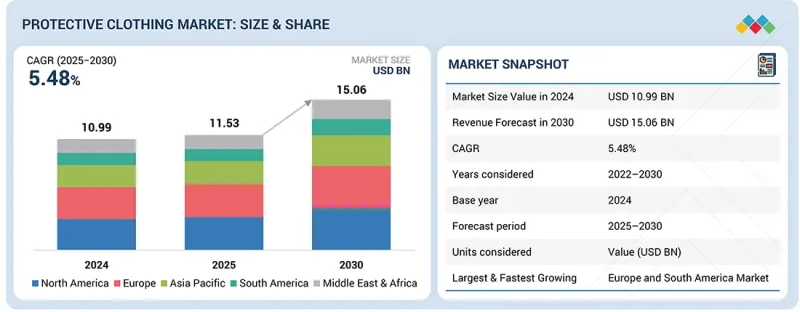
The protective clothing market size was USD 10.99 billion in 2024 and is projected to reach USD 15.06 billion by 2030, at a CAGR of 5.48%, between 2025 and 2030.
| Scope of the Report | |
|---|---|
| Years Considered for the Study | 2022-2030 |
| Base Year | 2024 |
| Forecast Period | 2025-2030 |
| Units Considered | Value (USD Million) |
| Segments | Material Type, Application, End-User Type, End-Use Industry and Region |
| Regions covered | Asia Pacific, Europe, North America, Middle East & Africa, and South America |
"Advances in Protective Clothing Materials and Functional Design to Drive Protective Clothing Market"
Ongoing advancements in textile engineering are turning protective clothing into lighter, stronger, more pliable protective suits that can better adapt to complex work settings. High-performance fibers like aramids, advanced polyethylene, and specialized blends deliver enhanced protection against heat, flames, abrasives, and corrosive chemicals, but remain breathable and comfortable for long-day wear. Coatings and laminates increase impermeability without bulk, and ergonomic tailoring boosts range of motion for physically saturating work.
There are even sector-specific innovations appearing, like in molten metal splash protection, which is useful for foundry work, or antistatic finishes, which find great utility in electronics manufacturing. Beyond passive protection, a few garments now include integrated communications capabilities or environmental sensors, particularly when working in extremes or in remote locations. These advancements keep up with shifting hazard profiles, and they also tackle one of the oldest barriers to protective apparel adoption, which is wearer discomfort. By making clothes that are easier to work with, companies are increasing the likelihood of constant use, which directly makes the workplace safer.
The polyamide segment was the third-largest segment, in terms of value, of the global protective clothing market.
Polyamide fabrics provide excellent protection clothing performance because of their remarkably high ability to resist abrasion, along with the durability of the garments that is retained despite continual contact with abrasive surfaces or mechanical friction. Polyamide garments are effective in many applications, especially in the construction, manufacturing, and mining industries, where this type of wear occurs on a continual basis, providing acceptable physical wear resistance. This durability means that the polyamide fibres and fabrics do not thin, tear, or fray too easily, and will service the user longer, at less cost to replace. Given that durability gives organizations an assurance in safety and cost prioritisation when sourcing protective clothing, polyamide provides the best options for clothing with enhanced durability during reduced service life.
The visibility segment accounted for the second-largest share in the protective clothing market, in terms of value, in 2024.
The visibility application held the second largest share of the protective clothing market in 2024. An increasing share of municipal and industrial work is ultimately accomplished at night or early in the morning to minimize interference in traffic and meet strict schedules. The resulting increase in nighttime operations has created greater demand for protective clothing that provides high visibility in low light and under artificial illumination. Recent improvements in retro-reflective technology allow garments to be seen from multiple angles and maintain brightness, thereby providing more safety for workers doing road repairs, utility work or providing emergency services. The frequency of around-the-clock operations in logistics hubs, ports, and transportation systems is also building demand for visibility clothing that can meet strict performance expectations for nighttime safety.
"South America is estimated to be the fastest growing region in the protective clothing market, in terms of value."
South America's industrial growth in mining, oil & gas, construction and manufacturing is driving the need for durable protective clothing in the region. These industries are high-risk, including heat, chemicals and mechanical hazards, requiring dedicated equipment. In places like Brazil, Chile, and Peru, occupational safety rules are being enforced more, and companies are being encouraged to invest in high quality protective clothing. With industrial projects growing in size and complexity, employers are looking for apparel that offers maximum hazard protection with mobility. This emphasis on protecting workers in perilous and high-hazard environments is further propelling market adoption, especially apparel designed to handle the region's fluctuating weather and operational conditions.
- By Company Type: Tier 1 - 55%, Tier 2 - 25%, and Tier 3 - 20%
- By Designation: Directors - 50%, Managers - 30%, and Others - 20%
- By Region: North America - 40%, Europe - 35%, Asia Pacific - 20%, Rest of World - 5%
The key players profiled in the report include 3M Company (US), DuPont de Nemours, Inc. (US), Ansell Limited (Australia), Lakeland Industries, Inc. (US), TEIJIN LIMITED (Japan), Protective Industrial Products, Inc. (US), TenCate Protective Fabrics (Netherlands), PBI Performance Products, Inc. (US), Sioen Industries NV (Belgium), and W. L. Gore & Associates, Inc. (US).
Research Coverage
This report segments the market for protective clothing based on material type, application, end-user type, end-user type, end-use industry and region and provides estimations of value (USD Million) for the overall market size across various regions. A detailed analysis of key industry players has been conducted to provide insights into their business overviews, services, and key strategies, associated with the market for protective clothing.
Reasons to Buy this Report
This research report is focused on various levels of analysis - industry analysis (industry trends), market share analysis of top players, and company profiles, which together provide an overall view of the competitive landscape, emerging and high-growth segments of the protective clothing market; high-growth regions; and market drivers, restraints, and opportunities.
The report provides insights into the following points:
- Market Penetration: Comprehensive information on protective clothing offered by top players in the global market
- Analysis of key drivers: (Rising workplace safety regulations across industries, surge in demand from oil & gas and chemical sectors, and growth in construction and infrastructure projects) restraints (limited awareness in small and medium enterprises and complex maintenance and cleaning requirements) opportunities (growing demand for sustainable and eco-friendly fabric and rising need for flame-resistant clothing in renewable energy projects) and challenges (difficulty in customizing clothing for niche industrial applications and slow adoption rates in cost-sensitive markets) influencing the growth of protective clothing market.
- Product Development/Innovation: Detailed insights on upcoming technologies, research & development activities, and new product & service launches in the protective clothing market
- Market Development: Comprehensive information about lucrative emerging markets - the report analyzes the markets for protective clothing across regions.
- Market Diversification: Exhaustive information about new products, untapped regions, and recent developments in the global protective clothing market
- Competitive Assessment: In-depth assessment of market shares, strategies, products, and manufacturing capabilities of leading players in the protective clothing market.
TABLE OF CONTENTS
1 INTRODUCTION
- 1.1 STUDY OBJECTIVES
- 1.2 MARKET DEFINITION
- 1.3 STUDY SCOPE
- 1.3.1 MARKETS COVERED AND REGIONAL SCOPE
- 1.3.2 INCLUSIONS AND EXCLUSIONS
- 1.3.3 MARKET DEFINITION AND INCLUSIONS, BY MATERIAL TYPE
- 1.3.4 MARKET DEFINITION AND INCLUSIONS, BY APPLICATION
- 1.3.5 MARKET DEFINITION AND INCLUSIONS, BY END-USER TYPE
- 1.3.6 MARKET DEFINITION AND INCLUSIONS, BY END-USE INDUSTRY
- 1.3.7 YEARS CONSIDERED
- 1.3.8 CURRENCY CONSIDERED
- 1.4 STAKEHOLDERS
- 1.5 SUMMARY OF CHANGES
2 RESEARCH METHODOLOGY
- 2.1 RESEARCH DATA
- 2.1.1 SECONDARY DATA
- 2.1.2 PRIMARY DATA
- 2.1.2.1 Key primary participants
- 2.1.2.2 Key industry insights
- 2.1.2.3 Breakdown of primary interviews
- 2.2 MARKET SIZE ESTIMATION
- 2.2.1 BOTTOM-UP APPROACH
- 2.2.2 TOP-DOWN APPROACH
- 2.3 DATA TRIANGULATION
- 2.4 GROWTH FORECAST
- 2.4.1 SUPPLY-SIDE ANALYSIS
- 2.4.2 DEMAND-SIDE ANALYSIS
- 2.5 ASSUMPTIONS
- 2.6 LIMITATIONS
- 2.7 RISK ASSESSMENT
3 EXECUTIVE SUMMARY
4 PREMIUM INSIGHTS
- 4.1 ATTRACTIVE OPPORTUNITIES FOR PLAYERS IN PROTECTIVE CLOTHING MARKET
- 4.2 PROTECTIVE CLOTHING MARKET, BY REGION
- 4.3 EUROPE: PROTECTIVE CLOTHING MARKET, BY MATERIAL TYPE AND COUNTRY
- 4.4 REGIONAL ANALYSIS: PROTECTIVE CLOTHING MARKET, BY APPLICATION
- 4.5 REGIONAL ANALYSIS: PROTECTIVE CLOTHING MARKET, BY END-USE INDUSTRY
- 4.6 PROTECTIVE CLOTHING MARKET, BY COUNTRY
5 MARKET OVERVIEW
- 5.1 INTRODUCTION
- 5.2 MARKET DYNAMICS
- 5.2.1 DRIVERS
- 5.2.1.1 Workplace safety concerns
- 5.2.1.2 Rising industrial hazards to fuel demand
- 5.2.1.3 Growing demand from hazard-intensive laboratories
- 5.2.2 RESTRAINTS
- 5.2.2.1 Regulatory compliance adds complexity
- 5.2.2.2 High costs of specialized protective clothing
- 5.2.3 OPPORTUNITIES
- 5.2.3.1 Rising demand from emerging economies
- 5.2.3.2 Eco-friendly protective clothing solutions
- 5.2.4 CHALLENGES
- 5.2.4.1 Customization demands outpace standard production
- 5.2.1 DRIVERS
- 5.3 PORTER'S FIVE FORCES ANALYSIS
- 5.3.1 THREAT OF NEW ENTRANTS
- 5.3.2 THREAT OF SUBSTITUTES
- 5.3.3 BARGAINING POWER OF SUPPLIERS
- 5.3.4 BARGAINING POWER OF BUYERS
- 5.3.5 INTENSITY OF COMPETITIVE RIVALRY
- 5.4 KEY STAKEHOLDERS AND BUYING CRITERIA
- 5.4.1 KEY STAKEHOLDERS IN BUYING PROCESS
- 5.4.2 BUYING CRITERIA
- 5.5 MACROECONOMIC INDICATORS
- 5.5.1 GDP TRENDS AND FORECAST
6 INDUSTRY TRENDS
- 6.1 SUPPLY CHAIN ANALYSIS
- 6.2 PRICING ANALYSIS
- 6.2.1 INDICATIVE SELLING PRICE TREND OF PROTECTIVE CLOTHING, BY REGION, 2022-2030
- 6.3 TRENDS/DISRUPTIONS IMPACTING CUSTOMER BUSINESS
- 6.4 ECOSYSTEM ANALYSIS
- 6.5 TECHNOLOGY ANALYSIS
- 6.5.1 KEY TECHNOLOGIES
- 6.5.1.1 Multi-layer fabric engineering
- 6.5.1.2 Membrane and coating technology
- 6.5.2 COMPLEMENTARY TECHNOLOGIES
- 6.5.2.1 Phase change materials
- 6.5.1 KEY TECHNOLOGIES
- 6.6 CASE STUDY ANALYSIS
- 6.6.1 OPTIMIZING SAFETY APPAREL COMPLIANCE WITH 3M COMPANY'S COVERALL SOLUTIONS
- 6.6.2 STREAMLINING GLOVE PROCUREMENT FOR OIL DRILLING GIANT
- 6.7 TRADE ANALYSIS
- 6.7.1 IMPORT SCENARIO (HS CODE 621010)
- 6.7.2 EXPORT SCENARIO (HS CODE 621010)
- 6.8 REGULATORY LANDSCAPE
- 6.8.1 REGULATORY BODIES, GOVERNMENT AGENCIES, AND OTHER ORGANIZATIONS
- 6.8.2 REGULATORY FRAMEWORK
- 6.8.2.1 OSHA Protective Clothing Standard (29 CFR 1910)
- 6.8.2.2 ISO 45001:2018 - Occupational Health and Safety Management Systems
- 6.9 KEY CONFERENCES AND EVENTS
- 6.10 INVESTMENT AND FUNDING SCENARIO
- 6.11 PATENT ANALYSIS
- 6.11.1 APPROACH
- 6.11.2 DOCUMENT TYPES
- 6.11.3 TOP APPLICANTS
- 6.11.4 JURISDICTION ANALYSIS
- 6.12 IMPACT OF 2025 US TARIFF - PROTECTIVE CLOTHING MARKET
- 6.12.1 INTRODUCTION
- 6.12.2 KEY TARIFF RATES
- 6.12.3 PRICE IMPACT ANALYSIS
- 6.12.4 IMPACT ON COUNTRY/REGION
- 6.12.4.1 US
- 6.12.4.2 Europe
- 6.12.4.3 Asia Pacific
- 6.12.5 IMPACT ON END-USE INDUSTRIES
- 6.13 IMPACT OF AI/GEN AI ON PROTECTIVE CLOTHING MARKET
7 PROTECTIVE CLOTHING MARKET, BY MATERIAL TYPE
- 7.1 INTRODUCTION
- 7.2 ARAMID & BLENDS
- 7.2.1 ENHANCED DURABILITY AND STRENGTH TO BOOST DEMAND
- 7.3 POLYOLEFIN & BLENDS
- 7.3.1 RISING DEMAND FOR MATERIALS WITH SUPERIOR PROPERTIES TO DRIVE MARKET
- 7.4 POLYAMIDE
- 7.4.1 HIGH TENSILE STRENGTH AND DURABILITY TO SPUR MARKET DEMAND
- 7.5 PBI
- 7.5.1 RISING DEMAND FOR HIGH-PERFORMANCE FLAME-RESISTANT MATERIALS TO SUPPORT MARKET GROWTH
- 7.6 UHMW POLYETHYLENE
- 7.6.1 GROWING NEED FOR LIGHTWEIGHT, HIGH-STRENGTH FIBERS TO ACCELERATE DEMAND
- 7.7 COTTON FIBERS
- 7.7.1 RISING PREFERENCE FOR COMFORTABLE AND AFFORDABLE PROTECTIVE FABRICS TO PROPEL MARKET
- 7.8 LAMINATED POLYESTERS
- 7.8.1 ADVANCEMENTS IN COATED AND LAMINATED FABRICS TO DRIVE DEMAND
- 7.9 OTHER MATERIAL TYPES
8 PROTECTIVE CLOTHING MARKET, BY APPLICATION
- 8.1 INTRODUCTION
- 8.2 THERMAL
- 8.2.1 RISING NEED FOR ADVANCED HEAT- AND FLAME-RESISTANT APPAREL ACROSS HIGH-RISK INDUSTRIES TO DRIVE MARKET
- 8.3 CHEMICAL
- 8.3.1 STRINGENT SAFETY REGULATIONS TO FUEL MARKET GROWTH
- 8.4 MECHANICAL
- 8.4.1 INDUSTRIAL EXPANSION AND HEAVY-DUTY OPERATIONS TO BOOST MARKET GROWTH
- 8.5 BIOLOGICAL/RADIATION
- 8.5.1 GROWING SAFETY IMPERATIVES IN HIGH-RISK ENVIRONMENTS TO DRIVE MARKET
- 8.6 VISIBILITY
- 8.6.1 GROWING INFRASTRUCTURE PROJECTS TO INCREASE DEMAND
- 8.7 OTHER APPLICATIONS
9 PROTECTIVE CLOTHING MARKET, BY END-USER TYPE
- 9.1 INTRODUCTION
- 9.2 PERSONAL
- 9.2.1 EXPANDING OUTDOOR AND RECREATIONAL ACTIVITIES TO FUEL DEMAND FOR PERSONAL PROTECTION
- 9.3 INDUSTRIAL
- 9.3.1 INDUSTRIAL EXPANSION IN EMERGING ECONOMIES TO ACCELERATE MARKET GROWTH
10 PROTECTIVE CLOTHING MARKET, BY END-USE INDUSTRY
- 10.1 INTRODUCTION
- 10.2 OIL & GAS
- 10.2.1 MULTI-HAZARD OPERATIONAL COMPLEXITY AND WORKFORCE EFFICIENCY TO DRIVE MARKET
- 10.3 CONSTRUCTION
- 10.3.1 RISING ON-SITE RISKS AND REGULATORY PRESSURE TO FUEL MARKET GROWTH
- 10.4 MANUFACTURING
- 10.4.1 OPERATIONAL SAFETY PRIORITIES PUSH MARKET FOR NEXT-GENERATION PROTECTIVE WEAR
- 10.5 HEALTHCARE/MEDICAL
- 10.5.1 SURGE IN HIGH-RISK CLINICAL PROCEDURES TO SUPPORT MARKET GROWTH
- 10.6 FIREFIGHTING & LAW ENFORCEMENT
- 10.6.1 OPERATIONAL COMPLEXITY TO FUEL DEMAND FOR TECHNOLOGICALLY ADVANCED PROTECTIVE CLOTHING
- 10.7 MINING
- 10.7.1 RISING OCCUPATIONAL HAZARDS TO DRIVE DEMAND
- 10.8 MILITARY
- 10.8.1 RISING DEFENSE BUDGETS AND MODERNIZATION EFFORTS TO DRIVE MARKET
- 10.9 WAREHOUSE & LOGISTICS
- 10.9.1 RAPID E-COMMERCE GROWTH AND WAREHOUSE AUTOMATION TO FUEL MARKET GROWTH
- 10.10 OTHER END-USE INDUSTRIES
11 PROTECTIVE CLOTHING MARKET, BY REGION
- 11.1 INTRODUCTION
- 11.2 ASIA PACIFIC
- 11.2.1 CHINA
- 11.2.1.1 Manufacturing power and safety mandates to support market growth
- 11.2.2 INDIA
- 11.2.2.1 Labor-intensive industries to drive market
- 11.2.3 JAPAN
- 11.2.3.1 Compliance and innovation to propel demand
- 11.2.4 SOUTH KOREA
- 11.2.4.1 Strategic sector growth spurs adoption of multi-hazard protective clothing
- 11.2.5 AUSTRALIA
- 11.2.5.1 Extreme climate and industrial conditions to drive demand
- 11.2.1 CHINA
- 11.3 NORTH AMERICA
- 11.3.1 US
- 11.3.1.1 Regulatory compliance and safety awareness to fuel market growth
- 11.3.2 CANADA
- 11.3.2.1 Healthcare industry dominance and safety protocols to support market growth
- 11.3.3 MEXICO
- 11.3.3.1 Rising manufacturing activity to drive demand
- 11.3.1 US
- 11.4 EUROPE
- 11.4.1 GERMANY
- 11.4.1.1 Expanding manufacturing base to drive market
- 11.4.2 FRANCE
- 11.4.2.1 Strengthened healthcare protocols to fuel market growth
- 11.4.3 ITALY
- 11.4.3.1 Rising safety awareness to propel market growth
- 11.4.4 UK
- 11.4.4.1 Multi-hazard exposure in oil & gas to accelerate market expansion
- 11.4.5 RUSSIA
- 11.4.5.1 Diverse climate and harsh industrial environments to drive innovation in market
- 11.4.6 SPAIN
- 11.4.6.1 Growing industrialization and manufacturing sector to drive demand
- 11.4.1 GERMANY
- 11.5 MIDDLE EAST & AFRICA
- 11.5.1 SAUDI ARABIA
- 11.5.1.1 Expanding oil & gas and petrochemical operations to strengthen demand
- 11.5.2 UAE
- 11.5.2.1 Industrial investments and economic diversification to accelerate market demand
- 11.5.3 IRAQ
- 11.5.3.1 Oil & gas dominance and infrastructure rehabilitation to fuel market growth
- 11.5.1 SAUDI ARABIA
- 11.6 SOUTH AMERICA
- 11.6.1 BRAZIL
- 11.6.1.1 Industrial growth to drive adoption
- 11.6.1 BRAZIL
12 COMPETITIVE LANDSCAPE
- 12.1 INTRODUCTION
- 12.2 KEY PLAYER STRATEGIES/RIGHT TO WIN
- 12.2.1 STRATEGIES ADOPTED BY KEY PROTECTIVE CLOTHING MANUFACTURERS, JANUARY 2020-JULY 2025
- 12.3 MARKET SHARE ANALYSIS
- 12.4 REVENUE ANALYSIS
- 12.5 COMPANY EVALUATION MATRIX: KEY PLAYERS, 2024
- 12.5.1 STARS
- 12.5.2 EMERGING LEADERS
- 12.5.3 PERVASIVE PLAYERS
- 12.5.4 PARTICIPANTS
- 12.5.5 COMPANY FOOTPRINT: KEY PLAYERS, 2024
- 12.5.5.1 Company footprint
- 12.5.5.2 Region footprint
- 12.5.5.3 Material type footprint
- 12.5.5.4 End-user type footprint
- 12.5.5.5 Application footprint
- 12.5.5.6 End-use industry footprint
- 12.6 COMPANY EVALUATION MATRIX: STARTUPS/SMES, 2024
- 12.6.1 PROGRESSIVE COMPANIES
- 12.6.2 RESPONSIVE COMPANIES
- 12.6.3 DYNAMIC COMPANIES
- 12.6.4 STARTING BLOCKS
- 12.6.5 COMPETITIVE BENCHMARKING: STARTUPS/SMES, 2024
- 12.6.5.1 Detailed list of key startups/SMEs
- 12.6.5.2 Competitive benchmarking of key startups/SMEs
- 12.7 BRAND/PRODUCT COMPARISON ANALYSIS
- 12.8 COMPANY VALUATION AND FINANCIAL METRICS
- 12.9 COMPETITIVE SCENARIO
- 12.9.1 PRODUCT LAUNCHES
- 12.9.2 DEALS
- 12.9.3 EXPANSIONS
- 12.9.4 OTHER DEVELOPMENTS
13 COMPANY PROFILES
- 13.1 KEY PLAYERS
- 13.1.1 3M COMPANY
- 13.1.1.1 Business overview
- 13.1.1.2 Products/Solutions/Services offered
- 13.1.1.3 MnM view
- 13.1.1.3.1 Key strengths
- 13.1.1.3.2 Strategic choices
- 13.1.1.3.3 Weaknesses and competitive threats
- 13.1.2 DUPONT DE NEMOURS, INC.
- 13.1.2.1 Business overview
- 13.1.2.2 Products/Solutions/Services offered
- 13.1.2.3 Recent developments
- 13.1.2.3.1 Deals
- 13.1.2.3.2 Expansions
- 13.1.2.3.3 Other developments
- 13.1.2.4 MnM view
- 13.1.2.4.1 Key strengths
- 13.1.2.4.2 Strategic choices
- 13.1.2.4.3 Weaknesses and competitive threats
- 13.1.3 ANSELL LIMITED
- 13.1.3.1 Business overview
- 13.1.3.2 Products/Solutions/Services offered
- 13.1.3.3 Recent developments
- 13.1.3.3.1 Deals
- 13.1.3.3.2 Other developments
- 13.1.3.4 MnM view
- 13.1.3.4.1 Key strengths
- 13.1.3.4.2 Strategic choices
- 13.1.3.4.3 Weaknesses and competitive threats
- 13.1.4 LAKELAND INDUSTRIES, INC.
- 13.1.4.1 Business overview
- 13.1.4.2 Products/Solutions/Services offered
- 13.1.4.3 Recent developments
- 13.1.4.3.1 Deals
- 13.1.4.3.2 Expansions
- 13.1.4.4 MnM view
- 13.1.4.4.1 Key strengths
- 13.1.4.4.2 Strategic choices
- 13.1.4.4.3 Weaknesses and competitive threats
- 13.1.5 TEIJIN LIMITED
- 13.1.5.1 Business overview
- 13.1.5.2 Products/Solutions/Services offered
- 13.1.5.3 Recent developments
- 13.1.5.3.1 Deals
- 13.1.5.4 MnM view
- 13.1.5.4.1 Key strengths
- 13.1.5.4.2 Strategic choices
- 13.1.5.4.3 Weaknesses and competitive threats
- 13.1.6 SIOEN INDUSTRIES NV
- 13.1.6.1 Business overview
- 13.1.6.2 Products/Solutions/Services offered
- 13.1.6.3 Recent developments
- 13.1.6.3.1 Product launches
- 13.1.7 PROTECTIVE INDUSTRIAL PRODUCTS, INC.
- 13.1.7.1 Business overview
- 13.1.7.2 Products/Solutions/Services offered
- 13.1.7.3 Recent developments
- 13.1.7.3.1 Deals
- 13.1.8 TENCATE PROTECTIVE FABRICS
- 13.1.8.1 Business overview
- 13.1.8.2 Products/Solutions/Services offered
- 13.1.9 PBI PERFORMANCE PRODUCTS, INC.
- 13.1.9.1 Business overview
- 13.1.9.2 Products/Solutions/Services offered
- 13.1.10 W. L. GORE & ASSOCIATES, INC.
- 13.1.10.1 Business overview
- 13.1.10.2 Products/Solutions/Services offered
- 13.1.10.3 Recent developments
- 13.1.10.3.1 Product launches
- 13.1.1 3M COMPANY
- 13.2 STARTUPS/SMES
- 13.2.1 LION GROUP, INC.
- 13.2.2 MSA SAFETY INCORPORATED
- 13.2.3 WORKWEAR OUTFITTERS, LLC
- 13.2.4 LOGISTIK UNICORP INC.
- 13.2.5 MALLCOM INDIA LIMITED
- 13.2.6 GLOBUS
- 13.2.7 KLEIN TOOLS, INC.
- 13.2.8 NEWTEX INDUSTRIES, INC.
- 13.2.9 HYDROWEAR B.V.
- 13.2.10 ALPHA PRO TECH, LTD.
- 13.2.11 RADIANS, INC.
- 13.2.12 NATIONAL SAFETY APPAREL
- 13.2.13 LINDSTROM GROUP
- 13.2.14 KAPPLER, INC.
- 13.2.15 BALLYCLARE INTERNATIONAL
14 ADJACENT & RELATED MARKETS
- 14.1 INTRODUCTION
- 14.2 LIMITATIONS
- 14.3 PERSONAL PROTECTIVE EQUIPMENT MARKET
- 14.3.1 MARKET DEFINITION
- 14.3.2 MARKET OVERVIEW
- 14.3.3 PERSONAL PROTECTIVE EQUIPMENT MARKET, BY REGION
- 14.3.3.1 Europe
- 14.3.3.2 North America
- 14.3.3.3 Asia Pacific
- 14.3.3.4 Middle East & Africa
- 14.3.3.5 South America
15 APPENDIX
- 15.1 DISCUSSION GUIDE
- 15.2 KNOWLEDGESTORE: MARKETSANDMARKETS' SUBSCRIPTION PORTAL
- 15.3 CUSTOMIZATION OPTIONS
- 15.4 RELATED REPORTS
- 15.5 AUTHOR DETAILS
List of Tables
- TABLE 1 PROTECTIVE CLOTHING MARKET: RISK ASSESSMENT
- TABLE 2 PROTECTIVE CLOTHING MARKET: PORTER'S FIVE FORCES ANALYSIS
- TABLE 3 IMPACT OF STAKEHOLDERS ON BUYING PROCESS FOR TOP THREE END-USE INDUSTRIES (%)
- TABLE 4 KEY BUYING CRITERIA FOR TOP THREE END-USE INDUSTRIES
- TABLE 5 GDP TRENDS AND FORECAST OF MAJOR ECONOMIES, 2022-2030 (USD BILLION)
- TABLE 6 INDICATIVE SELLING PRICE TREND OF PROTECTIVE CLOTHING, BY REGION, 2022-2030 (USD/UNIT)
- TABLE 7 ROLES OF COMPANIES IN PROTECTIVE CLOTHING ECOSYSTEM
- TABLE 8 IMPORT DATA RELATED TO PROTECTIVE CLOTHING, BY REGION, 2019-2024 (USD MILLION)
- TABLE 9 EXPORT DATA RELATED TO PROTECTIVE CLOTHING, BY REGION, 2019-2024 (USD MILLION)
- TABLE 10 GLOBAL: REGULATORY BODIES, GOVERNMENT AGENCIES, AND OTHER ORGANIZATIONS
- TABLE 11 NORTH AMERICA: REGULATORY BODIES, GOVERNMENT AGENCIES, AND OTHER ORGANIZATIONS
- TABLE 12 EUROPE: REGULATORY BODIES, GOVERNMENT AGENCIES, AND OTHER ORGANIZATIONS
- TABLE 13 ASIA PACIFIC: REGULATORY BODIES, GOVERNMENT AGENCIES, AND OTHER ORGANIZATIONS
- TABLE 14 MIDDLE EAST & AFRICA: REGULATORY BODIES, GOVERNMENT AGENCIES, AND OTHER ORGANIZATIONS
- TABLE 15 PROTECTIVE CLOTHING MARKET: LIST OF KEY CONFERENCES AND EVENTS, 2025-2026
- TABLE 16 PROTECTIVE CLOTHING MARKET: INVESTMENT AND FUNDING SCENARIO, 2022-2025
- TABLE 17 PATENT STATUS: PATENT APPLICATIONS, LIMITED PATENTS, AND GRANTED PATENTS, 2014-2024
- TABLE 18 LIST OF MAJOR PATENTS RELATED TO PROTECTIVE CLOTHING, 2014-2024
- TABLE 19 PATENTS BY NIKE, INC.
- TABLE 20 US ADJUSTED RECIPROCAL TARIFF RATES
- TABLE 21 PROTECTIVE CLOTHING MARKET, BY MATERIAL TYPE, 2022-2024 (USD MILLION)
- TABLE 22 PROTECTIVE CLOTHING MARKET, BY MATERIAL TYPE, 2025-2030 (USD MILLION)
- TABLE 23 ARAMID & BLENDS: PROTECTIVE CLOTHING MARKET, BY REGION, 2022-2024 (USD MILLION)
- TABLE 24 ARAMID & BLENDS: PROTECTIVE CLOTHING MARKET, BY REGION, 2025-2030 (USD MILLION)
- TABLE 25 POLYOLEFIN & BLENDS: PROTECTIVE CLOTHING MARKET, BY REGION, 2022-2024 (USD MILLION)
- TABLE 26 POLYOLEFIN & BLENDS: PROTECTIVE CLOTHING MARKET, BY REGION, 2025-2030 (USD MILLION)
- TABLE 27 POLYAMIDE: PROTECTIVE CLOTHING MARKET, BY REGION, 2022-2024 (USD MILLION)
- TABLE 28 POLYAMIDE: PROTECTIVE CLOTHING MARKET, BY REGION, 2025-2030 (USD MILLION)
- TABLE 29 PBI: PROTECTIVE CLOTHING MARKET, BY REGION, 2022-2024 (USD MILLION)
- TABLE 30 PBI: PROTECTIVE CLOTHING MARKET, BY REGION, 2025-2030 (USD MILLION)
- TABLE 31 UHMW POLYETHYLENE: PROTECTIVE CLOTHING MARKET, BY REGION, 2022-2024 (USD MILLION)
- TABLE 32 UHMW POLYETHYLENE: PROTECTIVE CLOTHING MARKET, BY REGION, 2025-2030 (USD MILLION)
- TABLE 33 COTTON FIBERS: PROTECTIVE CLOTHING MARKET, BY REGION, 2022-2024 (USD MILLION)
- TABLE 34 COTTON FIBERS: PROTECTIVE CLOTHING MARKET, BY REGION, 2025-2030 (USD MILLION)
- TABLE 35 LAMINATED POLYESTERS: PROTECTIVE CLOTHING MARKET, BY REGION, 2022-2024 (USD MILLION)
- TABLE 36 LAMINATED POLYESTERS: PROTECTIVE CLOTHING MARKET, BY REGION, 2025-2030 (USD MILLION)
- TABLE 37 OTHER MATERIAL TYPES: PROTECTIVE CLOTHING MARKET, BY REGION, 2022-2024 (USD MILLION)
- TABLE 38 OTHER MATERIAL TYPES: PROTECTIVE CLOTHING MARKET, BY REGION, 2025-2030 (USD MILLION)
- TABLE 39 PROTECTIVE CLOTHING MARKET, BY APPLICATION, 2022-2024 (USD MILLION)
- TABLE 40 PROTECTIVE CLOTHING MARKET, BY APPLICATION, 2025-2030 (USD MILLION)
- TABLE 41 THERMAL: PROTECTIVE CLOTHING MARKET, BY REGION, 2022-2024 (USD MILLION)
- TABLE 42 THERMAL: PROTECTIVE CLOTHING MARKET, BY REGION, 2025-2030 (USD MILLION)
- TABLE 43 THERMAL: PROTECTIVE CLOTHING MARKET, BY END-USE INDUSTRY, 2022-2024 (USD MILLION)
- TABLE 44 THERMAL: PROTECTIVE CLOTHING MARKET, BY END-USE INDUSTRY, 2025-2030 (USD MILLION)
- TABLE 45 CHEMICAL: PROTECTIVE CLOTHING MARKET, BY REGION, 2022-2024 (USD MILLION)
- TABLE 46 CHEMICAL: PROTECTIVE CLOTHING MARKET, BY REGION, 2025-2030 (USD MILLION)
- TABLE 47 CHEMICAL: PROTECTIVE CLOTHING MARKET, BY END-USE INDUSTRY, 2022-2024 (USD MILLION)
- TABLE 48 CHEMICAL: PROTECTIVE CLOTHING MARKET, BY END-USE INDUSTRY, 2025-2030 (USD MILLION)
- TABLE 49 MECHANICAL: PROTECTIVE CLOTHING MARKET, BY REGION, 2022-2024 (USD MILLION)
- TABLE 50 MECHANICAL: PROTECTIVE CLOTHING MARKET, BY REGION, 2025-2030 (USD MILLION)
- TABLE 51 MECHANICAL: PROTECTIVE CLOTHING MARKET, BY END-USE INDUSTRY, 2022-2024 (USD MILLION)
- TABLE 52 MECHANICAL: PROTECTIVE CLOTHING MARKET, BY END-USE INDUSTRY, 2025-2030 (USD MILLION)
- TABLE 53 BIOLOGICAL/RADIATION: PROTECTIVE CLOTHING MARKET, BY REGION, 2022-2024 (USD MILLION)
- TABLE 54 BIOLOGICAL/RADIATION: PROTECTIVE CLOTHING MARKET, BY REGION, 2025-2030 (USD MILLION)
- TABLE 55 BIOLOGICAL/RADIATION: PROTECTIVE CLOTHING MARKET, BY END-USE INDUSTRY, 2022-2024 (USD MILLION)
- TABLE 56 BIOLOGICAL/RADIATION: PROTECTIVE CLOTHING MARKET, BY END-USE INDUSTRY, 2025-2030 (USD MILLION)
- TABLE 57 VISIBILITY: PROTECTIVE CLOTHING MARKET, BY REGION, 2022-2024 (USD MILLION)
- TABLE 58 VISIBILITY: PROTECTIVE CLOTHING MARKET, BY REGION, 2025-2030 (USD MILLION)
- TABLE 59 VISIBILITY: PROTECTIVE CLOTHING MARKET, BY END-USE INDUSTRY, 2022-2024 (USD MILLION)
- TABLE 60 VISIBILITY: PROTECTIVE CLOTHING MARKET, BY END-USE INDUSTRY, 2025-2030 (USD MILLION)
- TABLE 61 OTHER APPLICATIONS: PROTECTIVE CLOTHING MARKET, BY REGION, 2022-2024 (USD MILLION)
- TABLE 62 OTHER APPLICATIONS: PROTECTIVE CLOTHING MARKET, BY REGION, 2025-2030 (USD MILLION)
- TABLE 63 OTHER APPLICATIONS: PROTECTIVE CLOTHING MARKET, BY END-USE INDUSTRY, 2022-2024 (USD MILLION)
- TABLE 64 OTHER APPLICATIONS: PROTECTIVE CLOTHING MARKET, BY END-USE INDUSTRY, 2025-2030 (USD MILLION)
- TABLE 65 PROTECTIVE CLOTHING MARKET, BY END-USER TYPE, 2022-2024 (USD MILLION)
- TABLE 66 PROTECTIVE CLOTHING MARKET, BY END-USER TYPE, 2025-2030 (USD MILLION)
- TABLE 67 PERSONAL: PROTECTIVE CLOTHING MARKET, BY REGION, 2022-2024 (USD MILLION)
- TABLE 68 PERSONAL: PROTECTIVE CLOTHING MARKET, BY REGION, 2025-2030 (USD MILLION)
- TABLE 69 INDUSTRIAL: PROTECTIVE CLOTHING MARKET, BY REGION, 2022-2024 (USD MILLION)
- TABLE 70 INDUSTRIAL: PROTECTIVE CLOTHING MARKET, BY REGION, 2025-2030 (USD MILLION)
- TABLE 71 PROTECTIVE CLOTHING MARKET, BY END-USE INDUSTRY, 2022-2024 (USD MILLION)
- TABLE 72 PROTECTIVE CLOTHING MARKET, BY END-USE INDUSTRY, 2025-2030 (USD MILLION)
- TABLE 73 OIL & GAS: PROTECTIVE CLOTHING MARKET, BY REGION, 2022-2024 (USD MILLION)
- TABLE 74 OIL & GAS: PROTECTIVE CLOTHING MARKET, BY REGION, 2025-2030 (USD MILLION)
- TABLE 75 OIL & GAS: PROTECTIVE CLOTHING MARKET, BY APPLICATION, 2022-2024 (USD MILLION)
- TABLE 76 OIL & GAS: PROTECTIVE CLOTHING MARKET, BY APPLICATION, 2025-2030 (USD MILLION)
- TABLE 77 CONSTRUCTION: PROTECTIVE CLOTHING MARKET, BY REGION, 2022-2024 (USD MILLION)
- TABLE 78 CONSTRUCTION: PROTECTIVE CLOTHING MARKET, BY REGION, 2025-2030 (USD MILLION)
- TABLE 79 CONSTRUCTION: PROTECTIVE CLOTHING MARKET, BY APPLICATION, 2022-2024 (USD MILLION)
- TABLE 80 CONSTRUCTION: PROTECTIVE CLOTHING MARKET, BY APPLICATION, 2025-2030 (USD MILLION)
- TABLE 81 MANUFACTURING: PROTECTIVE CLOTHING MARKET, BY REGION, 2022-2024 (USD MILLION)
- TABLE 82 MANUFACTURING: PROTECTIVE CLOTHING MARKET, BY REGION, 2025-2030 (USD MILLION)
- TABLE 83 MANUFACTURING: PROTECTIVE CLOTHING MARKET, BY APPLICATION, 2022-2024 (USD MILLION)
- TABLE 84 MANUFACTURING: PROTECTIVE CLOTHING MARKET, BY APPLICATION, 2025-2030 (USD MILLION)
- TABLE 85 HEALTHCARE/MEDICAL: PROTECTIVE CLOTHING MARKET, BY REGION, 2022-2024 (USD MILLION)
- TABLE 86 HEALTHCARE/MEDICAL: PROTECTIVE CLOTHING MARKET, BY REGION, 2025-2030 (USD MILLION)
- TABLE 87 HEALTHCARE/MEDICAL: PROTECTIVE CLOTHING MARKET, BY APPLICATION, 2022-2024 (USD MILLION)
- TABLE 88 HEALTHCARE/MEDICAL: PROTECTIVE CLOTHING MARKET, BY APPLICATION, 2025-2030 (USD MILLION)
- TABLE 89 FIREFIGHTING & LAW ENFORCEMENT: PROTECTIVE CLOTHING MARKET, BY REGION, 2022-2024 (USD MILLION)
- TABLE 90 FIREFIGHTING & LAW ENFORCEMENT: PROTECTIVE CLOTHING MARKET, BY REGION, 2025-2030 (USD MILLION)
- TABLE 91 FIREFIGHTING & LAW ENFORCEMENT: PROTECTIVE CLOTHING MARKET, BY APPLICATION, 2022-2024 (USD MILLION)
- TABLE 92 FIREFIGHTING & LAW ENFORCEMENT: PROTECTIVE CLOTHING MARKET, BY APPLICATION, 2025-2030 (USD MILLION)
- TABLE 93 MINING: PROTECTIVE CLOTHING MARKET, BY REGION, 2022-2024 (USD MILLION)
- TABLE 94 MINING: PROTECTIVE CLOTHING MARKET, BY REGION, 2025-2030 (USD MILLION)
- TABLE 95 MINING: PROTECTIVE CLOTHING MARKET, BY APPLICATION, 2022-2024 (USD MILLION)
- TABLE 96 MINING: PROTECTIVE CLOTHING MARKET, BY APPLICATION, 2025-2030 (USD MILLION)
- TABLE 97 MILITARY: PROTECTIVE CLOTHING MARKET, BY REGION, 2022-2024 (USD MILLION)
- TABLE 98 MILITARY: PROTECTIVE CLOTHING MARKET, BY REGION, 2025-2030 (USD MILLION)
- TABLE 99 MILITARY: PROTECTIVE CLOTHING MARKET, BY APPLICATION, 2022-2024 (USD MILLION)
- TABLE 100 MILITARY: PROTECTIVE CLOTHING MARKET, BY APPLICATION, 2025-2030 (USD MILLION)
- TABLE 101 WAREHOUSE & LOGISTICS: PROTECTIVE CLOTHING MARKET, BY REGION, 2022-2024 (USD MILLION)
- TABLE 102 WAREHOUSE & LOGISTICS: PROTECTIVE CLOTHING MARKET, BY REGION, 2025-2030 (USD MILLION)
- TABLE 103 WAREHOUSE & LOGISTICS: PROTECTIVE CLOTHING MARKET, BY APPLICATION, 2022-2024 (USD MILLION)
- TABLE 104 WAREHOUSE & LOGISTICS: PROTECTIVE CLOTHING MARKET, BY APPLICATION, 2025-2030 (USD MILLION)
- TABLE 105 OTHER END-USE INDUSTRIES: PROTECTIVE CLOTHING MARKET, BY REGION, 2022-2024 (USD MILLION)
- TABLE 106 OTHER END-USE INDUSTRIES: PROTECTIVE CLOTHING MARKET, BY REGION, 2025-2030 (USD MILLION)
- TABLE 107 OTHER END-USE INDUSTRIES: PROTECTIVE CLOTHING MARKET, BY APPLICATION, 2022-2024 (USD MILLION)
- TABLE 108 OTHER END-USE INDUSTRIES: PROTECTIVE CLOTHING MARKET, BY APPLICATION, 2025-2030 (USD MILLION)
- TABLE 109 PROTECTIVE CLOTHING MARKET, BY REGION, 2022-2024 (USD MILLION)
- TABLE 110 PROTECTIVE CLOTHING MARKET, BY REGION, 2025-2030 (USD MILLION)
- TABLE 111 ASIA PACIFIC: PROTECTIVE CLOTHING MARKET, BY MATERIAL TYPE, 2022-2024 (USD MILLION)
- TABLE 112 ASIA PACIFIC: PROTECTIVE CLOTHING MARKET, BY MATERIAL TYPE, 2025-2030 (USD MILLION)
- TABLE 113 ASIA PACIFIC: PROTECTIVE CLOTHING MARKET, BY APPLICATION, 2022-2024 (USD MILLION)
- TABLE 114 ASIA PACIFIC: PROTECTIVE CLOTHING MARKET, BY APPLICATION, 2025-2030 (USD MILLION)
- TABLE 115 ASIA PACIFIC: PROTECTIVE CLOTHING MARKET, BY END-USER TYPE, 2022-2024 (USD MILLION)
- TABLE 116 ASIA PACIFIC: PROTECTIVE CLOTHING MARKET, BY END-USER TYPE, 2025-2030 (USD MILLION)
- TABLE 117 ASIA PACIFIC: PROTECTIVE CLOTHING MARKET, BY END-USE INDUSTRY, 2022-2024 (USD MILLION)
- TABLE 118 ASIA PACIFIC: PROTECTIVE CLOTHING MARKET, BY END-USE INDUSTRY, 2025-2030 (USD MILLION)
- TABLE 119 ASIA PACIFIC: PROTECTIVE CLOTHING MARKET, BY COUNTRY, 2022-2024 (USD MILLION)
- TABLE 120 ASIA PACIFIC: PROTECTIVE CLOTHING MARKET, BY COUNTRY, 2025-2030 (USD MILLION)
- TABLE 121 CHINA: PROTECTIVE CLOTHING MARKET, BY END-USE INDUSTRY, 2022-2024 (USD MILLION)
- TABLE 122 CHINA: PROTECTIVE CLOTHING MARKET, BY END-USE INDUSTRY, 2025-2030 (USD MILLION)
- TABLE 123 INDIA: PROTECTIVE CLOTHING MARKET, BY END-USE INDUSTRY, 2022-2024 (USD MILLION)
- TABLE 124 INDIA: PROTECTIVE CLOTHING MARKET, BY END-USE INDUSTRY, 2025-2030 (USD MILLION)
- TABLE 125 JAPAN: PROTECTIVE CLOTHING MARKET, BY END-USE INDUSTRY, 2022-2024 (USD MILLION)
- TABLE 126 JAPAN: PROTECTIVE CLOTHING MARKET, BY END-USE INDUSTRY, 2025-2030 (USD MILLION)
- TABLE 127 SOUTH KOREA: PROTECTIVE CLOTHING MARKET, BY END-USE INDUSTRY, 2022-2024 (USD MILLION)
- TABLE 128 SOUTH KOREA: PROTECTIVE CLOTHING MARKET, BY END-USE INDUSTRY, 2025-2030 (USD MILLION)
- TABLE 129 AUSTRALIA: PROTECTIVE CLOTHING MARKET, BY END-USE INDUSTRY, 2022-2024 (USD MILLION)
- TABLE 130 AUSTRALIA: PROTECTIVE CLOTHING MARKET, BY END-USE INDUSTRY, 2025-2030 (USD MILLION)
- TABLE 131 NORTH AMERICA: PROTECTIVE CLOTHING MARKET, BY MATERIAL TYPE, 2022-2024 (USD MILLION)
- TABLE 132 NORTH AMERICA: PROTECTIVE CLOTHING MARKET, BY MATERIAL TYPE, 2025-2030 (USD MILLION)
- TABLE 133 NORTH AMERICA: PROTECTIVE CLOTHING MARKET, BY APPLICATION, 2022-2024 (USD MILLION)
- TABLE 134 NORTH AMERICA: PROTECTIVE CLOTHING MARKET, BY APPLICATION, 2025-2030 (USD MILLION)
- TABLE 135 NORTH AMERICA: PROTECTIVE CLOTHING MARKET, BY END-USER TYPE, 2022-2024 (USD MILLION)
- TABLE 136 NORTH AMERICA: PROTECTIVE CLOTHING MARKET, BY END-USER TYPE, 2025-2030 (USD MILLION)
- TABLE 137 NORTH AMERICA: PROTECTIVE CLOTHING MARKET, BY END-USE INDUSTRY, 2022-2024 (USD MILLION)
- TABLE 138 NORTH AMERICA: PROTECTIVE CLOTHING MARKET, BY END-USE INDUSTRY, 2025-2030 (USD MILLION)
- TABLE 139 NORTH AMERICA: PROTECTIVE CLOTHING MARKET, BY COUNTRY, 2022-2024 (USD MILLION)
- TABLE 140 NORTH AMERICA: PROTECTIVE CLOTHING MARKET, BY COUNTRY, 2025-2030 (USD MILLION)
- TABLE 141 US: PROTECTIVE CLOTHING MARKET, BY END-USE INDUSTRY, 2022-2024 (USD MILLION)
- TABLE 142 US: PROTECTIVE CLOTHING MARKET, BY END-USE INDUSTRY, 2025-2030 (USD MILLION)
- TABLE 143 CANADA: PROTECTIVE CLOTHING MARKET, BY END-USE INDUSTRY, 2022-2024 (USD MILLION)
- TABLE 144 CANADA: PROTECTIVE CLOTHING MARKET, BY END-USE INDUSTRY, 2025-2030 (USD MILLION)
- TABLE 145 MEXICO: PROTECTIVE CLOTHING MARKET, BY END-USE INDUSTRY, 2022-2024 (USD MILLION)
- TABLE 146 MEXICO: PROTECTIVE CLOTHING MARKET, BY END-USE INDUSTRY, 2025-2030 (USD MILLION)
- TABLE 147 EUROPE: PROTECTIVE CLOTHING MARKET, BY MATERIAL TYPE, 2022-2024 (USD MILLION)
- TABLE 148 EUROPE: PROTECTIVE CLOTHING MARKET, BY MATERIAL TYPE, 2025-2030 (USD MILLION)
- TABLE 149 EUROPE: PROTECTIVE CLOTHING MARKET, BY APPLICATION, 2022-2024 (USD MILLION)
- TABLE 150 EUROPE: PROTECTIVE CLOTHING MARKET, BY APPLICATION, 2025-2030 (USD MILLION)
- TABLE 151 EUROPE: PROTECTIVE CLOTHING MARKET, BY END-USER TYPE, 2022-2024 (USD MILLION)
- TABLE 152 EUROPE: PROTECTIVE CLOTHING MARKET, BY END-USER TYPE, 2025-2030 (USD MILLION)
- TABLE 153 EUROPE: PROTECTIVE CLOTHING MARKET, BY END-USE INDUSTRY, 2022-2024 (USD MILLION)
- TABLE 154 EUROPE: PROTECTIVE CLOTHING MARKET, BY END-USE INDUSTRY, 2025-2030 (USD MILLION)
- TABLE 155 EUROPE: PROTECTIVE CLOTHING MARKET, BY COUNTRY, 2022-2024 (USD MILLION)
- TABLE 156 EUROPE: PROTECTIVE CLOTHING MARKET, BY COUNTRY, 2025-2030 (USD MILLION)
- TABLE 157 GERMANY: PROTECTIVE CLOTHING MARKET, BY END-USE INDUSTRY, 2022-2024 (USD MILLION)
- TABLE 158 GERMANY: PROTECTIVE CLOTHING MARKET, BY END-USE INDUSTRY, 2025-2030 (USD MILLION)
- TABLE 159 FRANCE: PROTECTIVE CLOTHING MARKET, BY END-USE INDUSTRY, 2022-2024 (USD MILLION)
- TABLE 160 FRANCE: PROTECTIVE CLOTHING MARKET, BY END-USE INDUSTRY, 2025-2030 (USD MILLION)
- TABLE 161 ITALY: PROTECTIVE CLOTHING MARKET, BY END-USE INDUSTRY, 2022-2024 (USD MILLION)
- TABLE 162 ITALY: PROTECTIVE CLOTHING MARKET, BY END-USE INDUSTRY, 2025-2030 (USD MILLION)
- TABLE 163 UK: PROTECTIVE CLOTHING MARKET, BY END-USE INDUSTRY, 2022-2024 (USD MILLION)
- TABLE 164 UK: PROTECTIVE CLOTHING MARKET, BY END-USE INDUSTRY, 2025-2030 (USD MILLION)
- TABLE 165 RUSSIA: PROTECTIVE CLOTHING MARKET, BY END-USE INDUSTRY, 2022-2024 (USD MILLION)
- TABLE 166 RUSSIA: PROTECTIVE CLOTHING MARKET, BY END-USE INDUSTRY, 2025-2030 (USD MILLION)
- TABLE 167 SPAIN: PROTECTIVE CLOTHING MARKET, BY END-USE INDUSTRY, 2022-2024 (USD MILLION)
- TABLE 168 SPAIN: PROTECTIVE CLOTHING MARKET, BY END-USE INDUSTRY, 2025-2030 (USD MILLION)
- TABLE 169 MIDDLE EAST & AFRICA: PROTECTIVE CLOTHING MARKET, BY MATERIAL TYPE, 2022-2024 (USD MILLION)
- TABLE 170 MIDDLE EAST & AFRICA: PROTECTIVE CLOTHING MARKET, BY MATERIAL TYPE, 2025-2030 (USD MILLION)
- TABLE 171 MIDDLE EAST & AFRICA: PROTECTIVE CLOTHING MARKET, BY APPLICATION, 2022-2024 (USD MILLION)
- TABLE 172 MIDDLE EAST & AFRICA: PROTECTIVE CLOTHING MARKET, BY APPLICATION, 2025-2030 (USD MILLION)
- TABLE 173 MIDDLE EAST & AFRICA: PROTECTIVE CLOTHING MARKET, BY END-USER TYPE, 2022-2024 (USD MILLION)
- TABLE 174 MIDDLE EAST & AFRICA: PROTECTIVE CLOTHING MARKET, BY END-USER TYPE, 2025-2030 (USD MILLION)
- TABLE 175 MIDDLE EAST & AFRICA: PROTECTIVE CLOTHING MARKET, BY END-USE INDUSTRY, 2022-2024 (USD MILLION)
- TABLE 176 MIDDLE EAST & AFRICA: PROTECTIVE CLOTHING MARKET, BY END-USE INDUSTRY, 2025-2030 (USD MILLION)
- TABLE 177 MIDDLE EAST & AFRICA: PROTECTIVE CLOTHING MARKET, BY COUNTRY, 2022-2024 (USD MILLION)
- TABLE 178 MIDDLE EAST & AFRICA: PROTECTIVE CLOTHING MARKET, BY COUNTRY, 2025-2030 (USD MILLION)
- TABLE 179 SAUDI ARABIA: PROTECTIVE CLOTHING MARKET, BY END-USE INDUSTRY, 2022-2024 (USD MILLION)
- TABLE 180 SAUDI ARABIA: PROTECTIVE CLOTHING MARKET, BY END-USE INDUSTRY, 2025-2030 (USD MILLION)
- TABLE 181 UAE: PROTECTIVE CLOTHING MARKET, BY END-USE INDUSTRY, 2022-2024 (USD MILLION)
- TABLE 182 UAE: PROTECTIVE CLOTHING MARKET, BY END-USE INDUSTRY, 2025-2030 (USD MILLION)
- TABLE 183 IRAQ: PROTECTIVE CLOTHING MARKET, BY END-USE INDUSTRY, 2022-2024 (USD MILLION)
- TABLE 184 IRAQ: PROTECTIVE CLOTHING MARKET, BY END-USE INDUSTRY, 2025-2030 (USD MILLION)
- TABLE 185 SOUTH AMERICA: PROTECTIVE CLOTHING MARKET, BY MATERIAL TYPE, 2022-2024 (USD MILLION)
- TABLE 186 SOUTH AMERICA: PROTECTIVE CLOTHING MARKET, BY MATERIAL TYPE, 2025-2030 (USD MILLION)
- TABLE 187 SOUTH AMERICA: PROTECTIVE CLOTHING MARKET, BY APPLICATION, 2022-2024 (USD MILLION)
- TABLE 188 SOUTH AMERICA: PROTECTIVE CLOTHING MARKET, BY APPLICATION, 2025-2030 (USD MILLION)
- TABLE 189 SOUTH AMERICA: PROTECTIVE CLOTHING MARKET, BY END-USER TYPE, 2022-2024 (USD MILLION)
- TABLE 190 SOUTH AMERICA: PROTECTIVE CLOTHING MARKET, BY END-USER TYPE, 2025-2030 (USD MILLION)
- TABLE 191 SOUTH AMERICA: PROTECTIVE CLOTHING MARKET, BY END-USE INDUSTRY, 2022-2024 (USD MILLION)
- TABLE 192 SOUTH AMERICA: PROTECTIVE CLOTHING MARKET, BY END-USE INDUSTRY, 2025-2030 (USD MILLION)
- TABLE 193 SOUTH AMERICA: PROTECTIVE CLOTHING MARKET, BY COUNTRY, 2022-2024 (USD MILLION)
- TABLE 194 SOUTH AMERICA: PROTECTIVE CLOTHING MARKET, BY COUNTRY, 2025-2030 (USD MILLION)
- TABLE 195 BRAZIL: PROTECTIVE CLOTHING MARKET, BY END-USE INDUSTRY, 2022-2024 (USD MILLION)
- TABLE 196 BRAZIL: PROTECTIVE CLOTHING MARKET, BY END-USE INDUSTRY, 2025-2030 (USD MILLION)
- TABLE 197 PROTECTIVE CLOTHING MARKET: DEGREE OF COMPETITION, 2024
- TABLE 198 PROTECTIVE CLOTHING MARKET: REGION FOOTPRINT
- TABLE 199 PROTECTIVE CLOTHING MARKET: MATERIAL TYPE FOOTPRINT
- TABLE 200 PROTECTIVE CLOTHING MARKET: END-USER TYPE FOOTPRINT
- TABLE 201 PROTECTIVE CLOTHING MARKET: APPLICATION FOOTPRINT
- TABLE 202 PROTECTIVE CLOTHING MARKET: END-USE INDUSTRY FOOTPRINT
- TABLE 203 PROTECTIVE CLOTHING MARKET: DETAILED LIST OF KEY STARTUPS/SMES
- TABLE 204 PROTECTIVE CLOTHING MARKET: COMPETITIVE BENCHMARKING OF KEY STARTUPS/SMES
- TABLE 205 PROTECTIVE CLOTHING MARKET: PRODUCT LAUNCHES, JANUARY 2020-AUGUST 2025
- TABLE 206 PROTECTIVE CLOTHING MARKET: DEALS, JANUARY 2020-AUGUST 2025
- TABLE 207 PROTECTIVE CLOTHING MARKET: EXPANSIONS, JANUARY 2020-AUGUST 2025
- TABLE 208 PROTECTIVE CLOTHING MARKET: OTHER DEVELOPMENTS, JANUARY 2020-AUGUST 2025
- TABLE 209 3M COMPANY: COMPANY OVERVIEW
- TABLE 210 3M COMPANY: PRODUCTS/SOLUTIONS/SERVICES OFFERED
- TABLE 211 DUPONT DE NEMOURS, INC.: COMPANY OVERVIEW
- TABLE 212 DUPONT DE NEMOURS, INC.: PRODUCTS/SOLUTIONS/SERVICES OFFERED
- TABLE 213 DUPONT DE NEMOURS, INC.: DEALS
- TABLE 214 DUPONT DE NEMOURS, INC.: EXPANSIONS
- TABLE 215 DUPONT DE NEMOURS, INC.: OTHER DEVELOPMENTS
- TABLE 216 ANSELL LIMITED: COMPANY OVERVIEW
- TABLE 217 ANSELL LIMITED: PRODUCTS/SOLUTIONS/SERVICES OFFERED
- TABLE 218 ANSELL LIMITED: DEALS
- TABLE 219 ANSELL LIMITED: OTHER DEVELOPMENTS
- TABLE 220 LAKELAND INDUSTRIES, INC.: COMPANY OVERVIEW
- TABLE 221 LAKELAND INDUSTRIES, INC.: PRODUCTS/SOLUTIONS/SERVICES OFFERED
- TABLE 222 LAKELAND INDUSTRIES, INC.: DEALS
- TABLE 223 LAKELAND INDUSTRIES, INC.: EXPANSIONS
- TABLE 224 TEIJIN LIMITED: COMPANY OVERVIEW
- TABLE 225 TEIJIN LIMITED: PRODUCTS/SOLUTIONS/SERVICES OFFERED
- TABLE 226 TEIJIN LIMITED: DEALS
- TABLE 227 SIOEN INDUSTRIES NV: COMPANY OVERVIEW
- TABLE 228 SIOEN INDUSTRIES NV: PRODUCTS/SOLUTIONS/SERVICES OFFERED
- TABLE 229 SIOEN INDUSTRIES NV: PRODUCT LAUNCHES
- TABLE 230 PROTECTIVE INDUSTRIAL PRODUCTS, INC.: COMPANY OVERVIEW
- TABLE 231 PROTECTIVE INDUSTRIAL PRODUCTS, INC.: PRODUCTS/SOLUTIONS/ SERVICES OFFERED
- TABLE 232 PROTECTIVE INDUSTRIAL PRODUCTS, INC.: DEALS
- TABLE 233 TENCATE PROTECTIVE FABRICS: COMPANY OVERVIEW
- TABLE 234 TENCATE PROTECTIVE FABRICS: PRODUCTS/SOLUTIONS/SERVICES OFFERED
- TABLE 235 PBI PERFORMANCE PRODUCTS, INC.: COMPANY OVERVIEW
- TABLE 236 PBI PERFORMANCE PRODUCTS, INC.: PRODUCTS/SOLUTIONS/SERVICES OFFERED
- TABLE 237 W. L. GORE & ASSOCIATES, INC.: COMPANY OVERVIEW
- TABLE 238 W. L. GORE & ASSOCIATES, INC.: PRODUCTS/SOLUTIONS/SERVICES OFFERED
- TABLE 239 W. L. GORE & ASSOCIATES, INC.: PRODUCT LAUNCHES
- TABLE 240 LION GROUP, INC.: COMPANY OVERVIEW
- TABLE 241 MSA SAFETY INCORPORATED: COMPANY OVERVIEW
- TABLE 242 WORKWEAR OUTFITTERS, LLC: COMPANY OVERVIEW
- TABLE 243 LOGISTIK UNICORP INC.: COMPANY OVERVIEW
- TABLE 244 MALLCOM INDIA LIMITED: COMPANY OVERVIEW
- TABLE 245 GLOBUS: COMPANY OVERVIEW
- TABLE 246 KLEIN TOOLS, INC.: COMPANY OVERVIEW
- TABLE 247 NEWTEX INDUSTRIES, INC.: COMPANY OVERVIEW
- TABLE 248 HYDROWEAR B.V.: COMPANY OVERVIEW
- TABLE 249 ALPHA PRO TECH, LTD.: COMPANY OVERVIEW
- TABLE 250 RADIANS, INC.: COMPANY OVERVIEW
- TABLE 251 NATIONAL SAFETY APPAREL: COMPANY OVERVIEW
- TABLE 252 LINDSTROM GROUP: COMPANY OVERVIEW
- TABLE 253 KAPPLER, INC.: COMPANY OVERVIEW
- TABLE 254 BALLYCLARE INTERNATIONAL: COMPANY OVERVIEW
- TABLE 255 EUROPE: PERSONAL PROTECTIVE EQUIPMENT MARKET, BY COUNTRY, 2019-2024 (USD MILLION)
- TABLE 256 EUROPE: PERSONAL PROTECTIVE EQUIPMENT MARKET, BY COUNTRY, 2025-2030 (USD MILLION)
- TABLE 257 NORTH AMERICA: PERSONAL PROTECTIVE EQUIPMENT MARKET, BY COUNTRY, 2019-2024 (USD MILLION)
- TABLE 258 NORTH AMERICA: PERSONAL PROTECTIVE EQUIPMENT MARKET, BY COUNTRY, 2025-2030 (USD MILLION)
- TABLE 259 ASIA PACIFIC: PERSONAL PROTECTIVE EQUIPMENT MARKET, BY COUNTRY, 2019-2024 (USD MILLION)
- TABLE 260 ASIA PACIFIC: PERSONAL PROTECTIVE EQUIPMENT MARKET, BY COUNTRY, 2025-2030 (USD MILLION)
- TABLE 261 MIDDLE EAST & AFRICA: PERSONAL PROTECTIVE EQUIPMENT MARKET, BY COUNTRY, 2019-2024 (USD MILLION)
- TABLE 262 MIDDLE EAST & AFRICA: PERSONAL PROTECTIVE EQUIPMENT MARKET, BY COUNTRY, 2025-2030 (USD MILLION)
- TABLE 263 SOUTH AMERICA: PERSONAL PROTECTIVE EQUIPMENT MARKET, BY COUNTRY, 2019-2024 (USD MILLION)
- TABLE 264 SOUTH AMERICA: PERSONAL PROTECTIVE EQUIPMENT MARKET, BY COUNTRY, 2025-2030 (USD MILLION)
List of Figures
- FIGURE 1 PROTECTIVE CLOTHING MARKET SEGMENTATION AND REGIONAL SCOPE
- FIGURE 2 PROTECTIVE CLOTHING MARKET: RESEARCH DESIGN
- FIGURE 3 MARKET SIZE ESTIMATION METHODOLOGY: APPROACH 1 (SUPPLY SIDE): COLLECTIVE MARKET SHARE OF KEY PLAYERS
- FIGURE 4 MARKET SIZE ESTIMATION METHODOLOGY: APPROACH 2 - BOTTOM-UP (SUPPLY SIDE): COLLECTIVE REVENUE OF ALL PRODUCTS
- FIGURE 5 MARKET SIZE ESTIMATION METHODOLOGY: APPROACH 3 - BOTTOM-UP (DEMAND SIDE)
- FIGURE 6 MARKET SIZE ESTIMATION METHODOLOGY: APPROACH 4 - TOP-DOWN
- FIGURE 7 PROTECTIVE CLOTHING MARKET: DATA TRIANGULATION
- FIGURE 8 MARKET CAGR PROJECTIONS FROM SUPPLY SIDE
- FIGURE 9 MARKET GROWTH PROJECTIONS FROM DEMAND-SIDE DRIVERS AND OPPORTUNITIES
- FIGURE 10 ARAMID & BLENDS SEGMENT ACCOUNTED FOR LARGEST MARKET SHARE IN 2024
- FIGURE 11 THERMAL SEGMENT TO LEAD MARKET DURING FORECAST PERIOD
- FIGURE 12 INDUSTRIAL SECTOR TO REGISTER FASTEST GROWTH DURING FORECAST PERIOD
- FIGURE 13 MANUFACTURING TO BE LARGEST END-USE INDUSTRY DURING FORECAST PERIOD
- FIGURE 14 EUROPE ACCOUNTED FOR LARGEST MARKET SHARE IN 2024
- FIGURE 15 RISING DEMAND FOR HIGH-PERFORMANCE PROTECTIVE CLOTHING TO DRIVE MARKET
- FIGURE 16 SOUTH AMERICA TO REGISTER HIGHEST CAGR DURING FORECAST PERIOD
- FIGURE 17 ARAMID & BLENDS SEGMENT ACCOUNTED FOR LARGEST SHARE OF EUROPEAN MARKET IN 2024
- FIGURE 18 THERMAL APPLICATION DOMINATED MARKET ACROSS ALL REGIONS IN 2024
- FIGURE 19 MANUFACTURING INDUSTRY DOMINATED MARKET IN MOST REGIONS IN 2024
- FIGURE 20 UAE TO REGISTER HIGHEST GROWTH DURING FORECAST PERIOD
- FIGURE 21 PROTECTIVE CLOTHING MARKET: DRIVERS, RESTRAINTS, OPPORTUNITIES, AND CHALLENGES
- FIGURE 22 PROTECTIVE CLOTHING MARKET: PORTER'S FIVE FORCES ANALYSIS
- FIGURE 23 INFLUENCE OF STAKEHOLDERS ON BUYING PROCESS FOR TOP THREE END-USE INDUSTRIES
- FIGURE 24 KEY BUYING CRITERIA FOR TOP THREE END-USE INDUSTRIES
- FIGURE 25 PROTECTIVE CLOTHING MARKET: SUPPLY CHAIN ANALYSIS
- FIGURE 26 INDICATIVE SELLING PRICE TREND OF PROTECTIVE CLOTHING, BY REGION, 2022-2030
- FIGURE 27 TRENDS/DISRUPTIONS IMPACTING CUSTOMER BUSINESS
- FIGURE 28 PROTECTIVE CLOTHING MARKET: ECOSYSTEM ANALYSIS
- FIGURE 29 IMPORT DATA FOR PROTECTIVE CLOTHING, BY KEY COUNTRY, 2019-2024 (USD MILLION)
- FIGURE 30 EXPORT DATA FOR PROTECTIVE CLOTHING, BY KEY COUNTRY, 2019-2024 (USD MILLION)
- FIGURE 31 PATENTS REGISTERED FOR PROTECTIVE CLOTHING, 2014-2024
- FIGURE 32 MAJOR PATENTS RELATED TO PROTECTIVE CLOTHING, 2014-2024
- FIGURE 33 LEGAL STATUS OF PATENTS FILED RELATED TO PROTECTIVE CLOTHING, 2014-2024
- FIGURE 34 MAXIMUM PATENTS FILED IN JURISDICTION OF US FROM 2014 TO 2024
- FIGURE 35 IMPACT OF AI/GEN AI ON PROTECTIVE CLOTHING MARKET
- FIGURE 36 ARAMID & BLENDS SEGMENT TO HOLD LARGEST MARKET SHARE DURING FORECAST PERIOD
- FIGURE 37 THERMAL APPLICATION SEGMENT TO DOMINATE MARKET DURING FORECAST PERIOD
- FIGURE 38 INDUSTRIAL SEGMENT TO HOLD LARGEST MARKET SHARE IN 2025
- FIGURE 39 MANUFACTURING SEGMENT TO DOMINATE MARKET DURING FORECAST PERIOD
- FIGURE 40 EUROPE TO LEAD MARKET IN 2025
- FIGURE 41 ASIA PACIFIC: PROTECTIVE CLOTHING MARKET SNAPSHOT
- FIGURE 42 NORTH AMERICA: PROTECTIVE CLOTHING MARKET SNAPSHOT
- FIGURE 43 EUROPE: PROTECTIVE CLOTHING MARKET SNAPSHOT
- FIGURE 44 PROTECTIVE CLOTHING MARKET SHARE ANALYSIS, 2024
- FIGURE 45 PROTECTIVE CLOTHING MARKET: REVENUE ANALYSIS OF KEY PLAYERS, 2022-2024
- FIGURE 46 PROTECTIVE CLOTHING MARKET: COMPANY EVALUATION MATRIX (KEY PLAYERS), 2024
- FIGURE 47 PROTECTIVE CLOTHING MARKET: COMPANY FOOTPRINT
- FIGURE 48 PROTECTIVE CLOTHING MARKET: COMPANY EVALUATION MATRIX (STARTUPS/SMES), 2024
- FIGURE 49 PROTECTIVE CLOTHING MARKET: BRAND/PRODUCT COMPARISON (1/2)
- FIGURE 50 PROTECTIVE CLOTHING MARKET: BRAND/PRODUCT COMPARISON (2/2)
- FIGURE 51 PROTECTIVE CLOTHING MARKET: EV/EBITDA OF KEY MANUFACTURERS
- FIGURE 52 PROTECTIVE CLOTHING MARKET: ENTERPRISE VALUATION OF KEY PLAYERS
- FIGURE 53 3M COMPANY: COMPANY SNAPSHOT
- FIGURE 54 DUPONT DE NEMOURS, INC.: COMPANY SNAPSHOT
- FIGURE 55 ANSELL LIMITED: COMPANY SNAPSHOT
- FIGURE 56 LAKELAND INDUSTRIES, INC.: COMPANY SNAPSHOT
- FIGURE 57 TEIJIN LIMITED: COMPANY SNAPSHOT

