
PUBLISHER: MarketsandMarkets | PRODUCT CODE: 1895140
PUBLISHER: MarketsandMarkets | PRODUCT CODE: 1895140
Induction Heating Market by Power By Frequency By Application By End-User, Region - Forecast to 2030
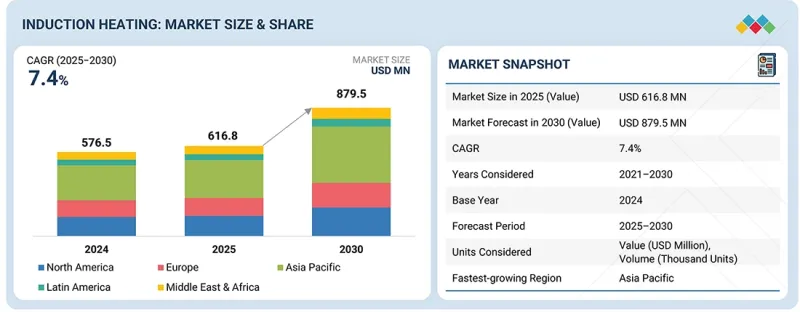
The global Induction heating market is estimated to grow from USD 616.8 million in 2025 to USD 879.5 million by 2030, at a CAGR of 7.4% during the forecast period.
| Scope of the Report | |
|---|---|
| Years Considered for the Study | 2021-2030 |
| Base Year | 2024 |
| Forecast Period | 2025-2030 |
| Units Considered | Value (USD Million), Volume (Thousand Units) |
| Segments | Frequency, Power, Application, and End User |
| Regions covered | North America, Europe, Asia Pacific, Latin America, and the Middle East & Africa |
Rapid expansion of industrial and manufacturing infrastructure across major economies is driving strong demand for Induction Heating systems. In India, initiatives such as the National Infrastructure Pipeline and growing investments in metals, automotive, chemicals, and electronics are driving the need for efficient heating technologies that enhance productivity and energy performance.
In the United States, federal programs such as the Infrastructure Investment and Jobs Act and clean-energy industrial expansion are pushing upgrades in steel, semiconductors, all of which require reliable, high-efficiency Induction Heating solutions. This steady modernization and capacity building directly increase the adoption of advanced heating systems for faster processing, reduced energy use, and improved operational reliability.
"By frequency, the 10-50 kHz segment is expected to dominate the Induction heating market during the forecast period."
The Induction heating market by frequency has the 10-50 kHz range as its leading segment. This is primarily because this frequency band offers an ideal balance between heating depth and process efficiency, making it suitable for a wide variety of industrial applications such as hardening, brazing, annealing, and forging. Systems operating in the 10-50 kHz range deliver fast, uniform heating with high energy efficiency, enabling precise temperature control and improved metallurgical results.
This frequency range is widely compatible with both conductive and moderately thin workpieces, allowing industries to utilize it for diverse production requirements. Additionally, equipment in this band is cost-effective, easier to maintain, and adaptable to both legacy and modern manufacturing setups. Owing to these advantages, the 10-50 kHz segment is being rapidly adopted across metal processing, automotive, and general manufacturing, making it the most preferred and extensively deployed frequency category in the market.
"By application, the heat-treating segment is expected to dominate the Induction heating market during the forecast period."
The Induction heating market by application is led by the heat-treating segment. This dominance is driven by the widespread use of heat-treating processes-such as hardening, tempering, annealing, and stress relieving across core industries, including automotive, machinery manufacturing, and metalworking. Heat-treating requires precise, consistent, and energy-efficient thermal control, which makes advanced Induction Heating systems highly suited for achieving desired material properties and improving component durability.
Induction Heating technologies used for heat treating provide rapid heating rates, clean operation, and superior metallurgical accuracy, making them a preferred choice over conventional gas-based systems. Furthermore, growing demand for high-performance metals, lightweight automotive components, and precision-engineered parts is increasing reliance on modern heat-treating systems. These factors collectively make heat-treating the largest and most critical application segment in the Induction Heating market.
"By region, Europe is estimated to be the third fastest-growing market during the forecast period."
The Induction Heating market, by region, identifies Europe as the third-fastest-growing market. This growth is driven by the region's strong manufacturing base, accelerating investments in energy-efficient industrial technologies, and stringent regulatory frameworks that promote cleaner and more sustainable heating solutions. European industries, especially automotive, heavy machinery, and advanced metallurgy, are rapidly upgrading to high-efficiency electric and induction-based heating systems to meet decarbonization targets and reduce operational emissions.
Additionally, the ongoing modernization of industrial infrastructure, supported by EU-level initiatives for digitalization and the green transition, is driving industries to adopt precise, automated, and low-maintenance heating technologies. The presence of leading industrial equipment manufacturers, combined with strong R&D capabilities and a rising demand for premium-quality processed materials, further positions Europe as a steadily expanding market, making it the third-fastest-growing region in the Induction Heating Landscape.
In-depth interviews have been conducted with various key industry participants, subject-matter experts, C-level executives of key market players, and industry consultants, among other experts, to obtain and verify critical qualitative and quantitative information and assess future market prospects. The distribution of primary interviews is as follows:
By Company Type: Tier 1- 30%, Tier 2- 45%, and Tier 3 - 25%
By Designation: C-level Executives - 30%, Directors - 20%, and Others - 50%
By Region: North America - 18%, Europe - 8%, Asia Pacific - 60%, Middle East & Africa - 10%, and South America - 4%
Notes: The tiers of the companies are defined based on their total revenues as of 2024. Tier 1: > USD 1 billion, Tier 2: USD 500 million to USD 1 billion, and Tier 3: < USD 500 million.
Other designations include sales managers, engineers, and regional managers.
Research Coverage:
The report defines, describes, and forecasts the global Induction heating market by power, application, end user, and region. It also offers a detailed qualitative and quantitative analysis of the market. The report comprehensively reviews the major market drivers, restraints, opportunities, and challenges. It also covers various important aspects of the market. These include an analysis of the competitive landscape, market dynamics, market estimates in terms of value, and future trends in the Induction Heating market.
Key Benefits of Buying the Report
- It provides an analysis of key drivers, restraints, opportunities, and challenges influencing the growth of the Induction Heating market.
- Market Development: Comprehensive information about lucrative markets - the report analyses the Induction heating market across varied regions.
- Market Diversification: Exhaustive information about new products and services, untapped geographies, recent developments, and investments in the Induction Heating market.
- Competitive Assessment: In-depth assessment of market shares, growth strategies, and service offerings of leading players like Interpower Induction (US), Thermo International (US), inTEST Corporation (US), Radyne Corporation (US), Hammond Power Solutions (Canada), SPC Electronics Corporation (Japan), Park-Ohio Holdings Corp (US), Induction Innovations (US), ENRX (Germany), RDO Induction, Inc. (US), UltraFlex Power Technologies (US), Eldec Induction GmbH (Germany), TRUMPF (Germany), MagneForce Inc. (US), Dai-Ichi Kiden Co., Ltd. (Japan), Shenzhen Double-Power Technology Co., Ltd. (China), Nippon Avionics Co., Ltd. (Japan). among others in the Induction Heatingmarket.
TABLE OF CONTENTS
1 INTRODUCTION
- 1.1 STUDY OBJECTIVES
- 1.2 MARKET DEFINITION
- 1.3 STUDY SCOPE
- 1.3.1 MARKETS COVERED AND REGIONAL SCOPE
- 1.3.2 INCLUSIONS AND EXCLUSIONS
- 1.3.3 YEARS CONSIDERED
- 1.4 CURRENCY CONSIDERED
- 1.5 UNIT CONSIDERED
- 1.6 LIMITATIONS
- 1.7 STAKEHOLDERS
2 EXECUTIVE SUMMARY
- 2.1 MARKET HIGHLIGHTS AND KEY INSIGHTS
- 2.2 KEY MARKET PARTICIPANTS: MAPPING OF STRATEGIC DEVELOPMENTS
- 2.3 DISRUPTIVE TRENDS IN INDUCTION HEATING MARKET
- 2.4 HIGH-GROWTH SEGMENTS
- 2.5 REGIONAL SNAPSHOT: MARKET SIZE, GROWTH RATE, AND FORECAST
3 PREMIUM INSIGHTS
- 3.1 ATTRACTIVE OPPORTUNITIES FOR PLAYERS IN INDUCTION HEATING MARKET
- 3.2 INDUCTION HEATING MARKET, BY POWER RATING
- 3.3 INDUCTION HEATING MARKET, BY END-USE INDUSTRY
- 3.4 INDUCTION HEATING MARKET, BY FREQUENCY
- 3.5 INDUCTION HEATING MARKET IN ASIA PACIFIC, BY END-USE INDUSTRY AND COUNTRY
- 3.6 INDUCTION HEATING MARKET, BY REGION
4 MARKET OVERVIEW
- 4.1 INTRODUCTION
- 4.2 MARKET DYNAMICS
- 4.2.1 DRIVERS
- 4.2.1.1 Increasing precision-driven manufacturing requirements and trade-driven industrial growth
- 4.2.1.2 Global focus on energy efficiency and decarbonization
- 4.2.2 RESTRAINTS
- 4.2.2.1 High upfront CAPEX associated with larger induction heating systems
- 4.2.3 OPPORTUNITIES
- 4.2.3.1 Surging demand for electric vehicles
- 4.2.3.2 Expanding induction heating applications in semiconductor and precision electronics
- 4.2.4 CHALLENGES
- 4.2.4.1 Preference for low-cost conventional resistance heating solutions
- 4.2.4.2 Sustaining competitive edge amid technology commoditization
- 4.2.1 DRIVERS
- 4.3 UNMET NEEDS AND WHITE SPACES
- 4.3.1 UNMET NEEDS IN INDUCTION HEATING MARKET
- 4.3.2 WHITE SPACE OPPORTUNITIES
- 4.4 INTERCONNECTED MARKETS AND CROSS-SECTOR OPPORTUNITIES
- 4.4.1 INTERCONNECTED MARKETS
- 4.4.2 CROSS-SECTOR OPPORTUNITIES
- 4.5 STRATEGIC MOVES BY TIER-1/2/3 PLAYERS
- 4.5.1 KEY MOVES AND STRATEGIC FOCUS
5 INDUSTRY TRENDS
- 5.1 PORTER'S FIVE FORCES ANALYSIS
- 5.1.1 BARGAINING POWER OF SUPPLIERS
- 5.1.2 BARGAINING POWER OF BUYERS
- 5.1.3 THREAT OF NEW ENTRANTS
- 5.1.4 THREAT OF SUBSTITUTES
- 5.1.5 INTENSITY OF COMPETITIVE RIVALRY
- 5.2 MACROECONOMIC OUTLOOK
- 5.2.1 INTRODUCTION
- 5.2.2 GDP TRENDS AND FORECAST
- 5.2.3 INFLATION RATE ACROSS VARIOUS REGIONS, 2024
- 5.2.4 MANUFACTURING VALUE ADDED (% OF GDP)
- 5.2.5 TRENDS IN GLOBAL AUTOMOTIVE INDUSTRY
- 5.2.6 TRENDS IN GLOBAL TRANSPORTATION INDUSTRY
- 5.3 VALUE CHAIN ANALYSIS
- 5.4 ECOSYSTEM ANALYSIS
- 5.5 PRICING ANALYSIS
- 5.5.1 AVERAGE SELLING PRICE TREND OF INDUCTION HEATING SYSTEMS, BY POWER RATING, 2022-2024
- 5.5.2 AVERAGE SELLING PRICE TREND OF INDUCTION HEATING SYSTEMS, BY REGION, 2022-2024
- 5.6 TRADE ANALYSIS
- 5.6.1 EXPORT SCENARIO (HS CODE 851440)
- 5.6.2 IMPORT SCENARIO (HS CODE 851440)
- 5.7 KEY CONFERENCES AND EVENTS, 2025-2026
- 5.8 TRENDS/DISRUPTIONS IMPACTING CUSTOMER BUSINESS
- 5.9 INVESTMENT AND FUNDING SCENARIO
- 5.10 CASE STUDY ANALYSIS
- 5.10.1 USE OF INDUCTION HEATING SOLUTION TO IMPROVE OPERATIONAL EFFICIENCY
- 5.10.2 ADOPTION OF HIGH-POWER INDUCTION DRYER TO ENHANCE COATING LINE SPEED AND UNIFORMITY
- 5.10.3 DEPLOYMENT OF HIGH-THROUGHPUT INDUCTION SYSTEMS TO IMPROVE METALLURGICAL PERFORMANCE AND PRODUCTIVITY
- 5.11 IMPACT OF 2025 US TARIFF ON INDUCTION HEATING MARKET
- 5.11.1 INTRODUCTION
- 5.11.2 KEY TARIFF RATES
- 5.11.3 PRICE IMPACT ANALYSIS
- 5.11.4 IMPACT ON COUNTRIES/REGIONS
- 5.11.4.1 US
- 5.11.4.2 Europe
- 5.11.4.3 Asia Pacific
- 5.11.5 IMPACT ON END-USE INDUSTRIES
6 TECHNOLOGICAL ADVANCEMENTS, AI-DRIVEN IMPACT, PATENTS, INNOVATIONS, AND FUTURE APPLICATIONS
- 6.1 KEY TECHNOLOGIES
- 6.1.1 SILICON CARBIDE AND GALLIUM NITRIDE SEMICONDUCTORS
- 6.1.2 DIGITAL TWIN AND PREDICTIVE CONTROL SYSTEMS
- 6.2 COMPLEMENTARY TECHNOLOGIES
- 6.2.1 SYSTEMS SMART FACTORY AND INDUSTRIAL IOT INTEGRATION
- 6.3 TECHNOLOGY ROADMAP
- 6.4 PATENT ANALYSIS
- 6.5 FUTURE APPLICATIONS
- 6.6 IMPACT OF AI/GEN AI ON INDUCTION HEATING MARKET
- 6.6.1 TOP USE CASES AND MARKET POTENTIAL
- 6.6.2 BEST PRACTICES FOLLOWED BY MANUFACTURERS IN INDUCTION HEATING MARKET
- 6.6.3 IMPACT OF AI/GEN AI ON END-USE INDUSTRIES
- 6.6.4 IMPACT OF AI ON INDUCTION HEATING MARKET, BY REGION
- 6.6.5 CASE STUDIES OF AI IMPLEMENTATION IN INDUSTRIAL HEATING MARKET
- 6.6.6 INTERCONNECTED/ADJACENT ECOSYSTEM AND IMPACT ON MARKET PLAYERS
- 6.6.7 CLIENTS' READINESS TO ADOPT GENERATIVE AI IN INDUSTRIAL HEATING MARKET
7 REGULATORY LANDSCAPE AND SUSTAINABILITY INITIATIVES
- 7.1 REGIONAL REGULATIONS AND COMPLIANCE
- 7.1.1 REGULATORY BODIES, GOVERNMENT AGENCIES, AND OTHER ORGANIZATIONS
- 7.1.2 INDUSTRY STANDARDS
- 7.1.2.1 CODES AND REGULATIONS related to induction heating
- 7.2 SUSTAINABILITY INITIATIVES
- 7.2.1 INTRODUCTION
- 7.2.2 SUSTAINABILITY INITIATIVES
- 7.2.3 IMPACT OF REGULATORY POLICIES ON SUSTAINABILITY INITIATIVES
8 CUSTOMER LANDSCAPE AND BUYER BEHAVIOR
- 8.1 INTRODUCTION
- 8.2 DECISION-MAKING PROCESS
- 8.3 KEY STAKEHOLDERS INVOLVED IN BUYING PROCESS AND THEIR EVALUATION CRITERIA
- 8.3.1 KEY STAKEHOLDERS IN BUYING PROCESS
- 8.3.2 BUYING CRITERIA
- 8.4 ADOPTION BARRIERS AND INTERNAL CHALLENGES
- 8.5 UNMET NEEDS OF VARIOUS END-USE INDUSTRIES
- 8.6 MARKET PROFITABILITY
9 INDUCTION HEATING MARKET, BY POWER RATING
- 9.1 INTRODUCTION
- 9.2 LESS THAN 10 KW
- 9.2.1 STRINGENT WORKPLACE SAFETY GUIDELINES TO BOOST DEMAND
- 9.3 10-100 KW
- 9.3.1 GOVERNMENT-BACKED INDUSTRIAL MODERNIZATION PROGRAMS TO ACCELERATE ADOPTION
- 9.4 ABOVE 100 KW
- 9.4.1 RISING GOVERNMENT ENVIRONMENTAL REGULATIONS TO DRIVE MARKET
10 INDUCTION HEATING MARKET, BY FREQUENCY
- 10.1 INTRODUCTION
- 10.2 LOW
- 10.2.1 TRANSITION TO CLEAN, EFFICIENT ELECTRIC HEATING TECHNOLOGIES TO FUEL SEGMENTAL GROWTH
- 10.3 MEDIUM
- 10.3.1 GOVERNMENT-BACKED INDUSTRIAL ELECTRIFICATION INITIATIVES TO STIMULATE DEMAND
- 10.4 HIGH
- 10.4.1 SMART MANUFACTURING INITIATIVES TO CONTRIBUTE TO MARKET GROWTH
11 INDUCTION HEATING MARKET, BY APPLICATION
- 11.1 INTRODUCTION
- 11.2 METAL MELTING
- 11.2.1 GOVERNMENT-BACKED INDUSTRIAL DECARBONIZATION EFFORTS TO ACCELERATE DEMAND
- 11.3 ANNEALING
- 11.3.1 FOCUS OF INDUSTRIES ON ENERGY-EFFICIENT, LOW-EMISSION, AND PRECISION-CONTROLLED THERMAL PROCESSING TO FUEL DEMAND
- 11.4 HEAT TREATING
- 11.4.1 STRINGENT EMISSION REGULATIONS AND TRANSITION TO ELECTRIFIED INDUSTRIAL HEATING TO PROPEL MARKET
- 11.5 BRAZING AND SOLDERING
- 11.5.1 RISING DEMAND FOR SPECIALTY ALLOY COMPONENTS WITH SUPERIOR JOINT INTEGRITY TO SUPPORT MARKET GROWTH
- 11.6 SURFACE HARDENING
- 11.6.1 PRESSING NEED TO CUT PARTICULATE AND NOX EMISSIONS IN LARGE MANUFACTURING FACILITIES TO DRIVE MARKET
12 INDUCTION HEATING MARKET, BY END-USE INDUSTRY
- 12.1 INTRODUCTION
- 12.2 METALS
- 12.2.1 STRATEGIC SHIFT TOWARD ENERGY-EFFICIENT AND LOW-EMISSION PROCESSES TO FUEL DEMAND
- 12.3 INDUSTRIAL MANUFACTURING
- 12.3.1 GOVERNMENT INCENTIVES TO REDUCE CARBON EMISSIONS DURING INDUSTRIAL PROCESSES TO ACCELERATE ADOPTION
- 12.4 AUTOMOTIVE
- 12.4.1 GROWING FOCUS ON EXPANDING EV INFRASTRUCTURE TO DRIVE MARKET
- 12.5 PLASTIC PROCESSING
- 12.5.1 RISING PUSH TOWARD ELECTRIFICATION AND PRECISION IN THERMAL MANAGEMENT TO FUEL MARKET GROWTH
- 12.6 ELECTRONICS & SEMICONDUCTORS
- 12.6.1 INTEGRATION OF HIGH-PRECISION THERMAL PROCESSES INTO HIGH-TECH MANUFACTURING TO FOSTER MARKET GROWTH
- 12.7 CONSUMER APPLIANCES
- 12.7.1 RISING SHIFT TOWARD EFFICIENT, SAFE, AND SMART TECHNOLOGIES TO FUEL MARKET GROWTH
- 12.8 MEDICAL DEVICES
- 12.8.1 SHIFT TOWARD ENERGY-EFFICIENT THERMAL PROCESSING WHILE MANUFACTURING MEDICAL DEVICES TO DRIVE MARKET
13 INDUCTION HEATING MARKET, BY REGION
- 13.1 INTRODUCTION
- 13.2 NORTH AMERICA
- 13.2.1 US
- 13.2.1.1 Strict energy efficiency and emission regulations to boost demand
- 13.2.2 CANADA
- 13.2.2.1 High investments in green supply chains and smart factories to support market growth
- 13.2.1 US
- 13.3 EUROPE
- 13.3.1 GERMANY
- 13.3.1.1 Growing reliance on renewable energy sources to fuel market growth
- 13.3.2 ITALY
- 13.3.2.1 Green Deal and REPowerEU initiatives to contribute to market growth
- 13.3.3 SPAIN
- 13.3.3.1 Rapid transition from gas-based furnaces to high-efficiency induction systems to propel market
- 13.3.4 UK
- 13.3.4.1 Concentration of high-performance industrial hubs to create growth opportunities
- 13.3.5 FRANCE
- 13.3.5.1 Industrial decarbonization grants and R&D incentives to stimulate demand
- 13.3.6 REST OF EUROPE
- 13.3.1 GERMANY
- 13.4 ASIA PACIFIC
- 13.4.1 CHINA
- 13.4.1.1 Booming steel industry to fuel market growth
- 13.4.2 JAPAN
- 13.4.2.1 Strong industrial base and greater emphasis on precision manufacturing to fuel market growth
- 13.4.3 INDIA
- 13.4.3.1 Large-scale rail infrastructure modernization projects to create lucrative opportunities
- 13.4.4 AUSTRALIA
- 13.4.4.1 Investment in mining, renewable energy, and infrastructure modernization programs to foster market growth
- 13.4.5 REST OF ASIA PACIFIC
- 13.4.1 CHINA
- 13.5 MIDDLE EAST & AFRICA
- 13.5.1 GCC
- 13.5.1.1 Saudi Arabia
- 13.5.1.1.1 Growing number of infrastructure megaprojects to fuel market growth
- 13.5.1.2 UAE
- 13.5.1.2.1 Large-scale infrastructure, renewable energy, and logistics projects to boost demand
- 13.5.1.3 Rest of GCC
- 13.5.1.1 Saudi Arabia
- 13.5.2 SOUTH AFRICA
- 13.5.2.1 Rising need to reduce operating costs and energy consumption to fuel market growth
- 13.5.3 REST OF MIDDLE EAST & AFRICA
- 13.5.1 GCC
- 13.6 LATIN AMERICA
- 13.6.1 BRAZIL
- 13.6.1.1 Emphasis on modernizing fabrication workflows to boost demand
- 13.6.2 ARGENTINA
- 13.6.2.1 Expanding metalworking and manufacturing base to drive market
- 13.6.3 MEXICO
- 13.6.3.1 Automotive sector to contribute to market growth
- 13.6.4 REST OF LATIN AMERICA
- 13.6.1 BRAZIL
14 COMPETITIVE LANDSCAPE
- 14.1 OVERVIEW
- 14.2 KEY PLAYER COMPETITIVE STRATEGIES/RIGHT TO WIN, 2021-2025
- 14.3 MARKET SHARE ANALYSIS, 2024
- 14.4 REVENUE ANALYSIS, 2020-2024
- 14.5 BRAND/PRODUCT COMPARISON
- 14.5.1 INDUCTOTHERM GROUP (US)
- 14.5.2 PARK-OHIO HOLDINGS CORP. (US)
- 14.5.3 ENRX (NORWAY)
- 14.5.4 INTERPOWER INDUCTION (US)
- 14.5.5 INTEST CORPORATION (US)
- 14.6 COMPANY EVALUATION MATRIX: KEY PLAYERS, 2024
- 14.6.1 STARS
- 14.6.2 EMERGING LEADERS
- 14.6.3 PERVASIVE PLAYERS
- 14.6.4 PARTICIPANTS
- 14.6.5 COMPANY FOOTPRINT: KEY PLAYERS, 2024
- 14.6.5.1 Company footprint
- 14.6.5.2 Region footprint
- 14.6.5.3 Power rating footprint
- 14.6.5.4 Frequency footprint
- 14.6.5.5 End-use industry footprint
- 14.7 COMPANY EVALUATION MATRIX: STARTUPS/SMES, 2024
- 14.7.1 PROGRESSIVE COMPANIES
- 14.7.2 RESPONSIVE COMPANIES
- 14.7.3 DYNAMIC COMPANIES
- 14.7.4 STARTING BLOCKS
- 14.7.5 COMPETITIVE BENCHMARKING: STARTUPS/SMES, 2024
- 14.7.5.1 Detailed list of key startups/SMEs
- 14.7.5.2 Competitive benchmarking of key startups/SMEs
- 14.8 COMPETITIVE SCENARIO
- 14.8.1 PRODUCT LAUNCHES
- 14.8.2 DEALS
- 14.8.3 EXPANSIONS
15 COMPANY PROFILES
- 15.1 KEY PLAYERS
- 15.1.1 INTERPOWER INDUCTION
- 15.1.1.1 Business overview
- 15.1.1.2 Products/Solutions/Services offered
- 15.1.1.3 MnM view
- 15.1.1.3.1 Key strategies/Right to win
- 15.1.1.3.2 Strategic choices
- 15.1.1.3.3 Weaknesses/Competitive threats
- 15.1.2 ENRX
- 15.1.2.1 Business overview
- 15.1.2.2 Products/Solutions/Services offered
- 15.1.2.3 Recent developments
- 15.1.2.3.1 Deals
- 15.1.2.4 MnM view
- 15.1.2.4.1 Key strategies/Right to win
- 15.1.2.4.2 Strategic choices
- 15.1.2.4.3 Weaknesses/Competitive threats
- 15.1.3 INTEST CORPORATION
- 15.1.3.1 Business overview
- 15.1.3.2 Products/Solutions/Services offered
- 15.1.3.3 Recent developments
- 15.1.3.3.1 Product launches
- 15.1.3.3.2 Expansions
- 15.1.3.4 MnM view
- 15.1.3.4.1 Key strategies/Right to win
- 15.1.3.4.2 Strategic choices
- 15.1.3.4.3 Weaknesses/Competitive threats
- 15.1.4 INDUCTOTHERM GROUP
- 15.1.4.1 Business overview
- 15.1.4.2 Products/Solutions/Services offered
- 15.1.4.3 Recent developments
- 15.1.4.3.1 Expansions
- 15.1.4.4 MnM view
- 15.1.4.4.1 Key strategies/Right to win
- 15.1.4.4.2 Strategic choices
- 15.1.4.4.3 Weaknesses/Competitive threats
- 15.1.5 PARK-OHIO HOLDINGS CORP.
- 15.1.5.1 Business overview
- 15.1.5.2 Products/Solutions/Services offered
- 15.1.5.3 MnM view
- 15.1.5.3.1 Key strategies/Right to win
- 15.1.5.3.2 Strategic choices
- 15.1.5.3.3 Weaknesses/Competitive threats
- 15.1.6 THERMO INTERNATIONAL
- 15.1.6.1 Business overview
- 15.1.6.2 Products/Solutions/Services offered
- 15.1.6.3 Recent developments
- 15.1.6.3.1 Product launches
- 15.1.7 HAMMOND POWER SOLUTIONS
- 15.1.7.1 Business overview
- 15.1.7.2 Products/Solutions/Services offered
- 15.1.7.3 Recent developments
- 15.1.7.3.1 Deals
- 15.1.8 SPC ELECTRONICS CORPORATION
- 15.1.8.1 Business overview
- 15.1.8.2 Products/Solutions/Services offered
- 15.1.9 INDUCTION INNOVATIONS
- 15.1.9.1 Business overview
- 15.1.9.2 Products/Solutions/Services offered
- 15.1.10 RDO INDUCTION, INC.
- 15.1.10.1 Business overview
- 15.1.10.2 Products/Solutions/Services offered
- 15.1.11 ULTRAFLEX POWER TECHNOLOGIES
- 15.1.11.1 Business overview
- 15.1.11.2 Products/Solutions/Services offered
- 15.1.12 ELDEC INDUCTION GMBH
- 15.1.12.1 Business overview
- 15.1.12.2 Products/Solutions/Services offered
- 15.1.13 DAI-ICHI KIDEN CO., LTD.
- 15.1.13.1 Business overview
- 15.1.13.2 Products/Solutions/Services offered
- 15.1.14 DAOBRIGHT
- 15.1.14.1 Business overview
- 15.1.14.2 Products/Solutions/Services offered
- 15.1.15 TRUMPF
- 15.1.15.1 Business overview
- 15.1.15.2 Products/Solutions/Services offered
- 15.1.1 INTERPOWER INDUCTION
- 15.2 OTHER PLAYERS
- 15.2.1 MAGNEFORCE INC.
- 15.2.2 SHENZHEN DOUBLE-POWER TECHNOLOGY CO., LTD.
- 15.2.3 NIPPON AVIONICS CO., LTD.
- 15.2.4 ELECTROTHERM
- 15.2.5 CHENGDU JINKEZHI ELECTRONIC CO., LTD.
- 15.2.6 HF ENERGY AB
- 15.2.7 UCHINO CO., LTD.
- 15.2.8 AGNI INDUCTION TECHNOLOGIES
- 15.2.9 ELECTROHEAT INDUCTION
- 15.2.10 SUZHOU HONGCHUANG HIGH FREQUENCY HEATING EQUIPMENT CO., LTD.
16 RESEARCH METHODOLOGY
- 16.1 RESEARCH DATA
- 16.2 SECONDARY AND PRIMARY RESEARCH
- 16.2.1 SECONDARY DATA
- 16.2.1.1 List of key secondary sources
- 16.2.1.2 Key data from secondary sources
- 16.2.2 PRIMARY DATA
- 16.2.2.1 List of primary interview participants
- 16.2.2.2 Key industry insights
- 16.2.2.3 Breakdown of primaries
- 16.2.2.4 Key data from primary sources
- 16.2.1 SECONDARY DATA
- 16.3 MARKET SIZE ESTIMATION METHODOLOGY
- 16.3.1 BOTTOM-UP APPROACH
- 16.3.2 TOP-DOWN APPROACH
- 16.3.3 DEMAND-SIDE ANALYSIS
- 16.3.3.1 Demand-side assumptions
- 16.3.3.2 Demand-side calculations
- 16.3.4 SUPPLY-SIDE ANALYSIS
- 16.3.4.1 Supply-side assumptions
- 16.3.4.2 Supply-side calculations
- 16.4 GROWTH FORECAST
- 16.5 DATA TRIANGULATION
- 16.6 RESEARCH LIMITATIONS
- 16.7 RISK ANALYSIS
17 APPENDIX
- 17.1 DISCUSSION GUIDE
- 17.2 KNOWLEDGESTORE: MARKETSANDMARKETS' SUBSCRIPTION PORTAL
- 17.3 CUSTOMIZATION OPTIONS
- 17.4 RELATED REPORTS
- 17.5 AUTHOR DETAILS
List of Tables
- TABLE 1 INDUCTION HEATING MARKET: INCLUSIONS AND EXCLUSIONS
- TABLE 2 REGION-WISE HISTORICAL AND FORECAST DATA ON T&D INFRASTRUCTURE EXPANSION, 2014-2035
- TABLE 3 PORTER'S FIVE FORCES ANALYSIS
- TABLE 4 WORLDWIDE GDP GROWTH PROJECTION, 2021-2028 (USD TRILLION)
- TABLE 5 INFLATION RATE, AVERAGE CONSUMER PRICES, ANNUAL PERCENT CHANGE (2024)
- TABLE 6 MANUFACTURING, VALUE ADDED (% OF GDP), BY COUNTRY, 2023
- TABLE 7 ROLE OF COMPANIES IN INDUCTION HEATING ECOSYSTEM
- TABLE 8 AVERAGE SELLING PRICE TREND OF INDUCTION HEATING SYSTEMS, BY POWER RATING, 2022-2024 (USD/UNIT)
- TABLE 9 AVERAGE SELLING PRICE TREND OF INDUCTION HEATING SYSTEMS, BY REGION, 2022-2024 (USD/UNIT)
- TABLE 10 EXPORT DATA FOR HS CODE 851440-COMPLIANT PRODUCTS, BY COUNTRY, 2021-2024 (USD THOUSAND)
- TABLE 11 IMPORT DATA FOR HS CODE 851440, BY COUNTRY, 2021-2024 (USD THOUSAND)
- TABLE 12 KEY CONFERENCES AND EVENTS, 2025-2026
- TABLE 13 ACCELERATING HEAT TREATMENT WITH INDUCTION TECHNOLOGY FOR HIGH-PRECISION ANNEALING
- TABLE 14 TRANSFORMING LINE PRODUCTIVITY WITH RAPID, UNIFORM INDUCTION HEATING
- TABLE 15 ENHANCING API-GRADE TUBE QUALITY THROUGH PRECISION INDUCTION HEAT TREATMENT
- TABLE 16 US-ADJUSTED RECIPROCAL TARIFF RATES, 2024 (USD BILLION)
- TABLE 17 EXPECTED CHANGE IN PRICE AND IMPACT ON END-USE MARKET DUE TO TARIFFS
- TABLE 18 LIST OF KEY PATENTS RELATED TO INDUCTION HEATING TECHNOLOGY, 2020-2025
- TABLE 19 NORTH AMERICA: LIST OF REGULATORY BODIES, GOVERNMENT AGENCIES, AND OTHER ORGANIZATIONS
- TABLE 20 EUROPE: LIST OF REGULATORY BODIES, GOVERNMENT AGENCIES, AND OTHER ORGANIZATIONS
- TABLE 21 ASIA PACIFIC: LIST OF REGULATORY BODIES, GOVERNMENT AGENCIES, AND OTHER ORGANIZATIONS
- TABLE 22 ROW: LIST OF REGULATORY BODIES, GOVERNMENT AGENCIES, AND OTHER ORGANIZATIONS
- TABLE 23 GLOBAL: LIST OF REGULATORY BODIES, GOVERNMENT AGENCIES, AND OTHER ORGANIZATIONS
- TABLE 24 INDUCTION HEATING MARKET: CODES AND REGULATIONS
- TABLE 25 INFLUENCE OF STAKEHOLDERS ON BUYING PROCESS FOR FREQUENCY SEGMENT
- TABLE 26 KEY BUYING CRITERIA FOR FREQUENCY SEGMENT
- TABLE 27 INDUCTION HEATING MARKET, BY POWER RATING, 2021-2024 (USD MILLION)
- TABLE 28 INDUCTION HEATING MARKET, BY POWER RATING, 2025-2030 (USD MILLION)
- TABLE 29 LESS THAN 10 KW: INDUCTION HEATING MARKET, BY REGION, 2021-2024 (USD MILLION)
- TABLE 30 LESS THAN 10 KW: INDUCTION HEATING MARKET, BY REGION, 2025-2030 (USD MILLION)
- TABLE 31 10-100 KW: INDUCTION HEATING MARKET, BY REGION, 2021-2024 (USD MILLION)
- TABLE 32 10-100 KW: INDUCTION HEATING MARKET, BY REGION, 2025-2030 (USD MILLION)
- TABLE 33 ABOVE 100 KW: INDUCTION HEATING MARKET, BY REGION, 2021-2024 (USD MILLION)
- TABLE 34 ABOVE 100 KW: INDUCTION HEATING MARKET, BY REGION, 2025-2030 (USD MILLION)
- TABLE 35 INDUCTION HEATING MARKET, BY FREQUENCY, 2021-2024 (USD MILLION)
- TABLE 36 INDUCTION HEATING MARKET, BY FREQUENCY, 2025-2030 (USD MILLION)
- TABLE 37 LOW: INDUCTION HEATING MARKET, BY REGION, 2021-2024 (USD MILLION)
- TABLE 38 LOW: INDUCTION HEATING MARKET, BY REGION, 2025-2030 (USD MILLION)
- TABLE 39 MEDIUM: INDUCTION HEATING MARKET, BY REGION, 2021-2024 (USD MILLION)
- TABLE 40 MEDIUM: INDUCTION HEATING MARKET, BY REGION, 2025-2030 (USD MILLION)
- TABLE 41 HIGH: INDUCTION HEATING MARKET, BY REGION, 2021-2024 (USD MILLION)
- TABLE 42 HIGH: INDUCTION HEATING MARKET, BY REGION, 2025-2030 (USD MILLION)
- TABLE 43 INDUCTION HEATING MARKET, BY APPLICATION, 2021-2024 (USD MILLION)
- TABLE 44 INDUCTION HEATING MARKET, BY APPLICATION, 2025-2030 (USD MILLION)
- TABLE 45 METAL MELTING: INDUCTION HEATING MARKET, BY REGION, 2021-2024 (USD MILLION)
- TABLE 46 METAL MELTING: INDUCTION HEATING MARKET, BY REGION, 2025-2030 (USD MILLION)
- TABLE 47 ANNEALING: INDUCTION HEATING MARKET, BY REGION, 2021-2024 (USD MILLION)
- TABLE 48 ANNEALING: INDUCTION HEATING MARKET, BY REGION, 2025-2030 (USD MILLION)
- TABLE 49 HEAT TREATING: INDUCTION HEATING MARKET, BY REGION, 2021-2024 (USD MILLION)
- TABLE 50 HEAT TREATING: INDUCTION HEATING MARKET, BY REGION, 2025-2030 (USD MILLION)
- TABLE 51 BRAZING AND SOLDERING: INDUCTION HEATING MARKET, BY REGION, 2021-2024 (USD MILLION)
- TABLE 52 BRAZING AND SOLDERING: INDUCTION HEATING MARKET, BY REGION, 2025-2030 (USD MILLION)
- TABLE 53 SURFACE HARDENING: INDUCTION HEATING MARKET, BY REGION, 2021-2024 (USD MILLION)
- TABLE 54 SURFACE HARDENING: INDUCTION HEATING MARKET, BY REGION, 2025-2030 (USD MILLION)
- TABLE 55 INDUCTION HEATING MARKET, BY END-USE INDUSTRY, 2021-2024 (USD MILLION)
- TABLE 56 INDUCTION HEATING MARKET, BY END-USE INDUSTRY, 2025-2030 (USD MILLION)
- TABLE 57 METALS: INDUCTION HEATING MARKET, BY REGION, 2021-2024 (USD MILLION)
- TABLE 58 METALS: INDUCTION HEATING MARKET, BY REGION, 2025-2030 (USD MILLION)
- TABLE 59 INDUSTRIAL MANUFACTURING: INDUCTION HEATING MARKET, BY REGION, 2021-2024 (USD MILLION)
- TABLE 60 INDUSTRIAL MANUFACTURING: INDUCTION HEATING MARKET, BY REGION, 2025-2030 (USD MILLION)
- TABLE 61 AUTOMOTIVE: INDUCTION HEATING MARKET, BY REGION, 2021-2024 (USD MILLION)
- TABLE 62 AUTOMOTIVE: INDUCTION HEATING MARKET, BY REGION, 2025-2030 (USD MILLION)
- TABLE 63 PLASTIC PROCESSING: INDUCTION HEATING MARKET, BY REGION, 2021-2024 (USD MILLION)
- TABLE 64 PLASTIC PROCESSING: INDUCTION HEATING MARKET, BY REGION, 2025-2030 (USD MILLION)
- TABLE 65 ELECTRONICS & SEMICONDUCTORS: INDUCTION HEATING MARKET, BY REGION, 2021-2024 (USD MILLION)
- TABLE 66 ELECTRONICS & SEMICONDUCTORS: INDUCTION HEATING MARKET, BY REGION, 2025-2030 (USD MILLION)
- TABLE 67 CONSUMER APPLIANCES: INDUCTION HEATING MARKET, BY REGION, 2021-2024 (USD MILLION)
- TABLE 68 CONSUMER APPLIANCES: INDUCTION HEATING MARKET, BY REGION, 2025-2030 (USD MILLION)
- TABLE 69 MEDICAL DEVICES: INDUCTION HEATING MARKET, BY REGION, 2021-2024 (USD MILLION)
- TABLE 70 MEDICAL DEVICES: INDUCTION HEATING MARKET, BY REGION, 2025-2030 (USD MILLION)
- TABLE 71 INDUCTION HEATING MARKET, BY REGION, 2021-2024 (USD MILLION)
- TABLE 72 INDUCTION HEATING MARKET, BY REGION, 2025-2030 (USD MILLION)
- TABLE 73 INDUCTION HEATING MARKET, BY REGION, 2021-2024 (UNITS)
- TABLE 74 INDUCTION HEATING MARKET, BY REGION, 2025-2030 (UNITS)
- TABLE 75 NORTH AMERICA: INDUCTION HEATING MARKET, BY POWER RATING, 2021-2024 (USD MILLION)
- TABLE 76 NORTH AMERICA: INDUCTION HEATING MARKET, BY POWER RATING, 2025-2030 (USD MILLION)
- TABLE 77 NORTH AMERICA: INDUCTION HEATING MARKET, BY FREQUENCY, 2021-2024 (USD MILLION)
- TABLE 78 NORTH AMERICA: INDUCTION HEATING MARKET, BY FREQUENCY, 2025-2030 (USD MILLION)
- TABLE 79 NORTH AMERICA: INDUCTION HEATING MARKET, BY APPLICATION, 2021-2024 (USD MILLION)
- TABLE 80 NORTH AMERICA: INDUCTION HEATING, BY APPLICATION, 2025-2030 (USD MILLION)
- TABLE 81 NORTH AMERICA: INDUCTION HEATING MARKET, BY END-USE INDUSTRY, 2021-2024 (USD MILLION)
- TABLE 82 NORTH AMERICA: INDUCTION HEATING MARKET, BY END-USE INDUSTRY, 2025-2030 (USD MILLION)
- TABLE 83 NORTH AMERICA: INDUCTION HEATING MARKET, BY COUNTRY, 2021-2024 (USD MILLION)
- TABLE 84 NORTH AMERICA: INDUCTION HEATING MARKET, BY COUNTRY, 2025-2030 (USD MILLION)
- TABLE 85 US: INDUCTION HEATING MARKET, BY END-USE INDUSTRY, 2021-2024 (USD MILLION)
- TABLE 86 US: INDUCTION HEATING MARKET, BY END-USE INDUSTRY, 2025-2030 (USD MILLION)
- TABLE 87 CANADA: INDUCTION HEATING MARKET, BY END-USE INDUSTRY, 2021-2024 (USD MILLION)
- TABLE 88 CANADA: INDUCTION HEATING MARKET, BY END-USE INDUSTRY, 2025-2030 (USD MILLION)
- TABLE 89 EUROPE: INDUCTION HEATING MARKET, BY POWER RATING, 2021-2024 (USD MILLION)
- TABLE 90 EUROPE: INDUCTION HEATING MARKET, BY POWER RATING, 2025-2030 (USD MILLION)
- TABLE 91 EUROPE: INDUCTION HEATING MARKET, BY FREQUENCY, 2021-2024 (USD MILLION)
- TABLE 92 EUROPE: INDUCTION HEATING MARKET, BY FREQUENCY, 2025-2030 (USD MILLION)
- TABLE 93 EUROPE: INDUCTION HEATING MARKET, BY APPLICATION, 2021-2024 (USD MILLION)
- TABLE 94 EUROPE: INDUCTION HEATING, BY APPLICATION, 2025-2030 (USD MILLION)
- TABLE 95 EUROPE: INDUCTION HEATING MARKET, BY END-USE INDUSTRY, 2021-2024 (USD MILLION)
- TABLE 96 EUROPE: INDUCTION HEATING MARKET, BY END-USE INDUSTRY, 2025-2030 (USD MILLION)
- TABLE 97 EUROPE: INDUCTION HEATING MARKET, BY COUNTRY, 2021-2024 (USD MILLION)
- TABLE 98 EUROPE: INDUCTION MARKET, BY COUNTRY, 2025-2030 (USD MILLION)
- TABLE 99 GERMANY: INDUCTION HEATING MARKET, BY END-USE INDUSTRY, 2021-2024 (USD MILLION)
- TABLE 100 GERMANY: INDUCTION HEATING MARKET, BY END-USE INDUSTRY, 2025-2030 (USD MILLION)
- TABLE 101 ITALY: INDUCTION HEATING MARKET, BY END-USE INDUSTRY, 2021-2024 (USD MILLION)
- TABLE 102 ITALY: INDUCTION HEATING MARKET, BY END-USE INDUSTRY, 2025-2030 (USD MILLION)
- TABLE 103 SPAIN: INDUCTION HEATING MARKET, BY END-USE INDUSTRY, 2021-2024 (USD MILLION)
- TABLE 104 SPAIN: INDUCTION HEATING MARKET, BY END-USE INDUSTRY, 2025-2030 (USD MILLION)
- TABLE 105 UK: INDUCTION HEATING MARKET, BY END-USE INDUSTRY, 2021-2024 (USD MILLION)
- TABLE 106 UK: INDUCTION HEATING MARKET, BY END-USE INDUSTRY, 2025-2030 (USD MILLION)
- TABLE 107 FRANCE: INDUCTION HEATING MARKET, BY END-USE INDUSTRY, 2021-2024 (USD MILLION)
- TABLE 108 FRANCE: INDUCTION HEATING MARKET, BY END-USE INDUSTRY, 2025-2030 (USD MILLION)
- TABLE 109 REST OF EUROPE: INDUCTION HEATING MARKET, BY END-USE INDUSTRY, 2021-2024 (USD MILLION)
- TABLE 110 REST OF EUROPE: INDUCTION HEATING MARKET, BY END-USE INDUSTRY, 2025-2030 (USD MILLION)
- TABLE 111 ASIA PACIFIC: INDUCTION HEATING MARKET, BY POWER RATING, 2021-2024 (USD MILLION)
- TABLE 112 ASIA PACIFIC: INDUCTION HEATING MARKET, BY POWER RATING, 2025-2030 (USD MILLION)
- TABLE 113 ASIA PACIFIC: INDUCTION HEATING MARKET, BY FREQUENCY, 2021-2024 (USD MILLION)
- TABLE 114 ASIA PACIFIC: INDUCTION HEATING MARKET, BY FREQUENCY, 2025-2030 (USD MILLION)
- TABLE 115 ASIA PACIFIC: INDUCTION HEATING MARKET, BY APPLICATION, 2021-2024 (USD MILLION)
- TABLE 116 ASIA PACIFIC: INDUCTION HEATING, BY APPLICATION, 2025-2030 (USD MILLION)
- TABLE 117 ASIA PACIFIC: INDUCTION HEATING MARKET, BY END-USE INDUSTRY, 2021-2024 (USD MILLION)
- TABLE 118 ASIA PACIFIC: INDUCTION HEATING MARKET, BY END-USE INDUSTRY, 2025-2030 (USD MILLION)
- TABLE 119 ASIA PACIFIC: INDUCTION HEATING MARKET, BY COUNTRY, 2021-2024 (USD MILLION)
- TABLE 120 ASIA PACIFIC: INDUCTION MARKET, BY COUNTRY, 2025-2030 (USD MILLION)
- TABLE 121 CHINA: INDUCTION HEATING MARKET, BY END-USE INDUSTRY, 2021-2024 (USD MILLION)
- TABLE 122 CHINA: INDUCTION HEATING MARKET, BY END-USE INDUSTRY, 2025-2030 (USD MILLION)
- TABLE 123 JAPAN: INDUCTION HEATING MARKET, BY END-USE INDUSTRY, 2021-2024 (USD MILLION)
- TABLE 124 JAPAN: INDUCTION HEATING MARKET, BY END-USE INDUSTRY, 2025-2030 (USD MILLION)
- TABLE 125 INDIA: INDUCTION HEATING MARKET, BY END-USE INDUSTRY, 2021-2024 (USD MILLION)
- TABLE 126 INDIA: INDUCTION HEATING MARKET, BY END-USE INDUSTRY, 2025-2030 (USD MILLION)
- TABLE 127 AUSTRALIA: INDUCTION HEATING MARKET, BY END-USE INDUSTRY, 2021-2024 (USD MILLION)
- TABLE 128 AUSTRALIA: INDUCTION HEATING MARKET, BY END-USE INDUSTRY, 2025-2030 (USD MILLION)
- TABLE 129 REST OF ASIA PACIFIC: INDUCTION HEATING MARKET, BY END-USE INDUSTRY, 2021-2024 (USD MILLION)
- TABLE 130 REST OF ASIA PACIFIC: INDUCTION HEATING MARKET, BY END-USE INDUSTRY, 2025-2030 (USD MILLION)
- TABLE 131 MIDDLE EAST & AFRICA: INDUCTION HEATING MARKET, BY POWER RATING, 2021-2024 (USD MILLION)
- TABLE 132 MIDDLE EAST & AFRICA: INDUCTION HEATING MARKET, BY POWER RATING, 2025-2030 (USD MILLION)
- TABLE 133 MIDDLE EAST & AFRICA: INDUCTION HEATING MARKET, BY FREQUENCY, 2021-2024 (USD MILLION)
- TABLE 134 MIDDLE EAST & AFRICA: INDUCTION HEATING MARKET, BY FREQUENCY, 2025-2030 (USD MILLION)
- TABLE 135 MIDDLE EAST & AFRICA: INDUCTION HEATING MARKET, BY APPLICATION, 2021-2024 (USD MILLION)
- TABLE 136 MIDDLE EAST & AFRICA: INDUCTION HEATING, BY APPLICATION, 2025-2030 (USD MILLION)
- TABLE 137 MIDDLE EAST & AFRICA: INDUCTION HEATING MARKET, BY END-USE INDUSTRY, 2021-2024 (USD MILLION)
- TABLE 138 MIDDLE EAST & AFRICA: INDUCTION HEATING MARKET, BY END-USE INDUSTRY, 2025-2030 (USD MILLION)
- TABLE 139 MIDDLE EAST & AFRICA: INDUCTION HEATING MARKET, BY COUNTRY, 2021-2024 (USD MILLION)
- TABLE 140 MIDDLE EAST & AFRICA: INDUCTION HEATING MARKET, BY COUNTRY, 2025-2030 (USD MILLION)
- TABLE 141 GCC: INDUCTION HEATING MARKET, BY COUNTRY, 2021-2024 (USD MILLION)
- TABLE 142 GCC: INDUCTION HEATING MARKET, BY COUNTRY, 2025-2030 (USD MILLION)
- TABLE 143 SAUDI ARABIA: INDUCTION HEATING MARKET, BY END-USE INDUSTRY, 2021-2024 (USD MILLION)
- TABLE 144 SAUDI ARABIA: INDUCTION HEATING MARKET, BY END-USE INDUSTRY, 2025-2030 (USD MILLION)
- TABLE 145 UAE: INDUCTION HEATING MARKET, BY END-USE INDUSTRY, 2021-2024 (USD MILLION)
- TABLE 146 UAE: INDUCTION HEATING MARKET, BY END-USE INDUSTRY, 2025-2030 (USD MILLION)
- TABLE 147 REST OF GCC: INDUCTION HEATING MARKET, BY END-USE INDUSTRY, 2021-2024 (USD MILLION)
- TABLE 148 REST OF GCC: INDUCTION HEATING MARKET, BY END-USE INDUSTRY, 2025-2030 (USD MILLION)
- TABLE 149 SOUTH AFRICA: INDUCTION HEATING MARKET, BY END-USE INDUSTRY, 2021-2024 (USD MILLION)
- TABLE 150 SOUTH AFRICA: INDUCTION HEATING MARKET, BY END-USE INDUSTRY, 2025-2030 (USD MILLION)
- TABLE 151 REST OF MIDDLE EAST & AFRICA: INDUCTION HEATING MARKET, BY END-USE INDUSTRY, 2021-2024 (USD MILLION)
- TABLE 152 REST OF MIDDLE EAST & AFRICA: INDUCTION HEATING MARKET, BY END-USE INDUSTRY, 2025-2030 (USD MILLION)
- TABLE 153 LATIN AMERICA: INDUCTION HEATING MARKET, BY POWER RATING, 2021-2024 (USD MILLION)
- TABLE 154 LATIN AMERICA: INDUCTION HEATING MARKET, BY POWER RATING, 2025-2030 (USD MILLION)
- TABLE 155 LATIN AMERICA: INDUCTION HEATING MARKET, BY FREQUENCY, 2021-2024 (USD MILLION)
- TABLE 156 LATIN AMERICA: INDUCTION HEATING MARKET, BY FREQUENCY, 2025-2030 (USD MILLION)
- TABLE 157 LATIN AMERICA: INDUCTION HEATING MARKET, BY APPLICATION, 2021-2024 (USD MILLION)
- TABLE 158 LATIN AMERICA: INDUCTION HEATING, BY APPLICATION, 2025-2030 (USD MILLION)
- TABLE 159 LATIN AMERICA: INDUCTION HEATING MARKET, BY END-USE INDUSTRY, 2021-2024 (USD MILLION)
- TABLE 160 LATIN AMERICA: INDUCTION HEATING MARKET, BY END-USE INDUSTRY, 2025-2030 (USD MILLION)
- TABLE 161 LATIN AMERICA: INDUCTION HEATING MARKET, BY COUNTRY, 2021-2024 (USD MILLION)
- TABLE 162 LATIN AMERICA: INDUCTION HEATING MARKET, BY COUNTRY, 2025-2030 (USD MILLION)
- TABLE 163 BRAZIL: INDUCTION HEATING MARKET, BY END-USE INDUSTRY, 2021-2024 (USD MILLION)
- TABLE 164 BRAZIL: INDUCTION HEATING MARKET, BY END-USE INDUSTRY, 2025-2030 (USD MILLION)
- TABLE 165 ARGENTINA: INDUCTION HEATING MARKET, BY END-USE INDUSTRY, 2021-2024 (USD MILLION)
- TABLE 166 ARGENTINA: INDUCTION HEATING MARKET, BY END-USE INDUSTRY, 2025-2030 (USD MILLION)
- TABLE 167 MEXICO: INDUCTION HEATING MARKET, BY END-USE INDUSTRY, 2021-2024 (USD MILLION)
- TABLE 168 MEXICO: INDUCTION HEATING MARKET, BY END-USE INDUSTRY, 2025-2030 (USD MILLION)
- TABLE 169 REST OF LATIN AMERICA: INDUCTION HEATING MARKET, BY END-USE INDUSTRY, 2021-2024 (USD MILLION)
- TABLE 170 REST OF LATIN AMERICA: INDUCTION HEATING MARKET, BY END-USE INDUSTRY, 2025-2030 (USD MILLION)
- TABLE 171 OVERVIEW OF KEY STRATEGIES ADOPTED BY TOP PLAYERS, JANUARY 2021-AUGUST 2025
- TABLE 172 INDUCTION HEATING MARKET: DEGREE OF COMPETITION
- TABLE 173 INDUCTION HEATING MARKET: REGION FOOTPRINT
- TABLE 174 INDUCTION HEATING MARKET: POWER RATING FOOTPRINT
- TABLE 175 INDUCTION HEATING MARKET: FREQUENCY FOOTPRINT
- TABLE 176 INDUCTION HEATING MARKET: END-USE INDUSTRY FOOTPRINT
- TABLE 177 INDUCTION HEATING MARKET: LIST OF KEY STARTUPS/SMES
- TABLE 178 INDUCTION HEATING MARKET: COMPETITIVE BENCHMARKING OF KEY STARTUPS/SMES
- TABLE 179 INDUCTION HEATING MARKET: PRODUCT LAUNCHES, JANUARY 2021- AUGUST 2025
- TABLE 180 INDUCTION HEATING MARKET: DEALS, JANUARY 2021-AUGUST 2025
- TABLE 181 INDUCTION HEATING MARKET: EXPANSIONS, JANUARY 2021-AUGUST 2025
- TABLE 182 INTERPOWER INDUCTION: COMPANY OVERVIEW
- TABLE 183 INTERPOWER INDUCTION: PRODUCTS/SOLUTIONS/SERVICES OFFERED
- TABLE 184 ENRX: COMPANY OVERVIEW
- TABLE 185 ENRX: PRODUCTS/SOLUTIONS/SERVICES OFFERED
- TABLE 186 ENRX: DEALS
- TABLE 187 INTEST CORPORATION: COMPANY OVERVIEW
- TABLE 188 INTEST CORPORATION: PRODUCTS/SOLUTIONS/SERVICES OFFERED
- TABLE 189 INTEST CORPORATION: PRODUCT LAUNCHES
- TABLE 190 INTEST CORPORATION: EXPANSIONS
- TABLE 191 INDUCTOTHERM GROUP: COMPANY OVERVIEW
- TABLE 192 INDUCTOTHERM GROUP: PRODUCTS/SOLUTIONS/SERVICES OFFERED
- TABLE 193 INDUCTOTHERM GROUP: EXPANSIONS
- TABLE 194 PARK-OHIO HOLDINGS CORP.: COMPANY OVERVIEW
- TABLE 195 PARK-OHIO HOLDINGS CORP.: PRODUCTS/SOLUTIONS/SERVICES OFFERED
- TABLE 196 THERMO INTERNATIONAL: COMPANY OVERVIEW
- TABLE 197 THERMO INTERNATIONAL: PRODUCTS/SOLUTIONS/SERVICES OFFERED
- TABLE 198 THERMO INTERNATIONAL: PRODUCT LAUNCHES
- TABLE 199 HAMMOND POWER SOLUTIONS: COMPANY OVERVIEW
- TABLE 200 HAMMOND POWER SOLUTIONS: PRODUCTS/SOLUTIONS/SERVICES OFFERED
- TABLE 201 HAMMOND POWER SOLUTIONS: DEALS
- TABLE 202 SPC ELECTRONICS CORPORATION: COMPANY OVERVIEW
- TABLE 203 SPC ELECTRONICS CORPORATION: PRODUCTS/SOLUTIONS/SERVICES OFFERED
- TABLE 204 INDUCTION INNOVATIONS: COMPANY OVERVIEW
- TABLE 205 INDUCTION INNOVATIONS: PRODUCTS/SOLUTIONS/SERVICES OFFERED
- TABLE 206 RDO INDUCTION, INC.: COMPANY OVERVIEW
- TABLE 207 RDO INDUCTION, INC.: PRODUCTS/SOLUTIONS/SERVICES OFFERED
- TABLE 208 ULTRAFLEX POWER TECHNOLOGIES: COMPANY OVERVIEW
- TABLE 209 ULTRAFLEX POWER TECHNOLOGIES: PRODUCTS/SOLUTIONS/SERVICES OFFERED
- TABLE 210 ELDEC INDUCTION GMBH: COMPANY OVERVIEW
- TABLE 211 ELDEC INDUCTION GMBH: PRODUCTS/SOLUTIONS/SERVICES OFFERED
- TABLE 212 DAI-ICHI KIDEN CO., LTD.: COMPANY OVERVIEW
- TABLE 213 DAI-ICHI KIDEN CO., LTD.: PRODUCTS/SOLUTIONS/SERVICES OFFERED
- TABLE 214 DAOBRIGHT: COMPANY OVERVIEW
- TABLE 215 DAOBRIGHT: PRODUCTS/SOLUTIONS/SERVICES OFFERED
- TABLE 216 TRUMPF: COMPANY OVERVIEW
- TABLE 217 TRUMPF: PRODUCTS/SOLUTIONS/SERVICES OFFERED
- TABLE 218 LIST OF PRIMARY INTERVIEW PARTICIPANTS
- TABLE 219 DATA OBTAINED FROM PRIMARY SOURCES
List of Figures
- FIGURE 1 INDUCTION HEATING MARKET SEGMENTATION AND REGIONAL SCOPE
- FIGURE 2 DURATION COVERED
- FIGURE 3 MARKET SCENARIO
- FIGURE 4 GLOBAL INDUCTION HEATING MARKET, 2021-2030
- FIGURE 5 MAJOR STRATEGIES ADOPTED BY KEY PLAYERS IN INDUCTION HEATING MARKET, 2021-2025
- FIGURE 6 DISRUPTIONS INFLUENCING INDUCTION HEATING MARKET GROWTH
- FIGURE 7 HIGH-GROWTH SEGMENTS IN INDUCTION HEATING MARKET, 2025-2030
- FIGURE 8 ASIA PACIFIC TO REGISTER HIGHEST CAGR IN INDUCTION HEATING MARKET DURING FORECAST PERIOD
- FIGURE 9 SIGNIFICANT INVESTMENTS IN ADVANCED MANUFACTURING TO DRIVE MARKET
- FIGURE 10 10-100 KW SEGMENT TO DOMINATE MARKET IN 2030
- FIGURE 11 METALS SEGMENT TO CAPTURE LARGEST MARKET SHARE IN 2030
- FIGURE 12 MEDIUM-FREQUENCY INDUCTION HEATING SYSTEMS TO ACCOUNT FOR LARGEST MARKET SHARE IN 2030
- FIGURE 13 METALS AND CHINA TO HOLD LARGEST SHARE OF ASIA PACIFIC INDUCTION HEATING MARKET IN 2030
- FIGURE 14 ASIA PACIFIC TO HOLD LARGEST SHARE OF GLOBAL INDUCTION HEATING MARKET IN 2030
- FIGURE 15 INDUCTION HEATING MARKET: DRIVERS, RESTRAINTS, OPPORTUNITIES, AND CHALLENGES
- FIGURE 16 EXPORT DATA FOR MEDIUM- AND HIGH-TECHNOLOGY MANUFACTURED GOODS, 2021-2024
- FIGURE 17 IMPORT DATA FOR MEDIUM- AND HIGH-TECHNOLOGY MANUFACTURED GOODS, 2021-2024
- FIGURE 18 CO2 EMISSIONS FROM ENERGY COMBUSTION AND INDUSTRIAL PROCESSES, 2000-2024
- FIGURE 19 ELECTRIC CAR STOCK GROWTH, BY TECHNOLOGY, 2021-2023
- FIGURE 20 PORTER'S FIVE FORCES ANALYSIS
- FIGURE 21 VALUE CHAIN ANALYSIS
- FIGURE 22 INDUCTION HEATING ECOSYSTEM ANALYSIS
- FIGURE 23 AVERAGE SELLING PRICE TREND OF INDUCTION HEATING SYSTEMS BASED ON DIFFERENT POWER RATINGS, 2022-2024
- FIGURE 24 REGION-WISE AVERAGE SELLING PRICE TREND OF INDUCTION HEATING SYSTEMS, 2022-2024
- FIGURE 25 EXPORT SCENARIO FOR HS CODE 851440-COMPLIANT PRODUCTS IN TOP 5 COUNTRIES, 2021-2024
- FIGURE 26 IMPORT SCENARIO FOR HS CODE 851440-COMPLIANT PRODUCTS IN TOP 5 COUNTRIES, 2021-2024
- FIGURE 27 TRENDS/DISRUPTIONS INFLUENCING CUSTOMER BUSINESS
- FIGURE 28 INVESTMENT AND FUNDING SCENARIO, BY COMPANY
- FIGURE 29 PATENTS APPLIED AND GRANTED, 2015-2024
- FIGURE 30 IMPACT OF GENERATIVE AI/AI ON END-USE INDUSTRIES, BY REGION
- FIGURE 31 DECISION-MAKING PROCESS
- FIGURE 32 INFLUENCE OF STAKEHOLDERS ON BUYING PROCESS OF INDUCTION HEATING SYSTEMS, BY FREQUENCY
- FIGURE 33 KEY BUYING CRITERIA FOR FREQUENCY SEGMENT
- FIGURE 34 INDUCTION HEATING MARKET SHARE, BY POWER RATING, 2024
- FIGURE 35 INDUCTION HEATING MARKET SHARE, BY FREQUENCY, 2024
- FIGURE 36 INDUCTION HEATING MARKET SHARE, BY APPLICATION, 2024
- FIGURE 37 INDUCTION HEATING MARKET SHARE, BY END-USE INDUSTRY, 2024
- FIGURE 38 ASIA PACIFIC TO REGISTER HIGHEST CAGR IN INDUCTION HEATING MARKET DURING FORECAST PERIOD
- FIGURE 39 INDUCTION HEATING MARKET, BY REGION, 2024
- FIGURE 40 INDUCTION HEATING MARKET SNAPSHOT IN NORTH AMERICA
- FIGURE 41 INDUCTION HEATING MARKET SNAPSHOT IN ASIA PACIFIC
- FIGURE 42 MARKET SHARE ANALYSIS OF COMPANIES OFFERING INDUCTION HEATING SYSTEMS, 2024
- FIGURE 43 REVENUE ANALYSIS OF KEY PLAYERS IN INDUCTION HEATING MARKET, 2020-2024
- FIGURE 44 BRAND/PRODUCT COMPARISON ANALYSIS
- FIGURE 45 INDUCTION HEATING MARKET: COMPANY EVALUATION MATRIX (KEY PLAYERS), 2024
- FIGURE 46 INDUCTION HEATING MARKET: COMPANY FOOTPRINT
- FIGURE 47 INDUCTION HEATING MARKET: COMPANY EVALUATION MATRIX (STARTUPS/SMES), 2024
- FIGURE 48 INTEST CORPORATION: COMPANY SNAPSHOT
- FIGURE 49 PARK-OHIO HOLDINGS CORP.: COMPANY SNAPSHOT
- FIGURE 50 HAMMOND POWER SOLUTIONS: COMPANY SNAPSHOT
- FIGURE 51 TRUMPF: COMPANY SNAPSHOT
- FIGURE 52 INDUCTION HEATING MARKET: RESEARCH DESIGN
- FIGURE 53 KEY DATA FROM SECONDARY SOURCES
- FIGURE 54 INDUSTRY EXPERT INSIGHTS
- FIGURE 55 INDUCTION HEATING MARKET: BOTTOM-UP APPROACH
- FIGURE 56 INDUCTION HEATING MARKET: TOP-DOWN APPROACH
- FIGURE 57 KEY METRICS CONSIDERED TO ANALYZE DEMAND FOR INDUCTION HEATING TECHNOLOGY
- FIGURE 58 KEY METRICS CONSIDERED TO ASSESS SUPPLY OF INDUCTION HEATING SYSTEMS
- FIGURE 59 INDUCTION HEATING MARKET: SUPPLY-SIDE ANALYSIS
- FIGURE 60 INDUSTRY CONCENTRATION, 2024
- FIGURE 61 INDUCTION HEATING MARKET: DATA TRIANGULATION
- FIGURE 62 INDUCTION HEATING MARKET: RESEARCH LIMITATIONS

