
PUBLISHER: MarketsandMarkets | PRODUCT CODE: 1901402

PUBLISHER: MarketsandMarkets | PRODUCT CODE: 1901402
Intraocular Lens Market by Type (Monofocal IOLs, Premium IOLs ), Material, Application, End User - Global Forecast to 2030
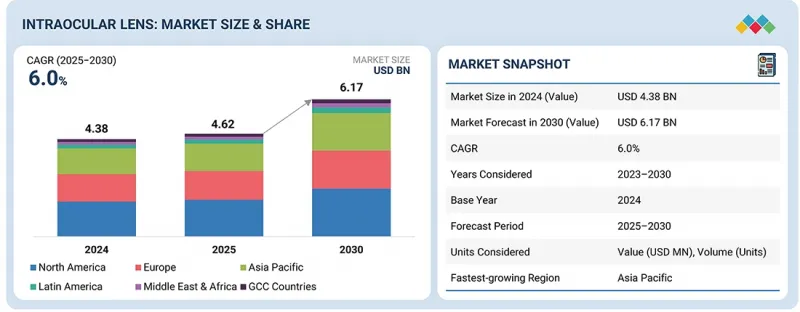
The intraocular lens market is projected to reach USD 6.17 billion by 2030 from USD 4.62 billion in 2025, at a CAGR of 6.0% during the forecast period.
| Scope of the Report | |
|---|---|
| Years Considered for the Study | 2024-2030 |
| Base Year | 2024 |
| Forecast Period | 2025-2030 |
| Units Considered | Value (USD billion) |
| Segments | Type, Material, Application, End User, and Region |
| Regions covered | North America, Europe, Asia Pacific, Latin America, the Middle East & Africa, and GCC Countries |
The intraocular lens market is driven by the rising global prevalence of cataracts, a growing elderly population, and the increasing adoption of premium lenses that offer enhanced visual outcomes. However, high costs of advanced IOLs, reimbursement limitations, and unequal access to skilled ophthalmic care restrain broader uptake. Opportunities emerge from expanding healthcare infrastructure in emerging economies, rising demand for presbyopia-correcting and EDOF IOLs, and continuous innovations aimed at improving postoperative vision and reducing complications, creating strong growth potential across regions.
Based on type, aspheric monofocal IOLs hold the largest market share because they deliver dependable visual clarity, reduce spherical aberrations, and enhance contrast sensitivity at an affordable cost. Their broad surgeon acceptance, strong safety profile, and extensive reimbursement coverage make them the standard choice for routine cataract surgeries. Consistent global availability and proven long-term outcomes further reinforce their dominant market position.
Based on material, hydrophobic acrylic IOLs hold the largest market share due to their excellent biocompatibility, low rates of posterior capsular opacification, and strong long-term optical performance. Surgeons prefer them for their stability, reduced glistening, and high patient satisfaction. Their widespread availability, proven clinical outcomes, and suitability across both standard and premium IOL categories further reinforce their dominant position in the global IOLs market.
North America holds the largest market share in the IOLs market due to its high volume of cataract surgeries, advanced healthcare infrastructure, and strong adoption of premium technologies, such as toric, multifocal, and EDOF IOLs. Favorable reimbursement policies, a well-established network of skilled ophthalmic surgeons, and continuous innovation from leading manufacturers further support market dominance. Additionally, high patient awareness, early uptake of new devices, and substantial healthcare spending reinforce North America's leading position globally.
A breakdown of the primary participants (supply side) for the intraocular lens market referred to in this report is provided below:
- By Company Type: Tier 1 (45%), Tier 2 (30%), and Tier 3 (25%)
- By Designation: C-level Executives (42%), Director-level Executives (29%), and Others (29%)
- By Region: North America (29%), Europe (24%), Asia Pacific (29%), Latin America (10%), Middle East & Africa (5%), and GCC Countries (3%)
Prominent players in the intraocular lens market are Alcon (US), Johnson & Johnson Vision Care, Inc. (US), Carl Zeiss Meditec AG (Germany), HOYA Corporation (Japan), Bausch + Lomb (US), Santen Pharmaceutical Co., Ltd. (Japan), NIDEK CO., LTD. (Japan), Lenstec, Inc. (US), Rayner Group (England), BVI (US), OPHTEC B.V. (Netherlands), SAV-IOL SA (Switzerland), Appasamy Associates Private Limited (India), Atia Vision, Inc. (US), and Biotech (Switzerland), among others.
Research Coverage
The report evaluates the intraocular lens market and estimates the market size and future growth potential of this market based on various segments, including material, type, application, end user, and region. The report also includes a competitive analysis of the major players in this market, along with company profiles, product offerings, recent developments, and key market strategies.
Reasons to Buy the Report
The report will assist market leaders and new entrants with data on the nearest approximations of revenue numbers for the overall intraocular lens market and its subsegments. The report will help stakeholders understand the competitive landscape and gain further insights into better positioning their businesses and developing effective go-to-market strategies. The report helps stakeholders understand the market pulse and provides them with data on influential drivers, hindrances, obstacles, and opportunities in the market.
This report provides insights into the following points:
- Analysis of key drivers (increasing geriatric population, rising prevalence of eye disorders, technological advancements in ophthalmic devices, and increased government initiatives to control visual impairment), restraints (high cost of ophthalmology devices, high cost and risk associated with eye surgeries, and the rising adoption of refurbished ophthalmic devices), opportunities (potential growth opportunities in emerging markets and the low adoption of phacoemulsification devices and premium IOLs in emerging markets), and challenges (low accessibility to eye care in low-income countries and lack of skilled professionals)
- Product Enhancement/Innovation: Comprehensive details about product launches and anticipated trends in the global intraocular lens market
- Market Development: Thorough knowledge and analysis of the profitable rising markets by type, material, application, end user, and region
- Market Diversification: Comprehensive information about newly launched products, expanding markets, current advancements, and investments in the global intraocular lens market
- Competitive Assessment: Thorough evaluation of the market shares, growth plans, offerings, and capacities of the major competitors in the global intraocular lens market
TABLE OF CONTENTS
1 INTRODUCTION
- 1.1 STUDY OBJECTIVES
- 1.2 MARKET DEFINITION
- 1.3 STUDY SCOPE
- 1.3.1 MARKET SEGMENTATION AND REGIONAL SCOPE
- 1.3.2 INCLUSIONS AND EXCLUSIONS
- 1.3.3 YEARS CONSIDERED
- 1.4 CURRENCY CONSIDERED
- 1.5 STAKEHOLDERS
- 1.6 SUMMARY OF CHANGES
2 EXECUTIVE SUMMARY
- 2.1 KEY INSIGHTS AND MARKET HIGHLIGHTS
- 2.2 KEY MARKET PARTICIPANTS: INSIGHTS AND STRATEGIC DEVELOPMENTS
- 2.3 DISRUPTIVE TRENDS SHAPING MARKET
- 2.4 HIGH-GROWTH SEGMENTS & EMERGING FRONTIERS
- 2.5 SNAPSHOT: MARKET SIZE, GROWTH RATE, AND FORECAST
3 PREMIUM INSIGHTS
- 3.1 INTRAOCULAR LENS MARKET OVERVIEW
- 3.2 ASIA PACIFIC: INTRAOCULAR LENS MARKET
- 3.3 INTRAOCULAR LENS MARKET: GEOGRAPHIC GROWTH OPPORTUNITIES
- 3.4 INTRAOCULAR LENS MARKET: REGIONAL MIX
- 3.5 INTRAOCULAR LENS MARKET: DEVELOPED MARKETS VS. EMERGING ECONOMIES
4 MARKET OVERVIEW
- 4.1 INTRODUCTION
- 4.2 MARKET DYNAMICS
- 4.2.1 DRIVERS
- 4.2.1.1 Increasing geriatric population and subsequent rise in ophthalmic disorders
- 4.2.1.2 Rising number of cataract surgeries
- 4.2.1.3 Growing technological advancements in intraocular lens
- 4.2.2 RESTRAINTS
- 4.2.2.1 Rising cost of intraocular lenses
- 4.2.3 OPPORTUNITIES
- 4.2.3.1 High growth potential in emerging economies
- 4.2.4 CHALLENGES
- 4.2.4.1 Shortage of skilled ophthalmologists
- 4.2.1 DRIVERS
- 4.3 UNMET NEEDS AND WHITE SPACES
- 4.3.1 UNMET NEEDS IN INTRAOCULAR LENS MARKET
- 4.3.2 WHITE SPACE OPPORTUNITIES
- 4.4 INTERCONNECTED MARKETS AND CROSS-SECTOR OPPORTUNITIES
- 4.4.1 INTERCONNECTED MARKETS
- 4.4.2 CROSS-SECTOR OPPORTUNITIES
- 4.5 STRATEGIC MOVES BY TIER 1/2/3 PLAYERS
5 INDUSTRY TRENDS
- 5.1 PORTER'S FIVE FORCES ANALYSIS
- 5.1.1 BARGAINING POWER OF BUYERS
- 5.1.2 BARGAINING POWER OF SUPPLIERS
- 5.1.3 THREAT OF NEW ENTRANTS
- 5.1.4 THREAT OF SUBSTITUTES
- 5.1.5 INTENSITY OF COMPETITIVE RIVALRY
- 5.2 MACROECONOMIC OUTLOOK
- 5.2.1 INTRODUCTION
- 5.2.2 GDP TRENDS AND FORECAST
- 5.2.3 TRENDS IN GLOBAL OPHTHALMIC EQUIPMENT INDUSTRY
- 5.2.4 TRENDS IN GLOBAL CATARACT SURGERY INDUSTRY
- 5.3 SUPPLY CHAIN ANALYSIS
- 5.4 VALUE CHAIN ANALYSIS
- 5.5 ECOSYSTEM ANALYSIS
- 5.6 PRICING ANALYSIS
- 5.6.1 AVERAGE SELLING PRICE TREND, BY KEY PLAYER
- 5.6.2 AVERAGE SELLING PRICE TREND, BY REGION
- 5.7 TRADE ANALYSIS
- 5.7.1 IMPORT SCENARIO (HS CODE 900290)
- 5.7.2 EXPORT DATA (HS CODE 900290)
- 5.8 KEY CONFERENCES AND EVENTS, 2025-2027
- 5.9 TRENDS/DISRUPTIONS IMPACTING CUSTOMER BUSINESS
- 5.10 INVESTMENT AND FUNDING SCENARIO
- 5.11 CASE STUDY ANALYSIS
- 5.11.1 CASE STUDY 1: ENHANCED REFRACTIVE ACCURACY FOR POST-LASIK CATARACT PATIENTS
- 5.11.2 CASE STUDY 2: EXPANDING ACCESS TO CATARACT CARE IN LOW-INCOME REGIONS
- 5.11.3 CASE STUDY 3: DIGITAL WORKFLOW TRANSFORMATION FOR PREMIUM CATARACT SURGERY
- 5.12 IMPACT OF 2025 US TARIFF ON INTRAOCULAR LENS MARKET
- 5.12.1 INTRODUCTION
- 5.12.2 KEY TARIFF RATES
- 5.12.3 PRICE IMPACT ANALYSIS
- 5.12.4 IMPACT ON COUNTRY/REGION
- 5.12.4.1 North America
- 5.12.4.2 Europe
- 5.12.4.3 Asia Pacific
- 5.12.5 END-USE INDUSTRY IMPACT
6 TECHNOLOGICAL ADVANCEMENTS, AI-DRIVEN IMPACT, PATENTS, INNOVATIONS, AND FUTURE APPLICATIONS
- 6.1 KEY EMERGING TECHNOLOGIES
- 6.1.1 NEXT-GENERATION EDOF AND HYBRID OPTIC DESIGNS
- 6.1.2 AI-DRIVEN PERSONALIZED IOL PLANNING AND CALCULATION PLATFORMS
- 6.2 COMPLEMENTARY TECHNOLOGIES
- 6.2.1 ADVANCED BIOMETRY AND DIAGNOSTICS
- 6.3 TECHNOLOGY/PRODUCT ROADMAP
- 6.3.1 SHORT-TERM (2025-2027) | FOUNDATION & EARLY COMMERCIALIZATION
- 6.3.2 MID-TERM (2027-2030) | EXPANSION & STANDARDIZATION
- 6.3.3 LONG-TERM (2030-2035+) | MASS COMMERCIALIZATION & DISRUPTION
- 6.4 PATENT ANALYSIS
- 6.4.1 JURISDICTION AND TOP APPLICANT ANALYSIS
- 6.4.2 LIST OF PATENTS
- 6.5 FUTURE APPLICATIONS
- 6.5.1 POSTOPERATIVE ADJUSTABLE AND CUSTOMIZABLE INTRAOCULAR LENS
- 6.5.2 REGENERATIVE AND BIOINTEGRATIVE LENS TECHNOLOGIES
- 6.5.3 AI-INTEGRATED DIGITAL SURGICAL ECOSYSTEMS FOR INTRAOCULAR LENS
- 6.6 IMPACT OF AI/GEN AI ON INTRAOCULAR LENS MARKET
- 6.6.1 INTRODUCTION
- 6.6.2 TOP USE CASES AND MARKET POTENTIAL
- 6.6.3 CASE STUDIES OF AI IMPLEMENTATION IN INTRAOCULAR LENS MARKET
- 6.6.4 INTERCONNECTED ADJACENT ECOSYSTEM AND IMPACT ON MARKET PLAYERS
- 6.6.5 CLIENTS' READINESS TO ADOPT GENERATIVE AI IN INTRAOCULAR LENS MARKET
7 SUSTAINABILITY AND REGULATORY LANDSCAPE
- 7.1 REGIONAL REGULATIONS AND COMPLIANCE
- 7.1.1 REGULATORY BODIES, GOVERNMENT AGENCIES, AND OTHER ORGANIZATIONS
- 7.1.2 INDUSTRY STANDARDS
- 7.2 SUSTAINABILITY INITIATIVES
- 7.2.1 CARBON IMPACT AND ECO-APPLICATIONS OF INTRAOCULAR LENS
- 7.2.1.1 Carbon impact reduction
- 7.2.1.2 Eco-applications
- 7.2.1 CARBON IMPACT AND ECO-APPLICATIONS OF INTRAOCULAR LENS
- 7.3 SUSTAINABILITY IMPACT AND REGULATORY POLICY INITIATIVES
- 7.4 CERTIFICATIONS, LABELING, AND ECO-STANDARDS
8 CUSTOMER LANDSCAPE AND BUYER BEHAVIOR
- 8.1 DECISION-MAKING PROCESS
- 8.2 BUYER STAKEHOLDERS AND BUYING EVALUATION CRITERIA
- 8.2.1 KEY STAKEHOLDERS IN BUYING PROCESS
- 8.2.2 KEY BUYING CRITERIA
- 8.3 ADOPTION BARRIERS AND INTERNAL CHALLENGES
- 8.4 UNMET NEEDS FROM VARIOUS END-USE INDUSTRIES
- 8.5 MARKET PROFITABILITY
- 8.5.1 REVENUE POTENTIAL
- 8.5.2 COST DYNAMICS
- 8.5.3 MARGIN OPPORTUNITIES IN KEY APPLICATIONS
9 INTRAOCULAR LENS MARKET, BY TYPE
- 9.1 INTRODUCTION
- 9.2 MONOFOCAL INTRAOCULAR LENSES
- 9.2.1 ASPHERIC MONOFOCAL INTRAOCULAR LENSES
- 9.2.1.1 Increased visual quality and performance to propel market
- 9.2.2 SPHERIC MONOFOCAL INTRAOCULAR LENSES
- 9.2.2.1 Cost-effectiveness to drive market
- 9.2.1 ASPHERIC MONOFOCAL INTRAOCULAR LENSES
- 9.3 PREMIUM INTRAOCULAR LENSES
- 9.3.1 MULTIFOCAL INTRAOCULAR LENSES
- 9.3.1.1 Enhanced visual acuity to support growth
- 9.3.2 EXTENDED DEPTH OF FOCUS (EDOF) INTRAOCULAR LENSES
- 9.3.2.1 Broader range of clear vision to drive market
- 9.3.3 ACCOMMODATING INTRAOCULAR LENSES
- 9.3.3.1 High utilization in cataract correction to aid growth
- 9.3.1 MULTIFOCAL INTRAOCULAR LENSES
- 9.4 PHAKIC INTRAOCULAR LENSES
- 9.4.1 LIMITED AWARENESS AND COST CONCERNS TO RESTRAIN MARKET
- 9.5 OTHER INTRAOCULAR LENSES
10 INTRAOCULAR LENS MARKET, BY MATERIAL
- 10.1 INTRODUCTION
- 10.2 HYDROPHOBIC ACRYLIC IOL
- 10.2.1 INCREASED BIOCOMPATIBILITY AND HEIGHTENED STABILITY TO DRIVE MARKET
- 10.3 HYDROPHILIC ACRYLIC IOL
- 10.3.1 GLARE REDUCTION AND INCREASED COMPRESSIBILITY TO PROPEL MARKET
- 10.4 POLYMETHYLMETHACRYLATE
- 10.4.1 LOW MATERIAL COST AND ADVANCED DURABILITY TO BOOST MARKET
- 10.5 SILICONE IOL
- 10.5.1 LOW AWARENESS AND LIMITED FOLDABILITY TO RESTRAIN MARKET
- 10.6 OTHER MATERIALS
11 INTRAOCULAR LENS MARKET, BY APPLICATION
- 11.1 INTRODUCTION
- 11.2 CATARACT SURGERIES
- 11.2.1 RISING GERIATRIC POPULATION TO FACILITATE GROWTH
- 11.3 PRESBYOPIA
- 11.3.1 GROWING AWARENESS OF TECHNOLOGICALLY ADVANCED LENSES TO BOOST MARKET
- 11.4 CORNEAL DISORDERS
- 11.4.1 INCREASING PREFERENCE FOR MINIMALLY INVASIVE SURGERIES TO SPUR GROWTH
- 11.5 OTHER APPLICATIONS
12 INTRAOCULAR LENS MARKET, BY END USER
- 12.1 INTRODUCTION
- 12.2 HOSPITALS
- 12.2.1 HIGH PURCHASING POWER FOR ADVANCED EQUIPMENT TO PROPEL MARKET
- 12.3 OPHTHALMOLOGY CLINICS
- 12.3.1 REDUCED WAITING TIME AND MINIMAL COST OF DIAGNOSTIC & SURGICAL PROCEDURES TO DRIVE MARKET
- 12.4 EYE RESEARCH INSTITUTES
- 12.4.1 INCREASING R&D ON INTRAOCULAR LENS TECHNOLOGIES TO ENCOURAGE GROWTH
- 12.5 OTHER END USERS
13 INTRAOCULAR LENS MARKET, BY REGION
- 13.1 INTRODUCTION
- 13.2 NORTH AMERICA
- 13.2.1 US
- 13.2.1.1 Favorable reimbursement policies to drive market
- 13.2.2 CANADA
- 13.2.2.1 Large target population to fuel market
- 13.2.1 US
- 13.3 EUROPE
- 13.3.1 GERMANY
- 13.3.1.1 Increasing public healthcare expenditure to aid growth
- 13.3.2 FRANCE
- 13.3.2.1 Government initiatives for visual care awareness to support growth
- 13.3.3 UK
- 13.3.3.1 Growing healthcare expenditure to facilitate growth
- 13.3.4 ITALY
- 13.3.4.1 Increasing R&D initiatives for eye care to spur growth
- 13.3.5 SPAIN
- 13.3.5.1 Rising healthcare spending to encourage growth
- 13.3.6 REST OF EUROPE
- 13.3.1 GERMANY
- 13.4 ASIA PACIFIC
- 13.4.1 JAPAN
- 13.4.1.1 Rising geriatric population to boost demand
- 13.4.2 CHINA
- 13.4.2.1 Improved healthcare infrastructure to support growth
- 13.4.3 INDIA
- 13.4.3.1 Rising number of cataract surgeries to drive market
- 13.4.4 AUSTRALIA
- 13.4.4.1 High focus on R&D for advanced IOLs to fuel market
- 13.4.5 SOUTH KOREA
- 13.4.5.1 Rising adoption of technologically advanced intraocular lenses to boost market
- 13.4.6 REST OF ASIA PACIFIC
- 13.4.1 JAPAN
- 13.5 LATIN AMERICA
- 13.5.1 BRAZIL
- 13.5.1.1 Government initiatives for healthcare infrastructure to boost market
- 13.5.2 MEXICO
- 13.5.2.1 Rising incidence of chronic diseases to support growth
- 13.5.3 REST OF LATIN AMERICA
- 13.5.1 BRAZIL
- 13.6 MIDDLE EAST & AFRICA
- 13.6.1 EXPANDING ACCESS TO VISION CARE TO ACCELERATE GROWTH
- 13.7 GCC COUNTRIES
- 13.7.1 RISE IN CAMPAIGNS TO BOOST AWARENESS FOR CATARACT SURGERIES AND TREATMENT TO DRIVE MARKET
14 COMPETITIVE LANDSCAPE
- 14.1 OVERVIEW
- 14.2 KEY PLAYER COMPETITIVE STRATEGIES/RIGHT TO WIN
- 14.3 REVENUE ANALYSIS, 2020-2024
- 14.4 MARKET SHARE ANALYSIS, 2024
- 14.5 US MARKET SHARE ANALYSIS
- 14.6 BRAND/PRODUCT COMPARISON
- 14.7 COMPANY EVALUATION MATRIX: KEY PLAYERS, 2024
- 14.7.1 STARS
- 14.7.2 EMERGING LEADERS
- 14.7.3 PERVASIVE PLAYERS
- 14.7.4 PARTICIPANTS
- 14.7.5 COMPANY FOOTPRINT: KEY PLAYERS, 2024
- 14.7.5.1 Company footprint
- 14.7.5.2 Region footprint
- 14.7.5.3 Type footprint
- 14.7.5.4 Material footprint
- 14.7.5.5 Application footprint
- 14.7.5.6 End-user footprint
- 14.8 COMPANY EVALUATION MATRIX: STARTUPS/SMES, 2024
- 14.8.1 PROGRESSIVE COMPANIES
- 14.8.2 RESPONSIVE COMPANIES
- 14.8.3 DYNAMIC COMPANIES
- 14.8.4 STARTING BLOCKS
- 14.8.5 COMPETITIVE BENCHMARKING: STARTUPS/SMES, 2024
- 14.8.5.1 Detailed list of key startups/SMEs
- 14.8.5.2 Competitive benchmarking of key startups/SMEs
- 14.9 COMPANY VALUATION AND FINANCIAL METRICS
- 14.9.1 COMPANY VALUATION
- 14.9.2 FINANCIAL METRICS
- 14.10 COMPETITIVE SCENARIO
- 14.10.1 PRODUCT LAUNCHES AND APPROVALS
- 14.10.2 DEALS
- 14.10.3 EXPANSIONS
15 COMPANY PROFILES
- 15.1 KEY PLAYERS
- 15.1.1 ALCON
- 15.1.1.1 Business overview
- 15.1.1.2 Products offered
- 15.1.1.3 Recent developments
- 15.1.1.3.1 Product launches and approvals
- 15.1.1.3.2 Deals
- 15.1.1.4 MnM view
- 15.1.1.4.1 Key strengths/Right to win
- 15.1.1.4.2 Strategic choices
- 15.1.1.4.3 Weaknesses/Competitive threats
- 15.1.2 JOHNSON & JOHNSON VISION CARE, INC.
- 15.1.2.1 Business overview
- 15.1.2.2 Products offered
- 15.1.2.3 Recent developments
- 15.1.2.3.1 Product launches and approvals
- 15.1.2.4 MnM view
- 15.1.2.4.1 Key strengths/Right to win
- 15.1.2.4.2 Strategic choices
- 15.1.2.4.3 Weaknesses/Competitive threats
- 15.1.3 BAUSCH + LOMB
- 15.1.3.1 Business overview
- 15.1.3.2 Products offered
- 15.1.3.3 Recent developments
- 15.1.3.3.1 Product launches and approvals
- 15.1.3.3.2 Deals
- 15.1.3.4 MnM view
- 15.1.3.4.1 Key strengths/Right to win
- 15.1.3.4.2 Strategic choices
- 15.1.3.4.3 Weaknesses/Competitive threats
- 15.1.4 CARL ZEISS MEDITEC AG
- 15.1.4.1 Business overview
- 15.1.4.2 Products offered
- 15.1.4.3 Recent developments
- 15.1.4.3.1 Product launches and approvals
- 15.1.4.3.2 Deals
- 15.1.4.4 MnM view
- 15.1.4.4.1 Key strengths/Right to win
- 15.1.4.4.2 Strategic choices
- 15.1.4.4.3 Weaknesses/Competitive threats
- 15.1.5 HOYA CORPORATION
- 15.1.5.1 Business overview
- 15.1.5.2 Products offered
- 15.1.5.3 Recent developments
- 15.1.5.3.1 Deals
- 15.1.5.4 MnM view
- 15.1.5.4.1 Key strengths/Right to win
- 15.1.5.4.2 Strategic choices
- 15.1.5.4.3 Weaknesses/Competitive threats
- 15.1.6 SANTEN PHARMACEUTICAL CO., LTD.
- 15.1.6.1 Business overview
- 15.1.6.2 Products offered
- 15.1.7 NIDEK CO., LTD.
- 15.1.7.1 Business overview
- 15.1.7.2 Products offered
- 15.1.7.3 Recent developments
- 15.1.7.3.1 Deals
- 15.1.8 LENSTEC, INC.
- 15.1.8.1 Business overview
- 15.1.8.2 Products offered
- 15.1.8.3 Recent developments
- 15.1.8.3.1 Other developments
- 15.1.9 RAYNER GROUP
- 15.1.9.1 Business overview
- 15.1.9.2 Products offered
- 15.1.9.3 Recent developments
- 15.1.9.3.1 Product launches and approvals
- 15.1.10 BVI
- 15.1.10.1 Business overview
- 15.1.10.2 Products offered
- 15.1.10.3 Recent developments
- 15.1.10.3.1 Product launches and approvals
- 15.1.10.3.2 Expansions
- 15.1.11 OPHTEC B.V.
- 15.1.11.1 Business overview
- 15.1.11.2 Products offered
- 15.1.12 SAV-IOL SA
- 15.1.12.1 Business overview
- 15.1.12.2 Products offered
- 15.1.13 APPASAMY ASSOCIATES PRIVATE LIMITED
- 15.1.13.1 Business overview
- 15.1.13.2 Products offered
- 15.1.14 ATIA VISION, INC.
- 15.1.14.1 Business overview
- 15.1.14.2 Products offered
- 15.1.15 ADAPTILENS
- 15.1.15.1 Business overview
- 15.1.15.2 Products offered
- 15.1.1 ALCON
- 15.2 OTHER PLAYERS
- 15.2.1 BIOTECH
- 15.2.2 TELEON SURGICAL BV
- 15.2.3 OMNI LENS PVT. LTD.
- 15.2.4 EYEKON MEDICAL
- 15.2.5 HUMANOPTICS HOLDING AG
- 15.2.6 CARE GROUP
- 15.2.7 SIFI S.P.A.
- 15.2.8 HANITA LENSES LTD.
- 15.2.9 EXCELLENT HI-CARE PVT LTD.
- 15.2.10 ADVIN HEALTH CARE
16 RESEARCH METHODOLOGY
- 16.1 RESEARCH DATA
- 16.1.1 SECONDARY DATA
- 16.1.1.1 Key data from secondary sources
- 16.1.2 PRIMARY DATA
- 16.1.2.1 Key data from primary sources
- 16.1.2.2 Key primary participants
- 16.1.2.3 Breakdown of primary interviews
- 16.1.2.4 Key industry insights
- 16.1.1 SECONDARY DATA
- 16.2 MARKET SIZE ESTIMATION
- 16.3 DATA TRIANGULATION
- 16.4 MARKET SHARE ESTIMATION
- 16.5 RESEARCH ASSUMPTIONS
- 16.6 RESEARCH LIMITATIONS AND RISK ASSESSMENT
- 16.6.1 RESEARCH LIMITATIONS
- 16.6.2 RISK ASSESSMENT
17 APPENDIX
- 17.1 DISCUSSION GUIDE
- 17.2 KNOWLEDGESTORE: MARKETSANDMARKETS' SUBSCRIPTION PORTAL
- 17.3 CUSTOMIZATION OPTIONS
- 17.4 RELATED REPORTS
- 17.5 AUTHOR DETAILS
List of Tables
- TABLE 1 INCLUSIONS AND EXCLUSIONS
- TABLE 2 STANDARD CURRENCY CONVERSION RATES, 2020-2024
- TABLE 3 INTRAOCULAR LENS MARKET: INTERCONNECTED MARKETS
- TABLE 4 STRATEGIC MOVES BY TIER 1/2/3 PLAYERS
- TABLE 5 INTRAOCULAR LENS MARKET: PORTER'S FIVE FORCES ANALYSIS
- TABLE 6 GDP PERCENTAGE CHANGE, BY KEY COUNTRY, 2021-2030
- TABLE 7 AVERAGE SELLING PRICE TREND OF INTRAOCULAR LENS, BY KEY PLAYER, 2022-2024 (USD)
- TABLE 8 AVERAGE PRICING TREND OF INTRAOCULAR LENS, BY REGION, 2022-2024 (USD)
- TABLE 9 IMPORT DATA FOR INTRAOCULAR LENS PRODUCTS UNDER HS CODE 900290, BY COUNTRY, 2020-2024 (USD THOUSAND)
- TABLE 10 EXPORT DATA FOR INTRAOCULAR LENS UNDER HS CODE 900290, BY COUNTRY, 2020-2024 (USD THOUSAND)
- TABLE 11 INTRAOCULAR LENS MARKET: KEY CONFERENCES AND EVENTS, 2025-2027
- TABLE 12 US-ADJUSTED RECIPROCAL TARIFF RATES
- TABLE 13 KEY PRODUCT-RELATED TARIFF EFFECTIVE FOR INTRAOCULAR LENS
- TABLE 14 INTRAOCULAR LENS MARKET: LIST OF PATENTS, 2022-2025
- TABLE 15 TOP USE CASES AND MARKET POTENTIAL
- TABLE 16 INTRAOCULAR LENS MARKET: CASE STUDIES RELATED TO AI IMPLEMENTATION
- TABLE 17 INTERCONNECTED ADJACENT ECOSYSTEM AND IMPACT ON MARKET PLAYERS
- TABLE 18 NORTH AMERICA: REGULATORY BODIES, GOVERNMENT AGENCIES, AND OTHER ORGANIZATIONS
- TABLE 19 EUROPE: REGULATORY BODIES, GOVERNMENT AGENCIES, AND OTHER ORGANIZATIONS
- TABLE 20 ASIA PACIFIC: REGULATORY BODIES, GOVERNMENT AGENCIES, AND OTHER ORGANIZATIONS
- TABLE 21 LATIN AMERICA: REGULATORY BODIES, GOVERNMENT AGENCIES, AND OTHER ORGANIZATIONS
- TABLE 22 MIDDLE EAST & AFRICA AND GCC COUNTRIES: REGULATORY BODIES, GOVERNMENT AGENCIES, AND OTHER ORGANIZATIONS
- TABLE 23 GLOBAL STANDARDS IN INTRAOCULAR LENS MARKET
- TABLE 24 INTRAOCULAR LENS MARKET: CERTIFICATIONS, LABELING, AND ECO-STANDARDS
- TABLE 25 INFLUENCE OF STAKEHOLDERS ON BUYING PROCESS FOR INTRAOCULAR LENS, BY APPLICATION
- TABLE 26 KEY BUYING CRITERIA FOR TOP THREE APPLICATIONS
- TABLE 27 INTRAOCULAR LENS MARKET: UNMET NEEDS/END-USER EXPECTATIONS
- TABLE 28 INTRAOCULAR LENS MARKET, BY TYPE, 2023-2030 (USD MILLION)
- TABLE 29 MONOFOCAL INTRAOCULAR LENSES MARKET, BY TYPE, 2023-2030 (USD MILLION)
- TABLE 30 MONOFOCAL INTRAOCULAR LENSES MARKET, BY COUNTRY, 2023-2030 (USD MILLION)
- TABLE 31 MONOFOCAL INTRAOCULAR LENSES MARKET, BY COUNTRY, 2023-2030 (THOUSAND UNIT)
- TABLE 32 ASPHERIC MONOFOCAL INTRAOCULAR LENSES MARKET, BY COUNTRY, 2023-2030 (USD MILLION)
- TABLE 33 SPHERIC MONOFOCAL INTRAOCULAR LENSES MARKET, BY COUNTRY, 2023-2030 (USD MILLION)
- TABLE 34 PREMIUM INTRAOCULAR LENSES MARKET, BY TYPE, 2023-2030 (USD MILLION)
- TABLE 35 PREMIUM INTRAOCULAR LENSES MARKET, BY COUNTRY, 2023-2030 (USD MILLION)
- TABLE 36 PREMIUM INTRAOCULAR LENSES MARKET, BY COUNTRY, 2023-2030 (THOUSAND UNIT)
- TABLE 37 MULTIFOCAL INTRAOCULAR LENSES MARKET, BY COUNTRY, 2023-2030 (USD MILLION)
- TABLE 38 EXTENDED DEPTH OF FOCUS (EDOF) INTRAOCULAR LENSES MARKET, BY COUNTRY, 2023-2030 (USD MILLION)
- TABLE 39 ACCOMMODATING INTRAOCULAR LENSES MARKET, BY COUNTRY, 2023-2030 (USD MILLION)
- TABLE 40 PHAKIC INTRAOCULAR LENSES MARKET, BY COUNTRY, 2023-2030 (USD MILLION)
- TABLE 41 PHAKIC INTRAOCULAR LENSES MARKET, BY COUNTRY, 2023-2030 (THOUSAND UNIT)
- TABLE 42 OTHER INTRAOCULAR LENSES MARKET, BY COUNTRY, 2023-2030 (USD MILLION)
- TABLE 43 INTRAOCULAR LENS MARKET, BY MATERIAL, 2023-2030 (USD MILLION)
- TABLE 44 INTRAOCULAR LENS MARKET FOR HYDROPHOBIC ACRYLIC IOL, BY COUNTRY, 2023-2030 (USD MILLION)
- TABLE 45 INTRAOCULAR LENS MARKET FOR HYDROPHILIC ACRYLIC IOL, BY COUNTRY, 2023-2030 (USD MILLION)
- TABLE 46 INTRAOCULAR LENS MARKET FOR POLYMETHYLMETHACRYLATE, BY COUNTRY, 2023-2030 (USD MILLION)
- TABLE 47 INTRAOCULAR LENS MARKET FOR SILICONE IOL, BY COUNTRY, 2023-2030 (USD MILLION)
- TABLE 48 INTRAOCULAR LENS MARKET FOR OTHER MATERIALS, BY COUNTRY, 2023-2030 (USD MILLION)
- TABLE 49 INTRAOCULAR LENS MARKET, BY APPLICATION, 2023-2030 (USD MILLION)
- TABLE 50 INTRAOCULAR LENS MARKET FOR CATARACT SURGERIES, BY COUNTRY, 2023-2030 (USD MILLION)
- TABLE 51 INTRAOCULAR LENS MARKET FOR PRESBYOPIA, BY COUNTRY, 2023-2030 (USD MILLION)
- TABLE 52 INTRAOCULAR LENS MARKET FOR CORNEAL DISORDERS, BY COUNTRY, 2023-2030 (USD MILLION)
- TABLE 53 INTRAOCULAR LENS MARKET FOR OTHER APPLICATIONS, BY COUNTRY, 2023-2030 (USD MILLION)
- TABLE 54 INTRAOCULAR LENS MARKET, BY END USER, 2023-2030 (USD MILLION)
- TABLE 55 INTRAOCULAR LENS MARKET FOR HOSPITALS, BY COUNTRY, 2023-2030 (USD MILLION)
- TABLE 56 INTRAOCULAR LENS MARKET FOR CLINICS, BY COUNTRY, 2023-2030 (USD MILLION)
- TABLE 57 INTRAOCULAR LENS MARKET FOR EYE RESEARCH INSTITUTES, BY COUNTRY, 2023-2030 (USD MILLION)
- TABLE 58 INTRAOCULAR LENS MARKET FOR OTHER END USERS, BY COUNTRY, 2023-2030 (USD MILLION)
- TABLE 59 INTRAOCULAR LENS MARKET, BY REGION, 2023-2030 (USD MILLION)
- TABLE 60 NORTH AMERICA: INTRAOCULAR LENS MARKET, BY COUNTRY, 2023-2030 (USD MILLION)
- TABLE 61 NORTH AMERICA: INTRAOCULAR LENS MARKET, BY TYPE, 2023-2030 (USD MILLION)
- TABLE 62 NORTH AMERICA: INTRAOCULAR LENS MARKET FOR MONOFOCAL IOL, BY TYPE,2023-2030 (USD MILLION)
- TABLE 63 NORTH AMERICA: INTRAOCULAR LENS MARKET FOR PREMIUM IOL, BY TYPE, 2023-2030 (USD MILLION)
- TABLE 64 NORTH AMERICA: INTRAOCULAR LENS MARKET, BY MATERIAL, 2023-2030 (USD MILLION)
- TABLE 65 NORTH AMERICA: INTRAOCULAR LENS MARKET, BY APPLICATION, 2023-2030 (USD MILLION)
- TABLE 66 NORTH AMERICA: INTRAOCULAR LENS MARKET, BY END USER, 2023-2030 (USD MILLION)
- TABLE 67 US: INTRAOCULAR LENS MARKET, BY TYPE, 2023-2030 (USD MILLION)
- TABLE 68 US: INTRAOCULAR LENS MARKET FOR MONOFOCAL IOL, BY TYPE, 2023-2030 (USD MILLION)
- TABLE 69 US: INTRAOCULAR LENS MARKET FOR PREMIUM IOL, BY TYPE, 2023-2030 (USD MILLION)
- TABLE 70 US: INTRAOCULAR LENS MARKET, BY MATERIAL, 2023-2030 (USD MILLION)
- TABLE 71 US: INTRAOCULAR LENS MARKET, BY APPLICATION, 2023-2030 (USD MILLION)
- TABLE 72 US: INTRAOCULAR LENS MARKET, BY END USER, 2023-2030 (USD MILLION)
- TABLE 73 CANADA: INTRAOCULAR LENS MARKET, BY TYPE, 2023-2030 (USD MILLION)
- TABLE 74 CANADA: INTRAOCULAR LENS MARKET FOR MONOFOCAL IOL, BY TYPE, 2023-2030 (USD MILLION)
- TABLE 75 CANADA: INTRAOCULAR LENS MARKET FOR PREMIUM IOL, BY TYPE, 2023-2030 (USD MILLION)
- TABLE 76 CANADA: INTRAOCULAR LENS MARKET, BY MATERIAL, 2023-2030 (USD MILLION)
- TABLE 77 CANADA: INTRAOCULAR LENS MARKET, BY APPLICATION, 2023-2030 (USD MILLION)
- TABLE 78 CANADA: INTRAOCULAR LENS MARKET, BY END USER, 2023-2030 (USD MILLION)
- TABLE 79 EUROPE: INTRAOCULAR LENS MARKET, BY COUNTRY, 2023-2030 (USD MILLION)
- TABLE 80 EUROPE: INTRAOCULAR LENS MARKET, BY TYPE, 2023-2030 (USD MILLION)
- TABLE 81 EUROPE: INTRAOCULAR LENS MARKET FOR MONOFOCAL IOL, BY TYPE, 2023-2030 (USD MILLION)
- TABLE 82 EUROPE: INTRAOCULAR LENS MARKET FOR PREMIUM IOL, BY TYPE, 2023-2030 (USD MILLION)
- TABLE 83 EUROPE: INTRAOCULAR LENS MARKET, BY MATERIAL, 2023-2030 (USD MILLION)
- TABLE 84 EUROPE: INTRAOCULAR LENS MARKET, BY APPLICATION, 2023-2030 (USD MILLION)
- TABLE 85 EUROPE: INTRAOCULAR LENS MARKET, BY END USER, 2023-2030 (USD MILLION)
- TABLE 86 GERMANY: INTRAOCULAR LENS MARKET, BY TYPE, 2023-2030 (USD MILLION)
- TABLE 87 GERMANY: INTRAOCULAR LENS MARKET FOR MONOFOCAL IOL, BY TYPE, 2023-2030 (USD MILLION)
- TABLE 88 GERMANY: INTRAOCULAR LENS MARKET FOR PREMIUM IOL, BY TYPE, 2023-2030 (USD MILLION)
- TABLE 89 GERMANY: INTRAOCULAR LENS MARKET, BY MATERIAL, 2023-2030 (USD MILLION)
- TABLE 90 GERMANY: INTRAOCULAR LENS MARKET, BY APPLICATION, 2023-2030 (USD MILLION)
- TABLE 91 GERMANY: INTRAOCULAR LENS MARKET, BY END USER, 2023-2030 (USD MILLION)
- TABLE 92 FRANCE: INTRAOCULAR LENS MARKET, BY TYPE, 2023-2030 (USD MILLION)
- TABLE 93 FRANCE: INTRAOCULAR LENS MARKET FOR MONOFOCAL IOL, BY TYPE, 2023-2030 (USD MILLION)
- TABLE 94 FRANCE: INTRAOCULAR LENS MARKET FOR PREMIUM IOL, BY TYPE, 2023-2030 (USD MILLION)
- TABLE 95 FRANCE: INTRAOCULAR LENS MARKET, BY MATERIAL, 2023-2030 (USD MILLION)
- TABLE 96 FRANCE: INTRAOCULAR LENS MARKET, BY APPLICATION, 2023-2030 (USD MILLION)
- TABLE 97 FRANCE: INTRAOCULAR LENS MARKET, BY END USER, 2023-2030 (USD MILLION)
- TABLE 98 UK: INTRAOCULAR LENS MARKET, BY TYPE, 2023-2030 (USD MILLION)
- TABLE 99 UK: INTRAOCULAR LENS MARKET FOR MONOFOCAL IOL, BY TYPE, 2023-2030 (USD MILLION)
- TABLE 100 UK: INTRAOCULAR LENS MARKET FOR PREMIUM IOL, BY TYPE, 2023-2030 (USD MILLION)
- TABLE 101 UK: INTRAOCULAR LENS MARKET, BY MATERIAL, 2023-2030 (USD MILLION)
- TABLE 102 UK: INTRAOCULAR LENS MARKET, BY APPLICATION, 2023-2030 (USD MILLION)
- TABLE 103 UK: INTRAOCULAR LENS MARKET, BY END USER, 2023-2030 (USD MILLION)
- TABLE 104 ITALY: INTRAOCULAR LENS MARKET, BY TYPE, 2023-2030 (USD MILLION)
- TABLE 105 ITALY: INTRAOCULAR LENS MARKET FOR MONOFOCAL IOL, BY TYPE, 2023-2030 (USD MILLION)
- TABLE 106 ITALY: INTRAOCULAR LENS MARKET FOR PREMIUM IOL, BY TYPE, 2023-2030 (USD MILLION)
- TABLE 107 ITALY: INTRAOCULAR LENS MARKET, BY MATERIAL, 2023-2030 (USD MILLION)
- TABLE 108 ITALY: INTRAOCULAR LENS MARKET, BY APPLICATION, 2023-2030 (USD MILLION)
- TABLE 109 ITALY: INTRAOCULAR LENS MARKET, BY END USER, 2023-2030 (USD MILLION)
- TABLE 110 SPAIN: INTRAOCULAR LENS MARKET, BY TYPE, 2023-2030 (USD MILLION)
- TABLE 111 SPAIN: INTRAOCULAR LENS MARKET FOR MONOFOCAL IOL, BY TYPE, 2023-2030 (USD MILLION)
- TABLE 112 SPAIN: INTRAOCULAR LENS MARKET FOR PREMIUM IOL, BY TYPE, 2023-2030 (USD MILLION)
- TABLE 113 SPAIN: INTRAOCULAR LENS MARKET, BY MATERIAL, 2023-2030 (USD MILLION)
- TABLE 114 SPAIN: INTRAOCULAR LENS MARKET, BY APPLICATION, 2023-2030 (USD MILLION)
- TABLE 115 SPAIN: INTRAOCULAR LENS MARKET, BY END USER, 2023-2030 (USD MILLION)
- TABLE 116 REST OF EUROPE: INTRAOCULAR LENS MARKET, BY TYPE, 2023-2030 (USD MILLION)
- TABLE 117 REST OF EUROPE: INTRAOCULAR LENS MARKET FOR MONOFOCAL IOL, BY TYPE, 2023-2030 (USD MILLION)
- TABLE 118 REST OF EUROPE: INTRAOCULAR LENS MARKET FOR PREMIUM IOL, BY TYPE, 2023-2030 (USD MILLION)
- TABLE 119 REST OF EUROPE: INTRAOCULAR LENS MARKET, BY MATERIAL, 2023-2030 (USD MILLION)
- TABLE 120 REST OF EUROPE: INTRAOCULAR LENS MARKET, BY APPLICATION, 2023-2030 (USD MILLION)
- TABLE 121 REST OF EUROPE: INTRAOCULAR LENS MARKET, BY END USER, 2023-2030 (USD MILLION)
- TABLE 122 ASIA PACIFIC: INTRAOCULAR LENS MARKET, BY COUNTRY, 2023-2030 (USD MILLION)
- TABLE 123 ASIA PACIFIC: INTRAOCULAR LENS MARKET, BY TYPE, 2023-2030 (USD MILLION)
- TABLE 124 ASIA PACIFIC: INTRAOCULAR LENS MARKET FOR MONOFOCAL IOL, BY TYPE, 2023-2030 (USD MILLION)
- TABLE 125 ASIA PACIFIC: INTRAOCULAR LENS MARKET FOR PREMIUM IOL, BY TYPE, 2023-2030 (USD MILLION)
- TABLE 126 ASIA PACIFIC: INTRAOCULAR LENS MARKET, BY MATERIAL, 2023-2030 (USD MILLION)
- TABLE 127 ASIA PACIFIC: INTRAOCULAR LENS MARKET, BY APPLICATION, 2023-2030 (USD MILLION)
- TABLE 128 ASIA PACIFIC: INTRAOCULAR LENS MARKET, BY END USER, 2023-2030 (USD MILLION)
- TABLE 129 JAPAN: INTRAOCULAR LENS MARKET, BY TYPE, 2023-2030 (USD MILLION)
- TABLE 130 JAPAN: INTRAOCULAR LENS MARKET FOR MONOFOCAL IOL, BY TYPE, 2023-2030 (USD MILLION)
- TABLE 131 JAPAN: INTRAOCULAR LENS MARKET FOR PREMIUM IOL, BY TYPE, 2023-2030 (USD MILLION)
- TABLE 132 JAPAN: INTRAOCULAR LENS MARKET, BY MATERIAL, 2023-2030 (USD MILLION)
- TABLE 133 JAPAN: INTRAOCULAR LENS MARKET, BY APPLICATION, 2023-2030 (USD MILLION)
- TABLE 134 JAPAN: INTRAOCULAR LENS MARKET, BY END USER, 2023-2030 (USD MILLION)
- TABLE 135 CHINA: INTRAOCULAR LENS MARKET, BY TYPE, 2023-2030 (USD MILLION)
- TABLE 136 CHINA: INTRAOCULAR LENS MARKET FOR MONOFOCAL IOL, BY TYPE, 2023-2030 (USD MILLION)
- TABLE 137 CHINA: INTRAOCULAR LENS MARKET FOR PREMIUM IOL, BY TYPE, 2023-2030 (USD MILLION)
- TABLE 138 CHINA: INTRAOCULAR LENS MARKET, BY MATERIAL, 2023-2030 (USD MILLION)
- TABLE 139 CHINA: INTRAOCULAR LENS MARKET, BY APPLICATION, 2023-2030 (USD MILLION)
- TABLE 140 CHINA: INTRAOCULAR LENS MARKET, BY END USER, 2023-2030 (USD MILLION)
- TABLE 141 INDIA: INTRAOCULAR LENS MARKET, BY TYPE, 2023-2030 (USD MILLION)
- TABLE 142 INDIA: INTRAOCULAR LENS MARKET FOR MONOFOCAL IOL, BY TYPE, 2023-2030 (USD MILLION)
- TABLE 143 INDIA: INTRAOCULAR LENS MARKET FOR PREMIUM IOL, BY TYPE, 2023-2030 (USD MILLION)
- TABLE 144 INDIA: INTRAOCULAR LENS MARKET, BY MATERIAL, 2023-2030 (USD MILLION)
- TABLE 145 INDIA: INTRAOCULAR LENS MARKET, BY APPLICATION, 2023-2030 (USD MILLION)
- TABLE 146 INDIA: INTRAOCULAR LENS MARKET, BY END USER, 2023-2030 (USD MILLION)
- TABLE 147 AUSTRALIA: INTRAOCULAR LENS MARKET, BY TYPE, 2023-2030 (USD MILLION)
- TABLE 148 AUSTRALIA: INTRAOCULAR LENS MARKET FOR MONOFOCAL IOL, BY TYPE, 2023-2030 (USD MILLION)
- TABLE 149 AUSTRALIA: INTRAOCULAR LENS MARKET FOR PREMIUM IOL, BY TYPE, 2023-2030 (USD MILLION)
- TABLE 150 AUSTRALIA: INTRAOCULAR LENS MARKET, BY MATERIAL, 2023-2030 (USD MILLION)
- TABLE 151 AUSTRALIA: INTRAOCULAR LENS MARKET, BY APPLICATION, 2023-2030 (USD MILLION)
- TABLE 152 AUSTRALIA: INTRAOCULAR LENS MARKET, BY END USER, 2023-2030 (USD MILLION)
- TABLE 153 SOUTH KOREA: INTRAOCULAR LENS MARKET, BY TYPE, 2023-2030 (USD MILLION)
- TABLE 154 SOUTH KOREA: INTRAOCULAR LENS MARKET FOR MONOFOCAL IOL, BY TYPE, 2023-2030 (USD MILLION)
- TABLE 155 SOUTH KOREA: INTRAOCULAR LENS MARKET FOR PREMIUM IOL, BY TYPE, 2023-2030 (USD MILLION)
- TABLE 156 SOUTH KOREA: INTRAOCULAR LENS MARKET, BY MATERIAL, 2023-2030 (USD MILLION)
- TABLE 157 SOUTH KOREA: INTRAOCULAR LENS MARKET, BY APPLICATION, 2023-2030 (USD MILLION)
- TABLE 158 SOUTH KOREA: INTRAOCULAR LENS MARKET, BY END USER, 2023-2030 (USD MILLION)
- TABLE 159 REST OF ASIA PACIFIC: INTRAOCULAR LENS MARKET, BY TYPE, 2023-2030 (USD MILLION)
- TABLE 160 REST OF ASIA PACIFIC: INTRAOCULAR LENS MARKET FOR MONOFOCAL IOL, BY TYPE, 2023-2030 (USD MILLION)
- TABLE 161 REST OF ASIA PACIFIC: INTRAOCULAR LENS MARKET FOR PREMIUM IOL, BY TYPE, 2023-2030 (USD MILLION)
- TABLE 162 REST OF ASIA PACIFIC: INTRAOCULAR LENS MARKET, BY MATERIAL, 2023-2030 (USD MILLION)
- TABLE 163 REST OF ASIA PACIFIC: INTRAOCULAR LENS MARKET, BY APPLICATION, 2023-2030 (USD MILLION)
- TABLE 164 REST OF ASIA PACIFIC: INTRAOCULAR LENS MARKET, BY END USER, 2023-2030 (USD MILLION)
- TABLE 165 LATIN AMERICA: INTRAOCULAR LENS MARKET, BY COUNTRY, 2023-2030 (USD MILLION)
- TABLE 166 LATIN AMERICA: INTRAOCULAR LENS MARKET, BY TYPE, 2023-2030 (USD MILLION)
- TABLE 167 LATIN AMERICA: INTRAOCULAR LENS MARKET FOR MONOFOCAL IOL, BY TYPE, 2023-2030 (USD MILLION)
- TABLE 168 LATIN AMERICA: INTRAOCULAR LENS MARKET FOR PREMIUM IOL, BY TYPE, 2023-2030 (USD MILLION)
- TABLE 169 LATIN AMERICA: INTRAOCULAR LENS MARKET, BY MATERIAL, 2023-2030 (USD MILLION)
- TABLE 170 LATIN AMERICA: INTRAOCULAR LENS MARKET, BY APPLICATION, 2023-2030 (USD MILLION)
- TABLE 171 LATIN AMERICA: INTRAOCULAR LENS MARKET, BY END USER, 2023-2030 (USD MILLION)
- TABLE 172 BRAZIL: INTRAOCULAR LENS MARKET, BY TYPE, 2023-2030 (USD MILLION)
- TABLE 173 BRAZIL: INTRAOCULAR LENS MARKET FOR MONOFOCAL IOL, BY TYPE, 2023-2030 (USD MILLION)
- TABLE 174 BRAZIL: INTRAOCULAR LENS MARKET FOR PREMIUM IOL, BY TYPE, 2023-2030 (USD MILLION)
- TABLE 175 BRAZIL: INTRAOCULAR LENS MARKET, BY MATERIAL, 2023-2030 (USD MILLION)
- TABLE 176 BRAZIL: INTRAOCULAR LENS MARKET, BY APPLICATION, 2023-2030 (USD MILLION)
- TABLE 177 BRAZIL: INTRAOCULAR LENS MARKET, BY END USER, 2023-2030 (USD MILLION)
- TABLE 178 MEXICO: INTRAOCULAR LENS MARKET, BY TYPE, 2023-2030 (USD MILLION)
- TABLE 179 MEXICO: INTRAOCULAR LENS MARKET FOR MONOFOCAL IOL, BY TYPE, 2023-2030 (USD MILLION)
- TABLE 180 MEXICO: INTRAOCULAR LENS MARKET FOR PREMIUM IOL, BY TYPE, 2023-2030 (USD MILLION)
- TABLE 181 MEXICO: INTRAOCULAR LENS MARKET, BY MATERIAL, 2023-2030 (USD MILLION)
- TABLE 182 MEXICO: INTRAOCULAR LENS MARKET, BY APPLICATION, 2023-2030 (USD MILLION)
- TABLE 183 MEXICO: INTRAOCULAR LENS MARKET, BY END USER, 2023-2030 (USD MILLION)
- TABLE 184 REST OF LATIN AMERICA: INTRAOCULAR LENS MARKET, BY TYPE, 2023-2030 (USD MILLION)
- TABLE 185 REST OF LATIN AMERICA: INTRAOCULAR LENS MARKET FOR MONOFOCAL IOL, BY TYPE,2023-2030 (USD MILLION)
- TABLE 186 REST OF LATIN AMERICA: INTRAOCULAR LENS MARKET FOR PREMIUM IOL, BY TYPE,2023-2030 (USD MILLION)
- TABLE 187 REST OF LATIN AMERICA: INTRAOCULAR LENS MARKET, BY MATERIAL, 2023-2030 (USD MILLION)
- TABLE 188 REST OF LATIN AMERICA: INTRAOCULAR LENS MARKET, BY APPLICATION, 2023-2030 (USD MILLION)
- TABLE 189 REST OF LATIN AMERICA: INTRAOCULAR LENS MARKET, BY END USER, 2023-2030 (USD MILLION)
- TABLE 190 MIDDLE EAST & AFRICA: INTRAOCULAR LENS MARKET, BY TYPE, 2023-2030 (USD MILLION)
- TABLE 191 MIDDLE EAST & AFRICA: INTRAOCULAR LENS MARKET FOR MONOFOCAL IOL, BY TYPE, 2023-2030 (USD MILLION)
- TABLE 192 MIDDLE EAST & AFRICA: INTRAOCULAR LENS MARKET FOR PREMIUM IOL, BY TYPE, 2023-2030 (USD MILLION)
- TABLE 193 MIDDLE EAST & AFRICA: INTRAOCULAR LENS MARKET, BY MATERIAL, 2023-2030 (USD MILLION)
- TABLE 194 MIDDLE EAST & AFRICA: INTRAOCULAR LENS MARKET, BY APPLICATION, 2023-2030 (USD MILLION)
- TABLE 195 MIDDLE EAST & AFRICA: INTRAOCULAR LENS MARKET, BY END USER, 2023-2030 (USD MILLION)
- TABLE 196 GCC COUNTRIES: INTRAOCULAR LENS MARKET, BY TYPE, 2023-2030 (USD MILLION)
- TABLE 197 GCC COUNTRIES: INTRAOCULAR LENS MARKET FOR MONOFOCAL IOL, BY TYPE, 2023-2030 (USD MILLION)
- TABLE 198 GCC COUNTRIES: INTRAOCULAR LENS MARKET FOR PREMIUM IOL, BY TYPE, 2023-2030 (USD MILLION)
- TABLE 199 GCC COUNTRIES: INTRAOCULAR LENS MARKET, BY MATERIAL, 2023-2030 (USD MILLION)
- TABLE 200 GCC COUNTRIES: INTRAOCULAR LENS MARKET, BY APPLICATION, 2023-2030 (USD MILLION)
- TABLE 201 GCC COUNTRIES: INTRAOCULAR LENS MARKET, BY END USER, 2023-2030 (USD MILLION)
- TABLE 202 KEY DEVELOPMENTS IN INTRAOCULAR LENS MARKET, JANUARY 2021-NOVEMBER 2025
- TABLE 203 INTRAOCULAR LENS MARKET: DEGREE OF COMPETITION
- TABLE 204 US INTRAOCULAR LENS MARKET: DEGREE OF COMPETITION
- TABLE 205 INTRAOCULAR LENS MARKET: REGION FOOTPRINT
- TABLE 206 INTRAOCULAR LENS MARKET: TYPE FOOTPRINT
- TABLE 207 INTRAOCULAR LENS MARKET: MATERIAL FOOTPRINT
- TABLE 208 INTRAOCULAR LENS MARKET: APPLICATION FOOTPRINT
- TABLE 209 INTRAOCULAR LENS MARKET: END-USER FOOTPRINT
- TABLE 210 INTRAOCULAR LENS MARKET: DETAILED LIST OF KEY STARTUPS/SMES
- TABLE 211 INTRAOCULAR LENS MARKET: COMPETITIVE BENCHMARKING OF KEY STARTUPS/SMES
- TABLE 212 INTRAOCULAR LENS MARKET: PRODUCT LAUNCHES, JANUARY 2021-NOVEMBER 2025
- TABLE 213 INTRAOCULAR LENS MARKET: DEALS, JANUARY 2021-NOVEMBER 2025
- TABLE 214 INTRAOCULAR LENS MARKET: EXPANSIONS, JANUARY 2021-NOVEMBER 2025
- TABLE 215 ALCON: COMPANY OVERVIEW
- TABLE 216 ALCON: PRODUCTS OFFERED
- TABLE 217 ALCON: PRODUCT LAUNCHES AND APPROVALS, JANUARY 2021-NOVEMBER 2025
- TABLE 218 ALCON: DEALS, JANUARY 2021-NOVEMBER 2025
- TABLE 219 JOHNSON & JOHNSON VISION CARE, INC.: COMPANY OVERVIEW
- TABLE 220 JOHNSON & JOHNSON VISION CARE, INC.: PRODUCTS OFFERED
- TABLE 221 JOHNSON & JOHNSON VISION CARE, INC.: PRODUCT LAUNCHES AND APPROVALS, JANUARY 2021-OCTOBER 2025
- TABLE 222 BAUSCH + LOMB: COMPANY OVERVIEW
- TABLE 223 BAUSCH + LOMB: PRODUCTS OFFERED
- TABLE 224 BAUSCH + LOMB: PRODUCT LAUNCHES AND APPROVALS, JANUARY 2021-NOVEMBER 2025
- TABLE 225 BAUSCH + LOMB: DEALS, JANUARY 2021-NOVEMBER 2025
- TABLE 226 CARL ZEISS MEDITEC AG: COMPANY OVERVIEW
- TABLE 227 CARL ZEISS MEDITEC AG: PRODUCTS OFFERED
- TABLE 228 CARL ZEISS MEDITEC AG: PRODUCT LAUNCHES AND APPROVALS, JANUARY 2021-NOVEMBER 2025
- TABLE 229 CARL ZEISS MEDITEC AG: DEALS, JANUARY 2021-NOVEMBER 2025
- TABLE 230 HOYA CORPORATION: COMPANY OVERVIEW
- TABLE 231 HOYA CORPORATION: PRODUCTS OFFERED
- TABLE 232 HOYA CORPORATION: DEALS, JANUARY 2021-NOVEMBER 2025
- TABLE 233 SANTEN PHARMACEUTICAL CO., LTD.: COMPANY OVERVIEW
- TABLE 234 SANTEN PHARMACEUTICAL CO., LTD.: PRODUCTS OFFERED
- TABLE 235 NIDEK CO., LTD.: COMPANY OVERVIEW
- TABLE 236 NIDEK CO., LTD.: PRODUCTS OFFERED
- TABLE 237 NIDEK CO., LTD.: DEALS, JANUARY 2021-NOVEMBER 2025
- TABLE 238 LENSTEC, INC.: COMPANY OVERVIEW
- TABLE 239 LENSTEC, INC.: PRODUCTS OFFERED
- TABLE 240 LENSTEC, INC.: OTHER DEVELOPMENTS, JANUARY 2021-NOVEMBER 2025
- TABLE 241 RAYNER GROUP: COMPANY OVERVIEW
- TABLE 242 RAYNER GROUP: PRODUCTS OFFERED
- TABLE 243 RAYNER GROUP: PRODUCT LAUNCHES AND APPROVALS, JANUARY 2021-NOVEMBER 2025
- TABLE 244 BVI: COMPANY OVERVIEW
- TABLE 245 BVI: PRODUCTS OFFERED
- TABLE 246 BVI: PRODUCT LAUNCHES AND APPROVALS, JANUARY 2021-NOVEMBER 2025
- TABLE 247 BVI: DEALS, JANUARY 2021-NOVEMBER 2025
- TABLE 248 BVI: EXPANSIONS, JANUARY 2021-NOVEMBER 2025
- TABLE 249 OPHTEC B.V.: COMPANY OVERVIEW
- TABLE 250 OPHTEC B.V.: PRODUCTS OFFERED
- TABLE 251 SAV-IOL SA: COMPANY OVERVIEW
- TABLE 252 SAV-IOL SA: PRODUCTS OFFERED
- TABLE 253 APPASAMY ASSOCIATES PRIVATE LIMITED: COMPANY OVERVIEW
- TABLE 254 APPASAMY ASSOCIATES PRIVATE LIMITED: PRODUCTS OFFERED
- TABLE 255 ATIA VISION, INC.: COMPANY OVERVIEW
- TABLE 256 ATIA VISION, INC.: PRODUCTS OFFERED
- TABLE 257 ADAPTILENS: COMPANY OVERVIEW
- TABLE 258 ADAPTILENS: PRODUCTS OFFERED
- TABLE 259 BIOTECH: COMPANY OVERVIEW
- TABLE 260 TELEON SURGICAL BV: COMPANY OVERVIEW
- TABLE 261 OMNI LENS PVT. LTD.: COMPANY OVERVIEW
- TABLE 262 EYEKON MEDICAL: COMPANY OVERVIEW
- TABLE 263 HUMANOPTICS HOLDING AG: COMPANY OVERVIEW
- TABLE 264 CARE GROUP: COMPANY OVERVIEW
- TABLE 265 SIFI S.P.A.: COMPANY OVERVIEW
- TABLE 266 HANITA LENSES LTD.: COMPANY OVERVIEW
- TABLE 267 EXCELLENT HI-CARE PVT. LTD.: COMPANY OVERVIEW
- TABLE 268 ADVIN HEALTH CARE: COMPANY OVERVIEW
- TABLE 269 INTRAOCULAR LENS MARKET: RESEARCH ASSUMPTIONS
- TABLE 270 INTRAOCULAR LENS MARKET: RISK ASSESSMENT
List of Figures
- FIGURE 1 INTRAOCULAR LENS MARKET SEGMENTATION AND REGIONAL SCOPE
- FIGURE 2 MARKET SCENARIO
- FIGURE 3 INTRAOCULAR LENS MARKET, 2025-2030
- FIGURE 4 MAJOR STRATEGIES ADOPTED BY KEY PLAYERS IN INTRAOCULAR LENS MARKET (2020-2025)
- FIGURE 5 DISRUPTIVE TRENDS INFLUENCING GROWTH OF INTRAOCULAR LENS MARKET
- FIGURE 6 HIGH-GROWTH SEGMENTS IN INTRAOCULAR LENS MARKET
- FIGURE 7 NORTH AMERICA TO REGISTER HIGHEST GROWTH DURING FORECAST PERIOD
- FIGURE 8 INCREASING INCIDENCE OF CHRONIC DISEASES AND SUBSEQUENT RISE IN CATARACT SURGERIES TO DRIVE MARKET
- FIGURE 9 HOSPITALS SEGMENT AND CHINA LED ASIA PACIFIC MARKET IN 2024
- FIGURE 10 INDIA TO REGISTER HIGHEST CAGR DURING FORECAST PERIOD
- FIGURE 11 NORTH AMERICA ACCOUNTED FOR LARGEST MARKET SHARE IN 2024
- FIGURE 12 EMERGING ECONOMIES TO REGISTER HIGHER GROWTH RATES DURING FORECAST PERIOD
- FIGURE 13 INTRAOCULAR LENS MARKET: DRIVERS, RESTRAINTS, OPPORTUNITIES, AND CHALLENGES
- FIGURE 14 GLOBAL DISTANCE VISION IMPAIRMENT STATISTICS, 2023
- FIGURE 15 INTRAOCULAR LENS MARKET: PORTER'S FIVE FORCES ANALYSIS
- FIGURE 16 INTRAOCULAR LENS MARKET: SUPPLY CHAIN ANALYSIS
- FIGURE 17 INTRAOCULAR LENS MARKET: VALUE CHAIN ANALYSIS
- FIGURE 18 INTRAOCULAR LENS MARKET: ECOSYSTEM ANALYSIS
- FIGURE 19 REVENUE SHIFT AND NEW REVENUE POCKETS FOR PLAYERS IN INTRAOCULAR LENS MARKET
- FIGURE 20 INTRAOCULAR LENS MARKET: INVESTMENT AND FUNDING SCENARIO
- FIGURE 21 INTRAOCULAR LENS MARKET: PATENT ANALYSIS, JANUARY 2015-NOVEMBER 2025
- FIGURE 22 TOP APPLICANTS FOR INTRAOCULAR LENS, BY COUNTRY/REGION, JANUARY 2015- NOVEMBER 2025
- FIGURE 23 INFLUENCE OF STAKEHOLDERS ON BUYING PROCESS FOR INTRAOCULAR LENS, BY APPLICATION
- FIGURE 24 KEY BUYING CRITERIA FOR TOP THREE APPLICATIONS
- FIGURE 25 NORTH AMERICA: INTRAOCULAR LENS MARKET SNAPSHOT
- FIGURE 26 ASIA PACIFIC: INTRAOCULAR LENS MARKET SNAPSHOT
- FIGURE 27 REVENUE ANALYSIS OF TOP PLAYERS IN INTRAOCULAR LENS MARKET, 2020-2024 (USD MILLION)
- FIGURE 28 MARKET SHARE ANALYSIS OF KEY PLAYERS, 2024
- FIGURE 29 US MARKET SHARE ANALYSIS OF KEY PLAYERS, 2024
- FIGURE 30 INTRAOCULAR LENS MARKET: BRAND/PRODUCT COMPARISON
- FIGURE 31 INTRAOCULAR LENS MARKET: COMPANY EVALUATION MATRIX (KEY PLAYERS), 2024
- FIGURE 32 INTRAOCULAR LENS MARKET: COMPANY FOOTPRINT
- FIGURE 33 INTRAOCULAR LENS MARKET: COMPANY EVALUATION MATRIX (STARTUPS/SMES), 2024
- FIGURE 34 YEAR-TO-DATE (YTD) PRICE TOTAL RETURN AND 5-YEAR STOCK BETA OF KEY VENDORS
- FIGURE 35 EV/EBITDA OF KEY VENDORS
- FIGURE 36 ALCON: COMPANY SNAPSHOT (2024)
- FIGURE 37 JOHNSON & JOHNSON VISION CARE, INC.: COMPANY SNAPSHOT (2024)
- FIGURE 38 BAUSCH + LOMB: COMPANY SNAPSHOT (2024)
- FIGURE 39 CARL ZEISS MEDITEC AG: COMPANY SNAPSHOT (2024)
- FIGURE 40 HOYA CORPORATION: COMPANY SNAPSHOT (2024)
- FIGURE 41 SANTEN PHARMACEUTICAL CO., LTD.: COMPANY SNAPSHOT (2024)
- FIGURE 42 RESEARCH DESIGN
- FIGURE 43 PRIMARY SOURCES
- FIGURE 44 KEY PRIMARY INTERVIEWS: SUPPLY/DEMAND-SIDE PARTICIPANTS
- FIGURE 45 BREAKDOWN OF PRIMARY INTERVIEWS (SUPPLY SIDE): BY COMPANY TYPE, DESIGNATION, AND REGION
- FIGURE 46 BREAKDOWN OF PRIMARY INTERVIEWS (DEMAND SIDE): BY END USER, DESIGNATION, AND REGION
- FIGURE 47 SUPPLY-SIDE MARKET SIZE ESTIMATION: REVENUE SHARE ANALYSIS
- FIGURE 48 REVENUE SHARE ANALYSIS ILLUSTRATION: ALCON, INC.
- FIGURE 49 SUPPLY-SIDE ANALYSIS OF TOP COMPANIES (2024)
- FIGURE 50 INTRAOCULAR LENS MARKET: TOP-DOWN APPROACH
- FIGURE 51 DEMAND-SIDE MARKET ESTIMATION FOR INTRAOCULAR LENSES
- FIGURE 52 INTRAOCULAR LENS MARKET: CAGR PROJECTIONS OF DRIVERS, RESTRAINTS, OPPORTUNITIES, AND CHALLENGES (2023-2030)
- FIGURE 53 CAGR PROJECTIONS: SUPPLY-SIDE ANALYSIS
- FIGURE 54 DATA TRIANGULATION

