
PUBLISHER: MarketsandMarkets | PRODUCT CODE: 1906297
PUBLISHER: MarketsandMarkets | PRODUCT CODE: 1906297
Medical Membranes Market by Material, Process Technology, Application, and Region - Global Forecast to 2030
The medical membranes market is projected to reach USD 6.66 billion by 2030 from USD 4.31 billion in 2025, at a CAGR of 9.1% during the forecast period. The global medical membranes market is driven by the increasing number of chronic kidney disease and diabetes patients. Continuous innovations in membrane technology like better biocompatibility, antifouling coatings, and nanofiltration capabilities are making drug purification, bioprocessing, and artificial organ applications possible.
| Scope of the Report | |
|---|---|
| Years Considered for the Study | 2022-2030 |
| Base Year | 2024 |
| Forecast Period | 2025-2030 |
| Units Considered | Value (USD Million) Volume (Square Meters) |
| Segments | Material, Process Technology, Application, and Region |
| Regions covered | North America, Europe, Asia Pacific, South America, and Middle East & Africa |
Additionally, the increasing number of surgical procedures, preference for advanced wound dressings, and tissue engineering scaffolds are also supporting market growth. Meanwhile, there is strong investment in single-use disposable membrane systems in biotech and pharmaceutical manufacturing for eliminating cross-contamination. Moreover, the healthcare infrastructure in emerging markets (especially Asia Pacific), the aging population in mature regions, and significant R&D on bio-artificial organs and regenerative medicine are all contributing to the market growth.
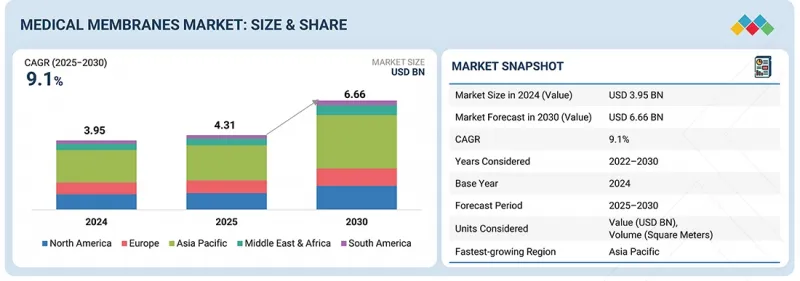
"Polyvinylidene fluoride (PVDF) is the fastest-growing material segment in the medical membranes market during the forecast period."
Polyvinylidene fluoride (PVDF) is the fastest-growing segment in the medical membranes market due to its excellent properties. PVDF is known for its chemical resistance, heat stability, physical strength, and low protein adherence and, thus, is widely used in the purification of liquids in pharmaceuticals and biopharmaceuticals, alongside blood filtering, drug purification, and filtration of the final products of biopharmaceuticals. Hydrophilic PVDF membranes are increasingly used in medical diagnostics and biologics production, driven by the worldwide rise in chronic diseases, the growing focus on personalized medicine, and the expanding aging population. PVDF's biocompatibility is a key factor for innovations in tissue engineering, wound dressings, and virus removal, which makes it superior to competitors such as PTFE or PESU. At the same time, the pandemic-induced surge in pharmaceutical manufacturing and increased investments in advanced filtration technologies also favor PVDF.
"Ultrafiltration is projected to be the largest process technology segment in the medical membranes market during the forecast period."
Ultrafiltration (UF) is the largest technology segment in the overall medical membranes market due to its essential application in hemodialysis. Hemodialysis overcomes the limits of kidney function in more than 3 million end-stage renal disease patients, curing them by highly efficient removal of ureotoxins and keeping essential proteins in the body. UF membranes are often made from polysulfone, polyethersulfone, or modified PES, and they have precise corresponding molecular weight cut-offs (5-50kDa) that give excellent biocompatibility as well as high flux rates and superior hemocompatibility. Thus, they have become the standard for purification in dialysis clinics and ICUs. The strong growth of the medical membranes market is also supported by the expanding use of ultrafiltration (UF) beyond renal therapy. UF is widely applied in microbiology and pharmaceutical downstream processing for concentrating, diafiltering, and exchanging buffers in monoclonal antibodies, vaccines, and recombinant proteins, all of which are increasing rapidly with the rise of biologics. Its ability to pump at low transmembrane pressure and usage of advanced surface modifications to reduce fouling make it even more preferred over microfiltration, reverse osmosis, or nanofiltration in high-volume, high-value medical applications.
"Europe is projected to be the second-largest medical membranes market during the forecast period."
Europe is the second-largest medical membranes market. The market in the region is driven by its excellent healthcare systems, high spending on renal care per capita, and a large number of elderly people with a high prevalence of chronic kidney diseases. The market in the region is also supported by the presence of major membrane manufacturers with significant R&D and production capacity in Germany, France, Italy, and Switzerland. Stringent EU regulatory standards ensure that only the best products are delivered to the market. However, this creates barriers for new players. Moreover, widespread reimbursement for dialysis treatments, the growing use of single-use bioprocessing systems in the fast-expanding biologics sector, and significant public and private investments in fields like regenerative medicine and bioartificial organs contribute to the demand for the product.
Extensive primary interviews were conducted to determine and verify the market size for several segments and subsegments and the information gathered through secondary research.
The breakdown of primary interviews is given below:
- By Department: Tier 1 - 40%, Tier 2 - 25%, and Tier 3 - 35%
- By Designation: C Level - 35%, Director Level - 30%, and Executives - 35%
- By Region: North America - 25%, Europe - 45%, Asia Pacific - 20%, South America - 5%, and Middle East & Africa - 5%
Asahi Kasei Corporation (Japan), Mann+Hummel (Germany), Sartorius AG (Germany), Merck KGaA (Germany), Solventum (US), Cytiva (US), W. L. Gore & Associates, Inc. (US), Kovalus Separation Solutions (US),and Cobetter (China), among others, are some of the key players in the medical membranes market. The study includes an in-depth competitive analysis of these key players in the medical membranes market, with their company profiles, recent developments, and key market strategies.
Research Coverage
The market study covers the medical membranes market across various segments. It aims to estimate the market size and the growth potential of this market across different segments based on material, process technology, application, and region. The study also includes an in-depth competitive analysis of key players in the market, their company profiles, key observations related to their products and business offerings, recent developments undertaken by them, and key growth strategies adopted by them to improve their position in the medical membranes market.
Key Benefits of Buying the Report
The report is expected to help the market leaders/new entrants in this market with the closest approximations of the revenue numbers of the overall medical membranes market and its segments and subsegments. This report is projected to help stakeholders understand the competitive landscape of the market, gain insights to improve the position of their businesses, and plan suitable go-to-market strategies. The report also aims to help stakeholders understand the pulse of the market and provide them with information on the key market drivers, restraints, challenges, and opportunities.
The report provides insights into the following pointers:
- Analysis of key drivers (Rising prevalence of chronic diseases, Growing adoption of membrane-based separation technologies, Increasing number of surgical procedures), restraints (High cost of advanced medical membranes, Stringent regulatory approval processes, Risk of membrane fouling and limited lifespan of membranes), opportunities (Growing demand for single-use membrane systems in bioprocessing, Expansion in emerging markets, Integration of nanotechnology and smart membranes), challenges (Complexity in scaling up production of high-performance membranes, Environmental concerns, and Intense competition).
- Product Development/Innovation: Detailed insights on upcoming technologies, research & development activities, and new product & service launches in the medical membranes market
- Market Development: Comprehensive information about lucrative markets - the report analyses the medical membranes market across varied regions.
Market Diversification: Exhaustive information about new products & services, untapped geographies, recent developments, and investments in the medical membranes market
- Competitive Assessment: In-depth assessment of market shares, growth strategies, and service offerings of leading players like Asahi Kasei Corporation (Japan), Mann+Hummel (Germany), Sartorius AG (Germany), Merck KGaA (Germany), Solventum (US), Cytiva (US), W. L. Gore & Associates, Inc. (US), Kovalus Separation Solutions (US), and Cobetter (China), among others
TABLE OF CONTENTS
1 INTRODUCTION
- 1.1 STUDY OBJECTIVES
- 1.2 MARKET DEFINITION
- 1.3 STUDY SCOPE
- 1.3.1 MARKETS COVERED AND REGIONAL SCOPE
- 1.3.2 INCLUSIONS AND EXCLUSIONS
- 1.3.3 YEARS CONSIDERED
- 1.3.4 CURRENCY CONSIDERED
- 1.3.5 UNIT CONSIDERED
- 1.4 STAKEHOLDERS
2 EXECUTIVE SUMMARY
3 PREMIUM INSIGHTS
- 3.1 ATTRACTIVE OPPORTUNITIES FOR PLAYERS IN MEDICAL MEMBRANES MARKET
- 3.2 MEDICAL MEMBRANES MARKET, BY APPLICATION
- 3.3 MEDICAL MEMBRANES MARKET, BY MATERIAL
- 3.4 MEDICAL MEMBRANES MARKET, BY PROCESS TECHNOLOGY
- 3.5 MEDICAL MEMBRANES MARKET, BY REGION
4 MARKET OVERVIEW
- 4.1 INTRODUCTION
- 4.2 MARKET DYNAMICS
- 4.2.1 DRIVERS
- 4.2.1.1 Rising prevalence of chronic diseases
- 4.2.1.2 Advancements in biotechnology and drug delivery systems
- 4.2.1.3 Rising demand for hemodialysis and filtration technologies
- 4.2.1.4 Expansion of healthcare infrastructure and increasing access globally
- 4.2.2 RESTRAINTS
- 4.2.2.1 High manufacturing and production costs
- 4.2.2.2 Stringent regulatory approvals and compliance
- 4.2.2.3 Membrane fouling and degradation issues
- 4.2.3 OPPORTUNITIES
- 4.2.3.1 Growing demand for single-use membrane systems in bioprocessing
- 4.2.3.2 Rapid expansion of medical membranes into emerging economies
- 4.2.4 CHALLENGES
- 4.2.4.1 Complexity in scaling up production of high-performance membranes
- 4.2.4.2 Environmental concerns
- 4.2.1 DRIVERS
- 4.3 UNMET NEEDS AND WHITE SPACES
- 4.3.1 UNMET NEEDS IN MEDICAL MEMBRANES MARKET
- 4.3.2 WHITE SPACE OPPORTUNITIES
- 4.4 INTERCONNECTED MARKETS AND CROSS-SECTOR OPPORTUNITIES
- 4.4.1 INTERCONNECTED MARKETS
- 4.4.2 CROSS-SECTOR OPPORTUNITIES
- 4.5 EMERGING BUSINESS MODELS AND ECOSYSTEM SHIFTS
- 4.5.1 EMERGING BUSINESS MODELS
- 4.5.2 ECOSYSTEM SHIFTS
- 4.6 STRATEGIC MOVES BY TIER-1/2/3 PLAYERS
- 4.6.1 KEY MOVES AND STRATEGIC FOCUS
5 INDUSTRY TRENDS
- 5.1 PORTER'S FIVE FORCES ANALYSIS
- 5.1.1 THREAT OF NEW ENTRANTS
- 5.1.2 THREAT OF SUBSTITUTES
- 5.1.3 BARGAINING POWER OF SUPPLIERS
- 5.1.4 BARGAINING POWER OF BUYERS
- 5.1.5 INTENSITY OF COMPETITIVE RIVALRY
- 5.2 MACROECONOMIC INDICATORS
- 5.2.1 GLOBAL GDP TRENDS
- 5.3 VALUE CHAIN ANALYSIS
- 5.4 ECOSYSTEM ANALYSIS
- 5.5 PRICING ANALYSIS
- 5.5.1 AVERAGE SELLING PRICE TREND, BY REGION
- 5.6 TRADE ANALYSIS
- 5.6.1 IMPORT SCENARIO (HS CODE 901890)
- 5.6.2 EXPORT SCENARIO (HS CODE 901890)
- 5.7 KEY CONFERENCES AND EVENTS
- 5.8 TRENDS AND DISRUPTIONS IMPACTING CUSTOMER BUSINESS
- 5.9 INVESTMENT AND FUNDING SCENARIO
- 5.10 CASE STUDY ANALYSIS
- 5.10.1 ENSURING RELIABLE CLEANABILITY OF MEDICAL ULTRAFILTRATION MEMBRANES - MERCK MILLIPORE
- 5.10.2 ADVANCED MEDICAL MEMBRANE SOLUTION FOR HOSPITAL WASTEWATER TREATMENT BY IMEMFLO
- 5.11 2025 US TARIFF
- 5.11.1 INTRODUCTION
- 5.11.2 KEY TARIFF RATES
- 5.11.3 PRICE IMPACT ANALYSIS
- 5.11.4 IMPACT ON KEY REGIONS
- 5.11.4.1 North America
- 5.11.4.2 Europe
- 5.11.4.3 Asia Pacific
- 5.11.5 IMPACT ON END-USE INDUSTRIES
6 STRATEGIC DISRUPTION THROUGH TECHNOLOGY, PATENTS, DIGITAL, AND AI ADOPTIONS
- 6.1 KEY EMERGING TECHNOLOGIES
- 6.1.1 CELL MEMBRANE-COATED NANOPARTICLES (CNPS)
- 6.1.2 BIOCOMPATIBLE AND BIODEGRADABLE COMPOSITE MEMBRANES
- 6.2 COMPLEMENTARY TECHNOLOGIES
- 6.2.1 SURFACE MODIFICATION & ANTIMICROBIAL/ANTIFOULING COATINGS
- 6.3 TECHNOLOGY/PRODUCT ROADMAP
- 6.3.1 SHORT-TERM (2025-2027) | FOUNDATION & EARLY COMMERCIALIZATION
- 6.3.2 MID-TERM (2027-2030) | EXPANSION & STANDARDIZATION
- 6.3.3 LONG-TERM (2030-2035+) | MASS COMMERCIALIZATION & DISRUPTION
- 6.4 PATENT ANALYSIS
- 6.4.1 INTRODUCTION
- 6.4.2 METHODOLOGY
- 6.4.3 DOCUMENT TYPE
- 6.4.4 INSIGHTS
- 6.4.5 LEGAL STATUS OF PATENTS
- 6.4.6 JURISDICTION ANALYSIS
- 6.4.7 TOP APPLICANTS
- 6.4.8 TOP 10 PATENT OWNERS IN LAST 10 YEARS
- 6.5 FUTURE APPLICATIONS
- 6.5.1 NEXT-GENERATION HEMODIALYSIS & ARTIFICIAL ORGANS
- 6.5.2 ADVANCED WOUND-CARE & TISSUE-ENGINEERING MEMBRANES
- 6.5.3 CONTROLLED DRUG-DELIVERY & IMPLANTABLE THERAPEUTIC MEMBRANES
- 6.5.4 POINT-OF-CARE DIAGNOSTICS & MICROFLUIDIC LAB-ON-CHIP DEVICES
- 6.5.5 WEARABLE HEALTH SENSORS & CONTINUOUS BIOMARKER MONITORING
- 6.6 IMPACT OF AI/GEN AI ON MEDICAL MEMBRANES MARKET
- 6.6.1 TOP USE CASES AND MARKET POTENTIAL
- 6.6.2 BEST PRACTICES IN MEDICAL MEMBRANES PROCESSING
- 6.6.3 CASE STUDIES OF AI IMPLEMENTATION IN MEDICAL MEMBRANES MARKET
- 6.6.4 INTERCONNECTED ADJACENT ECOSYSTEM AND IMPACT ON MARKET PLAYERS
- 6.6.5 CLIENTS' READINESS TO ADOPT GENERATIVE AI IN MEDICAL MEMBRANES MARKET
- 6.7 SUCCESS STORIES AND REAL-WORLD APPLICATIONS
- 6.7.1 PALL CORPORATION: HEMODIALYSIS MEMBRANES
- 6.7.2 MERCK KGAA: BIOFUNCTIONAL MEMBRANES
- 6.7.3 BAXTER INTERNATIONAL: EXTRACORPOREAL MEMBRANES
7 SUSTAINABILITY AND REGULATORY LANDSCAPE
- 7.1 REGIONAL REGULATIONS AND COMPLIANCE
- 7.1.1 REGULATORY BODIES, GOVERNMENT AGENCIES, AND OTHER ORGANIZATIONS
- 7.1.2 INDUSTRY STANDARDS
- 7.2 SUSTAINABILITY INITIATIVES
- 7.3 SUSTAINABILITY IMPACT AND REGULATORY POLICY INITIATIVES
- 7.4 CERTIFICATIONS, LABELING, AND ECO-STANDARDS
8 CUSTOMER LANDSCAPE & BUYER BEHAVIOR
- 8.1 DECISION-MAKING PROCESS
- 8.2 KEY STAKEHOLDERS AND BUYING CRITERIA
- 8.2.1 KEY STAKEHOLDERS IN BUYING PROCESS
- 8.2.2 BUYING CRITERIA
- 8.3 ADOPTION BARRIERS & INTERNAL CHALLENGES
- 8.4 UNMET NEEDS IN VARIOUS APPLICATIONS
- 8.5 MARKET PROFITABILITY
- 8.5.1 REVENUE POTENTIAL
- 8.5.2 COST DYNAMICS
- 8.5.3 MARGIN OPPORTUNITIES IN KEY END-USE INDUSTRIES
9 MEDICAL MEMBRANES MARKET, BY MATERIAL
- 9.1 INTRODUCTION
- 9.2 POLYSULFONE (PSU) & POLYETHERSULFONE (PESU)
- 9.2.1 ADVANCING DIALYSIS AND CLINICAL FILTRATION WITH BIOCOMPATIBLE, HIGH-FLUX MEMBRANE TECHNOLOGIES TO DRIVE MARKET
- 9.3 POLYVINYLIDENE FLUORIDE (PVDF)
- 9.3.1 EXCELLENT MECHANICAL STRENGTH, THERMAL STABILITY, AND CHEMICAL RESISTANCE TO DRIVE MARKET
- 9.3.2 HYDROPHOBIC PVDF MEMBRANE
- 9.3.3 HYDROPHOBIC PVDF MEMBRANE
- 9.4 POLYTETRAFLUOROETHYLENE (PTFE)
- 9.4.1 ADVANCING MEDICAL VENT FILTRATION WITH ULTRA-RESILIENT MEMBRANE MATERIALS TO DRIVE MARKET
- 9.5 POLYPROPYLENE (PP)
- 9.5.1 OPTIMIZING THERMAL STABILITY FOR HIGH-TEMPERATURE USE TO DRIVE MARKET
- 9.6 POLYACRYLONITRILE (PAN)
- 9.6.1 PROVIDES SUPERIOR CHEMICAL RESISTANCE IN AGGRESSIVE DRUG FILTRATION TO DRIVE MARKET
- 9.7 POLYAMIDE (PA)
- 9.7.1 ENABLES HIGH PERMSELECTIVITY IN PHARMACEUTICAL NANOFILTRATION AND DRUG CONCENTRATION TO DRIVE MARKET
- 9.8 MODIFIED ACRYLICS
- 9.8.1 DELIVERS UNMATCHED OPTICAL CLARITY FOR HIGH-SENSITIVITY DIAGNOSTIC DEVICES TO DRIVE MARKET
- 9.9 OTHER MATERIALS
10 MEDICAL MEMBRANES MARKET, BY PROCESS TECHNOLOGY
- 10.1 INTRODUCTION
- 10.2 ULTRAFILTRATION
- 10.2.1 TRANSFORMING MEDICAL PURIFICATION WORKFLOWS WITH HIGH-PERFORMANCE MEMBRANE SOLUTIONS TO DRIVE MARKET
- 10.3 NANOFILTRATION
- 10.3.1 REMOVES ENDOTOXINS, HORMONE RESIDUES, ANTIBIOTICS, AND OTHER TRACES FROM PROCESS WATER AND MEDICAL SOLUTIONS TO DRIVE MARKET
- 10.4 MICROFILTRATION
- 10.4.1 RISING DEMAND FOR ENERGY-EFFICIENT AIR CONDITIONING SYSTEMS AND RETROFITTING OF OLDER BUILDINGS TO DRIVE MARKET
- 10.5 OTHER PROCESS TECHNOLOGIES
11 MEDICAL MEMBRANES MARKET, BY APPLICATION
- 11.1 INTRODUCTION
- 11.2 PHARMACEUTICAL FILTRATION
- 11.2.1 ENHANCING BIOPHARMACEUTICAL SAFETY WITH HIGH-PERFORMANCE MEMBRANE SOLUTIONS TO DRIVE MARKET
- 11.3 HEMODIALYSIS
- 11.3.1 EMPOWERING RENAL SUPPORT WITH PRECISION FILTRATION TO DRIVE MARKET
- 11.4 DRUG DELIVERY
- 11.4.1 ENHANCING TREATMENT RELIABILITY THROUGH CONTROLLED DIFFUSION TECHNOLOGY TO DRIVE MARKET
- 11.5 IV FUSION & STERILE FILTRATION
- 11.5.1 ADVANCING CLINICAL OUTCOMES THROUGH CUTTING-EDGE FILTRATION AND DELIVERY TO DRIVE MARKET
- 11.6 MEMBRANE OXYGENATOR
- 11.6.1 DRIVING EFFICIENT AND SAFE OXYGEN DELIVERY WITH MEMBRANE INNOVATION TO DRIVE MARKET
- 11.7 APHERESIS MEMBRANE
- 11.7.1 TRANSFORMING BLOOD TREATMENT THROUGH ADVANCED MEMBRANE TECHNOLOGY TO DRIVE MARKET
- 11.8 OTHER APPLICATIONS
12 MEDICAL MEMBRANES MARKET, BY REGION
- 12.1 INTRODUCTION
- 12.2 ASIA PACIFIC
- 12.2.1 CHINA
- 12.2.1.1 Accelerating expansion in healthcare filtration technologies to drive market
- 12.2.2 INDIA
- 12.2.2.1 Seizing opportunities in cost-effective dialysis and filtration to drive market
- 12.2.3 JAPAN
- 12.2.3.1 Strengthening healthcare outcomes with high-tech filtration to drive market
- 12.2.4 SOUTH KOREA
- 12.2.4.1 Rising demand from healthcare, pharmaceutical, and biotechnology sector to drive market
- 12.2.5 REST OF ASIA PACIFIC
- 12.2.1 CHINA
- 12.3 NORTH AMERICA
- 12.3.1 US
- 12.3.1.1 Surge in construction activities to drive market
- 12.3.2 CANADA
- 12.3.2.1 Rise of new housing projects to drive market
- 12.3.3 MEXICO
- 12.3.3.1 Expanding industrial capabilities and healthcare systems to drive market
- 12.3.1 US
- 12.4 EUROPE
- 12.4.1 GERMANY
- 12.4.1.1 Surge in construction of residential infrastructure to drive market
- 12.4.2 UK
- 12.4.2.1 Rising demand for hemodialysis, pharmaceutical filtration, and IV infusion systems to drive market
- 12.4.3 FRANCE
- 12.4.3.1 Policy and financial incentives for building renovation and low-carbon heating to drive market
- 12.4.4 ITALY
- 12.4.4.1 Investments in residential buildings and renovation activities to drive market
- 12.4.5 SPAIN
- 12.4.5.1 High demand for commercial air conditioning units to drive market
- 12.4.6 REST OF EUROPE
- 12.4.1 GERMANY
- 12.5 MIDDLE EAST & AFRICA
- 12.5.1 SAUDI ARABIA
- 12.5.1.1 Trend of small and affordable housing units to drive market
- 12.5.2 UAE
- 12.5.2.1 Projects aimed at promoting economic development to drive market
- 12.5.3 SOUTH AFRICA
- 12.5.3.1 Regional copper trade expansion to drive market
- 12.5.4 REST OF MIDDLE EAST & AFRICA
- 12.5.1 SAUDI ARABIA
- 12.6 SOUTH AMERICA
- 12.6.1 BRAZIL
- 12.6.1.1 Rapid industrial growth to drive market
- 12.6.2 ARGENTINA
- 12.6.2.1 Economic stabilization to drive market
- 12.6.3 REST OF SOUTH AMERICA
- 12.6.1 BRAZIL
13 COMPETITIVE LANDSCAPE
- 13.1 INTRODUCTION
- 13.2 KEY PLAYER STRATEGIES/RIGHT TO WIN, 2023-2025
- 13.3 REVENUE ANALYSIS, 2022-2024
- 13.4 MARKET SHARE ANALYSIS, 2024
- 13.5 COMPANY VALUATION AND FINANCIAL METRICS
- 13.6 PRODUCT COMPARISON
- 13.7 COMPANY EVALUATION MATRIX: KEY PLAYERS, 2024
- 13.7.1 STARS
- 13.7.2 EMERGING LEADERS
- 13.7.3 PERVASIVE PLAYERS
- 13.7.4 PARTICIPANTS
- 13.7.5 COMPANY FOOTPRINT: KEY PLAYERS, 2024
- 13.7.5.1 Company footprint
- 13.7.5.2 Region footprint
- 13.7.5.3 Material footprint
- 13.7.5.4 Process technology footprint
- 13.7.5.5 Application footprint
- 13.8 COMPANY EVALUATION MATRIX: STARTUPS/SMES, 2024
- 13.8.1 PROGRESSIVE COMPANIES
- 13.8.2 RESPONSIVE COMPANIES
- 13.8.3 DYNAMIC COMPANIES
- 13.8.4 STARTING BLOCKS
- 13.8.5 COMPETITIVE BENCHMARKING: STARTUPS/SMES, 2024
- 13.8.5.1 Detailed list of key startups/SMEs
- 13.8.5.2 Competitive benchmarking of startups/SMEs
- 13.9 COMPETITIVE SCENARIO
- 13.9.1 DEALS
- 13.9.2 EXPANSIONS
14 COMPANY PROFILES
- 14.1 KEY PLAYERS
- 14.1.1 ASAHI KASEI CORPORATION
- 14.1.1.1 Business overview
- 14.1.1.2 Products offered
- 14.1.1.3 MnM view
- 14.1.1.3.1 Right to win
- 14.1.1.3.2 Strategic choices
- 14.1.1.3.3 Weaknesses and competitive threats
- 14.1.2 MANN+HUMMEL
- 14.1.2.1 Business overview
- 14.1.2.2 Products offered
- 14.1.2.3 MnM view
- 14.1.2.3.1 Right to win
- 14.1.2.3.2 Strategic choices
- 14.1.2.3.3 Weaknesses and competitive threats
- 14.1.3 SARTORIUS AG
- 14.1.3.1 Business overview
- 14.1.3.2 Products offered
- 14.1.3.3 MnM view
- 14.1.3.3.1 Right to win
- 14.1.3.3.2 Strategic choices
- 14.1.3.3.3 Weaknesses and competitive threats
- 14.1.4 MERCK KGAA
- 14.1.4.1 Business overview
- 14.1.4.2 Products offered
- 14.1.4.3 Recent developments
- 14.1.4.3.1 Expansions
- 14.1.4.4 MnM view
- 14.1.4.4.1 Right to win
- 14.1.4.4.2 Strategic choices
- 14.1.4.4.3 Weaknesses and competitive threats
- 14.1.5 SOLVENTUM
- 14.1.5.1 Business overview
- 14.1.5.2 Products offered
- 14.1.5.3 Recent developments
- 14.1.5.3.1 Deals
- 14.1.5.4 MnM view
- 14.1.5.4.1 Right to win
- 14.1.5.4.2 Strategic choices
- 14.1.5.4.3 Weaknesses and competitive threats
- 14.1.6 CYTIVA (DANAHER CORPORATION)
- 14.1.6.1 Business overview
- 14.1.6.2 Products offered
- 14.1.6.3 Recent developments
- 14.1.6.3.1 Deals
- 14.1.6.3.2 Expansions
- 14.1.6.4 MnM view
- 14.1.7 W. L. GORE & ASSOCIATES, INC.
- 14.1.7.1 Business overview
- 14.1.7.2 Products offered
- 14.1.7.3 MnM view
- 14.1.8 KOVALUS SEPARATION SOLUTIONS
- 14.1.8.1 Business overview
- 14.1.8.2 Products offered
- 14.1.8.3 MnM view
- 14.1.9 COBETTER
- 14.1.9.1 Business overview
- 14.1.9.2 Products offered
- 14.1.9.3 MnM view
- 14.1.10 POREX
- 14.1.10.1 Business overview
- 14.1.10.2 Products offered
- 14.1.10.3 MnM view
- 14.1.1 ASAHI KASEI CORPORATION
- 14.2 OTHER PLAYERS
- 14.2.1 ADVANCED MICRODEVICES PVT. LTD.
- 14.2.2 AMERICAN MEMBRANE CORPORATION
- 14.2.3 AMS MEMTECH TECHNOLOGY (ZHEJIANG) CO., LTD
- 14.2.4 APPLIED MEMBRANE TECHNOLOGY, INC.
- 14.2.5 GRAVER TECHNOLOGIES
- 14.2.6 MEDICA SPA
- 14.2.7 MEMBRANE SOLUTIONS (NANTONG)
- 14.2.8 NX FILTRATION
- 14.2.9 OSMOTECH
- 14.2.10 PERMIONICS GROUP
- 14.2.11 REPLIGEN CORPORATION
- 14.2.12 SYNDER FILTRATION, INC.
- 14.2.13 THEWAY MEMBRANES
- 14.2.14 UNISOL MEMBRANE TECHNOLOGY
- 14.2.15 XINNA
15 RESEARCH METHODOLOGY
- 15.1 RESEARCH DATA
- 15.1.1 SECONDARY DATA
- 15.1.1.1 List of secondary sources
- 15.1.1.2 Key data from secondary sources
- 15.1.2 PRIMARY DATA
- 15.1.2.1 List of primary interview participants-demand and supply side
- 15.1.2.2 Key data from primary sources
- 15.1.2.3 Breakdown of primary interviews
- 15.1.2.4 Insights from industry experts
- 15.1.1 SECONDARY DATA
- 15.2 MARKET SIZE ESTIMATION
- 15.2.1 BOTTOM-UP APPROACH
- 15.2.2 TOP-DOWN APPROACH
- 15.3 FORECAST NUMBER CALCULATION
- 15.4 DATA TRIANGULATION
- 15.5 FACTOR ANALYSIS
- 15.6 RESEARCH ASSUMPTIONS
- 15.7 RESEARCH LIMITATIONS AND RISK ASSESSMENT
16 APPENDIX
- 16.1 DISCUSSION GUIDE
- 16.2 KNOWLEDGESTORE: MARKETSANDMARKETS' SUBSCRIPTION PORTAL
- 16.3 CUSTOMIZATION OPTIONS
- 16.4 RELATED REPORTS
- 16.5 AUTHOR DETAILS
List of Tables
- TABLE 1 PORTER'S FIVE FORCES ANALYSIS
- TABLE 2 PROJECTED REAL GDP GROWTH (ANNUAL PERCENT CHANGE) OF KEY COUNTRIES, 2021-2030
- TABLE 3 ROLE OF COMPANIES IN ECOSYSTEM
- TABLE 4 AVERAGE SELLING PRICE TREND, BY REGION, 2022-2024 (USD/METER)
- TABLE 5 IMPORT SCENARIO FOR HS CODE 901890-COMPLIANT PRODUCTS, BY COUNTRY, 2020-2024 (USD MILLION)
- TABLE 6 EXPORT SCENARIO FOR HS CODE 901890-COMPLIANT PRODUCTS, BY COUNTRY, 2020-2024 (USD MILLION)
- TABLE 7 KEY CONFERENCES AND EVENTS, 2026
- TABLE 8 US-ADJUSTED RECIPROCAL TARIFF RATES
- TABLE 9 TOTAL NUMBER OF PATENTS
- TABLE 10 TOP 10 PATENT OWNERS
- TABLE 11 TOP USE CASES AND MARKET POTENTIAL
- TABLE 12 BEST PRACTICES: NOTABLE INDUSTRY PRACTICES BY LEADING COMPANIES
- TABLE 13 MEDICAL MEMBRANES MARKET: CASE STUDIES RELATED TO AI IMPLEMENTATION
- TABLE 14 INTERCONNECTED ADJACENT ECOSYSTEM AND IMPACT ON MARKET PLAYERS
- TABLE 15 NORTH AMERICA: REGULATORY BODIES, GOVERNMENT AGENCIES, AND OTHER ORGANIZATIONS
- TABLE 16 EUROPE: REGULATORY BODIES, GOVERNMENT AGENCIES, AND OTHER ORGANIZATIONS
- TABLE 17 ASIA PACIFIC: REGULATORY BODIES, GOVERNMENT AGENCIES, AND OTHER ORGANIZATIONS
- TABLE 18 ROW: REGULATORY BODIES, GOVERNMENT AGENCIES, AND OTHER ORGANIZATIONS
- TABLE 19 GLOBAL STANDARDS IN MEDICAL MEMBRANES MARKET
- TABLE 20 CERTIFICATIONS, LABELING, AND ECO-STANDARDS IN MEDICAL MEMBRANES MARKET
- TABLE 21 INFLUENCE OF STAKEHOLDERS ON BUYING PROCESS, BY APPICATION (%)
- TABLE 22 KEY BUYING CRITERIA, BY APPLICATION
- TABLE 23 MEDICAL MEMBRANES MARKET: UNMET NEEDS IN KEY APPLICATIONS
- TABLE 24 MEDICAL MEMBRANES MARKET, BY MATERIAL, 2022-2024 (USD MILLION)
- TABLE 25 MEDICAL MEMBRANES MARKET, BY MATERIAL, 2025-2030 (USD MILLION)
- TABLE 26 MEDICAL MEMBRANES MARKET, BY PROCESS TECHNOLOGY, 2022-2024 (USD MILLION)
- TABLE 27 MEDICAL MEMBRANES MARKET, BY PROCESS TECHNOLOGY, 2025-2030 (USD MILLION)
- TABLE 28 MEDICAL MEMBRANES MARKET, BY APPLICATION, 2022-2024 (USD MILLION)
- TABLE 29 MEDICAL MEMBRANES MARKET, BY APPLICATION, 2025-2030 (USD MILLION)
- TABLE 30 MEDICAL MEMBRANES MARKET, BY REGION, 2022-2024 (USD MILLION)
- TABLE 31 MEDICAL MEMBRANES MARKET, BY REGION, 2025-2030 (USD MILLION)
- TABLE 32 MEDICAL MEMBRANES MARKET, BY REGION, 2022-2024 (MILLION SQUARE METER)
- TABLE 33 MEDICAL MEMBRANES MARKET, BY REGION, 2025-2030 (MILLION SQUARE METER)
- TABLE 34 ASIA PACIFIC: MEDICAL MEMBRANES MARKET, BY COUNTRY, 2022-2024 (USD MILLION)
- TABLE 35 ASIA PACIFIC: MEDICAL MEMBRANES MARKET, BY COUNTRY, 2025-2030 (USD MILLION)
- TABLE 36 ASIA PACIFIC: MEDICAL MEMBRANES MARKET, BY MATERIAL, 2022-2024 (USD MILLION)
- TABLE 37 ASIA PACIFIC: MEDICAL MEMBRANES MARKET, BY MATERIAL, 2025-2030 (USD MILLION)
- TABLE 38 ASIA PACIFIC: MEDICAL MEMBRANES MARKET, BY PROCESS TECHNOLOGY, 2022-2024 (USD MILLION)
- TABLE 39 ASIA PACIFIC: MEDICAL MEMBRANES MARKET, BY PROCESS TECHNOLOGY, 2025-2030 (USD MILLION)
- TABLE 40 ASIA PACIFIC: MEDICAL MEMBRANES MARKET, BY APPLICATION, 2022-2024 (USD MILLION)
- TABLE 41 ASIA PACIFIC: MEDICAL MEMBRANES MARKET, BY APPLICATION, 2025-2030 (USD MILLION)
- TABLE 42 CHINA: MEDICAL MEMBRANES MARKET, BY APPLICATION, 2022-2024 (USD MILLION)
- TABLE 43 CHINA: MEDICAL MEMBRANES MARKET, BY APPLICATION, 2025-2030 (USD MILLION)
- TABLE 44 INDIA: MEDICAL MEMBRANES MARKET, BY APPLICATION, 2022-2024 (USD MILLION)
- TABLE 45 INDIA: MEDICAL MEMBRANES MARKET, BY APPLICATION, 2025-2030 (USD MILLION)
- TABLE 46 JAPAN: MEDICAL MEMBRANES MARKET, BY APPLICATION, 2022-2024 (USD MILLION)
- TABLE 47 JAPAN: MEDICAL MEMBRANES MARKET, BY APPLICATION, 2025-2030 (USD MILLION)
- TABLE 48 SOUTH KOREA: MEDICAL MEMBRANES MARKET, BY APPLICATION, 2022-2024 (USD MILLION)
- TABLE 49 SOUTH KOREA: MEDICAL MEMBRANES MARKET, BY APPLICATION, 2025-2030 (USD MILLION)
- TABLE 50 REST OF ASIA PACIFIC: MEDICAL MEMBRANES MARKET, BY APPLICATION, 2022-2024 (USD MILLION)
- TABLE 51 REST OF ASIA PACIFIC: MEDICAL MEMBRANES MARKET, BY APPLICATION, 2025-2030 (USD MILLION)
- TABLE 52 NORTH AMERICA: MEDICAL MEMBRANES MARKET, BY COUNTRY, 2022-2024 (USD MILLION)
- TABLE 53 NORTH AMERICA: MEDICAL MEMBRANES MARKET, BY COUNTRY, 2025-2030 (USD MILLION)
- TABLE 54 NORTH AMERICA: MEDICAL MEMBRANES MARKET, BY MATERIAL, 2022-2024 (USD MILLION)
- TABLE 55 NORTH AMERICA: MEDICAL MEMBRANES MARKET, BY MATERIAL, 2025-2030 (USD MILLION)
- TABLE 56 NORTH AMERICA: MEDICAL MEMBRANES MARKET, BY PROCESS TECHNOLOGY, 2022-2024 (USD MILLION)
- TABLE 57 NORTH AMERICA: MEDICAL MEMBRANES MARKET, BY PROCESS TECHNOLOGY, 2025-2030 (USD MILLION)
- TABLE 58 NORTH AMERICA: MEDICAL MEMBRANES MARKET, BY APPLICATION, 2022-2024 (USD MILLION)
- TABLE 59 NORTH AMERICA: MEDICAL MEMBRANES MARKET, BY APPLICATION, 2025-2030 (USD MILLION)
- TABLE 60 US: MEDICAL MEMBRANES MARKET, BY APPLICATION, 2022-2024 (USD MILLION)
- TABLE 61 US: MEDICAL MEMBRANES MARKET, BY APPLICATION, 2025-2030 (USD MILLION)
- TABLE 62 CANADA: MEDICAL MEMBRANES MARKET, BY APPLICATION, 2022-2024 (USD MILLION)
- TABLE 63 CANADA: MEDICAL MEMBRANES MARKET, BY APPLICATION, 2025-2030 (USD MILLION)
- TABLE 64 MEXICO: MEDICAL MEMBRANES MARKET, BY APPLICATION, 2022-2024 (USD MILLION)
- TABLE 65 MEXICO: MEDICAL MEMBRANES MARKET, BY APPLICATION, 2025-2030 (USD MILLION)
- TABLE 66 EUROPE: MEDICAL MEMBRANES MARKET, BY COUNTRY, 2022-2024 (USD MILLION)
- TABLE 67 EUROPE: MEDICAL MEMBRANES MARKET BY COUNTRY, 2025-2030 (USD MILLION)
- TABLE 68 EUROPE: MEDICAL MEMBRANES MARKET, BY MATERIAL, 2022-2024 (USD MILLION)
- TABLE 69 EUROPE: MEDICAL MEMBRANES MARKET, BY MATERIAL, 2025-2030 (USD MILLION)
- TABLE 70 EUROPE: MEDICAL MEMBRANES MARKET, BY PROCESS TECHNOLOGY, 2022-2024 (USD MILLION)
- TABLE 71 EUROPE: MEDICAL MEMBRANES MARKET, BY PROCESS TECHNOLOGY, 2025-2030 (USD MILLION)
- TABLE 72 EUROPE: MEDICAL MEMBRANES MARKET, BY APPLICATION, 2022-2024 (USD MILLION)
- TABLE 73 EUROPE: MEDICAL MEMBRANES MARKET, BY APPLICATION, 2025-2030 (USD MILLION)
- TABLE 74 GERMANY: MEDICAL MEMBRANES MARKET, BY APPLICATION, 2022-2024 (USD MILLION)
- TABLE 75 GERMANY: MEDICAL MEMBRANES MARKET, BY APPLICATION, 2025-2030 (USD MILLION)
- TABLE 76 UK: MEDICAL MEMBRANES MARKET, BY APPLICATION, 2022-2024 (USD MILLION)
- TABLE 77 UK: MEDICAL MEMBRANES MARKET, BY APPLICATION, 2025-2030 (USD MILLION)
- TABLE 78 FRANCE: MEDICAL MEMBRANES MARKET, BY APPLICATION, 2022-2024 (USD MILLION)
- TABLE 79 FRANCE: MEDICAL MEMBRANES MARKET, BY APPLICATION, 2025-2030 (USD MILLION)
- TABLE 80 ITALY: MEDICAL MEMBRANES MARKET, BY APPLICATION, 2022-2024 (USD MILLION)
- TABLE 81 ITALY: MEDICAL MEMBRANES MARKET, BY APPLICATION, 2025-2030 (USD MILLION)
- TABLE 82 SPAIN: MEDICAL MEMBRANES MARKET, BY APPLICATION, 2022-2024 (USD MILLION)
- TABLE 83 SPAIN: MEDICAL MEMBRANES MARKET, BY APPLICATION, 2025-2030 (USD MILLION)
- TABLE 84 REST OF EUROPE: MEDICAL MEMBRANES MARKET, BY APPLICATION, 2022-2024 (USD MILLION)
- TABLE 85 REST OF EUROPE: MEDICAL MEMBRANES MARKET, BY APPLICATION, 2025-2030 (USD MILLION)
- TABLE 86 MIDDLE EAST & AFRICA: MEDICAL MEMBRANES MARKET, BY COUNTRY, 2022-2024 (USD MILLION)
- TABLE 87 MIDDLE EAST & AFRICA: MEDICAL MEMBRANES MARKET, BY COUNTRY, 2025-2030 (USD MILLION)
- TABLE 88 MIDDLE EAST & AFRICA: MEDICAL MEMBRANES MARKET, BY MATERIAL, 2022-2024 (USD MILLION)
- TABLE 89 MIDDLE EAST & AFRICA: MEDICAL MEMBRANES MARKET, BY MATERIAL, 2025-2030 (USD MILLION)
- TABLE 90 MIDDLE EAST & AFRICA: MEDICAL MEMBRANES MARKET, BY PROCESS TECHNOLOGY, 2022-2024 (USD MILLION)
- TABLE 91 MIDDLE EAST & AFRICA: MEDICAL MEMBRANES MARKET, BY PROCESS TECHNOLOGY, 2025-2030 (USD MILLION)
- TABLE 92 MIDDLE EAST & AFRICA: MEDICAL MEMBRANES MARKET, BY APPLICATION, 2022-2024 (USD MILLION)
- TABLE 93 MIDDLE EAST & AFRICA: MEDICAL MEMBRANES MARKET, BY APPLICATION, 2025-2030 (USD MILLION)
- TABLE 94 SAUDI ARABIA: MEDICAL MEMBRANES MARKET, BY APPLICATION, 2022-2024 (USD MILLION)
- TABLE 95 SAUDI ARABIA: MEDICAL MEMBRANES MARKET, BY APPLICATION, 2025-2030 (USD MILLION)
- TABLE 96 UAE: MEDICAL MEMBRANES MARKET, BY APPLICATION, 2022-2024 (USD MILLION)
- TABLE 97 UAE: MEDICAL MEMBRANES MARKET, BY APPLICATION, 2025-2030 (USD MILLION)
- TABLE 98 SOUTH AFRICA: MEDICAL MEMBRANES MARKET, BY APPLICATION, 2022-2024 (USD MILLION)
- TABLE 99 SOUTH AFRICA: MEDICAL MEMBRANES MARKET, BY APPLICATION, 2025-2030 (USD MILLION)
- TABLE 100 REST OF MIDDLE EAST: MEDICAL MEMBRANES MARKET, BY APPLICATION, 2022-2024 (USD MILLION)
- TABLE 101 REST OF MIDDLE EAST: MEDICAL MEMBRANES MARKET, BY APPLICATION, 2025-2030 (USD MILLION)
- TABLE 102 SOUTH AMERICA: MEDICAL MEMBRANES MARKET, BY COUNTRY, 2022-2024 (USD MILLION)
- TABLE 103 SOUTH AMERICA: MEDICAL MEMBRANES MARKET, BY COUNTRY, 2025-2030 (USD MILLION)
- TABLE 104 SOUTH AMERICA: MEDICAL MEMBRANES MARKET, BY MATERIAL, 2022-2024 (USD MILLION)
- TABLE 105 SOUTH AMERICA: MEDICAL MEMBRANES MARKET, BY MATERIAL, 2025-2030 (USD MILLION)
- TABLE 106 SOUTH AMERICA: MEDICAL MEMBRANES MARKET, BY PROCESS TECHNOLOGY, 2022-2024 (USD MILLION)
- TABLE 107 SOUTH AMERICA: MEDICAL MEMBRANES MARKET, BY PROCESS TECHNOLOGY, 2025-2030 (USD MILLION)
- TABLE 108 SOUTH AMERICA: MEDICAL MEMBRANES MARKET, BY APPLICATION, 2022-2024 (USD MILLION)
- TABLE 109 SOUTH AMERICA: MEDICAL MEMBRANES MARKET, BY APPLICATION, 2025-2030 (USD MILLION)
- TABLE 110 BRAZIL: MEDICAL MEMBRANES MARKET, BY APPLICATION, 2022-2024 (USD MILLION)
- TABLE 111 BRAZIL: MEDICAL MEMBRANES MARKET, BY APPLICATION, 2025-2030 (USD MILLION)
- TABLE 112 ARGENTIINA: MEDICAL MEMBRANES MARKET, BY APPLICATION, 2022-2024 (USD MILLION)
- TABLE 113 ARGENTINA: MEDICAL MEMBRANES MARKET, BY APPLICATION, 2025-2030 (USD MILLION)
- TABLE 114 REST OF SOUTH AMERICA: MEDICAL MEMBRANES MARKET, BY APPLICATION, 2022-2024 (USD MILLION)
- TABLE 115 REST OF SOUTH AMERICA: MEDICAL MEMBRANES MARKET, BY APPLICATION, 2025-2030 (USD MILLION)
- TABLE 116 KEY PLAYER STRATEGIES/RIGHT TO WIN, 2023-2025
- TABLE 117 MEDICAL MEMBRANES MARKET: DEGREE OF COMPETITION
- TABLE 118 MEDICAL MEMBRANES MARKET: REGION FOOTPRINT
- TABLE 119 MEDICAL MEMBRANES MARKET: MATERIAL FOOTPRINT
- TABLE 120 MEDICAL MEMBRANES MARKET: PROCESS TECHNOLOGY FOOTPRINT
- TABLE 121 MEDICAL MEMBRANES MARKET: APPLICATION FOOTPRINT
- TABLE 122 MEDICAL MEMBRANES MARKET: DETAILED LIST OF STARTUPS/SMES
- TABLE 123 MEDICAL MEMBRANES MARKET: COMPETITIVE BENCHMARKING OF STARTUPS/SMES
- TABLE 124 MEDICAL MEMBRANES MARKET: DEALS, JANUARY 2023-OCTOBER 2025
- TABLE 125 MEDICAL MEMBRANES MARKET: EXPANSIONS, JANUARY 2023-OCTOBER 2025
- TABLE 126 ASAHI KASEI CORPORATION: COMPANY OVERVIEW
- TABLE 127 ASAHI KASEI CORPORATION: PRODUCTS OFFERED
- TABLE 128 MANN+HUMMEL: COMPANY OVERVIEW
- TABLE 129 MANN+HUMMEL: PRODUCTS OFFERED
- TABLE 130 SARTORIUS AG: COMPANY OVERVIEW
- TABLE 131 SARTORIUS AG: PRODUCTS OFFERED
- TABLE 132 MERCK KGAA: COMPANY OVERVIEW
- TABLE 133 MERCK KGAA: PRODUCTS OFFERED
- TABLE 134 MERCK KGAA: EXPANSIONS, JANUARY 2023-OCTOBER 2025
- TABLE 135 SOLVENTUM: COMPANY OVERVIEW
- TABLE 136 SOLVENTUM: PRODUCTS OFFERED
- TABLE 137 SOLVENTUM: DEALS
- TABLE 138 CYTIVA: COMPANY OVERVIEW
- TABLE 139 CYTIVA: PRODUCTS OFFERED
- TABLE 140 CYTIVA: DEALS
- TABLE 141 CYTIVA: EXPANSIONS, JANUARY 2023-OCTOBER 2025
- TABLE 142 W. L. GORE & ASSOCIATES, INC.: COMPANY OVERVIEW
- TABLE 143 W. L. GORE & ASSOCIATES, INC.: PRODUCTS OFFERED
- TABLE 144 KOVALUS SEPARATION SOLUTIONS: COMPANY OVERVIEW
- TABLE 145 KOVALUS SEPARATION SOLUTIONS: PRODUCTS OFFERED
- TABLE 146 COBETTER: COMPANY OVERVIEW
- TABLE 147 COBETTER: PRODUCTS OFFERED
- TABLE 148 POREX: COMPANY OVERVIEW
- TABLE 149 POREX: PRODUCTS OFFERED
- TABLE 150 ADVANCED MICRODEVICES PVT. LTD.: COMPANY OVERVIEW
- TABLE 151 AMERICAN MEMBRANE CORPORATION: COMPANY OVERVIEW
- TABLE 152 AMS MEMTECH TECHNOLOGY (ZHEJIANG) CO., LTD: COMPANY OVERVIEW
- TABLE 153 APPLIED MEMBRANE TECHNOLOGY, INC.: COMPANY OVERVIEW
- TABLE 154 GRAVER TECHNOLOGIES: COMPANY OVERVIEW
- TABLE 155 MEDICA SPA: COMPANY OVERVIEW
- TABLE 156 MEMBRANE SOLUTIONS (NANTONG): COMPANY OVERVIEW
- TABLE 157 NX FILTRATION: COMPANY OVERVIEW
- TABLE 158 OSMOTECH: COMPANY OVERVIEW
- TABLE 159 PERMIONICS GROUP: COMPANY OVERVIEW
- TABLE 160 REPLIGEN CORPORATION: COMPANY OVERVIEW
- TABLE 161 SYNDER FILTRATION, INC.: COMPANY OVERVIEW
- TABLE 162 THEWAY MEMBRANES: COMPANY OVERVIEW
- TABLE 163 UNISOL MEMBRANE TECHNOLOGY: COMPANY OVERVIEW
- TABLE 164 XINNA: COMPANY OVERVIEW
List of Figures
- FIGURE 1 MEDICAL MEMBRANES MARKET SEGMENTATION
- FIGURE 2 PHARMACEUTICAL FILTRATION TO DOMINATE MEDICAL MEMBRANES MARKET DURING FORECAST PERIOD
- FIGURE 3 PSU & PESU TO BE FASTEST-GROWING MATERIAL TYPE DURING FORECAST PERIOD
- FIGURE 4 ULTRAFILTRATION PROCESS TECHNOLOGY TO DOMINATE MEDICAL MEMBRANES MARKET
- FIGURE 5 ASIA PACIFIC TO BE FASTEST-GROWING MARKET DURING FORECAST PERIOD
- FIGURE 6 INCREASING CHRONIC DISEASES AND GROWING DEMAND FOR FILTRATION SOLUTIONS TO DRIVE MARKET DURING FORECAST PERIOD
- FIGURE 7 IV FUSION AND STERILE FILTRATION TO BE SECOND FASTEST-GROWING APPLICATION IN MEDICAL MEMBRANES MARKET DURING FORECAST PERIOD
- FIGURE 8 PVDF TO BE SECOND-LARGEST MATERIAL TYPE SEGMENT DURING FORECAST PERIOD
- FIGURE 9 NANOFILTRATION PROCESS TECHNOLOGY TO BE FASTEST-GROWING SEGMENT IN MEDICAL MEMBRANES MARKET
- FIGURE 10 ASIA PACIFIC TO ACCOUNT FOR LARGEST MARKET SHARE DURING FORECAST PERIOD
- FIGURE 11 MEDICAL MEMBRANES MARKET: DRIVERS, RESTRAINTS, OPPORTUNITIES, AND CHALLENGES
- FIGURE 12 PORTER'S FIVE FORCES ANALYSIS
- FIGURE 13 VALUE CHAIN ANALYSIS
- FIGURE 14 ECOSYSTEM ANALYSIS
- FIGURE 15 AVERAGE SELLING PRICE TREND, BY REGION, 2022-2024 (USD/METER)
- FIGURE 16 IMPORT DATA FOR HS CODE 901890-COMPLIANT PRODUCTS, BY COUNTRY, 2020-2024 (USD MILLION)
- FIGURE 17 EXPORT DATA FOR HS CODE 901890-COMPLIANT PRODUCTS, BY COUNTRY, 2020-2024 (USD MILLION)
- FIGURE 18 TRENDS AND DISRUPTIONS IMPACTING CUSTOMER BUSINESS
- FIGURE 19 INVESTMENT AND FUNDING SCENARIO, 2021-2024 (USD MILLION)
- FIGURE 20 PATENT ANALYSIS, BY DOCUMENT TYPE, 2016-2025
- FIGURE 21 PATENT PUBLICATION TRENDS, 2016-2025
- FIGURE 22 MEDICAL MEMBRANES MARKET: LEGAL STATUS OF PATENTS, JANUARY 2016-DECEMBER 2025
- FIGURE 23 JURISDICTION OF US REGISTERED HIGHEST SHARE OF PATENTS, 2016-2025
- FIGURE 24 TOP PATENT APPLICANTS, 2016-2025
- FIGURE 25 FUTURE APPLICATIONS OF MEDICAL MEMBRANES
- FIGURE 26 MEDICAL MEMBRANES MARKET: DECISION-MAKING FACTORS
- FIGURE 27 INFLUENCE OF STAKEHOLDERS ON BUYING PROCESS, BY APPLICATION
- FIGURE 28 KEY BUYING CRITERIA, BY APPLICATION
- FIGURE 29 ADOPTION BARRIERS & INTERNAL CHALLENGES
- FIGURE 30 MEDICAL MEMBRANES MARKET, BY MATERIAL, 2025-2030 (USD MILLION)
- FIGURE 31 MEDICAL MEMBRANES MARKET, BY PROCESS TECHNOLOGY, 2025-2030 (USD MILLION)
- FIGURE 32 MEDICAL MEMBRANES MARKET, BY PROCESS TECHNOLOGY, 2025-2030 (USD MILLION)
- FIGURE 33 MEDICAL MEMBRANES MARKET, BY COUNTRY, 2025-2030
- FIGURE 34 ASIA PACIFIC: MEDICAL MEMBRANES MARKET SNAPSHOT
- FIGURE 35 NORTH AMERICA: MEDICAL MEMBRANES MARKET SNAPSHOT
- FIGURE 36 EUROPE: MEDICAL MEMBRANES MARKET SNAPSHOT
- FIGURE 37 REVENUE ANALYSIS OF TOP LISTED/PUBLIC PLAYER, 2022-2024
- FIGURE 38 MARKET SHARE ANALYSIS OF KEY PLAYERS, 2024
- FIGURE 39 COMPANY VALUATION (USD BILLION)
- FIGURE 40 FINANCIAL METRICS (EV/EBITDA)
- FIGURE 41 PRODUCT COMPARISON
- FIGURE 42 MEDICAL MEMBRANES MARKET: COMPANY EVALUATION MATRIX (KEY PLAYERS), 2024
- FIGURE 43 MEDICAL MEMBRANES MARKET: COMPANY FOOTPRINT
- FIGURE 44 MEDICAL MEMBRANES MARKET: COMPANY EVALUATION MATRIX (STARTUPS/SMES), 2024
- FIGURE 45 ASAHI KASEI CORPORATION: COMPANY SNAPSHOT
- FIGURE 46 MANN+HUMMEL: COMPANY SNAPSHOT
- FIGURE 47 SARTORIUS AG: COMPANY SNAPSHOT
- FIGURE 48 MERCK KGAA: COMPANY SNAPSHOT
- FIGURE 49 SOLVENTUM: COMPANY SNAPSHOT
- FIGURE 50 DANAHER CORPORATION: COMPANY SNAPSHOT
- FIGURE 51 RESEARCH DESIGN
- FIGURE 52 BOTTOM-UP APPROACH
- FIGURE 53 TOP-DOWN APPROACH
- FIGURE 54 MARKET SIZE ESTIMATION NOTES
- FIGURE 55 DEMAND-SIDE FORECAST PROJECTIONS
- FIGURE 56 DATA TRIANGULATION

