PUBLISHER: MarketsandMarkets | PRODUCT CODE: 1950781
PUBLISHER: MarketsandMarkets | PRODUCT CODE: 1950781
Micronized PTFE Market by Type, Application, End-use Industry, and Region - Global Forecast to 2030
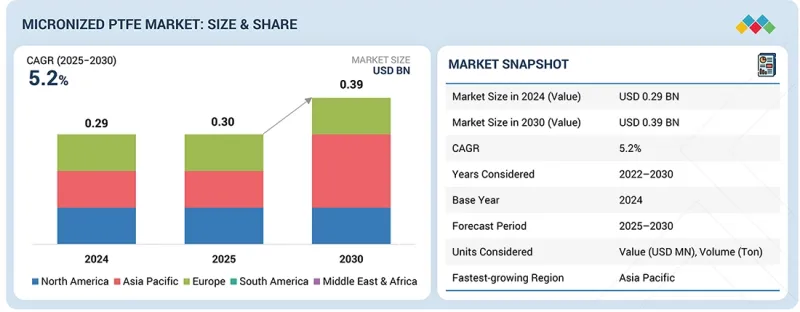
The micronized PTFE market is expected to reach USD 0.39 billion by 2030 from USD 0.30 billion in 2025, at a CAGR of 5.2% during the forecast period.
| Scope of the Report | |
|---|---|
| Years Considered for the Study | 2022-2030 |
| Base Year | 2024 |
| Forecast Period | 2025-2030 |
| Units Considered | Value (USD Million) and Volume (Ton) |
| Segments | Type, Application, End-use Industry, and Region |
| Regions covered | North America, Asia Pacific, Europe, Middle East & Africa, and South America |
Micronized PTFE is gradually becoming the new ingredient in coatings, plastics, inks, lubricants, and other specialized industries, primarily because of the ever-increasing demand for better surface properties, longer product life, and easier processing. The increasing demand for better wear & abrasion resistance, friction reduction, chemical resistance, & thermal stability is thus creating a demand for micronized PTFE. Micronized PTFE is manufactured via advanced processing techniques that enable regulated particle size and consistent dispersion in various polymers. Moreover, innovation has led to the use of water-based, low-VOC products, a step toward sustainability and regulatory compliance. With the growing need for performance optimization and material efficiency, micronized PTFE is gaining importance as a functional additive in advanced materials applications.
"Recycled PTFE is projected to be the fastest-growing type in the micronized PTFE market during the forecast period."
Recycled PTFE is projected to be the fastest-growing type in the micronized PTFE market during the forecast period. This is due to rising sustainability demands and the adoption of circular-economy trends. Recycled micronized PTFE is produced from post-industrial and post-consumer waste PTFE. It possesses qualities similar to virgin PTFE, making it suitable for applications such as coatings, inks, polymers, and lubricants. The key advantages of using recycled micronized PTFE include improved wear resistance, low friction, and improved surface properties. Market growth is further driven by the environmental and economic advantages associated with lower raw material costs and reduced environmental impact. Moreover, the implementation of rigorous environmental standards and the decrease in carbon footprints and virgin fluoropolymers are also facilitating market expansion.
"Thermoplastics & elastomers are projected to be the second-fastest-growing application in the micronized PTFE market during the forecast period."
Thermoplastics & elastomers are anticipated to witness the second-fastest growth rate as applications in the micronized PTFE market during the forecast period, driven by the growing need for high-performance polymers across the automotive, industrial, electrical & electronics, and consumer goods industries. Micronized PTFE is widely used as a functional additive in thermoplastics and elastomers to impart wear resistance, reduce friction, improve surface smoothness, and reduce stick-slip effects. The micronized PTFE's ability to improve mold release, abrasion resistance, and long-term durability without affecting mechanical properties makes it suitable for engineering plastics and rubber compounds. Moreover, the increasing focus on lightweight materials, longer product life, and energy-efficient processing is also encouraging polymer processors to use micronized PTFE. Ongoing developments in compounding technology and the increasing demand for low-maintenance polymer parts are also fueling the rapid growth of the micronized PTFE market.
"Automotive & transportation is projected to be the fastest-growing end-use industry in the micronized PTFE market during the forecast period."
The automotive & transportation sector is anticipated to be the fastest-growing end-use industry for the micronized PTFE market during the forecast period, driven by rising demand for high-performance materials to enhance the efficiency and durability of components. Micronized PTFE has wide applications in the automotive sector as a coating agent for plastics, elastomers, and lubricants, enhancing friction, wear, and abrasion resistance, as well as surface properties. The rising trend of lightweighting, fuel efficiency, and the development of electric vehicles in the automotive sector is also boosting demand for micronized PTFE, as it enhances material properties without significantly increasing weight. Moreover, the rising need to meet tougher emission and quality standards is also driving the adoption of advanced additives that enhance reliability and minimize maintenance, thereby fueling the growth of the micronized PTFE market in the automotive and transportation industries.
"Asia Pacific is projected to be the fastest-growing region in the micronized PTFE market during the forecast period."
The Asia Pacific market is expected to be the fastest-growing in the micronized PTFE market during the forecast period, driven by rapid industrialization and increased manufacturing capacity in the region, as well as the growing demand for high-performance materials across key end-use industries. The strong growth of coatings, plastics, the automotive industry, electronics, and manufacturing in the region, including countries such as China, India, Japan, and South Korea, is driving the use of micronized PTFE as a functional additive. The Asia Pacific market has a large polymer-processing base, and the region also offers cost-effective manufacturing and increasing investments in specialty chemicals and high-performance materials. Moreover, the trend toward water-based and low-VOC products, along with increasingly stringent environmental regulations, is driving demand for performance-enhancing additives such as micronized PTFE.
By Company Type: Tier 1: 40%, Tier 2: 30%, and Tier 3: 30%
By Designation: Directors: 30%, Managers: 20%, and Others: 50%
By Region: North America: 20%, Europe: 10%, Asia Pacific: 40%, South America: 10%, and Middle East & Africa 20%
Notes: Others include sales, marketing, and product managers.
Tier 1: >USD 1 billion, Tier 2: USD 500 million-1 billion, and Tier 3: <USD 500 million.
Companies Covered: The Chemours Company (US), DAIKIN INDUSTRIES, Ltd. (Japan), 3M (US), Syensqo (Belgium), AGC Inc. (Japan), DONGYUE GROUP (China), Shamrock Technologies Inc. (US), Gujarat Fluorochemicals Limited (India), HaloPolymer (Russia), and Nanjing Tianshi New Material Technologies Co., Ltd. (China) are covered in the report.
The study includes an in-depth competitive analysis of these key players in the micronized PTFE market, with their company profiles, recent developments, and key market strategies.
Research Coverage
This research report categorizes the micronized market based on type (recycled PTFE, virgin PTFE material), application (inks & coatings, thermoplastics & elastomers, paints, lubricants & greases, other applications), and end-use industry (automotive & transportation, electrical & electronics, chemical & industrial processing, medical & pharmaceutical, building & construction, other end-use industries). The report's scope covers detailed information regarding the drivers, restraints, challenges, and opportunities influencing the growth of the micronized PTFE market. A detailed analysis of the key industry players has been done to provide insights into their business overview, products offered, and key strategies, such as mergers, acquisitions, product launches, and expansions, associated with the micronized PTFE market. This report covers a competitive analysis of upcoming startups in the micronized PTFE market ecosystem.
Reasons to Buy the Report
The report will offer the market leaders/new entrants with information on the closest approximations of the revenue numbers for the overall micronized PTFE market and the subsegments. This report will help stakeholders understand the competitive landscape, gain more insights into positioning their businesses better, and plan suitable go-to-market strategies. The report will help stakeholders understand the pulse of the market and provide them with information on key market drivers, restraints, challenges, and opportunities.
The report provides insights into the following points: Analysis of key drivers (strong demand in coatings, lubricants, and high-performance additives, superior functional properties, and advancements in processing technology), restraints (high production and processing costs and substitution risk from alternative materials), opportunities (expansion into emerging industries and advanced applications, recycled and sustainable PTFE grades, and regional expansion and industrial growth in Asia Pacific are driving micronized PTFE demand), and challenges (maintaining consistent ultra-fine particle control & supply chain volatility and raw material price fluctuations).
- Product Development/Innovation: Detailed insights into upcoming technologies, research & development activities, and product & service launches in the micronized PTFE market.
- Market Development: Comprehensive information about profitable markets - the report analyzes the micronized PTFE market across varied regions.
- Market Diversification: Exhaustive information about new products & services, untapped geographies, recent developments, and investments in the micronized PTFE market.
- Competitive Assessment: In-depth assessment of market shares, growth strategies, and service offerings of leading players such as The Chemours Company (US), DAIKIN INDUSTRIES, Ltd. (Japan), 3M (US), Syensqo (Belgium), AGC Inc. (Japan), DONGYUE GROUP (China), Shamrock Technologies Inc. (US), Gujarat Fluorochemicals Limited (India), HaloPolymer (Russia), and Nanjing Tianshi New Material Technologies Co., Ltd. (China).
TABLE OF CONTENTS
1 INTRODUCTION
- 1.1 STUDY OBJECTIVES
- 1.2 MARKET DEFINITION
- 1.3 MARKET SCOPE
- 1.3.1 MARKET SEGMENTATION AND REGIONAL SCOPE
- 1.3.2 INCLUSIONS AND EXCLUSIONS
- 1.3.3 YEARS CONSIDERED
- 1.4 CURRENCY CONSIDERED
- 1.5 UNIT CONSIDERED
- 1.6 STAKEHOLDERS
- 1.7 SUMMARY OF CHANGES
2 EXECUTIVE SUMMARY
- 2.1 MARKET HIGHLIGHTS AND KEY INSIGHTS
- 2.2 KEY MARKET PARTICIPANTS: MAPPING OF STRATEGIC DEVELOPMENTS
- 2.3 DISRUPTIVE TRENDS IN MICRONIZED PTFE MARKET
- 2.4 HIGH-GROWTH SEGMENTS
- 2.5 REGIONAL SNAPSHOT: MARKET SIZE, GROWTH RATE, AND FORECAST
3 PREMIUM INSIGHTS
- 3.1 ATTRACTIVE OPPORTUNITIES FOR PLAYERS IN MICRONIZED PTFE MARKET
- 3.2 MICRONIZED PTFE MARKET, BY TYPE
- 3.3 MICRONIZED PTFE MARKET, BY APPLICATION
- 3.4 MICRONIZED PTFE MARKET, BY END-USE INDUSTRY
- 3.5 MICRONIZED PTFE MARKET, BY COUNTRY
4 MARKET OVERVIEW
- 4.1 INTRODUCTION
- 4.2 MARKET DYNAMICS
- 4.2.1 DRIVERS
- 4.2.1.1 Surging demand for electric vehicles
- 4.2.1.2 Pressing need for high-performance additives in coatings, inks, and surface formulations
- 4.2.1.3 Rising use of micronized PTFE in thermoplastics, elastomers, and engineered polymers
- 4.2.2 RESTRAINTS
- 4.2.2.1 High production and processing costs
- 4.2.2.2 Regulatory scrutiny on fluoropolymers and PFAS
- 4.2.3 OPPORTUNITIES
- 4.2.3.1 Growing emphasis on circular economy and sustainability
- 4.2.3.2 Emerging applications of micronized PTFE
- 4.2.4 CHALLENGES
- 4.2.4.1 Maintaining uniform ultra-fine particle size and reliable dispersion
- 4.2.4.2 Shift toward PFAS-free alternatives
- 4.2.1 DRIVERS
- 4.3 UNMET NEEDS AND WHITE SPACES
- 4.3.1 UNMET NEEDS IN MICRONIZED PTFE MARKET
- 4.3.2 WHITE SPACE OPPORTUNITIES
- 4.4 INTERCONNECTED MARKETS AND CROSS-SECTOR OPPORTUNITIES
- 4.4.1 INTERCONNECTED MARKETS
- 4.4.2 CROSS-SECTOR OPPORTUNITIES
- 4.4.2.1 CHEMICAL PROCESSING & OIL/GAS -> RENEWABLE ENERGY
- 4.4.2.2 AUTOMOTIVE & TRANSPORTATION -> ELECTRICAL & ELECTRONICS
- 4.4.2.3 SEMICONDUCTOR MANUFACTURING -> MEDICAL & LIFE SCIENCE DEVICES
- 4.4.2.4 INDUSTRIAL COATINGS & INKS -> PACKAGING & CONSUMER GOODS
- 4.5 STRATEGIC MOVES BY TIER 1/2/3 PLAYERS
- 4.5.1 TIER 1 PLAYERS: GLOBAL LEADERS STRENGTHENING SUPPLY CHAINS AND MARKET ACCESS
- 4.5.1.1 THE CHEMOURS COMPANY - STRATEGIC MANUFACTURING AGREEMENT WITH SRF LIMITED (INDIA)
- 4.5.1.2 AGC INC.- DEVELOPMENT OF SURFACTANT-FREE FLUOROPOLYMER MANUFACTURING TECHNOLOGY
- 4.5.2 TIER 2 PLAYERS: INNOVATION-DRIVEN SPECIALISTS EXPANDING APPLICATION REACH
- 4.5.2.1 SHAMROCK TECHNOLOGIES - ADVANCED MICRONIZED & NANO-SCALE PTFE PORTFOLIO SHOWCASED AT CHINAPLAS 2025
- 4.5.3 TIER 3 PLAYERS: REGIONAL MANUFACTURERS SCALING CAPACITY AND OPERATIONAL EFFICIENCY
- 4.5.3.1 ITAFLON - EXPANSION AND RELOCATION TO NEW ADVANCED PRODUCTION FACILITY
- 4.5.1 TIER 1 PLAYERS: GLOBAL LEADERS STRENGTHENING SUPPLY CHAINS AND MARKET ACCESS
5 INDUSTRY TRENDS
- 5.1 PORTER'S FIVE FORCES ANALYSIS
- 5.1.1 THREAT OF NEW ENTRANTS
- 5.1.2 THREAT OF SUBSTITUTES
- 5.1.3 BARGAINING POWER OF SUPPLIERS
- 5.1.4 BARGAINING POWER OF BUYERS
- 5.1.5 INTENSITY OF COMPETITIVE RIVALRY
- 5.2 MACROECONOMIC OUTLOOK
- 5.2.1 INTRODUCTION
- 5.2.2 GDP TRENDS AND FORECASTS
- 5.2.3 TRENDS IN AUTOMOTIVE & TRANSPORTATION INDUSTRY
- 5.2.4 TRENDS IN CHEMICALS & INDUSTRIAL PROCESSING INDUSTRY
- 5.3 VALUE CHAIN ANALYSIS
- 5.4 ECOSYSTEM ANALYSIS
- 5.5 PRICING ANALYSIS
- 5.5.1 AVERAGE SELLING PRICE OF MICRONIZED PTFE TYPES, BY KEY PLAYER, 2024
- 5.5.2 PRICING TREND OF MICRONIZED PTFE, BY END-USE INDUSTRY, 2022-2024
- 5.5.3 AVERAGE SELLING PRICE TREND OF MICRONIZED PTFE, BY REGION, 2022-2024
- 5.6 TRADE ANALYSIS
- 5.6.1 EXPORT SCENARIO (HS CODE 390461)
- 5.6.2 IMPORT SCENARIO (HS CODE 390461)
- 5.7 KEY CONFERENCES AND EVENTS, 2026-2027
- 5.8 TRENDS/DISRUPTIONS IMPACTING CUSTOMER BUSINESS
- 5.9 INVESTMENT AND FUNDING SCENARIO
- 5.10 CASE STUDY ANALYSIS
- 5.10.1 IMPROVING FRICTION AND WEAR-RESISTANCE WITH ENGINEERED PTFE@SIO2 STRUCTURES
- 5.10.2 STRENGTHENING INDUSTRIAL COMPONENT RELIABILITY WITH PTFE-BASED EPOXY ENHANCEMENTS
- 5.10.3 OPTIMIZING POLYMER DURABILITY AND LUBRICATION WITH PTFE ADDITIVE TECHNOLOGIES
- 5.11 IMPACT OF 2025 US TARIFFS ON MICRONIZED PTFE MARKET
- 5.11.1 INTRODUCTION
- 5.11.2 KEY TARIFF RATES
- 5.11.3 PRICE IMPACT ANALYSIS
- 5.11.4 IMPACT ON COUNTRIES/REGIONS
- 5.11.4.1 US
- 5.11.4.2 China
- 5.11.4.3 Europe
- 5.11.4.4 Mexico
- 5.11.5 IMPACT ON END-USE INDUSTRIES
6 TECHNOLOGICAL ADVANCEMENTS, AI-DRIVEN IMPACT, PATENTS, INNOVATIONS, AND FUTURE APPLICATIONS
- 6.1 KEY TECHNOLOGIES
- 6.1.1 MICRONIZED PTFE
- 6.1.2 MECHANICAL MICRONIZATION
- 6.1.3 IRRADIATION-ASSISTED MICRONIZATION
- 6.1.4 SURFACE MODIFICATION AND PTFE MICROPOWDER ENCAPSULATION
- 6.2 COMPLEMENTARY TECHNOLOGIES
- 6.2.1 DISPERSION AND FORMULATION
- 6.2.2 MASTERBATCH AND COMPOUND INTEGRATION
- 6.2.3 GRANULATION, LOW-DUST FORMULATION, AND AGGLOMERATION CONTROL
- 6.3 TECHNOLOGY/PRODUCT ROADMAP
- 6.3.1 SHORT-TERM (2025-2027) | PROCESS OPTIMIZATION AND FORMULATION STABILITY
- 6.3.2 MID-TERM (2027-2030) | FUNCTIONAL INTEGRATION AND APPLICATION-SPECIFIC GRADES
- 6.3.3 LONG-TERM (2030-2035+) | SUSTAINABILITY AND REGULATORY COMPLIANCE
- 6.4 PATENT ANALYSIS
- 6.4.1 INTRODUCTION
- 6.4.2 METHODOLOGY
- 6.4.3 MICRONIZED PTFE MARKET, PATENT ANALYSIS, 2016-2025
- 6.5 FUTURE APPLICATIONS
- 6.5.1 HIGH-PERFORMANCE COATINGS AND SURFACE MODIFICATION APPLICATIONS
- 6.5.2 TRIBOLOGICAL COMPONENTS AND INDUSTRIAL MACHINERY APPLICATIONS
- 6.5.3 HIGH-PERFORMANCE ELECTRONICS AND ELECTRICAL APPLICATIONS
- 6.6 IMPACT OF AI/GEN AI ON MICRONIZED PTFE MARKET
- 6.6.1 TOP USE CASES AND MARKET POTENTIAL
- 6.6.2 BEST PRACTICES FOLLOWED BY MANUFACTURERS/OEMS IN MICRONIZED PTFE MARKET
- 6.6.3 CASE STUDIES RELATED TO AI/GEN AI IMPLEMENTATION IN MICRONIZED PTFE MARKET
- 6.6.4 INTERCONNECTED/ADJACENT ECOSYSTEM AND IMPACT ON MARKET PLAYERS
- 6.6.5 CLIENTS' READINESS TO ADOPT AL/GEN AI IN MICRONIZED PTFE MARKET
- 6.7 SUCCESS STORIES AND REAL-WORLD APPLICATIONS
- 6.7.1 ZONYL PTFE MICROPOWDERS BY CHEMOURS ENHANCE WEAR AND SURFACE PERFORMANCE IN COATINGS, INKS, AND POLYMER SYSTEMS
- 6.7.2 DAIKIN POLYFLON MICRONIZED PTFE ENABLES LOW-FRICTION PERFORMANCE IN INDUSTRIAL COATINGS AND PRINTING INKS
7 REGULATORY LANDSCAPE AND SUSTAINABILITY INITIATIVES
- 7.1 REGIONAL REGULATIONS AND COMPLIANCE
- 7.1.1 REGULATORY BODIES, GOVERNMENT AGENCIES, AND OTHER ORGANIZATIONS
- 7.1.2 INDUSTRY STANDARDS
- 7.2 SUSTAINABILITY INITIATIVES
- 7.2.1 GREEN MATERIAL EFFICIENCY AND LIFECYCLE OPTIMIZATION
- 7.2.2 SUSTAINABLE MANUFACTURING PRACTICES AND EMISSION CONTROL IN MICRONIZED PTFE PRODUCTION
- 7.2.3 RESOURCE EFFICIENCY AND LIFECYCLE PERFORMANCE BENEFITS IN END-USE APPLICATIONS
- 7.2.4 COLLABORATIVE RESEARCH AND REGULATORY-ALIGNED SUSTAINABILITY DEVELOPMENT
- 7.2.5 ENVIRONMENTAL PERFORMANCE AND EFFICIENCY-DRIVEN APPLICATIONS
- 7.3 IMPACT OF REGULATORY POLICIES ON SUSTAINABILITY INITIATIVES
8 CUSTOMER LANDSCAPE AND BUYER BEHAVIOR
- 8.1 DECISION-MAKING PROCESS
- 8.2 KEY STAKEHOLDERS INVOLVED IN BUYING PROCESS AND THEIR EVALUATION CRITERIA
- 8.2.1 KEY STAKEHOLDERS IN BUYING PROCESS
- 8.2.2 BUYING CRITERIA
- 8.3 ADOPTION BARRIERS AND INTERNAL CHALLENGES
- 8.4 UNMET NEEDS FROM VARIOUS END-USE INDUSTRIES
- 8.5 MARKET PROFITABILITY
- 8.5.1 REVENUE POTENTIAL
- 8.5.2 COST DYNAMICS
- 8.5.3 MARGIN OPPORTUNITIES, BY APPLICATION
9 MICRONIZED PTFE MARKET, BY TYPE
- 9.1 INTRODUCTION
- 9.2 RECYCLED PTFE MATERIAL
- 9.2.1 RISING FOCUS ON ENVIRONMENTAL COMPLIANCE AND RESOURCE EFFICIENCY TO STIMULATE SEGMENTAL GROWTH
- 9.3 VIRGIN PTFE MATERIAL
- 9.3.1 REQUIREMENT FOR PREMIUM ADDITIVE PERFORMANCE TO BOOST DEMAND
10 MICRONIZED PTFE MARKET, BY APPLICATION
- 10.1 INTRODUCTION
- 10.2 INKS & COATINGS
- 10.2.1 CHEMICAL INERTNESS, THERMAL STABILITY, AND NON-STICK PROPERTIES OF MICRONIZED PTFE TO BOOST DEMAND
- 10.3 THERMOPLASTICS & ELASTOMERS
- 10.3.1 STRINGENT MECHANICAL, THERMAL, AND CHEMICAL PERFORMANCE REQUIREMENTS ACROSS INDUSTRIAL SECTORS TO SPIKE ADOPTION
- 10.4 PAINTS
- 10.4.1 STRICT DURABILITY AND AESTHETIC STANDARDS ACROSS DECORATIVE, INDUSTRIAL, AND AUTOMOTIVE SECTORS TO STIMULATE DEMAND
- 10.5 LUBRICANTS & GREASES
- 10.5.1 ABILITY TO EXTEND SERVICE LIFE OF BEARINGS, GEARS, CHAINS, AND SLIDING COMPONENTS TO INCREASE ADOPTION
- 10.6 OTHER APPLICATIONS
11 MICRONIZED PTFE MARKET, BY END-USE INDUSTRY
- 11.1 INTRODUCTION
- 11.2 AUTOMOTIVE & TRANSPORTATION
- 11.2.1 SIGNIFICANT FOCUS ON REDUCING EMISSIONS AND IMPROVING FUEL EFFICIENCY TO ACCELERATE DEMAND
- 11.3 CHEMICALS & INDUSTRIAL PROCESSING
- 11.3.1 POTENTIAL TO PROTECT VESSELS, PIPING, AND HEAT EXCHANGERS FROM AGGRESSIVE CHEMICAL ATTACK TO SUPPORT MARKET GROWTH
- 11.4 ELECTRICAL & ELECTRONICS
- 11.4.1 ABILITY TO PRESERVE SIGNAL INTEGRITY IN HIGH-SPEED DATA TRANSMISSION AND RF/MICROWAVE SYSTEMS TO SPIKE DEMAND
- 11.5 BUILDING & CONSTRUCTION
- 11.5.1 INCLINATION TOWARD SPECIALTY CONSTRUCTION MATERIALS FOR LONG-TERM ASSET DURABILITY TO SPUR ADOPTION
- 11.6 MEDICAL & PHARMACEUTICALS
- 11.6.1 INCREASING DEMAND FOR MINIMALLY INVASIVE PROCEDURES TO FOSTER MARKET GROWTH
- 11.7 OTHER END-USE INDUSTRIES
12 MICRONIZED PTFE MARKET, BY REGION
- 12.1 INTRODUCTION
- 12.2 NORTH AMERICA
- 12.2.1 US
- 12.2.1.1 Robust industrial base and regulatory frameworks for environmental safety to accelerate demand
- 12.2.2 CANADA
- 12.2.2.1 Strong base of advanced manufacturing and environmental stewardship to spike demand
- 12.2.3 MEXICO
- 12.2.3.1 High foreign direct investment in specialty chemicals, polymers, and downstream industrial applications to facilitate market growth
- 12.2.1 US
- 12.3 EUROPE
- 12.3.1 GERMANY
- 12.3.1.1 Strong automotive and industrial machinery sectors to contribute to market growth
- 12.3.2 FRANCE
- 12.3.2.1 Constant activities in construction, infrastructure development and maintenance, and public facilities to propel market
- 12.3.3 UK
- 12.3.3.1 Stringent chemical regulation and strong downstream coatings and engineering sectors to support market growth
- 12.3.4 ITALY
- 12.3.4.1 Urban regeneration initiatives and strong coatings and surface treatment ecosystem to drive market
- 12.3.5 SPAIN
- 12.3.5.1 Rapid urbanization and infrastructure development to boost adoption
- 12.3.6 REST OF EUROPE
- 12.3.1 GERMANY
- 12.4 SOUTH AMERICA
- 12.4.1 BRAZIL
- 12.4.1.1 Booming automotive, chemical processing, electrical equipment, and industrial machinery sectors to support market growth
- 12.4.2 ARGENTINA
- 12.4.2.1 Industrial and public infrastructure projects in chemicals, utilities, and energy sectors to create growth opportunities
- 12.4.3 REST OF SOUTH AMERICA
- 12.4.1 BRAZIL
- 12.5 ASIA PACIFIC
- 12.5.1 CHINA
- 12.5.1.1 Sustainable industrial practices under Beautiful China initiative to expedite market growth
- 12.5.2 JAPAN
- 12.5.2.1 Demographic-driven industrial density and sustainability-focused regulations to reinforce market expansion
- 12.5.3 INDIA
- 12.5.3.1 Urban industrial hubs and expanding manufacturing capacity to foster market growth
- 12.5.4 SOUTH KOREA
- 12.5.4.1 Aging industrial infrastructure and regulatory focus on chemical safety and sustainability to create market opportunities
- 12.5.5 REST OF ASIA PACIFIC
- 12.5.1 CHINA
- 12.6 MIDDLE EAST & AFRICA
- 12.6.1 GCC
- 12.6.1.1 Saudi Arabia
- 12.6.1.1.1 Expanding oil & gas, petrochemicals, chemicals, energy, and water treatment sectors to support market growth
- 12.6.1.2 UAE
- 12.6.1.2.1 Expo-related developments and ongoing urban master plans to increase micronized PTFE penetration
- 12.6.1.3 Rest of GCC
- 12.6.1.1 Saudi Arabia
- 12.6.2 SOUTH AFRICA
- 12.6.2.1 Surging adoption of high-performance materials in energy, water, chemicals, and manufacturing sectors to stimulate demand
- 12.6.3 REST OF MIDDLE EAST & AFRICA
- 12.6.1 GCC
13 COMPETITIVE LANDSCAPE
- 13.1 OVERVIEW
- 13.2 KEY PLAYER COMPETITIVE STRATEGIES/RIGHT TO WIN, 2020-2025
- 13.3 REVENUE ANALYSIS, 2020-2024
- 13.4 MARKET SHARE ANALYSIS, 2024
- 13.5 PRODUCT COMPARISON
- 13.5.1 THE CHEMOURS COMPANY (ZONYL MICROPOWDERS) (US)
- 13.5.2 DAIKIN INDUSTRIES, LTD, LTD. (PTFE MICROPOWDER HL SERIES) (JAPAN)
- 13.5.3 3M (DYNEON) (US)
- 13.5.4 SYENSQO (ALGOFLON L PTFE MICRONIZED POWDERS) (BELGIUM)
- 13.6 COMPANY EVALUATION MATRIX: KEY PLAYERS, 2024
- 13.6.1 STARS
- 13.6.2 EMERGING LEADERS
- 13.6.3 PERVASIVE PLAYERS
- 13.6.4 PARTICIPANTS
- 13.6.5 COMPANY FOOTPRINT: KEY PLAYERS, 2024
- 13.6.5.1 Company footprint
- 13.6.5.2 Region footprint
- 13.6.5.3 Type footprint
- 13.6.5.4 Application footprint
- 13.6.5.5 End-use industry footprint
- 13.7 COMPANY EVALUATION MATRIX: STARTUPS/SMES, 2024
- 13.7.1 PROGRESSIVE COMPANIES
- 13.7.2 RESPONSIVE COMPANIES
- 13.7.3 DYNAMIC COMPANIES
- 13.7.4 STARTING BLOCKS
- 13.7.5 COMPETITIVE BENCHMARKING: STARTUPS/SMES, 2024
- 13.7.5.1 Detailed list of key startups/SMEs
- 13.7.5.2 Competitive benchmarking of key startups/SMEs
- 13.8 COMPANY VALUATION AND FINANCIAL METRICS
- 13.9 COMPETITIVE SCENARIO
- 13.9.1 PRODUCT LAUNCHES
- 13.9.2 DEALS
- 13.9.3 EXPANSIONS
- 13.9.4 OTHER DEVELOPMENTS
14 COMPANY PROFILES
- 14.1 KEY PLAYERS
- 14.1.1 THE CHEMOURS COMPANY
- 14.1.1.1 Business overview
- 14.1.1.2 Products/Solutions/Services offered
- 14.1.1.3 Recent developments
- 14.1.1.3.1 Deals
- 14.1.1.4 MnM view
- 14.1.1.4.1 Right to win
- 14.1.1.4.2 Strategic choices
- 14.1.1.4.3 Weaknesses & competitive threats
- 14.1.2 DAIKIN INDUSTRIES, LTD.
- 14.1.2.1 Business overview
- 14.1.2.2 Products/Solutions/Services offered
- 14.1.2.3 Recent developments
- 14.1.2.3.1 Expansions
- 14.1.2.4 MnM view
- 14.1.2.4.1 Right to win
- 14.1.2.4.2 Strategic choices
- 14.1.2.4.3 Weaknesses & competitive threats
- 14.1.3 3M
- 14.1.3.1 Business overview
- 14.1.3.2 Products/Solutions/Products offered
- 14.1.3.3 MnM view
- 14.1.3.3.1 Right to win
- 14.1.3.3.2 Strategic choices
- 14.1.3.3.3 Weaknesses & competitive threats
- 14.1.4 SYENSQO
- 14.1.4.1 Business overview
- 14.1.4.2 Products/Solutions/Services offered
- 14.1.4.3 MnM view
- 14.1.4.3.1 Right to win
- 14.1.4.3.2 Strategic Choices
- 14.1.4.3.3 Weaknesses & competitive threats
- 14.1.5 AGC INC.
- 14.1.5.1 Business overview
- 14.1.5.2 Products/Solutions/Services offered
- 14.1.5.3 Recent developments
- 14.1.5.3.1 Product launches
- 14.1.5.3.2 Expansions
- 14.1.5.4 MnM view
- 14.1.5.4.1 Right to win
- 14.1.5.4.2 Strategic choices
- 14.1.5.4.3 Weaknesses & competitive threats
- 14.1.6 DONGYUE GROUP
- 14.1.6.1 Business overview
- 14.1.6.2 Products/Solutions/Services offered
- 14.1.6.3 MnM view
- 14.1.7 SHAMROCK TECHNOLOGIES
- 14.1.7.1 Business overview
- 14.1.7.2 Products/Solutions/Services offered
- 14.1.7.3 Recent developments
- 14.1.7.3.1 Developments
- 14.1.7.4 MnM view
- 14.1.8 GUJARAT FLUOROCHEMICALS LIMITED
- 14.1.8.1 Business overview
- 14.1.8.2 Products/Solutions/Services offered
- 14.1.8.3 Recent developments
- 14.1.8.3.1 Product launches
- 14.1.8.4 MnM view
- 14.1.9 HALOPOLYMER
- 14.1.9.1 Business overview
- 14.1.9.2 Products/Solutions/Services offered
- 14.1.9.3 MnM view
- 14.1.10 NANJING TIANSHI NEW MATERIAL TECHNOLOGIES CO., LTD.
- 14.1.10.1 Business overview
- 14.1.10.2 Products/Solutions/Services offered
- 14.1.10.3 MnM view
- 14.1.1 THE CHEMOURS COMPANY
- 14.2 OTHER PLAYERS
- 14.2.1 MAFLON S.P.A.
- 14.2.2 FUZHOU TOPDA NEW MATERIAL CO., LTD.
- 14.2.3 PEFLON
- 14.2.4 SUZHOU NORSHINE PERFORMANCE MATERIAL CO. LTD.
- 14.2.5 REPROLON
- 14.2.6 ZHEJIANG QUZHOU WANNENGDA TECHNOLOGY CO., LTD.
- 14.2.7 ZHONGHAO CHENGUANG RESEARCH INSTITUTE OF CHEMICAL INDUSTRY CO., LTD.
- 14.2.8 KITAMURA LIMITED
- 14.2.9 POLYMER ADD (THAILAND) CO., LTD.
- 14.2.10 HANGZHOU JUFU NEW MATERIAL TECHNOLOGY CO., LTD.
- 14.2.11 SHANGHAI TONGS SCIENCE & TECHNOLOGY CO., LTD.
- 14.2.12 HANGZHOU FINE FLUOROTECH CO., LTD.
- 14.2.13 ITAFLON
- 14.2.14 XEON PTFE
- 14.2.15 SHANGHAI KAYSON CHEMICAL
15 RESEARCH METHODOLOGY
- 15.1 RESEARCH DATA
- 15.1.1 SECONDARY DATA
- 15.1.1.1 Key data from secondary sources
- 15.1.1.2 List of key secondary sources
- 15.1.2 PRIMARY DATA
- 15.1.2.1 Key data from primary sources
- 15.1.2.2 List of primary interview participants
- 15.1.2.3 Key industry insights
- 15.1.2.4 Breakdown of primary interviews
- 15.1.1 SECONDARY DATA
- 15.2 MARKET SIZE ESTIMATION
- 15.2.1 BOTTOM-UP APPROACH
- 15.2.2 TOP-DOWN APPROACH
- 15.3 DATA TRIANGULATION
- 15.4 RESEARCH ASSUMPTIONS
- 15.5 RESEARCH LIMITATIONS
- 15.6 RISK ANALYSIS
16 APPENDIX
- 16.1 DISCUSSION GUIDE
- 16.2 KNOWLEDGESTORE: MARKETSANDMARKETS' SUBSCRIPTION PORTAL
- 16.3 CUSTOMIZATION OPTIONS
- 16.4 RELATED REPORTS
- 16.5 AUTHOR DETAILS
List of Tables
- TABLE 1 MICRONIZED PTFE MARKET: INCLUSIONS AND EXCLUSIONS
- TABLE 2 CHANGES MADE IN LATEST REPORT VERSION
- TABLE 3 PORTER'S FIVE FORCES ANALYSIS
- TABLE 4 GLOBAL GDP GROWTH, BY REGION, 2021-2028 (USD TRILLION)
- TABLE 5 ROLES OF COMPANIES IN MICRONIZED PTFE ECOSYSTEM
- TABLE 6 AVERAGE SELLING PRICE OF MICRONIZED PTFE TYPES OFFERED BY KEY PLAYERS, 2024 (USD/KG)
- TABLE 7 PRICING TREND OF MICRONIZED PTFE, BY END-USE INDUSTRY, 2022-2024 (USD/KG)
- TABLE 8 AVERAGE SELLING PRICE TREND OF MICRONIZED PTFE, BY REGION, 2022-2024 (USD/KG)
- TABLE 9 EXPORT DATA FOR HS CODE 390461-COMPLIANT PRODUCTS, BY COUNTRY, 2020-2024 (USD MILLION)
- TABLE 10 IMPORT DATA FOR HS CODE 390461-COMPLIANT PRODUCTS, BY COUNTRY, 2020-2024 (USD MILLION)
- TABLE 11 LIST OF KEY CONFERENCES AND EVENTS, 2026-2027
- TABLE 12 USE OF ADVANCED MICRONIZED PTFE COMPOSITE TO REDUCE FRICTION AND WEAR
- TABLE 13 INTEGRATION OF MICRONIZED PTFE TO IMPROVE TRIBOLOGICAL PERFORMANCE
- TABLE 14 ADOPTION OF MICRONIZED PTFE TO OPTIMIZE POLYMER DURABILITY AND LUBRICATION
- TABLE 15 MICRONIZED PTFE MARKET: LIST OF KEY PATENTS, 2022-2024
- TABLE 16 INNOVATION, SCALABILITY, AND ADOPTION OF MICRONIZED PTFE COATINGS
- TABLE 17 GROWTH OPPORTUNITIES FOR MICRONIZED PTFE IN INDUSTRIAL EQUIPMENT AND ENERGY SYSTEMS
- TABLE 18 EMERGING OPPORTUNITIES IN SEMICONDUCTOR AND HIGH-SPEED ELECTRONICS MARKETS
- TABLE 19 KEY USE CASES AND MARKET POTENTIAL
- TABLE 20 BEST PRACTICES FOLLOWED BY MARKET PLAYERS
- TABLE 21 MICRONIZED PTFE MARKET: CASE STUDIES RELATED TO AI/GEN AI IMPLEMENTATION
- TABLE 22 NORTH AMERICA: LIST OF REGULATORY BODIES, GOVERNMENT AGENCIES, INDUSTRY ASSOCIATIONS, AND OTHER ORGANIZATIONS
- TABLE 23 EUROPE: LIST OF REGULATORY BODIES, GOVERNMENT AGENCIES, INDUSTRY ASSOCIATIONS, AND OTHER ORGANIZATIONS
- TABLE 24 ASIA PACIFIC: LIST OF REGULATORY BODIES, GOVERNMENT AGENCIES, INDUSTRY ASSOCIATIONS, AND OTHER ORGANIZATIONS
- TABLE 25 MIDDLE EAST & AFRICA: LIST OF REGULATORY BODIES, GOVERNMENT AGENCIES, INDUSTRY ASSOCIATIONS, AND OTHER ORGANIZATIONS
- TABLE 26 SOUTH AMERICA: LIST OF REGULATORY BODIES, GOVERNMENT AGENCIES, INDUSTRY ASSOCIATIONS, AND OTHER ORGANIZATIONS
- TABLE 27 GLOBAL INDUSTRY STANDARDS IN MICRONIZED PTFE MARKET
- TABLE 28 INFLUENCE OF STAKEHOLDERS ON BUYING PROCESS, BY END-USE INDUSTRY (%)
- TABLE 29 KEY BUYING CRITERIA, BY END-USE INDUSTRY
- TABLE 30 UNMET NEEDS OF END-USE INDUSTRIES IN MICRONIZED PTFE MARKET
- TABLE 31 MICRONIZED PTFE MARKET, BY TYPE, 2022-2024 (USD MILLION)
- TABLE 32 MICRONIZED PTFE MARKET, BY TYPE, 2025-2030 (USD MILLION)
- TABLE 33 MICRONIZED PTFE MARKET, BY TYPE, 2022-2024 (TON)
- TABLE 34 MICRONIZED PTFE MARKET, BY TYPE, 2025-2030 (TON)
- TABLE 35 MICRONIZED PTFE MARKET, BY APPLICATION, 2022-2024 (USD MILLION)
- TABLE 36 MICRONIZED PTFE MARKET, BY APPLICATION, 2025-2030 (USD MILLION)
- TABLE 37 MICRONIZED PTFE MARKET, BY APPLICATION, 2022-2024 (TON)
- TABLE 38 MICRONIZED PTFE MARKET, BY APPLICATION, 2025-2030 (TON)
- TABLE 39 MICRONIZED PTFE MARKET, BY END-USE INDUSTRY, 2022-2024 (USD MILLION)
- TABLE 40 MICRONIZED PTFE MARKET, BY END-USE INDUSTRY, 2025-2030 (USD MILLION)
- TABLE 41 MICRONIZED PTFE MARKET, BY END-USE INDUSTRY, 2022-2024 (TON)
- TABLE 42 MICRONIZED PTFE MARKET, BY END-USE INDUSTRY, 2025-2030 (TON)
- TABLE 43 MICRONIZED PTFE MARKET, BY REGION, 2022-2024 (USD MILLION)
- TABLE 44 MICRONIZED PTFE MARKET, BY REGION, 2025-2030 (USD MILLION)
- TABLE 45 MICRONIZED PTFE MARKET, BY REGION, 2022-2024 (TON)
- TABLE 46 MICRONIZED PTFE MARKET, BY REGION, 2025-2030 (TON)
- TABLE 47 NORTH AMERICA: MICRONIZED PTFE MARKET, BY COUNTRY, 2022-2024 (USD MILLION)
- TABLE 48 NORTH AMERICA: MICRONIZED PTFE MARKET, BY COUNTRY, 2025-2030 (USD MILLION)
- TABLE 49 NORTH AMERICA: MICRONIZED PTFE MARKET, BY COUNTRY, 2022-2024 (TON)
- TABLE 50 NORTH AMERICA: MICRONIZED PTFE MARKET, BY COUNTRY, 2025-2030 (TON)
- TABLE 51 NORTH AMERICA: MICRONIZED PTFE MARKET, BY TYPE, 2022-2024 (USD MILLION)
- TABLE 52 NORTH AMERICA: MICRONIZED PTFE MARKET, BY TYPE, 2025-2030 (USD MILLION)
- TABLE 53 NORTH AMERICA: MICRONIZED PTFE MARKET, BY TYPE, 2022-2024 (TON)
- TABLE 54 NORTH AMERICA: MICRONIZED PTFE MARKET, BY TYPE, 2025-2030 (TON)
- TABLE 55 NORTH AMERICA: MICRONIZED PTFE MARKET, BY APPLICATION, 2022-2024 (USD MILLION)
- TABLE 56 NORTH AMERICA: MICRONIZED PTFE MARKET, BY APPLICATION, 2025-2030 (USD MILLION)
- TABLE 57 NORTH AMERICA: MICRONIZED PTFE MARKET, BY APPLICATION, 2022-2024 (TON)
- TABLE 58 NORTH AMERICA: MICRONIZED PTFE MARKET, BY APPLICATION, 2025-2030 (TON)
- TABLE 59 NORTH AMERICA: MICRONIZED PTFE MARKET, BY END-USE INDUSTRY, 2022-2024 (USD MILLION)
- TABLE 60 NORTH AMERICA: MICRONIZED PTFE MARKET, BY END-USE INDUSTRY, 2025-2030 (USD MILLION)
- TABLE 61 NORTH AMERICA: MICRONIZED PTFE MARKET, BY END-USE INDUSTRY, 2022-2024 (TON)
- TABLE 62 NORTH AMERICA: MICRONIZED PTFE MARKET, BY END-USE INDUSTRY, 2025-2030 (TON)
- TABLE 63 US: MICRONIZED PTFE MARKET, BY END-USE INDUSTRY, 2022-2024 (USD MILLION)
- TABLE 64 US: MICRONIZED PTFE MARKET, BY END-USE INDUSTRY, 2025-2030 (USD MILLION)
- TABLE 65 US: MICRONIZED PTFE MARKET, BY END-USE INDUSTRY, 2022-2024 (TON)
- TABLE 66 US: MICRONIZED PTFE MARKET, BY END-USE INDUSTRY, 2025-2030 (TON)
- TABLE 67 CANADA: MICRONIZED PTFE MARKET, BY END-USE INDUSTRY, 2022-2024 (USD MILLION)
- TABLE 68 CANADA: MICRONIZED PTFE MARKET, BY END-USE INDUSTRY, 2025-2030 (USD MILLION)
- TABLE 69 CANADA: MICRONIZED PTFE MARKET, BY END-USE INDUSTRY, 2022-2024 (TON)
- TABLE 70 CANADA: MICRONIZED PTFE MARKET, BY END-USE INDUSTRY, 2025-2030 (TON)
- TABLE 71 MEXICO: MICRONIZED PTFE MARKET, BY END-USE INDUSTRY, 2022-2024 (USD MILLION)
- TABLE 72 MEXICO: MICRONIZED PTFE MARKET, BY END-USE INDUSTRY, 2025-2030 (USD MILLION)
- TABLE 73 MEXICO: MICRONIZED PTFE MARKET, BY END-USE INDUSTRY, 2022-2024 (TON)
- TABLE 74 MEXICO: MICRONIZED PTFE MARKET, BY END-USE INDUSTRY, 2025-2030 (TON)
- TABLE 75 EUROPE: MICRONIZED PTFE MARKET, BY COUNTRY, 2022-2024 (USD MILLION)
- TABLE 76 EUROPE: MICRONIZED PTFE MARKET, BY COUNTRY, 2025-2030 (USD MILLION)
- TABLE 77 EUROPE: MICRONIZED PTFE MARKET, BY COUNTRY, 2022-2024 (TON)
- TABLE 78 EUROPE: MICRONIZED PTFE MARKET, BY COUNTRY, 2025-2030 (TON)
- TABLE 79 EUROPE: MICRONIZED PTFE MARKET, BY TYPE, 2022-2024 (USD MILLION)
- TABLE 80 EUROPE: MICRONIZED PTFE MARKET, BY TYPE, 2025-2030 (USD MILLION)
- TABLE 81 EUROPE: MICRONIZED PTFE MARKET, BY TYPE, 2022-2024 (TON)
- TABLE 82 EUROPE: MICRONIZED PTFE MARKET, BY TYPE, 2025-2030 (TON)
- TABLE 83 EUROPE: MICRONIZED PTFE MARKET, BY APPLICATION, 2022-2024 (USD MILLION)
- TABLE 84 EUROPE: MICRONIZED PTFE MARKET, BY APPLICATION, 2025-2030 (USD MILLION)
- TABLE 85 EUROPE: MICRONIZED PTFE MARKET, BY APPLICATION, 2022-2024 (TON)
- TABLE 86 EUROPE: MICRONIZED PTFE MARKET, BY APPLICATION, 2025-2030 (TON)
- TABLE 87 EUROPE: MICRONIZED PTFE MARKET, BY END-USE INDUSTRY, 2022-2024 (USD MILLION)
- TABLE 88 EUROPE: MICRONIZED PTFE MARKET, BY END-USE INDUSTRY, 2025-2030 (USD MILLION)
- TABLE 89 EUROPE: MICRONIZED PTFE MARKET, BY END-USE INDUSTRY, 2022-2024 (TON)
- TABLE 90 EUROPE: MICRONIZED PTFE MARKET, BY END-USE INDUSTRY, 2025-2030 (TON)
- TABLE 91 GERMANY: MICRONIZED PTFE MARKET, BY END-USE INDUSTRY, 2022-2024 (USD MILLION)
- TABLE 92 GERMANY: MICRONIZED PTFE MARKET, BY END-USE INDUSTRY, 2025-2030 (USD MILLION)
- TABLE 93 GERMANY: MICRONIZED PTFE MARKET, BY END-USE INDUSTRY, 2022-2024 (TON)
- TABLE 94 GERMANY: MICRONIZED PTFE MARKET, BY END-USE INDUSTRY, 2025-2030 (TON)
- TABLE 95 FRANCE: MICRONIZED PTFE MARKET, BY END-USE INDUSTRY, 2022-2024 (USD MILLION)
- TABLE 96 FRANCE: MICRONIZED PTFE MARKET, BY END-USE INDUSTRY, 2025-2030 (USD MILLION)
- TABLE 97 FRANCE: MICRONIZED PTFE MARKET, BY END-USE INDUSTRY, 2022-2024 (TON)
- TABLE 98 FRANCE: MICRONIZED PTFE MARKET, BY END-USE INDUSTRY, 2025-2030 (TON)
- TABLE 99 UK: MICRONIZED PTFE MARKET, BY END-USE INDUSTRY, 2022-2024 (USD MILLION)
- TABLE 100 UK: MICRONIZED PTFE MARKET, BY END-USE INDUSTRY, 2025-2030 (USD MILLION)
- TABLE 101 UK: MICRONIZED PTFE MARKET, BY END-USE INDUSTRY, 2022-2024 (TON)
- TABLE 102 UK: MICRONIZED PTFE MARKET, BY END-USE INDUSTRY, 2025-2030 (TON)
- TABLE 103 ITALY: MICRONIZED PTFE MARKET, BY END-USE INDUSTRY, 2022-2024 (USD MILLION)
- TABLE 104 ITALY: MICRONIZED PTFE MARKET, BY END-USE INDUSTRY, 2025-2030 (USD MILLION)
- TABLE 105 ITALY: MICRONIZED PTFE MARKET, BY END-USE INDUSTRY, 2022-2024 (TON)
- TABLE 106 ITALY: MICRONIZED PTFE MARKET, BY END-USE INDUSTRY, 2025-2030 (TON)
- TABLE 107 SPAIN: MICRONIZED PTFE MARKET, BY END-USE INDUSTRY, 2022-2024 (USD MILLION)
- TABLE 108 SPAIN: MICRONIZED PTFE MARKET, BY END-USE INDUSTRY, 2025-2030 (USD MILLION)
- TABLE 109 SPAIN: MICRONIZED PTFE MARKET, BY END-USE INDUSTRY, 2022-2024 (TON)
- TABLE 110 SPAIN: MICRONIZED PTFE MARKET, BY END-USE INDUSTRY, 2025-2030 (TON)
- TABLE 111 REST OF EUROPE: MICRONIZED PTFE MARKET, BY END-USE INDUSTRY, 2022-2024 (USD MILLION)
- TABLE 112 REST OF EUROPE: MICRONIZED PTFE MARKET, BY END-USE INDUSTRY, 2025-2030 (USD MILLION)
- TABLE 113 REST OF EUROPE: MICRONIZED PTFE MARKET, BY END-USE INDUSTRY, 2022-2024 (TON)
- TABLE 114 REST OF EUROPE: MICRONIZED PTFE MARKET, BY END-USE INDUSTRY, 2025-2030 (TON)
- TABLE 115 SOUTH AMERICA: MICRONIZED PTFE MARKET, BY COUNTRY, 2022-2024 (USD MILLION)
- TABLE 116 SOUTH AMERICA: MICRONIZED PTFE MARKET, BY COUNTRY, 2025-2030 (USD MILLION)
- TABLE 117 SOUTH AMERICA: MICRONIZED PTFE MARKET, BY COUNTRY, 2022-2024 (TON)
- TABLE 118 SOUTH AMERICA: MICRONIZED PTFE MARKET, BY COUNTRY, 2025-2030 (TON)
- TABLE 119 SOUTH AMERICA: MICRONIZED PTFE MARKET, BY TYPE, 2022-2024 (USD MILLION)
- TABLE 120 SOUTH AMERICA: MICRONIZED PTFE MARKET, BY TYPE, 2025-2030 (USD MILLION)
- TABLE 121 SOUTH AMERICA: MICRONIZED PTFE MARKET, BY TYPE, 2022-2024 (TON)
- TABLE 122 SOUTH AMERICA: MICRONIZED PTFE MARKET, BY TYPE, 2025-2030 (TON)
- TABLE 123 SOUTH AMERICA: MICRONIZED PTFE MARKET, BY APPLICATION, 2022-2024 (USD MILLION)
- TABLE 124 SOUTH AMERICA: MICRONIZED PTFE MARKET, BY APPLICATION, 2025-2030 (USD MILLION)
- TABLE 125 SOUTH AMERICA: MICRONIZED PTFE MARKET, BY APPLICATION, 2022-2024 (TON)
- TABLE 126 SOUTH AMERICA: MICRONIZED PTFE MARKET, BY APPLICATION, 2025-2030 (TON)
- TABLE 127 SOUTH AMERICA: MICRONIZED PTFE MARKET, BY END-USE INDUSTRY, 2022-2024 (USD MILLION)
- TABLE 128 SOUTH AMERICA: MICRONIZED PTFE MARKET, BY END-USE INDUSTRY, 2025-2030 (USD MILLION)
- TABLE 129 SOUTH AMERICA: MICRONIZED PTFE MARKET, BY END-USE INDUSTRY, 2022-2024 (TON)
- TABLE 130 SOUTH AMERICA: MICRONIZED PTFE MARKET, BY END-USE INDUSTRY, 2025-2030 (TON)
- TABLE 131 BRAZIL: MICRONIZED PTFE MARKET, BY END-USE INDUSTRY, 2022-2024 (USD MILLION)
- TABLE 132 BRAZIL: MICRONIZED PTFE MARKET, BY END-USE INDUSTRY, 2025-2030 (USD MILLION)
- TABLE 133 BRAZIL: MICRONIZED PTFE MARKET, BY END-USE INDUSTRY, 2022-2024 (TON)
- TABLE 134 BRAZIL: MICRONIZED PTFE MARKET, BY END-USE INDUSTRY, 2025-2030 (TON)
- TABLE 135 ARGENTINA: MICRONIZED PTFE MARKET, BY END-USE INDUSTRY, 2022-2024 (USD MILLION)
- TABLE 136 ARGENTINA: MICRONIZED PTFE MARKET, BY END-USE INDUSTRY, 2025-2030 (USD MILLION)
- TABLE 137 ARGENTINA: MICRONIZED PTFE MARKET, BY END-USE INDUSTRY, 2022-2024 (TON)
- TABLE 138 ARGENTINA: MICRONIZED PTFE MARKET, BY END-USE INDUSTRY, 2025-2030 (TON)
- TABLE 139 REST OF SOUTH AMERICA: MICRONIZED PTFE MARKET, BY END-USE INDUSTRY, 2022-2024 (USD MILLION)
- TABLE 140 REST OF SOUTH AMERICA: MICRONIZED PTFE MARKET, BY END-USE INDUSTRY, 2025-2030 (USD MILLION)
- TABLE 141 REST OF SOUTH AMERICA: MICRONIZED PTFE MARKET, BY END-USE INDUSTRY, 2022-2024 (TON)
- TABLE 142 REST OF SOUTH AMERICA: MICRONIZED PTFE MARKET, BY END-USE INDUSTRY, 2025-2030 (TON)
- TABLE 143 ASIA PACIFIC: MICRONIZED PTFE MARKET, BY COUNTRY, 2022-2024 (USD MILLION)
- TABLE 144 ASIA PACIFIC: MICRONIZED PTFE MARKET, BY COUNTRY, 2025-2030 (USD MILLION)
- TABLE 145 ASIA PACIFIC: MICRONIZED PTFE MARKET, BY COUNTRY, 2022-2024 (TON)
- TABLE 146 ASIA PACIFIC: MICRONIZED PTFE MARKET, BY COUNTRY, 2025-2030 (TON)
- TABLE 147 ASIA PACIFIC: MICRONIZED PTFE MARKET, BY TYPE, 2022-2024 (USD MILLION)
- TABLE 148 ASIA PACIFIC: MICRONIZED PTFE MARKET, BY TYPE, 2025-2030 (USD MILLION)
- TABLE 149 ASIA PACIFIC: MICRONIZED PTFE MARKET, BY TYPE, 2022-2024 (TON)
- TABLE 150 ASIA PACIFIC: MICRONIZED PTFE MARKET, BY TYPE, 2025-2030 (TON)
- TABLE 151 ASIA PACIFIC: MICRONIZED PTFE MARKET, BY APPLICATION, 2022-2024 (USD MILLION)
- TABLE 152 ASIA PACIFIC: MICRONIZED PTFE MARKET, BY APPLICATION, 2025-2030 (USD MILLION)
- TABLE 153 ASIA PACIFIC: MICRONIZED PTFE MARKET, BY APPLICATION, 2022-2024 (TON)
- TABLE 154 ASIA PACIFIC: MICRONIZED PTFE MARKET, BY APPLICATION, 2025-2030 (TON)
- TABLE 155 ASIA PACIFIC: MICRONIZED PTFE MARKET, BY END-USE INDUSTRY, 2022-2024 (USD MILLION)
- TABLE 156 ASIA PACIFIC: MICRONIZED PTFE MARKET, BY END-USE INDUSTRY, 2025-2030 (USD MILLION)
- TABLE 157 ASIA PACIFIC: MICRONIZED PTFE MARKET, BY END-USE INDUSTRY, 2022-2024 (TON)
- TABLE 158 ASIA PACIFIC: MICRONIZED PTFE MARKET, BY END-USE INDUSTRY, 2025-2030 (TON)
- TABLE 159 CHINA: MICRONIZED PTFE MARKET, BY END-USE INDUSTRY, 2022-2024 (USD MILLION)
- TABLE 160 CHINA: MICRONIZED PTFE MARKET, BY END-USE INDUSTRY, 2025-2030 (USD MILLION)
- TABLE 161 CHINA: MICRONIZED PTFE MARKET, BY END-USE INDUSTRY, 2022-2024 (TON)
- TABLE 162 CHINA: MICRONIZED PTFE MARKET, BY END-USE INDUSTRY, 2025-2030 (TON)
- TABLE 163 JAPAN: MICRONIZED PTFE MARKET, BY END-USE INDUSTRY, 2022-2024 (USD MILLION)
- TABLE 164 JAPAN: MICRONIZED PTFE MARKET, BY END-USE INDUSTRY, 2025-2030 (USD MILLION)
- TABLE 165 JAPAN: MICRONIZED PTFE MARKET, BY END-USE INDUSTRY, 2022-2024 (TON)
- TABLE 166 JAPAN: MICRONIZED PTFE MARKET, BY END-USE INDUSTRY, 2025-2030 (TON)
- TABLE 167 INDIA: MICRONIZED PTFE MARKET, BY END-USE INDUSTRY, 2022-2024 (USD MILLION)
- TABLE 168 INDIA: MICRONIZED PTFE MARKET, BY END-USE INDUSTRY, 2025-2030 (USD MILLION)
- TABLE 169 INDIA: MICRONIZED PTFE MARKET, BY END-USE INDUSTRY, 2022-2024 (TON)
- TABLE 170 INDIA: MICRONIZED PTFE MARKET, BY END-USE INDUSTRY, 2025-2030 (TON)
- TABLE 171 SOUTH KOREA: MICRONIZED PTFE MARKET, BY END-USE INDUSTRY, 2022-2024 (USD MILLION)
- TABLE 172 SOUTH KOREA: MICRONIZED PTFE MARKET, BY END-USE INDUSTRY, 2025-2030 (USD MILLION)
- TABLE 173 SOUTH KOREA: MICRONIZED PTFE MARKET, BY END-USE INDUSTRY, 2022-2024 (TON)
- TABLE 174 SOUTH KOREA: MICRONIZED PTFE MARKET, BY END-USE INDUSTRY, 2025-2030 (TON)
- TABLE 175 REST OF ASIA PACIFIC: MICRONIZED PTFE MARKET, BY END-USE INDUSTRY, 2022-2024 (USD MILLION)
- TABLE 176 REST OF ASIA PACIFIC: MICRONIZED PTFE MARKET, BY END-USE INDUSTRY, 2025-2030 (USD MILLION)
- TABLE 177 REST OF ASIA PACIFIC: MICRONIZED PTFE MARKET, BY END-USE INDUSTRY, 2022-2024 (TON)
- TABLE 178 REST OF ASIA PACIFIC: MICRONIZED PTFE MARKET, BY END-USE INDUSTRY, 2025-2030 (TON)
- TABLE 179 MIDDLE EAST & AFRICA: MICRONIZED PTFE MARKET, BY COUNTRY, 2022-2024 (USD MILLION)
- TABLE 180 MIDDLE EAST & AFRICA: MICRONIZED PTFE MARKET, BY COUNTRY, 2025-2030 (USD MILLION)
- TABLE 181 MIDDLE EAST & AFRICA: MICRONIZED PTFE MARKET, BY COUNTRY, 2022-2024 (TON)
- TABLE 182 MIDDLE EAST & AFRICA: MICRONIZED PTFE MARKET, BY COUNTRY, 2025-2030 (TON)
- TABLE 183 MIDDLE EAST & AFRICA: MICRONIZED PTFE MARKET, BY TYPE, 2022-2024 (USD MILLION)
- TABLE 184 MIDDLE EAST & AFRICA: MICRONIZED PTFE MARKET, BY TYPE, 2025-2030 (USD MILLION)
- TABLE 185 MIDDLE EAST & AFRICA: MICRONIZED PTFE MARKET, BY TYPE, 2022-2024 (TON)
- TABLE 186 MIDDLE EAST & AFRICA: MICRONIZED PTFE MARKET, BY TYPE, 2025-2030 (TON)
- TABLE 187 MIDDLE EAST & AFRICA: MICRONIZED PTFE MARKET, BY APPLICATION, 2022-2024 (USD MILLION)
- TABLE 188 MIDDLE EAST & AFRICA: MICRONIZED PTFE MARKET, BY APPLICATION, 2025-2030 (USD MILLION)
- TABLE 189 MIDDLE EAST & AFRICA: MICRONIZED PTFE MARKET, BY APPLICATION, 2022-2024 (TON)
- TABLE 190 MIDDLE EAST & AFRICA: MICRONIZED PTFE MARKET, BY APPLICATION, 2025-2030 (TON)
- TABLE 191 MIDDLE EAST & AFRICA: MICRONIZED PTFE MARKET, BY END-USE INDUSTRY, 2022-2024 (USD MILLION)
- TABLE 192 MIDDLE EAST & AFRICA: MICRONIZED PTFE MARKET, BY END-USE INDUSTRY, 2025-2030 (USD MILLION)
- TABLE 193 MIDDLE EAST & AFRICA: MICRONIZED PTFE MARKET, BY END-USE INDUSTRY, 2022-2024 (TON)
- TABLE 194 MIDDLE EAST & AFRICA: MICRONIZED PTFE MARKET, BY END-USE INDUSTRY, 2025-2030 (TON)
- TABLE 195 GCC: MICRONIZED PTFE MARKET, BY END-USE INDUSTRY, 2022-2024 (USD MILLION)
- TABLE 196 GCC: MICRONIZED PTFE MARKET, BY END-USE INDUSTRY, 2025-2030 (USD MILLION)
- TABLE 197 GCC: MICRONIZED PTFE MARKET, BY END-USE INDUSTRY, 2022-2024 (TON)
- TABLE 198 GCC: MICRONIZED PTFE MARKET, BY END-USE INDUSTRY, 2025-2030 (TON)
- TABLE 199 SAUDI ARABIA: MICRONIZED PTFE MARKET, BY END-USE INDUSTRY, 2022-2024 (USD MILLION)
- TABLE 200 SAUDI ARABIA: MICRONIZED PTFE MARKET, BY END-USE INDUSTRY, 2025-2030 (USD MILLION)
- TABLE 201 SAUDI ARABIA: MICRONIZED PTFE MARKET, BY END-USE INDUSTRY, 2022-2024 (TON)
- TABLE 202 SAUDI ARABIA: MICRONIZED PTFE MARKET, BY END-USE INDUSTRY, 2025-2030 (TON)
- TABLE 203 UAE: MICRONIZED PTFE MARKET, BY END-USE INDUSTRY, 2022-2024 (USD MILLION)
- TABLE 204 UAE: MICRONIZED PTFE MARKET, BY END-USE INDUSTRY, 2025-2030 (USD MILLION)
- TABLE 205 UAE: MICRONIZED PTFE MARKET, BY END-USE INDUSTRY, 2022-2024 (TON)
- TABLE 206 UAE: MICRONIZED PTFE MARKET, BY END-USE INDUSTRY, 2025-2030 (TON)
- TABLE 207 REST OF GCC: MICRONIZED PTFE MARKET, BY END-USE INDUSTRY, 2022-2024 (USD MILLION)
- TABLE 208 REST OF GCC COUNTRIES: MICRONIZED PTFE MARKET, BY END-USE INDUSTRY, 2025-2030 (USD MILLION)
- TABLE 209 REST OF GCC COUNTRIES: MICRONIZED PTFE MARKET, BY END-USE INDUSTRY, 2022-2024 (TON)
- TABLE 210 REST OF GCC COUNTRIES: MICRONIZED PTFE MARKET, BY END-USE INDUSTRY, 2025-2030 (TON)
- TABLE 211 SOUTH AFRICA: MICRONIZED PTFE MARKET, BY END-USE INDUSTRY, 2022-2024 (USD MILLION)
- TABLE 212 SOUTH AFRICA: MICRONIZED PTFE MARKET, BY END-USE INDUSTRY, 2025-2030 (USD MILLION)
- TABLE 213 SOUTH AFRICA: MICRONIZED PTFE MARKET, BY END-USE INDUSTRY, 2022-2024 (TON)
- TABLE 214 SOUTH AFRICA: MICRONIZED PTFE MARKET, BY END-USE INDUSTRY, 2025-2030 (TON)
- TABLE 215 REST OF MIDDLE EAST & AFRICA: MICRONIZED PTFE MARKET, BY END-USE INDUSTRY, 2022-2024 (USD MILLION)
- TABLE 216 REST OF MIDDLE EAST & AFRICA: MICRONIZED PTFE MARKET, BY END-USE INDUSTRY, 2025-2030 (USD MILLION)
- TABLE 217 REST OF MIDDLE EAST & AFRICA: MICRONIZED PTFE MARKET, BY END-USE INDUSTRY, 2022-2024 (TON)
- TABLE 218 REST OF MIDDLE EAST & AFRICA: MICRONIZED PTFE MARKET, BY END-USE INDUSTRY, 2025-2030 (TON)
- TABLE 219 MICRONIZED PTFE MARKET: KEY STRATEGIES ADOPTED BY MAJOR PLAYERS
- TABLE 220 MICRONIZED PTFE MARKET: DEGREE OF COMPETITION, 2024
- TABLE 221 MICRONIZED PTFE MARKET: REGION FOOTPRINT
- TABLE 222 MICRONIZED PTFE MARKET: TYPE FOOTPRINT
- TABLE 223 MICRONIZED PTFE MARKET: APPLICATION FOOTPRINT
- TABLE 224 MICRONIZED PTFE MARKET: END-USE INDUSTRY FOOTPRINT
- TABLE 225 MICRONIZED PTFE MARKET: DETAILED LIST OF KEY STARTUPS/SMES
- TABLE 226 MICRONIZED PTFE MARKET: COMPETITIVE BENCHMARKING OF KEY STARTUPS/SMES (1/2)
- TABLE 227 MICRONIZED PTFE MARKET: COMPETITIVE BENCHMARKING OF KEY STARTUPS/SMES (2/2)
- TABLE 228 MICRONIZED PTFE MARKET: PRODUCT LAUNCHES, JANUARY 2020-DECEMBER 2025
- TABLE 229 MICRONIZED PTFE MARKET: DEALS, JANUARY 2020-DECEMBER 2025
- TABLE 230 MICRONIZED PTFE MARKET: EXPANSIONS, JANUARY 2020-DECEMBER 2025
- TABLE 231 SHAMROCK TECHNOLOGIES: OTHER DEVELOPMENTS, JANUARY 2020-DECEMBER 2025
- TABLE 232 THE CHEMOURS COMPANY: COMPANY OVERVIEW
- TABLE 233 THE CHEMOURS COMPANY: PRODUCTS/SOLUTIONS/SERVICES OFFERED
- TABLE 234 THE CHEMOURS COMPANY: DEALS
- TABLE 235 DAIKIN INDUSTRIES, LTD.: COMPANY OVERVIEW
- TABLE 236 DAIKIN INDUSTRIES, LTD.: PRODUCTS/SOLUTIONS/SERVICES OFFERED
- TABLE 237 DAIKIN INDUSTRIES, LTD.: EXPANSIONS
- TABLE 238 3M: COMPANY OVERVIEW
- TABLE 239 3M: PRODUCTS/SOLUTIONS/PRODUCTS OFFERED
- TABLE 240 SYENSQO: COMPANY OVERVIEW
- TABLE 241 SYENSQO: PRODUCTS/SOLUTIONS/SERVICES/TECHNOLOGY OFFERED
- TABLE 242 AGC INC.: COMPANY OVERVIEW
- TABLE 243 AGC INC.: PRODUCTS/SOLUTIONS/SERVICES/TECHNOLOGY OFFERED
- TABLE 244 AGC INC.: PRODUCT LAUNCHES
- TABLE 245 AGC INC.: EXPANSIONS
- TABLE 246 DONGYUE GROUP: COMPANY OVERVIEW
- TABLE 247 DONGYUE GROUP: PRODUCTS OFFERED
- TABLE 248 SHAMROCK TECHNOLOGIES COMPANY OVERVIEW
- TABLE 249 SHAMROCK TECHNOLOGIES: PRODUCT OFFERED
- TABLE 250 SHAMROCK TECHNOLOGIES: DEVELOPMENTS
- TABLE 251 GUJARAT FLUOROCHEMICALS LIMITED: COMPANY OVERVIEW
- TABLE 252 GUJARAT FLUOROCHEMICALS LIMITED: PRODUCT/SERVICES/SOLUTIONS OFFERED
- TABLE 253 GUJARAT FLUOROCHEMICALS LIMITED: PRODUCT LAUNCHES
- TABLE 254 HALOPOLYMER: COMPANY OVERVIEW
- TABLE 255 HALOPOLYMER: PRODUCTS/SOLUTIONS/SERVICES OFFERED
- TABLE 256 NANJING TIANSHI NEW MATERIAL TECHNOLOGIES CO., LTD.: COMPANY OVERVIEW
- TABLE 257 NANJING TIANSHI NEW MATERIAL TECHNOLOGIES CO., LTD.: PRODUCTS/SOLUTIONS/SERVICES OFFERED
- TABLE 258 MAFLON S.P.A.: COMPANY OVERVIEW
- TABLE 259 FUZHOU TOPDA NEW MATERIAL CO., LTD.: COMPANY OVERVIEW
- TABLE 260 PEFLON: COMPANY OVERVIEW
- TABLE 261 SUZHOU NORSHINE PERFORMANCE MATERIAL CO. LTD.: COMPANY OVERVIEW
- TABLE 262 REPROLON: COMPANY OVERVIEW
- TABLE 263 ZHEJIANG QUZHOU WANNENGDA TECHNOLOGY CO., LTD.: COMPANY OVERVIEW
- TABLE 264 ZHONGHAO CHENGUANG RESEARCH INSTITUTE OF CHEMICAL INDUSTRY CO., LTD.: COMPANY OVERVIEW
- TABLE 265 KITAMURA LIMITED: COMPANY OVERVIEW
- TABLE 266 POLYMER ADD (THAILAND) CO., LTD.: COMPANY OVERVIEW
- TABLE 267 HANGZHOU JUFU NEW MATERIAL TECHNOLOGY CO., LTD.: COMPANY OVERVIEW
- TABLE 268 SHANGHAI TONGS SCIENCE & TECHNOLOGY CO., LTD.: COMPANY OVERVIEW
- TABLE 269 HANGZHOU FINE FLUOROTECH CO., LTD.: COMPANY OVERVIEW
- TABLE 270 ITAFLON: COMPANY OVERVIEW
- TABLE 271 XEON PTFE: COMPANY OVERVIEW
- TABLE 272 SHANGHAI KAYSON CHEMICAL: COMPANY OVERVIEW
- TABLE 273 MAJOR SECONDARY SOURCES
- TABLE 274 LIST OF PRIMARY INTERVIEW PARTICIPANTS
- TABLE 275 MICRONIZED PTFE MARKET: RISK ANALYSIS
List of Figures
- FIGURE 1 MICRONIZED PTFE MARKET SEGMENTATION AND REGIONAL SCOPE
- FIGURE 2 DURATION COVERED
- FIGURE 3 MICRONIZED PTFE MARKET SCENARIO
- FIGURE 4 MICRONIZED PTFE MARKET, IN TERMS OF VALUE, 2022-2030
- FIGURE 5 MAJOR STRATEGIES ADOPTED BY KEY PLAYERS IN MICRONIZED PTFE MARKET, 2020-2025
- FIGURE 6 DISRUPTIVE TRENDS INFLUENCING GROWTH OF MICRONIZED PTFE MARKET
- FIGURE 7 HIGH-GROWTH SEGMENTS IN MICRONIZED PTFE MARKET, IN TERMS OF VALUE, 2025-2030
- FIGURE 8 ASIA PACIFIC TO REGISTER HIGHEST GROWTH RATE DURING FORECAST PERIOD
- FIGURE 9 ASIA PACIFIC TO OFFER LUCRATIVE OPPORTUNITIES IN MICRONIZED PTFE MARKET, IN TERMS OF VOLUME, DURING FORECAST PERIOD
- FIGURE 10 RECYCLED PTFE MATERIAL SEGMENT TO CAPTURE PROMINENT MARKET SHARE, IN TERMS OF VOLUME, IN 2030
- FIGURE 11 LUBRICANTS & GREASES TO BE FASTEST-GROWING SEGMENT, IN TERMS OF VOLUME, DURING FORECAST PERIOD
- FIGURE 12 AUTOMOTIVE & TRANSPORTATION SEGMENT TO RECORD HIGHEST CAGR, IN TERMS OF VOLUME, DURING FORECAST PERIOD
- FIGURE 13 INDIA TO BE MOST LUCRATIVE MARKET GLOBALLY DURING FORECAST PERIOD
- FIGURE 14 MICRONIZED PTFE MARKET: DRIVERS, RESTRAINTS, OPPORTUNITIES, AND CHALLENGES
- FIGURE 15 GLOBAL ELECTRIC VEHICLE SALES, BY TYPE, 2020-2024
- FIGURE 16 GLOBAL SEMICONDUCTOR SALES AND YOY GROWTH, 2020-2026
- FIGURE 17 MICRONIZED PTFE MARKET: PORTER'S FIVE FORCES ANALYSIS
- FIGURE 18 MICRONIZED PTFE MARKET: VALUE CHAIN ANALYSIS
- FIGURE 19 MICRONIZED PTFE MARKET: ECOSYSTEM ANALYSIS
- FIGURE 20 AVERAGE SELLING PRICE OF DIFFERENT TYPES OF MICRONIZED PTFE, BY KEY PLAYER, 2024
- FIGURE 21 REGION-WISE AVERAGE SELLING PRICE TREND OF MICRONIZED PTFE, 2022-2024
- FIGURE 22 EXPORT SCENARIO FOR HS CODE 390461-COMPLIANT PRODUCTS IN TOP 5 COUNTRIES, 2020-2024
- FIGURE 23 IMPORT SCENARIO FOR HS CODE 390461-COMPLIANT PRODUCTS IN TOP 5 COUNTRIES, 2020-2024
- FIGURE 24 TRENDS/DISRUPTIONS INFLUENCING CUSTOMER BUSINESS
- FIGURE 25 INVESTMENT AND FUNDING SCENARIO, 2019-2024
- FIGURE 26 LIST OF MAJOR PATENTS FOR MICRONIZED PTFE, 2016-2025
- FIGURE 27 PERCENTAGE OF APPLIED AND GRANTED PATENTS RELATED TO MICRONIZED PTFE, BY GEOGRAPHY, 2016-2025
- FIGURE 28 STRATEGIC CONSIDERATIONS IN MICRONIZED PTFE PURCHASING DECISIONS
- FIGURE 29 INFLUENCE OF STAKEHOLDERS FROM END-USE INDUSTRIES ON BUYING PROCESS
- FIGURE 30 KEY BUYING CRITERIA OF STAKEHOLDERS FROM END-USE INDUSTRIES
- FIGURE 31 ADOPTION BARRIERS AND INTERNAL CHALLENGES
- FIGURE 32 RECYCLED MICRONIZED PTFE TO ACCOUNT FOR LARGER MARKET SHARE IN 2025
- FIGURE 33 INKS & COATINGS APPLICATIONS TO ACCOUNT FOR LARGEST MARKET SHARE IN 2025
- FIGURE 34 AUTOMOTIVE & TRANSPORTATION SEGMENT TO ACCOUNT FOR LARGEST MARKET SHARE IN 2025
- FIGURE 35 INDIA TO BE FASTEST-GROWING GLOBAL MARKET FOR MICRONIZED PTFE DURING FORECAST PERIOD
- FIGURE 36 NORTH AMERICA: MICRONIZED PTFE MARKET SNAPSHOT
- FIGURE 37 EUROPE: MICRONIZED PTFE MARKET SNAPSHOT
- FIGURE 38 ASIA PACIFIC: MICRONIZED PTFE MARKET SNAPSHOT
- FIGURE 39 MICRONIZED PTFE MARKET: REVENUE ANALYSIS OF KEY PLAYERS, 2020-2024
- FIGURE 40 MICRONIZED PTFE MARKET SHARE ANALYSIS, 2024
- FIGURE 41 MICRONIZED PTFE MARKET: PRODUCT COMPARISON
- FIGURE 42 MICRONIZED PTFE MARKET: COMPANY EVALUATION MATRIX (KEY PLAYERS), 2024
- FIGURE 43 MICRONIZED PTFE MARKET: COMPANY FOOTPRINT
- FIGURE 44 MICRONIZED PTFE MARKET: COMPANY EVALUATION MATRIX (STARTUPS/SMES), 2024
- FIGURE 45 MICRONIZED PTFE MARKET: EV/EBITDA OF KEY MANUFACTURERS
- FIGURE 46 MICRONIZED PTFE MARKET: YEAR-TO-DATE (YTD) PRICE TOTAL RETURN AND 5-YEAR STOCK BETA OF KEY MANUFACTURERS
- FIGURE 47 MICRONIZED PTFE MARKET: VALUATION OF KEY PLAYERS, 2025
- FIGURE 48 THE CHEMOURS COMPANY: COMPANY SNAPSHOT
- FIGURE 49 DAIKIN INDUSTRIES, LTD.: COMPANY SNAPSHOT
- FIGURE 50 3M: COMPANY SNAPSHOT
- FIGURE 51 SYENSQO: COMPANY SNAPSHOT
- FIGURE 52 AGC INC.: COMPANY SNAPSHOT
- FIGURE 53 DONGYUE GROUP: COMPANY SNAPSHOT
- FIGURE 54 GUJARAT FLUOROCHEMICALS LIMITED: COMPANY SNAPSHOT
- FIGURE 55 MICRONIZED PTFE MARKET: RESEARCH DESIGN
- FIGURE 56 KEY DATA FROM SECONDARY SOURCES
- FIGURE 57 KEY DATA SOURCED FROM PRIMARY INTERVIEW PARTICIPANTS
- FIGURE 58 KEY INDUSTRY INSIGHTS
- FIGURE 59 BREAKDOWN OF PRIMARY INTERVIEWS: BY COMPANY TYPE, DESIGNATION, AND REGION
- FIGURE 60 MICRONIZED PTFE MARKET: BOTTOM-UP APPROACH
- FIGURE 61 MICRONIZED PTFE MARKET: TOP-DOWN APPROACH
- FIGURE 62 MICRONIZED PTFE MARKET: DATA TRIANGULATION
- FIGURE 63 RESEARCH ASSUMPTIONS
- FIGURE 64 LIMITATIONS OF RESEARCH STUDY

