
PUBLISHER: MarketsandMarkets | PRODUCT CODE: 1956048
PUBLISHER: MarketsandMarkets | PRODUCT CODE: 1956048
Satellites Market by Mass (1-1200 kg, 1201-2000 kg, >2000 kg), Application (Communication, Earth Observation, Navigation), Subsystem (Satellite Bus, Solar Panels, Payloads, Satellite Antenna), Frequency, Propulsion, and Region -Global Forecast to 2031
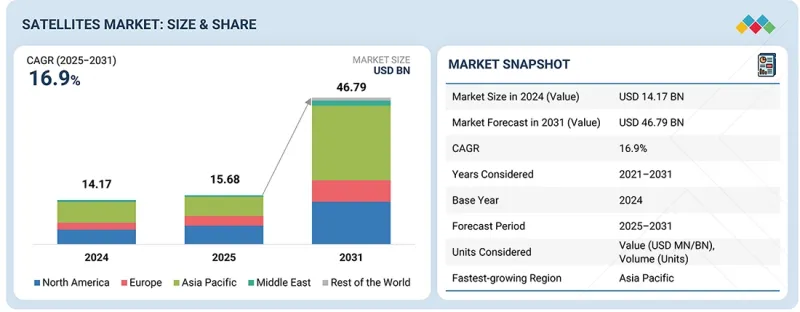
The satellites market is projected to reach USD 46.79 billion by 2031, from USD 15.68 billion in 2025, with a CAGR of 16.9%. In terms of volume, the market is expected to rise from 2,942 units in 2025 to 5,110 units by 2031. The satellites market is expanding as operators continue adding capacity through new launches, constellation expansion, and replacing older satellites.
| Scope of the Report | |
|---|---|
| Years Considered for the Study | 2021-2031 |
| Base Year | 2024 |
| Forecast Period | 2025-2031 |
| Units Considered | Value (USD Billion) |
| Segments | By Mass, Application, Subsystem and Region |
| Regions covered | North America, Europe, APAC, RoW |
Demand is increasing in communication, Earth observation, and navigation, which supports higher satellite volumes. Meanwhile, more commercial players and regional space programs are entering the market, contributing to overall growth.
"The Ku-band is expected to be the fastest-growing frequency segment during the forecast period."
The Ku-band is expected to record the highest CAGR during the forecast period because of its widespread use in satellite communication for broadcasting, broadband internet, and mobility applications such as aviation and maritime connectivity. Ku-band provides a good balance of coverage, available bandwidth, and mature ground infrastructure, making it cost-effective for large-scale deployments. The existing base of terminals and service providers supports continued strong adoption and steady growth.
"Electric is expected to be the largest propulsion technology segment during the forecast period."
The electric segment is expected to be dominant during the forecast period, as more satellites use electric propulsion for station keeping, orbit raising, and constellation missions because it is lighter and more efficient. Electric systems enable operators to carry more payloads per launch and reduce overall launch costs. They also support longer satellite lifespans and require less propellant, which is why many commercial operators are shifting toward electric propulsion.
"North America is expected to hold the second-largest position during the forecast period."
North America is expected to hold the second-largest share of the satellites market through 2031, driven by strong commercial satellite operators and consistent spending on defense and civil space programs. The region leads by deploying communication and Earth observation satellites for broadband, mobility, and data services. Continued investment in next-generation satellite systems like high-throughput platforms and resilient space setups keeps demand steady. A mature launch ecosystem and major satellite manufacturers also help sustain North America's position.
The breakdown of profiles for primary participants in the satellites market is provided below:
- By Company Type: Tier 1 - 30%, Tier 2 - 45%, and Tier 3 - 25%
- By Designation: Directors - 20%, Managers - 10%, and Others - 70%
- By Region: North America - 40%, Europe - 20%, Asia Pacific - 20%, Middle East - 10%, and Rest of the World - 10%
Research Coverage:
This market study covers the satellites market across various segments and subsegments. It aims to estimate the size and growth potential of this market across different regions. The study also provides an in-depth competitive analysis of the key players, their company profiles, important observations about their products and business offerings, recent developments, and the key strategies they have adopted.
Reasons to buy this report:
The report will assist market leaders and new entrants by providing approximations of the revenue figures for the overall satellites market. It will also help stakeholders understand the competitive landscape and gain insights to better position their businesses and develop effective go-to-market strategies. Additionally, the report will provide insights into the market pulse, including key drivers, restraints, challenges, and opportunities.
The report provides insights into the following pointers:
- Market Drivers (Rapid deployment of LEO constellations, Rising demand for Earth observation data, Declining launch and satellite production costs), Restraints (Spectrum allocation and regulatory approvals, Limited availability of space-qualified components), Opportunities (Data-as-a-service business models, Software-defined and reconfigurable satellites, On-orbit servicing and end-of-life solutions), Challenges (Orbital congestion and collision risk, Long-term constellation economics).
- Market Penetration: Comprehensive information on satellites offered by the top players in the market
- Product Development/Innovation: Detailed insights on upcoming technologies, R&D activities, and product launches in the satellites market
- Market Development: Comprehensive information about lucrative markets across varied regions
- Market Diversification: Exhaustive information about new products, untapped geographies, recent developments, and investments in the satellites market
- Competitive Assessment: In-depth assessment of market share, growth strategies, products, and manufacturing capabilities of leading players in the satellites market
TABLE OF CONTENTS
1 INTRODUCTION
- 1.1 STUDY OBJECTIVES
- 1.2 MARKET DEFINITION
- 1.3 STUDY SCOPE
- 1.3.1 MARKET SEGMENTATION & REGIONAL SCOPE
- 1.3.2 INCLUSIONS & EXCLUSIONS
- 1.4 YEARS CONSIDERED
- 1.5 CURRENCY CONSIDERED
- 1.6 STAKEHOLDERS
- 1.7 SUMMARY OF CHANGES
2 EXECUTIVE SUMMARY
- 2.1 KEY INSIGHTS AND MARKET HIGHLIGHTS
- 2.2 KEY MARKET PARTICIPANTS: MAPPING OF STRATEGIC DEVELOPMENTS
- 2.3 HIGH-GROWTH SEGMENTS
- 2.4 REGIONAL SNAPSHOT: MARKET SIZE, GROWTH RATE, AND FORECAST
3 PREMIUM INSIGHTS
- 3.1 ATTRACTIVE OPPORTUNITIES FOR PLAYERS IN SATELLITES MARKET
- 3.2 SATELLITES MARKET, BY SATELLITE MASS
- 3.3 SATELLITES MARKET, BY APPLICATION
- 3.4 SATELLITES MARKET, BY PROPULSION TECHNOLOGY
4 MARKET OVERVIEW
- 4.1 INTRODUCTION
- 4.2 MARKET DYNAMICS
- 4.2.1 DRIVERS
- 4.2.1.1 Rapid deployment of low Earth orbit (LEO) constellations
- 4.2.1.2 Rising demand for Earth observation (EO) data
- 4.2.1.3 Declining launch and satellite production costs
- 4.2.2 RESTRAINTS
- 4.2.2.1 Spectrum allocation and regulatory approvals
- 4.2.2.2 Limited availability of space-qualified components
- 4.2.3 OPPORTUNITIES
- 4.2.3.1 Data-as-a-service business models
- 4.2.3.2 Software-defined and reconfigurable satellites
- 4.2.3.3 On-orbit servicing and end-of-life solutions
- 4.2.4 CHALLENGES
- 4.2.4.1 Orbital congestion and collision risk
- 4.2.4.2 Long-term constellation economics
- 4.2.1 DRIVERS
- 4.3 UNMET NEEDS AND WHITE SPACES
- 4.3.1 INTEGRATED SPACE TRAFFIC MANAGEMENT AND COLLISION AVOIDANCE
- 4.3.2 AFFORDABLE LIFECYCLE MANAGEMENT FOR MID-VALUE SATELLITES
- 4.3.3 GROUND SEGMENT INTEGRATION AND DATA USABILITY GAPS
- 4.3.4 REGULATORY AND SUSTAINABILITY COMPLIANCE SUPPORT
- 4.4 INTERCONNECTED MARKET AND CROSS-SECTOR OPPORTUNITIES
- 4.4.1 INTEGRATION WITH TERRESTRIAL DIGITAL INFRASTRUCTURE
- 4.4.2 GOVERNMENT AND PUBLIC SECTOR DIGITALIZATION
- 4.4.3 ENERGY AND NATURAL RESOURCE MONITORING
- 4.4.4 FINANCIAL SERVICES AND INSURANCE APPLICATIONS
- 4.4.5 MOBILITY AND TRANSPORTATION ECOSYSTEMS
- 4.5 STRATEGIC MOVES BY TIER 1/2/3 PLAYERS
- 4.6 SATELLITES MARKET: VOLUME DATA
5 INDUSTRY TRENDS
- 5.1 INTRODUCTION
- 5.2 MACROECONOMIC INDICATORS
- 5.2.1 INTRODUCTION
- 5.2.2 GDP TRENDS AND FORECAST
- 5.2.3 TRENDS IN GLOBAL SPACE INDUSTRY
- 5.3 VALUE CHAIN ANALYSIS
- 5.4 ECOSYSTEM ANALYSIS
- 5.4.1 PRIME CONTRACTORS & INTEGRATED SATELLITE PROVIDERS
- 5.4.2 SATELLITE PLATFORM & SUBSYSTEM MANUFACTURERS
- 5.4.3 END USERS
- 5.5 TOTAL COST OF OWNERSHIP
- 5.6 BILL OF MATERIALS
- 5.7 TRADE DATA
- 5.7.1 IMPORT SCENARIO (HS CODE 880260)
- 5.7.2 EXPORT SCENARIO (HS CODE 880260)
- 5.8 KEY CONFERENCES & EVENTS, 2026
- 5.9 TRENDS AND DISRUPTIONS IMPACTING CUSTOMER BUSINESS
- 5.10 INVESTMENT AND FUNDING SCENARIO
- 5.11 PRICING ANALYSIS
- 5.11.1 AVERAGE SELLING PRICE TREND, BY REGION, 2021-2024 (USD MILLION)
- 5.11.2 INDICATIVE PRICING ANALYSIS, BY SATELLITE MASS, 2024 (USD MILLION)
- 5.12 CASE STUDIES
6 TECHNOLOGICAL ADVANCEMENTS, AI-DRIVEN IMPACT, PATENTS, INNOVATIONS, AND FUTURE APPLICATIONS
- 6.1 KEY EMERGING TECHNOLOGIES
- 6.1.1 ADVANCED PROPULSION SYSTEMS
- 6.1.2 AUTONOMOUS OPERATIONS AND ONBOARD DECISION-MAKING
- 6.1.3 SPACE SITUATIONAL AWARENESS (SSA) AND THREAT MONITORING PAYLOADS
- 6.2 COMPLEMENTARY TECHNOLOGIES
- 6.2.1 COMMAND-AND-CONTROL SYSTEMS
- 6.2.2 GROUND SEGMENT VIRTUALIZATION AND CLOUD-BASED OPERATIONS
- 6.2.3 TECHNOLOGY ROADMAP
- 6.3 EMERGING TECHNOLOGY TRENDS
- 6.4 PATENT ANALYSIS
- 6.5 FUTURE APPLICATIONS
- 6.6 IMPACT OF AI/ GENERATIVE AI ON SATELLITES MARKET
- 6.6.1 TOP USE CASES AND MARKET POTENTIAL
- 6.6.2 BEST PRACTICES IN THE SATELLITES MARKET
- 6.6.3 CASE STUDIES OF AI IMPLEMENTATION IN SATELLITES MARKET
- 6.6.4 INTERCONNECTED ADJACENT ECOSYSTEM AND IMPACT ON MARKET PLAYERS
- 6.6.5 CLIENTS' READINESS TO ADOPT GENERATIVE AI IN SATELLITES MARKET
- 6.7 SUCCESS STORIES AND REAL-WORLD APPLICATIONS
- 6.7.1 SPACEX - TRANSFORMING GLOBAL CONNECTIVITY THROUGH LARGE-SCALE LEO CONSTELLATIONS
- 6.7.2 AIRBUS DEFENCE AND SPACE - ENABLING MISSION-CRITICAL SATELLITE SYSTEMS ACROSS CIVIL AND DEFENSE DOMAINS
- 6.7.3 MAXAR TECHNOLOGIES - CONVERTING SATELLITE DATA INTO ACTIONABLE GEOSPATIAL INTELLIGENCE
7 CUSTOMER LANDSCAPE & BUYER BEHAVIOR
- 7.1 DECISION-MAKING PROCESS
- 7.2 BUYER STAKEHOLDERS AND BUYING EVALUATION CRITERIA
- 7.2.1 KEY STAKEHOLDERS IN BUYING PROCESS
- 7.2.2 BUYING CRITERIA
- 7.3 ADOPTION BARRIERS & INTERNAL CHALLENGES
8 SUSTAINABILITY AND REGULATORY LANDSCAPE
- 8.1 REGIONAL REGULATIONS AND COMPLIANCE
- 8.1.1 TARIFF DATA
- 8.1.2 REGULATORY BODIES, GOVERNMENT AGENCIES, AND OTHER ORGANIZATIONS
- 8.2 REGULATORY FRAMEWORK
- 8.2.1 NORTH AMERICA
- 8.2.2 EUROPE
- 8.2.3 ASIA PACIFIC
- 8.2.4 MIDDLE EAST
- 8.2.5 LATIN AMERICA AND AFRICA
- 8.2.6 INDUSTRY STANDARDS
- 8.3 SUSTAINABILITY INITIATIVES
- 8.4 SUSTAINABILITY IMPACT AND REGULATORY POLICY INITIATIVES
- 8.5 CERTIFICATIONS, LABELING, AND ECO-STANDARDS
9 SATELLITES MARKET, BY SATELLITE MASS
- 9.1 INTRODUCTION
- 9.2 ORBIT-LEVEL DEPLOYMENT OF SATELLITES BASED ON MASS CATEGORY
- 9.2.1 LOW EARTH ORBIT (LEO) (160-2,000 KM): TOP USE CASES
- 9.2.2 MEDIUM EARTH ORBIT (MEO) (2,000-35,786 KM): TOP USE CASES
- 9.2.3 GEOSTATIONARY ORBIT (GEO) (35,786 KM): TOP USE CASES
- 9.3 SMALL SATELLITES (1-1200 KG)
- 9.3.1 ADVANCEMENTS IN MINIATURIZATION OF ELECTRONICS TO DRIVE MARKET
- 9.3.2 NANOSATELLITE (1-10 KG)
- 9.3.3 MICROSATELLITE (11-100 KG)
- 9.3.4 MINISATELLITE (101-1200 KG)
- 9.4 MEDIUM SATELLITES (1201-2000 KG)
- 9.4.1 NEED FOR TECHNOLOGICAL ADVANCEMENTS TO DRIVE MARKET
- 9.5 LARGE SATELLITES (ABOVE 2000 KG)
- 9.5.1 DEMAND FOR HIGH-CAPACITY TELECOMMUNICATION AND BROADBAND SERVICES TO DRIVE MARKET
10 SATELLITES MARKET, BY SUBSYSTEM
- 10.1 INTRODUCTION
- 10.2 SATELLITE BUS CONFIGURATION OF LOW-COMPLEXITY AND HIGH-CAPABILITY PLATFORMS
- 10.2.1 LOW-COMPLEXITY BUS CONFIGURATIONS (NON-PROPULSION, BASIC ADCS, FIXED ANTENNAS): TOP USE CASES
- 10.2.2 HIGH-CAPABILITY BUS CONFIGURATIONS (PROPULSION-EQUIPPED, HIGH-POWER, PRECISE ADCS): TOP USE CASES
- 10.3 SATELLITE BUS
- 10.3.1 FOCUS ON ENHANCING SATELLITE PERFORMANCE TO DRIVE MARKET
- 10.3.2 ATTITUDE AND ORBITAL CONTROL SYSTEMS
- 10.3.2.1 Sensors
- 10.3.2.1.1 Sun sensors
- 10.3.2.1.2 Magnetometers
- 10.3.2.2 Reaction wheels
- 10.3.2.3 Actuators
- 10.3.2.4 Control electronics
- 10.3.2.1 Sensors
- 10.3.3 COMMAND AND DATA HANDLING SYSTEMS
- 10.3.3.1 Onboard computer
- 10.3.3.2 Processor
- 10.3.3.3 Microcontroller
- 10.3.3.4 Memory
- 10.3.3.5 Solid state recorder
- 10.3.3.6 Router
- 10.3.3.7 On-board charger (OBC) adaptor
- 10.3.4 ELECTRICAL POWER SYSTEMS
- 10.3.4.1 Power management device
- 10.3.4.2 Power converter
- 10.3.4.3 Battery
- 10.3.4.3.1 Primary battery
- 10.3.4.3.2 Secondary battery
- 10.3.5 PROPULSION SYSTEMS
- 10.3.5.1 Thrusters
- 10.3.5.2 Propellant tank
- 10.3.5.3 Propellant feed plumbing
- 10.3.6 TELEMETRY, TRACKING, AND COMMAND SYSTEMS
- 10.3.6.1 Transmitter
- 10.3.6.2 Receiver
- 10.3.6.3 Modem/Baseband unit
- 10.3.7 STRUCTURES
- 10.3.8 THERMAL SYSTEMS
- 10.3.8.1 Temperature sensors
- 10.3.8.2 Heaters
- 10.3.8.3 Thermostats
- 10.3.8.4 Insulation
- 10.4 PAYLOADS
- 10.4.1 PAYLOADS DRIVE SATELLITES' DESIGN AND SUBSYSTEMS
- 10.4.2 TRADITIONAL PAYLOADS
- 10.4.3 SOFTWARE-DEFINED PAYLOADS
- 10.5 SOLAR PANELS
- 10.5.1 NEED FOR ENHANCED EFFICIENCY WITH PHOTOVOLTAIC CELL MATERIALS TO DRIVE MARKET
- 10.6 SATELLITE ANTENNAS
- 10.6.1 ABILITY OF SATELLITE ANTENNAS TO OPERATE IN DIFFERENT FREQUENCIES TO DRIVE DEMAND
- 10.6.2 WIRE ANTENNAS
- 10.6.2.1 Monopole antenna
- 10.6.2.2 Dipole antenna
- 10.6.3 HORN ANTENNAS
- 10.6.4 ARRAY ANTENNAS
- 10.6.5 REFLECTOR ANTENNAS
- 10.6.5.1 Parabolic reflector
- 10.6.5.2 Double reflector
- 10.7 OTHER SYSTEMS
11 SATELLITES MARKET, BY APPLICATION
- 11.1 INTRODUCTION
- 11.2 PAYLOAD TECHNOLOGY USED ACROSS SATELLITE APPLICATIONS
- 11.2.1 SENSING AND IMAGING PAYLOADS (OPTICAL, IR, MULTISPECTRAL, HYPERSPECTRAL, SAR, LIDAR): TOP USE CASES
- 11.2.2 COMMUNICATION PAYLOADS (RF/OPTICAL TRANSPONDERS, IOT/M2M, DATA RELAY, AIS/ADS-B): TOP USE CASES
- 11.2.3 SCIENTIFIC AND MISSION-SUPPORT PAYLOADS (ATMOSPHERIC SENSORS, GNSS-R, PARTICLE DETECTORS, TECH-DEMO PAYLOADS): TOP USE CASES
- 11.3 COMMUNICATION SATELLITES
- 11.3.1 GROWING DEMAND FOR GLOBAL CONNECTIVITY AND RESILIENT COMMUNICATION INFRASTRUCTURE TO DRIVE MARKET
- 11.4 NAVIGATION SATELLITES
- 11.4.1 DEPENDENCE OF CRITICAL INFRASTRUCTURE AND MILITARY OPERATIONS ON PRECISE PNT SERVICES TO DRIVE MARKET
- 11.5 EARTH OBSERVATION SATELLITES
- 11.5.1 RISING NEED FOR REAL-TIME INTELLIGENCE AND DATA-DRIVEN ENVIRONMENTAL MONITORING TO DRIVE MARKET
- 11.6 OTHERS
12 SATELLITES MARKET, BY CUSTOMER TYPE
- 12.1 INTRODUCTION
- 12.2 REGION-WISE GOVERNMENT AND PRIVATE SATELLITE LAUNCH PROGRAMS
- 12.2.1 GOVERNMENT PROGRAMS: TOP USE CASES
- 12.2.2 PRIVATE PROGRAMS: TOP USE CASES
- 12.3 COMMERCIAL
- 12.3.1 SATELLITE OPERATORS/OWNERS
- 12.3.1.1 Rapid deployment of satellite constellations to drive market
- 12.3.2 MEDIA & ENTERTAINMENT COMPANIES
- 12.3.2.1 High demand for fast broadband connectivity from streaming platforms to drive market
- 12.3.3 ENERGY SERVICE PROVIDERS
- 12.3.3.1 Integration of satellite technology to enhance energy-related operations and services to drive market
- 12.3.4 SCIENTIFIC RESEARCH & DEVELOPMENT ORGANIZATIONS
- 12.3.4.1 Untapped potential in space research to drive market
- 12.3.5 OTHERS
- 12.3.1 SATELLITE OPERATORS/OWNERS
- 12.4 GOVERNMENT & CIVIL
- 12.4.1 NATIONAL SPACE AGENCIES
- 12.4.1.1 Need for cost-effective space exploration solutions to drive market
- 12.4.2 SEARCH & RESCUE ENTITIES
- 12.4.2.1 Need for swift and accurate data in emergencies to drive market
- 12.4.3 ACADEMIC & RESEARCH INSTITUTIONS
- 12.4.3.1 Active participation in satellite development to drive market
- 12.4.4 NATIONAL MAPPING & TOPOGRAPHIC AGENCIES
- 12.4.4.1 Emphasis on improving navigation and tracking capabilities to drive market
- 12.4.1 NATIONAL SPACE AGENCIES
- 12.5 DEFENSE
- 12.5.1 RESILIENT AND MISSION-CRITICAL SPACE ARCHITECTURES TO DRIVE MARKET
13 SATELLITES MARKET, BY FREQUENCY
- 13.1 INTRODUCTION
- 13.2 SATELLITE THROUGHPUT CATEGORIES ACROSS DIFFERENT FREQUENCY BANDS
- 13.2.1 LOW THROUGHPUT SATELLITES (1 KBPS-50 MBPS): TOP USE CASES
- 13.2.2 HIGH THROUGHPUT SATELLITES (50 MBPS-100+ GBPS): TOP USE CASES
- 13.3 L-BAND
- 13.3.1 NEED FOR EFFECTIVE SATELLITE COMMUNICATION AND GPS SERVICES TO BOOST GROWTH
- 13.4 S-BAND
- 13.4.1 INCREASING SCIENTIFIC MISSIONS TO DRIVE DEMAND FOR S-BAND SATELLITES
- 13.5 C-BAND
- 13.5.1 ESCALATING DEMAND FOR STEADY COMMUNICATIONS SERVICES FROM DEVELOPING REGIONS TO DRIVE MARKET
- 13.6 X-BAND
- 13.6.1 RISING GEOPOLITICAL TENSIONS TO DRIVE MARKET
- 13.7 KU-K BAND
- 13.7.1 GROWING INTERNET PENETRATION IN SATELLITES TO DRIVE MARKET
- 13.8 KA-BAND
- 13.8.1 NEED FOR BACKHAUL SOLUTIONS WITH EXPANSION OF 5G TO DRIVE MARKET
- 13.9 Q/V/E-BAND
- 13.9.1 ELEVATED DEMAND FOR ULTRA-HIGH-SPEED DATA SERVICES TO DRIVE MARKET
- 13.10 HF/VHF/UHF-BAND
- 13.10.1 NEED FOR WIDE-RANGE COVERAGE TO DRIVE MARKET
- 13.11 LASER/OPTICAL BAND
- 13.11.1 DEVELOPMENT OF LASER COMMUNICATION TECHNOLOGY BY PROMINENT COMPANIES TO DRIVE MARKET
14 SATELLITES MARKET, BY PROPULSION TECHNOLOGY
- 14.1 INTRODUCTION
- 14.2 HIGH-THRUST PROPULSION SYSTEMS (100-2,000 N): TOP USE CASES
- 14.2.1 LOW-THRUST PROPULSION SYSTEMS (MICRO-NEWTON TO < 100 N): TOP USE CASES
- 14.3 CHEMICAL
- 14.3.1 FOCUS ON FAST ORBIT INSERTION AND COLLISION AVOIDANCE TO DRIVE MARKET
- 14.3.1.1 Solid
- 14.3.1.2 Liquid
- 14.3.1.3 Hybrid
- 14.3.1 FOCUS ON FAST ORBIT INSERTION AND COLLISION AVOIDANCE TO DRIVE MARKET
- 14.4 ELECTRIC
- 14.4.1 EFFICIENCY OF ELECTRIC PROPULSION TO DRIVE CONSTELLATION-SCALE DEPLOYMENT OF SATELLITES
- 14.4.1.1 Electrostatic
- 14.4.1.2 Electrothermal
- 14.4.1.3 Electromagnetic
- 14.4.1 EFFICIENCY OF ELECTRIC PROPULSION TO DRIVE CONSTELLATION-SCALE DEPLOYMENT OF SATELLITES
- 14.5 OTHER TECHNOLOGIES
- 14.5.1 SOLAR SAIL
- 14.5.2 COLD GAS/WARM GAS
15 SATELLITES MARKET, BY REGION
- 15.1 INTRODUCTION
- 15.2 NORTH AMERICA
- 15.2.1 US
- 15.2.1.1 Integration of national security objectives with commercial space capabilities to drive market
- 15.2.2 CANADA
- 15.2.2.1 Sovereign Earth observation needs and climate-driven policy mandates to drive market
- 15.2.1 US
- 15.3 ASIA PACIFIC
- 15.3.1 CHINA
- 15.3.1.1 State-led expansion of satellite constellations to drive market
- 15.3.2 INDIA
- 15.3.2.1 Demand for digital connectivity, Earth observation, navigation augmentation, and defense surveillance to drive market
- 15.3.3 JAPAN
- 15.3.3.1 Emphasis on Earth observation, navigation augmentation, and defense-related satellite systems to drive market
- 15.3.4 SOUTH KOREA
- 15.3.4.1 Government funding for satellite development to drive market
- 15.3.5 AUSTRALIA
- 15.3.5.1 Government measures to develop domestic space industry to drive market
- 15.3.1 CHINA
- 15.4 EUROPE
- 15.4.1 RUSSIA
- 15.4.1.1 National security dependence on sovereign space infrastructure to drive market
- 15.4.2 UK
- 15.4.2.1 Commercial satellite services aligned with national resilience objectives to drive market
- 15.4.3 GERMANY
- 15.4.3.1 Emphasis on technological innovation and advanced engineering to drive market
- 15.4.4 FRANCE
- 15.4.4.1 Defense-led satellite modernization and sustained institutional funding to drive market
- 15.4.5 ITALY
- 15.4.5.1 Targeted investments in application-specific missions to drive market
- 15.4.1 RUSSIA
- 15.5 MIDDLE EAST
- 15.5.1 UAE
- 15.5.1.1 National technology leadership and sovereign space capability to drive market
- 15.5.2 SAUDI ARABIA
- 15.5.2.1 Growing investments in satellite infrastructure to drive market
- 15.5.3 REST OF MIDDLE EAST
- 15.5.1 UAE
- 15.6 REST OF THE WORLD (ROW)
- 15.6.1 LATIN AMERICA
- 15.6.1.1 Use of satellites for monitoring and management to drive market
- 15.6.2 AFRICA
- 15.6.2.1 Development-driven demand for data, connectivity, and capacity building to drive market
- 15.6.1 LATIN AMERICA
16 COMPETITIVE LANDSCAPE
- 16.1 INTRODUCTION
- 16.2 KEY PLAYER STRATEGIES/RIGHT TO WIN
- 16.3 REVENUE ANALYSIS, 2021-2024
- 16.4 MARKET SHARE ANALYSIS, 2024
- 16.5 COMPANY EVALUATION MATRIX: KEY PLAYERS, 2025
- 16.5.1 STARS
- 16.5.2 EMERGING LEADERS
- 16.5.3 PERVASIVE PLAYERS
- 16.5.4 PARTICIPANTS
- 16.5.5 COMPANY FOOTPRINT: KEY PLAYERS, 2025
- 16.6 COMPANY EVALUATION MATRIX: STARTUPS/SMES, 2025
- 16.6.1 PROGRESSIVE COMPANIES
- 16.6.2 RESPONSIVE COMPANIES
- 16.6.3 DYNAMIC COMPANIES
- 16.6.4 STARTING BLOCKS
- 16.6.5 COMPETITIVE BENCHMARKING
- 16.7 COMPANY VALUATION AND FINANCIAL METRICS
- 16.8 BRAND/PRODUCT COMPARISON
- 16.9 COMPETITIVE SCENARIO
- 16.9.1 PRODUCT LAUNCHES
- 16.9.2 DEALS
- 16.9.3 OTHER DEVELOPMENTS
17 COMPANY PROFILES
- 17.1 KEY PLAYERS
- 17.1.1 SPACEX
- 17.1.1.1 Business overview
- 17.1.1.2 Products/Solutions/Services offered
- 17.1.1.3 Recent developments
- 17.1.1.3.1 Deals
- 17.1.1.3.2 Other developments
- 17.1.1.4 MnM view
- 17.1.1.4.1 Right to win
- 17.1.1.4.2 Strategic choices
- 17.1.1.4.3 Weaknesses & competitive threats
- 17.1.2 LOCKHEED MARTIN CORPORATION
- 17.1.2.1 Business overview
- 17.1.2.2 Products/Solutions/Services offered
- 17.1.2.3 Recent developments
- 17.1.2.3.1 Deals
- 17.1.2.3.2 Other developments
- 17.1.2.4 MnM view
- 17.1.2.4.1 Right to win
- 17.1.2.4.2 Strategic choices
- 17.1.2.4.3 Weaknesses & competitive threats
- 17.1.3 AIRBUS
- 17.1.3.1 Business overview
- 17.1.3.2 Products/Solutions/Services offered
- 17.1.3.3 Recent developments
- 17.1.3.3.1 Product launches
- 17.1.3.3.2 Deals
- 17.1.3.3.3 Other developments
- 17.1.3.4 MnM view
- 17.1.3.4.1 Right to win
- 17.1.3.4.2 Strategic choices
- 17.1.3.4.3 Weaknesses & competitive threats
- 17.1.4 NORTHROP GRUMMAN
- 17.1.4.1 Business overview
- 17.1.4.2 Products/Solutions/Services offered
- 17.1.4.3 Recent developments
- 17.1.4.3.1 Deals
- 17.1.4.3.2 Other developments
- 17.1.4.4 MnM view
- 17.1.4.4.1 Right to win
- 17.1.4.4.2 Strategic choices
- 17.1.4.4.3 Weaknesses & competitive threats
- 17.1.5 THALES ALENIA SPACE
- 17.1.5.1 Business overview
- 17.1.5.2 Products/Solutions/Services offered
- 17.1.5.3 Recent developments
- 17.1.5.3.1 Deals
- 17.1.5.3.2 Other developments
- 17.1.5.4 MnM view
- 17.1.5.4.1 Right to win
- 17.1.5.4.2 Strategic choices
- 17.1.5.4.3 Weaknesses & competitive threats
- 17.1.6 L3HARRIS TECHNOLOGIES, INC.
- 17.1.6.1 Business overview
- 17.1.6.2 Products/Solutions/Services offered
- 17.1.6.3 Recent developments
- 17.1.6.3.1 Deals
- 17.1.6.3.2 Other developments
- 17.1.7 MDA SPACE
- 17.1.7.1 Business overview
- 17.1.7.2 Products/Solutions/Services offered
- 17.1.7.3 Recent developments
- 17.1.7.3.1 Other developments
- 17.1.8 PLANET LABS PBC
- 17.1.8.1 Business overview
- 17.1.8.2 Products/Solutions/Services offered
- 17.1.8.3 Recent developments
- 17.1.8.3.1 Product launches
- 17.1.8.3.2 Deals
- 17.1.8.3.3 Other developments
- 17.1.9 SNC
- 17.1.9.1 Business overview
- 17.1.9.2 Products/Solutions/Services offered
- 17.1.9.3 Recent developments
- 17.1.9.3.1 Other developments
- 17.1.10 LANTERIS SPACE SYSTEMS
- 17.1.10.1 Business overview
- 17.1.10.2 Products/Solutions/Services offered
- 17.1.10.3 Recent developments
- 17.1.10.3.1 Deals
- 17.1.10.3.2 Other developments
- 17.1.11 MITSUBISHI ELECTRIC CORPORATION
- 17.1.11.1 Business overview
- 17.1.11.2 Products/Solutions/Services offered
- 17.1.11.3 Recent developments
- 17.1.11.3.1 Deals
- 17.1.11.3.2 Other developments
- 17.1.12 RTX
- 17.1.12.1 Business overview
- 17.1.12.2 Products/Solutions/Services offered
- 17.1.12.3 Recent developments
- 17.1.12.3.1 Other developments
- 17.1.13 OHB SE
- 17.1.13.1 Business overview
- 17.1.13.2 Products/Solutions/Services offered
- 17.1.13.3 Recent developments
- 17.1.13.3.1 Deals
- 17.1.13.3.2 Other developments
- 17.1.14 BOEING
- 17.1.14.1 Business overview
- 17.1.14.2 Products/Solutions/Services offered
- 17.1.14.3 Recent developments
- 17.1.14.3.1 Other developments
- 17.1.15 YORK SPACE SYSTEMS
- 17.1.15.1 Business overview
- 17.1.15.2 Products/Solutions/Services offered
- 17.1.15.3 Recent developments
- 17.1.15.3.1 Other developments
- 17.1.16 SURREY SATELLITE TECHNOLOGY LTD.
- 17.1.16.1 Business overview
- 17.1.16.2 Products/Solutions/Services offered
- 17.1.16.3 Recent developments
- 17.1.16.3.1 Deals
- 17.1.1 SPACEX
- 17.2 OTHER PLAYERS
- 17.2.1 AEROSPACELAB
- 17.2.2 ENDUROSAT
- 17.2.3 NANOAVIONICS
- 17.2.4 ASTRANIS
- 17.2.5 ICEYE
- 17.2.6 PIXXEL
- 17.2.7 FLEET SPACE TECHNOLOGIES PTY LTD
- 17.2.8 AMAZON LEO
- 17.2.9 ALEN SPACE
- 17.2.10 SKYKRAFT PTY LTD
- 17.2.11 ARGOTEC S.R.L.
18 RESEARCH METHODOLOGY
- 18.1 RESEARCH DATA
- 18.1.1 SECONDARY DATA
- 18.1.1.1 Key data from secondary sources
- 18.1.2 PRIMARY DATA
- 18.1.2.1 Primary sources
- 18.1.2.2 Key data from primary sources
- 18.1.2.3 Breakdown of primary interviews
- 18.1.1 SECONDARY DATA
- 18.2 FACTOR ANALYSIS
- 18.2.1 INTRODUCTION
- 18.2.2 DEMAND-SIDE INDICATORS
- 18.2.3 SUPPLY-SIDE INDICATORS
- 18.3 MARKET SIZE ESTIMATION
- 18.3.1 BOTTOM-UP APPROACH
- 18.3.1.1 Market size estimation methodology (demand side)
- 18.3.2 TOP-DOWN APPROACH
- 18.3.1 BOTTOM-UP APPROACH
- 18.4 DATA TRIANGULATION
- 18.5 RESEARCH ASSUMPTIONS
- 18.6 RESEARCH LIMITATIONS
- 18.7 RISK ASSESSMENT
19 APPENDIX
- 19.1 DISCUSSION GUIDE
- 19.2 KNOWLEDGESTORE: MARKETSANDMARKETS' SUBSCRIPTION PORTAL
- 19.3 CUSTOMIZATION OPTIONS
- 19.4 RELATED REPORTS
- 19.5 AUTHOR DETAILS
List of Tables
- TABLE 1 USD EXCHANGE RATES, 2021-2024
- TABLE 2 KEY UNMET NEEDS AND WHITE SPACES IN SATELLITES MARKET
- TABLE 3 CROSS-SECTOR OPPORTUNITY MATRIX
- TABLE 4 STRATEGIC MOVES BY TIER 1/2/3 PLAYERS
- TABLE 5 SATELLITES MARKET, BY SATELLITE MASS, 2021-2024 (UNITS)
- TABLE 6 GDP PERCENTAGE CHANGE, BY KEY COUNTRY, 2021-2029
- TABLE 7 ROLE OF COMPANIES IN ECOSYSTEM
- TABLE 8 TOTAL COST OF OWNERSHIP: SMALL VS. MEDIUM VS. LARGE SATELLITES
- TABLE 9 AVERAGE TOTAL COST OF OWNERSHIP FOR SATELLITES, BY SATELLITE MASS (USD MILLION)
- TABLE 10 BILL OF MATERIALS ANALYSIS FOR SATELLITES
- TABLE 11 COMPARISON OF BILL OF MATERIALS FOR SATELLITES
- TABLE 12 IMPORT DATA FOR HS CODE 880260-COMPLIANT PRODUCTS, BY COUNTRY, 2020-2024 (USD THOUSAND)
- TABLE 13 EXPORT DATA FOR HS CODE 880260-COMPLIANT PRODUCTS, BY COUNTRY, 2020-2024 (USD THOUSAND)
- TABLE 14 KEY CONFERENCES & EVENTS, 2026
- TABLE 15 AVERAGE SELLING PRICE TREND, BY REGION, 2021-2024 (USD MILLION)
- TABLE 16 INDICATIVE PRICING, BY SATELLITE MASS, 2024 (USD MILLION)
- TABLE 17 VIASAT (US) DEPLOYED HIGH-CAPACITY GEOSTATIONARY COMMUNICATION SATELLITES DESIGNED FOR BROADBAND-INTENSIVE APPLICATIONS
- TABLE 18 MAXAR TECHNOLOGIES (US) OPERATED FLEET OF HIGH-RESOLUTION EARTH OBSERVATION SATELLITES CAPABLE OF CAPTURING DETAILED IMAGERY WITH FREQUENT REVISIT RATES
- TABLE 19 US SPACE FORCE'S GPS DEPLOYED CONSTELLATION OF NAVIGATION SATELLITES, PROVIDING CONTINUOUS GLOBAL COVERAGE
- TABLE 20 LIST OF MAJOR PATENTS FOR SATELLITES, 2024-2025
- TABLE 21 GLOBAL BROADBAND AND DIRECT-TO-DEVICE CONNECTIVITY
- TABLE 22 PERSISTENT EARTH OBSERVATION AND REAL-TIME INTELLIGENCE
- TABLE 23 SPACE-BASED NAVIGATION, TIMING, AND RESILIENCE SERVICES
- TABLE 24 TOP USE CASES AND MARKET POTENTIAL
- TABLE 25 BEST PRACTICES: COMPANIES IMPLEMENTING USE CASES
- TABLE 26 SATELLITES MARKET: CASE STUDIES RELATED TO GENERATIVE AI IMPLEMENTATION
- TABLE 27 INTERCONNECTED ADJACENT ECOSYSTEM AND IMPACT ON MARKET PLAYERS
- TABLE 28 INFLUENCE OF STAKEHOLDERS ON BUYING PROCESS FOR SATELLITES, BY CUSTOMER TYPE (%)
- TABLE 29 KEY BUYING CRITERIA FOR SATELLITES MARKET, BY CUSTOMER TYPE
- TABLE 30 NORTH AMERICA: REGULATORY BODIES, GOVERNMENT AGENCIES, AND OTHER ORGANIZATIONS
- TABLE 31 EUROPE: REGULATORY BODIES, GOVERNMENT AGENCIES, AND OTHER ORGANIZATIONS
- TABLE 32 ASIA PACIFIC: REGULATORY BODIES, GOVERNMENT AGENCIES, AND OTHER ORGANIZATIONS
- TABLE 33 MIDDLE EAST: REGULATORY BODIES, GOVERNMENT AGENCIES, AND OTHER ORGANIZATIONS
- TABLE 34 REST OF THE WORLD: REGULATORY BODIES, GOVERNMENT AGENCIES, AND OTHER ORGANIZATIONS
- TABLE 35 CERTIFICATIONS, LABELING, AND ECO-STANDARDS IN SATELLITES MARKET
- TABLE 36 SATELLITES MARKET, BY SATELLITE MASS, 2021-2024 (USD MILLION)
- TABLE 37 SATELLITES MARKET, BY SATELLITE MASS, 2025-2031 (USD MILLION)
- TABLE 38 SATELLITES MARKET, BY SUBSYSTEM, 2021-2024 (USD MILLION)
- TABLE 39 SATELLITES MARKET, BY SUBSYSTEM, 2025-2031 (USD MILLION)
- TABLE 40 SATELLITES MARKET, BY SATELLITE BUS, 2021-2024 (USD MILLION)
- TABLE 41 SATELLITES MARKET, BY SATELLITE BUS, 2025-2031 (USD MILLION)
- TABLE 42 SATELLITES MARKET, BY ATTITUDE AND ORBITAL CONTROL SYSTEM, 2021-2024 (USD MILLION)
- TABLE 43 SATELLITES MARKET, BY ATTITUDE AND ORBITAL CONTROL SYSTEM, 2025-2031 (USD MILLION)
- TABLE 44 SATELLITES MARKET, BY SENSOR, 2021-2024 (USD MILLION)
- TABLE 45 SATELLITES MARKET, BY SENSOR, 2025-2031 (USD MILLION)
- TABLE 46 SATELLITES MARKET, BY COMMAND AND DATA HANDLING SYSTEM, 2021-2024 (USD MILLION)
- TABLE 47 SATELLITES MARKET, BY COMMAND AND DATA HANDLING SYSTEM, 2025-2031 (USD MILLION)
- TABLE 48 SATELLITES MARKET, BY ELECTRICAL POWER SYSTEM, 2021-2024 (USD MILLION)
- TABLE 49 SATELLITES MARKET, BY ELECTRICAL POWER SYSTEM, 2025-2031 (USD MILLION)
- TABLE 50 SATELLITES MARKET, BY BATTERY, 2021-2024 (USD MILLION)
- TABLE 51 SATELLITES MARKET, BY BATTERY, 2025-2031 (USD MILLION)
- TABLE 52 SATELLITES MARKET, BY PROPULSION SYSTEM, 2021-2024 (USD MILLION)
- TABLE 53 SATELLITES MARKET, BY PROPULSION SYSTEM, 2025-2031 (USD MILLION)
- TABLE 54 SATELLITES MARKET, BY TELEMETRY, TRACKING, AND COMMAND SYSTEM, 2021-2024 (USD MILLION)
- TABLE 55 SATELLITES MARKET, BY TELEMETRY, TRACKING, AND COMMAND SYSTEM, 2025-2031 (USD MILLION)
- TABLE 56 SATELLITES MARKET, BY THERMAL SYSTEM, 2021-2024 (USD MILLION)
- TABLE 57 SATELLITES MARKET, BY THERMAL SYSTEM, 2025-2031 (USD MILLION)
- TABLE 58 SATELLITES MARKET, BY PAYLOAD, 2021-2024 (USD MILLION)
- TABLE 59 SATELLITES MARKET, BY PAYLOAD, 2025-2031 (USD MILLION)
- TABLE 60 SATELLITES MARKET, BY SATELLITE ANTENNA, 2021-2024 (USD MILLION)
- TABLE 61 SATELLITES MARKET, BY SATELLITE ANTENNA, 2025-2031 (USD MILLION)
- TABLE 62 SATELLITES MARKET, BY WIRE ANTENNA, 2021-2024 (USD MILLION)
- TABLE 63 SATELLITES MARKET, BY WIRE ANTENNA, 2025-2031 (USD MILLION)
- TABLE 64 SATELLITES MARKET, BY REFLECTOR ANTENNA, 2021-2024 (USD MILLION)
- TABLE 65 SATELLITES MARKET, BY REFLECTOR ANTENNA, 2025-2031 (USD MILLION)
- TABLE 66 SATELLITES MARKET, BY APPLICATION, 2021-2024 (USD MILLION)
- TABLE 67 SATELLITES MARKET, BY APPLICATION, 2025-2031 (USD MILLION)
- TABLE 68 SATELLITES MARKET, BY CUSTOMER TYPE, 2021-2024 (USD MILLION)
- TABLE 69 SATELLITES MARKET, BY CUSTOMER TYPE, 2025-2031 (USD MILLION)
- TABLE 70 SATELLITES MARKET, BY FREQUENCY, 2021-2024 (USD MILLION)
- TABLE 71 SATELLITES MARKET, BY FREQUENCY, 2025-2031 (USD MILLION)
- TABLE 72 SATELLITES MARKET, BY PROPULSION TECHNOLOGY, 2021-2024 (USD MILLION)
- TABLE 73 SATELLITES MARKET, BY PROPULSION TECHNOLOGY, 2025-2031 (USD MILLION)
- TABLE 74 SATELLITES MARKET, BY REGION, 2021-2024 (USD MILLION)
- TABLE 75 SATELLITES MARKET, BY REGION, 2025-2031 (USD MILLION)
- TABLE 76 SATELLITES MARKET, BY REGION, 2021-2024 (UNITS)
- TABLE 77 SATELLITES MARKET, BY REGION, 2025-2031 (UNITS)
- TABLE 78 NORTH AMERICA: SATELLITES MARKET, BY SATELLITE MASS, 2021-2024 (USD MILLION)
- TABLE 79 NORTH AMERICA: SATELLITES MARKET, BY SATELLITE MASS, 2025-2031 (USD MILLION)
- TABLE 80 NORTH AMERICA: SATELLITES MARKET, BY APPLICATION, 2021-2024 (USD MILLION)
- TABLE 81 NORTH AMERICA: SATELLITES MARKET, BY APPLICATION, 2025-2031 (USD MILLION)
- TABLE 82 NORTH AMERICA: SATELLITES MARKET, BY COUNTRY, 2021-2024 (USD MILLION)
- TABLE 83 NORTH AMERICA: SATELLITES MARKET, BY COUNTRY, 2025-2031 (USD MILLION)
- TABLE 84 NORTH AMERICA: SATELLITES MARKET, BY SATELLITE MASS, 2021-2024 (UNITS)
- TABLE 85 NORTH AMERICA: SATELLITES MARKET, BY SATELLITE MASS, 2025-2031 (UNITS)
- TABLE 86 NORTH AMERICA: SATELLITES MARKET, BY APPLICATION, 2021-2024 (UNITS)
- TABLE 87 NORTH AMERICA: SATELLITES MARKET, BY APPLICATION, 2025-2031 (UNITS)
- TABLE 88 NORTH AMERICA: SATELLITES MARKET, BY COUNTRY, 2021-2024 (UNITS)
- TABLE 89 NORTH AMERICA: SATELLITES MARKET, BY COUNTRY, 2025-2031 (UNITS)
- TABLE 90 US: SATELLITES MARKET, BY SATELLITE MASS, 2021-2024 (UNITS)
- TABLE 91 US: SATELLITES MARKET, BY SATELLITE MASS, 2025-2031 (UNITS)
- TABLE 92 US: SATELLITES MARKET, BY APPLICATION, 2021-2024 (UNITS)
- TABLE 93 US: SATELLITES MARKET, BY APPLICATION, 2025-2031 (UNITS)
- TABLE 94 CANADA: SATELLITES MARKET, BY SATELLITE MASS, 2021-2024 (UNITS)
- TABLE 95 CANADA: SATELLITES MARKET, BY SATELLITE MASS, 2025-2031 (UNITS)
- TABLE 96 CANADA: SATELLITES MARKET, BY APPLICATION, 2021-2024 (UNITS)
- TABLE 97 CANADA: SATELLITES MARKET, BY APPLICATION, 2025-2031 (UNITS)
- TABLE 98 ASIA PACIFIC: SATELLITES MARKET, BY SATELLITE MASS, 2021-2024 (USD MILLION)
- TABLE 99 ASIA PACIFIC: SATELLITES MARKET, BY SATELLITE MASS, 2025-2031 (USD MILLION)
- TABLE 100 ASIA PACIFIC: SATELLITES MARKET, BY APPLICATION, 2021-2024 (USD MILLION)
- TABLE 101 ASIA PACIFIC: SATELLITES MARKET, BY APPLICATION, 2025-2031 (USD MILLION)
- TABLE 102 ASIA PACIFIC: SATELLITES MARKET, BY COUNTRY, 2021-2024 (USD MILLION)
- TABLE 103 ASIA PACIFIC: SATELLITES MARKET, BY COUNTRY, 2025-2031 (USD MILLION)
- TABLE 104 ASIA PACIFIC: SATELLITES MARKET, BY SATELLITE MASS, 2021-2024 (UNITS)
- TABLE 105 ASIA PACIFIC: SATELLITES MARKET, BY SATELLITE MASS, 2025-2031 (UNITS)
- TABLE 106 ASIA PACIFIC: SATELLITES MARKET, BY APPLICATION, 2021-2024 (UNITS)
- TABLE 107 ASIA PACIFIC: SATELLITES MARKET, BY APPLICATION, 2025-2031 (UNITS)
- TABLE 108 ASIA PACIFIC: SATELLITES MARKET, BY COUNTRY, 2021-2024 (UNITS)
- TABLE 109 ASIA PACIFIC: SATELLITES MARKET, BY COUNTRY, 2025-2031 (UNITS)
- TABLE 110 CHINA: SATELLITES MARKET, BY SATELLITE MASS, 2021-2024 (UNITS)
- TABLE 111 CHINA: SATELLITES MARKET, BY SATELLITE MASS, 2025-2031 (UNITS)
- TABLE 112 CHINA: SATELLITES MARKET, BY APPLICATION, 2021-2024 (UNITS)
- TABLE 113 CHINA: SATELLITES MARKET, BY APPLICATION, 2025-2031 (UNITS)
- TABLE 114 INDIA: SATELLITES MARKET, BY SATELLITE MASS, 2021-2024 (UNITS)
- TABLE 115 INDIA: SATELLITES MARKET, BY SATELLITE MASS, 2025-2031 (UNITS)
- TABLE 116 INDIA: SATELLITES MARKET, BY APPLICATION, 2021-2024 (UNITS)
- TABLE 117 INDIA: SATELLITES MARKET, BY APPLICATION, 2025-2031 (UNITS)
- TABLE 118 JAPAN: SATELLITES MARKET, BY SATELLITE MASS, 2021-2024 (UNITS)
- TABLE 119 JAPAN: SATELLITES MARKET, BY SATELLITE MASS, 2025-2031 (UNITS)
- TABLE 120 JAPAN: SATELLITES MARKET, BY APPLICATION, 2021-2024 (UNITS)
- TABLE 121 JAPAN: SATELLITES MARKET, BY APPLICATION, 2025-2031 (UNITS)
- TABLE 122 SOUTH KOREA: SATELLITES MARKET, BY SATELLITE MASS, 2021-2024 (UNITS)
- TABLE 123 SOUTH KOREA: SATELLITES MARKET, BY SATELLITE MASS, 2025-2031 (UNITS)
- TABLE 124 SOUTH KOREA: SATELLITES MARKET, BY APPLICATION, 2021-2024 (UNITS)
- TABLE 125 SOUTH KOREA: SATELLITES MARKET, BY APPLICATION, 2025-2031 (UNITS)
- TABLE 126 AUSTRALIA: SATELLITES MARKET, BY SATELLITE MASS, 2021-2024 (UNITS)
- TABLE 127 AUSTRALIA: SATELLITES MARKET, BY SATELLITE MASS, 2025-2031 (UNITS)
- TABLE 128 AUSTRALIA: SATELLITES MARKET, BY APPLICATION, 2021-2024 (UNITS)
- TABLE 129 AUSTRALIA: SATELLITES MARKET, BY APPLICATION, 2025-2031 (UNITS)
- TABLE 130 EUROPE: SATELLITES MARKET, BY SATELLITE MASS, 2021-2024 (USD MILLION)
- TABLE 131 EUROPE: SATELLITES MARKET, BY SATELLITE MASS, 2025-2031 (USD MILLION)
- TABLE 132 EUROPE: SATELLITES MARKET, BY APPLICATION, 2021-2024 (USD MILLION)
- TABLE 133 EUROPE: SATELLITES MARKET, BY APPLICATION, 2025-2031 (USD MILLION)
- TABLE 134 EUROPE: SATELLITES MARKET, BY COUNTRY, 2021-2024 (USD MILLION)
- TABLE 135 EUROPE: SATELLITES MARKET, BY COUNTRY, 2025-2031 (USD MILLION)
- TABLE 136 EUROPE: SATELLITES MARKET, BY SATELLITE MASS, 2021-2024 (UNITS)
- TABLE 137 EUROPE: SATELLITES MARKET, BY SATELLITE MASS, 2025-2031 (UNITS)
- TABLE 138 EUROPE: SATELLITES MARKET, BY APPLICATION, 2021-2024 (UNITS)
- TABLE 139 EUROPE: SATELLITES MARKET, BY APPLICATION, 2025-2031 (UNITS)
- TABLE 140 EUROPE: SATELLITES MARKET, BY COUNTRY, 2021-2024 (UNITS)
- TABLE 141 EUROPE: SATELLITES MARKET, BY COUNTRY, 2025-2031 (UNITS)
- TABLE 142 RUSSIA: SATELLITES MARKET, BY SATELLITE MASS, 2021-2024 (UNITS)
- TABLE 143 RUSSIA: SATELLITES MARKET, BY SATELLITE MASS, 2025-2031 (UNITS)
- TABLE 144 RUSSIA: SATELLITES MARKET, BY APPLICATION, 2021-2024 (UNITS)
- TABLE 145 RUSSIA: SATELLITES MARKET, BY APPLICATION, 2025-2031 (UNITS)
- TABLE 146 UK: SATELLITES MARKET, BY SATELLITE MASS, 2021-2024 (UNITS)
- TABLE 147 UK: SATELLITES MARKET, BY SATELLITE MASS, 2025-2031 (UNITS)
- TABLE 148 UK: SATELLITES MARKET, BY APPLICATION, 2021-2024 (UNITS)
- TABLE 149 UK: SATELLITES MARKET, BY APPLICATION, 2025-2031 (UNITS)
- TABLE 150 GERMANY: SATELLITES MARKET, BY SATELLITE MASS, 2021-2024 (UNITS)
- TABLE 151 GERMANY: SATELLITES MARKET, BY SATELLITE MASS, 2025-2031 (UNITS)
- TABLE 152 GERMANY: SATELLITES MARKET, BY APPLICATION, 2021-2024 (UNITS)
- TABLE 153 GERMANY: SATELLITES MARKET, BY APPLICATION, 2025-2031 (UNITS)
- TABLE 154 FRANCE: SATELLITES MARKET, BY SATELLITE MASS, 2021-2024 (UNITS)
- TABLE 155 FRANCE: SATELLITES MARKET, BY SATELLITE MASS, 2025-2031 (UNITS)
- TABLE 156 FRANCE: SATELLITES MARKET, BY APPLICATION, 2021-2024 (UNITS)
- TABLE 157 FRANCE: SATELLITES MARKET, BY APPLICATION, 2025-2031 (UNITS)
- TABLE 158 ITALY: SATELLITES MARKET, BY SATELLITE MASS, 2021-2024 (UNITS)
- TABLE 159 ITALY: SATELLITES MARKET, BY SATELLITE MASS, 2025-2031 (UNITS)
- TABLE 160 ITALY: SATELLITES MARKET, BY APPLICATION, 2021-2024 (UNITS)
- TABLE 161 ITALY: SATELLITES MARKET, BY APPLICATION, 2025-2031 (UNITS)
- TABLE 162 MIDDLE EAST: SATELLITES MARKET, BY SATELLITE MASS, 2021-2024 (USD MILLION)
- TABLE 163 MIDDLE EAST: SATELLITES MARKET, BY SATELLITE MASS, 2025-2031 (USD MILLION)
- TABLE 164 MIDDLE EAST: SATELLITES MARKET, BY APPLICATION, 2021-2024 (USD MILLION)
- TABLE 165 MIDDLE EAST: SATELLITES MARKET, BY APPLICATION, 2025-2031 (USD MILLION)
- TABLE 166 MIDDLE EAST: SATELLITES MARKET, BY COUNTRY, 2021-2024 (USD MILLION)
- TABLE 167 MIDDLE EAST: SATELLITES MARKET, BY COUNTRY, 2025-2031 (USD MILLION)
- TABLE 168 MIDDLE EAST: SATELLITES MARKET, BY SATELLITE MASS, 2021-2024 (UNITS)
- TABLE 169 MIDDLE EAST: SATELLITES MARKET, BY SATELLITE MASS, 2025-2031 (UNITS)
- TABLE 170 MIDDLE EAST: SATELLITES MARKET, BY APPLICATION, 2021-2024 (UNITS)
- TABLE 171 MIDDLE EAST: SATELLITES MARKET, BY APPLICATION, 2025-2031 (UNITS)
- TABLE 172 MIDDLE EAST: SATELLITES MARKET, BY COUNTRY, 2021-2024 (UNITS)
- TABLE 173 MIDDLE EAST: SATELLITES MARKET, BY COUNTRY, 2025-2031 (UNITS)
- TABLE 174 UAE: SATELLITES MARKET, BY SATELLITE MASS, 2021-2024 (UNITS)
- TABLE 175 UAE: SATELLITES MARKET, BY SATELLITE MASS, 2025-2031 (UNITS)
- TABLE 176 UAE: SATELLITES MARKET, BY APPLICATION, 2021-2024 (UNITS)
- TABLE 177 UAE: SATELLITES MARKET, BY APPLICATION, 2025-2031 (UNITS)
- TABLE 178 SAUDI ARABIA: SATELLITES MARKET, BY SATELLITE MASS, 2021-2024 (UNITS)
- TABLE 179 SAUDI ARABIA: SATELLITES MARKET, BY SATELLITE MASS, 2025-2031 (UNITS)
- TABLE 180 SAUDI ARABIA: SATELLITES MARKET, BY APPLICATION, 2021-2024 (UNITS)
- TABLE 181 SAUDI ARABIA: SATELLITES MARKET, BY APPLICATION, 2025-2031 (UNITS)
- TABLE 182 REST OF MIDDLE EAST: SATELLITES MARKET, BY SATELLITE MASS, 2021-2024 (UNITS)
- TABLE 183 REST OF MIDDLE EAST: SATELLITES MARKET, BY SATELLITE MASS, 2025-2031 (UNITS)
- TABLE 184 REST OF MIDDLE EAST: SATELLITES MARKET, BY APPLICATION, 2021-2024 (UNITS)
- TABLE 185 REST OF MIDDLE EAST: SATELLITES MARKET, BY APPLICATION, 2025-2031 (UNITS)
- TABLE 186 REST OF THE WORLD: SATELLITES MARKET, BY SATELLITE MASS, 2021-2024 (USD MILLION)
- TABLE 187 REST OF THE WORLD: SATELLITES MARKET, BY SATELLITE MASS, 2025-2031 (USD MILLION)
- TABLE 188 REST OF THE WORLD: SATELLITES MARKET, BY APPLICATION, 2021-2024 (USD MILLION)
- TABLE 189 REST OF THE WORLD: SATELLITES MARKET, BY APPLICATION, 2025-2031 (USD MILLION)
- TABLE 190 REST OF THE WORLD: SATELLITES MARKET, BY REGION, 2021-2024 (USD MILLION)
- TABLE 191 REST OF THE WORLD: SATELLITES MARKET, BY REGION, 2025-2031 (USD MILLION)
- TABLE 192 REST OF THE WORLD: SATELLITES MARKET, BY SATELLITE MASS, 2021-2024 (UNITS)
- TABLE 193 REST OF THE WORLD: SATELLITES MARKET, BY SATELLITE MASS, 2025-2031 (UNITS)
- TABLE 194 REST OF THE WORLD: SATELLITES MARKET, BY APPLICATION, 2021-2024 (UNITS)
- TABLE 195 REST OF THE WORLD: SATELLITES MARKET, BY APPLICATION, 2025-2031 (UNITS)
- TABLE 196 REST OF THE WORLD: SATELLITES MARKET, BY REGION, 2021-2024 (UNITS)
- TABLE 197 REST OF THE WORLD: SATELLITES MARKET, BY REGION, 2025-2031 (UNITS)
- TABLE 198 LATIN AMERICA: SATELLITES MARKET, BY SATELLITE MASS, 2021-2024 (UNITS)
- TABLE 199 LATIN AMERICA: SATELLITES MARKET, BY SATELLITE MASS, 2025-2031 (UNITS)
- TABLE 200 LATIN AMERICA: SATELLITES MARKET, BY APPLICATION, 2021-2024 (UNITS)
- TABLE 201 LATIN AMERICA: SATELLITES MARKET, BY APPLICATION, 2025-2031 (UNITS)
- TABLE 202 AFRICA: SATELLITES MARKET, BY SATELLITE MASS, 2021-2024 (UNITS)
- TABLE 203 AFRICA: SATELLITES MARKET, BY SATELLITE MASS, 2025-2031 (UNITS)
- TABLE 204 AFRICA: SATELLITES MARKET, BY APPLICATION, 2021-2024 (UNITS)
- TABLE 205 AFRICA: SATELLITES MARKET, BY APPLICATION, 2025-2031 (UNITS)
- TABLE 206 KEY PLAYER STRATEGIES/RIGHT TO WIN, 2021-2025
- TABLE 207 SATELLITES MARKET: DEGREE OF COMPETITION
- TABLE 208 VOLUME BREAKDOWN OF SATELLITES LAUNCHED, 2024
- TABLE 209 CUSTOMER TYPE FOOTPRINT
- TABLE 210 APPLICATION FOOTPRINT
- TABLE 211 SATELLITE MASS FOOTPRINT
- TABLE 212 SUBSYSTEM FOOTPRINT
- TABLE 213 FREQUENCY FOOTPRINT
- TABLE 214 REGION FOOTPRINT
- TABLE 215 LIST OF STARTUPS/SMES
- TABLE 216 COMPETITIVE BENCHMARKING OF STARTUPS/SMES
- TABLE 217 SATELLITES MARKET: PRODUCT LAUNCHES, JANUARY 2020- JANUARY 2026
- TABLE 218 SATELLITES MARKET: DEALS, JANUARY 2020- JANUARY 2026
- TABLE 219 SATELLITES MARKET: OTHER DEVELOPMENTS, JANUARY 2020- JANUARY 2026
- TABLE 220 SPACEX: COMPANY OVERVIEW
- TABLE 221 SPACEX: PRODUCTS/SOLUTIONS/SERVICES OFFERED
- TABLE 222 SPACEX: DEALS
- TABLE 223 SPACEX: OTHER DEVELOPMENTS
- TABLE 224 LOCKHEED MARTIN CORPORATION: COMPANY OVERVIEW
- TABLE 225 LOCKHEED MARTIN CORPORATION: PRODUCTS/SOLUTIONS/SERVICES OFFERED
- TABLE 226 LOCKHEED MARTIN CORPORATION: DEALS
- TABLE 227 LOCKHEED MARTIN CORPORATION: OTHER DEVELOPMENTS
- TABLE 228 AIRBUS: COMPANY OVERVIEW
- TABLE 229 AIRBUS: PRODUCTS/SOLUTIONS/SERVICES OFFERED
- TABLE 230 AIRBUS: PRODUCT LAUNCHES
- TABLE 231 AIRBUS: DEALS
- TABLE 232 AIRBUS: OTHER DEVELOPMENTS
- TABLE 233 NORTHROP GRUMMAN: COMPANY OVERVIEW
- TABLE 234 NORTHROP GRUMMAN: PRODUCTS/SOLUTIONS/SERVICES OFFERED
- TABLE 235 NORTHROP GRUMMAN: DEALS
- TABLE 236 NORTHROP GRUMMAN: OTHER DEVELOPMENTS
- TABLE 237 THALES ALENIA SPACE: COMPANY OVERVIEW
- TABLE 238 THALES ALENIA SPACE: PRODUCTS/SOLUTIONS/SERVICES OFFERED
- TABLE 239 THALES ALENIA SPACE: DEALS
- TABLE 240 THALES ALENIA SPACE: OTHER DEVELOPMENTS
- TABLE 241 L3HARRIS TECHNOLOGIES, INC.: COMPANY OVERVIEW
- TABLE 242 L3HARRIS TECHNOLOGIES, INC.: PRODUCTS/SOLUTIONS/SERVICES OFFERED
- TABLE 243 L3HARRIS TECHNOLOGIES, INC.: DEALS
- TABLE 244 L3HARRIS TECHNOLOGIES, INC.: OTHER DEVELOPMENTS
- TABLE 245 MDA SPACE: COMPANY OVERVIEW
- TABLE 246 MDA SPACE: PRODUCTS/SOLUTIONS/SERVICES OFFERED
- TABLE 247 MDA SPACE: OTHER DEVELOPMENTS
- TABLE 248 PLANET LABS PBC: COMPANY OVERVIEW
- TABLE 249 PLANET LABS PBC: PRODUCTS/SOLUTIONS/SERVICES OFFERED
- TABLE 250 PLANET LABS PBC: PRODUCT LAUNCHES
- TABLE 251 PLANET LABS PBC: DEALS
- TABLE 252 PLANET LABS PBC: OTHER DEVELOPMENTS
- TABLE 253 SNC: COMPANY OVERVIEW
- TABLE 254 SNC: PRODUCTS/SOLUTIONS/SERVICES OFFERED
- TABLE 255 SNC: OTHER DEVELOPMENTS
- TABLE 256 LANTERIS SPACE SYSTEMS: COMPANY OVERVIEW
- TABLE 257 LANTERIS SPACE SYSTEMS: PRODUCTS/SOLUTIONS/SERVICES OFFERED
- TABLE 258 LANTERIS SPACE SYSTEMS: DEALS
- TABLE 259 LANTERIS SPACE SYSTEMS: OTHER DEVELOPMENTS
- TABLE 260 MITSUBISHI ELECTRIC CORPORATION: COMPANY OVERVIEW
- TABLE 261 MITSUBISHI ELECTRIC CORPORATION: PRODUCTS/SOLUTIONS/ SERVICES OFFERED
- TABLE 262 MITSUBISHI ELECTRIC CORPORATION: DEALS
- TABLE 263 MITSUBISHI ELECTRIC CORPORATION: OTHER DEVELOPMENTS
- TABLE 264 RTX: COMPANY OVERVIEW
- TABLE 265 RTX: PRODUCTS/SOLUTIONS/SERVICES OFFERED
- TABLE 266 RTX: OTHER DEVELOPMENTS
- TABLE 267 OHB SE: COMPANY OVERVIEW
- TABLE 268 OHB SE: PRODUCTS/SOLUTIONS/SERVICES OFFERED
- TABLE 269 OHB SE: DEALS
- TABLE 270 OHB SE: OTHER DEVELOPMENTS
- TABLE 271 BOEING: COMPANY OVERVIEW
- TABLE 272 BOEING: PRODUCTS/SOLUTIONS/SERVICES OFFERED
- TABLE 273 BOEING: OTHER DEVELOPMENTS
- TABLE 274 YORK SPACE SYSTEMS: COMPANY OVERVIEW
- TABLE 275 YORK SPACE SYSTEMS: PRODUCTS/SOLUTIONS/SERVICES OFFERED
- TABLE 276 YORK SPACE SYSTEMS: OTHER DEVELOPMENTS
- TABLE 277 SURREY SATELLITE TECHNOLOGY LTD.: COMPANY OVERVIEW
- TABLE 278 SURREY SATELLITE TECHNOLOGY LTD.: PRODUCTS/SOLUTIONS/ SERVICES OFFERED
- TABLE 279 SURREY SATELLITE TECHNOLOGY LTD.: PRODUCT LAUNCHES
- TABLE 280 SURREY SATELLITE TECHNOLOGY LTD.: DEALS
- TABLE 281 AEROSPACELAB: COMPANY OVERVIEW
- TABLE 282 ENDUROSAT: COMPANY OVERVIEW
- TABLE 283 NANOAVIONICS: COMPANY OVERVIEW
- TABLE 284 ASTRANIS: COMPANY OVERVIEW
- TABLE 285 ICEYE: COMPANY OVERVIEW
- TABLE 286 PIXXEL: COMPANY OVERVIEW
- TABLE 287 FLEET SPACE TECHNOLOGIES PTY LTD: COMPANY OVERVIEW
- TABLE 288 AMAZON LEO: COMPANY OVERVIEW
- TABLE 289 ALEN SPACE: COMPANY OVERVIEW
- TABLE 290 SKYKRAFT PTY LTD: COMPANY OVERVIEW
- TABLE 291 ARGOTEC S.R.L.: COMPANY OVERVIEW
List of Figures
- FIGURE 1 MARKET SCENARIO
- FIGURE 2 GLOBAL SATELLITES MARKET, 2021-2031
- FIGURE 3 MAJOR STRATEGIES ADOPTED BY KEY PLAYERS IN SATELLITES MARKET
- FIGURE 4 HIGH-GROWTH SEGMENTS IN SATELLITES MARKET
- FIGURE 5 ASIA PACIFIC TO BE LARGEST REGIONAL MARKET DURING FORECAST PERIOD
- FIGURE 6 NEED FOR HIGH-CAPACITY, SECURE, AND LOW-LATENCY SPACE-BASED DATA TRANSFER TO DRIVE SATELLITES MARKET
- FIGURE 7 SMALL SATELLITES SEGMENT TO ACCOUNT FOR LARGEST SHARE BY 2031
- FIGURE 8 COMMUNICATION SATELLITES SEGMENT TO EXHIBIT FASTEST GROWTH DURING FORECAST PERIOD
- FIGURE 9 ELECTRIC SEGMENT ACCOUNTED FOR LARGEST SHARE IN 2025
- FIGURE 10 SATELLITES MARKET: DRIVERS, RESTRAINTS, OPPORTUNITIES, AND CHALLENGES
- FIGURE 11 VALUE CHAIN ANALYSIS
- FIGURE 12 ECOSYSTEM ANALYSIS
- FIGURE 13 BREAKDOWN OF TOTAL COST OF OWNERSHIP
- FIGURE 14 OVERALL COST OF OWNERSHIP FOR DIFFERENT SATELLITE PLATFORMS
- FIGURE 15 BILL OF MATERIALS FOR LARGE SATELLITES
- FIGURE 16 BILL OF MATERIALS FOR MEDIUM SATELLITES
- FIGURE 17 BILL OF MATERIALS FOR SMALL SATELLITES
- FIGURE 18 IMPORT DATA FOR HS CODE 880260-COMPLIANT PRODUCTS, BY COUNTRY, 2020-2024 (USD THOUSAND)
- FIGURE 19 EXPORT DATA FOR HS CODE 880260-COMPLIANT PRODUCTS, BY COUNTRY, 2020-2024 (USD THOUSAND)
- FIGURE 20 TRENDS AND DISRUPTIONS IMPACTING CUSTOMER BUSINESS
- FIGURE 21 INVESTMENT & FUNDING SCENARIO, 2021-2025
- FIGURE 22 AVERAGE SELLING PRICE TREND, BY REGION, 2021-2024 (USD MILLION)
- FIGURE 23 INDICATIVE PRICING, BY SATELLITE MASS, 2024 (USD MILLION)
- FIGURE 24 TECHNOLOGY ROADMAP (2020-2035)
- FIGURE 25 EMERGING TECHNOLOGY TRENDS
- FIGURE 26 PATENT ANALYSIS, 2015-2025
- FIGURE 27 FUTURE APPLICATIONS
- FIGURE 28 SATELLITES MARKET: IMPACT OF AI/GENERATIVE AI
- FIGURE 29 SATELLITES MARKET: DECISION-MAKING FACTORS
- FIGURE 30 INFLUENCE OF STAKEHOLDERS ON BUYING PROCESS, BY CUSTOMER TYPE
- FIGURE 31 KEY BUYING CRITERIA FOR SATELLITES, BY CUSTOMER TYPE
- FIGURE 32 ADOPTION BARRIERS & INTERNAL CHALLENGES
- FIGURE 33 SATELLITES MARKET, BY SATELLITE MASS, 2025-2031 (USD MILLION)
- FIGURE 34 SATELLITES MARKET, BY SUBSYSTEM, 2025-2031 (USD MILLION)
- FIGURE 35 SATELLITES MARKET, BY APPLICATION, 2025-2031 (USD MILLION)
- FIGURE 36 SATELLITES MARKET, BY CUSTOMER TYPE, 2025-2031 (USD MILLION)
- FIGURE 37 SATELLITES MARKET, BY FREQUENCY, 2025-2031 (USD MILLION)
- FIGURE 38 SATELLITES MARKET, BY PROPULSION TECHNOLOGY, 2025-2031 (USD MILLION)
- FIGURE 39 SATELLITES MARKET, BY REGION, 2025-2031
- FIGURE 40 NORTH AMERICA: SATELLITES MARKET SNAPSHOT
- FIGURE 41 ASIA PACIFIC: SATELLITES MARKET SNAPSHOT
- FIGURE 42 EUROPE: SATELLITES MARKET SNAPSHOT
- FIGURE 43 MIDDLE EAST: SATELLITES MARKET SNAPSHOT
- FIGURE 44 REST OF THE WORLD: SATELLITES MARKET SNAPSHOT
- FIGURE 45 REVENUE ANALYSIS OF TOP FOUR PLAYERS, 2021-2024 (USD MILLION)
- FIGURE 46 MARKET SHARE ANALYSIS OF KEY PLAYERS, 2024
- FIGURE 47 VOLUME ANALYSIS OF SATELLITES LAUNCHED, 2024
- FIGURE 48 SATELLITES MARKET: COMPANY EVALUATION MATRIX (KEY PLAYERS), 2025
- FIGURE 49 COMPANY FOOTPRINT
- FIGURE 50 SATELLITES MARKET: COMPANY EVALUATION MATRIX (STARTUPS/SMES), 2025
- FIGURE 51 COMPANY VALUATION, 2025
- FIGURE 52 EV/EBITDA, 2025
- FIGURE 53 BRAND/PRODUCT COMPARISON
- FIGURE 54 LOCKHEED MARTIN CORPORATION: COMPANY SNAPSHOT
- FIGURE 55 AIRBUS: COMPANY SNAPSHOT
- FIGURE 56 NORTHROP GRUMMAN: COMPANY SNAPSHOT
- FIGURE 57 L3HARRIS TECHNOLOGIES, INC.: COMPANY SNAPSHOT
- FIGURE 58 MDA SPACE: COMPANY SNAPSHOT
- FIGURE 59 PLANET LABS PBC: COMPANY SNAPSHOT
- FIGURE 60 MITSUBISHI ELECTRIC CORPORATION: COMPANY SNAPSHOT
- FIGURE 61 RTX: COMPANY SNAPSHOT
- FIGURE 62 OHB SE: COMPANY SNAPSHOT
- FIGURE 63 BOEING: COMPANY SNAPSHOT
- FIGURE 64 RESEARCH DESIGN MODEL
- FIGURE 65 RESEARCH DESIGN
- FIGURE 66 BOTTOM-UP APPROACH
- FIGURE 67 TOP-DOWN APPROACH
- FIGURE 68 DATA TRIANGULATION

