PUBLISHER: MarketsandMarkets | PRODUCT CODE: 1979421

PUBLISHER: MarketsandMarkets | PRODUCT CODE: 1979421
Chemiluminescence Immunoassay Market by Product (Instruments, Consumables), Technology (CLEIA, ECLI, Microparticle CLIA), Sample Type (Blood, Saliva), Application (Oncology, Cardiology), End User (Hospital, Clinical Laboratory) - Global Forecast to 2031
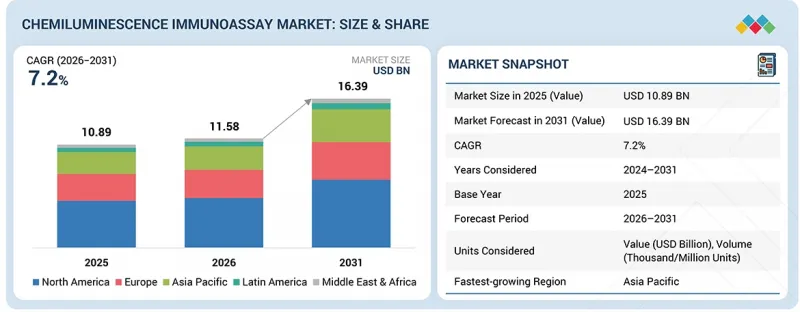
The chemiluminescence immunoassay market is projected to reach USD 16.39 billion by 2031 from USD 11.58 billion in 2026, at a CAGR of 7.2% from 2026 to 2031.
| Scope of the Report | |
|---|---|
| Years Considered for the Study | 2024-2031 |
| Base Year | 2025 |
| Forecast Period | 2025-2031 |
| Units Considered | Value (USD billion) |
| Segments | Product type, technology, sample type, application, end user, and region |
| Regions covered | North America, Europe, APAC, LATAM, MEA |
The global market for CLIA testing systems is growing as people need accurate diagnostic tests to identify chronic and infectious diseases, including cancer, cardiovascular disorders, thyroid diseases, and viral infections. The increasing need for early disease detection, together with preventive healthcare approaches, leads to greater use of CLIA testing because it provides excellent sensitivity and a wide testing range and can identify trace amounts of biomarkers. The development of automated high-throughput testing systems, together with more stable testing materials and the ability to conduct multiple tests simultaneously, has improved laboratory productivity while decreasing testing duration. The market growth benefits from improved healthcare facilities, expanded testing laboratory systems, and increased medical expenditures that emerging markets are experiencing. The rising importance of biomarker testing for personalized medicine, drug development, and clinical research, together with strict blood screening regulations and health checkup awareness, boosts the need for CLIA systems in hospitals and reference laboratories throughout the world.
"Based on the product, the consumables segment is expected to grow at the highest CAGR in the CLIA market."
The consumables segment of the CLIA market is growing because diagnostic testing requires laboratories to use reagents, calibrators, controls, and reaction vessels multiple times throughout their workday. Assay kits and reagent packs that hospitals and reference laboratories use daily see increased demand because infectious disease tests, oncology marker tests, cardiac biomarker tests, endocrine disorder tests, and therapeutic drug monitoring tests are being performed more frequently. Consumables require continuous replacement, which generates ongoing revenue while driving market growth, in contrast to analyzers. The adoption of new technologies that enhance reagent stability and ready-to-use product development and extended shelf-life capabilities leads to higher operational efficiency and lower material waste in laboratory workflows. The expansion of automated high-throughput CLIA systems, together with increased preventive health screening programs, higher blood safety testing, and expanded test menu options, is driving up consumables consumption, which makes this segment a key driver of overall CLIA market expansion.
"Based on application, the oncology segment is expected to grow with the highest CAGR in the CLIA market."
The CLIA market in oncology applications shows growth because cancer cases are increasing worldwide, and there is greater demand for early diagnosis, prognosis evaluation, and treatment assessment. CLIA technology enables the detection of tumor markers through highly sensitive and specific methods, which include PSA, CA-125, CEA, AFP, and HER2 as diagnostic tools for initial patient evaluation and progress assessment of their medical condition. The rise in biomarker-based testing and precision oncology practices has created a need for dependable immunoassays, which assist in determining targeted therapies and individualized treatment options. The clinical use of CLIA tests has grown because these tests now help doctors monitor patient treatment response, identify cancer recurrences, and assess patients who have a high risk of developing cancer. The introduction of better assay systems, which enhance test sensitivity through automated processes and multiplex testing features, will continue to drive businesses toward adopting CLIA systems in their cancer diagnostic processes.
"Based on the end user, the hospitals segment is expected to grow by the highest CAGR in the CLIA market."
Hospitals need to conduct accurate tests for various medical conditions, including cardiac markers, sepsis indicators, cancer biomarkers, hormone levels, and infectious pathogens. The CLIA systems enable emergency departments, intensive care units, and inpatient services to start treatment without delay through their advanced sensitivity, extensive testing capabilities, and quick result delivery. The move to centralized diagnostic systems, together with automated diagnostic machines, helps hospitals to cut down on manual tasks while achieving better operational results through standardized processes. The worldwide implementation of CLIA analyzers and assays in hospital systems accelerates because hospitals expand their facilities, and preventive health screening programs become more popular, accreditation and quality standards increase, and hospitals need complete laboratory information systems.
"APAC is estimated to register the highest CAGR during the forecast period."
The CLIA market in the Asia Pacific region is growing due to three factors: expanding healthcare, rising healthcare spending, and improved distribution of diagnostic services in countries such as China, India, and Southeast Asia. The rising need for precise early diagnostic tests results from the increasing incidence of chronic illnesses, infectious diseases, and conditions linked to lifestyle choices. The government modernization projects, which include hospital upgrades, laboratory automation, and the development of a national screening program, accelerate the implementation of high-throughput CLIA systems. The demand for advanced immunoassay technologies grows due to three factors, which include increasing public knowledge about preventive healthcare, expanding private diagnostic laboratory networks, and rising medical tourism. The regional growth of the market benefits from three factors, which include a large patient base, better insurance access, and the market's shift toward automated laboratory systems that manage high testing loads. The widespread implementation of CLIA platforms throughout APAC results from two factors, which include ongoing international diagnostic company expansion and the rise of affordable domestic manufacturers.
Key players in the CLIA market
The key players in the market include F. Hoffmann-La Roche Ltd. (Switzerland), Abbott Laboratories (US), Siemens Healthineers (Germany), Danaher Corporation (US), DiaSorin S.p.A. (Italy), QuidelOrtho Corporation (US), Sysmex Corporation (Japan), Shenzhen New Industry Biomedical Engineering Co., Ltd. (SNIBE Diagnostics) (China), Tosoh Corporation (Japan), Werfen (Spain), Bio-Rad Laboratories, Inc. (US), Shenzhen Mindray Biomedical Electronics Co., Ltd. (China), Fujirebio (Japan), HUMAN Gesellschaft fur Biochemica und Diagnostica mbH. (Germany), EUROIMMUN Medizinische Labordiagnostika AG (Germany), Agappe Diagnostics Ltd (India), Zecen Biotech Co., Ltd (China), Maccura Biotechnology Co., Ltd (China), Autobio Diagnostics Co., Ltd. (China), Artron Laboratories Inc.(Canada), Abnova Corporation (Taiwan), Beijing Hotgen Biotech Co., Ltd (China), and Shanghai Kehua Bio-Engineering Co., Ltd. (China).
Research Coverage:
The report analyzes the CLIA market and aims at estimating the market size and future growth potential of this market based on various segments such as product type, sample type, technology, application, and end user. The report also includes a product portfolio matrix of various CLIA available in the market. The report also provides a competitive analysis of the key players in this market, along with their company profiles, product offerings, and key market strategies.
Reasons to Buy the Report
The report will help the market leaders/new entrants in this market with information on the closest approximations of the revenue numbers for the overall CLIA market and the subsegments. This report will help stakeholders understand the competitive landscape and gain more insights to position their businesses better and plan suitable go-to-market strategies. The report also helps stakeholders understand the pulse of the market and provides them with information on key market drivers, restraints, challenges, and opportunities.
This report provides insights into the following pointers:
- Analysis of key drivers (increasing incidences of chronic and infectious diseases globally, advancements in improving CLIA technologies in recent years, rapid increase in geriatric population globally, growth of biotechnology and biopharmaceutical industries), restraints (high cost associated with placement and maintenance of CLIA, product recalls and failures), challenges (shortage of skilled professionals, risks associated with CLIAs), and opportunities (growth potential in emerging economies)
- Product Enhancement/Innovation: Comprehensive details about new product launches and anticipated trends in the global CLIA market
- Product Development/Innovation: Detailed insights on upcoming trends, research & development activities, and new product launches in the global CLIA market
- Market Development: Comprehensive information on the lucrative emerging markets by product type, technology, sample type, application, and end user
- Market Diversification: Exhaustive information about new products and services or product and service enhancements, growing geographies, recent developments, and investments in the global CLIA market
- Competitive Assessment: Thorough evaluation of the market shares, growth plans, offerings of products and services, and capacities of the major competitors in the global CLIA market
TABLE OF CONTENTS
1 INTRODUCTION
- 1.1 STUDY OBJECTIVES
- 1.2 MARKET DEFINITION
- 1.3 STUDY SCOPE
- 1.3.1 MARKETS COVERED & REGIONAL SCOPE
- 1.3.2 INCLUSIONS & EXCLUSIONS
- 1.3.3 YEARS CONSIDERED
- 1.3.4 CURRENCY CONSIDERED
- 1.3.5 UNITS CONSIDERED
- 1.4 STAKEHOLDERS
- 1.5 SUMMARY OF CHANGES
2 EXECUTIVE SUMMARY
- 2.1 MARKET HIGHLIGHTS & KEY INSIGHTS
- 2.2 KEY MARKET PARTICIPANTS: MAPPING OF STRATEGIC DEVELOPMENTS
- 2.3 DISRUPTIVE TRENDS IN CHEMILUMINESCENCE IMMUNOASSAY (CLIA) MARKET
- 2.4 HIGH-GROWTH SEGMENTS
- 2.5 REGIONAL SNAPSHOT: MARKET SIZE, GROWTH RATE, AND FORECAST
3 PREMIUM INSIGHTS
- 3.1 CHEMILUMINESCENCE IMMUNOASSAY OVERVIEW
- 3.2 ASIA PACIFIC CHEMILUMINESCENCE IMMUNOASSAY, BY PRODUCT AND COUNTRY
- 3.3 CHEMILUMINESCENCE IMMUNOASSAY: DEVELOPED MARKETS VS. EMERGING ECONOMIES
- 3.4 CHEMILUMINESCENCE IMMUNOASSAY: GEOGRAPHIC GROWTH OPPORTUNITIES
- 3.5 CHEMILUMINESCENCE IMMUNOASSAY: REGIONAL MIX
4 MARKET OVERVIEW
- 4.1 INTRODUCTION
- 4.2 MARKET DYNAMICS
- 4.2.1 DRIVERS
- 4.2.1.1 Increasing incidence of chronic and infectious diseases globally
- 4.2.1.2 Advancements in chemiluminescence immunoassay technologies in recent years
- 4.2.1.3 Rapid increase in geriatric population globally
- 4.2.1.4 Growth of biotechnology and biopharmaceutical industries
- 4.2.2 RESTRAINTS
- 4.2.2.1 High cost of chemiluminescence systems and reagents
- 4.2.2.2 Lack of regular quality control procedures for monitoring and detecting cross-reactivity and interference
- 4.2.3 OPPORTUNITIES
- 4.2.3.1 High growth prospects for players in emerging economies
- 4.2.3.2 Increasing number of collaborations and partnerships
- 4.2.4 CHALLENGES
- 4.2.4.1 Unfavorable reimbursement scenario and budgetary constraints in healthcare systems
- 4.2.4.2 Lack of skilled professionals and aging workforce
- 4.2.1 DRIVERS
- 4.3 UNMET NEEDS & WHITE SPACES
- 4.4 INTERCONNECTED MARKETS & CROSS-SECTOR OPPORTUNITIES
- 4.4.1 INTERCONNECTED MARKETS
- 4.4.2 CROSS-SECTOR OPPORTUNITIES
- 4.5 STRATEGIC MOVES BY TIER-1/2/3 PLAYERS
5 INDUSTRY TRENDS
- 5.1 PORTER'S FIVE FORCES ANALYSIS
- 5.1.1 THREAT OF NEW ENTRANTS
- 5.1.2 THREAT OF SUBSTITUTES
- 5.1.3 BARGAINING POWER OF SUPPLIERS
- 5.1.4 BARGAINING POWER OF BUYERS
- 5.1.5 INTENSITY OF COMPETITIVE RIVALRY
- 5.2 MACROECONOMIC INDICATORS
- 5.2.1 INTRODUCTION
- 5.2.2 GDP TRENDS & FORECAST
- 5.2.3 TRENDS IN GLOBAL HEALTHCARE INDUSTRY
- 5.2.4 TRENDS IN GLOBAL MEDICAL DEVICE INDUSTRY
- 5.3 VALUE CHAIN ANALYSIS
- 5.4 SUPPLY CHAIN ANALYSIS
- 5.5 ECOSYSTEM ANALYSIS
- 5.6 PRICING ANALYSIS
- 5.6.1 AVERAGE SELLING PRICE TREND OF CHEMILUMINESCENCE IMMUNOASSAY ANALYZERS, BY KEY PLAYER, 2023-2025 (USD)
- 5.6.2 AVERAGE SELLING PRICE TREND OF CHEMILUMINESCENCE IMMUNOASSAY ANALYZERS, BY REGION, 2023-2025 (USD)
- 5.6.3 AVERAGE SELLING PRICE TREND OF CHEMILUMINESCENCE IMMUNOASSAY ANALYZERS, BY TECHNOLOGY, 2023-2025 (USD)
- 5.6.4 AVERAGE SELLING PRICE TREND OF CHEMILUMINESCENCE IMMUNOASSAY CONSUMABLES (KITS, REAGENTS, AND OTHERS), BY SAMPLE TYPE, 2023-2025 (USD)
- 5.7 TRADE ANALYSIS
- 5.7.1 IMPORT DATA FOR HS CODE 9027.89, 2021-2025
- 5.7.2 EXPORT DATA FOR HS CODE 9027.89, 2021-2025
- 5.8 KEY CONFERENCES & EVENTS, 2026-2027
- 5.9 TRENDS/DISRUPTIONS IMPACTING CUSTOMERS' BUSINESSES
- 5.10 INVESTMENT & FUNDING SCENARIO
- 5.11 CASE STUDY ANALYSIS
- 5.11.1 CASE STUDY 1: ROCHE COBAS CLIA DRIVES HIGH-VOLUME TESTING PERFORMANCE
- 5.11.2 CASE STUDY 2: ABBOTT ARCHITECT DRIVES REGIONAL MULTI-CENTER LAB EXPANSION
- 5.11.3 CASE STUDY 3: SIEMENS ADVIA CENTAUR XP BOOSTS GOVERNMENT LAB TESTING EFFICIENCY
- 5.12 IMPACT OF 2025 US TARIFFS ON CHEMILUMINESCENCE IMMUNOASSAY MARKET
- 5.12.1 INTRODUCTION
- 5.12.2 KEY TARIFF RATES
- 5.12.3 PRICE IMPACT ANALYSIS
- 5.12.4 IMPACT ON COUNTRIES/REGIONS
- 5.12.4.1 US
- 5.12.4.2 Europe
- 5.12.4.3 Asia Pacific
- 5.12.5 IMPACT ON END-USE INDUSTRIES
- 5.12.5.1 Hospitals
- 5.12.5.2 Clinical laboratories
- 5.12.5.3 Pharmaceutical & biotechnology companies and contract research organizations
6 STRATEGIC DISRUPTIONS THROUGH TECHNOLOGY, PATENTS, AND DIGITAL & AI ADOPTION
- 6.1 TECHNOLOGY ANALYSIS
- 6.1.1 KEY EMERGING TECHNOLOGIES
- 6.1.1.1 Nano-engineered chemiluminescent labels
- 6.1.1.2 Digital immunoassay platforms
- 6.1.2 COMPLEMENTARY TECHNOLOGIES
- 6.1.2.1 Bead-based & microarray chemiluminescence
- 6.1.2.2 Integration with microfluidic platforms
- 6.1.3 ADJACENT TECHNOLOGIES
- 6.1.3.1 Enzyme-linked immunosorbent assay (ELISA)
- 6.1.1 KEY EMERGING TECHNOLOGIES
- 6.2 TECHNOLOGY/PRODUCT ROADMAP
- 6.3 PATENT ANALYSIS
- 6.3.1 INSIGHTS ON PATENT PUBLICATION TRENDS, TOP APPLICANTS, AND JURISDICTION FOR CHEMILUMINESCENCE IMMUNOASSAY MARKET, JANUARY 2015-SEPTEMBER 2025
- 6.3.2 LIST OF MAJOR PATENTS, 2022-2025
- 6.4 FUTURE APPLICATIONS
- 6.4.1 PERSONALIZED & PRECISION MEDICINE
- 6.4.2 REMOTE MONITORING & DECENTRALIZED TESTING
- 6.4.3 PREDICTIVE DIAGNOSTICS & CLINICAL DECISION SUPPORT
- 6.4.4 INTEGRATION WITH DIGITAL HEALTH ECOSYSTEMS
- 6.4.5 NEXT-GENERATION BIOMARKER DISCOVERY & MULTIPLEX TESTING
- 6.5 IMPACT OF GEN AI ON CHEMILUMINESCENCE IMMUNOASSAY MARKET
- 6.5.1 IMPACT OF AI/GEN AI ON INTERCONNECTED & ADJACENT ECOSYSTEMS
- 6.6 SUCCESS STORIES AND REAL-WORLD APPLICATIONS
- 6.6.1 IMPROVED OUTCOMES IN CRITICAL CARE & EMERGENCY DIAGNOSTICS
- 6.6.2 PUBLIC HEALTH SCREENING & INFECTIOUS DISEASE CONTROL
- 6.6.3 ENDOCRINOLOGY & CHRONIC DISEASE MANAGEMENT
- 6.6.4 ONCOLOGY DIAGNOSTICS & THERAPY MONITORING
- 6.6.5 MATERNAL & NEONATAL SCREENING PROGRAMS
- 6.6.6 DECENTRALIZED & MID-VOLUME LABORATORY ADOPTION
- 6.6.7 REAL-WORLD IMPACT
7 SUSTAINABILITY & REGULATORY LANDSCAPE
- 7.1 REGULATORY LANDSCAPE
- 7.1.1 REGULATORY BODIES, GOVERNMENT AGENCIES, AND OTHER ORGANIZATIONS
- 7.1.2 INDUSTRY STANDARDS
- 7.1.2.1 ISO 15189 - Quality & competence requirements for medical laboratories
- 7.1.2.2 CLSI Guidelines (Clinical & Laboratory Standards Institute) - Immunoassay performance & validation
- 7.1.2.3 ISO 13485 - Quality management systems for IVD manufacturers
- 7.1.2.4 ISO 17511 - Metrological traceability of calibrators & control materials
- 7.2 SUSTAINABILITY INITIATIVES
- 7.2.1 REAGENT PACKAGING REDUCTION & RECYCLABLE MATERIALS (INDUSTRY INITIATIVES)
- 7.2.2 ENERGY-EFFICIENT & LOW-WASTE ANALYZER OPERATIONS
- 7.2.3 LABORATORY WASTE MANAGEMENT & GREEN LAB PROGRAMS
- 7.3 CERTIFICATIONS, LABELING, AND ECO-STANDARDS
- 7.3.1 CERTIFICATIONS & LABELING STANDARDS
- 7.3.2 ECO-STANDARDS & SUSTAINABILITY CONSIDERATIONS
8 CUSTOMER LANDSCAPE & BUYER BEHAVIOR
- 8.1 DECISION-MAKING PROCESS
- 8.2 KEY STAKEHOLDERS & BUYING CRITERIA
- 8.2.1 KEY STAKEHOLDERS IN BUYING PROCESS
- 8.2.1.1 Influence of stakeholders on buying process for product types
- 8.2.2 BUYING CRITERIA
- 8.2.1 KEY STAKEHOLDERS IN BUYING PROCESS
- 8.3 ADOPTION BARRIERS & INTERNAL CHALLENGES
- 8.4 UNMET NEEDS IN VARIOUS END-USE SETTINGS
- 8.5 MARKET PROFITABILITY
- 8.5.1 REVENUE POTENTIAL
- 8.5.2 COST DYNAMICS
- 8.5.3 MARGIN OPPORTUNITIES IN KEY APPLICATIONS
9 CHEMILUMINESCENCE IMMUNOASSAY MARKET, BY PRODUCT TYPE
- 9.1 INTRODUCTION
- 9.2 CONSUMABLES
- 9.2.1 CONSUMABLES TO ACCOUNT FOR LARGEST MARKET SHARE DURING STUDY PERIOD
- 9.3 INSTRUMENTS
- 9.3.1 INCREASING ADVANCES WITH HIGH-THROUGHPUT CAPACITIES AND GROWING AUTOMATION TRENDS TO DRIVE MARKET
10 CHEMILUMINESCENCE IMMUNOASSAY MARKET, BY TECHNOLOGY
- 10.1 INTRODUCTION
- 10.2 CHEMILUMINESCENCE ENZYME IMMUNOASSAYS
- 10.2.1 HIGH RELIABILITY OF BLOOD TESTS IN CLINICAL DIAGNOSTICS AND PHARMACEUTICAL RESEARCH TO DRIVE MARKET
- 10.3 ELECTROCHEMILUMINESCENCE IMMUNOASSAYS
- 10.3.1 RISING DEMAND FOR HIGH-SENSITIVITY CARDIAC AND ONCOLOGY BIOMARKERS TO DRIVE MARKET
- 10.4 MICROPARTICLE CHEMILUMINESCENCE IMMUNOASSAYS
- 10.4.1 SUPERIOR SENSITIVITY AND EARLY DISEASE DETECTION TO DRIVE MARKET GROWTH
11 CHEMILUMINESCENCE IMMUNOASSAY MARKET, BY SAMPLE TYPE
- 11.1 INTRODUCTION
- 11.2 BLOOD
- 11.2.1 RELIABILITY OF BLOOD TESTS FOR IMMUNOASSAY DIAGNOSTIC PROCEDURES AND HEALTH SCREENING TO DRIVE MARKET
- 11.3 URINE
- 11.3.1 INCREASING USE IN LAW ENFORCEMENT AND DRUG TESTING CENTERS TO DRIVE MARKET
- 11.4 SALIVA
- 11.4.1 CONVENIENCE AND EASY TESTING OF BIOLOGICALLY ACTIVE PARTS OF HORMONES TO DRIVE MARKET
- 11.5 OTHER SAMPLE TYPES
12 CHEMILUMINESCENCE IMMUNOASSAY MARKET, BY APPLICATION
- 12.1 INTRODUCTION
- 12.2 INFECTIOUS DISEASES
- 12.2.1 RISING PREVALENCE OF INFECTIOUS DISEASES TO DRIVE MARKET
- 12.3 ENDOCRINOLOGY
- 12.3.1 RISING INCIDENCES OF DIABETES TO PROPEL DEMAND FOR DIAGNOSTICS
- 12.4 ONCOLOGY
- 12.4.1 RISING BURDEN OF CANCER AND EMPHASIS ON EARLY DISEASE DIAGNOSIS TO DRIVE MARKET
- 12.5 CARDIOLOGY
- 12.5.1 HIGH BURDEN OF CARDIOVASCULAR DISEASES AMONG ALL AGE GROUPS TO DRIVE MARKET
- 12.6 ALLERGY DIAGNOSTICS
- 12.6.1 GROWING PREVALENCE OF ALLERGIES TO INCREASE DEMAND FOR CHEMILUMINESCENCE IMMUNOASSAYS
- 12.7 BLOOD SCREENING
- 12.7.1 RISING VOLUME OF BLOOD DONATIONS AND INCREASING INCIDENCES OF BLOOD-RELATED DISORDERS TO DRIVE MARKET
- 12.8 AUTOIMMUNE DISORDERS
- 12.8.1 GROWING PREVALENCE OF AUTOIMMUNE DISORDERS AND RISING ECONOMIC BURDEN OF DISEASE MANAGEMENT TO DRIVE MARKET
- 12.9 BONE & MINERAL DISORDERS
- 12.9.1 HIGH DISORDER PREVALENCE TO OFFER STRONG GROWTH OPPORTUNITIES FOR IMMUNOASSAYS
- 12.10 TOXICOLOGY
- 12.10.1 INCREASED DRUG-OF-ABUSE TESTING AND HIGHER ILLICIT DRUG CONSUMPTION TO DRIVE MARKET
- 12.11 NEWBORN SCREENING
- 12.11.1 ROUTINE USE IN FIRST-TIER NEWBORN SCREENING PROTOCOL TO SUSTAIN DEMAND
- 12.12 THERAPEUTIC DRUG MONITORING
- 12.12.1 RAPID DETECTION TIME AND GOOD SPECIFICITY TO DRIVE MARKET
- 12.13 METABOLIC DISORDERS
- 12.13.1 RISING PREVALENCE OF METABOLIC DISORDERS TO DRIVE MARKET
- 12.14 GASTROENTEROLOGY
- 12.14.1 INCREASING INCIDENCE OF GASTROINTESTINAL TRACT INFECTIONS AND SERIOUS GASTRIC DISEASES TO DRIVE MARKET
- 12.15 NEUROLOGY
- 12.15.1 EFFECTIVE DETECTION, MONITORING, AND MANAGEMENT OF NEUROLOGICAL DISORDERS TO DRIVE SEGMENT
- 12.16 RESPIRATORY DISEASES
- 12.16.1 EASY DETECTION AND DIAGNOSIS OF RESPIRATORY DISEASES TO DRIVE MARKET
- 12.17 OTHER APPLICATIONS
13 CHEMILUMINESCENCE IMMUNOASSAY MARKET, BY END USER
- 13.1 INTRODUCTION
- 13.2 HOSPITALS
- 13.2.1 GROWING PATIENT POPULATION AND TESTING VOLUMES ENSURE LEADERSHIP OF HOSPITALS
- 13.3 CLINICAL LABORATORIES
- 13.3.1 RISING CLINICAL TEST VOLUMES AND REQUIREMENTS TO DRIVE SEGMENT
- 13.4 PHARMACEUTICAL & BIOTECHNOLOGY COMPANIES AND CROS
- 13.4.1 RISING DRUG DISCOVERY ACTIVITY AND CLINICAL STUDIES TO DRIVE MARKET
- 13.5 OTHER END USERS
14 CHEMILUMINESCENCE IMMUNOASSAY MARKET, BY REGION
- 14.1 INTRODUCTION
- 14.1.1 GLOBAL: VOLUME ANALYSIS OF CHEMILUMINESCENCE IMMUNOASSAY INSTRUMENTS, 2024-2031 (HUNDRED UNITS)
- 14.2 NORTH AMERICA
- 14.2.1 MACROECONOMIC OUTLOOK
- 14.2.2 NORTH AMERICA: VOLUME ANALYSIS OF CHEMILUMINESCENCE IMMUNOASSAY INSTRUMENTS, 2024-2031 (HUNDRED UNITS)
- 14.2.3 US
- 14.2.3.1 US to hold largest share of North American market during forecast period
- 14.2.4 CANADA
- 14.2.4.1 Rising government initiatives and funding for early disease diagnosis to drive market
- 14.3 EUROPE
- 14.3.1 MACROECONOMIC OUTLOOK
- 14.3.2 EUROPE: VOLUME ANALYSIS OF CHEMILUMINESCENCE IMMUNOASSAY INSTRUMENTS, 2024-2031 (HUNDRED UNITS)
- 14.3.3 GERMANY
- 14.3.3.1 Growing investments in clinical diagnostics research and increasing government spending on healthcare to drive market
- 14.3.4 FRANCE
- 14.3.4.1 Favorable reimbursement policies and increased investments in diagnostics to drive market
- 14.3.5 UK
- 14.3.5.1 Increasing number of accredited clinical laboratories and growing accessibility to IVD tests to drive market
- 14.3.6 ITALY
- 14.3.6.1 Growing geriatric population and increasing support for research to drive market
- 14.3.7 SPAIN
- 14.3.7.1 Rising adoption of technologically advanced immunoassay systems to drive market
- 14.3.8 REST OF EUROPE
- 14.4 ASIA PACIFIC
- 14.4.1 MACROECONOMIC OUTLOOK
- 14.4.2 ASIA PACIFIC: VOLUME ANALYSIS OF CHEMILUMINESCENCE IMMUNOASSAY INSTRUMENTS, 2024-2031 (HUNDRED UNITS)
- 14.4.3 JAPAN
- 14.4.3.1 Growing investments in clinical diagnostics research to drive market
- 14.4.4 CHINA
- 14.4.4.1 China to register highest growth rate in Asia Pacific market during study period
- 14.4.5 INDIA
- 14.4.5.1 Growing medical tourism and healthcare infrastructure to drive market
- 14.4.6 SOUTH KOREA
- 14.4.6.1 Rising healthcare spending for innovative IVD technologies to drive market
- 14.4.7 AUSTRALIA
- 14.4.7.1 Rising healthcare spending for innovative IVD technologies to drive market
- 14.4.8 REST OF ASIA PACIFIC
- 14.5 LATIN AMERICA
- 14.5.1 MACROECONOMIC OUTLOOK
- 14.5.2 LATIN AMERICA: VOLUME ANALYSIS OF CHEMILUMINESCENCE IMMUNOASSAY INSTRUMENTS, 2024-2031 (HUNDRED UNITS)
- 14.5.3 BRAZIL
- 14.5.3.1 Improving healthcare facilities to drive market
- 14.5.4 MEXICO
- 14.5.4.1 Robust healthcare system to drive market growth in Mexico
- 14.5.5 REST OF LATIN AMERICA
- 14.6 MIDDLE EAST & AFRICA
- 14.6.1 MACROECONOMIC OUTLOOK
- 14.6.2 MIDDLE EAST & AFRICA: VOLUME ANALYSIS OF CHEMILUMINESCENCE IMMUNOASSAY INSTRUMENTS, 2024-2031 (HUNDRED UNITS)
- 14.6.3 GCC COUNTRIES
- 14.6.4 REST OF MIDDLE EAST & AFRICA
15 COMPETITIVE LANDSCAPE
- 15.1 OVERVIEW
- 15.2 KEY PLAYER STRATEGIES/RIGHT TO WIN, 2023-2026
- 15.3 REVENUE ANALYSIS, 2021-2025
- 15.4 MARKET SHARE ANALYSIS, 2025
- 15.5 COMPANY EVALUATION MATRIX: KEY PLAYERS, 2025
- 15.5.1 STARS
- 15.5.2 EMERGING LEADERS
- 15.5.3 PERVASIVE PLAYERS
- 15.5.4 PARTICIPANTS
- 15.5.5 COMPANY FOOTPRINT: KEY PLAYERS, 2025
- 15.5.5.1 Company footprint
- 15.5.5.2 Region footprint
- 15.5.5.3 Product type footprint
- 15.5.5.4 Technology footprint
- 15.5.5.5 Sample type footprint
- 15.5.5.6 Application footprint
- 15.6 COMPANY EVALUATION MATRIX: START-UPS/SMES, 2025
- 15.6.1 PROGRESSIVE COMPANIES
- 15.6.2 RESPONSIVE COMPANIES
- 15.6.3 DYNAMIC COMPANIES
- 15.6.4 STARTING BLOCKS
- 15.6.5 COMPETITIVE BENCHMARKING: START-UPS/SMES, 2025
- 15.6.5.1 Detailed list of key start-ups/SMEs
- 15.6.5.2 Competitive benchmarking of key start-ups/SMEs
- 15.7 COMPANY VALUATION AND FINANCIAL METRICS
- 15.8 PRODUCT COMPARISON
- 15.8.1 F. HOFFMANN-LA ROCHE LTD
- 15.8.2 DANAHER CORPORATION
- 15.8.3 ABBOTT
- 15.8.4 SIEMENS HEALTHINEERS AG
- 15.8.5 DIASORIN S.P.A
- 15.9 COMPETITIVE SCENARIO
16 COMPANY PROFILES
- 16.1 KEY PLAYERS
- 16.1.1 F. HOFFMANN-LA ROCHE LTD
- 16.1.1.1 Business overview
- 16.1.1.2 Products offered
- 16.1.1.3 Recent developments
- 16.1.1.3.1 Product approvals
- 16.1.1.3.2 Deals
- 16.1.1.4 MnM view
- 16.1.1.4.1 Key strengths/Right to win
- 16.1.1.4.2 Strategic choices
- 16.1.1.4.3 Weaknesses/Competitive threats
- 16.1.2 ABBOTT
- 16.1.2.1 Business overview
- 16.1.2.2 Products offered
- 16.1.2.3 Recent developments
- 16.1.2.3.1 Deals
- 16.1.2.4 MnM view
- 16.1.2.4.1 Key strengths/Right to win
- 16.1.2.4.2 Strategic choices
- 16.1.2.4.3 Weaknesses/Competitive threats
- 16.1.3 SIEMENS HEALTHINEERS AG
- 16.1.3.1 Business overview
- 16.1.3.2 Products offered
- 16.1.3.3 Recent developments
- 16.1.3.3.1 Deals
- 16.1.3.4 MnM view
- 16.1.3.4.1 Key strengths/Right to win
- 16.1.3.4.2 Strategic choices
- 16.1.3.4.3 Weaknesses/Competitive threats
- 16.1.4 DANAHER CORPORATION
- 16.1.4.1 Business overview
- 16.1.4.2 Products offered
- 16.1.4.3 Recent developments
- 16.1.4.3.1 Deals
- 16.1.4.4 MnM view
- 16.1.4.4.1 Key strengths/Right to win
- 16.1.4.4.2 Strategic choices
- 16.1.4.4.3 Weaknesses/Competitive threats
- 16.1.5 DIASORIN S.P.A.
- 16.1.5.1 Business overview
- 16.1.5.2 Products offered
- 16.1.5.3 Recent developments
- 16.1.5.3.1 Product approvals
- 16.1.5.3.2 Deals
- 16.1.5.4 MnM view
- 16.1.5.4.1 Key strengths/Right to win
- 16.1.5.4.2 Strategic choices
- 16.1.5.4.3 Weaknesses/Competitive threats
- 16.1.6 QUIDELORTHO CORPORATION
- 16.1.6.1 Business overview
- 16.1.6.2 Products offered
- 16.1.6.3 Recent developments
- 16.1.6.3.1 Deals
- 16.1.7 SYSMEX CORPORATION
- 16.1.7.1 Business overview
- 16.1.7.2 Products offered
- 16.1.7.3 Recent developments
- 16.1.7.3.1 Product launches
- 16.1.7.3.2 Deals
- 16.1.8 SHENZHEN NEW INDUSTRIES BIOMEDICAL ENGINEERING CO., LTD.
- 16.1.8.1 Business overview
- 16.1.8.2 Products offered
- 16.1.8.3 Recent developments
- 16.1.8.3.1 Product approvals
- 16.1.9 TOSOH CORPORATION
- 16.1.9.1 Business overview
- 16.1.9.2 Products offered
- 16.1.9.3 Recent developments
- 16.1.9.3.1 Product launches
- 16.1.10 WERFEN
- 16.1.10.1 Business overview
- 16.1.10.2 Products offered
- 16.1.10.3 Recent developments
- 16.1.10.3.1 Deals
- 16.1.11 BIO-RAD LABORATORIES, INC.
- 16.1.11.1 Business overview
- 16.1.11.2 Products offered
- 16.1.11.3 Recent developments
- 16.1.11.3.1 Product launches
- 16.1.12 SHENZHEN MINDRAY BIO-MEDICAL ELECTRONICS CO., LTD.
- 16.1.12.1 Business overview
- 16.1.12.2 Products offered
- 16.1.12.3 Recent developments
- 16.1.12.3.1 Deals
- 16.1.13 FUJIREBIO
- 16.1.13.1 Business overview
- 16.1.13.2 Products offered
- 16.1.13.3 Recent developments
- 16.1.13.3.1 Deals
- 16.1.14 EUROIMMUN MEDIZINISCHE LABORDIAGNOSTIKA AG
- 16.1.14.1 Business overview
- 16.1.14.2 Products offered
- 16.1.14.3 Recent developments
- 16.1.14.3.1 Product launches & approvals
- 16.1.14.3.2 Deals
- 16.1.15 AGAPPE DIAGNOSTICS LTD.
- 16.1.15.1 Business overview
- 16.1.15.2 Products offered
- 16.1.15.3 Recent developments
- 16.1.15.3.1 Deals
- 16.1.1 F. HOFFMANN-LA ROCHE LTD
- 16.2 OTHER PLAYERS
- 16.2.1 ZECEN BIOTECH CO., LTD
- 16.2.2 MACCURA BIOTECHNOLOGY CO., LTD.
- 16.2.3 AUTOBIO DIAGNOSTICS
- 16.2.4 ARTRON LABORATORIES INC.
- 16.2.5 HUMAN GESELLSCHAFT FUR BIOCHEMICA UND DIAGNOSTICA MBH
- 16.2.6 ABNOVA CORPORATION
- 16.2.7 BEIJING HOTGEN BIOTECH CO., LTD.
- 16.2.8 ELABSCIENCE
- 16.2.9 GETEIN BIOTECH, INC.
- 16.2.10 SHANGHAI KEHUA BIO-ENGINEERING CO., LTD.
17 RESEARCH METHODOLOGY
- 17.1 RESEARCH DATA
- 17.1.1 SECONDARY DATA
- 17.1.1.1 Key data from secondary sources
- 17.1.1.2 Primary sources
- 17.1.1.3 Key data from primary sources
- 17.1.1.4 Breakdown of primaries
- 17.1.1 SECONDARY DATA
- 17.2 MARKET SIZE ESTIMATION
- 17.3 GROWTH FORECAST
- 17.4 MARKET BREAKDOWN & DATA TRIANGULATION
- 17.5 RESEARCH ASSUMPTIONS
- 17.6 RESEARCH LIMITATIONS
- 17.7 RISK ASSESSMENT
18 APPENDIX
- 18.1 DISCUSSION GUIDE
- 18.2 KNOWLEDGESTORE: MARKETSANDMARKETS' SUBSCRIPTION PORTAL
- 18.3 CUSTOMIZATION OPTIONS
- 18.3.1 GEOGRAPHIC ANALYSIS
- 18.3.2 REGIONAL/COUNTRY-LEVEL MARKET SHARE ANALYSIS
- 18.3.3 COMPANY INFORMATION
- 18.3.4 PRODUCT TYPE ANALYSIS
- 18.3.4.1 By Analyzer (Semi and fully automated system)
- 18.3.4.2 By Technology (Breakdown by subcategories)
- 18.3.5 BY END USER (BREAKDOWN BY SUBCATEGORIES)
- 18.3.6 BY MODE OF PURCHASE/BUSINESS MODEL
- 18.3.7 COUNTRY-LEVEL VOLUME ANALYSIS
- 18.3.8 BY PRODUCT TYPE MARKET SHARE ANALYSIS (TOP 5 PLAYERS)
- 18.3.9 ANY CONSULTS/CUSTOM REQUIREMENTS AS PER CLIENT REQUEST
- 18.4 RELATED REPORTS
- 18.5 AUTHOR DETAILS
List of Tables
- TABLE 1 STANDARD CURRENCY CONVERSION RATES (UNIT OF USD)
- TABLE 2 UNMET CUSTOMER NEEDS & WHITE SPACES IN CHEMILUMINESCENCE IMMUNOASSAY MARKET
- TABLE 3 INTERCONNECTED MARKETS IN CHEMILUMINESCENCE IMMUNOASSAY MARKET
- TABLE 4 STRATEGIC MOVES BY TIER-1/2/3 PLAYERS IN CHEMILUMINESCENCE IMMUNOASSAY MARKET
- TABLE 5 CHEMILUMINESCENCE IMMUNOASSAY MARKET: PORTER'S FIVE FORCES ANALYSIS
- TABLE 6 GLOBAL GROSS DOMESTIC PRODUCT AT CURRENT PRICES, 2021-2030 (USD BILLION)
- TABLE 7 CHEMILUMINESCENCE IMMUNOASSAY MARKET: ROLE IN ECOSYSTEM
- TABLE 8 AVERAGE SELLING PRICE TREND OF CHEMILUMINESCENCE IMMUNOASSAY ANALYZERS, BY KEY PLAYER, 2023-2025 (USD)
- TABLE 9 AVERAGE SELLING PRICE TREND OF CHEMILUMINESCENCE IMMUNOASSAY ANALYZERS, BY REGION, 2023-2025 (USD)
- TABLE 10 AVERAGE SELLING PRICE TREND OF CHEMILUMINESCENCE IMMUNOASSAY ANALYZERS, BY TECHNOLOGY, 2023-2025 (USD)
- TABLE 11 AVERAGE SELLING PRICE TREND OF CHEMILUMINESCENCE IMMUNOASSAY CONSUMABLES (KITS, REAGENTS, AND OTHERS), BY SAMPLE TYPE, 2023-2025 (USD)
- TABLE 12 IMPORT DATA FOR HS CODE 9027.89-COMPLIANT PRODUCTS, BY COUNTRY, 2021-2025 (USD THOUSAND)
- TABLE 13 EXPORT DATA FOR HS CODE 901839-COMPLIANT PRODUCTS, BY COUNTRY, 2021-2025 (USD THOUSAND)
- TABLE 14 DETAILED LIST OF CONFERENCES & EVENTS, 2026-2027
- TABLE 15 US-ADJUSTED RECIPROCAL TARIFF RATES
- TABLE 16 CHEMILUMINESCENCE IMMUNOASSAY MARKET: TECHNOLOGY/PRODUCT ROADMAP
- TABLE 17 CHEMILUMINESCENCE IMMUNOASSAY MARKET: LIST OF MAJOR PATENTS, JANUARY 2022-SEPTEMBER 2025
- TABLE 18 NORTH AMERICA: REGULATORY BODIES, GOVERNMENT AGENCIES, AND OTHER ORGANIZATIONS
- TABLE 19 EUROPE: REGULATORY BODIES, GOVERNMENT AGENCIES, AND OTHER ORGANIZATIONS
- TABLE 20 ASIA PACIFIC: REGULATORY BODIES, GOVERNMENT AGENCIES, AND OTHER ORGANIZATIONS
- TABLE 21 LATIN AMERICA: REGULATORY BODIES, GOVERNMENT AGENCIES, AND OTHER ORGANIZATIONS
- TABLE 22 MIDDLE EAST & AFRICA: REGULATORY BODIES, GOVERNMENT AGENCIES, AND OTHER ORGANIZATIONS
- TABLE 23 INFLUENCE OF STAKEHOLDERS ON BUYING PROCESS FOR PRODUCT TYPES
- TABLE 24 KEY BUYING CRITERIA FOR TOP THREE END USERS
- TABLE 25 CHEMILUMINESCENCE IMMUNOASSAY MARKET: UNMET NEEDS IN KEY END-USE SETTINGS
- TABLE 26 CHEMILUMINESCENCE IMMUNOASSAY MARKET, BY PRODUCT TYPE, 2024-2031 (USD MILLION)
- TABLE 27 LIST OF CHEMILUMINESCENCE IMMUNOASSAY CONSUMABLES AVAILABLE
- TABLE 28 CHEMILUMINESCENCE IMMUNOASSAY CONSUMABLES MARKET, BY COUNTRY, 2024-2031 (USD MILLION)
- TABLE 29 CHEMILUMINESCENCE IMMUNOASSAY INSTRUMENTS MARKET, 2024-2031 (HUNDRED UNITS)
- TABLE 30 LIST OF CHEMILUMINESCENCE IMMUNOASSAY INSTRUMENTS AVAILABLE
- TABLE 31 CHEMILUMINESCENCE IMMUNOASSAY INSTRUMENTS MARKET, BY COUNTRY, 2024-2031 (USD MILLION)
- TABLE 32 CHEMILUMINESCENCE IMMUNOASSAY MARKET, BY TECHNOLOGY, 2024-2031 (USD MILLION)
- TABLE 33 CHEMILUMINESCENCE ENZYME IMMUNOASSAY MARKET, BY COUNTRY, 2024-2031 (USD MILLION)
- TABLE 34 ELECTROCHEMILUMINESCENCE IMMUNOASSAY MARKET, BY COUNTRY, 2024-2031 (USD MILLION)
- TABLE 35 MICROPARTICLE CHEMILUMINESCENCE IMMUNOASSAY MARKET, BY COUNTRY, 2024-2031 (USD MILLION)
- TABLE 36 CHEMILUMINESCENCE IMMUNOASSAY MARKET, BY SAMPLE TYPE, 2024-2031 (USD MILLION)
- TABLE 37 CHEMILUMINESCENCE IMMUNOASSAY MARKET FOR BLOOD SAMPLES, BY COUNTRY, 2024-2031 (USD MILLION)
- TABLE 38 CHEMILUMINESCENCE IMMUNOASSAY MARKET FOR URINE SAMPLES, BY COUNTRY, 2024-2031 (USD MILLION)
- TABLE 39 CHEMILUMINESCENCE IMMUNOASSAY MARKET FOR SALIVA SAMPLES, BY REGION, 2024-2031 (USD MILLION)
- TABLE 40 CHEMILUMINESCENCE IMMUNOASSAY MARKET FOR OTHER SAMPLE TYPES, BY COUNTRY, 2024-2031 (USD MILLION)
- TABLE 41 CHEMILUMINESCENCE IMMUNOASSAY MARKET, BY APPLICATION, 2024-2031 (USD MILLION)
- TABLE 42 CHEMILUMINESCENCE IMMUNOASSAY MARKET FOR INFECTIOUS DISEASES, BY COUNTRY, 2024-2031 (USD MILLION)
- TABLE 43 CHEMILUMINESCENCE IMMUNOASSAY MARKET FOR ENDOCRINOLOGY, BY COUNTRY, 2024-2031 (USD MILLION)
- TABLE 44 CANCER INCIDENCE, BY TYPE (2022)
- TABLE 45 INCREASING INCIDENCE OF CANCER, BY REGION, 2020 VS. 2030 VS. 2040 (MILLION)
- TABLE 46 CHEMILUMINESCENCE IMMUNOASSAY MARKET FOR ONCOLOGY, BY COUNTRY, 2024-2031 (USD MILLION)
- TABLE 47 CHEMILUMINESCENCE IMMUNOASSAY MARKET FOR CARDIOLOGY, BY COUNTRY, 2024-2031 (USD MILLION)
- TABLE 48 CHEMILUMINESCENCE IMMUNOASSAY MARKET FOR ALLERGY DIAGNOSTICS, BY COUNTRY, 2024-2031 (USD MILLION)
- TABLE 49 CHEMILUMINESCENCE IMMUNOASSAY MARKET FOR BLOOD SCREENING, BY COUNTRY, 2024-2031 (USD MILLION)
- TABLE 50 CHEMILUMINESCENCE IMMUNOASSAY MARKET FOR AUTOIMMUNE DISORDERS, BY COUNTRY, 2024-2031 (USD MILLION)
- TABLE 51 CHEMILUMINESCENCE IMMUNOASSAY MARKET FOR BONE & MINERAL DISORDERS, BY COUNTRY, 2024-2031 (USD MILLION)
- TABLE 52 CHEMILUMINESCENCE IMMUNOASSAY MARKET FOR TOXICOLOGY, BY COUNTRY, 2024-2031 (USD MILLION)
- TABLE 53 CHEMILUMINESCENCE IMMUNOASSAY MARKET FOR NEWBORN SCREENING, BY COUNTRY, 2024-2031 (USD MILLION)
- TABLE 54 CHEMILUMINESCENCE IMMUNOASSAY MARKET FOR THERAPEUTIC DRUG MONITORING, BY COUNTRY, 2024-2031 (USD MILLION)
- TABLE 55 CHEMILUMINESCENCE IMMUNOASSAY MARKET FOR METABOLIC DISORDERS, BY COUNTRY, 2024-2031 (USD MILLION)
- TABLE 56 CHEMILUMINESCENCE IMMUNOASSAY MARKET FOR GASTROENTEROLOGY, BY COUNTRY, 2024-2031 (USD MILLION)
- TABLE 57 CHEMILUMINESCENCE IMMUNOASSAY MARKET FOR NEUROLOGY, BY COUNTRY, 2024-2031 (USD MILLION)
- TABLE 58 CHEMILUMINESCENCE IMMUNOASSAY MARKET FOR RESPIRATORY DISEASES, BY COUNTRY, 2024-2031 (USD MILLION)
- TABLE 59 CHEMILUMINESCENCE IMMUNOASSAY MARKET FOR OTHER APPLICATIONS, BY COUNTRY, 2024-2031 (USD MILLION)
- TABLE 60 CHEMILUMINESCENCE IMMUNOASSAY MARKET, BY END USER, 2024-2031 (USD MILLION)
- TABLE 61 CHEMILUMINESCENCE IMMUNOASSAY MARKET FOR HOSPITALS, BY COUNTRY, 2024-2031 (USD MILLION)
- TABLE 62 CHEMILUMINESCENCE IMMUNOASSAY MARKET FOR CLINICAL LABORATORIES BY COUNTRY, 2024-2031 (USD MILLION)
- TABLE 63 CHEMILUMINESCENCE IMMUNOASSAY MARKET FOR PHARMACEUTICAL & BIOTECHNOLOGY COMPANIES AND CROS, BY COUNTRY, 2024-2031 (USD MILLION)
- TABLE 64 CHEMILUMINESCENCE IMMUNOASSAY MARKET FOR OTHER END USERS, BY COUNTRY, 2024-2031 (USD MILLION)
- TABLE 65 CHEMILUMINESCENCE IMMUNOASSAY MARKET, BY REGION, 2024-2031 (USD MILLION)
- TABLE 66 CHEMILUMINESCENCE IMMUNOASSAY INSTRUMENTS MARKET, 2024-2031 (HUNDRED UNITS)
- TABLE 67 NORTH AMERICA: MACROECONOMIC OUTLOOK
- TABLE 68 NORTH AMERICA: CHEMILUMINESCENCE IMMUNOASSAY MARKET, BY COUNTRY, 2024-2031 (USD MILLION)
- TABLE 69 NORTH AMERICA: CHEMILUMINESCENCE IMMUNOASSAY MARKET, BY PRODUCT TYPE, 2024-2031 (USD MILLION)
- TABLE 70 NORTH AMERICA: CHEMILUMINESCENCE IMMUNOASSAY INSTRUMENTS MARKET, 2024-2031 (HUNDRED UNITS)
- TABLE 71 NORTH AMERICA: CHEMILUMINESCENCE IMMUNOASSAY MARKET, BY TECHNOLOGY, 2024-2031 (USD MILLION)
- TABLE 72 NORTH AMERICA: CHEMILUMINESCENCE IMMUNOASSAY MARKET, BY SAMPLE TYPE, 2024-2031 (USD MILLION)
- TABLE 73 NORTH AMERICA: CHEMILUMINESCENCE IMMUNOASSAY MARKET, BY APPLICATION, 2024-2031 (USD MILLION)
- TABLE 74 NORTH AMERICA: CHEMILUMINESCENCE IMMUNOASSAY MARKET, BY END USER, 2024-2031 (USD MILLION)
- TABLE 75 US: KEY MACROINDICATORS
- TABLE 76 US: CHEMILUMINESCENCE IMMUNOASSAY MARKET, BY PRODUCT TYPE, 2024-2031 (USD MILLION)
- TABLE 77 US: CHEMILUMINESCENCE IMMUNOASSAY MARKET, BY TECHNOLOGY, 2024-2031 (USD MILLION)
- TABLE 78 US: CHEMILUMINESCENCE IMMUNOASSAY MARKET, BY SAMPLE TYPE, 2024-2031 (USD MILLION)
- TABLE 79 US: CHEMILUMINESCENCE IMMUNOASSAY MARKET, BY APPLICATION, 2024-2031 (USD MILLION)
- TABLE 80 US: CHEMILUMINESCENCE IMMUNOASSAY MARKET, BY END USER, 2024-2031 (USD MILLION)
- TABLE 81 CANADA: ESTIMATED PREVALENCE OF DIABETES
- TABLE 82 CANADA: KEY MACROINDICATORS (2024)
- TABLE 83 CANADA: CHEMILUMINESCENCE IMMUNOASSAY MARKET, BY PRODUCT TYPE, 2024-2031 (USD MILLION)
- TABLE 84 CANADA: CHEMILUMINESCENCE IMMUNOASSAY MARKET, BY TECHNOLOGY, 2024-2031 (USD MILLION)
- TABLE 85 CANADA: CHEMILUMINESCENCE IMMUNOASSAY MARKET, BY SAMPLE TYPE, 2024-2031 (USD MILLION)
- TABLE 86 CANADA: CHEMILUMINESCENCE IMMUNOASSAY MARKET, BY APPLICATION, 2024-2031 (USD MILLION)
- TABLE 87 CANADA: CHEMILUMINESCENCE IMMUNOASSAY MARKET, BY END USER, 2024-2031 (USD MILLION)
- TABLE 88 EUROPE: MACROECONOMIC OUTLOOK
- TABLE 89 EUROPE: CHEMILUMINESCENCE IMMUNOASSAY MARKET, BY COUNTRY, 2024-2031 (USD MILLION)
- TABLE 90 EUROPE: CHEMILUMINESCENCE IMMUNOASSAY MARKET, BY PRODUCT TYPE, 2024-2031 (USD MILLION)
- TABLE 91 EUROPE: CHEMILUMINESCENCE IMMUNOASSAY INSTRUMENTS MARKET, 2024-2031 (HUNDRED UNITS)
- TABLE 92 EUROPE: CHEMILUMINESCENCE IMMUNOASSAY MARKET, BY TECHNOLOGY, 2024-2031 (USD MILLION)
- TABLE 93 EUROPE: CHEMILUMINESCENCE IMMUNOASSAY MARKET, BY SAMPLE TYPE, 2024-2031 (USD MILLION)
- TABLE 94 EUROPE: CHEMILUMINESCENCE IMMUNOASSAY MARKET, BY APPLICATION, 2024-2031 (USD MILLION)
- TABLE 95 EUROPE: CHEMILUMINESCENCE IMMUNOASSAY MARKET, BY END USER, 2024-2031 (USD MILLION)
- TABLE 96 GERMANY: KEY MACROINDICATORS
- TABLE 97 GERMANY: CHEMILUMINESCENCE IMMUNOASSAY MARKET, BY PRODUCT TYPE, 2024-2031 (USD MILLION)
- TABLE 98 GERMANY: CHEMILUMINESCENCE IMMUNOASSAY MARKET, BY TECHNOLOGY, 2024-2031 (USD MILLION)
- TABLE 99 GERMANY: CHEMILUMINESCENCE IMMUNOASSAY MARKET, BY SAMPLE TYPE, 2024-2031 (USD MILLION)
- TABLE 100 GERMANY: CHEMILUMINESCENCE IMMUNOASSAY MARKET, BY APPLICATION, 2024-2031 (USD MILLION)
- TABLE 101 GERMANY: CHEMILUMINESCENCE IMMUNOASSAY MARKET, BY END USER, 2024-2031 (USD MILLION)
- TABLE 102 FRANCE: KEY MACROINDICATORS (2024)
- TABLE 103 FRANCE: CHEMILUMINESCENCE IMMUNOASSAY MARKET, BY PRODUCT TYPE, 2024-2031 (USD MILLION)
- TABLE 104 FRANCE: CHEMILUMINESCENCE IMMUNOASSAY MARKET, BY TECHNOLOGY, 2024-2031 (USD MILLION)
- TABLE 105 FRANCE: CHEMILUMINESCENCE IMMUNOASSAY MARKET, BY SAMPLE TYPE, 2024-2031 (USD MILLION)
- TABLE 106 FRANCE: CHEMILUMINESCENCE IMMUNOASSAY MARKET, BY APPLICATION, 2024-2031 (USD MILLION)
- TABLE 107 FRANCE: CHEMILUMINESCENCE IMMUNOASSAY MARKET, BY END USER, 2024-2031 (USD MILLION)
- TABLE 108 UK: KEY MACROINDICATORS
- TABLE 109 UK: CHEMILUMINESCENCE IMMUNOASSAY MARKET, BY PRODUCT TYPE, 2024-2031 (USD MILLION)
- TABLE 110 UK: CHEMILUMINESCENCE IMMUNOASSAY MARKET, BY TECHNOLOGY, 2024-2031 (USD MILLION)
- TABLE 111 UK: CHEMILUMINESCENCE IMMUNOASSAY MARKET, BY SAMPLE TYPE, 2024-2031 (USD MILLION)
- TABLE 112 UK: CHEMILUMINESCENCE IMMUNOASSAY MARKET, BY APPLICATION, 2024-2031 (USD MILLION)
- TABLE 113 UK: CHEMILUMINESCENCE IMMUNOASSAY MARKET, BY END USER, 2024-2031 (USD MILLION)
- TABLE 114 ITALY: KEY MACROINDICATORS (2024)
- TABLE 115 ITALY: CHEMILUMINESCENCE IMMUNOASSAY MARKET, BY PRODUCT TYPE, 2024-2031 (USD MILLION)
- TABLE 116 ITALY: CHEMILUMINESCENCE IMMUNOASSAY MARKET, BY TECHNOLOGY, 2024-2031 (USD MILLION)
- TABLE 117 ITALY: CHEMILUMINESCENCE IMMUNOASSAY MARKET, BY SAMPLE TYPE, 2024-2031 (USD MILLION)
- TABLE 118 ITALY: CHEMILUMINESCENCE IMMUNOASSAY MARKET, BY APPLICATION, 2024-2031 (USD MILLION)
- TABLE 119 ITALY: CHEMILUMINESCENCE IMMUNOASSAY MARKET, BY END USER, 2024-2031 (USD MILLION)
- TABLE 120 SPAIN: KEY MACROINDICATORS (2024)
- TABLE 121 SPAIN: CHEMILUMINESCENCE IMMUNOASSAY MARKET, BY PRODUCT TYPE, 2024-2031 (USD MILLION)
- TABLE 122 SPAIN: CHEMILUMINESCENCE IMMUNOASSAY MARKET, BY TECHNOLOGY, 2024-2031 (USD MILLION)
- TABLE 123 SPAIN: CHEMILUMINESCENCE IMMUNOASSAY MARKET, BY SAMPLE TYPE, 2024-2031 (USD MILLION)
- TABLE 124 SPAIN: CHEMILUMINESCENCE IMMUNOASSAY MARKET, BY APPLICATION, 2024-2031 (USD MILLION)
- TABLE 125 SPAIN: CHEMILUMINESCENCE IMMUNOASSAY MARKET, BY END USER, 2024-2031 (USD MILLION)
- TABLE 126 REST OF EUROPE: CHEMILUMINESCENCE IMMUNOASSAY MARKET, BY PRODUCT TYPE, 2024-2031 (USD MILLION)
- TABLE 127 REST OF EUROPE: CHEMILUMINESCENCE IMMUNOASSAY MARKET, BY TECHNOLOGY, 2024-2031 (USD MILLION)
- TABLE 128 REST OF EUROPE: CHEMILUMINESCENCE IMMUNOASSAY MARKET, BY SAMPLE TYPE, 2024-2031 (USD MILLION)
- TABLE 129 REST OF EUROPE: CHEMILUMINESCENCE IMMUNOASSAY MARKET, BY APPLICATION, 2024-2031 (USD MILLION)
- TABLE 130 REST OF EUROPE: CHEMILUMINESCENCE IMMUNOASSAY MARKET, BY END USER, 2024-2031 (USD MILLION)
- TABLE 131 ASIA PACIFIC: MACROECONOMIC OUTLOOK
- TABLE 132 ASIA PACIFIC: CHEMILUMINESCENCE IMMUNOASSAY MARKET, BY COUNTRY, 2024-2031 (USD MILLION)
- TABLE 133 ASIA PACIFIC: CHEMILUMINESCENCE IMMUNOASSAY MARKET, BY PRODUCT TYPE, 2024-2031 (USD MILLION)
- TABLE 134 ASIA PACIFIC: CHEMILUMINESCENCE IMMUNOASSAY INSTRUMENTS MARKET, 2024-2031 (HUNDRED UNITS)
- TABLE 135 ASIA PACIFIC: CHEMILUMINESCENCE IMMUNOASSAY MARKET, BY TECHNOLOGY, 2024-2031 (USD MILLION)
- TABLE 136 ASIA PACIFIC: CHEMILUMINESCENCE IMMUNOASSAY MARKET, BY SAMPLE TYPE, 2024-2031 (USD MILLION)
- TABLE 137 ASIA PACIFIC: CHEMILUMINESCENCE IMMUNOASSAY MARKET, BY APPLICATION, 2024-2031 (USD MILLION)
- TABLE 138 ASIA PACIFIC: CHEMILUMINESCENCE IMMUNOASSAY MARKET, BY END USER, 2024-2031 (USD MILLION)
- TABLE 139 JAPAN: KEY MACROINDICATORS (2024)
- TABLE 140 JAPAN: CHEMILUMINESCENCE IMMUNOASSAY MARKET, BY PRODUCT TYPE, 2024-2031 (USD MILLION)
- TABLE 141 JAPAN: CHEMILUMINESCENCE IMMUNOASSAY MARKET, BY TECHNOLOGY, 2024-2031 (USD MILLION)
- TABLE 142 JAPAN: CHEMILUMINESCENCE IMMUNOASSAY MARKET, BY SAMPLE TYPE, 2024-2031 (USD MILLION)
- TABLE 143 JAPAN: CHEMILUMINESCENCE IMMUNOASSAY MARKET, BY APPLICATION, 2024-2031 (USD MILLION)
- TABLE 144 JAPAN: CHEMILUMINESCENCE IMMUNOASSAY MARKET, BY END USER, 2024-2031 (USD MILLION)
- TABLE 145 CHINA: KEY MACROINDICATORS (2024)
- TABLE 146 CHINA: CHEMILUMINESCENCE IMMUNOASSAY MARKET, BY PRODUCT TYPE, 2024-2031 (USD MILLION)
- TABLE 147 CHINA: CHEMILUMINESCENCE IMMUNOASSAY MARKET, BY TECHNOLOGY, 2024-2031 (USD MILLION)
- TABLE 148 CHINA: CHEMILUMINESCENCE IMMUNOASSAY MARKET, BY SAMPLE TYPE, 2024-2031 (USD MILLION)
- TABLE 149 CHINA: CHEMILUMINESCENCE IMMUNOASSAY MARKET, BY APPLICATION, 2024-2031 (USD MILLION)
- TABLE 150 CHINA: CHEMILUMINESCENCE IMMUNOASSAY MARKET, BY END USER, 2024-2031 (USD MILLION)
- TABLE 151 INDIA: KEY MACROINDICATORS (2024)
- TABLE 152 INDIA: CHEMILUMINESCENCE IMMUNOASSAY MARKET, BY PRODUCT TYPE, 2024-2031 (USD MILLION)
- TABLE 153 INDIA: CHEMILUMINESCENCE IMMUNOASSAY MARKET, BY TECHNOLOGY, 2024-2031 (USD MILLION)
- TABLE 154 INDIA: CHEMILUMINESCENCE IMMUNOASSAY MARKET, BY SAMPLE TYPE, 2024-2031 (USD MILLION)
- TABLE 155 INDIA: CHEMILUMINESCENCE IMMUNOASSAY MARKET, BY APPLICATION, 2024-2031 (USD MILLION)
- TABLE 156 INDIA: CHEMILUMINESCENCE IMMUNOASSAY MARKET, BY END USER, 2024-2031 (USD MILLION)
- TABLE 157 SOUTH KOREA: KEY MACROINDICATORS (2024)
- TABLE 158 SOUTH KOREA: CHEMILUMINESCENCE IMMUNOASSAY MARKET, BY PRODUCT TYPE, 2024-2031 (USD MILLION)
- TABLE 159 SOUTH KOREA: CHEMILUMINESCENCE IMMUNOASSAY MARKET, BY TECHNOLOGY, 2024-2031 (USD MILLION)
- TABLE 160 SOUTH KOREA: CHEMILUMINESCENCE IMMUNOASSAY MARKET, BY SAMPLE TYPE, 2024-2031 (USD MILLION)
- TABLE 161 SOUTH KOREA: CHEMILUMINESCENCE IMMUNOASSAY MARKET, BY APPLICATION, 2024-2031 (USD MILLION)
- TABLE 162 SOUTH KOREA: CHEMILUMINESCENCE IMMUNOASSAY MARKET, BY END USER, 2024-2031 (USD MILLION)
- TABLE 163 AUSTRALIA: KEY MACROINDICATORS (2024)
- TABLE 164 AUSTRALIA: CHEMILUMINESCENCE IMMUNOASSAY MARKET, BY PRODUCT TYPE, 2024-2031 (USD MILLION)
- TABLE 165 AUSTRALIA: CHEMILUMINESCENCE IMMUNOASSAY MARKET, BY TECHNOLOGY, 2024-2031 (USD MILLION)
- TABLE 166 AUSTRALIA: CHEMILUMINESCENCE IMMUNOASSAY MARKET, BY SAMPLE TYPE, 2024-2031 (USD MILLION)
- TABLE 167 AUSTRALIA: CHEMILUMINESCENCE IMMUNOASSAY MARKET, BY APPLICATION, 2024-2031 (USD MILLION)
- TABLE 168 AUSTRALIA: CHEMILUMINESCENCE IMMUNOASSAY MARKET, BY END USER, 2024-2031 (USD MILLION)
- TABLE 169 REST OF ASIA PACIFIC: CHEMILUMINESCENCE IMMUNOASSAY MARKET, BY PRODUCT TYPE, 2024-2031 (USD MILLION)
- TABLE 170 REST OF ASIA PACIFIC: CHEMILUMINESCENCE IMMUNOASSAY MARKET, BY TECHNOLOGY, 2024-2031 (USD MILLION)
- TABLE 171 REST OF ASIA PACIFIC: CHEMILUMINESCENCE IMMUNOASSAY MARKET, BY SAMPLE TYPE, 2024-2031 (USD MILLION)
- TABLE 172 REST OF ASIA PACIFIC: CHEMILUMINESCENCE IMMUNOASSAY MARKET, BY APPLICATION, 2024-2031 (USD MILLION)
- TABLE 173 REST OF ASIA PACIFIC: CHEMILUMINESCENCE IMMUNOASSAY MARKET, BY END USER, 2024-2031 (USD MILLION)
- TABLE 174 LATIN AMERICA: MACROECONOMIC OUTLOOK
- TABLE 175 LATIN AMERICA: CHEMILUMINESCENCE IMMUNOASSAY MARKET, BY COUNTRY, 2024-2031 (USD MILLION)
- TABLE 176 LATIN AMERICA: CHEMILUMINESCENCE IMMUNOASSAY MARKET, BY PRODUCT TYPE, 2024-2031 (USD MILLION)
- TABLE 177 LATIN AMERICA: CHEMILUMINESCENCE IMMUNOASSAY INSTRUMENTS MARKET, 2024-2031 (HUNDRED UNITS)
- TABLE 178 LATIN AMERICA: CHEMILUMINESCENCE IMMUNOASSAY MARKET, BY TECHNOLOGY, 2024-2031 (USD MILLION)
- TABLE 179 LATIN AMERICA: CHEMILUMINESCENCE IMMUNOASSAY MARKET, BY SAMPLE TYPE, 2024-2031 (USD MILLION)
- TABLE 180 LATIN AMERICA: CHEMILUMINESCENCE IMMUNOASSAY MARKET, BY APPLICATION, 2024-2031 (USD MILLION)
- TABLE 181 LATIN AMERICA: CHEMILUMINESCENCE IMMUNOASSAY MARKET, BY END USER, 2024-2031 (USD MILLION)
- TABLE 182 BRAZIL: KEY MACROINDICATORS (2024)
- TABLE 183 BRAZIL: CHEMILUMINESCENCE IMMUNOASSAY MARKET, BY PRODUCT TYPE, 2024-2031 (USD MILLION)
- TABLE 184 BRAZIL: CHEMILUMINESCENCE IMMUNOASSAY MARKET, BY TECHNOLOGY, 2024-2031 (USD MILLION)
- TABLE 185 BRAZIL: CHEMILUMINESCENCE IMMUNOASSAY MARKET, BY SAMPLE TYPE, 2024-2031 (USD MILLION)
- TABLE 186 BRAZIL: CHEMILUMINESCENCE IMMUNOASSAY MARKET, BY APPLICATION, 2024-2031 (USD MILLION)
- TABLE 187 BRAZIL: CHEMILUMINESCENCE IMMUNOASSAY MARKET, BY END USER, 2024-2031 (USD MILLION)
- TABLE 188 MEXICO: KEY MACROINDICATORS (2024)
- TABLE 189 MEXICO: CHEMILUMINESCENCE IMMUNOASSAY MARKET, BY PRODUCT TYPE, 2024-2031 (USD MILLION)
- TABLE 190 MEXICO: CHEMILUMINESCENCE IMMUNOASSAY MARKET, BY TECHNOLOGY, 2024-2031 (USD MILLION)
- TABLE 191 MEXICO: CHEMILUMINESCENCE IMMUNOASSAY MARKET, BY SAMPLE TYPE, 2024-2031 (USD MILLION)
- TABLE 192 MEXICO: CHEMILUMINESCENCE IMMUNOASSAY MARKET, BY APPLICATION, 2024-2031 (USD MILLION)
- TABLE 193 MEXICO: CHEMILUMINESCENCE IMMUNOASSAY MARKET, BY END USER, 2024-2031 (USD MILLION)
- TABLE 194 REST OF LATIN AMERICA: CHEMILUMINESCENCE IMMUNOASSAY MARKET, BY PRODUCT TYPE, 2024-2031 (USD MILLION)
- TABLE 195 REST OF LATIN AMERICA: CHEMILUMINESCENCE IMMUNOASSAY MARKET, BY TECHNOLOGY, 2024-2031 (USD MILLION)
- TABLE 196 REST OF LATIN AMERICA: CHEMILUMINESCENCE IMMUNOASSAY MARKET, BY SAMPLE TYPE, 2024-2031 (USD MILLION)
- TABLE 197 REST OF LATIN AMERICA: CHEMILUMINESCENCE IMMUNOASSAY MARKET, BY APPLICATION, 2024-2031 (USD MILLION)
- TABLE 198 REST OF LATIN AMERICA: CHEMILUMINESCENCE IMMUNOASSAY MARKET, BY END USER, 2024-2031 (USD MILLION)
- TABLE 199 MIDDLE EAST & AFRICA: MACROECONOMIC OUTLOOK
- TABLE 200 MIDDLE EAST & AFRICA: CHEMILUMINESCENCE IMMUNOASSAY MARKET, BY REGION, 2024-2031 (USD MILLION)
- TABLE 201 MIDDLE EAST & AFRICA: CHEMILUMINESCENCE IMMUNOASSAY MARKET, BY PRODUCT TYPE, 2024-2031 (USD MILLION)
- TABLE 202 MIDDLE EAST & AFRICA: CHEMILUMINESCENCE IMMUNOASSAY INSTRUMENTS MARKET, 2024-2031 (HUNDRED UNITS)
- TABLE 203 MIDDLE EAST & AFRICA: CHEMILUMINESCENCE IMMUNOASSAY MARKET, BY TECHNOLOGY, 2024-2031 (USD MILLION)
- TABLE 204 MIDDLE EAST & AFRICA: CHEMILUMINESCENCE IMMUNOASSAY MARKET, BY SAMPLE TYPE, 2024-2031 (USD MILLION)
- TABLE 205 MIDDLE EAST & AFRICA: CHEMILUMINESCENCE IMMUNOASSAY MARKET, BY APPLICATION, 2024-2031 (USD MILLION)
- TABLE 206 MIDDLE EAST & AFRICA: CHEMILUMINESCENCE IMMUNOASSAY MARKET, BY END USER, 2024-2031 (USD MILLION)
- TABLE 207 GCC COUNTRIES: CHEMILUMINESCENCE IMMUNOASSAY MARKET, BY PRODUCT TYPE, 2024-2031 (USD MILLION)
- TABLE 208 GCC COUNTRIES: CHEMILUMINESCENCE IMMUNOASSAY MARKET, BY TECHNOLOGY, 2024-2031 (USD MILLION)
- TABLE 209 GCC COUNTRIES: CHEMILUMINESCENCE IMMUNOASSAY MARKET, BY SAMPLE TYPE, 2024-2031 (USD MILLION)
- TABLE 210 GCC COUNTRIES: CHEMILUMINESCENCE IMMUNOASSAY MARKET, BY APPLICATION, 2024-2031 (USD MILLION)
- TABLE 211 GCC COUNTRIES: CHEMILUMINESCENCE IMMUNOASSAY MARKET, BY END USER, 2024-2031 (USD MILLION)
- TABLE 212 REST OF MIDDLE EAST & AFRICA: CHEMILUMINESCENCE IMMUNOASSAY MARKET, BY PRODUCT TYPE, 2024-2031 (USD MILLION)
- TABLE 213 REST OF MIDDLE EAST & AFRICA: CHEMILUMINESCENCE IMMUNOASSAY MARKET, BY TECHNOLOGY, 2024-2031 (USD MILLION)
- TABLE 214 REST OF MIDDLE EAST & AFRICA: CHEMILUMINESCENCE IMMUNOASSAY MARKET, BY SAMPLE TYPE, 2024-2031 (USD MILLION)
- TABLE 215 REST OF MIDDLE EAST & AFRICA: CHEMILUMINESCENCE IMMUNOASSAY MARKET, BY APPLICATION, 2024-2031 (USD MILLION)
- TABLE 216 REST OF MIDDLE EAST & AFRICA: CHEMILUMINESCENCE IMMUNOASSAY MARKET, BY END USER, 2024-2031 (USD MILLION)
- TABLE 217 OVERVIEW OF STRATEGIES ADOPTED BY KEY PLAYERS IN CHEMILUMINESCENCE IMMUNOASSAY MARKET, JANUARY 2023-JANUARY 2026
- TABLE 218 CHEMILUMINESCENCE IMMUNOASSAY MARKET: DEGREE OF COMPETITION, 2025
- TABLE 219 CHEMILUMINESCENCE IMMUNOASSAY MARKET: REGION FOOTPRINT
- TABLE 220 CHEMILUMINESCENCE IMMUNOASSAY MARKET: PRODUCT TYPE FOOTPRINT
- TABLE 221 CHEMILUMINESCENCE IMMUNOASSAY MARKET: TECHNOLOGY FOOTPRINT
- TABLE 222 CHEMILUMINESCENCE IMMUNOASSAY MARKET: SAMPLE TYPE FOOTPRINT
- TABLE 223 CHEMILUMINESCENCE IMMUNOASSAY MARKET: APPLICATION FOOTPRINT
- TABLE 224 CHEMILUMINESCENCE IMMUNOASSAY MARKET: DETAILED LIST OF KEY START-UPS/SMES
- TABLE 225 CHEMILUMINESCENCE IMMUNOASSAY MARKET: COMPETITIVE BENCHMARKING OF KEY START-UPS/SMES
- TABLE 226 CHEMILUMINESCENCE IMMUNOASSAY MARKET: PRODUCT LAUNCHES & APPROVALS, JANUARY 2023-JANUARY 2026
- TABLE 227 CHEMILUMINESCENCE IMMUNOASSAY MARKET: DEALS, JANUARY 2023-JANUARY 2026
- TABLE 228 F. HOFFMANN-LA ROCHE LTD: COMPANY OVERVIEW
- TABLE 229 F. HOFFMANN-LA ROCHE LTD: PRODUCTS OFFERED
- TABLE 230 F. HOFFMANN-LA ROCHE LTD: PRODUCT APPROVALS, JANUARY 2023-JANUARY 2026
- TABLE 231 F. HOFFMANN-LA ROCHE LTD: DEALS, JANUARY 2023-JANUARY 2026
- TABLE 232 ABBOTT: COMPANY OVERVIEW
- TABLE 233 ABBOTT: PRODUCTS OFFERED
- TABLE 234 ABBOTT: DEALS, JANUARY 2023-JANUARY 2026
- TABLE 235 SIEMENS HEALTHINEERS AG: COMPANY OVERVIEW
- TABLE 236 SIEMENS HEALTHINEERS AG: PRODUCTS OFFERED
- TABLE 237 SIEMENS HEALTHINEERS AG: DEALS, JANUARY 2023-JANUARY 2026
- TABLE 238 DANAHER CORPORATION: COMPANY OVERVIEW
- TABLE 239 DANAHER CORPORATION: PRODUCTS OFFERED
- TABLE 240 DANAHER CORPORATION: DEALS, JANUARY 2023-JANUARY 2026
- TABLE 241 DIASORIN S.P.A.: COMPANY OVERVIEW
- TABLE 242 DIASORIN S.P.A.: PRODUCTS OFFERED
- TABLE 243 DIASORIN S.P.A.: PRODUCT APPROVALS, JANUARY 2023-JANUARY 2026
- TABLE 244 DIASORIN S.P.A.: DEALS, JANUARY 2023-JANUARY 2026
- TABLE 245 QUIDELORTHO CORPORATION: COMPANY OVERVIEW
- TABLE 246 QUIDELORTHO CORPORATION: PRODUCTS OFFERED
- TABLE 247 QUIDELORTHO CORPORATION: DEALS, JANUARY 2023-JANUARY 2026
- TABLE 248 SYSMEX CORPORATION: COMPANY OVERVIEW
- TABLE 249 SYSMEX CORPORATION: PRODUCTS OFFERED
- TABLE 250 SYSMEX CORPORATION: PRODUCT LAUNCHES, JANUARY 2023-JANUARY 2026
- TABLE 251 SYSMEX CORPORATION: DEALS, JANUARY 2023-JANUARY 2026
- TABLE 252 SHENZHEN NEW INDUSTRIES BIOMEDICAL ENGINEERING CO., LTD.: COMPANY OVERVIEW
- TABLE 253 SHENZHEN NEW INDUSTRIES BIOMEDICAL ENGINEERING CO., LTD.: PRODUCTS OFFERED
- TABLE 254 SHENZHEN NEW INDUSTRIES BIOMEDICAL ENGINEERING CO., LTD.: PRODUCT APPROVALS, JANUARY 2023-JANUARY 2026
- TABLE 255 TOSOH CORPORATION: COMPANY OVERVIEW
- TABLE 256 TOSOH CORPORATION: PRODUCTS OFFERED
- TABLE 257 TOSOH CORPORATION: PRODUCT LAUNCHES, JANUARY 2023-JANUARY 2026
- TABLE 258 WERFEN: COMPANY OVERVIEW
- TABLE 259 WERFEN: PRODUCTS OFFERED
- TABLE 260 WERFEN: DEALS, JANUARY 2023-JANUARY 2026
- TABLE 261 BIO-RAD LABORATORIES, INC.: COMPANY OVERVIEW
- TABLE 262 BIO-RAD LABORATORIES, INC.: PRODUCTS OFFERED
- TABLE 263 BIO-RAD LABORATORIES, INC.: PRODUCT LAUNCHES, JANUARY 2023-JANUARY 2026
- TABLE 264 SHENZHEN MINDRAY BIOMEDICAL ELECTRONICS CO., LTD.: COMPANY OVERVIEW
- TABLE 265 SHENZHEN MINDRAY BIOMEDICAL ELECTRONICS CO., LTD.: PRODUCTS OFFERED
- TABLE 266 SHENZHEN MINDRAY BIOMEDICAL ELECTRONICS CO., LTD.: DEALS, JANUARY 2023-JANUARY 2026
- TABLE 267 FUJIREBIO: COMPANY OVERVIEW
- TABLE 268 FUJIREBIO: PRODUCTS OFFERED
- TABLE 269 FUJIREBIO: DEALS, JANUARY 2023-JANUARY 2026
- TABLE 270 EUROIMMUN MEDIZINISCHE LABORDIAGNOSTIKA AG: COMPANY OVERVIEW
- TABLE 271 EUROIMMUN MEDIZINISCHE LABORDIAGNOSTIKA AG: PRODUCTS OFFERED
- TABLE 272 EUROIMMUN MEDIZINISCHE LABORDIAGNOSTIKA AG: PRODUCT LAUNCHES & APPROVALS, JANUARY 2023-JANUARY 2026
- TABLE 273 EUROIMMUN MEDIZINISCHE LABORDIAGNOSTIKA AG: DEALS, JANUARY 2023-JANUARY 2026
- TABLE 274 AGAPPE DIAGNOSTICS LTD.: COMPANY OVERVIEW
- TABLE 275 AGAPPE DIAGNOSTICS LTD.: PRODUCTS OFFERED
- TABLE 276 AGAPPE DIAGNOSTICS LTD.: DEALS, JANUARY 2023-JANUARY 2026
- TABLE 277 ZECEN BIOTECH CO., LTD: COMPANY OVERVIEW
- TABLE 278 MACCURA BIOTECHNOLOGY CO., LTD.: COMPANY OVERVIEW
- TABLE 279 AUTOBIO DIAGNOSTICS: COMPANY OVERVIEW
- TABLE 280 ARTRON LABORATORIES INC.: COMPANY OVERVIEW
- TABLE 281 HUMAN GESELLSCHAFT FUR BIOCHEMICA UND DIAGNOSTICA MBH: COMPANY OVERVIEW
- TABLE 282 ABNOVA CORPORATION: COMPANY OVERVIEW
- TABLE 283 BEIJING HOTGEN BIOTECH CO., LTD.: COMPANY OVERVIEW
- TABLE 284 ELABSCIENCE: COMPANY OVERVIEW
- TABLE 285 GETEIN BIOTECH, INC.: COMPANY OVERVIEW
- TABLE 286 SHANGHAI KEHUA BIO-ENGINEERING CO., LTD.: COMPANY OVERVIEW
List of Figures
- FIGURE 1 CHEMILUMINESCENCE IMMUNOASSAY MARKET SEGMENTATION & REGIONAL SCOPE
- FIGURE 2 MARKET SCENARIO
- FIGURE 3 GLOBAL CHEMILUMINESCENCE IMMUNOASSAY MARKET, 2024-2031
- FIGURE 4 MAJOR STRATEGIES ADOPTED BY KEY PLAYERS IN CHEMILUMINESCENCE IMMUNOASSAY MARKET, 2023-2026
- FIGURE 5 DISRUPTIONS INFLUENCING GROWTH OF CHEMILUMINESCENCE IMMUNOASSAY (CLIA) MARKET
- FIGURE 6 HIGH-GROWTH SEGMENTS IN CHEMILUMINESCENCE IMMUNOASSAY MARKET, 2026-2031
- FIGURE 7 ASIA PACIFIC TO REGISTER HIGHEST CAGR IN THE CHEMILUMINESCENCE IMMUNOASSAY MARKET, IN TERMS OF VALUE, DURING FORECAST PERIOD
- FIGURE 8 TECHNOLOGICAL ADVANCEMENTS IN MEDICAL DEVICE MODALITIES TO DRIVE THE MARKET
- FIGURE 9 CHINA AND CONSUMABLES TO DOMINATE APAC MARKET IN 2025
- FIGURE 10 CHINA TO REGISTER HIGHEST GROWTH RATE DURING FORECAST PERIOD
- FIGURE 11 ASIA PACIFIC TO REGISTER HIGHEST GROWTH RATE DURING FORECAST PERIOD
- FIGURE 12 NORTH AMERICA TO DOMINATE MARKET IN 2030
- FIGURE 13 CHEMILUMINESCENCE IMMUNOASSAY MARKET: DRIVERS, RESTRAINTS, OPPORTUNITIES, AND CHALLENGES
- FIGURE 14 GLOBAL DIABETES INCIDENCE, 2021 VS. 2045 (MILLION)
- FIGURE 15 NUMBER OF PEOPLE WITH CHRONIC CONDITIONS IN US, 1995-2030 (MILLION INDIVIDUALS)
- FIGURE 16 GLOBAL GERIATRIC POPULATION, BY REGION, 2019 VS. 2050 (MILLION)
- FIGURE 17 CHEMILUMINESCENCE IMMUNOASSAY MARKET: PORTER'S FIVE FORCES ANALYSIS
- FIGURE 18 CHEMILUMINESCENCE IMMUNOASSAY MARKET: VALUE CHAIN ANALYSIS (2025)
- FIGURE 19 CHEMILUMINESCENCE IMMUNOASSAY MARKET: SUPPLY CHAIN ANALYSIS (2025)
- FIGURE 20 CHEMILUMINESCENCE IMMUNOASSAY MARKET: ECOSYSTEM ANALYSIS, 2025
- FIGURE 21 AVERAGE SELLING PRICE TREND OF CHEMILUMINESCENCE IMMUNOASSAY ANALYZERS, BY REGION, 2023-2025 (USD)
- FIGURE 22 TRENDS & DISRUPTIONS IMPACTING CUSTOMERS' BUSINESSES
- FIGURE 23 INVESTMENT/VENTURE CAPITAL SCENARIO IN CHEMILUMINESCENCE IMMUNOASSAY MARKET, 2022-2025
- FIGURE 24 PATENT PUBLICATION TRENDS, JURISDICTION, AND TOP APPLICANT ANALYSIS (JANUARY 2015-DECEMBER 2025)
- FIGURE 25 TOP APPLICANT COUNTRIES/REGIONS FOR CHEMILUMINESCENCE IMMUNOASSAY PATENTS (JANUARY 2015-DECEMBER 2025)
- FIGURE 26 MARKET POTENTIAL OF AI/GEN AI ON CLIA ACROSS END USERS
- FIGURE 27 IMPACT OF AI/GEN AI ON INTERCONNECTED & ADJACENT ECOSYSTEMS
- FIGURE 28 CHEMILUMINESCENCE IMMUNOASSAY MARKET: DECISION-MAKING FACTORS
- FIGURE 29 KEY BUYING CRITERIA FOR TOP THREE END USERS
- FIGURE 30 ADOPTION BARRIERS & INTERNAL CHALLENGES
- FIGURE 31 GLOBAL INCIDENCE OF DIABETES
- FIGURE 32 NORTH AMERICA: CHEMILUMINESCENCE IMMUNOASSAY MARKET SNAPSHOT
- FIGURE 33 ASIA PACIFIC: CHEMILUMINESCENCE IMMUNOASSAY MARKET SNAPSHOT
- FIGURE 34 CHEMILUMINESCENCE IMMUNOASSAY MARKET: REVENUE ANALYSIS OF TOP FIVE PLAYERS, 2021-2025
- FIGURE 35 MARKET SHARE ANALYSIS OF COMPANIES OFFERING CHEMILUMINESCENCE IMMUNOASSAYS, 2025
- FIGURE 36 CHEMILUMINESCENCE IMMUNOASSAY MARKET: COMPANY EVALUATION MATRIX (KEY PLAYERS), 2025
- FIGURE 37 CHEMILUMINESCENCE IMMUNOASSAY MARKET: COMPANY FOOTPRINT
- FIGURE 38 CHEMILUMINESCENCE IMMUNOASSAY MARKET: COMPANY EVALUATION MATRIX (START-UPS/SMES), 2025
- FIGURE 39 5-YEAR STOCK BETA OF KEY VENDORS
- FIGURE 40 FINANCIAL METRICS (EV/EBITDA)
- FIGURE 41 CHEMILUMINESCENCE IMMUNOASSAYS: PRODUCT COMPARATIVE ANALYSIS
- FIGURE 42 F. HOFFMANN-LA ROCHE LTD: COMPANY SNAPSHOT (2025)
- FIGURE 43 ABBOTT: COMPANY SNAPSHOT (2025)
- FIGURE 44 SIEMENS HEALTHINEERS AG: COMPANY SNAPSHOT (2025)
- FIGURE 45 DANAHER CORPORATION: COMPANY SNAPSHOT (2025)
- FIGURE 46 DIASORIN S.P.A.: COMPANY SNAPSHOT (2025)
- FIGURE 47 QUIDELORTHO CORPORATION: COMPANY SNAPSHOT (2025)
- FIGURE 48 SYSMEX CORPORATION: COMPANY SNAPSHOT (2025)
- FIGURE 49 SHENZHEN NEW INDUSTRIES BIOMEDICAL ENGINEERING CO., LTD.: COMPANY SNAPSHOT (2024)
- FIGURE 50 TOSOH CORPORATION: COMPANY SNAPSHOT (2025)
- FIGURE 51 WERFEN: COMPANY SNAPSHOT (2024)
- FIGURE 52 BIO-RAD LABORATORIES, INC.: COMPANY SNAPSHOT (2025)
- FIGURE 53 RESEARCH DESIGN
- FIGURE 54 BREAKDOWN OF PRIMARY INTERVIEWS (SUPPLY SIDE): BY COMPANY TYPE, DESIGNATION, AND REGION
- FIGURE 55 BREAKDOWN OF PRIMARY INTERVIEWS (DEMAND SIDE): BY END USER, DESIGNATION, AND REGION
- FIGURE 56 MARKET SIZE ESTIMATION PROCESS
- FIGURE 57 MARKET SIZE ESTIMATION: REVENUE SHARE ANALYSIS (2025)
- FIGURE 58 CHEMILUMINESCENCE IMMUNOASSAY MARKET: SUPPLY-SIDE ANALYSIS
- FIGURE 59 TOP-DOWN APPROACH
- FIGURE 60 CAGR PROJECTIONS FROM ANALYSIS OF DRIVERS, RESTRAINTS, OPPORTUNITIES, AND CHALLENGES IN CHEMILUMINESCENCE IMMUNOASSAY MARKET (2026-2031)
- FIGURE 61 CAGR PROJECTIONS: SUPPLY-SIDE ANALYSIS OF CHEMILUMINESCENCE IMMUNOASSAY MARKET (2025)
- FIGURE 62 DATA TRIANGULATION

