PUBLISHER: MarketsandMarkets | PRODUCT CODE: 2007117

PUBLISHER: MarketsandMarkets | PRODUCT CODE: 2007117
Air Traffic Management Market by Operation (ATS, ATFM, ASM, AIM), Technology (Communication, Navigation, Surveillance, Automation Systems), Solution (Hardware, Software, Services), Deployment (New, Upgrade), and Region - Global Forecast to 2030
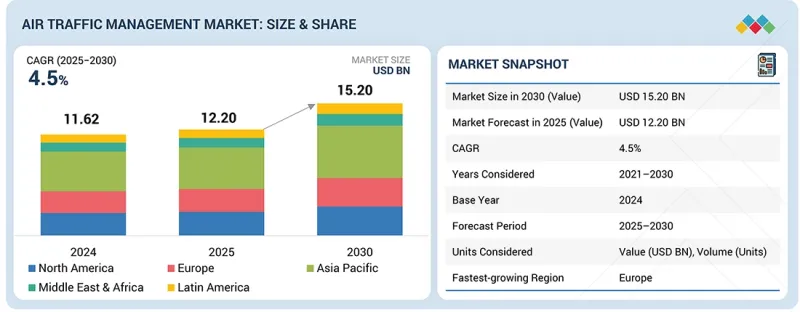
The global air traffic management market is projected to reach USD 12.20 billion in 2025 and is expected to grow to USD 15.20 billion by 2030, at a CAGR of 4.5% from 2025 to 2030. Market growth is driven by the continuous increase in global passenger and cargo traffic each year. This steady growth puts pressure on existing airspace capacity and makes operations more complex to manage.
| Scope of the Report | |
|---|---|
| Years Considered for the Study | 2021-2030 |
| Base Year | 2024 |
| Forecast Period | 2025-2030 |
| Units Considered | Value (USD Billion) |
| Segments | By Operation, Technology, Solution and Region |
| Regions covered | North America, Europe, APAC, RoW |
As traffic volume rises, it becomes more difficult to maintain efficiency with older systems. Governments and air navigation service providers are investing in upgrading communication, navigation, surveillance, and automation infrastructure to enhance safety and reduce congestion. Meanwhile, the integration of unmanned aircraft systems and advanced air mobility platforms is creating a demand for scalable, more digital air traffic management solutions across various regions.
"By solution, the software segment is projected to grow at the highest CAGR during the fore cast period."
The software segment is projected to experience the fastest growth in the air traffic management market, mainly due to the shift toward digital and data-driven airspace operations. The increasing demand for real-time data processing, predictive analytics, and integrated decision support systems is driving the adoption of advanced air traffic management software solutions. There is also a growing need for seamless interoperability among different stakeholders, which is encouraging investments in scalable, cloud-based platforms. These factors are helping improve operational efficiency, boost situational awareness, and make air traffic flow management more effective.
"By communication system, the controller-pilot data link controller (CPDLC) segment is projected to grow at the highest CAGR."
The controller pilot data link communications segment is expected to see the fastest growth in the air traffic management market, mainly due to the increasing need for more efficient and reliable communication between pilots and air traffic controllers. Growing air traffic congestion is driving the shift from traditional voice-based communication to data link systems that help reduce frequency congestion and minimize communication errors.
At the same time, regulatory requirements along with modernization programs support the adoption of these systems to enhance airspace efficiency while maintaining safety. These developments help improve message accuracy, reduce controller workload, and make air traffic operations more streamlined.
"Latin America is projected to grow at a steady CAGR during the forecast period."
The Latin America region is expected to experience steady growth in the air traffic management market, mainly driven by increasing investments in airport infrastructure and airspace modernization efforts. Rising passenger traffic and the expansion of regional airline networks are creating a greater need for more efficient and reliable air traffic systems. These developments are gradually encouraging the adoption of advanced air traffic management technologies across the region.
The breakdown of profiles for primary participants in the air traffic management market is provided below:
- By Company Type: Tier 1 - 35%, Tier 2 - 45%, and Tier 3 - 20%
- By Designation: C Level - 35%, Director Level - 25%, and Others - 40%
- By Region: North America - 25%, Europe - 15%, Asia Pacific - 45%, Middle East - 10% Rest of the World (RoW) - 5%
Research Coverage:
This market study examines the air traffic management market across various segments and subsegments. It aims to estimate the market's size and growth potential in different regions. The study also provides a detailed competitive analysis of key market players, including their company profiles, product offerings, recent developments, and strategic market initiatives.
Reasons to buy this report:
The report will assist market leaders and new entrants with estimates of the revenue figures for the overall air traffic management market. It will also enable stakeholders to understand the competitive landscape better and gain insights to position their businesses more effectively and develop appropriate go-to-market strategies. Additionally, the report will help stakeholders understand the market dynamics and provide information on key market drivers, restraints, challenges, and opportunities.
The report provides insights into the following pointers:
- Market Drivers (Rising Global Air Traffic and Airspace Congestion), Restraints (High Capital Investment and Long Implementation Cycles), Opportunities (Adoption of Artificial Intelligence and Predictive Analytics), Challenges (Escalating Cybersecurity Risks in Digitized Air Traffic Management Infrastructure)
- Market Penetration: Comprehensive information on the air traffic management market offered by the top players in the market
- Product Development/Innovation: Detailed insights on upcoming technologies, research & development activities, and product launches in the air traffic management market.
- Market Development: Comprehensive information about lucrative markets across varied regions
- Market Diversification: Exhaustive information about new products, untapped geographies, recent developments, and investments in the air traffic management market
- Competitive Assessment: In-depth assessment of market share, growth strategies, products, and manufacturing capabilities of leading players in the air traffic management market
TABLE OF CONTENTS
1 INTRODUCTION
- 1.1 STUDY OBJECTIVES
- 1.2 MARKET DEFINITION
- 1.3 STUDY SCOPE
- 1.3.1 MARKET SEGMENTATION & REGIONAL SCOPE
- 1.3.2 INCLUSIONS & EXCLUSIONS
- 1.4 YEARS CONSIDERED
- 1.5 CURRENCY CONSIDERED
- 1.6 STAKEHOLDERS
- 1.7 SUMMARY OF CHANGES
2 EXECUTIVE SUMMARY
- 2.1 KEY INSIGHTS & MARKET HIGHLIGHTS
- 2.2 KEY MARKET PARTICIPANTS: MAPPING OF STRATEGIC DEVELOPMENTS
- 2.3 DISRUPTIVE TRENDS IN AIR TRAFFIC MANAGEMENT MARKET
- 2.4 HIGH-GROWTH SEGMENTS
- 2.5 REGIONAL SNAPSHOT: MARKET SIZE, GROWTH RATE, AND FORECAST
3 PREMIUM INSIGHTS
- 3.1 ATTRACTIVE OPPORTUNITIES FOR PLAYERS IN AIR TRAFFIC MANAGEMENT MARKET
- 3.2 AIR TRAFFIC MANAGEMENT MARKET, BY DEPLOYMENT
- 3.3 AIR TRAFFIC MANAGEMENT MARKET, BY CUSTOMER
- 3.4 AIR TRAFFIC MANAGEMENT MARKET, BY SOLUTION
- 3.5 AIR TRAFFIC MANAGEMENT MARKET, BY TECHNOLOGY
4 MARKET OVERVIEW
- 4.1 INTRODUCTION
- 4.2 MARKET DYNAMICS
- 4.2.1 DRIVERS
- 4.2.1.1 Rising global air traffic and airspace congestion
- 4.2.1.2 Government-led airspace modernization programs
- 4.2.1.3 Increasing focus on operational efficiency and cost optimization
- 4.2.2 RESTRAINTS
- 4.2.2.1 High capital investment and long implementation cycles
- 4.2.2.2 Integration complexity with legacy systems
- 4.2.2.3 Shortage of skilled air traffic and technical personnel
- 4.2.3 OPPORTUNITIES
- 4.2.3.1 Integration of unmanned aircraft systems and advanced air mobility
- 4.2.3.2 Adoption of artificial intelligence and predictive analytics
- 4.2.3.3 Expansion of cross-border airspace harmonization initiatives
- 4.2.4 CHALLENGES
- 4.2.4.1 Escalating cybersecurity risks in digitized air traffic management infrastructure
- 4.2.4.2 Regulatory fragmentation across global jurisdictions
- 4.2.4.3 Managing traffic volatility and unpredictable disruptions
- 4.2.1 DRIVERS
- 4.3 UNMET NEEDS AND WHITE SPACES
- 4.3.1 STANDARDIZED DIGITAL DATA EXCHANGE ACROSS AVIATION ECOSYSTEM
- 4.3.2 ADVANCED HUMAN-MACHINE COLLABORATION TOOLS FOR CONTROLLERS
- 4.3.3 SCALABLE ATM SOLUTIONS FOR SECONDARY AND REGIONAL AIRPORTS
- 4.4 INTERCONNECTED MARKETS AND CROSS-SECTOR OPPORTUNITIES
- 4.4.1 INTEGRATION WITH SMART AIRPORT AND DIGITAL AVIATION ECOSYSTEMS
- 4.4.2 COLLABORATION WITH SPACE-BASED COMMUNICATION AND SATELLITE NAVIGATION PROVIDERS
- 4.5 STRATEGIC MOVES BY TIER 1/2/3 PLAYERS
5 INDUSTRY TRENDS
- 5.1 INTRODUCTION
- 5.2 MACROECONOMIC OUTLOOK
- 5.2.1 INTRODUCTION
- 5.2.2 GDP TRENDS & FORECAST
- 5.2.3 TRENDS IN GLOBAL AVIATION INDUSTRY
- 5.2.4 TRENDS IN GLOBAL AIR TRAFFIC MANAGEMENT INDUSTRY
- 5.3 VALUE CHAIN ANALYSIS
- 5.3.1 R&D ENGINEERS (~30%)
- 5.3.2 RAW MATERIAL SUPPLIERS (10~%)
- 5.3.3 COMPONENT & PRODUCT MANUFACTURERS (~10%)
- 5.3.4 ASSEMBLERS & INTEGRATORS (~30%)
- 5.3.5 END USERS (~20%)
- 5.4 ECOSYSTEM ANALYSIS
- 5.4.1 MANUFACTURERS
- 5.4.2 SOLUTION AND SERVICE PROVIDERS
- 5.4.3 END USERS
- 5.5 INVESTMENT & FUNDING SCENARIO
- 5.6 PRICING ANALYSIS
- 5.6.1 INDICATIVE PRICING OF AIR TRAFFIC HARDWARE TYPES, BY KEY PLAYER
- 5.6.2 INDICATIVE PRICING, BY HARDWARE
- 5.7 TRADE ANALYSIS
- 5.7.1 IMPORT SCENARIO (HS CODE 8526)
- 5.7.2 EXPORT SCENARIO (HS CODE 8526)
- 5.8 KEY CONFERENCE & EVENTS, 2025-2026
- 5.9 TRENDS AND DISRUPTIONS IMPACTING CUSTOMER BUSINESS
- 5.10 CASE STUDY ANALYSIS
- 5.10.1 THALES DEPLOYED ADVANCED DIGITAL TOWER PLATFORM USING HIGH-DEFINITION
- 5.10.2 INDRA IMPLEMENTED UNIFIED AIR TRAFFIC MANAGEMENT AUTOMATION PLATFORM
- 5.10.3 FREQUENTIS DEPLOYED IP-BASED VOICE COMMUNICATION CONTROL SYSTEM CONNECTING TOWERS, APPROACH, AND EN-ROUTE CENTERS THROUGH REDUNDANT DIGITAL NETWORK
- 5.11 IMPACT OF 2025 US TARIFF
- 5.11.1 KEY TARIFF RATES
- 5.11.2 PRICE IMPACT ANALYSIS
- 5.11.3 IMPACT ON COUNTRY/REGION
- 5.11.3.1 US
- 5.11.3.2 Europe
- 5.11.3.3 Asia Pacific
- 5.11.4 IMPACT ON END-USE SECTORS
- 5.11.4.1 Commercial
- 5.11.4.2 Government & military
6 CUSTOMER LANDSCAPE AND BUYER BEHAVIOR
- 6.1 DECISION-MAKING PROCESS
- 6.2 STAKEHOLDERS AND BUYING EVALUATION CRITERIA
- 6.2.1 KEY STAKEHOLDERS IN BUYING PROCESS
- 6.2.2 BUYING CRITERIA
- 6.3 ADOPTION BARRIERS AND INTERNAL CHALLENGES
- 6.4 UNMET NEEDS FROM VARIOUS END USES
- 6.4.1 NEED FOR HIGH AUTOMATION AND DECISION-SUPPORT CAPABILITIES
- 6.4.2 NEED FOR SEAMLESS CROSS-BORDER INTEROPERABILITY
- 6.4.3 NEED FOR FLEXIBLE AND SCALABLE DIGITAL INFRASTRUCTURE
7 REGULATORY LANDSCAPE AND SUSTAINABILITY INITIATIVES
- 7.1 REGIONAL REGULATIONS AND COMPLIANCE
- 7.1.1 REGULATORY BODIES, GOVERNMENT AGENCIES, AND OTHER ORGANIZATIONS
- 7.1.2 REGULATORY FRAMEWORK
- 7.1.3 INDUSTRY STANDARDS
- 7.2 SUSTAINABILITY INITIATIVES
- 7.2.1 CARBON IMPACT REDUCTION
- 7.2.2 ECO-APPLICATIONS
- 7.3 SUSTAINABILITY IMPACT AND REGULATORY POLICY INITIATIVES
- 7.3.1 SUSTAINABILITY IMPACT ON AIR TRAFFIC MANAGEMENT MARKET
- 7.3.2 REGULATORY POLICIES DRIVING AIR TRAFFIC MANAGEMENT DEPLOYMENT
- 7.4 CERTIFICATIONS, LABELING, AND ECO-STANDARDS
8 TECHNOLOGICAL ADVANCEMENTS, AI-DRIVEN IMPACT, PATENTS, INNOVATIONS, AND FUTURE APPLICATIONS
- 8.1 KEY EMERGING TECHNOLOGIES
- 8.1.1 ARTIFICIAL INTELLIGENCE-DRIVEN AIR TRAFFIC FLOW MANAGEMENT
- 8.1.2 AUTOMATIC DEPENDENT SURVEILLANCE-BROADCAST (ADS-B) AND SPACE-BASED SURVEILLANCE
- 8.1.3 SYSTEM-WIDE INFORMATION MANAGEMENT (SWIM) DATA EXCHANGE PLATFORMS
- 8.2 COMPLEMENTARY TECHNOLOGIES
- 8.2.1 DIGITAL AERONAUTICAL INFORMATION MANAGEMENT (AIM) AND E-CHARTS
- 8.2.2 DIGITAL TWIN SIMULATION AND PREDICTIVE OPERATIONS PLATFORMS
- 8.2.3 QUANTUM-RESILIENT CYBERSECURITY AND SECURE AVIATION NETWORKS
- 8.3 ADJACENT TECHNOLOGIES
- 8.3.1 ADVANCED WEATHER INTELLIGENCE AND NOWCASTING PLATFORMS
- 8.3.2 ADVANCED AIRPORT COLLABORATIVE DECISION-MAKING (A-CDM) INTEGRATED WITH AIRPORT OPERATIONS PLATFORMS
- 8.4 TECHNOLOGY ROADMAP
- 8.5 PATENT ANALYSIS
- 8.6 FUTURE APPLICATIONS
- 8.6.1 CASE STUDIES
- 8.7 IMPACT OF AI/GEN AI
- 8.7.1 IMPACT OF AI/GEN AI: TOP USE CASES AND MARKET POTENTIAL
- 8.7.2 CASE STUDIES: IMPLEMENTATION OF AI
- 8.7.3 INTERCONNECTED ECOSYSTEM AND IMPACT ON MARKET PLAYERS
- 8.7.4 CLIENTS' READINESS TO ADOPT GEN AI
- 8.8 SUCCESS STORIES AND REAL-WORLD APPLICATIONS
9 AIR TRAFFIC MANAGEMENT MARKET, BY OPERATION (MARKET SIZE & FORECAST TO 2030 - USD MILLION)
- 9.1 INTRODUCTION
- 9.2 AIR TRAFFIC SERVICES (ATS)
- 9.2.1 USE CASE: INTEGRATED ATS PLATFORM BY INDRA
- 9.2.2 AIR TRAFFIC CONTROL (ATC)
- 9.2.2.1 Need to manage increasing aircraft movements to drive growth
- 9.2.2.2 Use case: Digital Tower Air Traffic Control Solution by Saab
- 9.2.3 FLIGHT INFORMATION SERVICES (FIS)
- 9.2.3.1 Increasing reliance of pilots on continuous operational updates to drive market
- 9.2.3.2 Use case: Nationwide Air-Ground Communication System by Indra
- 9.2.4 ALERTING SERVICES
- 9.2.4.1 High traffic volumes and extended oceanic and remote-area operations to boost market
- 9.3 AIR TRAFFIC FLOW MANAGEMENT (ATFM)
- 9.3.1 INCREASING NETWORK CONGESTION TO DRIVE ADOPTION OF PREDICTIVE TRAFFIC FLOW OPTIMIZATION
- 9.3.2 USE CASE: TOPSKY FLOW MANAGER BY THALES
- 9.4 AIRSPACE MANAGEMENT (ASM)
- 9.4.1 INCREASING FLEXIBLE AIRSPACE UTILIZATION TO DRIVE ADOPTION OF DYNAMIC AIRSPACE MANAGEMENT
- 9.4.2 USE CASE: AIRSPACE MANAGER BY INDRA
- 9.5 AERONAUTICAL INFORMATION MANAGEMENT (AIM)
- 9.5.1 TRANSITION FROM STATIC PUBLICATIONS TO DIGITAL AERONAUTICAL DATA TO BOOST AERONAUTICAL INFORMATION MANAGEMENT
- 9.5.2 USE CASE: CADAS-AIMDB BY COMSOFT SOLUTIONS
- 9.6 AIRSPACE DESIGN
- 9.6.1 INCREASING DEMAND FOR PERFORMANCE-BASED NAVIGATION TO DRIVE MODERN AIRSPACE DESIGN
- 9.6.2 USE CASE: AIRSPACE OPTIMIZER BY NATS
- 9.7 GEOFENCING
- 9.7.1 INCREASING INTEGRATION OF DRONES AND SENSITIVE AIRSPACE PROTECTION TO DRIVE ADOPTION OF GEOFENCING
- 9.7.2 USE CASE: GEO ZONE GEOFENCING SYSTEM BY DJI
10 AIR TRAFFIC MANAGEMENT MARKET, BY TECHNOLOGY (MARKET SIZE & FORECAST TO 2030 - USD MILLION)
- 10.1 INTRODUCTION
- 10.2 ASSESSMENT OF BRAND AND PRODUCT USE CASES
- 10.3 COMMUNICATION SYSTEMS
- 10.3.1 DEMAND FOR INCREASING AIR-GROUND COMMUNICATION SYSTEMS TO DRIVE GROWTH
- 10.3.2 USE CASE: VOICE COMMUNICATION CONTROL SYSTEM BY FREQUENTIS
- 10.3.3 VHF VOICE COMMUNICATION
- 10.3.3.1 Use case: Series4200 Software-defined Radio by Rohde & Schwarz
- 10.3.4 CONTROLLER-PILOT DATA LINK COMMUNICATION (CPDLC)
- 10.3.4.1 Use case: Iris Air Traffic Management Service by Inmarsat
- 10.3.5 VOICE COMMUNICATION CONTROL SYSTEM (VCCS)
- 10.3.5.1 Use case: VCS3020X by Frequentis
- 10.3.6 AIR TRAFFIC INFORMATION SYSTEMS (ATIS)
- 10.3.6.1 Use case: D-ATIS by Collins Aerospace
- 10.4 NAVIGATION SYSTEMS
- 10.4.1 TRANSITION TOWARD PERFORMANCE-BASED NAVIGATION TO DRIVE GROWTH IN NAVIGATION SYSTEMS
- 10.4.2 USE CASE: INSTRUMENT LANDING SYSTEM (ILS) BY THALES
- 10.4.3 VOR/DVOR
- 10.4.3.1 Use case: DVOR 5000 by Rohde & Schwarz
- 10.4.4 DME
- 10.4.4.1 Use case: DME 415 by Thales
- 10.4.5 TACAN
- 10.4.5.1 Use case: TACAN 7000 by Rohde & Schwarz
- 10.4.6 NDB
- 10.4.6.1 Use case: NDB 600 by Rohde & Schwarz
- 10.4.7 GNSS/GPS
- 10.4.7.1 Use case: SmartPath Ground-Based Augmentation System by Honeywell
- 10.4.8 PRNAV
- 10.4.8.1 Use case: Required Navigation Performance and PRNAV Procedure Design by NATS
- 10.4.9 ILS
- 10.4.9.1 Use case: ILS 420 by Thales
- 10.5 SURVEILLANCE SYSTEMS
- 10.5.1 INCREASING AIRSPACE COMPLEXITY AND MULTI-SENSOR INTEGRATION TO DRIVE GROWTH IN SURVEILLANCE SYSTEMS
- 10.5.2 USE CASE: MULTI-SENSOR SURVEILLANCE SYSTEM BY THALES
- 10.5.3 PSR
- 10.5.3.1 Use case: STAR NG Primary Surveillance Radar by Thales
- 10.5.4 SSR
- 10.5.4.1 Use case: RSM 970S Secondary Surveillance Radar by HENSOLDT
- 10.5.5 ADS-B
- 10.5.5.1 Use case: Aireon Space-Based ADS-B Service by Aireon
- 10.5.6 MLAT
- 10.5.6.1 Use case: ERA Multilateration System by ERA
- 10.5.7 A-SMGCS
- 10.5.7.1 Use case: A-SMGCS by Thales
- 10.6 AUTOMATION SYSTEMS
- 10.6.1 INCREASING TRAFFIC DENSITY AND OPERATIONAL EFFICIENCY MANDATES TO DRIVE GROWTH IN AUTOMATION SYSTEMS
- 10.6.2 USE CASE: ITEC SKYNEX AUTOMATION PLATFORM BY INDRA
- 10.6.3 FDPS
- 10.6.3.1 Use case: TopSky - Flight Data Processing by Thales
- 10.6.4 SDPS
- 10.6.4.1 Use case: SkyFusion Surveillance Data Processing by Indra
- 10.6.5 AMAN/DMAN
- 10.6.5.1 Use case: TopSky - AMAN/DMAN by Thales
- 10.6.6 STCA/MSAW
- 10.6.6.1 Use case: TopSky - Safety Nets by Thales
- 10.6.7 CONTROL & MONITORING DISPLAYS
- 10.6.7.1 Use case: OneControl Working Position by Indra
- 10.6.8 APOS
- 10.6.8.1 Use case: Airspace Optimizer by NATS
11 AIR TRAFFIC MANAGEMENT MARKET, BY SOLUTION (MARKET SIZE & FORECAST TO 2030 - USD MILLION)
- 11.1 INTRODUCTION
- 11.2 AIR TRAFFIC MANAGEMENT SOLUTIONS: USE CASES
- 11.2.1 DIGITAL TOWERS
- 11.2.1.1 Use case: Digital Tower Suite by Saab
- 11.2.1.2 Use case: Remote Tower Solution by Indra
- 11.2.1.3 Use case: Remote Tower System by Frequentis
- 11.2.2 REMOTE TOWER
- 11.2.2.1 Use case: r-TWR Remote Tower System by Thales
- 11.2.2.2 Use case: Digital Tower Solution by Kongsberg Geospatial
- 11.2.2.3 Use case: Remote Tower Solution by DFS Aviation Services
- 11.2.1 DIGITAL TOWERS
- 11.3 HARDWARE
- 11.3.1 USE CASE: MULTI-SENSOR RADAR HARDWARE DEPLOYMENT BY THALES
- 11.3.2 RADAR SYSTEMS
- 11.3.2.1 Rising airspace security and traffic density to drive growth
- 11.3.2.2 Use case: STAR NG Radar by Thales
- 11.3.3 SENSORS
- 11.3.3.1 Expanding surveillance and environmental monitoring needs to drive growth
- 11.3.3.2 Use case: Aerodrome Weather Observation System (AWOS) by Vaisala
- 11.3.4 ANTENNAS
- 11.3.4.1 Expanding connectivity and spectrum management to drive demand for antennas
- 11.3.4.2 Use case: AV-1745 VHF Airband Antenna by Sensor Systems
- 11.3.5 CAMERAS
- 11.3.5.1 Expanding remote operations and surface monitoring to propel market
- 11.3.5.2 Use case: High-Definition Camera System by Saab Digital Tower
- 11.3.6 DISPLAYS
- 11.3.6.1 Increasing data integration and demand for human-machine interface to drive growth
- 11.3.6.2 Use case: ControlSphere Integrated Display by Thales
- 11.3.7 ENCODERS/DECODERS
- 11.3.7.1 Increasing digital communication and data standardization to drive growth in encoders/decoders for air traffic management
- 11.3.7.2 Use case: Mode S Decoder Unit by Indra
- 11.3.8 AMPLIFIERS
- 11.3.8.1 Increasing signal integrity and coverage requirements to boost growth
- 11.3.8.2 Use case: Solid-State RF Power Amplifier by Rohde & Schwarz
- 11.3.9 OTHERS
- 11.3.9.1 Use case: Integrated Redundant Power & Server Infrastructure by Frequentis
- 11.4 SOFTWARE
- 11.4.1 USE CASE: INTEGRATED ATM SOFTWARE SUITE BY THALES
- 11.4.2 ATM PLATFORMS & SUITES
- 11.4.2.1 Increasing system integration and digital transformation to boost growth
- 11.4.2.2 Use case: TopSky Air Traffic Management Suite by Thales
- 11.4.3 DATABASE MANAGEMENT SYSTEMS
- 11.4.3.1 Growing data volume and integrity requirements to drive market growth
- 11.4.3.2 Use case: Centralized Operational Database by Indra
- 11.4.4 INCIDENT & EVENT MANAGEMENT SOFTWARE
- 11.4.4.1 Increasing operational risk monitoring and regulatory compliance to drive growth of incident & event management software
- 11.4.4.2 Use case: Safety Management System (SMS) Platform by Indra
- 11.4.5 CAPACITY & DEMAND MANAGEMENT SOFTWARE
- 11.4.5.1 Increasing traffic variability and network congestion to spur demand for capacity & demand management software
- 11.4.5.2 Use case: TopSky Flow Manager by Thales
- 11.4.6 COMMUNICATION & RECORDING SOFTWARE
- 11.4.6.1 Increasing regulatory compliance and communication traceability to drive market
- 11.4.6.2 Use case: DIVOS Recording System by Frequentis
- 11.5 SERVICES
- 11.5.1 USE CASE: INTEGRATED LIFECYCLE SERVICES PROGRAM BY THALES
- 11.5.2 SYSTEM INTEGRATION
- 11.5.2.1 Increasing multi-system complexity to drive market growth
- 11.5.2.2 Use case: Integrated ATM Deployment Services by Thales
- 11.5.3 MAINTENANCE & SUPPORT
- 11.5.3.1 Increasing system availability requirements to drive growth of air traffic maintenance & support services
- 11.5.3.2 Use case: Lifecycle Support Services by Indra
- 11.5.4 UPGRADE & MODERNIZATION SERVICES
- 11.5.4.1 Accelerating digital transformation to drive growth
- 11.5.4.2 Use case: ATM Modernization Program by Thales
- 11.5.5 TRAINING & SIMULATION SERVICES
- 11.5.5.1 Rising traffic complexity and technology transition to drive demand
- 11.5.5.2 Use case: ATC Simulation Platform by Indra
12 AIR TRAFFIC MANAGEMENT MARKET, BY DEPLOYMENT (MARKET SIZE & FORECAST TO 2030 - USD MILLION)
- 12.1 INTRODUCTION
- 12.2 ASSESSMENT OF AIRPORT CLASSES
- 12.2.1 COMMERCIAL AIRPORTS
- 12.2.1.1 Class I (Large international/Hub airports)
- 12.2.1.1.1 Rising international traffic and hub connectivity to drive growth in Class I (Large international/hub airports)
- 12.2.1.1.2 Use case: TopSky - AMAN/DMAN Suite by Thales
- 12.2.1.2 Class II (Major Regional/National Airports)
- 12.2.1.2.1 Expanding regional air connectivity to drive investments in Class II (Major regional/national airports)
- 12.2.1.2.2 Use case: TopSky AMAN by Thales
- 12.2.1.3 Class III (Small commercial/domestic airports)
- 12.2.1.3.1 Regional air mobility expansions to drive modernization in Class III (Small commercial/domestic airports)
- 12.2.1.3.2 Use case: Remote Tower System by Saab
- 12.2.1.4 Class IV (Regional/Remote/General aviation airports)
- 12.2.1.4.1 Cost-efficient airspace oversight to drive growth in Class IV (Regional/Remote/General aviation airports)
- 12.2.1.4.2 Use case: ADS-B Ground Station Solution by Indra
- 12.2.1.1 Class I (Large international/Hub airports)
- 12.2.2 MILITARY AIRPORTS
- 12.2.2.1 Class M-I (Major military air bases - Strategic/Joint operations)
- 12.2.2.1.1 Increasing strategic air defense integration to drive growth in Class M-I (Major military air bases - Strategic/Joint operations)
- 12.2.2.1.2 Use case: Integrated Military ATC System by Indra
- 12.2.2.2 Class M-II (Operational/Tactical air bases)
- 12.2.2.2.1 Increasing tactical mission readiness to drive modernization in Class M-II (Operational/Tactical air bases)
- 12.2.2.2.2 Use case: Deployable ATC System by Thales
- 12.2.2.3 Class M-III (Forward Operating bases/deployed airfields)
- 12.2.2.3.1 Rapid deployment and expeditionary air operations to drive growth in Class M-III (Forward operating bases/deployed airfields)
- 12.2.2.3.2 Use case: Deployable Tactical Radar System by Indra
- 12.2.2.4 Class M-IV (Training, UAV & Auxiliary Airfields)
- 12.2.2.4.1 Expanding unmanned operations and pilot training programs to drive growth in Class M-IV (Training, UAV, auxiliary airfields)
- 12.2.2.4.2 Use case: Deployable Tactical Radar System by Indra
- 12.2.2.1 Class M-I (Major military air bases - Strategic/Joint operations)
- 12.2.3 VERTIPORT
- 12.2.3.1 Emergence of advanced air mobility to drive growth in vertiport infrastructure
- 12.2.3.2 Use case: Urban Air Traffic Management Platform by Thales
- 12.2.1 COMMERCIAL AIRPORTS
- 12.3 NEW INSTALLATION
- 12.3.1 EXPANSION OF AVIATION INFRASTRUCTURE AND GREENFIELD PROJECTS TO DRIVE GROWTH
- 12.3.1.1 Use case: Integrated Greenfield ATM Deployment by Indra
- 12.3.1 EXPANSION OF AVIATION INFRASTRUCTURE AND GREENFIELD PROJECTS TO DRIVE GROWTH
- 12.4 UPGRADE & MODERNIZATION
- 12.4.1 AGING INFRASTRUCTURE AND DIGITAL TRANSITION TO DRIVE GROWTH
- 12.4.1.1 Use case: ATM Modernization Program by Thales
- 12.4.1 AGING INFRASTRUCTURE AND DIGITAL TRANSITION TO DRIVE GROWTH
13 AIR TRAFFIC MANAGEMENT MARKET, BY CUSTOMER (MARKET SIZE & FORECAST TO 2030 - USD MILLION)
- 13.1 INTRODUCTION
- 13.2 CIVIL AVIATION AUTHORITIES
- 13.2.1 REGULATORY MODERNIZATION AND AIRSPACE SAFETY MANDATES TO DRIVE GROWTH
- 13.2.1.1 National ATM Modernization Program by Indra
- 13.2.1 REGULATORY MODERNIZATION AND AIRSPACE SAFETY MANDATES TO DRIVE GROWTH
- 13.3 AIRPORT OPERATORS
- 13.3.1 INCREASING PASSENGER THROUGHPUT AND OPERATIONAL EFFICIENCY REQUIREMENTS TO PROPEL MARKET
- 13.3.1.1 Use case: Advanced Surface Movement Guidance & Control System by Thales
- 13.3.1 INCREASING PASSENGER THROUGHPUT AND OPERATIONAL EFFICIENCY REQUIREMENTS TO PROPEL MARKET
- 13.4 AIR NAVIGATION SERVICE PROVIDERS (ANSPS)
- 13.4.1 INCREASING AIRSPACE COMPLEXITY AND CAPACITY OPTIMIZATION MANDATES TO DRIVE GROWTH
- 13.4.1.1 Use case: iTEC SkyNex by Indra
- 13.4.1 INCREASING AIRSPACE COMPLEXITY AND CAPACITY OPTIMIZATION MANDATES TO DRIVE GROWTH
- 13.5 MILITARY & GOVERNMENT ORGANIZATIONS
- 13.5.1 FOCUS ON STRENGTHENING NATIONAL AIRSPACE SECURITY AND DEFENSE MODERNIZATION TO DRIVE GROWTH
- 13.5.1.1 Use case: Integrated Military Airspace Management System by Thales
- 13.5.1 FOCUS ON STRENGTHENING NATIONAL AIRSPACE SECURITY AND DEFENSE MODERNIZATION TO DRIVE GROWTH
- 13.6 UTM OPERATORS
- 13.6.1 RAPID EXPANSION OF UNMANNED AIRCRAFT OPERATIONS TO DRIVE GROWTH
- 13.6.1.1 Use case: Integrated Military Airspace Management System by Thales
- 13.6.1 RAPID EXPANSION OF UNMANNED AIRCRAFT OPERATIONS TO DRIVE GROWTH
14 AIR TRAFFIC MANAGEMENT MARKET, BY REGION (MARKET SIZE & FORECAST TO 2030 - USD MILLION)
- 14.1 INTRODUCTION
- 14.2 NORTH AMERICA
- 14.2.1 US
- 14.2.1.1 Air traffic control modernization programs to drive market
- 14.2.2 CANADA
- 14.2.2.1 Expansion of remote air navigation services to drive market
- 14.2.1 US
- 14.3 EUROPE
- 14.3.1 UK
- 14.3.1.1 Implementation of 'UK Airspace Modernization Strategy' to drive market
- 14.3.2 GERMANY
- 14.3.2.1 Upgrade of national air navigation infrastructure to drive market
- 14.3.3 FRANCE
- 14.3.3.1 Investments in remote and digital tower capabilities and improved communication networks to drive market
- 14.3.4 SWEDEN
- 14.3.4.1 Continuous deployment of digital air navigation services to drive market
- 14.3.5 ITALY
- 14.3.5.1 Integration of performance-based navigation procedures and upgraded surveillance systems to drive market
- 14.3.6 SPAIN
- 14.3.6.1 Airport capacity optimization and digital air traffic system deployment to drive market
- 14.3.7 REST OF EUROPE
- 14.3.1 UK
- 14.4 ASIA PACIFIC
- 14.4.1 CHINA
- 14.4.1.1 Increase in passenger traffic and rigorous airport construction to drive market
- 14.4.2 INDIA
- 14.4.2.1 Rapid aviation growth to drive market
- 14.4.3 JAPAN
- 14.4.3.1 High aircraft movement density around metropolitan areas to drive market
- 14.4.4 AUSTRALIA
- 14.4.4.1 Adoption of satellite-based surveillance and advanced traffic flow management systems to drive market
- 14.4.5 SOUTH KOREA
- 14.4.5.1 Smart airport programs and high traffic density to drive market
- 14.4.6 REST OF ASIA PACIFIC
- 14.4.1 CHINA
- 14.5 MIDDLE EAST & AFRICA
- 14.5.1 GCC
- 14.5.1.1 UAE
- 14.5.1.1.1 Rapid passenger growth and expansion of cargo operations to drive market
- 14.5.1.2 Saudi Arabia
- 14.5.1.2.1 Expansion of aviation industry under national transport and tourism development programs to drive market
- 14.5.1.1 UAE
- 14.5.2 SOUTH AFRICA
- 14.5.2.1 Need to strengthen aviation safety and improve regional connectivity to drive market
- 14.5.3 REST OF MIDDLE EAST & AFRICA
- 14.5.1 GCC
- 14.6 LATIN AMERICA
- 14.6.1 BRAZIL
- 14.6.1.1 Strong domestic aviation demand and increased aircraft movements to drive market
- 14.6.2 MEXICO
- 14.6.2.1 Rising passenger volumes and increasing regional connectivity to drive market
- 14.6.3 ARGENTINA
- 14.6.3.1 Emphasis on strengthening aviation safety and improving connectivity to drive market
- 14.6.4 REST OF LATIN AMERICA
- 14.6.1 BRAZIL
15 COMPETITIVE LANDSCAPE
- 15.1 INTRODUCTION
- 15.2 KEY PLAYER STRATEGIES/RIGHT TO WIN
- 15.3 REVENUE ANALYSIS, 2021-2024
- 15.4 MARKET SHARE ANALYSIS, 2024
- 15.5 BRAND/PRODUCT COMPARISON
- 15.6 COMPANY VALUATION AND FINANCIAL METRICS
- 15.7 COMPANY EVALUATION MATRIX: KEY PLAYERS, 2024
- 15.7.1 STARS
- 15.7.2 EMERGING LEADERS
- 15.7.3 PERVASIVE PLAYERS
- 15.7.4 PARTICIPANTS
- 15.7.5 COMPANY FOOTPRINT
- 15.7.5.1 Company footprint
- 15.7.5.2 Region footprint
- 15.7.5.3 Technology footprint
- 15.7.5.4 Solution footprint
- 15.7.5.5 Customer footprint
- 15.8 COMPANY EVALUATION MATRIX: STARTUPS/SMES, 2024
- 15.8.1 PROGRESSIVE COMPANIES
- 15.8.2 RESPONSIVE COMPANIES
- 15.8.3 DYNAMIC COMPANIES
- 15.8.4 STARTING BLOCKS
- 15.8.5 COMPETITIVE BENCHMARKING
- 15.8.5.1 List of startups/SMEs
- 15.8.5.2 Competitive benchmarking of startups/SMEs
- 15.9 COMPETITIVE SCENARIO
- 15.9.1 PRODUCT LAUNCHES/DEVELOPMENTS
- 15.9.2 DEALS
- 15.9.3 OTHER DEVELOPMENTS
16 COMPANY PROFILES
- 16.1 KEY PLAYERS
- 16.1.1 THALES
- 16.1.1.1 Business overview
- 16.1.1.2 Products offered
- 16.1.1.3 Recent developments
- 16.1.1.3.1 Product launches/developments
- 16.1.1.3.2 Deals
- 16.1.1.3.3 Other developments
- 16.1.2 RTX
- 16.1.2.1 Business overview
- 16.1.2.2 Products offered
- 16.1.2.3 Recent developments
- 16.1.2.3.1 Product launches/developments
- 16.1.2.3.2 Deals
- 16.1.2.3.3 Other developments
- 16.1.3 L3HARRIS TECHNOLOGIES, INC.
- 16.1.3.1 Business overview
- 16.1.3.2 Products offered
- 16.1.3.3 Recent developments
- 16.1.3.3.1 Deals
- 16.1.3.3.2 Other developments
- 16.1.4 INDRA
- 16.1.4.1 Business overview
- 16.1.4.2 Products offered
- 16.1.4.3 Recent developments
- 16.1.4.3.1 Deals
- 16.1.4.3.2 Other developments
- 16.1.5 SAAB AB
- 16.1.5.1 Business overview
- 16.1.5.2 Products offered
- 16.1.5.3 Recent developments
- 16.1.5.3.1 Deals
- 16.1.5.3.2 Other developments
- 16.1.6 KONGSBERG DEFENSE & AEROSPACE
- 16.1.6.1 Business overview
- 16.1.6.2 Products offered
- 16.1.6.3 Recent developments
- 16.1.6.3.1 Other developments
- 16.1.7 SITA
- 16.1.7.1 Business overview
- 16.1.7.2 Products offered
- 16.1.7.3 Recent developments
- 16.1.7.3.1 Product launches/developments
- 16.1.7.3.2 Deals
- 16.1.7.3.3 Other developments
- 16.1.8 BAE SYSTEMS
- 16.1.8.1 Business overview
- 16.1.8.2 Products offered
- 16.1.8.3 Recent developments
- 16.1.8.3.1 Other developments
- 16.1.9 FREQUENTIS AG
- 16.1.9.1 Business overview
- 16.1.9.2 Products offered
- 16.1.9.3 Recent developments
- 16.1.9.3.1 Deals
- 16.1.9.3.2 Other developments
- 16.1.10 HONEYWELL INTERNATIONAL, INC.
- 16.1.10.1 Business overview
- 16.1.10.2 Products offered
- 16.1.10.2.1 Deals
- 16.1.10.2.2 Other developments
- 16.1.11 ADVANCED NAVIGATION AND POSITIONING CORPORATION
- 16.1.11.1 Business overview
- 16.1.11.2 Products offered
- 16.1.11.3 Recent developments
- 16.1.11.3.1 Other developments
- 16.1.12 LEIDOS
- 16.1.12.1 Business overview
- 16.1.12.2 Products offered
- 16.1.12.3 Recent developments
- 16.1.12.3.1 Other developments
- 16.1.13 INTELCAN TECHNOSYSTEMS INC.
- 16.1.13.1 Business overview
- 16.1.13.2 Products offered
- 16.1.13.3 Recent developments
- 16.1.13.3.1 Other developments
- 16.1.14 AMADEUS IT GROUP, SA
- 16.1.14.1 Business overview
- 16.1.14.2 Products offered
- 16.1.14.3 Recent developments
- 16.1.14.3.1 Deals
- 16.1.15 LEONARDO S.P.A.
- 16.1.15.1 Business overview
- 16.1.15.2 Products offered
- 16.1.15.3 Recent developments
- 16.1.15.3.1 Deals
- 16.1.15.3.2 Other developments
- 16.1.16 NAV CANADA
- 16.1.16.1 Business overview
- 16.1.16.2 Products offered
- 16.1.16.3 Recent developments
- 16.1.16.3.1 Product launches/developments
- 16.1.16.3.2 Deals
- 16.1.16.3.3 Other developments
- 16.1.1 THALES
- 16.2 OTHER PLAYERS
- 16.2.1 SEARIDGE TECHNOLOGIES
- 16.2.2 AIREON
- 16.2.3 SKYSOFT-ATM
- 16.2.4 ANRA TECHNOLOGIES
- 16.2.5 ONESKY
- 16.2.6 ALOFT TECHNOLOGIES
- 16.2.7 AEROBITS
- 16.2.8 UNIFLY
- 16.2.9 MOSAIC ATM
- 16.2.10 SKYGRID, LLC
17 RESEARCH METHODOLOGY
- 17.1 RESEARCH DATA
- 17.1.1 SECONDARY DATA
- 17.1.1.1 Key data from secondary sources
- 17.1.2 PRIMARY DATA
- 17.1.2.1 Primary interview participants
- 17.1.2.2 Key data from primary sources
- 17.1.2.3 Breakdown of primary interviews
- 17.1.2.4 Insights from industry experts
- 17.1.1 SECONDARY DATA
- 17.2 MARKET SIZE ESTIMATION
- 17.2.1 BOTTOM-UP APPROACH
- 17.2.2 TOP-DOWN APPROACH
- 17.2.3 BASE NUMBER CALCULATION
- 17.3 FACTOR ANALYSIS
- 17.3.1 SUPPLY-SIDE INDICATORS
- 17.3.2 DEMAND-SIDE INDICATORS
- 17.4 DATA TRIANGULATION
- 17.5 RESEARCH ASSUMPTIONS
- 17.6 RESEARCH LIMITATIONS
- 17.7 RISK ASSESSMENT
18 APPENDIX
- 18.1 DISCUSSION GUIDE
- 18.2 KNOWLEDGESTORE: MARKETSANDMARKETS' SUBSCRIPTION PORTAL
- 18.3 CUSTOMIZATION OPTIONS
- 18.4 RELATED REPORTS
- 18.5 AUTHOR DETAILS
List of Tables
- TABLE 1 USD EXCHANGE RATES, 2021-2025
- TABLE 2 UNMET NEEDS AND WHITE SPACES
- TABLE 3 STRATEGIC MOVES BY TIER 1/2/3 PLAYERS
- TABLE 4 GDP PERCENTAGE CHANGE, BY COUNTRY, 2021-2030
- TABLE 5 ROLE OF COMPANIES IN ECOSYSTEM
- TABLE 6 INDICATIVE PRICING OF AIR TRAFFIC HARDWARE TYPES, BY KEY PLAYER, 2024 (USD)
- TABLE 7 INDICATIVE PRICING FOR CORE SURVEILLANCE & SENSING SYSTEMS
- TABLE 8 INDICATIVE PRICING FOR COMMUNICATION & NAVIGATION HARDWARE SYSTEMS
- TABLE 9 INDICATIVE PRICING FOR CONTROL CENTER HARDWARE & INTERFACES
- TABLE 10 INDICATIVE PRICING FOR IMAGING & SURVEILLANCE ENHANCEMENT SYSTEMS
- TABLE 11 INDICATIVE PRICING FOR SIGNAL PROCESSING & POWER ELECTRONICS
- TABLE 12 INDICATIVE PRICING FOR OTHER SYSTEMS (INTEGRATED INFRASTRUCTURE)
- TABLE 13 IMPORT DATA FOR HS CODE 8526-COMPLIANT PRODUCTS, BY COUNTRY, 2021-2024 (USD THOUSAND)
- TABLE 14 EXPORT DATA FOR HS CODE 8526-COMPLIANT PRODUCTS, BY COUNTRY, 2021-2024 (USD THOUSAND)
- TABLE 15 KEY CONFERENCES & EVENTS, 2025-2026
- TABLE 16 RECIPROCAL TARIFF RATES ADJUSTED BY US
- TABLE 17 EXPECTED CHANGE IN HARDWARE PRICES AND LIKELY IMPACT ON END-USE MARKET DUE TO TARIFF IMPACT
- TABLE 18 INFLUENCE OF STAKEHOLDERS ON BUYING PROCESS, BY SOLUTION (%)
- TABLE 19 KEY BUYING CRITERIA, BY SOLUTION
- TABLE 20 NORTH AMERICA: REGULATORY BODIES, GOVERNMENT AGENCIES, AND OTHER ORGANIZATIONS
- TABLE 21 EUROPE: REGULATORY BODIES, GOVERNMENT AGENCIES, AND OTHER ORGANIZATIONS
- TABLE 22 ASIA PACIFIC: REGULATORY BODIES, GOVERNMENT AGENCIES, AND OTHER ORGANIZATIONS
- TABLE 23 MIDDLE EAST: REGULATORY BODIES, GOVERNMENT AGENCIES, AND OTHER ORGANIZATIONS
- TABLE 24 REST OF THE WORLD: REGULATORY BODIES, GOVERNMENT AGENCIES, AND OTHER ORGANIZATIONS
- TABLE 25 KEY PROVISIONS UNDER AIR TRAFFIC MANAGEMENT REGULATIONS
- TABLE 26 GLOBAL DESIGN, STRUCTURAL, AND OPERATIONAL STANDARDS
- TABLE 27 GLOBAL ELECTRICAL, COMMUNICATION, AND CYBERSECURITY STANDARDS
- TABLE 28 GLOBAL QUALITY, ENVIRONMENTAL, AND COMPLIANCE STANDARDS
- TABLE 29 CARBON IMPACT REDUCTION
- TABLE 30 ECO APPLICATIONS
- TABLE 31 GLOBAL REGULATORY FRAMEWORKS IMPACTING AIR TRAFFIC MANAGEMENT MARKET
- TABLE 32 CERTIFICATIONS, LABELING, AND ECO-STANDARDS
- TABLE 33 KEY PATENTS, 2022-2026
- TABLE 34 DIGITAL & REMOTE TOWER OPERATIONS IN AIR TRAFFIC MANAGEMENT MARKET
- TABLE 35 PREDICTIVE WEATHER-BASED AIRSPACE OPTIMIZATION IN AIR TRAFFIC MANAGEMENT MARKET
- TABLE 36 AIR TRAFFIC MANAGEMENT MARKET, BY OPERATION, 2021-2024 (USD MILLION)
- TABLE 37 AIR TRAFFIC MANAGEMENT MARKET, BY OPERATION, 2025-2030 (USD MILLION)
- TABLE 38 AIR TRAFFIC MANAGEMENT MARKET, BY AIR TRAFFIC SERVICE, 2021-2024 (USD MILLION)
- TABLE 39 AIR TRAFFIC MANAGEMENT MARKET, BY AIR TRAFFIC SERVICE, 2025-2030 (USD MILLION)
- TABLE 40 AIR TRAFFIC MANAGEMENT MARKET, BY TECHNOLOGY, 2021-2024 (USD MILLION)
- TABLE 41 AIR TRAFFIC MANAGEMENT MARKET, BY TECHNOLOGY, 2025-2030 (USD MILLION)
- TABLE 42 BRANDS AND PRODUCT USE CASES IN TECHNOLOGY SEGMENT
- TABLE 43 AIR TRAFFIC MANAGEMENT MARKET, BY COMMUNICATION SYSTEM, 2021-2024 (USD MILLION)
- TABLE 44 AIR TRAFFIC MANAGEMENT MARKET, BY COMMUNICATION SYSTEM, 2025-2030 (USD MILLION)
- TABLE 45 AIR TRAFFIC MANAGEMENT MARKET, BY NAVIGATION SYSTEM, 2021-2024 (USD MILLION)
- TABLE 46 AIR TRAFFIC MANAGEMENT MARKET, BY NAVIGATION SYSTEM, 2025-2030 (USD MILLION)
- TABLE 47 AIR TRAFFIC MANAGEMENT MARKET, BY SURVEILLANCE SYSTEM, 2021-2024 (USD MILLION)
- TABLE 48 AIR TRAFFIC MANAGEMENT MARKET, BY SURVEILLANCE SYSTEM, 2025-2030 (USD MILLION)
- TABLE 49 AIR TRAFFIC MANAGEMENT MARKET, BY AUTOMATION SYSTEM, 2021-2024 (USD MILLION)
- TABLE 50 AIR TRAFFIC MANAGEMENT MARKET, BY AUTOMATION SYSTEM, 2025-2030 (USD MILLION)
- TABLE 51 AIR TRAFFIC MANAGEMENT MARKET, BY SOLUTION, 2021-2024 (USD MILLION)
- TABLE 52 AIR TRAFFIC MANAGEMENT MARKET, BY SOLUTION, 2025-2030 (USD MILLION)
- TABLE 53 AIR TRAFFIC MANAGEMENT MARKET, BY HARDWARE, 2021-2024 (USD MILLION)
- TABLE 54 AIR TRAFFIC MANAGEMENT MARKET, BY HARDWARE, 2025-2030 (USD MILLION)
- TABLE 55 AIR TRAFFIC MANAGEMENT MARKET, BY SOFTWARE, 2021-2024 (USD MILLION)
- TABLE 56 AIR TRAFFIC MANAGEMENT MARKET, BY SOFTWARE, 2025-2030 (USD MILLION)
- TABLE 57 AIR TRAFFIC MANAGEMENT MARKET, BY SERVICE, 2021-2024 (USD MILLION)
- TABLE 58 AIR TRAFFIC MANAGEMENT MARKET, BY SERVICE, 2025-2030 (USD MILLION)
- TABLE 59 AIR TRAFFIC MANAGEMENT MARKET, BY DEPLOYMENT, 2021-2024 (USD MILLION)
- TABLE 60 AIR TRAFFIC MANAGEMENT MARKET, BY DEPLOYMENT, 2025-2030 (USD MILLION)
- TABLE 61 AIR TRAFFIC MANAGEMENT MARKET, BY CUSTOMER, 2021-2024 (USD MILLION)
- TABLE 62 AIR TRAFFIC MANAGEMENT MARKET, BY CUSTOMER, 2025-2030 (USD MILLION)
- TABLE 63 AIR TRAFFIC MANAGEMENT MARKET, BY REGION, 2021-2024 (USD MILLION)
- TABLE 64 AIR TRAFFIC MANAGEMENT MARKET, BY REGION, 2025-2030 (USD MILLION)
- TABLE 65 NORTH AMERICA: AIR TRAFFIC MANAGEMENT MARKET, BY COUNTRY, 2021-2024 (USD MILLION)
- TABLE 66 NORTH AMERICA: AIR TRAFFIC MANAGEMENT MARKET, BY COUNTRY, 2025-2030 (USD MILLION)
- TABLE 67 NORTH AMERICA: AIR TRAFFIC MANAGEMENT MARKET, BY CUSTOMER, 2021-2024 (USD MILLION)
- TABLE 68 NORTH AMERICA: AIR TRAFFIC MANAGEMENT MARKET, BY CUSTOMER, 2025-2030 (USD MILLION)
- TABLE 69 NORTH AMERICA: AIR TRAFFIC MANAGEMENT MARKET, BY TECHNOLOGY, 2021-2024 (USD MILLION)
- TABLE 70 NORTH AMERICA: AIR TRAFFIC MANAGEMENT MARKET, BY TECHNOLOGY, 2025-2030 (USD MILLION)
- TABLE 71 NORTH AMERICA: AIR TRAFFIC MANAGEMENT MARKET, BY DEPLOYMENT, 2021-2024 (USD MILLION)
- TABLE 72 NORTH AMERICA: AIR TRAFFIC MANAGEMENT MARKET, BY DEPLOYMENT, 2025-2030 (USD MILLION)
- TABLE 73 US: AIR TRAFFIC MANAGEMENT MARKET, BY CUSTOMER, 2021-2024 (USD MILLION)
- TABLE 74 US: AIR TRAFFIC MANAGEMENT MARKET, BY CUSTOMER, 2025-2030 (USD MILLION)
- TABLE 75 US: AIR TRAFFIC MANAGEMENT MARKET, BY TECHNOLOGY, 2021-2024 (USD MILLION)
- TABLE 76 US: AIR TRAFFIC MANAGEMENT MARKET, BY TECHNOLOGY, 2025-2030 (USD MILLION)
- TABLE 77 US: AIR TRAFFIC MANAGEMENT MARKET, BY DEPLOYMENT, 2021-2024 (USD MILLION)
- TABLE 78 US: AIR TRAFFIC MANAGEMENT MARKET, BY DEPLOYMENT, 2025-2030 (USD MILLION)
- TABLE 79 CANADA: AIR TRAFFIC MANAGEMENT MARKET, BY CUSTOMER, 2021-2024 (USD MILLION)
- TABLE 80 CANADA: AIR TRAFFIC MANAGEMENT MARKET, BY CUSTOMER, 2025-2030 (USD MILLION)
- TABLE 81 CANADA: AIR TRAFFIC MANAGEMENT MARKET, BY TECHNOLOGY, 2021-2024 (USD MILLION)
- TABLE 82 CANADA: AIR TRAFFIC MANAGEMENT MARKET, BY TECHNOLOGY, 2025-2030 (USD MILLION)
- TABLE 83 CANADA: AIR TRAFFIC MANAGEMENT MARKET, BY DEPLOYMENT, 2021-2024 (USD MILLION)
- TABLE 84 CANADA: AIR TRAFFIC MANAGEMENT MARKET, BY DEPLOYMENT, 2025-2030 (USD MILLION)
- TABLE 85 EUROPE: AIR TRAFFIC MANAGEMENT MARKET, BY COUNTRY, 2021-2024 (USD MILLION)
- TABLE 86 EUROPE: AIR TRAFFIC MANAGEMENT MARKET, BY COUNTRY, 2025-2030 (USD MILLION)
- TABLE 87 EUROPE: AIR TRAFFIC MANAGEMENT MARKET, BY CUSTOMER, 2021-2024 (USD MILLION)
- TABLE 88 EUROPE: AIR TRAFFIC MANAGEMENT MARKET, BY CUSTOMER, 2025-2030 (USD MILLION)
- TABLE 89 EUROPE: AIR TRAFFIC MANAGEMENT MARKET, BY TECHNOLOGY, 2021-2024 (USD MILLION)
- TABLE 90 EUROPE: AIR TRAFFIC MANAGEMENT MARKET, BY TECHNOLOGY, 2025-2030 (USD MILLION)
- TABLE 91 EUROPE: AIR TRAFFIC MANAGEMENT MARKET, BY DEPLOYMENT, 2021-2024 (USD MILLION)
- TABLE 92 EUROPE: AIR TRAFFIC MANAGEMENT MARKET, BY DEPLOYMENT, 2025-2030 (USD MILLION)
- TABLE 93 UK: AIR TRAFFIC MANAGEMENT MARKET, BY CUSTOMER, 2021-2024 (USD MILLION)
- TABLE 94 UK: AIR TRAFFIC MANAGEMENT MARKET, BY CUSTOMER, 2025-2030 (USD MILLION)
- TABLE 95 UK: AIR TRAFFIC MANAGEMENT MARKET, BY TECHNOLOGY, 2021-2024 (USD MILLION)
- TABLE 96 UK: AIR TRAFFIC MANAGEMENT MARKET, BY TECHNOLOGY, 2025-2030 (USD MILLION)
- TABLE 97 UK: AIR TRAFFIC MANAGEMENT MARKET, BY DEPLOYMENT, 2021-2024 (USD MILLION)
- TABLE 98 UK: AIR TRAFFIC MANAGEMENT MARKET, BY DEPLOYMENT, 2025-2030 (USD MILLION)
- TABLE 99 GERMANY: AIR TRAFFIC MANAGEMENT MARKET, BY CUSTOMER, 2021-2024 (USD MILLION)
- TABLE 100 GERMANY: AIR TRAFFIC MANAGEMENT MARKET, BY CUSTOMER, 2025-2030 (USD MILLION)
- TABLE 101 GERMANY: AIR TRAFFIC MANAGEMENT MARKET, BY TECHNOLOGY, 2021-2024 (USD MILLION)
- TABLE 102 GERMANY: AIR TRAFFIC MANAGEMENT MARKET, BY TECHNOLOGY, 2025-2030 (USD MILLION)
- TABLE 103 GERMANY: AIR TRAFFIC MANAGEMENT MARKET, BY DEPLOYMENT, 2021-2024 (USD MILLION)
- TABLE 104 GERMANY: AIR TRAFFIC MANAGEMENT MARKET, BY DEPLOYMENT, 2025-2030 (USD MILLION)
- TABLE 105 FRANCE: AIR TRAFFIC MANAGEMENT MARKET, BY CUSTOMER, 2021-2024 (USD MILLION)
- TABLE 106 FRANCE: AIR TRAFFIC MANAGEMENT MARKET, BY CUSTOMER, 2025-2030 (USD MILLION)
- TABLE 107 FRANCE: AIR TRAFFIC MANAGEMENT MARKET, BY TECHNOLOGY, 2021-2024 (USD MILLION)
- TABLE 108 FRANCE: AIR TRAFFIC MANAGEMENT MARKET, BY TECHNOLOGY, 2025-2030 (USD MILLION)
- TABLE 109 FRANCE: AIR TRAFFIC MANAGEMENT MARKET, BY DEPLOYMENT, 2021-2024 (USD MILLION)
- TABLE 110 FRANCE: AIR TRAFFIC MANAGEMENT MARKET, BY DEPLOYMENT, 2025-2030 (USD MILLION)
- TABLE 111 SWEDEN: AIR TRAFFIC MANAGEMENT MARKET, BY CUSTOMER, 2021-2024 (USD MILLION)
- TABLE 112 SWEDEN: AIR TRAFFIC MANAGEMENT MARKET, BY CUSTOMER, 2025-2030 (USD MILLION)
- TABLE 113 SWEDEN: AIR TRAFFIC MANAGEMENT MARKET, BY TECHNOLOGY, 2021-2024 (USD MILLION)
- TABLE 114 SWEDEN: AIR TRAFFIC MANAGEMENT MARKET, BY TECHNOLOGY, 2025-2030 (USD MILLION)
- TABLE 115 SWEDEN: AIR TRAFFIC MANAGEMENT MARKET, BY DEPLOYMENT, 2021-2024 (USD MILLION)
- TABLE 116 SWEDEN: AIR TRAFFIC MANAGEMENT MARKET, BY DEPLOYMENT, 2025-2030 (USD MILLION)
- TABLE 117 ITALY: AIR TRAFFIC MANAGEMENT MARKET, BY CUSTOMER, 2021-2024 (USD MILLION)
- TABLE 118 ITALY: AIR TRAFFIC MANAGEMENT MARKET, BY CUSTOMER, 2025-2030 (USD MILLION)
- TABLE 119 ITALY: AIR TRAFFIC MANAGEMENT MARKET, BY TECHNOLOGY, 2021-2024 (USD MILLION)
- TABLE 120 ITALY: AIR TRAFFIC MANAGEMENT MARKET, BY TECHNOLOGY, 2025-2030 (USD MILLION)
- TABLE 121 ITALY: AIR TRAFFIC MANAGEMENT MARKET, BY DEPLOYMENT, 2021-2024 (USD MILLION)
- TABLE 122 ITALY: AIR TRAFFIC MANAGEMENT MARKET, BY DEPLOYMENT, 2025-2030 (USD MILLION)
- TABLE 123 SPAIN: AIR TRAFFIC MANAGEMENT MARKET, BY CUSTOMER, 2021-2024 (USD MILLION)
- TABLE 124 SPAIN: AIR TRAFFIC MANAGEMENT MARKET, BY CUSTOMER, 2025-2030 (USD MILLION)
- TABLE 125 SPAIN: AIR TRAFFIC MANAGEMENT MARKET, BY TECHNOLOGY, 2021-2024 (USD MILLION)
- TABLE 126 SPAIN: AIR TRAFFIC MANAGEMENT MARKET, BY TECHNOLOGY, 2025-2030 (USD MILLION)
- TABLE 127 SPAIN: AIR TRAFFIC MANAGEMENT MARKET, BY DEPLOYMENT, 2021-2024 (USD MILLION)
- TABLE 128 SPAIN: AIR TRAFFIC MANAGEMENT MARKET, BY DEPLOYMENT, 2025-2030 (USD MILLION)
- TABLE 129 REST OF EUROPE: AIR TRAFFIC MANAGEMENT MARKET, BY CUSTOMER, 2021-2024 (USD MILLION)
- TABLE 130 REST OF EUROPE: AIR TRAFFIC MANAGEMENT MARKET, BY CUSTOMER, 2025-2030 (USD MILLION)
- TABLE 131 REST OF EUROPE: AIR TRAFFIC MANAGEMENT MARKET, BY TECHNOLOGY, 2021-2024 (USD MILLION)
- TABLE 132 REST OF EUROPE: AIR TRAFFIC MANAGEMENT MARKET, BY TECHNOLOGY, 2025-2030 (USD MILLION)
- TABLE 133 REST OF EUROPE: AIR TRAFFIC MANAGEMENT MARKET, BY DEPLOYMENT, 2021-2024 (USD MILLION)
- TABLE 134 REST OF EUROPE: AIR TRAFFIC MANAGEMENT MARKET, BY DEPLOYMENT, 2025-2030 (USD MILLION)
- TABLE 135 ASIA PACIFIC: AIR TRAFFIC MANAGEMENT MARKET, BY COUNTRY, 2021-2024 (USD MILLION)
- TABLE 136 ASIA PACIFIC: AIR TRAFFIC MANAGEMENT MARKET, BY COUNTRY, 2025-2030 (USD MILLION)
- TABLE 137 ASIA PACIFIC: AIR TRAFFIC MANAGEMENT MARKET, BY CUSTOMER, 2021-2024 (USD MILLION)
- TABLE 138 ASIA PACIFIC: AIR TRAFFIC MANAGEMENT MARKET, BY CUSTOMER, 2025-2030 (USD MILLION)
- TABLE 139 ASIA PACIFIC: AIR TRAFFIC MANAGEMENT MARKET, BY TECHNOLOGY, 2021-2024 (USD MILLION)
- TABLE 140 ASIA PACIFIC: AIR TRAFFIC MANAGEMENT MARKET, BY TECHNOLOGY, 2025-2030 (USD MILLION)
- TABLE 141 ASIA PACIFIC: AIR TRAFFIC MANAGEMENT MARKET, BY DEPLOYMENT, 2021-2024 (USD MILLION)
- TABLE 142 ASIA PACIFIC: AIR TRAFFIC MANAGEMENT MARKET, BY DEPLOYMENT, 2025-2030 (USD MILLION)
- TABLE 143 CHINA: AIR TRAFFIC MANAGEMENT MARKET, BY CUSTOMER, 2021-2024 (USD MILLION)
- TABLE 144 CHINA: AIR TRAFFIC MANAGEMENT MARKET, BY CUSTOMER, 2025-2030 (USD MILLION)
- TABLE 145 CHINA: AIR TRAFFIC MANAGEMENT MARKET, BY TECHNOLOGY, 2021-2024 (USD MILLION)
- TABLE 146 CHINA: AIR TRAFFIC MANAGEMENT MARKET, BY TECHNOLOGY, 2025-2030 (USD MILLION)
- TABLE 147 CHINA: AIR TRAFFIC MANAGEMENT MARKET, BY DEPLOYMENT, 2021-2024 (USD MILLION)
- TABLE 148 CHINA: AIR TRAFFIC MANAGEMENT MARKET, BY DEPLOYMENT, 2025-2030 (USD MILLION)
- TABLE 149 INDIA: AIR TRAFFIC MANAGEMENT MARKET, BY CUSTOMER, 2021-2024 (USD MILLION)
- TABLE 150 INDIA: AIR TRAFFIC MANAGEMENT MARKET, BY CUSTOMER, 2025-2030 (USD MILLION)
- TABLE 151 INDIA: AIR TRAFFIC MANAGEMENT MARKET, BY TECHNOLOGY, 2021-2024 (USD MILLION)
- TABLE 152 INDIA: AIR TRAFFIC MANAGEMENT MARKET, BY TECHNOLOGY, 2025-2030 (USD MILLION)
- TABLE 153 INDIA: AIR TRAFFIC MANAGEMENT MARKET, BY DEPLOYMENT, 2021-2024 (USD MILLION)
- TABLE 154 INDIA: AIR TRAFFIC MANAGEMENT MARKET, BY DEPLOYMENT, 2025-2030 (USD MILLION)
- TABLE 155 JAPAN: AIR TRAFFIC MANAGEMENT MARKET, BY CUSTOMER, 2021-2024 (USD MILLION)
- TABLE 156 JAPAN: AIR TRAFFIC MANAGEMENT MARKET, BY CUSTOMER, 2025-2030 (USD MILLION)
- TABLE 157 JAPAN: AIR TRAFFIC MANAGEMENT MARKET, BY TECHNOLOGY, 2021-2024 (USD MILLION)
- TABLE 158 JAPAN: AIR TRAFFIC MANAGEMENT MARKET, BY TECHNOLOGY, 2025-2030 (USD MILLION)
- TABLE 159 JAPAN: AIR TRAFFIC MANAGEMENT MARKET, BY DEPLOYMENT, 2021-2024 (USD MILLION)
- TABLE 160 JAPAN: AIR TRAFFIC MANAGEMENT MARKET, BY DEPLOYMENT, 2025-2030 (USD MILLION)
- TABLE 161 AUSTRALIA: AIR TRAFFIC MANAGEMENT MARKET, BY CUSTOMER, 2021-2024 (USD MILLION)
- TABLE 162 AUSTRALIA: AIR TRAFFIC MANAGEMENT MARKET, BY CUSTOMER, 2025-2030 (USD MILLION)
- TABLE 163 AUSTRALIA: AIR TRAFFIC MANAGEMENT MARKET, BY TECHNOLOGY, 2021-2024 (USD MILLION)
- TABLE 164 AUSTRALIA: AIR TRAFFIC MANAGEMENT MARKET, BY TECHNOLOGY, 2025-2030 (USD MILLION)
- TABLE 165 AUSTRALIA: AIR TRAFFIC MANAGEMENT MARKET, BY DEPLOYMENT, 2021-2024 (USD MILLION)
- TABLE 166 AUSTRALIA: AIR TRAFFIC MANAGEMENT MARKET, BY DEPLOYMENT, 2025-2030 (USD MILLION)
- TABLE 167 SOUTH KOREA: AIR TRAFFIC MANAGEMENT MARKET, BY CUSTOMER, 2021-2024 (USD MILLION)
- TABLE 168 SOUTH KOREA: AIR TRAFFIC MANAGEMENT MARKET, BY CUSTOMER, 2025-2030 (USD MILLION)
- TABLE 169 SOUTH KOREA: AIR TRAFFIC MANAGEMENT MARKET, BY TECHNOLOGY, 2021-2024 (USD MILLION)
- TABLE 170 SOUTH KOREA: AIR TRAFFIC MANAGEMENT MARKET, BY TECHNOLOGY, 2025-2030 (USD MILLION)
- TABLE 171 SOUTH KOREA: AIR TRAFFIC MANAGEMENT MARKET, BY DEPLOYMENT, 2021-2024 (USD MILLION)
- TABLE 172 SOUTH KOREA: AIR TRAFFIC MANAGEMENT MARKET, BY DEPLOYMENT, 2025-2030 (USD MILLION)
- TABLE 173 REST OF ASIA PACIFIC: AIR TRAFFIC MANAGEMENT MARKET, BY CUSTOMER, 2021-2024 (USD MILLION)
- TABLE 174 REST OF ASIA PACIFIC: AIR TRAFFIC MANAGEMENT MARKET, BY CUSTOMER, 2025-2030 (USD MILLION)
- TABLE 175 REST OF ASIA PACIFIC: AIR TRAFFIC MANAGEMENT MARKET, BY TECHNOLOGY, 2021-2024 (USD MILLION)
- TABLE 176 REST OF ASIA PACIFIC: AIR TRAFFIC MANAGEMENT MARKET, BY TECHNOLOGY, 2025-2030 (USD MILLION)
- TABLE 177 REST OF ASIA PACIFIC: AIR TRAFFIC MANAGEMENT MARKET, BY DEPLOYMENT, 2021-2024 (USD MILLION)
- TABLE 178 REST OF ASIA PACIFIC: AIR TRAFFIC MANAGEMENT MARKET, BY DEPLOYMENT, 2025-2030 (USD MILLION)
- TABLE 179 MIDDLE EAST & AFRICA: AIR TRAFFIC MANAGEMENT MARKET, BY COUNTRY, 2021-2024 (USD MILLION)
- TABLE 180 MIDDLE EAST & AFRICA: AIR TRAFFIC MANAGEMENT MARKET, BY COUNTRY, 2025-2030 (USD MILLION)
- TABLE 181 MIDDLE EAST & AFRICA: AIR TRAFFIC MANAGEMENT MARKET, BY CUSTOMER, 2021-2024 (USD MILLION)
- TABLE 182 MIDDLE EAST & AFRICA: AIR TRAFFIC MANAGEMENT MARKET, BY CUSTOMER, 2025-2030 (USD MILLION)
- TABLE 183 MIDDLE EAST & AFRICA: AIR TRAFFIC MANAGEMENT MARKET, BY TECHNOLOGY, 2021-2024 (USD MILLION)
- TABLE 184 MIDDLE EAST & AFRICA: AIR TRAFFIC MANAGEMENT MARKET, BY TECHNOLOGY, 2025-2030 (USD MILLION)
- TABLE 185 MIDDLE EAST & AFRICA: AIR TRAFFIC MANAGEMENT MARKET, BY DEPLOYMENT, 2021-2024 (USD MILLION)
- TABLE 186 MIDDLE EAST & AFRICA: AIR TRAFFIC MANAGEMENT MARKET, BY DEPLOYMENT, 2025-2030 (USD MILLION)
- TABLE 187 UAE: AIR TRAFFIC MANAGEMENT MARKET, BY CUSTOMER, 2021-2024 (USD MILLION)
- TABLE 188 UAE: AIR TRAFFIC MANAGEMENT MARKET, BY CUSTOMER, 2025-2030 (USD MILLION)
- TABLE 189 UAE: AIR TRAFFIC MANAGEMENT MARKET, BY TECHNOLOGY, 2021-2024 (USD MILLION)
- TABLE 190 UAE: AIR TRAFFIC MANAGEMENT MARKET, BY TECHNOLOGY, 2025-2030 (USD MILLION)
- TABLE 191 UAE: AIR TRAFFIC MANAGEMENT MARKET, BY DEPLOYMENT, 2021-2024 (USD MILLION)
- TABLE 192 UAE: AIR TRAFFIC MANAGEMENT MARKET, BY DEPLOYMENT, 2025-2030 (USD MILLION)
- TABLE 193 SAUDI ARABIA: AIR TRAFFIC MANAGEMENT MARKET, BY CUSTOMER, 2021-2024 (USD MILLION)
- TABLE 194 SAUDI ARABIA: AIR TRAFFIC MANAGEMENT MARKET, BY CUSTOMER, 2025-2030 (USD MILLION)
- TABLE 195 SAUDI ARABIA: AIR TRAFFIC MANAGEMENT MARKET, BY TECHNOLOGY, 2021-2024 (USD MILLION)
- TABLE 196 SAUDI ARABIA: AIR TRAFFIC MANAGEMENT MARKET, BY TECHNOLOGY, 2025-2030 (USD MILLION)
- TABLE 197 SAUDI ARABIA: AIR TRAFFIC MANAGEMENT MARKET, BY DEPLOYMENT, 2021-2024 (USD MILLION)
- TABLE 198 SAUDI ARABIA: AIR TRAFFIC MANAGEMENT MARKET, BY DEPLOYMENT, 2025-2030 (USD MILLION)
- TABLE 199 SOUTH AFRICA: AIR TRAFFIC MANAGEMENT MARKET, BY CUSTOMER, 2021-2024 (USD MILLION)
- TABLE 200 SOUTH AFRICA: AIR TRAFFIC MANAGEMENT MARKET, BY CUSTOMER, 2025-2030 (USD MILLION)
- TABLE 201 SOUTH AFRICA: AIR TRAFFIC MANAGEMENT MARKET, BY TECHNOLOGY, 2021-2024 (USD MILLION)
- TABLE 202 SOUTH AFRICA: AIR TRAFFIC MANAGEMENT MARKET, BY TECHNOLOGY, 2025-2030 (USD MILLION)
- TABLE 203 SOUTH AFRICA: AIR TRAFFIC MANAGEMENT MARKET, BY DEPLOYMENT, 2021-2024 (USD MILLION)
- TABLE 204 SOUTH AFRICA: AIR TRAFFIC MANAGEMENT MARKET, BY DEPLOYMENT, 2025-2030 (USD MILLION)
- TABLE 205 REST OF MIDDLE EAST & AFRICA: AIR TRAFFIC MANAGEMENT MARKET, BY CUSTOMER, 2021-2024 (USD MILLION)
- TABLE 206 REST OF MIDDLE EAST & AFRICA: AIR TRAFFIC MANAGEMENT MARKET, BY CUSTOMER, 2025-2030 (USD MILLION)
- TABLE 207 REST OF MIDDLE EAST & AFRICA: AIR TRAFFIC MANAGEMENT MARKET, BY TECHNOLOGY, 2021-2024 (USD MILLION)
- TABLE 208 REST OF MIDDLE EAST & AFRICA: AIR TRAFFIC MANAGEMENT MARKET, BY TECHNOLOGY, 2025-2030 (USD MILLION)
- TABLE 209 REST OF MIDDLE EAST & AFRICA: AIR TRAFFIC MANAGEMENT MARKET, BY DEPLOYMENT, 2021-2024 (USD MILLION)
- TABLE 210 REST OF MIDDLE EAST & AFRICA: AIR TRAFFIC MANAGEMENT MARKET, BY DEPLOYMENT, 2025-2030 (USD MILLION)
- TABLE 211 LATIN AMERICA: AIR TRAFFIC MANAGEMENT MARKET, BY COUNTRY, 2021-2024 (USD MILLION)
- TABLE 212 LATIN AMERICA: AIR TRAFFIC MANAGEMENT MARKET, BY COUNTRY, 2025-2030 (USD MILLION)
- TABLE 213 LATIN AMERICA: AIR TRAFFIC MANAGEMENT MARKET, BY CUSTOMER, 2021-2024 (USD MILLION)
- TABLE 214 LATIN AMERICA: AIR TRAFFIC MANAGEMENT MARKET, BY CUSTOMER, 2025-2030 (USD MILLION)
- TABLE 215 LATIN AMERICA: AIR TRAFFIC MANAGEMENT MARKET, BY TECHNOLOGY, 2021-2024 (USD MILLION)
- TABLE 216 LATIN AMERICA: AIR TRAFFIC MANAGEMENT MARKET, BY TECHNOLOGY, 2025-2030 (USD MILLION)
- TABLE 217 LATIN AMERICA: AIR TRAFFIC MANAGEMENT MARKET, BY DEPLOYMENT, 2021-2024 (USD MILLION)
- TABLE 218 LATIN AMERICA: AIR TRAFFIC MANAGEMENT MARKET, BY DEPLOYMENT, 2025-2030 (USD MILLION)
- TABLE 219 BRAZIL: AIR TRAFFIC MANAGEMENT MARKET, BY CUSTOMER, 2021-2024 (USD MILLION)
- TABLE 220 BRAZIL: AIR TRAFFIC MANAGEMENT MARKET, BY CUSTOMER, 2025-2030 (USD MILLION)
- TABLE 221 BRAZIL: AIR TRAFFIC MANAGEMENT MARKET, BY TECHNOLOGY, 2021-2024 (USD MILLION)
- TABLE 222 BRAZIL: AIR TRAFFIC MANAGEMENT MARKET, BY TECHNOLOGY, 2025-2030 (USD MILLION)
- TABLE 223 BRAZIL: AIR TRAFFIC MANAGEMENT MARKET, BY DEPLOYMENT, 2021-2024 (USD MILLION)
- TABLE 224 BRAZIL: AIR TRAFFIC MANAGEMENT MARKET, BY DEPLOYMENT, 2025-2030 (USD MILLION)
- TABLE 225 MEXICO: AIR TRAFFIC MANAGEMENT MARKET, BY CUSTOMER, 2021-2024 (USD MILLION)
- TABLE 226 MEXICO: AIR TRAFFIC MANAGEMENT MARKET, BY CUSTOMER, 2025-2030 (USD MILLION)
- TABLE 227 MEXICO: AIR TRAFFIC MANAGEMENT MARKET, BY TECHNOLOGY, 2021-2024 (USD MILLION)
- TABLE 228 MEXICO: AIR TRAFFIC MANAGEMENT MARKET, BY TECHNOLOGY, 2025-2030 (USD MILLION)
- TABLE 229 MEXICO: AIR TRAFFIC MANAGEMENT MARKET, BY DEPLOYMENT, 2021-2024 (USD MILLION)
- TABLE 230 MEXICO: AIR TRAFFIC MANAGEMENT MARKET, BY DEPLOYMENT, 2025-2030 (USD MILLION)
- TABLE 231 ARGENTINA: AIR TRAFFIC MANAGEMENT MARKET, BY CUSTOMER, 2021-2024 (USD MILLION)
- TABLE 232 ARGENTINA: AIR TRAFFIC MANAGEMENT MARKET, BY CUSTOMER, 2025-2030 (USD MILLION)
- TABLE 233 ARGENTINA: AIR TRAFFIC MANAGEMENT MARKET, BY TECHNOLOGY, 2021-2024 (USD MILLION)
- TABLE 234 ARGENTINA: AIR TRAFFIC MANAGEMENT MARKET, BY TECHNOLOGY, 2025-2030 (USD MILLION)
- TABLE 235 ARGENTINA: AIR TRAFFIC MANAGEMENT MARKET, BY DEPLOYMENT, 2021-2024 (USD MILLION)
- TABLE 236 ARGENTINA: AIR TRAFFIC MANAGEMENT MARKET, BY DEPLOYMENT, 2025-2030 (USD MILLION)
- TABLE 237 REST OF LATIN AMERICA: AIR TRAFFIC MANAGEMENT MARKET, BY CUSTOMER, 2021-2024 (USD MILLION)
- TABLE 238 REST OF LATIN AMERICA: AIR TRAFFIC MANAGEMENT MARKET, BY CUSTOMER, 2025-2030 (USD MILLION)
- TABLE 239 REST OF LATIN AMERICA: AIR TRAFFIC MANAGEMENT MARKET, BY TECHNOLOGY, 2021-2024 (USD MILLION)
- TABLE 240 REST OF LATIN AMERICA: AIR TRAFFIC MANAGEMENT MARKET, BY TECHNOLOGY, 2025-2030 (USD MILLION)
- TABLE 241 REST OF LATIN AMERICA: AIR TRAFFIC MANAGEMENT MARKET, BY DEPLOYMENT, 2021-2024 (USD MILLION)
- TABLE 242 REST OF LATIN AMERICA: AIR TRAFFIC MANAGEMENT MARKET, BY DEPLOYMENT, 2025-2030 (USD MILLION)
- TABLE 243 KEY PLAYER STRATEGIES/RIGHT TO WIN, JANUARY 2021-DECEMBER 2025
- TABLE 244 AIR TRAFFIC MANAGEMENT MARKET: DEGREE OF COMPETITION
- TABLE 245 REGION FOOTPRINT
- TABLE 246 TECHNOLOGY FOOTPRINT
- TABLE 247 SOLUTION FOOTPRINT
- TABLE 248 CUSTOMER FOOTPRINT
- TABLE 249 LIST OF KEY STARTUPS/SMES
- TABLE 250 COMPETITIVE BENCHMARKING OF STARTUPS/SMES
- TABLE 251 AIR TRAFFIC MANAGEMENT MARKET: PRODUCT LAUNCHES/DEVELOPMENTS, JANUARY 2021-DECEMBER 2025
- TABLE 252 AIR TRAFFIC MANAGEMENT MARKET: DEALS, JANUARY 2021-DECEMBER 2025
- TABLE 253 AIR TRAFFIC MANAGEMENT MARKET: OTHER DEVELOPMENTS, JANUARY 2021-DECEMBER 2025
- TABLE 254 THALES: COMPANY OVERVIEW
- TABLE 255 THALES: PRODUCTS OFFERED
- TABLE 256 THALES: PRODUCT LAUNCHES/DEVELOPMENTS
- TABLE 257 THALES: DEALS
- TABLE 258 THALES: OTHER DEVELOPMENTS
- TABLE 259 RTX: COMPANY OVERVIEW
- TABLE 260 RTX: PRODUCTS OFFERED
- TABLE 261 RTX: PRODUCT LAUNCHES/DEVELOPMENTS
- TABLE 262 RTX: DEALS
- TABLE 263 RTX: OTHER DEVELOPMENTS
- TABLE 264 L3HARRIS TECHNOLOGIES, INC.: COMPANY OVERVIEW
- TABLE 265 L3HARRIS TECHNOLOGIES, INC.: PRODUCTS OFFERED
- TABLE 266 L3HARRIS TECHNOLOGIES, INC.: DEALS
- TABLE 267 L3HARRIS TECHNOLOGIES, INC.: OTHER DEVELOPMENTS
- TABLE 268 INDRA: COMPANY OVERVIEW
- TABLE 269 INDRA: PRODUCTS OFFERED
- TABLE 270 INDRA: DEALS
- TABLE 271 INDRA: OTHER DEVELOPMENTS
- TABLE 272 SAAB AB: COMPANY OVERVIEW
- TABLE 273 SAAB AB: PRODUCTS OFFERED
- TABLE 274 SAAB AB: DEALS
- TABLE 275 SAAB AB: OTHER DEVELOPMENTS
- TABLE 276 KONGSBERG DEFENSE & AEROSPACE: COMPANY OVERVIEW
- TABLE 277 KONGSBERG DEFENSE & AEROSPACE: PRODUCTS OFFERED
- TABLE 278 KONGSBERG DEFENSE & AEROSPACE: OTHER DEVELOPMENTS
- TABLE 279 SITA: COMPANY OVERVIEW
- TABLE 280 SITA: PRODUCTS OFFERED
- TABLE 281 SITA: PRODUCT LAUNCHES/DEVELOPMENTS
- TABLE 282 SITA: DEALS
- TABLE 283 SITA: OTHER DEVELOPMENTS
- TABLE 284 BAE SYSTEMS: COMPANY OVERVIEW
- TABLE 285 BAE SYSTEMS: PRODUCTS OFFERED
- TABLE 286 BAE SYSTEMS: OTHER DEVELOPMENTS
- TABLE 287 FREQUENTIS AG: COMPANY OVERVIEW
- TABLE 288 FREQUENTIS AG: PRODUCTS OFFERED
- TABLE 289 FREQUENTIS AG: DEALS
- TABLE 290 FREQUENTIS AG: OTHER DEVELOPMENTS
- TABLE 291 HONEYWELL INTERNATIONAL, INC.: COMPANY OVERVIEW
- TABLE 292 HONEYWELL INTERNATIONAL, INC.: PRODUCTS OFFERED
- TABLE 293 HONEYWELL INTERNATIONAL, INC.: DEALS
- TABLE 294 HONEYWELL INTERNATIONAL, INC.: OTHER DEVELOPMENTS
- TABLE 295 ADVANCED NAVIGATION AND POSITIONING CORPORATION: COMPANY OVERVIEW
- TABLE 296 ADVANCED NAVIGATION AND POSITIONING CORPORATION: PRODUCTS OFFERED
- TABLE 297 ADVANCED NAVIGATION AND POSITIONING CORPORATION: OTHER DEVELOPMENTS
- TABLE 298 LEIDOS: COMPANY OVERVIEW
- TABLE 299 LEIDOS: PRODUCTS OFFERED
- TABLE 300 LEIDOS: OTHER DEVELOPMENTS
- TABLE 301 INTELCAN TECHNOSYSTEMS INC.: COMPANY OVERVIEW
- TABLE 302 INTELCAN TECHNOSYSTEMS INC.: PRODUCTS OFFERED
- TABLE 303 INTELCAN TECHNOSYSTEMS INC.: OTHER DEVELOPMENTS
- TABLE 304 AMADEUS IT GROUP SA: COMPANY OVERVIEW
- TABLE 305 AMADEUS IT GROUP SA: PRODUCTS OFFERED
- TABLE 306 AMADEUS IT GROUP SA: DEALS
- TABLE 307 LEONARDO S.P.A.: COMPANY OVERVIEW
- TABLE 308 LEONARDO S.P.A.: PRODUCTS OFFERED
- TABLE 309 LEONARDO S.P.A.: DEALS
- TABLE 310 LEONARDO S.P.A.: OTHER DEVELOPMENTS
- TABLE 311 NAV CANADA: COMPANY OVERVIEW
- TABLE 312 NAV CANADA: PRODUCTS OFFERED
- TABLE 313 NAV CANADA: PRODUCT LAUNCHES/DEVELOPMENTS
- TABLE 314 NAV CANADA: DEALS
- TABLE 315 NAV CANADA: OTHER DEVELOPMENTS
- TABLE 316 SEARIDGE TECHNOLOGIES: COMPANY OVERVIEW
- TABLE 317 AIREON: COMPANY OVERVIEW
- TABLE 318 SKYSOFT-ATM: COMPANY OVERVIEW
- TABLE 319 ANRA TECHNOLOGIES: COMPANY OVERVIEW
- TABLE 320 ONESKY: COMPANY OVERVIEW
- TABLE 321 ALOFT TECHNOLOGIES: COMPANY OVERVIEW
- TABLE 322 AEROBITS: COMPANY OVERVIEW
- TABLE 323 UNIFLY: COMPANY OVERVIEW
- TABLE 324 MOSAIC ATM: COMPANY OVERVIEW
- TABLE 325 SKYGRID, LLC: COMPANY OVERVIEW
List of Figures
- FIGURE 1 MARKET SCENARIO
- FIGURE 2 GLOBAL AIR TRAFFIC MANAGEMENT MARKET, 2021-2030
- FIGURE 3 MAJOR STRATEGIES ADOPTED BY KEY PLAYERS IN AIR TRAFFIC MANAGEMENT MARKET
- FIGURE 4 DISRUPTIONS INFLUENCING GROWTH OF AIR TRAFFIC MANAGEMENT MARKET
- FIGURE 5 HIGH-GROWTH SEGMENTS IN AIR TRAFFIC MANAGEMENT MARKET
- FIGURE 6 EUROPE TO BE FASTEST-GROWING MARKET DURING FORECAST PERIOD
- FIGURE 7 INCREASING AIR TRAFFIC VOLUMES, AIRSPACE MODERNIZATION PROGRAMS, AND ADOPTION OF DIGITAL AIR TRAFFIC CONTROL SYSTEMS TO DRIVE MARKET
- FIGURE 8 NEW INSTALLMENT SEGMENT ACCOUNTED FOR LARGER SHARE THAN UPGRADE & MODERNIZATION SEGMENT IN 2025
- FIGURE 9 UTM OPERATORS SEGMENT TO EXHIBIT FASTEST GROWTH DURING FORECAST PERIOD
- FIGURE 10 SOFTWARE SEGMENT TO GROW AT HIGHEST CAGR DURING FORECAST PERIOD
- FIGURE 11 AUTOMATION SYSTEMS SEGMENT TO ACHIEVE FASTEST GROWTH DURING FORECAST PERIOD
- FIGURE 12 AIR TRAFFIC MANAGEMENT MARKET: DRIVERS, RESTRAINTS, OPPORTUNITIES, AND CHALLENGES
- FIGURE 13 VALUE CHAIN ANALYSIS
- FIGURE 14 ECOSYSTEM ANALYSIS
- FIGURE 15 INVESTMENT & FUNDING SCENARIO, 2021-2025
- FIGURE 16 IMPORT DATA FOR HS CODE 8526-COMPLIANT PRODUCTS, BY COUNTRY, 2021-2024 (USD THOUSAND)
- FIGURE 17 EXPORT DATA FOR HS CODE 8526-COMPLIANT PRODUCTS, BY COUNTRY, 2021-2024 (USD THOUSAND)
- FIGURE 18 TRENDS AND DISRUPTIONS IMPACTING CUSTOMER BUSINESS
- FIGURE 19 DECISION-MAKING FACTORS
- FIGURE 20 INFLUENCE OF STAKEHOLDERS ON BUYING PROCESS, BY SOLUTION
- FIGURE 21 KEY BUYING CRITERIA, BY SOLUTION
- FIGURE 22 ADOPTION BARRIERS AND INTERNAL CHALLENGES
- FIGURE 23 TECHNOLOGY ROADMAP, 2020-2035
- FIGURE 24 PATENT ANALYSIS, 2018-2025
- FIGURE 25 FUTURE APPLICATIONS
- FIGURE 26 IMPACT OF AI/GEN AI
- FIGURE 27 AIR TRAFFIC MANAGEMENT MARKET, BY OPERATION, 2025 VS. 2030 (USD MILLION)
- FIGURE 28 AIR TRAFFIC MANAGEMENT MARKET, BY TECHNOLOGY, 2025 VS. 2030 (USD MILLION)
- FIGURE 29 AIR TRAFFIC MANAGEMENT MARKET, BY SOLUTION, 2025 VS. 2030 (USD MILLION)
- FIGURE 30 AIR TRAFFIC MANAGEMENT MARKET, BY DEPLOYMENT, 2025 VS. 2030 (USD MILLION)
- FIGURE 31 AIR TRAFFIC MANAGEMENT MARKET, BY CUSTOMER, 2025 VS. 2030 (USD MILLION)
- FIGURE 32 AIR TRAFFIC MANAGEMENT MARKET, BY REGION, 2025-2030
- FIGURE 33 NORTH AMERICA: AIR TRAFFIC MANAGEMENT MARKET SNAPSHOT
- FIGURE 34 EUROPE: AIR TRAFFIC MANAGEMENT MARKET SNAPSHOT
- FIGURE 35 ASIA PACIFIC: AIR TRAFFIC MANAGEMENT MARKET SNAPSHOT
- FIGURE 36 MIDDLE EAST & AFRICA: AIR TRAFFIC MANAGEMENT MARKET SNAPSHOT
- FIGURE 37 LATIN AMERICA: AIR TRAFFIC MANAGEMENT MARKET SNAPSHOT
- FIGURE 38 REVENUE ANALYSIS OF KEY PLAYERS, 2021-2024
- FIGURE 39 MARKET SHARE ANALYSIS, 2024
- FIGURE 40 BRAND/PRODUCT COMPARISON
- FIGURE 41 FINANCIAL METRICS (EV/EBITDA)
- FIGURE 42 COMPANY VALUATION
- FIGURE 43 AIR TRAFFIC MANAGEMENT MARKET: COMPANY EVALUATION MATRIX (KEY PLAYERS), 2024
- FIGURE 44 COMPANY FOOTPRINT
- FIGURE 45 AIR TRAFFIC MANAGEMENT MARKET: COMPANY EVALUATION MATRIX (STARTUPS/SMES), 2024
- FIGURE 46 THALES: COMPANY SNAPSHOT
- FIGURE 47 RTX: COMPANY SNAPSHOT
- FIGURE 48 L3HARRIS TECHNOLOGIES, INC.: COMPANY SNAPSHOT
- FIGURE 49 INDRA: COMPANY SNAPSHOT
- FIGURE 50 SAAB AB: COMPANY SNAPSHOT
- FIGURE 51 KONGSBERG DEFENSE & AEROSPACE: COMPANY SNAPSHOT
- FIGURE 52 BAE SYSTEMS: COMPANY SNAPSHOT
- FIGURE 53 FREQUENTIS AG: COMPANY SNAPSHOT
- FIGURE 54 HONEYWELL INTERNATIONAL, INC.: COMPANY SNAPSHOT
- FIGURE 55 AMADEUS IT GROUP SA: COMPANY SNAPSHOT
- FIGURE 56 LEONARDO S.P.A.: COMPANY SNAPSHOT
- FIGURE 57 RESEARCH DESIGN MODEL
- FIGURE 58 RESEARCH DESIGN
- FIGURE 59 BOTTOM-UP APPROACH
- FIGURE 60 TOP-DOWN APPROACH
- FIGURE 61 DATA TRIANGULATION

