
PUBLISHER: MarketsandMarkets | PRODUCT CODE: 2008705
PUBLISHER: MarketsandMarkets | PRODUCT CODE: 2008705
Dual-Axis Gyro-Stabilized Platforms Market by Gyro, Deployment, Payload, System Component, Application, and Region - Global Forecast to 2030
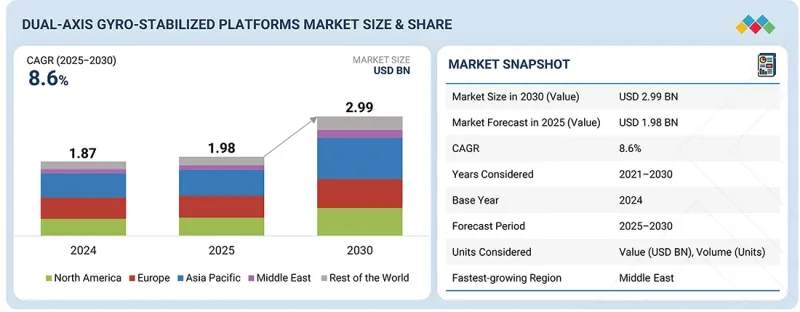
The global dual-axis gyro-stabilized platforms market is projected to grow from USD 1.98 billion in 2025 to USD 2.99 billion by 2030, at a CAGR of 8.6% from 2025 to 2030.
| Scope of the Report | |
|---|---|
| Years Considered for the Study | 2021-2030 |
| Base Year | 2024 |
| Forecast Period | 2025-2030 |
| Units Considered | Value (USD Billion) |
| Segments | By Deployment, Payload, Application and Region |
| Regions covered | North America, Europe, APAC, RoW |
The market is witnessing steady growth due to the rising use of advanced surveillance and targeting systems.
"By payload type, the scientific & environmental sensor payload segment is projected to grow at the highest CAGR during the forecast period."
The scientific & environmental sensor payload segment is experiencing growth in the dual-axis gyro-stabilized platforms market. This growth is primarily driven by a heightened focus on climate monitoring and environmental surveillance, as well as growing interest in atmospheric research across various regions. Governments and research organizations are investing in high-precision sensing systems that collect accurate real-time data in changing conditions. Consequently, there is a rising need for stable data collection on moving platforms, which is promoting the use of dual-axis stabilization technologies. Additionally, new applications are emerging in disaster monitoring, and resource management is also witnessing growth. Weather observation capabilities are expanding as well, all contributing to the steady growth of this segment.
"By system component, the embedded software & stabilization algorithms segment is projected to grow at the highest CAGR during the forecast period."
The embedded software & stabilization algorithms segment is the fastest-growing system component for dual-axis gyro-stabilized platforms. This is mainly due to the need for real-time processing and better control. Systems must now quickly adapt to changing conditions. Advancements in control algorithms are enhancing system accuracy, and artificial intelligence is increasingly being integrated into these systems. Additionally, sensor fusion technologies are improving overall response and performance. As a result, platforms are becoming more reliable in dynamic environments. There is also a growing trend toward software-driven performance, with systems designed to work seamlessly with advanced sensors. Alongside this, the demand for autonomous and unmanned platforms is rising, leading to an increased need for advanced stabilization software solutions.
"The Asia Pacific region captured the largest market share in 2025."
The Asia Pacific region was the leading dual-axis gyro-stabilized platforms market in 2025. This is mainly due to strong defense spending across major countries in the region. There is a strong demand for surveillance and border security systems, driven in part by military modernization programs. Countries such as China, India, Japan, and South Korea are investing in advanced stabilization and electro-optical technologies. Additionally, there is an increasing utilization of unmanned systems and naval platforms. The improvement of local manufacturing capabilities is also contributing to the region's ability to maintain its leading position in the market.
The breakdown of profiles for primary participants in the dual-axis gyro-stabilized platforms market is provided below:
- By Company Type: Tier 1 - 35%, Tier 2 - 45%, and Tier 3 - 20%
- By Designation: C Level - 35%, Director Level - 25%, and Others - 40%
- By Region: North America - 25%, Europe - 15%, Asia Pacific - 45%, Middle East - 10%, and Rest of the World (RoW) - 5%
Research Coverage:
This market study examines the dual-axis gyro-stabilized platforms market across various segments and subsegments. It aims to estimate the market's size and growth potential in different regions. The study also provides a detailed competitive analysis of key market players, including their company profiles, product offerings, recent developments, and strategic market initiatives.
Reasons to buy this report:
The report will assist market leaders and new entrants with estimates of the revenue figures for the overall dual-axis gyro-stabilized platforms market. It will also enable stakeholders to understand the competitive landscape better and gain insights to position their businesses more effectively and develop appropriate go-to-market strategies. Additionally, the report will help stakeholders understand the market dynamics and provide information on key market drivers, restraints, challenges, and opportunities.
The report provides insights into the following pointers:
- Market drivers (rising defense modernization & military spending), restraints (high manufacturing & integration costs), opportunities (miniaturization for small UAV and commercial drone platforms), and challenges (performance requirements in harsh operating environments)
- Market Penetration: Comprehensive information on the dual-axis gyro-stabilized platforms market offered by the top players in the market
- Product Development/Innovation: Detailed insights into upcoming technologies, research & development activities, and product launches in the dual-axis gyro-stabilized platforms market
- Market Development: Comprehensive information about lucrative markets across varied regions
- Market Diversification: Exhaustive information about new products, untapped geographies, recent developments, and investments in the market
- Competitive Assessment: In-depth assessment of market share, growth strategies, products, and manufacturing capabilities of leading players in the market
TABLE OF CONTENTS
1 INTRODUCTION
- 1.1 STUDY OBJECTIVES
- 1.2 MARKET DEFINITION
- 1.3 STUDY SCOPE
- 1.3.1 MARKETS COVERED
- 1.3.2 INCLUSIONS AND EXCLUSIONS
- 1.3.3 YEARS CONSIDERED
- 1.4 CURRENCY CONSIDERED
- 1.5 STAKEHOLDERS
2 EXECUTIVE SUMMARY
- 2.1 KEY INSIGHTS AND MARKET HIGHLIGHTS
- 2.2 KEY MARKET PARTICIPANTS: MAPPING OF STRATEGIC DEVELOPMENTS
- 2.3 DISRUPTIVE TRENDS IN DUAL-AXIS GYRO-STABILIZED PLATFORMS MARKET
- 2.4 HIGH-GROWTH SEGMENTS
- 2.5 REGIONAL SNAPSHOT: MARKET SIZE, GROWTH RATE, AND FORECAST
3 PREMIUM INSIGHTS
- 3.1 ATTRACTIVE OPPORTUNITIES FOR PLAYERS IN DUAL-AXIS GYRO-STABILIZED PLATFORMS MARKET
- 3.2 DUAL-AXIS GYRO-STABILIZED PLATFORMS MARKET, BY DEPLOYMENT
- 3.3 DUAL-AXIS GYRO-STABILIZED PLATFORMS MARKET, BY SYSTEM COMPONENT
- 3.4 DUAL-AXIS GYRO-STABILIZED PLATFORMS MARKET, BY GYRO TECHNOLOGY
- 3.5 DUAL-AXIS GYRO-STABILIZED PLATFORMS MARKET, BY APPLICATION
4 MARKET OVERVIEW
- 4.1 INTRODUCTION
- 4.2 MARKET DYNAMICS
- 4.2.1 DRIVERS
- 4.2.1.1 Rising defense modernization & military spending
- 4.2.1.2 Increasing deployment of UAVs and UGVs with integrated gyro-stabilized payloads
- 4.2.1.3 Autonomous vehicle navigation
- 4.2.1.4 Integration of MEMS sensors and AI-enabled stabilization systems
- 4.2.1.5 Growing adoption of stabilized surveillance systems for maritime security
- 4.2.2 RESTRAINTS
- 4.2.2.1 High manufacturing & integration costs
- 4.2.2.2 Export controls & regulatory barriers
- 4.2.3 OPPORTUNITIES
- 4.2.3.1 Miniaturization for small UAV and commercial drone platforms
- 4.2.3.2 Increasing adoption in commercial applications
- 4.2.4 CHALLENGES
- 4.2.4.1 Performance requirements in harsh operating environments
- 4.2.4.2 Complexity of systems & skilled workforce requirements
- 4.2.1 DRIVERS
- 4.3 UNMET NEEDS AND WHITE SPACES
- 4.3.1 LIMITED AVAILABILITY OF LIGHTWEIGHT, LOW-SWAP, AND HIGH-PRECISION STABILIZATION FOR SMALL UAVS
- 4.3.2 ABSENCE OF INTELLIGENT STABILIZATION INTEGRATED WITH AI AND SENSOR FUSION
- 4.3.3 LIMITED STANDARDIZATION AND INTEROPERABILITY ACROSS MULTI-DOMAIN PLATFORMS
- 4.3.4 CYBER RESILIENT AND EMI-HARDENED STABILIZATION SYSTEMS
- 4.4 INTERCONNECTED MARKETS AND CROSS-SECTOR OPPORTUNITIES
- 4.4.1 CONVERGENCE WITH UAV, AUTONOMOUS SYSTEMS, AND ISR PLATFORM ECOSYSTEMS
- 4.4.2 INTEGRATION WITH ADVANCED EO/IR SENSORS, RADAR, AND MULTI-SENSOR FUSION ARCHITECTURES
- 4.4.3 ALIGNMENT WITH AI, EDGE COMPUTING, AND AUTONOMOUS TARGETING SYSTEMS
- 4.4.4 SYNERGIES WITH NAVAL MODERNIZATION AND MARITIME DOMAIN AWARENESS PROGRAMS
- 4.4.5 CONVERGENCE WITH DEFENSE COMMUNICATION AND ELECTRONIC WARFARE ECOSYSTEMS
- 4.5 STRATEGIC MOVES BY TIER 1/2/3 PLAYERS
5 INDUSTRY TRENDS
- 5.1 INTRODUCTION
- 5.2 MACROECONOMIC OUTLOOK
- 5.2.1 INTRODUCTION
- 5.2.2 GDP TRENDS AND FORECAST
- 5.2.3 TRENDS IN GLOBAL MOTION CONTROL & STABILIZATION SYSTEMS INDUSTRY
- 5.2.4 TRENDS IN GLOBAL DUAL-AXIS GYRO-STABILIZED PLATFORMS INDUSTRY
- 5.3 VALUE CHAIN ANALYSIS
- 5.3.1 R&D ENGINEERS AND TECHNOLOGY DEVELOPERS (~40%)
- 5.3.2 COMPONENT AND SUBSYSTEM MANUFACTURERS (40-60%)
- 5.3.3 SYSTEM INTEGRATORS AND DEFENSE OEMS (60-80%)
- 5.3.4 END USERS (80-100%)
- 5.4 ECOSYSTEM ANALYSIS
- 5.4.1 COMPONENT AND PRECISION TECHNOLOGY MANUFACTURERS
- 5.4.2 DUAL-AXIS GIMBAL AND STABILIZED PLATFORM MANUFACTURERS
- 5.4.3 SYSTEM INTEGRATORS AND PLATFORM OEMS
- 5.4.4 END USERS
- 5.5 INVESTMENT AND FUNDING SCENARIO
- 5.6 INDICATIVE PRICING ANALYSIS
- 5.6.1 INDICATIVE PRICING ANALYSIS, BY DEPLOYMENT, 2025 (USD MILLION)
- 5.7 TRADE ANALYSIS
- 5.7.1 IMPORT SCENARIO (HS CODE 901420)
- 5.7.2 EXPORT SCENARIO (HS CODE 901420)
- 5.8 KEY CONFERENCES AND EVENTS
- 5.9 TRENDS AND DISRUPTIONS IMPACTING CUSTOMER BUSINESS
- 5.10 CASE STUDY ANALYSIS
- 5.10.1 CONTROP PRECISION TECHNOLOGIES: NAVAL EO/IR STABILIZED SURVEILLANCE DEPLOYMENT
- 5.10.2 GREMSY: UAV ISR STABILIZED GIMBAL INTEGRATION
- 5.10.3 KONGSBERG DEFENCE & AEROSPACE: REMOTE WEAPON STATION STABILIZATION
- 5.10.4 TELEDYNE FLIR: AIRBORNE EO/IR STABILIZED IMAGING SYSTEMS
- 5.10.5 NEXTVISION STABILIZED SYSTEMS: TACTICAL UAV STABILIZED PAYLOADS
- 5.11 IMPACT OF 2025 US TARIFFS
- 5.11.1 KEY TARIFF RATES
- 5.11.2 PRICE IMPACT ANALYSIS
- 5.11.3 IMPACT ON COUNTRY/REGION
- 5.11.3.1 US
- 5.11.3.2 Europe
- 5.11.3.3 Asia Pacific
- 5.11.4 IMPACT ON DIFFERENT SECTORS
- 5.11.4.1 Aerospace & defense
- 5.11.4.2 Commercial & civil
- 5.11.4.3 Telecom & SATCOM
6 TECHNOLOGICAL ADVANCEMENTS, AI-DRIVEN IMPACT, PATENTS, INNOVATIONS, AND FUTURE APPLICATIONS
- 6.1 KEY TECHNOLOGIES
- 6.1.1 AI-DRIVEN STABILIZATION AND ADAPTIVE CONTROL
- 6.1.2 ADVANCED MICRO-ELECTRO MECHANICAL SYSTEMS (MEMS) AND FIBER-OPTIC GYROSCOPE TECHNOLOGIES
- 6.1.3 ADVANCED MULTI-SENSOR FUSION STABILIZATION ALGORITHMS
- 6.2 COMPLEMENTARY TECHNOLOGIES
- 6.2.1 ELECTRO-OPTICAL AND INFRARED (EO/IR) SENSOR SYSTEMS
- 6.2.2 INERTIAL NAVIGATION AND GNSS FUSION SYSTEMS
- 6.3 ADJACENT TECHNOLOGIES
- 6.3.1 AUTONOMOUS AND ROBOTIC PLATFORM TECHNOLOGIES
- 6.3.2 INTELLIGENCE, SURVEILLANCE, AND RECONNAISSANCE (ISR) AND COMMAND-AND-CONTROL (C2) INTEGRATION SYSTEMS
- 6.4 TECHNOLOGY ROADMAP
- 6.5 PATENT ANALYSIS
- 6.6 FUTURE APPLICATIONS
- 6.7 IMPACT OF AI/ GENERATIVE AI
- 6.7.1 TOP USE CASES AND MARKET POTENTIAL
- 6.7.2 CASE STUDIES OF AI IMPLEMENTATION IN DUAL-AXIS GYRO-STABILIZED PLATFORMS MARKET
- 6.7.3 INTERCONNECTED ADJACENT ECOSYSTEM AND IMPACT ON MARKET PLAYERS
- 6.7.4 CLIENTS' READINESS TO ADOPT GENERATIVE AI IN DUAL-AXIS GYRO-STABILIZED PLATFORMS MARKET
7 CUSTOMER LANDSCAPE & BUYER BEHAVIOR
- 7.1 DECISION-MAKING PROCESS
- 7.2 BUYER STAKEHOLDERS AND BUYING EVALUATION CRITERIA
- 7.2.1 KEY STAKEHOLDERS IN BUYING PROCESS
- 7.2.2 BUYING EVALUATION CRITERIA
- 7.3 ADOPTION BARRIERS AND INTERNAL CHALLENGES
- 7.4 UNMET NEEDS FROM VARIOUS END-USE INDUSTRIES
8 SUSTAINABILITY AND REGULATORY LANDSCAPE
- 8.1 REGIONAL REGULATIONS AND COMPLIANCE
- 8.1.1 REGULATORY BODIES, GOVERNMENT AGENCIES, AND OTHER ORGANIZATIONS
- 8.1.2 INDUSTRY STANDARDS
- 8.2 CERTIFICATIONS, LABELING, AND ECO-STANDARDS
9 DUAL-AXIS GYRO-STABILIZED PLATFORMS MARKET, BY GYRO TECHNOLOGY (MARKET SIZE & FORECAST TO 2030 - USD MILLION)
- 9.1 INTRODUCTION
- 9.2 RING LASER GYROSCOPES (RLG)
- 9.2.1 INCREASING DEMAND FOR HIGH-PRECISION ELECTRO-OPTICAL SYSTEMS, FIRE CONTROL SOLUTIONS, AND AIRBORNE SURVEILLANCE PLATFORMS TO DRIVE GROWTH
- 9.2.2 USE CASE: RING LASER GYROSCOPE-BASED INERTIAL SYSTEMS BY HONEYWELL IN ADVANCED DEFENSE PLATFORMS
- 9.3 FIBER-OPTIC GYROSCOPES (FOG)
- 9.3.1 INCREASING DEMAND FOR GNSS-INDEPENDENT NAVIGATION AND ENHANCED PRECISION TO DRIVE GROWTH
- 9.3.2 USE CASE: FIBER-OPTIC GYROSCOPE-BASED STABILIZATION USING SAFRAN'S GEONYX INERTIAL NAVIGATION SYSTEM IN NAVAL PLATFORMS
- 9.4 MICRO-ELECTROMECHANICAL SYSTEMS (MEMS) GYROSCOPES
- 9.4.1 INCREASING DEMAND FOR COMPACT, COST-EFFECTIVE, AND SCALABLE STABILIZATION SOLUTIONS TO DRIVE GROWTH
- 9.4.2 USE CASE: MEMS GYROSCOPE-BASED STABILIZATION USING BOSCH SENSORTEC'S BMI270 IN COMPACT DRONE PLATFORMS
- 9.5 OTHERS
- 9.5.1 USE CASE: QUANTUM INERTIAL SENSOR (QIS) BY NORTHROP GRUMMAN
10 DUAL-AXIS GYRO-STABILIZED PLATFORMS MARKET, BY SYSTEM COMPONENT (MARKET SIZE & FORECAST TO 2030 - USD MILLION)
- 10.1 INTRODUCTION
- 10.2 STRUCTURAL ASSEMBLY
- 10.2.1 INCREASING DEMAND FOR RUGGEDIZED AND LIGHTWEIGHT PLATFORM STRUCTURES TO DRIVE GROWTH
- 10.2.2 USE CASE: PROTECTOR RWS BY KONGSBERG DEFENCE & AEROSPACE
- 10.3 MOTION CONTROL HARDWARE
- 10.3.1 INCREASING DEMAND FOR HIGH-PRECISION ACTUATION AND REAL-TIME RESPONSIVENESS TO DRIVE GROWTH
- 10.3.2 USE CASE: MOOG SERVO ACTUATION SYSTEMS
- 10.4 INERTIAL & POSITION SENSING
- 10.4.1 INCREASING DEMAND FOR HIGH-ACCURACY MOTION SENSING AND REAL-TIME POSITION FEEDBACK TO DRIVE GROWTH
- 10.4.2 USE CASE: HG4930 INERTIAL MEASUREMENT UNIT (IMU) BY HONEYWELL
- 10.5 CONTROL ELECTRONICS
- 10.5.1 INCREASING DEMAND FOR HIGH-SPEED PROCESSING AND REAL-TIME CONTROL TO DRIVE GROWTH
- 10.5.2 USE CASE: CURTISS-WRIGHT VPX EMBEDDED PROCESSING SYSTEMS
- 10.6 EMBEDDED SOFTWARE & STABILIZATION ALGORITHMS
- 10.6.1 INCREASING DEMAND FOR INTELLIGENT STABILIZATION AND ADVANCED CONTROL ALGORITHMS TO DRIVE GROWTH
- 10.6.2 USE CASE: ELBIT SYSTEMS TORCH-X SOFTWARE SUITE
- 10.7 POWER & INTERFACE MODULES
- 10.7.1 INCREASING DEMAND FOR RELIABLE POWER MANAGEMENT AND ROBUST SYSTEM INTEGRATION TO DRIVE GROWTH
- 10.7.2 USE CASE: AMPHENOL RUGGED INTERCONNECT SOLUTIONS
11 DUAL-AXIS GYRO-STABILIZED PLATFORMS MARKET, BY PAYLOAD TYPE (MARKET SIZE & FORECAST TO 2030-USD MILLION)
- 11.1 INTRODUCTION
- 11.2 ELECTRO-OPTICAL/INFRARED (EO/IR) IMAGING PAYLOAD
- 11.2.1 INCREASING DEMAND FOR HIGH-RESOLUTION SURVEILLANCE AND TARGETING TO DRIVE GROWTH
- 11.2.2 USE CASE: WESCAM MX-SERIES BY L3HARRIS TECHNOLOGIES
- 11.3 RADAR & ANTENNA STABILIZATION PAYLOAD
- 11.3.1 INCREASING DEMAND FOR CONTINUOUS SIGNAL ACCURACY AND STABLE COMMUNICATION TO DRIVE GROWTH
- 11.3.2 USE CASE: SEA TEL STABILIZED ANTENNA SYSTEMS BY COBHAM
- 11.4 LASER-BASED PAYLOAD
- 11.4.1 INCREASING DEMAND FOR PRECISION ENGAGEMENT AND HIGH-ACCURACY TARGETING TO DRIVE GROWTH
- 11.4.2 USE CASE: AN/AAQ-28 LITENING TARGETING POD BY NORTHROP GRUMMAN
- 11.5 ACOUSTIC PAYLOAD
- 11.5.1 INCREASING DEMAND FOR UNDERWATER SURVEILLANCE AND ANTI-SUBMARINE WARFARE TO DRIVE GROWTH
- 11.5.2 USE CASE: CAPTAS-4 SONAR SYSTEM BY THALES GROUP
- 11.6 WEAPON/EFFECTOR PAYLOAD
- 11.6.1 INCREASING DEMAND FOR PRECISION ENGAGEMENT AND STABILIZED WEAPON SYSTEMS TO DRIVE GROWTH
- 11.6.2 USE CASE: PROTECTOR RS4 REMOTE WEAPON STATION BY KONGSBERG.
- 11.7 SCIENTIFIC & ENVIRONMENTAL SENSOR PAYLOAD
- 11.7.1 INCREASING DEMAND FOR ACCURATE ENVIRONMENTAL MONITORING AND SCIENTIFIC DATA COLLECTION TO DRIVE GROWTH
- 11.7.2 USE CASE: LEICA CITYMAPPER-2 BY HEXAGON AB
12 DUAL-AXIS GYRO-STABILIZED PLATFORMS MARKET, BY DEPLOYMENT (MARKET SIZE & FORECAST TO 2030-USD MILLION)
- 12.1 INTRODUCTION
- 12.2 AIRBORNE
- 12.2.1 USE CASE: WESCAM MX-15 BY L3HARRIS TECHNOLOGIES
- 12.2.2 MANNED AIRCRAFT
- 12.2.2.1 Fixed Wing
- 12.2.2.1.1 Increasing demand for long-endurance surveillance and high-altitude precision operations to drive growth
- 12.2.2.1.2 Use Case: King Air 350ER ISR Aircraft by Textron Aviation
- 12.2.2.2 Rotary Wing
- 12.2.2.2.1 Increasing demand for low-altitude surveillance and hover-based precision operations to drive growth
- 12.2.2.2.2 Use Case: AW139 Helicopter Mission System by Leonardo
- 12.2.2.1 Fixed Wing
- 12.2.3 UNMANNED AERIAL VEHICLE (UAV)
- 12.2.3.1 Increasing demand for autonomous surveillance and scalable ISR operations to drive growth
- 12.2.3.1.1 Use Case: MQ-9 Reaper by General Atomics Aeronautical Systems
- 12.2.3.1 Increasing demand for autonomous surveillance and scalable ISR operations to drive growth
- 12.3 LAND
- 12.3.1 USE CASE: PROTECTOR RS4 BY KONGSBERG DEFENCE & AEROSPACE
- 12.3.2 MILITARY GROUND VEHICLE
- 12.3.2.1 Increasing demand for stabilized targeting and mobile combat effectiveness to drive growth
- 12.3.2.2 Use Case: CV90 Armored Vehicle by BAE Systems
- 12.3.3 UNMANNED GROUND VEHICLE (UGV)
- 12.3.3.1 Increasing demand for autonomous ground operations and remote surveillance to drive growth
- 12.3.3.2 Use Case: TALON UGV by QinetiQ
- 12.4 MARINE
- 12.4.1 USE CASE: SEAFLIR 280-HD BY TELEDYNE FLIR
- 12.4.2 NAVAL SHIP
- 12.4.2.1 Increasing demand for maritime surveillance, targeting accuracy, and stable operations to drive growth
- 12.4.2.2 Use Case: Sea Giraffe Radar System by Saab AB
- 12.4.3 UNMANNED MARINE VEHICLE
- 12.4.3.1 Increasing demand for autonomous maritime surveillance and persistent ocean monitoring to drive growth
- 12.4.3.2 Use Case: REMUS 100 by HII (Hydroid)
- 12.4.4 SMALL BOAT
- 12.4.4.1 Increasing demand for agile maritime surveillance and stabilized operations in high-speed environments to drive growth
- 12.4.4.2 Use Case: SeaFLIR 280-HD by Teledyne FLIR
- 12.5 GROUND FIXED INFRASTRUCTURE
- 12.5.1 USE CASE: FIXED SURVEILLANCE SYSTEMS BY AXIS COMMUNICATIONS
- 12.5.2 RAIL
- 12.5.2.1 Increasing demand for real-time rail monitoring and operational safety to drive growth
- 12.5.2.2 Use Case: Railigent Application Suite by Siemens Mobility
- 12.5.3 BORDER TOWERS
- 12.5.3.1 Increasing demand for persistent border surveillance and threat detection to drive growth
- 12.5.3.2 Use Case: Long-range observation and reconnaissance system (LOROS) by Elbit Systems
- 12.5.4 INDUSTRIAL PLATFORMS
- 12.5.4.1 Increasing demand for continuous asset monitoring and operational efficiency to drive growth
- 12.5.4.2 Use Case: Honeywell Forge Industrial Analytics Platform
13 DUAL-AXIS GYRO-STABILIZED PLATFORMS MARKET, BY APPLICATION (MARKET SIZE & FORECAST TO 2030-USD MILLION)
- 13.1 INTRODUCTION
- 13.2 COMMUNICATION STABILIZATION
- 13.2.1 INCREASING DEMAND FOR RELIABLE CONNECTIVITY AND SIGNAL STABILITY TO DRIVE GROWTH
- 13.2.2 USE CASE: GX60NX MARITIME VSAT BY INTELLIAN TECHNOLOGIES
- 13.3 NAVIGATION & GUIDANCE
- 13.3.1 INCREASING DEMAND FOR HIGH-PRECISION POSITIONING AND GNSS-INDEPENDENT OPERATIONS TO DRIVE GROWTH
- 13.3.2 USE CASE: GEONYX INERTIAL NAVIGATION SYSTEM BY SAFRAN ELECTRONICS & DEFENSE
- 13.4 AERIAL & CINEMATIC IMAGING
- 13.4.1 INCREASING DEMAND FOR HIGH-QUALITY VISUAL CONTENT AND STABLE IMAGING TO DRIVE GROWTH
- 13.4.2 USE CASE: RONIN 2 GIMBAL BY DJI
- 13.5 TARGETING & FIRE CONTROL
- 13.5.1 INCREASING DEMAND FOR PRECISION ENGAGEMENT AND REAL-TIME TARGETING TO DRIVE GROWTH
- 13.5.2 USE CASE: PROTECTOR RS4 BY KONGSBERG DEFENCE & AEROSPACE
- 13.6 INTELLIGENCE, SURVEILLANCE, AND RECONNAISSANCE (ISR)
- 13.6.1 INCREASING DEMAND FOR PERSISTENT SURVEILLANCE AND REAL-TIME INTELLIGENCE TO DRIVE GROWTH
- 13.6.2 USE CASE: WESCAM MX-20 BY L3HARRIS TECHNOLOGIES
- 13.7 MONITORING & INSPECTION
- 13.7.1 INCREASING DEMAND FOR ACCURATE ASSET MONITORING AND PREDICTIVE MAINTENANCE TO DRIVE GROWTH
- 13.7.2 USE CASE: MATRICE 350 RTK BY DJI
- 13.8 MAPPING & SURVEYING
- 13.8.1 INCREASING DEMAND FOR HIGH-ACCURACY GEOSPATIAL DATA AND LARGE-SCALE SURVEY EFFICIENCY TO DRIVE GROWTH
- 13.8.2 USE CASE: TRIMBLE MX9 MOBILE MAPPING SYSTEM
- 13.9 ATMOSPHERIC RESEARCH
- 13.9.1 INCREASING DEMAND FOR HIGH-PRECISION ENVIRONMENTAL DATA AND CLIMATE MONITORING TO DRIVE GROWTH
- 13.9.2 USE CASE: ER-2 HIGH-ALTITUDE AIRCRAFT BY NASA
14 DUAL-AXIS GYRO-STABILIZED PLATFORMS MARKET, BY REGION (MARKET SIZE & FORECAST TO 2030 - IN VALUE, USD MILLION)
- 14.1 INTRODUCTION
- 14.2 NORTH AMERICA
- 14.2.1 US
- 14.2.1.1 Tactical ISR capability expansion to drive market
- 14.2.2 CANADA
- 14.2.2.1 National security imaging and Arctic ISR modernization to support stabilized platform adoption
- 14.2.1 US
- 14.3 EUROPE
- 14.3.1 UK
- 14.3.1.1 Sustained investment in advanced sensing contracts to drive market
- 14.3.2 GERMANY
- 14.3.2.1 NATO-aligned defense modernization to drive market
- 14.3.3 FRANCE
- 14.3.3.1 Expeditionary ISR capability enhancement to drive market
- 14.3.4 ITALY
- 14.3.4.1 Emphasis on maritime security across Mediterranean region to drive market
- 14.3.5 SPAIN
- 14.3.5.1 Naval fleet modernization and airborne ISR upgrades to drive market
- 14.3.6 REST OF EUROPE
- 14.3.1 UK
- 14.4 ASIA PACIFIC
- 14.4.1 CHINA
- 14.4.1.1 Large-scale UAV production and naval expansion to drive market
- 14.4.2 INDIA
- 14.4.2.1 High altitude border surveillance and naval modernization to drive market
- 14.4.3 JAPAN
- 14.4.3.1 Maritime patrol modernization and precision airborne ISR to drive market
- 14.4.4 AUSTRALIA
- 14.4.4.1 Maritime endurance operations and naval modernization to drive market
- 14.4.5 SOUTH KOREA
- 14.4.5.1 Armored vehicle modernization to drive market
- 14.4.6 REST OF ASIA PACIFIC
- 14.4.1 CHINA
- 14.5 MIDDLE EAST
- 14.5.1 GCC
- 14.5.1.1 UAE
- 14.5.1.1.1 Sustained maritime security investment in Gulf region to drive market
- 14.5.1.2 Saudi Arabia
- 14.5.1.2.1 Vision 2030 defense localization and border security modernization to drive market
- 14.5.1.3 Turkey
- 14.5.1.3.1 Rising demand for UAV-integrated stabilization systems to drive market
- 14.5.1.4 Qatar
- 14.5.1.4.1 Growing demand for ISR-centric stabilization systems to drive market
- 14.5.1.1 UAE
- 14.5.1 GCC
- 14.6 REST OF THE WORLD
- 14.6.1 LATIN AMERICA
- 14.6.1.1 Maritime security modernization across coastal nations to drive market
- 14.6.2 AFRICA
- 14.6.2.1 Rising demand for motion-stabilized imaging platforms for security operations to drive growth
- 14.6.1 LATIN AMERICA
15 COMPETITIVE LANDSCAPE
- 15.1 INTRODUCTION
- 15.2 KEY PLAYER STRATEGIES/RIGHT TO WIN, JANUARY 2021-MARCH 2026
- 15.3 REVENUE ANALYSIS, 2021-2024
- 15.4 MARKET SHARE ANALYSIS, 2024
- 15.5 BRAND/PRODUCT COMPARISON
- 15.6 COMPANY VALUATION AND FINANCIAL METRICS
- 15.7 COMPANY EVALUATION MATRIX: KEY PLAYERS, 2024
- 15.7.1 STARS
- 15.7.2 EMERGING LEADERS
- 15.7.3 PERVASIVE PLAYERS
- 15.7.4 PARTICIPANTS
- 15.7.5 COMPANY FOOTPRINT
- 15.7.5.1 Company footprint
- 15.7.5.2 Region footprint
- 15.7.5.3 Gyro technology footprint
- 15.7.5.4 Deployment footprint
- 15.8 COMPANY EVALUATION MATRIX: STARTUPS/SMES, 2024
- 15.8.1 PROGRESSIVE COMPANIES
- 15.8.2 RESPONSIVE COMPANIES
- 15.8.3 DYNAMIC COMPANIES
- 15.8.4 STARTING BLOCKS
- 15.8.5 COMPETITIVE BENCHMARKING
- 15.8.5.1 List of startups/SMEs
- 15.8.5.2 Competitive benchmarking of startups/SMEs
- 15.9 COMPETITIVE SCENARIO
- 15.9.1 PRODUCT LAUNCHES/DEVELOPMENTS
- 15.9.2 DEALS
- 15.9.3 OTHER DEVELOPMENTS
16 COMPANY PROFILES
- 16.1 KEY PLAYERS
- 16.1.1 KONGSBERG
- 16.1.1.1 Business overview
- 16.1.1.2 Products/Solutions offered
- 16.1.1.3 Recent developments
- 16.1.1.3.1 Product launches/developments
- 16.1.1.3.2 Deals
- 16.1.1.3.3 Other developments
- 16.1.1.4 MnM view
- 16.1.1.4.1 Key strengths
- 16.1.1.4.2 Strategic choices
- 16.1.1.4.3 Weaknesses and competitive threats
- 16.1.2 ASELSAN A.S.
- 16.1.2.1 Business overview
- 16.1.2.2 Products/Solutions offered
- 16.1.2.3 Recent developments
- 16.1.2.3.1 Product launches/developments
- 16.1.2.3.2 Deals
- 16.1.2.3.3 Other developments
- 16.1.2.4 MnM view
- 16.1.2.4.1 Key strengths
- 16.1.2.4.2 Strategic choices
- 16.1.2.4.3 Weaknesses and competitive threats
- 16.1.3 ISRAEL AEROSPACE INDUSTRIES
- 16.1.3.1 Business overview
- 16.1.3.2 Products/Solutions offered
- 16.1.3.3 Recent developments
- 16.1.3.3.1 Product launches/developments
- 16.1.3.3.2 Deals
- 16.1.3.3.3 Other developments
- 16.1.3.4 MnM view
- 16.1.3.4.1 Key strengths
- 16.1.3.4.2 Strategic choices
- 16.1.3.4.3 Weaknesses and competitive threats
- 16.1.4 L3HARRIS TECHNOLOGIES, INC.
- 16.1.4.1 Business overview
- 16.1.4.2 Products/Solutions offered
- 16.1.4.3 Recent developments
- 16.1.4.3.1 Product launches/developments
- 16.1.4.3.2 Deals
- 16.1.4.3.3 Other developments
- 16.1.4.4 MnM view
- 16.1.4.4.1 Key strengths
- 16.1.4.4.2 Strategic choices
- 16.1.4.4.3 Weaknesses and competitive threats
- 16.1.5 KVH INDUSTRIES, INC.
- 16.1.5.1 Business overview
- 16.1.5.2 Products/Solutions offered
- 16.1.5.3 Recent developments
- 16.1.5.3.1 Product launches
- 16.1.5.3.2 Deals
- 16.1.5.3.3 Other developments
- 16.1.5.4 MnM view
- 16.1.5.4.1 Key strengths
- 16.1.5.4.2 Strategic choices
- 16.1.5.4.3 Weaknesses and competitive threats
- 16.1.6 LOCKHEED MARTIN CORPORATION
- 16.1.6.1 Business overview
- 16.1.6.2 Products/Solutions offered
- 16.1.6.3 Recent developments
- 16.1.6.3.1 Product launches/developments
- 16.1.6.3.2 Deals
- 16.1.6.3.3 Other developments
- 16.1.7 ELBIT SYSTEMS LTD.
- 16.1.7.1 Business overview
- 16.1.7.2 Products/Solutions offered
- 16.1.7.3 Recent developments
- 16.1.7.3.1 Product launches/developments
- 16.1.7.3.2 Deals
- 16.1.7.3.3 Other developments
- 16.1.8 SAFRAN S.A.
- 16.1.8.1 Business overview
- 16.1.8.2 Products/Solutions offered
- 16.1.8.3 Recent developments
- 16.1.8.3.1 Product launches/developments
- 16.1.8.3.2 Deals
- 16.1.8.3.3 Other developments
- 16.1.9 LEONARDO S.P.A.
- 16.1.9.1 Business overview
- 16.1.9.2 Products/Solutions offered
- 16.1.9.3 Recent developments
- 16.1.9.3.1 Product launches/developments
- 16.1.9.3.2 Deals
- 16.1.9.3.3 Other developments
- 16.1.10 RAFAEL ADVANCED DEFENSE SYSTEMS LTD.
- 16.1.10.1 Business overview
- 16.1.10.2 Products/Solutions offered
- 16.1.10.3 Recent developments
- 16.1.10.3.1 Product launches/developments
- 16.1.10.3.2 Deals
- 16.1.10.3.3 Other developments
- 16.1.11 TELEDYNE FLIR LLC
- 16.1.11.1 Business overview
- 16.1.11.2 Products/Solutions offered
- 16.1.11.3 Recent developments
- 16.1.11.3.1 Product launches/developments
- 16.1.11.3.2 Deals
- 16.1.11.3.3 Other developments
- 16.1.12 HENSOLDT AG
- 16.1.12.1 Business overview
- 16.1.12.2 Products/Solutions offered
- 16.1.12.3 Recent developments
- 16.1.12.3.1 Product launches/developments
- 16.1.12.3.2 Deals
- 16.1.12.3.3 Other developments
- 16.1.13 MOOG INC.
- 16.1.13.1 Business overview
- 16.1.13.2 Products/Solutions offered
- 16.1.13.3 Recent developments
- 16.1.13.3.1 Product launches/developments
- 16.1.13.3.2 Deals
- 16.1.13.3.3 Other developments
- 16.1.14 GYRO-STABILIZED SYSTEMS
- 16.1.14.1 Business overview
- 16.1.14.2 Products/Solutions offered
- 16.1.14.3 Recent developments
- 16.1.14.3.1 Product launches
- 16.1.14.3.2 Deals
- 16.1.15 CACI INTERNATIONAL INC
- 16.1.15.1 Business overview
- 16.1.15.2 Products/Solutions offered
- 16.1.15.3 Recent developments
- 16.1.15.3.1 Product launches/developments
- 16.1.15.3.2 Deals
- 16.1.15.3.3 Other developments
- 16.1.16 KRATOS
- 16.1.16.1 Business overview
- 16.1.16.2 Products/Solutions offered
- 16.1.16.3 Recent developments
- 16.1.16.3.1 Product launches/developments
- 16.1.16.3.2 Deals
- 16.1.16.3.3 Other developments
- 16.1.17 GENERAL DYNAMICS CORPORATION
- 16.1.17.1 Business overview
- 16.1.17.2 Products/Solutions offered
- 16.1.17.3 Recent developments
- 16.1.17.3.1 Product launches
- 16.1.17.3.2 Deals
- 16.1.17.3.3 Other developments
- 16.1.18 BAE SYSTEMS
- 16.1.18.1 Business overview
- 16.1.18.2 Products/Solutions offered
- 16.1.18.3 Recent developments
- 16.1.18.3.1 Product launches
- 16.1.18.3.2 Deals
- 16.1.18.3.3 Other developments
- 16.1.19 HANWHA GROUP
- 16.1.19.1 Business overview
- 16.1.19.2 Products/Solutions offered
- 16.1.19.3 Recent developments
- 16.1.19.3.1 Product launches/developments
- 16.1.19.3.2 Deals
- 16.1.19.3.3 Other developments
- 16.1.20 HONEYWELL INTERNATIONAL INC.
- 16.1.20.1 Business overview
- 16.1.20.2 Products/Solutions offered
- 16.1.20.3 Recent developments
- 16.1.20.3.1 Product launches
- 16.1.20.3.2 Deals
- 16.1.20.3.3 Other developments
- 16.1.21 EXAIL SAS
- 16.1.21.1 Business overview
- 16.1.21.2 Products/Solutions offered
- 16.1.21.3 Recent developments
- 16.1.21.3.1 Product launches
- 16.1.21.3.2 Deals
- 16.1.21.3.3 Other developments
- 16.1.22 TRILLIUM
- 16.1.22.1 Business overview
- 16.1.22.2 Products/Solutions offered
- 16.1.22.3 Recent developments
- 16.1.22.3.1 Product launches
- 16.1.22.3.2 Deals
- 16.1.22.3.3 Other developments
- 16.1.23 CONTROP
- 16.1.23.1 Business overview
- 16.1.23.2 Products/Solutions offered
- 16.1.23.3 Recent developments
- 16.1.23.3.1 Deals
- 16.1.23.3.2 Other developments
- 16.1.24 NEXTVISION STABILIZED SYSTEMS LTD
- 16.1.24.1 Business overview
- 16.1.24.2 Products/Solutions offered
- 16.1.24.3 Recent developments
- 16.1.24.3.1 Product launches
- 16.1.24.3.2 Deals
- 16.1.24.3.3 Other developments
- 16.1.25 GREMSY
- 16.1.25.1 Business overview
- 16.1.25.2 Products/Solutions offered
- 16.1.25.3 Recent developments
- 16.1.25.3.1 Product launches
- 16.1.25.3.2 Deals
- 16.1.26 AEROVIRONMENT, INC.
- 16.1.26.1 Business overview
- 16.1.26.2 Products/Solutions offered
- 16.1.26.3 Recent developments
- 16.1.26.3.1 Product launches
- 16.1.26.3.2 Deals
- 16.1.26.3.3 Other developments
- 16.1.1 KONGSBERG
- 16.2 OTHER PLAYERS
- 16.2.1 EDGE AUTONOMY
- 16.2.2 TRAKKA
- 16.2.3 UAVOS INC.
- 16.2.4 FREEFLY SYSTEMS
- 16.2.5 UAV VISION
- 16.2.6 BLITZ TECHNOLOGY INC.
17 RESEARCH METHODOLOGY
- 17.1 RESEARCH DATA
- 17.1.1 SECONDARY DATA
- 17.1.1.1 Key data from secondary sources
- 17.1.2 PRIMARY DATA
- 17.1.2.1 Primary interview participants
- 17.1.2.2 Key data from primary sources
- 17.1.2.3 Breakdown of primary interviews
- 17.1.1 SECONDARY DATA
- 17.2 MARKET SIZE ESTIMATION
- 17.2.1 BOTTOM-UP APPROACH
- 17.2.2 TOP-DOWN APPROACH
- 17.2.3 BASE NUMBER CALCULATION
- 17.3 DATA TRIANGULATION
- 17.4 FACTOR ANALYSIS
- 17.4.1 SUPPLY-SIDE INDICATORS
- 17.4.2 DEMAND-SIDE INDICATORS
- 17.5 RESEARCH ASSUMPTIONS
- 17.6 RESEARCH LIMITATIONS
- 17.7 RISK ASSESSMENT
18 APPENDIX
- 18.1 DISCUSSION GUIDE
- 18.2 ANNEXURE
- 18.3 KNOWLEDGESTORE: MARKETSANDMARKETS' SUBSCRIPTION PORTAL
- 18.4 CUSTOMIZATION OPTIONS
- 18.5 RELATED REPORTS
- 18.6 AUTHOR DETAILS
List of Tables
- TABLE 1 DUAL-AXIS GYRO-STABILIZED PLATFORMS MARKET: INCLUSIONS AND EXCLUSIONS
- TABLE 2 UNMET NEEDS AND WHITE SPACES
- TABLE 3 STRATEGIC MOVES BY TIER 1/2/3 PLAYERS
- TABLE 4 GDP PERCENTAGE CHANGE, BY COUNTRY, 2021-2030
- TABLE 5 ROLE OF COMPANIES IN ECOSYSTEM
- TABLE 6 INDICATIVE PRICING ANALYSIS, BY DEPLOYMENT (USD MILLION), 2025
- TABLE 7 IMPORT DATA FOR HS CODE 901420-COMPLIANT PRODUCTS, BY COUNTRY, 2021-2024 (USD THOUSAND)
- TABLE 8 EXPORT DATA FOR HS CODE 901420-COMPLIANT PRODUCTS, BY COUNTRY, 2021-2024 (USD THOUSAND)
- TABLE 9 KEY CONFERENCES AND EVENTS, 2026-2027
- TABLE 10 US-ADJUSTED RECIPROCAL TARIFF RATES
- TABLE 11 EVOLUTION OF DUAL-AXIS GYRO-STABILIZED PLATFORMS
- TABLE 12 PATENT ANALYSIS, 2021-2025
- TABLE 13 AI-ENABLED AUTONOMOUS ISR AND TARGETING PLATFORMS: FUTURE OF INTELLIGENT MULTI-DOMAIN SURVEILLANCE AND PRECISION ENGAGEMENT
- TABLE 14 NEXT-GENERATION REMOTE WEAPON STATIONS AND SMART TURRETS: FUTURE OF STABILIZED COMBAT AND TACTICAL RESPONSE SYSTEMS
- TABLE 15 TOP USE CASES AND MARKET POTENTIAL
- TABLE 16 CASE STUDIES OF AI IMPLEMENTATION IN DUAL-AXIS GYRO-STABILIZED PLATFORMS MARKET
- TABLE 17 INFLUENCE OF STAKEHOLDERS ON BUYING PROCESS, BY APPLICATION (%)
- TABLE 18 KEY BUYING CRITERIA, BY APPLICATION
- TABLE 19 UNMET NEEDS IN DUAL-AXIS GYRO-STABILIZED PLATFORM MARKET, BY APPLICATION
- TABLE 20 NORTH AMERICA: REGULATORY BODIES, GOVERNMENT AGENCIES, AND OTHER ORGANIZATIONS
- TABLE 21 EUROPE: REGULATORY BODIES, GOVERNMENT AGENCIES, AND OTHER ORGANIZATIONS
- TABLE 22 ASIA PACIFIC: REGULATORY BODIES, GOVERNMENT AGENCIES, AND OTHER ORGANIZATIONS
- TABLE 23 MIDDLE EAST: REGULATORY BODIES, GOVERNMENT AGENCIES, AND OTHER ORGANIZATIONS
- TABLE 24 REST OF THE WORLD: REGULATORY BODIES, GOVERNMENT AGENCIES, AND OTHER ORGANIZATIONS
- TABLE 25 GLOBAL DESIGN, STRUCTURAL, AND OPERATIONAL STANDARDS
- TABLE 26 CERTIFICATIONS, LABELING, AND ECO-STANDARDS
- TABLE 27 DUAL-AXIS GYRO-STABILIZED PLATFORMS MARKET, BY GYRO TECHNOLOGY, 2021-2024 (USD MILLION)
- TABLE 28 DUAL-AXIS GYRO-STABILIZED PLATFORMS MARKET, BY GYRO TECHNOLOGY, 2025-2030 (USD MILLION)
- TABLE 29 DUAL-AXIS GYRO-STABILIZED PLATFORMS MARKET, BY SYSTEM COMPONENT, 2021-2024 (USD MILLION)
- TABLE 30 DUAL-AXIS GYRO-STABILIZED PLATFORMS MARKET, BY SYSTEM COMPONENT, 2025-2030 (USD MILLION)
- TABLE 31 DUAL-AXIS GYRO-STABILIZED PLATFORMS MARKET, BY PAYLOAD TYPE, 2021-2024 (USD MILLION)
- TABLE 32 DUAL-AXIS GYRO-STABILIZED PLATFORMS MARKET, BY PAYLOAD TYPE, 2025-2030 (USD MILLION)
- TABLE 33 DUAL-AXIS GYRO-STABILIZED PLATFORMS MARKET, BY DEPLOYMENT, 2021-2024 (USD MILLION)
- TABLE 34 DUAL-AXIS GYRO-STABILIZED PLATFORMS MARKET, BY DEPLOYMENT, 2025-2030 (USD MILLION)
- TABLE 35 DUAL-AXIS GYRO-STABILIZED PLATFORMS MARKET, BY AIRBORNE DEPLOYMENT, 2021-2024 (USD MILLION)
- TABLE 36 DUAL-AXIS GYRO-STABILIZED PLATFORMS MARKET, BY AIRBORNE DEPLOYMENT, 2025-2030 (USD MILLION)
- TABLE 37 DUAL-AXIS GYRO-STABILIZED PLATFORMS MARKET, BY MANNED AIRCRAFT, 2021-2024 (USD MILLION)
- TABLE 38 DUAL-AXIS GYRO-STABILIZED PLATFORMS MARKET, BY MANNED AIRCRAFT, 2025-2030 (USD MILLION)
- TABLE 39 DUAL-AXIS GYRO-STABILIZED PLATFORMS MARKET, BY LAND DEPLOYMENT, 2021-2024 (USD MILLION)
- TABLE 40 DUAL-AXIS GYRO-STABILIZED PLATFORMS MARKET, BY LAND DEPLOYMENT, 2025-2030 (USD MILLION)
- TABLE 41 DUAL-AXIS GYRO-STABILIZED PLATFORMS MARKET, BY MARINE DEPLOYMENT, 2021-2024 (USD MILLION)
- TABLE 42 DUAL-AXIS GYRO-STABILIZED PLATFORMS MARKET, BY MARINE DEPLOYMENT, 2025-2030 (USD MILLION)
- TABLE 43 DUAL-AXIS GYRO-STABILIZED PLATFORMS MARKET, BY GROUND FIXED INFRASTRUCTURE, 2021-2024 (USD MILLION)
- TABLE 44 DUAL-AXIS GYRO-STABILIZED PLATFORMS MARKET, BY GROUND FIXED INFRASTRUCTURE, 2025-2030 (USD MILLION)
- TABLE 45 DUAL-AXIS GYRO-STABILIZED PLATFORMS MARKET, BY APPLICATION, 2021-2024 (USD MILLION)
- TABLE 46 DUAL-AXIS GYRO-STABILIZED PLATFORMS MARKET, BY APPLICATION, 2025-2030 (USD MILLION)
- TABLE 47 DUAL-AXIS GYRO-STABILIZED PLATFORMS MARKET, BY REGION, 2021-2024 (USD MILLION)
- TABLE 48 DUAL-AXIS GYRO-STABILIZED PLATFORMS MARKET, BY REGION, 2025-2030 (USD MILLION)
- TABLE 49 NORTH AMERICA: DUAL-AXIS GYRO-STABILIZED PLATFORMS MARKET, BY COUNTRY, 2021-2024 (USD MILLION)
- TABLE 50 NORTH AMERICA: DUAL-AXIS GYRO-STABILIZED PLATFORMS MARKET, BY COUNTRY, 2025-2030 (USD MILLION)
- TABLE 51 NORTH AMERICA: DUAL-AXIS GYRO-STABILIZED PLATFORMS MARKET, BY DEPLOYMENT, 2021-2024 (USD MILLION)
- TABLE 52 NORTH AMERICA: DUAL-AXIS GYRO-STABILIZED PLATFORMS MARKET, BY DEPLOYMENT, 2025-2030 (USD MILLION)
- TABLE 53 NORTH AMERICA: DUAL-AXIS GYRO-STABILIZED PLATFORMS MARKET, BY GYRO TECHNOLOGY, 2021-2024 (USD MILLION)
- TABLE 54 NORTH AMERICA: DUAL-AXIS GYRO-STABILIZED PLATFORMS MARKET, BY GYRO TECHNOLOGY, 2025-2030 (USD MILLION)
- TABLE 55 US: DUAL-AXIS GYRO-STABILIZED PLATFORMS MARKET, BY DEPLOYMENT, 2021-2024 (USD MILLION)
- TABLE 56 US: DUAL-AXIS GYRO-STABILIZED PLATFORMS MARKET, BY DEPLOYMENT, 2025-2030 (USD MILLION)
- TABLE 57 US: DUAL-AXIS GYRO-STABILIZED PLATFORMS MARKET, BY GYRO TECHNOLOGY, 2021-2024 (USD MILLION)
- TABLE 58 US: DUAL-AXIS GYRO-STABILIZED PLATFORMS MARKET, BY GYRO TECHNOLOGY, 2025-2030 (USD MILLION)
- TABLE 59 CANADA: DUAL-AXIS GYRO-STABILIZED PLATFORMS MARKET, BY DEPLOYMENT, 2021-2024 (USD MILLION)
- TABLE 60 CANADA: DUAL-AXIS GYRO-STABILIZED PLATFORMS MARKET, BY DEPLOYMENT, 2025-2030 (USD MILLION)
- TABLE 61 CANADA: DUAL-AXIS GYRO-STABILIZED PLATFORMS MARKET, BY GYRO TECHNOLOGY, 2021-2024 (USD MILLION)
- TABLE 62 CANADA: DUAL-AXIS GYRO-STABILIZED PLATFORMS MARKET, BY GYRO TECHNOLOGY, 2025-2030 (USD MILLION)
- TABLE 63 EUROPE: DUAL-AXIS GYRO-STABILIZED PLATFORMS MARKET, BY COUNTRY, 2021-2024 (USD MILLION)
- TABLE 64 EUROPE: DUAL-AXIS GYRO-STABILIZED PLATFORMS MARKET, BY COUNTRY, 2025-2030 (USD MILLION)
- TABLE 65 EUROPE: DUAL-AXIS GYRO-STABILIZED PLATFORMS MARKET, BY DEPLOYMENT, 2021-2024 (USD MILLION)
- TABLE 66 EUROPE: DUAL-AXIS GYRO-STABILIZED PLATFORMS MARKET, BY DEPLOYMENT, 2025-2030 (USD MILLION)
- TABLE 67 EUROPE: DUAL-AXIS GYRO-STABILIZED PLATFORMS MARKET, BY GYRO TECHNOLOGY, 2021-2024 (USD MILLION)
- TABLE 68 EUROPE: DUAL-AXIS GYRO-STABILIZED PLATFORMS MARKET, BY GYRO TECHNOLOGY, 2025-2030 (USD MILLION)
- TABLE 69 UK: DUAL-AXIS GYRO-STABILIZED PLATFORMS MARKET, BY DEPLOYMENT, 2021-2024 (USD MILLION)
- TABLE 70 UK: DUAL-AXIS GYRO-STABILIZED PLATFORMS MARKET, BY DEPLOYMENT, 2025-2030 (USD MILLION)
- TABLE 71 UK: DUAL-AXIS GYRO-STABILIZED PLATFORMS MARKET, BY GYRO TECHNOLOGY, 2021-2024 (USD MILLION)
- TABLE 72 UK: DUAL-AXIS GYRO-STABILIZED PLATFORMS MARKET, BY GYRO TECHNOLOGY, 2025-2030 (USD MILLION)
- TABLE 73 GERMANY: DUAL-AXIS GYRO-STABILIZED PLATFORMS MARKET, BY DEPLOYMENT, 2021-2024 (USD MILLION)
- TABLE 74 GERMANY: DUAL-AXIS GYRO-STABILIZED PLATFORMS MARKET, BY DEPLOYMENT, 2025-2030 (USD MILLION)
- TABLE 75 GERMANY: DUAL-AXIS GYRO-STABILIZED PLATFORMS MARKET, BY GYRO TECHNOLOGY, 2021-2024 (USD MILLION)
- TABLE 76 GERMANY: DUAL-AXIS GYRO-STABILIZED PLATFORMS MARKET, BY GYRO TECHNOLOGY, 2025-2030 (USD MILLION)
- TABLE 77 FRANCE: DUAL-AXIS GYRO-STABILIZED PLATFORMS MARKET, BY DEPLOYMENT, 2021-2024 (USD MILLION)
- TABLE 78 FRANCE: DUAL-AXIS GYRO-STABILIZED PLATFORMS MARKET, BY DEPLOYMENT, 2025-2030 (USD MILLION)
- TABLE 79 FRANCE: DUAL-AXIS GYRO-STABILIZED PLATFORMS MARKET, BY GYRO TECHNOLOGY, 2021-2024 (USD MILLION)
- TABLE 80 FRANCE: DUAL-AXIS GYRO-STABILIZED PLATFORMS MARKET, BY GYRO TECHNOLOGY, 2025-2030 (USD MILLION)
- TABLE 81 ITALY: DUAL-AXIS GYRO-STABILIZED PLATFORMS MARKET, BY DEPLOYMENT, 2021-2024 (USD MILLION)
- TABLE 82 ITALY: DUAL-AXIS GYRO-STABILIZED PLATFORMS MARKET, BY DEPLOYMENT, 2025-2030 (USD MILLION)
- TABLE 83 ITALY: DUAL-AXIS GYRO-STABILIZED PLATFORMS MARKET, BY GYRO TECHNOLOGY, 2021-2024 (USD MILLION)
- TABLE 84 ITALY: DUAL-AXIS GYRO-STABILIZED PLATFORMS MARKET, BY GYRO TECHNOLOGY, 2025-2030 (USD MILLION)
- TABLE 85 SPAIN: DUAL-AXIS GYRO-STABILIZED PLATFORMS MARKET, BY DEPLOYMENT, 2021-2024 (USD MILLION)
- TABLE 86 SPAIN: DUAL-AXIS GYRO-STABILIZED PLATFORMS MARKET, BY DEPLOYMENT, 2025-2030 (USD MILLION)
- TABLE 87 SPAIN: DUAL-AXIS GYRO-STABILIZED PLATFORMS MARKET, BY GYRO TECHNOLOGY, 2021-2024 (USD MILLION)
- TABLE 88 SPAIN: DUAL-AXIS GYRO-STABILIZED PLATFORMS MARKET, BY GYRO TECHNOLOGY, 2025-2030 (USD MILLION)
- TABLE 89 REST OF EUROPE: DUAL-AXIS GYRO-STABILIZED PLATFORMS MARKET, BY DEPLOYMENT, 2021-2024 (USD MILLION)
- TABLE 90 REST OF EUROPE: DUAL-AXIS GYRO-STABILIZED PLATFORMS MARKET, BY DEPLOYMENT, 2025-2030 (USD MILLION)
- TABLE 91 REST OF EUROPE: DUAL-AXIS GYRO-STABILIZED PLATFORMS MARKET, BY GYRO TECHNOLOGY, 2021-2024 (USD MILLION)
- TABLE 92 REST OF EUROPE: DUAL-AXIS GYRO-STABILIZED PLATFORMS MARKET, BY GYRO TECHNOLOGY, 2025-2030 (USD MILLION)
- TABLE 93 ASIA PACIFIC: DUAL-AXIS GYRO-STABILIZED PLATFORMS MARKET, BY COUNTRY, 2021-2024 (USD MILLION)
- TABLE 94 ASIA PACIFIC: DUAL-AXIS GYRO-STABILIZED PLATFORMS MARKET, BY COUNTRY, 2025-2030 (USD MILLION)
- TABLE 95 ASIA PACIFIC: DUAL-AXIS GYRO-STABILIZED PLATFORMS MARKET, BY DEPLOYMENT, 2021-2024 (USD MILLION)
- TABLE 96 ASIA PACIFIC: DUAL-AXIS GYRO-STABILIZED PLATFORMS MARKET, BY DEPLOYMENT, 2025-2030 (USD MILLION)
- TABLE 97 ASIA PACIFIC: DUAL-AXIS GYRO-STABILIZED PLATFORMS MARKET, BY GYRO TECHNOLOGY, 2021-2024 (USD MILLION)
- TABLE 98 ASIA PACIFIC: DUAL-AXIS GYRO-STABILIZED PLATFORMS MARKET, BY GYRO TECHNOLOGY, 2025-2030 (USD MILLION)
- TABLE 99 CHINA: DUAL-AXIS GYRO-STABILIZED PLATFORMS MARKET, BY DEPLOYMENT, 2021-2024 (USD MILLION)
- TABLE 100 CHINA: DUAL-AXIS GYRO-STABILIZED PLATFORMS MARKET, BY DEPLOYMENT, 2025-2030 (USD MILLION)
- TABLE 101 CHINA: DUAL-AXIS GYRO-STABILIZED PLATFORMS MARKET, BY GYRO TECHNOLOGY, 2021-2024 (USD MILLION)
- TABLE 102 CHINA: DUAL-AXIS GYRO-STABILIZED PLATFORMS MARKET, BY GYRO TECHNOLOGY, 2025-2030 (USD MILLION)
- TABLE 103 INDIA: DUAL-AXIS GYRO-STABILIZED PLATFORMS MARKET, BY DEPLOYMENT, 2021-2024 (USD MILLION)
- TABLE 104 INDIA: DUAL-AXIS GYRO-STABILIZED PLATFORMS MARKET, BY DEPLOYMENT, 2025-2030 (USD MILLION)
- TABLE 105 INDIA: DUAL-AXIS GYRO-STABILIZED PLATFORMS MARKET, BY GYRO TECHNOLOGY, 2021-2024 (USD MILLION)
- TABLE 106 INDIA: DUAL-AXIS GYRO-STABILIZED PLATFORMS MARKET, BY GYRO TECHNOLOGY, 2025-2030 (USD MILLION)
- TABLE 107 JAPAN: DUAL-AXIS GYRO-STABILIZED PLATFORMS MARKET, BY DEPLOYMENT, 2021-2024 (USD MILLION)
- TABLE 108 JAPAN: DUAL-AXIS GYRO-STABILIZED PLATFORMS MARKET, BY DEPLOYMENT, 2025-2030 (USD MILLION)
- TABLE 109 JAPAN: DUAL-AXIS GYRO-STABILIZED PLATFORMS MARKET, BY GYRO TECHNOLOGY, 2021-2024 (USD MILLION)
- TABLE 110 JAPAN: DUAL-AXIS GYRO-STABILIZED PLATFORMS MARKET, BY GYRO TECHNOLOGY, 2025-2030 (USD MILLION)
- TABLE 111 AUSTRALIA: DUAL-AXIS GYRO-STABILIZED PLATFORMS MARKET, BY DEPLOYMENT, 2021-2024 (USD MILLION)
- TABLE 112 AUSTRALIA: DUAL-AXIS GYRO-STABILIZED PLATFORMS MARKET, BY DEPLOYMENT, 2025-2030 (USD MILLION)
- TABLE 113 AUSTRALIA: DUAL-AXIS GYRO-STABILIZED PLATFORMS MARKET, BY GYRO TECHNOLOGY, 2021-2024 (USD MILLION)
- TABLE 114 AUSTRALIA: DUAL-AXIS GYRO-STABILIZED PLATFORMS MARKET, BY GYRO TECHNOLOGY, 2025-2030 (USD MILLION)
- TABLE 115 SOUTH KOREA: DUAL-AXIS GYRO-STABILIZED PLATFORMS MARKET, BY DEPLOYMENT, 2021-2024 (USD MILLION)
- TABLE 116 SOUTH KOREA: DUAL-AXIS GYRO-STABILIZED PLATFORMS MARKET, BY DEPLOYMENT, 2025-2030 (USD MILLION)
- TABLE 117 SOUTH KOREA: DUAL-AXIS GYRO-STABILIZED PLATFORMS MARKET, BY GYRO TECHNOLOGY, 2021-2024 (USD MILLION)
- TABLE 118 SOUTH KOREA: DUAL-AXIS GYRO-STABILIZED PLATFORMS MARKET, BY GYRO TECHNOLOGY, 2025-2030 (USD MILLION)
- TABLE 119 REST OF ASIA PACIFIC: DUAL-AXIS GYRO-STABILIZED PLATFORMS MARKET, BY DEPLOYMENT, 2021-2024 (USD MILLION)
- TABLE 120 REST OF ASIA PACIFIC: DUAL-AXIS GYRO-STABILIZED PLATFORMS MARKET, BY DEPLOYMENT, 2025-2030 (USD MILLION)
- TABLE 121 REST OF ASIA PACIFIC: DUAL-AXIS GYRO-STABILIZED PLATFORMS MARKET, BY GYRO TECHNOLOGY, 2021-2024 (USD MILLION)
- TABLE 122 REST OF ASIA PACIFIC: DUAL-AXIS GYRO-STABILIZED PLATFORMS MARKET, BY GYRO TECHNOLOGY, 2025-2030 (USD MILLION)
- TABLE 123 MIDDLE EAST: DUAL-AXIS GYRO-STABILIZED PLATFORMS MARKET, BY COUNTRY, 2021-2024 (USD MILLION)
- TABLE 124 MIDDLE EAST: DUAL-AXIS GYRO-STABILIZED PLATFORMS MARKET, BY COUNTRY, 2025-2030 (USD MILLION)
- TABLE 125 MIDDLE EAST: DUAL-AXIS GYRO-STABILIZED PLATFORMS MARKET, BY DEPLOYMENT, 2021-2024 (USD MILLION)
- TABLE 126 MIDDLE EAST: DUAL-AXIS GYRO-STABILIZED PLATFORMS MARKET, BY DEPLOYMENT, 2025-2030 (USD MILLION)
- TABLE 127 MIDDLE EAST: DUAL-AXIS GYRO-STABILIZED PLATFORMS MARKET, BY GYRO TECHNOLOGY, 2021-2024 (USD MILLION)
- TABLE 128 MIDDLE EAST: DUAL-AXIS GYRO-STABILIZED PLATFORMS MARKET, BY GYRO TECHNOLOGY, 2025-2030 (USD MILLION)
- TABLE 129 UAE: DUAL-AXIS GYRO-STABILIZED PLATFORMS MARKET, BY DEPLOYMENT, 2021-2024 (USD MILLION)
- TABLE 130 UAE: DUAL-AXIS GYRO-STABILIZED PLATFORMS MARKET, BY DEPLOYMENT, 2025-2030 (USD MILLION)
- TABLE 131 UAE: DUAL-AXIS GYRO-STABILIZED PLATFORMS MARKET, BY GYRO TECHNOLOGY, 2021-2024 (USD MILLION)
- TABLE 132 UAE: DUAL-AXIS GYRO-STABILIZED PLATFORMS MARKET, BY GYRO TECHNOLOGY, 2025-2030 (USD MILLION)
- TABLE 133 SAUDI ARABIA: DUAL-AXIS GYRO-STABILIZED PLATFORMS MARKET, BY DEPLOYMENT, 2021-2024 (USD MILLION)
- TABLE 134 SAUDI ARABIA: DUAL-AXIS GYRO-STABILIZED PLATFORMS MARKET, BY DEPLOYMENT, 2025-2030 (USD MILLION)
- TABLE 135 SAUDI ARABIA: DUAL-AXIS GYRO-STABILIZED PLATFORMS MARKET, BY GYRO TECHNOLOGY, 2021-2024 (USD MILLION)
- TABLE 136 SAUDI ARABIA: DUAL-AXIS GYRO-STABILIZED PLATFORMS MARKET, BY GYRO TECHNOLOGY, 2025-2030 (USD MILLION)
- TABLE 137 TURKEY: DUAL-AXIS GYRO-STABILIZED PLATFORMS MARKET, BY DEPLOYMENT, 2021-2024 (USD MILLION)
- TABLE 138 TURKEY: DUAL-AXIS GYRO-STABILIZED PLATFORMS MARKET, BY DEPLOYMENT, 2025-2030 (USD MILLION)
- TABLE 139 TURKEY: DUAL-AXIS GYRO-STABILIZED PLATFORMS MARKET, BY GYRO TECHNOLOGY, 2021-2024 (USD MILLION)
- TABLE 140 TURKEY: DUAL-AXIS GYRO-STABILIZED PLATFORMS MARKET, BY GYRO TECHNOLOGY, 2025-2030 (USD MILLION)
- TABLE 141 QATAR: DUAL-AXIS GYRO-STABILIZED PLATFORMS MARKET, BY DEPLOYMENT, 2021-2024 (USD MILLION)
- TABLE 142 QATAR: DUAL-AXIS GYRO-STABILIZED PLATFORMS MARKET, BY DEPLOYMENT, 2025-2030 (USD MILLION)
- TABLE 143 QATAR: DUAL-AXIS GYRO-STABILIZED PLATFORMS MARKET, BY GYRO TECHNOLOGY, 2021-2024 (USD MILLION)
- TABLE 144 QATAR: DUAL-AXIS GYRO-STABILIZED PLATFORMS MARKET, BY GYRO TECHNOLOGY, 2025-2030 (USD MILLION)
- TABLE 145 REST OF THE WORLD: DUAL-AXIS GYRO-STABILIZED PLATFORMS MARKET, BY REGION, 2021-2024 (USD MILLION)
- TABLE 146 REST OF THE WORLD: DUAL-AXIS GYRO-STABILIZED PLATFORMS MARKET, BY REGION, 2025-2030 (USD MILLION)
- TABLE 147 REST OF THE WORLD: DUAL-AXIS GYRO-STABILIZED PLATFORMS MARKET, BY DEPLOYMENT, 2021-2024 (USD MILLION)
- TABLE 148 REST OF THE WORLD: DUAL-AXIS GYRO-STABILIZED PLATFORMS MARKET, BY DEPLOYMENT, 2025-2030 (USD MILLION)
- TABLE 149 REST OF THE WORLD: DUAL-AXIS GYRO-STABILIZED PLATFORMS MARKET, BY GYRO TECHNOLOGY, 2021-2024 (USD MILLION)
- TABLE 150 REST OF THE WORLD: DUAL-AXIS GYRO-STABILIZED PLATFORMS MARKET, BY GYRO TECHNOLOGY, 2025-2030 (USD MILLION)
- TABLE 151 LATIN AMERICA: DUAL-AXIS GYRO-STABILIZED PLATFORMS MARKET, BY DEPLOYMENT, 2021-2024 (USD MILLION)
- TABLE 152 LATIN AMERICA: DUAL-AXIS GYRO-STABILIZED PLATFORMS MARKET, BY DEPLOYMENT, 2025-2030 (USD MILLION)
- TABLE 153 LATIN AMERICA: DUAL-AXIS GYRO-STABILIZED PLATFORMS MARKET, BY GYRO TECHNOLOGY, 2021-2024 (USD MILLION)
- TABLE 154 LATIN AMERICA: DUAL-AXIS GYRO-STABILIZED PLATFORMS MARKET, BY GYRO TECHNOLOGY, 2025-2030 (USD MILLION)
- TABLE 155 AFRICA: DUAL-AXIS GYRO-STABILIZED PLATFORMS MARKET, BY DEPLOYMENT, 2021-2024 (USD MILLION)
- TABLE 156 AFRICA: DUAL-AXIS GYRO-STABILIZED PLATFORMS MARKET, BY DEPLOYMENT, 2025-2030 (USD MILLION)
- TABLE 157 AFRICA: DUAL-AXIS GYRO-STABILIZED PLATFORMS MARKET, BY GYRO TECHNOLOGY, 2021-2024 (USD MILLION)
- TABLE 158 AFRICA: DUAL-AXIS GYRO-STABILIZED PLATFORMS MARKET, BY GYRO TECHNOLOGY, 2025-2030 (USD MILLION)
- TABLE 159 KEY PLAYER STRATEGIES/RIGHT TO WIN, JANUARY 2021-MARCH 2026
- TABLE 160 DUAL-AXIS GYRO-STABILIZED PLATFORMS MARKET: DEGREE OF COMPETITION
- TABLE 161 DUAL-AXIS GYRO-STABILIZED PLATFORMS MARKET: REGION FOOTPRINT
- TABLE 162 DUAL-AXIS GYRO-STABILIZED PLATFORMS MARKET: GYRO TECHNOLOGY FOOTPRINT
- TABLE 163 DUAL-AXIS GYRO-STABILIZED PLATFORMS MARKET: DEPLOYMENT FOOTPRINT
- TABLE 164 DUAL-AXIS GYRO-STABILIZED PLATFORMS MARKET: LIST OF KEY STARTUPS/SMES
- TABLE 165 DUAL-AXIS GYRO-STABILIZED PLATFORMS MARKET: COMPETITIVE BENCHMARKING OF STARTUPS/SMES
- TABLE 166 DUAL-AXIS GYRO-STABILIZED PLATFORMS MARKET: PRODUCT LAUNCHES/DEVELOPMENTS, JANUARY 2021- MARCH 2026
- TABLE 167 DUAL-AXIS GYRO-STABILIZED PLATFORMS MARKET: DEALS, JANUARY 2021-MARCH 2026
- TABLE 168 DUAL-AXIS GYRO-STABILIZED PLATFORMS MARKET: OTHER DEVELOPMENTS, JANUARY 2021-MARCH 2026
- TABLE 169 KONGSBERG: COMPANY OVERVIEW
- TABLE 170 KONGSBERG: PRODUCTS/SOLUTIONS OFFERED
- TABLE 171 KONGSBERG: PRODUCT LAUNCHES/DEVELOPMENTS
- TABLE 172 KONGSBERG: DEALS
- TABLE 173 KONGSBERG: OTHER DEVELOPMENTS
- TABLE 174 ASELSAN A.S.: COMPANY OVERVIEW
- TABLE 175 ASELSAN A.S.: PRODUCTS/SOLUTIONS OFFERED
- TABLE 176 ASELSAN A.S.: PRODUCT LAUNCHES/DEVELOPMENTS
- TABLE 177 ASELSAN A.S.: DEALS
- TABLE 178 ASELSAN A.S.: OTHER DEVELOPMENTS
- TABLE 179 ISRAEL AEROSPACE INDUSTRIES: COMPANY OVERVIEW
- TABLE 180 ISRAEL AEROSPACE INDUSTRIES: PRODUCTS/SOLUTIONS OFFERED
- TABLE 181 ISRAEL AEROSPACE INDUSTRIES: PRODUCT LAUNCHES/DEVELOPMENTS
- TABLE 182 ISRAEL AEROSPACE INDUSTRIES: DEALS
- TABLE 183 ISRAEL AEROSPACE INDUSTRIES: OTHER DEVELOPMENTS
- TABLE 184 L3HARRIS TECHNOLOGIES, INC.: COMPANY OVERVIEW
- TABLE 185 L3HARRIS TECHNOLOGIES, INC.: PRODUCTS/SOLUTIONS OFFERED
- TABLE 186 L3HARRIS TECHNOLOGIES, INC.: PRODUCT LAUNCHES/DEVELOPMENTS
- TABLE 187 L3HARRIS TECHNOLOGIES, INC.: DEALS
- TABLE 188 L3HARRIS TECHNOLOGIES, INC.: OTHER DEVELOPMENTS
- TABLE 189 KVH INDUSTRIES, INC.: COMPANY OVERVIEW
- TABLE 190 KVH INDUSTRIES, INC.: PRODUCTS/SOLUTIONS OFFERED
- TABLE 191 KVH INDUSTRIES, INC.: PRODUCT LAUNCHES
- TABLE 192 KVH INDUSTRIES, INC.: DEALS
- TABLE 193 KVH INDUSTRIES, INC.: OTHER DEVELOPMENTS
- TABLE 194 LOCKHEED MARTIN CORPORATION: COMPANY OVERVIEW
- TABLE 195 LOCKHEED MARTIN CORPORATION: PRODUCTS/SOLUTIONS OFFERED
- TABLE 196 LOCKHEED MARTIN CORPORATION: PRODUCT LAUNCHES/DEVELOPMENTS
- TABLE 197 LOCKHEED MARTIN CORPORATION: DEALS
- TABLE 198 LOCKHEED MARTIN CORPORATION: OTHER DEVELOPMENTS
- TABLE 199 ELBIT SYSTEMS LTD.: COMPANY OVERVIEW
- TABLE 200 ELBIT SYSTEMS LTD.: PRODUCTS/SOLUTIONS OFFERED
- TABLE 201 ELBIT SYSTEMS LTD.: PRODUCT LAUNCHES/DEVELOPMENTS
- TABLE 202 ELBIT SYSTEMS LTD.: DEALS
- TABLE 203 ELBIT SYSTEMS LTD.: OTHER DEVELOPMENTS
- TABLE 204 SAFRAN S.A.: COMPANY OVERVIEW
- TABLE 205 SAFRAN S.A.: PRODUCTS/SOLUTIONS OFFERED
- TABLE 206 SAFRAN S.A.: PRODUCT LAUNCHES/DEVELOPMENTS
- TABLE 207 SAFRAN S.A.: DEALS
- TABLE 208 SAFRAN S.A.: OTHER DEVELOPMENTS
- TABLE 209 LEONARDO S.P.A.: COMPANY OVERVIEW
- TABLE 210 LEONARDO S.P.A.: PRODUCTS/SOLUTIONS OFFERED
- TABLE 211 LEONARDO S.P.A.: PRODUCT LAUNCHES/DEVELOPMENTS
- TABLE 212 LEONARDO S.P.A.: DEALS
- TABLE 213 LEONARDO S.P.A.: OTHER DEVELOPMENTS
- TABLE 214 RAFAEL ADVANCED DEFENSE SYSTEMS LTD.: COMPANY OVERVIEW
- TABLE 215 RAFAEL ADVANCED DEFENSE SYSTEMS LTD.: PRODUCTS/SOLUTIONS OFFERED
- TABLE 216 RAFAEL ADVANCED DEFENSE SYSTEMS LTD: PRODUCT LAUNCHES/DEVELOPMENTS
- TABLE 217 RAFAEL ADVANCED DEFENSE SYSTEMS LTD.: DEALS
- TABLE 218 RAFAEL ADVANCED DEFENSE SYSTEMS LTD.: OTHER DEVELOPMENTS
- TABLE 219 TELEDYNE FLIR LLC: COMPANY OVERVIEW
- TABLE 220 TELEDYNE FLIR LLC: PRODUCTS/SOLUTIONS OFFERED
- TABLE 221 TELEDYNE FLIR LLC: PRODUCT LAUNCHES/DEVELOPMENTS
- TABLE 222 TELEDYNE FLIR LLC: DEALS
- TABLE 223 TELEDYNE FLIR LLC: OTHER DEVELOPMENTS
- TABLE 224 HENSOLDT AG: COMPANY OVERVIEW
- TABLE 225 HENSOLDT AG: PRODUCTS/SOLUTIONS OFFERED
- TABLE 226 HENSOLDT AG: PRODUCT LAUNCHES/DEVELOPMENTS
- TABLE 227 HENSOLDT AG: DEALS
- TABLE 228 HENSOLDT AG: OTHER DEVELOPMENTS
- TABLE 229 MOOG INC.: COMPANY OVERVIEW
- TABLE 230 MOOG INC.: PRODUCTS/SOLUTIONS OFFERED
- TABLE 231 MOOG INC.: PRODUCT LAUNCHES/DEVELOPMENTS
- TABLE 232 MOOG INC.: DEALS
- TABLE 233 MOOG INC.: OTHER DEVELOPMENTS
- TABLE 234 GYRO-STABILIZED SYSTEMS: COMPANY OVERVIEW
- TABLE 235 GYRO-STABILIZED SYSTEMS: PRODUCTS/SOLUTIONS OFFERED
- TABLE 236 GYRO-STABILIZED SYSTEMS: PRODUCT LAUNCHES
- TABLE 237 GYRO-STABILIZED SYSTEMS: DEALS
- TABLE 238 CACI INTERNATIONAL INC: COMPANY OVERVIEW
- TABLE 239 CACI INTERNATIONAL INC: PRODUCTS/SOLUTIONS OFFERED
- TABLE 240 CACI INTERNATIONAL INC: PRODUCT LAUNCHES/DEVELOPMENTS
- TABLE 241 CACI INTERNATIONAL INC: DEALS
- TABLE 242 CACI INTERNATIONAL INC: OTHER DEVELOPMENTS
- TABLE 243 KRATOS: COMPANY OVERVIEW
- TABLE 244 KRATOS: PRODUCTS/SOLUTIONS OFFERED
- TABLE 245 KRATOS: PRODUCT LAUNCHES/DEVELOPMENTS
- TABLE 246 KRATOS: DEALS
- TABLE 247 KRATOS: OTHER DEVELOPMENTS
- TABLE 248 GENERAL DYNAMICS CORPORATION: COMPANY OVERVIEW
- TABLE 249 GENERAL DYNAMICS CORPORATION: PRODUCTS/SOLUTIONS OFFERED
- TABLE 250 GENERAL DYNAMICS CORPORATION: PRODUCT LAUNCHES
- TABLE 251 GENERAL DYNAMICS CORPORATION: DEALS
- TABLE 252 GENERAL DYNAMICS CORPORATION: OTHER DEVELOPMENTS
- TABLE 253 BAE SYSTEMS: COMPANY OVERVIEW
- TABLE 254 BAE SYSTEMS: PRODUCTS/SOLUTIONS OFFERED
- TABLE 255 BAE SYSTEMS: PRODUCT LAUNCHES
- TABLE 256 BAE SYSTEMS: DEALS
- TABLE 257 BAE SYSTEMS: OTHER DEVELOPMENTS
- TABLE 258 HANWHA GROUP: COMPANY OVERVIEW
- TABLE 259 HANWHA GROUP: PRODUCTS/SOLUTIONS OFFERED
- TABLE 260 HANWHA GROUP: PRODUCT LAUNCHES/DEVELOPMENTS
- TABLE 261 HANWHA GROUP: DEALS
- TABLE 262 HANWHA GROUP: OTHER DEVELOPMENTS
- TABLE 263 HONEYWELL INTERNATIONAL INC.: COMPANY OVERVIEW
- TABLE 264 HONEYWELL INTERNATIONAL INC.: PRODUCTS/SOLUTIONS OFFERED
- TABLE 265 HONEYWELL INTERNATIONAL INC.: PRODUCT LAUNCHES/DEVELOPMENTS
- TABLE 266 HONEYWELL INTERNATIONAL INC.: DEALS
- TABLE 267 HONEYWELL INTERNATIONAL INC.: OTHER DEVELOPMENTS
- TABLE 268 EXAIL SAS: COMPANY OVERVIEW
- TABLE 269 EXAIL SAS: PRODUCTS/SOLUTIONS OFFERED
- TABLE 270 EXAIL SAS: PRODUCT LAUNCHES
- TABLE 271 EXAIL SAS: DEALS
- TABLE 272 EXAIL SAS: OTHER DEVELOPMENTS
- TABLE 273 TRILLIUM: COMPANY OVERVIEW
- TABLE 274 TRILLIUM: PRODUCTS/SOLUTIONS OFFERED
- TABLE 275 TRILLIUM: PRODUCT LAUNCHES
- TABLE 276 TRILLIUM: DEALS
- TABLE 277 TRILLIUM: OTHER DEVELOPMENTS
- TABLE 278 CONTROP: COMPANY OVERVIEW
- TABLE 279 CONTROP: PRODUCTS/SOLUTIONS OFFERED
- TABLE 280 CONTROP: DEALS
- TABLE 281 CONTROP: OTHER DEVELOPMENTS
- TABLE 282 NEXTVISION STABILIZED SYSTEMS LTD: COMPANY OVERVIEW
- TABLE 283 NEXTVISION STABILIZED SYSTEMS LTD: PRODUCTS/SOLUTIONS OFFERED
- TABLE 284 NEXTVISION STABILIZED SYSTEMS LTD: PRODUCT LAUNCHES/DEVELOPMENTS
- TABLE 285 NEXTVISION STABILIZED SYSTEMS LTD: DEALS
- TABLE 286 NEXTVISION STABILIZED SYSTEMS LTD: OTHER DEVELOPMENTS
- TABLE 287 GREMSY: COMPANY OVERVIEW
- TABLE 288 GREMSY: PRODUCTS/SOLUTIONS OFFERED
- TABLE 289 GREMSY: PRODUCT LAUNCHES
- TABLE 290 GREMSY: DEALS
- TABLE 291 AEROVIRONMENT, INC.: COMPANY OVERVIEW
- TABLE 292 AEROVIRONMENT, INC.: PRODUCTS/SOLUTIONS OFFERED
- TABLE 293 AEROVIRONMENT, INC.: PRODUCT LAUNCHES
- TABLE 294 AEROVIRONMENT, INC.: DEALS
- TABLE 295 AEROVIRONMENT, INC.: OTHER DEVELOPMENTS
- TABLE 296 EDGE AUTONOMY: COMPANY OVERVIEW
- TABLE 297 TRAKKA: COMPANY OVERVIEW
- TABLE 298 UAVOS INC.: COMPANY OVERVIEW
- TABLE 299 FREEFLY SYSTEMS: COMPANY OVERVIEW
- TABLE 300 UAV VISION: COMPANY OVERVIEW
- TABLE 301 BLITZ TECHNOLOGY INC.: COMPANY OVERVIEW
- TABLE 302 DUAL-AXIS GYRO-STABILIZED PLATFORMS MARKET: LAUNDRY LIST OF OTHER MAPPED COMPANIES
List of Figures
- FIGURE 1 DUAL-AXIS GYRO-STABILIZED PLATFORMS MARKET SEGMENTATION & REGIONAL SNAPSHOT
- FIGURE 2 MARKET SCENARIO
- FIGURE 3 DUAL-AXIS GYRO-STABILIZED PLATFORMS MARKET, 2021-2030
- FIGURE 4 MAJOR STRATEGIES ADOPTED BY KEY PLAYERS IN DUAL-AXIS GYRO-STABILIZED PLATFORMS MARKET
- FIGURE 5 DISRUPTIONS INFLUENCING GROWTH OF DUAL-AXIS GYRO-STABILIZED PLATFORMS MARKET
- FIGURE 6 HIGH-GROWTH SEGMENTS IN DUAL-AXIS GYRO-STABILIZED PLATFORMS MARKET
- FIGURE 7 MIDDLE EAST TO BE FASTEST-GROWING MARKET DURING FORECAST PERIOD
- FIGURE 8 INCREASING DEFENSE MODERNIZATION PROGRAMS, RISING UAV ADOPTION, AND GROWING DEMAND FOR ADVANCED SURVEILLANCE SYSTEMS TO DRIVE DUAL-AXIS GYRO-STABILIZED PLATFORMS MARKET
- FIGURE 9 AIRBORNE SEGMENT HELD LARGEST MARKET SHARE IN 2025
- FIGURE 10 EMBEDDED SOFTWARE & STABILIZATION ALGORITHMS SEGMENT TO EXHIBIT FASTEST GROWTH DURING FORECAST PERIOD
- FIGURE 11 MEMS GYROSCOPE SEGMENT TO GROW AT HIGHEST CAGR DURING FORECAST PERIOD
- FIGURE 12 MAPPING & SURVEYING TO BE FASTEST-GROWING APPLICATION OF DUAL-AXIS GYRO-STABILIZED PLATFORMS
- FIGURE 13 DUAL-AXIS GYRO-STABILIZED PLATFORMS MARKET: DRIVERS, RESTRAINTS, OPPORTUNITIES, AND CHALLENGES
- FIGURE 14 VALUE CHAIN ANALYSIS
- FIGURE 15 ECOSYSTEM ANALYSIS
- FIGURE 16 INVESTMENT AND FUNDING SCENARIO, 2021-2025
- FIGURE 17 IMPORT DATA FOR HS CODE 901420-COMPLIANT PRODUCTS, BY COUNTRY, 2021-2024 (USD THOUSAND)
- FIGURE 18 EXPORT DATA FOR HS CODE 901420-COMPLIANT PRODUCTS, BY COUNTRY, 2021-2024 (USD THOUSAND)
- FIGURE 19 TRENDS AND DISRUPTIONS IMPACTING CUSTOMER BUSINESS
- FIGURE 20 TECHNOLOGY ROADMAP FOR DUAL-AXIS GYRO-STABILIZED PLATFORMS
- FIGURE 21 PATENT ANALYSIS, 2016-2025
- FIGURE 22 FUTURE APPLICATIONS
- FIGURE 23 IMPACT OF AI/GENERATIVE AI
- FIGURE 24 DECISION-MAKING FACTORS
- FIGURE 25 INFLUENCE OF STAKEHOLDERS ON BUYING PROCESS, BY APPLICATION
- FIGURE 26 KEY BUYING CRITERIA, BY APPLICATION
- FIGURE 27 ADOPTION BARRIERS AND INTERNAL CHALLENGES
- FIGURE 28 DUAL-AXIS GYRO-STABILIZED PLATFORMS MARKET, BY GYRO TECHNOLOGY, 2025-2030 (USD MILLION)
- FIGURE 29 DUAL-AXIS GYRO-STABILIZED PLATFORMS MARKET, BY SYSTEM COMPONENT, 2025-2030 (USD MILLION)
- FIGURE 30 DUAL-AXIS GYRO-STABILIZED PLATFORMS MARKET, BY PAYLOAD TYPE, 2025-2030 (USD MILLION)
- FIGURE 31 DUAL-AXIS GYRO-STABILIZED PLATFORMS MARKET, BY DEPLOYMENT, 2025-2030 (USD MILLION)
- FIGURE 32 DUAL-AXIS GYRO-STABILIZED PLATFORMS MARKET, BY APPLICATION, 2025-2030 (USD MILLION)
- FIGURE 33 DUAL-AXIS GYRO-STABILIZED PLATFORMS MARKET, BY REGION, 2025-2030 (USD MILLION)
- FIGURE 34 NORTH AMERICA: DUAL-AXIS GYRO-STABILIZED PLATFORMS MARKET SNAPSHOT
- FIGURE 35 EUROPE: DUAL-AXIS GYRO-STABILIZED PLATFORMS MARKET SNAPSHOT
- FIGURE 36 ASIA PACIFIC: DUAL-AXIS GYRO-STABILIZED PLATFORMS MARKET SNAPSHOT
- FIGURE 37 MIDDLE EAST: DUAL-AXIS GYRO-STABILIZED PLATFORMS MARKET SNAPSHOT
- FIGURE 38 REST OF THE WORLD: DUAL-AXIS GYRO-STABILIZED PLATFORMS MARKET SNAPSHOT
- FIGURE 39 REVENUE ANALYSIS OF TOP 5 PLAYERS, 2021-2024
- FIGURE 40 MARKET SHARE ANALYSIS OF KEY PLAYERS, 2024
- FIGURE 41 BRAND/PRODUCT COMPARISON
- FIGURE 42 FINANCIAL METRICS (EV/EBITDA)
- FIGURE 43 COMPANY VALUATION (USD BILLION)
- FIGURE 44 COMPANY EVALUATION MATRIX (KEY PLAYERS), 2024
- FIGURE 45 DUAL-AXIS GYRO-STABILIZED PLATFORMS MARKET: COMPANY FOOTPRINT
- FIGURE 46 COMPANY EVALUATION MATRIX (STARTUPS/SMES), 2024
- FIGURE 47 KONGSBERG: COMPANY SNAPSHOT
- FIGURE 48 ASELSAN A.S.: COMPANY SNAPSHOT
- FIGURE 49 ISRAEL AEROSPACE INDUSTRIES: COMPANY SNAPSHOT
- FIGURE 50 L3HARRIS TECHNOLOGIES, INC.: COMPANY SNAPSHOT
- FIGURE 51 KVH INDUSTRIES, INC.: COMPANY SNAPSHOT
- FIGURE 52 LOCKHEED MARTIN CORPORATION: COMPANY SNAPSHOT
- FIGURE 53 ELBIT SYSTEMS LTD.: COMPANY SNAPSHOT
- FIGURE 54 SAFRAN S.A.: COMPANY SNAPSHOT
- FIGURE 55 LEONARDO S.P.A.: COMPANY SNAPSHOT
- FIGURE 56 RAFAEL ADVANCED DEFENSE SYSTEMS LTD.: COMPANY SNAPSHOT
- FIGURE 57 TELEDYNE FLIR LLC: COMPANY SNAPSHOT
- FIGURE 58 HENSOLDT AG: COMPANY SNAPSHOT
- FIGURE 59 MOOG INC.: COMPANY SNAPSHOT
- FIGURE 60 CACI INTERNATIONAL INC: COMPANY SNAPSHOT
- FIGURE 61 KRATOS: COMPANY SNAPSHOT
- FIGURE 62 GENERAL DYNAMICS CORPORATION: COMPANY SNAPSHOT
- FIGURE 63 BAE SYSTEMS: COMPANY SNAPSHOT
- FIGURE 64 HANWHA GROUP: COMPANY SNAPSHOT
- FIGURE 65 HONEYWELL INTERNATIONAL INC.: COMPANY SNAPSHOT
- FIGURE 66 NEXTVISION STABILIZED SYSTEMS LTD: COMPANY SNAPSHOT
- FIGURE 67 AEROVIRONMENT, INC.: COMPANY SNAPSHOT
- FIGURE 68 RESEARCH DESIGN MODEL
- FIGURE 69 RESEARCH DESIGN
- FIGURE 70 KEY INDUSTRY INSIGHTS
- FIGURE 71 BOTTOM-UP APPROACH
- FIGURE 72 TOP-DOWN APPROACH
- FIGURE 73 DATA TRIANGULATION

