
PUBLISHER: MarketsandMarkets | PRODUCT CODE: 2008706
PUBLISHER: MarketsandMarkets | PRODUCT CODE: 2008706
AI Driven Predictive Maintenance Market by Offering (Software, Services), Solution (Integrated, Standalone), Deployment Mode (Cloud-based, On-premises), Technique (Vibration Analysis, Oil Analysis), and Organization Size-Global Forecast to 2032
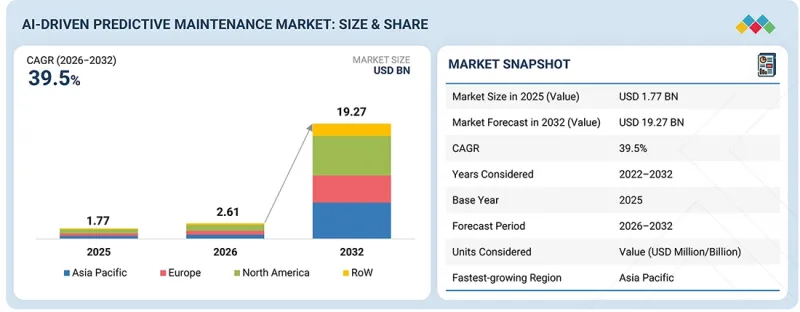
The AI-driven predictive maintenance market is anticipated to grow from USD 2.61 billion in 2026 to USD 19.27 billion by 2032, at a CAGR of 39.5% between 2026 and 2032. The increasing focus on cost optimization and asset lifecycle extension across industries drives the market growth.
| Scope of the Report | |
|---|---|
| Years Considered for the Study | 2021-2032 |
| Base Year | 2025 |
| Forecast Period | 2026-2032 |
| Units Considered | Value (USD Billion) |
| Segments | By Offering, Solution, Technique and Region |
| Regions covered | North America, Europe, APAC, RoW |
Organizations are under growing pressure to reduce maintenance costs while maximizing the efficiency and lifespan of critical equipment, leading to a shift from reactive and scheduled maintenance to data-driven approaches. AI-enabled predictive maintenance solutions help identify potential failures in advance, optimize spare parts inventory, and reduce unnecessary maintenance activities, thereby lowering operational expenditure and improving return on assets. This cost-efficiency advantage is encouraging widespread adoption across manufacturing, energy, transportation, and other asset-intensive sectors.
"Vibration analysis is expected to hold the largest share, by technique, in 2032."
Vibration analysis currently holds the largest share of the AI-driven predictive maintenance market and is expected to remain one of the leading segments during the forecast period. Its dominance can be attributed to its widespread adoption across industries for early fault detection and equipment monitoring. This technique is extensively used in rotating machinery such as motors, pumps, and turbines, where changes in vibration patterns help identify issues such as imbalance, misalignment, and component wear.
While other techniques, such as thermal imaging and oil analysis, are gaining traction, vibration analysis remains a foundational approach in predictive maintenance. As industries increasingly adopt proactive maintenance strategies and focus on operational efficiency, the demand for vibration analysis is expected to remain strong, thereby supporting its significant market share.
"The healthcare industry is estimated to record the highest CAGR during the forecast period."
The healthcare segment is projected to grow at the highest CAGR in the AI-driven predictive maintenance market, driven by the increasing adoption of AI to improve equipment reliability and patient care. Healthcare industries are increasingly using AI to monitor critical medical equipment such as imaging systems, diagnostic devices, and hospital infrastructure, helping detect potential issues early and reduce unplanned downtime. The growing use of connected devices and digital systems is generating large volumes of data, enabling more accurate and timely maintenance planning through real-time insights. In addition, the need to ensure continuous operations, reduce maintenance costs, and improve asset utilization is encouraging the adoption of predictive maintenance solutions across healthcare facilities. The integration of IoT and advanced analytics is further supporting this shift toward proactive maintenance strategies. As healthcare providers continue to focus on operational efficiency, service quality, and patient safety, the demand for AI-driven predictive maintenance solutions is expected to increase significantly during the forecast period.
"The Asia Pacific is expected to grow at the highest CAGR during the forecast period."
The Asia Pacific is expected to grow at the highest CAGR in the AI-driven predictive maintenance market, driven by rapid digital transformation and increasing AI adoption across industries. Countries such as China, Japan, South Korea, and India are investing in smart manufacturing, industrial automation, and digital infrastructure, driving demand for predictive maintenance solutions. Governments across the region are supporting technology adoption through initiatives focused on Industry 4.0, smart factories, and the development of the digital economy. The growing use of connected equipment and IoT devices is generating large volumes of operational data, enabling organizations to adopt AI-based solutions for real-time monitoring and early fault detection.
Extensive primary interviews were conducted with key industry experts in the AI-driven predictive maintenance to determine and verify the market size for various segments and subsegments gathered through secondary research. The breakdown of primary participants for the report is provided below:
The study includes insights from industry experts, ranging from component suppliers to Tier 1 companies and OEMs. The break-up of the primaries is as follows:
- By Company Type: Tier 1-40%, Tier 2-25%, and Tier 3-25%
- By Designation: C-level-40%, Directors-45%, and Others-15%
- By Region: North America-26%, Europe-28%, Asia Pacific-41%, and RoW-5%
The report profiles key players in the AI-driven predictive maintenance market, including their respective market rankings. Prominent players profiled in this report are IBM (US), Siemens (Germany), SAP SE (Germany), GE Vernova (US), C3.ai (US), ABB (Switzerland), Schneider Electric (France), Hitachi, Ltd. (Japan), Uptake Technologies Inc. (US), among others.
KONE (Finland), PTC (US), Emerson Electric Co. (US), Honeywell International Inc. (US), Augury Ltd. (US), Nanoprecise (Canada), Oracle (US), SKF AB (Sweden), Falkonry (US), Capgemini (France), Hexagon AB (Sweden), Dynamox (Brazil), Bosch Global Software Technologies Private Limited (India), eMaint (US), and Rockwell Automation (US) are among the few other companies in the market.
Research Coverage:
This research report categorizes the AI-driven predictive maintenance market based on offering, solution, deployment mode, organization size, technique, industry, and region. The report describes the major drivers, restraints, challenges, and opportunities for the market and forecasts them through 2032. Apart from this, the report includes leadership mapping and analysis of all companies in the ecosystem.
Key Benefits of Buying the Report
The report will help market leaders/new entrants in this market by providing information on the closest approximations of the numbers for the overall market and its subsegments. This report will help stakeholders understand the competitive landscape and gain additional insights to better position their businesses and plan suitable go-to-market strategies. The report also helps stakeholders understand the pulse of the market and provides them with information on key market drivers, restraints, challenges, and opportunities.
The report provides insights into the following pointers:
- Analysis of Key Drivers (increasing demand for real-time condition monitoring systems, increasing demand to reduce unplanned equipment downtime, growing adoption of Industry 4.0 and smart manufacturing, expansion of IoT-enabled connected assets and sensors)
- Product Development/Innovation: Detailed insights into upcoming technologies, research & development activities, and new product launches in the market
- Market Development: Comprehensive information about lucrative markets-the report analyzes the market across varied regions.
- Market Diversification: Exhaustive information about new products, untapped geographies, recent developments, and investments in the market
- Competitive Assessment: In-depth assessment of market shares, growth strategies, and service offerings of leading market players, such as IBM (US), Siemens (Germany), SAP SE (Germany), GE Vernova (US), and C3.ai (US)
TABLE OF CONTENTS
1 INTRODUCTION
- 1.1 STUDY OBJECTIVES
- 1.2 MARKET DEFINITION
- 1.3 STUDY SCOPE
- 1.3.1 MARKETS COVERED AND REGIONAL SCOPE
- 1.3.2 INCLUSIONS AND EXCLUSIONS
- 1.3.3 YEARS CONSIDERED
- 1.3.4 CURRENCY CONSIDERED
- 1.4 STAKEHOLDERS
2 EXECUTIVE SUMMARY
- 2.1 KEY INSIGHTS AND MARKET HIGHLIGHTS
- 2.2 KEY MARKET PARTICIPANTS: SHARE INSIGHTS AND STRATEGIC DEVELOPMENTS
- 2.3 DISRUPTIVE TRENDS SHAPING MARKET
- 2.4 HIGH-GROWTH SEGMENTS AND EMERGING FRONTIERS
- 2.5 SNAPSHOT: GLOBAL MARKET SIZE, GROWTH RATE, AND FORECAST
3 PREMIUM INSIGHTS
- 3.1 ATTRACTIVE OPPORTUNITIES FOR PLAYERS IN AI-DRIVEN PREDICTIVE MAINTENANCE MARKET
- 3.2 AI-DRIVEN PREDICTIVE MAINTENANCE MARKET, BY OFFERING
- 3.3 AI-DRIVEN PREDICTIVE MAINTENANCE MARKET, BY SOLUTION
- 3.4 AI-DRIVEN PREDICTIVE MAINTENANCE MARKET, BY DEPLOYMENT
- 3.5 AI-DRIVEN PREDICTIVE MAINTENANCE MARKET, BY ORGANIZATION SIZE
- 3.6 AI-DRIVEN PREDICTIVE MAINTENANCE MARKET, BY TECHNIQUE
- 3.7 AI-DRIVEN PREDICTIVE MAINTENANCE MARKET, BY INDUSTRY
- 3.8 AI-DRIVEN PREDICTIVE MAINTENANCE MARKET, BY REGION
4 MARKET OVERVIEW
- 4.1 INTRODUCTION
- 4.2 MARKET DYNAMICS
- 4.2.1 DRIVERS
- 4.2.1.1 Increasing demand for real-time condition monitoring systems
- 4.2.1.2 Need to reduce unplanned equipment downtime
- 4.2.1.3 Growing adoption of Industry 4.0 and smart manufacturing
- 4.2.1.4 Expansion of IoT-enabled connected assets and sensors
- 4.2.2 RESTRAINTS
- 4.2.2.1 High initial capital investment for AI infrastructure and sensor deployment
- 4.2.2.2 Cybersecurity risks in connected industrial environments
- 4.2.3 OPPORTUNITIES
- 4.2.3.1 Expansion of predictive maintenance-as-a-service (PdMaaS) models
- 4.2.3.2 Partnerships between AI vendors and industrial OEMs
- 4.2.3.3 Expansion of AI at the edge for low-latency predictive analytics
- 4.2.4 CHALLENGES
- 4.2.4.1 Lack of skilled workforce
- 4.2.4.2 Continuous model upgradation
- 4.2.1 DRIVERS
- 4.3 INTERCONNECTED MARKETS AND CROSS-SECTOR OPPORTUNITIES
- 4.3.1 INTERCONNECTED MARKETS
- 4.3.2 CROSS-SECTOR OPPORTUNITIES
- 4.4 STRATEGIC MOVES BY TIER 1/2/3 PLAYERS
5 INDUSTRY TRENDS
- 5.1 INTRODUCTION
- 5.2 PORTER'S FIVE FORCES ANALYSIS
- 5.2.1 THREAT OF NEW ENTRANTS
- 5.2.2 THREAT OF SUBSTITUTES
- 5.2.3 BARGAINING POWER OF SUPPLIERS
- 5.2.4 BARGAINING POWER OF BUYERS
- 5.2.5 INTENSITY OF COMPETITIVE RIVALRY
- 5.3 MACROECONOMIC OUTLOOK
- 5.3.1 INTRODUCTION
- 5.3.2 GDP TRENDS AND FORECAST
- 5.3.3 TRENDS IN GLOBAL AI-DRIVEN PREDICTIVE MAINTENANCE MARKET
- 5.4 ECOSYSTEM ANALYSIS
- 5.5 PRICING ANALYSIS
- 5.5.1 AVERAGE SELLING PRICE OF SOFTWARE, BY KEY PLAYER
- 5.5.2 AVERAGE SELLING PRICE TREND, BY REGION, 2022-2025 (USD/MONTH)
- 5.6 TRADE ANALYSIS
- 5.6.1 IMPORT SCENARIO (HS CODE 847150)
- 5.6.2 EXPORT SCENARIO (HS CODE 847150)
- 5.7 KEY CONFERENCES AND EVENTS, 2026-2027
- 5.8 TRENDS/DISRUPTIONS IMPACTING CUSTOMERS' BUSINESSES
- 5.9 INVESTMENT AND FUNDING SCENARIO, 2023-2025
- 5.10 CASE STUDY ANALYSIS
- 5.10.1 KONE AND IBM IMPLEMENT AI-BASED PREDICTIVE MAINTENANCE FOR HUMLEGARDEN, ENHANCING OPERATIONAL EFFICIENCY
- 5.10.2 SIEMENS ENABLES AI-DRIVEN PREDICTIVE MAINTENANCE FOR BLUESCOPE STEEL, IMPROVING MAINTENANCE EFFICIENCY AND DECISION-MAKING
- 5.10.3 IBM ENABLES AI-DRIVEN PREDICTIVE MAINTENANCE FOR KONE, IMPROVING ELEVATOR RELIABILITY AND REDUCING DOWNTIME
- 5.11 IMPACT OF US TARIFFS-AI-DRIVEN PREDICTIVE MAINTENANCE MARKET
- 5.11.1 INTRODUCTION
- 5.11.1.1 Key tariff rates
- 5.11.2 PRICE IMPACT ANALYSIS
- 5.11.3 IMPACT OF COUNTRIES/REGIONS
- 5.11.3.1 US
- 5.11.3.2 Europe
- 5.11.3.3 Asia Pacific
- 5.11.4 IMPACT ON END-USE INDUSTRIES
- 5.11.1 INTRODUCTION
6 TECHNOLOGICAL ADVANCEMENTS, PATENTS, INNOVATIONS, AND FUTURE APPLICATIONS
- 6.1 KEY EMERGING TECHNOLOGIES
- 6.1.1 MACHINE LEARNING-BASED ANOMALY DETECTION TECHNOLOGY
- 6.1.2 DIGITAL TWIN AND CONDITION MONITORING TECHNOLOGY
- 6.1.3 EDGE AI-BASED REAL-TIME MONITORING TECHNOLOGY
- 6.1.4 PRESCRIPTIVE ANALYTICS AND REMAINING USEFUL LIFE (RUL) ESTIMATION TECHNOLOGY
- 6.2 COMPLEMENTARY TECHNOLOGIES
- 6.2.1 INDUSTRIAL INTERNET OF THINGS (IIOT) AND SENSOR NETWORKS
- 6.2.2 CLOUD COMPUTING AND ENTERPRISE ASSET MANAGEMENT (EAM) INTEGRATION
- 6.3 TECHNOLOGY ROADMAP
- 6.4 PATENT ANALYSIS
- 6.5 FUTURE APPLICATIONS
7 REGULATORY LANDSCAPE
- 7.1 INTRODUCTION
- 7.1.1 REGULATORY BODIES, GOVERNMENT AGENCIES, AND OTHER ORGANIZATIONS
- 7.1.2 STANDARDS
- 7.1.2.1 ISO 55000
- 7.1.2.2 ISO 17359
- 7.1.2.3 IEC 62443
- 7.1.2.4 ISO/IEC 27001
- 7.1.2.5 ISO 14224
- 7.1.2.6 NIST AI Risk Management Framework (AI RMF)
8 CUSTOMER LANDSCAPE AND BUYER BEHAVIOR
- 8.1 DECISION-MAKING PROCESS
- 8.2 KEY STAKEHOLDERS INVOLVED IN BUYING PROCESS AND THEIR EVALUATION CRITERIA
- 8.2.1 KEY STAKEHOLDERS IN BUYING PROCESS
- 8.2.2 BUYING CRITERIA
- 8.3 ADOPTION BARRIERS AND INTERNAL CHALLENGES
- 8.4 UNMET NEEDS FROM VARIOUS END USERS
9 AI-DRIVEN PREDICTIVE MAINTENANCE MARKET, BY OFFERING
- 9.1 INTRODUCTION
- 9.2 SOFTWARE
- 9.2.1 RISING ADOPTION OF AI-POWERED ASSET ANALYTICS PLATFORMS DRIVING GROWTH OF PREDICTIVE MAINTENANCE SOFTWARE
- 9.3 SERVICES
- 9.3.1 GROWING DEMAND FOR AI IMPLEMENTATION AND INTEGRATION EXPERTISE TO ACCELERATE ADOPTION OF PREDICTIVE MAINTENANCE SERVICES
10 AI-DRIVEN PREDICTIVE MAINTENANCE MARKET, BY SOLUTION
- 10.1 INTRODUCTION
- 10.2 INTEGRATED SOLUTIONS
- 10.2.1 INCREASING DEMAND FOR UNIFIED ASSET MONITORING AND ANALYTICS PLATFORMS TO BOOST ADOPTION
- 10.3 STANDALONE SOLUTIONS
- 10.3.1 NEED FOR SPECIALIZED CONDITION MONITORING TOOLS SUPPORTS UPTAKE OF STANDALONE SOLUTIONS
11 AI-DRIVEN PREDICTIVE MAINTENANCE MARKET, BY DEPLOYMENT MODE
- 11.1 INTRODUCTION
- 11.2 CLOUD-BASED
- 11.2.1 RISING DEMAND FOR REAL-TIME MONITORING AND SCALABLE ANALYTICS TO DRIVE DEMAND FOR CLOUD-BASED PREDICTIVE MAINTENANCE
- 11.3 ON-PREMISES
- 11.3.1 NEED FOR DATA CONTROL AND SECURE INDUSTRIAL INFRASTRUCTURE TO PROPEL MARKET GROWTH
12 AI-DRIVEN PREDICTIVE MAINTENANCE MARKET, BY ORGANIZATION SIZE
- 12.1 INTRODUCTION
- 12.2 LARGE ENTERPRISES
- 12.2.1 HIGH COST OF DOWNTIME AND NEED FOR ENTERPRISE-WIDE MONITORING ARE ACCELERATING DEMAND
- 12.3 SMALL AND MEDIUM-SIZED ENTERPRISES
- 12.3.1 INCREASING AVAILABILITY OF SCALABLE AND CLOUD-BASED PREDICTIVE MAINTENANCE PLATFORMS TO SUPPORT ADOPTION
13 AI-DRIVEN PREDICTIVE MAINTENANCE MARKET, BY TECHNIQUE
- 13.1 INTRODUCTION
- 13.2 VIBRATION ANALYSIS
- 13.2.1 RISING NEED FOR EARLY DETECTION OF MECHANICAL FAILURES IN ROTATING EQUIPMENT DRIVES MARKET
- 13.3 INFRARED THERMOGRAPHY
- 13.3.1 DEMAND FOR NON-CONTACT AND SAFE INSPECTION METHODS PROPELS ADOPTION OF INFRARED THERMOGRAPHY
- 13.4 ACOUSTIC MONITORING
- 13.4.1 NEED FOR EARLY FAULT DETECTION AND NON-INVASIVE MONITORING TO SUPPORT USAGE
- 13.5 OIL ANALYSIS
- 13.5.1 INCREASING USE OF HEAVY MACHINERY AND CRITICAL ASSETS IN MINING, ENERGY, ETC., BOOSTS DEMAND
- 13.6 MOTOR CIRCUIT ANALYSIS
- 13.6.1 EXPANSION OF AUTOMATED INDUSTRIAL EQUIPMENT PROPELS USE OF MOTOR CIRCUIT ANALYSIS TECHNIQUES
- 13.7 OTHER TECHNIQUES
14 AI-DRIVEN PREDICTIVE MAINTENANCE MARKET, BY INDUSTRY
- 14.1 INTRODUCTION
- 14.2 ENERGY & UTILITIES
- 14.2.1 GROWING NEED FOR CONTINUOUS MONITORING OF CRITICAL ENERGY INFRASTRUCTURE DRIVES PREDICTIVE MAINTENANCE ADOPTION
- 14.3 MANUFACTURING
- 14.3.1 EXPANSION OF SMART MANUFACTURING AND AUTOMATION DRIVING PREDICTIVE MAINTENANCE ADOPTION
- 14.4 TRANSPORTATION
- 14.4.1 INCREASING INFRASTRUCTURE MODERNIZATION AND DEMAND FOR OPERATIONAL RELIABILITY DRIVING PREDICTIVE MAINTENANCE ADOPTION
- 14.5 AEROSPACE & DEFENSE
- 14.5.1 INCREASING EMPHASIS ON MISSION READINESS AND SYSTEM RELIABILITY TO PROPEL MARKET GROWTH
- 14.6 MINING & HEAVY EQUIPMENT
- 14.6.1 RISING FOCUS ON EQUIPMENT UPTIME IN HARSH OPERATING CONDITIONS SUPPORTS ADOPTION
- 14.7 HEALTHCARE
- 14.7.1 CONTINUOUS EQUIPMENT AVAILABILITY BECOMING CRITICAL FOR EFFICIENT HEALTHCARE OPERATION
- 14.8 TELECOMMUNICATIONS
- 14.8.1 GROWING COMPLEXITY OF NETWORK INFRASTRUCTURE TO DRIVE DEMAND
- 14.9 OTHER INDUSTRIES
15 AI-DRIVEN PREDICTIVE MAINTENANCE MARKET, BY REGION
- 15.1 INTRODUCTION
- 15.2 NORTH AMERICA
- 15.2.1 US
- 15.2.1.1 Strong presence of highly developed industrial AI and analytics ecosystem to drive demand
- 15.2.2 CANADA
- 15.2.2.1 Growing demand for operational efficiency and regulatory compliance to spur market growth
- 15.2.3 MEXICO
- 15.2.3.1 Expansion of automotive manufacturing and industrial automation supporting adoption
- 15.2.1 US
- 15.3 EUROPE
- 15.3.1 GERMANY
- 15.3.1.1 Leadership in industry 4.0 and advanced manufacturing driving adoption of AI-driven predictive maintenance
- 15.3.2 UK
- 15.3.2.1 Industry 4.0 initiatives and advanced aerospace manufacturing driving adoption of AI-driven predictive maintenance
- 15.3.3 FRANCE
- 15.3.3.1 Accelerating industrial digitalization and aerospace expansion driving market growth
- 15.3.4 ITALY
- 15.3.4.1 Strong industrial machinery sector and manufacturing modernization driving predictive maintenance adoption
- 15.3.5 REST OF EUROPE
- 15.3.1 GERMANY
- 15.4 ASIA PACIFIC
- 15.4.1 CHINA
- 15.4.1.1 Large-scale industrial production and smart factory initiatives driving adoption of AI-driven predictive maintenance
- 15.4.2 JAPAN
- 15.4.2.1 Increasing need to address aging industrial infrastructure and workforce shortages to spur market demand
- 15.4.3 SOUTH KOREA
- 15.4.3.1 Smart manufacturing and industrial automation driving adoption in South Korea
- 15.4.4 INDIA
- 15.4.4.1 Industrial digitalization and expansion of industrial automation supporting predictive maintenance adoption
- 15.4.5 REST OF ASIA PACIFIC
- 15.4.1 CHINA
- 15.5 REST OF THE WORLD (ROW)
- 15.5.1 MIDDLE EAST & AFRICA
- 15.5.1.1 GCC Countries
- 15.5.1.2 Rest of Middle East & Africa
- 15.5.2 SOUTH AMERICA
- 15.5.2.1 Expansion of industrial production and energy infrastructure supporting predictive maintenance adoption
- 15.5.1 MIDDLE EAST & AFRICA
16 COMPETITIVE LANDSCAPE
- 16.1 INTRODUCTION
- 16.2 KEY PLAYERS, STRATEGIES/RIGHT TO WIN (2022-2026)
- 16.3 REVENUE ANALYSIS, 2022-2025
- 16.4 MARKET SHARE ANALYSIS, 2025
- 16.5 COMPANY VALUATION AND FINANCIAL METRICS
- 16.6 BRAND COMPARISON
- 16.7 COMPANY EVALUATION MATRIX: KEY PLAYERS, 2025
- 16.7.1 STARS
- 16.7.2 EMERGING LEADERS
- 16.7.3 PERVASIVE PLAYERS
- 16.7.4 PARTICIPANTS
- 16.7.5 COMPANY FOOTPRINT: KEY PLAYERS, 2025
- 16.7.5.1 Company footprint
- 16.7.5.2 Region footprint
- 16.7.5.3 Offering footprint
- 16.7.5.4 Deployment mode footprint
- 16.7.5.5 Application footprint
- 16.8 COMPANY EVALUATION MATRIX: STARTUPS/SMES, 2025
- 16.8.1 PROGRESSIVE COMPANIES
- 16.8.2 RESPONSIVE COMPANIES
- 16.8.3 DYNAMIC COMPANIES
- 16.8.4 STARTING BLOCKS
- 16.8.5 COMPETITIVE BENCHMARKING: STARTUPS/SMES, 2025
- 16.8.5.1 Detailed list of key startups/SMEs
- 16.8.5.2 Competitive benchmarking of key startups/SMEs
- 16.9 COMPETITIVE SCENARIO
- 16.9.1 PRODUCT LAUNCHES
- 16.9.2 DEALS
17 COMPANY PROFILES
- 17.1 KEY PLAYERS
- 17.1.1 IBM
- 17.1.1.1 Business overview
- 17.1.1.2 Products/solutions/services offered
- 17.1.1.3 Recent developments
- 17.1.1.3.1 Product launches
- 17.1.1.4 MnM view
- 17.1.1.4.1 Key strengths/right to win
- 17.1.1.4.2 Strategic choices made
- 17.1.1.4.3 Weaknesses and competitive threats
- 17.1.2 SIEMENS
- 17.1.2.1 Business overview
- 17.1.2.2 Products/solutions/services offered
- 17.1.2.3 Recent developments
- 17.1.2.3.1 Product launches
- 17.1.2.3.2 Deals
- 17.1.2.4 MnM view
- 17.1.2.4.1 Key strengths/right to win
- 17.1.2.4.2 Strategic choices made
- 17.1.2.4.3 Weaknesses and competitive threats
- 17.1.3 SAP SE
- 17.1.3.1 Business overview
- 17.1.3.2 Products/solutions/services offered
- 17.1.3.3 MnM view
- 17.1.3.3.1 Key strengths/right to win
- 17.1.3.3.2 Strategic choices made
- 17.1.3.3.3 Weaknesses and competitive threats
- 17.1.4 GE VERNOVA
- 17.1.4.1 Business overview
- 17.1.4.2 Products/solutions/services offered
- 17.1.4.3 Recent developments
- 17.1.4.3.1 Product launches
- 17.1.4.3.2 Deals
- 17.1.4.3.3 Other developments
- 17.1.4.4 MnM view
- 17.1.4.4.1 Key strengths/right to win
- 17.1.4.4.2 Strategic choices made
- 17.1.4.4.3 Weaknesses and competitive threats
- 17.1.5 C3.AI
- 17.1.5.1 Business overview
- 17.1.5.2 Products/solutions/services offered
- 17.1.5.3 Recent developments
- 17.1.5.3.1 Product enhancements
- 17.1.5.3.2 Deals
- 17.1.5.3.3 Other developments
- 17.1.5.4 MnM view
- 17.1.5.4.1 Key strengths/right to win
- 17.1.5.4.2 Strategic choices made
- 17.1.5.4.3 Weaknesses and competitive threats
- 17.1.6 ABB
- 17.1.6.1 Business overview
- 17.1.6.2 Products/solutions/services offered
- 17.1.6.3 Recent developments
- 17.1.6.3.1 Deals
- 17.1.7 SCHNEIDER ELECTRIC
- 17.1.7.1 Business overview
- 17.1.7.2 Products/solutions/services offered
- 17.1.7.3 Recent developments
- 17.1.7.3.1 Product launches
- 17.1.7.3.2 Deals
- 17.1.8 HITACHI, LTD.
- 17.1.8.1 Business overview
- 17.1.8.2 Products/solutions/services offered
- 17.1.8.3 Recent developments
- 17.1.8.3.1 Product launches
- 17.1.8.3.2 Deals
- 17.1.9 L&T TECHNOLOGY SERVICES LIMITED
- 17.1.9.1 Business overview
- 17.1.9.2 Products/solutions/services offered
- 17.1.9.3 Recent developments
- 17.1.9.3.1 Product launches
- 17.1.9.3.2 Other deals
- 17.1.10 UPTAKE TECHNOLOGIES INC.
- 17.1.10.1 Business overview
- 17.1.10.2 Products/solutions/services offered
- 17.1.10.3 Recent developments
- 17.1.10.3.1 Product launches
- 17.1.1 IBM
- 17.2 OTHER PLAYERS
- 17.2.1 KONE
- 17.2.2 PTC
- 17.2.3 EMERSON ELECTRIC CO.
- 17.2.4 HONEYWELL INTERNATIONAL INC.
- 17.2.5 AUGURY LTD.
- 17.2.6 NANOPRECISE
- 17.2.7 ORACLE
- 17.2.8 SKF
- 17.2.9 FALKONRY
- 17.2.10 CAPGEMINI
- 17.2.11 HEXAGON AB
- 17.2.12 DYNAMOX
- 17.2.13 BOSCH GLOBAL SOFTWARE TECHNOLOGIES PRIVATE LIMITED
- 17.2.14 EMAINT
- 17.2.15 ROCKWELL AUTOMATION
18 RESEARCH METHODOLOGY
- 18.1 RESEARCH DATA
- 18.2 SECONDARY AND PRIMARY RESEARCH
- 18.2.1 SECONDARY DATA
- 18.2.1.1 Key data from secondary sources
- 18.2.1.2 List of key secondary sources
- 18.2.2 PRIMARY DATA
- 18.2.2.1 Key data from primary sources
- 18.2.2.2 List of primary interview participants
- 18.2.2.3 Breakdown of primaries
- 18.2.2.4 Key industry insights
- 18.2.1 SECONDARY DATA
- 18.3 MARKET SIZE ESTIMATION
- 18.3.1 BOTTOM-UP APPROACH
- 18.3.2 TOP-DOWN APPROACH
- 18.3.3 MARKET SIZE CALCULATION FOR BASE YEAR
- 18.4 MARKET FORECAST APPROACH
- 18.4.1 BOTTOM-UP APPROACH
- 18.4.2 TOP-DOWN APPROACH
- 18.5 DATA TRIANGULATION
- 18.6 FACTOR ANALYSIS
- 18.7 RESEARCH ASSUMPTIONS
- 18.8 RESEARCH LIMITATIONS
- 18.9 RISK ANALYSIS
19 APPENDIX
- 19.1 DISCUSSION GUIDE
- 19.2 KNOWLEDGESTORE: MARKETSANDMARKETS' SUBSCRIPTION PORTAL
- 19.3 CUSTOMIZATION OPTIONS
- 19.4 RELATED REPORTS
- 19.5 AUTHOR DETAILS
List of Tables
- TABLE 1 AI-DRIVEN PREDICTIVE MAINTENANCE MARKET: INCLUSIONS AND EXCLUSIONS
- TABLE 2 STRATEGIC FOCUS OF TIER-1/2/3 PLAYERS
- TABLE 3 AI-DRIVEN PREDICTIVE MAINTENANCE MARKET: IMPACT OF PORTER'S FIVE FORCES
- TABLE 4 GDP PERCENTAGE CHANGE, BY COUNTRY, 2021-2030
- TABLE 5 ROLE OF PLAYERS IN AI-DRIVEN PREDICTIVE MAINTENANCE MARKET ECOSYSTEM
- TABLE 6 INDICATIVE SELLING PRICE OF AI-DRIVEN PREDICTIVE MAINTENANCE SOFTWARE, 2025
- TABLE 7 INDICATIVE SELLING PRICE OF SOFTWARE, BY KEY PLAYER (USD/MONTH)
- TABLE 8 AVERAGE SELLING PRICE TREND OF SOFTWARE, BY REGION, 2022-2025 (USD/MONTH)
- TABLE 9 IMPORT DATA FOR HS CODE 847150-COMPLIANT PRODUCTS, BY COUNTRY, 2020-2024 (USD MILLION)
- TABLE 10 EXPORT DATA FOR HS CODE 847150-COMPLIANT PRODUCTS, BY COUNTRY, 2020-2024 (USD MILLION)
- TABLE 11 AI-DRIVEN PREDICTIVE MAINTENANCE MARKET: KEY CONFERENCES AND EVENTS, 2026-2027
- TABLE 12 US-ADJUSTED RECIPROCAL TARIFF RATES
- TABLE 13 EVOLUTION OF PREDICTIVE MAINTENANCE TECHNOLOGIES
- TABLE 14 LIST OF APPLIED/GRANTED PATENTS, APRIL 2023-MARCH 2025
- TABLE 15 FUTURE APPLICATIONS
- TABLE 16 NORTH AMERICA: REGULATORY BODIES, GOVERNMENT AGENCIES, AND OTHER ORGANIZATIONS
- TABLE 17 EUROPE: REGULATORY BODIES, GOVERNMENT AGENCIES, AND OTHER ORGANIZATIONS
- TABLE 18 ASIA PACIFIC: REGULATORY BODIES, GOVERNMENT AGENCIES, AND OTHER ORGANIZATIONS
- TABLE 19 REST OF WORLD: REGULATORY BODIES, GOVERNMENT AGENCIES, AND OTHER ORGANIZATIONS
- TABLE 20 INFLUENCE OF STAKEHOLDERS ON BUYING PROCESS FOR TOP 3 END USERS (%)
- TABLE 21 KEY BUYING CRITERIA FOR TOP THREE END USERS
- TABLE 22 UNMET NEEDS IN AI-DRIVEN PREDICTIVE MAINTENANCE MARKET FOR END USERS
- TABLE 23 AI-DRIVEN PREDICTIVE MAINTENANCE MARKET, BY OFFERING, 2022-2025 (USD MILLION)
- TABLE 24 AI-DRIVEN PREDICTIVE MAINTENANCE MARKET, BY OFFERING, 2026-2032 (USD MILLION)
- TABLE 25 SOFTWARE: AI-DRIVEN PREDICTIVE MAINTENANCE MARKET, BY REGION, 2022-2025 (USD MILLION)
- TABLE 26 SOFTWARE: AI-DRIVEN PREDICTIVE MAINTENANCE MARKET, BY REGION, 2026-2032 (USD MILLION)
- TABLE 27 SERVICES: AI-DRIVEN PREDICTIVE MAINTENANCE MARKET, BY REGION, 2022-2025 (USD MILLION)
- TABLE 28 SERVICES: AI-DRIVEN PREDICTIVE MAINTENANCE MARKET, BY REGION, 2026-2032 (USD MILLION)
- TABLE 29 AI-DRIVEN PREDICTIVE MAINTENANCE MARKET, BY SOLUTION, 2022-2025 (USD MILLION)
- TABLE 30 AI-DRIVEN PREDICTIVE MAINTENANCE MARKET, BY SOLUTION, 2026-2032 (USD MILLION)
- TABLE 31 AI-DRIVEN PREDICTIVE MAINTENANCE MARKET, BY DEPLOYMENT MODE, 2022-2025 (USD MILLION)
- TABLE 32 AI-DRIVEN PREDICTIVE MAINTENANCE MARKET, BY DEPLOYMENT MODE, 2026-2032 (USD MILLION)
- TABLE 33 AI-DRIVEN PREDICTIVE MAINTENANCE MARKET, BY ORGANIZATION SIZE, 2022-2025 (USD MILLION)
- TABLE 34 AI-DRIVEN PREDICTIVE MAINTENANCE MARKET, BY ORGANIZATION SIZE, 2026-2032 (USD MILLION)
- TABLE 35 LARGE ENTERPRISES: AI-DRIVEN PREDICTIVE MAINTENANCE MARKET, BY REGION, 2022-2025 (USD MILLION)
- TABLE 36 LARGE ENTERPRISES: AI-DRIVEN PREDICTIVE MAINTENANCE MARKET, BY REGION, 2026-2032 (USD MILLION)
- TABLE 37 SMES: AI-DRIVEN PREDICTIVE MAINTENANCE MARKET, BY REGION, 2022-2025 (USD MILLION)
- TABLE 38 SMES: AI-DRIVEN PREDICTIVE MAINTENANCE MARKET, BY REGION, 2026-2032 (USD MILLION)
- TABLE 39 AI-DRIVEN PREDICTIVE MAINTENANCE MARKET, BY TECHNIQUE, 2022-2025 (USD MILLION)
- TABLE 40 AI-DRIVEN PREDICTIVE MAINTENANCE MARKET, BY TECHNIQUE, 2026-2032 (USD MILLION)
- TABLE 41 VIBRATION ANALYSIS: AI-DRIVEN PREDICTIVE MAINTENANCE MARKET, BY REGION, 2022-2025 (USD MILLION)
- TABLE 42 VIBRATION ANALYSIS: AI-DRIVEN PREDICTIVE MAINTENANCE MARKET, BY REGION, 2026-2032 (USD MILLION)
- TABLE 43 INFRARED THERMOGRAPHY: AI-DRIVEN PREDICTIVE MAINTENANCE MARKET, BY REGION, 2022-2025 (USD MILLION)
- TABLE 44 INFRARED THERMOGRAPHY: AI-DRIVEN PREDICTIVE MAINTENANCE MARKET, BY REGION, 2026-2032 (USD MILLION)
- TABLE 45 ACOUSTIC MONITORING: AI-DRIVEN PREDICTIVE MAINTENANCE MARKET, BY REGION, 2022-2025 (USD MILLION)
- TABLE 46 ACOUSTIC MONITORING: AI-DRIVEN PREDICTIVE MAINTENANCE MARKET, BY REGION, 2026-2032 (USD MILLION)
- TABLE 47 OIL ANALYSIS: AI-DRIVEN PREDICTIVE MAINTENANCE MARKET, BY REGION, 2022-2025 (USD MILLION)
- TABLE 48 OIL ANALYSIS: AI-DRIVEN PREDICTIVE MAINTENANCE MARKET, BY REGION, 2026-2032 (USD MILLION)
- TABLE 49 MOTOR CIRCUIT ANALYSIS: AI-DRIVEN PREDICTIVE MAINTENANCE MARKET, BY REGION, 2022-2025 (USD MILLION)
- TABLE 50 MOTOR CIRCUIT ANALYSIS: AI-DRIVEN PREDICTIVE MAINTENANCE MARKET, BY REGION, 2026-2032 (USD MILLION)
- TABLE 51 OTHER TECHNIQUES: AI-DRIVEN PREDICTIVE MAINTENANCE MARKET, BY REGION, 2022-2025 (USD MILLION)
- TABLE 52 OTHER TECHNIQUES: AI-DRIVEN PREDICTIVE MAINTENANCE MARKET, BY REGION, 2026-2032 (USD MILLION)
- TABLE 53 AI-DRIVEN PREDICTIVE MAINTENANCE MARKET, BY INDUSTRY, 2022-2025 (USD MILLION)
- TABLE 54 AI-DRIVEN PREDICTIVE MAINTENANCE MARKET, BY INDUSTRY, 2026-2032 (USD MILLION)
- TABLE 55 ENERGY & UTILITIES: AI-DRIVEN PREDICTIVE MAINTENANCE MARKET, BY REGION, 2022-2025 (USD MILLION)
- TABLE 56 ENERGY & UTILITIES: AI-DRIVEN PREDICTIVE MAINTENANCE MARKET, BY REGION, 2026-2032 (USD MILLION)
- TABLE 57 ENERGY & UTILITIES: AI-DRIVEN PREDICTIVE MAINTENANCE MARKET IN NORTH AMERICA, BY COUNTRY, 2022-2025 (USD MILLION)
- TABLE 58 ENERGY & UTILITIES: AI-DRIVEN PREDICTIVE MAINTENANCE MARKET IN NORTH AMERICA, BY COUNTRY, 2026-2032 (USD MILLION)
- TABLE 59 ENERGY & UTILITIES: AI-DRIVEN PREDICTIVE MAINTENANCE MARKET IN EUROPE, BY COUNTRY, 2022-2025 (USD MILLION)
- TABLE 60 ENERGY & UTILITIES: AI-DRIVEN PREDICTIVE MAINTENANCE MARKET IN EUROPE, BY COUNTRY, 2026-2032 (USD MILLION)
- TABLE 61 ENERGY & UTILITIES: AI-DRIVEN PREDICTIVE MAINTENANCE MARKET IN ASIA PACIFIC, BY COUNTRY, 2022-2025 (USD MILLION)
- TABLE 62 ENERGY & UTILITIES: AI-DRIVEN PREDICTIVE MAINTENANCE MARKET IN ASIA PACIFIC, BY COUNTRY, 2026-2032 (USD MILLION)
- TABLE 63 ENERGY & UTILITIES: AI-DRIVEN PREDICTIVE MAINTENANCE MARKET IN ROW, BY REGION, 2022-2025 (USD MILLION)
- TABLE 64 ENERGY & UTILITIES: AI-DRIVEN PREDICTIVE MAINTENANCE MARKET IN ROW, BY REGION, 2026-2032 (USD MILLION)
- TABLE 65 MANUFACTURING: AI-DRIVEN PREDICTIVE MAINTENANCE MARKET, BY REGION, 2022-2025 (USD MILLION)
- TABLE 66 MANUFACTURING: AI-DRIVEN PREDICTIVE MAINTENANCE MARKET, BY REGION, 2026-2032 (USD MILLION)
- TABLE 67 MANUFACTURING: AI-DRIVEN PREDICTIVE MAINTENANCE MARKET IN NORTH AMERICA, BY COUNTRY, 2022-2025 (USD MILLION)
- TABLE 68 MANUFACTURING: AI-DRIVEN PREDICTIVE MAINTENANCE MARKET IN NORTH AMERICA, BY COUNTRY, 2026-2032 (USD MILLION)
- TABLE 69 MANUFACTURING: AI-DRIVEN PREDICTIVE MAINTENANCE MARKET IN EUROPE, BY COUNTRY, 2022-2025 (USD MILLION)
- TABLE 70 MANUFACTURING: AI-DRIVEN PREDICTIVE MAINTENANCE MARKET IN EUROPE, BY COUNTRY, 2026-2032 (USD MILLION)
- TABLE 71 MANUFACTURING: AI-DRIVEN PREDICTIVE MAINTENANCE MARKET IN ASIA PACIFIC, BY COUNTRY, 2022-2025 (USD MILLION)
- TABLE 72 MANUFACTURING: AI-DRIVEN PREDICTIVE MAINTENANCE MARKET IN ASIA PACIFIC, BY COUNTRY, 2026-2032 (USD MILLION)
- TABLE 73 MANUFACTURING: AI-DRIVEN PREDICTIVE MAINTENANCE MARKET IN ROW, BY REGION, 2022-2025 (USD MILLION)
- TABLE 74 MANUFACTURING: AI-DRIVEN PREDICTIVE MAINTENANCE MARKET IN ROW, BY REGION, 2026-2032 (USD MILLION)
- TABLE 75 TRANSPORTATION: AI-DRIVEN PREDICTIVE MAINTENANCE MARKET, BY REGION, 2022-2025 (USD MILLION)
- TABLE 76 TRANSPORTATION: AI-DRIVEN PREDICTIVE MAINTENANCE MARKET, BY REGION, 2026-2032 (USD MILLION)
- TABLE 77 TRANSPORTATION: AI-DRIVEN PREDICTIVE MAINTENANCE MARKET IN NORTH AMERICA, BY COUNTRY, 2022-2025 (USD MILLION)
- TABLE 78 TRANSPORTATION: AI-DRIVEN PREDICTIVE MAINTENANCE MARKET IN NORTH AMERICA, BY COUNTRY, 2026-2032 (USD MILLION)
- TABLE 79 TRANSPORTATION: AI-DRIVEN PREDICTIVE MAINTENANCE MARKET IN EUROPE, BY COUNTRY, 2022-2025 (USD MILLION)
- TABLE 80 TRANSPORTATION: AI-DRIVEN PREDICTIVE MAINTENANCE MARKET IN EUROPE, BY COUNTRY, 2026-2032 (USD MILLION)
- TABLE 81 TRANSPORTATION: AI-DRIVEN PREDICTIVE MAINTENANCE MARKET IN ASIA PACIFIC, BY COUNTRY, 2022-2025 (USD MILLION)
- TABLE 82 TRANSPORTATION: AI-DRIVEN PREDICTIVE MAINTENANCE MARKET IN ASIA PACIFIC, BY COUNTRY, 2026-2032 (USD MILLION)
- TABLE 83 TRANSPORTATION: AI-DRIVEN PREDICTIVE MAINTENANCE MARKET IN ROW, BY REGION, 2022-2025 (USD MILLION)
- TABLE 84 TRANSPORTATION: AI-DRIVEN PREDICTIVE MAINTENANCE MARKET IN ROW, BY REGION, 2026-2032 (USD MILLION)
- TABLE 85 AEROSPACE & DEFENSE: AI-DRIVEN PREDICTIVE MAINTENANCE MARKET, BY REGION, 2022-2025 (USD MILLION)
- TABLE 86 AEROSPACE & DEFENSE: AI-DRIVEN PREDICTIVE MAINTENANCE MARKET, BY REGION, 2026-2032 (USD MILLION)
- TABLE 87 AEROSPACE & DEFENSE: AI-DRIVEN PREDICTIVE MAINTENANCE MARKET IN NORTH AMERICA, BY COUNTRY, 2022-2025 (USD MILLION)
- TABLE 88 AEROSPACE & DEFENSE: AI-DRIVEN PREDICTIVE MAINTENANCE MARKET IN NORTH AMERICA, BY COUNTRY, 2026-2032 (USD MILLION)
- TABLE 89 AEROSPACE & DEFENSE: AI-DRIVEN PREDICTIVE MAINTENANCE MARKET IN EUROPE, BY COUNTRY, 2022-2025 (USD MILLION)
- TABLE 90 AEROSPACE & DEFENSE: AI-DRIVEN PREDICTIVE MAINTENANCE MARKET IN EUROPE, BY COUNTRY, 2026-2032 (USD MILLION)
- TABLE 91 AEROSPACE & DEFENSE: AI-DRIVEN PREDICTIVE MAINTENANCE MARKET IN ASIA PACIFIC, BY COUNTRY, 2022-2025 (USD MILLION)
- TABLE 92 AEROSPACE & DEFENSE: AI-DRIVEN PREDICTIVE MAINTENANCE MARKET IN ASIA PACIFIC, BY COUNTRY, 2026-2032 (USD MILLION)
- TABLE 93 AEROSPACE & DEFENSE: AI-DRIVEN PREDICTIVE MAINTENANCE MARKET IN ROW, BY REGION, 2022-2025 (USD MILLION)
- TABLE 94 AEROSPACE & DEFENSE: AI-DRIVEN PREDICTIVE MAINTENANCE MARKET IN ROW, BY REGION, 2026-2032 (USD MILLION)
- TABLE 95 MINING & HEAVY EQUIPMENT: AI-DRIVEN PREDICTIVE MAINTENANCE MARKET, BY REGION, 2022-2025 (USD MILLION)
- TABLE 96 MINING & HEAVY EQUIPMENT: AI-DRIVEN PREDICTIVE MAINTENANCE MARKET, BY REGION, 2026-2032 (USD MILLION)
- TABLE 97 MINING & HEAVY EQUIPMENT: AI-DRIVEN PREDICTIVE MAINTENANCE MARKET IN NORTH AMERICA, BY COUNTRY, 2022-2025 (USD MILLION)
- TABLE 98 MINING & HEAVY EQUIPMENT: AI-DRIVEN PREDICTIVE MAINTENANCE MARKET IN NORTH AMERICA, BY COUNTRY, 2026-2032 (USD MILLION)
- TABLE 99 MINING & HEAVY EQUIPMENT: AI-DRIVEN PREDICTIVE MAINTENANCE MARKET IN EUROPE, BY COUNTRY, 2022-2025 (USD MILLION)
- TABLE 100 MINING & HEAVY EQUIPMENT: AI-DRIVEN PREDICTIVE MAINTENANCE MARKET IN EUROPE, BY COUNTRY, 2026-2032 (USD MILLION)
- TABLE 101 MINING & HEAVY EQUIPMENT: AI-DRIVEN PREDICTIVE MAINTENANCE MARKET IN ASIA PACIFIC, BY COUNTRY, 2022-2025 (USD MILLION)
- TABLE 102 MINING & HEAVY EQUIPMENT: AI-DRIVEN PREDICTIVE MAINTENANCE MARKET IN ASIA PACIFIC, BY COUNTRY, 2026-2032 (USD MILLION)
- TABLE 103 MINING & HEAVY EQUIPMENT: AI-DRIVEN PREDICTIVE MAINTENANCE MARKET IN ROW, BY REGION, 2022-2025 (USD MILLION)
- TABLE 104 MINING & HEAVY EQUIPMENT: AI-DRIVEN PREDICTIVE MAINTENANCE MARKET IN ROW, BY REGION, 2026-2032 (USD MILLION)
- TABLE 105 HEALTHCARE: AI-DRIVEN PREDICTIVE MAINTENANCE MARKET, BY REGION, 2022-2025 (USD MILLION)
- TABLE 106 HEALTHCARE: AI-DRIVEN PREDICTIVE MAINTENANCE MARKET, BY REGION, 2026-2032 (USD MILLION)
- TABLE 107 HEALTHCARE: AI-DRIVEN PREDICTIVE MAINTENANCE MARKET IN NORTH AMERICA, BY COUNTRY, 2022-2025 (USD MILLION)
- TABLE 108 HEALTHCARE: AI-DRIVEN PREDICTIVE MAINTENANCE MARKET IN NORTH AMERICA, BY COUNTRY, 2026-2032 (USD MILLION)
- TABLE 109 HEALTHCARE: AI-DRIVEN PREDICTIVE MAINTENANCE MARKET IN EUROPE, BY COUNTRY, 2022-2025 (USD MILLION)
- TABLE 110 HEALTHCARE: AI-DRIVEN PREDICTIVE MAINTENANCE MARKET IN EUROPE, BY COUNTRY, 2026-2032 (USD MILLION)
- TABLE 111 HEALTHCARE: AI-DRIVEN PREDICTIVE MAINTENANCE MARKET IN ASIA PACIFIC, BY COUNTRY, 2022-2025 (USD MILLION)
- TABLE 112 HEALTHCARE: AI-DRIVEN PREDICTIVE MAINTENANCE MARKET IN ASIA PACIFIC, BY COUNTRY, 2026-2032 (USD MILLION)
- TABLE 113 HEALTHCARE: AI-DRIVEN PREDICTIVE MAINTENANCE MARKET IN ROW, BY REGION, 2022-2025 (USD MILLION)
- TABLE 114 HEALTHCARE: AI-DRIVEN PREDICTIVE MAINTENANCE MARKET IN ROW, BY REGION, 2026-2032 (USD MILLION)
- TABLE 115 TELECOMMUNICATIONS: AI-DRIVEN PREDICTIVE MAINTENANCE MARKET, BY REGION, 2022-2025 (USD MILLION)
- TABLE 116 TELECOMMUNICATIONS: AI-DRIVEN PREDICTIVE MAINTENANCE MARKET, BY REGION, 2026-2032 (USD MILLION)
- TABLE 117 TELECOMMUNICATIONS: AI-DRIVEN PREDICTIVE MAINTENANCE MARKET IN NORTH AMERICA, BY COUNTRY, 2022-2025 (USD MILLION)
- TABLE 118 TELECOMMUNICATIONS: AI-DRIVEN PREDICTIVE MAINTENANCE MARKET IN NORTH AMERICA, BY COUNTRY, 2026-2032 (USD MILLION)
- TABLE 119 TELECOMMUNICATIONS: AI-DRIVEN PREDICTIVE MAINTENANCE MARKET IN EUROPE, BY COUNTRY, 2022-2025 (USD MILLION)
- TABLE 120 TELECOMMUNICATIONS: AI-DRIVEN PREDICTIVE MAINTENANCE MARKET IN EUROPE, BY COUNTRY, 2026-2032 (USD MILLION)
- TABLE 121 TELECOMMUNICATIONS: AI-DRIVEN PREDICTIVE MAINTENANCE MARKET IN ASIA PACIFIC, BY COUNTRY, 2022-2025 (USD MILLION)
- TABLE 122 TELECOMMUNICATIONS: AI-DRIVEN PREDICTIVE MAINTENANCE MARKET IN ASIA PACIFIC, BY COUNTRY, 2026-2032 (USD MILLION)
- TABLE 123 TELECOMMUNICATIONS: AI-DRIVEN PREDICTIVE MAINTENANCE MARKET IN ROW, BY REGION, 2022-2025 (USD MILLION)
- TABLE 124 TELECOMMUNICATIONS: AI-DRIVEN PREDICTIVE MAINTENANCE MARKET IN ROW, BY REGION, 2026-2032 (USD MILLION)
- TABLE 125 OTHER INDUSTRIES: AI-DRIVEN PREDICTIVE MAINTENANCE MARKET, BY REGION, 2022-2025 (USD MILLION)
- TABLE 126 OTHER INDUSTRIES: AI-DRIVEN PREDICTIVE MAINTENANCE MARKET, BY REGION, 2026-2032 (USD MILLION)
- TABLE 127 OTHER INDUSTRIES: AI-DRIVEN PREDICTIVE MAINTENANCE MARKET IN NORTH AMERICA, BY COUNTRY, 2022-2025 (USD MILLION)
- TABLE 128 OTHER INDUSTRIES: AI-DRIVEN PREDICTIVE MAINTENANCE MARKET IN NORTH AMERICA, BY COUNTRY, 2026-2032 (USD MILLION)
- TABLE 129 OTHER INDUSTRIES: AI-DRIVEN PREDICTIVE MAINTENANCE MARKET IN EUROPE, BY COUNTRY, 2022-2025 (USD MILLION)
- TABLE 130 OTHER INDUSTRIES: AI-DRIVEN PREDICTIVE MAINTENANCE MARKET IN EUROPE, BY COUNTRY, 2026-2032 (USD MILLION)
- TABLE 131 OTHER INDUSTRIES: AI-DRIVEN PREDICTIVE MAINTENANCE MARKET IN ASIA PACIFIC, BY COUNTRY, 2022-2025 (USD MILLION)
- TABLE 132 OTHER INDUSTRIES: AI-DRIVEN PREDICTIVE MAINTENANCE MARKET IN ASIA PACIFIC, BY COUNTRY, 2026-2032 (USD MILLION)
- TABLE 133 OTHER INDUSTRIES: AI-DRIVEN PREDICTIVE MAINTENANCE MARKET IN ROW, BY REGION, 2022-2025 (USD MILLION)
- TABLE 134 OTHER INDUSTRIES: AI-DRIVEN PREDICTIVE MAINTENANCE MARKET IN ROW, BY REGION, 2026-2032 (USD MILLION)
- TABLE 135 AI-DRIVEN PREDICTIVE MAINTENANCE MARKET, BY REGION, 2022-2025 (USD MILLION)
- TABLE 136 AI-DRIVEN PREDICTIVE MAINTENANCE MARKET, BY REGION, 2026-2032 (USD MILLION)
- TABLE 137 NORTH AMERICA: AI-DRIVEN PREDICTIVE MAINTENANCE MARKET, BY ORGANIZATION SIZE, 2022-2025 (USD MILLION)
- TABLE 138 NORTH AMERICA: AI-DRIVEN PREDICTIVE MAINTENANCE MARKET, BY ORGANIZATION SIZE, 2026-2032 (USD MILLION)
- TABLE 139 NORTH AMERICA: AI-DRIVEN PREDICTIVE MAINTENANCE MARKET, BY TECHNIQUE, 2022-2025 (USD MILLION)
- TABLE 140 NORTH AMERICA: AI-DRIVEN PREDICTIVE MAINTENANCE MARKET, BY TECHNIQUE, 2026-2032 (USD MILLION)
- TABLE 141 NORTH AMERICA: AI-DRIVEN PREDICTIVE MAINTENANCE MARKET, BY INDUSTRY, 2022-2025 (USD MILLION)
- TABLE 142 NORTH AMERICA: AI-DRIVEN PREDICTIVE MAINTENANCE MARKET, BY INDUSTRY, 2026-2032 (USD MILLION)
- TABLE 143 NORTH AMERICA: AI-DRIVEN PREDICTIVE MAINTENANCE MARKET, BY COUNTRY, 2022-2025 (USD MILLION)
- TABLE 144 NORTH AMERICA: AI-DRIVEN PREDICTIVE MAINTENANCE MARKET, BY COUNTRY, 2026-2032 (USD MILLION)
- TABLE 145 US: AI-DRIVEN PREDICTIVE MAINTENANCE MARKET, BY INDUSTRY, 2022-2025 (USD MILLION)
- TABLE 146 US: AI-DRIVEN PREDICTIVE MAINTENANCE MARKET, BY INDUSTRY, 2026-2032 (USD MILLION)
- TABLE 147 CANADA: AI-DRIVEN PREDICTIVE MAINTENANCE MARKET, BY INDUSTRY, 2022-2025 (USD MILLION)
- TABLE 148 CANADA: AI-DRIVEN PREDICTIVE MAINTENANCE MARKET, BY INDUSTRY, 2026-2032 (USD MILLION)
- TABLE 149 MEXICO: AI-DRIVEN PREDICTIVE MAINTENANCE MARKET, BY INDUSTRY, 2022-2025 (USD MILLION)
- TABLE 150 MEXICO: AI-DRIVEN PREDICTIVE MAINTENANCE MARKET, BY INDUSTRY, 2026-2032 (USD MILLION)
- TABLE 151 EUROPE: AI-DRIVEN PREDICTIVE MAINTENANCE MARKET, BY ORGANIZATION SIZE, 2022-2025 (USD MILLION)
- TABLE 152 EUROPE: AI-DRIVEN PREDICTIVE MAINTENANCE MARKET, BY ORGANIZATION SIZE, 2026-2032 (USD MILLION)
- TABLE 153 EUROPE: AI-DRIVEN PREDICTIVE MAINTENANCE MARKET, BY TECHNIQUE, 2022-2025 (USD MILLION)
- TABLE 154 EUROPE: AI-DRIVEN PREDICTIVE MAINTENANCE MARKET, BY TECHNIQUE, 2026-2032 (USD MILLION)
- TABLE 155 EUROPE: AI-DRIVEN PREDICTIVE MAINTENANCE MARKET, BY INDUSTRY, 2022-2025 (USD MILLION)
- TABLE 156 EUROPE: AI-DRIVEN PREDICTIVE MAINTENANCE MARKET, BY INDUSTRY, 2026-2032 (USD MILLION)
- TABLE 157 EUROPE: AI-DRIVEN PREDICTIVE MAINTENANCE MARKET, BY COUNTRY, 2022-2025 (USD MILLION)
- TABLE 158 EUROPE: AI-DRIVEN PREDICTIVE MAINTENANCE MARKET, BY COUNTRY, 2026-2032 (USD MILLION)
- TABLE 159 GERMANY: AI-DRIVEN PREDICTIVE MAINTENANCE MARKET, BY INDUSTRY, 2022-2025 (USD MILLION)
- TABLE 160 GERMANY: AI-DRIVEN PREDICTIVE MAINTENANCE MARKET, BY INDUSTRY, 2026-2032 (USD MILLION)
- TABLE 161 UK: AI-DRIVEN PREDICTIVE MAINTENANCE MARKET, BY INDUSTRY, 2022-2025 (USD MILLION)
- TABLE 162 UK: AI-DRIVEN PREDICTIVE MAINTENANCE MARKET, BY INDUSTRY, 2026-2032 (USD MILLION)
- TABLE 163 FRANCE: AI-DRIVEN PREDICTIVE MAINTENANCE MARKET, BY INDUSTRY, 2022-2025 (USD MILLION)
- TABLE 164 FRANCE: AI-DRIVEN PREDICTIVE MAINTENANCE MARKET, BY INDUSTRY, 2026-2032 (USD MILLION)
- TABLE 165 ITALY: AI-DRIVEN PREDICTIVE MAINTENANCE MARKET, BY INDUSTRY, 2022-2025 (USD MILLION)
- TABLE 166 ITALY: AI-DRIVEN PREDICTIVE MAINTENANCE MARKET, BY INDUSTRY, 2026-2032 (USD MILLION)
- TABLE 167 REST OF EUROPE: AI-DRIVEN PREDICTIVE MAINTENANCE MARKET, BY INDUSTRY, 2022-2025 (USD MILLION)
- TABLE 168 REST OF EUROPE: AI-DRIVEN PREDICTIVE MAINTENANCE MARKET, BY INDUSTRY, 2026-2032 (USD MILLION)
- TABLE 169 ASIA PACIFIC: AI-DRIVEN PREDICTIVE MAINTENANCE MARKET, BY ORGANIZATION SIZE, 2022-2025 (USD MILLION)
- TABLE 170 ASIA PACIFIC: AI-DRIVEN PREDICTIVE MAINTENANCE MARKET, BY ORGANIZATION SIZE, 2026-2032 (USD MILLION)
- TABLE 171 ASIA PACIFIC: AI-DRIVEN PREDICTIVE MAINTENANCE MARKET, BY TECHNIQUE, 2022-2025 (USD MILLION)
- TABLE 172 ASIA PACIFIC: AI-DRIVEN PREDICTIVE MAINTENANCE MARKET, BY TECHNIQUE, 2026-2032 (USD MILLION)
- TABLE 173 ASIA PACIFIC: AI-DRIVEN PREDICTIVE MAINTENANCE MARKET, BY INDUSTRY, 2022-2025 (USD MILLION)
- TABLE 174 ASIA PACIFIC: AI-DRIVEN PREDICTIVE MAINTENANCE MARKET, BY INDUSTRY, 2026-2032 (USD MILLION)
- TABLE 175 ASIA PACIFIC: AI-DRIVEN PREDICTIVE MAINTENANCE MARKET, BY COUNTRY, 2022-2025 (USD MILLION)
- TABLE 176 ASIA PACIFIC: AI-DRIVEN PREDICTIVE MAINTENANCE MARKET, BY COUNTRY, 2026-2032 (USD MILLION)
- TABLE 177 CHINA: AI-DRIVEN PREDICTIVE MAINTENANCE MARKET, BY INDUSTRY, 2022-2025 (USD MILLION)
- TABLE 178 CHINA: AI-DRIVEN PREDICTIVE MAINTENANCE MARKET, BY INDUSTRY, 2026-2032 (USD MILLION)
- TABLE 179 JAPAN: AI-DRIVEN PREDICTIVE MAINTENANCE MARKET, BY INDUSTRY, 2022-2025 (USD MILLION)
- TABLE 180 JAPAN: AI-DRIVEN PREDICTIVE MAINTENANCE MARKET, BY INDUSTRY, 2026-2032 (USD MILLION)
- TABLE 181 SOUTH KOREA: AI-DRIVEN PREDICTIVE MAINTENANCE MARKET, BY INDUSTRY, 2022-2025 (USD MILLION)
- TABLE 182 SOUTH KOREA: AI-DRIVEN PREDICTIVE MAINTENANCE MARKET, BY INDUSTRY, 2026-2032 (USD MILLION)
- TABLE 183 INDIA: AI-DRIVEN PREDICTIVE MAINTENANCE MARKET, BY INDUSTRY, 2022-2025 (USD MILLION)
- TABLE 184 INDIA: AI-DRIVEN PREDICTIVE MAINTENANCE MARKET, BY INDUSTRY, 2026-2032 (USD MILLION)
- TABLE 185 REST OF ASIA PACIFIC: AI-DRIVEN PREDICTIVE MAINTENANCE MARKET, BY INDUSTRY, 2022-2025 (USD MILLION)
- TABLE 186 REST OF ASIA PACIFIC: AI-DRIVEN PREDICTIVE MAINTENANCE MARKET, BY INDUSTRY, 2026-2032 (USD MILLION)
- TABLE 187 ROW: AI-DRIVEN PREDICTIVE MAINTENANCE MARKET, BY ORGANIZATION SIZE, 2022-2025 (USD MILLION)
- TABLE 188 ROW: AI-DRIVEN PREDICTIVE MAINTENANCE MARKET, BY ORGANIZATION SIZE, 2026-2032 (USD MILLION)
- TABLE 189 ROW: AI-DRIVEN PREDICTIVE MAINTENANCE MARKET, BY TECHNIQUE, 2022-2025 (USD MILLION)
- TABLE 190 ROW: AI-DRIVEN PREDICTIVE MAINTENANCE MARKET, BY TECHNIQUE, 2026-2032 (USD MILLION)
- TABLE 191 ROW: AI-DRIVEN PREDICTIVE MAINTENANCE MARKET, BY INDUSTRY, 2022-2025 (USD MILLION)
- TABLE 192 ROW: AI-DRIVEN PREDICTIVE MAINTENANCE MARKET, BY INDUSTRY, 2026-2032 (USD MILLION)
- TABLE 193 ROW: AI-DRIVEN PREDICTIVE MAINTENANCE MARKET, BY REGION, 2022-2025 (USD MILLION)
- TABLE 194 ROW: AI-DRIVEN PREDICTIVE MAINTENANCE MARKET, BY REGION, 2026-2032 (USD MILLION)
- TABLE 195 MIDDLE EAST & AFRICA: AI-DRIVEN PREDICTIVE MAINTENANCE MARKET, BY REGION, 2022-2025 (USD MILLION)
- TABLE 196 MIDDLE EAST & AFRICA: AI-DRIVEN PREDICTIVE MAINTENANCE MARKET, BY REGION, 2026-2032 (USD MILLION)
- TABLE 197 MIDDLE EAST & AFRICA: AI-DRIVEN PREDICTIVE MAINTENANCE MARKET, BY INDUSTRY, 2022-2025 (USD MILLION)
- TABLE 198 MIDDLE EAST & AFRICA: AI-DRIVEN PREDICTIVE MAINTENANCE MARKET, BY INDUSTRY, 2026-2032 (USD MILLION)
- TABLE 199 SOUTH AMERICA: AI-DRIVEN PREDICTIVE MAINTENANCE MARKET, BY INDUSTRY, 2022-2025 (USD MILLION)
- TABLE 200 SOUTH AMERICA: AI-DRIVEN PREDICTIVE MAINTENANCE MARKET, BY INDUSTRY, 2026-2032 (USD MILLION)
- TABLE 201 OVERVIEW OF STRATEGIES DEPLOYED BY KEY PLAYERS IN AI-DRIVEN PREDICTIVE MAINTENANCE MARKET (2022-2026)
- TABLE 202 AI-DRIVEN PREDICTIVE MAINTENANCE MARKET: DEGREE OF COMPETITION, 2025
- TABLE 203 AI-DRIVEN PREDICTIVE MAINTENANCE MARKET: REGION FOOTPRINT
- TABLE 204 AI-DRIVEN PREDICTIVE MAINTENANCE MARKET: OFFERING FOOTPRINT
- TABLE 205 AI-DRIVEN PREDICTIVE MAINTENANCE MARKET: DEPLOYMENT FOOTPRINT
- TABLE 206 AI-DRIVEN PREDICTIVE MAINTENANCE MARKET: APPLICATION FOOTPRINT
- TABLE 207 AI-DRIVEN PREDICTIVE MAINTENANCE MARKET: DETAILED LIST OF KEY STARTUPS/SMES
- TABLE 208 AI-DRIVEN PREDICTIVE MAINTENANCE MARKET: COMPETITIVE BENCHMARKING OF KEY STARTUPS/SMES (1/2)
- TABLE 209 AI-DRIVEN PREDICTIVE MAINTENANCE MARKET: COMPETITIVE BENCHMARKING OF KEY STARTUPS/SMES (2/2)
- TABLE 210 AI-DRIVEN PREDICTIVE MAINTENANCE MARKET: PRODUCT LAUNCHES, JANUARY 2021-NOVEMBER 2025
- TABLE 211 AI-DRIVEN PREDICTIVE MAINTENANCE MARKET: DEALS, JANUARY 2021-NOVEMBER 2025
- TABLE 212 IBM: COMPANY OVERVIEW
- TABLE 213 IBM: PRODUCT/SOLUTIONS/SERVICES OFFERINGS
- TABLE 214 IBM: PRODUCT LAUNCHES
- TABLE 215 SIEMENS: COMPANY OVERVIEW
- TABLE 216 SIEMENS: PRODUCT/SOLUTIONS/SERVICES OFFERINGS
- TABLE 217 SIEMENS: PRODUCT LAUNCHES
- TABLE 218 SIEMENS: DEALS
- TABLE 219 SAP SE: BUSINESS OVERVIEW
- TABLE 220 SAP SE: PRODUCT/SOLUTIONS/SERVICES OFFERINGS
- TABLE 221 GE VERNOVA: COMPANY OVERVIEW
- TABLE 222 GE VERNOVA: PRODUCT/SOLUTIONS/SERVICES OFFERINGS
- TABLE 223 GE VERNOVA: PRODUCT LAUNCHES
- TABLE 224 GE VERNOVA: DEALS
- TABLE 225 GE VERNOVA: OTHER DEVELOPMENTS
- TABLE 226 C3.AI: COMPANY OVERVIEW
- TABLE 227 C3.AI: PRODUCT/SOLUTIONS/SERVICES OFFERINGS
- TABLE 228 C3 .AI: PRODUCT ENHANCEMENTS
- TABLE 229 C3.AI: DEALS
- TABLE 230 C3.AI: OTHER DEVELOPMENTS
- TABLE 231 ABB: COMPANY OVERVIEW
- TABLE 232 ABB: PRODUCT/SOLUTIONS/SERVICES OFFERINGS
- TABLE 233 ABB: DEALS
- TABLE 234 SCHNEIDER ELECTRIC: COMPANY OVERVIEW
- TABLE 235 SCHNEIDER ELECTRIC: PRODUCT/SOLUTIONS/SERVICES OFFERINGS
- TABLE 236 SCHNEIDER ELECTRIC: PRODUCT LAUNCHES
- TABLE 237 SCHNEIDER ELECTRIC: DEALS
- TABLE 238 HITACHI, LTD.: COMPANY OVERVIEW
- TABLE 239 HITACHI, LTD.: PRODUCT/SOLUTIONS/SERVICES OFFERINGS
- TABLE 240 HITACHI, LTD.: PRODUCT LAUNCHES
- TABLE 241 HITACHI, LTD.: DEALS
- TABLE 242 L&T TECHNOLOGY SERVICES LIMITED: COMPANY OVERVIEW
- TABLE 243 L&T TECHNOLOGY SERVICES LIMITED: PRODUCT/SOLUTIONS/SERVICES OFFERINGS
- TABLE 244 L&T TECHNOLOGY SERVICES LIMITED: PRODUCT LAUNCHES
- TABLE 245 L&T TECHNOLOGY SERVICES LIMITED: OTHER DEALS
- TABLE 246 UPTAKE TECHNOLOGIES INC.: COMPANY OVERVIEW
- TABLE 247 UPTAKE TECHNOLOGIES INC.: PRODUCT/SOLUTIONS/SERVICES OFFERINGS
- TABLE 248 UPTAKE: PRODUCT LAUNCHES
- TABLE 249 MAJOR SECONDARY SOURCES
- TABLE 250 PRIMARY INTERVIEW PARTICIPANTS
- TABLE 251 AI-DRIVEN PREDICTIVE MAINTENANCE MARKET: RESEARCH ASSUMPTIONS
- TABLE 252 AI-DRIVEN PREDICTIVE MAINTENANCE MARKET: RISK ANALYSIS
List of Figures
- FIGURE 1 AI-DRIVEN PREDICTIVE MAINTENANCE MARKET SEGMENTATION AND REGIONAL SCOPE
- FIGURE 2 KEY INSIGHTS AND MARKET HIGHLIGHTS
- FIGURE 3 AI-DRIVEN PREDICTIVE MAINTENANCE MARKET, 2026-2032
- FIGURE 4 MAJOR STRATEGIES ADOPTED BY KEY PLAYERS IN AI-DRIVEN PREDICTIVE MAINTENANCE MARKET (JANUARY 2022-MARCH 2026)
- FIGURE 5 DISRUPTIVE TRENDS IMPACTING GROWTH OF THE AI-DRIVEN PREDICTIVE MAINTENANCE MARKET
- FIGURE 6 HIGH-GROWTH SEGMENTS AND EMERGING FRONTIERS IN AI-DRIVEN PREDICTIVE MAINTENANCE MARKET, 2026-2032
- FIGURE 7 ASIA PACIFIC EXPECTED TO REGISTER HIGHEST CAGR DURING FORECAST PERIOD
- FIGURE 8 INCREASING ASSET COMPLEXITY AND NEED FOR REAL-TIME MONITORING TO DRIVE ADOPTION OF PREDICTIVE MAINTENANCE SOLUTIONS
- FIGURE 9 SOFTWARE TO ACCOUNT FOR MAJORITY OF MARKET SHARE IN 2032
- FIGURE 10 INTEGRATED SOLUTIONS TO HOLD LARGEST MARKET SHARE IN 2032
- FIGURE 11 CLOUD-BASED TO SECURE PROMINENT MARKET SHARE IN 2032
- FIGURE 12 LARGE ENTERPRISES TO SECURE PROMINENT MARKET SHARE IN 2032
- FIGURE 13 VIBRATION ANALYSIS TO SECURE PROMINENT MARKET SHARES IN 2032
- FIGURE 14 MANUFACTURING TO SECURE PROMINENT MARKET SHARE IN 2032
- FIGURE 15 INDIA TO RECORD HIGHEST CAGR IN GLOBAL MARKET DURING FORECAST PERIOD
- FIGURE 16 DRIVERS, RESTRAINTS, OPPORTUNITIES, AND CHALLENGES
- FIGURE 17 IMPACT ANALYSIS: DRIVERS
- FIGURE 18 IMPACT ANALYSIS: RESTRAINTS
- FIGURE 19 IMPACT ANALYSIS: OPPORTUNITIES
- FIGURE 20 IMPACT ANALYSIS: CHALLENGES
- FIGURE 21 AI-DRIVEN PREDICTIVE MAINTENANCE MARKET: PORTER'S FIVE FORCES ANALYSIS
- FIGURE 22 AI-DRIVEN PREDICTIVE MAINTENANCE MARKET: VALUE CHAIN ANALYSIS
- FIGURE 23 AI-DRIVEN PREDICTIVE MAINTENANCE MARKET: ECOSYSTEM ANALYSIS
- FIGURE 24 AVERAGE SELLING PRICE TREND OF SOFTWARE, BY REGION, 2022-2025 (USD)
- FIGURE 25 IMPORT DATA FOR HS CODE 847150-COMPLIANT PRODUCTS FOR TOP FIVE COUNTRIES, 2020-2024
- FIGURE 26 EXPORT DATA FOR HS CODE 847150-COMPLIANT PRODUCTS FOR TOP FIVE COUNTRIES, 2020-2024
- FIGURE 27 TRENDS/DISRUPTIONS IMPACTING CUSTOMERS' BUSINESSES
- FIGURE 28 INVESTMENT AND FUNDING SCENARIO, 2023-2025
- FIGURE 29 AI-DRIVEN PREDICTIVE MAINTENANCE MARKET: PATENT ANALYSIS, 2016-2025
- FIGURE 30 DECISION-MAKING FACTORS IN AI-DRIVEN PREDICTIVE MAINTENANCE MARKET
- FIGURE 31 INFLUENCE OF STAKEHOLDERS ON BUYING PROCESS FOR TOP 3 END USERS
- FIGURE 32 KEY BUYING CRITERIA FOR TOP 3 END USERS
- FIGURE 33 ADOPTION BARRIERS AND INTERNAL CHALLENGES
- FIGURE 34 AI-DRIVEN PREDICTIVE MAINTENANCE MARKET, BY OFFERING
- FIGURE 35 AI-DRIVEN PREDICTIVE MAINTENANCE MARKET, BY SOLUTION
- FIGURE 36 AI-DRIVEN PREDICTIVE MAINTENANCE MARKET, BY DEPLOYMENT MODE
- FIGURE 37 AI-DRIVEN PREDICTIVE MAINTENANCE MARKET, BY ORGANIZATION SIZE
- FIGURE 38 AI-DRIVEN PREDICTIVE MAINTENANCE MARKET, BY TECHNIQUE
- FIGURE 39 AI-DRIVEN PREDICTIVE MAINTENANCE MARKET, BY INDUSTRY
- FIGURE 40 NORTH AMERICA TO HOLD LARGEST MARKET SHARE THROUGHOUT FORECAST PERIOD
- FIGURE 41 NORTH AMERICA: AI-DRIVEN PREDICTIVE MAINTENANCE MARKET SNAPSHOT
- FIGURE 42 EUROPE: AI-DRIVEN PREDICTIVE MAINTENANCE MARKET SNAPSHOT
- FIGURE 43 ASIA PACIFIC: AI-DRIVEN PREDICTIVE MAINTENANCE MARKET SNAPSHOT
- FIGURE 44 ROW: AI-DRIVEN PREDICTIVE MAINTENANCE MARKET SNAPSHOT
- FIGURE 45 AI-DRIVEN PREDICTIVE MAINTENANCE MARKET: REVENUE ANALYSIS OF KEY PLAYERS, 2022-2025
- FIGURE 46 MARKET SHARE ANALYSIS, 2025
- FIGURE 47 COMPANY VALUATION, 2025
- FIGURE 48 FINANCIAL METRICS (EV/EBITDA), 2025
- FIGURE 49 BRAND COMPARISON
- FIGURE 50 AI-DRIVEN PREDICTIVE MAINTENANCE MARKET: COMPANY EVALUATION MATRIX (KEY PLAYERS), 2025
- FIGURE 51 AI-DRIVEN PREDICTIVE MAINTENANCE MARKET: COMPANY FOOTPRINT
- FIGURE 52 AI-DRIVEN PREDICTIVE MAINTENANCE MARKET: COMPANY EVALUATION MATRIX (STARTUPS/SMES), 2025
- FIGURE 53 IBM: COMPANY SNAPSHOT
- FIGURE 54 SIEMENS: COMPANY SNAPSHOT
- FIGURE 55 SAP SE: COMPANY SNAPSHOT
- FIGURE 56 GE VERNOVA: COMPANY SNAPSHOT
- FIGURE 57 C3.AI: COMPANY SNAPSHOT
- FIGURE 58 ABB: COMPANY SNAPSHOT
- FIGURE 59 SCHNEIDER ELECTRIC: COMPANY SNAPSHOT
- FIGURE 60 HITACHI, LTD.: COMPANY SNAPSHOT
- FIGURE 61 L&T TECHNOLOGY SERVICES LIMITED: COMPANY SNAPSHOT
- FIGURE 62 AI-DRIVEN PREDICTIVE MAINTENANCE MARKET: RESEARCH DESIGN
- FIGURE 63 AI-DRIVEN PREDICTIVE MAINTENANCE MARKET: RESEARCH APPROACH
- FIGURE 64 DATA CAPTURED FROM SECONDARY SOURCES
- FIGURE 65 DATA CAPTURED FROM PRIMARY SOURCES
- FIGURE 66 BREAKDOWN OF PRIMARY INTERVIEWS, BY COMPANY TYPE, DESIGNATION, AND REGION
- FIGURE 67 CORE FINDINGS FROM INDUSTRY EXPERTS
- FIGURE 68 AI-DRIVEN PREDICTIVE MAINTENANCE MARKET: RESEARCH FLOW
- FIGURE 69 AI-DRIVEN PREDICTIVE MAINTENANCE MARKET: BOTTOM-UP APPROACH
- FIGURE 70 AI-DRIVEN PREDICTIVE MAINTENANCE MARKET: TOP-DOWN APPROACH
- FIGURE 71 AI-DRIVEN PREDICTIVE MAINTENANCE MARKET SIZE ESTIMATION (SUPPLY SIDE)
- FIGURE 72 AI-DRIVEN PREDICTIVE MAINTENANCE MARKET: DATA TRIANGULATION
- FIGURE 73 AI-DRIVEN PREDICTIVE MAINTENANCE MARKET: RESEARCH LIMITATIONS

