PUBLISHER: MarketsandMarkets | PRODUCT CODE: 2011927

PUBLISHER: MarketsandMarkets | PRODUCT CODE: 2011927
Smart Home Market By Product (Lighting Control, Smart Speaker, Entertainment and Other Controls, Smart Kitchen, HVAC Control, Security & Access Control, Home Healthcare, Home Appliances), Offering (Behavioral, Proactive) - Global Forecast to 2032
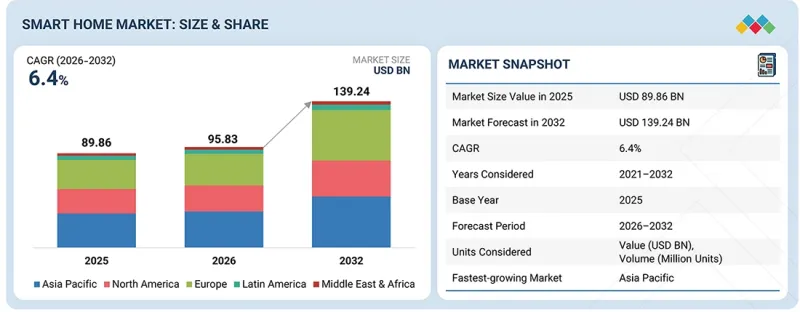
The global smart home market is projected to reach USD 139.24 billion by 2032 from USD 95.83 billion in 2026, registering a CAGR of 6.4%.
| Scope of the Report | |
|---|---|
| Years Considered for the Study | 2021-2032 |
| Base Year | 2024 |
| Forecast Period | 2026-2032 |
| Units Considered | Value (USD Billion) |
| Segments | By Product, Offering and Region |
| Regions covered | North America, Europe, APAC, RoW |
The smart home market is experiencing steady growth, driven by increasing internet penetration, rising adoption of connected devices, and the growing emphasis on energy-efficient and secure residential living. Homeowners across developed and emerging economies are investing in smart home solutions to enhance convenience, improve household safety, and optimize energy consumption. The expansion of broadband infrastructure, smart housing developments, and digital lifestyle trends is further accelerating demand for integrated home automation systems. Advancements in AI-enabled analytics, IoT sensors, voice-controlled platforms, and cloud-based home management systems are improving system interoperability, enhancing user experience, and enabling real-time monitoring and automation. As residential digitalization continues to expand, the demand for scalable, reliable, and integrated smart home ecosystems is expected to grow steadily over the forecast period.
"Smart kitchen product type to register fastest growth during forecast period"
The smart kitchen segment is projected to register the fastest growth in the smart home market during the forecast period, driven by the increasing adoption of connected appliances and rising demand for convenience-oriented household automation. Growing consumer preference for smart refrigerators, connected ovens, intelligent dishwashers, and voice-enabled cooking assistants is accelerating product penetration across residential households. Advancements in IoT-enabled appliances, energy-efficient technologies, and app-based remote monitoring are enhancing user control, safety, and energy optimization within kitchen environments. As consumers increasingly seek integrated and automated cooking experiences, manufacturers are investing in AI-powered features and interoperability capabilities, positioning the smart kitchen segment as the fastest-growing product type.
"Direct sales channel to account for dominant market share in 2032"
The direct sales segment is expected to account for the dominant share of the smart home market, based on sales channel, as manufacturers increasingly engage directly with consumers through brand websites, exclusive stores, and authorized installation networks. Direct-to-consumer strategies enable companies to maintain pricing control, enhance customer engagement, and provide integrated installation and after-sales support services. With rising demand for customized smart home solutions and professional system integration, direct sales channels offer greater value through bundled offerings and technical expertise. As consumer trust in branded ecosystems strengthens, direct sales are projected to remain the dominant distribution channel in the smart home market.
"North America to account for largest market share in 2026."
North America is projected to account for the largest share of the smart home market in 2026, driven by high internet penetration, early adoption of connected technologies, and strong consumer awareness of home automation benefits. The region benefits from advanced digital infrastructure, widespread availability of smart devices, and the strong presence of leading technology providers. Increasing demand for energy-efficient homes, smart security systems, and voice-enabled automation solutions continues to support market expansion across the US and Canada. As residential digital transformation accelerates, North America is expected to maintain its leadership position in the global smart home market.
The breakdown of the profile of primary participants in the smart home market is as follows:
- By Company Type - Tier 1 - 35%, Tier 2 - 45%, Tier 3 - 20%
- By Designation - C-level Executives - 40%, Directors - 30%, Others - 30%
- By Region - North America - 40%, Europe - 20%, Asia Pacific - 30%, RoW - 10%
Note: Other designations include sales, marketing, and product managers.
The three tiers of the companies are based on their total revenues as of 2024: Tier 1: >USD 1 billion, Tier 2: USD 500 million-1 billion, and Tier 3: USD 500 million.
The smart home market is dominated by a few globally established players such as Johnson Controls Inc. (Ireland), Honeywell International Inc. (US), Schneider Electric (France), Siemens (Germany), ASSA ABLOY (Sweden), Amazon.com, Inc. (US), Apple Inc. (US), ADT (US), Robert Bosch (Germany), and ABB (Switzerland). The study includes an in-depth competitive analysis of these key players in the smart home market, with their company profiles, recent developments, and key market strategies.
Research Coverage
The report segments the smart home market and forecasts its size by product, installation type, sales channel, offering, and region. It also provides a comprehensive review of drivers, restraints, opportunities, and challenges influencing market growth. The report covers both qualitative and quantitative aspects of the market.
Reasons to Buy the Report:
The report will help leaders/new entrants in this market by providing approximate revenue figures for the overall smart home market and related segments. This report will help stakeholders understand the competitive landscape and gain deeper insights to strengthen their market position and plan effective go-to-market strategies. The report will also help stakeholders understand the market pulse and provides information on key drivers, restraints, opportunities, and challenges.
The report provides insights into the following pointers:
- Analysis of key drivers (increasing number of internet users and growing adoption of smart devices, increasing disposable income in emerging economies, increasing importance of home monitoring in remote locations, growing need for energy-saving and low-carbon emission-oriented solutions, concerns about safety, security, and convenience among the general population). restraint (convenience-driven rather than necessity-driven market, high cost of switching for existing smart device consumers, issues related to security and privacy breaches), opportunity (favorable government regulations to promote green buildings, incorporation of lighting controllers with in-built data-connectivity technology, integration of power line communication technology in smart homes), challenges (difficulties linking disparate systems, limited functionality, and lack of open standards, risk of device malfunction)
- Product Development/Innovation: Detailed insights into upcoming technologies, research & development activities, and product launches in the smart home market
- Market Development: Comprehensive information about lucrative markets by analyzing the smart home market across varied regions
- Market Diversification: Exhaustive information about new products, untapped geographies, recent developments, and investments in the smart home market
- Competitive Assessment: In-depth assessment of market shares, growth strategies, and service offerings of leading players like Johnson Controls Inc. (Ireland), Honeywell International Inc. (US), Schneider Electric (France), Siemens (Germany), ASSA ABLOY (Sweden), Amazon.com, Inc. (US), Apple Inc. (US), ADT (US), Robert Bosch (Germany), and ABB (Switzerland), among others in the smart home market
TABLE OF CONTENTS
1 INTRODUCTION
- 1.1 STUDY OBJECTIVES
- 1.2 MARKET DEFINITION
- 1.3 MARKET SCOPE
- 1.3.1 MARKETS COVERED AND REGIONAL SCOPE
- 1.3.2 YEARS CONSIDERED
- 1.3.3 INCLUSIONS AND EXCLUSIONS
- 1.4 CURRENCY CONSIDERED
- 1.5 UNITS CONSIDERED
- 1.6 STAKEHOLDERS
- 1.7 SUMMARY OF CHANGES
2 EXECUTIVE SUMMARY
- 2.1 MARKET HIGHLIGHTS AND KEY INSIGHTS
- 2.2 KEY MARKET PARTICIPANTS: MAPPING OF STRATEGIC DEVELOPMENTS
- 2.3 DISRUPTIVE TRENDS IN SMART HOME MARKET
- 2.4 HIGH-GROWTH SEGMENTS
- 2.5 REGIONAL SNAPSHOT: MARKET SIZE, GROWTH RATE, AND FORECAST
3 PREMIUM INSIGHTS
- 3.1 OPPORTUNITIES FOR PLAYERS IN SMART HOME MARKET
- 3.2 SMART HOME MARKET, BY INSTALLATION TYPE
- 3.3 SMART HOME MARKET, BY CONTROL INTERFACE
- 3.4 SMART HOME MARKET, BY REGION
- 3.5 SMART HOME MARKET IN ASIA PACIFIC, BY PRODUCT TYPE AND GEOGRAPHY
4 MARKET OVERVIEW
- 4.1 INTRODUCTION
- 4.2 MARKET DYNAMICS
- 4.2.1 DRIVERS
- 4.2.1.1 Rising internet penetration and proliferation of connected devices
- 4.2.1.2 Increasing disposable income and expanding middle-class population in developing countries
- 4.2.1.3 Elevating demand for real-time home monitoring and remote access to household systems
- 4.2.1.4 Pressing need for energy-efficient smart home solutions
- 4.2.1.5 Growing public emphasis on safety, security, and convenience
- 4.2.1.6 Ongoing advancements in AI- and voice-enabled smart home solutions
- 4.2.2 RESTRAINTS
- 4.2.2.1 Limited adoption of smart home solutions due to high costs, data security risks, and connectivity dependence
- 4.2.2.2 Data privacy, security risks, and regulatory compliance challenges
- 4.2.2.3 Dependence on stable internet connectivity and network infrastructure
- 4.2.2.4 Perception of smart home technologies as convenience-driven rather than necessity-driven
- 4.2.3 OPPORTUNITIES
- 4.2.3.1 Government regulations and initiatives promoting green buildings and energy-efficient infrastructure
- 4.2.3.2 Integration of IoT-enabled lighting controllers with built-in connectivity
- 4.2.3.3 Incorporation of power line communication technology in smart homes
- 4.2.4 CHALLENGES
- 4.2.4.1 Interoperability gaps and lack of unified standards in smart home ecosystems
- 4.2.4.2 Risk of device malfunction
- 4.2.1 DRIVERS
- 4.3 INTERCONNECTED MARKETS AND CROSS-SECTOR OPPORTUNITIES
- 4.3.1 INTERCONNECTED MARKETS
- 4.3.2 CROSS-SECTOR OPPORTUNITIES
- 4.4 STRATEGIC MOVES BY TIER 1/2/3 PLAYERS
- 4.4.1 STRATEGIC FOCUS AND MOVES CARRIED OUT BY MARKET PLAYERS
5 INDUSTRY TRENDS
- 5.1 INTRODUCTION
- 5.2 PORTER'S FIVE FORCES ANALYSIS
- 5.2.1 INTENSITY OF COMPETITIVE RIVALRY
- 5.2.2 BARGAINING POWER OF SUPPLIERS
- 5.2.3 BARGAINING POWER OF BUYERS
- 5.2.4 THREAT OF SUBSTITUTES
- 5.2.5 THREAT OF NEW ENTRANTS
- 5.3 MACROECONOMIC OUTLOOK
- 5.3.1 INTRODUCTION
- 5.3.2 GDP TRENDS AND FORECAST
- 5.3.3 TRENDS IN SMART HOME MARKET
- 5.4 VALUE CHAIN ANALYSIS
- 5.5 ECOSYSTEM ANALYSIS
- 5.6 PRICING ANALYSIS
- 5.6.1 AVERAGE SELLING PRICE TREND OF SMART HOME PRODUCTS, BY KEY PLAYER, 2022-2025
- 5.6.2 AVERAGE SELLING PRICE TREND OF SMART HOME APPLIANCES (REFRIGERATORS), BY REGION, 2022-2025
- 5.7 TRADE ANALYSIS
- 5.7.1 IMPORT SCENARIO (HS CODE 845011)
- 5.7.2 EXPORT SCENARIO (HS CODE 845011)
- 5.8 KEY CONFERENCES AND EVENTS, 2026-2027
- 5.9 TRENDS/DISRUPTIONS IMPACTING CUSTOMER BUSINESS
- 5.10 INVESTMENT AND FUNDING SCENARIO
- 5.11 CASE STUDY ANALYSIS
- 5.11.1 ASSA ABLOY DEPLOYS ACCESS CONTROL SYSTEMS TO REDUCE EMERGENCY RESPONSE TIME
- 5.11.2 JOHNSON CONTROLS PROVIDES FISERV WITH YORK TEMPO CHILLERS TO ACHIEVE ENERGY SAVINGS
- 5.11.3 HONEYWELL OFFERS SECURITY SOLUTIONS TO IMPROVE SECURITY AND VISITOR ACCESS
- 5.12 IMPACT OF US TARIFF ON SMART HOME MARKET
- 5.12.1 INTRODUCTION
- 5.12.2 KEY TARIFF RATES
- 5.12.3 PRICE IMPACT ANALYSIS
- 5.12.4 IMPACT ON COUNTRIES/REGIONS
- 5.12.4.1 US
- 5.12.4.2 Europe
- 5.12.4.3 Asia Pacific
- 5.12.5 IMPACT ON END USERS
6 TECHNOLOGICAL ADVANCEMENTS, AI-DRIVEN IMPACT, PATENTS, AND INNOVATIONS
- 6.1 KEY TECHNOLOGIES
- 6.1.1 VOICE ASSISTANTS
- 6.1.2 WIRELESS COMMUNICATION PROTOCOLS
- 6.2 COMPLEMENTARY TECHNOLOGIES
- 6.2.1 5G NETWORKS & ADVANCED BROADBAND INFRASTRUCTURE
- 6.2.2 AUGMENTED REALITY (AR) & MOBILE APP INTERFACES
- 6.3 TECHNOLOGY/PRODUCT ROADMAP
- 6.3.1 SHORT-TERM (2025-2027): INTEROPERABILITY & AI-ENABLED AUTOMATION
- 6.3.2 MID-TERM (2027-2030): ECOSYSTEM INTEGRATION & EDGE AI EXPANSION
- 6.3.3 LONG-TERM (2030-2035+): AUTONOMOUS SMART HOMES & DIGITAL ECOSYSTEM CONVERGENCE
- 6.4 PATENT ANALYSIS
- 6.5 IMPACT OF AI ON SMART HOME MARKET
- 6.5.1 TOP USE CASES AND MARKET POTENTIAL
- 6.5.2 BEST PRACTICES FOLLOWED BY COMPANIES IN SMART HOME MARKET
- 6.5.3 CASE STUDIES RELATED TO AI IMPLEMENTATION IN SMART HOME MARKET
- 6.5.4 INTERCONNECTED ECOSYSTEM AND IMPACT ON MARKET PLAYERS
- 6.5.5 CLIENTS' READINESS TO ADOPT AI IN SMART HOME MARKET
7 REGULATORY LANDSCAPE
- 7.1 REGIONAL REGULATION AND COMPLIANCE
- 7.1.1 REGULATORY BODIES, GOVERNMENT AGENCIES, AND OTHER ORGANIZATIONS
- 7.1.2 LAWS AND DIRECTIVES
- 7.1.3 INDUSTRY STANDARDS
- 7.1.3.1 Smart HVAC standards
- 7.1.3.2 Entertainment & control system standards
- 7.1.3.3 Access control & security standards
- 7.1.3.4 Smart home appliances standards
- 7.1.3.5 Smart furniture standards
- 7.1.4 REGIONAL REGULATIONS
- 7.1.4.1 US
- 7.1.4.2 Europe
- 7.1.4.3 China
- 7.1.4.4 Japan
- 7.1.4.5 India
8 CUSTOMER LANDSCAPE AND BUYER BEHAVIOR
- 8.1 DECISION-MAKING PROCESS
- 8.2 KEY STAKEHOLDERS INVOLVED IN BUYING PROCESS AND THEIR EVALUATION CRITERIA
- 8.2.1 KEY STAKEHOLDERS IN BUYING PROCESS
- 8.2.2 BUYING CRITERIA
- 8.3 ADOPTION BARRIERS AND INTERNAL CHALLENGES
- 8.4 UNMET NEEDS OF VARIOUS END USERS
- 8.5 MARKET PROFITABILITY
9 TECHNOLOGIES USED IN SMART HOME INFRASTRUCTURE
- 9.1 INTRODUCTION
- 9.2 IOT CONNECTIVITY
- 9.3 AI & MACHINE LEARNING
- 9.4 VOICE RECOGNITION
- 9.5 COMPUTER VISION
- 9.6 EDGE COMPUTING
10 SMART HOME MARKET, BY RESIDENCE TYPE
- 10.1 INTRODUCTION
- 10.2 SINGLE-FAMILY HOMES
- 10.2.1 GREATER OWNERSHIP CONTROL TO SUPPORT ADOPTION OF PREMIUM SMART HOME SOLUTIONS
- 10.3 MULTI-FAMILY BUILDINGS
- 10.3.1 STRONG FOCUS ON ROBUST SECURITY AND ENERGY MANAGEMENT IN SHARED INFRASTRUCTURE TO BOOST DEMAND FOR SMART SOLUTIONS
- 10.4 VILLAS/LUXURY HOMES
- 10.4.1 HEIGHTENED DEMAND FOR LUXURY LIVING TO FUEL IMPLEMENTATION OF CUTTING-EDGE SOLUTIONS FOR ENHANCED PRIVACY AND CONVENIENCE
11 SMART HOME MARKET, BY PROTOCOL & COMMUNICATION TECHNOLOGY
- 11.1 INTRODUCTION
- 11.2 WIRED
- 11.2.1 SURGING ADOPTION IN NEWLY CONSTRUCTED RESIDENTIAL PROJECTS TO FACILITATE MARKET GROWTH
- 11.2.2 DALI
- 11.2.3 KNX
- 11.2.4 DMX
- 11.2.5 LONWORKS
- 11.2.6 ETHERNET
- 11.2.7 MODBUS
- 11.2.8 BACNET
- 11.2.9 POWER LINE COMMUNICATION
- 11.3 WIRELESS
- 11.3.1 FLEXIBILITY, SCALABILITY, COST-EFFICIENCY, AND USER-CENTRIC DESIGNS TO SUPPORT WIDESPREAD ADOPTION
- 11.3.2 ZIGBEE
- 11.3.3 MATTER
- 11.3.4 Z-WAVE
- 11.3.5 WI-FI
- 11.3.6 BLUETOOTH
- 11.3.7 ENOCEAN
- 11.3.8 THREAD
12 SMART HOME MARKET, BY PRODUCT TYPE
- 12.1 INTRODUCTION
- 12.2 SMART LIGHTING SOLUTIONS
- 12.2.1 HARDWARE
- 12.2.1.1 Luminaires & smart lights
- 12.2.1.1.1 Proficiency in creating dynamic lighting environments tailored to specific activities or moods to spur demand
- 12.2.1.2 Lighting controls
- 12.2.1.2.1 Relays
- 12.2.1.2.1.1 Ability to enable remote operation, scheduled switching, motion-triggered lighting, or security-based illumination to fuel segmental growth
- 12.2.1.2.2 Occupancy sensors
- 12.2.1.2.2.1 Competency in enhancing user convenience and reducing energy consumption to support segmental growth
- 12.2.1.2.3 Daylight sensors
- 12.2.1.2.3.1 Capacity to optimize ambient light for sustainable illumination to boost adoption
- 12.2.1.2.4 Timers
- 12.2.1.2.4.1 Schedule- and preference-based automation to propel segmental growth
- 12.2.1.2.5 Dimmers
- 12.2.1.2.5.1 Potential to reduce thermal stress on lighting components to spike demand
- 12.2.1.2.6 Switches
- 12.2.1.2.6.1 User inclination toward immediate, intuitive control to promote deployment
- 12.2.1.2.7 Other lighting control types
- 12.2.1.2.1 Relays
- 12.2.1.1 Luminaires & smart lights
- 12.2.2 SOFTWARE & SERVICES
- 12.2.2.1 Potential to provide centralized control interface, data analytics, and remote access capabilities to drive segmental growth
- 12.2.1 HARDWARE
- 12.3 SMART SECURITY & ACCESS CONTROL SYSTEMS
- 12.3.1 VIDEO SURVEILLANCE SOLUTIONS
- 12.3.1.1 Hardware
- 12.3.1.1.1 Cameras
- 12.3.1.1.1.1 Analog cameras
- 12.3.1.1.1.1.1 Rising use in budget-sensitive or retrofit residential applications to support segmental growth
- 12.3.1.1.1.2 IP cameras
- 12.3.1.1.1.2.1 Superior scalability and high-definition and ultra-high-definition video quality to contribute to segmental growth
- 12.3.1.1.1.1 Analog cameras
- 12.3.1.1.2 Storage devices
- 12.3.1.1.2.1 Pressing need for storage equipment to store crucial data to foster segmental growth
- 12.3.1.1.3 Monitors
- 12.3.1.1.3.1 Ability to display highly detailed images needed to make security decisions to spur demand
- 12.3.1.1.4 Other accessories
- 12.3.1.1.1 Cameras
- 12.3.1.2 Software & services
- 12.3.1.2.1 Incorporation of artificial intelligence and data analytics to ensure safety & security to fuel demand
- 12.3.1.1 Hardware
- 12.3.2 ACCESS CONTROL SYSTEMS
- 12.3.2.1 Hardware
- 12.3.2.1.1 Tags
- 12.3.2.1.1.1 Temporary access provisioning, time-based restrictions, and remote credential management features to drive adoption
- 12.3.2.1.2 Readers
- 12.3.2.1.2.1 Card-based readers
- 12.3.2.1.2.1.1 Simplicity, scalability, and compatibility with existing infrastructure to accelerate demand
- 12.3.2.1.2.2 Biometrics readers
- 12.3.2.1.2.2.1 Increasing privacy and security concerns to boost adoption
- 12.3.2.1.2.2.2 Fingerprint
- 12.3.2.1.2.2.3 Palm recognition
- 12.3.2.1.2.2.4 Iris recognition
- 12.3.2.1.2.2.5 Face recognition
- 12.3.2.1.2.2.6 Voice recognition
- 12.3.2.1.2.3 Multi-technology readers
- 12.3.2.1.2.3.1 Ability to unify multiple access methods into single interface to support implementation
- 12.3.2.1.2.1 Card-based readers
- 12.3.2.1.3 Smart locks
- 12.3.2.1.3.1 Smart deadbolt locks
- 12.3.2.1.3.1.1 Elevating demand for robust and reliable front-door security to fuel segmental growth
- 12.3.2.1.3.2 Smart lever & knob locks
- 12.3.2.1.3.2.1 Suitability for high-frequency usage areas such as bedrooms, offices, and utility rooms to escalate demand
- 12.3.2.1.3.3 Smart door handle sets
- 12.3.2.1.3.3.1 Easy installation and intuitive access control interfaces to drive demand
- 12.3.2.1.3.4 Smart mortise locks
- 12.3.2.1.3.4.1 Durability, advanced functionality, and sophisticated design features to stimulate segmental growth
- 12.3.2.1.3.5 Smart cam locks
- 12.3.2.1.3.5.1 Need to safeguard valuables, sensitive documents, and restricted household items to foster segmental growth
- 12.3.2.1.3.6 Smart garage door locks & controllers
- 12.3.2.1.3.6.1 Ability to provide automated access to vehicle entry and perimeter security to boost demand
- 12.3.2.1.3.1 Smart deadbolt locks
- 12.3.2.1.4 Controllers
- 12.3.2.1.4.1 Focus on improving access system coordination through communication-enabled control panels to drive market
- 12.3.2.1.5 Alarm systems
- 12.3.2.1.5.1 Elevating demand for real-time threat detection and responsive security activation to support market growth
- 12.3.2.1.6 Other access control hardware types
- 12.3.2.1.1 Tags
- 12.3.2.2 Software & services
- 12.3.2.2.1 Surging demand for intelligent, adaptive, and future-ready smart home security systems to support segmental growth
- 12.3.2.1 Hardware
- 12.3.1 VIDEO SURVEILLANCE SOLUTIONS
- 12.4 SMART HVAC SOLUTIONS
- 12.4.1 HARDWARE
- 12.4.1.1 HVAC systems
- 12.4.1.1.1 Intelligent thermal management capabilities to boost demand
- 12.4.1.2 HVAC controls
- 12.4.1.2.1 Smart thermostats
- 12.4.1.2.1.1 Strong focus on achieving energy efficiency to fuel demand
- 12.4.1.2.2 Sensors
- 12.4.1.2.2.1 Constant need to capture environmental and operational data in real time to facilitate adoption
- 12.4.1.2.3 Control valves
- 12.4.1.2.3.1 Strong focus on reducing energy wastage to drive demand
- 12.4.1.2.4 Dampers
- 12.4.1.2.4.1 Proficiency in offering balanced airflow distribution and enhancing occupant comfort to elevate demand
- 12.4.1.2.5 Actuators
- 12.4.1.2.5.1 High reliability and low power consumption attributes to create growth opportunities
- 12.4.1.2.6 Smart vents
- 12.4.1.2.6.1 Inclination toward room-level airflow optimization for personalized comfort and energy efficiency to drive segmental growth
- 12.4.1.2.1 Smart thermostats
- 12.4.1.1 HVAC systems
- 12.4.2 SOFTWARE & SERVICES
- 12.4.2.1 Need to remotely manage temperature settings, schedules, and system performance in real time to stimulate segmental growth
- 12.4.1 HARDWARE
- 12.5 SMART ENTERTAINMENT & OTHER SYSTEMS
- 12.5.1 AUDIO
- 12.5.1.1 Smart speakers
- 12.5.1.1.1 Shift toward more intelligent and autonomous audio systems to expedite segmental growth
- 12.5.1.2 Voice-enabled devices
- 12.5.1.2.1 Expanding use of natural language interfaces across integrated entertainment systems to drive market
- 12.5.1.1 Smart speakers
- 12.5.2 VIDEO
- 12.5.2.1 Smart TVs
- 12.5.2.1.1 Superior picture quality, enhanced contrast, and improved color accuracy attributes to stimulate demand
- 12.5.2.2 Smart streaming devices
- 12.5.2.2.1 Surging demand for flexible, scalable, and user-centric home entertainment solutions to fuel segmental growth
- 12.5.2.1 Smart TVs
- 12.5.3 CONTROLS
- 12.5.3.1 Entertainment controls
- 12.5.3.1.1 Competency in managing and synchronizing multiple audio-visual devices through unified, intuitive interfaces to spike demand
- 12.5.3.1.2 Audio & volume controls
- 12.5.3.1.3 Home theater system controls
- 12.5.3.1.4 Touchscreen & keypad interfaces
- 12.5.3.2 Other controls
- 12.5.3.2.1 Smart meters
- 12.5.3.2.2 Smart plugs
- 12.5.3.2.3 Smart hubs
- 12.5.3.2.4 Smoke detectors
- 12.5.3.1 Entertainment controls
- 12.5.1 AUDIO
- 12.6 SMART HEALTHCARE SOLUTIONS
- 12.6.1 HEALTH STATUS MONITORS
- 12.6.1.1 Transformation of residential health management through digitally integrated care ecosystem to propel market
- 12.6.1.2 Cardiovascular health monitors
- 12.6.1.3 Respiratory health monitors
- 12.6.1.4 Metabolic & endocrine health monitors
- 12.6.1.5 Temperature & fever monitors
- 12.6.1.6 Neurological & mental health status monitors
- 12.6.1.7 Vision & hearing health monitors
- 12.6.2 PHYSICAL ACTIVITY MONITORS
- 12.6.2.1 Rising focus on physical fitness and wellness to accelerate adoption
- 12.6.2.2 Smart fitness & activity trackers
- 12.6.2.3 Smart home gym & exercise equipment
- 12.6.2.4 Smart posture & movement monitors
- 12.6.2.5 Other physical activity monitor types
- 12.6.1 HEALTH STATUS MONITORS
- 12.7 SMART KITCHEN APPLIANCES
- 12.7.1 SMART REFRIGERATORS
- 12.7.1.1 Capability to reduce food waste and improve household planning to boost demand
- 12.7.2 SMART COFFEE MAKERS
- 12.7.2.1 Increasing popularity of premium coffee culture to accelerate adoption
- 12.7.3 SMART KETTLES
- 12.7.3.1 Rapid heating, energy-efficient operation, and safety mechanism features to promote deployment
- 12.7.4 SMART DISHWASHERS
- 12.7.4.1 Growing focus on reducing water usage and energy consumption to contribute to high adoption
- 12.7.5 SMART OVENS & COOKTOPS
- 12.7.5.1 Elevating demand for precision cooking, energy-efficient appliances, and enhanced kitchen safety to support market growth
- 12.7.6 SMART COOKERS
- 12.7.6.1 Proficiency in monitoring cooking progress and sending notifications to users to elevate adoption
- 12.7.1 SMART REFRIGERATORS
- 12.8 SMART HOME GADGETS
- 12.8.1 SMART WASHERS & DRYERS
- 12.8.1.1 Improved cleaning performance and minimized use of water and energy to heighten demand
- 12.8.2 SMART WATER HEATERS
- 12.8.2.1 High reliability due to leak detection, automatic shut-off, and fault diagnostics features to accelerate demand
- 12.8.3 SMART VACUUM CLEANERS
- 12.8.3.1 Integration of robotics and AI technologies for optimized cleaning to create growth opportunities
- 12.8.1 SMART WASHERS & DRYERS
- 12.9 SMART FURNITURE
- 12.9.1 SMART TABLES
- 12.9.1.1 Multi-utility interactive surfaces for connected living and digital engagement to contribute to market expansion
- 12.9.2 SMART DESKS
- 12.9.2.1 Growing trend of hybrid work models to unlock opportunities
- 12.9.3 SMART STOOLS & BENCHES
- 12.9.3.1 Escalating demand for multifunctional and space-saving furniture to support segmental growth
- 12.9.4 SMART SOFAS
- 12.9.4.1 Increasing demand for immersive home entertainment and personalized comfort to drive market
- 12.9.5 SMART CHAIRS
- 12.9.5.1 Integration of sensors to track posture, sitting duration, and movement patterns to accelerate adoption
- 12.9.1 SMART TABLES
13 SMART HOME MARKET, BY INSTALLATION TYPE
- 13.1 INTRODUCTION
- 13.2 NEW INSTALLATION
- 13.2.1 FOCUS OF BUILDERS ON MEETING EVOLVING CONSUMER DEMAND FOR CONNECTED LIVING TO ACCELERATE DEPLOYMENT
- 13.3 RETROFIT INSTALLATION
- 13.3.1 AVAILABILITY OF USER-FRIENDLY, SUSTAINABLE, AND DIY INSTALLATION OPTIONS TO SPUR DEMAND FOR SMART TECHNOLOGY
14 SMART HOME MARKET, BY CONTROL INTERFACE
- 14.1 INTRODUCTION
- 14.2 SMARTPHONE/TABLET APPLICATIONS
- 14.2.1 ABILITY TO MONITOR AND MANAGE CONNECTED DEVICES FROM ANY LOCATION TO DRIVE DEMAND
- 14.3 VOICE ASSISTANTS
- 14.3.1 PROFICIENCY IN MANAGING SMART HOME DEVICES WITHOUT PHYSICAL INTERACTION TO SPUR DEMAND
- 14.4 WALL PANELS & SWITCHES
- 14.4.1 COMMERCIALIZATION OF ADVANCED WALL PANELS WITH OF TOUCHSCREEN AND CUSTOMIZABLE CONTROLS TO SUPPORT SEGMENTAL GROWTH
- 14.5 WEARABLES
- 14.5.1 POTENTIAL TO OFFER QUICK AND CONVENIENT ACCESS TO ESSENTIAL FUNCTIONS TO PROPEL SEGMENTAL GROWTH
15 SMART HOME MARKET, BY END USER
- 15.1 INTRODUCTION
- 15.2 INDIVIDUAL HOMEOWNERS
- 15.2.1 INCREASING ENVIRONMENTAL AWARENESS TO SPUR DEMAND FOR ENERGY-EFFICIENT SMART HOME SOLUTIONS
- 15.3 RESIDENTIAL BUILDERS & DEVELOPERS
- 15.3.1 RISING FOCUS ON MEETING SUSTAINABILITY STANDARDS AND ENHANCING PROPERTY VALUE TO SPIKE ADOPTION
- 15.4 RENTAL HOUSING OWNERS & OPERATORS
- 15.4.1 GREATER EMPHASIS ON IMPROVING TENANT EXPERIENCE TO SPIKE DEMAND
16 SMART HOME MARKET, BY APPLICATION
- 16.1 INTRODUCTION
- 16.2 SAFETY & SECURITY
- 16.2.1 INCREASING CONCERNS AROUND RESIDENTIAL SAFETY, ASSET PROTECTION, AND PERSONAL WELL-BEING TO ELEVATE DEMAND
- 16.3 COMFORT & CONVENIENCE
- 16.3.1 SIGNIFICANT FOCUS ON IMPROVING QUALITY OF LIFE THROUGH AUTOMATION AND INTELLIGENT CONTROL SYSTEMS TO SUPPORT MARKET GROWTH
- 16.4 ENERGY MANAGEMENT
- 16.4.1 CONSIDERABLE FOCUS ON MONITORING, CONTROLLING, AND OPTIMIZING ENERGY USAGE TO ENCOURAGE SMART HOME TECHNOLOGY ADOPTION
- 16.5 ENTERTAINMENT
- 16.5.1 INTEGRATION OF AUDIO-VISUAL ECOSYSTEMS TO CREATE PERSONALIZED ENTERTAINMENT ENVIRONMENT TO FOSTER MARKET GROWTH
- 16.6 HEALTH & WELLNESS
- 16.6.1 HIGH DEMAND FROM CAREGIVERS AND HEALTHCARE PROFESSIONALS FOR REAL-TIME DATA ON VITAL PARAMETERS TO BOOST ADOPTION
- 16.7 OTHER APPLICATIONS
17 SMART HOME MARKET, BY REGION
- 17.1 INTRODUCTION
- 17.2 NORTH AMERICA
- 17.2.1 US
- 17.2.1.1 Strong presence of companies offering robust security and surveillance solutions to drive market
- 17.2.2 CANADA
- 17.2.2.1 Favorable government policies promoting installation of safety and security products to support market growth
- 17.2.3 MEXICO
- 17.2.3.1 Rapid penetration of connected devices due to increasing disposable incomes to contribute to market growth
- 17.2.1 US
- 17.3 EUROPE
- 17.3.1 UK
- 17.3.1.1 Stringent fire safety rules for building occupants to support market growth
- 17.3.2 GERMANY
- 17.3.2.1 High standard of living and preference for comfort and security to create growth opportunities
- 17.3.3 FRANCE
- 17.3.3.1 Government mandates and incentives for energy-efficient renovations to fuel market growth
- 17.3.4 ITALY
- 17.3.4.1 Government energy efficiency policies to boost demand
- 17.3.5 SPAIN
- 17.3.5.1 Strong focus on renewable energy integration to stimulate market growth
- 17.3.6 NETHERLANDS
- 17.3.6.1 Increasing adoption of advanced smart metering and AI-based energy optimization platforms to propel market
- 17.3.7 NORDICS
- 17.3.7.1 Strong environmental awareness and government support for renewable energy-powered solutions to drive market
- 17.3.8 REST OF EUROPE
- 17.3.1 UK
- 17.4 ASIA PACIFIC
- 17.4.1 CHINA
- 17.4.1.1 Strong government support for digital infrastructure to foster market growth
- 17.4.2 JAPAN
- 17.4.2.1 Greater emphasis on reducing energy consumption in residential buildings to elevate demand
- 17.4.3 SOUTH KOREA
- 17.4.3.1 Development of energy-efficient lighting controls to propel market
- 17.4.4 INDIA
- 17.4.4.1 Availability of local language-based and cost-effective voice assistants to fuel market growth
- 17.4.5 SINGAPORE
- 17.4.5.1 Smart Nation initiative to expedite adoption of smart home solutions
- 17.4.6 AUSTRALIA
- 17.4.6.1 High consumer awareness and demand for energy-efficient living to support market growth
- 17.4.7 SOUTHEAST ASIA
- 17.4.8 REST OF ASIA PACIFIC
- 17.4.1 CHINA
- 17.5 SOUTH AMERICA
- 17.5.1 BRAZIL
- 17.5.1.1 Large-scale investments in digital infrastructure and e-commerce expansion to accelerate demand
- 17.5.2 ARGENTINA
- 17.5.2.1 Expansion of e-commerce platforms to create growth opportunities
- 17.5.3 REST OF SOUTH AMERICA
- 17.5.1 BRAZIL
- 17.6 MIDDLE EAST & AFRICA
- 17.6.1 SOUTH AFRICA
- 17.6.1.1 Growing need for energy-efficient and secure residential solutions to fuel market growth
- 17.6.2 GCC COUNTRIES
- 17.6.3 REST OF MIDDLE EAST & AFRICA
- 17.6.1 SOUTH AFRICA
18 COMPETITIVE LANDSCAPE
- 18.1 OVERVIEW
- 18.2 KEY PLAYER COMPETITIVE STRATEGIES/RIGHT TO WIN, SEPTEMBER 2022-FEBRUARY 2026
- 18.3 MARKET SHARE ANALYSIS, 2025
- 18.4 REVENUE ANALYSIS, 2021-2025
- 18.5 COMPANY VALUATION AND FINANCIAL METRICS
- 18.5.1 SMART HOME MARKET: COMPANY VALUATION
- 18.5.2 SMART HOME MARKET: FINANCIAL METRICS
- 18.6 BRAND/PRODUCT COMPARISON
- 18.6.1 SCHNEIDER ELECTRIC (FRANCE)
- 18.6.2 SIEMENS (GERMANY)
- 18.6.3 AMAZON.COM, INC. (US)
- 18.6.4 HONEYWELL INTERNATIONAL INC. (US)
- 18.6.5 ASSA ABLOY (SWEDEN)
- 18.7 COMPANY EVALUATION MATRIX: KEY PLAYERS, 2025
- 18.7.1 STARS
- 18.7.2 EMERGING LEADERS
- 18.7.3 PERVASIVE PLAYERS
- 18.7.4 PARTICIPANTS
- 18.7.5 COMPANY FOOTPRINT: KEY PLAYERS, 2025
- 18.7.5.1 Company footprint
- 18.7.5.2 Region footprint
- 18.7.5.3 Protocol & communication technology footprint
- 18.7.5.4 Product type footprint
- 18.7.5.5 Installation type footprint
- 18.7.5.6 Application footprint
- 18.8 COMPANY EVALUATION MATRIX: STARTUPS/SMES, 2025
- 18.8.1 PROGRESSIVE COMPANIES
- 18.8.2 RESPONSIVE COMPANIES
- 18.8.3 DYNAMIC COMPANIES
- 18.8.4 STARTING BLOCKS
- 18.8.5 COMPETITIVE BENCHMARKING: STARTUPS/SMES, 2025
- 18.8.5.1 Detailed list of key startups/SMEs
- 18.8.5.2 Competitive benchmarking of key startups/SMEs
- 18.9 COMPETITIVE SCENARIO
- 18.9.1 PRODUCT LAUNCHES/ENHANCEMENTS
- 18.9.2 DEALS
19 COMPANY PROFILES
- 19.1 KEY PLAYERS
- 19.1.1 JOHNSON CONTROLS
- 19.1.1.1 Business overview
- 19.1.1.2 Products/Solutions/Services offered
- 19.1.1.3 Recent developments
- 19.1.1.3.1 Product launches/enhancements
- 19.1.1.3.2 Other developments
- 19.1.1.4 MnM view
- 19.1.1.4.1 Key strengths/Right to win
- 19.1.1.4.2 Strategic choices
- 19.1.1.4.3 Weaknesses/Competitive threats
- 19.1.2 SCHNEIDER ELECTRIC
- 19.1.2.1 Business overview
- 19.1.2.2 Products/Solutions/Services offered
- 19.1.2.3 Recent developments
- 19.1.2.3.1 Product launches/enhancements
- 19.1.2.3.2 Deals
- 19.1.2.4 MnM view
- 19.1.2.4.1 Key strengths/Right to win
- 19.1.2.4.2 Strategic choices
- 19.1.2.4.3 Weaknesses/Competitive threats
- 19.1.3 SIEMENS
- 19.1.3.1 Business overview
- 19.1.3.2 Products/Solutions/Services offered
- 19.1.3.3 Recent developments
- 19.1.3.3.1 Product launches/enhancements
- 19.1.3.3.2 Deals
- 19.1.3.4 MnM view
- 19.1.3.4.1 Key strengths/Right to win
- 19.1.3.4.2 Strategic choices
- 19.1.3.4.3 Weaknesses/Competitive threats
- 19.1.4 HONEYWELL INTERNATIONAL INC.
- 19.1.4.1 Business overview
- 19.1.4.2 Products/Solutions/Services offered
- 19.1.4.3 Recent developments
- 19.1.4.3.1 Product launches/enhancements
- 19.1.4.3.2 Deals
- 19.1.4.4 MnM view
- 19.1.4.4.1 Key strengths/Right to win
- 19.1.4.4.2 Strategic choices
- 19.1.4.4.3 Weaknesses/Competitive threats
- 19.1.5 ASSA ABLOY
- 19.1.5.1 Business overview
- 19.1.5.2 Products/Solutions/Services offered
- 19.1.5.3 Recent developments
- 19.1.5.3.1 Product launches/enhancements
- 19.1.5.3.2 Deals
- 19.1.5.4 MnM view
- 19.1.5.4.1 Key strengths/Right to win
- 19.1.5.4.2 Strategic choices
- 19.1.5.4.3 Weaknesses and competitive threats
- 19.1.6 ADT
- 19.1.6.1 Business overview
- 19.1.6.2 Products/Solutions/Services offered
- 19.1.6.3 Recent developments
- 19.1.6.3.1 Product launches/enhancements
- 19.1.6.3.2 Deals
- 19.1.7 ROBERT BOSCH GMBH
- 19.1.7.1 Business overview
- 19.1.7.2 Products/Solutions/Services offered
- 19.1.7.3 Recent developments
- 19.1.7.3.1 Product launches/enhancements
- 19.1.7.3.2 Deals
- 19.1.8 ABB
- 19.1.8.1 Business overview
- 19.1.8.2 Products/Solutions/Services offered
- 19.1.8.3 Recent developments
- 19.1.8.3.1 Product launches/enhancements
- 19.1.8.3.2 Deals
- 19.1.9 APPLE INC.
- 19.1.9.1 Business overview
- 19.1.9.2 Products/Solutions/Services offered
- 19.1.9.3 Recent developments
- 19.1.9.3.1 Product launches/enhancements
- 19.1.9.3.2 Deals
- 19.1.10 AMAZON.COM, INC.
- 19.1.10.1 Business overview
- 19.1.10.2 Products/Solutions/Services offered
- 19.1.10.3 Recent developments
- 19.1.10.3.1 Product launches/enhancements
- 19.1.10.3.2 Deals
- 19.1.11 SIGNIFY HOLDING
- 19.1.11.1 Business overview
- 19.1.11.2 Products/Solutions/Services offered
- 19.1.11.3 Recent developments
- 19.1.11.3.1 Product launches/enhancements
- 19.1.11.3.2 Deals
- 19.1.12 ACUITY INC.
- 19.1.12.1 Business overview
- 19.1.12.2 Products/Solutions/Services offered
- 19.1.12.3 Recent developments
- 19.1.12.3.1 Product launches/enhancements
- 19.1.12.3.2 Deals
- 19.1.13 LEGRAND
- 19.1.13.1 Business overview
- 19.1.13.2 Products/Solutions/Services offered
- 19.1.13.3 Recent developments
- 19.1.13.3.1 Product launches/enhancements
- 19.1.14 DAIKIN INDUSTRIES LTD.
- 19.1.14.1 Business overview
- 19.1.14.2 Products/Solutions/Services offered
- 19.1.14.3 Recent developments
- 19.1.14.3.1 Product launches/enhancements
- 19.1.14.3.2 Deals
- 19.1.15 CARRIER
- 19.1.15.1 Business overview
- 19.1.15.2 Products/Solutions/Services offered
- 19.1.15.3 Recent developments
- 19.1.15.3.1 Product launches/enhancements
- 19.1.1 JOHNSON CONTROLS
- 19.2 OTHER PLAYERS
- 19.2.1 PANASONIC HOLDINGS CORPORATION
- 19.2.2 ZUMTOBEL GROUP
- 19.2.3 EMERSON ELECTRIC CO.
- 19.2.4 AMS-OSRAM AG
- 19.2.5 RESIDEO TECHNOLOGIES INC.
- 19.2.6 SAMSUNG
- 19.2.7 SONY GROUP CORPORATION
- 19.2.8 OOMA, INC.
- 19.2.9 WOZART TECHNOLOGIES PRIVATE LIMITED
- 19.2.10 AXIS COMMUNICATIONS AB
- 19.2.11 COMCAST
- 19.2.12 ECOBEE
- 19.2.13 CRESTRON ELECTRONICS, INC.
- 19.2.14 SIMPLISAFE, INC.
- 19.2.15 SAVANT SYSTEMS, INC
- 19.2.16 SMARTFROG LTD.
- 19.2.17 LG ELECTRONICS
- 19.2.18 LUTRON
- 19.2.19 HANGZHOU HIKVISION DIGITAL TECHNOLOGIES
- 19.2.20 WIPRO LIGHTING
- 19.2.21 INTER IKEA SYSTEMS B.V.
- 19.2.22 LENNOX INTERNATIONAL INC.
- 19.2.23 U-TEC GROUP INC.
- 19.2.24 ALARM.COM
- 19.2.25 HAVELLS INDIA LTD.
20 RESEARCH METHODOLOGY
- 20.1 INTRODUCTION
- 20.2 RESEARCH DATA
- 20.2.1 SECONDARY DATA
- 20.2.1.1 List of key secondary sources
- 20.2.1.2 Key data from secondary sources
- 20.2.2 PRIMARY DATA
- 20.2.2.1 Breakdown of primary interviews
- 20.2.2.2 Key data from primary sources
- 20.2.2.3 Key industry insights
- 20.2.2.4 List of primary interview participants
- 20.2.1 SECONDARY DATA
- 20.3 MARKET SIZE ESTIMATION
- 20.3.1 BOTTOM-UP APPROACH
- 20.3.1.1 Approach to estimate market size using bottom-up analysis (demand side)
- 20.3.2 TOP-DOWN APPROACH
- 20.3.2.1 Approach to estimate market size using top-down analysis (supply side)
- 20.3.1 BOTTOM-UP APPROACH
- 20.4 MARKET FORECAST APPROACH
- 20.4.1 SMART HOME MARKET SIZE ESTIMATION: DEMAND-SIDE ANALYSIS
- 20.5 DATA TRIANGULATION
- 20.6 RESEARCH ASSUMPTIONS
- 20.6.1 ASSUMPTIONS CONSIDERED DURING RESEARCH
- 20.6.2 GROWTH PROJECTION AND FORECAST-RELATED ASSUMPTIONS
- 20.7 RESEARCH LIMITATIONS
- 20.8 RISK ASSESSMENT
21 APPENDIX
- 21.1 DISCUSSION GUIDE
- 21.2 KNOWLEDGESTORE: MARKETSANDMARKETS' SUBSCRIPTION PORTAL
- 21.3 CUSTOMIZATION OPTIONS
- 21.4 RELATED REPORTS
- 21.5 AUTHOR DETAILS
List of Tables
- TABLE 1 REPORT INCLUSIONS AND EXCLUSIONS
- TABLE 2 PREVIOUS VS. LATEST REPORT VERSION
- TABLE 3 PORTER'S FIVE FORCES ANALYSIS: SMART HOME MARKET
- TABLE 4 GDP PERCENTAGE CHANGE, BY KEY COUNTRY, 2021-2029
- TABLE 5 ROLE OF COMPANIES IN SMART HOME ECOSYSTEM
- TABLE 6 AVERAGE SELLING PRICE TREND OF SMART HOME APPLIANCES, BY KEY PLAYER, 2022-2025 (USD)
- TABLE 7 AVERAGE SELLING PRICE TREND OF REFRIGERATORS, BY REGION, 2022-2025 (USD)
- TABLE 8 IMPORT DATA FOR HS CODE 845011-COMPLIANT PRODUCTS, BY COUNTRY, 2020-2024 (USD MILLION)
- TABLE 9 EXPORT DATA FOR HS CODE 845011-COMPLIANT PRODUCTS, BY COUNTRY, 2020-2024 (USD MILLION)
- TABLE 10 KEY CONFERENCES AND EVENTS RELATED TO SMART HOME TECHNOLOGIES, 2026-2027
- TABLE 11 US-ADJUSTED RECIPROCAL TARIFF RATES
- TABLE 12 LIST OF MAJOR PATENTS, 2022-2025
- TABLE 13 TOP USE CASES AND MARKET POTENTIAL
- TABLE 14 BEST PRACTICES IMPLEMENTED BY COMPANIES
- TABLE 15 SMART HOME MARKET: CASE STUDIES RELATED TO AI IMPLEMENTATION
- TABLE 16 INTERCONNECTED ECOSYSTEMS AND THEIR INFLUENCE ON MARKET PLAYERS
- TABLE 17 NORTH AMERICA: REGULATORY BODIES, GOVERNMENT AGENCIES, AND OTHER ORGANIZATIONS
- TABLE 18 EUROPE: REGULATORY BODIES, GOVERNMENT AGENCIES, AND OTHER ORGANIZATIONS
- TABLE 19 ASIA PACIFIC: REGULATORY BODIES, GOVERNMENT AGENCIES, AND OTHER ORGANIZATIONS
- TABLE 20 SMART HOME MARKET: LAWS AND DIRECTIVES
- TABLE 21 INFLUENCE OF STAKEHOLDERS ON BUYING PROCESS FOR END USERS (%)
- TABLE 22 KEY BUYING CRITERIA FOR END USERS
- TABLE 23 UNMET NEEDS OF END USERS OF SMART HOME SOLUTIONS
- TABLE 24 SMART HOME MARKET, BY RESIDENCE TYPE, 2022-2025 (USD MILLION)
- TABLE 25 SMART HOME MARKET, BY RESIDENCE TYPE, 2026-2032 (USD MILLION)
- TABLE 26 SMART HOME MARKET, BY PROTOCOL & COMMUNICATION TECHNOLOGY, 2022-2025 (USD MILLION)
- TABLE 27 SMART HOME MARKET, BY PROTOCOL & COMMUNICATION TECHNOLOGY, 2026-2032 (USD MILLION)
- TABLE 28 SMART HOME MARKET, BY PRODUCT TYPE, 2022-2025 (USD MILLION)
- TABLE 29 SMART HOME MARKET, BY PRODUCT TYPE, 2026-2032 (USD MILLION)
- TABLE 30 SMART HOME MARKET, BY PRODUCT TYPE, 2022-2025 (MILLION UNITS)
- TABLE 31 SMART HOME MARKET, BY PRODUCT TYPE, 2026-2032 (MILLION UNITS)
- TABLE 32 SMART HOME MARKET, BY SMART LIGHTING SOLUTION TYPE, 2022-2025 (USD MILLION)
- TABLE 33 SMART HOME MARKET, BY SMART LIGHTING SOLUTION TYPE, 2026-2032 (USD MILLION)
- TABLE 34 SMART LIGHTING SOLUTIONS: SMART HOME MARKET, BY REGION, 2022-2025 (USD MILLION)
- TABLE 35 SMART LIGHTING SOLUTIONS: SMART HOME MARKET, BY REGION, 2026-2032 (USD MILLION)
- TABLE 36 SMART LIGHTING SOLUTIONS: SMART HOME MARKET, BY HARDWARE TYPE, 2022-2025 (USD MILLION)
- TABLE 37 SMART LIGHTING SOLUTIONS: SMART HOME MARKET, BY HARDWARE TYPE, 2026-2032 (USD MILLION)
- TABLE 38 SMART LIGHTING SOLUTIONS: SMART HOME MARKET FOR HARDWARE TYPE, BY REGION, 2022-2025 (USD MILLION)
- TABLE 39 SMART LIGHTING SOLUTIONS: SMART HOME MARKET FOR HARDWARE TYPE, BY REGION, 2026-2032 (USD MILLION)
- TABLE 40 SMART LIGHTING SOLUTIONS: SMART HOME MARKET FOR LUMINAIRES & SMART LIGHTS, BY REGION, 2022-2025 (USD MILLION)
- TABLE 41 SMART LIGHTING SOLUTIONS: SMART HOME MARKET FOR LUMINAIRES & SMART LIGHTS, BY REGION, 2026-2032 (USD MILLION)
- TABLE 42 SMART LIGHTING SOLUTIONS: SMART HOME MARKET, BY LIGHTING CONTROL TYPE, 2022-2025 (USD MILLION)
- TABLE 43 SMART LIGHTING SOLUTIONS: SMART HOME MARKET, BY LIGHTING CONTROL TYPE, 2026-2032 (USD MILLION)
- TABLE 44 SMART LIGHTING SOLUTIONS: SMART HOME MARKET FOR LIGHTING CONTROLS, BY REGION, 2022-2025 (USD MILLION)
- TABLE 45 SMART LIGHTING SOLUTIONS: SMART HOME MARKET FOR LIGHTING CONTROLS, BY REGION, 2026-2032 (USD MILLION)
- TABLE 46 SMART LIGHTING SOLUTIONS: SMART HOME MARKET FOR SOFTWARE & SERVICES, BY REGION, 2022-2025 (USD MILLION)
- TABLE 47 SMART LIGHTING SOLUTIONS: SMART HOME MARKET FOR SOFTWARE & SERVICES, BY REGION, 2026-2032 (USD MILLION)
- TABLE 48 SMART HOME MARKET, BY SECURITY & ACCESS CONTROL SYSTEM TYPE, 2022-2025 (USD MILLION)
- TABLE 49 SMART HOME MARKET, BY SECURITY & ACCESS CONTROL SYSTEM TYPE, 2026-2032 (USD MILLION)
- TABLE 50 SECURITY & ACCESS CONTROL SYSTEMS: SMART HOME MARKET, BY REGION, 2022-2025 (USD MILLION)
- TABLE 51 SECURITY & ACCESS CONTROL SYSTEMS: SMART HOME MARKET, BY REGION, 2026-2032 (USD MILLION)
- TABLE 52 SECURITY & ACCESS CONTROL SYSTEMS: SMART HOME MARKET, BY VIDEO SURVEILLANCE SOLUTION TYPE, 2022-2025 (USD MILLION)
- TABLE 53 SECURITY & ACCESS CONTROL SYSTEMS: SMART HOME MARKET, BY VIDEO SURVEILLANCE SOLUTION TYPE, 2026-2032 (USD MILLION)
- TABLE 54 SECURITY & ACCESS CONTROL SYSTEMS: SMART HOME MARKET FOR VIDEO SURVEILLANCE SOLUTIONS, BY REGION, 2022-2025 (USD MILLION)
- TABLE 55 SECURITY & ACCESS CONTROL SYSTEMS: SMART HOME MARKET FOR VIDEO SURVEILLANCE SOLUTIONS, BY REGION, 2026-2032 (USD MILLION)
- TABLE 56 SECURITY & ACCESS CONTROL SYSTEMS: SMART HOME MARKET FOR VIDEO SURVEILLANCE SOLUTIONS, BY HARDWARE TYPE, 2022-2025 (USD MILLION)
- TABLE 57 SECURITY & ACCESS CONTROL SYSTEMS: SMART HOME MARKET FOR VIDEO SURVEILLANCE SOLUTIONS, BY HARDWARE TYPE, 2026-2032 (USD MILLION)
- TABLE 58 SECURITY & ACCESS CONTROL SYSTEMS: SMART HOME MARKET FOR VIDEO SURVEILLANCE SOLUTIONS, BY CAMERA TYPE, 2022-2025 (USD MILLION)
- TABLE 59 SECURITY & ACCESS CONTROL SYSTEMS: SMART HOME MARKET FOR VIDEO SURVEILLANCE SOLUTIONS, BY CAMERA TYPE, 2026-2032 (USD MILLION)
- TABLE 60 SECURITY & ACCESS CONTROL SYSTEMS: SMART HOME MARKET, BY ACCESS CONTROL SYSTEM TYPE, 2022-2025 (USD MILLION)
- TABLE 61 SECURITY & ACCESS CONTROL SYSTEMS: SMART HOME MARKET, BY ACCESS CONTROL SYSTEM TYPE, 2026-2032 (USD MILLION)
- TABLE 62 SECURITY & ACCESS CONTROL SYSTEMS: SMART HOME MARKET FOR ACCESS CONTROL SYSTEMS, BY REGION, 2022-2025 (USD MILLION)
- TABLE 63 SECURITY & ACCESS CONTROL SYSTEMS: SMART HOME MARKET FOR ACCESS CONTROL SYSTEMS, BY REGION, 2026-2032 (USD MILLION)
- TABLE 64 SECURITY & ACCESS CONTROL SYSTEMS: SMART HOME MARKET FOR ACCESS CONTROL SYSTEMS, BY HARDWARE TYPE, 2022-2025 (USD MILLION)
- TABLE 65 SECURITY & ACCESS CONTROL SYSTEMS: SMART HOME MARKET FOR ACCESS CONTROL SYSTEMS, BY HARDWARE TYPE, 2026-2032 (USD MILLION)
- TABLE 66 SECURITY & ACCESS CONTROL SYSTEMS: SMART HOME MARKET FOR ACCESS CONTROL SYSTEMS, BY READER TYPE, 2022-2025 (USD MILLION)
- TABLE 67 SECURITY & ACCESS CONTROL SYSTEMS: SMART HOME MARKET FOR ACCESS CONTROL SYSTEMS, BY READER TYPE, 2026-2032 (USD MILLION)
- TABLE 68 SECURITY & ACCESS CONTROL SYSTEMS: SMART HOME MARKET FOR ACCESS CONTROL SYSTEMS, BY SMART LOCK TYPE, 2022-2025 (USD MILLION)
- TABLE 69 SECURITY & ACCESS CONTROL SYSTEMS: SMART HOME MARKET FOR ACCESS CONTROL SYSTEMS, BY SMART LOCK TYPE, 2026-2032 (USD MILLION)
- TABLE 70 SMART HOME MARKET, BY SMART HVAC SOLUTION TYPE, 2022-2025 (USD MILLION)
- TABLE 71 SMART HOME MARKET, BY SMART HVAC SOLUTION TYPE, 2026-2032 (USD MILLION)
- TABLE 72 SMART HVAC SOLUTIONS: SMART HOME MARKET, BY REGION, 2022-2025 (USD MILLION)
- TABLE 73 SMART HVAC SOLUTIONS: SMART HOME MARKET, BY REGION, 2026-2032 (USD MILLION)
- TABLE 74 SMART HVAC SOLUTIONS: SMART HOME MARKET, BY HARDWARE TYPE, 2022-2025 (USD MILLION)
- TABLE 75 SMART HVAC SOLUTIONS: SMART HOME MARKET, BY HARDWARE TYPE, 2026-2032 (USD MILLION)
- TABLE 76 SMART HVAC SOLUTIONS: SMART HOME MARKET FOR HARDWARE, BY REGION, 2022-2025 (USD MILLION)
- TABLE 77 SMART HVAC SOLUTIONS: SMART HOME MARKET FOR HARDWARE, BY REGION, 2026-2032 (USD MILLION)
- TABLE 78 SMART HVAC SOLUTIONS: SMART HOME MARKET FOR HVAC SYSTEMS, BY REGION, 2022-2025 (USD MILLION)
- TABLE 79 SMART HVAC SOLUTIONS: SMART HOME MARKET FOR HVAC SYSTEMS, BY REGION, 2026-2032 (USD MILLION)
- TABLE 80 SMART HVAC SOLUTIONS: SMART HOME MARKET FOR HVAC CONTROLS, BY HARDWARE TYPE, 2022-2025 (USD MILLION)
- TABLE 81 SMART HVAC SOLUTIONS: SMART HOME MARKET FOR HVAC CONTROLS, BY HARDWARE TYPE, 2026-2032 (USD MILLION)
- TABLE 82 SMART HVAC SOLUTIONS: SMART HOME MARKET FOR HVAC CONTROLS, BY REGION, 2022-2025 (USD MILLION)
- TABLE 83 SMART HVAC SOLUTIONS: SMART HOME MARKET FOR HVAC CONTROLS, BY REGION, 2026-2032 (USD MILLION)
- TABLE 84 SMART HVAC SOLUTIONS: SMART HOME MARKET FOR SOFTWARE & SERVICES, BY REGION, 2022-2025 (USD MILLION)
- TABLE 85 SMART HVAC SOLUTIONS: SMART HOME MARKET FOR SOFTWARE & SERVICES, BY REGION, 2026-2032 (USD MILLION)
- TABLE 86 SMART HOME MARKET, BY SMART ENTERTAINMENT & OTHER SYSTEM TYPE, 2022-2025 (USD MILLION)
- TABLE 87 SMART HOME MARKET, BY SMART ENTERTAINMENT & OTHER SYSTEM TYPE, 2026-2032 (USD MILLION)
- TABLE 88 SMART ENTERTAINMENT & OTHER SYSTEMS: SMART HOME MARKET, BY REGION, 2022-2025 (USD MILLION)
- TABLE 89 SMART ENTERTAINMENT & OTHER SYSTEMS: SMART HOME MARKET, BY REGION, 2026-2032 (USD MILLION)
- TABLE 90 SMART ENTERTAINMENT & OTHER SYSTEMS: SMART HOME MARKET, BY AUDIO TYPE, 2022-2025 (USD MILLION)
- TABLE 91 SMART ENTERTAINMENT & OTHER SYSTEMS: SMART HOME MARKET, BY AUDIO TYPE, 2026-2032 (USD MILLION)
- TABLE 92 SMART ENTERTAINMENT & OTHER SYSTEMS: SMART HOME MARKET FOR AUDIO, BY REGION, 2022-2025 (USD MILLION)
- TABLE 93 SMART ENTERTAINMENT & OTHER SYSTEMS: SMART HOME MARKET FOR AUDIO, BY REGION, 2026-2032 (USD MILLION)
- TABLE 94 SMART ENTERTAINMENT & OTHER SYSTEMS: SMART HOME MARKET, BY VIDEO TYPE, 2022-2025 (USD MILLION)
- TABLE 95 SMART ENTERTAINMENT & OTHER SYSTEMS: SMART HOME MARKET, BY VIDEO TYPE, 2026-2032 (USD MILLION)
- TABLE 96 SMART ENTERTAINMENT & OTHER SYSTEMS: SMART HOME MARKET FOR VIDEO, BY REGION, 2022-2025 (USD MILLION)
- TABLE 97 SMART ENTERTAINMENT & OTHER SYSTEMS: SMART HOME MARKET FOR VIDEO, BY REGION, 2026-2032 (USD MILLION)
- TABLE 98 SMART ENTERTAINMENT & OTHER SYSTEMS: SMART HOME MARKET, BY CONTROL TYPE, 2022-2025 (USD MILLION)
- TABLE 99 SMART ENTERTAINMENT & OTHER SYSTEMS: SMART HOME MARKET, BY CONTROL TYPE, 2026-2032 (USD MILLION)
- TABLE 100 SMART ENTERTAINMENT & OTHER SYSTEMS: SMART HOME MARKET FOR CONTROLS, BY REGION, 2022-2025 (USD MILLION)
- TABLE 101 SMART ENTERTAINMENT & OTHER SYSTEMS: SMART HOME MARKET FOR CONTROLS, BY REGION, 2026-2032 (USD MILLION)
- TABLE 102 SMART HOME MARKET, BY SMART HEALTHCARE SOLUTION, 2022-2025 (USD MILLION)
- TABLE 103 SMART HOME MARKET, BY SMART HEALTHCARE SOLUTION, 2026-2032 (USD MILLION)
- TABLE 104 SMART HEALTHCARE SOLUTIONS: SMART HOME MARKET, BY REGION, 2022-2025 (USD MILLION)
- TABLE 105 SMART HEALTHCARE SOLUTIONS: SMART HOME MARKET, BY REGION, 2026-2032 (USD MILLION)
- TABLE 106 SMART HEALTHCARE SOLUTIONS: SMART HOME MARKET FOR HEALTH STATUS MONITORS, BY REGION, 2022-2025 (USD MILLION)
- TABLE 107 SMART HEALTHCARE SOLUTIONS: SMART HOME MARKET FOR HEALTH STATUS MONITORS, BY REGION, 2026-2032 (USD MILLION)
- TABLE 108 SMART HEALTHCARE SOLUTIONS: SMART HOME MARKET FOR PHYSICAL ACTIVITY MONITORS, BY REGION, 2022-2025 (USD MILLION)
- TABLE 109 SMART HEALTHCARE SOLUTIONS: SMART HOME MARKET FOR PHYSICAL ACTIVITY MONITORS, BY REGION, 2026-2032 (USD MILLION)
- TABLE 110 SMART HOME MARKET, BY SMART KITCHEN APPLIANCE TYPE, 2022-2025 (USD MILLION)
- TABLE 111 SMART HOME MARKET, BY SMART KITCHEN APPLIANCE TYPE, 2026-2032 (USD MILLION)
- TABLE 112 SMART KITCHEN APPLIANCES: SMART HOME MARKET, BY REGION, 2022-2025 (USD MILLION)
- TABLE 113 SMART KITCHEN APPLIANCES: SMART HOME MARKET, BY REGION, 2026-2032 (USD MILLION)
- TABLE 114 SMART KITCHEN APPLIANCES: SMART HOME MARKET FOR SMART REFRIGERATORS, BY REGION, 2022-2025 (USD MILLION)
- TABLE 115 SMART KITCHEN APPLIANCES: SMART HOME MARKET FOR SMART REFRIGERATORS, BY REGION, 2026-2032 (USD MILLION)
- TABLE 116 SMART KITCHEN APPLIANCES: SMART HOME MARKET FOR SMART COFFEE MAKERS, BY REGION, 2022-2025 (USD MILLION)
- TABLE 117 SMART KITCHEN APPLIANCES: SMART HOME MARKET FOR SMART COFFEE MAKERS, BY REGION, 2026-2032 (USD MILLION)
- TABLE 118 SMART KITCHEN APPLIANCES: SMART HOME MARKET FOR SMART KETTLES, BY REGION, 2022-2025 (USD MILLION)
- TABLE 119 SMART KITCHEN APPLIANCES: SMART HOME MARKET FOR SMART KETTLES, BY REGION, 2026-2032 (USD MILLION)
- TABLE 120 SMART KITCHEN APPLIANCES: SMART HOME MARKET FOR SMART DISHWASHERS, BY REGION, 2022-2025 (USD MILLION)
- TABLE 121 SMART KITCHEN APPLIANCES: SMART HOME MARKET FOR SMART DISHWASHERS, BY REGION, 2026-2032 (USD MILLION)
- TABLE 122 SMART KITCHEN APPLIANCES: SMART HOME MARKET FOR SMART OVENS & COOKTOPS, BY REGION, 2022-2025 (USD MILLION)
- TABLE 123 SMART KITCHEN APPLIANCES: SMART HOME MARKET FOR SMART OVENS & COOKTOPS, BY REGION, 2026-2032 (USD MILLION)
- TABLE 124 SMART KITCHEN APPLIANCES: SMART HOME MARKET FOR SMART COOKERS, BY REGION, 2022-2025 (USD MILLION)
- TABLE 125 SMART KITCHEN APPLIANCES: SMART HOME MARKET FOR SMART COOKERS, BY REGION, 2026-2032 (USD MILLION)
- TABLE 126 SMART HOME MARKET, BY SMART HOME GADGET TYPE, 2022-2025 (USD MILLION)
- TABLE 127 SMART HOME MARKET, BY SMART HOME GADGET TYPE, 2026-2032 (USD MILLION)
- TABLE 128 SMART HOME GADGETS: SMART HOME MARKET, BY REGION, 2022-2025 (USD MILLION)
- TABLE 129 SMART HOME GADGETS: SMART HOME MARKET, BY REGION, 2026-2032 (USD MILLION)
- TABLE 130 SMART HOME GADGETS: SMART HOME MARKET FOR SMART WASHERS & DRYERS, BY REGION, 2022-2025 (USD MILLION)
- TABLE 131 SMART HOME GADGETS: SMART HOME MARKET FOR SMART WASHERS & DRYERS, BY REGION, 2026-2032 (USD MILLION)
- TABLE 132 SMART HOME GADGETS: SMART HOME MARKET FOR SMART WATER HEATERS, BY REGION, 2022-2025 (USD MILLION)
- TABLE 133 SMART HOME GADGETS: SMART HOME MARKET FOR SMART WATER HEATERS, BY REGION, 2026-2032 (USD MILLION)
- TABLE 134 SMART HOME GADGETS: SMART HOME MARKET FOR SMART VACUUM CLEANERS, BY REGION, 2022-2025 (USD MILLION)
- TABLE 135 SMART HOME GADGETS: SMART HOME MARKET FOR SMART VACUUM CLEANERS, BY REGION, 2026-2032 (USD MILLION)
- TABLE 136 SMART HOME MARKET, BY SMART FURNITURE TYPE, 2022-2025 (USD MILLION)
- TABLE 137 SMART HOME MARKET, BY SMART FURNITURE TYPE, 2026-2032 (USD MILLION)
- TABLE 138 SMART FURNITURE: SMART HOME MARKET, BY REGION, 2022-2025 (USD MILLION)
- TABLE 139 SMART FURNITURE: SMART HOME MARKET, BY REGION, 2026-2032 (USD MILLION)
- TABLE 140 SMART FURNITURE: SMART HOME MARKET FOR SMART TABLES, BY REGION, 2022-2025 (USD MILLION)
- TABLE 141 SMART FURNITURE: SMART HOME MARKET FOR SMART TABLES, BY REGION, 2026-2032 (USD MILLION)
- TABLE 142 SMART FURNITURE: SMART HOME MARKET FOR SMART DESKS, BY REGION, 2022-2025 (USD MILLION)
- TABLE 143 SMART FURNITURE: SMART HOME MARKET FOR SMART DESKS, BY REGION, 2026-2032 (USD MILLION)
- TABLE 144 SMART FURNITURE: SMART HOME MARKET FOR SMART STOOLS AND BENCHES, BY REGION, 2022-2025 (USD MILLION)
- TABLE 145 SMART FURNITURE: SMART HOME MARKET FOR SMART STOOLS AND BENCHES, BY REGION, 2026-2032 (USD MILLION)
- TABLE 146 SMART FURNITURE: SMART HOME MARKET FOR SMART SOFAS, BY REGION, 2022-2025 (USD MILLION)
- TABLE 147 SMART FURNITURE: SMART HOME MARKET FOR SMART SOFAS, BY REGION, 2026-2032 (USD MILLION)
- TABLE 148 SMART FURNITURE: SMART HOME MARKET FOR SMART CHAIRS, BY REGION, 2022-2025 (USD MILLION)
- TABLE 149 SMART FURNITURE: SMART HOME MARKET FOR SMART CHAIRS, BY REGION, 2026-2032 (USD MILLION)
- TABLE 150 SMART HOME MARKET, BY INSTALLATION TYPE, 2022-2025 (USD MILLION)
- TABLE 151 SMART HOME MARKET, BY INSTALLATION TYPE, 2026-2032 (USD MILLION)
- TABLE 152 SMART HOME MARKET, BY CONTROL INTERFACE, 2022-2025 (USD MILLION)
- TABLE 153 SMART HOME MARKET, BY CONTROL INTERFACE, 2026-2032 (USD MILLION)
- TABLE 154 SMART HOME MARKET, BY END USER, 2022-2025 (USD MILLION)
- TABLE 155 SMART HOME MARKET, BY END USER, 2026-2032 (USD MILLION)
- TABLE 156 SMART HOME MARKET, BY APPLICATION, 2022-2025 (USD MILLION)
- TABLE 157 SMART HOME MARKET, BY APPLICATION, 2026-2032 (USD MILLION)
- TABLE 158 SMART HOME MARKET, BY REGION, 2022-2025 (USD MILLION)
- TABLE 159 SMART HOME MARKET, BY REGION, 2026-2032 (USD MILLION)
- TABLE 160 NORTH AMERICA: SMART HOME MARKET, BY COUNTRY, 2022-2025 (USD MILLION)
- TABLE 161 NORTH AMERICA: SMART HOME MARKET, BY COUNTRY, 2026-2032 (USD MILLION)
- TABLE 162 NORTH AMERICA: SMART HOME MARKET, BY PRODUCT TYPE, 2022-2025 (USD MILLION)
- TABLE 163 NORTH AMERICA: SMART HOME MARKET, BY PRODUCT TYPE, 2026-2032 (USD MILLION)
- TABLE 164 EUROPE: SMART HOME MARKET, BY COUNTRY, 2022-2025 (USD MILLION)
- TABLE 165 EUROPE: SMART HOME MARKET, BY COUNTRY, 2026-2032 (USD MILLION)
- TABLE 166 EUROPE: SMART HOME MARKET, BY PRODUCT TYPE, 2022-2025 (USD MILLION)
- TABLE 167 EUROPE: SMART HOME MARKET, BY PRODUCT TYPE, 2026-2032 (USD MILLION)
- TABLE 168 ASIA PACIFIC: SMART HOME MARKET, BY GEOGRAPHY, 2022-2025 (USD MILLION)
- TABLE 169 ASIA PACIFIC: SMART HOME MARKET, BY GEOGRAPHY, 2026-2032 (USD MILLION)
- TABLE 170 ASIA PACIFIC: SMART HOME MARKET, BY PRODUCT TYPE, 2022-2025 (USD MILLION)
- TABLE 171 ASIA PACIFIC: SMART HOME MARKET, BY PRODUCT TYPE, 2026-2032 (USD MILLION)
- TABLE 172 SOUTH AMERICA: SMART HOME MARKET, BY REGION, 2022-2025 (USD MILLION)
- TABLE 173 SOUTH AMERICA: SMART HOME MARKET, BY REGION, 2026-2032 (USD MILLION)
- TABLE 174 SOUTH AMERICA: SMART HOME MARKET, BY PRODUCT TYPE, 2022-2025 (USD MILLION)
- TABLE 175 SOUTH AMERICA: SMART HOME MARKET, BY PRODUCT TYPE, 2026-2032 (USD MILLION)
- TABLE 176 MIDDLE EAST & AFRICA: SMART HOME MARKET, BY COUNTRY, 2022-2025 (USD MILLION)
- TABLE 177 MIDDLE EAST & AFRICA: SMART HOME MARKET, BY REGION, 2026-2032 (USD MILLION)
- TABLE 178 MIDDLE EAST & AFRICA: SMART HOME MARKET, BY PRODUCT TYPE, 2022-2025 (USD MILLION)
- TABLE 179 MIDDLE EAST & AFRICA: SMART HOME MARKET, BY PRODUCT TYPE, 2026-2032 (USD MILLION)
- TABLE 180 OVERVIEW OF STRATEGIES ADOPTED BY KEY PLAYERS
- TABLE 181 SMART HOME MARKET: DEGREE OF COMPETITION, 2025
- TABLE 182 SMART HOME MARKET: REGION FOOTPRINT
- TABLE 183 SMART HOME MARKET: PROTOCOL & COMMUNICATION TECHNOLOGY FOOTPRINT
- TABLE 184 SMART HOME MARKET: PRODUCT TYPE FOOTPRINT
- TABLE 185 SMART HOME MARKET: INSTALLATION TYPE FOOTPRINT
- TABLE 186 SMART HOME MARKET: APPLICATION FOOTPRINT
- TABLE 187 SMART HOME MARKET: LIST OF KEY STARTUPS/SMES
- TABLE 188 SMART HOME MARKET: COMPETITIVE BENCHMARKING OF KEY STARTUPS/SMES
- TABLE 189 SMART HOME MARKET: PRODUCT LAUNCHES/ENHANCEMENTS, SEPTEMBER 2022-FEBRUARY 2026
- TABLE 190 SMART HOME MARKET: DEALS, SEPTEMBER 2022-FEBRUARY 2026
- TABLE 191 JOHNSON CONTROLS: COMPANY OVERVIEW
- TABLE 192 JOHNSON CONTROLS: PRODUCTS/SOLUTIONS/SERVICES OFFERED
- TABLE 193 JOHNSON CONTROLS: PRODUCT LAUNCHES/ENHANCEMENTS
- TABLE 194 JOHNSON CONTROLS: OTHER DEVELOPMENTS
- TABLE 195 SCHNEIDER ELECTRIC: COMPANY OVERVIEW
- TABLE 196 SCHNEIDER ELECTRIC: PRODUCTS/SOLUTIONS/SERVICES OFFERED
- TABLE 197 SCHNEIDER ELECTRIC: PRODUCT LAUNCHES/ENHANCEMENTS
- TABLE 198 SCHNEIDER ELECTRIC: DEALS
- TABLE 199 SIEMENS: COMPANY OVERVIEW
- TABLE 200 SIEMENS: PRODUCTS/SOLUTIONS/SERVICES OFFERED
- TABLE 201 SIEMENS: PRODUCT LAUNCHES/ENHANCEMENTS
- TABLE 202 SIEMENS: DEALS
- TABLE 203 HONEYWELL INTERNATIONAL INC.: COMPANY OVERVIEW
- TABLE 204 HONEYWELL INTERNATIONAL INC.: PRODUCTS/SOLUTIONS/SERVICES OFFERED
- TABLE 205 HONEYWELL INTERNATIONAL INC.: PRODUCT LAUNCHES/ENHANCEMENTS
- TABLE 206 HONEYWELL INTERNATIONAL INC.: DEALS
- TABLE 207 ASSA ABLOY: COMPANY OVERVIEW
- TABLE 208 ASSA ABLOY: PRODUCTS/SOLUTIONS/SERVICES OFFERED
- TABLE 209 ASSA ABLOY: PRODUCT LAUNCHES/ENHANCEMENTS
- TABLE 210 ASSA ABLOY: DEALS
- TABLE 211 ADT: COMPANY OVERVIEW
- TABLE 212 ADT: PRODUCTS/SOLUTIONS/SERVICES OFFERED
- TABLE 213 ADT INC.: PRODUCT LAUNCHES/ENHANCEMENTS
- TABLE 214 ADT: DEALS
- TABLE 215 ROBERT BOSCH GMBH: COMPANY OVERVIEW
- TABLE 216 ROBERT BOSCH GMBH: PRODUCTS/SOLUTIONS/SERVICES OFFERED
- TABLE 217 ROBERT BOSCH GMBH: PRODUCT LAUNCHES/DEVELOPMENTS
- TABLE 218 ROBERT BOSCH GMBH: DEALS
- TABLE 219 ABB: COMPANY OVERVIEW
- TABLE 220 ABB: PRODUCTS/SOLUTIONS/SERVICES OFFERED
- TABLE 221 ABB: PRODUCT LAUNCHES/ENHANCEMENTS
- TABLE 222 ABB: DEALS
- TABLE 223 APPLE INC.: COMPANY OVERVIEW
- TABLE 224 APPLE INC.: PRODUCTS/SOLUTIONS/SERVICES OFFERED
- TABLE 225 APPLE INC.: PRODUCT LAUNCHES/ENHANCEMENTS
- TABLE 226 APPLE INC.: DEALS
- TABLE 227 AMAZON.COM, INC.: COMPANY OVERVIEW
- TABLE 228 AMAZON.COM, INC.: PRODUCTS/SOLUTIONS/SERVICES OFFERED
- TABLE 229 AMAZON.COM, INC.: PRODUCT LAUNCHES/ENHANCEMENTS
- TABLE 230 AMAZON.COM, INC.: DEALS
- TABLE 231 SIGNIFY HOLDING: COMPANY OVERVIEW
- TABLE 232 SIGNIFY HOLDING: PRODUCTS/SOLUTIONS/SERVICES OFFERED
- TABLE 233 SIGNIFY HOLDING: PRODUCT LAUNCHES/ENHANCEMENTS
- TABLE 234 SIGNIFY HOLDING: DEALS
- TABLE 235 ACUITY INC.: COMPANY OVERVIEW
- TABLE 236 ACUITY INC.: PRODUCTS/SOLUTIONS/SERVICES OFFERED
- TABLE 237 ACUITY INC.: PRODUCT LAUNCHES/ENHANCEMENTS
- TABLE 238 ACUITY INC.: DEALS
- TABLE 239 LEGRAND: COMPANY OVERVIEW
- TABLE 240 LEGRAND: PRODUCTS/SOLUTIONS/SERVICES OFFERED
- TABLE 241 LEGRAND: PRODUCT LAUNCHES/ENHANCEMENTS
- TABLE 242 DAIKIN INDUSTRIES, LTD.: COMPANY OVERVIEW
- TABLE 243 DAIKIN INDUSTRIES, LTD.: PRODUCTS/SOLUTIONS/SERVICES OFFERED
- TABLE 244 DAIKIN INDUSTRIES, LTD.: PRODUCT LAUNCHES/ENHANCEMENTS
- TABLE 245 DAIKIN INDUSTRIES, LTD.: DEALS
- TABLE 246 CARRIER: COMPANY OVERVIEW
- TABLE 247 CARRIER: PRODUCTS/SOLUTIONS/SERVICES OFFERED
- TABLE 248 CARRIER: PRODUCT LAUNCHES/ENHANCEMENTS
- TABLE 249 PANASONIC HOLDINGS CORPORATION: COMPANY OVERVIEW
- TABLE 250 ZUMTOBEL GROUP: COMPANY OVERVIEW
- TABLE 251 EMERSON ELECTRIC CO.: COMPANY OVERVIEW
- TABLE 252 AMS-OSRAM AG: COMPANY OVERVIEW
- TABLE 253 RESIDEO TECHNOLOGIES INC.: COMPANY OVERVIEW
- TABLE 254 SAMSUNG: COMPANY OVERVIEW
- TABLE 255 SONY GROUP CORPORATION: COMPANY OVERVIEW
- TABLE 256 OOMA, INC.: COMPANY OVERVIEW
- TABLE 257 WOZART TECHNOLOGIES PRIVATE LIMITED: COMPANY OVERVIEW
- TABLE 258 AXIS COMMUNICATIONS AB: COMPANY OVERVIEW
- TABLE 259 COMCAST: COMPANY OVERVIEW
- TABLE 260 ECOBEE: COMPANY OVERVIEW
- TABLE 261 CRESTRON ELECTRONICS, INC.: COMPANY OVERVIEW
- TABLE 262 SIMPLISAFE, INC.: COMPANY OVERVIEW
- TABLE 263 SAVANT SYSTEMS, INC: COMPANY OVERVIEW
- TABLE 264 SMARTFROG LTD.: COMPANY OVERVIEW
- TABLE 265 LG ELECTRONICS: COMPANY OVERVIEW
- TABLE 266 LUTRON: COMPANY OVERVIEW
- TABLE 267 HANGZHOU HIKVISION DIGITAL TECHNOLOGIES: COMPANY OVERVIEW
- TABLE 268 WIPRO LIGHTING: COMPANY OVERVIEW
- TABLE 269 INTER IKEA SYSTEMS B.V.: COMPANY OVERVIEW
- TABLE 270 LENNOX INTERNATIONAL INC.: COMPANY OVERVIEW
- TABLE 271 U-TEC GROUP INC.: COMPANY OVERVIEW
- TABLE 272 ALARM.COM: COMPANY OVERVIEW
- TABLE 273 HAVELLS INDIA LTD.: COMPANY OVERVIEW
- TABLE 274 KEY SECONDARY SOURCES
- TABLE 275 KEY INTERVIEW PARTICIPANTS
- TABLE 276 SMART HOME MARKET: RESEARCH ASSUMPTIONS
- TABLE 277 FORECAST AND GROWTH PROJECTION-RELATED ASSUMPTIONS
- TABLE 278 SMART HOME MARKET: RISK ASSESSMENT
List of Figures
- FIGURE 1 MARKET SEGMENTATION
- FIGURE 2 REGIONS COVERED
- FIGURE 3 DURATION COVERED
- FIGURE 4 MARKET SCENARIO
- FIGURE 5 GLOBAL SMART HOME MARKET SIZE, 2022-2032
- FIGURE 6 MAJOR STRATEGIES ADOPTED BY KEY PLAYERS IN SMART HOME MARKET, 2025
- FIGURE 7 DISRUPTIVE TRENDS IMPACTING GROWTH OF SMART HOME MARKET
- FIGURE 8 HIGH-GROWTH SEGMENTS IN SMART HOME MARKET, 2026-2032
- FIGURE 9 ASIA PACIFIC TO DOMINATE SMART HOME MARKET IN 2032
- FIGURE 10 ASIA PACIFIC TO EMERGE AS FASTEST-GROWING MARKET FOR SMART HOME PRODUCTS DURING FORECAST PERIOD
- FIGURE 11 RETROFIT INSTALLATION TO DOMINATE MARKET IN 2032
- FIGURE 12 VOICE ASSISTANTS TO HOLD PROMINENT MARKET SHARE IN 2032
- FIGURE 13 ASIA PACIFIC TO CAPTURE MAJORITY OF MARKET SHARE IN 2032
- FIGURE 14 SMART ENTERTAINMENT & OTHER SYSTEMS AND CHINA ACCOUNTED FOR LARGEST SHARE OF ASIA PACIFIC MARKET IN 2025
- FIGURE 15 SMART HOME MARKET: DRIVERS, RESTRAINTS, OPPORTUNITIES, AND CHALLENGES
- FIGURE 16 IMPACT OF DRIVERS ON SMART HOME MARKET
- FIGURE 17 IMPACT OF RESTRAINTS ON SMART HOME MARKET
- FIGURE 18 IMPACT OF OPPORTUNITIES ON SMART HOME MARKET
- FIGURE 19 IMPACT OF CHALLENGES ON SMART HOME MARKET
- FIGURE 20 SMART HOME MARKET: PORTER'S FIVE FORCES ANALYSIS
- FIGURE 21 SMART HOME VALUE CHAIN ANALYSIS
- FIGURE 22 SMART HOME ECOSYSTEM ANALYSIS
- FIGURE 23 AVERAGE SELLING PRICE TREND OF SMART HOME APPLIANCES, BY KEY PLAYER, 2022-2025
- FIGURE 24 AVERAGE SELLING PRICE TREND OF REFRIGERATORS, BY REGION, 2022-2025
- FIGURE 25 IMPORT SCENARIO FOR HS CODE 845011-COMPLIANT PRODUCTS IN TOP 5 COUNTRIES, 2020-2024
- FIGURE 26 EXPORT SCENARIO FOR HS CODE 845011-COMPLIANT PRODUCTS IN TOP 5 COUNTRIES, 2020-2024
- FIGURE 27 TRENDS/DISRUPTIONS INFLUENCING CUSTOMER BUSINESS
- FIGURE 28 INVESTMENT AND FUNDING DETAILS, 2020-2024
- FIGURE 29 PATENTS APPLIED AND GRANTED, 2016-2025
- FIGURE 30 DECISION-MAKING FACTORS IN SMART HOME MARKET
- FIGURE 31 INFLUENCE OF STAKEHOLDERS ON BUYING PROCESS, BY END USER
- FIGURE 32 KEY BUYING CRITERIA FOR END USERS
- FIGURE 33 ADOPTION BARRIERS AND INTERNAL CHALLENGES
- FIGURE 34 MULTI-FAMILY BUILDINGS TO REGISTER HIGHEST CAGR DURING FORECAST PERIOD
- FIGURE 35 WIRELESS PROTOCOL & COMMUNICATION TECHNOLOGY TO REGISTER HIGHER CAGR IN SMART HOME MARKET DURING FORECAST PERIOD
- FIGURE 36 SMART ENTERTAINMENT & OTHER SYSTEMS TO HOLD LEADING MARKET POSITION IN 2026
- FIGURE 37 RETROFIT INSTALLATION SEGMENT TO LEAD SMART HOME MARKET THROUGHOUT FORECAST PERIOD
- FIGURE 38 SMARTPHONE/TABLET APPLICATIONS TO DOMINATE SMART HOME MARKET IN 2026
- FIGURE 39 INDIVIDUAL HOMEOWNERS TO DOMINATE SMART HOME MARKET IN 2026
- FIGURE 40 SAFETY & SECURITY APPLICATIONS TO COMMAND SMART HOME MARKET IN 2026
- FIGURE 41 NORTH AMERICA TO ACCOUNT FOR LARGEST MARKET SHARE IN 2026
- FIGURE 42 NORTH AMERICA: SMART HOME MARKET SNAPSHOT
- FIGURE 43 EUROPE: SMART HOME MARKET SNAPSHOT
- FIGURE 44 ASIA PACIFIC: SMART HOME MARKET SNAPSHOT
- FIGURE 45 BRAZIL TO HOLD LARGEST SHARE OF SMART HOME MARKET IN SOUTH AMERICA IN 2032
- FIGURE 46 GCC COUNTRIES TO HOLD LARGEST SHARE OF SMART HOME MARKET IN MIDDLE EAST & AFRICA IN 2032
- FIGURE 47 SMART HOME MARKET SHARE ANALYSIS, 2025
- FIGURE 48 REVENUE ANALYSIS OF KEY PLAYERS IN SMART HOME MARKET, 2021-2025
- FIGURE 49 COMPANY VALUATION
- FIGURE 50 FINANCIAL METRICS (EV/EBITDA)
- FIGURE 51 SMART HOME MARKET: BRAND/PRODUCT COMPARISON
- FIGURE 52 SMART HOME MARKET: COMPANY EVALUATION MATRIX (KEY PLAYERS), 2025
- FIGURE 53 SMART HOME MARKET: COMPANY FOOTPRINT
- FIGURE 54 SMART HOME MARKET: COMPANY EVALUATION MATRIX (STARTUPS/SMES), 2025
- FIGURE 55 JOHNSON CONTROLS: COMPANY SNAPSHOT
- FIGURE 56 SCHNEIDER ELECTRIC: COMPANY SNAPSHOT
- FIGURE 57 SIEMENS: COMPANY SNAPSHOT
- FIGURE 58 HONEYWELL INTERNATIONAL INC.: COMPANY SNAPSHOT
- FIGURE 59 ASSA ABLOY: COMPANY SNAPSHOT
- FIGURE 60 ADT: COMPANY SNAPSHOT
- FIGURE 61 ROBERT BOSCH GMBH: COMPANY SNAPSHOT
- FIGURE 62 ABB: COMPANY SNAPSHOT
- FIGURE 63 APPLE INC.: COMPANY SNAPSHOT
- FIGURE 64 AMAZON.COM, INC.: COMPANY SNAPSHOT
- FIGURE 65 SIGNIFY HOLDING: COMPANY SNAPSHOT
- FIGURE 66 ACUITY INC.: COMPANY SNAPSHOT
- FIGURE 67 LEGRAND: COMPANY SNAPSHOT
- FIGURE 68 DAIKIN INDUSTRIES, LTD.: COMPANY SNAPSHOT
- FIGURE 69 CARRIER: COMPANY SNAPSHOT
- FIGURE 70 SMART HOME MARKET: RESEARCH DESIGN
- FIGURE 71 PRIMARY AND SECONDARY RESEARCH
- FIGURE 72 DATA OBTAINED FROM SECONDARY SOURCES
- FIGURE 73 PRIMARY INTERVIEW BREAKDOWN: BY COMPANY TYPE, DESIGNATION, AND REGION
- FIGURE 74 DATA OBTAINED FROM PRIMARY SOURCES
- FIGURE 75 CRUCIAL INSIGHTS FROM EXPERTS
- FIGURE 76 MARKET SIZE ESTIMATION METHODOLOGY: BOTTOM-UP APPROACH
- FIGURE 77 MARKET SIZE ESTIMATION METHODOLOGY: TOP-DOWN APPROACH
- FIGURE 78 MARKET SIZE ESTIMATION METHODOLOGY: APPROACH 1 - TOP-DOWN (SUPPLY SIDE): REVENUES GENERATED BY COMPANIES FROM SALES OF SMART HOME PRODUCTS AND RELATED SERVICES
- FIGURE 79 MARKET SIZE ESTIMATION METHODOLOGY: DEMAND-SIDE ANALYSIS
- FIGURE 80 DATA TRIANGULATION

