PUBLISHER: MarketsandMarkets | PRODUCT CODE: 2013045

PUBLISHER: MarketsandMarkets | PRODUCT CODE: 2013045
Generative AI Server Market by Processor Type (GPU, FPGA, ASIC), Function (Training, Inference), Form Factor (Rack-mounted Server, Blade Server, Tower Server), Deployment (On-premises, Cloud), Cooling Technology, End User - Global Forecast to 2030
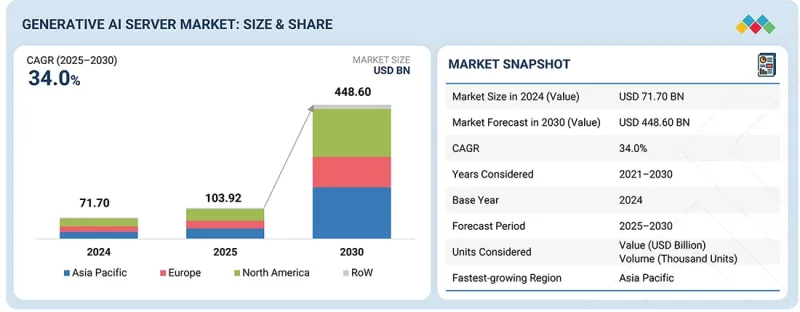
The generative AI server market is anticipated to grow from USD 103.92 billion in 2025 to USD 448.60 billion by 2030, at a CAGR of 34.0% between 2025 and 2030.
| Scope of the Report | |
|---|---|
| Years Considered for the Study | 2021-2030 |
| Base Year | 2024 |
| Forecast Period | 2025-2030 |
| Units Considered | Value (USD Billion) |
| Segments | By Processor Type, Function, Deployment and Region |
| Regions covered | North America, Europe, APAC, RoW |
Enterprises are increasingly deploying generative AI for applications such as content creation, customer service automation, drug discovery, and personalized marketing. This widespread adoption is significantly increasing demand for high-performance AI servers capable of handling intensive workloads.
"Cloud deployment will hold the largest market share."
Cloud deployment is expected to hold the largest market share in the generative AI server market by 2030 due to its unmatched scalability, flexibility, and cost efficiency. Generative AI workloads-such as large language models, image generation, and real-time inference-require massive computational power that is often impractical for enterprises to maintain on-premises. Cloud platforms enable organizations to access high-performance GPU- and ASIC-based servers on demand, eliminating heavy upfront capital investments. Additionally, leading cloud service providers like Amazon Web Services, Microsoft Azure, and Google Cloud continuously invest in advanced AI infrastructure, including specialized AI chips, high-speed networking, and liquid-cooled data centers. This ensures enterprises can leverage cutting-edge capabilities without managing complex hardware. Cloud deployment also supports seamless updates, rapid model deployment, and integration with AI development tools, accelerating time-to-market. As data volumes grow and AI adoption expands across industries, the cloud's ability to deliver elastic, high-performance infrastructure will solidify its dominant position in the generative AI server market by 2030.
"Enterprises are estimated to record the highest CAGR during the forecast period."
The enterprises segment is projected to register the highest CAGR in the generative AI server market due to the rapid acceleration of AI adoption across business operations. Enterprises are increasingly integrating generative AI into functions such as customer support, software development, marketing automation, and decision-making, creating strong demand for high-performance server infrastructure. Unlike early adoption led by hyperscalers, enterprises are now moving from pilot projects to full-scale deployment of AI models, including large language models and domain-specific AI systems. This transition significantly increases the need for scalable compute, storage, and networking capabilities. Additionally, enterprises often require customized and secure environments, driving investments in dedicated or hybrid AI server deployments. The growing focus on data privacy and regulatory compliance is another key factor, as enterprises prefer controlled environments for sensitive data processing. This is encouraging the adoption of private cloud and on-premise AI servers alongside public cloud usage. Furthermore, industries such as BFSI, healthcare, manufacturing, and retail are leveraging generative AI for competitive advantage, boosting infrastructure demand. As digital transformation intensifies and AI becomes central to enterprise strategy, the enterprise segment is expected to witness the fastest growth rate in the generative AI server market.
"Asia Pacific is expected to grow at the highest CAGR during the forecast period."
Asia Pacific is expected to register the highest CAGR in the generative AI server market due to a strong combination of digital expansion, government support, and rising enterprise AI adoption. Countries such as China, India, Japan, and South Korea are witnessing rapid growth in data generation, cloud adoption, and AI-driven applications, creating significant demand for high-performance AI servers. Governments across the region are actively promoting AI development through national strategies, funding programs, and digital infrastructure investments. For instance, China's AI development plans and India's digital initiatives are accelerating the deployment of AI workloads across sectors. This policy support is encouraging both domestic innovation and foreign investments in AI infrastructure. Additionally, the expansion of hyperscale data centers and the increasing presence of global cloud providers such as Amazon Web Services, Microsoft Azure, and Google Cloud are boosting regional capacity for generative AI workloads. Moreover, a large developer base, growing startup ecosystem, and increasing enterprise digitalization are driving widespread adoption of generative AI solutions. As businesses scale AI deployments across industries, the demand for advanced server infrastructure in the Asia Pacific is expected to grow at the fastest pace globally.
Extensive primary interviews were conducted with key industry experts in the generative AI server to determine and verify the market size for various segments and subsegments gathered through secondary research. The breakdown of primary participants for the report is provided below:
The study contains insights from various industry experts, from component suppliers to Tier 1 companies and OEMs. The break-up of the primaries is as follows:
- By Company Type: Tier 1-50%, Tier 2-20%, and Tier 3-30%
- By Designation: C-level-20%, Directors-30%, and Others-50%
- By Region: North America-40%, Europe-20%, Asia Pacific-30%, and RoW-10%
The report profiles key players in the generative AI server market with their respective market ranking analysis. Prominent players profiled in this report are Dell Inc. (US), Hewlett Packard Enterprise Development LP (US), Lenovo (China), Huawei Technologies Co., Ltd. (China), IBM (US), Super Micro Computer, Inc. (US), INSPUR Co., Ltd. (China), H3C Technologies Co., Ltd. (China), Cisco Systems, Inc. (US), Fujitsu (Japan), among others.
Research Coverage:
This research report categorizes the generative AI server market based on processor type, function, cooling technology, form factor, deployment, end user, and region. The report describes the major drivers, restraints, challenges, and opportunities pertaining to the generative AI server market and forecasts the same till 2030. Apart from these, the report also consists of leadership mapping and analysis of all the companies included in the generative AI server market ecosystem.
Key Benefits of Buying the Report
The report will help the market leaders/new entrants in this market with information on the closest approximations of the numbers for the overall generative AI server market and the subsegments. This report will help stakeholders understand the competitive landscape and gain more insights to position their businesses better and plan suitable go-to-market strategies. The report also helps stakeholders understand the pulse of the market and provides them with information on key market drivers, restraints, challenges, and opportunities.
The report provides insights into the following pointers:
- Analysis of key drivers (Rising Adoption of Generative AI Applications), restraints (High Infrastructure Costs), opportunities (Emerging Demand in Enterprises), and challenges (Data Privacy, Sovereignty & Regulatory Hurdles)
- Product Development/Innovation: Detailed insights on upcoming technologies, research & development activities, and product launches in the generative AI server market
- Market Development: Comprehensive information about lucrative markets-the report analyzes the generative AI server market across varied regions
- Market Diversification: Exhaustive information about new products, untapped geographies, recent developments, and investments in the generative AI server market
- Competitive Assessment: In-depth assessment of market shares, growth strategies, and service offerings of leading players, such as Dell Inc. (US), Hewlett Packard Enterprise Development LP (US), Lenovo (China), Huawei Technologies Co., Ltd. (China), and IBM (US), in the generative AI server market.
TABLE OF CONTENTS
1 INTRODUCTION
- 1.1 STUDY OBJECTIVES
- 1.2 MARKET DEFINITION
- 1.3 STUDY SCOPE
- 1.3.1 MARKETS COVERED AND REGIONAL SCOPE
- 1.3.2 INCLUSIONS AND EXCLUSIONS
- 1.3.3 YEARS CONSIDERED
- 1.4 CURRENCY CONSIDERED
- 1.5 UNITS CONSIDERED
- 1.6 LIMITATIONS
- 1.7 STAKEHOLDERS
2 RESEARCH METHODOLOGY
- 2.1 RESEARCH DATA
- 2.1.1 SECONDARY DATA
- 2.1.1.1 List of major secondary sources
- 2.1.1.2 Key data from secondary sources
- 2.1.2 PRIMARY DATA
- 2.1.2.1 List of primary interview participants
- 2.1.2.2 Breakdown of primaries
- 2.1.2.3 Key data from primary sources
- 2.1.2.4 Key industry insights
- 2.1.3 SECONDARY AND PRIMARY RESEARCH
- 2.1.1 SECONDARY DATA
- 2.2 MARKET SIZE ESTIMATION
- 2.2.1 BOTTOM-UP APPROACH
- 2.2.1.1 Approach to estimate market size using bottom-up analysis (demand side)
- 2.2.2 TOP-DOWN APPROACH
- 2.2.2.1 Approach to estimate market size using top-down analysis (supply side)
- 2.2.1 BOTTOM-UP APPROACH
- 2.3 MARKET BREAKDOWN AND DATA TRIANGULATION
- 2.4 RESEARCH ASSUMPTIONS
- 2.5 RISK ASSESSMENT
- 2.6 RESEARCH LIMITATIONS
3 EXECUTIVE SUMMARY
4 PREMIUM INSIGHTS
- 4.1 ATTRACTIVE OPPORTUNITIES FOR PLAYERS IN GENERATIVE AI SERVER MARKET
- 4.2 AI SERVER MARKET, BY PROCESSOR TYPE
- 4.3 AI SERVER MARKET, BY FUNCTION
- 4.4 AI SERVER MARKET, BY COOLING TECHNOLOGY
- 4.5 AI SERVER MARKET, BY FORM FACTOR
- 4.6 AI SERVER MARKET, BY DEPLOYMENT
- 4.7 AI SERVER MARKET, BY END-USER
- 4.8 AI SERVER MARKET, BY COUNTRY
- 4.9 AI SERVER MARKET, BY REGION
5 MARKET OVERVIEW
- 5.1 INTRODUCTION
- 5.2 MARKET DYNAMICS
- 5.2.1 DRIVERS
- 5.2.1.1 Rising adoption of generative AI applications
- 5.2.1.2 Demand for high-performance computing (HPC) infrastructure
- 5.2.1.3 Aggressive investments by cloud providers
- 5.2.2 RESTRAINTS
- 5.2.2.1 High infrastructure costs
- 5.2.2.2 Power consumption and sustainability concerns
- 5.2.2.3 Vendor lock-in and limited hardware availability
- 5.2.3 OPPORTUNITIES
- 5.2.3.1 Emerging markets
- 5.2.3.2 AI chip innovation and open hardware initiatives
- 5.2.4 CHALLENGES
- 5.2.4.1 Data privacy, sovereignty, and regulatory hurdles
- 5.2.4.2 Talent shortage in AI infrastructure design
- 5.2.1 DRIVERS
- 5.3 VALUE CHAIN ANALYSIS
- 5.4 ECOSYSTEM ANALYSIS
- 5.5 TRENDS/DISRUPTIONS IMPACTING CUSTOMER BUSINESSES
- 5.6 PRICING ANALYSIS
- 5.6.1 INDICATIVE PRICE TREND OF GENERATIVE AI SERVERS, BY REGION (USD)
- 5.7 TECHNOLOGY ANALYSIS
- 5.7.1 KEY TECHNOLOGIES
- 5.7.1.1 High-performance computing (HPC)
- 5.7.1.2 High bandwidth memory (HBM)
- 5.7.1.3 GenAI workload
- 5.7.2 COMPLEMENTARY TECHNOLOGIES
- 5.7.2.1 Data center power management and cooling system
- 5.7.2.2 High-speed interconnects
- 5.7.3 ADJACENT TECHNOLOGIES
- 5.7.3.1 AI development frameworks
- 5.7.3.2 Quantum AI
- 5.7.1 KEY TECHNOLOGIES
- 5.8 UPCOMING DEPLOYMENTS OF DATA CENTERS BY CLOUD SERVICE PROVIDERS
- 5.9 CAPEX OF CLOUD SERVICE PROVIDERS
- 5.10 PROCESSOR BENCHMARKING
- 5.10.1 GPU BENCHMARKING
- 5.10.2 CPU BENCHMARKING
- 5.11 PORTER'S FIVE FORCES ANALYSIS
- 5.11.1 THREAT OF NEW ENTRANTS
- 5.11.2 THREAT OF SUBSTITUTES
- 5.11.3 BARGAINING POWER OF SUPPLIERS
- 5.11.4 BARGAINING POWER OF BUYERS
- 5.11.5 INTENSITY OF COMPETITIVE RIVALRY
- 5.12 KEY STAKEHOLDERS AND BUYING CRITERIA
- 5.12.1 KEY STAKEHOLDERS IN BUYING PROCESS
- 5.12.2 BUYING CRITERIA
- 5.13 CASE STUDY ANALYSIS
- 5.13.1 AIVRES' HIGH-PERFORMANCE COMPUTING SERVER ACCELERATES AI SOLUTION DEVELOPMENT
- 5.13.2 SEEWEB COLLABORATES WITH LENOVO AND NVIDIA TO LAUNCH GPU-COMPUTING-AS-A-SERVICE MODEL AND EXPAND AI ACCESSIBILITY
- 5.13.3 SHARONAI EXPANDS AI INFRASTRUCTURE WITH LENOVO TRUSCALE, DEPLOYING HUNDREDS OF GPU-DENSE SERVERS
- 5.13.4 SERVING INFERENCE FOR LLMS: A CASE STUDY WITH NVIDIA TRITON INFERENCE SERVER AND ELEUTHER AI
- 5.13.5 APPLIED DIGITAL CORPORATION EXPANDS AI CAPABILITIES WITH SUPERMICRO SERVERS
- 5.14 INVESTMENT AND FUNDING SCENARIO
- 5.15 TRADE ANALYSIS
- 5.15.1 IMPORT SCENARIO (HS CODE 847150)
- 5.15.2 EXPORT SCENARIO (HS CODE 847150)
- 5.16 PATENT ANALYSIS
- 5.17 KEY CONFERENCES AND EVENTS, 2025-2026
- 5.18 REGULATORY LANDSCAPE
- 5.18.1 REGULATORY BODIES, GOVERNMENT AGENCIES, AND OTHER ORGANIZATIONS
- 5.18.2 STANDARDS
6 GENERATIVE AI SERVER MARKET, BY PROCESSOR TYPE
- 6.1 INTRODUCTION
- 6.2 GPU-BASED SERVERS
- 6.2.1 SCALABILITY AND PARALLEL PROCESSING CAPABILITIES TO DRIVE ADOPTION
- 6.3 FPGA-BASED SERVERS
- 6.3.1 CUSTOMIZATION AND ENERGY EFFICIENCY TO SUPPORT NICHE AI APPLICATIONS
- 6.4 ASIC-BASED SERVERS
- 6.4.1 HIGH-PERFORMANCE AND TASK-SPECIFIC DESIGN TO ACCELERATE GENERATIVE AI DEPLOYMENTS
7 GENERATIVE AI SERVER MARKET, BY FUNCTION
- 7.1 INTRODUCTION
- 7.2 TRAINING
- 7.2.1 HIGH COMPUTATIONAL DEMANDS OF TRAINING GENERATIVE AI MODELS TO DRIVE SERVER DEPLOYMENT
- 7.3 INFERENCE
- 7.3.1 LOW LATENCY AND REAL-TIME PROCESSING NEEDS TO FUEL DEMAND FOR INFERENCE-OPTIMIZED SERVERS
8 GENERATIVE AI SERVER MARKET, BY COOLING TECHNOLOGY
- 8.1 INTRODUCTION
- 8.2 AIR COOLING
- 8.2.1 COST-EFFECTIVE AND EASY-TO-DEPLOY SOLUTIONS CONTINUE TO SUPPORT AI INFRASTRUCTURE EXPANSION
- 8.3 LIQUID COOLING
- 8.3.1 HIGH-THERMAL-EFFICIENCY SOLUTIONS TO MEET DEMANDS OF DENSE, PERFORMANCE-INTENSIVE AI INFRASTRUCTURE
- 8.4 HYBRID COOLING
- 8.4.1 COMBINATION OF AIR AND LIQUID COOLING SOLUTIONS TO OPTIMIZE PERFORMANCE AND EFFICIENCY IN AI INFRASTRUCTURE
9 GENERATIVE AI SERVER MARKET, BY FORM FACTOR
- 9.1 INTRODUCTION
- 9.2 RACK-MOUNTED SERVER
- 9.2.1 HIGH-DENSITY COMPUTE CAPABILITIES AND MODULAR DESIGN OF RACK-BASED SERVERS TO SUPPORT GEN AI WORKLOADS
- 9.3 BLADE SERVERS
- 9.3.1 COMPACT DESIGN AND EFFICIENT RESOURCE UTILIZATION MAKE BLADE SERVERS IDEAL FOR AI-INTENSIVE DATA CENTERS
- 9.4 TOWER SERVERS
- 9.4.1 COST-EFFECTIVE AND EASILY DEPLOYABLE TOWER SERVERS CATER TO ENTRY-LEVEL GENERATIVE AI APPLICATIONS
10 GENERATIVE AI SERVER MARKET, BY DEPLOYMENT
- 10.1 INTRODUCTION
- 10.2 ON-PREMISES
- 10.2.1 DATA SECURITY AND CUSTOMIZATION NEEDS FUEL ON-PREMISES ADOPTION IN GENERATIVE AI SERVER DEPLOYMENTS
- 10.3 CLOUD
- 10.3.1 FLEXIBILITY AND SCALABILITY OF CLOUD DEPLOYMENT DRIVE GROWTH IN GENERATIVE AI SERVER MARKET
11 GENERATIVE AI SERVER MARKET, BY END USER
- 11.1 INTRODUCTION
- 11.2 CLOUD SERVICE PROVIDERS
- 11.2.1 SCALABILITY, COST EFFICIENCY, AND INFRASTRUCTURE FLEXIBILITY TO DRIVE CSP ADOPTION OF GENERATIVE AI SERVERS
- 11.3 ENTERPRISES
- 11.3.1 HEALTHCARE
- 11.3.1.1 Adoption of generative AI for drug discovery fuels market expansion
- 11.3.2 BFSI
- 11.3.2.1 Rising need for enhanced fraud detection in finance drives demand
- 11.3.3 AUTOMOTIVE
- 11.3.3.1 Increasing focus on safety, efficiency, and better driving experiences fuels growth
- 11.3.4 RETAIL & E-COMMERCE
- 11.3.4.1 Personalized shopping experiences and enhanced customer service to generate significant growth opportunities
- 11.3.5 MEDIA & ENTERTAINMENT
- 11.3.5.1 Real-time analysis of viewer preferences, engagement patterns, and demographic information to augment market growth
- 11.3.6 OTHERS
- 11.3.6.1 Proliferation of visual data through smart devices, security cameras, and self-driving cars to drive demand
- 11.3.1 HEALTHCARE
- 11.4 GOVERNMENT ORGANIZATIONS
- 11.4.1 INCREASING USE OF GENERATIVE AI IN NATIONAL SECURITY AND DEFENSE TO DRIVE MARKET GROWTH
12 GENERATIVE AI SERVER MARKET, BY REGION
- 12.1 INTRODUCTION
- 12.2 NORTH AMERICA
- 12.2.1 MACROECONOMIC OUTLOOK FOR NORTH AMERICA
- 12.2.2 US
- 12.2.2.1 Government-led initiatives to boost semiconductor manufacturing to drive market
- 12.2.3 CANADA
- 12.2.3.1 Growing emphasis on commercializing AI to spur demand
- 12.2.4 MEXICO
- 12.2.4.1 Increasing shift toward digital platforms and cloud-based solutions to accelerate demand
- 12.3 EUROPE
- 12.3.1 MACROECONOMIC OUTLOOK FOR EUROPE
- 12.3.2 UK
- 12.3.2.1 Strategic data center investments drive generative AI server demand
- 12.3.3 GERMANY
- 12.3.3.1 Industrial strength and strategic partnerships fuel market
- 12.3.4 FRANCE
- 12.3.4.1 Expanding startup ecosystem and government support to drive growth of market
- 12.3.5 ITALY
- 12.3.5.1 Government strategy and industry digitalization boost market
- 12.3.6 SPAIN
- 12.3.6.1 Strategic cloud investments and language model development - key drivers
- 12.3.7 REST OF EUROPE
- 12.4 ASIA PACIFIC
- 12.4.1 MACROECONOMIC OUTLOOK FOR ASIA PACIFIC
- 12.4.2 CHINA
- 12.4.2.1 Strategic investments and AI infrastructure expansion accelerate growth
- 12.4.3 JAPAN
- 12.4.3.1 Strategic investments and sovereign AI initiatives to drive market expansion
- 12.4.4 SOUTH KOREA
- 12.4.4.1 Market driven by semiconductor leadership and government initiatives
- 12.4.5 INDIA
- 12.4.5.1 Government initiatives and infrastructure investments drive market growth
- 12.4.6 REST OF ASIA PACIFIC
- 12.5 ROW
- 12.5.1 MACROECONOMIC OUTLOOK FOR ROW
- 12.5.2 MIDDLE EAST
- 12.5.2.1 Growing emphasis on digital transformation and technological innovation to drive market growth
- 12.5.2.2 GCC countries
- 12.5.2.3 Rest of Middle East
- 12.5.3 AFRICA
- 12.5.3.1 Rising internet penetration and mobile subscriptions to offer lucrative growth opportunities
- 12.5.4 SOUTH AMERICA
- 12.5.4.1 Growing need to store vast amounts of data to boost demand
13 COMPETITIVE LANDSCAPE
- 13.1 OVERVIEW
- 13.2 KEY PLAYER STRATEGIES/RIGHT TO WIN
- 13.3 REVENUE ANALYSIS, 2022-2024
- 13.4 MARKET SHARE ANALYSIS, 2024
- 13.5 COMPANY VALUATION AND FINANCIAL METRICS, 2024
- 13.6 BRAND/PRODUCT COMPARISON
- 13.7 COMPANY EVALUATION MATRIX: KEY PLAYERS, 2024
- 13.7.1 STARS
- 13.7.2 EMERGING LEADERS
- 13.7.3 PERVASIVE PLAYERS
- 13.7.4 PARTICIPANTS
- 13.7.5 COMPANY FOOTPRINT: KEY PLAYERS, 2024
- 13.7.5.1 Company footprint
- 13.7.5.2 Region footprint
- 13.7.5.3 Processor type footprint
- 13.7.5.4 Function footprint
- 13.7.5.5 Cooling technology footprint
- 13.7.5.6 Form factor footprint
- 13.7.5.7 Deployment footprint
- 13.7.5.8 Application footprint
- 13.7.5.9 End user footprint
- 13.8 COMPANY EVALUATION MATRIX: STARTUPS/SMES, 2024
- 13.8.1 PROGRESSIVE COMPANIES
- 13.8.2 RESPONSIVE COMPANIES
- 13.8.3 DYNAMIC COMPANIES
- 13.8.4 STARTING BLOCKS
- 13.8.5 COMPETITIVE BENCHMARKING: STARTUPS/SMES, 2024
- 13.8.5.1 Detailed list of key startups/SMEs
- 13.8.5.2 Competitive benchmarking of key startups/SMEs
- 13.9 COMPETITIVE SCENARIO AND TRENDS
- 13.9.1 PRODUCT LAUNCHES
- 13.9.2 DEALS
14 COMPANY PROFILES
- 14.1 KEY PLAYERS
- 14.1.1 DELL INC.
- 14.1.1.1 Business overview
- 14.1.1.2 Products offered
- 14.1.1.3 Recent developments
- 14.1.1.3.1 Product launches
- 14.1.1.3.2 Deals
- 14.1.1.4 MnM view
- 14.1.1.4.1 Key strengths
- 14.1.1.4.2 Strategic choices
- 14.1.1.4.3 Weaknesses and competitive threats
- 14.1.2 HEWLETT PACKARD ENTERPRISE DEVELOPMENT LP
- 14.1.2.1 Business overview
- 14.1.2.2 Products offered
- 14.1.2.3 Recent developments
- 14.1.2.3.1 Product launches
- 14.1.2.3.2 Deals
- 14.1.2.4 MnM view
- 14.1.2.4.1 Key strengths
- 14.1.2.4.2 Strategic choices
- 14.1.2.4.3 Weaknesses and competitive threats
- 14.1.3 LENOVO
- 14.1.3.1 Business overview
- 14.1.3.2 Products offered
- 14.1.3.3 Recent developments
- 14.1.3.3.1 Product launches
- 14.1.3.3.2 Deals
- 14.1.3.3.3 Expansions
- 14.1.3.4 MnM view
- 14.1.3.4.1 Key strengths
- 14.1.3.4.2 Strategic choices
- 14.1.3.4.3 Weaknesses and competitive threats
- 14.1.4 HUAWEI TECHNOLOGIES CO., LTD.
- 14.1.4.1 Business overview
- 14.1.4.2 Products offered
- 14.1.4.3 Recent developments
- 14.1.4.3.1 Deals
- 14.1.4.4 MnM view
- 14.1.4.4.1 Key strengths
- 14.1.4.4.2 Strategic choices
- 14.1.4.4.3 Weaknesses and competitive threats
- 14.1.5 IBM
- 14.1.5.1 Business overview
- 14.1.5.2 Products offered
- 14.1.5.3 Recent developments
- 14.1.5.3.1 Product launches
- 14.1.5.3.2 Deals
- 14.1.5.4 MnM view
- 14.1.5.4.1 Key strengths
- 14.1.5.4.2 Strategic choices
- 14.1.5.4.3 Weaknesses and competitive threats
- 14.1.6 H3C TECHNOLOGIES CO., LTD.
- 14.1.6.1 Business overview
- 14.1.6.2 Products offered
- 14.1.6.3 Recent developments
- 14.1.6.3.1 Product launches
- 14.1.6.3.2 Deals
- 14.1.7 CISCO SYSTEMS, INC.
- 14.1.7.1 Business overview
- 14.1.7.2 Products offered
- 14.1.7.3 Recent developments
- 14.1.7.3.1 Product launches
- 14.1.7.3.2 Deals
- 14.1.8 SUPER MICRO COMPUTER, INC.
- 14.1.8.1 Business overview
- 14.1.8.2 Products offered
- 14.1.8.3 Recent developments
- 14.1.8.3.1 Product launches
- 14.1.8.3.2 Deals
- 14.1.9 FUJITSU
- 14.1.9.1 Business overview
- 14.1.9.2 Products offered
- 14.1.9.3 Recent developments
- 14.1.9.3.1 Deals
- 14.1.10 INSPUR CO., LTD.
- 14.1.10.1 Business overview
- 14.1.10.2 Products offered
- 14.1.10.3 Recent developments
- 14.1.10.3.1 Product launches
- 14.1.10.3.2 Deals
- 14.1.1 DELL INC.
- 14.2 OTHER PLAYERS
- 14.2.1 NVIDIA CORPORATION
- 14.2.2 ADLINK TECHNOLOGY INC.
- 14.2.3 ADVANCED MICRO DEVICES, INC.
- 14.2.4 QUANTA COMPUTERS
- 14.2.5 WISTRON CORPORATION
- 14.2.6 GIGABIT TECHNOLOGIES PVT LTD.
- 14.2.7 ASUSTEK COMPUTER INC.
- 14.2.8 AIVRES
- 14.2.9 AIME
- 14.2.10 WIWYNN CORPORATION
- 14.2.11 MITAC COMPUTING TECHNOLOGY CORPORATION
- 14.2.12 NEC CORPORATION INDIA PRIVATE LIMITED
- 14.2.13 XENON SYSTEMS PTY LTD.
- 14.2.14 GRAPHCORE
- 14.2.15 2CRSI GROUP
15 APPENDIX
- 15.1 INSIGHTS FROM INDUSTRY EXPERTS
- 15.2 DISCUSSION GUIDE
- 15.3 KNOWLEDGESTORE: MARKETSANDMARKETS' SUBSCRIPTION PORTAL
- 15.4 CUSTOMIZATION OPTIONS
- 15.5 RELATED REPORTS
- 15.6 AUTHOR DETAILS
List of Tables
- TABLE 1 GENERATIVE AI SERVER MARKET: RISK ANALYSIS
- TABLE 2 ROLE OF PLAYERS IN GENERATIVE AI SERVER ECOSYSTEM
- TABLE 3 INDICATIVE PRICE OF GENERATIVE AI SERVERS OFFERED BY KEY PLAYERS, BY PROCESSOR TYPE (USD)
- TABLE 4 INDICATIVE PRICE TREND OF GPU-BASED GENERATIVE AI SERVERS, BY REGION, 2021-2024 (USD)
- TABLE 5 INDICATIVE PRICE TREND OF FPGA-BASED GENERATIVE AI SERVERS, BY REGION, 2021-2024 (USD)
- TABLE 6 COMPARISON OF NVIDIA AI GPU SPECIFICATIONS
- TABLE 7 COMPARISON OF CPU SPECIFICATIONS
- TABLE 8 GENERATIVE AI SERVER MARKET: PORTER'S FIVE FORCES ANALYSIS
- TABLE 9 INFLUENCE OF STAKEHOLDERS ON BUYING PROCESS FOR TOP 3 END USERS
- TABLE 10 KEY BUYING CRITERIA FOR TOP 3 END USERS
- TABLE 11 IMPORT DATA FOR HS CODE 847150-COMPLIANT PRODUCTS, BY COUNTRY, 2020-2024 (USD MILLION)
- TABLE 12 EXPORT DATA FOR HS CODE 847150-COMPLIANT PRODUCTS, BY COUNTRY, 2020-2024 (USD MILLION)
- TABLE 13 GENERATIVE AI SERVER MARKET: KEY PATENTS
- TABLE 14 GENERATIVE AI SERVER MARKET: KEY CONFERENCES AND EVENTS, 2025-2026
- TABLE 15 NORTH AMERICA: REGULATORY BODIES, GOVERNMENT AGENCIES, AND OTHER ORGANIZATIONS
- TABLE 16 EUROPE: REGULATORY BODIES, GOVERNMENT AGENCIES, AND OTHER ORGANIZATIONS
- TABLE 17 ASIA PACIFIC: REGULATORY BODIES, GOVERNMENT AGENCIES, AND OTHER ORGANIZATIONS
- TABLE 18 ROW: REGULATORY BODIES, GOVERNMENT AGENCIES, AND OTHER ORGANIZATIONS
- TABLE 19 REGULATORY STANDARDS
- TABLE 20 GENERATIVE AI SERVER MARKET, BY PROCESSOR TYPE, 2021-2024 (USD BILLION)
- TABLE 21 GENERATIVE AI SERVER MARKET, BY PROCESSOR TYPE, 2025-2030 (USD BILLION)
- TABLE 22 GENERATIVE AI SERVER MARKET, BY PROCESSOR TYPE, 2021-2024 (THOUSAND UNITS)
- TABLE 23 GENERATIVE AI SERVER MARKET, BY PROCESSOR TYPE, 2025-2030 (THOUSAND UNITS)
- TABLE 24 GPU-BASED GENERATIVE AI SERVER MARKET, BY REGION, 2021-2024 (USD MILLION)
- TABLE 25 GPU-BASED GENERATIVE AI SERVER MARKET, BY REGION, 2025-2030 (USD MILLION)
- TABLE 26 NORTH AMERICA: GPU-BASED GENERATIVE AI SERVER MARKET, BY COUNTRY, 2021-2024 (USD MILLION)
- TABLE 27 NORTH AMERICA: GPU-BASED GENERATIVE AI SERVER MARKET, BY COUNTRY, 2025-2030 (USD MILLION)
- TABLE 28 EUROPE: GPU-BASED GENERATIVE AI SERVER MARKET, BY COUNTRY, 2021-2024 (USD MILLION)
- TABLE 29 EUROPE: GPU-BASED GENERATIVE AI SERVER MARKET, BY COUNTRY, 2025-2030 (USD MILLION)
- TABLE 30 ASIA PACIFIC: GPU-BASED GENERATIVE AI SERVER MARKET, BY COUNTRY, 2021-2024 (USD MILLION)
- TABLE 31 ASIA PACIFIC: GPU-BASED GENERATIVE AI SERVER MARKET, BY COUNTRY, 2025-2030 (USD MILLION)
- TABLE 32 ROW: GPU-BASED GENERATIVE AI SERVER MARKET, BY COUNTRY, 2021-2024 (USD MILLION)
- TABLE 33 ROW: GPU-BASED GENERATIVE AI SERVER MARKET, BY COUNTRY, 2025-2030 (USD MILLION)
- TABLE 34 FPGA-BASED GENERATIVE AI SERVER MARKET, BY REGION, 2021-2024 (USD MILLION)
- TABLE 35 FPGA-BASED GENERATIVE AI SERVER MARKET, BY REGION, 2025-2030 (USD MILLION)
- TABLE 36 NORTH AMERICA: FPGA-BASED GENERATIVE AI SERVER MARKET, BY COUNTRY, 2021-2024 (USD MILLION)
- TABLE 37 NORTH AMERICA: FPGA-BASED GENERATIVE AI SERVER MARKET, BY COUNTRY, 2025-2030 (USD MILLION)
- TABLE 38 EUROPE: FPGA-BASED GENERATIVE AI SERVER MARKET, BY COUNTRY, 2021-2024 (USD MILLION)
- TABLE 39 EUROPE: FPGA-BASED GENERATIVE AI SERVER MARKET, BY COUNTRY, 2025-2030 (USD MILLION)
- TABLE 40 ASIA PACIFIC: FPGA-BASED GENERATIVE AI SERVER MARKET, BY COUNTRY, 2021-2024 (USD MILLION)
- TABLE 41 ASIA PACIFIC: FPGA-BASED GENERATIVE AI SERVER MARKET, BY COUNTRY, 2025-2030 (USD MILLION)
- TABLE 42 ROW: FPGA-BASED GENERATIVE AI SERVER MARKET, BY COUNTRY, 2021-2024 (USD MILLION)
- TABLE 43 ROW: FPGA-BASED GENERATIVE AI SERVER MARKET, BY COUNTRY, 2025-2030 (USD MILLION)
- TABLE 44 ASIC-BASED GENERATIVE AI SERVER MARKET, BY REGION, 2021-2024 (USD MILLION)
- TABLE 45 ASIC-BASED GENERATIVE AI SERVER MARKET, BY REGION, 2025-2030 (USD MILLION)
- TABLE 46 NORTH AMERICA: ASIC-BASED GENERATIVE AI SERVER MARKET, BY COUNTRY, 2021-2024 (USD MILLION)
- TABLE 47 NORTH AMERICA: ASIC-BASED GENERATIVE AI SERVER MARKET, BY COUNTRY, 2025-2030 (USD MILLION)
- TABLE 48 EUROPE: ASIC-BASED GENERATIVE AI SERVER MARKET, BY COUNTRY, 2021-2024 (USD MILLION)
- TABLE 49 EUROPE: ASIC-BASED GENERATIVE AI SERVER MARKET, BY COUNTRY, 2025-2030 (USD MILLION)
- TABLE 50 ASIA PACIFIC: ASIC-BASED GENERATIVE AI SERVER MARKET, BY COUNTRY, 2021-2024 (USD MILLION)
- TABLE 51 ASIA PACIFIC: ASIC-BASED GENERATIVE AI SERVER MARKET, BY COUNTRY, 2025-2030 (USD MILLION)
- TABLE 52 ROW: ASIC-BASED GENERATIVE AI SERVER MARKET, BY COUNTRY, 2021-2024 (USD MILLION)
- TABLE 53 ROW: ASIC-BASED GENERATIVE AI SERVER MARKET, BY COUNTRY, 2025-2030 (USD MILLION)
- TABLE 54 GENERATIVE AI SERVER MARKET, BY FUNCTION, 2021-2024 (USD BILLION)
- TABLE 55 GENERATIVE AI SERVER MARKET, BY FUNCTION, 2025-2030 (USD BILLION)
- TABLE 56 GENERATIVE AI SERVER MARKET, BY FUNCTION, 2021-2024 (THOUSAND UNITS)
- TABLE 57 GENERATIVE AI SERVER MARKET, BY FUNCTION, 2025-2030 (THOUSAND UNITS)
- TABLE 58 TRAINING: GENERATIVE AI SERVER MARKET, BY PROCESSOR TYPE, 2021-2024 (USD BILLION)
- TABLE 59 TRAINING: GENERATIVE AI SERVER MARKET, BY PROCESSOR TYPE, 2025-2030 (USD BILLION)
- TABLE 60 TRAINING: GENERATIVE AI SERVER MARKET, BY PROCESSOR TYPE, 2021-2024 (THOUSAND UNITS)
- TABLE 61 TRAINING: GENERATIVE AI SERVER MARKET, BY PROCESSOR TYPE, 2025-2030 (THOUSAND UNITS)
- TABLE 62 INFERENCE: GENERATIVE AI SERVER MARKET, BY PROCESSOR TYPE, 2021-2024 (USD BILLION)
- TABLE 63 INFERENCE: GENERATIVE AI SERVER MARKET, BY PROCESSOR TYPE, 2025-2030 (USD BILLION)
- TABLE 64 INFERENCE: GENERATIVE AI SERVER MARKET, BY PROCESSOR TYPE, 2021-2024 (THOUSAND UNITS)
- TABLE 65 INFERENCE: GENERATIVE AI SERVER MARKET, BY PROCESSOR TYPE, 2025-2030 (THOUSAND UNITS)
- TABLE 66 GENERATIVE AI SERVER MARKET, BY COOLING TECHNOLOGY, 2021-2024 (USD BILLION)
- TABLE 67 GENERATIVE AI SERVER MARKET, BY COOLING TECHNOLOGY, 2025-2030 (USD BILLION)
- TABLE 68 AIR COOLING: GENERATIVE AI SERVER MARKET, BY REGION, 2021-2024 (USD MILLION)
- TABLE 69 AIR COOLING: GENERATIVE AI SERVER MARKET, BY REGION, 2025-2030 (USD MILLION)
- TABLE 70 LIQUID COOLING: GENERATIVE AI SERVER MARKET, BY REGION, 2021-2024 (USD MILLION)
- TABLE 71 LIQUID COOLING: GENERATIVE AI SERVER MARKET, BY REGION, 2025-2030 (USD MILLION)
- TABLE 72 HYBRID COOLING: GENERATIVE AI SERVER MARKET, BY REGION, 2021-2024 (USD MILLION)
- TABLE 73 HYBRID COOLING: GENERATIVE AI SERVER MARKET, BY REGION, 2025-2030 (USD MILLION)
- TABLE 74 GENERATIVE AI SERVER MARKET, BY FORM FACTOR, 2021-2024 (USD BILLION)
- TABLE 75 GENERATIVE AI SERVER MARKET, BY FORM FACTOR, 2025-2030 (USD BILLION)
- TABLE 76 RACK-MOUNTED SERVERS: GENERATIVE AI SERVER MARKET, BY REGION, 2021-2024 (USD MILLION)
- TABLE 77 RACK-MOUNTED SERVERS: GENERATIVE AI SERVER MARKET, BY REGION, 2025-2030 (USD MILLION)
- TABLE 78 BLADE SERVERS: GENERATIVE AI SERVER MARKET, BY REGION, 2021-2024 (USD MILLION)
- TABLE 79 BLADE SERVERS: GENERATIVE AI SERVER MARKET, BY REGION, 2025-2030 (USD MILLION)
- TABLE 80 TOWER SERVERS: GENERATIVE AI SERVER MARKET, BY REGION, 2021-2024 (USD MILLION)
- TABLE 81 TOWER SERVERS: GENERATIVE AI SERVER MARKET, BY REGION, 2025-2030 (USD MILLION)
- TABLE 82 GENERATIVE AI SERVER MARKET, BY DEPLOYMENT, 2021-2024 (USD BILLION)
- TABLE 83 GENERATIVE AI SERVER MARKET, BY DEPLOYMENT, 2025-2030 (USD BILLION)
- TABLE 84 ON-PREMISES: GENERATIVE AI SERVER MARKET, BY REGION, 2021-2024 (USD MILLION)
- TABLE 85 ON-PREMISES: GENERATIVE AI SERVER MARKET, BY REGION, 2025-2030 (USD MILLION)
- TABLE 86 CLOUD: GENERATIVE AI SERVER MARKET, BY REGION, 2021-2024 (USD MILLION)
- TABLE 87 CLOUD: GENERATIVE AI SERVER MARKET, BY REGION, 2025-2030 (USD MILLION)
- TABLE 88 GENERATIVE AI SERVER MARKET, BY END USER, 2021-2024 (USD BILLION)
- TABLE 89 GENERATIVE AI SERVER MARKET, BY END USER, 2025-2030 (USD BILLION)
- TABLE 90 GENERATIVE AI SERVER MARKET, BY ENTERPRISE TYPE, 2021-2024 (USD BILLION)
- TABLE 91 GENERATIVE AI SERVER MARKET, BY ENTERPRISE TYPE, 2025-2030 (USD BILLION)
- TABLE 92 CLOUD SERVICE PROVIDERS (CSP): GENERATIVE AI SERVER MARKET, BY REGION, 2021-2024 (USD MILLION)
- TABLE 93 CLOUD SERVICE PROVIDERS (CSP): GENERATIVE AI SERVER MARKET, BY REGION, 2025-2030 (USD MILLION)
- TABLE 94 ENTERPRISES: GENERATIVE AI SERVER MARKET, BY REGION, 2021-2024 (USD MILLION)
- TABLE 95 ENTERPRISES: GENERATIVE AI SERVER MARKET, BY REGION, 2025-2030 (USD MILLION)
- TABLE 96 HEALTHCARE: GENERATIVE AI SERVER MARKET, BY REGION, 2021-2024 (USD MILLION)
- TABLE 97 HEALTHCARE: GENERATIVE AI SERVER MARKET, BY REGION, 2025-2030 (USD MILLION)
- TABLE 98 BFSI: GENERATIVE AI SERVER MARKET, BY REGION, 2021-2024 (USD MILLION)
- TABLE 99 BFSI: GENERATIVE AI SERVER MARKET, BY REGION, 2025-2030 (USD MILLION)
- TABLE 100 AUTOMOTIVE: GENERATIVE AI SERVER MARKET, BY REGION, 2021-2024 (USD MILLION)
- TABLE 101 AUTOMOTIVE: GENERATIVE AI SERVER MARKET, BY REGION, 2025-2030 (USD MILLION)
- TABLE 102 RETAIL & E-COMMERCE: GENERATIVE AI SERVER MARKET, BY REGION, 2021-2024 (USD MILLION)
- TABLE 103 RETAIL & E-COMMERCE: GENERATIVE AI SERVER MARKET, BY REGION, 2025-2030 (USD MILLION)
- TABLE 104 MEDIA & ENTERTAINMENT: GENERATIVE AI SERVER MARKET, BY REGION, 2021-2024 (USD MILLION)
- TABLE 105 MEDIA & ENTERTAINMENT: GENERATIVE AI SERVER MARKET, BY REGION, 2025-2030 (USD MILLION)
- TABLE 106 OTHERS: GENERATIVE AI SERVER MARKET, BY REGION, 2021-2024 (USD MILLION)
- TABLE 107 OTHERS: GENERATIVE AI SERVER MARKET, BY REGION, 2025-2030 (USD MILLION)
- TABLE 108 GOVERNMENT ORGANIZATIONS: GENERATIVE AI SERVER MARKET, BY REGION, 2021-2024 (USD MILLION)
- TABLE 109 GOVERNMENT ORGANIZATIONS: GENERATIVE AI SERVER MARKET, BY REGION, 2025-2030 (USD MILLION)
- TABLE 110 GENERATIVE AI SERVER MARKET, BY REGION, 2021-2024 (USD BILLION)
- TABLE 111 GENERATIVE AI SERVER MARKET, BY REGION, 2025-2030 (USD BILLION)
- TABLE 112 NORTH AMERICA: GENERATIVE AI SERVER MARKET, BY COUNTRY, 2021-2024 (USD MILLION)
- TABLE 113 NORTH AMERICA: GENERATIVE AI SERVER MARKET, BY COUNTRY, 2025-2030 (USD MILLION)
- TABLE 114 NORTH AMERICA: GENERATIVE AI SERVER MARKET, BY PROCESSOR TYPE, 2021-2024 (USD MILLION)
- TABLE 115 NORTH AMERICA: GENERATIVE AI SERVER MARKET, BY PROCESSOR TYPE, 2025-2030 (USD MILLION)
- TABLE 116 NORTH AMERICA: GENERATIVE AI SERVER MARKET, BY DEPLOYMENT, 2021-2024 (USD MILLION)
- TABLE 117 NORTH AMERICA: GENERATIVE AI SERVER MARKET, BY DEPLOYMENT, 2025-2030 (USD MILLION)
- TABLE 118 NORTH AMERICA: GENERATIVE AI SERVER MARKET, BY COOLING TECHNOLOGY, 2021-2024 (USD MILLION)
- TABLE 119 NORTH AMERICA: GENERATIVE AI SERVER MARKET, BY COOLING TECHNOLOGY, 2025-2030 (USD MILLION)
- TABLE 120 NORTH AMERICA: GENERATIVE AI SERVER MARKET, BY FORM FACTOR, 2021-2024 (USD MILLION)
- TABLE 121 NORTH AMERICA: GENERATIVE AI SERVER MARKET, BY FORM FACTOR, 2025-2030 (USD MILLION)
- TABLE 122 NORTH AMERICA: GENERATIVE AI SERVER MARKET, BY END USER, 2021-2024 (USD MILLION)
- TABLE 123 NORTH AMERICA: GENERATIVE AI SERVER MARKET, BY END USER, 2025-2030 (USD MILLION)
- TABLE 124 NORTH AMERICA: GENERATIVE AI SERVER MARKET, BY ENTERPRISE TYPE, 2021-2024 (USD MILLION)
- TABLE 125 NORTH AMERICA: GENERATIVE AI SERVER MARKET, BY ENTERPRISE TYPE, 2025-2030 (USD MILLION)
- TABLE 126 US: GENERATIVE AI SERVER MARKET, BY PROCESSOR TYPE, 2021-2024 (USD MILLION)
- TABLE 127 US: GENERATIVE AI SERVER MARKET, BY PROCESSOR TYPE, 2025-2030 (USD MILLION)
- TABLE 128 CANADA: GENERATIVE AI SERVER MARKET, BY PROCESSOR TYPE, 2021-2024 (USD MILLION)
- TABLE 129 CANADA: GENERATIVE AI SERVER MARKET, BY PROCESSOR TYPE, 2025-2030 (USD MILLION)
- TABLE 130 MEXICO: GENERATIVE AI SERVER MARKET, BY PROCESSOR TYPE, 2021-2024 (USD MILLION)
- TABLE 131 MEXICO: GENERATIVE AI SERVER MARKET, BY PROCESSOR TYPE, 2025-2030 (USD MILLION)
- TABLE 132 EUROPE: GENERATIVE AI SERVER MARKET, BY COUNTRY, 2021-2024 (USD MILLION)
- TABLE 133 EUROPE: GENERATIVE AI SERVER MARKET, BY COUNTRY, 2025-2030 (USD MILLION)
- TABLE 134 EUROPE: GENERATIVE AI SERVER MARKET, BY PROCESSOR TYPE, 2021-2024 (USD MILLION)
- TABLE 135 EUROPE: GENERATIVE AI SERVER MARKET, BY PROCESSOR TYPE, 2025-2030 (USD MILLION)
- TABLE 136 EUROPE: GENERATIVE AI SERVER MARKET, BY DEPLOYMENT, 2021-2024 (USD MILLION)
- TABLE 137 EUROPE: GENERATIVE AI SERVER MARKET, BY DEPLOYMENT, 2025-2030 (USD MILLION)
- TABLE 138 EUROPE: GENERATIVE AI SERVER MARKET, BY COOLING TECHNOLOGY, 2021-2024 (USD MILLION)
- TABLE 139 EUROPE: GENERATIVE AI SERVER MARKET, BY COOLING TECHNOLOGY, 2025-2030 (USD MILLION)
- TABLE 140 EUROPE: GENERATIVE AI SERVER MARKET, BY FORM FACTOR, 2021-2024 (USD MILLION)
- TABLE 141 EUROPE: GENERATIVE AI SERVER MARKET, BY FORM FACTOR, 2025-2030 (USD MILLION)
- TABLE 142 EUROPE: GENERATIVE AI SERVER MARKET, BY END USER, 2021-2024 (USD MILLION)
- TABLE 143 EUROPE: GENERATIVE AI SERVER MARKET, BY END USER, 2025-2030 (USD MILLION)
- TABLE 144 EUROPE: GENERATIVE AI SERVER MARKET, BY END USER, 2021-2024 (USD MILLION)
- TABLE 145 EUROPE: GENERATIVE AI SERVER MARKET, BY END USER, 2025-2030 (USD MILLION)
- TABLE 146 UK: GENERATIVE AI SERVER MARKET, BY PROCESSOR TYPE, 2021-2024 (USD MILLION)
- TABLE 147 UK: GENERATIVE AI SERVER MARKET, BY PROCESSOR TYPE, 2025-2030 (USD MILLION)
- TABLE 148 GERMANY: GENERATIVE AI SERVER MARKET, BY PROCESSOR TYPE, 2021-2024 (USD MILLION)
- TABLE 149 GERMANY: GENERATIVE AI SERVER MARKET, BY PROCESSOR TYPE, 2025-2030 (USD MILLION)
- TABLE 150 FRANCE: GENERATIVE AI SERVER MARKET, BY PROCESSOR TYPE, 2021-2024 (USD MILLION)
- TABLE 151 FRANCE: GENERATIVE AI SERVER MARKET, BY PROCESSOR TYPE, 2025-2030 (USD MILLION)
- TABLE 152 ITALY: GENERATIVE AI SERVER MARKET, BY PROCESSOR TYPE, 2021-2024 (USD MILLION)
- TABLE 153 ITALY: GENERATIVE AI SERVER MARKET, BY PROCESSOR TYPE, 2025-2030 (USD MILLION)
- TABLE 154 SPAIN: GENERATIVE AI SERVER MARKET, BY PROCESSOR TYPE, 2021-2024 (USD MILLION)
- TABLE 155 SPAIN: GENERATIVE AI SERVER MARKET, BY PROCESSOR TYPE, 2025-2030 (USD MILLION)
- TABLE 156 REST OF EUROPE: GENERATIVE AI SERVER MARKET, BY PROCESSOR TYPE, 2021-2024 (USD MILLION)
- TABLE 157 REST OF EUROPE: GENERATIVE AI SERVER MARKET, BY PROCESSOR TYPE, 2025-2030 (USD MILLION)
- TABLE 158 ASIA PACIFIC: GENERATIVE AI SERVER MARKET, BY COUNTRY, 2021-2024 (USD MILLION)
- TABLE 159 ASIA PACIFIC: GENERATIVE AI SERVER MARKET, BY COUNTRY, 2025-2030 (USD MILLION)
- TABLE 160 ASIA PACIFIC: GENERATIVE AI SERVER MARKET, BY COUNTRY, 2021-2024 (USD MILLION)
- TABLE 161 ASIA PACIFIC: GENERATIVE AI SERVER MARKET, BY COUNTRY, 2025-2030 (USD MILLION)
- TABLE 162 ASIA PACIFIC: GENERATIVE AI SERVER MARKET, BY PROCESSOR TYPE, 2021-2024 (USD MILLION)
- TABLE 163 ASIA PACIFIC: GENERATIVE AI SERVER MARKET, BY PROCESSOR TYPE, 2025-2030 (USD MILLION)
- TABLE 164 ASIA PACIFIC: GENERATIVE AI SERVER MARKET, BY DEPLOYMENT, 2021-2024 (USD MILLION)
- TABLE 165 ASIA PACIFIC: GENERATIVE AI SERVER MARKET, BY DEPLOYMENT, 2025-2030 (USD MILLION)
- TABLE 166 ASIA PACIFIC: GENERATIVE AI SERVER MARKET, BY COOLING TECHNOLOGY, 2021-2024 (USD MILLION)
- TABLE 167 ASIA PACIFIC: GENERATIVE AI SERVER MARKET, BY COOLING TECHNOLOGY, 2025-2030 (USD MILLION)
- TABLE 168 ASIA PACIFIC: GENERATIVE AI SERVER MARKET, BY FORM FACTOR, 2021-2024 (USD MILLION)
- TABLE 169 ASIA PACIFIC: GENERATIVE AI SERVER MARKET, BY FORM FACTOR, 2025-2030 (USD MILLION)
- TABLE 170 ASIA PACIFIC: GENERATIVE AI SERVER MARKET, BY END USER, 2021-2024 (USD MILLION)
- TABLE 171 ASIA PACIFIC: GENERATIVE AI SERVER MARKET, BY END USER, 2025-2030 (USD MILLION)
- TABLE 172 ASIA PACIFIC: GENERATIVE AI SERVER MARKET, BY ENTERPRISE TYPE, 2021-2024 (USD MILLION)
- TABLE 173 ASIA PACIFIC: GENERATIVE AI SERVER MARKET, BY ENTERPRISE TYPE, 2025-2030 (USD MILLION)
- TABLE 174 CHINA: GENERATIVE AI SERVER MARKET, BY PROCESSOR TYPE, 2021-2024 (USD MILLION)
- TABLE 175 CHINA: GENERATIVE AI SERVER MARKET, BY PROCESSOR TYPE, 2025-2030 (USD MILLION)
- TABLE 176 JAPAN: GENERATIVE AI SERVER MARKET, BY PROCESSOR TYPE, 2021-2024 (USD MILLION)
- TABLE 177 JAPAN: GENERATIVE AI SERVER MARKET, BY PROCESSOR TYPE, 2025-2030 (USD MILLION)
- TABLE 178 SOUTH KOREA: GENERATIVE AI SERVER MARKET, BY PROCESSOR TYPE, 2021-2024 (USD MILLION)
- TABLE 179 SOUTH KOREA: GENERATIVE AI SERVER MARKET, BY PROCESSOR TYPE, 2025-2030 (USD MILLION)
- TABLE 180 INDIA: GENERATIVE AI SERVER MARKET, BY PROCESSOR TYPE, 2021-2024 (USD MILLION)
- TABLE 181 INDIA: GENERATIVE AI SERVER MARKET, BY PROCESSOR TYPE, 2025-2030 (USD MILLION)
- TABLE 182 REST OF ASIA PACIFIC: GENERATIVE AI SERVER MARKET, BY PROCESSOR TYPE, 2021-2024 (USD MILLION)
- TABLE 183 REST OF ASIA PACIFIC: GENERATIVE AI SERVER MARKET, BY PROCESSOR TYPE, 2025-2030 (USD MILLION)
- TABLE 184 ROW: GENERATIVE AI SERVER MARKET, BY REGION, 2021-2024 (USD MILLION)
- TABLE 185 ROW: GENERATIVE AI SERVER MARKET, BY REGION, 2025-2030 (USD MILLION)
- TABLE 186 ROW: GENERATIVE AI SERVER MARKET, BY PROCESSOR TYPE, 2021-2024 (USD MILLION)
- TABLE 187 ROW: GENERATIVE AI SERVER MARKET, BY PROCESSOR TYPE, 2025-2030 (USD MILLION)
- TABLE 188 ROW: GENERATIVE AI SERVER MARKET, BY DEPLOYMENT, 2021-2024 (USD MILLION)
- TABLE 189 ROW: GENERATIVE AI SERVER MARKET, BY DEPLOYMENT, 2025-2030 (USD MILLION)
- TABLE 190 ROW: GENERATIVE AI SERVER MARKET, BY COOLING TECHNOLOGY, 2021-2024 (USD MILLION)
- TABLE 191 ROW: GENERATIVE AI SERVER MARKET, BY COOLING TECHNOLOGY, 2025-2030 (USD MILLION)
- TABLE 192 ROW: GENERATIVE AI SERVER MARKET, BY FORM FACTOR, 2021-2024 (USD MILLION)
- TABLE 193 ROW: GENERATIVE AI SERVER MARKET, BY FORM FACTOR, 2025-2030 (USD MILLION)
- TABLE 194 ROW: GENERATIVE AI SERVER MARKET, BY END USER, 2021-2024 (USD MILLION)
- TABLE 195 ROW: GENERATIVE AI SERVER MARKET, BY END USER, 2025-2030 (USD MILLION)
- TABLE 196 ROW: GENERATIVE AI SERVER MARKET, BY ENTERPRISE TYPE, 2021-2024 (USD MILLION)
- TABLE 197 ROW: GENERATIVE AI SERVER MARKET, BY ENTERPRISE TYPE, 2025-2030 (USD MILLION)
- TABLE 198 MIDDLE EAST: GENERATIVE AI SERVER MARKET, BY PROCESSOR TYPE, 2021-2024 (USD MILLION)
- TABLE 199 MIDDLE EAST: GENERATIVE AI SERVER MARKET, BY PROCESSOR TYPE, 2025-2030 (USD MILLION)
- TABLE 200 AFRICA: GENERATIVE AI SERVER MARKET, BY PROCESSOR TYPE, 2021-2024 (USD MILLION)
- TABLE 201 AFRICA: GENERATIVE AI SERVER MARKET, BY PROCESSOR TYPE, 2025-2030 (USD MILLION)
- TABLE 202 SOUTH AMERICA: GENERATIVE AI SERVER MARKET, BY PROCESSOR TYPE, 2021-2024 (USD MILLION)
- TABLE 203 SOUTH AMERICA: GENERATIVE AI SERVER MARKET, BY PROCESSOR TYPE, 2025-2030 (USD MILLION)
- TABLE 204 OVERVIEW OF STRATEGIES ADOPTED BY GENERATIVE AI SERVER VENDORS
- TABLE 205 GENERATIVE AI SERVER MARKET SHARE ANALYSIS, 2024
- TABLE 206 GENERATIVE AI SERVER MARKET: REGION FOOTPRINT
- TABLE 207 GENERATIVE AI SERVER MARKET: PROCESSOR TYPE FOOTPRINT
- TABLE 208 GENERATIVE AI SERVER MARKET: FUNCTION FOOTPRINT
- TABLE 209 GENERATIVE AI SERVER MARKET: COOLING TECHNOLOGY FOOTPRINT
- TABLE 210 GENERATIVE AI SERVER MARKET: FORM FACTOR FOOTPRINT
- TABLE 211 GENERATIVE AI SERVER MARKET: DEPLOYMENT FOOTPRINT
- TABLE 212 GENERATIVE AI SERVER MARKET: APPLICATION FOOTPRINT
- TABLE 213 GENERATIVE AI SERVER MARKET: END USER FOOTPRINT
- TABLE 214 GENERATIVE AI SERVER MARKET: LIST OF KEYS STARTUPS/SMES
- TABLE 215 GENERATIVE AI SERVER MARKET: COMPETITIVE BENCHMARKING OF KEY STARTUPS/SMES
- TABLE 216 GENERATIVE AI SERVER MARKET: PRODUCT LAUNCHES
- TABLE 217 GENERATIVE AI SERVER MARKET: DEALS
- TABLE 218 DELL INC.: COMPANY OVERVIEW
- TABLE 219 DELL INC.: PRODUCTS OFFERED
- TABLE 220 DELL INC.: PRODUCT LAUNCHES
- TABLE 221 DELL INC.: DEALS
- TABLE 222 HEWLETT PACKARD ENTERPRISE DEVELOPMENT LP: COMPANY OVERVIEW
- TABLE 223 HEWLETT PACKARD ENTERPRISE DEVELOPMENT LP: PRODUCTS OFFERED
- TABLE 224 HEWLETT PACKARD ENTERPRISE DEVELOPMENT LP: PRODUCT LAUNCHES
- TABLE 225 HEWLETT PACKARD ENTERPRISE DEVELOPMENT LP: DEALS
- TABLE 226 LENOVO: COMPANY OVERVIEW
- TABLE 227 LENOVO: PRODUCTS OFFERED
- TABLE 228 LENOVO: PRODUCT LAUNCHES
- TABLE 229 LENOVO: DEALS
- TABLE 230 LENOVO: EXPANSIONS
- TABLE 231 HUAWEI TECHNOLOGIES CO., LTD.: COMPANY OVERVIEW
- TABLE 232 HUAWEI TECHNOLOGIES CO., LTD.: PRODUCTS OFFERED
- TABLE 233 HUAWEI TECHNOLOGIES CO., LTD.: DEALS
- TABLE 234 IBM: COMPANY OVERVIEW
- TABLE 235 IBM: PRODUCTS OFFERED
- TABLE 236 IBM: PRODUCT LAUNCHES
- TABLE 237 IBM: DEALS
- TABLE 238 H3C TECHNOLOGIES CO., LTD.: COMPANY OVERVIEW
- TABLE 239 H3C TECHNOLOGIES CO., LTD.: PRODUCTS OFFERED
- TABLE 240 H3C TECHNOLOGIES CO., LTD.: PRODUCT LAUNCHES
- TABLE 241 H3C TECHNOLOGIES CO., LTD.: DEALS
- TABLE 242 CISCO SYSTEMS, INC.: COMPANY OVERVIEW
- TABLE 243 CISCO SYSTEMS, INC.: PRODUCTS OFFERED
- TABLE 244 CISCO SYSTEMS, INC.: PRODUCT LAUNCHES
- TABLE 245 CISCO SYSTEMS, INC.: DEALS
- TABLE 246 SUPER MICRO COMPUTER, INC.: COMPANY OVERVIEW
- TABLE 247 SUPER MICRO COMPUTER, INC.: PRODUCTS OFFERED
- TABLE 248 SUPER MICRO COMPUTER, INC.: PRODUCT LAUNCHES
- TABLE 249 SUPER MICRO COMPUTER, INC.: DEALS
- TABLE 250 FUJITSU: COMPANY OVERVIEW
- TABLE 251 FUJITSU: PRODUCT LAUNCHES
- TABLE 252 FUJITSU: DEALS
- TABLE 253 INSPUR CO., LTD.: COMPANY OVERVIEW
- TABLE 254 INSPUR CO., LTD.: PRODUCT LAUNCHES
- TABLE 255 INSPUR CO., LTD.: PRODUCT LAUNCHES
- TABLE 256 INSPUR CO., LTD.: DEALS
List of Figures
- FIGURE 1 GENERATIVE AI SERVER MARKET SEGMENTATION AND REGIONAL SCOPE
- FIGURE 2 GENERATIVE AI SERVER MARKET: RESEARCH DESIGN
- FIGURE 3 GENERATIVE AI SERVER MARKET: RESEARCH FLOW OF MARKET SIZE ESTIMATION
- FIGURE 4 GENERATIVE AI SERVER MARKET: SUPPLY-SIDE ANALYSIS
- FIGURE 5 GENERATIVE AI SERVER MARKET: BOTTOM-UP APPROACH
- FIGURE 6 GENERATIVE AI SERVER MARKET: TOP-DOWN APPROACH
- FIGURE 7 GENERATIVE AI SERVER MARKET: DATA TRIANGULATION
- FIGURE 8 GPU-BASED SERVERS SEGMENT TO ACCOUNT FOR LARGEST MARKET SHARE IN 2030
- FIGURE 9 INFERENCE FUNCTION SEGMENT TO DOMINATE MARKET IN 2030
- FIGURE 10 LIQUID COOLING TECHNOLOGY SEGMENT TO WITNESS HIGHEST MARKET SHARE IN 2030
- FIGURE 11 RACK-MOUNTED SERVERS SEGMENT TO DOMINATE MARKET IN 2025
- FIGURE 12 CLOUD DEPLOYMENT SEGMENT TO DOMINATE MARKET IN 2025
- FIGURE 13 CLOUD SERVICE PROVIDERS (CSP) SEGMENT TO DOMINATE MARKET IN 2025
- FIGURE 14 NORTH AMERICA HELD LARGEST MARKET SHARE IN 2024
- FIGURE 15 RISING DEMAND FOR GENERATIVE AI SERVERS AMONG CLOUD SERVICE PROVIDERS TO DRIVE MARKET
- FIGURE 16 ASIC-BASED GENERATIVE AI SERVERS SEGMENT TO EXHIBIT HIGHEST CAGR DURING FORECAST PERIOD
- FIGURE 17 INFERENCE SEGMENT TO RECORD HIGHER CAGR DURING FORECAST PERIOD
- FIGURE 18 LIQUID COOLING SEGMENT TO DOMINATE MARKET IN 2030
- FIGURE 19 RACK-MOUNTED SERVERS TO ACCOUNT FOR LARGEST MARKET SHARE IN 2030
- FIGURE 20 ON-PREMISES SEGMENT TO HOLD HIGHEST CAGR DURING FORECAST PERIOD
- FIGURE 21 ENTERPRISES SEGMENT TO EXHIBIT HIGHEST CAGR DURING FORECAST PERIOD
- FIGURE 22 CHINA TO EXHIBIT HIGHEST CAGR IN GLOBAL GENERATIVE AI SERVER MARKET DURING FORECAST PERIOD
- FIGURE 23 ASIA PACIFIC TO RECORD HIGHEST CAGR IN GENERATIVE AI SERVER MARKET DURING FORECAST PERIOD
- FIGURE 24 GENERATIVE AI SERVER MARKET: DRIVERS, RESTRAINTS, OPPORTUNITIES, AND CHALLENGES
- FIGURE 25 GENERATIVE AI SERVER MARKET: IMPACT ANALYSIS OF DRIVERS
- FIGURE 26 GENERATIVE AI SERVER MARKET: IMPACT ANALYSIS OF RESTRAINTS
- FIGURE 27 GLOBAL DATA CENTER ELECTRICITY CONSUMPTION
- FIGURE 28 GENERATIVE AI SERVER MARKET: IMPACT ANALYSIS OF OPPORTUNITIES
- FIGURE 29 EMERGING OPPORTUNITIES IN HEALTHCARE
- FIGURE 30 GENERATIVE AI SERVER MARKET: IMPACT ANALYSIS OF CHALLENGES
- FIGURE 31 GENERATIVE AI SERVER MARKET: VALUE CHAIN ANALYSIS
- FIGURE 32 GENERATIVE AI SERVER MARKET: ECOSYSTEM ANALYSIS
- FIGURE 33 TRENDS/DISRUPTIONS IMPACTING CUSTOMER BUSINESSES
- FIGURE 34 INDICATIVE PRICE TREND OF GPU-BASED GENERATIVE AI SERVERS, BY REGIONS, 2021-2024 (USD)
- FIGURE 35 INDICATIVE PRICE TREND OF FPGA-BASED GENERATIVE AI SERVERS BY REGIONS, 2021-2024 (USD)
- FIGURE 36 NVIDIA AI CHIPS WITH HIGH-BANDWIDTH MEMORY
- FIGURE 37 UPCOMING DEPLOYMENTS OF DATA CENTERS BY CLOUD SERVICE PROVIDERS IN VARIOUS REGIONS
- FIGURE 38 GLOBAL CSP/HYPERSCALERS CAPEX, 2020-2030 (USD BILLION)
- FIGURE 39 GLOBAL TOP CSP/HYPERSCALERS CAPEX SHARE, 2023
- FIGURE 40 GLOBAL CSP/HYPERSCALERS' IT EQUIPMENT SPENDING SHARE, 2023
- FIGURE 41 GENERATIVE AI SERVER MARKET: PORTER'S FIVE FORCES ANALYSIS
- FIGURE 42 KEY STAKEHOLDERS IN BUYING PROCESS FOR TOP 3 END USERS
- FIGURE 43 KEY BUYING CRITERIA FOR TOP 3 END USERS
- FIGURE 44 FUNDS RAISED BY AI-RELATED COMPANIES (2021-2024)
- FIGURE 45 IMPORT DATA FOR HS CODE 847150-COMPLIANT PRODUCTS, BY COUNTRY, 2020-2024 (USD MILLION)
- FIGURE 46 EXPORT DATA FOR HS CODE 847150-COMPLIANT PRODUCTS, BY COUNTRY, 2020-2024 (USD MILLION)
- FIGURE 47 PATENT APPLICANTS AND OWNERS, 2014-2024
- FIGURE 48 GENERATIVE AI SERVER MARKET, BY PROCESSOR TYPE
- FIGURE 49 ASIC-BASED GENERATIVE AI SERVERS TO HAVE HIGHEST CAGR IN FORECAST PERIOD
- FIGURE 50 GENERATIVE AI SERVER MARKET, BY FUNCTION
- FIGURE 51 INFERENCE TO HOLD MAJOR MARKET SHARE DURING FORECAST PERIOD
- FIGURE 52 GENERATIVE AI SERVER MARKET, BY COOLING TECHNOLOGY
- FIGURE 53 LIQUID COOLING TO HAVE HIGHEST CAGR DURING FORECAST PERIOD
- FIGURE 54 GENERATIVE AI SERVER MARKET, BY FORM FACTOR
- FIGURE 55 RACK-MOUNTED SERVERS TO HOLD DOMINANT MARKET SHARE DURING FORECAST PERIOD
- FIGURE 56 GENERATIVE AI SERVER MARKET, BY DEPLOYMENT
- FIGURE 57 CLOUD DEPLOYMENT TO EXHIBIT MAJOR MARKET SHARE THROUGHOUT FORECAST PERIOD
- FIGURE 58 GENERATIVE AI SERVER MARKET, BY END USER
- FIGURE 59 CLOUD SERVICE PROVIDERS TO DOMINATE MARKET DURING THE FORECAST PERIOD
- FIGURE 60 REGIONAL SPLIT OF GENERATIVE AI SERVER MARKET
- FIGURE 61 ASIA PACIFIC TO HOLD LARGEST MARKET SHARE IN 2030
- FIGURE 62 NORTH AMERICA: GENERATIVE AI SERVER MARKET SNAPSHOT
- FIGURE 63 US TO HOLD DOMINANT MARKET SHARE DURING FORECAST PERIOD
- FIGURE 64 EUROPE: GENERATIVE AI SERVER MARKET SNAPSHOT
- FIGURE 65 UK TO RECORD HIGHEST CAGR IN GENERATIVE AI SERVER MARKET IN EUROPE
- FIGURE 66 ASIA PACIFIC: GENERATIVE AI SERVER MARKET SNAPSHOT
- FIGURE 67 CHINA TO HAVE HIGHEST CAGR IN ASIA PACIFIC FOR GENERATIVE AI SERVER MARKET
- FIGURE 68 ROW: GENERATIVE AI SERVER MARKET SNAPSHOT
- FIGURE 69 MIDDLE EAST TO RECORD HIGHEST CAGR DURING THE FORECAST PERIOD
- FIGURE 70 GENERATIVE AI SERVER MARKET: REVENUE ANALYSIS OF KEY PLAYERS (2022-2024)
- FIGURE 71 GENERATIVE AI SERVER MARKET: SHARE OF KEY PLAYERS, 2024
- FIGURE 72 COMPANY VALUATION (USD BILLION), 2024
- FIGURE 73 FINANCIAL METRICS (EV/EBITDA), 2024
- FIGURE 74 BRAND/PRODUCT COMPARISON
- FIGURE 75 GENERATIVE AI SERVER MARKET: COMPETITIVE EVALUATION MATRIX (KEY PLAYERS), 2024
- FIGURE 76 GENERATIVE AI SERVER MARKET: COMPANY FOOTPRINT
- FIGURE 77 GENERATIVE AI SERVER MARKET: EVALUATION MATRIX (STARTUPS/SMES), 2024
- FIGURE 78 DELL INC.: COMPANY SNAPSHOT
- FIGURE 79 HEWLETT PACKARD ENTERPRISE DEVELOPMENT LP: COMPANY SNAPSHOT
- FIGURE 80 LENOVO: COMPANY SNAPSHOT
- FIGURE 81 HUAWEI TECHNOLOGIES CO., LTD.: COMPANY SNAPSHOT
- FIGURE 82 IBM: COMPANY SNAPSHOT
- FIGURE 83 CISCO SYSTEMS, INC.: COMPANY SNAPSHOT
- FIGURE 84 SUPER MICRO COMPUTER, INC.: COMPANY SNAPSHOT
- FIGURE 85 FUJITSU: COMPANY SNAPSHOT

