
PUBLISHER: MarketsandMarkets | PRODUCT CODE: 2013046

PUBLISHER: MarketsandMarkets | PRODUCT CODE: 2013046
Pedestrian Protection System Market by Technology (Passive, Active), Component (Camera, Radar, LiDAR, Ultrasonic, ECU, Actuator, Sensor), Vehicle Type (Passenger, Commercial), EV Type (BEV, HEV, PHEV), and Region - Global Forecast to 2033
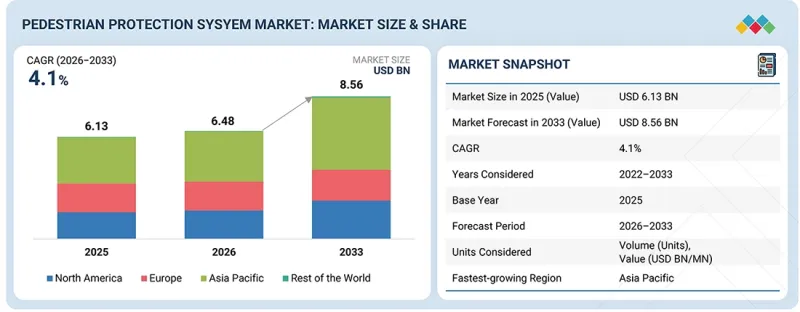
The pedestrian protection system market is projected to reach USD 8.56 billion by 2033, from USD 6.48 billion in 2026, with a CAGR of 4.1%. The market is experiencing steady growth as OEMs increasingly incorporate advanced safety technologies to improve pedestrian safety and comply with evolving regulatory standards.
| Scope of the Report | |
|---|---|
| Years Considered for the Study | 2026-2035 |
| Base Year | 2025 |
| Forecast Period | 2026-2035 |
| Units Considered | USD Billion |
| Segments | Technology, Component, Vehicle Type, EV Type, and Region |
| Regions covered | Asia Pacific, North America, Europe, Rest of the World |
The adoption of ADAS features like automatic emergency braking and pedestrian detection is expanding system deployment across various vehicle segments. Technologies such as 77 GHz radar sensors, forward-facing camera modules, imaging radar, and sensor fusion platforms are enhancing detection accuracy and response times. Growing production of passenger and commercial vehicles is driving the demand for reliable and scalable safety solutions. Ongoing advances in sensors, actuators, and control units are boosting system performance.
"Ultrasonic sensors are the largest segment by component."
Ultrasonic sensors hold the largest share in the pedestrian protection system market, usually making up over 35% of total sensor demand, primarily due to their role in short-range detection. These sensors emit sound wave pulses to identify nearby objects and measure distance, ensuring reliable performance in low-speed and close-proximity situations like urban driving and parking. Their ability to detect pedestrians in blind spots and near the vehicle's edges supports features such as parking assistance, obstacle detection, and low-speed automatic braking. With over 70% of new passenger cars worldwide incorporating parking assist features, the demand for ultrasonic sensors remains strong. Industry leaders like Bosch, Denso, and Valeo are enhancing capabilities through better signal processing and more compact designs.
"Passenger cars lead the market by vehicle type."
Passenger cars dominate the pedestrian protection system market due to high global production and widespread safety technology adoption. Growth is fueled by the broad deployment of pedestrian detection, automatic emergency braking, and sensor-based systems that use radar, cameras, and ultrasonic sensors. Increasing urban traffic and greater pedestrian exposure are driving the need for precise detection and impact mitigation solutions. Regulatory standards like Euro NCAP, UNECE GTR No. 9, Regulation No. 127, China NCAP, and Japan NCAP are encouraging OEMs such as Toyota, Volkswagen, Hyundai, Honda, and Ford to incorporate advanced pedestrian safety features. Ongoing advances in ADAS, sensor fusion, and AI-powered object recognition are further enhancing adoption.
"Stringent safety regulations and NCAP standards propel the market for pedestrian protection systems in Europe."
Europe is experiencing significant growth in the pedestrian protection system market, driven by strict regulations and ongoing enhancements in safety standards. Euro NCAP, UNECE R127, and the General Safety Regulation require higher performance for pedestrian impact protection and active safety systems. Automakers such as Volkswagen, BMW, Mercedes-Benz, and Stellantis are incorporating advanced features like automatic emergency braking and pedestrian detection across new models like the Volkswagen ID.7, BMW Neue Klasse platforms, Mercedes-Benz E-Class, and Peugeot e-3008. The region is also making progress in ADAS by improving AI-based object detection, which allows for more precise pedestrian recognition. Continuous regulatory pressure and rapid technological development are compelling OEMs to adopt fully integrated safety architectures.
Key players in the pedestrian protection system market include Robert Bosch GmbH (Germany), Aumovio, Denso Corporation (Japan), ZF Group (Germany), and Aptiv (Ireland).
In-depth interviews were conducted with CEOs, marketing directors, other innovation and technology directors, and executives from various key organizations operating in this market.
- By Company Type: ADAS and Active Safety System Providers - 50%, Automotive OEMs - 40%, Others - 10%
- By Designation: CXOs - 30%, Directors - 40%, Others - 30%
- By Country: Asia Pacific - 50%, Europe - 20%, North America - 20%, Rest of the World - 10%
Research Coverage:
This research report categorizes the pedestrian protection system market, in terms of technology [pyrotechnic (passive), mechatronic (active)], component [Active (camera, radar, LiDAR, ultrasonic, ECU), passive active hood lifter, hood lift actuator, ACU, sensor (pressure tube, acceleration)], vehicle type (passenger car, light commercial vehicle, heavy commercial vehicle), EV type (BEV, HEV, PHEV), and region (Asia Pacific, Europe, North America, Rest of the World). The scope of the report includes detailed information on major factors such as drivers, restraints, challenges, and opportunities that influence the market's growth. It also features a comprehensive analysis of key industry players to provide insights into their business overview, solutions, and recent developments related to the market.
Key Benefits of Buying the Report:
This report will assist market leaders and new entrants in this market by providing estimates of revenue figures for the pedestrian protection system market ecosystem and its subsegments. It will help stakeholders understand the competitive landscape and gain insights to better position their businesses and develop effective go-to-market strategies. Additionally, the report offers an understanding of the market's pulse by highlighting key market drivers, restraints, challenges, and opportunities.
The report provides insight into the following pointers:
- Analysis of key drivers (Rising pedestrian fatalities and road safety concerns, Rapid integration of ADAS with pedestrian detection capability), restraints (EV structural rigidity limits passive pedestrian protection, High complexity in integrating and validating active hood and external airbag systems), opportunities (Expansion of Pedestrian Automatic Emergency Braking across vehicle segments, AI based pedestrian intent prediction technologies) and challenges (Predicting pedestrian behaviour and sudden road crossing events, Lack of Regulatory Harmonization in Pedestrian Protection Testing Increasing Cost and Complexity)
- Product Development/Innovation: Detailed insights into upcoming technologies, R&D activities, and product launches in the pedestrian protection system market
- Market Development: Comprehensive information about lucrative markets; the report analyzes the pedestrian protection system market across varied regions
- Market Diversification: Exhaustive information about new products, untapped geographies, recent developments, and investments in the pedestrian protection system market
- Competitive Assessment: In-depth assessment of market ranking, growth strategies, and service offerings of leading players like Robert Bosch GmbH (Germany), Aumovio (Germany), Denso Corporation (Japan), ZF Group (Germany), and Aptiv (Ireland)
TABLE OF CONTENTS
1 INTRODUCTION
- 1.1 STUDY OBJECTIVES
- 1.2 MARKET DEFINITION
- 1.3 STUDY SCOPE
- 1.3.1 MARKET SEGMENTATION AND REGIONAL SCOPE
- 1.3.2 INCLUSIONS AND EXCLUSIONS
- 1.3.3 YEARS CONSIDERED
- 1.4 CURRENCY CONSIDERED
- 1.5 UNIT CONSIDERED
- 1.6 STAKEHOLDERS
2 EXECUTIVE SUMMARY
- 2.1 MARKET HIGHLIGHTS AND KEY INSIGHTS
- 2.2 KEY MARKET PARTICIPANTS: MAPPING OF STRATEGIC DEVELOPMENTS
- 2.3 DISRUPTIVE TRENDS IN PEDESTRIAN PROTECTION SYSTEM MARKET
- 2.4 HIGH-GROWTH SEGMENTS
- 2.5 REGIONAL SNAPSHOT: MARKET SIZE, GROWTH RATE, AND FORECAST
3 PREMIUM INSIGHTS
- 3.1 ATTRACTIVE OPPORTUNITIES FOR PLAYERS IN PEDESTRIAN PROTECTION SYSTEM MARKET
- 3.2 PEDESTRIAN PROTECTION SYSTEM MARKET, BY COMPONENT
- 3.3 PEDESTRIAN PROTECTION SYSTEM MARKET, BY VEHICLE TYPE
- 3.4 PEDESTRIAN PROTECTION SYSTEM MARKET, BY EV TYPE
- 3.5 PEDESTRIAN PROTECTION SYSTEM MARKET, BY REGION
4 MARKET OVERVIEW
- 4.1 INTRODUCTION
- 4.2 MARKET DYNAMICS
- 4.2.1 DRIVERS
- 4.2.1.1 Rising pedestrian fatalities and road safety concerns
- 4.2.1.2 Rapid integration of ADAS with pedestrian detection capabilities
- 4.2.2 RESTRAINTS
- 4.2.2.1 Limited adoption of passive pedestrian protection systems due to packaging constraints in EVs
- 4.2.2.2 Complexity in integrating and validating active hood and external airbag systems
- 4.2.3 OPPORTUNITIES
- 4.2.3.1 Expansion of pedestrian automatic emergency braking across vehicle segments
- 4.2.3.2 Rise of AI-based pedestrian intent prediction technologies
- 4.2.4 CHALLENGES
- 4.2.4.1 Unpredictable pedestrian behavior
- 4.2.4.2 High development cost and engineering complexity due to lack of regulatory harmonization
- 4.2.1 DRIVERS
- 4.3 UNMET NEEDS AND WHITE SPACES
- 4.4 STRATEGIC MOVES BY TIER-1/2/3 PLAYERS
5 INDUSTRY TRENDS
- 5.1 MACROECONOMIC INDICATORS
- 5.1.1 GDP TRENDS AND FORECAST
- 5.1.2 TRENDS IN GLOBAL ADAS INDUSTRY
- 5.1.3 TRENDS IN GLOBAL AUTOMOTIVE SAFETY SYSTEM INDUSTRY
- 5.2 ECOSYSTEM ANALYSIS
- 5.2.1 RAW MATERIAL SUPPLIERS
- 5.2.2 SENSOR AND SEMICONDUCTOR SUPPLIERS
- 5.2.3 ADAS TECHNOLOGY PROVIDERS
- 5.2.4 SAFETY SYSTEM MANUFACTURERS
- 5.2.5 AUTOMOTIVE OEMS
- 5.2.6 SOFTWARE AND CONNECTIVITY PROVIDERS
- 5.3 VALUE CHAIN ANALYSIS
- 5.4 PRICING ANALYSIS
- 5.4.1 AVERAGE SELLING PRICE TREND, BY REGION, 2022-2025
- 5.4.2 AVERAGE SELLING PRICE TREND, BY VEHICLE TYPE, 2022-2025
- 5.5 TRENDS/DISRUPTIONS IMPACTING CUSTOMER BUSINESS
- 5.6 INVESTMENT AND FUNDING SCENARIO
- 5.7 TRADE ANALYSIS
- 5.7.1 IMPORT SCENARIO (HS CODE 900211)
- 5.7.2 EXPORT SCENARIO (HS CODE 900211)
- 5.8 KEY CONFERENCES AND EVENTS, 2026-2027
- 5.9 CASE STUDY ANALYSIS
- 5.9.1 BOSCH DEVELOPS CAMERA- AND RADAR-BASED PEDESTRIAN AUTOMATIC EMERGENCY BRAKING
- 5.9.2 CONTINENTAL IMPLEMENTS SENSOR FUSION PLATFORM FOR PEDESTRIAN DETECTION
- 5.9.3 MOBILEYE DEVELOPS AI-BASED VISION SYSTEM FOR PEDESTRIAN COLLISION AVOIDANCE
- 5.9.4 AUTOLIV CREATES PEDESTRIAN AIRBAG SYSTEM FOR PASSIVE PEDESTRIAN PROTECTION
- 5.9.5 ZF INTRODUCES ADVANCED DRIVER ASSISTANCE PLATFORM WITH PEDESTRIAN DETECTION
- 5.9.6 VALEO IMPLEMENTS ADVANCED SENSING TECHNOLOGIES FOR PEDESTRIAN DETECTION
- 5.10 TECHNICAL IMPLEMENTATION ANALYSIS
- 5.10.1 PEDESTRIAN PROTECTION SYSTEM ARCHITECTURE
- 5.10.2 DETECTION TECHNOLOGY
- 5.10.3 ACTUATION MECHANISM
- 5.10.4 ELECTRONIC CONTROL ARCHITECTURE
- 5.10.5 INTEGRATION WITH ADAS ECOSYSTEM
- 5.10.6 FUNCTIONAL SAFETY FRAMEWORK
- 5.10.7 TESTING AND VALIDATION
- 5.10.8 FAILURE MODE AND RISK ANALYSIS
- 5.11 INSIGHTS ON SUPPLIER STRATEGIES FOR PEDESTRIAN PROTECTION SYSTEMS
- 5.12 INSIGHTS ON OEM STRATEGIES FOR PEDESTRIAN PROTECTION SYSTEMS
- 5.13 EU-INDIA FTA ANALYSIS
6 TECHNOLOGICAL ADVANCEMENTS, AI-DRIVEN IMPACT, PATENTS, AND INNOVATIONS
- 6.1 KEY TECHNOLOGIES
- 6.1.1 AI-BASED PEDESTRIAN DETECTION
- 6.1.2 VISION-BASED PEDESTRIAN RECOGNITION
- 6.1.3 PEDESTRIAN AUTOMATIC EMERGENCY BRAKING
- 6.1.4 ZONAL AND DOMAIN ECU ARCHITECTURE
- 6.1.5 DIGITAL TWIN AND CRASH SIMULATION
- 6.1.6 V2X COMMUNICATION
- 6.1.7 ACTIVE HOOD LIFT
- 6.2 COMPLEMENTARY TECHNOLOGIES
- 6.2.1 DRIVE-BY-WIRE AND BRAKE-BY-WIRE
- 6.2.2 ACTIVE SUSPENSION AND RIDE HEIGHT CONTROL
- 6.2.3 LIGHTWEIGHT FRONT-END MATERIAL
- 6.2.4 EXTERNAL PEDESTRIAN PROTECTION AIRBAG
- 6.3 TECHNOLOGY/PRODUCT ROADMAP
- 6.3.1 SHORT-TERM (2025-2027): FOUNDATION AND EARLY COMMERCIALIZATION
- 6.3.2 MID-TERM (2027-2030): EXPANSION AND STANDARDIZATION
- 6.3.3 LONG-TERM (2030-2033+): MASS COMMERCIALIZATION AND DISRUPTION
- 6.4 PATENT ANALYSIS
7 REGULATORY LANDSCAPE AND SUSTAINABILITY INITIATIVES
- 7.1 REGIONAL REGULATIONS AND COMPLIANCE
- 7.1.1 REGULATORY BODIES, GOVERNMENT AGENCIES, AND OTHER ORGANIZATIONS
- 7.1.2 INDUSTRY STANDARDS
- 7.2 SUSTAINABILITY INITIATIVES
- 7.3 IMPACT OF REGULATORY POLICIES ON SUSTAINABILITY INITIATIVES
8 CUSTOMER LANDSCAPE AND BUYER BEHAVIOR
- 8.1 DECISION-MAKING PROCESS
- 8.2 KEY STAKEHOLDERS IN BUYING PROCESS AND THEIR EVALUATION CRITERIA
- 8.2.1 KEY STAKEHOLDERS INVOLVED IN BUYING PROCESS
- 8.2.2 BUYING CRITERIA
- 8.3 ADOPTION BARRIERS AND INTERNAL CHALLENGES
9 PEDESTRIAN PROTECTION SYSTEM MARKET, BY TECHNOLOGY
- 9.1 INTRODUCTION
- 9.2 PYROTECHNIC (PASSIVE)
- 9.3 MECHATRONIC (ACTIVE)
10 PEDESTRIAN PROTECTION SYSTEM MARKET, BY COMPONENT
- 10.1 INTRODUCTION
- 10.2 ACTIVE
- 10.2.1 CAMERA
- 10.2.1.1 Expansion of vision-led ADAS architectures to drive market
- 10.2.2 RADAR
- 10.2.2.1 Safety standards emphasizing consistent all-weather performance to drive market
- 10.2.3 LIDAR
- 10.2.3.1 Declining sensor costs and increasing integration with sensor fusion systems to drive market
- 10.2.4 ULTRASONIC
- 10.2.4.1 Cost efficiency and suitability for short-range detection to drive market
- 10.2.5 ECU
- 10.2.5.1 Transition toward centralized and software-defined architectures to drive market
- 10.2.1 CAMERA
- 10.3 PASSIVE
- 10.3.1 ACTIVE HOOD LIFTER
- 10.3.2 HOOD LIFT ACTUATOR
- 10.3.3 ACU
- 10.3.4 SENSOR
11 PEDESTRIAN PROTECTION SYSTEM MARKET, BY VEHICLE TYPE
- 11.1 INTRODUCTION
- 11.2 PASSENGER CAR
- 11.2.1 INCREASING INTEGRATION OF ADAS AND SOFTWARE-DRIVEN SAFETY ARCHITECTURES TO DRIVE MARKET
- 11.3 LIGHT COMMERCIAL VEHICLE
- 11.3.1 GROWING RELIANCE ON ELECTRONIC CONTROL UNITS AND TELEMATICS FOR URBAN MOBILITY TO DRIVE MARKET
- 11.4 HEAVY COMMERCIAL VEHICLE
- 11.4.1 RISING REGULATORY FOCUS ON URBAN SAFETY TO DRIVE MARKET
12 PEDESTRIAN PROTECTION SYSTEM MARKET, EV TYPE
- 12.1 INTRODUCTION
- 12.2 BEV
- 12.2.1 RAPID ELECTRIFICATION AND NEED FOR LIGHTWEIGHT, ENERGY-EFFICIENT SAFETY SYSTEMS TO DRIVE MARKET
- 12.3 HEV
- 12.3.1 SURGE IN DEMAND FOR FLEXIBLE SAFETY SOLUTIONS TO DRIVE MARKET
- 12.4 PHEV
- 12.4.1 FOCUS ON OPTIMIZING SYSTEM COORDINATION AND CALIBRATION FOR RELIABLE PEDESTRIAN DETECTION TO DRIVE MARKET
13 PEDESTRIAN PROTECTION SYSTEM MARKET, BY REGION
- 13.1 INTRODUCTION
- 13.2 ASIA PACIFIC
- 13.2.1 CHINA
- 13.2.1.1 Strict regulatory enforcement and rapid technology deployment to drive market
- 13.2.2 JAPAN
- 13.2.2.1 Technology-led innovation and OEM-driven development to drive market
- 13.2.3 INDIA
- 13.2.3.1 Increasing localization of safety technologies to drive market
- 13.2.4 SOUTH KOREA
- 13.2.4.1 Robust vehicle safety standards to drive market
- 13.2.5 REST OF ASIA PACIFIC
- 13.2.1 CHINA
- 13.3 EUROPE
- 13.3.1 GERMANY
- 13.3.1.1 Advanced engineering and premium vehicle positioning to drive market
- 13.3.2 FRANCE
- 13.3.2.1 EU regulation alignment and sensor innovation to drive market
- 13.3.3 SPAIN
- 13.3.3.1 Increasing OEM focus on cost-efficient product development to drive market
- 13.3.4 UK
- 13.3.4.1 Software-led ADAS development to drive market
- 13.3.5 REST OF EUROPE
- 13.3.1 GERMANY
- 13.4 NORTH AMERICA
- 13.4.1 US
- 13.4.1.1 Continuous OEM-led innovations to drive market
- 13.4.2 MEXICO
- 13.4.2.1 Platform standardization and alignment with North American safety expectations to drive market
- 13.4.3 CANADA
- 13.4.3.1 Focus on environment-specific safety innovation to drive market
- 13.4.1 US
- 13.5 REST OF THE WORLD
- 13.5.1 BRAZIL
- 13.5.1.1 High volume ADAS integration across compact and mid-segment vehicles to drive market
- 13.5.2 SOUTH AFRICA
- 13.5.2.1 Prevalence of informal transport systems and unstructured pedestrian movement to drive market
- 13.5.1 BRAZIL
14 COMPETITIVE LANDSCAPE
- 14.1 OVERVIEW
- 14.2 KEY PLAYER STRATEGIES/RIGHT TO WIN, 2023-2026
- 14.3 MARKET SHARE ANALYSIS, 2025
- 14.4 REVENUE ANALYSIS, 2021-2025
- 14.5 COMPANY VALUATION AND FINANCIAL METRICS
- 14.6 BRAND/PRODUCT COMPARISON
- 14.7 COMPANY EVALUATION MATRIX: KEY PLAYERS, 2025
- 14.7.1 STARS
- 14.7.2 EMERGING LEADERS
- 14.7.3 PERVASIVE PLAYERS
- 14.7.4 PARTICIPANTS
- 14.7.5 COMPANY FOOTPRINT
- 14.7.5.1 Company footprint
- 14.7.5.2 Region footprint
- 14.7.5.3 Technology footprint
- 14.7.5.4 Vehicle type footprint
- 14.8 COMPANY EVALUATION MATRIX: START-UPS/SMES, 2025
- 14.8.1 PROGRESSIVE COMPANIES
- 14.8.2 RESPONSIVE COMPANIES
- 14.8.3 DYNAMIC COMPANIES
- 14.8.4 STARTING BLOCKS
- 14.8.5 COMPETITIVE BENCHMARKING
- 14.8.5.1 List of start-ups/SMEs
- 14.8.5.2 Competitive benchmarking of start-ups/SMEs
- 14.9 COMPETITIVE SCENARIO
- 14.9.1 DEALS
- 14.9.2 EXPANSIONS
- 14.9.3 OTHER DEVELOPMENTS
15 COMPANY PROFILES
- 15.1 KEY PLAYERS
- 15.1.1 ROBERT BOSCH GMBH
- 15.1.1.1 Business overview
- 15.1.1.2 Products offered
- 15.1.1.3 Recent developments
- 15.1.1.3.1 Deals
- 15.1.1.3.2 Expansions
- 15.1.1.3.3 Other developments
- 15.1.1.4 MnM view
- 15.1.1.4.1 Key strengths
- 15.1.1.4.2 Strategic choices
- 15.1.1.4.3 Weaknesses and competitive threats
- 15.1.2 AUMOVIO SE
- 15.1.2.1 Business overview
- 15.1.2.2 Products offered
- 15.1.2.3 Recent developments
- 15.1.2.3.1 Deals
- 15.1.2.3.2 Expansions
- 15.1.2.3.3 Other developments
- 15.1.2.4 MnM view
- 15.1.2.4.1 Key strengths
- 15.1.2.4.2 Strategic choices
- 15.1.2.4.3 Weaknesses and competitive threats
- 15.1.3 DENSO CORPORATION
- 15.1.3.1 Business overview
- 15.1.3.2 Products offered
- 15.1.3.3 Recent developments
- 15.1.3.3.1 Deals
- 15.1.3.3.2 Expansions
- 15.1.3.3.3 Other developments
- 15.1.3.4 MnM view
- 15.1.3.4.1 Key strengths
- 15.1.3.4.2 Strategic choices
- 15.1.3.4.3 Weaknesses and competitive threats
- 15.1.4 ZF FRIEDRICHSHAFEN AG
- 15.1.4.1 Business overview
- 15.1.4.2 Products offered
- 15.1.4.3 Recent developments
- 15.1.4.3.1 Deals
- 15.1.4.3.2 Expansions
- 15.1.4.3.3 Other developments
- 15.1.4.4 MnM view
- 15.1.4.4.1 Key strengths
- 15.1.4.4.2 Strategic choices
- 15.1.4.4.3 Weaknesses and competitive threats
- 15.1.5 APTIV
- 15.1.5.1 Business overview
- 15.1.5.2 Products offered
- 15.1.5.3 Recent developments
- 15.1.5.3.1 Deals
- 15.1.5.3.2 Other developments
- 15.1.5.4 MnM view
- 15.1.5.4.1 Key strengths
- 15.1.5.4.2 Strategic choices
- 15.1.5.4.3 Weaknesses and competitive threats
- 15.1.6 VALEO
- 15.1.6.1 Business overview
- 15.1.6.2 Products offered
- 15.1.6.3 Recent developments
- 15.1.6.3.1 Deals
- 15.1.6.3.2 Expansions
- 15.1.6.3.3 Other developments
- 15.1.7 MOBILEYE
- 15.1.7.1 Business overview
- 15.1.7.2 Products offered
- 15.1.7.3 Recent developments
- 15.1.7.3.1 Deals
- 15.1.7.3.2 Other developments
- 15.1.8 HYUNDAI MOBIS
- 15.1.8.1 Business overview
- 15.1.8.2 Products offered
- 15.1.8.3 Recent developments
- 15.1.8.3.1 Deals
- 15.1.8.3.2 Expansions
- 15.1.8.3.3 Other developments
- 15.1.9 MAGNA INTERNATIONAL INC.
- 15.1.9.1 Business overview
- 15.1.9.2 Products offered
- 15.1.9.3 Recent developments
- 15.1.9.3.1 Deals
- 15.1.9.3.2 Other developments
- 15.1.10 HITACHI ASTEMO
- 15.1.10.1 Business overview
- 15.1.10.2 Products offered
- 15.1.10.3 Recent developments
- 15.1.10.3.1 Deals
- 15.1.10.3.2 Other developments
- 15.1.11 AUTOLIV
- 15.1.11.1 Business overview
- 15.1.11.2 Products offered
- 15.1.11.3 Recent developments
- 15.1.11.3.1 Deals
- 15.1.11.3.2 Expansions
- 15.1.11.3.3 Other developments
- 15.1.12 JOYSON SAFTEY SYSTEMS
- 15.1.12.1 Business overview
- 15.1.12.2 Products offered
- 15.1.12.3 Recent developments
- 15.1.12.3.1 Deals
- 15.1.12.3.2 Other developments
- 15.1.1 ROBERT BOSCH GMBH
- 15.2 OTHER PLAYERS
- 15.2.1 NXP SEMICONDUCTORS
- 15.2.2 TEXAS INSTRUMENTS
- 15.2.3 ONSEMI
- 15.2.4 INFINEON TECHNOLOGIES AG
- 15.2.5 HELLA GMBH & CO. KGAA
- 15.2.6 ITERIS, INC.
- 15.2.7 ARBE ROBOTICS LTD.
- 15.2.8 INNOVIZ TECHNOLOGIES LTD.
- 15.2.9 LUMINAR TECHNOLOGIES, INC.
- 15.2.10 TRIEYE
- 15.2.11 CEPTON
- 15.2.12 STRADVISION
- 15.2.13 AMBARELLA, INC.
16 RESEARCH METHODOLOGY
- 16.1 RESEARCH DATA
- 16.1.1 SECONDARY DATA
- 16.1.1.1 Secondary sources
- 16.1.1.2 Key data from secondary sources
- 16.1.2 PRIMARY DATA
- 16.1.2.1 Breakdown of primary interviews
- 16.1.2.2 Primary participants
- 16.1.2.3 Insights from industry experts
- 16.1.1 SECONDARY DATA
- 16.2 MARKET SIZE ESTIMATION
- 16.2.1 BOTTOM-UP APPROACH
- 16.3 DATA TRIANGULATION
- 16.4 FACTOR ANALYSIS
- 16.5 RESEARCH ASSUMPTIONS
- 16.6 RESEARCH LIMITATIONS
- 16.7 RISK ASSESSMENT
17 APPENDIX
- 17.1 INSIGHTS FROM INDUSTRY EXPERTS
- 17.2 DISCUSSION GUIDE
- 17.3 KNOWLEDGESTORE: MARKETSANDMARKETS' SUBSCRIPTION PORTAL
- 17.4 CUSTOMIZATION OPTIONS
- 17.4.1 PEDESTRIAN PROTECTION SYSTEM MARKET, BY LEVEL OF AUTONOMY, AT REGIONAL LEVEL
- 17.4.2 COMPANY INFORMATION
- 17.4.2.1 Profiling of five additional market players
- 17.5 RELATED REPORTS
- 17.6 AUTHOR DETAILS
List of Tables
- TABLE 1 USD EXCHANGE RATES, 2021-2026
- TABLE 2 PEDESTRIAN PROTECTION SAFETY PROGRAMS
- TABLE 3 VEHICLES EQUIPPED WITH PEDESTRIAN PROTECTION SYSTEMS
- TABLE 4 OEM ADOPTION OF PEDESTRIAN AUTOMATIC EMERGENCY BRAKING
- TABLE 5 AI-BASED PEDESTRIAN INTENT PREDICTION TECHNOLOGIES
- TABLE 6 UNPREDICTABLE PEDESTRIAN BEHAVIORS
- TABLE 7 PEDESTRIAN PROTECTION TESTING REGULATIONS AND PROTOCOLS
- TABLE 8 STRATEGIC MOVES BY TIER-1/2/3 PLAYERS
- TABLE 9 GDP PERCENTAGE CHANGE, BY COUNTRY, 2021-2030
- TABLE 10 ROLE OF COMPANIES IN ECOSYSTEM
- TABLE 11 AVERAGE SELLING PRICE TREND, BY REGION, 2022-2025 (USD)
- TABLE 12 AVERAGE SELLING PRICE TREND, BY VEHICLE TYPE, 2022-2025 (USD)
- TABLE 13 IMPORT DATA FOR HS CODE 900211-COMPLIANT PRODUCTS, BY COUNTRY, 2021-2025 (USD MILLION)
- TABLE 14 EXPORT DATA FOR HS CODE 900211-COMPLIANT PRODUCTS, BY COUNTRY, 2021-2025 (USD MILLION)
- TABLE 15 KEY CONFERENCES AND EVENTS, 2026-2027
- TABLE 16 SUPPLIER STRATEGY BENCHMARKING FOR PEDESTRIAN PROTECTION SYSTEMS
- TABLE 17 OEM STRATEGY BENCHMARKING FOR PEDESTRIAN PROTECTION SYSTEMS
- TABLE 18 REGULATORY MANDATES FOR PEDESTRIAN AUTOMATIC EMERGENCY BRAKING
- TABLE 19 PATENT ANALYSIS
- TABLE 20 NORTH AMERICA: REGULATORY BODIES, GOVERNMENT AGENCIES, AND OTHER ORGANIZATIONS
- TABLE 21 EUROPE: REGULATORY BODIES, GOVERNMENT AGENCIES, AND OTHER ORGANIZATIONS
- TABLE 22 ASIA PACIFIC: REGULATORY BODIES, GOVERNMENT AGENCIES, AND OTHER ORGANIZATIONS
- TABLE 23 GLOBAL INDUSTRY STANDARDS
- TABLE 24 NORTH AMERICAN INDUSTRY STANDARDS
- TABLE 25 EUROPEAN INDUSTRY STANDARDS
- TABLE 26 ASIA PACIFIC INDUSTRY STANDARDS
- TABLE 27 IMPACT OF REGULATORY POLICIES ON SUSTAINABILITY INITIATIVES
- TABLE 28 INFLUENCE OF STAKEHOLDERS ON BUYING PROCESS, BY VEHICLE TYPE
- TABLE 29 KEY BUYING CRITERIA, BY VEHICLE TYPE
- TABLE 30 MECHATRONIC (ACTIVE) PEDESTRIAN PROTECTION SYSTEM MARKET, BY REGION, 2022-2025 (THOUSAND UNITS)
- TABLE 31 MECHATRONIC (ACTIVE) PEDESTRIAN PROTECTION SYSTEM MARKET, BY REGION, 2026-2033 (THOUSAND UNITS)
- TABLE 32 MECHATRONIC (ACTIVE) PEDESTRIAN PROTECTION SYSTEM MARKET, BY REGION, 2022-2025 (USD MILLION)
- TABLE 33 MECHATRONIC (ACTIVE) PEDESTRIAN PROTECTION SYSTEM MARKET, BY REGION, 2026-2033 (USD MILLION)
- TABLE 34 SALES OF TESLA MODELS EQUIPPED WITH PASSIVE PEDESTRIAN PROTECTION SYSTEMS IN EUROPE, 2023-2025
- TABLE 35 PEDESTRIAN PROTECTION SYSTEM MARKET, BY COMPONENT, 2022-2025 (THOUSAND UNITS)
- TABLE 36 PEDESTRIAN PROTECTION SYSTEM MARKET, BY COMPONENT, 2026-2033 (THOUSAND UNITS)
- TABLE 37 CAMERA: PEDESTRIAN PROTECTION SYSTEM MARKET, BY REGION, 2022-2025 (THOUSAND UNITS)
- TABLE 38 CAMERA: PEDESTRIAN PROTECTION SYSTEM MARKET, BY REGION, 2026-2033 (THOUSAND UNITS)
- TABLE 39 RADAR: PEDESTRIAN PROTECTION SYSTEM MARKET, BY REGION, 2022-2025 (THOUSAND UNITS)
- TABLE 40 RADAR: PEDESTRIAN PROTECTION SYSTEM MARKET, BY REGION, 2026-2033 (THOUSAND UNITS)
- TABLE 41 LIDAR: PEDESTRIAN PROTECTION SYSTEM MARKET, BY REGION, 2026-2033 (THOUSAND UNITS)
- TABLE 42 ULTRASONIC: PEDESTRIAN PROTECTION SYSTEM MARKET, BY REGION, 2022-2025 (THOUSAND UNITS)
- TABLE 43 ULTRASONIC: PEDESTRIAN PROTECTION SYSTEM MARKET, BY REGION, 2026-2033 (THOUSAND UNITS)
- TABLE 44 ECU: PEDESTRIAN PROTECTION SYSTEM MARKET, BY REGION, 2022-2025 (THOUSAND UNITS)
- TABLE 45 ECU: PEDESTRIAN PROTECTION SYSTEM MARKET, BY REGION, 2026-2033 (THOUSAND UNITS)
- TABLE 46 PEDESTRIAN PROTECTION SYSTEM MARKET, BY VEHICLE TYPE, 2022-2025 (THOUSAND UNITS)
- TABLE 47 PEDESTRIAN PROTECTION SYSTEM MARKET, BY VEHICLE TYPE, 2026-2033 (THOUSAND UNITS)
- TABLE 48 PEDESTRIAN PROTECTION SYSTEM MARKET, BY VEHICLE TYPE, 2022-2025 (USD MILLION)
- TABLE 49 PEDESTRIAN PROTECTION SYSTEM MARKET, BY VEHICLE TYPE, 2026-2033 (USD MILLION)
- TABLE 50 PASSENGER CAR: PEDESTRIAN PROTECTION SYSTEM MARKET, BY REGION, 2022-2025 (THOUSAND UNITS)
- TABLE 51 PASSENGER CAR: PEDESTRIAN PROTECTION SYSTEM MARKET, BY REGION, 2026-2033 (THOUSAND UNITS)
- TABLE 52 PASSENGER CAR: PEDESTRIAN PROTECTION SYSTEM MARKET, BY REGION, 2022-2025 (USD MILLION)
- TABLE 53 PASSENGER CAR: PEDESTRIAN PROTECTION SYSTEM MARKET, BY REGION, 2026-2033 (USD MILLION)
- TABLE 54 LIGHT COMMERCIAL VEHICLE: PEDESTRIAN PROTECTION SYSTEM MARKET, BY REGION, 2022-2025 (THOUSAND UNITS)
- TABLE 55 LIGHT COMMERCIAL VEHICLE: PEDESTRIAN PROTECTION SYSTEM MARKET, BY REGION, 2026-2033 (THOUSAND UNITS)
- TABLE 56 LIGHT COMMERCIAL VEHICLE: PEDESTRIAN PROTECTION SYSTEM MARKET, BY REGION, 2022-2025 (USD MILLION)
- TABLE 57 LIGHT COMMERCIAL VEHICLE: PEDESTRIAN PROTECTION SYSTEM MARKET, BY REGION, 2026-2033 (USD MILLION)
- TABLE 58 HEAVY COMMERCIAL VEHICLE: PEDESTRIAN PROTECTION SYSTEM MARKET, BY REGION, 2022-2025 (THOUSAND UNITS)
- TABLE 59 HEAVY COMMERCIAL VEHICLE: PEDESTRIAN PROTECTION SYSTEM MARKET, BY REGION, 2026-2033 (THOUSAND UNITS)
- TABLE 60 HEAVY COMMERCIAL VEHICLE: PEDESTRIAN PROTECTION SYSTEM MARKET, BY REGION, 2022-2025 (USD MILLION)
- TABLE 61 HEAVY COMMERCIAL VEHICLE: PEDESTRIAN PROTECTION SYSTEM MARKET, BY REGION, 2026-2033 (USD MILLION)
- TABLE 62 PEDESTRIAN PROTECTION SYSTEM MARKET, BY EV TYPE, 2022-2025 (THOUSAND UNITS)
- TABLE 63 PEDESTRIAN PROTECTION SYSTEM MARKET, BY EV TYPE, 2026-2033 (THOUSAND UNITS)
- TABLE 64 PEDESTRIAN PROTECTION SYSTEM MARKET, BY EV TYPE, 2022-2025 (USD MILLION)
- TABLE 65 PEDESTRIAN PROTECTION SYSTEM MARKET, BY EV TYPE, 2026-2033 (USD MILLION)
- TABLE 66 PEDESTRIAN PROTECTION SYSTEM MARKET, BY REGION, 2022-2025 (THOUSAND UNITS)
- TABLE 67 PEDESTRIAN PROTECTION SYSTEM MARKET, BY REGION, 2026-2033 (THOUSAND UNITS)
- TABLE 68 PEDESTRIAN PROTECTION SYSTEM MARKET, BY REGION, 2022-2025 (USD MILLION)
- TABLE 69 PEDESTRIAN PROTECTION SYSTEM MARKET, BY REGION, 2026-2033 (USD MILLION)
- TABLE 70 ASIA PACIFIC: PEDESTRIAN PROTECTION SYSTEM MARKET, BY COUNTRY, 2022-2025 (THOUSAND UNITS)
- TABLE 71 ASIA PACIFIC: PEDESTRIAN PROTECTION SYSTEM MARKET, BY COUNTRY, 2026-2033 (THOUSAND UNITS)
- TABLE 72 ASIA PACIFIC: PEDESTRIAN PROTECTION SYSTEM MARKET, BY COUNTRY, 2022-2025 (USD MILLION)
- TABLE 73 ASIA PACIFIC: PEDESTRIAN PROTECTION SYSTEM MARKET, BY COUNTRY, 2026-2033 (USD MILLION)
- TABLE 74 CHINA: PEDESTRIAN PROTECTION SYSTEM MARKET, BY VEHICLE TYPE, 2022-2025 (THOUSAND UNITS)
- TABLE 75 CHINA: PEDESTRIAN PROTECTION SYSTEM MARKET, BY VEHICLE TYPE, 2026-2033 (THOUSAND UNITS)
- TABLE 76 CHINA: PEDESTRIAN PROTECTION SYSTEM MARKET, BY VEHICLE TYPE, 2022-2025 (USD MILLION)
- TABLE 77 CHINA: PEDESTRIAN PROTECTION SYSTEM MARKET, BY VEHICLE TYPE, 2026-2033 (USD MILLION)
- TABLE 78 JAPAN: PEDESTRIAN PROTECTION SYSTEM MARKET, BY VEHICLE TYPE, 2022-2025 (THOUSAND UNITS)
- TABLE 79 JAPAN: PEDESTRIAN PROTECTION SYSTEM MARKET, BY VEHICLE TYPE, 2026-2033 (THOUSAND UNITS)
- TABLE 80 JAPAN: PEDESTRIAN PROTECTION SYSTEM MARKET, BY VEHICLE TYPE, 2022-2025 (USD MILLION)
- TABLE 81 JAPAN: PEDESTRIAN PROTECTION SYSTEM MARKET, BY VEHICLE TYPE, 2026-2033 (USD MILLION)
- TABLE 82 INDIA: PEDESTRIAN PROTECTION SYSTEM MARKET, BY VEHICLE TYPE, 2022-2025 (UNITS)
- TABLE 83 INDIA: PEDESTRIAN PROTECTION SYSTEM MARKET, BY VEHICLE TYPE, 2026-2033 (UNITS)
- TABLE 84 INDIA: PEDESTRIAN PROTECTION SYSTEM MARKET, BY VEHICLE TYPE, 2022-2025 (USD MILLION)
- TABLE 85 INDIA: PEDESTRIAN PROTECTION SYSTEM MARKET, BY VEHICLE TYPE, 2026-2033 (USD MILLION)
- TABLE 86 SOUTH KOREA: PEDESTRIAN PROTECTION SYSTEM MARKET, BY VEHICLE TYPE, 2022-2025 (THOUSAND UNITS)
- TABLE 87 SOUTH KOREA: PEDESTRIAN PROTECTION SYSTEM MARKET, BY VEHICLE TYPE, 2026-2033 (THOUSAND UNITS)
- TABLE 88 SOUTH KOREA: PEDESTRIAN PROTECTION SYSTEM MARKET, BY VEHICLE TYPE, 2022-2025 (USD MILLION)
- TABLE 89 SOUTH KOREA: PEDESTRIAN PROTECTION SYSTEM MARKET, BY VEHICLE TYPE, 2026-2033 (USD MILLION)
- TABLE 90 REST OF ASIA PACIFIC: PEDESTRIAN PROTECTION SYSTEM MARKET, BY VEHICLE TYPE, 2022-2025 (UNITS)
- TABLE 91 REST OF ASIA PACIFIC: PEDESTRIAN PROTECTION SYSTEM MARKET, BY VEHICLE TYPE, 2026-2033 (UNITS)
- TABLE 92 REST OF ASIA PACIFIC: PEDESTRIAN PROTECTION SYSTEM MARKET, BY VEHICLE TYPE, 2022-2025 (USD MILLION)
- TABLE 93 REST OF ASIA PACIFIC: PEDESTRIAN PROTECTION SYSTEM MARKET, BY VEHICLE TYPE, 2026-2033 (USD MILLION)
- TABLE 94 EUROPE: PEDESTRIAN PROTECTION SYSTEM MARKET, BY COUNTRY, 2022-2025 (THOUSAND UNITS)
- TABLE 95 EUROPE: PEDESTRIAN PROTECTION SYSTEM MARKET, BY COUNTRY, 2026-2033 (THOUSAND UNITS)
- TABLE 96 EUROPE: PEDESTRIAN PROTECTION SYSTEM MARKET, BY COUNTRY, 2022-2025 (USD MILLION)
- TABLE 97 EUROPE: PEDESTRIAN PROTECTION SYSTEM MARKET, BY COUNTRY, 2026-2033 (USD MILLION)
- TABLE 98 GERMANY: PEDESTRIAN PROTECTION SYSTEM MARKET, BY VEHICLE TYPE, 2022-2025 (THOUSAND UNITS)
- TABLE 99 GERMANY: PEDESTRIAN PROTECTION SYSTEM MARKET, BY VEHICLE TYPE, 2026-2033 (THOUSAND UNITS)
- TABLE 100 GERMANY: PEDESTRIAN PROTECTION SYSTEM MARKET, BY VEHICLE TYPE, 2022-2025 (USD MILLION)
- TABLE 101 GERMANY: PEDESTRIAN PROTECTION SYSTEM MARKET, BY VEHICLE TYPE, 2026-2033 (USD MILLION)
- TABLE 102 FRANCE: PEDESTRIAN PROTECTION SYSTEM MARKET, BY VEHICLE TYPE, 2022-2025 (THOUSAND UNITS)
- TABLE 103 FRANCE: PEDESTRIAN PROTECTION SYSTEM MARKET, BY VEHICLE TYPE, 2026-2033 (THOUSAND UNITS)
- TABLE 104 FRANCE: PEDESTRIAN PROTECTION SYSTEM MARKET, BY VEHICLE TYPE, 2022-2025 (USD MILLION)
- TABLE 105 FRANCE: PEDESTRIAN PROTECTION SYSTEM MARKET, BY VEHICLE TYPE, 2026-2033 (USD MILLION)
- TABLE 106 SPAIN: PEDESTRIAN PROTECTION SYSTEM MARKET, BY VEHICLE TYPE, 2022-2025 (THOUSAND UNITS)
- TABLE 107 SPAIN: PEDESTRIAN PROTECTION SYSTEM MARKET, BY VEHICLE TYPE, 2026-2033 (THOUSAND UNITS)
- TABLE 108 SPAIN: PEDESTRIAN PROTECTION SYSTEM MARKET, BY VEHICLE TYPE, 2022-2025 (USD MILLION)
- TABLE 109 SPAIN: PEDESTRIAN PROTECTION SYSTEM MARKET, BY VEHICLE TYPE, 2026-2033 (USD MILLION)
- TABLE 110 UK: PEDESTRIAN PROTECTION SYSTEM MARKET, BY VEHICLE TYPE, 2022-2025 (THOUSAND UNITS)
- TABLE 111 UK: PEDESTRIAN PROTECTION SYSTEM MARKET, BY VEHICLE TYPE, 2026-2033 (THOUSAND UNITS)
- TABLE 112 UK: PEDESTRIAN PROTECTION SYSTEM MARKET, BY VEHICLE TYPE, 2022-2025 (USD MILLION)
- TABLE 113 UK: PEDESTRIAN PROTECTION SYSTEM MARKET, BY VEHICLE TYPE, 2026-2033 (USD MILLION)
- TABLE 114 REST OF EUROPE: PEDESTRIAN PROTECTION SYSTEM MARKET, BY VEHICLE TYPE, 2022-2025 (THOUSAND UNITS)
- TABLE 115 REST OF EUROPE: PEDESTRIAN PROTECTION SYSTEM MARKET, BY VEHICLE TYPE, 2026-2033 (THOUSAND UNITS)
- TABLE 116 REST OF EUROPE: PEDESTRIAN PROTECTION SYSTEM MARKET, BY VEHICLE TYPE, 2022-2025 (USD MILLION)
- TABLE 117 REST OF EUROPE: PEDESTRIAN PROTECTION SYSTEM MARKET, BY VEHICLE TYPE, 2026-2033 (USD MILLION)
- TABLE 118 NORTH AMERICA: PEDESTRIAN PROTECTION SYSTEM MARKET, BY COUNTRY, 2022-2025 (THOUSAND UNITS)
- TABLE 119 NORTH AMERICA: PEDESTRIAN PROTECTION SYSTEM MARKET, BY COUNTRY, 2026-2033 (THOUSAND UNITS)
- TABLE 120 NORTH AMERICA: PEDESTRIAN PROTECTION SYSTEM MARKET, BY COUNTRY, 2022-2025 (USD MILLION)
- TABLE 121 NORTH AMERICA: PEDESTRIAN PROTECTION SYSTEM MARKET, BY COUNTRY, 2026-2033 (USD MILLION)
- TABLE 122 US: PEDESTRIAN PROTECTION SYSTEM MARKET, BY VEHICLE TYPE, 2022-2025 (THOUSAND UNITS)
- TABLE 123 US: PEDESTRIAN PROTECTION SYSTEM MARKET, BY VEHICLE TYPE, 2026-2033 (THOUSAND UNITS)
- TABLE 124 US: PEDESTRIAN PROTECTION SYSTEM MARKET, BY VEHICLE TYPE, 2022-2025 (USD MILLION)
- TABLE 125 US: PEDESTRIAN PROTECTION SYSTEM MARKET, BY VEHICLE TYPE, 2026-2033 (USD MILLION)
- TABLE 126 MEXICO: PEDESTRIAN PROTECTION SYSTEM MARKET, BY VEHICLE TYPE, 2022-2025 (THOUSAND UNITS)
- TABLE 127 MEXICO: PEDESTRIAN PROTECTION SYSTEM MARKET, BY VEHICLE TYPE, 2026-2033 (THOUSAND UNITS)
- TABLE 128 MEXICO: PEDESTRIAN PROTECTION SYSTEM MARKET, BY VEHICLE TYPE, 2022-2025 (USD MILLION)
- TABLE 129 MEXICO: PEDESTRIAN PROTECTION SYSTEM MARKET, BY VEHICLE TYPE, 2026-2033 (USD MILLION)
- TABLE 130 CANADA: PEDESTRIAN PROTECTION SYSTEM MARKET, BY VEHICLE TYPE, 2022-2025 (THOUSAND UNITS)
- TABLE 131 CANADA: PEDESTRIAN PROTECTION SYSTEM MARKET, BY VEHICLE TYPE, 2026-2033 (THOUSAND UNITS)
- TABLE 132 CANADA: PEDESTRIAN PROTECTION SYSTEM MARKET, BY VEHICLE TYPE, 2022-2025 (USD MILLION)
- TABLE 133 CANADA: PEDESTRIAN PROTECTION SYSTEM MARKET, BY VEHICLE TYPE, 2026-2033 (USD MILLION)
- TABLE 134 REST OF THE WORLD: PEDESTRIAN PROTECTION SYSTEM MARKET, BY COUNTRY, 2022-2025 (THOUSAND UNITS)
- TABLE 135 REST OF THE WORLD: PEDESTRIAN PROTECTION SYSTEM MARKET, BY COUNTRY, 2026-2033 (THOUSAND UNITS)
- TABLE 136 REST OF THE WORLD: PEDESTRIAN PROTECTION SYSTEM MARKET, BY COUNTRY, 2022-2025 (USD MILLION)
- TABLE 137 REST OF THE WORLD: PEDESTRIAN PROTECTION SYSTEM MARKET, BY COUNTRY, 2026-2033 (USD MILLION)
- TABLE 138 BRAZIL: PEDESTRIAN PROTECTION SYSTEM MARKET, BY VEHICLE TYPE, 2022-2025 (THOUSAND UNITS)
- TABLE 139 BRAZIL: PEDESTRIAN PROTECTION SYSTEM MARKET, BY VEHICLE TYPE, 2026-2033 (THOUSAND UNITS)
- TABLE 140 BRAZIL: PEDESTRIAN PROTECTION SYSTEM MARKET, BY VEHICLE TYPE, 2022-2025 (USD MILLION)
- TABLE 141 BRAZIL: PEDESTRIAN PROTECTION SYSTEM MARKET, BY VEHICLE TYPE, 2026-2033 (USD MILLION)
- TABLE 142 SOUTH AFRICA: PEDESTRIAN PROTECTION SYSTEM MARKET, BY VEHICLE TYPE, 2022-2025 (THOUSAND UNITS)
- TABLE 143 SOUTH AFRICA: PEDESTRIAN PROTECTION SYSTEM MARKET, BY VEHICLE TYPE, 2026-2033 (THOUSAND UNITS)
- TABLE 144 SOUTH AFRICA: PEDESTRIAN PROTECTION SYSTEM MARKET, BY VEHICLE TYPE, 2022-2025 (USD MILLION)
- TABLE 145 SOUTH AFRICA: PEDESTRIAN PROTECTION SYSTEM MARKET, BY VEHICLE TYPE, 2026-2033 (USD MILLION)
- TABLE 146 KEY PLAYER STRATEGIES/RIGHT TO WIN, 2022-2026
- TABLE 147 MARKET SHARE ANALYSIS OF KEY PLAYERS, 2025
- TABLE 148 REGION FOOTPRINT
- TABLE 149 TECHNOLOGY FOOTPRINT
- TABLE 150 VEHICLE TYPE FOOTPRINT
- TABLE 151 LIST OF START-UPS/SMES
- TABLE 152 COMPETITIVE BENCHMARKING OF START-UPS/SMES
- TABLE 153 PEDESTRIAN PROTECTION SYSTEM MARKET: DEALS, 2022-2026
- TABLE 154 PEDESTRIAN PROTECTION SYSTEM MARKET: EXPANSIONS, 2022-2026
- TABLE 155 PEDESTRIAN PROTECTION SYSTEM MARKET: OTHER DEVELOPMENTS, 2022-2026
- TABLE 156 ROBERT BOSCH GMBH: COMPANY OVERVIEW
- TABLE 157 ROBERT BOSCH GMBH: PRODUCTS OFFERED
- TABLE 158 ROBERT BOSCH GMBH: DEALS
- TABLE 159 ROBERT BOSCH GMBH: EXPANSIONS
- TABLE 160 ROBERT BOSCH GMBH: OTHER DEVELOPMENTS
- TABLE 161 AUMOVIO SE: COMPANY OVERVIEW
- TABLE 162 AUMOVIO SE: PRODUCTS OFFERED
- TABLE 163 AUMOVIO SE: DEALS
- TABLE 164 AUMOVIO SE: EXPANSIONS
- TABLE 165 AUMOVIO SE: OTHER DEVELOPMENTS
- TABLE 166 DENSO CORPORATION: COMPANY OVERVIEW
- TABLE 167 DENSO CORPORATION: PRODUCTS OFFERED
- TABLE 168 DENSO CORPORATION: DEALS
- TABLE 169 DENSO CORPORATION: EXPANSIONS
- TABLE 170 DENSO CORPORATION: OTHER DEVELOPMENTS
- TABLE 171 ZF FRIEDRICHSHAFEN AG: COMPANY OVERVIEW
- TABLE 172 ZF FRIEDRICHSHAFEN AG: PRODUCTS OFFERED
- TABLE 173 ZF FRIEDRICHSHAFEN AG: DEALS
- TABLE 174 ZF FRIEDRICHSHAFEN AG: EXPANSIONS
- TABLE 175 ZF FRIEDRICHSHAFEN AG: OTHER DEVELOPMENTS
- TABLE 176 APTIV: COMPANY OVERVIEW
- TABLE 177 APTIV: PRODUCTS OFFERED
- TABLE 178 APTIV: DEALS
- TABLE 179 APTIV: OTHER DEVELOPMENTS
- TABLE 180 VALEO: COMPANY OVERVIEW
- TABLE 181 VALEO: PRODUCTS OFFERED
- TABLE 182 VALEO: DEALS
- TABLE 183 VALEO: EXPANSIONS
- TABLE 184 VALEO: OTHER DEVELOPMENTS
- TABLE 185 MOBILEYE: COMPANY OVERVIEW
- TABLE 186 MOBILEYE: PRODUCTS OFFERED
- TABLE 187 MOBILEYE: DEALS
- TABLE 188 MOBILEYE: OTHER DEVELOPMENTS
- TABLE 189 HYUNDAI MOBIS: COMPANY OVERVIEW
- TABLE 190 HYUNDAI MOBIS: PRODUCTS OFFERED
- TABLE 191 HYUNDAI MOBIS: DEALS
- TABLE 192 HYUNDAI MOBIS: EXPANSIONS
- TABLE 193 HYUNDAI MOBIS: OTHER DEVELOPMENTS
- TABLE 194 MAGNA INTERNATIONAL INC.: COMPANY OVERVIEW
- TABLE 195 MAGNA INTERNATIONAL INC.: PRODUCTS OFFERED
- TABLE 196 MAGNA INTERNATIONAL INC.: DEALS
- TABLE 197 MAGNA INTERNATIONAL INC.: OTHER DEVELOPMENTS
- TABLE 198 HITACHI ASTEMO: COMPANY OVERVIEW
- TABLE 199 HITACHI ASTEMO: PRODUCTS OFFERED
- TABLE 200 HITACHI ASTEMO: DEALS
- TABLE 201 HITACHI ASTEMO: OTHER DEVELOPMENTS
- TABLE 202 AUTOLIV: COMPANY OVERVIEW
- TABLE 203 AUTOLIV: PRODUCTS OFFERED
- TABLE 204 AUTOLIV: DEALS
- TABLE 205 AUTOLIV: EXPANSIONS
- TABLE 206 AUTOLIV: OTHER DEVELOPMENTS
- TABLE 207 JOYSON SAFTEY SYSTEMS: COMPANY OVERVIEW
- TABLE 208 JOYSON SAFTEY SYSTEMS: PRODUCTS OFFERED
- TABLE 209 JOYSON SAFTEY SYSTEMS: DEALS
- TABLE 210 JOYSON SAFTEY SYSTEMS: OTHER DEVELOPMENTS
- TABLE 211 NXP SEMICONDUCTORS: COMPANY OVERVIEW
- TABLE 212 TEXAS INSTRUMENTS: COMPANY OVERVIEW
- TABLE 213 ONSEMI: COMPANY OVERVIEW
- TABLE 214 INFINEON TECHNOLOGIES AG: COMPANY OVERVIEW
- TABLE 215 HELLA GMBH & CO. KGAA: COMPANY OVERVIEW
- TABLE 216 ITERIS, INC.: COMPANY OVERVIEW
- TABLE 217 ARBE ROBOTICS LTD.: COMPANY OVERVIEW
- TABLE 218 INNOVIZ TECHNOLOGIES LTD.: COMPANY OVERVIEW
- TABLE 219 LUMINAR TECHNOLOGIES, INC.: COMPANY OVERVIEW
- TABLE 220 TRIEYE: COMPANY OVERVIEW
- TABLE 221 CEPTON: COMPANY OVERVIEW
- TABLE 222 STRADVISION: COMPANY OVERVIEW
- TABLE 223 AMBARELLA, INC.: COMPANY OVERVIEW
List of Figures
- FIGURE 1 MARKET SCENARIO
- FIGURE 2 GLOBAL PEDESTRIAN PROTECTION SYSTEM MARKET, 2026-2033
- FIGURE 3 STRATEGIC OUTLOOK
- FIGURE 4 STRATEGIES ADOPTED BY KEY PLAYERS IN PEDESTRIAN PROTECTION SYSTEM MARKET
- FIGURE 5 DISRUPTIONS INFLUENCING GROWTH OF PEDESTRIAN PROTECTION SYSTEM MARKET
- FIGURE 6 HIGH-GROWTH SEGMENTS IN PEDESTRIAN PROTECTION SYSTEM MARKET
- FIGURE 7 ASIA PACIFIC TO RECORD SIGNIFICANT GROWTH DURING FORECAST PERIOD
- FIGURE 8 RISE IN PEDESTRIAN FATALITIES AND STRINGENT SAFETY REGULATIONS TO DRIVE MARKET
- FIGURE 9 ULTRASONIC SEGMENT TO BE DOMINANT DURING FORECAST PERIOD
- FIGURE 10 PASSENGER CAR TO SURPASS OTHER SEGMENTS DURING FORECAST PERIOD
- FIGURE 11 BEV TO BE LARGEST SEGMENT DURING FORECAST PERIOD
- FIGURE 12 ASIA PACIFIC TO SECURE LEADING POSITION IN 2026
- FIGURE 13 PEDESTRIAN PROTECTION SYSTEM MARKET DYNAMICS
- FIGURE 14 ECOSYSTEM ANALYSIS
- FIGURE 15 VALUE CHAIN ANALYSIS
- FIGURE 16 AVERAGE SELLING PRICE TREND, BY REGION, 2022-2025 (USD)
- FIGURE 17 AVERAGE SELLING PRICE TREND, BY VEHICLE TYPE, 2022-2025 (USD)
- FIGURE 18 TRENDS/DISRUPTIONS IMPACTING CUSTOMER BUSINESS
- FIGURE 19 INVESTMENT AND FUNDING SCENARIO, 2023-2025
- FIGURE 20 IMPORT DATA FOR HS CODE 900211-COMPLIANT PRODUCTS, BY COUNTRY, 2021-2025 (USD MILLION)
- FIGURE 21 EXPORT DATA FOR HS CODE 900211-COMPLIANT PRODUCTS, BY COUNTRY, 2021-2025 (USD MILLION)
- FIGURE 22 IMPACT ON IMPORT DUTY FOR EUROPEAN VEHICLES DUT TO EUROPE-INDIA FTA
- FIGURE 23 IMPACT ON INDIAN OEMS AND SUPPLIERS DUE TO EUROPE-INDIA FTA
- FIGURE 24 IMPACT ON AUTOMOTIVE COMPONENT TRADE DUE TO EUROPE-INDIA FTA
- FIGURE 25 AI-BASED PEDESTRIAN DETECTION IN SMART TRAFFIC MANAGEMENT SYSTEMS
- FIGURE 26 VISION-BASED PEDESTRIAN RECOGNITION AND TRAFFIC MONITORING SYSTEMS
- FIGURE 27 PATENT ANALYSIS
- FIGURE 28 LEGAL STATUS OF PATENTS, 2016-2025
- FIGURE 29 INFLUENCE OF STAKEHOLDERS ON BUYING PROCESS, BY VEHICLE TYPE
- FIGURE 30 KEY BUYING CRITERIA, BY VEHICLE TYPE
- FIGURE 31 MECHATRONIC (ACTIVE) PEDESTRIAN PROTECTION SYSTEM MARKET, BY REGION, 2026 VS. 2033 (USD MILLION)
- FIGURE 32 PEDESTRIAN PROTECTION SYSTEM MARKET, BY COMPONENT, 2026 VS. 2033 (THOUSAND UNITS)
- FIGURE 33 PEDESTRIAN PROTECTION SYSTEM MARKET, BY VEHICLE TYPE, 2026 VS. 2033 (USD MILLION)
- FIGURE 34 PEDESTRIAN PROTECTION SYSTEM MARKET, BY EV TYPE, 2026 VS. 2033 (USD MILLION)
- FIGURE 35 PEDESTRIAN PROTECTION SYSTEM MARKET, BY REGION, 2026 VS. 2033 (THOUSAND UNITS)
- FIGURE 36 ASIA PACIFIC: PEDESTRIAN PROTECTION SYSTEM MARKET SNAPSHOT
- FIGURE 37 EUROPE: PEDESTRIAN PROTECTION SYSTEM MARKET SNAPSHOT
- FIGURE 38 NORTH AMERICA: PEDESTRIAN PROTECTION SYSTEM MARKET SNAPSHOT
- FIGURE 39 REST OF THE WORLD: PEDESTRIAN PROTECTION SYSTEM MARKET, BY COUNTRY, 2026-2033 (THOUSAND UNITS)
- FIGURE 40 MARKET SHARE ANALYSIS OF KEY PLAYERS, 2025
- FIGURE 41 STRATEGIES ADOPTED BY KEY SUPPLIERS
- FIGURE 42 REVENUE ANALYSIS OF TOP FIVE PLAYERS, 2021-2025 (USD BILLION)
- FIGURE 43 COMPANY VALUATION (USD BILLION)
- FIGURE 44 FINANCIAL METRICS (EV/EBITDA)
- FIGURE 45 BRAND/PRODUCT COMPARISON
- FIGURE 46 COMPANY EVALUATION MATRIX (KEY PLAYERS), 2025
- FIGURE 47 COMPANY FOOTPRINT
- FIGURE 48 COMPANY EVALUATION MATRIX (START-UPS/SMES), 2025
- FIGURE 49 ROBERT BOSCH GMBH: COMPANY SNAPSHOT
- FIGURE 50 AUMOVIO SE: COMPANY SNAPSHOT
- FIGURE 51 DENSO CORPORATION: COMPANY SNAPSHOT
- FIGURE 52 ZF FRIEDRICHSHAFEN AG: COMPANY SNAPSHOT
- FIGURE 53 APTIV: COMPANY SNAPSHOT
- FIGURE 54 VALEO: COMPANY SNAPSHOT
- FIGURE 55 MOBILEYE: COMPANY SNAPSHOT
- FIGURE 56 HYUNDAI MOBIS: COMPANY SNAPSHOT
- FIGURE 57 MAGNA INTERNATIONAL INC.: COMPANY SNAPSHOT
- FIGURE 58 HITACHI ASTEMO: COMPANY SNAPSHOT
- FIGURE 59 AUTOLIV: COMPANY SNAPSHOT
- FIGURE 60 RESEARCH DESIGN
- FIGURE 61 RESEARCH DESIGN MODEL
- FIGURE 62 RESEARCH METHODOLOGY: HYPOTHESIS BUILDING
- FIGURE 63 BOTTOM -UP APPROACH
- FIGURE 64 DATA TRIANGULATION
- FIGURE 65 MARKET GROWTH PROJECTIONS FROM DEMAND-SIDE DRIVERS
- FIGURE 66 DEMAND- AND SUPPLY-SIDE FACTOR ANALYSIS

