PUBLISHER: MarketsandMarkets | PRODUCT CODE: 2022832
PUBLISHER: MarketsandMarkets | PRODUCT CODE: 2022832
Dairy Processing Equipment Market by Type (Pasteurizers, Homogenizers, Mixers & Blenders, Separators, Evaporators, Dryers, Others), Mode of Operation (Automatic and Semi-automatic), Application, Plant Capacity, and Region - Global Forecast to 2031
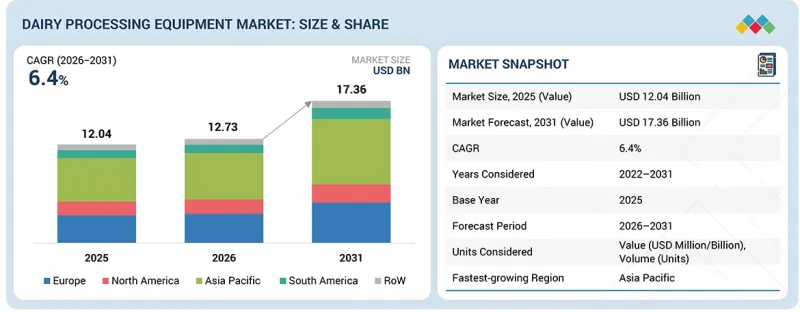
The market for dairy processing equipment is estimated to be USD 12.73 billion in 2026 and is projected to reach USD 17.36 billion by 2031, at a CAGR of 6.4% during the forecast period. Market growth is driven by rising demand for processed dairy products such as milk, cheese, yogurt, butter, and dairy-based beverages. These products need processing systems that can handle volume while maintaining safety and consistency.
| Scope of the Report | |
|---|---|
| Years Considered for the Study | 2026-2031 |
| Base Year | 2025 |
| Forecast Period | 2026-2031 |
| Units Considered | Value (USD Billion) and Volume (Units) |
| Segments | By Type, Application, Mode of Operation, Plant Capacity, and Region |
| Regions covered | North America, Europe, Asia Pacific, South America, RoW |
Processes such as pasteurization, homogenization, membrane filtration, evaporation, and drying continue to be a core part of dairy processing. Continuous technological improvements, coupled with the integration of automation and digital monitoring systems, are enabling dairy processors to enhance operational efficiency, maintain product consistency, and reduce production costs. Demand for dairy ingredients such as milk powder and protein-based products is also increasing. This is leading to investment in high-capacity and energy-efficient equipment, especially in large-scale and export-focused operations. At the same time, organized dairy processing is expanding in developing markets, which is supporting wider use of such equipment. Overall, the market is moving toward more advanced processing systems, with a clear focus on efficiency, scale, and better process control.
"The evaporators segment within the type category is estimated to witness a significant CAGR during the forecast period."
The evaporation process serves as an essential intermediate step that removes 85% to 90% of water from raw milk or whey. This process reduction results in lower energy needs while it enhances operational effectiveness. The production process uses evaporators as essential components because they operate as bottleneck assets that determine the processing capabilities of powder production lines.
The segment experiences growth because it relies on increased drying capacity, which is essential for export markets that need to produce milk powder and whey derivatives at high volumes. Large dairy processors are increasingly investing in multi-effect evaporators (MEE) and thermal vapor recompression (TVR)/mechanical vapor recompression (MVR) systems to optimize steam usage and reduce energy costs, which can account for a significant share of total processing expenditure. The industry trend towards continuous processing systems, together with integrated plant design systems, has created a greater need for automated evaporation systems that can process high volumes of material at industrial production levels. The increasing production of whey protein concentrates, whey protein isolates, and lactose drives the need for evaporation because it provides essential concentration for subsequent separation and drying processes. Evaporators give users the ability to maintain steady solids levels while they experience fewer operational interruptions and achieve better cleaning results through CIP-compatible systems. The market for evaporators will experience its fastest growth because dairy processors aim to enhance yield and decrease energy use while increasing ingredient production.
Evaporation is an important step in dairy processing. It removes a large amount of water from milk or whey so the solids can be concentrated before drying or other processing. Since it is a core stage in producing milk powder and whey ingredients, the evaporator often sets the pace for overall plant capacity and efficiency. Growth in this segment is supported by rising demand for milk powder, whey proteins, lactose, and other dairy ingredients, particularly in export driven markets that need high volume production. To manage energy use and operating costs, many dairy processors are investing in advanced systems like multi effect evaporators (MEE) and thermal or mechanical vapor recompression (TVR/MVR).
The move toward continuous and more integrated processing lines is also driving the adoption of automated evaporation systems that can run at a large scale. Newer evaporators are built to maintain stable solids levels, support clean in place (CIP) cleaning, and reduce downtime. As producers focus more on yield, energy savings, and overall efficiency, the evaporator segment is expected to grow within the dairy processing equipment market.
"The milk powder segment within the application category is estimated to witness strong growth during the forecast period."
Milk powder production is a highly equipment-dependent process within dairy processing, necessitating the integration of technologies including pasteurization, homogenization, evaporation, and spray drying. The expansion of this sector is consequently fueling capital investments in essential equipment, with a particular emphasis on evaporators and dryers. The rising demand for infant nutrition, functional dairy ingredients, and protein-enriched products is contributing to the growth of milk powder production capacity. Processors depend on sophisticated, high-capacity systems to maintain uniform product quality, encompassing regulated particle size, moisture content, and solubility. The increasing demand for exports, particularly from major dairy-producing areas, is fueling investments in new powder processing plants, each necessitating comprehensive and integrated processing lines. Consequently, the milk powder sector continues to be a primary catalyst for equipment demand and is projected to be among the most rapidly expanding application domains within the dairy processing equipment market.
"North America is estimated to hold a significant share of the dairy processing equipment market."
The dairy processing equipment market in North America is supported by a well-established dairy industry and strong processing infrastructure. The region has large-scale dairy operations that use automated and high-capacity systems to produce milk, cheese, butter, and dairy ingredients. The presence of prominent equipment suppliers, including SPX FLOW and Paul Mueller, further contributes to advancements in thermal processing, separation, and fluid handling. The increasing demand for value-added products, particularly cheese and protein-based ingredients, is resulting in greater utilization of equipment such as separators, membrane filtration systems, and evaporation and drying units. Simultaneously, stringent regulatory mandates and a robust cold-chain network are fueling the necessity for dependable, sanitary, and efficient processing systems. Furthermore, the collaborative efforts between equipment suppliers and dairy processors are facilitating plant enhancements, boosting efficiency, and fostering innovation throughout the region.
In-depth interviews were conducted with chief executive officers (CEOs), directors, and other executives from various key organizations operating in the dairy processing equipment market:
- By Company Type: Tier 1 - 25%, Tier 2 - 45%, and Tier 3 - 30%
- By Designation: Directors - 20%, Managers - 50%, Executives - 30%
- By Region: North America - 25%, Europe - 30%, Asia Pacific - 20%, South America - 15%, and Rest of the World (Middle East and Africa) - 10%
Prominent companies in the market include Alfa Laval (Sweden), SPX FLOW (US), Andritz AG (Austria), Pentair PLC (UK/US), Sulzer Ltd (Switzerland), Fristam Pumpen KG (Germany), HRS Heat Exchangers Ltd (UK), Anderson Dahlen (US), Anderson Dahlen Inc. (US), Coperion GmbH (Germany), Bucher Unipektin AG (Switzerland), Scherjon Equipment Holland B.V. (Netherlands), Fenco Food Machinery S.r.l. (Italy), Sealtech Engineers Pvt Ltd (India), Tetra Pak (Switzerland), GEA Group AG (Germany), Krones AG (Germany), JBT Marel (US/Iceland), Ziemann Holvrieka (Germany), IDMC Limited (India), Van den Heuvel Dairy & Food Equipment (Netherlands), Neologic Engineers Pvt Ltd (India), SSP Pvt Ltd (India), Goma Engineering Pvt Ltd (India), GEMAK Group (Turkey), TESSA I.E.C Group (Italy), IWAI Kikai Kogyo Co., Ltd. (Japan), and Shanghai Jimei Food Machinery Co., Ltd (China).
Other players include Skylark Engineers (India), Micro Dairy Designs Ltd (UK), INOXPA S.A.U. (Spain), CFT S.p.A. (Italy), Milkman Dairy Equipment (India), Triowin Intelligent Machinery Co., Ltd. (China), COMAT (Italy), REDA S.p.A. (Italy), and Kovalus Separation Solutions (US).
Research Coverage
This research report categorizes the dairy processing equipment market by product type (pasteurizers, homogenizers, mixers & blenders, separators, evaporators, dryers, membrane filtration equipment, and other types), application (processed milk, fresh dairy products, butter & buttermilk, cheese, milk powder, and protein ingredients), mode of operation (automatic and semi-automatic), plant capacity (qualitative) (small-scale dairy plants, medium-scale dairy plants, large industrial dairy plants), and region (North America, Europe, Asia Pacific, South America, and Rest of the World). The scope of the report covers detailed information regarding the major factors, such as drivers, restraints, challenges, and opportunities, influencing the growth of the dairy processing equipment market. A detailed analysis of the key industry players has been done to provide insights into their business overview, solutions, and services; key strategies; Contracts, partnerships, and agreements. The study includes new product & service launches, mergers & acquisitions, and recent developments associated with the dairy processing equipment market. This report also includes a competitive analysis of emerging startups in the dairy processing equipment market ecosystem.
Reasons To Buy This Report
The report will help market leaders/new entrants in this market with information on the closest approximations of the revenue numbers for the overall dairy processing equipment and the subsegments. It will also help stakeholders understand the competitive landscape and gain more insights to better position their businesses and plan suitable go-to-market strategies. The report also helps stakeholders understand the pulse of the market and provides them with information on key market drivers, restraints, challenges, and opportunities.
The report provides insights into the following pointers:
Q1. Which product type holds the largest share in the dairy processing equipment market?
Pasteurizers hold the largest share in the market, as pasteurization is a critical and mandatory step in dairy processing. These systems are widely used across applications such as processed milk, yogurt, and dairy beverages to ensure product safety and extend shelf life.
Q2. Which segment is expected to grow at the fastest rate in the market?
The evaporators segment is expected to register the highest growth rate, driven by increasing demand for milk powder and dairy ingredient production. Evaporation plays a key role in concentration processes prior to drying, making it essential for large-scale dairy operations.
Q3. Which region dominates the dairy processing equipment market?
Asia Pacific holds the largest share of the market due to its high milk production, growing consumption of dairy products, and increasing investments in modern dairy processing infrastructure. Countries such as China and India are key contributors to regional growth.
Q4. What are the key factors driving demand for dairy processing equipment?
Key growth drivers include rising consumption of processed and value-added dairy products, increasing demand for milk powder and protein ingredients, advancements in processing technologies, and growing adoption of automation to improve efficiency and product consistency.
TABLE OF CONTENTS
1 INTRODUCTION
- 1.1 STUDY OBJECTIVES
- 1.2 MARKET DEFINITION
- 1.3 STUDY SCOPE AND SEGMENTATION
- 1.3.1 MARKETS COVERED AND REGIONAL SCOPE
- 1.3.2 INCLUSIONS AND EXCLUSIONS
- 1.3.3 YEARS CONSIDERED
- 1.3.4 UNITS CONSIDERED
- 1.3.4.1 Currency unit
- 1.3.4.2 Volume unit
- 1.4 STAKEHOLDERS
- 1.5 SUMMARY OF CHANGES
2 EXECUTIVE SUMMARY
- 2.1 MARKET HIGHLIGHTS AND KEY INSIGHTS
- 2.2 KEY MARKET PARTICIPANTS: MAPPING OF STRATEGIC DEVELOPMENTS
- 2.3 DISRUPTIVE TRENDS IN DAIRY PROCESSING EQUIPMENT MARKET
- 2.4 HIGH GROWTH SEGMENTS
- 2.5 REGIONAL SNAPSHOT: MARKET SIZE, GROWTH RATE, AND FORECAST
3 PREMIUM INSIGHTS
- 3.1 ATTRACTIVE OPPORTUNITIES FOR PLAYERS IN DAIRY PROCESSING EQUIPMENT MARKET
- 3.2 DAIRY PROCESSING EQUIPMENT MARKET, BY TYPE AND REGION
- 3.3 DAIRY PROCESSING EQUIPMENT MARKET: BY TOP FOUR TYPES
- 3.4 DAIRY PROCESSING EQUIPMENT MARKET, BY APPLICATION
- 3.5 DAIRY PROCESSING EQUIPMENT MARKET, BY MODE OF OPERATION
- 3.6 DAIRY PROCESSING EQUIPMENT MARKET, BY COUNTRY
4 MARKET OVERVIEW
- 4.1 INTRODUCTION
- 4.2 MARKET DYNAMICS
- 4.2.1 DRIVERS
- 4.2.1.1 Rise in demand for functional and fortified dairy products
- 4.2.1.2 Growth in demand for dairy products with long shelf lives
- 4.2.1.3 Increase in adoption of automation and smart dairy plants in dairy processing facilities
- 4.2.1.4 Rise in demand for dairy ingredients in food industry
- 4.2.1.4.1 Growth in production of milk due to increase in consumption of dairy products
- 4.2.1.4.2 Increase in demand for protein-rich dairy ingredients such as whey and casein
- 4.2.1.4.3 Growth in demand for lactose-free and specialty dairy products, dairy powder, and infant nutrition products
- 4.2.1.5 Expansion of dairy processing capacity in emerging countries
- 4.2.2 RESTRAINTS
- 4.2.2.1 High initial investment and high maintenance, operational, and installation costs of dairy processing equipment
- 4.2.2.2 Complexity in integrating advanced automation systems in existing plants
- 4.2.2.3 Increase in energy costs
- 4.2.3 OPPORTUNITIES
- 4.2.3.1 Growing demand for membrane filtration technologies in dairy processing
- 4.2.3.2 Increase in investment in dairy cold chain infrastructure
- 4.2.3.3 Technological innovation in automated cleaning and sanitation systems
- 4.2.3.4 Higher demand for customized and modular dairy processing equipment
- 4.2.4 CHALLENGES
- 4.2.4.1 Strict food safety and hygiene regulations in dairy processing & compliance with international dairy quality standards
- 4.2.4.2 Equipment downtime affecting production efficiency
- 4.2.4.3 Increase in pressure to reduce energy consumption and carbon emissions
- 4.2.4.4 High costs associated with equipment upgrades and modernization
- 4.2.1 DRIVERS
- 4.3 UNMET NEEDS AND WHITE SPACES
- 4.3.1 UNMET NEEDS IN DAIRY PROCESSING EQUIPMENT MARKET
- 4.3.2 WHITE SPACE OPPORTUNITIES
- 4.4 INTERCONNECTED MARKETS AND CROSS-SECTOR OPPORTUNITIES
- 4.4.1 INTERCONNECTED MARKETS
- 4.4.2 CROSS-SECTOR OPPORTUNITIES
- 4.5 STRATEGIC MOVES BY TIER-1/2/3 PLAYERS
- 4.5.1 KEY MOVES AND STRATEGIC FOCUS
5 INDUSTRY TRENDS
- 5.1 PORTER'S FIVE FORCES ANALYSIS
- 5.1.1 INTENSITY OF COMPETITIVE RIVALRY
- 5.1.2 BARGAINING POWER OF SUPPLIERS
- 5.1.3 BARGAINING POWER OF BUYERS
- 5.1.4 THREAT OF SUBSTITUTES
- 5.1.5 THREAT OF NEW ENTRANTS
- 5.2 MACROECONOMICS OUTLOOK
- 5.2.1 INTRODUCTION
- 5.2.2 MACROECONOMIC INDICATORS
- 5.2.2.1 Rising investment in cold chain and food logistics infrastructure
- 5.2.2.2 Government subsidies and financial support for dairy processing infrastructure
- 5.3 VALUE CHAIN ANALYSIS
- 5.3.1 RAW MATERIAL & COMPONENT SOURCING
- 5.3.2 PRODUCT DEVELOPMENT & MANUFACTURING
- 5.3.3 QUALITY, SAFETY & REGULATORY COMPLIANCE
- 5.3.4 INSTALLATION, CUSTOMIZATION & INTEGRATION
- 5.3.5 SALES, DISTRIBUTION, AND AFTER-SALES SERVICES
- 5.3.6 END USERS
- 5.4 ECOSYSTEM/MARKET MAP ANALYSES
- 5.4.1 DEMAND SIDE
- 5.4.2 SUPPLY SIDE
- 5.5 PRICING ANALYSIS
- 5.5.1 INTRODUCTION
- 5.5.2 INDICATIVE PRICE TREND AMONG MARKET PLAYERS
- 5.5.3 INDICATIVE AVERAGE SELLING PRICE (ASP) TREND, BY REGION AND TYPE
- 5.6 TRADE ANALYSIS
- 5.6.1 IMPORT SCENARIO OF HS CODE 843420
- 5.6.2 EXPORT SCENARIO OF HS CODE 843420
- 5.7 KEY CONFERENCES AND EVENTS, 2026-2027
- 5.8 TRENDS/DISRUPTIONS IMPACTING CUSTOMER BUSINESS
- 5.9 INVESTMENT AND FUNDING SCENARIO
- 5.10 CASE STUDY ANALYSIS
- 5.10.1 GEA GROUP: LAUNCH OF ENERGY-EFFICIENT DAIRY EVAPORATOR TECHNOLOGY
- 5.10.2 ALFA LAVAL: EXTEND TECHNOLOGY IMPROVING EFFICIENCY IN DAIRY PASTEURIZATION
- 5.10.3 GEA GROUP: SUPPORTING ARLA FOODS IN HIGH-QUALITY LACTOSE PRODUCTION FOR INFANT NUTRITION
- 5.10.4 TETRA PAK: COLLABORATED WITH DAIRY INGREDIENT MANUFACTURER CAYUGA MILK INGREDIENTS (CMI) TO EXPAND DAIRY PROCESSING FACILITY IN CAYUGA COUNTY, NEW YORK
- 5.11 IMPACT OF 2025 US TARIFF - DAIRY PROCESSING EQUIPMENT MARKET
- 5.11.1 INTRODUCTION
- 5.11.2 PRICE IMPACT ANALYSIS
- 5.11.3 IMPACT ON COUNTRIES/REGIONS
- 5.11.3.1 US
- 5.11.3.2 Europe
- 5.11.3.3 Asia Pacific
- 5.11.4 IMPACT ON END-USE INDUSTRIES
- 5.12 MILK PRODUCTION DATA AND NUMBER OF DAIRY PROCESSING PLANTS
- 5.12.1 RAW MILK PRODUCTION
- 5.12.2 LIQUID MILK PRODUCTION
- 5.12.3 NUMBER OF DAIRY PROCESSING PLANTS, BY KEY COUNTRY
6 TECHNOLOGY ADVANCEMENTS, AI-DRIVEN IMPACT, PATENTS, INNOVATIONS, AND FUTURE APPLICATIONS
- 6.1 TECHNOLOGY ANALYSIS
- 6.1.1 KEY TECHNOLOGIES
- 6.1.1.1 Thermal processing technologies (pasteurization, UHT, sterilization)
- 6.1.1.2 Homogenization and Fat Standardization Technology
- 6.1.1.3 Membrane filtration technologies (UF, MF, RO)
- 6.1.2 COMPLEMENTARY ANALYSIS
- 6.1.2.1 Evaporation & drying technologies (spray drying, falling film evaporation)
- 6.1.2.2 Fermentation & culturing technologies
- 6.1.2.3 Enzyme-based cleaning-in-place (CIP) in dairy processing
- 6.1.2.4 Automation & process control systems (SCADA, PLC, IoT integration)
- 6.1.3 ADJACENT TECHNOLOGIES
- 6.1.3.1 Energy-efficient & sustainability-driven technologies (heat recovery, water recycling)
- 6.1.3.2 Smart monitoring & predictive maintenance systems
- 6.1.4 TECHNOLOGY/PRODUCT ROADMAP
- 6.1.4.1 Short-Term | Foundation & Early Commercialization
- 6.1.4.2 Mid-Term | Smart Technologies & Sustainable Processing
- 6.1.4.3 Long-Term | Fully Integrated Smart Factories & Industry 4.0
- 6.1.1 KEY TECHNOLOGIES
- 6.2 PATENT ANALYSIS
- 6.3 FUTURE APPLICATIONS
- 6.3.1 IOT-BASED MACHINE LEARNING SYSTEM FOR DAIRY PRODUCTION QUALITY OPTIMIZATION
- 6.3.2 AI-BASED SENSOR SYSTEM FOR ANTIBIOTIC DETECTION IN MILK
- 6.3.3 AI-DRIVEN ECONOMIC MODEL PREDICTIVE CONTROL FOR DAIRY PASTEURIZATION UNITS
- 6.3.4 LED-BASED TECHNOLOGIES FOR DAIRY PROCESSING AND STERILIZATION
- 6.3.5 ADVANCED MEMBRANE SEPARATION TECHNOLOGY FOR NEXT-GENERATION DAIRY PROCESSING
- 6.4 IMPACT OF GENERATIVE AI ON DAIRY PROCESSING EQUIPMENT MARKET
- 6.4.1 INTRODUCTION
- 6.4.2 TOP USE CASES AND MARKET POTENTIAL
- 6.4.3 BEST PRACTICES IN DAIRY PROCESSING EQUIPMENT INDUSTRY
- 6.4.4 CASE STUDIES OF AI IMPLEMENTATION IN DAIRY PROCESSING EQUIPMENT MARKET
- 6.4.5 INTERCONNECTED ADJACENT ECOSYSTEM AND IMPACT ON MARKET PLAYERS
- 6.4.6 CLIENTS' READINESS TO ADOPT GENERATIVE AI FOR DAIRY PROCESSING EQUIPMENT
- 6.5 SUCCESS STORIES AND REAL-WORLD APPLICATIONS
7 SUSTAINABILITY AND REGULATORY LANDSCAPE
- 7.1 REGIONAL REGULATIONS AND COMPLIANCE
- 7.1.1 REGULATORY BODIES, GOVERNMENT AGENCIES, AND OTHER ORGANIZATIONS
- 7.1.2 INDUSTRY STANDARDS
- 7.1.3 LABELING REQUIREMENTS AND CLAIMS
- 7.1.4 ANTICIPATED REGULATORY CHANGES IN NEXT 5-10 YEARS
- 7.1.4.1 Stricter hygienic equipment design and sanitation standards
- 7.1.4.2 Global harmonization of food processing equipment safety standards
- 7.1.4.3 Enhanced food safety and preventive control regulations
- 7.1.4.4 Digital traceability, smart monitoring, and compliance automation
- 7.2 SUSTAINABILITY INITIATIVES
- 7.2.1 SUSTAINABLE SOURCING
- 7.2.2 CARBON FOOTPRINT REDUCTION INITIATIVES
- 7.2.3 CIRCULAR ECONOMY APPROACHES
- 7.3 SUSTAINABILITY IMPACT AND REGULATORY POLICY INITIATIVES
- 7.4 CERTIFICATIONS, LABELING, ECO-STANDARDS
8 CUSTOMER LANDSCAPE AND BUYER BEHAVIOR
- 8.1 DECISION-MAKING PROCESS
- 8.2 KEY STAKEHOLDERS AND BUYING CRITERIA
- 8.2.1 KEY STAKEHOLDERS IN BUYING PROCESS
- 8.2.2 BUYING CRITERIA
- 8.3 ADOPTION BARRIERS AND INTERNAL CHALLENGES
- 8.4 UNMET NEEDS OF VARIOUS APPLICATION INDUSTRIES ACROSS SUPPLY CHAIN
- 8.5 MARKET PROFITABILITY
- 8.6 REVENUE POTENTIAL
- 8.6.1 COST DYNAMICS
- 8.6.2 MARGIN OPPORTUNITIES, BY TYPE
9 DAIRY PROCESSING EQUIPMENT MARKET, BY TYPE
- 9.1 INTRODUCTION
- 9.2 PASTEURIZERS
- 9.2.1 ENSURING DAIRY SAFETY AND SHELF LIFE THROUGH ADVANCED PASTEURIZATION SYSTEMS
- 9.3 HOMOGENIZERS
- 9.3.1 ENHANCING TEXTURE AND STABILITY FOR CONSISTENT, HIGH-QUALITY DAIRY PRODUCTS
- 9.4 MIXERS & BLENDERS
- 9.4.1 ENSURING UNIFORMITY AND TEXTURE IN DAIRY PRODUCTS THROUGH ADVANCED MIXING TECHNOLOGIES
- 9.5 SEPARATORS
- 9.5.1 ENABLING EFFICIENT MILK FRACTIONATION FOR VALUE-ADDED DAIRY PRODUCTION
- 9.6 EVAPORATORS
- 9.6.1 ENHANCING DAIRY CONCENTRATION WITH ENERGY-EFFICIENT EVAPORATION TECHNOLOGIES
- 9.7 DRYERS
- 9.7.1 ADVANCED DRYING TECHNOLOGIES FOR HIGH-QUALITY AND NUTRIENT-RICH DAIRY POWDERS
- 9.8 MEMBRANE FILTRATION EQUIPMENT
- 9.8.1 TRANSFORMING DAIRY PROCESSING THROUGH ADVANCED AND SUSTAINABLE FILTRATION SYSTEMS
- 9.9 OTHER TYPES
10 DAIRY PROCESSING EQUIPMENT MARKET, BY APPLICATION
- 10.1 INTRODUCTION
- 10.2 PROCESSED MILK
- 10.2.1 PROCESSED MILK DEMAND IS TRANSFORMING DAIRY PROCESSING FROM TRADITIONAL HANDLING TO TECHNOLOGY-DRIVEN, LARGE-SCALE PRECISION SYSTEMS
- 10.3 FRESH DAIRY PRODUCTS
- 10.3.1 SHIFT IN CONSUMER TRENDS TOWARD HEALTHIER DESSERTS AND GOURMET CUISINES
- 10.4 BUTTER & BUTTERMILK
- 10.4.1 STRONG GLOBAL BAKERY DEMAND DRIVES GROWTH IN BUTTER & BUTTERMILK PROCESSING EQUIPMENT
- 10.5 CHEESE
- 10.5.1 RISING GLOBAL CHEESE CONSUMPTION AND ITS EXPANDING ROLE IN PROCESSED FOODS TO DRIVE SUSTAINED DEMAND
- 10.6 MILK POWDER
- 10.6.1 RISING DEMAND FOR SHELF-STABLE DAIRY FUELS GROWTH IN MILK POWDER PROCESSING TECHNOLOGIES
- 10.7 PROTEIN INGREDIENTS
- 10.7.1 RISING DEMAND FOR WHEY PROTEIN INGREDIENTS DRIVES ADOPTION OF ADVANCED FILTRATION TECHNOLOGIES
11 DAIRY PROCESSING EQUIPMENT MARKET, BY MODE OF OPERATION
- 11.1 INTRODUCTION
- 11.2 AUTOMATIC
- 11.2.1 SMART AUTOMATION FOR SEAMLESS, EFFICIENT, AND HIGH-QUALITY DAIRY PROCESSING
- 11.3 SEMI-AUTOMATIC
- 11.3.1 FLEXIBLE AND COST-EFFECTIVE SOLUTIONS FOR CONTROLLED AND SCALABLE DAIRY PROCESSING
12 DAIRY PROCESSING EQUIPMENT, BY PLANT CAPACITY
- 12.1 INTRODUCTION
- 12.2 SMALL-SCALE DAIRY PLANTS
- 12.2.1 EMPOWER DECENTRALIZED MILK PROCESSING THROUGH COMPACT AND COST-EFFECTIVE EQUIPMENT SOLUTIONS
- 12.3 MEDIUM-SCALE DAIRY PLANTS
- 12.3.1 ACCELERATE MARKET GROWTH THROUGH SCALABLE CAPACITY AND ADVANCED PROCESSING INTEGRATION
- 12.4 LARGE INDUSTRIAL DAIRY PLANTS
- 12.4.1 INDUSTRIAL PRODUCTION THROUGH HIGH-CAPACITY AUTOMATION AND ADVANCED PROCESSING TECHNOLOGIES
13 DAIRY PROCESSING EQUIPMENT MARKET, BY REGION
- 13.1 INTRODUCTION
- 13.2 NORTH AMERICA
- 13.2.1 US
- 13.2.1.1 Strong dairy consumption and large-scale processing infrastructure to drive demand for advanced dairy processing equipment
- 13.2.2 CANADA
- 13.2.2.1 Expansion of dairy processing infrastructure and rising product value to fuel equipment demand
- 13.2.3 MEXICO
- 13.2.3.1 Rising dairy consumption and expanding processing base to support demand for dairy processing equipment
- 13.2.1 US
- 13.3 EUROPE
- 13.3.1 GERMANY
- 13.3.1.1 Large-scale milk production and strong processing industry to fuel demand for advanced dairy processing equipment
- 13.3.2 FRANCE
- 13.3.2.1 Strong dairy production, high-value product demand, and export orientation to support processing equipment adoption
- 13.3.3 ITALY
- 13.3.3.1 Strong cheese-focused processing industry and export demand to fuel equipment adoption
- 13.3.4 UK
- 13.3.4.1 Strong dairy processing infrastructure and rising demand for value-added products to drive equipment adoption
- 13.3.5 NETHERLANDS
- 13.3.5.1 High-value dairy processing ecosystem to accelerate demand for advanced equipment
- 13.3.6 REST OF EUROPE
- 13.3.1 GERMANY
- 13.4 ASIA PACIFIC
- 13.4.1 CHINA
- 13.4.1.1 Shifting demand toward high-value dairy products to accelerate need for advanced processing equipment
- 13.4.2 INDIA
- 13.4.2.1 Government-backed expansion of dairy processing infrastructure and modernization initiatives to significantly drive demand
- 13.4.3 JAPAN
- 13.4.3.1 High-quality dairy processing and rising demand for functional products to fuel equipment adoption
- 13.4.4 AUSTRALIA & NEW ZEALAND
- 13.4.4.1 Export-driven, high-efficiency dairy systems to fuel demand for advanced processing technologies
- 13.4.5 REST OF ASIA PACIFIC
- 13.4.1 CHINA
- 13.5 SOUTH AMERICA
- 13.5.1 BRAZIL
- 13.5.1.1 Brazil's rising milk output and shift toward value-added dairy processing to accelerate demand
- 13.5.2 ARGENTINA
- 13.5.2.1 Argentina's rising dairy production & consumption and industrial processing shift to drive demand for advanced dairy equipment
- 13.5.3 REST OF SOUTH AMERICA
- 13.5.1 BRAZIL
- 13.6 REST OF THE WORLD (ROW)
- 13.6.1 MIDDLE EAST
- 13.6.1.1 Middle East's rising dairy demand and food security initiatives to drive investment in advanced dairy processing equipment
- 13.6.2 AFRICA
- 13.6.2.1 Increase in demand for processed dairy products, along with potential in structural gaps in local dairy infrastructure, to provide growth opportunities
- 13.6.1 MIDDLE EAST
14 COMPETITIVE LANDSCAPE
- 14.1 OVERVIEW
- 14.2 KEY PLAYER STRATEGIES/RIGHT TO WIN
- 14.3 REVENUE ANALYSIS, 2022-2024
- 14.4 MARKET SHARE ANALYSIS, 2025
- 14.5 COMPANY VALUATION AND FINANCIAL METRICS
- 14.5.1 COMPANY VALUATION
- 14.5.2 EV/EBITDA
- 14.6 BRAND COMPARISON ANALYSIS
- 14.7 COMPANY EVALUATION MATRIX: OEM SECTOR (PROCESS INTEGRATORS), 2025
- 14.7.1 STARS
- 14.7.2 EMERGING LEADERS
- 14.7.3 PERVASIVE PLAYERS
- 14.7.4 PARTICIPANTS
- 14.7.5 COMPANY FOOTPRINT: OEM SECTOR (PROCESS INTEGRATORS), 2025
- 14.7.5.1 Company footprint
- 14.7.5.2 Regional footprint
- 14.7.5.3 Type footprint
- 14.7.5.4 Application footprint
- 14.8 COMPANY EVALUATION MATRIX: MACHINERY/PROCESS EQUIPMENT SUPPLIERS, 2025
- 14.8.1 STARS
- 14.8.2 EMERGING LEADERS
- 14.8.3 PERVASIVE PLAYERS
- 14.8.4 PARTICIPANTS
- 14.8.5 COMPANY FOOTPRINT: MACHINERY/PROCESS EQUIPMENT SUPPLIERS, 2025
- 14.8.5.1 Company footprint
- 14.8.5.2 Regional footprint
- 14.8.5.3 Type footprint
- 14.8.5.4 Application footprint
- 14.8.6 COMPETITIVE BENCHMARKING: OEM SECTOR (PROCESS INTEGRATORS), 2025
- 14.8.6.1 Detailed list of original equipment manufacturer (OEM)
- 14.9 COMPETITIVE SCENARIO AND TRENDS
- 14.9.1 PRODUCT LAUNCHES
- 14.9.2 DEALS
- 14.9.3 EXPANSIONS
- 14.9.4 OTHER DEVELOPMENTS
15 COMPANY PROFILES
- 15.1 OEM SECTOR (PROCESS INTEGRATORS)
- 15.1.1 TETRA LAVAL GROUP
- 15.1.1.1 Business overview
- 15.1.1.2 Products/Services/Solutions offered
- 15.1.1.3 Recent developments
- 15.1.1.3.1 Product launches
- 15.1.1.3.2 Other developments
- 15.1.1.4 MnM view
- 15.1.1.4.1 Key strengths
- 15.1.1.4.2 Strategic choices
- 15.1.1.4.3 Weaknesses & competitive threats
- 15.1.2 GEA GROUP AKTIENGESELLSCHAFT
- 15.1.2.1 Business overview
- 15.1.2.2 Products/Services/Solutions offered
- 15.1.2.3 Recent developments
- 15.1.2.3.1 Product launches
- 15.1.2.3.2 Expansions
- 15.1.2.4 MnM view
- 15.1.2.4.1 Key strengths
- 15.1.2.4.2 Strategic choices
- 15.1.2.4.3 Weaknesses and competitive threats
- 15.1.3 KRONES AG
- 15.1.3.1 Business overview
- 15.1.3.2 Products/Services/Solutions offered
- 15.1.3.3 Recent developments
- 15.1.3.3.1 Deals
- 15.1.3.4 MnM view
- 15.1.3.4.1 Key strengths
- 15.1.3.4.2 Strategic choices
- 15.1.3.4.3 Weaknesses & competitive threats
- 15.1.4 JBT MAREL
- 15.1.4.1 Business overview
- 15.1.4.2 Products/Services/Solutions offered
- 15.1.4.3 Recent developments
- 15.1.4.3.1 Expansions
- 15.1.4.4 MnM view
- 15.1.4.4.1 Key strengths
- 15.1.4.4.2 Strategic choices
- 15.1.4.4.3 Weaknesses & competitive threats
- 15.1.5 IDMC LIMITED
- 15.1.5.1 Business overview
- 15.1.5.2 Products/Services/Solutions offered
- 15.1.5.3 Recent developments
- 15.1.5.4 MnM view
- 15.1.5.4.1 Key strengths
- 15.1.5.4.2 Strategic choices
- 15.1.5.4.3 Weaknesses & competitive threats
- 15.1.6 VAN DEN HEUVEL DAIRY & FOOD EQUIPMENT
- 15.1.6.1 Business overview
- 15.1.6.2 Products/Services/Solutions offered
- 15.1.6.3 Recent developments
- 15.1.6.4 MnM view
- 15.1.7 NEOLOGIC ENGINEERS PRIVATE LIMITED
- 15.1.7.1 Business overview
- 15.1.7.2 Products/Services/Solutions offered
- 15.1.7.3 Recent developments
- 15.1.7.4 MnM view
- 15.1.8 SSP PVT. LTD
- 15.1.8.1 Business overview
- 15.1.8.2 Products/Services/Solutions offered
- 15.1.8.3 Recent developments
- 15.1.8.4 MnM view
- 15.1.9 GOMA
- 15.1.9.1 Business overview
- 15.1.9.2 Products/Services/Solutions offered
- 15.1.9.3 Recent developments
- 15.1.9.4 MnM view
- 15.1.10 GEMAK
- 15.1.10.1 Business overview
- 15.1.10.2 Products/Services/Solutions offered
- 15.1.10.3 Recent developments
- 15.1.10.4 MnM view
- 15.1.11 TESSA DAIRY MACHINERY
- 15.1.11.1 Business overview
- 15.1.11.2 Products/Services/Solutions offered
- 15.1.11.3 Recent developments
- 15.1.11.4 MnM view
- 15.1.12 IWAI KIKAI KOGYO CO., LTD.
- 15.1.12.1 Business overview
- 15.1.12.2 Products/Services/Solutions offered
- 15.1.12.3 Recent developments
- 15.1.12.4 MnM view
- 15.1.13 JIMEI MACHINERY CO., LTD.
- 15.1.13.1 Business overview
- 15.1.13.2 Products/Services/Solutions offered
- 15.1.13.3 Recent developments
- 15.1.13.4 MnM view
- 15.1.14 PIERRE GUERIN
- 15.1.14.1 Business overview
- 15.1.14.2 Products/Services/Solutions offered
- 15.1.14.3 Recent developments
- 15.1.14.4 MnM view
- 15.1.15 SM ENGINEERING
- 15.1.15.1 Business overview
- 15.1.15.2 Products/Services/Solutions offered
- 15.1.15.3 Recent developments
- 15.1.15.4 MnM view
- 15.1.16 SHANGHAI TRIOWIN INTELLIGENT MACHINERY CO., LTD
- 15.1.17 SICCADANIA
- 15.1.18 REDA SPA
- 15.1.19 COMAT
- 15.1.20 KOVALUS SEPARATION SOLUTIONS
- 15.1.1 TETRA LAVAL GROUP
- 15.2 MACHINERY/PROCESS EQUIPMENT SUPPLIERS
- 15.2.1 ALFA LAVAL
- 15.2.1.1 Business overview
- 15.2.1.2 Products/Services/Solutions offered
- 15.2.1.3 Recent developments
- 15.2.1.3.1 Product launches
- 15.2.1.3.2 Deals
- 15.2.1.3.3 Expansions
- 15.2.1.3.4 Other developments
- 15.2.1.4 MnM view
- 15.2.1.4.1 Right to win
- 15.2.1.4.2 Strategic choices
- 15.2.1.4.3 Weaknesses and competitive threats
- 15.2.2 SPX FLOW
- 15.2.2.1 Business overview
- 15.2.2.2 Products/Services/Solutions offered
- 15.2.2.3 Recent developments
- 15.2.2.3.1 Product launches
- 15.2.2.3.2 Deals
- 15.2.2.3.3 Expansions
- 15.2.2.3.4 Other developments
- 15.2.2.4 MnM view
- 15.2.2.4.1 Right to win
- 15.2.2.4.2 Strategic choices
- 15.2.2.4.3 Weaknesses and competitive threats
- 15.2.3 ANDRITZ AG
- 15.2.3.1 Business overview
- 15.2.3.2 Products/Services/Solutions offered
- 15.2.3.3 Recent developments
- 15.2.3.3.1 Product launches
- 15.2.3.3.2 Expansions
- 15.2.3.3.3 Other developments
- 15.2.3.4 MnM view
- 15.2.3.4.1 Right to win
- 15.2.3.4.2 Strategic choices
- 15.2.3.4.3 Weaknesses and competitive threats
- 15.2.4 ANDERSON DAHLEN
- 15.2.4.1 Business overview
- 15.2.4.2 Products/Services/Solutions offered
- 15.2.4.3 Recent developments
- 15.2.4.3.1 Product launches
- 15.2.4.3.2 Expansions
- 15.2.4.4 MnM view
- 15.2.4.4.1 Right to win
- 15.2.4.4.2 Strategic choices
- 15.2.4.4.3 Weaknesses and competitive threats
- 15.2.5 FRISTAM PUMPEN KG
- 15.2.5.1 Business overview
- 15.2.5.2 Products/Services/Solutions offered
- 15.2.5.3 Recent developments
- 15.2.5.3.1 Product launches
- 15.2.5.3.2 Expansions
- 15.2.5.3.3 Other developments
- 15.2.5.4 MnM view
- 15.2.5.4.1 Right to win
- 15.2.5.4.2 Strategic choices
- 15.2.5.4.3 Weaknesses and competitive threats
- 15.2.6 PENTAIR PLC
- 15.2.6.1 Business overview
- 15.2.6.2 Products/Services/Solutions offered
- 15.2.6.3 Recent developments
- 15.2.6.3.1 Product launches
- 15.2.6.3.2 Deals
- 15.2.6.3.3 Expansions
- 15.2.6.4 MnM view
- 15.2.6.4.1 Right to win
- 15.2.6.4.2 Strategic choices
- 15.2.6.4.3 Weaknesses and competitive threats
- 15.2.7 SULZER LTD
- 15.2.7.1 Business overview
- 15.2.7.2 Products/Services/Solutions offered
- 15.2.7.3 Recent developments
- 15.2.7.4 MnM view
- 15.2.7.4.1 Right to win
- 15.2.7.4.2 Strategic choices
- 15.2.7.4.3 Weaknesses and competitive threats
- 15.2.8 HRS HEAT EXCHANGERS LTD
- 15.2.8.1 Business overview
- 15.2.8.2 Products/Services/Solutions offered
- 15.2.8.3 Recent developments
- 15.2.8.3.1 Product launches
- 15.2.8.3.2 Deals
- 15.2.8.3.3 Expansions
- 15.2.8.3.4 Other developments
- 15.2.8.4 MnM view
- 15.2.8.4.1 Right to win
- 15.2.8.4.2 Strategic choices
- 15.2.8.4.3 Weaknesses and competitive threats
- 15.2.9 ATS CORPORATION
- 15.2.9.1 Business overview
- 15.2.9.2 Products/Services/Solutions offered
- 15.2.9.3 Recent developments
- 15.2.9.3.1 Product launches
- 15.2.9.3.2 Deals
- 15.2.9.3.3 Other developments
- 15.2.9.4 MnM view
- 15.2.9.4.1 Right to win
- 15.2.9.4.2 Strategic choices
- 15.2.9.4.3 Weaknesses and competitive threats
- 15.2.10 COPERION GMBH
- 15.2.10.1 Business overview
- 15.2.10.2 Products/Services/Solutions offered
- 15.2.10.3 Recent developments
- 15.2.10.3.1 Deals
- 15.2.10.4 MnM view
- 15.2.11 BUCHER UNIPEKTIN AG
- 15.2.11.1 Business overview
- 15.2.11.2 Products/Services/Solutions offered
- 15.2.11.3 Recent developments
- 15.2.11.3.1 Product launches
- 15.2.11.4 MnM view
- 15.2.11.4.1 Right to win
- 15.2.12 SCHERJON EQUIPMENT HOLLAND B.V.
- 15.2.12.1 Business overview
- 15.2.12.2 Products/Services/Solutions offered
- 15.2.12.3 Recent developments
- 15.2.12.3.1 Product launches
- 15.2.12.3.2 Expansions
- 15.2.12.3.3 Other developments
- 15.2.12.4 MnM view
- 15.2.13 FENCO FOOD MACHINERY S.R.L.
- 15.2.13.1 Business overview
- 15.2.13.2 Products/Services/Solutions offered
- 15.2.13.3 Recent developments
- 15.2.13.4 MnM view
- 15.2.13.4.1 Right to win
- 15.2.14 SEALTECH ENGINEERS PVT LTD
- 15.2.14.1 Business overview
- 15.2.14.2 Products/Services/Solutions offered
- 15.2.14.3 Recent developments
- 15.2.14.4 MnM view
- 15.2.14.4.1 Right to win
- 15.2.15 MICROTHERMICS, INC.
- 15.2.15.1 Business overview
- 15.2.15.2 Products/Services/Solutions offered
- 15.2.15.3 Recent developments
- 15.2.15.3.1 Product launches
- 15.2.15.4 MnM view
- 15.2.15.4.1 Right to win
- 15.2.16 SKYLARK ENGINEERS
- 15.2.17 MICRO DAIRY DESIGNS LTD
- 15.2.18 INOXPA S.A.U.
- 15.2.19 HARVEST HI-TECH EQUIPMENTS (INDIA) PVT LTD
- 15.2.20 MILKMAN DAIRY EQUIPMENT
- 15.2.1 ALFA LAVAL
16 ADJACENT AND RELATED MARKETS
- 16.1 INTRODUCTION
- 16.2 RESEARCH LIMITATIONS
- 16.3 FOOD & BEVERAGE PROCESSING EQUIPMENT MARKET
- 16.3.1 MARKET DEFINITION
- 16.3.2 MARKET OVERVIEW
- 16.3.3 FOOD & BEVERAGE PROCESSING EQUIPMENT MARKET, BY TYPE
- 16.4 BAKERY PROCESSING EQUIPMENT MARKET
- 16.4.1 MARKET DEFINITION
- 16.4.2 MARKET OVERVIEW
- 16.4.3 BAKERY PROCESSING EQUIPMENT MARKET, BY TYPE
17 RESEARCH METHODOLOGY
- 17.1 RESEARCH DATA
- 17.1.1 SECONDARY DATA
- 17.1.1.1 Key data from secondary sources
- 17.1.2 PRIMARY DATA
- 17.1.2.1 Key data from primary sources
- 17.1.2.2 Breakdown of primary profiles
- 17.1.2.3 Key insights from industry experts
- 17.1.1 SECONDARY DATA
- 17.2 MARKET SIZE ESTIMATION
- 17.2.1 TOP-DOWN APPROACH
- 17.2.1.1 Supply-side analysis
- 17.2.2 BOTTOM-UP APPROACH (DEMAND SIDE)
- 17.2.1 TOP-DOWN APPROACH
- 17.3 DATA TRIANGULATION
- 17.4 RESEARCH ASSUMPTIONS
- 17.5 RESEARCH LIMITATIONS AND RISK ASSESSMENT
18 APPENDIX
- 18.1 DISCUSSION GUIDE
- 18.2 KNOWLEDGESTORE: MARKETSANDMARKETS' SUBSCRIPTION PORTAL
- 18.3 CUSTOMIZATION OPTIONS
- 18.4 RELATED REPORTS
- 18.5 AUTHOR DETAILS
List of Tables
- TABLE 1 INCLUSIONS AND EXCLUSIONS
- TABLE 2 USD EXCHANGE RATES, 2021-2025
- TABLE 3 INTERCONNECTED MARKETS
- TABLE 4 KEY MOVES AND STRATEGIC FOCUS
- TABLE 5 DAIRY PROCESSING EQUIPMENT MARKET: PORTER'S FIVE FORCES ANALYSIS
- TABLE 6 DAIRY PROCESSING EQUIPMENT MARKET: SUPPLY CHAIN (ECOSYSTEM)
- TABLE 7 INDICATIVE AVERAGE SELLING PRICE (ASP) TREND, BY REGION AND TYPE, 2025 (USD/UNIT)
- TABLE 8 IMPORT SCENARIO FOR HS CODE: 843420, BY COUNTRY, 2021-2025 (USD)
- TABLE 9 EXPORT SCENARIO FOR HS CODE: 843420, BY COUNTRY, 2021-2025 (USD)
- TABLE 10 DAIRY PROCESSING EQUIPMENT MARKET: LIST OF KEY CONFERENCES AND EVENTS, 2026-2027
- TABLE 11 RAW MILK PRODUCTION, 2022-2025 ('000 TONS)
- TABLE 12 LIQUID MILK PRODUCTION, 2022-2025 ('000 TONS)
- TABLE 13 NUMBER OF DAIRY PROCESSING PLANTS, BY KEY COUNTRY
- TABLE 14 PATENTS PERTAINING TO DAIRY PROCESSING EQUIPMENT MARKET, 2021-2026
- TABLE 15 TOP USE CASES AND MARKET POTENTIAL
- TABLE 16 BEST PRACTICES: COMPANIES IMPLEMENTING USE CASES
- TABLE 17 DAIRY PROCESSING EQUIPMENT MARKET: CASE STUDIES RELATED TO GEN AI IMPLEMENTATION
- TABLE 18 INTERCONNECTED ADJACENT ECOSYSTEM AND IMPACT ON MARKET PLAYERS
- TABLE 19 NORTH AMERICA: REGULATORY BODIES, GOVERNMENT AGENCIES, AND OTHER ORGANIZATIONS
- TABLE 20 EUROPE: REGULATORY BODIES, GOVERNMENT AGENCIES, AND OTHER ORGANIZATIONS
- TABLE 21 ASIA PACIFIC: REGULATORY BODIES, GOVERNMENT AGENCIES, AND OTHER ORGANIZATIONS
- TABLE 22 SOUTH AMERICA: REGULATORY BODIES, GOVERNMENT AGENCIES, AND OTHER ORGANIZATIONS
- TABLE 23 INTERNATIONAL: REGULATORY BODIES, GOVERNMENT AGENCIES, AND OTHER ORGANIZATIONS
- TABLE 24 GLOBAL INDUSTRY STANDARDS IN DAIRY PROCESSING EQUIPMENT MARKET
- TABLE 25 LABELING REQUIREMENTS AND CLAIMS IN DAIRY PROCESSING EQUIPMENT MARKET
- TABLE 26 CERTIFICATIONS, LABELING, AND ECO-STANDARDS IN DAIRY PROCESSING EQUIPMENT MARKET
- TABLE 27 INFLUENCE OF STAKEHOLDERS ON BUYING PROCESS FOR MODE OF OPERATION
- TABLE 28 KEY BUYING CRITERIA FOR MODE OF OPERATION
- TABLE 29 UNMET NEEDS IN DAIRY PROCESSING EQUIPMENT MARKET, BY APPLICATION INDUSTRIES ACROSS SUPPLY CHAIN
- TABLE 30 COST DYNAMICS IN DAIRY PROCESSING EQUIPMENT MARKET
- TABLE 31 MARGIN OPPORTUNITIES IN DAIRY PROCESSING EQUIPMENT MARKET, BY TYPE
- TABLE 32 DAIRY PROCESSING EQUIPMENT MARKET, BY TYPE, 2022-2025 (USD MILLION)
- TABLE 33 DAIRY PROCESSING EQUIPMENT MARKET, BY TYPE, 2026-2031 (USD MILLION)
- TABLE 34 DAIRY PROCESSING EQUIPMENT MARKET, BY TYPE, 2022-2025 (UNITS)
- TABLE 35 DAIRY PROCESSING EQUIPMENT MARKET, BY TYPE, 2026-2031 (UNITS)
- TABLE 36 DAIRY PASTEURIZERS MARKET, BY REGION, 2022-2025 (USD MILLION)
- TABLE 37 DAIRY PASTEURIZERS MARKET, BY REGION, 2026-2031 (USD MILLION)
- TABLE 38 DAIRY HOMOGENIZERS MARKET, BY REGION, 2022-2025 (USD MILLION)
- TABLE 39 DAIRY HOMOGENIZERS MARKET, BY REGION, 2026-2031 (USD MILLION)
- TABLE 40 DAIRY MIXERS & BLENDERS MARKET, BY REGION, 2022-2025 (USD MILLION)
- TABLE 41 DAIRY MIXERS & BLENDERS MARKET, BY REGION, 2026-2031 (USD MILLION)
- TABLE 42 DAIRY SEPARATORS MARKET, BY REGION, 2022-2025 (USD MILLION)
- TABLE 43 DAIRY SEPARATORS MARKET, BY REGION, 2026-2031 (USD MILLION)
- TABLE 44 DAIRY EVAPORATORS MARKET, BY REGION, 2022-2025 (USD MILLION)
- TABLE 45 DAIRY EVAPORATORS MARKET, BY REGION, 2026-2031 (USD MILLION)
- TABLE 46 DAIRY DRYERS MARKET, BY REGION, 2022-2025 (USD MILLION)
- TABLE 47 DAIRY DRYERS MARKET, BY REGION, 2026-2031 (USD MILLION)
- TABLE 48 DAIRY MEMBRANE FILTRATION EQUIPMENT MARKET, BY REGION, 2022-2025 (USD MILLION)
- TABLE 49 DAIRY MEMBRANE FILTRATION EQUIPMENT MARKET, BY REGION, 2026-2031 (USD MILLION)
- TABLE 50 OTHER DAIRY PROCESSING EQUIPMENT TYPES MARKET, BY REGION, 2022-2025 (USD MILLION)
- TABLE 51 OTHER DAIRY PROCESSING EQUIPMENT TYPES MARKET, BY REGION, 2026-2031 (USD MILLION)
- TABLE 52 DAIRY PROCESSING EQUIPMENT MARKET, BY APPLICATION, 2022-2025 (USD MILLION)
- TABLE 53 DAIRY PROCESSING EQUIPMENT MARKET, BY APPLICATION, 2026-2031 (USD MILLION)
- TABLE 54 DAIRY PROCESSING EQUIPMENT MARKET FOR PROCESSED MILK, BY REGION, 2022-2025 (USD MILLION)
- TABLE 55 DAIRY PROCESSING EQUIPMENT MARKET FOR PROCESSED MILK, BY REGION, 2026-2031 (USD MILLION)
- TABLE 56 DAIRY PROCESSING EQUIPMENT MARKET FOR FRESH DAIRY PRODUCTS, BY REGION, 2022-2025 (USD MILLION)
- TABLE 57 DAIRY PROCESSING EQUIPMENT MARKET FOR FRESH DAIRY PRODUCTS, BY REGION, 2026-2031 (USD MILLION)
- TABLE 58 DAIRY PROCESSING EQUIPMENT MARKET FOR BUTTER & BUTTERMILK, BY REGION, 2022-2025 (USD MILLION)
- TABLE 59 DAIRY PROCESSING EQUIPMENT MARKET FOR BUTTER & BUTTERMILK, BY REGION, 2026-2031 (USD MILLION)
- TABLE 60 DAIRY PROCESSING EQUIPMENT MARKET FOR CHEESE, BY REGION, 2022-2025 (USD MILLION)
- TABLE 61 DAIRY PROCESSING EQUIPMENT MARKET FOR CHEESE, BY REGION, 2026-2031 (USD MILLION)
- TABLE 62 DAIRY PROCESSING EQUIPMENT MARKET FOR MILK POWDER, BY REGION, 2022-2025 (USD MILLION)
- TABLE 63 DAIRY PROCESSING EQUIPMENT MARKET FOR MILK POWDER, BY REGION, 2026-2031 (USD MILLION)
- TABLE 64 DAIRY PROCESSING EQUIPMENT MARKET FOR PROTEIN INGREDIENTS, BY REGION, 2022-2025 (USD MILLION)
- TABLE 65 DAIRY PROCESSING EQUIPMENT MARKET FOR PROTEIN INGREDIENTS, BY REGION, 2026-2031 (USD MILLION)
- TABLE 66 DAIRY PROCESSING EQUIPMENT MARKET, BY MODE OF OPERATION, 2022-2025 (USD MILLION)
- TABLE 67 DAIRY PROCESSING EQUIPMENT MARKET, BY MODE OF OPERATION, 2026-2031 (USD MILLION)
- TABLE 68 AUTOMATIC DAIRY PROCESSING EQUIPMENT MARKET, BY REGION, 2022-2025 (USD MILLION)
- TABLE 69 AUTOMATIC DAIRY PROCESSING EQUIPMENT MARKET, BY REGION, 2026-2031 (USD MILLION)
- TABLE 70 SEMI-AUTOMATIC DAIRY PROCESSING EQUIPMENT MARKET, BY REGION, 2022-2025 (USD MILLION)
- TABLE 71 SEMI-AUTOMATIC DAIRY PROCESSING EQUIPMENT MARKET, BY REGION, 2026-2031 (USD MILLION)
- TABLE 72 DAIRY PROCESSING EQUIPMENT MARKET, BY REGION, 2022-2025 (USD MILLION)
- TABLE 73 DAIRY PROCESSING EQUIPMENT MARKET, BY REGION, 2026-2031 (USD MILLION)
- TABLE 74 NORTH AMERICA: DAIRY PROCESSING EQUIPMENT MARKET, BY COUNTRY, 2022-2025 (USD MILLION)
- TABLE 75 NORTH AMERICA: DAIRY PROCESSING EQUIPMENT MARKET, BY COUNTRY, 2026-2031 (USD MILLION)
- TABLE 76 NORTH AMERICA: DAIRY PROCESSING EQUIPMENT MARKET, BY TYPE, 2022-2025 (USD MILLION)
- TABLE 77 NORTH AMERICA: DAIRY PROCESSING EQUIPMENT MARKET, BY TYPE, 2026-2031 (USD MILLION)
- TABLE 78 NORTH AMERICA: DAIRY PROCESSING EQUIPMENT MARKET, BY APPLICATION, 2022-2025 (USD MILLION)
- TABLE 79 NORTH AMERICA: DAIRY PROCESSING EQUIPMENT MARKET, BY APPLICATION, 2026-2031 (USD MILLION)
- TABLE 80 NORTH AMERICA: DAIRY PROCESSING EQUIPMENT MARKET, BY MODE OF OPERATION, 2022-2025 (USD MILLION)
- TABLE 81 NORTH AMERICA: DAIRY PROCESSING EQUIPMENT MARKET, BY MODE OF OPERATION, 2026-2031 (USD MILLION)
- TABLE 82 US: DAIRY PROCESSING EQUIPMENT MARKET, BY APPLICATION, 2022-2025 (USD MILLION)
- TABLE 83 US: DAIRY PROCESSING EQUIPMENT MARKET, BY APPLICATION, 2026-2031 (USD MILLION)
- TABLE 84 US: DAIRY PROCESSING EQUIPMENT MARKET, BY MODE OF OPERATION, 2022-2025 (USD MILLION)
- TABLE 85 US: DAIRY PROCESSING EQUIPMENT MARKET, BY MODE OF OPERATION, 2026-2031 (USD MILLION)
- TABLE 86 CANADA: DAIRY PROCESSING EQUIPMENT MARKET, BY APPLICATION, 2022-2025 (USD MILLION)
- TABLE 87 CANADA: DAIRY PROCESSING EQUIPMENT MARKET, BY APPLICATION, 2026-2031 (USD MILLION)
- TABLE 88 CANADA: DAIRY PROCESSING EQUIPMENT MARKET, BY MODE OF OPERATION, 2022-2025 (USD MILLION)
- TABLE 89 CANADA: DAIRY PROCESSING EQUIPMENT MARKET, BY MODE OF OPERATION, 2026-2031 (USD MILLION)
- TABLE 90 MEXICO: DAIRY PROCESSING EQUIPMENT MARKET, BY APPLICATION, 2022-2025 (USD MILLION)
- TABLE 91 MEXICO: DAIRY PROCESSING EQUIPMENT MARKET, BY APPLICATION, 2026-2031 (USD MILLION)
- TABLE 92 MEXICO: DAIRY PROCESSING EQUIPMENT MARKET, BY MODE OF OPERATION, 2022-2025 (USD MILLION)
- TABLE 93 MEXICO: DAIRY PROCESSING EQUIPMENT MARKET, BY MODE OF OPERATION, 2026-2031 (USD MILLION)
- TABLE 94 EUROPE: DAIRY PROCESSING EQUIPMENT MARKET, BY COUNTRY, 2022-2025 (USD MILLION)
- TABLE 95 EUROPE: DAIRY PROCESSING EQUIPMENT MARKET, BY COUNTRY, 2026-2031 (USD MILLION)
- TABLE 96 EUROPE: DAIRY PROCESSING EQUIPMENT MARKET, BY TYPE, 2022-2025 (USD MILLION)
- TABLE 97 EUROPE: DAIRY PROCESSING EQUIPMENT MARKET, BY TYPE, 2026-2031 (USD MILLION)
- TABLE 98 EUROPE: DAIRY PROCESSING EQUIPMENT MARKET, BY APPLICATION, 2022-2025 (USD MILLION)
- TABLE 99 EUROPE: DAIRY PROCESSING EQUIPMENT MARKET, BY APPLICATION, 2026-2031 (USD MILLION)
- TABLE 100 EUROPE: DAIRY PROCESSING EQUIPMENT MARKET, BY MODE OF OPERATION, 2022-2025 (USD MILLION)
- TABLE 101 EUROPE: DAIRY PROCESSING EQUIPMENT MARKET, BY MODE OF OPERATION, 2026-2031 (USD MILLION)
- TABLE 102 GERMANY: DAIRY PROCESSING EQUIPMENT MARKET, BY APPLICATION, 2022-2025 (USD MILLION)
- TABLE 103 GERMANY: DAIRY PROCESSING EQUIPMENT MARKET, BY APPLICATION, 2026-2031 (USD MILLION)
- TABLE 104 GERMANY: DAIRY PROCESSING EQUIPMENT MARKET, BY MODE OF OPERATION, 2022-2025 (USD MILLION)
- TABLE 105 GERMANY: DAIRY PROCESSING EQUIPMENT MARKET, BY MODE OF OPERATION, 2026-2031 (USD MILLION)
- TABLE 106 FRANCE: DAIRY PROCESSING EQUIPMENT MARKET, BY APPLICATION, 2022-2025 (USD MILLION)
- TABLE 107 FRANCE: DAIRY PROCESSING EQUIPMENT MARKET, BY APPLICATION, 2026-2031 (USD MILLION)
- TABLE 108 FRANCE: DAIRY PROCESSING EQUIPMENT MARKET, BY MODE OF OPERATION, 2022-2025 (USD MILLION)
- TABLE 109 FRANCE: DAIRY PROCESSING EQUIPMENT MARKET, BY MODE OF OPERATION, 2026-2031 (USD MILLION)
- TABLE 110 ITALY: DAIRY PROCESSING EQUIPMENT MARKET, BY APPLICATION, 2022-2025 (USD MILLION)
- TABLE 111 ITALY: DAIRY PROCESSING EQUIPMENT MARKET, BY APPLICATION, 2026-2031 (USD MILLION)
- TABLE 112 ITALY: DAIRY PROCESSING EQUIPMENT MARKET, BY MODE OF OPERATION, 2022-2025 (USD MILLION)
- TABLE 113 ITALY: DAIRY PROCESSING EQUIPMENT MARKET, BY MODE OF OPERATION, 2026-2031 (USD MILLION)
- TABLE 114 UK: DAIRY PROCESSING EQUIPMENT MARKET, BY APPLICATION, 2022-2025 (USD MILLION)
- TABLE 115 UK: DAIRY PROCESSING EQUIPMENT MARKET, BY APPLICATION, 2026-2031 (USD MILLION)
- TABLE 116 UK: DAIRY PROCESSING EQUIPMENT MARKET, BY MODE OF OPERATION, 2022-2025 (USD MILLION)
- TABLE 117 UK: DAIRY PROCESSING EQUIPMENT MARKET, BY MODE OF OPERATION, 2026-2031 (USD MILLION)
- TABLE 118 NETHERLANDS: DAIRY PROCESSING EQUIPMENT MARKET, BY APPLICATION, 2022-2025 (USD MILLION)
- TABLE 119 NETHERLANDS: DAIRY PROCESSING EQUIPMENT MARKET, BY APPLICATION, 2026-2031 (USD MILLION)
- TABLE 120 NETHERLANDS: DAIRY PROCESSING EQUIPMENT MARKET, BY MODE OF OPERATION, 2022-2025 (USD MILLION)
- TABLE 121 NETHERLANDS: DAIRY PROCESSING EQUIPMENT MARKET, BY MODE OF OPERATION, 2026-2031 (USD MILLION)
- TABLE 122 REST OF EUROPE: DAIRY PROCESSING EQUIPMENT MARKET, BY APPLICATION, 2022-2025 (USD MILLION)
- TABLE 123 REST OF EUROPE: DAIRY PROCESSING EQUIPMENT MARKET, BY APPLICATION, 2026-2031 (USD MILLION)
- TABLE 124 REST OF EUROPE: DAIRY PROCESSING EQUIPMENT MARKET, BY MODE OF OPERATION, 2022-2025 (USD MILLION)
- TABLE 125 REST OF EUROPE: DAIRY PROCESSING EQUIPMENT MARKET, BY MODE OF OPERATION, 2026-2031 (USD MILLION)
- TABLE 126 ASIA PACIFIC: DAIRY PROCESSING EQUIPMENT MARKET, BY COUNTRY, 2022-2025 (USD MILLION)
- TABLE 127 ASIA PACIFIC: DAIRY PROCESSING EQUIPMENT MARKET, BY COUNTRY, 2026-2031 (USD MILLION)
- TABLE 128 ASIA PACIFIC: DAIRY PROCESSING EQUIPMENT MARKET, BY TYPE, 2022-2025 (USD MILLION)
- TABLE 129 ASIA PACIFIC: DAIRY PROCESSING EQUIPMENT MARKET, BY TYPE, 2026-2031 (USD MILLION)
- TABLE 130 ASIA PACIFIC: DAIRY PROCESSING EQUIPMENT MARKET, BY APPLICATION, 2022-2025 (USD MILLION)
- TABLE 131 ASIA PACIFIC: DAIRY PROCESSING EQUIPMENT MARKET, BY APPLICATION, 2026-2031 (USD MILLION)
- TABLE 132 ASIA PACIFIC: DAIRY PROCESSING EQUIPMENT MARKET, BY MODE OF OPERATION, 2022-2025 (USD MILLION)
- TABLE 133 ASIA PACIFIC: DAIRY PROCESSING EQUIPMENT MARKET, BY MODE OF OPERATION, 2026-2031 (USD MILLION)
- TABLE 134 CHINA: DAIRY PROCESSING EQUIPMENT MARKET, BY APPLICATION, 2022-2025 (USD MILLION)
- TABLE 135 CHINA: DAIRY PROCESSING EQUIPMENT MARKET, BY APPLICATION, 2026-2031 (USD MILLION)
- TABLE 136 CHINA: DAIRY PROCESSING EQUIPMENT MARKET, BY MODE OF OPERATION, 2022-2025 (USD MILLION)
- TABLE 137 CHINA: DAIRY PROCESSING EQUIPMENT MARKET, BY MODE OF OPERATION, 2026-2031 (USD MILLION)
- TABLE 138 INDIA: DAIRY PROCESSING EQUIPMENT MARKET, BY APPLICATION, 2022-2025 (USD MILLION)
- TABLE 139 INDIA: DAIRY PROCESSING EQUIPMENT MARKET, BY APPLICATION, 2026-2031 (USD MILLION)
- TABLE 140 INDIA: DAIRY PROCESSING EQUIPMENT MARKET, BY MODE OF OPERATION, 2022-2025 (USD MILLION)
- TABLE 141 INDIA: DAIRY PROCESSING EQUIPMENT MARKET, BY MODE OF OPERATION, 2026-2031 (USD MILLION)
- TABLE 142 JAPAN: DAIRY PROCESSING EQUIPMENT MARKET, BY APPLICATION, 2022-2025 (USD MILLION)
- TABLE 143 JAPAN: DAIRY PROCESSING EQUIPMENT MARKET, BY APPLICATION, 2026-2031 (USD MILLION)
- TABLE 144 JAPAN: DAIRY PROCESSING EQUIPMENT MARKET, BY MODE OF OPERATION, 2022-2025 (USD MILLION)
- TABLE 145 JAPAN: DAIRY PROCESSING EQUIPMENT MARKET, BY MODE OF OPERATION, 2026-2031 (USD MILLION)
- TABLE 146 AUSTRALIA & NEW ZEALAND: DAIRY PROCESSING EQUIPMENT MARKET, BY APPLICATION, 2022-2025 (USD MILLION)
- TABLE 147 AUSTRALIA & NEW ZEALAND: DAIRY PROCESSING EQUIPMENT MARKET, BY APPLICATION, 2026-2031 (USD MILLION)
- TABLE 148 AUSTRALIA & NEW ZEALAND: DAIRY PROCESSING EQUIPMENT MARKET, BY MODE OF OPERATION, 2022-2025 (USD MILLION)
- TABLE 149 AUSTRALIA & NEW ZEALAND: DAIRY PROCESSING EQUIPMENT MARKET, BY MODE OF OPERATION, 2026-2031 (USD MILLION)
- TABLE 150 REST OF ASIA PACIFIC: DAIRY PROCESSING EQUIPMENT MARKET, BY APPLICATION, 2022-2025 (USD MILLION)
- TABLE 151 REST OF ASIA PACIFIC: DAIRY PROCESSING EQUIPMENT MARKET, BY APPLICATION, 2026-2031 (USD MILLION)
- TABLE 152 REST OF ASIA PACIFIC: DAIRY PROCESSING EQUIPMENT MARKET, BY MODE OF OPERATION, 2022-2025 (USD MILLION)
- TABLE 153 REST OF ASIA PACIFIC: DAIRY PROCESSING EQUIPMENT MARKET, BY MODE OF OPERATION, 2026-2031 (USD MILLION)
- TABLE 154 SOUTH AMERICA: DAIRY PROCESSING EQUIPMENT MARKET, BY COUNTRY, 2022-2025 (USD MILLION)
- TABLE 155 SOUTH AMERICA: DAIRY PROCESSING EQUIPMENT MARKET, BY COUNTRY, 2026-2031 (USD MILLION)
- TABLE 156 SOUTH AMERICA: DAIRY PROCESSING EQUIPMENT MARKET, BY TYPE, 2022-2025 (USD MILLION)
- TABLE 157 SOUTH AMERICA: DAIRY PROCESSING EQUIPMENT MARKET, BY TYPE, 2026-2031 (USD MILLION)
- TABLE 158 SOUTH AMERICA: DAIRY PROCESSING EQUIPMENT MARKET, BY APPLICATION, 2022-2025 (USD MILLION)
- TABLE 159 SOUTH AMERICA: DAIRY PROCESSING EQUIPMENT MARKET, BY APPLICATION, 2026-2031 (USD MILLION)
- TABLE 160 SOUTH AMERICA: DAIRY PROCESSING EQUIPMENT MARKET, BY MODE OF OPERATION, 2022-2025 (USD MILLION)
- TABLE 161 SOUTH AMERICA: DAIRY PROCESSING EQUIPMENT MARKET, BY MODE OF OPERATION, 2026-2031 (USD MILLION)
- TABLE 162 BRAZIL: DAIRY PROCESSING EQUIPMENT MARKET, BY APPLICATION, 2022-2025 (USD MILLION)
- TABLE 163 BRAZIL: DAIRY PROCESSING EQUIPMENT MARKET, BY APPLICATION, 2026-2031 (USD MILLION)
- TABLE 164 BRAZIL: DAIRY PROCESSING EQUIPMENT MARKET, BY MODE OF OPERATION, 2022-2025 (USD MILLION)
- TABLE 165 BRAZIL: DAIRY PROCESSING EQUIPMENT MARKET, BY MODE OF OPERATION, 2026-2031 (USD MILLION)
- TABLE 166 ARGENTINA: DAIRY PROCESSING EQUIPMENT MARKET, BY APPLICATION, 2022-2025 (USD MILLION)
- TABLE 167 ARGENTINA: DAIRY PROCESSING EQUIPMENT MARKET, BY APPLICATION, 2026-2031 (USD MILLION)
- TABLE 168 ARGENTINA: DAIRY PROCESSING EQUIPMENT MARKET, BY MODE OF OPERATION, 2022-2025 (USD MILLION)
- TABLE 169 ARGENTINA: DAIRY PROCESSING EQUIPMENT MARKET, BY MODE OF OPERATION, 2026-2031 (USD MILLION)
- TABLE 170 REST OF SOUTH AMERICA: DAIRY PROCESSING EQUIPMENT MARKET, BY APPLICATION, 2022-2025 (USD MILLION)
- TABLE 171 REST OF SOUTH AMERICA: DAIRY PROCESSING EQUIPMENT MARKET, BY APPLICATION, 2026-2031 (USD MILLION)
- TABLE 172 REST OF SOUTH AMERICA: DAIRY PROCESSING EQUIPMENT MARKET, BY MODE OF OPERATION, 2022-2025 (USD MILLION)
- TABLE 173 REST OF SOUTH AMERICA: DAIRY PROCESSING EQUIPMENT MARKET, BY MODE OF OPERATION, 2026-2031 (USD MILLION)
- TABLE 174 ROW: DAIRY PROCESSING EQUIPMENT MARKET, BY REGION, 2022-2025 (USD MILLION)
- TABLE 175 ROW: DAIRY PROCESSING EQUIPMENT MARKET, BY REGION, 2026-2031 (USD MILLION)
- TABLE 176 ROW: DAIRY PROCESSING EQUIPMENT MARKET, BY TYPE, 2022-2025 (USD MILLION)
- TABLE 177 ROW: DAIRY PROCESSING EQUIPMENT MARKET, BY TYPE, 2026-2031 (USD MILLION)
- TABLE 178 ROW: DAIRY PROCESSING EQUIPMENT MARKET, BY APPLICATION, 2022-2025 (USD MILLION)
- TABLE 179 ROW: DAIRY PROCESSING EQUIPMENT MARKET, BY APPLICATION, 2026-2031 (USD MILLION)
- TABLE 180 ROW: DAIRY PROCESSING EQUIPMENT MARKET, BY MODE OF OPERATION, 2022-2025 (USD MILLION)
- TABLE 181 ROW: DAIRY PROCESSING EQUIPMENT MARKET, BY MODE OF OPERATION, 2026-2031 (USD MILLION)
- TABLE 182 MIDDLE EAST: DAIRY PROCESSING EQUIPMENT MARKET, BY APPLICATION, 2022-2025 (USD MILLION)
- TABLE 183 MIDDLE EAST: DAIRY PROCESSING EQUIPMENT MARKET, BY APPLICATION, 2026-2031 (USD MILLION)
- TABLE 184 MIDDLE EAST: DAIRY PROCESSING EQUIPMENT MARKET, BY MODE OF OPERATION, 2022-2025 (USD MILLION)
- TABLE 185 MIDDLE EAST: DAIRY PROCESSING EQUIPMENT MARKET, BY MODE OF OPERATION, 2026-2031 (USD MILLION)
- TABLE 186 AFRICA: DAIRY PROCESSING EQUIPMENT MARKET, BY APPLICATION, 2022-2025 (USD MILLION)
- TABLE 187 AFRICA: DAIRY PROCESSING EQUIPMENT MARKET, BY APPLICATION, 2026-2031 (USD MILLION)
- TABLE 188 AFRICA: DAIRY PROCESSING EQUIPMENT MARKET, BY MODE OF OPERATION, 2022-2025 (USD MILLION)
- TABLE 189 AFRICA: DAIRY PROCESSING EQUIPMENT MARKET, BY MODE OF OPERATION, 2026-2031 (USD MILLION)
- TABLE 190 OVERVIEW OF STRATEGIES ADOPTED BY KEY DAIRY PROCESSING EQUIPMENT VENDORS
- TABLE 191 DAIRY PROCESSING EQUIPMENT MARKET: DEGREE OF COMPETITION
- TABLE 192 DAIRY PROCESSING EQUIPMENT MARKET: OEM SECTOR (PROCESS INTEGRATORS) REGION FOOTPRINT, 2025
- TABLE 193 DAIRY PROCESSING EQUIPMENT MARKET: OEM SECTOR (PROCESS INTEGRATORS) TYPE FOOTPRINT, 2025
- TABLE 194 DAIRY PROCESSING EQUIPMENT MARKET: OEM SECTOR (PROCESS INTEGRATORS) APPLICATION FOOTPRINT, 2025
- TABLE 195 DAIRY PROCESSING EQUIPMENT MARKET: MACHINERY/PROCESS EQUIPMENT SUPPLIERS REGION FOOTPRINT, 2025
- TABLE 196 DAIRY PROCESSING EQUIPMENT MARKET: MACHINERY/PROCESS EQUIPMENT SUPPLIERS TYPE FOOTPRINT, 2025
- TABLE 197 DAIRY PROCESSING EQUIPMENT MARKET: MACHINERY/PROCESS EQUIPMENT SUPPLIERS APPLICATION FOOTPRINT, 2025
- TABLE 198 DAIRY PROCESSING EQUIPMENT MARKET: DETAILED LIST OF ORIGINAL EQUIPMENT MANUFACTURERS (OEM), 2025
- TABLE 199 DAIRY PROCESSING EQUIPMENT MARKET: PRODUCT LAUNCHES, FEBRUARY 2021-FEBRUARY 2026
- TABLE 200 DAIRY PROCESSING EQUIPMENT MARKET: DEALS, FEBRUARY 2021-FEBRUARY 2026
- TABLE 201 DAIRY PROCESSING EQUIPMENT MARKET: EXPANSIONS, FEBRUARY 2021-FEBRUARY 2026
- TABLE 202 DAIRY PROCESSING EQUIPMENT MARKET: OTHER DEVELOPMENTS, FEBRUARY 2021-FEBRUARY 2026
- TABLE 203 TETRA LAVAL GROUP: BUSINESS OVERVIEW
- TABLE 204 TETRA LAVAL GROUP: PRODUCTS/SERVICES/SOLUTIONS OFFERED
- TABLE 205 TETRA LAVAL: PRODUCT LAUNCHES
- TABLE 206 TETRA LAVAL: OTHER DEVELOPMENTS
- TABLE 207 GEA GROUP AKTIENGESELLSCHAFT: BUSINESS OVERVIEW
- TABLE 208 GEA GROUP AKTIENGESELLSCHAFT: PRODUCTS/SERVICES/SOLUTIONS OFFERED
- TABLE 209 GEA GROUP AKTIENGESELLSCHAFT: PRODUCT LAUNCHES
- TABLE 210 GEA GROUP AKTIENGESELLSCHAFT: EXPANSIONS
- TABLE 211 KRONES AG: BUSINESS OVERVIEW
- TABLE 212 KRONES AG: PRODUCTS/SERVICES/SOLUTIONS OFFERED
- TABLE 213 KRONES AG: DEALS
- TABLE 214 JBT MAREL: BUSINESS OVERVIEW
- TABLE 215 JBT MAREL: PRODUCTS/SERVICES/SOLUTIONS OFFERED
- TABLE 216 JBT MAREL: EXPANSIONS
- TABLE 217 IDMC LIMITED: BUSINESS OVERVIEW
- TABLE 218 IDMC LIMITED: PRODUCTS/SERVICES/SOLUTIONS OFFERED
- TABLE 219 VAN DEN HEUVEL DAIRY & FOOD EQUIPMENT: BUSINESS OVERVIEW
- TABLE 220 VAN DEN HEUVEL DAIRY & FOOD EQUIPMENT: PRODUCTS/SERVICES/ SOLUTIONS OFFERED
- TABLE 221 NEOLOGIC ENGINEERS PRIVATE LIMITED: BUSINESS OVERVIEW
- TABLE 222 NEOLOGIC ENGINEERS PRIVATE LIMITED: PRODUCTS/SERVICES/ SOLUTIONS OFFERED
- TABLE 223 SSP PVT. LTD: BUSINESS OVERVIEW
- TABLE 224 SSP PVT. LTD: PRODUCTS/SERVICES/SOLUTIONS OFFERED
- TABLE 225 GOMA: BUSINESS OVERVIEW
- TABLE 226 GOMA: PRODUCTS/SERVICES/SOLUTIONS OFFERED
- TABLE 227 GEMAK: BUSINESS OVERVIEW
- TABLE 228 GEMAK: PRODUCTS/SERVICES/SOLUTIONS OFFERED
- TABLE 229 TESSA DAIRY MACHINERY: BUSINESS OVERVIEW
- TABLE 230 TESSA DAIRY MACHINERY: PRODUCTS/SERVICES/SOLUTIONS OFFERED
- TABLE 231 IWAI KIKAI KOGYO CO., LTD.: BUSINESS OVERVIEW
- TABLE 232 IWAI KIKAI KOGYO CO., LTD.: PRODUCTS/SERVICES/SOLUTIONS OFFERED
- TABLE 233 JIMEI MACHINERY CO., LTD.: BUSINESS OVERVIEW
- TABLE 234 JIMEI MACHINERY CO., LTD.: PRODUCTS/SERVICES/SOLUTIONS OFFERED
- TABLE 235 PIERRE GUERIN: BUSINESS OVERVIEW
- TABLE 236 PIERRE GUERIN: PRODUCTS/SERVICES/SOLUTIONS OFFERED
- TABLE 237 SM ENGINEERING: BUSINESS OVERVIEW
- TABLE 238 SM ENGINEERING: PRODUCTS/SERVICES/SOLUTIONS OFFERED
- TABLE 239 SHANGHAI TRIOWIN INTELLIGENT MACHINERY CO., LTD: COMPANY OVERVIEW
- TABLE 240 SICCADANIA: COMPANY OVERVIEW
- TABLE 241 REDA SPA: COMPANY OVERVIEW
- TABLE 242 COMAT: COMPANY OVERVIEW
- TABLE 243 KOVALUS SEPARATION SOLUTIONS: COMPANY OVERVIEW
- TABLE 244 ALFA LAVAL: COMPANY OVERVIEW
- TABLE 245 ALFA LAVAL: PRODUCTS/SERVICES/SOLUTIONS OFFERED
- TABLE 246 ALFA LAVAL: PRODUCT LAUNCHES
- TABLE 247 ALFA LAVAL: DEALS
- TABLE 248 ALFA LAVAL: EXPANSIONS
- TABLE 249 ALFA LAVAL: OTHER DEVELOPMENTS
- TABLE 250 SPX FLOW: COMPANY OVERVIEW
- TABLE 251 SPX FLOW: PRODUCTS/SERVICES/SOLUTIONS OFFERED
- TABLE 252 SPX FLOW: PRODUCT LAUNCHES
- TABLE 253 SPX FLOW: DEALS
- TABLE 254 SPX FLOW: EXPANSIONS
- TABLE 255 SPX FLOW: OTHER DEVELOPMENTS
- TABLE 256 ANDRITZ AG: COMPANY OVERVIEW
- TABLE 257 ANDRITZ AG: PRODUCTS/SERVICES/SOLUTIONS OFFERED
- TABLE 258 ANDRITZ AG: PRODUCT LAUNCHES
- TABLE 259 ANDRITZ AG: EXPANSIONS
- TABLE 260 ANDRITZ AG: OTHER DEVELOPMENTS
- TABLE 261 ANDERSON DAHLEN: COMPANY OVERVIEW
- TABLE 262 ANDERSON DAHLEN: PRODUCTS/SERVICES/SOLUTIONS OFFERED
- TABLE 263 ANDERSON DAHLEN: PRODUCT LAUNCHES
- TABLE 264 ANDERSON DAHLEN: EXPANSIONS
- TABLE 265 FRISTAM PUMPEN KG: COMPANY OVERVIEW
- TABLE 266 FRISTAM PUMPEN KG: PRODUCTS/SERVICES/SOLUTIONS OFFERED
- TABLE 267 FRISTAM PUMPEN KG: PRODUCT LAUNCHES
- TABLE 268 FRISTAM PUMPEN KG: EXPANSIONS
- TABLE 269 FRISTAM PUMPEN KG: OTHER DEVELOPMENTS
- TABLE 270 PENTAIR PLC: COMPANY OVERVIEW
- TABLE 271 PENTAIR PLC: PRODUCTS/SERVICES/SOLUTIONS OFFERED
- TABLE 272 PENTAIR PLC: PRODUCT LAUNCHES
- TABLE 273 PENTAIR PLC: DEALS
- TABLE 274 PENTAIR PLC: EXPANSIONS
- TABLE 275 SULZER LTD: COMPANY OVERVIEW
- TABLE 276 SULZER LTD: PRODUCTS/SERVICES/SOLUTIONS OFFERED
- TABLE 277 HRS HEAT EXCHANGERS LTD: COMPANY OVERVIEW
- TABLE 278 HRS HEAT EXCHANGERS LTD: PRODUCTS/SERVICES/SOLUTIONS OFFERED
- TABLE 279 HRS HEAT EXCHANGERS LTD: PRODUCT LAUNCHES
- TABLE 280 HRS HEAT EXCHANGERS LTD: DEALS
- TABLE 281 HRS HEAT EXCHANGERS LTD: EXPANSIONS
- TABLE 282 HRS HEAT EXCHANGERS LTD: OTHER DEVELOPMENTS
- TABLE 283 ATS CORPORATION: COMPANY OVERVIEW
- TABLE 284 ATS CORPORATION: PRODUCTS/SERVICES/SOLUTIONS OFFERED
- TABLE 285 ATS CORPORATION: PRODUCT LAUNCHES
- TABLE 286 ATS CORPORATION: DEALS
- TABLE 287 ATS CORPORATION: OTHER DEVELOPMENTS
- TABLE 288 COPERION GMBH: COMPANY OVERVIEW
- TABLE 289 COPERION GMBH: PRODUCTS/SERVICES/SOLUTIONS OFFERED
- TABLE 290 COPERION GMBH: DEALS
- TABLE 291 BUCHER UNIPEKTIN AG: COMPANY OVERVIEW
- TABLE 292 BUCHER UNIPEKTIN AG: PRODUCTS/SERVICES/SOLUTIONS OFFERED
- TABLE 293 BUCHER UNIPEKTIN AG: PRODUCT LAUNCHES
- TABLE 294 SCHERJON EQUIPMENT HOLLAND B.V.: COMPANY OVERVIEW
- TABLE 295 SCHERJON EQUIPMENT HOLLAND B.V.: PRODUCTS/SERVICES/ SOLUTIONS OFFERED
- TABLE 296 SCHERJON EQUIPMENT HOLLAND B.V.: PRODUCT LAUNCHES
- TABLE 297 SCHERJON EQUIPMENT HOLLAND B.V.: EXPANSIONS
- TABLE 298 SCHERJON EQUIPMENT HOLLAND B.V.: OTHER DEVELOPMENTS
- TABLE 299 FENCO FOOD MACHINERY S.R.L.: COMPANY OVERVIEW
- TABLE 300 FENCO FOOD MACHINERY S.R.L.: PRODUCTS/SERVICES/SOLUTIONS OFFERED
- TABLE 301 SEALTECH ENGINEERS PVT LTD: COMPANY OVERVIEW
- TABLE 302 SEALTECH ENGINEERS PVT LTD: PRODUCTS/SERVICES/SOLUTIONS OFFERED
- TABLE 303 MICROTHERMICS, INC.: COMPANY OVERVIEW
- TABLE 304 MICROTHERMICS, INC.: PRODUCTS/SERVICES/SOLUTIONS OFFERED
- TABLE 305 MICROTHERMICS, INC.: PRODUCT LAUNCHES
- TABLE 306 SKYLARK ENGINEERS: COMPANY OVERVIEW
- TABLE 307 MICRO DAIRY DESIGNS LTD: COMPANY OVERVIEW
- TABLE 308 INOXPA S.A.U.: COMPANY OVERVIEW
- TABLE 309 HARVEST HI-TECH EQUIPMENTS (INDIA) PVT LTD: COMPANY OVERVIEW
- TABLE 310 MILKMAN DAIRY EQUIPMENT: COMPANY OVERVIEW
- TABLE 311 MARKETS ADJACENT TO DAIRY PROCESSING EQUIPMENT MARKET
- TABLE 312 FOOD & BEVERAGE PROCESSING EQUIPMENT MARKET, BY TYPE, 2018-2022 (USD MILLION)
- TABLE 313 FOOD & BEVERAGE PROCESSING EQUIPMENT MARKET, BY TYPE, 2023-2028 (USD MILLION)
- TABLE 314 BAKERY PROCESSING EQUIPMENT MARKET, BY TYPE, 2016-2020 (USD MILLION)
- TABLE 315 BAKERY PROCESSING EQUIPMENT MARKET, BY TYPE, 2021-2026 (USD MILLION)
- TABLE 316 KEY DATA FROM PRIMARY SOURCES
- TABLE 317 RESEARCH ASSUMPTIONS
- TABLE 318 RESEARCH LIMITATIONS AND RISK ASSESSMENT
List of Figures
- FIGURE 1 DAIRY PROCESSING EQUIPMENT MARKET SEGMENTATION
- FIGURE 2 STUDY YEARS CONSIDERED
- FIGURE 3 MARKET SCENARIO
- FIGURE 4 GLOBAL DAIRY PROCESSING EQUIPMENT MARKET, 2022-2031 (USD BILLION)
- FIGURE 5 MAJOR STRATEGIES ADOPTED BY KEY PLAYERS IN DAIRY PROCESSING EQUIPMENT MARKET, 2021-2026
- FIGURE 6 DISRUPTIONS INFLUENCING GROWTH OF DAIRY PROCESSING EQUIPMENT MARKET
- FIGURE 7 HIGH-GROWTH SEGMENTS IN DAIRY PROCESSING EQUIPMENT MARKET
- FIGURE 8 ASIA PACIFIC TO REGISTER HIGHEST CAGR DURING FORECAST PERIOD
- FIGURE 9 INCREASING ADOPTION OF ADVANCED DAIRY PROCESSING TECHNOLOGIES CREATES LUCRATIVE OPPORTUNITIES FOR MARKET PLAYERS
- FIGURE 10 PASTEURIZERS SEGMENT AND ASIA PACIFIC TO ACCOUNT FOR LARGEST MARKET SHARES IN 2026
- FIGURE 11 PASTEURIZERS SEGMENT TO LEAD MARKET IN 2026
- FIGURE 12 PROCESSED MILK SEGMENT TO DOMINATE MARKET IN 2026
- FIGURE 13 AUTOMATIC SEGMENT TO DOMINATE MARKET IN 2026
- FIGURE 14 INDIA TO DOMINATE MARKET IN 2026
- FIGURE 15 DAIRY PROCESSING EQUIPMENT MARKET: DRIVERS, RESTRAINTS, OPPORTUNITIES, AND CHALLENGES
- FIGURE 16 GLOBAL MILK PRODUCTION, 2022-2031 (MILLION TONNE)
- FIGURE 17 ESTIMATED MILK PRODUCTION IN EMERGING ECONOMIES, 2022-2030 (MILLION TONNE)
- FIGURE 18 DAIRY PROCESSING EQUIPMENT MARKET: PORTER'S FIVE FORCES ANALYSIS
- FIGURE 19 DAIRY PROCESSING EQUIPMENT MARKET: VALUE CHAIN ANALYSIS
- FIGURE 20 DAIRY PROCESSING EQUIPMENT ECOSYSTEM MAP
- FIGURE 21 INDICATIVE PRICE TREND AMONG MARKET PLAYERS, BY TYPE, 2025 (USD/UNIT)
- FIGURE 22 IMPORT OF HS CODE 843420, BY KEY COUNTRY, 2021-2025 (USD)
- FIGURE 23 EXPORT OF HS CODE 843420, BY KEY COUNTRY, 2021-2025 (USD)
- FIGURE 24 TRENDS/DISRUPTIONS INFLUENCING CUSTOMERS' BUSINESSES
- FIGURE 25 INVESTMENT AND FUNDING SCENARIO
- FIGURE 26 NUMBER OF PATENTS GRANTED BETWEEN 2015 AND 2026
- FIGURE 27 FUTURE APPLICATIONS
- FIGURE 28 DAIRY PROCESSING EQUIPMENT MARKET DECISION-MAKING FACTORS
- FIGURE 29 INFLUENCE OF STAKEHOLDERS ON BUYING PROCESS FOR MODE OF OPERATION
- FIGURE 30 KEY BUYING CRITERIA FOR MODE OF OPERATION
- FIGURE 31 ADOPTION BARRIERS AND INTERNAL CHALLENGES
- FIGURE 32 DAIRY PROCESSING EQUIPMENT MARKET, BY TYPE, 2026 VS. 2031 (USD MILLION)
- FIGURE 33 DAIRY PROCESSING EQUIPMENT MARKET, BY APPLICATION, 2026 VS. 2031 (USD MILLION)
- FIGURE 34 DAIRY PROCESSING EQUIPMENT MARKET, BY MODE OF OPERATION, 2025 VS. 2030 (USD MILLION)
- FIGURE 35 DAIRY PROCESSING EQUIPMENT MARKET GROWTH TRENDS, BY KEY COUNTRY, 2026-2031
- FIGURE 36 EUROPE: DAIRY PROCESSING EQUIPMENT MARKET SNAPSHOT
- FIGURE 37 ASIA PACIFIC: DAIRY PROCESSING EQUIPMENT MARKET SNAPSHOT
- FIGURE 38 REVENUE ANALYSIS FOR KEY COMPANIES, 2022-2024 (USD BILLION)
- FIGURE 39 SHARE OF LEADING COMPANIES IN DAIRY PROCESSING EQUIPMENT MARKET, 2025
- FIGURE 40 COMPANY VALUATION OF KEY DAIRY PROCESSING EQUIPMENT VENDORS, 2024
- FIGURE 41 EV/EBITDA OF KEY COMPANIES, 2024
- FIGURE 42 BRAND COMPARISON ANALYSIS, BY TYPE
- FIGURE 43 DAIRY PROCESSING EQUIPMENT MARKET: COMPANY EVALUATION MATRIX (OEM SECTOR [PROCESS INTEGRATORS]), 2025
- FIGURE 44 DAIRY PROCESSING EQUIPMENT MARKET: OEM SECTOR (PROCESS INTEGRATORS) COMPANY FOOTPRINT, 2025
- FIGURE 45 DAIRY PROCESSING EQUIPMENT MARKET: COMPANY EVALUATION MATRIX (MACHINERY/PROCESS EQUIPMENT SUPPLIERS), 2025
- FIGURE 46 DAIRY PROCESSING EQUIPMENT MARKET: MACHINERY/PROCESS EQUIPMENT SUPPLIERS COMPANY FOOTPRINT, 2025
- FIGURE 47 TETRA LAVAL GROUP: COMPANY SNAPSHOT
- FIGURE 48 GEA GROUP AKTIENGESELLSCHAFT: COMPANY SNAPSHOT
- FIGURE 49 KRONES AG: COMPANY SNAPSHOT
- FIGURE 50 JBT MAREL: COMPANY SNAPSHOT
- FIGURE 51 ALFA LAVAL: COMPANY SNAPSHOT
- FIGURE 52 SPX FLOW: COMPANY SNAPSHOT
- FIGURE 53 ANDRITZ AG: COMPANY SNAPSHOT
- FIGURE 54 PENTAIR PLC: COMPANY SNAPSHOT
- FIGURE 55 SULZER LTD: COMPANY SNAPSHOT
- FIGURE 56 ATS CORPORATION: COMPANY SNAPSHOT
- FIGURE 57 BUCHER UNIPEKTIN AG: COMPANY SNAPSHOT
- FIGURE 58 DAIRY PROCESSING EQUIPMENT MARKET: RESEARCH DESIGN
- FIGURE 59 KEY DATA FROM SECONDARY SOURCES
- FIGURE 60 BREAKDOWN OF PRIMARY INTERVIEWS, BY COMPANY TYPE, DESIGNATION, AND REGION
- FIGURE 61 KEY INSIGHTS FROM INDUSTRY EXPERTS
- FIGURE 62 MARKET SIZE ESTIMATION METHODOLOGY: TOP-DOWN APPROACH
- FIGURE 63 SUPPLY-SIDE ANALYSIS: SOURCES OF INFORMATION AT EVERY STEP
- FIGURE 64 DAIRY PROCESSING EQUIPMENT MARKET SIZE ESTIMATION: BOTTOM-UP APPROACH
- FIGURE 65 DATA TRIANGULATION

