PUBLISHER: MarketsandMarkets | PRODUCT CODE: 2027369

PUBLISHER: MarketsandMarkets | PRODUCT CODE: 2027369
Physical AI Market by Offering, Robot Type, Level of Autonomy, Vertical, and Region - Global Forecast to 2032
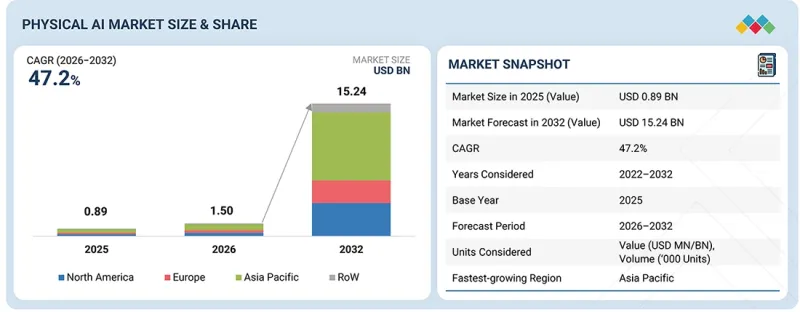
The global physical AI market is projected to reach USD 1.50 billion in 2026 and USD 15.24 billion by 2032, exhibiting a CAGR of 47.2% during the forecast period. The physical AI market is driven by the increasing adoption of autonomous robotics across manufacturing, logistics, and healthcare to improve efficiency and reduce labor dependency.
| Scope of the Report | |
|---|---|
| Years Considered for the Study | 2021-2032 |
| Base Year | 2025 |
| Forecast Period | 2026-2032 |
| Units Considered | Value (USD Billion) |
| Segments | By Offering, Robot Type, Vertical and Region |
| Regions covered | North America, Europe, APAC, RoW |
Advancements in AI compute, sensor fusion, and real-time processing enable robots to operate in complex, dynamic environments. Rising investments in humanoid robotics, digital twins, and AI platforms are boosting innovation and deployment. Additionally, the mounting demand for human-robot collaboration, scalable automation, and improved safety is further supporting market expansion across diverse industries.
"Industrial robots segment to register a high CAGR during the forecast period"
Industrial robots are projected to register a strong CAGR in the physical AI market, supported by the rapid shift toward intelligent and flexible manufacturing systems. Enterprises are increasingly deploying AI-enabled robots to enable dynamic task execution, real-time quality inspection, and autonomous workflow optimization. The growing emphasis on mass customization and shorter product lifecycles is driving the demand for robots that can quickly adapt to changing production requirements. Furthermore, advancements in human-robot collaboration, edge computing, and digital twins are enhancing operational efficiency and reducing deployment complexity. As industries continue to modernize and digitize their operations, industrial robots are emerging as a critical component of scalable and future-ready manufacturing ecosystems.
"Level 2: Intermediate (learning & adaptation) segment captured the largest market share in 2025"
Level 2 intermediate (learning & adaptation) autonomy is expected to hold the largest market share in 2025, as it offers a balanced combination of automation and human oversight. These systems can perform tasks such as navigation, object handling, and basic decision-making while still requiring human supervision for complex scenarios. This level of autonomy is widely adopted across industrial and service robotics due to its reliability, lower deployment risk, and ease of integration with existing workflows. Enterprises prefer Level 2 systems as they provide immediate productivity gains without requiring full infrastructure transformation. Additionally, the availability of mature technologies, such as computer vision, edge AI, and sensor fusion, supports widespread adoption. As a result, Level 2 autonomy remains the most commercially viable and scalable segment in the current market landscape.
"North America to hold a significant share of the physical AI market in 2032"
North America is expected to hold a significant share of the physical AI market in 2032, driven by the early adoption of advanced technologies and strong investment in AI and robotics. The region has a well-established ecosystem comprising AI technology providers, robotics companies, and system integrators, supporting rapid innovation and deployment. Industries such as manufacturing, logistics, healthcare, and retail are actively adopting physical AI solutions to enhance efficiency and automation. The presence of leading technology firms, strong R&D capabilities, and advanced cloud and computing infrastructure further strengthens market growth. Additionally, increasing focus on automation, labor optimization, and digital transformation initiatives is driving demand. Supportive government policies and funding for AI innovation also contribute to North America's strong market position.
Extensive primary interviews were conducted with key industry experts in the physical AI market to determine and verify the market size for various segments and subsegments gathered through secondary research. The breakdown of primary participants for the report is shown below.
The study contains insights from various industry experts, from component suppliers to Tier 1 companies and OEMs. The break-up of the primaries is as follows:
- By Company Type: Tier 1-20%, Tier 2-40%, and Tier 3-40%
- By Designation: C-level Executives-20%, Directors-30%, and Others-50%
- By Region: North America-20%, Europe-30%, Asia Pacific-40%, and RoW-10%
The physical AI market is dominated by a few globally established players, such as NVIDIA Corporation (US), Moog (US), Festo (Germany), Qualcomm Technologies, Inc. (US), STMicroelectronics (Switzerland), Advanced Micro Devices, Inc. (US), Sony Semiconductor Solutions Corporation (Japan), Texas Instruments Incorporated (US), Intel Corporation (US), SK HYNIX INC. (South Korea), Hesai Group (China), Bosch Sensortec GmbH (Germany), and ABB (Switzerland).
The study includes an in-depth competitive analysis of these key players in the physical AI market, with their company profiles, recent developments, and key market strategies.
Research Coverage:
The report segments the physical AI market based on offering (hardware, software, and services), robot type (industrial robots, professional service robots, and personal & household robots), level of autonomy (level 1: basic, level 2: intermediate, and level 3: advanced), and vertical (industrial automation, automotive, logistics & supply chain, defense & security, healthcare, retail, education, and other verticals). It also discusses the market's drivers, restraints, opportunities, and challenges. It gives a detailed view of the market across four main regions (North America, Europe, the Asia Pacific, and RoW). The report includes an ecosystem analysis of key players.
Key Benefits of Buying the Report:
- Analysis of key drivers (rising adoption of autonomous robotics across industrial and logistics sectors, advancements in edge AI compute, sensor fusion, and real-time processing capabilities, growing demand for human-robot collaboration enabled by physical AI systems), restraints (high upfront investment requirements and extended hardware replacement cycles, complex and unpredictable real-world environments limiting large-scale robot deployment), opportunities (integration of physical AI into defense modernization and autonomous security infrastructure, expansion of physical AI robotics in healthcare and medical assistance, deployment of AI-enabled agricultural and construction robotics in emerging economies, growth of digital twin and simulation platforms for training physical AI systems), challenges (lack of interoperability and standardization across multi-vendor robotics ecosystems, complexity in real-time multimodal perception and decision-making, limited availability of large-scale training datasets for physical task learning)
- Product Development/Innovation: Detailed insights into upcoming technologies, research and development activities, and launches in the physical AI market
- Market Development: Comprehensive information about lucrative markets through the analysis of the physical AI market across varied regions
- Market Diversification: Exhaustive information about new products, software, and services, untapped geographies, recent developments, and investments in the physical AI market
- Competitive Assessment: In-depth assessment of market shares, growth strategies, and product offerings of leading players, such as NVIDIA Corporation (US), Qualcomm Technologies, Inc. (US), Sony Semiconductor Solutions Corporation (Japan), Texas Instruments Incorporated (US), STMicroelectronics (Switzerland), and ABB (Switzerland)
TABLE OF CONTENTS
1 INTRODUCTION
- 1.1 STUDY OBJECTIVES
- 1.2 MARKET DEFINITION
- 1.3 STUDY SCOPE
- 1.3.1 MARKETS COVERED AND REGIONAL SCOPE
- 1.3.2 INCLUSIONS AND EXCLUSIONS
- 1.3.3 YEARS CONSIDERED
- 1.4 CURRENCY CONSIDERED
- 1.5 UNIT CONSIDERED
- 1.6 STAKEHOLDERS
2 EXECUTIVE SUMMARY
- 2.1 MARKET HIGHLIGHTS AND KEY INSIGHTS
- 2.2 KEY MARKET PARTICIPANTS: MAPPING OF STRATEGIC DEVELOPMENTS
- 2.3 DISRUPTIVE TRENDS IN PHYSICAL AI MARKET
- 2.4 HIGH-GROWTH SEGMENTS
- 2.5 REGIONAL SNAPSHOT: MARKET SIZE, GROWTH RATE, AND FORECAST
3 PREMIUM INSIGHTS
- 3.1 ATTRACTIVE OPPORTUNITIES FOR PLAYERS IN PHYSICAL AI MARKET
- 3.2 PHYSICAL AI MARKET, BY OFFERING
- 3.3 PHYSICAL AI MARKET, BY ROBOT TYPE
- 3.4 PHYSICAL AI MARKET, BY LEVEL OF AUTONOMY
- 3.5 PHYSICAL AI MARKET, BY VERTICAL
- 3.6 PHYSICAL AI MARKET, BY REGION
- 3.7 PHYSICAL AI MARKET, BY COUNTRY
4 MARKET OVERVIEW
- 4.1 INTRODUCTION
- 4.2 MARKET DYNAMICS
- 4.2.1 DRIVERS
- 4.2.1.1 Increasing deployment of autonomous robots across manufacturing and logistics operations
- 4.2.1.2 Advances in edge AI infrastructure and computing platforms
- 4.2.1.3 Growing need for safe human-robot interaction
- 4.2.2 RESTRAINTS
- 4.2.2.1 High upfront investment and extended hardware replacement cycles of physical AI robots
- 4.2.2.2 Complex and unpredictable real-world environments limiting large-scale physical AI deployment
- 4.2.3 OPPORTUNITIES
- 4.2.3.1 Integration of physical AI technologies into defense modernization programs and autonomous security infrastructure
- 4.2.3.2 Expansion of physical AI robotics in healthcare and medical assistance
- 4.2.3.3 Deployment of AI-enabled robots in agricultural and construction sectors in emerging economies
- 4.2.3.4 Use of digital twin platforms for simulation-driven robotic development
- 4.2.4 CHALLENGES
- 4.2.4.1 Interoperability and standardization issues across multi-vendor robotics ecosystems
- 4.2.4.2 Complexities associated with multi-sensory data integration for real-time decision-making
- 4.2.4.3 Limited availability of large-scale, high-quality datasets to train robots on complex tasks
- 4.2.1 DRIVERS
- 4.3 INTERCONNECTED MARKETS AND CROSS-SECTOR OPPORTUNITIES
- 4.4 STRATEGIC MOVES BY TIER 1/2/3 PLAYERS
5 INDUSTRY TRENDS
- 5.1 INTRODUCTION
- 5.2 PORTER'S FIVE FORCES ANALYSIS
- 5.2.1 INTENSITY OF COMPETITIVE RIVALRY
- 5.2.2 BARGAINING POWER OF SUPPLIERS
- 5.2.3 BARGAINING POWER OF BUYERS
- 5.2.4 THREAT OF SUBSTITUTES
- 5.2.5 THREAT OF NEW ENTRANTS
- 5.3 MACROECONOMIC OUTLOOK
- 5.3.1 INTRODUCTION
- 5.3.2 GDP TRENDS AND FORECAST
- 5.3.3 TRENDS IN INDUSTRIAL AUTOMATION VERTICAL
- 5.3.4 TRENDS IN HEALTHCARE VERTICAL
- 5.4 VALUE CHAIN ANALYSIS
- 5.5 ECOSYSTEM ANALYSIS
- 5.6 PRICING ANALYSIS
- 5.6.1 AVERAGE SELLING PRICE OF PROCESSING & COMPUTE HARDWARE OFFERINGS, BY KEY PLAYER, 2025
- 5.6.2 AVERAGE SELLING PRICE OF PROCESSING & COMPUTE HARDWARE OFFERINGS, BY REGION, 2025
- 5.6.2.1 Average selling price of GPUs, by region, 2025
- 5.6.2.2 Average selling price of SOCs, by region, 2025
- 5.6.2.3 Average selling price of memory, by region, 2025
- 5.7 TRADE ANALYSIS
- 5.7.1 IMPORT SCENARIO (HS CODE 854231)
- 5.7.2 EXPORT SCENARIO (HS CODE 854231)
- 5.8 KEY CONFERENCES AND EVENTS, 2026-2027
- 5.9 TRENDS/DISRUPTIONS IMPACTING CUSTOMER BUSINESS
- 5.10 INVESTMENT AND FUNDING SCENARIO
- 5.11 CASE STUDY ANALYSIS
- 5.11.1 BMW IMPROVES AUTOMOTIVE ASSEMBLY EFFICIENCY USING FIGURE 02 HUMANOID ROBOTS
- 5.11.2 AMAZON ENHANCES FULFILLMENT EFFICIENCY AND WORKPLACE SAFETY USING SEQUOIA AND DIGIT ROBOTS
- 5.11.3 WURTH IMPROVES WAREHOUSE EFFICIENCY AND ORDER FULFILLMENT USING AI-POWERED PICK-IT-EASY ROBOTS
- 5.12 IMPACT OF US TARIFFS - PHYSICAL AI MARKET
- 5.12.1 INTRODUCTION
- 5.12.2 KEY TARIFF RATES
- 5.12.3 PRICE IMPACT ANALYSIS
- 5.12.4 IMPACT ON VARIOUS COUNTRIES/REGIONS
- 5.12.4.1 US
- 5.12.4.2 Europe
- 5.12.4.3 Asia Pacific
- 5.12.5 IMPACT ON VERTICALS
6 TECHNOLOGICAL ADVANCEMENTS, AI-DRIVEN IMPACT, PATENTS, AND INNOVATIONS
- 6.1 KEY TECHNOLOGIES
- 6.1.1 EDGE AI AND EMBEDDED INFERENCE
- 6.1.2 COMPUTER VISION AND PERCEPTION
- 6.1.3 MOTION PLANNING AND CONTROL ALGORITHMS
- 6.1.4 REINFORCEMENT LEARNING AND IMITATION LEARNING
- 6.1.5 SENSOR FUSION
- 6.2 COMPLEMENTARY TECHNOLOGIES
- 6.2.1 HUMAN-ROBOT INTERACTION
- 6.2.2 DIGITAL TWINS AND PHYSICS SIMULATION
- 6.2.3 SYNTHETIC DATA GENERATION
- 6.3 ADJACENT TECHNOLOGIES
- 6.3.1 INDUSTRIAL AUTOMATION AND ROBOTICS
- 6.3.2 SOFTWARE-BASED AI AND PROCESS AUTOMATION
- 6.3.3 SMART SENSOR NETWORKS AND IOT SYSTEMS
- 6.4 TECHNOLOGY/PRODUCT ROADMAP
- 6.4.1 SHORT-TERM (2026-2028) | PERCEPTION-LED AUTOMATION AND CONTROL OPTIMIZATION
- 6.4.2 MID-TERM (2028-2031) | ADAPTIVE BEHAVIOR AND MULTI-MODAL INTELLIGENCE
- 6.4.3 LONG-TERM (2031-2036+) | GENERALIZED PHYSICAL INTELLIGENCE AND AUTONOMOUS SYSTEMS
- 6.5 PATENT ANALYSIS
7 REGULATORY LANDSCAPE
- 7.1 REGIONAL REGULATIONS AND COMPLIANCE
- 7.1.1 REGULATORY BODIES, GOVERNMENT AGENCIES, AND OTHER ORGANIZATIONS
- 7.1.2 INDUSTRY STANDARDS
- 7.1.2.1 ISO 10218 - Industrial Robot Safety Standard
- 7.1.2.2 ISO/TS 15066 - Collaborative Robot (Cobot) Safety
- 7.1.2.3 ISO 13482 - Service Robot Safety
- 7.1.2.4 IEC 61508 - Functional Safety of Electrical/Electronic Systems
- 7.1.2.5 IEEE 1872 - Ontologies for Robotics and Automation
- 7.1.2.6 ISO 8373 - Robotics Vocabulary
- 7.1.2.7 UL 4600 - Safety for Autonomous Products
- 7.1.2.8 IEEE 7000 Series - Ethical AI System Design
- 7.1.3 GOVERNMENT REGULATIONS
- 7.1.3.1 North America
- 7.1.3.1.1 California Consumer Privacy Act (CCPA) and California Privacy Rights Act (CPRA)
- 7.1.3.1.2 Artificial Intelligence and Data Act (AIDA)
- 7.1.3.1.3 Algorithmic Accountability Act (AAA)
- 7.1.3.2 Europe
- 7.1.3.2.1 European Union Artificial Intelligence Act (EU AI Act)
- 7.1.3.2.2 Machinery Regulation (EU) 2023/1230
- 7.1.3.2.3 General Data Protection Regulation (GDPR)
- 7.1.3.2.4 Radio Equipment Directive (RED)
- 7.1.3.2.5 Network and Information Security (NIS2) Directive
- 7.1.3.2.6 General Data Protection Regulation (GDPR)
- 7.1.3.2.7 Artificial Intelligence (AI) Act
- 7.1.3.2.8 EU Cybersecurity Act
- 7.1.3.3 Asia Pacific
- 7.1.3.3.1 Personal Information Protection Law (PIPL)
- 7.1.3.3.2 Protection of Personal Information (APPI)
- 7.1.3.3.3 Intelligent Robots Development and Distribution Promotion Act
- 7.1.3.3.4 Digital Personal Data Protection (DPDP) Act
- 7.1.3.4 RoW
- 7.1.3.4.1 Brazilian General Data Protection Law (LGPD)
- 7.1.3.4.2 Protection of Personal Information Act (POPIA)
- 7.1.3.1 North America
8 CUSTOMER LANDSCAPE AND BUYER BEHAVIOR
- 8.1 DECISION-MAKING PROCESS
- 8.2 KEY STAKEHOLDERS INVOLVED IN BUYING PROCESS AND THEIR EVALUATION CRITERIA
- 8.2.1 KEY STAKEHOLDERS IN BUYING PROCESS
- 8.2.2 BUYING CRITERIA
- 8.3 ADOPTION BARRIERS AND INTERNAL CHALLENGES
- 8.4 UNMET NEEDS OF VARIOUS VERTICALS
9 PHYSICAL AI MARKET, BY OFFERING
- 9.1 INTRODUCTION
- 9.2 HARDWARE
- 9.2.1 PROCESSING & COMPUTE HARDWARE
- 9.2.1.1 GPUs
- 9.2.1.1.1 Rising need for real-time, high-performance computing to bolster segmental growth
- 9.2.1.2 SoCs
- 9.2.1.2.1 Mounting demand for edge-native AI processing to contribute to segmental growth
- 9.2.1.3 DSPs
- 9.2.1.3.1 Requirement for low-latency, power-efficient processing of continuous sensor data streams to spur demand
- 9.2.1.4 Memory
- 9.2.1.4.1 Increasing data intensity and computational demands of physical AI systems to fuel segmental growth
- 9.2.1.5 FPGAs
- 9.2.1.5.1 Strong focus on real-time adaptability and processing performance in physical AI deployments to drive market
- 9.2.1.6 ASICs
- 9.2.1.6.1 Growing emphasis on customized, energy-efficient AI acceleration to accelerate segmental growth
- 9.2.1.1 GPUs
- 9.2.2 SENSORS
- 9.2.2.1 Image sensors
- 9.2.2.1.1 Mounting demand for vision-based autonomy and multimodal perception in physical AI systems to foster segmental growth
- 9.2.2.2 LiDAR
- 9.2.2.2.1 Rising need for high-precision 3D perception and scalable sensing solutions to augment segmental growth
- 9.2.2.3 Radar sensors
- 9.2.2.3.1 High emphasis on all-weather perception and enhanced safety in autonomous systems to boost segmental growth
- 9.2.2.4 Ultrasonic sensors
- 9.2.2.4.1 Mounting demand for cost-effective, energy-efficient, and reliable short-range sensing to expedite segmental growth
- 9.2.2.5 IMUs
- 9.2.2.5.1 Increasing mobility and autonomy of physical AI systems to contribute to segmental growth
- 9.2.2.6 Encoders
- 9.2.2.6.1 Mounting adoption of multi-axis robotic systems to bolster segmental growth
- 9.2.2.7 Force & torque sensors
- 9.2.2.7.1 High emphasis on adaptive, safe, and high-precision robotic operations to augment segmental growth
- 9.2.2.8 Tactile & pressure sensors
- 9.2.2.8.1 Strong focus on human-like dexterity and touch-based interaction to facilitate segmental growth
- 9.2.2.1 Image sensors
- 9.2.3 ACTUATORS
- 9.2.3.1 High precision, responsiveness, and energy efficiency to accelerate segmental growth
- 9.2.3.2 Electric
- 9.2.3.3 Hydraulic
- 9.2.3.4 Pneumatic
- 9.2.1 PROCESSING & COMPUTE HARDWARE
- 9.3 SOFTWARE
- 9.3.1 RISING NEED FOR SCALABLE, FLEXIBLE, AND SIMULATION-DRIVEN DEVELOPMENT OF AUTONOMOUS SYSTEMS TO FUEL SEGMENTAL GROWTH
- 9.3.2 PLATFORMS
- 9.3.2.1 Robot operating systems
- 9.3.2.2 AI model development platforms
- 9.3.2.3 Simulation & digital twin platforms
- 9.3.2.4 Fleet & device management platforms
- 9.3.2.5 Edge AI runtime infrastructure
- 9.3.3 APPLICATIONS
- 9.3.3.1 Perception intelligence
- 9.3.3.2 Navigation & planning intelligence
- 9.3.3.3 Manipulation & control intelligence
- 9.3.3.4 Cognitive & reasoning AI
- 9.3.3.5 Human-machine interaction
- 9.3.3.6 Functional safety algorithms
- 9.4 SERVICES
- 9.4.1 GROWING COMPLEXITY OF MULTI-SYSTEM INTEGRATION AND DEMAND FOR AUTOMATION TO EXPEDITE SEGMENTAL GROWTH
- 9.4.2 PROFESSIONAL
- 9.4.3 MANAGED
10 PHYSICAL AI MARKET, BY ROBOT TYPE
- 10.1 INTRODUCTION
- 10.2 INDUSTRIAL ROBOTS
- 10.2.1 RISING NEED FOR EFFICIENCY AND PRECISION IN INDUSTRIAL OPERATIONS AMID LABOR SHORTAGES TO FUEL SEGMENTAL GROWTH
- 10.2.2 INDUSTRIAL HUMANOIDS
- 10.2.3 COBOTS
- 10.2.4 AUTONOMOUS MOBILE ROBOTS
- 10.2.5 INSPECTION & MONITORING ROVERS
- 10.3 PROFESSIONAL SERVICE ROBOTS
- 10.3.1 HIGH INTEGRATION OF MULTIMODAL AI, EDGE COMPUTING, AND REAL-TIME ANALYTICS TO BOLSTER SEGMENTAL GROWTH
- 10.3.2 PROFESSIONAL HUMANOIDS
- 10.3.3 DELIVERY ROBOTS
- 10.3.4 MEDICAL ROBOTS
- 10.3.5 COMMERCIAL CLEANING ROBOTS
- 10.3.6 HOSPITALITY ROBOTS
- 10.3.7 SECURITY ROBOTS
- 10.3.8 AGRICULTURAL ROBOTS
- 10.3.9 CONSTRUCTION ROBOTS
- 10.4 PERSONAL & HOUSEHOLD ROBOTS
- 10.4.1 HIGH EMPHASIS ON CONVENIENCE, PERSONALIZED SUPPORT, AND INTERACTIVE ASSISTANCE TO EXPEDITE SEGMENTAL GROWTH
11 PHYSICAL AI MARKET, BY LEVEL OF AUTONOMY
- 11.1 INTRODUCTION
- 11.2 LEVEL 1: BASIC
- 11.2.1 HIGH PREFERENCE FOR COST-EFFECTIVE AND SCALABLE AUTOMATION SOLUTIONS TO EXPEDITE SEGMENTAL GROWTH
- 11.3 LEVEL 2: INTERMEDIATE
- 11.3.1 RISING ADOPTION IN ENVIRONMENTS DEMANDING ADAPTABILITY, PERCEPTION, AND REAL-TIME DECISION-MAKING TO DRIVE MARKET
- 11.4 LEVEL 3: ADVANCED
- 11.4.1 RAPID INTRODUCTION OF NEXT-GEN AI MODELS ENABLING REAL-WORLD REASONING AND ACTION TO AUGMENT SEGMENTAL GROWTH
12 PHYSICAL AI MARKET, BY VERTICAL
- 12.1 INTRODUCTION
- 12.2 INDUSTRIAL AUTOMATION
- 12.2.1 RAPID EVOLUTION OF INTELLIGENT ROBOTICS AND AI-DRIVEN PLATFORMS TO ACCELERATE SEGMENTAL GROWTH
- 12.3 AUTOMOTIVE
- 12.3.1 INCREASING INVESTMENT IN AI-DRIVEN ROBOTICS, DIGITAL TWINS, AND DATA-CENTRIC MANUFACTURING TO FOSTER SEGMENTAL GROWTH
- 12.4 LOGISTICS & SUPPLY CHAIN
- 12.4.1 GROWING PRESSURE TO REDUCE LABOR DEPENDENCY AND OPERATIONAL COSTS TO AUGMENT SEGMENTAL GROWTH
- 12.5 DEFENSE & SECURITY
- 12.5.1 HIGH EMPHASIS ON REAL-TIME SITUATIONAL AWARENESS, AUTONOMOUS OPERATIONS, AND ENHANCED DECISION-MAKING TO FUEL SEGMENTAL GROWTH
- 12.6 HEALTHCARE
- 12.6.1 RISING DEPLOYMENT OF AI-POWERED SURGICAL ROBOTICS AND PATIENT-CENTRIC AUTOMATION TO BOOST SEGMENTAL GROWTH
- 12.7 RETAIL
- 12.7.1 INCREASING INVESTMENT IN WAREHOUSE AUTOMATION AND CUSTOMER INTERACTION TECHNOLOGIES TO EXPEDITE SEGMENTAL GROWTH
- 12.8 EDUCATION
- 12.8.1 RISING ADOPTION OF SOCIAL ROBOTS AND SIMULATION-BASED LEARNING TO CONTRIBUTE TO SEGMENTAL GROWTH
- 12.9 OTHER VERTICALS
13 PHYSICAL AI MARKET, BY REGION
- 13.1 INTRODUCTION
- 13.2 NORTH AMERICA
- 13.2.1 US
- 13.2.1.1 Increasing investment in robotics, autonomous systems, and AI-enabled hardware to foster market growth
- 13.2.2 CANADA
- 13.2.2.1 Rising implementation of AI research programs and smart manufacturing initiatives to boost market growth
- 13.2.3 MEXICO
- 13.2.3.1 Robust manufacturing sector and expanding logistics infrastructure to accelerate market growth
- 13.2.1 US
- 13.3 EUROPE
- 13.3.1 UK
- 13.3.1.1 Mounting adoption of intelligent machines across industrial sectors to accelerate market growth
- 13.3.2 GERMANY
- 13.3.2.1 Growing reliance on Industry 4.0 technologies to contribute to market growth
- 13.3.3 FRANCE
- 13.3.3.1 High investment in intelligent automation technologies to foster market growth
- 13.3.4 ITALY
- 13.3.4.1 Rising automotive production, industrial machinery, and advanced manufacturing to bolster market growth
- 13.3.5 REST OF EUROPE
- 13.3.1 UK
- 13.4 ASIA PACIFIC
- 13.4.1 CHINA
- 13.4.1.1 Rising deployment of robotics platforms and intelligent machines to boost market growth
- 13.4.2 JAPAN
- 13.4.2.1 Strong industrial automation ecosystem and early adoption of intelligent machines to expedite market growth
- 13.4.3 INDIA
- 13.4.3.1 Rapid industrialization and adoption of automation technologies to contribute to market growth
- 13.4.4 SOUTH KOREA
- 13.4.4.1 Rising integration of AI-enabled automation technologies to augment segmental growth
- 13.4.5 REST OF ASIA PACIFIC
- 13.4.1 CHINA
- 13.5 ROW
- 13.5.1 MIDDLE EAST & AFRICA
- 13.5.1.1 Large-scale investments in AI, industrial automation, and smart infrastructure to fuel market growth
- 13.5.1.2 GCC countries
- 13.5.1.3 Africa & Rest of Middle East
- 13.5.2 SOUTH AMERICA
- 13.5.2.1 Strong focus on digital transformation to contribute to market growth
- 13.5.1 MIDDLE EAST & AFRICA
14 COMPETITIVE LANDSCAPE
- 14.1 OVERVIEW
- 14.2 KEY PLAYER COMPETITIVE STRATEGIES/RIGHT TO WIN, 2022-2026
- 14.3 REVENUE ANALYSIS, 2021-2025
- 14.4 MARKET SHARE ANALYSIS, 2025
- 14.5 COMPANY VALUATION AND FINANCIAL METRICS
- 14.6 BRAND COMPARISON
- 14.7 COMPANY EVALUATION MATRIX: KEY PLAYERS, 2025 (HARDWARE AND SOFTWARE)
- 14.7.1 STARS
- 14.7.2 EMERGING LEADERS
- 14.7.3 PERVASIVE PLAYERS
- 14.7.4 PARTICIPANTS
- 14.8 COMPANY EVALUATION MATRIX: KEY PLAYERS: 2025 (HUMANOID ROBOTS)
- 14.8.1 STARS
- 14.8.2 EMERGING LEADERS
- 14.8.3 PERVASIVE PLAYERS
- 14.8.4 PARTICIPANTS
- 14.8.5 COMPANY FOOTPRINT: KEY PLAYERS, 2025
- 14.8.5.1 Company footprint
- 14.8.5.2 Region footprint
- 14.8.5.3 Offering footprint
- 14.8.5.4 Robot type footprint
- 14.8.5.5 Vertical footprint
- 14.9 COMPANY EVALUATION MATRIX: STARTUPS/SMES, 2025
- 14.9.1 PROGRESSIVE COMPANIES
- 14.9.2 RESPONSIVE COMPANIES
- 14.9.3 DYNAMIC COMPANIES
- 14.9.4 STARTING BLOCKS
- 14.9.5 COMPETITIVE BENCHMARKING: STARTUPS/SMES, 2025
- 14.9.5.1 Detailed list of key startups/SMEs
- 14.9.5.2 Competitive benchmarking of key startups/SMEs
- 14.10 COMPETITIVE SCENARIO
- 14.10.1 PRODUCT LAUNCHES
- 14.10.2 DEALS
15 COMPANY PROFILES
- 15.1 KEY PLAYERS
- 15.1.1 NVIDIA CORPORATION
- 15.1.1.1 Business overview
- 15.1.1.2 Products/Solutions/Services offered
- 15.1.1.3 Recent developments
- 15.1.1.3.1 Product launches
- 15.1.1.3.2 Deals
- 15.1.1.4 MnM view
- 15.1.1.4.1 Key strengths/Right to win
- 15.1.1.4.2 Strategic choices
- 15.1.1.4.3 Weaknesses/Competitive threats
- 15.1.2 ABB
- 15.1.2.1 Business overview
- 15.1.2.2 Products/Solutions/Services offered
- 15.1.2.3 Recent developments
- 15.1.2.3.1 Deals
- 15.1.2.4 MnM view
- 15.1.2.4.1 Key strengths/Right to win
- 15.1.2.4.2 Strategic choices
- 15.1.2.4.3 Weaknesses/Competitive threats
- 15.1.3 QUALCOMM TECHNOLOGIES, INC.
- 15.1.3.1 Business overview
- 15.1.3.2 Products/Solutions/Services offered
- 15.1.3.3 Recent developments
- 15.1.3.3.1 Product launches
- 15.1.3.3.2 Deals
- 15.1.3.4 MnM view
- 15.1.3.4.1 Key strengths/Right to win
- 15.1.3.4.2 Strategic choices
- 15.1.3.4.3 Weaknesses/Competitive threats
- 15.1.4 MOOG INC.
- 15.1.4.1 Business overview
- 15.1.4.2 Products/Solutions/Services offered
- 15.1.4.3 Recent developments
- 15.1.4.3.1 Deals
- 15.1.4.4 MnM view
- 15.1.4.4.1 Key strengths/Right to win
- 15.1.4.4.2 Strategic choices
- 15.1.4.4.3 Weaknesses/Competitive threats
- 15.1.5 FESTO
- 15.1.5.1 Business overview
- 15.1.5.2 Products/Solutions/Services offered
- 15.1.5.3 Recent developments
- 15.1.5.3.1 Product launches
- 15.1.5.3.2 Deals
- 15.1.5.4 MnM view
- 15.1.5.4.1 Key strengths/Right to win
- 15.1.5.4.2 Strategic choices
- 15.1.5.4.3 Weaknesses/Competitive threats
- 15.1.6 TEXAS INSTRUMENTS INCORPORATED
- 15.1.6.1 Business overview
- 15.1.6.2 Products/Solutions/Services offered
- 15.1.6.3 Recent developments
- 15.1.6.3.1 Product launches
- 15.1.6.3.2 Deals
- 15.1.7 STMICROELECTRONICS
- 15.1.7.1 Business overview
- 15.1.7.2 Products/Solutions/Services offered
- 15.1.7.3 Recent developments
- 15.1.7.3.1 Product launches
- 15.1.7.3.2 Deals
- 15.1.8 SK HYNIX INC.
- 15.1.8.1 Business overview
- 15.1.8.2 Products/Solutions/Services offered
- 15.1.8.3 Recent developments
- 15.1.8.3.1 Product launches
- 15.1.8.3.2 Deals
- 15.1.9 INFINEON TECHNOLOGIES AG
- 15.1.9.1 Business overview
- 15.1.9.2 Products/Solutions/Services offered
- 15.1.9.3 Recent developments
- 15.1.9.3.1 Product launches
- 15.1.9.3.2 Deals
- 15.1.10 BOSCH SENSORTEC GMBH
- 15.1.10.1 Business overview
- 15.1.10.2 Products/Solutions/Services offered
- 15.1.10.3 Recent developments
- 15.1.10.3.1 Product launches
- 15.1.10.3.2 Deals
- 15.1.1 NVIDIA CORPORATION
- 15.2 OTHER PLAYERS
- 15.2.1 ADVANCED MICRO DEVICES, INC.
- 15.2.2 NXP SEMICONDUCTORS
- 15.2.3 SAMSUNG
- 15.2.4 MICRON TECHNOLOGY, INC.
- 15.2.5 HORIZON ROBOTICS
- 15.2.6 TESLA
- 15.2.7 UNIVERSAL ROBOTS A/S
- 15.2.8 SOFTBANK ROBOTICS GROUP
- 15.2.9 BOSTON DYNAMICS
- 15.2.10 UBTECH ROBOTICS CORP LTD.
- 15.2.11 TOYOTA MOTOR CORPORATION
- 15.2.12 FIGURE 305 15.2.13 AGILITY ROBOTICS
- 15.2.14 NEURA ROBOTICS GMBH
- 15.2.15 AGIBOT INNOVATION (SHANGHAI) TECHNOLOGY CO., LTD.
- 15.2.16 SANCTUARY COGNITIVE SYSTEMS CORPORATION
- 15.2.17 UNITREE ROBOTICS
- 15.2.18 DEXTERITY, INC.
- 15.2.19 ANYBOTICS
- 15.2.20 PHYSICAL INTELLIGENCE
- 15.2.21 SIMA TECHNOLOGIES, INC.
- 15.2.22 SKILD AI
16 RESEARCH METHODOLOGY
- 16.1 RESEARCH DATA
- 16.1.1 SECONDARY DATA
- 16.1.1.1 List of key secondary sources
- 16.1.1.2 Key data from secondary sources
- 16.1.2 PRIMARY DATA
- 16.1.2.1 List of primary interview participants
- 16.1.2.2 Breakdown of primary interviews
- 16.1.2.3 Key data from primary sources
- 16.1.2.4 Key industry insights
- 16.1.3 SECONDARY AND PRIMARY RESEARCH
- 16.1.1 SECONDARY DATA
- 16.2 MARKET SIZE ESTIMATION
- 16.2.1 BOTTOM-UP APPROACH
- 16.2.1.1 Approach to arrive at market size using bottom-up analysis (supply side)
- 16.2.2 TOP-DOWN APPROACH
- 16.2.2.1 Approach to arrive at market size using top-down analysis (demand side)
- 16.2.1 BOTTOM-UP APPROACH
- 16.3 DATA TRIANGULATION
- 16.4 RESEARCH ASSUMPTIONS
- 16.5 RESEARCH LIMITATIONS
- 16.6 RISK ANALYSIS
17 APPENDIX
- 17.1 DISCUSSION GUIDE
- 17.2 KNOWLEDGESTORE: MARKETSANDMARKETS' SUBSCRIPTION PORTAL
- 17.3 CUSTOMIZATION OPTIONS
- 17.4 RELATED REPORTS
- 17.5 AUTHOR DETAILS
List of Tables
- TABLE 1 PHYSICAL AI MARKET: INCLUSIONS AND EXCLUSIONS
- TABLE 2 STRATEGIC MOVES AND FOCUS OF KEY COMPANIES IN PHYSICAL AI MARKET
- TABLE 3 PHYSICAL AI MARKET: IMPACT OF PORTER'S FIVE FORCES
- TABLE 4 GDP PERCENTAGE CHANGE, BY KEY COUNTRY, 2021-2030
- TABLE 5 ROLE OF PLAYERS IN PHYSICAL AI ECOSYSTEM
- TABLE 6 AVERAGE SELLING PRICE OF PROCESSING & COMPUTE HARDWARE OFFERINGS PROVIDED BY KEY PLAYERS, 2025 (USD)
- TABLE 7 AVERAGE SELLING PRICE OF GPUS, BY REGION, 2025 (USD)
- TABLE 8 AVERAGE SELLING PRICE OF SOCS, BY REGION, 2025 (USD)
- TABLE 9 AVERAGE SELLING PRICE OF MEMORY, BY REGION, 2025 (USD)
- TABLE 10 IMPORT DATA FOR HS CODE 854231-COMPLIANT PRODUCTS, BY COUNTRY, 2020-2024 (USD MILLION)
- TABLE 11 EXPORT DATA FOR HS CODE 854231-COMPLIANT PRODUCTS, BY COUNTRY, 2020-2024 (USD MILLION)
- TABLE 12 MAJOR CONFERENCES AND EVENTS, 2026-2027
- TABLE 13 HUMANOID ROBOT DEPLOYMENT IN BMW AUTOMOTIVE ASSEMBLY OPERATIONS
- TABLE 14 ROBOTICS INTEGRATION IN AMAZON FULFILLMENT CENTERS
- TABLE 15 AI-POWERED ROBOTIC AUTOMATION IN WURTH WAREHOUSE OPERATIONS
- TABLE 16 US-ADJUSTED RECIPROCAL TARIFF RATES
- TABLE 17 LIST OF APPLIED/GRANTED PATENTS RELATED TO PHYSICAL AI, APRIL 2023-AUGUST 2025
- TABLE 18 NORTH AMERICA: REGULATORY BODIES, GOVERNMENT AGENCIES, AND OTHER ORGANIZATIONS
- TABLE 19 EUROPE: REGULATORY BODIES, GOVERNMENT AGENCIES, AND OTHER ORGANIZATIONS
- TABLE 20 ASIA PACIFIC: REGULATORY BODIES, GOVERNMENT AGENCIES, AND OTHER ORGANIZATIONS
- TABLE 21 ROW: REGULATORY BODIES, GOVERNMENT AGENCIES, AND OTHER ORGANIZATIONS
- TABLE 22 INFLUENCE OF STAKEHOLDERS ON BUYING PROCESS, BY VERTICAL (%)
- TABLE 23 KEY BUYING CRITERIA, BY VERTICAL
- TABLE 24 UNMET NEEDS OF VERTICALS IN PHYSICAL AI MARKET
- TABLE 25 PHYSICAL AI MARKET, BY OFFERING, 2022-2025 (USD MILLION)
- TABLE 26 PHYSICAL AI MARKET, BY OFFERING, 2026-2032 (USD MILLION)
- TABLE 27 HARDWARE: PHYSICAL AI MARKET, BY TYPE, 2022-2025 (THOUSAND UNITS)
- TABLE 28 HARDWARE: PHYSICAL AI MARKET, BY TYPE, 2026-2032 (THOUSAND UNITS)
- TABLE 29 HARDWARE: PHYSICAL AI MARKET, BY TYPE, 2022-2025 (USD MILLION)
- TABLE 30 HARDWARE: PHYSICAL AI MARKET, BY TYPE, 2026-2032 (USD MILLION)
- TABLE 31 HARDWARE: PHYSICAL AI MARKET, BY ROBOT TYPE, 2022-2025 (USD MILLION)
- TABLE 32 HARDWARE: PHYSICAL AI MARKET, BY ROBOT TYPE, 2026-2032 (USD MILLION)
- TABLE 33 PROCESSING & COMPUTE HARDWARE: PHYSICAL AI MARKET, BY TYPE, 2022-2025 (THOUSAND UNITS)
- TABLE 34 PROCESSING & COMPUTE HARDWARE: PHYSICAL AI MARKET, BY TYPE, 2026-2032 (THOUSAND UNITS)
- TABLE 35 PROCESSING & COMPUTE HARDWARE: PHYSICAL AI MARKET, BY TYPE, 2022-2025 (USD MILLION)
- TABLE 36 PROCESSING & COMPUTE HARDWARE: PHYSICAL AI MARKET, BY TYPE, 2026-2032 (USD MILLION)
- TABLE 37 SENSORS: PHYSICAL AI MARKET, BY TYPE, 2022-2025 (THOUSAND UNITS)
- TABLE 38 SENSORS: PHYSICAL AI MARKET, BY TYPE, 2026-2032 (THOUSAND UNITS)
- TABLE 39 SENSORS: PHYSICAL AI MARKET, BY TYPE, 2022-2025 (USD MILLION)
- TABLE 40 SENSORS: PHYSICAL AI MARKET, BY TYPE, 2026-2032 (USD MILLION)
- TABLE 41 SOFTWARE: PHYSICAL AI MARKET, BY ROBOT TYPE, 2022-2025 (USD MILLION)
- TABLE 42 SOFTWARE: PHYSICAL AI MARKET, BY ROBOT TYPE, 2026-2032 (USD MILLION)
- TABLE 43 SERVICES: PHYSICAL AI MARKET, BY ROBOT TYPE, 2022-2025 (USD MILLION)
- TABLE 44 SERVICES: PHYSICAL AI MARKET, BY ROBOT TYPE, 2026-2032 (USD MILLION)
- TABLE 45 PHYSICAL AI MARKET, BY ROBOT TYPE, 2022-2025 (USD MILLION)
- TABLE 46 PHYSICAL AI MARKET, BY ROBOT TYPE, 2026-2032 (USD MILLION)
- TABLE 47 INDUSTRIAL ROBOTS: PHYSICAL AI MARKET, BY REGION, 2022-2025 (USD MILLION)
- TABLE 48 INDUSTRIAL ROBOTS: PHYSICAL AI MARKET, BY REGION, 2026-2032 (USD MILLION)
- TABLE 49 INDUSTRIAL ROBOTS: PHYSICAL AI MARKET, BY VERTICAL, 2022-2025 (USD MILLION)
- TABLE 50 INDUSTRIAL ROBOTS: PHYSICAL AI MARKET, BY VERTICAL, 2026-2032 (USD MILLION)
- TABLE 51 INDUSTRIAL ROBOTS: PHYSICAL AI MARKET, BY OFFERING, 2022-2025 (USD MILLION)
- TABLE 52 INDUSTRIAL ROBOTS: PHYSICAL AI MARKET, BY OFFERING, 2026-2032 (USD MILLION)
- TABLE 53 INDUSTRIAL ROBOTS: PHYSICAL AI MARKET FOR HARDWARE, BY TYPE, 2022-2025 (USD MILLION)
- TABLE 54 INDUSTRIAL ROBOTS: PHYSICAL AI MARKET FOR HARDWARE, BY TYPE, 2026-2032 (USD MILLION)
- TABLE 55 INDUSTRIAL ROBOTS: PHYSICAL AI MARKET FOR PROCESSING & COMPUTE HARDWARE, BY TYPE, 2022-2025 (THOUSAND UNITS)
- TABLE 56 INDUSTRIAL ROBOTS: PHYSICAL AI MARKET FOR PROCESSING & COMPUTE HARDWARE, BY TYPE, 2026-2032 (THOUSAND UNITS)
- TABLE 57 INDUSTRIAL ROBOTS: PHYSICAL AI MARKET FOR PROCESSING & COMPUTE HARDWARE, BY TYPE, 2022-2025 (USD MILLION)
- TABLE 58 INDUSTRIAL ROBOTS: PHYSICAL AI MARKET FOR PROCESSING & COMPUTE HARDWARE, BY TYPE, 2026-2032 (USD MILLION)
- TABLE 59 INDUSTRIAL ROBOTS: PHYSICAL AI MARKET FOR SENSORS, BY TYPE, 2022-2025 (THOUSAND UNITS)
- TABLE 60 INDUSTRIAL ROBOTS: PHYSICAL AI MARKET FOR SENSORS, BY TYPE, 2026-2032 (THOUSAND UNITS)
- TABLE 61 INDUSTRIAL ROBOTS: PHYSICAL AI MARKET FOR SENSORS, BY TYPE, 2022-2025 (USD THOUSAND)
- TABLE 62 INDUSTRIAL ROBOTS: PHYSICAL AI MARKET FOR SENSORS, BY TYPE, 2026-2032 (USD THOUSAND)
- TABLE 63 PROFESSIONAL SERVICE ROBOTS: PHYSICAL AI MARKET, BY REGION, 2022-2025 (USD MILLION)
- TABLE 64 PROFESSIONAL SERVICE ROBOTS: PHYSICAL AI MARKET, BY REGION, 2026-2032 (USD MILLION)
- TABLE 65 PROFESSIONAL SERVICE ROBOTS: PHYSICAL AI MARKET, BY VERTICAL, 2022-2025 (USD MILLION)
- TABLE 66 PROFESSIONAL SERVICE ROBOTS: PHYSICAL AI MARKET, BY VERTICAL, 2026-2032 (USD MILLION)
- TABLE 67 PROFESSIONAL SERVICE ROBOTS: PHYSICAL AI MARKET, BY OFFERING, 2022-2025 (USD MILLION)
- TABLE 68 PROFESSIONAL SERVICE ROBOTS: PHYSICAL AI MARKET, BY OFFERING, 2026-2032 (USD MILLION)
- TABLE 69 PROFESSIONAL SERVICE ROBOTS: PHYSICAL AI MARKET FOR HARDWARE, BY TYPE, 2022-2025 (USD MILLION)
- TABLE 70 PROFESSIONAL SERVICE ROBOTS: PHYSICAL AI MARKET FOR HARDWARE, BY TYPE, 2026-2032 (USD MILLION)
- TABLE 71 PROFESSIONAL SERVICE ROBOTS: PHYSICAL AI MARKET FOR PROCESSING & COMPUTE HARDWARE, BY TYPE, 2022-2025 (THOUSAND UNITS)
- TABLE 72 PROFESSIONAL SERVICE ROBOTS: PHYSICAL AI MARKET FOR PROCESSING & COMPUTE HARDWARE, BY TYPE, 2026-2032 (THOUSAND UNITS)
- TABLE 73 PROFESSIONAL SERVICE ROBOTS: PHYSICAL AI MARKET FOR PROCESSING & COMPUTE HARDWARE, BY TYPE, 2022-2025 (USD MILLION)
- TABLE 74 PROFESSIONAL SERVICE ROBOTS: PHYSICAL AI MARKET FOR PROCESSING & COMPUTE HARDWARE, BY TYPE, 2026-2032 (USD MILLION)
- TABLE 75 PROFESSIONAL SERVICE ROBOTS: PHYSICAL AI MARKET FOR SENSORS, BY TYPE, 2022-2025 (THOUSAND UNITS)
- TABLE 76 PROFESSIONAL SERVICE ROBOTS: PHYSICAL AI MARKET FOR SENSORS, BY TYPE, 2026-2032 (THOUSAND UNITS)
- TABLE 77 PROFESSIONAL SERVICE ROBOTS: PHYSICAL AI MARKET FOR SENSORS, BY TYPE, 2022-2025 (USD THOUSAND)
- TABLE 78 PROFESSIONAL SERVICE ROBOTS: PHYSICAL AI MARKET FOR SENSORS, BY TYPE, 2026-2032 (USD THOUSAND)
- TABLE 79 PERSONAL & HOUSEHOLD ROBOTS: PHYSICAL AI MARKET, BY REGION, 2022-2025 (USD MILLION)
- TABLE 80 PERSONAL & HOUSEHOLD ROBOTS: PHYSICAL AI MARKET, BY REGION, 2026-2032 (USD MILLION)
- TABLE 81 PERSONAL & HOUSEHOLD ROBOTS: PHYSICAL AI MARKET, BY VERTICAL, 2022-2025 (USD MILLION)
- TABLE 82 PERSONAL & HOUSEHOLD ROBOTS: PHYSICAL AI MARKET, BY VERTICAL, 2026-2032 (USD MILLION)
- TABLE 83 PERSONAL & HOUSEHOLD ROBOTS: PHYSICAL AI MARKET, BY OFFERING, 2022-2025 (USD MILLION)
- TABLE 84 PERSONAL & HOUSEHOLD ROBOTS: PHYSICAL AI MARKET, BY OFFERING, 2026-2032 (USD MILLION)
- TABLE 85 PERSONAL & HOUSEHOLD ROBOTS: PHYSICAL AI MARKET FOR HARDWARE, BY TYPE, 2022-2025 (USD MILLION)
- TABLE 86 PERSONAL & HOUSEHOLD ROBOTS: PHYSICAL AI MARKET FOR HARDWARE, BY TYPE, 2026-2032 (USD MILLION)
- TABLE 87 PERSONAL & HOUSEHOLD ROBOTS: PHYSICAL AI MARKET FOR PROCESSING & COMPUTE HARDWARE, BY TYPE, 2022-2025 (THOUSAND UNITS)
- TABLE 88 PERSONAL & HOUSEHOLD ROBOTS: PHYSICAL AI MARKET FOR PROCESSING & COMPUTE HARDWARE, BY TYPE, 2026-2032 (THOUSAND UNITS)
- TABLE 89 PERSONAL & HOUSEHOLD ROBOTS: PHYSICAL AI MARKET FOR PROCESSING & COMPUTE HARDWARE, BY TYPE, 2022-2025 (USD MILLION)
- TABLE 90 PERSONAL & HOUSEHOLD ROBOTS: PHYSICAL AI MARKET FOR PROCESSING & COMPUTE HARDWARE, BY TYPE, 2026-2032 (USD MILLION)
- TABLE 91 PERSONAL & HOUSEHOLD ROBOTS: PHYSICAL AI MARKET FOR SENSORS, BY TYPE, 2022-2025 (THOUSAND UNITS)
- TABLE 92 PERSONAL & HOUSEHOLD ROBOTS: PHYSICAL AI MARKET FOR SENSORS, BY TYPE, 2026-2032 (THOUSAND UNITS)
- TABLE 93 PERSONAL & HOUSEHOLD ROBOTS: PHYSICAL AI MARKET FOR SENSORS, BY TYPE, 2022-2025 (USD THOUSAND)
- TABLE 94 PERSONAL & HOUSEHOLD ROBOTS: PHYSICAL AI MARKET FOR SENSORS, BY TYPE, 2026-2032 (USD THOUSAND)
- TABLE 95 PHYSICAL AI MARKET, BY LEVEL OF AUTONOMY, 2022-2025 (USD MILLION)
- TABLE 96 PHYSICAL AI MARKET, BY LEVEL OF AUTONOMY, 2026-2032 (USD MILLION)
- TABLE 97 PHYSICAL AI MARKET, BY VERTICAL, 2022-2025 (USD MILLION)
- TABLE 98 PHYSICAL AI MARKET, BY VERTICAL, 2026-2032 (USD MILLION)
- TABLE 99 INDUSTRIAL AUTOMATION: PHYSICAL AI MARKET, BY ROBOT TYPE, 2022-2025 (USD MILLION)
- TABLE 100 INDUSTRIAL AUTOMATION: PHYSICAL AI MARKET, BY ROBOT TYPE, 2026-2032 (USD MILLION)
- TABLE 101 INDUSTRIAL AUTOMATION: PHYSICAL AI MARKET, BY REGION, 2022-2025 (USD MILLION)
- TABLE 102 INDUSTRIAL AUTOMATION: PHYSICAL AI MARKET, BY REGION, 2026-2032 (USD MILLION)
- TABLE 103 AUTOMOTIVE: PHYSICAL AI MARKET, BY ROBOT TYPE, 2022-2025 (USD MILLION)
- TABLE 104 AUTOMOTIVE: PHYSICAL AI MARKET, BY ROBOT TYPE, 2026-2032 (USD MILLION)
- TABLE 105 AUTOMOTIVE: PHYSICAL AI MARKET, BY REGION, 2022-2025 (USD MILLION)
- TABLE 106 AUTOMOTIVE: PHYSICAL AI MARKET, BY REGION, 2026-2032 (USD MILLION)
- TABLE 107 LOGISTICS & SUPPLY CHAIN: PHYSICAL AI MARKET, BY ROBOT TYPE, 2022-2025 (USD MILLION)
- TABLE 108 LOGISTICS & SUPPLY CHAIN: PHYSICAL AI MARKET, BY ROBOT TYPE, 2026-2032 (USD MILLION)
- TABLE 109 LOGISTICS & SUPPLY CHAIN: PHYSICAL AI MARKET, BY REGION, 2022-2025 (USD MILLION)
- TABLE 110 LOGISTICS & SUPPLY CHAIN: PHYSICAL AI MARKET, BY REGION, 2026-2032 (USD MILLION)
- TABLE 111 DEFENSE & SECURITY: PHYSICAL AI MARKET, BY ROBOT TYPE, 2022-2025 (USD MILLION)
- TABLE 112 DEFENSE & SECURITY: PHYSICAL AI MARKET, BY ROBOT TYPE, 2026-2032 (USD MILLION)
- TABLE 113 DEFENSE & SECURITY: PHYSICAL AI MARKET, BY REGION, 2022-2025 (USD MILLION)
- TABLE 114 DEFENSE & SECURITY: PHYSICAL AI MARKET, BY REGION, 2026-2032 (USD MILLION)
- TABLE 115 HEALTHCARE: PHYSICAL AI MARKET, BY ROBOT TYPE, 2022-2025 (USD MILLION)
- TABLE 116 HEALTHCARE: PHYSICAL AI MARKET, BY ROBOT TYPE, 2026-2032 (USD MILLION)
- TABLE 117 HEALTHCARE: PHYSICAL AI MARKET, BY REGION, 2022-2025 (USD MILLION)
- TABLE 118 HEALTHCARE: PHYSICAL AI MARKET, BY REGION, 2026-2032 (USD MILLION)
- TABLE 119 RETAIL: PHYSICAL AI MARKET, BY ROBOT TYPE, 2022-2025 (USD MILLION)
- TABLE 120 RETAIL: PHYSICAL AI MARKET, BY ROBOT TYPE, 2026-2032 (USD MILLION)
- TABLE 121 RETAIL: PHYSICAL AI MARKET, BY REGION, 2022-2025 (USD MILLION)
- TABLE 122 RETAIL: PHYSICAL AI MARKET, BY REGION, 2026-2032 (USD MILLION)
- TABLE 123 EDUCATION: PHYSICAL AI MARKET, BY ROBOT TYPE, 2022-2025 (USD MILLION)
- TABLE 124 EDUCATION: PHYSICAL AI MARKET, BY ROBOT TYPE, 2026-2032 (USD MILLION)
- TABLE 125 EDUCATION: PHYSICAL AI MARKET, BY REGION, 2022-2025 (USD MILLION)
- TABLE 126 EDUCATION: PHYSICAL AI MARKET, BY REGION, 2026-2032 (USD MILLION)
- TABLE 127 OTHER VERTICALS: PHYSICAL AI MARKET, BY ROBOT TYPE, 2022-2025 (USD MILLION)
- TABLE 128 OTHER VERTICALS: PHYSICAL AI MARKET, BY ROBOT TYPE, 2026-2032 (USD MILLION)
- TABLE 129 OTHER VERTICALS: PHYSICAL AI MARKET, BY REGION, 2022-2025 (USD MILLION)
- TABLE 130 OTHER VERTICALS: PHYSICAL AI MARKET, BY REGION, 2026-2032 (USD MILLION)
- TABLE 131 PHYSICAL AI MARKET, BY REGION, 2022-2025 (USD MILLION)
- TABLE 132 PHYSICAL AI MARKET, BY REGION, 2026-2032 (USD MILLION)
- TABLE 133 NORTH AMERICA: PHYSICAL AI MARKET, BY ROBOT TYPE, 2022-2025 (USD MILLION)
- TABLE 134 NORTH AMERICA: PHYSICAL AI MARKET, BY ROBOT TYPE, 2026-2032 (USD MILLION)
- TABLE 135 NORTH AMERICA: PHYSICAL AI MARKET, BY VERTICAL, 2022-2025 (USD MILLION)
- TABLE 136 NORTH AMERICA: PHYSICAL AI MARKET, BY VERTICAL, 2026-2032 (USD MILLION)
- TABLE 137 NORTH AMERICA: PHYSICAL AI MARKET FOR INDUSTRIAL ROBOTS, BY VERTICAL, 2022-2025 (USD MILLION)
- TABLE 138 NORTH AMERICA: PHYSICAL AI MARKET FOR INDUSTRIAL ROBOTS, BY VERTICAL, 2026-2032 (USD MILLION)
- TABLE 139 NORTH AMERICA: PHYSICAL AI MARKET FOR PROFESSIONAL SERVICE ROBOTS, BY VERTICAL, 2022-2025 (USD MILLION)
- TABLE 140 NORTH AMERICA: PHYSICAL AI MARKET FOR PROFESSIONAL SERVICE ROBOTS, BY VERTICAL, 2026-2032 (USD MILLION)
- TABLE 141 NORTH AMERICA: PHYSICAL AI MARKET FOR PERSONAL & HOUSEHOLD ROBOTS, BY VERTICAL, 2022-2025 (USD MILLION)
- TABLE 142 NORTH AMERICA: PHYSICAL AI MARKET FOR PERSONAL & HOUSEHOLD ROBOTS, BY VERTICAL, 2026-2032 (USD MILLION)
- TABLE 143 NORTH AMERICA: PHYSICAL AI MARKET, BY COUNTRY, 2022-2025 (USD MILLION)
- TABLE 144 NORTH AMERICA: PHYSICAL AI MARKET, BY COUNTRY, 2026-2032 (USD MILLION)
- TABLE 145 EUROPE: PHYSICAL AI MARKET, BY ROBOT TYPE, 2022-2025 (USD MILLION)
- TABLE 146 EUROPE: PHYSICAL AI MARKET, BY ROBOT TYPE, 2026-2032 (USD MILLION)
- TABLE 147 EUROPE: PHYSICAL AI MARKET, BY VERTICAL, 2022-2025 (USD MILLION)
- TABLE 148 EUROPE: PHYSICAL AI MARKET, BY VERTICAL, 2026-2032 (USD MILLION)
- TABLE 149 EUROPE: PHYSICAL AI MARKET FOR INDUSTRIAL ROBOTS, BY VERTICAL, 2022-2025 (USD MILLION)
- TABLE 150 EUROPE: PHYSICAL AI MARKET FOR INDUSTRIAL ROBOTS, BY VERTICAL, 2026-2032 (USD MILLION)
- TABLE 151 EUROPE: PHYSICAL AI MARKET FOR PROFESSIONAL SERVICE ROBOTS, BY VERTICAL, 2022-2025 (USD MILLION)
- TABLE 152 EUROPE: PHYSICAL AI MARKET FOR PROFESSIONAL SERVICE ROBOTS, BY VERTICAL, 2026-2032 (USD MILLION)
- TABLE 153 EUROPE: PHYSICAL AI MARKET FOR PERSONAL & HOUSEHOLD ROBOTS, BY VERTICAL, 2022-2025 (USD MILLION)
- TABLE 154 EUROPE: PHYSICAL AI MARKET FOR PERSONAL & HOUSEHOLD ROBOTS, BY VERTICAL, 2026-2032 (USD MILLION)
- TABLE 155 EUROPE: PHYSICAL AI MARKET, BY COUNTRY, 2022-2025 (USD MILLION)
- TABLE 156 EUROPE: PHYSICAL AI MARKET, BY COUNTRY, 2026-2032 (USD MILLION)
- TABLE 157 ASIA PACIFIC: PHYSICAL AI MARKET, BY ROBOT TYPE, 2022-2025 (USD MILLION)
- TABLE 158 ASIA PACIFIC: PHYSICAL AI MARKET, BY ROBOT TYPE, 2026-2032 (USD MILLION)
- TABLE 159 ASIA PACIFIC: PHYSICAL AI MARKET, BY VERTICAL, 2022-2025 (USD MILLION)
- TABLE 160 ASIA PACIFIC: PHYSICAL AI MARKET, BY VERTICAL, 2026-2032 (USD MILLION)
- TABLE 161 ASIA PACIFIC: PHYSICAL AI MARKET FOR INDUSTRIAL ROBOTS, BY VERTICAL, 2022-2025 (USD MILLION)
- TABLE 162 ASIA PACIFIC: PHYSICAL AI MARKET FOR INDUSTRIAL ROBOTS, BY VERTICAL, 2026-2032 (USD MILLION)
- TABLE 163 ASIA PACIFIC: PHYSICAL AI MARKET FOR PROFESSIONAL SERVICE ROBOTS, BY VERTICAL, 2022-2025 (USD MILLION)
- TABLE 164 ASIA PACIFIC: PHYSICAL AI MARKET FOR PROFESSIONAL SERVICE ROBOTS, BY VERTICAL, 2026-2032 (USD MILLION)
- TABLE 165 ASIA PACIFIC: PHYSICAL AI MARKET FOR PERSONAL & HOUSEHOLD ROBOTS, BY VERTICAL, 2022-2025 (USD MILLION)
- TABLE 166 ASIA PACIFIC: PHYSICAL AI MARKET FOR PERSONAL & HOUSEHOLD ROBOTS, BY VERTICAL, 2026-2032 (USD MILLION)
- TABLE 167 ASIA PACIFIC: PHYSICAL AI MARKET, BY COUNTRY, 2022-2025 (USD MILLION)
- TABLE 168 ASIA PACIFIC: PHYSICAL AI MARKET, BY COUNTRY, 2026-2032 (USD MILLION)
- TABLE 169 ROW: PHYSICAL AI MARKET, BY ROBOT TYPE, 2022-2025 (USD MILLION)
- TABLE 170 ROW: PHYSICAL AI MARKET, BY ROBOT TYPE, 2026-2032 (USD MILLION)
- TABLE 171 ROW: PHYSICAL AI MARKET, BY VERTICAL, 2022-2025 (USD MILLION)
- TABLE 172 ROW: PHYSICAL AI MARKET, BY VERTICAL, 2026-2032 (USD MILLION)
- TABLE 173 ROW: PHYSICAL AI MARKET FOR INDUSTRIAL ROBOTS, BY VERTICAL, 2022-2025 (USD MILLION)
- TABLE 174 ROW: PHYSICAL AI MARKET FOR INDUSTRIAL ROBOTS, BY VERTICAL, 2026-2032 (USD MILLION)
- TABLE 175 ROW: PHYSICAL AI MARKET FOR PROFESSIONAL SERVICE ROBOTS, BY VERTICAL, 2022-2025 (USD MILLION)
- TABLE 176 ROW: PHYSICAL AI MARKET FOR PROFESSIONAL SERVICE ROBOTS, BY VERTICAL, 2026-2032 (USD MILLION)
- TABLE 177 ROW: PHYSICAL AI MARKET FOR PERSONAL & HOUSEHOLD ROBOTS, BY VERTICAL, 2022-2025 (USD MILLION)
- TABLE 178 ROW: PHYSICAL AI MARKET FOR PERSONAL & HOUSEHOLD ROBOTS, BY VERTICAL, 2026-2032 (USD MILLION)
- TABLE 179 ROW: PHYSICAL AI MARKET, BY REGION, 2022-2025 (USD MILLION)
- TABLE 180 ROW: PHYSICAL AI MARKET, BY REGION, 2026-2032 (USD MILLION)
- TABLE 181 MIDDLE EAST & AFRICA: PHYSICAL AI MARKET, BY COUNTRY, 2022-2025 (USD MILLION)
- TABLE 182 MIDDLE EAST & AFRICA: PHYSICAL AI MARKET, BY COUNTRY, 2026-2032 (USD MILLION)
- TABLE 183 PHYSICAL AI MARKET: OVERVIEW OF STRATEGIES ADOPTED BY KEY PLAYERS, JANUARY 2022-APRIL 2026
- TABLE 184 PHYSICAL AI MARKET: DEGREE OF COMPETITION, 2025
- TABLE 185 PHYSICAL AI MARKET: REGION FOOTPRINT
- TABLE 186 PHYSICAL AI MARKET: OFFERING FOOTPRINT
- TABLE 187 PHYSICAL AI MARKET: ROBOT TYPE FOOTPRINT
- TABLE 188 PHYSICAL AI MARKET: VERTICAL FOOTPRINT
- TABLE 189 PHYSICAL AI MARKET: DETAILED LIST OF KEY STARTUPS/SMES
- TABLE 190 PHYSICAL AI MARKET: COMPETITIVE BENCHMARKING OF KEY STARTUPS/SMES (1/2)
- TABLE 191 PHYSICAL AI MARKET: COMPETITIVE BENCHMARKING OF KEY STARTUPS/SMES (2/2)
- TABLE 192 PHYSICAL AI MARKET: PRODUCT LAUNCHES, JANUARY 2022-APRIL 2026
- TABLE 193 PHYSICAL AI MARKET: DEALS, JANUARY 2022-APRIL 2026
- TABLE 194 NVIDIA CORPORATION: COMPANY OVERVIEW
- TABLE 195 NVIDIA CORPORATION: PRODUCTS/SOLUTIONS/SERVICES OFFERED
- TABLE 196 NVIDIA CORPORATION: PRODUCT LAUNCHES
- TABLE 197 NVIDIA CORPORATION: DEALS
- TABLE 198 ABB: COMPANY OVERVIEW
- TABLE 199 ABB: PRODUCTS/SOLUTIONS/SERVICES OFFERED
- TABLE 200 ABB: DEALS
- TABLE 201 QUALCOMM TECHNOLOGIES, INC.: COMPANY OVERVIEW
- TABLE 202 QUALCOMM TECHNOLOGIES, INC.: PRODUCTS/SOLUTIONS/SERVICES OFFERED
- TABLE 203 QUALCOMM TECHNOLOGIES, INC.: PRODUCT LAUNCHES
- TABLE 204 QUALCOMM TECHNOLOGIES, INC.: DEALS
- TABLE 205 MOOG INC.: COMPANY OVERVIEW
- TABLE 206 MOOG INC.: PRODUCTS/SOLUTIONS/SERVICES OFFERED
- TABLE 207 MOOG INC.: DEALS
- TABLE 208 FESTO: COMPANY OVERVIEW
- TABLE 209 FESTO: PRODUCTS/SOLUTIONS/SERVICES OFFERED
- TABLE 210 FESTO: PRODUCT LAUNCHES
- TABLE 211 FESTO: DEALS
- TABLE 212 TEXAS INSTRUMENTS INCORPORATED: COMPANY OVERVIEW
- TABLE 213 TEXAS INSTRUMENTS INCORPORATED: PRODUCTS/SOLUTIONS/SERVICES OFFERED
- TABLE 214 TEXAS INSTRUMENTS INCORPORATED: PRODUCT LAUNCHES
- TABLE 215 TEXAS INSTRUMENTS INCORPORATED: DEALS
- TABLE 216 STMICROELECTRONICS: COMPANY OVERVIEW
- TABLE 217 STMICROELECTRONICS: PRODUCTS/SOLUTIONS/SERVICES OFFERED
- TABLE 218 STMICROELECTRONICS: PRODUCT LAUNCHES
- TABLE 219 STMICROELECTRONICS: DEALS
- TABLE 220 SK HYNIX INC.: COMPANY OVERVIEW
- TABLE 221 SK HYNIX INC.: PRODUCTS/SOLUTIONS/SERVICES OFFERED
- TABLE 222 SK HYNIX INC.: PRODUCT LAUNCHES
- TABLE 223 SK HYNIX INC.: DEALS
- TABLE 224 INFINEON TECHNOLOGIES AG: COMPANY OVERVIEW
- TABLE 225 INFINEON TECHNOLOGIES AG: PRODUCTS/SOLUTIONS/SERVICES OFFERED
- TABLE 226 INFINEON TECHNOLOGIES AG: PRODUCT LAUNCHES
- TABLE 227 INFINEON TECHNOLOGIES AG: DEALS
- TABLE 228 BOSCH SENSORTEC GMBH: COMPANY OVERVIEW
- TABLE 229 BOSCH SENSORTEC GMBH: PRODUCTS/SOLUTIONS/SERVICES OFFERED
- TABLE 230 BOSCH SENSORTEC GMBH: PRODUCT LAUNCHES
- TABLE 231 BOSCH SENSORTEC GMBH: DEALS
- TABLE 232 ADVANCED MICRO DEVICES, INC.: COMPANY OVERVIEW
- TABLE 233 NXP SEMICONDUCTORS: COMPANY OVERVIEW
- TABLE 234 SAMSUNG: COMPANY OVERVIEW
- TABLE 235 MICRON TECHNOLOGY, INC.: COMPANY OVERVIEW
- TABLE 236 HORIZON ROBOTICS: COMPANY OVERVIEW
- TABLE 237 TESLA: COMPANY OVERVIEW
- TABLE 238 UNIVERSAL ROBOTS A/S: COMPANY OVERVIEW
- TABLE 239 SOFTBANK ROBOTICS GROUP: COMPANY OVERVIEW
- TABLE 240 BOSTON DYNAMICS: COMPANY OVERVIEW
- TABLE 241 UBTECH ROBOTICS CORP LTD.: COMPANY OVERVIEW
- TABLE 242 TOYOTA MOTOR CORPORATION: COMPANY OVERVIEW
- TABLE 243 FIGURE: COMPANY OVERVIEW
- TABLE 244 AGILITY ROBOTICS: COMPANY OVERVIEW
- TABLE 245 NEURA ROBOTICS GMBH: COMPANY OVERVIEW
- TABLE 246 AGIBOT INNOVATION (SHANGHAI) TECHNOLOGY CO., LTD.: COMPANY OVERVIEW
- TABLE 247 SANCTUARY COGNITIVE SYSTEMS CORPORATION: COMPANY OVERVIEW
- TABLE 248 UNITREE ROBOTICS: COMPANY OVERVIEW
- TABLE 249 DEXTERITY, INC.: COMPANY OVERVIEW
- TABLE 250 ANYBOTICS: COMPANY OVERVIEW
- TABLE 251 PHYSICAL INTELLIGENCE: COMPANY OVERVIEW
- TABLE 252 SIMA TECHNOLOGIES, INC.: COMPANY OVERVIEW
- TABLE 253 SKILD AI: COMPANY OVERVIEW
- TABLE 254 MAJOR SECONDARY SOURCES
- TABLE 255 PRIMARY INTERVIEW PARTICIPANTS
- TABLE 256 DATA CAPTURED FROM PRIMARY SOURCES
- TABLE 257 PHYSICAL AI MARKET: RESEARCH ASSUMPTIONS
- TABLE 258 PHYSICAL AI MARKET: RISK ANALYSIS
List of Figures
- FIGURE 1 PHYSICAL AI MARKET SEGMENTATION AND REGIONAL SCOPE
- FIGURE 2 PHYSICAL AI MARKET: DURATION CONSIDERED
- FIGURE 3 PHYSICAL AI MARKET SCENARIO
- FIGURE 4 GLOBAL PHYSICAL AI MARKET SIZE, 2022-2032
- FIGURE 5 MAJOR STRATEGIES ADOPTED BY KEY PLAYERS IN PHYSICAL AI MARKET, 2022-2026
- FIGURE 6 DISRUPTIONS INFLUENCING GROWTH OF PHYSICAL AI MARKET
- FIGURE 7 HIGH-GROWTH SEGMENTS IN PHYSICAL AI MARKET, 2026-2032
- FIGURE 8 ASIA PACIFIC TO REGISTER HIGHEST CAGR IN PHYSICAL AI MARKET, IN TERMS OF VALUE, DURING FORECAST PERIOD
- FIGURE 9 ADVANCEMENTS IN EMBODIED AI AND MULTIMODAL SENSING TO FUEL PHYSICAL AI MARKET GROWTH
- FIGURE 10 HARDWARE SEGMENT TO DOMINATE PHYSICAL AI MARKET FROM 2026 TO 2032
- FIGURE 11 INDUSTRIAL ROBOTS SEGMENT TO EXPEDITE HIGHEST CAGR DURING FORECAST PERIOD
- FIGURE 12 LEVEL 2: INTERMEDIATE SEGMENT TO CAPTURE LARGEST MARKET SHARE IN 2032
- FIGURE 13 LOGISTICS & SUPPLY CHAIN SEGMENT TO WITNESS HIGHEST CAGR BETWEEN 2026 AND 2032
- FIGURE 14 ASIA PACIFIC TO HOLD MAJOR MARKET SHARE IN 2026 AND 2032
- FIGURE 15 INDIA TO WITNESS HIGHEST CAGR IN GLOBAL PHYSICAL AI MARKET DURING FORECAST PERIOD
- FIGURE 16 PHYSICAL AI MARKET DYNAMICS
- FIGURE 17 IMPACT OF DRIVERS ON PHYSICAL AI MARKET
- FIGURE 18 IMPACT OF RESTRAINTS ON PHYSICAL AI MARKET
- FIGURE 19 IMPACT OF OPPORTUNITIES ON PHYSICAL AI MARKET
- FIGURE 20 IMPACT OF CHALLENGES ON PHYSICAL AI MARKET
- FIGURE 21 PHYSICAL AI MARKET: PORTER'S FIVE FORCES ANALYSIS
- FIGURE 22 PHYSICAL AI VALUE CHAIN ANALYSIS
- FIGURE 23 PHYSICAL AI ECOSYSTEM ANALYSIS
- FIGURE 24 IMPORT SCENARIO FOR HS CODE 854231-COMPLIANT PRODUCTS IN TOP FIVE COUNTRIES, 2020-2024
- FIGURE 25 EXPORT SCENARIO FOR HS CODE 854231-COMPLIANT PRODUCTS IN TOP FIVE COUNTRIES, 2020-2024
- FIGURE 26 TRENDS AND DISRUPTIONS INFLUENCING CUSTOMER BUSINESS
- FIGURE 27 INVESTMENT AND FUNDING SCENARIO, 2022-2026
- FIGURE 28 PHYSICAL AI MARKET: PATENT ANALYSIS, 2015-2025
- FIGURE 29 DECISION-MAKING FACTORS IN PHYSICAL AI MARKET
- FIGURE 30 INFLUENCE OF STAKEHOLDERS FROM TOP THREE VERTICALS ON BUYING PROCESS
- FIGURE 31 KEY BUYING CRITERIA FOR TOP THREE VERTICALS
- FIGURE 32 ADOPTION BARRIERS AND INTERNAL CHALLENGES
- FIGURE 33 HARDWARE SEGMENT TO CAPTURE LARGEST SHARE OF PHYSICAL AI MARKET IN 2026 AND 2032
- FIGURE 34 INDUSTRIAL ROBOTS SEGMENT TO GROW AT HIGHEST CAGR BETWEEN 2026 AND 2032
- FIGURE 35 LEVEL 3: ADVANCED SEGMENT TO RECORD HIGHEST CAGR DURING FORECAST PERIOD
- FIGURE 36 LOGISTICS & SUPPLY CHAIN VERTICAL TO HOLD LARGEST MARKET SHARE IN 2026 AND 2032
- FIGURE 37 ASIA PACIFIC TO DOMINATE PHYSICAL AI MARKET DURING FORECAST PERIOD
- FIGURE 38 NORTH AMERICA: PHYSICAL AI MARKET SNAPSHOT
- FIGURE 39 US TO DOMINATE NORTH AMERICAN PHYSICAL AI MARKET FROM 2026 TO 2032
- FIGURE 40 EUROPE: PHYSICAL AI MARKET SNAPSHOT
- FIGURE 41 UK TO GROW AT HIGHEST CAGR IN EUROPE PHYSICAL AI MARKET DURING FORECAST PERIOD
- FIGURE 42 ASIA PACIFIC: PHYSICAL AI MARKET SNAPSHOT
- FIGURE 43 CHINA TO HOLD LARGEST SHARE OF PHYSICAL AI MARKET IN ASIA PACIFIC IN 2032
- FIGURE 44 ROW: PHYSICAL AI MARKET SNAPSHOT
- FIGURE 45 MIDDLE EAST & AFRICA TO WITNESS HIGHER CAGR BETWEEN 2026 AND 2032
- FIGURE 46 PHYSICAL AI MARKET: REVENUE ANALYSIS OF TOP FOUR PLAYERS, 2021-2025
- FIGURE 47 MARKET SHARE ANALYSIS OF KEY PLAYERS OFFERING PHYSICAL AI SOLUTIONS, 2025
- FIGURE 48 COMPANY VALUATION
- FIGURE 49 FINANCIAL METRICS (EV/EBITDA)
- FIGURE 50 BRAND COMPARISON
- FIGURE 51 PHYSICAL AI MARKET FOR HARDWARE AND SOFTWARE: COMPETITIVE EVALUATION MATRIX (KEY PLAYERS), 2025
- FIGURE 52 PHYSICAL AI MARKET FOR HUMANOID ROBOTS: COMPETITIVE EVALUATION MATRIX (KEY PLAYERS), 2025
- FIGURE 53 PHYSICAL AI MARKET: COMPANY FOOTPRINT
- FIGURE 54 PHYSICAL AI MARKET: COMPANY EVALUATION MATRIX (STARTUPS/SMES), 2025
- FIGURE 55 NVIDIA CORPORATION: COMPANY SNAPSHOT
- FIGURE 56 ABB: COMPANY SNAPSHOT
- FIGURE 57 QUALCOMM TECHNOLOGIES, INC.: COMPANY SNAPSHOT
- FIGURE 58 MOOG INC.: COMPANY SNAPSHOT
- FIGURE 59 TEXAS INSTRUMENTS INCORPORATED: COMPANY SNAPSHOT
- FIGURE 60 STMICROELECTRONICS: COMPANY SNAPSHOT
- FIGURE 61 SK HYNIX INC.: COMPANY SNAPSHOT
- FIGURE 62 INFINEON TECHNOLOGIES AG: COMPANY SNAPSHOT
- FIGURE 63 PHYSICAL AI MARKET: RESEARCH DESIGN
- FIGURE 64 DATA CAPTURED FROM SECONDARY SOURCES
- FIGURE 65 BREAKDOWN OF PRIMARY INTERVIEWS, BY COMPANY TYPE, DESIGNATION, AND REGION
- FIGURE 66 CORE FINDINGS FROM INDUSTRY EXPERTS
- FIGURE 67 PHYSICAL AI MARKET: RESEARCH APPROACH
- FIGURE 68 PHYSICAL AI MARKET: RESEARCH FLOW
- FIGURE 69 PHYSICAL AI MARKET SIZE ESTIMATION (SUPPLY SIDE)
- FIGURE 70 PHYSICAL AI MARKET: BOTTOM-UP APPROACH
- FIGURE 71 PHYSICAL AI MARKET: TOP-DOWN APPROACH
- FIGURE 72 PHYSICAL AI MARKET: DATA TRIANGULATION
- FIGURE 73 PHYSICAL AI MARKET: RESEARCH LIMITATIONS

