
PUBLISHER: MarketsandMarkets | PRODUCT CODE: 2029866

PUBLISHER: MarketsandMarkets | PRODUCT CODE: 2029866
Asset Performance Management Market by Solution, Asset Type - Global Forecast to 2032
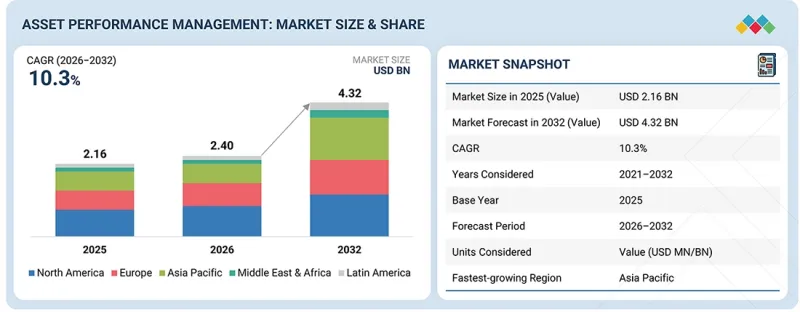
The global asset performance management market is expanding rapidly, with a projected market size expected to rise from about USD 2.40 billion in 2026 to USD 4.32 billion by 2032, reflecting a CAGR of 10.3%. The asset performance management (APM) market is driven by the growing adoption of predictive and prescriptive maintenance, as organizations aim to prevent failures before they occur and optimize asset utilization.
| Scope of the Report | |
|---|---|
| Years Considered for the Study | 2021-2032 |
| Base Year | 2026 |
| Forecast Period | 2026-2032 |
| Units Considered | Value (USD Million/Billion) |
| Segments | Offering, Type, Asset Type, Application, Deployment Type, Organization Size, Vertical |
| Regions covered | North America, Europe, Asia Pacific, Middle East & Africa, Latin America |
The rapid shift toward cloud and SaaS-based APM solutions accelerates deployments by offering scalability, flexibility, and cost efficiency across diverse industries. Integrating artificial intelligence, IoT, and digital twin technologies enables advanced diagnostics, real-time monitoring, and asset behavior simulation, improving decision-making and extending asset lifecycles. Additionally, the high cost of unplanned downtime pushes enterprises to invest in ROI-driven APM systems that reduce maintenance expenses and safeguard productivity in asset-intensive operations. On the other hand, the market faces restraints such as a shortage of a skilled workforce with expertise in analytics, IoT integration, and APM deployment, which can delay implementations and reduce effectiveness. Growing concerns over cybersecurity and data privacy further challenge adoption, as enterprises weigh the risks of connecting critical assets and operational data to cloud-enabled platforms.
"Digital/IT/OT assets to account for the fastest growth during the forecast period"
Digital/IT/OT assets, including IoT devices, SCADA systems, and control systems, form the digital backbone of modern industrial operations. These assets enable real-time data collection, centralized monitoring, and automated control, enhancing operational efficiency, reliability, and safety across industries. Integrating IT and OT enables predictive maintenance, optimized resource allocation, and reduced downtime, ensuring critical industrial processes run seamlessly. In August 2025, according to the Times of India, a ₹1,313 crore (approximately USD 1.5 billion) modernization initiative in Uttar Pradesh, India, is enhancing the power distribution network by integrating SCADA systems for real-time monitoring and automation. Similarly, in July 2025, the Times of India reported that the Uttar Pradesh Power Corporation Limited sanctioned ₹97 crore (approximately USD 11 million) for infrastructure upgrades, including SCADA implementation to ensure an uninterrupted electricity supply. These developments underscore the growing reliance on IT/OT integration to maintain operational continuity. Emerging vendors and solution providers can leverage this trend by developing scalable IoT devices, advanced SCADA platforms, and adaptive control systems, addressing challenges such as system interoperability, cybersecurity, and real-time data processing to capture value in the evolving industrial landscape.
"By application, remote asset monitoring & control to hold the largest market share"
Remote asset monitoring and control are becoming indispensable as industries with distributed assets demand secure, real-time visibility and predictive insights that improve reliability and compliance. Vendors entering this segment can differentiate by delivering multi-protocol edge agents, deterministic data models, and explainable AI that transforms raw sensor feeds into actionable intelligence and enables closed-loop control. Customers increasingly expect monitoring systems to serve as alert engines and compliance enablers, providing transparent, auditable visibility into asset health and safety performance. Siemens' introduction of generative AI capabilities for its Senseye predictive maintenance platform in February 2024 demonstrates how analytics is moving closer to automated diagnostics. A Senseye pilot documented in June 2025 avoided a primary pump replacement through early fault detection, proving the financial value of proactive monitoring. For new vendors, opportunities lie in building secure-by-design platforms that address cybersecurity and operational performance while offering low-friction pilots that quickly demonstrate uptime improvements. Providers can establish strong footholds and expand into enterprise-wide deployments by targeting sectors such as utilities, oil and gas, and manufacturing, and by positioning their solutions as operational and regulatory assets.
"North America leads the asset performance management market with strong industrial digitalization, widespread use of predictive maintenance, and high adoption of cloud-based platforms across energy, utilities, and manufacturing, while Asia Pacific is the fastest-growing region driven by rapid industrial expansion, rising demand for IoT-enabled monitoring, and government programs promoting smart factories and digital infrastructure modernization"
North America is expected to dominate the asset performance management (APM) market, driven by the growing adoption of predictive and prescriptive maintenance, cloud-based deployment models, and advanced analytics across asset-intensive sectors. For vendors and solution providers, this presents significant opportunities to deliver scalable platforms that enhance reliability and optimize performance across industries such as energy, utilities, transportation, and manufacturing. The region's strong digital infrastructure and the accelerated integration of IoT and digital twin technologies are shifting enterprises away from reactive maintenance toward data-driven asset optimization. Strategic collaborations among APM providers, industrial OEMs, and cloud hyperscalers further strengthen the ecosystem, enabling seamless operational data integration and improving decision-making across distributed environments. By addressing key enterprise requirements, including minimizing downtime, maximizing return on capital investments, and ensuring regulatory compliance, vendors can capture substantial value in a market defined by rapid technological adoption and continuous innovation.
Breakdown of Primaries
In-depth interviews were conducted with Chief Executive Officers (CEOs), innovation and technology directors, system integrators, and executives from various key organizations operating in the asset performance management market.
- By Company: Tier I - 34%, Tier II - 43%, and Tier III - 23%
- By Designation: C-Level Executives - 50%, Directors -30%, and others - 20%
- By Region: North America - 25%, Europe - 30%, Asia Pacific - 30%, Middle East & Africa - 5%, and Latin America - 5%
The report includes a study of key players offering asset performance management products. It profiles major vendors in the asset performance management market. The major market players include GE Vernova (US), AVEVA (UK), ABB (Switzerland), IBM (US), SAP (Germany), Fluke (US), Emerson (US), Rockwell Automation (US), Honeywell (US), Bentley Systems (US), Oracle (US), DNV (Norway), Siemens Energy (Germany), and Yokogawa (Japan).
Research Coverage
This research report categorizes the asset performance management market, which has been segmented based on offering, type, solution type, asset type, application, deployment type, organization size, verticals, and region. The type segment comprises AI-powered APM and traditional APM. The offering segment comprises solutions and services. The solution type segment comprises asset integrity & compliance management, asset reliability & condition monitoring, predictive maintenance & analytics, asset strategy & optimization, sustainability & emission management, and other solutions. The asset type segment covers fixed assets, mobile assets, rotary assets, linear/infrastructure assets, and digital/IT/OT assets. The application segment covers work order automation & management, remote asset monitoring & control, asset lifecycle management & planning, and operational support & resource management. The deployment type segment is split into on-premises APM and cloud-based APM (SaaS). The organization size segment is bifurcated into large, medium-sized, and startups/small enterprises. The vertical segment covers energy & utilities, oil & gas, manufacturing, government & defense, IT & telecom, healthcare & life sciences, transportation & logistics, and other verticals (real estate, consumer goods & food beverages), and region (North America, Europe, Asia Pacific, Middle East & Africa, and Latin America). The report's scope covers detailed information regarding the major factors, such as drivers, restraints, challenges, and opportunities, influencing the growth of the asset performance management market. A thorough analysis of the key industry players was done to provide insights into their business overview, solutions, and services; key strategies; contracts, partnerships, agreements, product & service launches, and mergers and acquisitions; and recent developments associated with the asset performance management market. This report also covers the competitive analysis of upcoming startups in the asset performance management market ecosystem.
Reason to buy this Report
The report would provide market leaders and new entrants with information on the closest approximations of the revenue numbers for the overall asset performance management and its subsegments. It would help stakeholders understand the competitive landscape and gain more insights to better position their businesses and plan suitable go-to-market strategies. It also helps stakeholders understand the market's pulse and provides them with information on key market drivers, restraints, challenges, and opportunities.
The report provides insights into the following pointers:
- Analysis of key drivers (Rising Adoption of Predictive & Prescriptive Maintenance, Rapid Shift to Cloud-based and SaaS-based APM Solutions for Cost Efficiency and Scalability, Integration of AI, IoT, and Digital Twin Technologies, High Cost of Downtime Driving ROI-Based Investments), restraints (Shortage of Skilled Workforce and Hybrid IT/OT Skill Gaps, Cybersecurity and Data Privacy Concerns in Edge-to-Cloud Data Workflows, High implementation complexity and cost of AI/IoT integration), opportunities (Rising Sustainability and ESG Compliance Needs with Carbon Tracking and Reporting, Emergence of Industry 4.0 and Smart Manufacturing with Real-time Analytics and Automation, AI-driven asset optimization and predictive failure prevention), and challenges (Complex integration with aging infrastructure and proprietary systems, Lack of open standards leading to vendor lock-in and limited cross-platform compatibility, Energy Crisis and Rising Operational Costs).
- Product Development/Innovation: Detailed insights on upcoming technologies, research & development activities, and product & service launches in the asset performance management market.
- Market Development: Comprehensive information about lucrative markets - the report analyses the asset performance management market across varied regions.
- Market Diversification: Exhaustive information about new products & services, untapped geographies, recent developments, and investments in the asset performance management market.
Competitive Assessment: In-depth assessment of market shares, growth strategies and service offerings of leading players such as GE Vernova (US), AVEVA (UK), ABB (Switzerland), IBM (US), SAP (Germany), Fluke (US), Emerson (US), Rockwell Automation (US), Honeywell (US), Bentley Systems (US), Oracle (US), DNV (Norway), Siemens Energy (Germany), and Yokogawa (Japan). The report also helps stakeholders understand the asset performance market's pulse and provides information on key market drivers, restraints, challenges, and opportunities.
TABLE OF CONTENTS
1 INTRODUCTION
- 1.1 STUDY OBJECTIVES
- 1.2 MARKET DEFINITION
- 1.3 MARKET SCOPE
- 1.3.1 MARKET SEGMENTATION AND REGIONAL SCOPE
- 1.3.2 INCLUSIONS AND EXCLUSIONS
- 1.3.3 YEARS CONSIDERED
- 1.4 CURRENCY CONSIDERED
- 1.5 STAKEHOLDERS
- 1.6 SUMMARY OF CHANGES
2 EXECUTIVE SUMMARY
- 2.1 MARKET HIGHLIGHTS AND KEY INSIGHTS
- 2.2 KEY MARKET PARTICIPANTS: MAPPING OF STRATEGIC DEVELOPMENTS
- 2.3 DISRUPTIVE TRENDS IN ASSET PERFORMANCE MANAGEMENT MARKET
- 2.4 HIGH-GROWTH SEGMENTS
- 2.5 REGIONAL SNAPSHOT: MARKET SIZE, GROWTH RATE, AND FORECAST
3 PREMIUM INSIGHTS
- 3.1 ATTRACTIVE OPPORTUNITIES FOR PLAYERS IN ASSET PERFORMANCE MANAGEMENT MARKET
- 3.2 ASSET PERFORMANCE MANAGEMENT MARKET, BY OFFERING
- 3.3 ASSET PERFORMANCE MANAGEMENT MARKET, BY SOLUTION
- 3.4 ASSET PERFORMANCE MANAGEMENT MARKET, BY TYPE
- 3.5 ASSET PERFORMANCE MANAGEMENT MARKET, BY VERTICAL
- 3.6 ASSET PERFORMANCE MANAGEMENT MARKET, BY REGION
4 MARKET OVERVIEW
- 4.1 INTRODUCTION
- 4.2 MARKET DYNAMICS
- 4.2.1 DRIVERS
- 4.2.1.1 Increasing shift toward AI-driven failure prediction
- 4.2.1.2 Digital twin integration in infrastructure industries
- 4.2.1.3 Multi-site standardization across global industrial enterprises
- 4.2.1.4 Rising adoption of cloud-based APM in distributed asset networks
- 4.2.2 RESTRAINTS
- 4.2.2.1 Reliance on legacy systems by industrial enterprises
- 4.2.2.2 High dependence on industrial data governance
- 4.2.3 OPPORTUNITIES
- 4.2.3.1 Emergence of renewable energy and storage assets
- 4.2.3.2 Rising application of generative AI maintenance copilots
- 4.2.3.3 Increasing focus on condition-based maintenance migration
- 4.2.3.4 Rising demand for autonomous inspection and visual AI
- 4.2.4 CHALLENGES
- 4.2.4.1 Connecting APM insights with maintenance execution systems
- 4.2.4.2 Scaling APM from pilot projects to enterprise-wide deployment
- 4.2.1 DRIVERS
- 4.3 UNMET NEEDS AND WHITE SPACES
- 4.3.1 UNMET NEEDS IN ASSET PERFORMANCE MANAGEMENT MARKET
- 4.3.2 WHITE SPACE OPPORTUNITIES
- 4.4 INTERCONNECTED MARKETS AND CROSS-SECTOR OPPORTUNITIES
- 4.4.1 INTERCONNECTED MARKETS
- 4.4.2 CROSS-SECTOR OPPORTUNITIES
- 4.5 EMERGING BUSINESS MODELS AND ECOSYSTEM SHIFTS
- 4.5.1 EMERGING BUSINESS MODELS
- 4.5.1.1 Asset performance management business models
- 4.5.2 ECOSYSTEM SHIFTS
- 4.5.1 EMERGING BUSINESS MODELS
- 4.6 STRATEGIC MOVES BY TIER-1/2/3 PLAYERS
- 4.6.1 KEY MOVES AND STRATEGIC FOCUS
5 INDUSTRY TRENDS
- 5.1 PORTER'S FIVE FORCES ANALYSIS
- 5.1.1 THREAT OF NEW ENTRANTS
- 5.1.2 THREAT OF SUBSTITUTES
- 5.1.3 BARGAINING POWER OF SUPPLIERS
- 5.1.4 BARGAINING POWER OF BUYERS
- 5.1.5 INTENSITY OF COMPETITIVE RIVALRY
- 5.2 MACROECONOMIC INDICATORS
- 5.2.1 INTRODUCTION
- 5.2.2 GDP TRENDS & FORECASTS
- 5.2.3 TRENDS IN GLOBAL ENTERPRISE ASSET MANAGEMENT INDUSTRY
- 5.2.4 TRENDS IN GLOBAL RAIL ASSET MANAGEMENT INDUSTRY
- 5.3 VALUE CHAIN ANALYSIS
- 5.4 ECOSYSTEM ANALYSIS
- 5.5 PRICING ANALYSIS
- 5.5.1 AVERAGE SELLING PRICE OF VENDORS, BY REGION
- 5.5.1.1 North America
- 5.5.1.2 Europe
- 5.5.1.3 Asia Pacific
- 5.5.1.4 Middle East & Africa
- 5.5.1.5 Latin America
- 5.5.2 PRICING LANDSCAPE FOR APM SOLUTIONS
- 5.5.1 AVERAGE SELLING PRICE OF VENDORS, BY REGION
- 5.6 KEY CONFERENCES AND EVENTS, 2026-2027
- 5.7 TRENDS/DISRUPTIONS IMPACTING CUSTOMER BUSINESS
- 5.8 INVESTMENT AND FUNDING SCENARIO
- 5.9 CASE STUDY ANALYSIS
- 5.9.1 NOVATE SOLUTIONS AND IBM DELIVER AI-DRIVEN ASSET PERFORMANCE MANAGEMENT FOR PREDICTIVE INDUSTRIAL RELIABILITY
- 5.9.2 SCG CHEMICALS AND AVEVA ENABLE AI-POWERED ASSET PERFORMANCE MANAGEMENT FOR NEAR-ZERO DOWNTIME OPERATIONS
- 5.9.3 EDP AND GE VERNOVA ENABLE PREDICTIVE ASSET PERFORMANCE MANAGEMENT TO OPTIMIZE POWER GENERATION EFFICIENCY
- 5.9.4 EPCOR UTILITIES AND BENTLEY SYSTEMS ENABLE RISK-BASED ASSET PERFORMANCE MANAGEMENT TO IMPROVE GRID RELIABILITY
- 5.9.5 LUCID MOTORS AND NEOMATRIX ENABLE REAL-TIME ASSET PERFORMANCE MANAGEMENT TO ENHANCE MANUFACTURING EFFICIENCY
- 5.10 IMPACT OF 2025 US TARIFF - ASSET PERFORMANCE MANAGEMENT MARKET
- 5.10.1 INTRODUCTION
- 5.10.2 KEY TARIFF RATES
- 5.10.3 PRICE IMPACT ANALYSIS
- 5.10.4 IMPACT ON REGIONS
- 5.10.4.1 North America
- 5.10.4.2 Europe
- 5.10.4.3 Asia Pacific
- 5.10.5 IMPACT ON VERTICALS
- 5.10.5.1 Energy & utilities
- 5.10.5.2 Manufacturing
- 5.10.5.3 Oil & gas
- 5.10.5.4 Transportation & logistics
- 5.10.5.5 Government & defense
- 5.10.5.6 IT & telecom
- 5.10.5.7 Healthcare & life sciences
- 5.10.5.8 Metal & mining
6 TECHNOLOGICAL ADVANCEMENTS, AI-DRIVEN IMPACT, PATENTS, INNOVATIONS, AND FUTURE APPLICATIONS
- 6.1 TECHNOLOGY ANALYSIS
- 6.1.1 KEY EMERGING TECHNOLOGIES
- 6.1.1.1 Industrial IoT-enabled condition monitoring
- 6.1.1.2 Digital twin technology for asset lifecycle simulation
- 6.1.1.3 Edge computing and edge AI for real-time asset analytics
- 6.1.2 COMPLEMENTARY TECHNOLOGIES
- 6.1.2.1 Cloud-native APM platforms and hybrid cloud deployment
- 6.1.2.2 Computerized maintenance management system (CMMS) and enterprise asset management (EAM) integration
- 6.1.2.3 Private 5G and advanced industrial connectivity
- 6.1.3 ADJACENT TECHNOLOGIES
- 6.1.3.1 Autonomous inspection robotics and drone-based asset monitoring
- 6.1.3.2 Augmented reality (AR)-assisted maintenance and remote expert guidance
- 6.1.1 KEY EMERGING TECHNOLOGIES
- 6.2 TECHNOLOGY/PRODUCT ROADMAP
- 6.2.1 SHORT-TERM (2026-2028) | AI-NATIVE ANALYTICS & CLOUD MIGRATION
- 6.2.1.1 Focus Areas:
- 6.2.1.2 Technology Development
- 6.2.1.3 Product Innovations
- 6.2.1.4 Market Adoption
- 6.2.2 MID-TERM (2028-2031) | DIGITAL TWIN INTEGRATION & PRESCRIPTIVE INTELLIGENCE
- 6.2.2.1 Focus Areas:
- 6.2.2.2 Technology Development
- 6.2.2.3 Product Innovations
- 6.2.2.4 Market Adoption
- 6.2.3 LONG-TERM (2031-2035+) | AUTONOMOUS OPERATIONS & SUSTAINABILITY-LINKED ASSET INTELLIGENCE
- 6.2.3.1 Focus Areas:
- 6.2.3.2 Technology Development
- 6.2.3.3 Product Innovations
- 6.2.3.4 Market Adoption
- 6.2.1 SHORT-TERM (2026-2028) | AI-NATIVE ANALYTICS & CLOUD MIGRATION
- 6.3 PATENT ANALYSIS
- 6.4 FUTURE APPLICATIONS
- 6.4.1 RENEWABLE ENERGY & HYBRID ASSET APM
- 6.4.2 AR-ENABLED CONNECTED WORKER APM PLATFORMS
- 6.4.3 CRITICAL INFRASTRUCTURE & LINEAR ASSET APM
- 6.4.4 DATA CENTER & HYPERSCALE FACILITY APM
- 6.4.5 GENERATIVE AI & AGENTIC APM COPILOTS
- 6.5 IMPACT OF AI/GENERATIVE AI ON ASSET PERFORMANCE MANAGEMENT MARKET
- 6.5.1 TOP USE CASES AND MARKET POTENTIAL
- 6.5.2 TOP USE CASES AND MARKET POTENTIAL
- 6.5.3 BEST PRACTICES IN ASSET PERFORMANCE MANAGEMENT
- 6.5.4 CASE STUDY OF AI IMPLEMENTATION IN ASSET PERFORMANCE MANAGEMENT MARKET
- 6.5.5 INTERCONNECTED ADJACENCY ECOSYSTEM AND IMPACT ON MARKET PLAYERS
- 6.5.6 CLIENT READINESS TO ADOPT GENERATIVE AI IN ASSET PERFORMANCE MANAGEMENT MARKET
- 6.5.7 GE VERNOVA: SMARTSIGNAL PREDICTIVE ANALYTICS
- 6.5.8 IBM: MAXIMO ASSET PERFORMANCE MANAGEMENT (APM)
7 REGULATORY LANDSCAPE
- 7.1 REGIONAL REGULATIONS AND COMPLIANCE
- 7.1.1 REGULATORY BODIES, GOVERNMENT AGENCIES, AND OTHER ORGANIZATIONS
- 7.1.2 INDUSTRY STANDARDS, BY REGION
- 7.1.2.1 North America
- 7.1.2.2 Europe
- 7.1.2.3 Asia Pacific
- 7.1.2.4 Middle East & South Africa
- 7.1.2.5 Latin America
8 CUSTOMER LANDSCAPE AND BUYER BEHAVIOR
- 8.1 DECISION-MAKING PROCESS
- 8.2 KEY STAKEHOLDERS INVOLVED IN BUYING PROCESS AND THEIR EVALUATION CRITERIA
- 8.2.1 KEY STAKEHOLDERS IN BUYING PROCESS
- 8.2.2 BUYING CRITERIA
- 8.3 ADOPTION BARRIERS AND INTERNAL CHALLENGES
- 8.4 UNMET NEEDS IN VARIOUS END-USER INDUSTRIES
- 8.5 MARKET PROFITABILITY
- 8.5.1 REVENUE POTENTIAL
- 8.5.2 COST DYNAMICS
- 8.5.3 MARGIN OPPORTUNITIES IN KEY APPLICATIONS
9 ASSET PERFORMANCE MANAGEMENT MARKET, BY TYPE
- 9.1 INTRODUCTION
- 9.1.1 TYPE: ASSET PERFORMANCE MANAGEMENT MARKET DRIVERS
- 9.2 AI-POWERED APM
- 9.2.1 INTEGRATION OF MACHINE LEARNING AND EDGE COMPUTING TO ENABLE REAL-TIME DECISION-MAKING AND AUTONOMOUS OPERATIONS
- 9.3 TRADITIONAL APM
- 9.3.1 CONTINUED RELIANCE ON LEGACY INFRASTRUCTURE TO SUSTAIN DEMAND FOR TRADITIONAL APM SOLUTIONS
10 ASSET PERFORMANCE MANAGEMENT MARKET, BY OFFERING
- 10.1 INTRODUCTION
- 10.1.1 OFFERING: ASSET PERFORMANCE MANAGEMENT MARKET DRIVERS
- 10.2 SOLUTIONS
- 10.2.1 SHIFT TOWARD AI-DRIVEN ANALYTICS AND CLOUD-NATIVE ARCHITECTURES TO PROPEL APM SOLUTION ADOPTION
- 10.3 SERVICES
- 10.3.1 PROFESSIONAL SERVICES
- 10.3.1.1 Shift toward advisory-led engagements and value-based deliverables to fuel professional service growth
- 10.3.1.2 Implementation & integration
- 10.3.1.3 Training & onboarding
- 10.3.1.4 Consulting
- 10.3.2 MANAGED SERVICES
- 10.3.2.1 Rising adoption of subscription-based models and remote IoT monitoring to streamline operational complexity
- 10.3.1 PROFESSIONAL SERVICES
11 ASSET PERFORMANCE MANAGEMENT MARKET, BY SOLUTION
- 11.1 INTRODUCTION
- 11.1.1 SOLUTION: ASSET PERFORMANCE MANAGEMENT MARKET DRIVERS
- 11.2 PREDICTIVE MAINTENANCE & ANALYTICS
- 11.2.1 INTEGRATION OF PRESCRIPTIVE CAPABILITIES AND AI/ML ALGORITHMS TO REVOLUTIONIZE DATA-DRIVEN MAINTENANCE STRATEGIES
- 11.2.2 PREDICTIVE ASSET ANALYTICS
- 11.2.2.1 AI/ML-based predictive maintenance
- 11.2.2.2 Prescriptive maintenance
- 11.3 ASSET RELIABILITY & CONDITION MONITORING
- 11.3.1 SHIFT TOWARD CENTRALIZED CLOUD-BASED PLATFORMS AND REAL-TIME VISIBILITY TO OPTIMIZE DISTRIBUTED ASSET NETWORKS
- 11.3.2 CONDITION MONITORING
- 11.3.2.1 Vibration monitoring
- 11.3.2.2 Thermal/Infrared monitoring
- 11.3.2.3 Acoustic monitoring
- 11.3.2.4 IoT sensor-based monitoring
- 11.3.3 ASSET HEALTH MANAGEMENT
- 11.3.3.1 Asset health management
- 11.3.3.1.1 Asset health scoring
- 11.3.3.1.2 Asset condition assessment
- 11.3.3.1.3 Others
- 11.3.3.1 Asset health management
- 11.4 ASSET INTEGRITY & COMPLIANCE MANAGEMENT
- 11.4.1 DIGITIZATION OF COMPLIANCE PROCESSES AND AUTOMATED DOCUMENTATION TO DRIVE PROACTIVE RISK-BASED INSPECTIONS
- 11.4.2 MECHANICAL INTEGRITY MANAGEMENT
- 11.4.2.1 Inspection management
- 11.5 ASSET STRATEGY & OPTIMIZATION
- 11.5.1 SHIFT TOWARD DATA-DRIVEN ASSET LIFECYCLE OPTIMIZATION TO DRIVE ADOPTION OF ADVANCED ASSET STRATEGY SOLUTIONS
- 11.5.2 ASSET STRATEGY MANAGEMENT
- 11.5.2.1 Failure modes and effects analysis (FMEA)
- 11.5.2.2 Reliability-centered maintenance (RCM)
- 11.5.3 DIGITAL TWIN/SIMULATION
- 11.6 SUSTAINABILITY & EMISSION MANAGEMENT
- 11.6.1 RISING REGULATORY PRESSURE AND NET-ZERO COMMITMENTS TO DRIVE ADOPTION OF SUSTAINABILITY AND EMISSION MANAGEMENT SOLUTIONS
- 11.6.2 ENERGY & PERFORMANCE OPTIMIZATION SOFTWARE
- 11.6.3 EMISSIONS MONITORING & MANAGEMENT
- 11.7 OTHER SOLUTIONS
12 ASSET PERFORMANCE MANAGEMENT MARKET, BY ASSET TYPE
- 12.1 INTRODUCTION
- 12.1.1 ASSET TYPE: ASSET PERFORMANCE MANAGEMENT MARKET DRIVERS
- 12.2 FIXED ASSETS
- 12.2.1 DRIVING APM ADOPTION IN FIXED ASSETS THROUGH DIGITAL TWIN INTEGRATION AND LIFECYCLE OPTIMIZATION
- 12.2.2 PLANT MACHINERY
- 12.2.3 PRODUCTION EQUIPMENT
- 12.2.4 INDUSTRIAL ROBOTS
- 12.3 MOBILE ASSETS
- 12.3.1 OPTIMIZING MOBILE ASSET PERFORMANCE THROUGH REAL-TIME FLEET VISIBILITY AND CONDITION-BASED MAINTENANCE
- 12.3.2 FLEET ASSETS
- 12.3.3 CONSTRUCTION EQUIPMENT
- 12.3.4 FIELD SERVICES ASSETS
- 12.4 ROTATING ASSETS
- 12.4.1 LEVERAGING APM SOLUTIONS TO ENHANCE RELIABILITY, EFFICIENCY, AND OPERATIONAL LIFESPAN OF ROTATING INDUSTRIAL EQUIPMENT
- 12.4.2 TURBINES & GENERATORS
- 12.4.3 MOTORS & PUMPS
- 12.4.4 COMPRESSORS
- 12.4.5 OTHER ROTATING ASSETS
- 12.5 LINEAR/INFRASTRUCTURE ASSETS
- 12.5.1 UNLOCKING STRATEGIC OPPORTUNITIES TO OPTIMIZE, MONITOR, AND MANAGE COMPLEX INFRASTRUCTURE ASSETS EFFICIENTLY
- 12.5.2 PIPELINES
- 12.5.3 BRIDGES & RAILWAY TRACKS
- 12.5.4 TRANSMISSION LINES
- 12.5.5 OTHER INFRASTRUCTURE ASSETS
- 12.6 DIGITAL/IT-OT ASSETS
- 12.6.1 ACCELERATING INDUSTRIAL EFFICIENCY THROUGH INTEGRATED IT/OT SYSTEMS AND SMART AUTOMATION
- 12.6.2 IOT DEVICES
- 12.6.3 SCADA SYSTEMS
- 12.6.4 CONTROL SYSTEMS
- 12.6.5 SERVERS & IT INFRASTRUCTURE
- 12.6.6 INDUSTRIAL CONTROL SYSTEMS
13 ASSET PERFORMANCE MANAGEMENT MARKET, BY DEPLOYMENT TYPE
- 13.1 INTRODUCTION
- 13.1.1 DEPLOYMENT TYPE: ASSET PERFORMANCE MANAGEMENT MARKET DRIVERS
- 13.2 ON-PREMISES
- 13.2.1 ENHANCING RESILIENCE BY USING ON-PREMISES APM FOR COMPLIANCE, DATA CONTROL, AND SEAMLESS SYSTEM INTEGRATION
- 13.3 CLOUD-BASED (SAAS)
- 13.3.1 DRIVING PERFORMANCE BY ADOPTING CLOUD-BASED APM FOR SCALABLE ANALYTICS, REMOTE ACCESS, AND RAPID DEPLOYMENT
14 ASSET PERFORMANCE MANAGEMENT MARKET, BY ORGANIZATION SIZE
- 14.1 INTRODUCTION
- 14.1.1 ORGANIZATION SIZE: ASSET PERFORMANCE MANAGEMENT MARKET DRIVERS
- 14.2 LARGE ENTERPRISES
- 14.2.1 LEVERAGING ADVANCED APM PLATFORMS TO STANDARDIZE ASSET MONITORING AND STRENGTHEN PREDICTIVE CAPABILITIES THROUGH TECHNOLOGY PARTNERSHIPS
- 14.3 SMES
- 14.3.1 ADOPTING SCALABLE APM SOLUTIONS WITH SIMPLIFIED DEPLOYMENT MODELS AND VERTICALIZED TEMPLATES TO BALANCE COST EFFICIENCY WITH PRODUCTIVITY IMPROVEMENTS
15 ASSET PERFORMANCE MANAGEMENT MARKET, BY APPLICATION
- 15.1 INTRODUCTION
- 15.1.1 APPLICATION: ASSET PERFORMANCE MANAGEMENT MARKET DRIVERS
- 15.2 WORK ORDER AUTOMATION & MANAGEMENT
- 15.2.1 AUTOMATING WORK ORDER PROCESSES TO ENHANCE SCHEDULING ACCURACY, ACCELERATE TASK EXECUTION, AND REDUCE OPERATIONAL DELAYS
- 15.2.2 MAINTENANCE TASK SCHEDULING
- 15.2.3 FIELD SERVICE DISPATCH
- 15.2.4 WORK ORDER ANALYTICS
- 15.3 REMOTE ASSET MONITORING & CONTROL
- 15.3.1 LEVERAGING REAL-TIME MONITORING AND REMOTE CONTROL TO ENSURE ASSET RELIABILITY AND UNINTERRUPTED PERFORMANCE
- 15.3.2 IOT-BASED REMOTE MONITORING
- 15.3.3 REMOTE CONTROL & INTERVENTION
- 15.3.4 CENTRALIZED DASHBOARDS
- 15.4 ASSET LIFECYCLE MANAGEMENT & PLANNING
- 15.4.1 ADOPTING LIFECYCLE STRATEGIES TO ALIGN ASSET PROCUREMENT, MAINTENANCE, AND DISPOSAL WITH LONG-TERM EFFICIENCY AND SUSTAINABILITY
- 15.4.2 ASSET COMMISSIONING & PROCUREMENT
- 15.4.3 LIFECYCLE MAINTENANCE & PLANNING
- 15.4.4 DECOMMISSIONING & DISPOSAL
- 15.5 OPERATIONAL SUPPORT & RESOURCE MANAGEMENT
- 15.5.1 OPTIMIZING RESOURCES BY IMPROVING INVENTORY, VENDOR MANAGEMENT, CRISIS RESPONSE, AND WORKFORCE ALIGNMENT FOR STRONGER OPERATIONS
- 15.5.2 SPARE PARTS & INVENTORY MANAGEMENT
- 15.5.3 VENDOR & CONTRACTOR MANAGEMENT
- 15.5.4 EMERGENCY RESPONSE & CRISIS MANAGEMENT
- 15.5.5 SKILLS & WORKFORCE MANAGEMENT
16 ASSET PERFORMANCE MANAGEMENT MARKET, BY VERTICAL
- 16.1 INTRODUCTION
- 16.1.1 VERTICAL: ASSET PERFORMANCE MANAGEMENT MARKET DRIVERS
- 16.2 ENERGY & UTILITIES
- 16.2.1 USING APM TO MODERNIZE GRIDS AND OPTIMIZE RENEWABLE ASSETS FOR RELIABLE, SUSTAINABLE OPERATIONS
- 16.2.2 ENERGY & UTILITIES, BY TYPE
- 16.2.2.1 Power generation
- 16.2.2.2 Transmission & distribution
- 16.2.2.3 Renewables
- 16.3 OIL & GAS
- 16.3.1 APPLYING APM TO ENHANCE EQUIPMENT RELIABILITY, REDUCE DOWNTIME, AND ENSURE SAFETY
- 16.3.2 OIL & GAS, BY OPERATION TYPE
- 16.3.2.1 Upstream
- 16.3.2.2 Midstream
- 16.3.2.3 Downstream
- 16.4 MANUFACTURING
- 16.4.1 ADOPTING APM TO BOOST EFFICIENCY, MINIMIZE FAILURES, AND STRENGTHEN COMPETITIVENESS
- 16.4.2 MANUFACTURING, BY TYPE
- 16.4.2.1 Discrete manufacturing
- 16.4.2.2 Process manufacturing
- 16.5 GOVERNMENT & DEFENSE
- 16.5.1 USING APM TO PROTECT INFRASTRUCTURE, EXTEND LIFECYCLES, AND REINFORCE MISSION READINESS
- 16.5.2 GOVERNMENT & DEFENSE, BY TYPE
- 16.5.2.1 Defense infrastructure
- 16.5.2.2 Public sector infrastructure
- 16.5.2.3 Other government & defense applications
- 16.6 IT & TELECOM
- 16.6.1 DEPLOYING APM TO OPTIMIZE IT HARDWARE, TOWERS, AND FACILITY PERFORMANCE
- 16.6.2 IT & TELECOM, BY TYPE
- 16.6.2.1 IT hardware lifecycle
- 16.6.2.2 Tower structural & civil
- 16.6.2.3 DCIM/BMS-linked facility
- 16.6.2.4 Data centers
- 16.6.2.5 Other IT & telecom applications
- 16.7 HEALTHCARE & LIFE SCIENCES
- 16.7.1 USING APM TO ENSURE EQUIPMENT RELIABILITY AND PATIENT SAFETY
- 16.7.2 HEALTHCARE & LIFE SCIENCES, BY TYPE
- 16.7.2.1 Pharmaceuticals
- 16.7.2.2 Laboratories
- 16.7.2.3 Research facilities
- 16.8 TRANSPORTATION & LOGISTICS
- 16.8.1 LEVERAGING APM TO MAXIMIZE FLEET AVAILABILITY AND IMPROVE TRANSPORT EFFICIENCY
- 16.8.2 TRANSPORTATION & LOGISTICS, BY TYPE
- 16.8.2.1 Aviation & aerospace
- 16.8.2.2 Rail & transit
- 16.8.2.3 Maritime & port
- 16.8.2.4 Fleet & vehicle
- 16.8.2.5 Other transportation & logistics applications
- 16.9 METAL & MINING
- 16.9.1 INTEGRATION OF DIGITAL TWINS AND SIMULATION MODELS TO ENHANCE EXTRACTION EFFICIENCY AND WORKER SAFETY
- 16.9.2 METAL & MINING, BY TYPE
- 16.9.2.1 Mining operations
- 16.9.2.2 Smelting & refinement
- 16.10 OTHER VERTICALS
17 ASSET PERFORMANCE MANAGEMENT MARKET, BY REGION
- 17.1 INTRODUCTION
- 17.2 NORTH AMERICA
- 17.2.1 US
- 17.2.1.1 Regulatory pressure and AI-driven vendor consolidation to drive market
- 17.2.2 CANADA
- 17.2.2.1 Resource-intensive industries and decarbonization mandates to create opportunities for emerging APM vendors
- 17.2.1 US
- 17.3 EUROPE
- 17.3.1 UK
- 17.3.1.1 National digital twin ambitions and infrastructure modernization to drive market
- 17.3.2 GERMANY
- 17.3.2.1 Industry 4.0 leadership and vendor-driven innovation to create opportunities for APM providers
- 17.3.3 FRANCE
- 17.3.3.1 Diverse industrial base and domestic vendor strength to create multi-sector opportunities for APM providers
- 17.3.4 ITALY
- 17.3.4.1 Development hub for APM innovation and large industrial base to drive market
- 17.3.5 REST OF EUROPE
- 17.3.1 UK
- 17.4 ASIA PACIFIC
- 17.4.1 CHINA
- 17.4.1.1 AI-driven asset performance at industrial mega-scale through smart manufacturing ecosystems to drive market
- 17.4.2 INDIA
- 17.4.2.1 AI-driven predictive maintenance to reshape asset performance management across industrial ecosystem
- 17.4.3 JAPAN
- 17.4.3.1 Precision-driven AI adoption to accelerate asset performance management in advanced manufacturing ecosystem
- 17.4.4 AUSTRALIA & NEW ZEALAND
- 17.4.4.1 Remote asset intelligence and AI-driven reliability to fuel APM adoption across resource-intensive industries
- 17.4.5 SOUTH KOREA
- 17.4.5.1 High-precision manufacturing and AI integration to drive advanced APM adoption
- 17.4.6 SINGAPORE
- 17.4.6.1 Smart nation and digital twin initiatives to accelerate transition to AI-driven asset performance management
- 17.4.7 REST OF ASIA PACIFIC
- 17.4.1 CHINA
- 17.5 MIDDLE EAST & AFRICA
- 17.5.1 GCC COUNTRIES
- 17.5.1.1 Saudi Arabia
- 17.5.1.1.1 AI-driven reliability and large-scale energy infrastructure modernization to accelerate APM adoption
- 17.5.1.2 UAE
- 17.5.1.2.1 AI-led asset intelligence and digital twin adoption to drive market
- 17.5.1.3 Other GCC countries
- 17.5.1.1 Saudi Arabia
- 17.5.2 SOUTH AFRICA
- 17.5.2.1 Reliability-centric APM adoption to accelerate across mining and energy infrastructure
- 17.5.3 REST OF MIDDLE EAST & AFRICA
- 17.5.1 GCC COUNTRIES
- 17.6 LATIN AMERICA
- 17.6.1 BRAZIL
- 17.6.1.1 Deepwater complexity and hydropower lifecycles to drive next-generation APM adoption
- 17.6.2 MEXICO
- 17.6.2.1 Production synchronization and real-time maintenance orchestration to drive APM adoption in manufacturing ecosystem
- 17.6.3 REST OF LATIN AMERICA
- 17.6.1 BRAZIL
18 COMPETITIVE LANDSCAPE
- 18.1 INTRODUCTION
- 18.2 KEY PLAYER STRATEGIES/RIGHT TO WIN, 2023-2026
- 18.3 REVENUE ANALYSIS, 2021-2025
- 18.4 MARKET SHARE ANALYSIS, 2025
- 18.5 BRAND/PRODUCT COMPARISON
- 18.5.1 GE VERNOVA
- 18.5.2 AVEVA
- 18.5.3 ABB
- 18.5.4 IBM
- 18.5.5 SAP
- 18.6 COMPANY EVALUATION MATRIX: KEY PLAYERS, 2025
- 18.6.1 STARS
- 18.6.2 EMERGING LEADERS
- 18.6.3 PERVASIVE PLAYERS
- 18.6.4 PARTICIPANTS
- 18.6.5 COMPANY FOOTPRINT: KEY PLAYERS, 2025
- 18.6.5.1 Company footprint
- 18.6.5.2 Region footprint
- 18.6.5.3 Solution footprint
- 18.6.5.4 Deployment type footprint
- 18.7 COMPANY EVALUATION MATRIX: STARTUPS/SMES, 2025
- 18.7.1 PROGRESSIVE COMPANIES
- 18.7.2 RESPONSIVE COMPANIES
- 18.7.3 DYNAMIC COMPANIES
- 18.7.4 STARTING BLOCKS
- 18.7.5 COMPETITIVE BENCHMARKING: STARTUP/SMES, 2025
- 18.7.5.1 Detailed list of key startups/SMEs
- 18.7.5.2 Competitive benchmarking of key startups/SMEs
- 18.8 COMPANY VALUATION AND FINANCIAL METRICS
- 18.8.1 COMPANY VALUATION OF KEY VENDORS
- 18.8.2 FINANCIAL METRICS OF KEY VENDORS
- 18.9 COMPETITIVE SCENARIO
- 18.9.1 PRODUCT LAUNCHES/ENHANCEMENTS
- 18.9.2 DEALS
19 COMPANY PROFILES
- 19.1 INTRODUCTION
- 19.2 MAJOR PLAYERS
- 19.2.1 GE VERNOVA
- 19.2.1.1 Business overview
- 19.2.1.2 Products/Solutions/Services offered
- 19.2.1.3 Recent developments
- 19.2.1.3.1 Product launches/enhancements
- 19.2.1.3.2 Deals
- 19.2.1.4 MnM view
- 19.2.1.4.1 Right to win
- 19.2.1.4.2 Strategic choices
- 19.2.1.4.3 Weaknesses and competitive threats
- 19.2.2 AVEVA
- 19.2.2.1 Business overview
- 19.2.2.2 Products/Solutions/Services offered
- 19.2.2.3 Recent developments
- 19.2.2.3.1 Product launches/enhancements
- 19.2.2.3.2 Deals
- 19.2.2.4 MnM view
- 19.2.2.4.1 Right to win
- 19.2.2.4.2 Strategic choices
- 19.2.2.4.3 Weaknesses and competitive threats
- 19.2.3 ABB
- 19.2.3.1 Business overview
- 19.2.3.2 Products/Solutions/Services offered
- 19.2.3.3 Recent developments
- 19.2.3.3.1 Product launches/enhancements
- 19.2.3.3.2 Deals
- 19.2.3.4 MnM view
- 19.2.3.4.1 Right to win
- 19.2.3.4.2 Strategic choices
- 19.2.3.4.3 Weaknesses and competitive threats
- 19.2.4 IBM
- 19.2.4.1 Business overview
- 19.2.4.2 Products/Solutions/Services offered
- 19.2.4.3 Recent developments
- 19.2.4.3.1 Product launches/enhancements
- 19.2.4.3.2 Deals
- 19.2.4.4 MnM view
- 19.2.4.4.1 Right to win
- 19.2.4.4.2 Strategic choices
- 19.2.4.4.3 Weaknesses and competitive threats
- 19.2.5 SAP
- 19.2.5.1 Business overview
- 19.2.5.2 Products/Solutions/Services offered
- 19.2.5.3 Recent developments
- 19.2.5.3.1 Product launches/enhancements
- 19.2.5.3.2 Deals
- 19.2.5.4 MnM view
- 19.2.5.4.1 Right to win
- 19.2.5.4.2 Strategic choices
- 19.2.5.4.3 Weaknesses and competitive threats
- 19.2.6 FLUKE
- 19.2.6.1 Business overview
- 19.2.6.2 Products/Solutions/Services offered
- 19.2.6.3 Recent developments
- 19.2.6.3.1 Product launches/enhancements
- 19.2.6.3.2 Deals
- 19.2.7 EMERSON
- 19.2.7.1 Business overview
- 19.2.7.2 Products/Solutions/Services offered
- 19.2.7.3 Recent developments
- 19.2.7.3.1 Product launches/enhancements
- 19.2.7.3.2 Deals
- 19.2.8 ROCKWELL AUTOMATION
- 19.2.8.1 Business overview
- 19.2.8.2 Products/Solutions/Services offered
- 19.2.8.3 Recent developments
- 19.2.8.3.1 Product launches/enhancements
- 19.2.8.3.2 Deals
- 19.2.9 HONEYWELL
- 19.2.9.1 Business overview
- 19.2.9.2 Products/Solutions/Services offered
- 19.2.9.3 Recent developments
- 19.2.9.3.1 Product launches/enhancements
- 19.2.9.3.2 Deals
- 19.2.10 BENTLEY SYSTEMS
- 19.2.10.1 Business overview
- 19.2.10.2 Products/Solutions/Services offered
- 19.2.10.3 Recent developments
- 19.2.10.3.1 Product launches/enhancements
- 19.2.10.3.2 Deals
- 19.2.1 GE VERNOVA
- 19.3 OTHER PLAYERS
- 19.3.1 SIEMENS ENERGY
- 19.3.2 YOKOGAWA ELECTRIC
- 19.3.3 HEXAGON AB
- 19.3.4 DNV
- 19.3.5 BAKER HUGHES
- 19.3.6 PROMETHEUS GROUP
- 19.3.7 NEXUS GLOBAL
- 19.3.8 SAS INSTITUTE
- 19.3.9 ACCRUENT
- 19.3.10 SHORELINE AI
- 19.3.11 MAINTAINX
- 19.3.12 MICROAI
- 19.3.13 TENNA
- 19.3.14 UPTAKE TECHNOLOGIES
- 19.3.15 PLASMA COMPUTING GROUP
- 19.3.16 MEGGER
- 19.3.17 UPKEEP
- 19.3.18 FRACTTAL TECH
- 19.3.19 VROC
- 19.3.20 MENTORAPM
- 19.3.21 C3 AI
- 19.3.22 EWORKORDERS
- 19.3.23 MAXGRIP
- 19.3.24 KCF TECHNOLOGIES
- 19.3.25 MAINWIZ TECHNOLOGIES
- 19.3.26 NEXTBITT
- 19.3.27 RUGGED MONITORING
- 19.3.28 MASTERCONTROL SOLUTIONS
20 RESEARCH METHODOLOGY
- 20.1 RESEARCH APPROACH
- 20.1.1 SECONDARY DATA
- 20.1.1.1 Key data from secondary sources
- 20.1.1.2 Breakup of primary profiles
- 20.1.1.3 Key industry insights
- 20.1.1 SECONDARY DATA
- 20.2 MARKET BREAKUP AND DATA TRIANGULATION
- 20.3 MARKET SIZE ESTIMATION
- 20.4 MARKET FORECAST
- 20.5 RESEARCH ASSUMPTIONS
- 20.6 RESEARCH LIMITATIONS
21 APPENDIX
- 21.1 DISCUSSION GUIDE
- 21.2 KNOWLEDGESTORE: MARKETSANDMARKETS' SUBSCRIPTION PORTAL
- 21.3 CUSTOMIZATION OPTIONS
- 21.4 RELATED REPORTS
- 21.5 AUTHOR DETAILS
List of Tables
- TABLE 1 USD EXCHANGE RATES, 2021-2025
- TABLE 2 IMPACT OF PORTER'S FIVE FORCES ON ASSET PERFORMANCE MANAGEMENT MARKET
- TABLE 3 GDP PERCENTAGE CHANGE, BY KEY COUNTRIES, 2021-2029
- TABLE 4 ASSET PERFORMANCE MANAGEMENT MARKET: ROLE OF COMPANIES IN ECOSYSTEM
- TABLE 5 AVERAGE SELLING PRICE OF VENDORS, BY REGION, 2025 (USD THOUSAND)
- TABLE 6 PRICING LANDSCAPE FOR APM SOLUTIONS, 2025
- TABLE 7 ASSET PERFORMANCE MANAGEMENT MARKET: LIST OF KEY CONFERENCES AND EVENTS, 2026-2027
- TABLE 8 US ADJUSTED RECIPROCAL TARIFF RATES
- TABLE 9 LIST OF GRANTED PATENTS IN ASSET PERFORMANCE MANAGEMENT MARKET, 2023-2026
- TABLE 10 BEST PRACTICES: COMPANIES IMPLEMENTING USE CASES
- TABLE 11 C3 AI PLATFORM HELPS HOLCIM OVERCOME LIMITATIONS OF EDGE DEVICES TO DELIVER REAL-TIME, AI-POWERED PREDICTIVE MAINTENANCE
- TABLE 12 INTERCONNECTED ADJACENT ECOSYSTEM AND IMPLICATIONS FOR MARKET PLAYERS
- TABLE 13 NORTH AMERICA: REGULATORY BODIES, GOVERNMENT AGENCIES, AND OTHER ORGANIZATIONS
- TABLE 14 EUROPE: REGULATORY BODIES, GOVERNMENT AGENCIES, AND OTHER ORGANIZATIONS
- TABLE 15 ASIA PACIFIC: REGULATORY BODIES, GOVERNMENT AGENCIES, AND OTHER ORGANIZATIONS
- TABLE 16 OTHERS: REGULATORY BODIES, GOVERNMENT AGENCIES, AND OTHER ORGANIZATIONS
- TABLE 17 INFLUENCE OF STAKEHOLDERS ON BUYING PROCESS FOR TOP THREE VERTICALS (%)
- TABLE 18 KEY BUYING CRITERIA FOR THE THREE VERTICALS
- TABLE 19 ASSET PERFORMANCE MANAGEMENT MARKET: UNMET NEEDS IN KEY END-USER INDUSTRIES
- TABLE 20 ASSET PERFORMANCE MANAGEMENT MARKET, BY TYPE, 2021-2025 (USD MILLION)
- TABLE 21 ASSET PERFORMANCE MANAGEMENT MARKET, BY TYPE, 2026-2032 (USD MILLION)
- TABLE 22 AI-POWERED APM: ASSET PERFORMANCE MANAGEMENT MARKET, BY REGION, 2021-2025 (USD MILLION)
- TABLE 23 AI-POWERED APM: ASSET PERFORMANCE MANAGEMENT MARKET, BY REGION, 2026-2032 (USD MILLION)
- TABLE 24 TRADITIONAL APM: ASSET PERFORMANCE MANAGEMENT MARKET, BY REGION, 2021-2025 (USD MILLION)
- TABLE 25 TRADITIONAL APM: ASSET PERFORMANCE MANAGEMENT MARKET, BY REGION, 2026-2032 (USD MILLION)
- TABLE 26 ASSET PERFORMANCE MANAGEMENT MARKET, BY OFFERING, 2021-2025 (USD MILLION)
- TABLE 27 ASSET PERFORMANCE MANAGEMENT MARKET, BY OFFERING, 2026-2032 (USD MILLION)
- TABLE 28 SOLUTIONS: ASSET PERFORMANCE MANAGEMENT MARKET, BY REGION, 2021-2025 (USD MILLION)
- TABLE 29 SOLUTIONS: ASSET PERFORMANCE MANAGEMENT MARKET, BY REGION, 2026-2032 (USD MILLION)
- TABLE 30 SERVICES: ASSET PERFORMANCE MANAGEMENT MARKET, BY REGION, 2021-2025 (USD MILLION)
- TABLE 31 SERVICES: ASSET PERFORMANCE MANAGEMENT MARKET, BY REGION, 2026-2032 (USD MILLION)
- TABLE 32 PROFESSIONAL SERVICES: ASSET PERFORMANCE MANAGEMENT MARKET, BY REGION, 2021-2025 (USD MILLION)
- TABLE 33 PROFESSIONAL SERVICES: ASSET PERFORMANCE MANAGEMENT MARKET, BY REGION, 2026-2032 (USD MILLION)
- TABLE 34 MANAGED SERVICES: ASSET PERFORMANCE MANAGEMENT MARKET, BY REGION, 2021-2025 (USD MILLION)
- TABLE 35 MANAGED SERVICES: ASSET PERFORMANCE MANAGEMENT MARKET, BY REGION, 2026-2032 (USD MILLION)
- TABLE 36 ASSET PERFORMANCE MANAGEMENT MARKET, BY SOLUTION, 2021-2025 (USD MILLION)
- TABLE 37 ASSET PERFORMANCE MANAGEMENT MARKET, BY SOLUTION, 2026-2032 (USD MILLION)
- TABLE 38 PREDICTIVE MAINTENANCE & ANALYTICS: ASSET PERFORMANCE MANAGEMENT MARKET, BY REGION, 2021-2025 (USD MILLION)
- TABLE 39 PREDICTIVE MAINTENANCE & ANALYTICS: ASSET PERFORMANCE MANAGEMENT MARKET, BY REGION, 2026-2032 (USD MILLION)
- TABLE 40 ASSET RELIABILITY & CONDITION MONITORING: ASSET PERFORMANCE MANAGEMENT MARKET, BY REGION, 2021-2025 (USD MILLION)
- TABLE 41 ASSET RELIABILITY & CONDITION MONITORING: ASSET PERFORMANCE MANAGEMENT MARKET, BY REGION, 2026-2032 (USD MILLION)
- TABLE 42 ASSET INTEGRITY & COMPLIANCE MANAGEMENT: ASSET PERFORMANCE MANAGEMENT MARKET, BY REGION, 2021-2025 (USD MILLION)
- TABLE 43 ASSET INTEGRITY & COMPLIANCE MANAGEMENT: ASSET PERFORMANCE MANAGEMENT MARKET, BY REGION, 2026-2032 (USD MILLION)
- TABLE 44 ASSET STRATEGY & OPTIMIZATION: ASSET PERFORMANCE MANAGEMENT MARKET, BY REGION, 2021-2025 (USD MILLION)
- TABLE 45 ASSET STRATEGY & OPTIMIZATION: ASSET PERFORMANCE MANAGEMENT MARKET, BY REGION, 2026-2032 (USD MILLION)
- TABLE 46 SUSTAINABILITY & EMISSION MANAGEMENT: ASSET PERFORMANCE MANAGEMENT MARKET, BY REGION, 2021-2025 (USD MILLION)
- TABLE 47 SUSTAINABILITY & EMISSION MANAGEMENT: ASSET PERFORMANCE MANAGEMENT MARKET, BY REGION, 2026-2032 (USD MILLION)
- TABLE 48 OTHER SOLUTIONS: ASSET PERFORMANCE MANAGEMENT MARKET, BY REGION, 2021-2025 (USD MILLION)
- TABLE 49 OTHER SOLUTIONS: ASSET PERFORMANCE MANAGEMENT MARKET, BY REGION, 2026-2032 (USD MILLION)
- TABLE 50 ASSET PERFORMANCE MANAGEMENT MARKET, BY ASSET TYPE, 2021-2025 (USD MILLION)
- TABLE 51 ASSET PERFORMANCE MANAGEMENT MARKET, BY ASSET TYPE, 2026-2032 (USD MILLION)
- TABLE 52 FIXED ASSETS: ASSET PERFORMANCE MANAGEMENT MARKET, BY REGION, 2021-2025 (USD MILLION)
- TABLE 53 FIXED ASSETS: ASSET PERFORMANCE MANAGEMENT MARKET, BY REGION, 2026-2032 (USD MILLION)
- TABLE 54 MOBILE ASSETS: ASSET PERFORMANCE MANAGEMENT MARKET, BY REGION, 2021-2025 (USD MILLION)
- TABLE 55 MOBILE ASSETS: ASSET PERFORMANCE MANAGEMENT MARKET, BY REGION, BY REGION, 2026-2032 (USD MILLION)
- TABLE 56 ROTATING ASSETS: ASSET PERFORMANCE MANAGEMENT MARKET, BY REGION, 2021-2025 (USD MILLION)
- TABLE 57 ROTATING ASSETS: ASSET PERFORMANCE MANAGEMENT MARKET, BY REGION, 2026-2032 (USD MILLION)
- TABLE 58 LINEAR/INFRASTRUCTURE ASSETS: ASSETS PERFORMANCE MANAGEMENT MARKET, BY REGION, 2021-2025 (USD MILLION)
- TABLE 59 LINEAR/INFRASTRUCTURE ASSETS: ASSETS PERFORMANCE MANAGEMENT, BY REGION, 2026-2032 (USD MILLION)
- TABLE 60 DIGITAL/IT-OT ASSETS: ASSET PERFORMANCE MANAGEMENT MARKET, BY REGION, 2021-2025 (USD MILLION)
- TABLE 61 DIGITAL/IT-OT ASSETS: ASSET PERFORMANCE MANAGEMENT MARKET, BY REGION, 2026-2032 (USD MILLION)
- TABLE 62 ASSET PERFORMANCE MANAGEMENT MARKET, BY DEPLOYMENT TYPE, 2021-2025 (USD MILLION)
- TABLE 63 ASSET PERFORMANCE MANAGEMENT MARKET, BY DEPLOYMENT TYPE, 2026-2032 (USD MILLION)
- TABLE 64 ON-PREMISES: ASSET PERFORMANCE MANAGEMENT MARKET, BY REGION, 2021-2025 (USD MILLION)
- TABLE 65 ON-PREMISES: ASSET PERFORMANCE MANAGEMENT MARKET, BY REGION, 2026-2032 (USD MILLION)
- TABLE 66 CLOUD-BASED (SAAS): ASSET PERFORMANCE MANAGEMENT MARKET, BY REGION, 2021-2025 (USD MILLION)
- TABLE 67 CLOUD-BASED (SAAS) ASSET PERFORMANCE MANAGEMENT MARKET, BY REGION, 2026-2032 (USD MILLION)
- TABLE 68 ASSET PERFORMANCE MANAGEMENT MARKET, BY ORGANIZATION SIZE, 2021-2025 (USD MILLION)
- TABLE 69 ASSET PERFORMANCE MANAGEMENT MARKET, BY ORGANIZATION SIZE, 2026-2032 (USD MILLION)
- TABLE 70 LARGE ENTERPRISES: ASSET PERFORMANCE MANAGEMENT MARKET, BY REGION, 2021-2025 (USD MILLION)
- TABLE 71 LARGE ENTERPRISES: ASSET PERFORMANCE MANAGEMENT MARKET, BY REGION, 2026-2032 (USD MILLION)
- TABLE 72 SMES: ASSET PERFORMANCE MANAGEMENT MARKET, BY REGION, 2021-2025 (USD MILLION)
- TABLE 73 SMES: ASSET PERFORMANCE MANAGEMENT MARKET, BY REGION, 2026-2032 (USD MILLION)
- TABLE 74 ASSET PERFORMANCE MANAGEMENT MARKET, BY APPLICATION, 2021-2025 (USD MILLION)
- TABLE 75 ASSET PERFORMANCE MANAGEMENT MARKET, BY APPLICATION, 2026-2032 (USD MILLION)
- TABLE 76 WORK ORDER AUTOMATION & MANAGEMENT: ASSET PERFORMANCE MANAGEMENT MARKET, BY REGION, 2021-2025 (USD MILLION)
- TABLE 77 WORK ORDER AUTOMATION & MANAGEMENT: ASSET PERFORMANCE MANAGEMENT MARKET, BY REGION, 2026-2032 (USD MILLION)
- TABLE 78 REMOTE ASSET MONITORING & CONTROL: ASSET PERFORMANCE MANAGEMENT MARKET, BY REGION, 2021-2025 (USD MILLION)
- TABLE 79 REMOTE ASSET MONITORING & CONTROL: ASSET PERFORMANCE MANAGEMENT MARKET, BY REGION, 2026-2032 (USD MILLION)
- TABLE 80 ASSET LIFECYCLE MANAGEMENT & PLANNING: ASSET PERFORMANCE MANAGEMENT MARKET, BY REGION, 2021-2025 (USD MILLION)
- TABLE 81 ASSET LIFECYCLE MANAGEMENT & PLANNING: ASSET PERFORMANCE MANAGEMENT MARKET, BY REGION, 2026-2032 (USD MILLION)
- TABLE 82 OPERATIONAL SUPPORT & RESOURCE MANAGEMENT: ASSET PERFORMANCE MANAGEMENT MARKET, BY REGION, 2021-2025 (USD MILLION)
- TABLE 83 OPERATIONAL SUPPORT & RESOURCE MANAGEMENT: ASSET PERFORMANCE MANAGEMENT MARKET, BY REGION, 2026-2032 (USD MILLION)
- TABLE 84 ASSET PERFORMANCE MANAGEMENT MARKET, BY VERTICAL, 2021-2025 (USD MILLION)
- TABLE 85 ASSET PERFORMANCE MANAGEMENT MARKET, BY VERTICAL, 2026-2032 (USD MILLION)
- TABLE 86 ENERGY & UTILITIES: ASSET PERFORMANCE MANAGEMENT MARKET, BY REGION, 2021-2025 (USD MILLION)
- TABLE 87 ENERGY & UTILITIES: ASSET PERFORMANCE MANAGEMENT MARKET, BY REGION, 2026-2032 (USD MILLION)
- TABLE 88 OIL & GAS: ASSET PERFORMANCE MANAGEMENT MARKET, BY REGION, 2021-2025 (USD MILLION)
- TABLE 89 OIL & GAS: ASSET PERFORMANCE MANAGEMENT MARKET, BY REGION, 2026-2032 (USD MILLION)
- TABLE 90 MANUFACTURING: ASSET PERFORMANCE MANAGEMENT MARKET, BY REGION, 2021-2025 (USD MILLION)
- TABLE 91 MANUFACTURING: ASSET PERFORMANCE MANAGEMENT MARKET, BY REGION, 2026-2032 (USD MILLION)
- TABLE 92 GOVERNMENT & DEFENSE: ASSET PERFORMANCE MANAGEMENT MARKET, BY REGION, 2021-2025 (USD MILLION)
- TABLE 93 GOVERNMENT & DEFENSE: ASSET PERFORMANCE MANAGEMENT MARKET, BY REGION, 2026-2032 (USD MILLION)
- TABLE 94 IT & TELECOM: ASSET PERFORMANCE MANAGEMENT MARKET, BY REGION, 2021-2025 (USD MILLION)
- TABLE 95 IT & TELECOM: ASSET PERFORMANCE MANAGEMENT MARKET, BY REGION, 2026-2032 (USD MILLION)
- TABLE 96 HEALTHCARE & LIFE SCIENCES: ASSET PERFORMANCE MANAGEMENT MARKET, BY REGION, 2021-2025 (USD MILLION)
- TABLE 97 HEALTHCARE & LIFE SCIENCES: ASSET PERFORMANCE MANAGEMENT MARKET, BY REGION, 2026-2032 (USD MILLION)
- TABLE 98 TRANSPORTATION & LOGISTICS: ASSET PERFORMANCE MANAGEMENT MARKET, BY REGION, 2021-2025 (USD MILLION)
- TABLE 99 TRANSPORTATION & LOGISTICS: ASSET PERFORMANCE MANAGEMENT MARKET, BY REGION, 2026-2032 (USD MILLION)
- TABLE 100 METAL & MINING: ASSET PERFORMANCE MANAGEMENT MARKET, BY REGION, 2021-2025 (USD MILLION)
- TABLE 101 METAL & MINING: ASSET PERFORMANCE MANAGEMENT MARKET, BY REGION, 2026-2032 (USD MILLION)
- TABLE 102 OTHER VERTICALS: ASSET PERFORMANCE MANAGEMENT MARKET, BY REGION, 2021-2025 (USD MILLION)
- TABLE 103 OTHER VERTICALS: ASSET PERFORMANCE MANAGEMENT MARKET, BY REGION, 2026-2032 (USD MILLION)
- TABLE 104 ASSET PERFORMANCE MANAGEMENT MARKET, BY REGION, 2021-2025 (USD MILLION)
- TABLE 105 ASSET PERFORMANCE MANAGEMENT MARKET, BY REGION, 2026-2032 (USD MILLION)
- TABLE 106 NORTH AMERICA: ASSET PERFORMANCE MANAGEMENT MARKET, BY OFFERING, 2021-2025 (USD MILLION)
- TABLE 107 NORTH AMERICA: ASSET PERFORMANCE MANAGEMENT MARKET, BY OFFERING, 2026-2032 (USD MILLION)
- TABLE 108 NORTH AMERICA: ASSET PERFORMANCE MANAGEMENT MARKET, BY SOLUTION, 2021-2025 (USD MILLION)
- TABLE 109 NORTH AMERICA: ASSET PERFORMANCE MANAGEMENT MARKET, BY SOLUTION, 2026-2032 (USD MILLION)
- TABLE 110 NORTH AMERICA: ASSET PERFORMANCE MANAGEMENT MARKET, BY SERVICE, 2021-2025 (USD MILLION)
- TABLE 111 NORTH AMERICA: ASSET PERFORMANCE MANAGEMENT MARKET, BY SERVICE, 2026-2032 (USD MILLION)
- TABLE 112 NORTH AMERICA: ASSET PERFORMANCE MANAGEMENT MARKET, BY PROFESSIONAL SERVICE, 2021-2025 (USD MILLION)
- TABLE 113 NORTH AMERICA: ASSET PERFORMANCE MANAGEMENT MARKET, BY PROFESSIONAL SERVICE, 2026-2032 (USD MILLION)
- TABLE 114 NORTH AMERICA: ASSET PERFORMANCE MANAGEMENT MARKET, BY TYPE, 2021-2025 (USD MILLION)
- TABLE 115 NORTH AMERICA: ASSET PERFORMANCE MANAGEMENT MARKET, BY TYPE, 2026-2032 (USD MILLION)
- TABLE 116 NORTH AMERICA: ASSET PERFORMANCE MANAGEMENT MARKET, BY ASSET TYPE, 2021-2025 (USD MILLION)
- TABLE 117 NORTH AMERICA: ASSET PERFORMANCE MANAGEMENT MARKET, BY ASSET TYPE, 2026-2032 (USD MILLION)
- TABLE 118 NORTH AMERICA: ASSET PERFORMANCE MANAGEMENT MARKET, BY APPLICATION, 2021-2025 (USD MILLION)
- TABLE 119 NORTH AMERICA: ASSET PERFORMANCE MANAGEMENT MARKET, BY APPLICATION, 2026-2032 (USD MILLION)
- TABLE 120 NORTH AMERICA: ASSET PERFORMANCE MANAGEMENT MARKET, BY DEPLOYMENT TYPE, 2021-2025 (USD MILLION)
- TABLE 121 NORTH AMERICA: ASSET PERFORMANCE MANAGEMENT MARKET, BY DEPLOYMENT TYPE, 2026-2032 (USD MILLION)
- TABLE 122 NORTH AMERICA: ASSET PERFORMANCE MANAGEMENT MARKET, BY ORGANIZATION SIZE, 2021-2025 (USD MILLION)
- TABLE 123 NORTH AMERICA: ASSET PERFORMANCE MANAGEMENT MARKET, BY ORGANIZATION SIZE, 2026-2032 (USD MILLION)
- TABLE 124 NORTH AMERICA: ASSET PERFORMANCE MANAGEMENT MARKET, BY VERTICAL, 2021-2025 (USD MILLION)
- TABLE 125 NORTH AMERICA: ASSET PERFORMANCE MANAGEMENT MARKET, BY VERTICAL, 2026-2032 (USD MILLION)
- TABLE 126 NORTH AMERICA: ASSET PERFORMANCE MANAGEMENT MARKET, BY COUNTRY, 2021-2025 (USD MILLION)
- TABLE 127 NORTH AMERICA: ASSET PERFORMANCE MANAGEMENT MARKET, BY COUNTRY, 2026-2032 (USD MILLION)
- TABLE 128 US: ASSET PERFORMANCE MANAGEMENT MARKET, BY OFFERING, 2021-2025 (USD MILLION)
- TABLE 129 US: ASSET PERFORMANCE MANAGEMENT MARKET, BY OFFERING, 2026-2032 (USD MILLION)
- TABLE 130 CANADA: ASSET PERFORMANCE MANAGEMENT MARKET, BY OFFERING, 2021-2025 (USD MILLION)
- TABLE 131 CANADA: ASSET PERFORMANCE MANAGEMENT MARKET, BY OFFERING, 2026-2032 (USD MILLION)
- TABLE 132 EUROPE: ASSET PERFORMANCE MANAGEMENT MARKET, BY OFFERING, 2021-2025 (USD MILLION)
- TABLE 133 EUROPE: ASSET PERFORMANCE MANAGEMENT MARKET, BY OFFERING, 2026-2032 (USD MILLION)
- TABLE 134 EUROPE: ASSET PERFORMANCE MANAGEMENT MARKET, BY SOLUTION, 2021-2025 (USD MILLION)
- TABLE 135 EUROPE: ASSET PERFORMANCE MANAGEMENT MARKET, BY SOLUTION, 2026-2032 (USD MILLION)
- TABLE 136 EUROPE: ASSET PERFORMANCE MANAGEMENT MARKET, BY SERVICE, 2021-2025 (USD MILLION)
- TABLE 137 EUROPE: ASSET PERFORMANCE MANAGEMENT MARKET, BY SERVICE, 2026-2032 (USD MILLION)
- TABLE 138 EUROPE: ASSET PERFORMANCE MANAGEMENT MARKET, BY PROFESSIONAL SERVICE, 2021-2025 (USD MILLION)
- TABLE 139 EUROPE: ASSET PERFORMANCE MANAGEMENT MARKET, BY PROFESSIONAL SERVICE, 2026-2032 (USD MILLION)
- TABLE 140 EUROPE: ASSET PERFORMANCE MANAGEMENT MARKET, BY TYPE, 2021-2025 (USD MILLION)
- TABLE 141 EUROPE: ASSET PERFORMANCE MANAGEMENT MARKET, BY TYPE, 2026-2032 (USD MILLION)
- TABLE 142 EUROPE: ASSET PERFORMANCE MANAGEMENT MARKET, BY ASSET TYPE, 2021-2025 (USD MILLION)
- TABLE 143 EUROPE: ASSET PERFORMANCE MANAGEMENT MARKET, BY ASSET TYPE, 2026-2032 (USD MILLION)
- TABLE 144 EUROPE: ASSET PERFORMANCE MANAGEMENT MARKET, BY APPLICATION, 2021-2025 (USD MILLION)
- TABLE 145 EUROPE: ASSET PERFORMANCE MANAGEMENT MARKET, BY APPLICATION, 2026-2032 (USD MILLION)
- TABLE 146 EUROPE: ASSET PERFORMANCE MANAGEMENT MARKET, BY DEPLOYMENT TYPE, 2021-2025 (USD MILLION)
- TABLE 147 EUROPE: ASSET PERFORMANCE MANAGEMENT MARKET, BY DEPLOYMENT TYPE, 2026-2032 (USD MILLION)
- TABLE 148 EUROPE: ASSET PERFORMANCE MANAGEMENT MARKET, BY ORGANIZATION SIZE, 2021-2025 (USD MILLION)
- TABLE 149 EUROPE: ASSET PERFORMANCE MANAGEMENT MARKET, BY ORGANIZATION SIZE, 2026-2032 (USD MILLION)
- TABLE 150 EUROPE: ASSET PERFORMANCE MANAGEMENT MARKET, BY VERTICAL, 2021-2025 (USD MILLION)
- TABLE 151 EUROPE: ASSET PERFORMANCE MANAGEMENT MARKET, BY VERTICAL, 2026-2032 (USD MILLION)
- TABLE 152 EUROPE: ASSET PERFORMANCE MANAGEMENT MARKET, BY COUNTRY, 2021-2025 (USD MILLION)
- TABLE 153 EUROPE: ASSET PERFORMANCE MANAGEMENT MARKET, BY COUNTRY, 2026-2032 (USD MILLION)
- TABLE 154 UK: ASSET PERFORMANCE MANAGEMENT MARKET, BY OFFERING, 2021-2025 (USD MILLION)
- TABLE 155 UK: ASSET PERFORMANCE MANAGEMENT MARKET, BY OFFERING, 2026-2032 (USD MILLION)
- TABLE 156 GERMANY: ASSET PERFORMANCE MANAGEMENT MARKET, BY OFFERING, 2021-2025 (USD MILLION)
- TABLE 157 GERMANY: ASSET PERFORMANCE MANAGEMENT MARKET, BY OFFERING, 2026-2032 (USD MILLION)
- TABLE 158 FRANCE: ASSET PERFORMANCE MANAGEMENT MARKET, BY OFFERING, 2021-2025 (USD MILLION)
- TABLE 159 FRANCE: ASSET PERFORMANCE MANAGEMENT MARKET, BY OFFERING, 2026-2032 (USD MILLION)
- TABLE 160 ITALY: ASSET PERFORMANCE MANAGEMENT MARKET, BY OFFERING, 2021-2025 (USD MILLION)
- TABLE 161 ITALY: ASSET PERFORMANCE MANAGEMENT MARKET, BY OFFERING, 2026-2032 (USD MILLION)
- TABLE 162 REST OF EUROPE: ASSET PERFORMANCE MANAGEMENT MARKET, BY OFFERING, 2021-2025 (USD MILLION)
- TABLE 163 REST OF EUROPE: ASSET PERFORMANCE MANAGEMENT MARKET, BY OFFERING, 2026-2032 (USD MILLION)
- TABLE 164 ASIA PACIFIC: ASSET PERFORMANCE MANAGEMENT MARKET, BY OFFERING, 2021-2025 (USD MILLION)
- TABLE 165 ASIA PACIFIC: ASSET PERFORMANCE MANAGEMENT MARKET, BY OFFERING, 2026-2032 (USD MILLION)
- TABLE 166 ASIA PACIFIC: ASSET PERFORMANCE MANAGEMENT MARKET, BY SOLUTION, 2021-2025 (USD MILLION)
- TABLE 167 ASIA PACIFIC: ASSET PERFORMANCE MANAGEMENT MARKET, BY SOLUTION, 2026-2032 (USD MILLION)
- TABLE 168 ASIA PACIFIC: ASSET PERFORMANCE MANAGEMENT MARKET, BY SERVICE, 2021-2025 (USD MILLION)
- TABLE 169 ASIA PACIFIC: ASSET PERFORMANCE MANAGEMENT MARKET, BY SERVICE, 2026-2032 (USD MILLION)
- TABLE 170 ASIA PACIFIC: ASSET PERFORMANCE MANAGEMENT MARKET, BY PROFESSIONAL SERVICE, 2021-2025 (USD MILLION)
- TABLE 171 ASIA PACIFIC: ASSET PERFORMANCE MANAGEMENT MARKET, BY PROFESSIONAL SERVICE, 2026-2032 (USD MILLION)
- TABLE 172 ASIA PACIFIC: ASSET PERFORMANCE MANAGEMENT MARKET, BY TYPE, 2021-2025 (USD MILLION)
- TABLE 173 ASIA PACIFIC: ASSET PERFORMANCE MANAGEMENT MARKET, BY TYPE, 2026-2032 (USD MILLION)
- TABLE 174 ASIA PACIFIC: ASSET PERFORMANCE MANAGEMENT MARKET, BY ASSET TYPE, 2021-2025 (USD MILLION)
- TABLE 175 ASIA PACIFIC: ASSET PERFORMANCE MANAGEMENT MARKET, BY ASSET TYPE, 2026-2032 (USD MILLION)
- TABLE 176 ASIA PACIFIC: ASSET PERFORMANCE MANAGEMENT MARKET, BY APPLICATION, 2021-2025 (USD MILLION)
- TABLE 177 ASIA PACIFIC: ASSET PERFORMANCE MANAGEMENT MARKET, BY APPLICATION, 2026-2032 (USD MILLION)
- TABLE 178 ASIA PACIFIC: ASSET PERFORMANCE MANAGEMENT MARKET, BY DEPLOYMENT TYPE, 2021-2025 (USD MILLION)
- TABLE 179 ASIA PACIFIC: ASSET PERFORMANCE MANAGEMENT MARKET, BY DEPLOYMENT TYPE, 2026-2032 (USD MILLION)
- TABLE 180 ASIA PACIFIC: ASSET PERFORMANCE MANAGEMENT MARKET, BY ORGANIZATION SIZE, 2021-2025 (USD MILLION)
- TABLE 181 ASIA PACIFIC: ASSET PERFORMANCE MANAGEMENT MARKET, BY ORGANIZATION SIZE, 2026-2032 (USD MILLION)
- TABLE 182 ASIA PACIFIC: ASSET PERFORMANCE MANAGEMENT MARKET, BY VERTICAL, 2021-2025 (USD MILLION)
- TABLE 183 ASIA PACIFIC: ASSET PERFORMANCE MANAGEMENT MARKET, BY VERTICAL, 2026-2032 (USD MILLION)
- TABLE 184 ASIA PACIFIC: ASSET PERFORMANCE MANAGEMENT MARKET, BY COUNTRY, 2021-2025 (USD MILLION)
- TABLE 185 ASIA PACIFIC: ASSET PERFORMANCE MANAGEMENT MARKET, BY COUNTRY, 2026-2032 (USD MILLION)
- TABLE 186 CHINA: ASSET PERFORMANCE MANAGEMENT MARKET, BY OFFERING, 2021-2025 (USD MILLION)
- TABLE 187 CHINA: ASSET PERFORMANCE MANAGEMENT MARKET, BY OFFERING, 2026-2032 (USD MILLION)
- TABLE 188 INDIA: ASSET PERFORMANCE MANAGEMENT MARKET, BY OFFERING, 2021-2025 (USD MILLION)
- TABLE 189 INDIA: ASSET PERFORMANCE MANAGEMENT MARKET, BY OFFERING, 2026-2032 (USD MILLION)
- TABLE 190 JAPAN: ASSET PERFORMANCE MANAGEMENT MARKET, BY OFFERING, 2021-2025 (USD MILLION)
- TABLE 191 JAPAN: ASSET PERFORMANCE MANAGEMENT MARKET, BY OFFERING, 2026-2032 (USD MILLION)
- TABLE 192 AUSTRALIA & NEW ZEALAND: ASSET PERFORMANCE MANAGEMENT MARKET, BY OFFERING, 2021-2025 (USD MILLION)
- TABLE 193 AUSTRALIA & NEW ZEALAND: ASSET PERFORMANCE MANAGEMENT MARKET, BY OFFERING, 2026-2032 (USD MILLION)
- TABLE 194 SOUTH KOREA: ASSET PERFORMANCE MANAGEMENT MARKET, BY OFFERING, 2021-2025 (USD MILLION)
- TABLE 195 SOUTH KOREA: ASSET PERFORMANCE MANAGEMENT MARKET, BY OFFERING, 2026-2032 (USD MILLION)
- TABLE 196 SINGAPORE: ASSET PERFORMANCE MANAGEMENT MARKET, BY OFFERING, 2021-2025 (USD MILLION)
- TABLE 197 SINGAPORE: ASSET PERFORMANCE MANAGEMENT MARKET, BY OFFERING, 2026-2032 (USD MILLION)
- TABLE 198 REST OF ASIA PACIFIC: ASSET PERFORMANCE MANAGEMENT MARKET, BY OFFERING, 2021-2025 (USD MILLION)
- TABLE 199 REST OF ASIA PACIFIC: ASSET PERFORMANCE MANAGEMENT MARKET, BY OFFERING, 2026-2032 (USD MILLION)
- TABLE 200 MIDDLE EAST & AFRICA: ASSET PERFORMANCE MANAGEMENT MARKET, BY OFFERING, 2021-2025 (USD MILLION)
- TABLE 201 MIDDLE EAST & AFRICA: ASSET PERFORMANCE MANAGEMENT MARKET, BY OFFERING, 2026-2032 (USD MILLION)
- TABLE 202 MIDDLE EAST & AFRICA: ASSET PERFORMANCE MANAGEMENT MARKET, BY SOLUTION, 2021-2025 (USD MILLION)
- TABLE 203 MIDDLE EAST & AFRICA: ASSET PERFORMANCE MANAGEMENT MARKET, BY SOLUTION, 2026-2032 (USD MILLION)
- TABLE 204 MIDDLE EAST & AFRICA: ASSET PERFORMANCE MANAGEMENT MARKET, BY SERVICE, 2021-2025 (USD MILLION)
- TABLE 205 MIDDLE EAST & AFRICA: ASSET PERFORMANCE MANAGEMENT MARKET, BY SERVICE, 2026-2032 (USD MILLION)
- TABLE 206 MIDDLE EAST & AFRICA: ASSET PERFORMANCE MANAGEMENT MARKET, BY PROFESSIONAL SERVICE, 2021-2025 (USD MILLION)
- TABLE 207 MIDDLE EAST & AFRICA: ASSET PERFORMANCE MANAGEMENT MARKET, BY PROFESSIONAL SERVICE, 2026-2032 (USD MILLION)
- TABLE 208 MIDDLE EAST & AFRICA: ASSET PERFORMANCE MANAGEMENT MARKET, BY TYPE, 2021-2025 (USD MILLION)
- TABLE 209 MIDDLE EAST & AFRICA: ASSET PERFORMANCE MANAGEMENT MARKET, BY TYPE, 2026-2032 (USD MILLION)
- TABLE 210 MIDDLE EAST & AFRICA: ASSET PERFORMANCE MANAGEMENT MARKET, BY ASSET TYPE, 2021-2025 (USD MILLION)
- TABLE 211 MIDDLE EAST & AFRICA: ASSET PERFORMANCE MANAGEMENT MARKET, BY ASSET TYPE, 2026-2032 (USD MILLION)
- TABLE 212 MIDDLE EAST & AFRICA: ASSET PERFORMANCE MANAGEMENT MARKET, BY APPLICATION, 2021-2025 (USD MILLION)
- TABLE 213 MIDDLE EAST & AFRICA: ASSET PERFORMANCE MANAGEMENT MARKET, BY APPLICATION, 2026-2032 (USD MILLION)
- TABLE 214 MIDDLE EAST & AFRICA: ASSET PERFORMANCE MANAGEMENT MARKET, BY DEPLOYMENT TYPE, 2021-2025 (USD MILLION)
- TABLE 215 MIDDLE EAST & AFRICA: ASSET PERFORMANCE MANAGEMENT MARKET, BY DEPLOYMENT TYPE, 2026-2032 (USD MILLION)
- TABLE 216 MIDDLE EAST & AFRICA: ASSET PERFORMANCE MANAGEMENT MARKET, BY ORGANIZATION SIZE, 2021-2025 (USD MILLION)
- TABLE 217 MIDDLE EAST & AFRICA: ASSET PERFORMANCE MANAGEMENT MARKET, BY ORGANIZATION SIZE, 2026-2032 (USD MILLION)
- TABLE 218 MIDDLE EAST & AFRICA: ASSET PERFORMANCE MANAGEMENT MARKET, BY VERTICAL, 2021-2025 (USD MILLION)
- TABLE 219 MIDDLE EAST & AFRICA: ASSET PERFORMANCE MANAGEMENT MARKET, BY VERTICAL, 2026-2032 (USD MILLION)
- TABLE 220 MIDDLE EAST & AFRICA: ASSET PERFORMANCE MANAGEMENT MARKET, BY COUNTRY, 2021-2025 (USD MILLION)
- TABLE 221 MIDDLE EAST & AFRICA: ASSET PERFORMANCE MANAGEMENT MARKET, BY COUNTRY, 2026-2032 (USD MILLION)
- TABLE 222 GCC COUNTRIES: ASSET PERFORMANCE MANAGEMENT MARKET, BY COUNTRY, 2021-2025 (USD MILLION)
- TABLE 223 GCC COUNTRIES: ASSET PERFORMANCE MANAGEMENT MARKET, BY COUNTRY, 2026-2032 (USD MILLION)
- TABLE 224 GCC COUNTRIES: ASSET PERFORMANCE MANAGEMENT MARKET, BY OFFERING, 2021-2025 (USD MILLION)
- TABLE 225 GCC COUNTRIES: ASSET PERFORMANCE MANAGEMENT MARKET, BY OFFERING, 2026-2032 (USD MILLION)
- TABLE 226 SAUDI ARABIA: ASSET PERFORMANCE MANAGEMENT MARKET, BY OFFERING, 2021-2025 (USD MILLION)
- TABLE 227 SAUDI ARABIA: ASSET PERFORMANCE MANAGEMENT MARKET, BY OFFERING, 2026-2032 (USD MILLION)
- TABLE 228 UAE: ASSET PERFORMANCE MANAGEMENT MARKET, BY OFFERING, 2021-2025 (USD MILLION)
- TABLE 229 UAE: ASSET PERFORMANCE MANAGEMENT MARKET, BY OFFERING, 2026-2032 (USD MILLION)
- TABLE 230 OTHER GCC COUNTRIES: ASSET PERFORMANCE MANAGEMENT MARKET, BY OFFERING, 2021-2025 (USD MILLION)
- TABLE 231 OTHER GCC COUNTRIES: ASSET PERFORMANCE MANAGEMENT MARKET, BY OFFERING, 2026-2032 (USD MILLION)
- TABLE 232 SOUTH AFRICA: ASSET PERFORMANCE MANAGEMENT MARKET, BY OFFERING, 2021-2025 (USD MILLION)
- TABLE 233 SOUTH AFRICA: ASSET PERFORMANCE MANAGEMENT MARKET, BY OFFERING, 2026-2032 (USD MILLION)
- TABLE 234 REST OF MIDDLE EAST & AFRICA: ASSET PERFORMANCE MANAGEMENT MARKET, BY OFFERING, 2021-2025 (USD MILLION)
- TABLE 235 REST OF MIDDLE EAST & AFRICA: ASSET PERFORMANCE MANAGEMENT MARKET, BY OFFERING, 2026-2032 (USD MILLION)
- TABLE 236 LATIN AMERICA: ASSET PERFORMANCE MANAGEMENT MARKET, BY OFFERING, 2021-2025 (USD MILLION)
- TABLE 237 LATIN AMERICA: ASSET PERFORMANCE MANAGEMENT MARKET, BY OFFERING, 2026-2032 (USD MILLION)
- TABLE 238 LATIN AMERICA: ASSET PERFORMANCE MANAGEMENT MARKET, BY SOLUTION, 2021-2025 (USD MILLION)
- TABLE 239 LATIN AMERICA: ASSET PERFORMANCE MANAGEMENT MARKET, BY SOLUTION, 2026-2032 (USD MILLION)
- TABLE 240 LATIN AMERICA: ASSET PERFORMANCE MANAGEMENT MARKET, BY SERVICE, 2021-2025 (USD MILLION)
- TABLE 241 LATIN AMERICA: ASSET PERFORMANCE MANAGEMENT MARKET, BY SERVICE, 2026-2032 (USD MILLION)
- TABLE 242 LATIN AMERICA: ASSET PERFORMANCE MANAGEMENT MARKET, BY PROFESSIONAL SERVICE, 2021-2025 (USD MILLION)
- TABLE 243 LATIN AMERICA: ASSET PERFORMANCE MANAGEMENT MARKET, BY PROFESSIONAL SERVICE, 2026-2032 (USD MILLION)
- TABLE 244 LATIN AMERICA: ASSET PERFORMANCE MANAGEMENT MARKET, BY TYPE, 2021-2025 (USD MILLION)
- TABLE 245 LATIN AMERICA: ASSET PERFORMANCE MANAGEMENT MARKET, BY TYPE, 2026-2032 (USD MILLION)
- TABLE 246 LATIN AMERICA: ASSET PERFORMANCE MANAGEMENT MARKET, BY ASSET TYPE, 2021-2025 (USD MILLION)
- TABLE 247 LATIN AMERICA: ASSET PERFORMANCE MANAGEMENT MARKET, BY ASSET TYPE, 2026-2032 (USD MILLION)
- TABLE 248 LATIN AMERICA: ASSET PERFORMANCE MANAGEMENT MARKET, BY APPLICATION, 2021-2025 (USD MILLION)
- TABLE 249 LATIN AMERICA: ASSET PERFORMANCE MANAGEMENT MARKET, BY APPLICATION, 2026-2032 (USD MILLION)
- TABLE 250 LATIN AMERICA: ASSET PERFORMANCE MANAGEMENT MARKET, BY DEPLOYMENT TYPE, 2021-2025 (USD MILLION)
- TABLE 251 LATIN AMERICA: ASSET PERFORMANCE MANAGEMENT MARKET, BY DEPLOYMENT TYPE, 2026-2032 (USD MILLION)
- TABLE 252 LATIN AMERICA: ASSET PERFORMANCE MANAGEMENT MARKET, BY ORGANIZATION SIZE, 2021-2025 (USD MILLION)
- TABLE 253 LATIN AMERICA: ASSET PERFORMANCE MANAGEMENT MARKET, BY ORGANIZATION SIZE, 2026-2032 (USD MILLION)
- TABLE 254 LATIN AMERICA: ASSET PERFORMANCE MANAGEMENT MARKET, BY VERTICAL, 2021-2025 (USD MILLION)
- TABLE 255 LATIN AMERICA: ASSET PERFORMANCE MANAGEMENT MARKET, BY VERTICAL, 2026-2032 (USD MILLION)
- TABLE 256 LATIN AMERICA: ASSET PERFORMANCE MANAGEMENT MARKET, BY COUNTRY, 2021-2025 (USD MILLION)
- TABLE 257 LATIN AMERICA: ASSET PERFORMANCE MANAGEMENT MARKET, BY COUNTRY, 2026-2032 (USD MILLION)
- TABLE 258 BRAZIL: ASSET PERFORMANCE MANAGEMENT MARKET, BY OFFERING, 2021-2025 (USD MILLION)
- TABLE 259 BRAZIL: ASSET PERFORMANCE MANAGEMENT MARKET, BY OFFERING, 2026-2032 (USD MILLION)
- TABLE 260 MEXICO: ASSET PERFORMANCE MANAGEMENT MARKET, BY OFFERING, 2021-2025 (USD MILLION)
- TABLE 261 MEXICO: ASSET PERFORMANCE MANAGEMENT MARKET, BY OFFERING, 2026-2032 (USD MILLION)
- TABLE 262 REST OF LATIN AMERICA: ASSET PERFORMANCE MANAGEMENT MARKET, BY OFFERING, 2021-2025 (USD MILLION)
- TABLE 263 REST OF LATIN AMERICA: ASSET PERFORMANCE MANAGEMENT MARKET, BY OFFERING, 2026-2032 (USD MILLION)
- TABLE 264 ASSET PERFORMANCE MANAGEMENT MARKET: OVERVIEW OF STRATEGIES ADOPTED BY KEY VENDORS, 2023-2026
- TABLE 265 ASSET PERFORMANCE MANAGEMENT MARKET: DEGREE OF COMPARISON
- TABLE 266 ASSET PERFORMANCE MANAGEMENT MARKET: REGION FOOTPRINT
- TABLE 267 ASSET PERFORMANCE MANAGEMENT MARKET: SOLUTION FOOTPRINT
- TABLE 268 ASSET PERFORMANCE MANAGEMENT MARKET: DEPLOYMENT TYPE FOOTPRINT
- TABLE 269 ASSET PERFORMANCE MANAGEMENT MARKET: LIST OF KEY STARTUPS/SMES
- TABLE 270 ASSET PERFORMANCE MANAGEMENT MARKET: COMPETITIVE BENCHMARKING OF KEY STARTUPS/SMES
- TABLE 271 ASSET PERFORMANCE MANAGEMENT MARKET: PRODUCT LAUNCHES/ENHANCEMENTS, JANUARY 2023-APRIL 2026
- TABLE 272 ASSET PERFORMANCE MANAGEMENT MARKET: DEALS, JANUARY 2023-APRIL 2026
- TABLE 273 GE VERNOVA: COMPANY OVERVIEW
- TABLE 274 GE VERNOVA: PRODUCTS/SOLUTIONS/SERVICES OFFERED
- TABLE 275 GE VERNOVA: PRODUCT LAUNCHES/ENHANCEMENTS
- TABLE 276 GE VERNOVA: DEALS
- TABLE 277 AVEVA: COMPANY OVERVIEW
- TABLE 278 AVEVA: PRODUCTS/SOLUTIONS/SERVICES OFFERED
- TABLE 279 AVEVA: PRODUCT LAUNCHES/ENHANCEMENTS
- TABLE 280 AVEVA: DEALS
- TABLE 281 ABB: COMPANY OVERVIEW
- TABLE 282 ABB: PRODUCTS/SOLUTIONS/SERVICES OFFERED
- TABLE 283 ABB: PRODUCT LAUNCHES/ENHANCEMENTS
- TABLE 284 ABB: DEALS
- TABLE 285 IBM: COMPANY OVERVIEW
- TABLE 286 IBM: PRODUCTS/SOLUTIONS/SERVICES OFFERED
- TABLE 287 IBM: PRODUCT LAUNCHES/ENHANCEMENTS
- TABLE 288 IBM: DEALS
- TABLE 289 SAP: COMPANY OVERVIEW
- TABLE 290 SAP: PRODUCTS/SOLUTIONS/SERVICES OFFERED
- TABLE 291 SAP: PRODUCT LAUNCHES/ENHANCEMENTS
- TABLE 292 SAP: DEALS
- TABLE 293 FLUKE CORPORATION: COMPANY OVERVIEW
- TABLE 294 FLUKE: PRODUCTS/SOLUTIONS/SERVICES OFFERED
- TABLE 295 FLUKE: PRODUCT LAUNCHES/ENHANCEMENTS
- TABLE 296 FLUKE: DEALS
- TABLE 297 EMERSON: COMPANY OVERVIEW
- TABLE 298 EMERSON: PRODUCTS/SOLUTIONS/SERVICES OFFERED
- TABLE 299 EMERSON: PRODUCT LAUNCHES/ENHANCEMENTS
- TABLE 300 EMERSON: DEALS
- TABLE 301 ROCKWELL AUTOMATION: COMPANY OVERVIEW
- TABLE 302 ROCKWELL AUTOMATION: PRODUCTS/SOLUTIONS/SERVICES OFFERED
- TABLE 303 ROCKWELL AUTOMATION: PRODUCT LAUNCHES/ENHANCEMENTS
- TABLE 304 ROCKWELL AUTOMATION: DEALS
- TABLE 305 HONEYWELL: COMPANY OVERVIEW
- TABLE 306 HONEYWELL: PRODUCTS/SOLUTIONS/SERVICES OFFERED
- TABLE 307 HONEYWELL: PRODUCT LAUNCHES/ENHANCEMENTS
- TABLE 308 HONEYWELL: DEALS
- TABLE 309 BENTLEY SYSTEMS: COMPANY OVERVIEW
- TABLE 310 BENTLEY SYSTEMS: PRODUCTS/SOLUTIONS/SERVICES OFFERED
- TABLE 311 BENTLEY SYSTEMS: PRODUCT LAUNCHES/ENHANCEMENTS
- TABLE 312 BENTLEY SYSTEMS: DEALS
- TABLE 313 FACTOR ANALYSIS
List of Figures
- FIGURE 1 MARKET SCENARIO
- FIGURE 2 ASSET PERFORMANCE MANAGEMENT MARKET, 2021-2032
- FIGURE 3 MAJOR STRATEGIES ADOPTED BY KEY PLAYERS IN ASSET PERFORMANCE MANAGEMENT MARKET (2023-2026)
- FIGURE 4 DISRUPTIONS INFLUENCING GROWTH OF ASSET PERFORMANCE MANAGEMENT MARKET
- FIGURE 5 HIGH-GROWTH SEGMENTS IN ASSET PERFORMANCE MANAGEMENT MARKET, 2026-2032
- FIGURE 6 ASIA PACIFIC TO REGISTER HIGHEST CAGR DURING THE FORECAST PERIOD
- FIGURE 7 RISING ASSET COMPLEXITY AND NEED FOR PREDICTIVE MAINTENANCE TO DRIVE MARKET
- FIGURE 8 SOLUTIONS SEGMENT TO DOMINATE MARKET DURING FORECAST PERIOD
- FIGURE 9 ASSET INTEGRITY & COMPLIANCE MANAGEMENT SEGMENT TO ACCOUNT FOR LARGEST MARKET SHARE DURING FORECAST PERIOD
- FIGURE 10 A-POWERED APM SEGMENT TO ACCOUNT FOR LARGER MARKET SHARE DURING FORECAST PERIOD
- FIGURE 11 MANUFACTURING SEGMENT TO ACCOUNT FOR LARGEST MARKET SHARE DURING FORECAST PERIOD
- FIGURE 12 NORTH AMERICA TO EMERGE AS MOST SIGNIFICANT MARKET IN NEXT FIVE YEARS
- FIGURE 13 ASSET PERFORMANCE MANAGEMENT MARKET: DRIVERS, RESTRAINTS, OPPORTUNITIES, AND CHALLENGES
- FIGURE 14 ASSET PERFORMANCE MANAGEMENT MARKET: PORTER'S FIVE FORCES ANALYSIS
- FIGURE 15 ASSET PERFORMANCE MANAGEMENT MARKET: VALUE CHAIN ANALYSIS
- FIGURE 16 ASSET PERFORMANCE MANAGEMENT MARKET: ECOSYSTEM ANALYSIS
- FIGURE 17 AVERAGE SELLING PRICE OF VENDORS, BY REGION, 2025 (USD THOUSAND)
- FIGURE 18 TRENDS/DISRUPTIONS IMPACTING CUSTOMER BUSINESS
- FIGURE 19 ASSET PERFORMANCE MANAGEMENT MARKET: INVESTMENT AND FUNDING SCENARIO
- FIGURE 20 PATENTS APPLIED AND GRANTED, 2015-2025
- FIGURE 21 FUTURE APPLICATIONS OF ASSET PERFORMANCE MANAGEMENT
- FIGURE 22 SUCCESS STORIES AND REAL-WORLD APPLICATIONS
- FIGURE 23 ASSET PERFORMANCE MANAGEMENT MARKET: DECISION-MAKING FACTORS
- FIGURE 24 INFLUENCE OF STAKEHOLDERS ON BUYING PROCESS FOR TOP THREE VERTICALS
- FIGURE 25 KEY BUYING CRITERIA FOR TOP THREE VERTICALS
- FIGURE 26 ADOPTION BARRIERS AND INTERNAL CHALLENGES
- FIGURE 27 AI-POWERED SEGMENT TO WITNESS HIGHER CAGR DURING FORECAST PERIOD
- FIGURE 28 SERVICES SEGMENT TO REGISTER HIGHER CAGR DURING FORECAST PERIOD
- FIGURE 29 ASSET INTEGRITY & COMPLIANCE MANAGEMENT SEGMENT TO LEAD MARKET DURING FORECAST PERIOD
- FIGURE 30 DIGITAL /IT-OT ASSETS SEGMENT TO GROW AT HIGHEST RATE DURING FORECAST PERIOD
- FIGURE 31 CLOUD-BASED (SAAS) TO LEAD IN TERMS OF GROWTH THROUGH 2032
- FIGURE 32 SMES SEGMENT TO RECORD HIGHER CAGR THROUGH 2032
- FIGURE 33 REMOTE ASSET MONITORING & CONTROL SEGMENT TO REGISTER HIGHEST CAGR DURING FORECAST PERIOD
- FIGURE 34 MANUFACTURING SEGMENT TO LEAD MARKET DURING FORECAST PERIOD
- FIGURE 35 NORTH AMERICA TO LEAD MARKET DURING FORECAST PERIOD
- FIGURE 36 NORTH AMERICA: ASSET PERFORMANCE MANAGEMENT MARKET SNAPSHOT
- FIGURE 37 ASIA PACIFIC: ASSET PERFORMANCE MANAGEMENT MARKET SNAPSHOT
- FIGURE 38 ASSET PERFORMANCE MARKET: REVENUE ANALYSIS OF KEY VENDORS, 2021-2025 (USD MILLION)
- FIGURE 39 ASSET PERFORMANCE MANAGEMENT MARKET: MARKET SHARE ANALYSIS, 2025
- FIGURE 40 ASSET PERFORMANCE MANAGEMENT MARKET: VENDOR BRAND/PRODUCT COMPARISON
- FIGURE 41 COMPANY EVALUATION MATRIX FOR KEY PLAYERS: CRITERIA WEIGHTAGE
- FIGURE 42 ASSET PERFORMANCE MANAGEMENT MARKET: COMPANY EVALUATION MATRIX (KEY PLAYERS), 2025
- FIGURE 43 ASSET PERFORMANCE MANAGEMENT MARKET: COMPANY FOOTPRINT
- FIGURE 44 EVALUATION MATRIX FOR STARTUPS/SMES: CRITERIA WEIGHTAGE
- FIGURE 45 ASSET PERFORMANCE MANAGEMENT MARKET: COMPANY EVALUATION MATRIX (STARTUPS/SMES), 2025
- FIGURE 46 COMPANY VALUATION OF KEY VENDORS, 2026 (USD BILLION)
- FIGURE 47 EV/EBITDA ANALYSIS OF KEY VENDORS, 2026
- FIGURE 48 YEAR-TO-DATE (YTD) PRICE TOTAL RETURN, AND 5-YEAR STOCK BETA OF KEY VENDORS
- FIGURE 49 GE VERNOVA: COMPANY SNAPSHOT
- FIGURE 50 ABB: COMPANY SNAPSHOT
- FIGURE 51 IBM: COMPANY SNAPSHOT
- FIGURE 52 SAP: COMPANY SNAPSHOT
- FIGURE 53 EMERSON: COMPANY SNAPSHOT
- FIGURE 54 ROCKWELL AUTOMATION: COMPANY SNAPSHOT
- FIGURE 55 HONEYWELL: COMPANY SNAPSHOT
- FIGURE 56 BENTLEY SYSTEMS: COMPANY SNAPSHOT
- FIGURE 57 ASSET PERFORMANCE MANAGEMENT MARKET: RESEARCH DESIGN
- FIGURE 58 BREAKUP OF PRIMARY INTERVIEWS: BY COMPANY TYPE, DESIGNATION, AND REGION
- FIGURE 59 ASSET PERFORMANCE MANAGEMENT MARKET: TOP-DOWN AND BOTTOM-UP APPROACHES
- FIGURE 60 MARKET SIZE ESTIMATION METHODOLOGY: SUPPLY-SIDE ANALYSIS
- FIGURE 61 MARKET SIZE ESTIMATION METHODOLOGY - BOTTOM-UP APPROACH (SUPPLY SIDE): COLLECTIVE REVENUE OF ASSET PERFORMANCE MANAGEMENT VENDORS
- FIGURE 62 MARKET SIZE ESTIMATION METHODOLOGY - (SUPPLY SIDE): ILLUSTRATION OF VENDOR REVENUE ESTIMATION
- FIGURE 63 MARKET SIZE ESTIMATION METHODOLOGY - APPROACH 2 (DEMAND SIDE): REVENUE GENERATED FROM OFFERINGS
- FIGURE 64 MARKET SIZE ESTIMATION METHODOLOGY - APPROACH 2 (DEMAND SIDE): ASSET PERFORMANCE MANAGEMENT MARKET

