PUBLISHER: MarketsandMarkets | PRODUCT CODE: 2033995
PUBLISHER: MarketsandMarkets | PRODUCT CODE: 2033995
EMI Shielding Market by Material, Method, Frequency, Type - Global Forecast to 2032
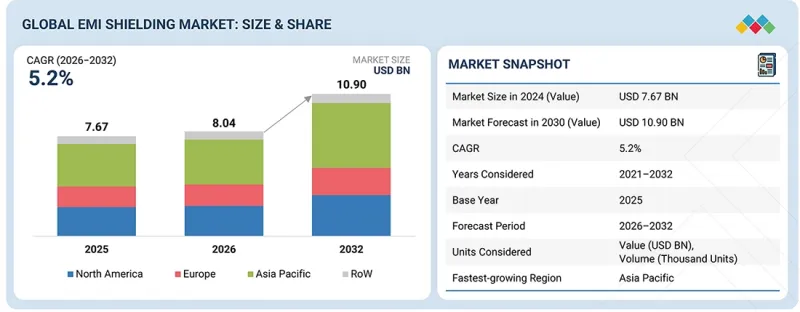
The global EMI shielding market is projected to grow from USD 8.04 billion in 2026 to USD 10.90 billion by 2032, registering a CAGR of 5.2%. The demand for EMI shielding is increasing with the rapid proliferation of wireless communication technologies because modern systems operate at higher frequencies and in increasingly crowded electromagnetic environments.
| Scope of the Report | |
|---|---|
| Years Considered for the Study | 2021-2032 |
| Base Year | 2025 |
| Forecast Period | 2026-2032 |
| Units Considered | Value (USD Billion) |
| Segments | By Material, Frequency, Type and Region |
| Regions covered | North America, Europe, APAC, RoW |
The expansion of 5G technology, along with Wi-Fi, Bluetooth, and IoT devices, has significantly increased signal density, leading to greater risks of electromagnetic interference between components and devices. This interference can degrade signal quality, reduce data transmission efficiency, and cause device malfunction. As a result, manufacturers are integrating advanced EMI shielding solutions to ensure signal integrity, maintain performance reliability, and meet stringent electromagnetic compatibility (EMC) regulations, especially in compact and high-speed electronic systems.
"Conduction, by method, is expected to record the highest CAGR during the forecast period."
The conduction segment in the EMI shielding market, by method, is likely to be the fastest-growing segment due to the increasing need for efficient dissipation of electromagnetic interference through direct electrical pathways. Conduction-based shielding works by transferring unwanted electromagnetic energy away from sensitive components through conductive materials such as metals, coatings, and gaskets, making it highly effective for compact, high-density electronic systems. With the rise of high-speed applications driven by 5G technology, EV electronics, and advanced PCBs, managing interference at the source has become critical. Additionally, conduction methods offer better reliability, cost efficiency, and ease of integration into modern device architectures, further accelerating their adoption across consumer electronics, automotive, and industrial applications.
"PCB-level shielding is expected to dominate the EMI shielding market, by application, throughout the forecast period"
PCB-level shielding is expected to dominate the market throughout the forecast period due to the increasing miniaturization and complexity of electronic devices, where interference needs to be controlled directly at the source. As components are densely packed onto printed circuit boards, the risk of electromagnetic interference between chips and circuits rises significantly, making localized shielding more effective than system-level approaches. PCB shielding solutions, such as shielding cans, conductive coatings, and ground planes, help contain and isolate noise within specific sections of the board, ensuring signal integrity and reliable performance. With the expansion of high-speed applications driven by 5G networks, IoT devices, and advanced automotive electronics, PCB-level shielding offers a compact, cost-efficient, and scalable solution, leading to its dominant adoption across industries.
"China secured the largest share of the Asia Pacific EMI shielding market in 2025."
China secured the largest share of the Asia Pacific EMI shielding market due to its strong dominance in electronics manufacturing, semiconductor production, and telecom infrastructure development. The country serves as a global hub for consumer electronics, with large-scale production of smartphones, laptops, and networking equipment that require effective EMI shielding solutions. Additionally, China's rapid deployment of 5G technology and the growth of its electric vehicle ecosystem further drive demand for advanced shielding materials. Government support, robust supply chains, and the presence of major OEMs and component manufacturers strengthen its market position, enabling China to maintain leadership in the region.
- By Company Type: Tier 1 - 30%, Tier 2 - 50%, and Tier 3 - 20%
- By Designation: Directors - 40%, C-level Executives - 30%, and Others - 30%
- By Region: North America - 22%, Europe - 22%, Asia Pacific - 45%, and RoW - 11%
Prominent players profiled in this report include PARKER HANNIFIN CORP (US), PPG Industries, Inc. (US), 3M (US), Hankel AG & CO KGAA (Germany), Qnity Electronics Inc (US), Leader Tech Inc (US), MG Chemicals (Canada), Nolato AB (Sweden), Tech Etch Inc (US), and RTP Company (US).
Research Coverage:
The report defines, describes, and forecasts the EMI shielding market based on type (narrowband EMI, broadband EMI), method (radiation, conduction), material (conductive coatings & paints (silver-based conductive coatings, copper-based conductive coatings, nickel-based conductive coatings, carbon-based conductive coatings (printed carbon ink, graphene-based conductive coatings)), conductive polymers (conductive elastomers (silicone and fluorosilicone, Ethylene Propylene Diene Monomer (EPDM)), conductive plastics)), metal shielding, EMI/EMC filters (EMI/EMC filters, by load type (AC filters (single-phase, three-phase), DC filters)), EMI/EMC filters (by insertion loss (differential mode, common mode), and EMI shielding tapes & laminates), frequency (low-frequency Shielding (below 100 MHz), high-frequency shielding (100 MHz-1 GHz)), application (PCB-level shielding, cable shielding, enclosure shielding, connector shielding, antenna shielding), industry (consumer electronics, telecommunications, automotive, healthcare, aerospace, energy & power, industrial, transportation), and region (North America, Europe, Asia Pacific, and RoW). It provides detailed information regarding drivers, restraints, opportunities, and challenges influencing the market's growth. It also analyzes competitive developments, including acquisitions, product launches, expansions, and actions taken by key players to grow in the market.
Reasons to Buy This Report:
The report will help market leaders/new entrants with information on the closest approximations of the revenue for the overall EMI shielding market and its subsegments. The report will help stakeholders understand the competitive landscape and gain more insight to position their business better and plan suitable go-to-market strategies. The report also helps stakeholders understand the market's pulse and provides information on key drivers, restraints, opportunities, and challenges.
The report will provide insights into the following points:
- Analysis of Key Drivers (Rising demand for high-speed and high-frequency devices, Enforcement of stringent regulations to prevent electronic equipment malfunctions), restraints (Environmental hazards and high costs of EMI shielding metals, Low effectiveness of traditional EMI shielding materials), opportunities (Growing adoption of digital healthcare solutions, Rising consumer awareness of effects of EMI shielding), and challenges (Reducing electromagnetic interference in miniaturized devices, Thermal management trade-offs) of the EMI shielding market
- Product Development/Innovation: Detailed insights into upcoming technologies, research & development activities, and product launches in the EMI shielding market
- Market Development: Comprehensive information about lucrative markets (The report analyzes the EMI shielding market across various regions.)
- Market Diversification: Exhaustive information about new products launched, untapped geographies, recent developments, and investments in the EMI shielding market
- Competitive Assessment: In-depth assessment of market share, growth strategies, and offerings of leading players, including PARKER HANNIFIN CORP (US), PPG Industries, Inc. (US), 3M (US), Hankel AG & CO KGAA (Germany), Qnity Electronics Inc (US), in the EMI shielding market.
TABLE OF CONTENTS
1 INTRODUCTION
- 1.1 STUDY OBJECTIVES
- 1.2 MARKET DEFINITION
- 1.3 MARKET SCOPE
- 1.3.1 MARKET SEGMENTATION AND REGIONAL SCOPE
- 1.3.2 INCLUSIONS AND EXCLUSIONS
- 1.3.3 YEARS CONSIDERED
- 1.4 CURRENCY CONSIDERED
- 1.5 STAKEHOLDERS
- 1.6 SUMMARY OF CHANGES
2 EXECUTIVE SUMMARY
- 2.1 MARKET HIGHLIGHTS AND KEY INSIGHTS
- 2.2 KEY MARKET PARTICIPANTS: MAPPING OF STRATEGIC DEVELOPMENTS
- 2.3 DISRUPTIVE TRENDS IN EMI SHIELDING MARKET
- 2.4 HIGH-GROWTH SEGMENTS
- 2.5 REGIONAL SNAPSHOT: MARKET SIZE, GROWTH RATE, AND FORECAST
3 PREMIUM INSIGHTS
- 3.1 ATTRACTIVE OPPORTUNITIES FOR PLAYERS OPERATING IN EMI SHIELDING MARKET
- 3.2 EMI SHIELDING MARKET, BY TYPE
- 3.3 EMI SHIELDING MARKET SHARE, BY MATERIAL
- 3.4 EMI SHIELDING MARKET IN NORTH AMERICA, BY INDUSTRY AND COUNTRY
- 3.5 EMI SHIELDING MARKET, BY COUNTRY
4 MARKET OVERVIEW
- 4.1 INTRODUCTION
- 4.2 MARKET DYNAMICS
- 4.2.1 DRIVERS
- 4.2.1.1 Increasing electronic content in devices
- 4.2.1.2 Stringent regulatory standards for electromagnetic compatibility across industries
- 4.2.1.3 Rising demand for high-speed and high-frequency devices
- 4.2.1.4 Increasing proliferation of wireless communication technologies
- 4.2.2 RESTRAINTS
- 4.2.2.1 High material and manufacturing cost
- 4.2.2.2 Design complexity in compact electronic devices
- 4.2.2.3 Environmental hazards and high costs of EMI shielding metals
- 4.2.3 OPPORTUNITIES
- 4.2.3.1 Growth of EVs, 5G infrastructure, and high-frequency electronics
- 4.2.3.2 Development of lightweight and flexible shielding materials
- 4.2.3.3 Growing adoption of digital healthcare solutions
- 4.2.3.4 Rising consumer awareness of effects of EMI shielding
- 4.2.4 CHALLENGES
- 4.2.4.1 Balancing shielding effectiveness with thermal management
- 4.2.4.2 High complexity in reducing electromagnetic interference in miniaturized devices
- 4.2.1 DRIVERS
- 4.3 INTERCONNECTED MARKETS AND CROSS-SECTOR OPPORTUNITIES
- 4.4 STRATEGIC MOVES BY TIER-1/2/3 PLAYERS
5 INDUSTRY TRENDS
- 5.1 INTRODUCTION
- 5.2 PORTER'S FIVE FORCES ANALYSIS
- 5.2.1 BARGAINING POWER OF SUPPLIERS
- 5.2.2 BARGAINING POWER OF BUYERS
- 5.2.3 THREAT OF NEW ENTRANTS
- 5.2.4 THREAT OF SUBSTITUTES
- 5.2.5 INTENSITY OF COMPETITIVE RIVALRY
- 5.3 MACROECONOMIC OUTLOOK
- 5.3.1 INTRODUCTION
- 5.3.2 GDP TRENDS AND FORECAST
- 5.3.3 TRENDS IN GLOBAL CONSUMER ELECTRONICS INDUSTRY
- 5.3.4 TRENDS IN GLOBAL TELECOMMUNICATIONS INDUSTRY
- 5.4 VALUE CHAIN ANALYSIS
- 5.5 ECOSYSTEM ANALYSIS
- 5.6 PRICING ANALYSIS
- 5.6.1 INDICATIVE PRICING OF KEY PLAYERS, BY MATERIAL, 2025
- 5.6.2 INDICATIVE PRICING OF CONDUCTIVE COATINGS & PAINTS, BY TYPE, 2025
- 5.6.3 AVERAGE SELLING PRICE TREND OF EMI SHIELDING, BY MATERIAL, 2021-2025
- 5.6.4 AVERAGE SELLING PRICE TREND, BY REGION, 2022-2025
- 5.7 TRADE ANALYSIS
- 5.7.1 IMPORT SCENARIO (852859)
- 5.7.2 EXPORT SCENARIO (852859)
- 5.8 KEY CONFERENCES AND EVENTS, 2026-2027
- 5.9 TRENDS/DISRUPTIONS IMPACTING CUSTOMER BUSINESS
- 5.10 INVESTMENT AND FUNDING SCENARIO
- 5.11 CASE STUDY ANALYSIS
- 5.11.1 MILITARY GROUND RADAR SYSTEM RECEIVES CUSTOM DUAL-FUNCTION EMI VENT
- 5.11.2 AUTOMOTIVE TIER-1 RESOLVES EMI AND THERMAL CHALLENGES IN COMPACT INFOTAINMENT CONTROLLER
- 5.11.3 MOUNT SINAI HOSPITAL ELIMINATES SUBWAY-INDUCED MRI INTERFERENCE USING ACTIVE MAGNETIC COMPENSATION
- 5.11.4 AUTOMOTIVE OEMS ACHIEVE DUAL EMI AND THERMAL PROTECTION IN ADAS MODULES WITH SINGLE SILICONE-FREE GAP PAD
- 5.11.5 GPU MANUFACTURER ELIMINATES BOARD-LEVEL EMI IN COMPACT SEMICONDUCTOR DESIGN WITH ULTRA-THIN FERRITE SHEETS
- 5.12 IMPACT OF 2025 US TARIFF - EMI SHIELDING MARKET
- 5.12.1 INTRODUCTION
- 5.12.2 KEY TARIFF RATES
- 5.12.3 PRICE IMPACT ANALYSIS
- 5.12.4 IMPACT ON COUNTRIES/REGIONS
- 5.12.4.1 North America
- 5.12.4.2 Europe
- 5.12.4.3 Asia Pacific
- 5.12.5 IMPACT ON END-USE INDUSTRIES
6 TECHNOLOGICAL ADVANCEMENTS, AI-DRIVEN IMPACT, PATENTS, AND INNOVATIONS
- 6.1 KEY TECHNOLOGIES
- 6.1.1 ELECTROMAGNETIC REFLECTION
- 6.1.2 MULTIPLE REFLECTION ATTENUATION
- 6.2 COMPLEMENTARY TECHNOLOGIES
- 6.2.1 GROUNDING AND BONDING ENGINEERING
- 6.2.2 SIGNAL INTEGRITY ENGINEERING
- 6.3 ADJACENT TECHNOLOGIES
- 6.3.1 DIFFERENTIAL SIGNALING TECHNOLOGY
- 6.3.2 ELECTROSTATIC DISCHARGE (ESD) CONTROL TECHNOLOGY
- 6.4 TECHNOLOGY/PRODUCT ROADMAP
- 6.5 PATENT ANALYSIS
- 6.6 IMPACT OF AI/GEN AI ON EMI SHIELDING MARKET
- 6.6.1 TOP USE CASES AND MARKET POTENTIAL
- 6.6.2 BEST PRACTICES FOLLOWED BY OEMS IN EMI SHIELDING MARKET
- 6.6.3 CASE STUDIES RELATED TO AI IMPLEMENTATION IN EMI SHIELDING MARKET
- 6.6.4 INTERCONNECTED/ADJACENT ECOSYSTEM AND IMPACT ON MARKET PLAYERS
- 6.6.5 CLIENTS' READINESS TO ADOPT AI-INTEGRATED EMI SHIELDING
7 REGULATORY LANDSCAPE
- 7.1 REGIONAL REGULATIONS AND COMPLIANCE
- 7.1.1 REGULATORY BODIES, GOVERNMENT AGENCIES, AND OTHER ORGANIZATIONS
- 7.1.1.1 Industry standards
- 7.1.1.2 Regulations
- 7.1.1 REGULATORY BODIES, GOVERNMENT AGENCIES, AND OTHER ORGANIZATIONS
8 CUSTOMER LANDSCAPE AND BUYER BEHAVIOR
- 8.1 DECISION-MAKING PROCESS
- 8.2 KEY STAKEHOLDERS INVOLVED IN BUYING PROCESS AND THEIR EVALUATION CRITERIA
- 8.2.1 KEY STAKEHOLDERS IN BUYING PROCESS
- 8.2.2 BUYING CRITERIA
- 8.3 ADOPTION BARRIERS AND INTERNAL CHALLENGES
- 8.4 UNMET NEEDS OF VARIOUS INDUSTRIES
9 LATEST EMI SHIELDING TECHNOLOGIES AND EFFECTIVENESS TESTS
- 9.1 LATEST EMI SHIELDING TECHNOLOGIES
- 9.1.1 TRANSPARENT EMI SHIELDING MATERIALS
- 9.2 EMI SHIELDING EFFECTIVENESS TESTS
- 9.2.1 SHIELDED BOX TESTS
- 9.2.2 SHIELDED ROOM TESTS
- 9.2.3 OPEN FIELD TESTS
- 9.2.4 COAXIAL TRANSMISSION LINE TESTS
10 FORMATIONS OF EMI SHIELDING
- 10.1 INTRODUCTION
- 10.2 EMI SHIELDING GASKETS AND O-RINGS
- 10.2.1 EMI SHIELDING GASKETS
- 10.2.2 EMI SHIELDING O-RINGS
- 10.3 SOLID ENCLOSURES
- 10.4 WIRE MESH & SCREENS
- 10.5 CABLE SHIELDING
- 10.6 COATINGS
11 EMI SHIELDING MARKET, BY TYPE
- 11.1 INTRODUCTION
- 11.1.1 NARROWBAND EMI
- 11.1.1.1 Increasing complexity of electronic architecture to accelerate demand for targeted EMI shielding
- 11.1.2 BROADBAND EMI
- 11.1.2.1 Expansion of high-speed connectivity infrastructure to drive demand for wide-spectrum shielding solutions
- 11.1.1 NARROWBAND EMI
12 EMI SHIELDING MARKET, BY MATERIAL
- 12.1 INTRODUCTION
- 12.2 CONDUCTIVE COATINGS & PAINTS
- 12.2.1 SILVER-BASED
- 12.2.1.1 Superior electrical conductivity to drive demand for high-performance EMI shielding
- 12.2.2 COPPER-BASED
- 12.2.2.1 Cost-effective conductivity to support adoption across high-volume electronics
- 12.2.3 NICKEL-BASED
- 12.2.3.1 Strong corrosion resistance to increase adoption in harsh operating environments
- 12.2.4 CARBON-BASED
- 12.2.4.1 Printed carbon ink
- 12.2.4.1.1 Increasing adoption of printed electronics to drive demand for carbon ink shielding solutions
- 12.2.4.2 Graphene-based conductive coatings
- 12.2.4.2.1 Superior conductivity-to-weight ratio to accelerate adoption
- 12.2.4.1 Printed carbon ink
- 12.2.5 OTHER TYPES
- 12.2.1 SILVER-BASED
- 12.3 CONDUCTIVE POLYMERS
- 12.3.1 CONDUCTIVE ELASTOMERS
- 12.3.1.1 Silicone and fluorosilicone
- 12.3.1.1.1 Increasing use of high-temperature electronics in aerospace and defense to drive demand
- 12.3.1.2 EPDM
- 12.3.1.2.1 Expansion of high-speed internet networks to boost demand
- 12.3.1.1 Silicone and fluorosilicone
- 12.3.2 CONDUCTIVE PLASTICS
- 12.3.2.1 Increasing demand for lightweight and versatile conductive plastics to augment market growth
- 12.3.1 CONDUCTIVE ELASTOMERS
- 12.4 METAL SHIELDING
- 12.4.1 INCREASING DEPLOYMENT OF 5G BASE STATIONS TO DRIVE DEMAND FOR HIGH-PERFORMANCE METAL SHIELDING MATERIALS
- 12.5 EMI/EMC FILTERS
- 12.5.1 EMI/EMC FILTERS, BY LOAD TYPE
- 12.5.1.1 AC filters
- 12.5.1.1.1 Single-phase
- 12.5.1.1.1.1 Increasing adoption of consumer electronics and low-power equipment to drive demand
- 12.5.1.1.2 Three-phase
- 12.5.1.1.2.1 Increasing industrial automation and motor drive adoption to propel demand
- 12.5.1.1.1 Single-phase
- 12.5.1.2 DC filters
- 12.5.1.2.1 Expansion of EV charging and renewable energy systems to accelerate demand for DC EMI filters
- 12.5.1.1 AC filters
- 12.5.2 EMI/EMC FILTERS, BY INSERTION LOSS
- 12.5.2.1 Common-mode
- 12.5.2.1.1 Increasing density of high-speed electronics to drive demand
- 12.5.2.2 Differential-mode
- 12.5.2.2.1 Rising use of power electronics to accelerate demand
- 12.5.2.1 Common-mode
- 12.5.1 EMI/EMC FILTERS, BY LOAD TYPE
- 12.6 EMI SHIELDING TAPES & LAMINATES
- 12.6.1 INCREASING DEMAND FOR EMI SHIELDING IN 5G INFRASTRUCTURE TO AUGMENT MARKET GROWTH
13 EMI SHIELDING MARKET, BY METHOD
- 13.1 INTRODUCTION
- 13.2 RADIATION
- 13.2.1 ADVANCEMENTS IN LIGHTWEIGHT SHIELDING MATERIALS TO DRIVE ADOPTION IN HIGH-PERFORMANCE ELECTRONIC APPLICATIONS
- 13.3 CONDUCTION
- 13.3.1 GROWTH IN CONNECTED ELECTRONICS ACROSS AUTOMOTIVE AND CONSUMER SEGMENTS TO INCREASE DEMAND
14 EMI SHIELDING MARKET, BY FREQUENCY
- 14.1 INTRODUCTION
- 14.2 BELOW 100 MHZ
- 14.2.1 INCREASING ADOPTION OF POWER ELECTRONICS TO DRIVE DEMAND FOR LOW-FREQUENCY EMI SHIELDING
- 14.3 ABOVE 100 MHZ
- 14.3.1 NEED FOR SEAMLESS CONNECTIVITY AND ADHERENCE TO STRINGENT REGULATORY STANDARDS TO DRIVE MARKET
15 EMI SHIELDING MARKET, BY APPLICATION
- 15.1 INTRODUCTION
- 15.2 PCB-LEVEL SHIELDING
- 15.2.1 INCREASING CIRCUIT DENSITY IN COMPACT ELECTRONICS TO DRIVE DEMAND
- 15.3 CABLE SHIELDING
- 15.3.1 RISING COMPLEXITY OF CONNECTED SYSTEMS TO ACCELERATE DEMAND
- 15.4 ENCLOSURE SHIELDING
- 15.4.1 INCREASING ADOPTION OF HIGH-FREQUENCY ELECTRONICS TO DRIVE MARKET
- 15.5 CONNECTOR SHIELDING
- 15.5.1 GROWTH IN HIGH-SPEED DATA TRANSMISSION TO INCREASE DEMAND
- 15.6 ANTENNA SHIELDING
- 15.6.1 EXPANSION OF MULTI-BAND WIRELESS DEVICES TO DRIVE MARKET
16 EMI SHIELDING MARKET, BY INDUSTRY
- 16.1 INTRODUCTION
- 16.2 CONSUMER ELECTRONICS
- 16.2.1 STRINGENT REGULATORY REQUIREMENTS FOR ELECTROMAGNETIC COMPATIBILITY TO FUEL MARKET GROWTH
- 16.2.2 SMARTPHONES
- 16.2.3 LAPTOPS AND COMPUTERS
- 16.2.4 SMART HOME DEVICES
- 16.2.5 GAMING CONSOLES
- 16.3 TELECOMMUNICATIONS
- 16.3.1 GOVERNMENT-BACKED 5G INVESTMENTS TO ACCELERATE DEMAND FOR EMI SHIELDING SOLUTIONS
- 16.3.2 BASE STATIONS AND SMALL CELLS
- 16.3.3 STORAGE DEVICES
- 16.3.4 OPTICAL TRANSCEIVERS
- 16.4 AUTOMOTIVE
- 16.4.1 INCREASING INVESTMENTS IN EV INFRASTRUCTURE AND ADVANCED VEHICLE ELECTRONICS TO DRIVE DEMAND FOR EMI SHIELDING
- 16.4.2 ADVANCED DRIVER ASSISTANCE SYSTEMS (ADAS)
- 16.4.3 INFOTAINMENT AND COMMUNICATION SYSTEMS
- 16.4.4 ENGINE CONTROL UNITS (ECUS)
- 16.5 HEALTHCARE
- 16.5.1 MINIATURIZATION OF MEDICAL DEVICES TO DRIVE MARKET GROWTH
- 16.5.2 MEDICAL DEVICES
- 16.5.3 DIAGNOSTIC EQUIPMENT
- 16.6 AEROSPACE
- 16.6.1 INCREASING ADOPTION OF ADVANCED AVIONICS AND RADAR SYSTEMS TO DRIVE DEMAND FOR EMI SHIELDING SOLUTIONS
- 16.6.2 NAVIGATION AND COMMUNICATION SYSTEMS
- 16.6.3 RADAR AND SURVEILLANCE SYSTEMS
- 16.7 ENERGY & POWER
- 16.7.1 INCREASING INVESTMENTS IN RENEWABLE ENERGY INFRASTRUCTURE TO DRIVE DEMAND FOR EMI SHIELDING SOLUTIONS
- 16.7.2 POWER DISTRIBUTION SYSTEMS
- 16.8 INDUSTRIAL
- 16.8.1 INCREASING DEMAND FOR ADVANCED ROBOTICS AND AUTOMATION SYSTEMS TO AUGMENT MARKET GROWTH
- 16.8.2 LOGIC CONTROLLERS
- 16.8.3 ROBOTICS
- 16.8.4 INDUSTRIAL IOT DEVICES
- 16.9 TRANSPORTATION
- 16.9.1 INCREASING INVESTMENTS IN RAIL ELECTRIFICATION AND HIGH-SPEED RAIL INFRASTRUCTURE TO DRIVE DEMAND
- 16.9.2 TRAIN CONTROL AND PROPULSION
17 EMI SHIELDING MARKET, BY REGION
- 17.1 INTRODUCTION
- 17.2 NORTH AMERICA
- 17.2.1 US
- 17.2.1.1 Increase in semiconductor manufacturing investments to drive market
- 17.2.2 CANADA
- 17.2.2.1 Increasing investments in semiconductor and advanced electronics manufacturing to propel market
- 17.2.3 MEXICO
- 17.2.3.1 Growth in electronics manufacturing and semiconductor assembly to drive market
- 17.2.1 US
- 17.3 EUROPE
- 17.3.1 GERMANY
- 17.3.1.1 Strong automotive electronics innovation to drive demand for EMI shielding solutions
- 17.3.2 UK
- 17.3.2.1 Growing demand for sophisticated electronic devices in healthcare industry to drive market
- 17.3.3 FRANCE
- 17.3.3.1 Adoption of advanced technologies in aerospace and defense to increase demand
- 17.3.4 REST OF EUROPE
- 17.3.1 GERMANY
- 17.4 ASIA PACIFIC
- 17.4.1 CHINA
- 17.4.1.1 Telecom infrastructure expansion to support market growth
- 17.4.2 JAPAN
- 17.4.2.1 Surging developments in various industries to stimulate market growth
- 17.4.3 INDIA
- 17.4.3.1 Expanding automotive, telecom, and defense electronics sectors to drive demand
- 17.4.4 REST OF ASIA PACIFIC
- 17.4.1 CHINA
- 17.5 ROW
- 17.5.1 MIDDLE EAST
- 17.5.1.1 Saudi Arabia
- 17.5.1.1.1 Telecom, automotive electrification, smart infrastructure, and digital transformation to drive growth
- 17.5.1.2 UAE
- 17.5.1.2.1 Increasing investments in manufacturing sector to drive market
- 17.5.1.3 Rest of Middle East
- 17.5.1.1 Saudi Arabia
- 17.5.2 AFRICA
- 17.5.2.1 Increased adoption of telecommunications networks, digital infrastructure, and electronics to propel market
- 17.5.3 SOUTH AMERICA
- 17.5.3.1 Brazil
- 17.5.3.1.1 Growing automotive industry to boost demand
- 17.5.3.2 Argentina
- 17.5.3.2.1 Modernization of manufacturing sector to drive market
- 17.5.3.3 Rest of South America
- 17.5.3.1 Brazil
- 17.5.1 MIDDLE EAST
18 COMPETITIVE LANDSCAPE
- 18.1 OVERVIEW
- 18.2 KEY PLAYER STRATEGIES/RIGHT TO WIN, 2021-2025
- 18.3 REVENUE ANALYSIS, 2021-2025
- 18.4 MARKET SHARE ANALYSIS, 2O25
- 18.5 COMPANY VALUATION AND FINANCIAL METRICS
- 18.6 BRAND COMPARISON
- 18.7 COMPANY EVALUATION MATRIX: KEY PLAYERS, 2025
- 18.7.1 STARS
- 18.7.2 EMERGING LEADERS
- 18.7.3 PERVASIVE PLAYERS
- 18.7.4 PARTICIPANTS
- 18.7.5 COMPANY FOOTPRINT: KEY PLAYERS, 2025
- 18.7.5.1 Company footprint
- 18.7.5.2 Region footprint
- 18.7.5.3 Material footprint
- 18.7.5.4 Method footprint
- 18.7.5.5 Industry footprint
- 18.8 COMPANY EVALUATION MATRIX: STARTUPS/SMES, 2025
- 18.8.1 PROGRESSIVE COMPANIES
- 18.8.2 RESPONSIVE COMPANIES
- 18.8.3 DYNAMIC COMPANIES
- 18.8.4 STARTING BLOCKS
- 18.8.5 COMPETITIVE BENCHMARKING: STARTUPS/SMES, 2024
- 18.8.5.1 Detailed list of key startups/SMEs
- 18.8.5.2 Competitive benchmarking of key startups/SMEs
- 18.9 COMPETITIVE SCENARIO
- 18.9.1 PRODUCT LAUNCHES
- 18.9.2 DEALS
- 18.9.3 EXPANSIONS
19 COMPANY PROFILES
- 19.1 KEY PLAYERS
- 19.1.1 PARKER HANNIFIN CORP
- 19.1.1.1 Business overview
- 19.1.1.2 Products/Solutions/Services offered
- 19.1.1.3 Recent developments
- 19.1.1.3.1 Product launches
- 19.1.1.4 MnM view
- 19.1.1.4.1 Right to win
- 19.1.1.4.2 Strategic choices
- 19.1.1.4.3 Weaknesses and competitive threats
- 19.1.2 PPG INDUSTRIES, INC.
- 19.1.2.1 Business overview
- 19.1.2.2 Products/Solutions/Services offered
- 19.1.2.3 Recent developments
- 19.1.2.3.1 Product launches
- 19.1.2.3.2 Deals
- 19.1.2.3.3 Expansions
- 19.1.2.3.4 Other developments
- 19.1.2.4 MnM view
- 19.1.2.4.1 Right to win
- 19.1.2.4.2 Strategic choices
- 19.1.2.4.3 Weaknesses and competitive threats
- 19.1.3 3M
- 19.1.3.1 Business overview
- 19.1.3.2 Products/Solutions/Services offered
- 19.1.3.3 Recent developments
- 19.1.3.3.1 Expansions
- 19.1.3.4 MnM view
- 19.1.3.4.1 Right to win
- 19.1.3.4.2 Strategic choices
- 19.1.3.4.3 Weaknesses and competitive threats
- 19.1.4 HENKEL AG & CO. KGAA
- 19.1.4.1 Business overview
- 19.1.4.2 Products/Solutions/Services offered
- 19.1.4.3 Recent developments
- 19.1.4.3.1 Product launches
- 19.1.4.3.2 Other developments
- 19.1.4.4 MnM view
- 19.1.4.4.1 Right to win
- 19.1.4.4.2 Strategic choices
- 19.1.4.4.3 Weaknesses and competitive threats
- 19.1.5 QNITY ELECTRONICS, INC.
- 19.1.5.1 Business overview
- 19.1.5.2 Products/Solutions/Services offered
- 19.1.5.3 Recent developments
- 19.1.5.3.1 Product launches
- 19.1.5.3.2 Other developments
- 19.1.5.4 MnM view
- 19.1.5.4.1 Right to win
- 19.1.5.4.2 Strategic choices
- 19.1.5.4.3 Weaknesses and competitive threats
- 19.1.6 LEADER TECH INC.
- 19.1.6.1 Business overview
- 19.1.6.2 Products/Solutions/Services offered
- 19.1.7 MG CHEMICALS
- 19.1.7.1 Business overview
- 19.1.7.2 Products/Solutions/Services offered
- 19.1.8 NOLATO AB
- 19.1.8.1 Business overview
- 19.1.8.2 Products/Solutions/Services offered
- 19.1.8.3 Recent developments
- 19.1.8.3.1 Deals
- 19.1.9 TECH ETCH, INC.
- 19.1.9.1 Business overview
- 19.1.9.2 Products/Solutions/Services offered
- 19.1.9.3 Recent developments
- 19.1.9.3.1 Product launches
- 19.1.9.3.2 Deals
- 19.1.10 RTP COMPANY
- 19.1.10.1 Business overview
- 19.1.10.2 Products/Solutions/Services offered
- 19.1.10.3 Recent developments
- 19.1.10.3.1 Deals
- 19.1.11 TE CONNECTIVITY
- 19.1.11.1 Business overview
- 19.1.11.2 Products/Solutions/Services offered
- 19.1.12 KITAGAWA INDUSTRIES AMERICA, INC.
- 19.1.12.1 Business overview
- 19.1.12.2 Products/Solutions/Services offered
- 19.1.13 ETS-LINDGREN
- 19.1.13.1 Business overview
- 19.1.13.2 Products/Solutions/Services offered
- 19.1.14 SEAL SCIENCE, INC.
- 19.1.14.1 Business overview
- 19.1.14.2 Products/Solutions/Services offered
- 19.1.1 PARKER HANNIFIN CORP
- 19.2 OTHER PLAYERS
- 19.2.1 E-SONG EMC CO., LTD
- 19.2.2 EAST COAST SHIELDING
- 19.2.3 EFFECTIVE SHIELDING CO. INC.
- 19.2.4 ATLANTA METAL COATING, INC.
- 19.2.5 HOLLAND SHIELDING SYSTEMS BV
- 19.2.6 ICOTEK
- 19.2.7 INTEGRATED POLYMER SOLUTIONS
- 19.2.8 INTERSTATE SPECIALTY PRODUCTS
- 19.2.9 MARIAN, INC.
- 19.2.10 NTRIUM INC.
- 19.2.11 OMEGA SHIELDING PRODUCTS
- 19.2.12 SPIRA MANUFACTURING
20 RESEARCH METHODOLOGY
- 20.1 RESEARCH APPROACH
- 20.1.1 SECONDARY AND PRIMARY RESEARCH
- 20.1.2 SECONDARY DATA
- 20.1.2.1 List of major secondary sources
- 20.1.2.2 Key data from secondary sources
- 20.1.3 PRIMARY DATA
- 20.1.3.1 Breakdown of primaries
- 20.1.3.2 Key data from primary sources
- 20.1.3.3 Key primary participants
- 20.1.3.4 Key industry insights
- 20.2 MARKET SIZE ESTIMATION
- 20.2.1 BOTTOM-UP APPROACH
- 20.2.2 TOP-DOWN APPROACH
- 20.2.3 MARKET SIZE CALCULATION FOR BASE YEAR
- 20.3 MARKET FORECAST APPROACH
- 20.3.1 SUPPLY SIDE
- 20.3.2 DEMAND SIDE
- 20.4 MARKET BREAKDOWN AND DATA TRIANGULATION
- 20.5 RESEARCH ASSUMPTIONS
- 20.6 RISK ASSESSMENT
21 APPENDIX
- 21.1 KNOWLEDGESTORE: MARKETSANDMARKETS' SUBSCRIPTION PORTAL
- 21.2 CUSTOMIZATION OPTIONS
- 21.3 RELATED REPORTS
- 21.4 AUTHOR DETAILS
List of Tables
- TABLE 1 EMI SHIELDING MARKET: INCLUSION/EXCLUSION DETAILS
- TABLE 2 SUMMARY OF CHANGES MADE IN UPDATED REPORT VERSION
- TABLE 3 INTERCONNECTED MARKETS AND CROSS-SECTOR OPPORTUNITIES
- TABLE 4 STRATEGIC FOCUS OF MAJOR COMPANIES IN EMI SHIELDING MARKET
- TABLE 5 EMI SHIELDING MARKET: PORTER'S FIVE FORCES ANALYSIS
- TABLE 6 GDP GROWTH RATES, BY KEY COUNTRY, 2022-2030
- TABLE 7 ROLE OF PLAYERS IN ECOSYSTEM
- TABLE 8 INDICATIVE PRICING OF EMI SHIELDING OFFERED BY KEY PLAYERS, BY MATERIAL, 2025 (USD)
- TABLE 9 INDICATIVE PRICING OF CONDUCTIVE COATINGS & PAINTS, BY TYPE, 2025 (USD)
- TABLE 10 AVERAGE SELLING PRICE TREND OF EMI SHIELDING, BY MATERIAL 2021-2025 (USD)
- TABLE 11 AVERAGE SELLING PRICE TREND OF EMI SHIELDING, BY REGION, 2022-2025 (USD)
- TABLE 12 IMPORT DATA FOR HS CODE 852859-COMPLIANT PRODUCTS, BY COUNTRY, 2021-2025 (USD MILLION)
- TABLE 13 EXPORT DATA FOR HS CODE 852859-COMPLIANT PRODUCTS, BY COUNTRY, 2021-2025 (USD MILLION)
- TABLE 14 EMI SHIELDING MARKET: LIST OF KEY CONFERENCES AND EVENTS
- TABLE 15 CUSTOM DUAL-FUNCTION EMI VENT GIVEN TO MILITARY GROUND RADAR SYSTEM
- TABLE 16 EMI AND THERMAL CHALLENGES IN COMPACT INFOTAINMENT CONTROLLER RESOLVED BY AUTOMOTIVE TIER-1 PLAYER
- TABLE 17 USING ACTIVE MAGNETIC COMPENSATION MOUNT SINAI HOSPITAL ELIMINATED SUBWAY-INDUCED MRI INTERFERENCE
- TABLE 18 AUTOMOTIVE OEMS ACHIEVE DUAL EMI AND THERMAL PROTECTION IN ADAS MODULES
- TABLE 19 ELIMINATION OF BOARD-LEVEL EMI IN COMPACT SEMICONDUCTOR DESIGN WITH ULTRA-THIN FERRITE SHEETS
- TABLE 20 US-ADJUSTED RECIPROCAL TARIFF RATES
- TABLE 21 TECHNOLOGY ROADMAP IN EMI SHIELDING MARKET
- TABLE 22 EMI SHIELDING MARKET: LIST OF KEY PATENTS, 2022-2025
- TABLE 23 TOP USE CASES AND MARKET POTENTIAL
- TABLE 24 BEST PRACTICES FOLLOWED BY COMPANIES IN EMI SHIELDING MARKET
- TABLE 25 CASE STUDIES RELATED TO AI IMPLEMENTATION IN EMI SHIELDING
- TABLE 26 INTERCONNECTED/ADJACENT ECOSYSTEM AND IMPACT ON MARKET PLAYERS
- TABLE 27 NORTH AMERICA: LIST OF REGULATORY BODIES, GOVERNMENT AGENCIES, AND OTHER ORGANIZATIONS
- TABLE 28 EUROPE: LIST OF REGULATORY BODIES, GOVERNMENT AGENCIES, AND OTHER ORGANIZATIONS
- TABLE 29 ASIA PACIFIC: LIST OF REGULATORY BODIES, GOVERNMENT AGENCIES, AND OTHER ORGANIZATIONS
- TABLE 30 ROW: LIST OF REGULATORY BODIES, GOVERNMENT AGENCIES, AND OTHER ORGANIZATIONS
- TABLE 31 EMI SHIELDING MARKET: INDUSTRY STANDARDS
- TABLE 32 INFLUENCE OF STAKEHOLDERS ON BUYING PROCESS FOR MAJOR INDUSTRIES (%)
- TABLE 33 KEY BUYING CRITERIA FOR MAJOR INDUSTRIES
- TABLE 34 UNMET NEEDS IN EMI SHIELDING MARKET, BY INDUSTRY
- TABLE 35 EMI SHIELDING MARKET, BY TYPE, 2021-2025 (USD MILLION)
- TABLE 36 EMI SHIELDING MARKET, BY TYPE, 2026-2032 (USD MILLION)
- TABLE 37 EMI SHIELDING MARKET, BY MATERIAL, 2021-2025 (USD MILLION)
- TABLE 38 EMI SHIELDING MARKET, BY MATERIAL, 2026-2032 (USD MILLION)
- TABLE 39 EMI SHIELDING MARKET, BY MATERIAL, 2021-2025 (THOUSAND UNITS)
- TABLE 40 EMI SHIELDING MARKET, BY MATERIAL, 2026-2032 (THOUSAND UNITS)
- TABLE 41 CONDUCTIVE PAINTS & COATINGS: EMI SHIELDING MARKET, BY TYPE, 2021-2025 (USD MILLION)
- TABLE 42 CONDUCTIVE PAINTS & COATINGS: EMI SHIELDING MARKET, BY TYPE, 2026-2032 (USD MILLION)
- TABLE 43 CONDUCTIVE PAINTS & COATINGS: EMI SHIELDING MARKET, BY INDUSTRY, 2021-2025 (USD MILLION)
- TABLE 44 CONDUCTIVE PAINTS & COATINGS: EMI SHIELDING MARKET, BY INDUSTRY, 2026-2032 (USD MILLION)
- TABLE 45 CARBON-BASED: EMI SHIELDING MARKET, BY TYPE, 2021-2025 (USD MILLION)
- TABLE 46 CARBON-BASED: EMI SHIELDING MARKET, BY TYPE, 2026-2032 (USD MILLION)
- TABLE 47 CONDUCTIVE POLYMERS: EMI SHIELDING MARKET, BY TYPE, 2021-2025 (USD MILLION)
- TABLE 48 CONDUCTIVE POLYMERS: EMI SHIELDING MARKET, BY TYPE, 2026-2032 (USD MILLION)
- TABLE 49 CONDUCTIVE POLYMERS: EMI SHIELDING MARKET, BY INDUSTRY, 2021-2025 (USD MILLION)
- TABLE 50 CONDUCTIVE POLYMERS: EMI SHIELDING MARKET, BY INDUSTRY, 2026-2032 (USD MILLION)
- TABLE 51 CONDUCTIVE ELASTOMERS: EMI SHIELDING MARKET, BY CHEMISTRY, 2021-2025 (USD MILLION)
- TABLE 52 CONDUCTIVE ELASTOMERS: EMI SHIELDING MARKET, BY CHEMISTRY, 2026-2032 (USD MILLION)
- TABLE 53 CONDUCTIVE ELASTOMERS: EMI SHIELDING MARKET, BY INDUSTRY, 2021-2025 (USD MILLION)
- TABLE 54 CONDUCTIVE ELASTOMERS: EMI SHIELDING MARKET, BY INDUSTRY, 2026-2032 (USD MILLION)
- TABLE 55 CONDUCTIVE PLASTICS: EMI SHIELDING MARKET, BY INDUSTRY, 2021-2025 (USD MILLION)
- TABLE 56 CONDUCTIVE PLASTICS: EMI SHIELDING MARKET, BY INDUSTRY, 2026-2032 (USD MILLION)
- TABLE 57 METAL SHIELDING: EMI SHIELDING MARKET, BY INDUSTRY, 2021-2025 (USD MILLION)
- TABLE 58 METAL SHIELDING: EMI SHIELDING MARKET, BY INDUSTRY, 2026-2032 (USD MILLION)
- TABLE 59 EMI/EMC FILTERS: EMI SHIELDING MARKET, BY INDUSTRY, 2021-2025 (USD MILLION)
- TABLE 60 EMI/EMC FILTERS: EMI SHIELDING MARKET, BY INDUSTRY, 2026-2032 (USD MILLION)
- TABLE 61 EMI/EMC FILTERS: EMI SHIELDING MARKET, BY LOAD TYPE, 2021-2025 (USD MILLION)
- TABLE 62 EMI/EMC FILTERS: EMI SHIELDING MARKET, BY LOAD TYPE, 2026-2032 (USD MILLION)
- TABLE 63 AC FILTERS: EMI SHIELDING MARKET, BY TYPE, 2021-2025 (USD MILLION)
- TABLE 64 AC FILTERS: EMI SHIELDING MARKET, BY TYPE, 2026-2032 (USD MILLION)
- TABLE 65 AC FILTERS: EMI SHIELDING MARKET, BY INDUSTRY, 2021-2025 (USD MILLION)
- TABLE 66 AC FILTERS: EMI SHIELDING MARKET, BY INDUSTRY, 2026-2032 (USD MILLION)
- TABLE 67 DC FILTERS: EMI SHIELDING MARKET, BY INDUSTRY, 2021-2025 (USD MILLION)
- TABLE 68 DC FILTERS: EMI SHIELDING MARKET, BY INDUSTRY, 2026-2032 (USD MILLION)
- TABLE 69 EMI/EMC FILTERS: EMI SHIELDING MARKET, BY INSERTION LOSS, 2021-2025 (USD MILLION)
- TABLE 70 EMI/EMC FILTERS: EMI SHIELDING MARKET, BY INSERTION LOSS, 2026-2032 (USD MILLION)
- TABLE 71 EMI SHIELDING TAPES & LAMINATES: EMI SHIELDING MARKET, BY INDUSTRY, 2021-2025 (USD MILLION)
- TABLE 72 EMI SHIELDING TAPES & LAMINATES: EMI SHIELDING MARKET, BY INDUSTRY, 2026-2032 (USD MILLION)
- TABLE 73 EMI SHIELDING MARKET, BY METHOD, 2021-2025 (USD MILLION)
- TABLE 74 EMI SHIELDING MARKET, BY METHOD, 2026-2032 (USD MILLION)
- TABLE 75 RADIATION: EMI SHIELDING MARKET, BY INDUSTRY, 2021-2025 (USD MILLION)
- TABLE 76 RADIATION: EMI SHIELDING MARKET, BY INDUSTRY, 2026-2032 (USD MILLION)
- TABLE 77 CONDUCTION: EMI SHIELDING MARKET, BY INDUSTRY, 2021-2025 (USD MILLION)
- TABLE 78 CONDUCTION: EMI SHIELDING MARKET, BY INDUSTRY, 2026-2032 (USD MILLION)
- TABLE 79 EMI SHIELDING MARKET, BY FREQUENCY, 2021-2025 (USD MILLION)
- TABLE 80 EMI SHIELDING MARKET, BY FREQUENCY, 2026-2032 (USD MILLION)
- TABLE 81 EMI SHIELDING MARKET, BY APPLICATION, 2021-2025 (USD MILLION)
- TABLE 82 EMI SHIELDING MARKET, BY APPLICATION, 2026-2032 (USD MILLION)
- TABLE 83 EMI SHIELDING MARKET, BY INDUSTRY, 2021-2025 (USD MILLION)
- TABLE 84 EMI SHIELDING MARKET, BY INDUSTRY, 2026-2032 (USD MILLION)
- TABLE 85 CONSUMER ELECTRONICS: EMI SHIELDING MARKET, BY METHOD, 2021-2025 (USD MILLION)
- TABLE 86 CONSUMER ELECTRONICS: EMI SHIELDING MARKET, BY METHOD, 2026-2032 (USD MILLION)
- TABLE 87 CONSUMER ELECTRONICS: EMI SHIELDING MARKET, BY MATERIAL, 2021-2025 (USD MILLION)
- TABLE 88 CONSUMER ELECTRONICS: EMI SHIELDING MARKET, BY MATERIAL, 2026-2032 (USD MILLION)
- TABLE 89 CONSUMER ELECTRONICS: EMI SHIELDING MARKET FOR CONDUCTIVE POLYMERS, BY TYPE, 2021-2025 (USD MILLION)
- TABLE 90 CONSUMER ELECTRONICS: EMI SHIELDING MARKET FOR CONDUCTIVE POLYMERS, BY TYPE, 2026-2032 (USD MILLION)
- TABLE 91 CONSUMER ELECTRONICS: EMI SHIELDING MARKET FOR EMI/EMC FILTERS, BY LOAD TYPE, 2021-2025 (USD MILLION)
- TABLE 92 CONSUMER ELECTRONICS: EMI SHIELDING MARKET FOR EMI/EMC FILTERS, BY LOAD TYPE, 2026-2032 (USD MILLION)
- TABLE 93 CONSUMER ELECTRONICS: EMI SHIELDING MARKET, BY REGION, 2021-2025 (USD MILLION)
- TABLE 94 CONSUMER ELECTRONICS: EMI SHIELDING MARKET, BY REGION, 2026-2032 (USD MILLION)
- TABLE 95 TELECOMMUNICATIONS: EMI SHIELDING MARKET, BY METHOD, 2021-2025 (USD MILLION)
- TABLE 96 TELECOMMUNICATIONS: EMI SHIELDING MARKET, BY METHOD, 2026-2032 (USD MILLION)
- TABLE 97 TELECOMMUNICATIONS: EMI SHIELDING MARKET, BY MATERIAL, 2021-2025 (USD MILLION)
- TABLE 98 TELECOMMUNICATIONS: EMI SHIELDING MARKET, BY MATERIAL, 2026-2032 (USD MILLION)
- TABLE 99 TELECOMMUNICATIONS: EMI SHIELDING MARKET FOR CONDUCTIVE POLYMERS, BY TYPE, 2021-2025 (USD MILLION)
- TABLE 100 TELECOMMUNICATIONS: EMI SHIELDING MARKET FOR CONDUCTIVE POLYMERS, BY TYPE, 2026-2032 (USD MILLION)
- TABLE 101 TELECOMMUNICATIONS: EMI SHIELDING MARKET FOR EMI/EMC FILTERS, BY LOAD TYPE, 2021-2025 (USD MILLION)
- TABLE 102 TELECOMMUNICATIONS: EMI SHIELDING MARKET FOR EMI/EMC FILTERS, BY LOAD TYPE, 2026-2032 (USD MILLION)
- TABLE 103 TELECOMMUNICATIONS: EMI SHIELDING MARKET, BY REGION, 2021-2025 (USD MILLION)
- TABLE 104 TELECOMMUNICATIONS: EMI SHIELDING MARKET, BY REGION, 2026-2032 (USD MILLION)
- TABLE 105 AUTOMOTIVE: EMI SHIELDING MARKET, BY METHOD, 2021-2025 (USD MILLION)
- TABLE 106 AUTOMOTIVE: EMI SHIELDING MARKET, BY METHOD, 2026-2032 (USD MILLION)
- TABLE 107 AUTOMOTIVE: EMI SHIELDING MARKET, BY MATERIAL, 2021-2025 (USD MILLION)
- TABLE 108 AUTOMOTIVE: EMI SHIELDING MARKET, BY MATERIAL, 2026-2032 (USD MILLION)
- TABLE 109 AUTOMOTIVE: EMI SHIELDING MARKET FOR CONDUCTIVE POLYMERS, BY TYPE, 2021-2025 (USD MILLION)
- TABLE 110 AUTOMOTIVE: EMI SHIELDING MARKET FOR CONDUCTIVE POLYMERS, BY TYPE, 2026-2032 (USD MILLION)
- TABLE 111 AUTOMOTIVE: EMI SHIELDING MARKET FOR EMI/EMC FILTERS, BY LOAD TYPE, 2021-2025 (USD MILLION)
- TABLE 112 AUTOMOTIVE: EMI SHIELDING MARKET FOR EMI/EMC FILTERS, BY LOAD TYPE, 2026-2032 (USD MILLION)
- TABLE 113 AUTOMOTIVE: EMI SHIELDING MARKET, BY REGION, 2021-2025 (USD MILLION)
- TABLE 114 AUTOMOTIVE: EMI SHIELDING MARKET, BY REGION, 2026-2032 (USD MILLION)
- TABLE 115 HEALTHCARE: EMI SHIELDING MARKET, BY METHOD, 2021-2025 (USD MILLION)
- TABLE 116 HEALTHCARE: EMI SHIELDING MARKET, BY METHOD, 2026-2032 (USD MILLION)
- TABLE 117 HEALTHCARE: EMI SHIELDING MARKET, BY MATERIAL, 2021-2025 (USD MILLION)
- TABLE 118 HEALTHCARE: EMI SHIELDING MARKET, BY MATERIAL, 2026-2032 (USD MILLION)
- TABLE 119 HEALTHCARE: EMI SHIELDING MARKET FOR CONDUCTIVE POLYMERS, BY TYPE, 2021-2025 (USD MILLION)
- TABLE 120 HEALTHCARE: EMI SHIELDING MARKET FOR CONDUCTIVE POLYMERS, BY TYPE, 2026-2032 (USD MILLION)
- TABLE 121 HEALTHCARE: EMI SHIELDING MARKET FOR EMI/EMC FILTERS, BY LOAD TYPE, 2021-2025 (USD MILLION)
- TABLE 122 HEALTHCARE: EMI SHIELDING MARKET FOR EMI/EMC FILTERS, BY LOAD TYPE, 2026-2032 (USD MILLION)
- TABLE 123 HEALTHCARE: EMI SHIELDING MARKET, BY REGION, 2021-2025 (USD MILLION)
- TABLE 124 HEALTHCARE: EMI SHIELDING MARKET, BY REGION, 2026-2032 (USD MILLION)
- TABLE 125 AEROSPACE: EMI SHIELDING MARKET, BY METHOD, 2021-2025 (USD MILLION)
- TABLE 126 AEROSPACE: EMI SHIELDING MARKET, BY METHOD, 2026-2032 (USD MILLION)
- TABLE 127 AEROSPACE: EMI SHIELDING MARKET, BY MATERIAL, 2021-2025 (USD MILLION)
- TABLE 128 AEROSPACE: EMI SHIELDING MARKET, BY MATERIAL, 2026-2032 (USD MILLION)
- TABLE 129 AEROSPACE: EMI SHIELDING MARKET FOR CONDUCTIVE POLYMERS, BY TYPE, 2021-2025 (USD MILLION)
- TABLE 130 AEROSPACE: EMI SHIELDING MARKET FOR CONDUCTIVE POLYMERS, BY TYPE, 2026-2032 (USD MILLION)
- TABLE 131 AEROSPACE: EMI SHIELDING MARKET FOR EMI/EMC FILTERS, BY LOAD TYPE, 2021-2025 (USD MILLION)
- TABLE 132 AEROSPACE: EMI SHIELDING MARKET FOR EMI/EMC FILTERS, BY LOAD TYPE, 2026-2032 (USD MILLION)
- TABLE 133 AEROSPACE: EMI SHIELDING MARKET, BY REGION, 2021-2025 (USD MILLION)
- TABLE 134 AEROSPACE: EMI SHIELDING MARKET, BY REGION, 2026-2032 (USD MILLION)
- TABLE 135 ENERGY & POWER: EMI SHIELDING MARKET, BY METHOD, 2021-2025 (USD MILLION)
- TABLE 136 ENERGY & POWER: EMI SHIELDING MARKET, BY METHOD, 2026-2032 (USD MILLION)
- TABLE 137 ENERGY & POWER: EMI SHIELDING MARKET, BY MATERIAL, 2021-2025 (USD MILLION)
- TABLE 138 ENERGY & POWER: EMI SHIELDING MARKET, BY MATERIAL, 2026-2032 (USD MILLION)
- TABLE 139 ENERGY & POWER: EMI SHIELDING MARKET FOR CONDUCTIVE POLYMERS, BY TYPE, 2021-2025 (USD MILLION)
- TABLE 140 ENERGY & POWER: EMI SHIELDING MARKET FOR CONDUCTIVE POLYMERS, BY TYPE, 2026-2032 (USD MILLION)
- TABLE 141 ENERGY & POWER: EMI SHIELDING MARKET FOR EMI/EMC FILTERS, BY LOAD TYPE, 2021-2025 (USD MILLION)
- TABLE 142 ENERGY & POWER: EMI SHIELDING MARKET FOR EMI/EMC FILTERS, BY LOAD TYPE, 2026-2032 (USD MILLION)
- TABLE 143 ENERGY & POWER: EMI SHIELDING MARKET, BY REGION, 2021-2025 (USD MILLION)
- TABLE 144 ENERGY & POWER: EMI SHIELDING MARKET, BY REGION, 2026-2032 (USD MILLION)
- TABLE 145 INDUSTRIAL: EMI SHIELDING MARKET, BY METHOD, 2021-2025 (USD MILLION)
- TABLE 146 INDUSTRIAL: EMI SHIELDING MARKET, BY METHOD, 2026-2032 (USD MILLION)
- TABLE 147 INDUSTRIAL: EMI SHIELDING MARKET, BY MATERIAL, 2021-2025 (USD MILLION)
- TABLE 148 INDUSTRIAL: EMI SHIELDING MARKET, BY MATERIAL, 2026-2032 (USD MILLION)
- TABLE 149 INDUSTRIAL: EMI SHIELDING MARKET FOR CONDUCTIVE POLYMERS, BY TYPE, 2021-2025 (USD MILLION)
- TABLE 150 INDUSTRIAL: EMI SHIELDING MARKET FOR CONDUCTIVE POLYMERS, BY TYPE, 2026-2032 (USD MILLION)
- TABLE 151 INDUSTRIAL: EMI SHIELDING MARKET FOR EMI/EMC FILTERS, BY LOAD TYPE, 2021-2025 (USD MILLION)
- TABLE 152 INDUSTRIAL: EMI SHIELDING MARKET FOR EMI/EMC FILTERS, BY LOAD TYPE, 2026-2032 (USD MILLION)
- TABLE 153 INDUSTRIAL: EMI SHIELDING MARKET, BY REGION, 2021-2025 (USD MILLION)
- TABLE 154 INDUSTRIAL: EMI SHIELDING MARKET, BY REGION, 2026-2032 (USD MILLION)
- TABLE 155 TRANSPORTATION: EMI SHIELDING MARKET, BY METHOD, 2021-2025 (USD MILLION)
- TABLE 156 TRANSPORTATION: EMI SHIELDING MARKET, BY METHOD, 2026-2032 (USD MILLION)
- TABLE 157 TRANSPORTATION: EMI SHIELDING MARKET, BY MATERIAL, 2021-2025 (USD MILLION)
- TABLE 158 TRANSPORTATION: EMI SHIELDING MARKET, BY MATERIAL, 2026-2032 (USD MILLION)
- TABLE 159 TRANSPORTATION: EMI SHIELDING MARKET FOR CONDUCTIVE POLYMERS, BY TYPE, 2021-2025 (USD MILLION)
- TABLE 160 TRANSPORTATION: EMI SHIELDING MARKET FOR CONDUCTIVE POLYMERS, BY TYPE, 2026-2032 (USD MILLION)
- TABLE 161 TRANSPORTATION: EMI SHIELDING MARKET FOR EMI/EMC FILTERS, BY LOAD TYPE, 2021-2025 (USD MILLION)
- TABLE 162 TRANSPORTATION: EMI SHIELDING MARKET FOR EMI/EMC FILTERS, BY LOAD TYPE, 2026-2032 (USD MILLION)
- TABLE 163 TRANSPORTATION: EMI SHIELDING MARKET, BY REGION, 2021-2025 (USD MILLION)
- TABLE 164 TRANSPORTATION: EMI SHIELDING MARKET, BY REGION, 2026-2032 (USD MILLION)
- TABLE 165 EMI SHIELDING MARKET, BY REGION, 2021-2025 (USD MILLION)
- TABLE 166 EMI SHIELDING MARKET, BY REGION, 2026-2032 (USD MILLION)
- TABLE 167 NORTH AMERICA: EMI SHIELDING MARKET, BY COUNTRY, 2021-2025 (USD MILLION)
- TABLE 168 NORTH AMERICA: EMI SHIELDING MARKET, BY COUNTRY, 2026-2032 (USD MILLION)
- TABLE 169 NORTH AMERICA: EMI SHIELDING MARKET, BY INDUSTRY, 2021-2025 (USD MILLION)
- TABLE 170 NORTH AMERICA: EMI SHIELDING MARKET, BY INDUSTRY, 2026-2032 (USD MILLION)
- TABLE 171 EUROPE: EMI SHIELDING MARKET, BY COUNTRY, 2021-2025 (USD MILLION)
- TABLE 172 EUROPE: EMI SHIELDING MARKET, BY COUNTRY, 2026-2032 (USD MILLION)
- TABLE 173 EUROPE: EMI SHIELDING MARKET, BY INDUSTRY, 2021-2025 (USD MILLION)
- TABLE 174 EUROPE: EMI SHIELDING MARKET, BY INDUSTRY, 2026-2032 (USD MILLION)
- TABLE 175 ASIA PACIFIC: EMI SHIELDING MARKET, BY COUNTRY, 2021-2025 (USD MILLION)
- TABLE 176 ASIA PACIFIC: EMI SHIELDING MARKET, BY COUNTRY, 2026-2032 (USD MILLION)
- TABLE 177 ASIA PACIFIC: EMI SHIELDING MARKET, BY INDUSTRY, 2021-2025 (USD MILLION)
- TABLE 178 ASIA PACIFIC: EMI SHIELDING MARKET, BY INDUSTRY, 2026-2032 (USD MILLION)
- TABLE 179 ROW: EMI SHIELDING MARKET, BY REGION, 2021-2025 (USD MILLION)
- TABLE 180 ROW: EMI SHIELDING MARKET, BY REGION, 2026-2032 (USD MILLION)
- TABLE 181 ROW: EMI SHIELDING MARKET, BY INDUSTRY, 2021-2025 (USD MILLION)
- TABLE 182 ROW: EMI SHIELDING MARKET, BY INDUSTRY, 2026-2032 (USD MILLION)
- TABLE 183 MIDDLE EAST: EMI SHIELDING MARKET, BY COUNTRY, 2021-2025 (USD MILLION)
- TABLE 184 MIDDLE EAST: EMI SHIELDING MARKET, BY COUNTRY, 2026-2032 (USD MILLION)
- TABLE 185 SOUTH AMERICA: EMI SHIELDING MARKET, BY COUNTRY, 2021-2025 (USD MILLION)
- TABLE 186 SOUTH AMERICA: EMI SHIELDING MARKET, BY COUNTRY, 2026-2032 (USD MILLION)
- TABLE 187 EMI SHIELDING MARKET: OVERVIEW OF STRATEGIES ADOPTED BY KEY PLAYERS, 2021-2025
- TABLE 188 EMI SHIELDING MARKET: DEGREE OF COMPETITION, 2025
- TABLE 189 EMI SHIELDING MARKET: REGION FOOTPRINT
- TABLE 190 EMI SHIELDING MARKET: MATERIAL FOOTPRINT
- TABLE 191 EMI SHIELDING MARKET: METHOD FOOTPRINT
- TABLE 192 EMI SHIELDING MARKET: INDUSTRY FOOTPRINT
- TABLE 193 EMI SHIELDING MARKET: DETAILED LIST OF KEY STARTUPS/SMES
- TABLE 194 EMI SHIELDING MARKET: COMPETITIVE BENCHMARKING OF KEY STARTUPS/SMES
- TABLE 195 EMI SHIELDING MARKET: PRODUCT LAUNCHES, JANUARY 2021-APRIL 2026
- TABLE 196 EMI SHIELDING MARKET: DEALS, JANUARY 2021-APRIL 2026
- TABLE 197 EMI SHIELDING MARKET: EXPANSIONS, JANUARY 2021-APRIL 2026
- TABLE 198 PARKER HANNIFIN CORP: COMPANY OVERVIEW
- TABLE 199 PARKER HANNIFIN CORP: PRODUCTS/SOLUTIONS/SERVICES OFFERED
- TABLE 200 PARKER HANNIFIN CORP: PRODUCT LAUNCHES
- TABLE 201 PPG INDUSTRIES, INC.: COMPANY OVERVIEW
- TABLE 202 PPG INDUSTRIES, INC.: PRODUCTS/SOLUTIONS/SERVICES OFFERED
- TABLE 203 PPG INDUSTRIES, INC: PRODUCT LAUNCHES
- TABLE 204 PPG INDUSTRIES, INC.: DEALS
- TABLE 205 PPG INDUSTRIES, INC.: EXPANSIONS
- TABLE 206 PPG INDUSTRIES, INC.: OTHER DEVELOPMENTS
- TABLE 207 3M: COMPANY OVERVIEW
- TABLE 208 3M: PRODUCTS/SOLUTIONS/SERVICES OFFERED
- TABLE 209 3M: EXPANSIONS
- TABLE 210 HENKEL AG & CO. KGAA: COMPANY OVERVIEW
- TABLE 211 HENKEL AG & CO. KGAA: PRODUCTS/SOLUTIONS/SERVICES OFFERED
- TABLE 212 HENKEL AG & CO. KGAA: PRODUCT LAUNCHES
- TABLE 213 HENKEL AG & CO. KGAA: OTHER DEVELOPMENTS
- TABLE 214 QNITY ELECTRONICS, INC.: COMPANY OVERVIEW
- TABLE 215 QNITY ELECTRONICS, INC.: PRODUCTS/SOLUTIONS/SERVICES OFFERED
- TABLE 216 QNITY ELECTRONICS, INC.: PRODUCT LAUNCHES
- TABLE 217 QNITY ELECTRONICS, INC.: OTHER DEVELOPMENTS
- TABLE 218 LEADER TECH INC.: COMPANY OVERVIEW
- TABLE 219 LEADER TECH INC.: PRODUCTS/SOLUTIONS/SERVICES OFFERED
- TABLE 220 MG CHEMICALS: COMPANY OVERVIEW
- TABLE 221 MG CHEMICALS: PRODUCTS/SOLUTIONS/SERVICES OFFERED
- TABLE 222 NOLATO AB: COMPANY OVERVIEW
- TABLE 223 NOLATO AB: PRODUCTS/SOLUTIONS/SERVICES OFFERED
- TABLE 224 NOLATO AB: DEALS
- TABLE 225 TECH ETCH INC.: COMPANY OVERVIEW
- TABLE 226 TECH ETCH INC.: PRODUCTS/SOLUTIONS/SERVICES OFFERED
- TABLE 227 TECH ETCH INC.: PRODUCT LAUNCHES
- TABLE 228 TECH ETCH, INC.: DEALS
- TABLE 229 RTP COMPANY: COMPANY OVERVIEW
- TABLE 230 RTP COMPANY: PRODUCTS/SOLUTIONS/SERVICES OFFERED
- TABLE 231 RTP COMPANY: DEALS
- TABLE 232 TE CONNECTIVITY: COMPANY OVERVIEW
- TABLE 233 TE CONNECTIVITY: PRODUCTS/SOLUTIONS/SERVICES OFFERED
- TABLE 234 KITAGAWA INDUSTRIES AMERICA, INC.: COMPANY OVERVIEW
- TABLE 235 KITAGAWA INDUSTRIES AMERICA, INC.: PRODUCTS/SOLUTIONS/SERVICES OFFERED
- TABLE 236 ETS-LINDGREN: COMPANY OVERVIEW
- TABLE 237 ETS-LINDGREN: PRODUCTS/SOLUTIONS/SERVICES OFFERED
- TABLE 238 SEAL SCIENCE, INC.: COMPANY OVERVIEW
- TABLE 239 SEAL SCIENCE, INC.: PRODUCTS/SOLUTIONS/SERVICES OFFERED
- TABLE 240 E-SONG EMC CO., LTD.: COMPANY OVERVIEW
- TABLE 241 EAST COAST SHIELDING: COMPANY OVERVIEW
- TABLE 242 EFFECTIVE SHIELDING CO. INC.: COMPANY OVERVIEW
- TABLE 243 ATLANTA METAL COATING, INC.: COMPANY OVERVIEW
- TABLE 244 HOLLAND SHIELDING SYSTEMS BV: COMPANY OVERVIEW
- TABLE 245 ICOTEK: COMPANY OVERVIEW
- TABLE 246 INTEGRATED POLYMER SOLUTIONS: COMPANY OVERVIEW
- TABLE 247 INTEGRATED SPECIALTY PRODUCTS: COMPANY OVERVIEW
- TABLE 248 MARIAN, INC.: COMPANY OVERVIEW
- TABLE 249 NTRIUM INC.: COMPANY OVERVIEW
- TABLE 250 OMEGA SHIELDING PRODUCTS: COMPANY OVERVIEW
- TABLE 251 SPIRA MANUFACTURING: COMPANY OVERVIEW
- TABLE 252 EMI SHIELDING MARKET: RISK ASSESSMENT
List of Figures
- FIGURE 1 EMI SHIELDING MARKET SEGMENTATION AND REGIONAL SCOPE
- FIGURE 2 DURATION COVERED
- FIGURE 3 MARKET SCENARIO
- FIGURE 4 GLOBAL EMI SHIELDING MARKET, 2022-2032
- FIGURE 5 MAJOR STRATEGIES ADOPTED BY KEY PLAYERS IN EMI SHIELDING MARKET, 2022-2025
- FIGURE 6 DISRUPTIONS INFLUENCING GROWTH OF EMI SHIELDING MARKET
- FIGURE 7 HIGH-GROWTH SEGMENTS IN EMI SHIELDING MARKET, 2026-2032
- FIGURE 8 ASIA PACIFIC TO REGISTER HIGHEST CAGR IN EMI SHIELDING MARKET DURING FORECAST PERIOD
- FIGURE 9 INCREASING DEMAND FOR HIGH-FREQUENCY ELECTRONICS AND EMC COMPLIANCE TO DRIVE MARKET
- FIGURE 10 BROADBAND EMI SEGMENT TO ACCOUNT FOR LARGER MARKET SHARE IN 2032
- FIGURE 11 CONDUCTIVE COATINGS & PAINTS SEGMENT ACCOUNTED FOR LARGEST MARKET SHARE IN 2025
- FIGURE 12 CONSUMER ELECTRONICS AND US TO HOLD LARGEST SHARES OF NORTH AMERICA MARKET IN 2032
- FIGURE 13 INDIA TO EXHIBIT HIGHEST CAGR IN EMI SHIELDING MARKET DURING FORECAST PERIOD
- FIGURE 14 EMI SHIELDING MARKET: DRIVERS, RESTRAINTS, OPPORTUNITIES, AND CHALLENGES
- FIGURE 15 IMPACT OF DRIVERS ON EMI SHIELDING MARKET
- FIGURE 16 IMPACT OF RESTRAINTS ON EMI SHIELDING MARKET
- FIGURE 17 IMPACT OF OPPORTUNITIES ON EMI SHIELDING MARKET
- FIGURE 18 IMPACT OF CHALLENGES ON EMI SHIELDING MARKET
- FIGURE 19 EMI SHIELDING MARKET: PORTER'S FIVE FORCES ANALYSIS
- FIGURE 20 VALUE CHAIN ANALYSIS
- FIGURE 21 EMI SHIELDING ECOSYSTEM
- FIGURE 22 AVERAGE SELLING PRICE TREND OF EMI SHIELDING, BY MATERIAL, 2021-2025
- FIGURE 23 AVERAGE SELLING PRICE TREND OF EMI SHIELDING, BY REGION, 2022-2025
- FIGURE 24 IMPORT SCENARIO FOR HS CODE 852859-COMPLIANT PRODUCTS, BY KEY COUNTRY, 2021-2025
- FIGURE 25 EXPORT SCENARIO FOR HS CODE 852859-COMPLIANT PRODUCTS, BY KEY COUNTRY, 2021-2025
- FIGURE 26 TRENDS/DISRUPTIONS IMPACTING CUSTOMER BUSINESS
- FIGURE 27 INVESTMENT AND FUNDING SCENARIO, 2021-2024
- FIGURE 28 EMI SHIELDING MARKET: PATENT ANALYSIS, 2016-2025
- FIGURE 29 DECISION-MAKING FACTORS CONSIDERED WHILE BUYING EMI SHIELDING SOLUTIONS
- FIGURE 30 INFLUENCE OF STAKEHOLDERS FROM MAJOR INDUSTRIES ON BUYING PROCESS
- FIGURE 31 KEY BUYING CRITERIA FOR MAJOR INDUSTRIES
- FIGURE 32 ADOPTION BARRIERS AND INTERNAL CHALLENGES
- FIGURE 33 EMI SHIELDING MARKET: EMI SHIELDING EFFECTIVENESS TESTS
- FIGURE 34 EMI SHIELDING MARKET: FORMATIONS OF EMI SHIELDING
- FIGURE 35 EMI SHIELDING MARKET: APPLICATIONS OF EMI GASKETS
- FIGURE 36 EMI SHIELDING MARKET: KEY PROPERTIES OF LIQUID GASKETS
- FIGURE 37 EMI SHIELDING MARKET: APPLICATIONS OF SOLID ENCLOSURES
- FIGURE 38 BROADBAND EMI TO ACCOUNT FOR LARGER MARKET SHARE DURING FORECAST PERIOD
- FIGURE 39 EMI SHIELDING TAPES & LAMINATES SEGMENT TO WITNESS HIGHEST CAGR DURING FORECAST PERIOD
- FIGURE 40 EMC SHIELDING MARKET, BY METHOD
- FIGURE 41 RADIATION METHOD TO ACCOUNT FOR LARGEST MARKET SHARE DURING FORECAST PERIOD
- FIGURE 42 ABOVE 100 MHZ SEGMENT TO REGISTER HIGHER GROWTH DURING FORECAST PERIOD
- FIGURE 43 PCB-LEVEL SHIELDING SEGMENT TO DOMINATE MARKET IN 2032
- FIGURE 44 AUTOMOTIVE INDUSTRY TO REGISTER HIGHEST CAGR DURING FORECAST PERIOD
- FIGURE 45 ASIA PACIFIC TO DOMINATE EMI SHIELDING MARKET DURING FORECAST PERIOD
- FIGURE 46 NORTH AMERICA: EMI SHIELDING MARKET SNAPSHOT
- FIGURE 47 EUROPE: EMI SHIELDING MARKET SNAPSHOT
- FIGURE 48 ASIA PACIFIC: EMI SHIELDING MARKET SNAPSHOT
- FIGURE 49 EMI SHIELDING MARKET: REVENUE ANALYSIS OF TOP PLAYERS, 2021-2025
- FIGURE 50 EMI SHIELDING MARKET SHARE ANALYSIS, 2025
- FIGURE 51 COMPANY VALUATION
- FIGURE 52 FINANCIAL METRICS (EV/EBITDA)
- FIGURE 53 BRAND COMPARISON
- FIGURE 54 EMI SHIELDING MARKET: COMPANY EVALUATION MATRIX (KEY PLAYERS), 2025
- FIGURE 55 EMI SHIELDING MARKET: COMPANY FOOTPRINT
- FIGURE 56 EMI SHIELDING MARKET: COMPANY EVALUATION MATRIX (STARTUPS/SMES), 2025
- FIGURE 57 PARKER HANNIFIN CORP: COMPANY SNAPSHOT
- FIGURE 58 PPG INDUSTRIES, INC.: COMPANY SNAPSHOT
- FIGURE 59 3M: COMPANY SNAPSHOT
- FIGURE 60 HENKEL AG & CO. KGAA: COMPANY SNAPSHOT
- FIGURE 61 QNITY ELECTRONICS, INC.: COMPANY SNAPSHOT
- FIGURE 62 NOLATO AB: COMPANY SNAPSHOT
- FIGURE 63 TE CONNECTIVITY: COMPANY SNAPSHOT
- FIGURE 64 EMI SHIELDING MARKET: RESEARCH DESIGN
- FIGURE 65 EMI SHIELDING MARKET: SECONDARY AND PRIMARY RESEARCH
- FIGURE 66 EMI SHIELDING MARKET: BOTTOM-UP APPROACH
- FIGURE 67 EMI SHIELDING MARKET: TOP-DOWN APPROACH
- FIGURE 68 MARKET SIZE ESTIMATION METHODOLOGY: SUPPLY-SIDE ANALYSIS
- FIGURE 69 DATA TRIANGULATION
- FIGURE 70 ASSUMPTIONS OF RESEARCH STUDY

