PUBLISHER: MarketsandMarkets | PRODUCT CODE: 2037097

PUBLISHER: MarketsandMarkets | PRODUCT CODE: 2037097
High Shear Mixers Market by System Type (Batch Mixers, Inline Mixers), Configuration, Mixing Application, Application (Dairy, Cheese, Ice Cream, Food Products, Dairy Alternatives, Beverages, Other Food Products), and Region - Forecast to 2031
The global high shear mixers market is projected to grow from USD 702.9 million in 2026 to USD 888.5 million by 2031, at a CAGR of 4.8%.
| Scope of the Report | |
|---|---|
| Years Considered for the Study | 2026-2031 |
| Base Year | 2025 |
| Forecast Period | 2026-2031 |
| Units Considered | Value (USD Billion) and Volume (Units) |
| Segments | By System Type, Configuration, Mixing Application, Application, and Region |
| Regions covered | North America, Europe, Asia Pacific, South America, RoW |
This growth is driven by increasing demand for processing solutions across industries such as food, dairy, beverages, plant-based products, and other processed food sectors. Manufacturers aim for consistency in product formulation, reduced processing times, and better integration of ingredients across a wide range of formulations, all of which contribute to market expansion.
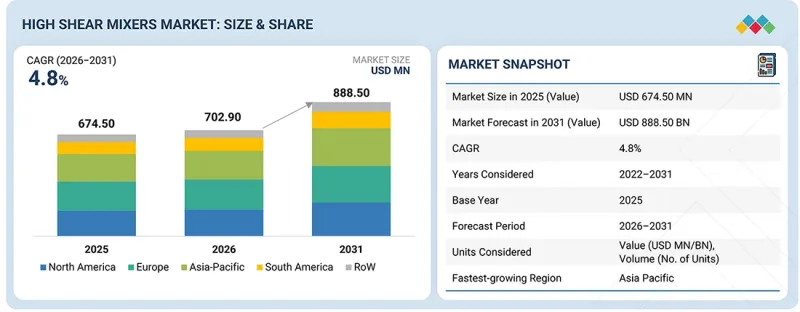
To meet these demands, manufacturers are developing advanced high shear rotor-stator systems, multi-stage mixers, and integrated heating and cooling modules. These innovations are designed to accelerate mixing processes and achieve smaller particle sizes. Major companies, such as GEA Group Aktiengesellschaft (Germany), SPX FLOW, Inc. (US), Tetra Laval Group (Switzerland), IDEX Corporation (US), Buhler Holding AG (Switzerland), EBARA Corporation (Japan), and Silverson Machines Ltd. (UK), are investing significantly in research and development to create a more advanced lineup of equipment that combines high-shear mixing, high-pressure homogenizing, and advanced filtration systems. Other companies also provide mixing equipment that includes heating, cooling, and vacuum features.
Several challenges could hinder market growth, including high costs associated with building and operating these plants, the need for specialized knowledge to manage production, and additional difficulties faced by small and medium-sized manufacturers. Furthermore, varying processing needs across different regions complicate integration, and diverse regional food preferences necessitate customization. Despite these challenges, there are significant market opportunities driven by rising demand for processed and convenient foods, the expansion of global food supply chains, the growing popularity of plant-based foods, and the increasing interest in functional foods.
"By system type, the inline segment is expected to be the fastest-growing segment during the forecast period."
The growing adoption of inline mixing systems in the high shear mixers market offers significant advantages over batch mixers. In inline mixers, materials are continuously fed into the system, mixed, and simultaneously discharged. This process enables quick operations, significantly accelerating production and reducing overall processing time. Inline mixers utilize rotor-stator systems to generate high shear forces, enabling rapid dispersion, emulsification, and homogenization. They are particularly well-suited for processing high-viscosity products and can be easily integrated into existing processing lines. This continuous operation enhances process control and flexibility while simplifying the overall process. Additionally, continuous mixing minimizes product variability and facilitates easier scale-up. While batch mixers still hold the largest market share and serve as the backbone for many applications requiring high-viscosity product mixing, inline and continuous systems are increasingly gaining popularity in modern high-throughput plants as their benefits become more widely recognized.
"By application, the food products segment is expected to account for a significant share of the high shear mixers market during the forecast period."
Food products hold the largest market share in the high shear mixer applications segment. Major application areas include baby food, infant formula, soups, sauces, batters, coffee creamers, custards, dips, mayonnaise, medical foods, special dietary products, sports nutrition, meal replacements, and pet foods, among others, all of which use high shear mixers to meet their specific application requirements. High shear mixing systems are increasingly used to process complex formulations that often require blending multiple ingredients, dispersing fine particles, and adjusting viscosity. Many of these processes involve multi-phase systems, such as oil-in-water emulsions and solid-liquid suspensions, where preventing phase separation is crucial. This segment is expected to grow further as the popularity of functional and fortified food products rises, where precision blending is vital to product efficacy and performance. Additionally, the increasing demand for convenience and ready-to-eat food products is likely to benefit the segment, as high shear mixers offer excellent performance at scale, ensuring high efficiency and productivity.
"By mixing application, the emulsification segment is expected to account for a significant share of the high shear mixers market."
Emulsification is the leading application segment in the high shear mixers market, as it is essential for creating stable emulsions of two immiscible liquids, such as oil and water. High shear mixers are specifically designed to generate the high shear conditions necessary for producing fine and stable emulsions. These emulsifiers are used across various sectors of the food & beverage industry, including dairy products (such as yogurt, enriched milk, recombined milk, and fortified milk), beverages (such as carbonated soft drinks and coffee drinks), sauces, ice creams, and salad dressings. Achieving a stable emulsion is critically important for enhancing texture and mouthfeel, as well as for preserving products that often contain added functional ingredients. Growing consumer demand for higher-quality, more visually appealing, and shelf-stable products is driving the use of high shear mixers in the emulsification segment. High shear technology simplifies processing, reduces the need for stabilizers, and improves formulation performance. As food manufacturing companies continue to innovate and optimize multi-phase recipes, the emulsification segment is expected to maintain a significant share of the high shear mixers market.
In-depth interviews have been conducted with chief executive officers (CEOs), directors, and other executives from key organizations operating in the high shear mixers market.
- By Company Type: Tier 1 (30%), Tier 2 (25%), and Tier 3 (45%)
- By Designation: CXOs (25%), Managers (35%), Others (40%)
- By Region: North America (20%), Europe (30%), Asia Pacific (35%), South America (10%), and the Rest of the World (5%)
Research Coverage
This research report categorizes the high shear mixers market by system type (batch mixers, inline mixers), configuration (batch mixing systems, recirculation mixing systems, continuous mixing systems, hybrid systems), mixing application (emulsification, homogenization, dispersion, particle size reduction), application (dairy, cheese, ice cream, food products, dairy alternatives, beverages, other food products), and region (North America, Europe, Asia Pacific, South America, and the Rest of the World).
The report provides comprehensive insights into the high shear mixers industry, highlighting key factors such as drivers, restraints, challenges, and opportunities that impact its growth. It includes an in-depth analysis of the major industry players, detailing their business activities, services, key strategies, contracts, partnerships, agreements, product launches, mergers and acquisitions and recent developments in the high shear mixers market.
Additionally, the report includes a competitive analysis of emerging startups in the high shear mixers market ecosystem. It also addresses industry-specific trends, including technology analysis, ecosystem and market mapping, and the patent and regulatory landscape, among other topics.
Reasons to Buy This Report
The report provides market leaders/new entrants with information on the closest approximations of revenue numbers for the overall High Shear Mixers and its subsegments. It will help stakeholders understand the competitive landscape and gain more insights to better position their businesses and plan suitable go-to-market strategies. The report also helps stakeholders understand the market pulse and provides information on key drivers, restraints, challenges, and opportunities.
The report provides insights into the following pointers:
- Analysis of key drivers (increasing demand for processed and convenience foods boosts the demand for high shear mixers), restraints (high capital cost of advanced high shear mixing systems), opportunities (adoption of continuous and inline mixing technologies), and challenges (handling complex multi-phase formulations) influencing the growth of the high shear mixers market
- Product Development/Innovation: Detailed insights into research & development activities and new product launches in the high shear mixers market
- Market Development: Comprehensive information about the market analysis of high shear mixers across varied regions
- Market Diversification: Exhaustive information about new product sources, untapped geographies, recent developments, and investments in the high shear mixers market
- Competitive Assessment: In-depth assessment of market shares, growth strategies, product offerings, brand/product comparison, and product footprints of leading players such as GEA Group Aktiengesellschaft (Germany), SPX FLOW, Inc. (US), Tetra Laval Group (Switzerland), IDEX Corporation (US), Buhler Holding AG (Switzerland), EBARA Corporation (Japan), Silverson Machines Ltd. (UK), IKA-Werke GmbH & Co. KG (Germany), Charles Ross & Son Company (US), Admix, Inc. (US), ystral GmbH Maschinenbau + Prozesstechnik (Germany), ProXES GmbH (Germany), INOXPA S.A.U. (Spain), Schold Manufacturing, LLC (US), ARDE-Barinco Inc. (US), and other players in the high shear mixers market.
TABLE OF CONTENTS
1 INTRODUCTION
- 1.1 STUDY OBJECTIVES
- 1.2 MARKET DEFINITION
- 1.3 STUDY SCOPE AND SEGMENTATION
- 1.3.1 MARKETS COVERED AND REGIONAL SCOPE
- 1.3.2 INCLUSIONS AND EXCLUSIONS
- 1.4 YEARS CONSIDERED
- 1.5 UNITS CONSIDERED
- 1.5.1 CURRENCY UNIT
- 1.5.2 VOLUME UNIT
- 1.6 STAKEHOLDERS
2 EXECUTIVE SUMMARY
- 2.1 MARKET HIGHLIGHTS AND KEY INSIGHTS
- 2.2 KEY MARKET PARTICIPANTS: MAPPING OF STRATEGIC DEVELOPMENTS
- 2.3 DISRUPTIVE TRENDS IN HIGH SHEAR MIXERS MARKET
- 2.4 HIGH GROWTH SEGMENTS
- 2.5 REGIONAL SNAPSHOT: MARKET SIZE, GROWTH RATE, AND FORECAST
3 PREMIUM INSIGHTS
- 3.1 ATTRACTIVE OPPORTUNITIES FOR PLAYERS IN HIGH SHEAR MIXERS MARKET
- 3.2 HIGH SHEAR MIXERS MARKET, BY MIXING APPLICATION AND REGION
- 3.3 HIGH SHEAR MIXERS MARKET, BY SYSTEM TYPE
- 3.4 HIGH SHEAR MIXERS MARKET, BY APPLICATION
- 3.5 HIGH SHEAR MIXERS MARKET, BY CONFIGURATION
- 3.6 HIGH SHEAR MIXERS MARKET, BY MIXING APPLICATION
- 3.7 HIGH SHEAR MIXERS MARKET, BY COUNTRY
4 MARKET OVERVIEW
- 4.1 INTRODUCTION
- 4.2 MARKET DYNAMICS
- 4.2.1 DRIVERS
- 4.2.1.1 Stringent food safety regulations and preventive control requirements
- 4.2.1.2 Growing demand for operational efficiency and reduced processing time
- 4.2.1.3 Advancement in rotor-stator technology and automation integration
- 4.2.1.4 Rising adoption in pharmaceutical and biologics manufacturing
- 4.2.2 RESTRAINTS
- 4.2.2.1 High capital expenditure and maintenance cost requirements
- 4.2.2.2 Technical complexity and skilled labor requirements
- 4.2.3 OPPORTUNITIES
- 4.2.3.1 Integration of advanced control systems and digital monitoring capabilities
- 4.2.3.2 Geographic expansion into Southeast Asian manufacturing markets
- 4.2.4 CHALLENGES
- 4.2.4.1 Limited product differentiation
- 4.2.4.2 Intense price competition
- 4.2.1 DRIVERS
- 4.3 UNMET NEEDS AND WHITE SPACES
- 4.3.1 UNMET NEEDS IN HIGH SHEAR MIXERS MARKET
- 4.3.1.1 Process consistency and real-time quality monitoring
- 4.3.1.2 Cost-effective and scalable solutions for emerging markets
- 4.3.1.3 Digital integration and smart manufacturing compatibility
- 4.3.1.4 Energy efficiency and maintenance optimization
- 4.3.2 WHITE SPACE OPPORTUNITIES
- 4.3.2.1 Smart and sensor-integrated mixing systems
- 4.3.2.2 Flexible commercial deployment models
- 4.3.2.3 Integrated continuous processing solutions
- 4.3.2.4 Digitally connected and automated mixing ecosystems
- 4.3.1 UNMET NEEDS IN HIGH SHEAR MIXERS MARKET
- 4.4 INTERCONNECTED MARKETS AND CROSS-SECTOR OPPORTUNITIES
- 4.5 STRATEGIC MOVES BY TIER-1/2/3 PLAYERS
5 INDUSTRY TRENDS
- 5.1 PORTER'S FIVE FORCES ANALYSIS
- 5.1.1 INTENSITY OF COMPETITIVE RIVALRY
- 5.1.2 BARGAINING POWER OF SUPPLIERS
- 5.1.3 BARGAINING POWER OF BUYERS
- 5.1.4 THREAT OF SUBSTITUTES
- 5.1.5 THREAT OF NEW ENTRANTS
- 5.2 MACROECONOMICS OUTLOOK
- 5.2.1 RISING GLOBAL POPULATION AND INCREASING FOOD DEMAND
- 5.2.2 COST PRESSURES & INFLATION
- 5.3 SUPPLY CHAIN ANALYSIS
- 5.3.1 UPSTREAM (RAW MATERIALS & COMPONENT SUPPLIERS)
- 5.3.2 COMPONENT MANUFACTURING & SUBASSEMBLY
- 5.3.3 EQUIPMENT MANUFACTURING (CORE STAGE)
- 5.3.4 DISTRIBUTION & INSTALLATION
- 5.3.5 END USERS
- 5.3.6 SUPPORTING ECOSYSTEM
- 5.4 ECOSYSTEM ANALYSIS
- 5.5 PRICING ANALYSIS
- 5.5.1 INDICATIVE SELLING PRICE OF KEY PLAYERS, BY SYSTEM TYPE
- 5.5.2 AVERAGE SELLING PRICE, BY REGION
- 5.6 TRADE ANALYSIS
- 5.6.1 IMPORT SCENARIO (HS CODE 847982)
- 5.6.2 EXPORT SCENARIO (HS CODE 847982)
- 5.7 KEY CONFERENCES AND EVENTS, 2026-2027
- 5.8 TRENDS/DISRUPTIONS IMPACTING CUSTOMER BUSINESS
- 5.9 INVESTMENT AND FUNDING SCENARIO
- 5.10 CASE STUDY ANALYSIS
- 5.11 IMPACT OF 2025 US TARIFFS - HIGH SHEAR MIXERS MARKET
- 5.11.1 INTRODUCTION
- 5.11.2 KEY TARIFF RATES
- 5.11.3 PRICE IMPACT ANALYSIS
- 5.11.4 IMPACT ON COUNTRIES/REGIONS
- 5.11.4.1 US
- 5.11.4.2 Europe
- 5.11.4.3 Asia Pacific
- 5.11.5 IMPACT ON END-USE INDUSTRIES
- 5.11.6 TRUMP TARIFF UPDATE (2026) AND LEGAL DEVELOPMENTS
6 TECHNOLOGY ADVANCEMENTS, AI-DRIVEN IMPACT, PATENTS, INNOVATIONS, AND FUTURE APPLICATIONS
- 6.1 KEY TECHNOLOGIES
- 6.1.1 ROTOR-STATOR TECHNOLOGY
- 6.1.2 SOLID-LIQUID INJECTION MANIFOLD (SLIM) AND POWDER INDUCTION TECHNOLOGY
- 6.1.3 VARIABLE FREQUENCY DRIVE (VFD) AND PRECISION SPEED CONTROL TECHNOLOGY
- 6.2 COMPLEMENTARY TECHNOLOGIES
- 6.2.1 CLEAN-IN-PLACE (CIP) AND STERILIZE-IN-PLACE (SIP) SYSTEMS
- 6.2.2 PROCESS ANALYTICAL TECHNOLOGY (PAT) AND INLINE SENSING
- 6.3 ADJACENT TECHNOLOGIES
- 6.3.1 HIGH-PRESSURE HOMOGENIZATION (HPH)
- 6.3.2 ULTRASONIC HOMOGENIZATION TECHNOLOGY
- 6.4 PATENT ANALYSIS
- 6.4.1 INTRODUCTION
- 6.4.2 LIST OF MAJOR PATENTS, JANUARY 2016-DECEMBER 2025
- 6.5 FUTURE APPLICATIONS
- 6.5.1 LIPID NANOPARTICLE (LNP) & M-RNA THERAPEUTICS MANUFACTURING
- 6.5.2 ALTERNATIVE PROTEIN & PLANT-BASED FOOD MANUFACTURING
- 6.5.3 BATTERY ELECTRODE SLURRY MANUFACTURING
- 6.5.4 CONTINUOUS PHARMACEUTICAL MANUFACTURING (CPM)
- 6.5.5 GREEN HYDROGEN, CARBON CAPTURE & ENERGY APPLICATIONS
- 6.6 IMPACT OF AI/GEN AI ON HIGH SHEAR MIXERS SERVICE INDUSTRY
- 6.6.1 TOP USE CASES AND MARKET POTENTIALS
- 6.6.2 BEST PRACTICES IN HIGH SHEAR MIXERS INDUSTRY
- 6.6.3 CASE STUDIES OF AI IMPLEMENTATION IN HIGH SHEAR MIXERS MARKET
- 6.6.4 INTERCONNECTED ADJACENT ECOSYSTEM AND IMPACT ON MARKET PLAYERS
- 6.6.5 READINESS TO ADOPT GENERATIVE AI IN HIGH SHEAR MIXERS MARKET
- 6.7 SUCCESS STORIES AND REAL-WORLD APPLICATIONS
- 6.7.1 GEA GROUP: PIONEERING AI-DRIVEN DIGITAL TRANSFORMATION IN MIXING & PROCESSING
- 6.7.2 SPX FLOW X SIEMENS: DIGITAL TWIN AND AI FOR MIXING AT MXD INNOVATION HUB
- 6.7.3 GEA GROUP: AI FOR NEW FOOD & ALTERNATIVE PROTEIN MIXING OPTIMIZATION
7 SUSTAINABILITY AND REGULATORY LANDSCAPE
- 7.1 REGIONAL REGULATIONS AND COMPLIANCE
- 7.1.1 REGULATORY FRAMEWORK
- 7.1.1.1 North America
- 7.1.1.1.1 US
- 7.1.1.1.2 Canada
- 7.1.1.1.3 Mexico
- 7.1.1.2 Europe
- 7.1.1.2.1 Germany
- 7.1.1.2.2 UK
- 7.1.1.2.3 France
- 7.1.1.2.4 Italy
- 7.1.1.2.5 Rest of Europe
- 7.1.1.3 Asia Pacific
- 7.1.1.3.1 China
- 7.1.1.3.2 India
- 7.1.1.3.3 Japan
- 7.1.1.3.4 Australia and New Zealand
- 7.1.1.3.5 Rest of Asia Pacific
- 7.1.1.4 South America
- 7.1.1.4.1 Brazil
- 7.1.1.4.2 Argentina
- 7.1.1.5 RoW
- 7.1.1.5.1 Middle East
- 7.1.1.5.2 Africa Region
- 7.1.1.1 North America
- 7.1.2 REGULATORY BODIES, GOVERNMENT AGENCIES, AND OTHER ORGANIZATIONS
- 7.1.3 INDUSTRY STANDARDS
- 7.1.4 DOCUMENTATION REQUIREMENTS
- 7.1.5 ANTICIPATED REGULATORY CHANGES IN NEXT 5-10 YEARS
- 7.1.1 REGULATORY FRAMEWORK
- 7.2 SUSTAINABILITY INITIATIVES
- 7.3 IMPACT OF REGULATORY POLICIES ON SUSTAINABILITY INITIATIVES
- 7.3.1 CERTIFICATIONS, LABELING, ECO-STANDARDS
8 CUSTOMER LANDSCAPE AND BUYER BEHAVIOR
- 8.1 DECISION-MAKING PROCESS
- 8.2 BUYER STAKEHOLDERS AND BUYING EVALUATION CRITERIA
- 8.2.1 KEY STAKEHOLDERS IN BUYING PROCESS
- 8.2.2 BUYING CRITERIA
- 8.3 ADOPTION BARRIERS AND INTERNAL CHALLENGES
- 8.4 UNMET NEEDS FROM VARIOUS END-USE INDUSTRIES
- 8.5 MARKET PROFITABILITY
- 8.5.1 REVENUE POTENTIAL
- 8.5.2 COST DYNAMICS
- 8.5.3 MARGIN OPPORTUNITIES, BY SYSTEM TYPE
9 HIGH SHEAR MIXERS MARKET, BY SYSTEM TYPE
- 9.1 INTRODUCTION
- 9.2 BATCH MIXERS
- 9.3 INLINE MIXERS
10 HIGH SHEAR MIXERS MARKET, BY APPLICATION
- 10.1 INTRODUCTION
- 10.2 DAIRY
- 10.2.1 EXPANDING GLOBAL DAIRY PROCESSING TO DRIVE HIGH-SHEAR MIXER DEMAND
- 10.3 CHEESE
- 10.3.1 GROWING PROCESSED AND ANALOGUE CHEESE PRODUCTION TO DRIVE HIGH-SHEAR MIXER ADOPTION
- 10.4 ICE CREAM
- 10.4.1 RISING INDUSTRIAL ICE CREAM PRODUCTION AND CONSUMPTION TO DRIVE HIGH-SHEAR MIXER DEMAND
- 10.5 FOOD PRODUCTS
- 10.5.1 RISING GLOBAL DEMAND FOR PROCESSED AND FUNCTIONAL FOODS TO DRIVE HIGH-SHEAR MIXER ADOPTION
- 10.6 DAIRY ALTERNATIVES
- 10.6.1 RAPID EXPANSION OF PLANT-BASED FOOD AND BEVERAGE PRODUCTION TO ACCELERATE HIGH-SHEAR MIXER DEMAND
- 10.7 BEVERAGES
- 10.7.1 RISE IN GLOBAL BEVERAGE PRODUCTION AND PROCESSING INTENSITY TO DRIVE HIGH SHEAR MIXER DEMAND
- 10.7.2 ALCOHOLIC BEVERAGES
- 10.7.3 NON-ALCOHOLIC BEVERAGES
- 10.8 OTHER FOOD PRODUCTS
11 HIGH SHEAR MIXERS MARKET, BY CONFIGURATION
- 11.1 INTRODUCTION
- 11.2 BATCH MIXING SYSTEMS
- 11.2.1 COMPLEX FORMULATIONS AND CONTROLLED HIGH SHEAR PROCESSING TO DRIVE BATCH SYSTEM DOMINANCE
- 11.3 RECIRCULATION MIXING SYSTEMS
- 11.3.1 ENHANCED DISPERSION EFFICIENCY AND MULTI-PASS SHEAR PROCESSING TO DRIVE RECIRCULATION SYSTEM ADOPTION
- 11.4 CONTINUOUS MIXING SYSTEMS
- 11.4.1 SHIFT TOWARD CONTINUOUS FOOD PROCESSING TO ACCELERATE INLINE HIGH SHEAR MIXING ADOPTION
- 11.5 HYBRID SYSTEMS
- 11.5.1 NEED FOR FLEXIBLE PROCESSING COMBINING BATCH CONTROL AND CONTINUOUS EFFICIENCY TO DRIVE HYBRID HSM ADOPTION
12 HIGH SHEAR MIXERS MARKET, BY MIXING APPLICATION
- 12.1 INTRODUCTION
- 12.2 EMULSIFICATION
- 12.2.1 DOMINANT APPLICATION DRIVEN BY DEMAND FOR STABLE LIQUID-LIQUID SYSTEMS
- 12.3 HOMOGENIZATION
- 12.3.1 ENSURING PRODUCT UNIFORMITY ACROSS LARGE-SCALE FOOD AND BEVERAGE PROCESSING
- 12.4 DISPERSION
- 12.4.1 INCREASING USE OF POWDERED INGREDIENTS TO DRIVE HIGH SHEAR DISPERSION APPLICATIONS
- 12.5 PARTICLE SIZE REDUCTION
- 12.5.1 DEMAND FOR TEXTURE CONTROL AND PRODUCT STABILITY TO DRIVE PARTICLE SIZE REDUCTION
13 HIGH SHEAR MIXERS, BY REGION
- 13.1 INTRODUCTION
- 13.2 NORTH AMERICA
- 13.2.1 US
- 13.2.1.1 Large-scale, multi-stage food processing industry driving demand for high-performance mixing technologies
- 13.2.2 CANADA
- 13.2.2.1 Strong focus on value-added and export-oriented food production supporting advanced mixing adoption
- 13.2.3 MEXICO
- 13.2.3.1 Expanding food manufacturing base and export integration driving demand for industrial mixing systems
- 13.2.1 US
- 13.3 EUROPE
- 13.3.1 GERMANY
- 13.3.1.1 Advanced food processing automation and engineering capabilities driving high shear mixer adoption
- 13.3.2 FRANCE
- 13.3.2.1 Strong dairy and value-added food production supporting demand for precision mixing technologies
- 13.3.3 UK
- 13.3.3.1 Growing demand for processed and plant-based foods driving mixing technology adoption
- 13.3.4 ITALY
- 13.3.4.1 Strong presence in processed food, sauces, and dairy driving demand for batch mixing systems
- 13.3.5 SPAIN
- 13.3.5.1 Expanding processed food and beverage sector driving adoption of efficient mixing technologies
- 13.3.6 REST OF EUROPE
- 13.3.1 GERMANY
- 13.4 ASIA PACIFIC
- 13.4.1 CHINA
- 13.4.1.1 Large-scale industrial food processing and dairy expansion driving dominant HSM demand
- 13.4.2 INDIA
- 13.4.2.1 Rapid growth in dairy processing and government-led food processing expansion driving HSM adoption
- 13.4.3 JAPAN
- 13.4.3.1 High-value, precision-driven food processing industry supporting advanced HSM adoption
- 13.4.4 AUSTRALIA & NEW ZEALAND
- 13.4.4.1 Export-oriented dairy processing and premium product focus driving HSM demand
- 13.4.5 REST OF ASIA PACIFIC
- 13.4.1 CHINA
- 13.5 SOUTH AMERICA
- 13.5.1 BRAZIL
- 13.5.1.1 Largest food processing and agricultural economy in the region, driving strong HSM demand
- 13.5.2 ARGENTINA
- 13.5.2.1 Export-driven dairy and processed food sector supporting adoption of precision mixing technologies
- 13.5.3 REST OF SOUTH AMERICA
- 13.5.1 BRAZIL
- 13.6 REST OF THE WORLD (ROW)
- 13.6.1 MIDDLE EAST
- 13.6.1.1 High dependence on dairy and food imports driving demand for reconstitution and mixing technologies
- 13.6.2 AFRICA
- 13.6.2.1 Expanding food processing capacity and rising dairy consumption driving gradual high shear mixer adoption
- 13.6.1 MIDDLE EAST
14 COMPETITIVE LANDSCAPE
- 14.1 OVERVIEW
- 14.2 KEY PLAYER STRATEGIES/RIGHT TO WIN
- 14.3 REVENUE ANALYSIS, 2020-2024
- 14.4 MARKET SHARE ANALYSIS, 2025
- 14.5 COMPANY VALUATION AND FINANCIAL METRICS
- 14.5.1 COMPANY VALUATION
- 14.5.2 EV/EBITDA
- 14.6 BRAND COMPARISON ANALYSIS
- 14.7 COMPANY EVALUATION MATRIX: KEY PLAYERS, 2025
- 14.7.1 STARS
- 14.7.2 EMERGING LEADERS
- 14.7.3 PERVASIVE PLAYERS
- 14.7.4 PARTICIPANTS
- 14.7.5 COMPANY FOOTPRINT: KEY PLAYERS, 2025
- 14.7.5.1 Company footprint
- 14.7.5.2 Regional footprint
- 14.7.5.3 System type footprint
- 14.7.5.4 Application footprint
- 14.8 COMPANY EVALUATION MATRIX: STARTUPS/SMES, 2025
- 14.8.1 PROGRESSIVE COMPANIES
- 14.8.2 RESPONSIVE COMPANIES
- 14.8.3 DYNAMIC COMPANIES
- 14.8.4 STARTING BLOCKS
- 14.8.5 COMPETITIVE BENCHMARKING: KEY STARTUPS/SMES, 2025
- 14.8.5.1 Detailed list of key startups/SMEs
- 14.8.5.2 Competitive benchmarking of key startups/SMEs
- 14.9 COMPETITIVE SCENARIO AND TRENDS
- 14.9.1 PRODUCT LAUNCHES
- 14.9.2 DEALS
- 14.9.3 EXPANSIONS
- 14.9.4 OTHER DEVELOPMENTS
15 COMPANY PROFILES
- 15.1 KEY PLAYERS
- 15.1.1 GEA GROUP AKTIENGESELLSCHAFT
- 15.1.1.1 Business overview
- 15.1.1.2 Products/Solutions/Services offered
- 15.1.1.3 Recent developments
- 15.1.1.3.1 Deals
- 15.1.1.3.2 Expansions
- 15.1.1.4 MnM view
- 15.1.1.4.1 Right to win
- 15.1.1.4.2 Strategic choices
- 15.1.1.4.3 Weaknesses and competitive threats
- 15.1.2 SPX FLOW, INC.
- 15.1.2.1 Business overview
- 15.1.2.2 Products/Solutions/Services offered
- 15.1.2.3 Recent developments
- 15.1.2.3.1 Deals
- 15.1.2.3.2 Expansions
- 15.1.2.3.3 Other developments
- 15.1.2.4 MnM view
- 15.1.2.4.1 Right to win
- 15.1.2.4.2 Strategic choices
- 15.1.2.4.3 Weaknesses and competitive threats
- 15.1.3 TETRA LAVAL GROUP
- 15.1.3.1 Business overview
- 15.1.3.2 Products/Solutions/Services offered
- 15.1.3.3 Recent developments
- 15.1.3.3.1 Deals
- 15.1.3.3.2 Expansions
- 15.1.3.4 MnM view
- 15.1.3.4.1 Right to win
- 15.1.3.4.2 Strategic choices
- 15.1.3.4.3 Weaknesses and competitive threats
- 15.1.4 IDEX CORPORATION
- 15.1.4.1 Business overview
- 15.1.4.2 Products/Solutions/Services offered
- 15.1.4.3 Recent developments
- 15.1.4.4 MnM view
- 15.1.4.4.1 Right to win
- 15.1.4.4.2 Strategic choices
- 15.1.4.4.3 Weaknesses and competitive threats
- 15.1.5 BUHLER HOLDING AG
- 15.1.5.1 Business overview
- 15.1.5.2 Products/Solutions/Services offered
- 15.1.5.3 Recent developments
- 15.1.5.4 MnM view
- 15.1.5.4.1 Right to win
- 15.1.5.4.2 Strategic choices
- 15.1.5.4.3 Weaknesses and competitive threats
- 15.1.6 SILVERSON MACHINES
- 15.1.6.1 Business overview
- 15.1.6.2 Products/Solutions/Services offered
- 15.1.6.3 Recent developments
- 15.1.6.4 MnM view
- 15.1.7 IKA-WERKE GMBH & CO. KG
- 15.1.7.1 Business overview
- 15.1.7.2 Products/Solutions/Services offered
- 15.1.7.3 Recent developments
- 15.1.7.3.1 Expansions
- 15.1.7.4 MnM view
- 15.1.8 CHARLES ROSS & SON COMPANY
- 15.1.8.1 Business overview
- 15.1.8.2 Products/Solutions/Services offered
- 15.1.8.3 Recent developments
- 15.1.8.4 MnM view
- 15.1.9 ADMIX, INC.
- 15.1.9.1 Business overview
- 15.1.9.2 Products/Solutions/Services offered
- 15.1.9.3 Recent developments
- 15.1.9.3.1 Product launches
- 15.1.9.3.2 Deals
- 15.1.9.4 MnM view
- 15.1.10 YSTRAL GMBH MASCHINENBAU + PROCESSTECHNIK
- 15.1.10.1 Business overview
- 15.1.10.2 Products/Solutions/Services offered
- 15.1.10.3 Recent developments
- 15.1.10.3.1 Product launches
- 15.1.10.3.2 Expansions
- 15.1.10.4 MnM view
- 15.1.11 PROXES GMBH
- 15.1.11.1 Business overview
- 15.1.11.2 Products/Solutions/Services offered
- 15.1.11.3 Recent developments
- 15.1.11.3.1 Expansions
- 15.1.11.4 MnM view
- 15.1.12 INOXPA S.A.U.
- 15.1.12.1 Business overview
- 15.1.12.2 Products/Solutions/Services offered
- 15.1.12.3 Recent developments
- 15.1.12.3.1 Product launches
- 15.1.12.3.2 Expansions
- 15.1.12.4 MnM view
- 15.1.13 SCHOLD MANUFACTURING, LLC
- 15.1.13.1 Business overview
- 15.1.13.2 Products/Solutions/Services offered
- 15.1.13.3 Recent developments
- 15.1.13.4 MnM view
- 15.1.14 EBARA CORPORATION
- 15.1.14.1 Business overview
- 15.1.14.2 Products/Solutions/Services offered
- 15.1.14.3 Recent developments
- 15.1.14.3.1 Product Launch
- 15.1.14.4 MnM view
- 15.1.15 ARDE-BARINCO, INC.
- 15.1.15.1 Business overview
- 15.1.15.2 Products/Solutions/Services offered
- 15.1.15.3 Recent developments
- 15.1.15.4 MnM view
- 15.1.1 GEA GROUP AKTIENGESELLSCHAFT
- 15.2 STARTUPS/SMES
- 15.2.1 PRIMIX CORPORATION
- 15.2.1.1 Business overview
- 15.2.1.2 Products/Solutions/Services offered
- 15.2.1.3 Recent developments
- 15.2.1.4 MnM view
- 15.2.2 MXD PROCESS
- 15.2.2.1 Business overview
- 15.2.2.2 Products/Solutions/Services offered
- 15.2.2.3 Recent developments
- 15.2.2.3.1 Deals
- 15.2.2.4 MnM view
- 15.2.3 PERMIX TEC CO., LTD.
- 15.2.3.1 Business overview
- 15.2.3.2 Products/Solutions/Services offered
- 15.2.3.3 Recent developments
- 15.2.3.4 MnM view
- 15.2.4 LEE INDUSTRIES
- 15.2.4.1 Business overview
- 15.2.4.2 Products/Solutions/Services offered
- 15.2.4.3 Recent developments
- 15.2.4.4 MnM view
- 15.2.5 JINHU GINHONG MACHINERY CO., LTD.
- 15.2.5.1 Business overview
- 15.2.5.2 Products/Solutions/Services offered
- 15.2.5.3 Recent developments
- 15.2.5.4 MnM view
- 15.2.6 HOCKMEYER EQUIPMENT CORPORATION
- 15.2.7 MAELSTROM ADVANCED PROCESS TECHNOLOGIES LIMITED
- 15.2.8 WAHAL ENGINEERS PVT. LTD.
- 15.2.9 FLUKO EQUIPMENT SHANGHAI CO., LTD.
- 15.2.10 SPM PROCESS SYSTEMS
- 15.2.1 PRIMIX CORPORATION
16 RESEARCH METHODOLOGY
- 16.1 RESEARCH DATA
- 16.1.1 SECONDARY DATA
- 16.1.1.1 Key data from secondary sources
- 16.1.2 PRIMARY DATA
- 16.1.2.1 Key data from primary sources
- 16.1.2.2 Breakdown of primary profiles
- 16.1.2.3 Key insights from industry experts
- 16.1.1 SECONDARY DATA
- 16.2 MARKET SIZE ESTIMATION
- 16.2.1 BOTTOM-UP APPROACH (BASED ON APPLICATION, BY REGION)
- 16.2.2 TOP-DOWN APPROACH (BASED ON GLOBAL MARKET)
- 16.2.3 SUPPLY SIDE
- 16.2.4 DEMAND SIDE
- 16.3 DATA TRIANGULATION
- 16.4 RESEARCH ASSUMPTIONS
- 16.5 RESEARCH LIMITATIONS AND RISK ASSESSMENT
17 ADJACENT AND RELATED MARKETS
- 17.1 INTRODUCTION
- 17.2 RESEARCH LIMITATIONS
- 17.3 FOOD & BEVERAGE PROCESSING EQUIPMENT MARKET
- 17.3.1 MARKET DEFINITION
- 17.3.2 MARKET OVERVIEW
- 17.3.3 FOOD & BEVERAGE PROCESSING EQUIPMENT MARKET, BY TYPE
- 17.4 BAKERY PROCESSING EQUIPMENT MARKET
- 17.4.1 MARKET DEFINITION
- 17.4.2 MARKET OVERVIEW
- 17.4.3 BAKERY PROCESSING EQUIPMENT MARKET, BY TYPE
18 APPENDIX
- 18.1 DISCUSSION GUIDE
- 18.2 KNOWLEDGESTORE: MARKETSANDMARKETS' SUBSCRIPTION PORTAL
- 18.3 CUSTOMIZATION OPTIONS
- 18.4 RELATED REPORTS
- 18.5 AUTHOR DETAILS
List of Tables
- TABLE 1 INCLUSIONS AND EXCLUSIONS
- TABLE 2 USD EXCHANGE RATES, 2021-2025
- TABLE 3 INTERCONNECTED MARKETS
- TABLE 4 CROSS-SECTOR OPPORTUNITIES
- TABLE 5 KEY MOVES AND STRATEGIC FOCUS
- TABLE 6 HIGH SHEAR MIXERS MARKET: PORTER'S FIVE FORCES ANALYSIS
- TABLE 7 ROLES OF COMPANIES IN HIGH SHEAR MIXERS ECOSYSTEM
- TABLE 8 IMPORT DATA RELATED TO HS CODE 847982-COMPLIANT PRODUCTS, BY KEY COUNTRY, 2025-2023 (USD THOUSANDS)
- TABLE 9 EXPORT DATA RELATED TO HS CODE 847982-COMPLIANT PRODUCTS, BY KEY COUNTRY, 2025-2022 (USD THOUSANDS)
- TABLE 10 HIGH SHEAR MIXERS MARKET: LIST OF KEY CONFERENCES AND EVENTS, 2026-2027
- TABLE 11 INVESTMENT AND FUNDING SCENARIO (USD MILLION)
- TABLE 12 UNILEVER OPTIMIZED EMULSION PROCESSING USING SILVERSON HIGH SHEAR MIXERS
- TABLE 13 NESTLE IMPROVED DAIRY PROCESSING WITH IKA HIGH SHEAR MIXING SYSTEMS
- TABLE 14 US-ADJUSTED RECIPROCAL TARIFF RATES
- TABLE 15 TOP USE CASES AND MARKET POTENTIAL
- TABLE 16 BEST PRACTICES: COMPANIES IMPLEMENTING USE CASES
- TABLE 17 HIGH SHEAR MIXERS MARKET: CASE STUDIES RELATED TO GEN AI IMPLEMENTATION
- TABLE 18 INTERCONNECTED ADJACENT ECOSYSTEM AND IMPACT ON MARKET PLAYERS
- TABLE 19 NORTH AMERICA: LIST OF REGULATORY BODIES, GOVERNMENT AGENCIES, AND OTHER ORGANIZATIONS
- TABLE 20 EUROPE: LIST OF REGULATORY BODIES, GOVERNMENT AGENCIES, AND OTHER ORGANIZATIONS
- TABLE 21 ASIA PACIFIC: LIST OF REGULATORY BODIES, GOVERNMENT AGENCIES, AND OTHER ORGANIZATIONS
- TABLE 22 SOUTH AMERICA: LIST OF REGULATORY BODIES, GOVERNMENT AGENCIES, AND OTHER ORGANIZATIONS
- TABLE 23 GLOBAL INDUSTRY STANDARDS IN HIGH SHEAR MIXERS MARKET
- TABLE 24 DOCUMENTATION REQUIREMENTS AND CLAIMS IN HIGH SHEAR MIXERS MARKET
- TABLE 25 CERTIFICATIONS, ACCREDITATION, AND ECO-STANDARDS IN HIGH SHEAR MIXERS MARKET
- TABLE 26 INFLUENCE OF STAKEHOLDERS ON BUYING PROCESS
- TABLE 27 KEY CRITERIA FOR SELECTING SUPPLIERS/VENDORS
- TABLE 28 UNMET NEEDS IN HIGH SHEAR MIXERS MARKET, BY END-USE INDUSTRY
- TABLE 29 COST DYNAMICS IN HIGH SHEAR MIXERS MARKET
- TABLE 30 MARGIN OPPORTUNITIES IN HIGH SHEAR MIXERS MARKET, BY SYSTEM TYPE
- TABLE 31 HIGH SHEAR MIXERS MARKET, BY SYSTEM TYPE, 2022-2025 (USD MILLION)
- TABLE 32 HIGH SHEAR MIXERS MARKET, BY SYSTEM TYPE, 2026-2031 (USD MILLION)
- TABLE 33 HIGH SHEAR BATCH MIXERS MARKET, BY REGION, 2022-2025 (USD MILLION)
- TABLE 34 HIGH SHEAR BATCH MIXERS MARKET, BY REGION, 2026-2031 (USD MILLION)
- TABLE 35 HIGH SHEAR INLINE MIXERS MARKET, BY REGION, 2022-2025 (USD MILLION)
- TABLE 36 HIGH SHEAR INLINE MIXERS MARKET, BY REGION, 2026-2031 (USD MILLION)
- TABLE 37 SYSTEM TYPE, BY APPLICATION
- TABLE 38 HIGH SHEAR MIXERS MARKET, BY APPLICATION, 2022-2025 (USD MILLION)
- TABLE 39 HIGH SHEAR MIXERS MARKET, BY APPLICATION, 2026-2031 (USD MILLION)
- TABLE 40 HIGH SHEAR MIXERS MARKET IN DAIRY, BY REGION, 2022-2025 (USD MILLION)
- TABLE 41 HIGH SHEAR MIXERS MARKET IN DAIRY, BY REGION, 2026-2031 (USD MILLION)
- TABLE 42 HIGH SHEAR MIXERS MARKET IN CHEESE, BY REGION, 2022-2025 (USD MILLION)
- TABLE 43 HIGH SHEAR MIXERS MARKET IN CHEESE, BY REGION, 2026-2031 (USD MILLION)
- TABLE 44 HIGH SHEAR MIXERS MARKET IN ICE CREAM, BY REGION, 2022-2025 (USD MILLION)
- TABLE 45 HIGH SHEAR MIXERS MARKET IN ICE CREAM, BY REGION, 2026-2031 (USD MILLION)
- TABLE 46 HIGH SHEAR MIXERS MARKET IN FOOD PRODUCTS, BY REGION, 2022-2025 (USD MILLION)
- TABLE 47 HIGH SHEAR MIXERS MARKET IN FOOD PRODUCTS, BY REGION, 2026-2031 (USD MILLION)
- TABLE 48 HIGH SHEAR MIXERS MARKET IN DAIRY ALTERNATIVES, BY REGION, 2022-2025 (USD MILLION)
- TABLE 49 HIGH SHEAR MIXERS MARKET IN DAIRY ALTERNATIVES, BY REGION, 2026-2031 (USD MILLION)
- TABLE 50 HIGH SHEAR MIXERS MARKET, BY BEVERAGE, 2022-2025 (USD MILLION)
- TABLE 51 HIGH SHEAR MIXERS MARKE, BY BEVERAGE, 2026-2031 (USD MILLION)
- TABLE 52 HIGH SHEAR MIXERS MARKET IN BEVERAGES, BY REGION, 2022-2025 (USD MILLION)
- TABLE 53 HIGH SHEAR MIXERS MARKET IN BEVERAGES, BY REGION, 2026-2031 (USD MILLION)
- TABLE 54 HIGH SHEAR MIXERS MARKET IN OTHER FOOD PRODUCTS, BY REGION, 2022-2025 (USD MILLION)
- TABLE 55 HIGH SHEAR MIXERS MARKET IN OTHER FOOD PRODUCTS, BY REGION, 2026-2031 (USD MILLION)
- TABLE 56 HIGH SHEAR MIXERS MARKET, BY CONFIGURATION, 2022-2025 (USD MILLION)
- TABLE 57 HIGH SHEAR MIXERS MARKET, BY CONFIGURATION, 2026-2031 (USD MILLION)
- TABLE 58 HIGH SHEAR BATCH MIXING SYSTEMS MARKET, BY REGION, 2022-2025 (USD MILLION)
- TABLE 59 HIGH SHEAR BATCH MIXING SYSTEMS MARKET, BY REGION, 2026-2031 (USD MILLION)
- TABLE 60 HIGH SHEAR RECIRCULATION MIXING SYSTEMS MARKET, BY REGION, 2022-2025 (USD MILLION)
- TABLE 61 HIGH SHEAR RECIRCULATION MIXING SYSTEMS MARKET, BY REGION, 2026-2031 (USD MILLION)
- TABLE 62 HIGH SHEAR CONTINUOUS MIXING SYSTEMS MARKET, BY REGION, 2022-2025 (USD MILLION)
- TABLE 63 HIGH SHEAR CONTINUOUS MIXING SYSTEMS MARKET, BY REGION, 2026-2031 (USD MILLION)
- TABLE 64 HIGH SHEAR HYBRID SYSTEMS MARKET, BY REGION, 2022-2025 (USD MILLION)
- TABLE 65 HIGH SHEAR HYBRID SYSTEMS MARKET, BY REGION, 2026-2031 (USD MILLION)
- TABLE 66 HIGH SHEAR MIXERS MARKET, BY MIXING APPLICATION, 2022-2025 (USD MILLION)
- TABLE 67 HIGH SHEAR MIXERS MARKET, BY MIXING APPLICATION, 2026-2031 (USD MILLION)
- TABLE 68 HIGH SHEAR MIXERS MARKET FOR EMULSIFICATION, BY REGION, 2022-2025 (USD MILLION)
- TABLE 69 HIGH SHEAR MIXERS MARKET FOR EMULSIFICATION, BY REGION, 2026-2031 (USD MILLION)
- TABLE 70 HIGH SHEAR MIXERS MARKET FOR HOMOGENIZATION, BY REGION, 2022-2025 (USD MILLION)
- TABLE 71 HIGH SHEAR MIXERS MARKET FOR HOMOGENIZATION, BY REGION, 2026-2031 (USD MILLION)
- TABLE 72 HIGH SHEAR MIXERS MARKET FOR DISPERSION, BY REGION, 2022-2025 (USD MILLION)
- TABLE 73 HIGH SHEAR MIXERS MARKET FOR DISPERSION, BY REGION, 2026-2031 (USD MILLION)
- TABLE 74 HIGH SHEAR MIXERS MARKET FOR PARTICLE SIZE REDUCTION, BY REGION, 2022-2025 (USD MILLION)
- TABLE 75 HIGH SHEAR MIXERS MARKET FOR PARTICLE SIZE REDUCTION, BY REGION, 2026-2031 (USD MILLION)
- TABLE 76 HIGH SHEAR MIXERS MARKET, BY REGION, 2022-2025 (USD MILLION)
- TABLE 77 HIGH SHEAR MIXERS MARKET, BY REGION, 2026-2031 (USD MILLION)
- TABLE 78 HIGH SHEAR MIXERS MARKET, BY REGION, 2022-2025 (NUMBER OF UNITS)
- TABLE 79 HIGH SHEAR MIXERS MARKET, BY REGION, 2026-2031 (NUMBER OF UNITS)
- TABLE 80 HIGH SHEAR MIXERS MARKET, BY SYSTEM TYPE, 2022-2025 (USD MILLION)
- TABLE 81 HIGH SHEAR MIXERS MARKET, BY SYSTEM TYPE, 2026-2031 (USD MILLION)
- TABLE 82 HIGH SHEAR MIXERS MARKET, BY CONFIGURATION, 2022-2025 (USD MILLION)
- TABLE 83 HIGH SHEAR MIXERS MARKET, BY CONFIGURATION, 2026-2031 (USD MILLION)
- TABLE 84 HIGH SHEAR MIXERS MARKET, BY MIXING APPLICATION, 2022-2025 (USD MILLION)
- TABLE 85 HIGH SHEAR MIXERS MARKET, BY MIXING APPLICATION, 2026-2031 (USD MILLION)
- TABLE 86 HIGH SHEAR MIXERS MARKET, BY APPLICATION, 2022-2025 (USD MILLION)
- TABLE 87 HIGH SHEAR MIXERS MARKET, BY APPLICATION, 2026-2031 (USD MILLION)
- TABLE 88 NORTH AMERICA: HIGH SHEAR MIXERS MARKET, BY SYSTEM TYPE, 2022-2025 (USD MILLION)
- TABLE 89 NORTH AMERICA: HIGH SHEAR MIXERS MARKET, BY SYSTEM TYPE, 2026-2031 (USD MILLION)
- TABLE 90 NORTH AMERICA: HIGH SHEAR MIXERS MARKET, BY CONFIGURATION, 2022-2025 (USD MILLION)
- TABLE 91 NORTH AMERICA: HIGH SHEAR MIXERS MARKET, BY CONFIGURATION, 2026-2031 (USD MILLION)
- TABLE 92 NORTH AMERICA: HIGH SHEAR MIXERS MARKET, BY MIXING APPLICATION, 2022-2025 (USD MILLION)
- TABLE 93 NORTH AMERICA: HIGH SHEAR MIXERS MARKET, BY MIXING APPLICATION, 2026-2031 (USD MILLION)
- TABLE 94 NORTH AMERICA: HIGH SHEAR MIXERS MARKET, BY APPLICATION, 2022-2025 (USD MILLION)
- TABLE 95 NORTH AMERICA: HIGH SHEAR MIXERS MARKET, BY APPLICATION, 2026-2031 (USD MILLION)
- TABLE 96 US: HIGH SHEAR MIXERS MARKET, BY SYSTEM TYPE, 2022-2025 (USD MILLION)
- TABLE 97 US: HIGH SHEAR MIXERS MARKET, BY SYSTEM TYPE, 2026-2031 (USD MILLION)
- TABLE 98 US: HIGH SHEAR MIXERS MARKET, BY APPLICATION, 2022-2025 (USD MILLION)
- TABLE 99 US: HIGH SHEAR MIXERS MARKET, BY APPLICATION, 2026-2031 (USD MILLION)
- TABLE 100 CANADA: HIGH SHEAR MIXERS MARKET, BY SYSTEM TYPE, 2022-2025 (USD MILLION)
- TABLE 101 CANADA: HIGH SHEAR MIXERS MARKET, BY SYSTEM TYPE, 2026-2031 (USD MILLION)
- TABLE 102 CANADA: HIGH SHEAR MIXERS MARKET, BY APPLICATION, 2022-2025 (USD MILLION)
- TABLE 103 CANADA: HIGH SHEAR MIXERS MARKET, BY APPLICATION, 2026-2031 (USD MILLION)
- TABLE 104 MEXICO: HIGH SHEAR MIXERS MARKET, BY SYSTEM TYPE, 2022-2025 (USD MILLION)
- TABLE 105 MEXICO: HIGH SHEAR MIXERS MARKET, BY SYSTEM TYPE, 2026-2031 (USD MILLION)
- TABLE 106 MEXICO: HIGH SHEAR MIXERS MARKET, BY APPLICATION, 2022-2025 (USD MILLION)
- TABLE 107 MEXICO: HIGH SHEAR MIXERS MARKET, BY APPLICATION, 2026-2031 (USD MILLION)
- TABLE 108 EUROPE: HIGH SHEAR MIXERS MARKET, BY SYSTEM TYPE, 2022-2025 (USD MILLION)
- TABLE 109 EUROPE: HIGH SHEAR MIXERS MARKET, BY SYSTEM TYPE, 2026-2031 (USD MILLION)
- TABLE 110 EUROPE: HIGH SHEAR MIXERS MARKET, BY CONFIGURATION, 2022-2025 (USD MILLION)
- TABLE 111 EUROPE: HIGH SHEAR MIXERS MARKET, BY CONFIGURATION, 2026-2031 (USD MILLION)
- TABLE 112 EUROPE: HIGH SHEAR MIXERS MARKET, BY MIXING APPLICATION, 2022-2025 (USD MILLION)
- TABLE 113 EUROPE: HIGH SHEAR MIXERS MARKET, BY MIXING APPLICATION, 2026-2031 (USD MILLION)
- TABLE 114 EUROPE: HIGH SHEAR MIXERS MARKET, BY APPLICATION, 2022-2025 (USD MILLION)
- TABLE 115 EUROPE: HIGH SHEAR MIXERS MARKET, BY APPLICATION, 2026-2031 (USD MILLION)
- TABLE 116 GERMANY: HIGH SHEAR MIXERS MARKET, BY SYSTEM TYPE, 2022-2025 (USD MILLION)
- TABLE 117 GERMANY: HIGH SHEAR MIXERS MARKET, BY SYSTEM TYPE, 2026-2031 (USD MILLION)
- TABLE 118 GERMANY: HIGH SHEAR MIXERS MARKET, BY APPLICATION, 2022-2025 (USD MILLION)
- TABLE 119 GERMANY: HIGH SHEAR MIXERS MARKET, BY APPLICATION, 2026-2031 (USD MILLION)
- TABLE 120 FRANCE: HIGH SHEAR MIXERS MARKET, BY SYSTEM TYPE, 2022-2025 (USD MILLION)
- TABLE 121 FRANCE: HIGH SHEAR MIXERS MARKET, BY SYSTEM TYPE, 2026-2031 (USD MILLION)
- TABLE 122 FRANCE: HIGH SHEAR MIXERS MARKET, BY APPLICATION, 2022-2025 (USD MILLION)
- TABLE 123 FRANCE: HIGH SHEAR MIXERS MARKET, BY APPLICATION, 2026-2031 (USD MILLION)
- TABLE 124 UK: HIGH SHEAR MIXERS MARKET, BY SYSTEM TYPE, 2022-2025 (USD MILLION)
- TABLE 125 UK: HIGH SHEAR MIXERS MARKET, BY SYSTEM TYPE, 2026-2031 (USD MILLION)
- TABLE 126 UK: HIGH SHEAR MIXERS MARKET, BY APPLICATION, 2022-2025 (USD MILLION)
- TABLE 127 UK: HIGH SHEAR MIXERS MARKET, BY APPLICATION, 2026-2031 (USD MILLION)
- TABLE 128 ITALY: HIGH SHEAR MIXERS MARKET, BY SYSTEM TYPE, 2022-2025 (USD MILLION)
- TABLE 129 ITALY: HIGH SHEAR MIXERS MARKET, BY SYSTEM TYPE, 2026-2031 (USD MILLION)
- TABLE 130 ITALY: HIGH SHEAR MIXERS MARKET, BY APPLICATION, 2022-2025 (USD MILLION)
- TABLE 131 ITALY: HIGH SHEAR MIXERS MARKET, BY APPLICATION, 2026-2031 (USD MILLION)
- TABLE 132 SPAIN: HIGH SHEAR MIXERS MARKET, BY SYSTEM TYPE, 2022-2025 (USD MILLION)
- TABLE 133 SPAIN: HIGH SHEAR MIXERS MARKET, BY SYSTEM TYPE, 2026-2031 (USD MILLION)
- TABLE 134 SPAIN: HIGH SHEAR MIXERS MARKET, BY APPLICATION, 2022-2025 (USD MILLION)
- TABLE 135 SPAIN: HIGH SHEAR MIXERS MARKET, BY APPLICATION, 2026-2031 (USD MILLION)
- TABLE 136 REST OF EUROPE: HIGH SHEAR MIXERS MARKET, BY SYSTEM TYPE, 2022-2025 (USD MILLION)
- TABLE 137 REST OF EUROPE: HIGH SHEAR MIXERS MARKET, BY SYSTEM TYPE, 2026-2031 (USD MILLION)
- TABLE 138 REST OF EUROPE: HIGH SHEAR MIXERS MARKET, BY APPLICATION, 2022-2025 (USD MILLION)
- TABLE 139 REST OF EUROPE: HIGH SHEAR MIXERS MARKET, BY APPLICATION, 2026-2031 (USD MILLION)
- TABLE 140 ASIA PACIFIC: HIGH SHEAR MIXERS MARKET, BY SYSTEM TYPE, 2022-2025 (USD MILLION)
- TABLE 141 ASIA PACIFIC: HIGH SHEAR MIXERS MARKET, BY SYSTEM TYPE, 2026-2031 (USD MILLION)
- TABLE 142 ASIA PACIFIC: HIGH SHEAR MIXERS MARKET, BY CONFIGURATION, 2022-2025 (USD MILLION)
- TABLE 143 ASIA PACIFIC: HIGH SHEAR MIXERS MARKET, BY CONFIGURATION, 2026-2031 (USD MILLION)
- TABLE 144 ASIA PACIFIC: HIGH SHEAR MIXERS MARKET, BY MIXING APPLICATION, 2022-2025 (USD MILLION)
- TABLE 145 ASIA PACIFIC: HIGH SHEAR MIXERS MARKET, BY MIXING APPLICATION, 2026-2031 (USD MILLION)
- TABLE 146 ASIA PACIFIC: HIGH SHEAR MIXERS MARKET, BY APPLICATION, 2022-2025 (USD MILLION)
- TABLE 147 ASIA PACIFIC: HIGH SHEAR MIXERS MARKET, BY APPLICATION, 2026-2031 (USD MILLION)
- TABLE 148 CHINA: HIGH SHEAR MIXERS MARKET, BY SYSTEM TYPE, 2022-2025 (USD MILLION)
- TABLE 149 CHINA: HIGH SHEAR MIXERS MARKET, BY SYSTEM TYPE, 2026-2031 (USD MILLION)
- TABLE 150 CHINA: HIGH SHEAR MIXERS MARKET, BY APPLICATION, 2022-2025 (USD MILLION)
- TABLE 151 CHINA: HIGH SHEAR MIXERS MARKET, BY APPLICATION, 2026-2031 (USD MILLION)
- TABLE 152 INDIA: HIGH SHEAR MIXERS MARKET, BY SYSTEM TYPE, 2022-2025 (USD MILLION)
- TABLE 153 INDIA: HIGH SHEAR MIXERS MARKET, BY SYSTEM TYPE, 2026-2031 (USD MILLION)
- TABLE 154 INDIA: HIGH SHEAR MIXERS MARKET, BY APPLICATION, 2022-2025 (USD MILLION)
- TABLE 155 INDIA: HIGH SHEAR MIXERS MARKET, BY APPLICATION, 2026-2031 (USD MILLION)
- TABLE 156 JAPAN: HIGH SHEAR MIXERS MARKET, BY SYSTEM TYPE, 2022-2025 (USD MILLION)
- TABLE 157 JAPAN: HIGH SHEAR MIXERS MARKET, BY SYSTEM TYPE, 2026-2031 (USD MILLION)
- TABLE 158 JAPAN: HIGH SHEAR MIXERS MARKET, BY APPLICATION, 2022-2025 (USD MILLION)
- TABLE 159 JAPAN: HIGH SHEAR MIXERS MARKET, BY APPLICATION, 2026-2031 (USD MILLION)
- TABLE 160 AUSTRALIA AND NEW ZEALAND: HIGH SHEAR MIXERS MARKET, BY SYSTEM TYPE, 2022-2025 (USD MILLION)
- TABLE 161 AUSTRALIA AND NEW ZEALAND: HIGH SHEAR MIXERS MARKET, BY SYSTEM TYPE, 2026-2031 (USD MILLION)
- TABLE 162 AUSTRALIA AND NEW ZEALAND: HIGH SHEAR MIXERS MARKET, BY APPLICATION, 2022-2025 (USD MILLION)
- TABLE 163 AUSTRALIA AND NEW ZEALAND: HIGH SHEAR MIXERS MARKET, BY APPLICATION, 2026-2031 (USD MILLION)
- TABLE 164 REST OF ASIA PACIFIC: HIGH SHEAR MIXERS MARKET, BY SYSTEM TYPE, 2022-2025 (USD MILLION)
- TABLE 165 REST OF ASIA PACIFIC: HIGH SHEAR MIXERS MARKET, BY SYSTEM TYPE, 2026-2031 (USD MILLION)
- TABLE 166 REST OF ASIA PACIFIC: HIGH SHEAR MIXERS MARKET, BY APPLICATION, 2022-2025 (USD MILLION)
- TABLE 167 REST OF ASIA PACIFIC: HIGH SHEAR MIXERS MARKET, BY APPLICATION, 2026-2031 (USD MILLION)
- TABLE 168 SOUTH AMERICA: HIGH SHEAR MIXERS MARKET, BY SYSTEM TYPE, 2022-2025 (USD MILLION)
- TABLE 169 SOUTH AMERICA: HIGH SHEAR MIXERS MARKET, BY SYSTEM TYPE, 2026-2031 (USD MILLION)
- TABLE 170 SOUTH AMERICA: HIGH SHEAR MIXERS MARKET, BY CONFIGURATION, 2022-2025 (USD MILLION)
- TABLE 171 SOUTH AMERICA: HIGH SHEAR MIXERS MARKET, BY CONFIGURATION, 2026-2031 (USD MILLION)
- TABLE 172 SOUTH AMERICA: HIGH SHEAR MIXERS MARKET, BY MIXING APPLICATION, 2022-2025 (USD MILLION)
- TABLE 173 SOUTH AMERICA: HIGH SHEAR MIXERS MARKET, BY MIXING APPLICATION, 2026-2031 (USD MILLION)
- TABLE 174 SOUTH AMERICA: HIGH SHEAR MIXERS MARKET, BY APPLICATION, 2022-2025 (USD MILLION)
- TABLE 175 SOUTH AMERICA: HIGH SHEAR MIXERS MARKET, BY APPLICATION, 2026-2031 (USD MILLION)
- TABLE 176 BRAZIL: HIGH SHEAR MIXERS MARKET, BY SYSTEM TYPE, 2022-2025 (USD MILLION)
- TABLE 177 BRAZIL: HIGH SHEAR MIXERS MARKET, BY SYSTEM TYPE, 2026-2031 (USD MILLION)
- TABLE 178 BRAZIL: HIGH SHEAR MIXERS MARKET, BY APPLICATION, 2022-2025 (USD MILLION)
- TABLE 179 BRAZIL: HIGH SHEAR MIXERS MARKET, BY APPLICATION, 2026-2031 (USD MILLION)
- TABLE 180 ARGENTINA: HIGH SHEAR MIXERS MARKET, BY SYSTEM TYPE, 2022-2025 (USD MILLION)
- TABLE 181 ARGENTINA: HIGH SHEAR MIXERS MARKET, BY SYSTEM TYPE, 2026-2031 (USD MILLION)
- TABLE 182 ARGENTINA: HIGH SHEAR MIXERS MARKET, BY APPLICATION, 2022-2025 (USD MILLION)
- TABLE 183 ARGENTINA: HIGH SHEAR MIXERS MARKET, BY APPLICATION, 2026-2031 (USD MILLION)
- TABLE 184 REST OF SOUTH AMERICA: HIGH SHEAR MIXERS MARKET, BY SYSTEM TYPE, 2022-2025 (USD MILLION)
- TABLE 185 REST OF SOUTH AMERICA: HIGH SHEAR MIXERS MARKET, BY SYSTEM TYPE, 2026-2031 (USD MILLION)
- TABLE 186 REST OF SOUTH AMERICA: HIGH SHEAR MIXERS MARKET, BY APPLICATION, 2022-2025 (USD MILLION)
- TABLE 187 REST OF SOUTH AMERICA: HIGH SHEAR MIXERS MARKET, BY APPLICATION, 2026-2031 (USD MILLION)
- TABLE 188 ROW: HIGH SHEAR MIXERS MARKET, BY SYSTEM TYPE, 2022-2025 (USD MILLION)
- TABLE 189 ROW: HIGH SHEAR MIXERS MARKET, BY SYSTEM TYPE, 2026-2031 (USD MILLION)
- TABLE 190 ROW: HIGH SHEAR MIXERS MARKET, BY CONFIGURATION, 2022-2025 (USD MILLION)
- TABLE 191 ROW: HIGH SHEAR MIXERS MARKET, BY CONFIGURATION, 2026-2031 (USD MILLION)
- TABLE 192 ROW: HIGH SHEAR MIXERS MARKET, BY MIXING APPLICATION, 2022-2025 (USD MILLION)
- TABLE 193 ROW: HIGH SHEAR MIXERS MARKET, BY MIXING APPLICATION, 2026-2031 (USD MILLION)
- TABLE 194 ROW: HIGH SHEAR MIXERS MARKET, BY APPLICATION, 2022-2025 (USD MILLION)
- TABLE 195 ROW: HIGH SHEAR MIXERS MARKET, BY APPLICATION, 2026-2031 (USD MILLION)
- TABLE 196 MIDDLE EAST: HIGH SHEAR MIXERS MARKET, BY SYSTEM TYPE, 2022-2025 (USD MILLION)
- TABLE 197 MIDDLE EAST: HIGH SHEAR MIXERS MARKET, BY SYSTEM TYPE, 2026-2031 (USD MILLION)
- TABLE 198 MIDDLE EAST: HIGH SHEAR MIXERS MARKET, BY APPLICATION, 2022-2025 (USD MILLION)
- TABLE 199 MIDDLE EAST: HIGH SHEAR MIXERS MARKET, BY APPLICATION, 2026-2031 (USD MILLION)
- TABLE 200 AFRICA: HIGH SHEAR MIXERS MARKET, BY SYSTEM TYPE, 2022-2025 (USD MILLION)
- TABLE 201 AFRICA: HIGH SHEAR MIXERS MARKET, BY SYSTEM TYPE, 2026-2031 (USD MILLION)
- TABLE 202 AFRICA: HIGH SHEAR MIXERS MARKET, BY APPLICATION, 2022-2025 (USD MILLION)
- TABLE 203 AFRICA: HIGH SHEAR MIXERS MARKET, BY APPLICATION, 2026-2031 (USD MILLION)
- TABLE 204 OVERVIEW OF STRATEGIES ADOPTED BY KEY HIGH-SHEAR MIXER PRODUCT PROVIDERS
- TABLE 205 HIGH-SHEAR MIXERS MARKET: DEGREE OF COMPETITION
- TABLE 206 HIGH-SHEAR MIXERS MARKET: REGIONAL FOOTPRINT, 2025
- TABLE 207 HIGH-SHEAR MIXERS MARKET: SYSTEM TYPE FOOTPRINT, 2025
- TABLE 208 HIGH-SHEAR MIXERS MARKET: APPLICATION FOOTPRINT, 2025
- TABLE 209 HIGH-SHEAR MIXERS MARKET: DETAILED LIST OF KEY STARTUPS/SMES, 2025
- TABLE 210 HIGH-SHEAR MIXERS MARKET: COMPETITIVE BENCHMARKING OF KEY STARTUPS/SMES
- TABLE 211 HIGH-SHEAR MIXERS MARKET: PRODUCT LAUNCHES, JANUARY 2020-APRIL 2026
- TABLE 212 HIGH-SHEAR MIXERS MARKET: DEALS, JANUARY 2020-APRIL 2026
- TABLE 213 HIGH-SHEAR MIXERS MARKET: EXPANSIONS, JANUARY 2020-APRIL 2026
- TABLE 214 HIGH-SHEAR MIXERS MARKET: OTHER DEVELOPMENTS, JANUARY 2020-APRIL 2026
- TABLE 215 GEA GROUP AKTIENGESELLSCHAFT: COMPANY OVERVIEW
- TABLE 216 GEA GROUP AKTIENGESELLSCHAFT: PRODUCTS/SOLUTIONS/SERVICES OFFERED
- TABLE 217 GEA GROUP AKTIENGESELLSCHAFT: DEALS
- TABLE 218 GEA GROUP AKTIENGESELLSCHAFT: EXPANSIONS
- TABLE 219 SPX FLOW, INC.: COMPANY OVERVIEW
- TABLE 220 SPX FLOW, INC.: PRODUCTS/SOLUTIONS/SERVICES OFFERED
- TABLE 221 SPX FLOW, INC.: DEALS
- TABLE 222 SPX FLOW, INC.: EXPANSIONS
- TABLE 223 SPX FLOW, INC.: OTHER DEVELOPMENTS
- TABLE 224 TETRA LAVAL GROUP: COMPANY OVERVIEW
- TABLE 225 TETRA LAVAL GROUP: PRODUCTS/SOLUTIONS/SERVICES OFFERED
- TABLE 226 TETRA LAVAL GROUP: DEALS
- TABLE 227 TETRA LAVAL GROUP: EXPANSIONS
- TABLE 228 IDEX CORPORATION: COMPANY OVERVIEW
- TABLE 229 IDEX CORPORATION: PRODUCTS/SOLUTIONS/SERVICES OFFERED
- TABLE 230 BUHLER HOLDING AG: COMPANY OVERVIEW
- TABLE 231 BUHLER HOLDING AG: PRODUCTS/SOLUTIONS/SERVICES OFFERED
- TABLE 232 SILVERSON MACHINES: COMPANY OVERVIEW
- TABLE 233 SILVERSON MACHINES: PRODUCTS/SOLUTIONS/SERVICES OFFERED
- TABLE 234 IKA-WERKE GMBH & CO. KG: COMPANY OVERVIEW
- TABLE 235 IKA-WERKE GMBH & CO. KG: PRODUCTS/SOLUTIONS/SERVICES OFFERED
- TABLE 236 IKA-WERKE GMBH & CO. KG: EXPANSIONS
- TABLE 237 CHARLES ROSS & SON COMPANY: BUSINESS OVERVIEW
- TABLE 238 CHARLES ROSS & SON COMPANY: PRODUCTS/SOLUTIONS/SERVICES OFFERED
- TABLE 239 ADMIX, INC.: COMPANY OVERVIEW
- TABLE 240 ADMIX, INC.: PRODUCTS/SOLUTIONS/SERVICES OFFERED
- TABLE 241 ADMIX INC.: PRODUCT LAUNCHES
- TABLE 242 ADMIX, INC.: DEALS
- TABLE 243 YSTRAL GMBH MASCHINENBAU + PROCESSTECHNIK: COMPANY OVERVIEW
- TABLE 244 YSTRAL GMBH MASCHINENBAU + PROCESSTECHNIK: PRODUCTS/SOLUTIONS/SERVICES OFFERED
- TABLE 245 YSTRAL GMBH MASCHINENBAU + PROCESSTECHNIK: PRODUCT LAUNCHES
- TABLE 246 YSTRAL GMBH MASCHINENBAU + PROCESSTECHNIK: EXPANSIONS
- TABLE 247 PROXES GMBH: COMPANY OVERVIEW
- TABLE 248 PROXES GMBH: PRODUCTS/SOLUTIONS/SERVICES OFFERED
- TABLE 249 PROXES GMBH: EXPANSIONS
- TABLE 250 INOXPA S.A.U.: COMPANY OVERVIEW
- TABLE 251 INOXPA S.A.U.: PRODUCTS/SOLUTIONS/SERVICES OFFERED
- TABLE 252 INOXPA S.A.U.: PRODUCT LAUNCHES
- TABLE 253 INOXPA S.A.U.: EXPANSIONS
- TABLE 254 SCHOLD MANUFACTURING, LLC: COMPANY OVERVIEW
- TABLE 255 SCHOLD MANUFACTURING, LLC: PRODUCTS/SOLUTIONS/SERVICES OFFERED
- TABLE 256 EBARA CORPORATION: COMPANY OVERVIEW
- TABLE 257 EBARA CORPORATION: PRODUCTS/SOLUTIONS/SERVICES OFFERED
- TABLE 258 EBARA CORPORATION: PRODUCT LAUNCH
- TABLE 259 ARDE-BARINCO, INC.: COMPANY OVERVIEW
- TABLE 260 ARDE-BARINCO, INC.: PRODUCTS/SOLUTIONS/SERVICES OFFERED
- TABLE 261 PRIMIX CORPORATION: COMPANY OVERVIEW
- TABLE 262 PRIMIX CORPORATION: PRODUCTS/SOLUTIONS/SERVICES OFFERED
- TABLE 263 MXD PROCESS: COMPANY OVERVIEW
- TABLE 264 MXD PROCESS: PRODUCTS/SOLUTIONS/SERVICES OFFERED
- TABLE 265 MXD PROCESS: DEALS
- TABLE 266 PERMIX TEC CO., LTD.: COMPANY OVERVIEW
- TABLE 267 PERMIX TEC CO., LTD.: PRODUCTS/SOLUTIONS/SERVICES OFFERED
- TABLE 268 LEE INDUSTRIES: COMPANY OVERVIEW
- TABLE 269 LEE INDUSTRIES: PRODUCTS/SOLUTIONS/SERVICES OFFERED
- TABLE 270 JINHU GINHONG MACHINERY CO., LTD.: COMPANY OVERVIEW
- TABLE 271 JINHU GINHONG MACHINERY CO., LTD.: PRODUCTS/SOLUTIONS/ SERVICES OFFERED
- TABLE 272 HOCKMEYER EQUIPMENT CORPORATION: BUSINESS OVERVIEW
- TABLE 273 MAELSTROM ADVANCED PROCESS TECHNOLOGIES LIMITED: BUSINESS OVERVIEW
- TABLE 274 WAHAL ENGINEERS PVT. LTD.: BUSINESS OVERVIEW
- TABLE 275 FLUKO EQUIPMENT SHANGHAI CO., LTD.: BUSINESS OVERVIEW
- TABLE 276 SPM PROCESS SYSTEMS: BUSINESS OVERVIEW
- TABLE 277 KEY DATA FROM PRIMARY SOURCES
- TABLE 278 RESEARCH ASSUMPTIONS
- TABLE 279 RESEARCH LIMITATIONS AND RISK ASSESSMENT
- TABLE 280 MARKETS ADJACENT TO HIGH SHEAR MIXERS MARKET
- TABLE 281 FOOD & BEVERAGE PROCESSING EQUIPMENT MARKET, BY TYPE, 2018-2022 (USD MILLION)
- TABLE 282 FOOD & BEVERAGE PROCESSING EQUIPMENT MARKET, BY TYPE, 2023-2028 (USD MILLION)
- TABLE 283 BAKERY PROCESSING EQUIPMENT MARKET, BY TYPE, 2016-2020 (USD MILLION)
- TABLE 284 BAKERY PROCESSING EQUIPMENT MARKET, BY TYPE, 2021-2026 (USD MILLION)
List of Figures
- FIGURE 1 HIGH SHEAR MIXERS MARKET SEGMENTATION
- FIGURE 2 STUDY YEARS CONSIDERED
- FIGURE 3 MARKET SCENARIO
- FIGURE 4 HIGH SHEAR MIXERS MARKET, 2022-2031 (USD MILLION)
- FIGURE 5 MAJOR STRATEGIES ADOPTED BY KEY PLAYERS IN HIGH SHEAR MIXERS MARKET, 2021-2026
- FIGURE 6 DISRUPTIONS INFLUENCING GROWTH OF HIGH SHEAR MIXERS MARKET
- FIGURE 7 HIGH-GROWTH SEGMENTS IN HIGH SHEAR MIXERS MARKET
- FIGURE 8 ASIA PACIFIC TO REGISTER HIGHEST CAGR DURING FORECAST PERIOD
- FIGURE 9 RISING DEMAND FOR HYGIENIC, HIGH-QUALITY PROCESSING IS CREATING OPPORTUNITIES FOR HIGH SHEAR MIXER PLAYERS
- FIGURE 10 EMULSIFICATION AND NORTH AMERICA TO EMERGE LARGEST SEGMENTS, 2026
- FIGURE 11 HIGH SHEAR MIXERS MARKET SHARE, BY SYSTEM TYPE, 2026
- FIGURE 12 BEVERAGES SEGMENT TO DOMINATE APPLICATION MARKET IN 2026
- FIGURE 13 HIGH SHEAR MIXERS MARKET SHARE: TYPES OF CONFIGURATIONS, 2026
- FIGURE 14 HIGH SHEAR MIXERS MARKET SHARE: TYPES OF MIXING APPLICATIONS, 2026
- FIGURE 15 US TO DOMINATE MARKET IN 2026
- FIGURE 16 HIGH SHEAR MIXERS MARKET: DRIVERS, RESTRAINTS, OPPORTUNITIES, AND CHALLENGES
- FIGURE 17 HIGH SHEAR MIXERS MARKET: PORTER'S FIVE FORCES ANALYSIS
- FIGURE 18 GLOBAL POPULATION, BY ECONOMY, 2022 (BILLION)
- FIGURE 19 POPULATION GROWTH TREND, 1950-2050 (BILLION)
- FIGURE 20 HIGH SHEAR MIXERS MARKET: SUPPLY CHAIN ANALYSIS
- FIGURE 21 HIGH SHEAR MIXERS MARKET: ECOSYSTEM ANALYSIS
- FIGURE 22 INDICATIVE SELLING PRICE OF HIGH SHEAR MIXERS OFFERED BY KEY PLAYERS, BY SYSTEM TYPE, 2025 (USD/UNIT)
- FIGURE 23 AVERAGE SELLING PRICE OF HIGH SHEAR MIXERS, BY REGION, 2022-2025 (USD/UNIT)
- FIGURE 24 TRENDS/DISRUPTIONS INFLUENCING CUSTOMER BUSINESS
- FIGURE 25 INVESTMENT AND FUNDING SCENARIO (USD MILLION)
- FIGURE 26 PATENTS APPLIED AND GRANTED, JANUARY 2016-APRIL 2026
- FIGURE 27 FUTURE APPLICATIONS
- FIGURE 28 HIGH SHEAR MIXERS MARKET DECISION-MAKING FACTORS
- FIGURE 29 INFLUENCE OF STAKEHOLDERS ON BUYING PROCESS, BY SYSTEM TYPE
- FIGURE 30 KEY BUYING CRITERIA, BY SYSTEM TYPE
- FIGURE 31 ADOPTION BARRIERS AND INTERNAL CHALLENGES
- FIGURE 32 HIGH SHEAR MIXERS MARKET, BY SYSTEM TYPE, 2026 VS. 2031 (USD MILLION)
- FIGURE 33 HIGH SHEAR MIXERS MARKET, BY APPLICATION, 2026 VS. 2031 (USD MILLION)
- FIGURE 34 HIGH SHEAR MIXERS MARKET, BY CONFIGURATION, 2026 VS. 2031 (USD MILLION)
- FIGURE 35 HIGH SHEAR MIXERS MARKET, BY MIXING APPLICATION, 2026 VS. 2031 (USD MILLION)
- FIGURE 36 HIGH SHEAR MIXERS MARKET: GEOGRAPHIC SNAPSHOT
- FIGURE 37 EUROPE: HIGH SHEAR MIXERS MARKET SNAPSHOT
- FIGURE 38 ASIA PACIFIC: HIGH SHEAR MIXERS MARKET SNAPSHOT
- FIGURE 39 REVENUE ANALYSIS FOR KEY COMPANIES, 2020-2024 (USD MILLION)
- FIGURE 40 SHARE OF LEADING COMPANIES IN HIGH-SHEAR MIXERS MARKET, 2025
- FIGURE 41 COMPANY VALUATION OF KEY HIGH-SHEAR MIXERS COMPANIES, 2025 (USD BILLION)
- FIGURE 42 EV/EBITDA OF KEY COMPANIES, 2025
- FIGURE 43 COMPANY PRODUCT COMPARISON ANALYSIS, BY TYPE
- FIGURE 44 HIGH-SHEAR MIXERS MARKET: COMPANY EVALUATION MATRIX (KEY PLAYERS), 2025
- FIGURE 45 HIGH-SHEAR MIXERS MARKET: COMPANY FOOTPRINT, 2025
- FIGURE 46 HIGH-SHEAR MIXERS MARKET: COMPANY EVALUATION MATRIX (STARTUPS/SMES), 2025
- FIGURE 47 GEA GROUP AKTIENGESELLSCHAFT: COMPANY SNAPSHOT
- FIGURE 48 TETRA LAVAL GROUP: COMPANY SNAPSHOT
- FIGURE 49 IDEX CORPORATION: COMPANY SNAPSHOT
- FIGURE 50 BUHLER HOLDING AG: COMPANY SNAPSHOT
- FIGURE 51 PROXES GMBH: COMPANY SNAPSHOT
- FIGURE 52 EBARA CORPORATION: COMPANY SNAPSHOT
- FIGURE 53 HIGH SHEAR MIXERS MARKET: RESEARCH DESIGN
- FIGURE 54 KEY DATA FROM SECONDARY SOURCES
- FIGURE 55 BREAKDOWN OF PRIMARY INTERVIEWS, BY COMPANY TYPE, DESIGNATION, AND REGION
- FIGURE 56 KEY INSIGHTS FROM INDUSTRY EXPERTS
- FIGURE 57 BOTTOM-UP APPROACH (BASED ON APPLICATION, BY REGION)
- FIGURE 58 TOP-DOWN APPROACH (BASED ON GLOBAL MARKET)
- FIGURE 59 HIGH SHEAR MIXERS MARKET: SUPPLY SIDE
- FIGURE 60 HIGHS SHEAR MIXERS: DEMAND SIDE
- FIGURE 61 DATA TRIANGULATION METHODOLOGY

