PUBLISHER: MarketsandMarkets | PRODUCT CODE: 2037099
PUBLISHER: MarketsandMarkets | PRODUCT CODE: 2037099
Agentic AI Security Market by Security Function, Tool (Prompt Security Tools, Guardrail Frameworks, Al Pen Testing & Red Teaming Tools, Guardrail Frameworks), Deployment Layer - Global Forecast to 2032
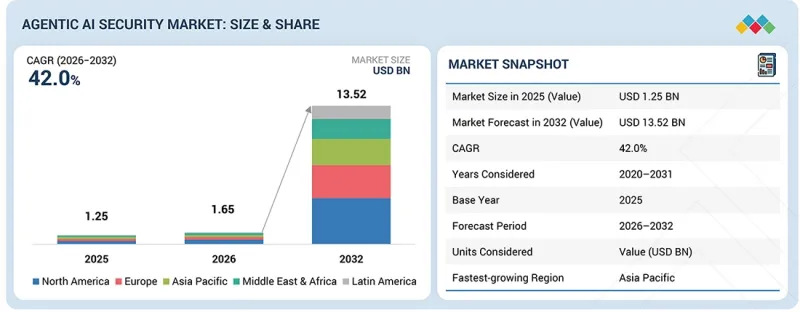
The agentic AI security market is projected to grow from USD 1.65 billion in 2026 to USD 13.52 billion by 2032, at a CAGR of 42.0% during the forecast period.
| Scope of the Report | |
|---|---|
| Years Considered for the Study | 2019-2032 |
| Base Year | 2025 |
| Forecast Period | 2026-2032 |
| Units Considered | Value (USD Billion) |
| Segments | Security Function, Offering, Deployment Layer, Organization Size, and Vertical |
| Regions covered | North America, Europe, Asia Pacific, the Middle East & Africa, and Latin America |
The growing use of third-party AI tools and plugins is increasing the need for secure integration across agentic AI environments. These components often interact with core systems and data, creating potential entry points for threats. Organizations are investing in security measures to validate, monitor, and control these integrations to prevent misuse, data exposure, and unauthorized agent actions.
"By vertical, the BFSI segment is projected to hold the largest market share in 2026."
The BFSI vertical is expected to hold the largest share in the agentic AI security market due to the early and extensive adoption of AI-driven systems in financial operations. Banks and financial institutions are increasingly deploying autonomous agents for fraud detection, risk assessment, trading, and customer interactions. This high level of automation, combined with the sensitivity of financial data and strict regulatory requirements, makes cybersecurity a critical priority. Agentic AI introduces new risks, including unauthorized transactions, model manipulation, and data exposure, driving strong demand for advanced security solutions. As a result, BFSI organizations continue to invest heavily in securing AI agents, data flows, and decision-making processes, making it the largest segment in the market.
"By security function, the AI governance & risk platforms segment is expected to witness the highest CAGR during the forecast period."
AI governance & risk platforms are expected to experience the fastest growth in the agentic AI security market as organizations prioritize control, accountability, and compliance across autonomous systems. In agentic environments, AI agents operate with high levels of autonomy and make continuous decisions, making transparency, policy enforcement, and risk mitigation critical. These platforms enable organizations to monitor AI behavior, enforce guardrails, manage model risk, and ensure alignment with regulatory and ethical standards.
As enterprises scale the deployment of multi-agent systems, the need for centralized governance frameworks increases to manage issues such as decision drift, unauthorized actions, and data misuse. AI governance & risk platforms support auditability, real-time policy validation, and lifecycle risk management across AI pipelines and agent workflows. This growing reliance on structured governance and risk controls is a key factor driving rapid adoption and growth in this segment.
Breakdown of Primaries
The study draws insights from a range of industry experts, including component suppliers, Tier 1/2/3 companies, and OEMs. The break-up of the primaries is as follows:
- By Company Type: Tier 1 - 20%, Tier 2 - 32%, and Tier 3 - 48%
- By Designation: C-level - 40% and Managerial & Other Levels - 60%
- By Region: North America - 20%, Europe - 30%, Asia Pacific - 40%, Middle East and Africa - 5%, and Latin America - 5%
Major vendors in the agentic AI security market include Microsoft (US), Palo Alto Networks (US), CrowdStrike (US), Straiker (US), SentinelOne (US), Okta (US), Cloudflare (US), Cato Networks (Israel), Check Point Software Technologies (Israel), Securiti (US), HiddenLayer (US), Noma Security (Israel), Obsidian Security (US), Mindgard (UK), DeepKeep (Israel), Enkrypt AI (US), Pillar Security (US), Astrix Security (Israel), Natoma (US), Trufoundry (US), Descope (US), Zenity (Israel), Fiddler AI (US), Openlayer (US), Aembit (US), Lasso Security (Israel), Akto (US), Credo AI (US), Promptfoo (US), Strata Identity (US), Holistic AI (UK), Geordie AI (UK), NeuralTrust (Spain), and Usercentrics (Germany).
The study includes an in-depth competitive analysis of the key players in the agentic AI security market, their company profiles, recent developments, and key market strategies.
Research Coverage
The report segments the agentic AI security market and forecasts its size based on Security Function (Identity & Access Security, AI Governance & Risk Platforms, Threat Detection & Response, Data Security & Privacy, Vulnerability Assessment & Remediation, Security Orchestration, Automation & Response (SOAR), Security Posture Management (SPM), Deception Technology), Offering (Solutions (Software Platforms, Tools & Point Solutions [Prompt Security Tools, Guardrail Frameworks, AI Pen Testing & Red Teaming Tools]), Services (Managed Security Services [Managed AI Security Operations (AI SOC), Other Managed Security Services], Professional & Integration Services, Training & Certification Services)), Level of Autonomy (Semi-autonomous Systems (Human-in-the-Loop), Fully Autonomous Security Agents), Deployment Layer (Model Layer, Agent/Orchestration Layer, Application Layer, Data Layer, Infrastructure Layer, Integration Layer), Organization Size (Large Enterprises, SMEs), Vertical (BFSI, Healthcare & Life Sciences, Government, Defense, IT & ITES, Telecommunications, Retail & eCommerce, Energy & Utilities, Manufacturing, Other Verticals), and Region (North America, Europe, Asia Pacific, Middle East & Africa, and Latin America).
The study also includes an in-depth competitive analysis of the market's key players, including their company profiles, key observations on product and business offerings, recent developments, and key market strategies.
Key Benefits of Buying the Report
The report will help market leaders/new entrants by providing the closest approximations of revenue numbers for the overall agentic AI Security market and its subsegments. This report will help stakeholders understand the competitive landscape and gain valuable insights to better position their businesses and plan suitable go-to-market strategies. The report also helps stakeholders understand the market pulse and provides information on key market drivers, restraints, challenges, and opportunities.
The report provides insights on the following pointers:
- Analysis of critical drivers (rapid enterprise adoption of autonomous AI agents across critical workflows, increasing risk of AI-to-AI and adversarial attacks targeting agent ecosystems), restraints (limited standardization in securing agentic AI architectures and protocols, high complexity in securing dynamic, self-learning AI systems), opportunities (emergence of AI-native security platforms for agent monitoring and governance, integration of agentic AI security with zero trust and identity-first frameworks), and challenges (lack of visibility into autonomous agent decision-making and behavior, difficulty in detecting and mitigating real-time manipulation of AI agents (prompt injection, model drift))
- Product Development/Innovation: Detailed insights on upcoming technologies, research development activities, new products, and service launches in the agentic AI security market.
- Market Development: Comprehensive information about lucrative markets - the report analyses the agentic AI security market across varied regions.
- Market Diversification: Exhaustive information about new products and services, untapped geographies, recent developments, and investments in the agentic AI security market.
- Competitive Assessment: In-depth assessment of market shares, growth strategies, and service offerings of leading players such as Microsoft (US), Palo Alto Networks (US), CrowdStrike (US), Straiker (US), SentinelOne (US), Okta (US), Cloudflare (US), Cato Networks (Israel), Check Point Software Technologies (Israel), Securiti (US), HiddenLayer (US), Noma Security (Israel), Obsidian Security (US), Mindgard (UK), DeepKeep (Israel), Enkrypt AI (US), Pillar Security (US), Astrix Security (Israel), Natoma (US), Trufoundry (US), Descope (US), Zenity (Israel), Fiddler AI (US), Openlayer (US), Aembit (US), Lasso Security (Israel), Akto (US), Credo AI (US), Promptfoo (US), Strata Identity (US), Holistic AI (UK), Geordie AI (UK), NeuralTrust (Spain), and Usercentrics (Germany), among others, in the agentic AI security market.
TABLE OF CONTENTS
1 INTRODUCTION
- 1.1 STUDY OBJECTIVES
- 1.2 MARKET DEFINITION
- 1.3 STUDY SCOPE AND SEGMENTATION
- 1.3.1 MARKET SEGMENTATION
- 1.3.2 INCLUSIONS AND EXCLUSIONS
- 1.4 YEARS CONSIDERED
- 1.5 CURRENCY CONSIDERED
- 1.6 STAKEHOLDERS
- 1.7 SUMMARY OF CHANGES
2 EXECUTIVE SUMMARY
- 2.1 MARKET HIGHLIGHTS AND KEY INSIGHTS
- 2.2 KEY MARKET PARTICIPANTS: MAPPING OF STRATEGIC DEVELOPMENTS
- 2.3 DISRUPTIVE TRENDS SHAPING MARKET
- 2.4 HIGH-GROWTH SEGMENTS AND EMERGING FRONTIERS
- 2.5 REGIONAL SNAPSHOT: MARKET SIZE, GROWTH RATE, AND FORECAST
3 PREMIUM INSIGHTS
- 3.1 ATTRACTIVE OPPORTUNITIES FOR PLAYERS IN AGENTIC AI SECURITY MARKET
- 3.2 AGENTIC AI SECURITY MARKET, BY OFFERING
- 3.3 AGENTIC AI SECURITY MARKET, BY SOLUTION
- 3.4 AGENTIC AI SECURITY MARKET, BY TOOL & POINT SOLUTION
- 3.5 AGENTIC AI SECURITY MARKET, BY SERVICE
- 3.6 AGENTIC AI SECURITY MARKET, BY MANAGED SECURITY SERVICE
- 3.7 AGENTIC AI SECURITY MARKET, BY SECURITY FUNCTION
- 3.8 AGENTIC AI SECURITY MARKET, BY LEVEL OF AUTONOMY
- 3.9 AGENTIC AI SECURITY MARKET, BY DEPLOYMENT LAYER
- 3.10 AGENTIC AI SECURITY MARKET, BY ORGANIZATION SIZE
- 3.11 AGENTIC AI SECURITY MARKET, BY VERTICAL
- 3.12 AGENTIC AI SECURITY MARKET, BY REGION
4 MARKET OVERVIEW
- 4.1 INTRODUCTION
- 4.2 MARKET DYNAMICS
- 4.2.1 DRIVERS
- 4.2.1.1 Rapid enterprise adoption of autonomous AI agents across critical workflows
- 4.2.1.2 Increasing risk of AI-to-AI and adversarial attacks targeting agent ecosystems
- 4.2.1.3 Expansion of AI attack surface via APIs, tool integrations, and multi-agent systems
- 4.2.2 RESTRAINTS
- 4.2.2.1 Limited standardization in agentic AI architectures and security protocols
- 4.2.2.2 High complexity in securing dynamic, self-learning AI systems
- 4.2.2.3 Shortage of skilled professionals in agentic AI security implementation
- 4.2.3 OPPORTUNITIES
- 4.2.3.1 Emergence of AI-native security platforms for agent monitoring and governance
- 4.2.3.2 Integration of agentic AI security with zero-trust and identity-first frameworks
- 4.2.3.3 Growing demand for agent observability and auditability solutions
- 4.2.4 CHALLENGES
- 4.2.4.1 Lack of visibility into autonomous agent decision-making and behavior
- 4.2.4.2 Limited explainability and traceability for auditing and compliance
- 4.2.1 DRIVERS
- 4.3 UNMET NEEDS AND WHITE SPACES
- 4.4 INTERCONNECTED MARKETS AND CROSS-SECTOR OPPORTUNITIES
- 4.4.1 INTERCONNECTED MARKETS
- 4.4.2 CROSS-SECTOR OPPORTUNITIES
- 4.5 STRATEGIC MOVES BY TIER -1/2/3 PLAYERS
- 4.5.1 STRATEGIC TRENDS
- 4.5.1.1 Rise of execution-layer security in agentic AI
- 4.5.1.2 Emergence of agent governance and control frameworks
- 4.5.2 AGENTIC AI SECURITY THREATS
- 4.5.2.1 Autonomous decision drift
- 4.5.2.2 Prompt injection and instruction hijacking
- 4.5.2.3 Tool abuse and unauthorized actions
- 4.5.2.4 Data poisoning in learning loops
- 4.5.2.5 Identity and privilege escalation
- 4.5.2.6 Multi-agent collusion risks
- 4.5.2.7 Model exploitation and jailbreaking
- 4.5.2.8 Lack of explainability and auditability
- 4.5.2.9 Over-automation without human oversight
- 4.5.2.10 Supply chain vulnerabilities in models, plugins, and APIs
- 4.5.1 STRATEGIC TRENDS
5 INDUSTRY TRENDS
- 5.1 PORTER'S FIVE FORCES ANALYSIS
- 5.1.1 THREAT OF NEW ENTRANTS
- 5.1.2 BARGAINING POWER OF SUPPLIERS
- 5.1.3 BARGAINING POWER OF BUYERS
- 5.1.4 THREAT OF SUBSTITUTES
- 5.1.5 INTENSITY OF COMPETITIVE RIVALRY
- 5.2 MACROECONOMIC INDICATORS
- 5.2.1 INTRODUCTION
- 5.2.2 GDP TRENDS AND FORECAST
- 5.2.3 TRENDS IN GLOBAL ICT INDUSTRY
- 5.2.4 TRENDS IN GLOBAL CYBERSECURITY INDUSTRY
- 5.3 VALUE CHAIN ANALYSIS
- 5.3.1 RESEARCH & DEVELOPMENT
- 5.3.2 AGENTIC AI SECURITY PLATFORM DEVELOPMENT
- 5.3.3 AGENT RUNTIME SECURITY & MONITORING
- 5.3.4 PLANNING & DESIGNING
- 5.3.5 INFRASTRUCTURE DEPLOYMENT & SYSTEM INTEGRATION
- 5.3.6 END USER VERTICALS
- 5.4 ECOSYSTEM ANALYSIS
- 5.5 PRICING ANALYSIS
- 5.5.1 AVERAGE SELLING PRICE OF KEY VENDORS, BY SECURITY FUNCTION, 2026
- 5.5.2 INDICATIVE PRICING ANALYSIS, BY VENDOR, 2026
- 5.6 KEY CONFERENCES AND EVENTS, 2026
- 5.7 TRENDS/DISRUPTIONS IMPACTING CUSTOMER BUSINESS
- 5.8 INVESTMENT AND FUNDING SCENARIO
- 5.9 CASE STUDY ANALYSIS
- 5.9.1 DROPBOX STRENGTHENS GENAI SECURITY AGAINST PROMPT INJECTION USING LAKERA
- 5.9.2 ADDRESSING ENTERPRISE AI RISK AND COMPLIANCE CHALLENGES AT SCALE
- 5.9.3 PROTECT AI SECURES ML PIPELINES AND AGENTIC WORKFLOWS (HUNTR PLATFORM)
- 5.10 IMPACT OF 2025 US TARIFF - AGENTIC AI SECURITY MARKET
- 5.10.1 INTRODUCTION
- 5.10.2 KEY TARIFF RATES
- 5.10.3 PRICE IMPACT ANALYSIS
- 5.10.4 IMPACT ON COUNTRIES/REGIONS
- 5.10.4.1 North America
- 5.10.4.2 Europe
- 5.10.4.3 Asia Pacific
- 5.10.5 IMPACT ON END-USE INDUSTRIES
6 TECHNOLOGICAL ADVANCEMENTS, AI-DRIVEN IMPACT, PATENTS, INNOVATIONS, AND FUTURE APPLICATIONS
- 6.1 TECHNOLOGY ANALYSIS
- 6.1.1 KEY EMERGING TECHNOLOGIES
- 6.1.1.1 Agent runtime security and monitoring
- 6.1.1.2 AI governance & policy enforcement
- 6.1.1.3 Adversarial AI & prompt security
- 6.1.2 COMPLEMENTARY TECHNOLOGIES
- 6.1.2.1 Identity & access management (IAM)
- 6.1.2.2 Extended detection & response (XDR)
- 6.1.2.3 Security information & event management (SIEM)
- 6.1.3 ADJACENT TECHNOLOGIES
- 6.1.3.1 Data security & privacy technologies (DSPM/Encryption)
- 6.1.3.2 AI/ML platforms & MLOps
- 6.1.1 KEY EMERGING TECHNOLOGIES
- 6.2 TECHNOLOGY/PRODUCT ROADMAP
- 6.2.1 SHORT-TERM (2026-2027) | FOUNDATION & EARLY COMMERCIALIZATION
- 6.2.2 MID-TERM (2027-2030) | SCALING, INTELLIGENCE & ECOSYSTEM EXPANSION
- 6.2.3 LONG-TERM (2030-2035+) | AUTONOMOUS, REAL-TIME & PREDICTIVE CYBER DEFENSE
- 6.3 PATENT ANALYSIS
- 6.4 FUTURE APPLICATIONS
- 6.4.1 AUTONOMOUS AGENT SECURITY OPERATIONS (SOC)
- 6.4.2 AGENT RUNTIME MONITORING & CONTROL
- 6.4.3 AI GOVERNANCE AND POLICY ENFORCEMENT
- 6.4.4 ADVERSARIAL AI AND PROMPT SECURITY
- 6.4.5 NON-HUMAN IDENTITY (NHI) SECURITY
- 6.5 IMPACT OF AI/GEN AI ON AGENTIC AI SECURITY MARKET
- 6.5.1 BEST PRACTICES IN AGENTIC AI SECURITY MARKET
- 6.5.2 CASE STUDIES OF AI IMPLEMENTATION IN AGENTIC AI SECURITY MARKET
- 6.5.3 INTERCONNECTED ADJACENT ECOSYSTEM AND IMPACT ON MARKET PLAYERS
- 6.5.4 CLIENTS' READINESS TO ADOPT GENERATIVE AI IN AGENTIC AI SECURITY MARKET
- 6.6 SUCCESS STORIES AND REAL-WORLD APPLICATIONS
- 6.6.1 LAKERA: ENTERPRISE LLM APPLICATION SECURITY IMPLEMENTATION
- 6.6.2 PROTECT AI: SECURING AI/ML PIPELINES AND AGENT WORKFLOWS
7 REGULATORY LANDSCAPE
- 7.1 REGIONAL REGULATIONS AND COMPLIANCE
- 7.1.1 REGULATORY BODIES, GOVERNMENT AGENCIES, AND OTHER ORGANIZATIONS
- 7.1.2 INDUSTRY STANDARDS
8 CONSUMER LANDSCAPE AND BUYER BEHAVIOR
- 8.1 DECISION-MAKING PROCESS
- 8.2 KEY STAKEHOLDERS INVOLVED IN BUYING PROCESS AND THEIR EVALUATION CRITERIA
- 8.2.1 KEY STAKEHOLDERS IN BUYING PROCESS
- 8.2.2 BUYING CRITERIA
- 8.3 ADOPTION BARRIERS AND INTERNAL CHALLENGES
- 8.4 UNMET NEEDS IN VARIOUS END-USE INDUSTRIES
9 AGENTIC AI SECURITY MARKET, BY OFFERING
- 9.1 INTRODUCTION
- 9.1.1 OFFERING: AGENTIC AI SECURITY MARKET DRIVERS
- 9.2 SOLUTIONS
- 9.2.1 SOFTWARE PLATFORMS
- 9.2.1.1 Increasing preference for unified platforms to secure entire AI lifecycle
- 9.2.2 TOOLS & POINT SOLUTIONS
- 9.2.2.1 Rising demand for specialized tools to address AI-specific security risks
- 9.2.2.2 Prompt security tools
- 9.2.2.3 Guardrail frameworks
- 9.2.2.4 AI pen testing & red teaming tools
- 9.2.1 SOFTWARE PLATFORMS
- 9.3 SERVICES
- 9.3.1 MANAGED SECURITY SERVICES
- 9.3.1.1 Rising need for continuous monitoring of AI-driven environments to drive demand
- 9.3.1.2 Managed AI security operations
- 9.3.1.3 Other managed security services
- 9.3.2 PROFESSIONAL & INTEGRATION SERVICES
- 9.3.2.1 Increasing need to integrate AI security into enterprise ecosystems to drive demand
- 9.3.3 TRAINING & CERTIFICATION SERVICES
- 9.3.3.1 Growing demand for skilled workforce in AI security domain to drive demand
- 9.3.1 MANAGED SECURITY SERVICES
10 AGENTIC AI SECURITY MARKET, BY SECURITY FUNCTION
- 10.1 INTRODUCTION
- 10.1.1 SECURITY FUNCTION: AGENTIC AI SECURITY MARKET DRIVERS
- 10.2 IDENTITY & ACCESS SECURITY
- 10.2.1 RISING NEED TO SECURE IDENTITIES ACROSS AUTONOMOUS AI AGENTS TO DRIVE MARKET
- 10.3 AI GOVERNANCE & RISK PLATFORMS
- 10.3.1 GROWING DEMAND FOR ACCOUNTABILITY AND COMPLIANCE IN AI-DRIVEN SYSTEMS TO DRIVE MARKET
- 10.4 THREAT DETECTION & RESPONSE
- 10.4.1 INCREASING SOPHISTICATION OF AI-POWERED THREATS TARGETING AUTONOMOUS SYSTEMS TO DRIVE MARKET
- 10.5 DATA SECURITY & PRIVACY
- 10.5.1 RISING CONCERNS OVER SENSITIVE DATA EXPOSURE IN AI WORKFLOWS TO DRIVE MARKET
- 10.6 VULNERABILITY ASSESSMENT & REMEDIATION
- 10.6.1 GROWING NEED TO IDENTIFY AND FIX AI-SPECIFIC SECURITY WEAKNESSES TO DRIVE MARKET
- 10.7 SECURITY ORCHESTRATION, AUTOMATION, & RESPONSE (SOAR)
- 10.7.1 INCREASING DEMAND FOR AUTOMATED SECURITY OPERATIONS IN AI ENVIRONMENTS TO DRIVE MARKET
- 10.8 SECURITY POSTURE MANAGEMENT (SPM)
- 10.8.1 NEED FOR CONTINUOUS VISIBILITY INTO AI SYSTEMS AND AGENT SECURITY POSTURE TO DRIVE MARKET
- 10.9 DECEPTION TECHNOLOGY
- 10.9.1 INCREASING NEED TO DETECT SOPHISTICATED ATTACKERS TARGETING AI SYSTEMS TO DRIVE MARKET
11 AGENTIC AI SECURITY MARKET, BY DEPLOYMENT LAYER
- 11.1 INTRODUCTION
- 11.1.1 DEPLOYMENT LAYER: AGENTIC AI SECURITY MARKET DRIVERS
- 11.2 MODEL LAYER
- 11.2.1 INCREASING NEED TO SECURE MODELS AGAINST ADVERSARIAL MANIPULATION RISKS TO DRIVE DEMAND
- 11.3 AGENT/ORCHESTRATION LAYER
- 11.3.1 RISING RISKS FROM AUTONOMOUS AGENTS COORDINATING COMPLEX WORKFLOWS TO DRIVE DEMAND
- 11.4 APPLICATION LAYER
- 11.4.1 EXPANDING ATTACK SURFACE ACROSS AI-POWERED APPLICATIONS AND APIS
- 11.5 DATA LAYER
- 11.5.1 RISING CONCERNS OVER SENSITIVE DATA EXPOSURE ACROSS AI PIPELINES TO DRIVE DEMAND
- 11.6 INFRASTRUCTURE LAYER
- 11.6.1 GROWING NEED TO SECURE CLOUD AND RUNTIME ENVIRONMENTS FOR AI TO DRIVE DEMAND
- 11.7 INTEGRATION LAYER
- 11.7.1 INCREASING NEED TO SECURE INTERCONNECTED AI AND ENTERPRISE SYSTEMS TO DRIVE DEMAND
12 AGENTIC AI SECURITY MARKET, BY LEVEL OF AUTONOMY
- 12.1 INTRODUCTION
- 12.1.1 LEVEL OF AUTONOMY: AGENTIC AI SECURITY MARKET DRIVERS
- 12.2 SEMI-AUTONOMOUS SYSTEMS (HUMAN-IN-THE-LOOP)
- 12.2.1 INCREASING NEED FOR HUMAN OVERSIGHT IN CRITICAL AI DECISIONS TO DRIVE MARKET
- 12.3 FULLY AUTONOMOUS SECURITY AGENTS
- 12.3.1 GROWING ADOPTION OF INDEPENDENT AI AGENTS FOR SECURITY OPERATIONS TO DRIVE MARKET
13 AGENTIC AI SECURITY MARKET, BY ORGANIZATION SIZE
- 13.1 INTRODUCTION
- 13.1.1 ORGANIZATION SIZE: AGENTIC AI SECURITY MARKET DRIVERS
- 13.2 LARGE ENTERPRISES
- 13.2.1 INCREASING INVESTMENTS IN COMPREHENSIVE SECURITY FOR LARGE-SCALE AI DEPLOYMENTS TO DRIVE MARKET
- 13.3 SMES
- 13.3.1 GROWING DEMAND FOR COST-EFFECTIVE AND MANAGED AI SECURITY SOLUTIONS TO DRIVE MARKET
14 AGENTIC AI SECURITY MARKET, BY VERTICAL
- 14.1 INTRODUCTION
- 14.1.1 VERTICAL: AGENTIC AI SECURITY MARKET DRIVERS
- 14.2 BANKING, FINANCIAL SERVICES, AND INSURANCE (BFSI)
- 14.2.1 SECURING AUTONOMOUS FINANCIAL AGENTS AND HIGH-VALUE DATA IN REGULATED BFSI ENVIRONMENTS
- 14.3 HEALTHCARE & LIFE SCIENCES
- 14.3.1 PROTECTING AGENT-DRIVEN CLINICAL SYSTEMS AND SENSITIVE PATIENT DATA IN HEALTHCARE
- 14.4 GOVERNMENT
- 14.4.1 GROWING DEMAND TO SECURE AI-DRIVEN PUBLIC SECTOR SYSTEMS AND DIGITAL GOVERNANCE FRAMEWORKS
- 14.5 DEFENSE
- 14.5.1 RISING NEED TO PROTECT AI-ENABLED MISSION-CRITICAL AND INTELLIGENCE OPERATIONS
- 14.6 IT & ITES
- 14.6.1 SECURING AGENT-LED ENTERPRISE OPERATIONS AND API-DRIVEN WORKFLOWS IN IT & ITES
- 14.7 TELECOMMUNICATIONS
- 14.7.1 RISING NEED TO PROTECT AGENTIC AI-DRIVEN TELECOM NETWORKS AND REAL-TIME SERVICE ORCHESTRATION
- 14.8 RETAIL & E-COMMERCE
- 14.8.1 INCREASING NEED TO PROTECT CUSTOMER DATA IN AI-DRIVEN COMMERCE
- 14.9 MANUFACTURING
- 14.9.1 GROWING NEED TO SECURE AI-DRIVEN INDUSTRIAL AUTOMATION ENVIRONMENTS
- 14.10 OTHER VERTICALS
15 AGENTIC AI SECURITY MARKET, BY REGION
- 15.1 INTRODUCTION
- 15.2 NORTH AMERICA
- 15.2.1 NORTH AMERICA: AGENTIC AI SECURITY MARKET DRIVERS
- 15.2.2 US
- 15.2.2.1 Accelerating enterprise adoption of autonomous AI to fuel market growth
- 15.2.3 CANADA
- 15.2.3.1 Strong regulatory push and rising cyber threats to drive market
- 15.3 EUROPE
- 15.3.1 EUROPE: AGENTIC AI SECURITY MARKET DRIVERS
- 15.3.2 UK
- 15.3.2.1 Rising enterprise adoption and governance gaps to drive demand
- 15.3.3 GERMANY
- 15.3.3.1 Customer experience transformation and compliance pressures to fuel market growth
- 15.3.4 FRANCE
- 15.3.4.1 Sovereign AI initiatives and rising cyber threat complexity to drive market
- 15.3.5 REST OF EUROPE
- 15.4 ASIA PACIFIC
- 15.4.1 ASIA PACIFIC: AGENTIC AI SECURITY MARKET DRIVERS
- 15.4.2 CHINA
- 15.4.2.1 Rapid AI expansion, platform fragmentation, and control-led regulation to drive market
- 15.4.3 JAPAN
- 15.4.3.1 Expansion of autonomous AI systems to drive demand for agentic AI security
- 15.4.4 INDIA
- 15.4.4.1 Sovereign AI expansion and autonomous systems adoption to drive market
- 15.4.5 REST OF ASIA PACIFIC
- 15.5 MIDDLE EAST & AFRICA
- 15.5.1 MIDDLE EAST & AFRICA: AGENTIC AI SECURITY MARKET DRIVERS
- 15.5.2 GCC
- 15.5.2.1 Expansion of agentic AI in critical sectors to drive demand for secure frameworks
- 15.5.2.2 UAE
- 15.5.2.2.1 Sovereign and edge-driven innovation to drive agentic AI security demand
- 15.5.2.3 KSA
- 15.5.2.3.1 Regulatory maturity and Vision 2030 initiatives to strengthen market
- 15.5.2.4 Rest of GCC
- 15.5.3 REST OF MIDDLE EAST & AFRICA
- 15.6 LATIN AMERICA
- 15.6.1 LATIN AMERICA: AGENTIC AI SECURITY MARKET DRIVERS
16 COMPETITIVE LANDSCAPE
- 16.1 KEY PLAYER STRATEGIES/RIGHT TO WIN, 2024-2026
- 16.2 REVENUE ANALYSIS, 2025-2026
- 16.3 MARKET SHARE ANALYSIS, 2025
- 16.4 BRAND COMPARISON
- 16.5 COMPANY VALUATION AND FINANCIAL METRICS, 2026
- 16.5.1 COMPANY VALUATION
- 16.5.2 FINANCIAL METRICS USING EV/EBIDTA, 2026
- 16.6 COMPANY EVALUATION MATRIX: ESTABLISHED TECHNOLOGY PLAYERS, 2025
- 16.6.1 STARS
- 16.6.2 EMERGING LEADERS
- 16.6.3 PERVASIVE PLAYERS
- 16.6.4 PARTICIPANTS
- 16.6.5 COMPANY FOOTPRINT: ESTABLISHED TECHNOLOGY PLAYERS, 2025
- 16.6.5.1 Company footprint
- 16.6.5.2 Solution type footprint
- 16.6.5.3 Deployment layer footprint
- 16.6.5.4 Vertical footprint
- 16.6.5.5 Regional footprint
- 16.7 COMPANY EVALUATION MATRIX: AI SECURITY SPECIALISTS/STARTUPS, 2025
- 16.7.1 STARS
- 16.7.2 EMERGING LEADERS
- 16.7.3 PERVASIVE PLAYERS
- 16.7.4 PARTICIPANTS
- 16.7.5 COMPETITIVE BENCHMARKING: AI SECURITY SPECIALISTS/STARTUPS, 2025
- 16.7.5.1 Detailed list of key AI security specialists/startups
- 16.7.5.2 Competitive benchmarking of key AI security specialists/startups
- 16.8 COMPETITIVE SCENARIO
- 16.8.1 PRODUCT LAUNCHES AND ENHANCEMENTS
- 16.8.2 DEALS
17 COMPANY PROFILE
- 17.1 KEY PLAYERS
- 17.1.1 MICROSOFT
- 17.1.1.1 Business overview
- 17.1.1.2 Products/Solutions/Services offered
- 17.1.1.3 Recent developments
- 17.1.1.3.1 Product launches/enhancements
- 17.1.1.3.2 Deals
- 17.1.1.3.3 Expansions
- 17.1.1.4 MnM view
- 17.1.1.4.1 Key strengths
- 17.1.1.4.2 Strategic choices
- 17.1.1.4.3 Weaknesses and competitive threats
- 17.1.2 SENTINELONE
- 17.1.2.1 Business overview
- 17.1.2.2 Products/Solutions/Services offered
- 17.1.2.3 Recent developments
- 17.1.2.3.1 Product launches/enhancements
- 17.1.2.3.2 Deals
- 17.1.2.4 MnM view
- 17.1.2.4.1 Key strengths
- 17.1.2.4.2 Strategic choices
- 17.1.2.4.3 Weaknesses and competitive threats
- 17.1.3 PALO ALTO NETWORKS
- 17.1.3.1 Business overview
- 17.1.3.2 Products/Solutions/Services offered
- 17.1.3.3 Recent developments
- 17.1.3.3.1 Product launches/enhancements
- 17.1.3.3.2 Deals
- 17.1.3.4 MnM view
- 17.1.3.4.1 Key strengths
- 17.1.3.4.2 Strategic choices
- 17.1.3.4.3 Weaknesses and competitive threats
- 17.1.4 OKTA
- 17.1.4.1 Business overview
- 17.1.4.2 Products/Solutions/Services offered
- 17.1.4.3 Recent developments
- 17.1.4.3.1 Product launches/enhancements
- 17.1.4.3.2 Deals
- 17.1.4.3.3 Expansions
- 17.1.4.4 MnM view
- 17.1.4.4.1 Key strengths
- 17.1.4.4.2 Strategic choices
- 17.1.4.4.3 Weaknesses and competitive threats
- 17.1.5 CLOUDFLARE
- 17.1.5.1 Business overview
- 17.1.5.2 Products/Solutions/Services offered
- 17.1.5.3 Recent developments
- 17.1.5.3.1 Product launches/enhancements
- 17.1.5.3.2 Deals
- 17.1.5.3.3 Expansions
- 17.1.5.4 MnM view
- 17.1.5.4.1 Key strengths
- 17.1.5.4.2 Strategic choices
- 17.1.5.4.3 Weaknesses and competitive threats
- 17.1.6 NEURALTRUST
- 17.1.6.1 Business overview
- 17.1.6.2 Products/Solutions/Services offered
- 17.1.6.3 Recent developments
- 17.1.6.3.1 Product launches/enhancements
- 17.1.6.4 MnM view
- 17.1.6.4.1 Key strengths
- 17.1.6.4.2 Strategic choices
- 17.1.6.4.3 Weaknesses and competitive threats
- 17.1.7 STRAIKER
- 17.1.7.1 Business overview
- 17.1.7.2 Products/Solutions/Services offered
- 17.1.7.3 Recent developments
- 17.1.7.3.1 Product launches/enhancements
- 17.1.7.3.2 Deals
- 17.1.8 CROWDSTRIKE
- 17.1.8.1 Business overview
- 17.1.8.2 Products/Solutions/Services offered
- 17.1.8.3 Recent developments
- 17.1.8.3.1 Product launches/enhancements
- 17.1.8.3.2 Deals
- 17.1.9 CATO NETWORKS
- 17.1.9.1 Business overview
- 17.1.9.2 Products/Solutions/Services offered
- 17.1.9.3 Recent developments
- 17.1.9.3.1 Product launches/enhancements
- 17.1.9.3.2 Deals
- 17.1.9.3.3 Expansions
- 17.1.10 CHECK POINT
- 17.1.10.1 Business overview
- 17.1.10.2 Products/Solutions/Services offered
- 17.1.10.3 Recent developments
- 17.1.10.3.1 Product launches/enhancements
- 17.1.10.3.2 Deals
- 17.1.10.3.3 Expansions
- 17.1.11 SECURITI
- 17.1.11.1 Business overview
- 17.1.11.2 Products/Solutions/Services offered
- 17.1.11.3 Recent developments
- 17.1.11.3.1 Product launches/enhancements
- 17.1.11.3.2 Deals
- 17.1.12 HIDDENLAYER
- 17.1.12.1 Business overview
- 17.1.12.2 Products/Solutions/Services offered
- 17.1.12.3 Recent developments
- 17.1.12.3.1 Product launches/enhancements
- 17.1.12.3.2 Deals
- 17.1.13 USERCENTRICS
- 17.1.13.1 Business overview
- 17.1.13.2 Products/Solutions/Services offered
- 17.1.13.3 Recent developments
- 17.1.13.3.1 Product launches/enhancements
- 17.1.13.3.2 Deals
- 17.1.14 NOMA SECURITY
- 17.1.14.1 Business overview
- 17.1.14.2 Products/Solutions/Services offered
- 17.1.14.3 Recent developments
- 17.1.14.3.1 Product launches/enhancements
- 17.1.14.3.2 Deals
- 17.1.15 OBSIDIAN SECURITY
- 17.1.15.1 Business overview
- 17.1.15.2 Products/Solutions/Services offered
- 17.1.15.3 Recent developments
- 17.1.15.3.1 Product launches/enhancements
- 17.1.15.3.2 Deals
- 17.1.16 SAILPOINT
- 17.1.17 F5
- 17.1.18 SNYK
- 17.1.19 IBM
- 17.1.1 MICROSOFT
- 17.2 OTHER PLAYERS
- 17.2.1 MINDGARD
- 17.2.2 DEEEPKEEP
- 17.2.3 ENKRYPT AI
- 17.2.4 PILLAR SECURITY
- 17.2.5 ASTRIX SECURITY
- 17.2.6 NATOMA
- 17.2.7 TRUEFOUNDRY
- 17.2.8 DESCOPE
- 17.2.9 ZENITY
- 17.2.10 FIDDLER AI
- 17.2.11 OPENLAYER
- 17.2.12 AEMBIT
- 17.2.13 LASSO SECURITY
- 17.2.14 AKTO
- 17.2.15 CREDO AI
- 17.2.16 PROMPTFOO
- 17.2.17 STRATA IDENTITY
- 17.2.18 HOLISTIC AI
- 17.2.19 GEORDIE AI
- 17.2.20 WITNESSAI
- 17.2.21 ONYX AI
18 RESEARCH METHODOLOGY
- 18.1 RESEARCH DATA
- 18.1.1 SECONDARY DATA
- 18.1.2 PRIMARY DATA
- 18.1.2.1 Breakup of primary profiles
- 18.1.2.2 Key industry insights
- 18.2 DATA TRIANGULATION
- 18.3 MARKET SIZE ESTIMATION
- 18.3.1 TOP-DOWN APPROACH
- 18.3.2 BOTTOM-UP APPROACH
- 18.4 FACTOR ANALYSIS
- 18.5 RESEARCH ASSUMPTIONS
- 18.6 RESEARCH LIMITATIONS
19 APPENDIX
- 19.1 DISCUSSION GUIDE
- 19.2 KNOWLEDGESTORE: MARKETSANDMARKETS' SUBSCRIPTION PORTAL
- 19.3 CUSTOMIZATION OPTIONS
- 19.4 RELATED REPORTS
- 19.5 AUTHOR DETAILS
List of Tables
- TABLE 1 INCLUSIONS AND EXCLUSIONS
- TABLE 2 USD EXCHANGE RATES, 2021-2025
- TABLE 3 UNMET NEEDS AND WHITE SPACES IN AGENTIC AI SECURITY MARKET
- TABLE 4 STRATEGIC MOVES BY PLAYERS IN AGENTIC AI SECURITY MARKET
- TABLE 5 IMPACT OF PORTER'S FIVE FORCES ON AGENTIC AI SECURITY MARKET
- TABLE 6 GDP PERCENTAGE CHANGE, BY KEY COUNTRY, 2021-2030
- TABLE 7 ROLE OF COMPANIES IN ECOSYSTEM
- TABLE 8 AVERAGE SELLING PRICE OF KEY VENDORS, BY SECURITY FUNCTION, 2026 (USD/YEAR)
- TABLE 9 INDICATIVE PRICING ANALYSIS OF AGENTIC AI, BY VENDOR, 2026
- TABLE 10 AGENTIC AI SECURITY MARKET: LIST OF KEY CONFERENCES AND EVENTS, 2026
- TABLE 11 KEY TARIFF RATES
- TABLE 12 LIST OF TOP PATENTS IN AGENTIC AI SECURITY MARKET, 2024-2026
- TABLE 13 TOP USE CASES AND MARKET POTENTIAL
- TABLE 14 BEST PRACTICES: COMPANIES IMPLEMENTING USE CASES
- TABLE 15 AGENTIC AI SECURITY MARKET: CASE STUDIES RELATED TO GEN AI IMPLEMENTATION
- TABLE 16 INTERCONNECTED ADJACENT ECOSYSTEM AND IMPACT ON MARKET PLAYERS
- TABLE 17 NORTH AMERICA: REGULATORY BODIES, GOVERNMENT AGENCIES, AND OTHER ORGANIZATIONS
- TABLE 18 EUROPE: LIST OF REGULATORY BODIES, GOVERNMENT AGENCIES, AND OTHER ORGANIZATIONS
- TABLE 19 ASIA PACIFIC: LIST OF REGULATORY BODIES, GOVERNMENT AGENCIES, AND OTHER ORGANIZATIONS
- TABLE 20 MIDDLE EAST & AFRICA: LIST OF REGULATORY BODIES, GOVERNMENT AGENCIES, AND OTHER ORGANIZATIONS
- TABLE 21 LATIN AMERICA: LIST OF REGULATORY BODIES, GOVERNMENT AGENCIES, AND OTHER ORGANIZATIONS
- TABLE 22 GLOBAL INDUSTRY STANDARDS IN AGENTIC AI SECURITY MARKET
- TABLE 23 INFLUENCE OF STAKEHOLDERS ON BUYING PROCESS TOP THREE VERTICALS (%)
- TABLE 24 KEY BUYING CRITERIA FOR TOP THREE VERTICALS
- TABLE 25 UNMET NEEDS IN AGENTIC AI SECURITY MARKET, BY END-USE INDUSTRY
- TABLE 26 AGENTIC AI SECURITY MARKET, BY OFFERING, 2025-2032 (USD MILLION)
- TABLE 27 SOLUTIONS: AGENTIC AI SECURITY MARKET, BY TYPE, 2025-2032 (USD MILLION)
- TABLE 28 SOLUTIONS: AGENTIC AI SECURITY MARKET: BY REGION, 2025-2032 (USD MILLION)
- TABLE 29 SOFTWARE PLATFORMS: AGENTIC AI SECURITY MARKET, BY REGION, 2025-2032 (USD MILLION)
- TABLE 30 TOOLS & POINT SOLUTIONS: AGENTIC AI SECURITY MARKET, BY TYPE, 2025-2032 (USD MILLION)
- TABLE 31 TOOLS & POINT SOLUTIONS: AGENTIC AI SECURITY MARKET, BY REGION, 2025-2032 (USD MILLION)
- TABLE 32 PROMPT SECURITY TOOLS: AGENTIC AI SECURITY MARKET, BY REGION, 2025-2032 (USD MILLION)
- TABLE 33 GUARDRAIL FRAMEWORKS: AGENTIC AI SECURITY MARKET, BY REGION, 2025-2032 (USD MILLION)
- TABLE 34 AI PEN TESTING & RED TEAMING TOOLS: AGENTIC AI SECURITY MARKET, BY REGION, 2025-2032 (USD MILLION)
- TABLE 35 SERVICES: AGENTIC AI SECURITY MARKET, BY TYPE, 2025-2032 (USD MILLION)
- TABLE 36 SERVICES: AGENTIC AI SECURITY MARKET, BY REGION, 2025-2032 (USD MILLION)
- TABLE 37 MANAGED SECURITY SERVICES: AGENTIC AI SECURITY MARKET, BY TYPE, 2025-2032 (USD MILLION)
- TABLE 38 MANAGED SECURITY SERVICES: AGENTIC AI SECURITY MARKET, BY REGION, 2025-2032 (USD MILLION)
- TABLE 39 MANAGED AI SECURITY OPERATIONS: AGENTIC AI SECURITY MARKET, BY REGION, 2025-2032 (USD MILLION)
- TABLE 40 OTHER MANAGED SECURITY SERVICES: AGENTIC AI SECURITY MARKET, BY REGION, 2025-2032 (USD MILLION)
- TABLE 41 PROFESSIONAL & INTEGRATION SERVICES: AGENTIC AI SECURITY MARKET, BY REGION, 2025-2032 (USD MILLION)
- TABLE 42 TRAINING & CERTIFICATION SERVICES: AGENTIC AI SECURITY MARKET, BY REGION, 2025-2032 (USD MILLION)
- TABLE 43 AGENTIC AI SECURITY MARKET, BY SECURITY FUNCTION, 2025-2032 (USD MILLION)
- TABLE 44 IDENTITY & ACCESS SECURITY: AGENTIC AI SECURITY MARKET, BY REGION, 2025-2032 (USD MILLION)
- TABLE 45 AI GOVERNANCE & RISK PLATFORMS: AGENTIC AI SECURITY MARKET, BY REGION, 2025-2032 (USD MILLION)
- TABLE 46 THREAT DETECTION & RESPONSE: AGENTIC AI SECURITY MARKET, BY REGION, 2025-2032 (USD MILLION)
- TABLE 47 DATA SECURITY & PRIVACY: AGENTIC AI SECURITY MARKET, BY REGION, 2025-2032 (USD MILLION)
- TABLE 48 VULNERABILITY ASSESSMENT & REMEDIATION: AGENTIC AI SECURITY MARKET, BY REGION, 2025-2032 (USD MILLION)
- TABLE 49 SECURITY ORCHESTRATION, AUTOMATION, & RESPONSE (SOAR): AGENTIC AI SECURITY MARKET, BY REGION, 2025-2032 (USD MILLION)
- TABLE 50 SECURITY POSTURE MANAGEMENT (SPM): AGENTIC AI SECURITY MARKET, BY REGION, 2025-2032 (USD MILLION)
- TABLE 51 DECEPTION TECHNOLOGY: AGENTIC AI SECURITY MARKET, BY REGION, 2025-2032 (USD MILLION)
- TABLE 52 AGENTIC AI SECURITY MARKET, BY DEPLOYMENT LAYER, 2025-2032 (USD MILLION)
- TABLE 53 MODEL LAYER: AGENTIC AI SECURITY MARKET, BY REGION, 2025-2032 (USD MILLION)
- TABLE 54 AGENT/ORCHESTRATION LAYER: AGENTIC AI SECURITY MARKET, BY REGION, 2025-2032 (USD MILLION)
- TABLE 55 APPLICATION LAYER: AGENTIC AI SECURITY MARKET, BY REGION, 2025-2032 (USD MILLION)
- TABLE 56 DATA LAYER: AGENTIC AI SECURITY MARKET, BY REGION, 2025-2032 (USD MILLION)
- TABLE 57 INFRASTRUCTURE LAYER: AGENTIC AI SECURITY MARKET, BY REGION, 2025-2032 (USD MILLION)
- TABLE 58 INTEGRATION LAYER: AGENTIC AI SECURITY MARKET, BY REGION, 2025-2032 (USD MILLION)
- TABLE 59 AGENTIC AI SECURITY MARKET, BY LEVEL OF AUTONOMY, 2025-2032 (USD MILLION)
- TABLE 60 SEMI-AUTONOMOUS SYSTEMS (HUMAN-IN-THE-LOOP): AGENTIC AI SECURITY MARKET, BY REGION, 2025-2032 (USD MILLION)
- TABLE 61 FULLY AUTONOMOUS SECURITY AGENTS: AGENTIC AI SECURITY MARKET, BY REGION, 2025-2032 (USD MILLION)
- TABLE 62 AGENTIC AI SECURITY MARKET, BY ORGANIZATION SIZE, 2025-2032 (USD MILLION)
- TABLE 63 LARGE ENTERPRISES: AGENTIC AI SECURITY MARKET, BY REGION, 2025-2032 (USD MILLION)
- TABLE 64 SMES: AGENTIC AI SECURITY MARKET, BY REGION, 2025-2032 (USD MILLION)
- TABLE 65 AGENTIC AI SECURITY MARKET, BY VERTICAL, 2025-2032 (USD MILLION)
- TABLE 66 BFSI: AGENTIC AI SECURITY MARKET, BY REGION, 2025-2032 (USD MILLION)
- TABLE 67 HEALTHCARE & LIFE SCIENCES: AGENTIC AI SECURITY MARKET, BY REGION, 2025-2032 (USD MILLION)
- TABLE 68 GOVERNMENT: AGENTIC AI SECURITY MARKET, BY REGION, 2025-2032 (USD MILLION)
- TABLE 69 DEFENSE: AGENTIC AI SECURITY MARKET, BY REGION, 2025-2032 (USD MILLION)
- TABLE 70 IT & ITES: AGENTIC AI SECURITY MARKET, BY REGION, 2025-2032 (USD MILLION)
- TABLE 71 TELECOMMUNICATIONS: AGENTIC AI SECURITY MARKET, BY REGION, 2025-2032 (USD MILLION)
- TABLE 72 RETAIL & E-COMMERCE: AGENTIC AI SECURITY MARKET, BY REGION, 2025-2032 (USD MILLION)
- TABLE 73 MANUFACTURING: AGENTIC AI SECURITY MARKET, BY REGION, 2025-2032 (USD MILLION)
- TABLE 74 OTHER VERTICALS: AGENTIC AI SECURITY MARKET, BY REGION, 2025-2032 (USD MILLION)
- TABLE 75 AGENTIC AI SECURITY MARKET, BY REGION, 2025-2032 (USD MILLION)
- TABLE 76 NORTH AMERICA: AGENTIC AI SECURITY MARKET, BY OFFERING, 2025-2032 (USD MILLION)
- TABLE 77 NORTH AMERICA: AGENTIC AI SECURITY MARKET, BY SOLUTION, 2025-2032 (USD MILLION)
- TABLE 78 NORTH AMERICA: AGENTIC AI SECURITY MARKET, BY TOOL & POINT SOLUTION, 2025-2032 (USD MILLION)
- TABLE 79 NORTH AMERICA: AGENTIC AI SECURITY MARKET, BY SERVICE, 2025-2032 (USD MILLION)
- TABLE 80 NORTH AMERICA: AGENTIC AI SECURITY MARKET, BY MANAGED SECURITY SERVICE, 2025-2032 (USD MILLION)
- TABLE 81 NORTH AMERICA: AGENTIC AI SECURITY MARKET, BY SECURITY FUNCTION, 2025-2032 (USD MILLION)
- TABLE 82 NORTH AMERICA: AGENTIC AI SECURITY MARKET, BY LEVEL OF AUTONOMY, 2025-2032 (USD MILLION)
- TABLE 83 NORTH AMERICA: AGENTIC AI SECURITY MARKET, BY ORGANIZATION SIZE, 2025-2032 (USD MILLION)
- TABLE 84 NORTH AMERICA: AGENTIC AI SECURITY MARKET, BY DEPLOYMENT LAYER, 2025-2032 (USD MILLION)
- TABLE 85 NORTH AMERICA: AGENTIC AI SECURITY MARKET, BY VERTICAL, 2025-2032 (USD MILLION)
- TABLE 86 NORTH AMERICA: AGENTIC AI SECURITY MARKET, BY COUNTRY, 2025-2032 (USD MILLION)
- TABLE 87 US: AGENTIC AI SECURITY MARKET, BY OFFERING, 2025-2032 (USD MILLION)
- TABLE 88 US: AGENTIC AI SECURITY MARKET, BY SOLUTION, 2025-2032 (USD MILLION)
- TABLE 89 US: AGENTIC AI SECURITY MARKET, BY TOOL & POINT SOLUTION, 2025-2032 (USD MILLION)
- TABLE 90 US: AGENTIC AI SECURITY MARKET, BY SERVICE, 2025-2032 (USD MILLION)
- TABLE 91 US: AGENTIC AI SECURITY MARKET, BY MANAGED SECURITY SERVICE, 2025-2032 (USD MILLION)
- TABLE 92 US: AGENTIC AI SECURITY MARKET, BY SECURITY FUNCTION, 2025-2032 (USD MILLION)
- TABLE 93 US: AGENTIC AI SECURITY MARKET, BY LEVEL OF AUTONOMY, 2025-2032 (USD MILLION)
- TABLE 94 US: AGENTIC AI SECURITY MARKET, BY ORGANIZATION SIZE, 2025-2032 (USD MILLION)
- TABLE 95 US: AGENTIC AI SECURITY MARKET, BY DEPLOYMENT LAYER, 2025-2032 (USD MILLION)
- TABLE 96 US: AGENTIC AI SECURITY MARKET, BY VERTICAL, 2025-2032 (USD MILLION)
- TABLE 97 CANADA: AGENTIC AI SECURITY MARKET, BY OFFERING, 2025-2032 (USD MILLION)
- TABLE 98 CANADA: AGENTIC AI SECURITY MARKET, BY SOLUTION, 2025-2032 (USD MILLION)
- TABLE 99 CANADA: AGENTIC AI SECURITY MARKET, BY TOOL & POINT SOLUTION, 2025-2032 (USD MILLION)
- TABLE 100 CANADA: AGENTIC AI SECURITY MARKET, BY SERVICE, 2025-2032 (USD MILLION)
- TABLE 101 CANADA: AGENTIC AI SECURITY MARKET, BY MANAGED SECURITY SERVICE, 2025-2032 (USD MILLION)
- TABLE 102 CANADA: AGENTIC AI SECURITY MARKET, BY SECURITY FUNCTION, 2025-2032 (USD MILLION)
- TABLE 103 CANADA: AGENTIC AI SECURITY MARKET, BY LEVEL OF AUTONOMY, 2025-2032 (USD MILLION)
- TABLE 104 CANADA: AGENTIC AI SECURITY MARKET, BY ORGANIZATION SIZE, 2025-2032 (USD MILLION)
- TABLE 105 CANADA: AGENTIC AI SECURITY MARKET, BY DEPLOYMENT LAYER, 2025-2032 (USD MILLION)
- TABLE 106 CANADA: AGENTIC AI SECURITY MARKET, BY VERTICAL, 2025-2032 (USD MILLION)
- TABLE 107 EUROPE: AGENTIC AI SECURITY MARKET, BY OFFERING, 2025-2032 (USD MILLION)
- TABLE 108 EUROPE: AGENTIC AI SECURITY MARKET, BY SOLUTION, 2025-2032 (USD MILLION)
- TABLE 109 EUROPE: AGENTIC AI SECURITY MARKET, BY TOOL & POINT SOLUTION, 2025-2032 (USD MILLION)
- TABLE 110 EUROPE: AGENTIC AI SECURITY MARKET, BY SERVICE, 2025-2032 (USD MILLION)
- TABLE 111 EUROPE: AGENTIC AI SECURITY MARKET, BY MANAGED SECURITY SERVICE, 2025-2032 (USD MILLION)
- TABLE 112 EUROPE: AGENTIC AI SECURITY MARKET, BY SECURITY FUNCTION, 2025-2032 (USD MILLION)
- TABLE 113 EUROPE: AGENTIC AI SECURITY MARKET, BY LEVEL OF AUTONOMY, 2025-2032 (USD MILLION)
- TABLE 114 EUROPE: AGENTIC AI SECURITY MARKET, BY ORGANIZATION SIZE, 2025-2032 (USD MILLION)
- TABLE 115 EUROPE: AGENTIC AI SECURITY MARKET, BY DEPLOYMENT LAYER, 2025-2032 (USD MILLION)
- TABLE 116 EUROPE: AGENTIC AI SECURITY MARKET, BY VERTICAL, 2025-2032 (USD MILLION)
- TABLE 117 EUROPE: AGENTIC AI SECURITY MARKET, BY COUNTRY, 2025-2032 (USD MILLION)
- TABLE 118 UK: AGENTIC AI SECURITY MARKET, BY OFFERING, 2025-2032 (USD MILLION)
- TABLE 119 UK: AGENTIC AI SECURITY MARKET, BY SOLUTION, 2025-2032 (USD MILLION)
- TABLE 120 UK: AGENTIC AI SECURITY MARKET, BY TOOL & POINT SOLUTION, 2025-2032 (USD MILLION)
- TABLE 121 UK: AGENTIC AI SECURITY MARKET, BY SERVICE, 2025-2032 (USD MILLION)
- TABLE 122 UK: AGENTIC AI SECURITY MARKET, BY MANAGED SECURITY SERVICE, 2025-2032 (USD MILLION)
- TABLE 123 UK: AGENTIC AI SECURITY MARKET, BY SECURITY FUNCTION, 2025-2032 (USD MILLION)
- TABLE 124 UK: AGENTIC AI SECURITY MARKET, BY LEVEL OF AUTONOMY, 2025-2032 (USD MILLION)
- TABLE 125 UK: AGENTIC AI SECURITY MARKET, BY ORGANIZATION SIZE, 2025-2032 (USD MILLION)
- TABLE 126 UK: AGENTIC AI SECURITY MARKET, BY DEPLOYMENT LAYER, 2025-2032 (USD MILLION)
- TABLE 127 UK: AGENTIC AI SECURITY MARKET, BY VERTICAL, 2025-2032 (USD MILLION)
- TABLE 128 GERMANY: AGENTIC AI SECURITY MARKET, BY OFFERING, 2025-2032 (USD MILLION)
- TABLE 129 GERMANY: AGENTIC AI SECURITY MARKET, BY SOLUTION, 2025-2032 (USD MILLION)
- TABLE 130 GERMANY: AGENTIC AI SECURITY MARKET, BY TOOL & POINT SOLUTION, 2025-2032 (USD MILLION)
- TABLE 131 GERMANY: AGENTIC AI SECURITY MARKET, BY SERVICE, 2025-2032 (USD MILLION)
- TABLE 132 GERMANY: AGENTIC AI SECURITY MARKET, BY MANAGED SECURITY SERVICE, 2025-2032 (USD MILLION)
- TABLE 133 GERMANY: AGENTIC AI SECURITY MARKET, BY SECURITY FUNCTION, 2025-2032 (USD MILLION)
- TABLE 134 GERMANY: AGENTIC AI SECURITY MARKET, BY LEVEL OF AUTONOMY, 2025-2032 (USD MILLION)
- TABLE 135 GERMANY: AGENTIC AI SECURITY MARKET, BY ORGANIZATION SIZE, 2025-2032 (USD MILLION)
- TABLE 136 GERMANY: AGENTIC AI SECURITY MARKET, BY DEPLOYMENT LAYER, 2025-2032 (USD MILLION)
- TABLE 137 GERMANY: AGENTIC AI SECURITY MARKET, BY VERTICAL, 2025-2032 (USD MILLION)
- TABLE 138 FRANCE: AGENTIC AI SECURITY MARKET, BY OFFERING, 2025-2032 (USD MILLION)
- TABLE 139 FRANCE: AGENTIC AI SECURITY MARKET, BY SOLUTION, 2025-2032 (USD MILLION)
- TABLE 140 FRANCE: AGENTIC AI SECURITY MARKET, BY TOOL & POINT SOLUTION, 2025-2032 (USD MILLION)
- TABLE 141 FRANCE: AGENTIC AI SECURITY MARKET, BY SERVICE, 2025-2032 (USD MILLION)
- TABLE 142 FRANCE: AGENTIC AI SECURITY MARKET, BY MANAGED SECURITY SERVICE, 2025-2032 (USD MILLION)
- TABLE 143 FRANCE: AGENTIC AI SECURITY MARKET, BY SECURITY FUNCTION, 2025-2032 (USD MILLION)
- TABLE 144 FRANCE: AGENTIC AI SECURITY MARKET, BY LEVEL OF AUTONOMY, 2025-2032 (USD MILLION)
- TABLE 145 FRANCE: AGENTIC AI SECURITY MARKET, BY ORGANIZATION SIZE, 2025-2032 (USD MILLION)
- TABLE 146 FRANCE: AGENTIC AI SECURITY MARKET, BY DEPLOYMENT LAYER, 2025-2032 (USD MILLION)
- TABLE 147 FRANCE: AGENTIC AI SECURITY MARKET, BY VERTICAL, 2025-2032 (USD MILLION)
- TABLE 148 REST OF EUROPE: AGENTIC AI SECURITY MARKET, BY OFFERING, 2025-2032 (USD MILLION)
- TABLE 149 REST OF EUROPE: AGENTIC AI SECURITY MARKET, BY SOLUTION, 2025-2032 (USD MILLION)
- TABLE 150 REST OF EUROPE: AGENTIC AI SECURITY MARKET, BY TOOL & POINT SOLUTION, 2025-2032 (USD MILLION)
- TABLE 151 REST OF EUROPE: AGENTIC AI SECURITY MARKET, BY SERVICE, 2025-2032 (USD MILLION)
- TABLE 152 REST OF EUROPE: AGENTIC AI SECURITY MARKET, BY MANAGED SECURITY SERVICE, 2025-2032 (USD MILLION)
- TABLE 153 REST OF EUROPE: AGENTIC AI SECURITY MARKET, BY SECURITY FUNCTION, 2025-2032 (USD MILLION)
- TABLE 154 REST OF EUROPE: AGENTIC AI SECURITY MARKET, BY LEVEL OF AUTONOMY, 2025-2032 (USD MILLION)
- TABLE 155 REST OF EUROPE: AGENTIC AI SECURITY MARKET, BY ORGANIZATION SIZE, 2025-2032 (USD MILLION)
- TABLE 156 REST OF EUROPE: AGENTIC AI SECURITY MARKET, BY DEPLOYMENT LAYER, 2025-2032 (USD MILLION)
- TABLE 157 REST OF EUROPE: AGENTIC AI SECURITY MARKET, BY VERTICAL, 2025-2032 (USD MILLION)
- TABLE 158 ASIA PACIFIC: AGENTIC AI SECURITY MARKET, BY OFFERING, 2025-2032 (USD MILLION)
- TABLE 159 ASIA PACIFIC: AGENTIC AI SECURITY MARKET, BY SOLUTION, 2025-2032 (USD MILLION)
- TABLE 160 ASIA PACIFIC: AGENTIC AI SECURITY MARKET, BY TOOL & POINT SOLUTION, 2025-2032 (USD MILLION)
- TABLE 161 ASIA PACIFIC: AGENTIC AI SECURITY MARKET, BY SERVICE, 2025-2032 (USD MILLION)
- TABLE 162 ASIA PACIFIC: AGENTIC AI SECURITY MARKET, BY MANAGED SECURITY SERVICE, 2025-2032 (USD MILLION)
- TABLE 163 ASIA PACIFIC: AGENTIC AI SECURITY MARKET, BY SECURITY FUNCTION, 2025-2032 (USD MILLION)
- TABLE 164 ASIA PACIFIC: AGENTIC AI SECURITY MARKET, BY LEVEL OF AUTONOMY, 2025-2032 (USD MILLION)
- TABLE 165 ASIA PACIFIC: AGENTIC AI SECURITY MARKET, BY ORGANIZATION SIZE, 2025-2032 (USD MILLION)
- TABLE 166 ASIA PACIFIC: AGENTIC AI SECURITY MARKET, BY DEPLOYMENT LAYER, 2025-2032 (USD MILLION)
- TABLE 167 ASIA PACIFIC: AGENTIC AI SECURITY MARKET, BY VERTICAL, 2025-2032 (USD MILLION)
- TABLE 168 ASIA PACIFIC: AGENTIC AI SECURITY MARKET, BY COUNTRY, 2025-2032 (USD MILLION)
- TABLE 169 CHINA: AGENTIC AI SECURITY MARKET, BY OFFERING, 2025-2032 (USD MILLION)
- TABLE 170 CHINA: AGENTIC AI SECURITY MARKET, BY SOLUTION, 2025-2032 (USD MILLION)
- TABLE 171 CHINA: AGENTIC AI SECURITY MARKET, BY TOOL & POINT SOLUTION, 2025-2032 (USD MILLION)
- TABLE 172 CHINA: AGENTIC AI SECURITY MARKET, BY SERVICE, 2025-2032 (USD MILLION)
- TABLE 173 CHINA: AGENTIC AI SECURITY MARKET, BY MANAGED SECURITY SERVICE, 2025-2032 (USD MILLION)
- TABLE 174 CHINA: AGENTIC AI SECURITY MARKET, BY SECURITY FUNCTION, 2025-2032 (USD MILLION)
- TABLE 175 CHINA: AGENTIC AI SECURITY MARKET, BY LEVEL OF AUTONOMY, 2025-2032 (USD MILLION)
- TABLE 176 CHINA: AGENTIC AI SECURITY MARKET, BY ORGANIZATION SIZE, 2025-2032 (USD MILLION)
- TABLE 177 CHINA: AGENTIC AI SECURITY MARKET, BY DEPLOYMENT LAYER, 2025-2032 (USD MILLION)
- TABLE 178 CHINA: AGENTIC AI SECURITY MARKET, BY VERTICAL, 2025-2032 (USD MILLION)
- TABLE 179 JAPAN: AGENTIC AI SECURITY MARKET, BY OFFERING, 2025-2032 (USD MILLION)
- TABLE 180 JAPAN: AGENTIC AI SECURITY MARKET, BY SOLUTION, 2025-2032 (USD MILLION)
- TABLE 181 JAPAN: AGENTIC AI SECURITY MARKET, BY TOOL & POINT SOLUTION, 2025-2032 (USD MILLION)
- TABLE 182 JAPAN: AGENTIC AI SECURITY MARKET, BY SERVICE, 2025-2032 (USD MILLION)
- TABLE 183 JAPAN: AGENTIC AI SECURITY MARKET, BY MANAGED SECURITY SERVICE, 2025-2032 (USD MILLION)
- TABLE 184 JAPAN: AGENTIC AI SECURITY MARKET, BY SECURITY FUNCTION, 2025-2032 (USD MILLION)
- TABLE 185 JAPAN: AGENTIC AI SECURITY MARKET, BY LEVEL OF AUTONOMY, 2025-2032 (USD MILLION)
- TABLE 186 JAPAN: AGENTIC AI SECURITY MARKET, BY ORGANIZATION SIZE, 2025-2032 (USD MILLION)
- TABLE 187 JAPAN: AGENTIC AI SECURITY MARKET, BY DEPLOYMENT LAYER, 2025-2032 (USD MILLION)
- TABLE 188 JAPAN: AGENTIC AI SECURITY MARKET, BY VERTICAL, 2025-2032 (USD MILLION)
- TABLE 189 INDIA: AGENTIC AI SECURITY MARKET, BY OFFERING, 2025-2032 (USD MILLION)
- TABLE 190 INDIA: AGENTIC AI SECURITY MARKET, BY SOLUTION, 2025-2032 (USD MILLION)
- TABLE 191 INDIA: AGENTIC AI SECURITY MARKET, BY TOOL & POINT SOLUTION, 2025-2032 (USD MILLION)
- TABLE 192 INDIA: AGENTIC AI SECURITY MARKET, BY SERVICE, 2025-2032 (USD MILLION)
- TABLE 193 INDIA: AGENTIC AI SECURITY MARKET, BY MANAGED SECURITY SERVICE, 2025-2032 (USD MILLION)
- TABLE 194 INDIA: AGENTIC AI SECURITY MARKET, BY SECURITY FUNCTION, 2025-2032 (USD MILLION)
- TABLE 195 INDIA: AGENTIC AI SECURITY MARKET, BY LEVEL OF AUTONOMY, 2025-2032 (USD MILLION)
- TABLE 196 INDIA: AGENTIC AI SECURITY MARKET, BY ORGANIZATION SIZE, 2025-2032 (USD MILLION)
- TABLE 197 INDIA: AGENTIC AI SECURITY MARKET, BY DEPLOYMENT LAYER, 2025-2032 (USD MILLION)
- TABLE 198 INDIA: AGENTIC AI SECURITY MARKET, BY VERTICAL, 2025-2032 (USD MILLION)
- TABLE 199 REST OF ASIA PACIFIC: AGENTIC AI SECURITY MARKET, BY OFFERING, 2025-2032 (USD MILLION)
- TABLE 200 REST OF ASIA PACIFIC: AGENTIC AI SECURITY MARKET, BY SOLUTION, 2025-2032 (USD MILLION)
- TABLE 201 REST OF ASIA PACIFIC: AGENTIC AI SECURITY MARKET, BY TOOL & POINT SOLUTION, 2025-2032 (USD MILLION)
- TABLE 202 REST OF ASIA PACIFIC: AGENTIC AI SECURITY MARKET, BY SERVICE, 2025-2032 (USD MILLION)
- TABLE 203 REST OF ASIA PACIFIC: AGENTIC AI SECURITY MARKET, BY MANAGED SECURITY SERVICE, 2025-2032 (USD MILLION)
- TABLE 204 REST OF ASIA PACIFIC: AGENTIC AI SECURITY MARKET, BY SECURITY FUNCTION, 2025-2032 (USD MILLION)
- TABLE 205 REST OF ASIA PACIFIC: AGENTIC AI SECURITY MARKET, BY LEVEL OF AUTONOMY, 2025-2032 (USD MILLION)
- TABLE 206 REST OF ASIA PACIFIC: AGENTIC AI SECURITY MARKET, BY ORGANIZATION SIZE, 2025-2032 (USD MILLION)
- TABLE 207 REST OF ASIA PACIFIC: AGENTIC AI SECURITY MARKET, BY DEPLOYMENT LAYER, 2025-2032 (USD MILLION)
- TABLE 208 REST OF ASIA PACIFIC: AGENTIC AI SECURITY MARKET, BY VERTICAL, 2025-2032 (USD MILLION)
- TABLE 209 MIDDLE EAST & AFRICA: AGENTIC AI SECURITY MARKET, BY OFFERING, 2025-2032 (USD MILLION)
- TABLE 210 MIDDLE EAST & AFRICA: AGENTIC AI SECURITY MARKET, BY SOLUTION, 2025-2032 (USD MILLION)
- TABLE 211 MIDDLE EAST & AFRICA: AGENTIC AI SECURITY MARKET, BY TOOL & POINT SOLUTION, 2025-2032 (USD MILLION)
- TABLE 212 MIDDLE EAST & AFRICA: AGENTIC AI SECURITY MARKET, BY SERVICE, 2025-2032 (USD MILLION)
- TABLE 213 MIDDLE EAST & AFRICA: AGENTIC AI SECURITY MARKET, BY MANAGED SECURITY SERVICE, 2025-2032 (USD MILLION)
- TABLE 214 MIDDLE EAST & AFRICA: AGENTIC AI SECURITY MARKET, BY SECURITY FUNCTION, 2025-2032 (USD MILLION)
- TABLE 215 MIDDLE EAST & AFRICA: AGENTIC AI SECURITY MARKET, BY LEVEL OF AUTONOMY, 2025-2032 (USD MILLION)
- TABLE 216 MIDDLE EAST & AFRICA: AGENTIC AI SECURITY MARKET, BY ORGANIZATION SIZE, 2025-2032 (USD MILLION)
- TABLE 217 MIDDLE EAST & AFRICA: AGENTIC AI SECURITY MARKET, BY DEPLOYMENT LAYER, 2025-2032 (USD MILLION)
- TABLE 218 MIDDLE EAST & AFRICA: AGENTIC AI SECURITY MARKET, BY VERTICAL, 2025-2032 (USD MILLION)
- TABLE 219 MIDDLE EAST & AFRICA: AGENTIC AI SECURITY MARKET, BY SUB-REGION, 2025-2032 (USD MILLION)
- TABLE 220 GCC: AGENTIC AI SECURITY MARKET, BY OFFERING, 2025-2032 (USD MILLION)
- TABLE 221 GCC: AGENTIC AI SECURITY MARKET, BY SOLUTION, 2025-2032 (USD MILLION)
- TABLE 222 GCC: AGENTIC AI SECURITY MARKET, BY TOOL & POINT SOLUTION, 2025-2032 (USD MILLION)
- TABLE 223 GCC: AGENTIC AI SECURITY MARKET, BY SERVICE, 2025-2032 (USD MILLION)
- TABLE 224 GCC: AGENTIC AI SECURITY MARKET, BY MANAGED SECURITY SERVICE, 2025-2032 (USD MILLION)
- TABLE 225 GCC: AGENTIC AI SECURITY MARKET, BY SECURITY FUNCTION, 2025-2032 (USD MILLION)
- TABLE 226 GCC: AGENTIC AI SECURITY MARKET, BY LEVEL OF AUTONOMY, 2025-2032 (USD MILLION)
- TABLE 227 GCC: AGENTIC AI SECURITY MARKET, BY ORGANIZATION SIZE, 2025-2032 (USD MILLION)
- TABLE 228 GCC: AGENTIC AI SECURITY MARKET, BY DEPLOYMENT LAYER, 2025-2032 (USD MILLION)
- TABLE 229 GCC: AGENTIC AI SECURITY MARKET, BY VERTICAL, 2025-2032 (USD MILLION)
- TABLE 230 GCC: AGENTIC AI SECURITY MARKET, BY COUNTRY, 2025-2032 (USD MILLION)
- TABLE 231 UAE: AGENTIC AI SECURITY MARKET, BY OFFERING, 2025-2032 (USD MILLION)
- TABLE 232 UAE: AGENTIC AI SECURITY MARKET, BY SOLUTION, 2025-2032 (USD MILLION)
- TABLE 233 UAE: AGENTIC AI SECURITY MARKET, BY TOOL & POINT SOLUTION, 2025-2032 (USD MILLION)
- TABLE 234 UAE: AGENTIC AI SECURITY MARKET, BY SERVICE, 2025-2032 (USD MILLION)
- TABLE 235 UAE: AGENTIC AI SECURITY MARKET, BY MANAGED SECURITY SERVICE, 2025-2032 (USD MILLION)
- TABLE 236 UAE: AGENTIC AI SECURITY MARKET, BY SECURITY FUNCTION, 2025-2032 (USD MILLION)
- TABLE 237 UAE: AGENTIC AI SECURITY MARKET, BY LEVEL OF AUTONOMY, 2025-2032 (USD MILLION)
- TABLE 238 UAE: AGENTIC AI SECURITY MARKET, BY ORGANIZATION SIZE, 2025-2032 (USD MILLION)
- TABLE 239 UAE: AGENTIC AI SECURITY MARKET, BY DEPLOYMENT LAYER, 2025-2032 (USD MILLION)
- TABLE 240 UAE: AGENTIC AI SECURITY MARKET, BY VERTICAL, 2025-2032 (USD MILLION)
- TABLE 241 KSA: AGENTIC AI SECURITY MARKET, BY OFFERING, 2025-2032 (USD MILLION)
- TABLE 242 KSA: AGENTIC AI SECURITY MARKET, BY SOLUTION, 2025-2032 (USD MILLION)
- TABLE 243 KSA: AGENTIC AI SECURITY MARKET, BY TOOL & POINT SOLUTION, 2025-2032 (USD MILLION)
- TABLE 244 KSA: AGENTIC AI SECURITY MARKET, BY SERVICE, 2025-2032 (USD MILLION)
- TABLE 245 KSA: AGENTIC AI SECURITY MARKET, BY MANAGED SECURITY SERVICE, 2025-2032 (USD MILLION)
- TABLE 246 KSA: AGENTIC AI SECURITY MARKET, BY SECURITY FUNCTION, 2025-2032 (USD MILLION)
- TABLE 247 KSA: AGENTIC AI SECURITY MARKET, BY LEVEL OF AUTONOMY, 2025-2032 (USD MILLION)
- TABLE 248 KSA: AGENTIC AI SECURITY MARKET, BY ORGANIZATION SIZE, 2025-2032 (USD MILLION)
- TABLE 249 KSA: AGENTIC AI SECURITY MARKET, BY DEPLOYMENT LAYER, 2025-2032 (USD MILLION)
- TABLE 250 KSA: AGENTIC AI SECURITY MARKET, BY VERTICAL, 2025-2032 (USD MILLION)
- TABLE 251 REST OF GCC: AGENTIC AI SECURITY MARKET, BY OFFERING, 2025-2032 (USD MILLION)
- TABLE 252 REST OF GCC: AGENTIC AI SECURITY MARKET, BY SOLUTION, 2025-2032 (USD MILLION)
- TABLE 253 REST OF GCC: AGENTIC AI SECURITY MARKET, BY TOOL & POINT SOLUTION, 2025-2032 (USD MILLION)
- TABLE 254 REST OF GCC: AGENTIC AI SECURITY MARKET, BY SERVICE, 2025-2032 (USD MILLION)
- TABLE 255 REST OF GCC: AGENTIC AI SECURITY MARKET, BY MANAGED SECURITY SERVICE, 2025-2032 (USD MILLION)
- TABLE 256 REST OF GCC: AGENTIC AI SECURITY MARKET, BY SECURITY FUNCTION, 2025-2032 (USD MILLION)
- TABLE 257 REST OF GCC: AGENTIC AI SECURITY MARKET, BY LEVEL OF AUTONOMY, 2025-2032 (USD MILLION)
- TABLE 258 REST OF GCC: AGENTIC AI SECURITY MARKET, BY ORGANIZATION SIZE, 2025-2032 (USD MILLION)
- TABLE 259 REST OF GCC: AGENTIC AI SECURITY MARKET, BY DEPLOYMENT LAYER, 2025-2032 (USD MILLION)
- TABLE 260 REST OF GCC: AGENTIC AI SECURITY MARKET, BY VERTICAL, 2025-2032 (USD MILLION)
- TABLE 261 REST OF MIDDLE EAST & AFRICA: AGENTIC AI SECURITY MARKET, BY OFFERING, 2025-2032 (USD MILLION)
- TABLE 262 REST OF MIDDLE EAST & AFRICA: AGENTIC AI SECURITY MARKET, BY SOLUTION, 2025-2032 (USD MILLION)
- TABLE 263 REST OF MIDDLE EAST & AFRICA: AGENTIC AI SECURITY MARKET, BY TOOL & POINT SOLUTION, 2025-2032 (USD MILLION)
- TABLE 264 REST OF MIDDLE EAST & AFRICA: AGENTIC AI SECURITY MARKET, BY SERVICE, 2025-2032 (USD MILLION)
- TABLE 265 REST OF MIDDLE EAST & AFRICA: AGENTIC AI SECURITY MARKET, BY MANAGED SECURITY SERVICE, 2025-2032 (USD MILLION)
- TABLE 266 REST OF MIDDLE EAST & AFRICA: AGENTIC AI SECURITY MARKET, BY SECURITY FUNCTION, 2025-2032 (USD MILLION)
- TABLE 267 REST OF MIDDLE EAST & AFRICA: AGENTIC AI SECURITY MARKET, BY LEVEL OF AUTONOMY, 2025-2032 (USD MILLION)
- TABLE 268 REST OF MIDDLE EAST & AFRICA: AGENTIC AI SECURITY MARKET, BY ORGANIZATION SIZE, 2025-2032 (USD MILLION)
- TABLE 269 REST OF MIDDLE EAST & AFRICA: AGENTIC AI SECURITY MARKET, BY DEPLOYMENT LAYER, 2025-2032 (USD MILLION)
- TABLE 270 REST OF MIDDLE EAST & AFRICA: AGENTIC AI SECURITY MARKET, BY VERTICAL, 2025-2032 (USD MILLION)
- TABLE 271 LATIN AMERICA: AGENTIC AI SECURITY MARKET, BY OFFERING, 2025-2032 (USD MILLION)
- TABLE 272 LATIN AMERICA: AGENTIC AI SECURITY MARKET, BY SOLUTION, 2025-2032 (USD MILLION)
- TABLE 273 LATIN AMERICA: AGENTIC AI SECURITY MARKET, BY TOOL & POINT SOLUTION, 2025-2032 (USD MILLION)
- TABLE 274 LATIN AMERICA: AGENTIC AI SECURITY MARKET, BY SERVICE, 2025-2032 (USD MILLION)
- TABLE 275 LATIN AMERICA: AGENTIC AI SECURITY MARKET, BY MANAGED SECURITY SERVICE, 2025-2032 (USD MILLION)
- TABLE 276 LATIN AMERICA: AGENTIC AI SECURITY MARKET, BY SECURITY FUNCTION, 2025-2032 (USD MILLION)
- TABLE 277 LATIN AMERICA: AGENTIC AI SECURITY MARKET, BY LEVEL OF AUTONOMY, 2025-2032 (USD MILLION)
- TABLE 278 LATIN AMERICA: AGENTIC AI SECURITY MARKET, BY ORGANIZATION SIZE, 2025-2032 (USD MILLION)
- TABLE 279 LATIN AMERICA: AGENTIC AI SECURITY MARKET, BY DEPLOYMENT LAYER, 2025-2032 (USD MILLION)
- TABLE 280 LATIN AMERICA: AGENTIC AI SECURITY MARKET, BY VERTICAL, 2025-2032 (USD MILLION)
- TABLE 281 OVERVIEW OF STRATEGIES ADOPTED BY KEY AGENTIC AI SECURITY VENDORS, 2024-2026
- TABLE 282 AGENTIC AI SECURITY MARKET: DEGREE OF COMPETITION
- TABLE 283 AGENTIC AI SECURITY MARKET: SOLUTION TYPE FOOTPRINT
- TABLE 284 AGENTIC AI SECURITY MARKET: DEPLOYMENT LAYER FOOTPRINT
- TABLE 285 AGENTIC AI SECURITY MARKET: VERTICAL FOOTPRINT
- TABLE 286 AGENTIC AI SECURITY MARKET: REGIONAL FOOTPRINT
- TABLE 287 AGENTIC AI SECURITY MARKET: KEY AI SECURITY SPECIALISTS/STARTUPS
- TABLE 288 AGENTIC AI SECURITY MARKET: COMPETITIVE BENCHMARKING OF KEY AI SECURITY SPECIALISTS/STARTUPS
- TABLE 289 AGENTIC AI SECURITY MARKET: PRODUCT LAUNCHES AND ENHANCEMENTS, JANUARY 2024-APRIL 2026
- TABLE 290 AGENTIC AI SECURITY MARKET: DEALS, JANUARY 2024-APRIL 2026
- TABLE 291 MICROSOFT: COMPANY OVERVIEW
- TABLE 292 MICROSOFT: PRODUCTS/SOLUTIONS/SERVICES OFFERED
- TABLE 293 MICROSOFT: PRODUCT LAUNCHES/ENHANCEMENTS
- TABLE 294 MICROSOFT: DEALS
- TABLE 295 MICROSOFT: EXPANSIONS
- TABLE 296 SENTINELONE: COMPANY OVERVIEW
- TABLE 297 SENTINELONE: PRODUCTS/SOLUTIONS/SERVICES OFFERED
- TABLE 298 SENTINELONE: PRODUCT LAUNCHES/ENHANCEMENTS
- TABLE 299 SENTINELONE: DEALS
- TABLE 300 PALO ALTO NETWORKS: COMPANY OVERVIEW
- TABLE 301 PALO ALTO NETWORKS: PRODUCTS/SOLUTIONS/SERVICES OFFERED
- TABLE 302 PALO ALTO NETWORKS: PRODUCT LAUNCHES/ENHANCEMENTS
- TABLE 303 PALO ALTO NETWORKS: DEALS
- TABLE 304 OKTA: COMPANY OVERVIEW
- TABLE 305 OKTA: PRODUCTS/SOLUTIONS/SERVICES OFFERED
- TABLE 306 OKTA: PRODUCT LAUNCHES/ENHANCEMENTS
- TABLE 307 OKTA: DEALS
- TABLE 308 OKTA: EXPANSIONS
- TABLE 309 CLOUDFLARE: COMPANY OVERVIEW
- TABLE 310 CLOUDFLARE: PRODUCTS/SOLUTIONS/SERVICES OFFERED
- TABLE 311 CLOUDFLARE: PRODUCT LAUNCHES/ENHANCEMENTS
- TABLE 312 CLOUDFLARE: DEALS
- TABLE 313 CLOUDFLARE: EXPANSIONS
- TABLE 314 NEURALTRUST: COMPANY OVERVIEW
- TABLE 315 NEURALTRUST: PRODUCTS/SOLUTIONS/SERVICES OFFERED
- TABLE 316 NEURALTRUST: PRODUCT LAUNCHES/ENHANCEMENTS
- TABLE 317 STRAIKER: COMPANY OVERVIEW
- TABLE 318 STRAIKER: PRODUCTS/SOLUTIONS/SERVICES OFFERED
- TABLE 319 STRAIKER: PRODUCT LAUNCHES/ENHANCEMENTS
- TABLE 320 STRAIKER: DEALS
- TABLE 321 CROWDSTRIKE: COMPANY OVERVIEW
- TABLE 322 CROWDSTRIKE: PRODUCTS/SOLUTIONS/SERVICES OFFERED
- TABLE 323 CROWDSTRIKE: PRODUCT LAUNCHES/ENHANCEMENTS
- TABLE 324 CROWDSTRIKE: DEALS
- TABLE 325 CATO NETWORKS: COMPANY OVERVIEW
- TABLE 326 CATO NETWORKS: PRODUCTS/SOLUTIONS/SERVICES OFFERED
- TABLE 327 CATO NETWORKS: PRODUCT LAUNCHES/ENHANCEMENTS
- TABLE 328 CATO NETWORKS: DEALS
- TABLE 329 CATO NETWORKS: EXPANSIONS
- TABLE 330 CHECK POINT: COMPANY OVERVIEW
- TABLE 331 CHECK POINT: PRODUCTS/SOLUTIONS/SERVICES OFFERED
- TABLE 332 CHECK POINT: PRODUCT LAUNCHES/ENHANCEMENTS
- TABLE 333 CHECK POINT: DEALS
- TABLE 334 CHECK POINT: EXPANSIONS
- TABLE 335 SECURITI: COMPANY OVERVIEW
- TABLE 336 SECURITI: PRODUCTS/SOLUTIONS/SERVICES OFFERED
- TABLE 337 SECURITI: PRODUCT LAUNCHES/ENHANCEMENTS
- TABLE 338 SECURITI: DEALS
- TABLE 339 HIDDENLAYER: COMPANY OVERVIEW
- TABLE 340 HIDDENLAYER: PRODUCTS/SOLUTIONS/SERVICES OFFERED
- TABLE 341 HIDDENLAYER: PRODUCT LAUNCHES/ENHANCEMENTS
- TABLE 342 HIDDENLAYER: DEALS
- TABLE 343 USERCENTRICS: COMPANY OVERVIEW
- TABLE 344 USERCENTRICS: PRODUCTS/SOLUTIONS/SERVICES OFFERED
- TABLE 345 USERCENTRICS: PRODUCT LAUNCHES/ENHANCEMENTS
- TABLE 346 USERCENTRICS: DEALS
- TABLE 347 NOMA SECURITY: COMPANY OVERVIEW
- TABLE 348 NOMA SECURITY: PRODUCTS/SOLUTIONS/SERVICES OFFERED
- TABLE 349 NOMA SECURITY: PRODUCT LAUNCHES/ENHANCEMENTS
- TABLE 350 NOMA SECURITY: DEALS
- TABLE 351 OBSIDIAN SECURITY: COMPANY OVERVIEW
- TABLE 352 OBSIDIAN SECURITY: PRODUCTS/SOLUTIONS/SERVICES OFFERED
- TABLE 353 OBSIDIAN SECURITY: PRODUCT LAUNCHES/ENHANCEMENTS
- TABLE 354 OBSIDIAN SECURITY: DEALS
- TABLE 355 FACTOR ANALYSIS
List of Figures
- FIGURE 1 AGENTIC AI SECURITY MARKET SEGMENTATION
- FIGURE 2 STUDY YEARS CONSIDERED
- FIGURE 3 MARKET SCENARIO
- FIGURE 4 AGENTIC AI SECURITY MARKET, 2025-2032
- FIGURE 5 MAJOR STRATEGIES ADOPTED BY KEY PLAYERS IN AGENTIC AI SECURITY MARKET, 2020-2026
- FIGURE 6 DISRUPTIVE TRENDS IMPACTING GROWTH OF AGENTIC AI SECURITY MARKET
- FIGURE 7 HIGH-GROWTH SEGMENTS AND EMERGING FRONTIERS IN AGENTIC AI SECURITY MARKET, 2026-2032
- FIGURE 8 ASIA PACIFIC TO REGISTER HIGHEST CAGR DURING FORECAST PERIOD
- FIGURE 9 RISING AUTONOMOUS AI RISKS, GOVERNANCE GAPS, AND NEED FOR REAL-TIME AGENT MONITORING TO DRIVE MARKET
- FIGURE 10 SOLUTIONS SEGMENT TO DOMINATE MARKET DURING FORECAST PERIOD
- FIGURE 11 SOFTWARE PLATFORMS SEGMENT TO ACCOUNT FOR LARGER MARKET SHARE DURING FORECAST PERIOD
- FIGURE 12 GUARDRAIL FRAMEWORKS SEGMENT TO HOLD LARGEST MARKET SHARE BY 2032
- FIGURE 13 MANAGED SECURITY SERVICES SEGMENT TO ACCOUNT FOR LARGEST MARKET SHARE DURING FORECAST PERIOD
- FIGURE 14 MANAGED AI SECURITY OPERATIONS (AI SOC) SEGMENT TO HOLD LARGER MARKET SHARE DURING FORECAST PERIOD
- FIGURE 15 THREAT DETECTION & RESPONSE SEGMENT TO ACCOUNT FOR LARGEST MARKET SHARE DURING FORECAST PERIOD
- FIGURE 16 SEMI-AUTONOMOUS SYSTEMS (HUMAN-IN-THE-LOOP) SEGMENT TO DOMINATE MARKET DURING FORECAST PERIOD
- FIGURE 17 APPLICATION LAYER SEGMENT TO HOLD LARGEST MARKET SHARE DURING FORECAST PERIOD
- FIGURE 18 LARGE ENTERPRISES SEGMENT TO DOMINATE MARKET DURING FORECAST PERIOD
- FIGURE 19 BFSI SEGMENT TO ACCOUNT FOR LARGEST MARKET SHARE DURING FORECAST PERIOD
- FIGURE 20 NORTH AMERICA TO EMERGE AS MOST SIGNIFICANT MARKET FOR NEXT FIVE YEARS
- FIGURE 21 AGENTIC AI SECURITY MARKET: DRIVERS, RESTRAINTS, OPPORTUNITIES, AND CHALLENGES
- FIGURE 22 AGENTIC AI SECURITY THREATS
- FIGURE 23 AGENTIC AI SECURITY MARKET: PORTER'S FIVE FORCES ANALYSIS
- FIGURE 24 AGENTIC AI SECURITY MARKET: VALUE CHAIN ANALYSIS
- FIGURE 25 AGENTIC AI SECURITY MARKET: ECOSYSTEM ANALYSIS
- FIGURE 26 AVERAGE SELLING PRICE OF KEY VENDORS, BY SECURITY FUNCTION, 2026
- FIGURE 27 TRENDS/DISRUPTIONS INFLUENCING CUSTOMER BUSINESS
- FIGURE 28 LEADING GLOBAL AGENTIC AI SECURITY VENDORS, BY TOTAL FUNDING VALUE AND NUMBER OF FUNDING ROUNDS
- FIGURE 29 PATENTS APPLIED AND GRANTED, 2017-2026
- FIGURE 30 REGIONAL ANALYSIS OF PATENTS GRANTED IN AGENTIC AI SECURITY MARKET
- FIGURE 31 AGENTIC AI SECURITY MARKET: FUTURE APPLICATIONS
- FIGURE 32 AGENTIC AI SECURITY MARKET: DECISION-MAKING FACTORS
- FIGURE 33 INFLUENCE OF STAKEHOLDERS ON BUYING PROCESS FOR TOP THREE VERTICALS
- FIGURE 34 KEY BUYING CRITERIA FOR TOP THREE VERTICALS
- FIGURE 35 ADOPTION BARRIERS AND INTERNAL CHALLENGES
- FIGURE 36 SOLUTIONS SEGMENT TO DOMINATE MARKET DURING FORECAST PERIOD
- FIGURE 37 SOFTWARE PLATFORMS SEGMENT TO LEAD MARKET DURING FORECAST PERIOD
- FIGURE 38 GUARDRAIL FRAMEWORKS SEGMENT TO REGISTER HIGHEST CAGR DURING FORECAST PERIOD
- FIGURE 39 MANAGED SECURITY SERVICES SEGMENT TO LEAD MARKET DURING FORECAST PERIOD
- FIGURE 40 MANAGED AI SECURITY OPERATIONS (MANAGED AI SOC) SEGMENT TO LEAD MARKET DURING FORECAST PERIOD
- FIGURE 41 THREAT DETECTION & RESPONSE SEGMENT TO LEAD MARKET DURING FORECAST PERIOD
- FIGURE 42 AGENT/ORCHESTRATION LAYER SEGMENT TO REGISTER HIGHEST CAGR DURING FORECAST PERIOD
- FIGURE 43 SEMI-AUTONOMOUS SYSTEMS (HUMAN-IN-THE-LOOP) SEGMENT TO LEAD MARKET DURING FORECAST PERIOD
- FIGURE 44 LARGE ENTERPRISES SEGMENT TO LEAD MARKET DURING FORECAST PERIOD
- FIGURE 45 GOVERNMENT SEGMENT TO REGISTER HIGHEST CAGR DURING FORECAST PERIOD
- FIGURE 46 ASIA PACIFIC TO REGISTER HIGHEST CAGR DURING FORECAST PERIOD
- FIGURE 47 NORTH AMERICA: MARKET SNAPSHOT
- FIGURE 48 ASIA PACIFIC: MARKET SNAPSHOT
- FIGURE 49 AGENTIC AI SECURITY MARKET: REVENUE ANALYSIS OF TOP FIVE PLAYERS, 2025-2026 (USD MILLION)
- FIGURE 50 SHARE OF LEADING COMPANIES IN AGENTIC AI SECURITY MARKET, 2025
- FIGURE 51 BRAND COMPARISON
- FIGURE 52 AGENTIC AI SECURITY MARKET: COMPANY VALUATION OF KEY VENDORS (USD BILLION), 2026
- FIGURE 53 AGENTIC AI SECURITY MARKET: FINANCIAL METRICS OF KEY VENDORS, 2026
- FIGURE 54 AGENTIC AI SECURITY MARKET: COMPANY EVALUATION MATRIX (ESTABLISHED TECHNOLOGY PLAYERS), 2025
- FIGURE 55 AGENTIC AI SECURITY MARKET: COMPANY FOOTPRINT
- FIGURE 56 AGENTIC AI SECURITY MARKET: COMPANY EVALUATION MATRIX (AI SECURITY SPECIALISTS/STARTUPS), 2025
- FIGURE 57 MICROSOFT: COMPANY SNAPSHOT
- FIGURE 58 SENTINELONE: COMPANY SNAPSHOT
- FIGURE 59 PALO ALTO NETWORKS: COMPANY SNAPSHOT
- FIGURE 60 OKTA: COMPANY SNAPSHOT
- FIGURE 61 CLOUDFLARE: COMPANY SNAPSHOT
- FIGURE 62 CROWDSTRIKE: COMPANY SNAPSHOT
- FIGURE 63 CHECK POINT: COMPANY SNAPSHOT
- FIGURE 64 AGENTIC AI SECURITY MARKET: RESEARCH DESIGN
- FIGURE 65 APPROACH 1 (SUPPLY-SIDE): REVENUE FROM PLATFORMS AND SERVICES IN AGENTIC AI SECURITY MARKET
- FIGURE 66 SUPPLY-SIDE ANALYSIS: MARKET SIZE ESTIMATION METHODOLOGY
- FIGURE 67 APPROACH 2: BOTTOM-UP (DEMAND SIDE)
- FIGURE 68 AGENTIC AI SECURITY MARKET: RESEARCH FLOW

