PUBLISHER: MarketsandMarkets | PRODUCT CODE: 2038242
PUBLISHER: MarketsandMarkets | PRODUCT CODE: 2038242
5G NTN Market by Application (EMBB, URLLC, MMTC), Location (Urban, Rural, Remote, Isolated), Platform (UAS Platform, LEO Satellite, MEO Satellite, GEO Satellite), and Region - Global Forecast to 2031
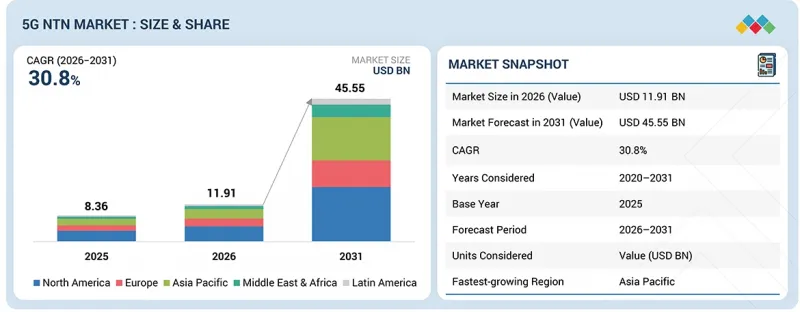
The 5G NTN market is expected to expand from USD 11.91 billion to USD 45.55 billion between 2026 and 2031 at a compound annual growth rate of 30.8%. The market is being shaped by the growing need for continuous connectivity beyond the reach of terrestrial networks, particularly across remote, maritime, aviation, and disaster-prone environments. As enterprises and governments seek resilient communications for mission-critical operations, demand is rising for satellite access, direct-to-device connectivity, and NTN-enabled IoT solutions.
| Scope of the Report | |
|---|---|
| Years Considered for the Study | 2020-2031 |
| Base Year | 2025 |
| Forecast Period | 2026-2031 |
| Units Considered | Value (USD Billion) |
| Segments | By Offering, Platform, Application, Location, End-Use Industry, and Region |
| Regions covered | North America, Europe, Asia Pacific, the Middle East & Africa, and Latin America |
The market is also benefiting from the increasing alignment of satellite systems with 5G standards, which is improving interoperability and making deployment more commercially viable. The strongest opportunities will come from hybrid terrestrial-satellite architectures, LEO constellation integration, and scalable connectivity services for industrial use cases. These drivers and opportunities are expected to expand network coverage, improve service reliability, and create new monetization pathways for operators and technology providers.
"The GEO satellite segment is expected to hold the largest market size during the forecast period."
The 5G NTN GEO satellite market capitalizes on its distinct advantages. GEO satellites provide wide-ranging and reliable coverage from their high-altitude equatorial orbits, making them ideal for remote asset monitoring and marine communications. When launching new satellite constellations, the initial investment costs are higher when using existing infrastructure. However, because they are farther from customers, GEO satellites experience higher latency, making them less suitable for real-time applications. They perform particularly well in applications where wide coverage is more important than low latency, including in-flight internet services and backhauling distant sensor data. Notwithstanding the growing importance of competing satellite technologies, the distinct capabilities of GEO satellites continue to meet particular demands as the market changes.
The services segment to register the fastest growth rate during the forecast period.
The 5G NTN services market is experiencing explosive growth driven by rising demand for ubiquitous connectivity. This demand stems from businesses seeking seamless global coverage for remote operations and data exchange, governments striving to bridge the digital divide in underserved regions, and consumers hungry for uninterrupted high-speed internet access everywhere. The 5G NTN service market offers a range of solutions to address these needs. These include network connectivity services that provide access to 5G NTN infrastructure, ensuring users stay connected even in remote locations. Additionally, deployment services are crucial for planning, installing, and managing 5G NTN networks to ensure they reach their full potential. This combination of services is fueling rapid expansion in the 5G NTN market, fostering a future of truly global and uninterrupted connectivity.
"Asia Pacific will register the highest growth rate during the forecast period."
In the rapidly evolving 5G NTN market across Asia-Pacific, significant strides are being made by innovative developments and strategic investments. China, South Korea, and India are the major revenue contributors in the Asia-Pacific. These countries have seen a significant rise in the number of smart device users. The large population in the Asia Pacific has created an extensive pool of mobile subscribers for telecom companies. The region is the largest contributor to the global total of mobile subscribers and will add more subscribers to its network in the coming years. Improving public safety during disasters and other emergencies can also be a major driver of 5G NTN adoption in this region. The Asia Pacific region is witnessing a surge in smart infrastructure, such as smart city projects, creating greater demand for public safety and security technologies, including surveillance systems, scanning and screening systems, and critical communication networks. Various industries, including aerospace, maritime, and defense, are adopting integrated 5G networks and satellite-based solutions to enhance network coverage across diverse locations. In the marine industry, maritime satellite technology has been adopted to leverage advanced communication networks to establish communication with employees working at remote offshore locations.
Breakdown of primaries
The study includes insights from industry experts, ranging from solution vendors to Tier 1 companies. The break-up of the primaries is as follows:
- By Company Type: Tier 1 - 30%, Tier 2 - 45%, and Tier 3 - 25%
- By Designation: C-level -35%, D-level - 30%, and Managers - 35%
- By Region: North America - 40%, Europe - 20%, Asia Pacific - 30%, Middle East & Africa- 5%, and Latin America- 5%.
The major players in the 5G NTN Market are Thales (France), Mediatek (Taiwan), Echostar Corporation (US), Qualcomm Technologies (US), SpaceX (France), Gatehouse Satcom (Denmark), SES (Luxembourg), Rohde & Schwarz (Germany), Softbank Group (Japan), Keysight Technologies (US), Sunwave Communications (China), ZTE (China), Ericsson (Sweden), Nokia (Finland), Viavi Solutions (US), Viasat (US), Telesat (Canada), Telit Cinterion (US), Mavenir (US), AST Spacemobile (US), OQ Technology (Luxembourg), Omnispace (US), Skylo (US), Sateliot (Spain), Myriota (Australia), and Monogoto (US). These players have adopted various growth strategies, such as partnerships, agreements, and collaborations; new product launches; product enhancements; and acquisitions, to expand their 5G NTN footprint.
Research Coverage
The market study covers the 5G NTN Market size across different segments. It aims to estimate market size and growth potential across segments, including offering, platform, application, location, end-use industry, and region. The study includes an in-depth competitive analysis of leading market players, their company profiles, key observations on product and business offerings, recent developments, and market strategies.
Key Benefits of Buying the Report
The report will help market leaders/new entrants with information on the closest approximations of the global 5G NTN market revenue and its subsegments. This report will help stakeholders understand the competitive landscape and gain additional insights to better position their businesses and plan suitable go-to-market strategies. Moreover, the report will provide insights for stakeholders to understand the market's pulse and provide them with information on key market drivers, restraints, challenges, and opportunities.
The report provides insights into the following pointers:
Analysis of key drivers (3GPP evolution toward NTN interworking and integration, growing demand of IoT, need to address extreme coverage extension, adoption of software-centric approach), restraints (need for radio components to be grounded, regulatory constraints), opportunities (impact of NR-NTN integration on 5G connectivity, need for NTN in the evolution toward 5G and 6G, 5G NB-IoT NTN to contribute to global high speed) and challenges (signal interception, propagation delay and low latency due to great distance between satellites and terrestrial user equipment, doppler frequence shift owing to mobility issues) influencing the growth of the 5G NTN market.
Product Development/Innovation: Detailed insights on upcoming technologies, research and development activities, and new product and service launches in the 5G NTN market.
Market Development: Comprehensive information about lucrative markets - the report analyses various regions' 5G NTN markets.
Market Diversification: Exhaustive information about new products and services, untapped geographies, recent developments, and investments in the 5G NTN market.
Competitive Assessment: In-depth assessment of market shares, growth strategies, and service offerings of leading players like Thales (France), Mediatek (Taiwan), Echostar Corporation (US), Qualcomm Technologies (US), SpaceX (France), Gatehouse Satcom (Denmark), SES (Luxembourg), Rohde & Schwarz (Germany), Softbank Group (Japan), Keysight Technologies (US), Sunwave Communications (China), ZTE (China), Ericsson (Sweden), Nokia (Finland), Viavi Solutions (US), Viasat (US), Telesat (Canada), Telit Cinterion (US), Mavenir (US), AST Spacemobile (US), OQ Technology (Luxembourg), Omnispace (US), Skylo (US), Sateliot (Spain), Myriota (Australia), Monogoto (US).
TABLE OF CONTENTS
1 INTRODUCTION
- 1.1 STUDY OBJECTIVES
- 1.2 MARKET DEFINITION
- 1.3 MARKET SCOPE
- 1.3.1 MARKET SEGMENTATION AND REGIONAL SCOPE
- 1.3.2 INCLUSIONS & EXCLUSIONS
- 1.3.3 YEARS CONSIDERED
- 1.3.4 CURRENCY CONSIDERED
- 1.4 STAKEHOLDERS
- 1.5 SUMMARY OF CHANGES
2 EXECUTIVE SUMMARY
- 2.1 MARKET HIGHLIGHTS AND KEY INSIGHTS
- 2.2 KEY MARKET PARTICIPANTS: MAPPING OF STRATEGIC DEVELOPMENTS
- 2.3 DISRUPTIVE TRENDS IN 5G NTN MARKET
- 2.4 HIGH-GROWTH SEGMENTS
- 2.5 REGIONAL SNAPSHOT: MARKET SIZE, GROWTH RATE, AND FORECAST
3 PREMIUM INSIGHTS
- 3.1 ATTRACTIVE OPPORTUNITIES FOR PLAYERS IN 5G NTN MARKET
- 3.2 5G NTN MARKET, BY OFFERING AND REGION
- 3.3 5G NTN MARKET, BY OFFERING
- 3.4 5G NTN MARKET, BY SERVICE
- 3.5 5G NTN MARKET, BY PLATFORM
- 3.6 5G NTN MARKET, BY APPLICATION
- 3.7 5G NTN MARKET, BY LOCATION
- 3.8 5G NTN MARKET, BY END-USE INDUSTRY
4 MARKET OVERVIEW AND INDUSTRY TRENDS
- 4.1 INTRODUCTION
- 4.2 MARKET DYNAMICS
- 4.2.1 DRIVERS
- 4.2.1.1 Adoption of software-centric approach
- 4.2.1.2 Need to address extreme coverage extension
- 4.2.1.3 3GPP evolution toward NTN interworking and integration
- 4.2.1.4 Growing demand for IoT
- 4.2.2 RESTRAINTS
- 4.2.2.1 Need for radio components to be grounded
- 4.2.2.2 Regulatory constraints
- 4.2.3 OPPORTUNITIES
- 4.2.3.1 Impact of NR-NTN integration on 5G connectivity
- 4.2.3.2 Need for NTN in evolution toward 5G and 6G
- 4.2.3.3 5G NB-IoT NTN to contribute to global high speed
- 4.2.4 CHALLENGES
- 4.2.4.1 Signal interception
- 4.2.4.2 Propagation delay and low latency due to great distance between satellites and terrestrial user equipment
- 4.2.4.3 Doppler frequency shift owing to mobility issues
- 4.2.1 DRIVERS
- 4.3 BRIEF HISTORY OF 5G NTN TECHNOLOGY
- 4.3.1 2000-2015
- 4.3.2 2016-2018
- 4.3.3 2019-2021
- 4.3.4 2022-2023
- 4.3.5 2024-PRESENT
- 4.4 TRENDS & DISRUPTIONS IMPACTING CUSTOMER BUSINESS
- 4.5 PRICING ANALYSIS
- 4.5.1 AVERAGE SELLING PRICE OF KEY PLAYERS, BY HARDWARE, 2025
- 4.5.2 INDICATIVE PRICING ANALYSIS OF 5G NTN, BY SERVICE, 2025
- 4.6 VALUE CHAIN ANALYSIS
- 4.7 5G NTN MARKET: ECOSYSTEM ANALYSIS
- 4.8 TECHNOLOGY ANALYSIS
- 4.8.1 KEY TECHNOLOGIES
- 4.8.1.1 Satellite communications
- 4.8.1.2 IoT
- 4.8.1.3 High-Altitude Platforms (HAPs)
- 4.8.2 COMPLEMENTARY TECHNOLOGIES
- 4.8.2.1 Wi-Fi
- 4.8.2.2 Cloud computing
- 4.8.2.3 Fiber optic
- 4.8.3 ADJACENT TECHNOLOGIES
- 4.8.3.1 Artificial Intelligence and Machine Learning
- 4.8.3.2 Edge computing
- 4.8.1 KEY TECHNOLOGIES
- 4.9 PATENT ANALYSIS
- 4.9.1 METHODOLOGY
- 4.9.2 LIST OF MAJOR PATENTS IN 5G NTN MARKET, 2023-2025
- 4.10 HS CODES
- 4.10.1 EXPORT SCENARIO FOR HS CODE: 851761
- 4.10.2 IMPORT SCENARIO FOR HS CODE: 851761
- 4.11 CASE STUDY ANALYSIS
- 4.11.1 CASE STUDY 1: KEYSIGHT TECHNOLOGIES AND QUALCOMM TECHNOLOGIES ESTABLISHED END-TO-END 5G NTN CONNECTION
- 4.11.2 CASE STUDY 2: ERICSSON, QUALCOMM, AND THALES COLLABORATED TO PROVIDE GLOBAL COVERAGE THROUGH 5G SMARTPHONES
- 4.11.3 CASE STUDY 3: SMART AND OMNISPACE TEAMED UP TO EXPLORE SPACE-BASED 5G TECHNOLOGIES
- 4.11.4 CASE STUDY 4: T-MOBILE AND SPACEX COLLABORATED TO PROVIDE TEXT COVERAGE AND OFFER NO-DEAD ZONES
- 4.11.5 CASE STUDY 5: ZTE CORPORATION AND CHINA MOBILE SHOWCASED FIRST 5G NTN FIELD TRIAL
- 4.12 KEY CONFERENCES AND EVENTS, 2026-2027
- 4.13 5G NTN MARKET: BUSINESS MODELS
- 4.13.1 SATELLITE INTERNET SERVICE PROVIDERS (ISPS)
- 4.13.2 AERIAL NETWORK PROVIDERS
- 4.13.3 ENTERPRISE SOLUTIONS
- 4.13.4 SUBSCRIPTION-BASED SERVICES
- 4.13.5 INFRASTRUCTURE-AS-A-SERVICE (IAAS)
- 4.14 BEST PRACTICES IN 5G NTN MARKET
- 4.14.1 STRATEGIC DEPLOYMENT PLANNING
- 4.14.2 TECHNOLOGY INTEGRATION
- 4.14.3 ADVANCED ANTENNA AND MODEM TECHNOLOGIES
- 4.14.4 EFFICIENT SPECTRUM MANAGEMENT
- 4.14.5 ROBUST BACKHAUL SOLUTIONS
- 4.14.6 POWER MANAGEMENT AND SUSTAINABILITY
- 4.14.7 SECURITY AND PRIVACY
- 4.14.8 COLLABORATIONS AND PARTNERSHIPS
- 4.14.9 ROBUST API DOCUMENTATION
- 4.14.10 USER EXPERIENCE AND FEEDBACK
- 4.15 5G NTN TOOLS, FRAMEWORKS, AND TECHNIQUES
- 4.16 REGULATORY LANDSCAPE
- 4.16.1 REGULATORY BODIES, GOVERNMENT AGENCIES, AND OTHER ORGANIZATIONS
- 4.16.2 REGULATIONS, BY REGION
- 4.16.2.1 North America
- 4.16.2.1.1 US
- 4.16.2.1.2 Canada
- 4.16.2.2 Europe
- 4.16.2.3 Asia Pacific
- 4.16.2.3.1 China
- 4.16.2.3.2 Australia
- 4.16.2.3.3 Japan
- 4.16.2.4 Middle East & Africa
- 4.16.2.4.1 UAE
- 4.16.2.4.2 KSA
- 4.16.2.5 Latin America
- 4.16.2.5.1 Mexico
- 4.16.2.1 North America
- 4.17 PORTER'S FIVE FORCES ANALYSIS
- 4.17.1 THREAT OF NEW ENTRANTS
- 4.17.2 THREAT OF SUBSTITUTES
- 4.17.3 BARGAINING POWER OF BUYERS
- 4.17.4 BARGAINING POWER OF SUPPLIERS
- 4.17.5 INTENSITY OF COMPETITIVE RIVALRY
- 4.18 KEY STAKEHOLDERS & BUYING CRITERIA
- 4.18.1 KEY STAKEHOLDERS IN BUYING PROCESS
- 4.18.2 BUYING CRITERIA
- 4.19 INVESTMENT & FUNDING SCENARIO
5 5G NTN MARKET, BY OFFERING
- 5.1 INTRODUCTION
- 5.1.1 OFFERING: 5G NTN MARKET DRIVERS
- 5.2 HARDWARE
- 5.2.1 SHIFT TOWARD 5G NTN HARDWARE INSTALLATION TO ENHANCE NETWORK COVERAGE
- 5.3 SOFTWARE
- 5.3.1 SOFTWARE SOLUTIONS TO ENSURE SEAMLESS CONNECTIVITY IN REMOTE LOCATIONS
- 5.4 SERVICES
- 5.4.1 DEMAND FOR UNINTERRUPTED CONNECTIVITY IN UNDERSERVED AREAS TO DRIVE MARKET FOR 5G NTN SERVICES
- 5.4.2 DEPLOYMENT SERVICES
- 5.4.3 CONNECTIVITY SERVICES
6 5G NTN MARKET, BY PLATFORM
- 6.1 INTRODUCTION
- 6.1.1 PLATFORM: 5G NTN MARKET DRIVERS
- 6.2 UAS PLATFORM
- 6.2.1 FOCUS ON SUPPORTING AIRBORNE COMMUNICATION TO SPUR GROWTH
- 6.3 LEO SATELLITE
- 6.3.1 LEO SATELLITES PROVIDE CONNECTIVITY COVERAGE AT ALTITUDES RANGING FROM 300 TO 1500 KM
- 6.4 MEO SATELLITE
- 6.4.1 MEO SATELLITES HAVE LOWER ORBITS THAN GEO SATELLITES, REDUCING RF POWER REQUIREMENTS AND COMMUNICATION DELAYS
- 6.5 GEO SATELLITE
- 6.5.1 GEO PLATFORMS SUPPORT AND ENHANCE NETWORK COVERAGE IN REMOTE, ISOLATED, AND UNDERSERVED AREAS
7 5G NTN MARKET, BY APPLICATION
- 7.1 INTRODUCTION
- 7.1.1 APPLICATION: 5G NTN MARKET DRIVERS
- 7.2 EMBB
- 7.2.1 NEED TO OFFER HIGH-SPEED BROADBAND CONNECTIVITY IN DENSELY POPULATED AREAS TO PROPEL GROWTH
- 7.3 MMTC
- 7.3.1 NEED FOR SCALABLE AND EFFICIENT CONNECTIVITY OF MANY DEVICES TO BOOST MARKET EXPANSION
- 7.4 URLLC
- 7.4.1 URLLC PROVIDES DATA TRANSMISSION WITH HIGH RELIABILITY IN 5G NTN SYSTEMS
8 5G NTN MARKET, BY END-USE INDUSTRY
- 8.1 INTRODUCTION
- 8.1.1 END-USE INDUSTRY: 5G NTN MARKET DRIVERS
- 8.2 MARITIME
- 8.2.1 ENHANCED 5G NETWORK COVERAGE TO SUPPORT TRACKING AND MONITORING IN MARITIME INDUSTRY
- 8.2.2 USE CASES
- 8.2.2.1 Vessel Connectivity
- 8.2.2.2 Port Operations Optimization
- 8.3 AEROSPACE & DEFENSE
- 8.3.1 INCREASING ADOPTION OF INNOVATIVE TECHNOLOGY AND DIGITALIZED SOLUTIONS TO DRIVE MARKET
- 8.3.2 USE CASES
- 8.3.2.1 Military Tactical Communication
- 8.3.2.2 Airborne Command and Control
- 8.3.2.3 Defense Surveillance and Reconnaissance
- 8.4 GOVERNMENT
- 8.4.1 RISING NEED FOR IMPROVED SAFETY AND SECURITY OF GOVERNMENT NETWORKS TO BOOST MARKET
- 8.4.2 USE CASES
- 8.4.2.1 Disaster Response Coordination
- 8.4.2.2 Remote Governance and Public Services
- 8.5 MINING
- 8.5.1 ADOPTION OF 5G CONNECTIVITY IN MINING SECTOR TO FACILITATE WORKER SAFETY
- 8.5.2 USE CASES
- 8.5.2.1 Remote Equipment Monitoring
- 8.5.2.2 Environmental Monitoring
- 8.6 OTHER END-USE INDUSTRIES
- 8.6.1 USE CASES
- 8.6.1.1 Smart Warehousing
- 8.6.1.2 Wildfire Detection and Prevention
- 8.6.1.3 Autonomous Driving
- 8.6.1.4 Real-Time Patient Monitoring
- 8.6.1 USE CASES
9 5G NTN MARKET, BY LOCATION
- 9.1 INTRODUCTION
- 9.1.1 LOCATION: 5G NTN MARKET DRIVERS
- 9.2 URBAN
- 9.2.1 HIGH-SPEED INTERNET CONNECTIVITY TO STRENGTHEN SMART INFRASTRUCTURE IN URBAN AREAS
- 9.3 RURAL
- 9.3.1 FOCUS ON ELIMINATING DIGITAL DIVIDE IN RURAL AREAS TO ENCOURAGE ADOPTION OF 5G NTN SYSTEMS
- 9.4 REMOTE
- 9.4.1 5G NTN SYSTEMS SUPPORT MOVEMENT OF WORKERS FROM URBAN TO REMOTE AREAS
- 9.5 ISOLATED
- 9.5.1 5G NTN SERVICES PROVIDE 5G COVERAGE IN ISOLATED AREAS
10 5G NTN MARKET, BY REGION
- 10.1 INTRODUCTION
- 10.2 NORTH AMERICA
- 10.2.1 NORTH AMERICA: 5G NTN MARKET DRIVERS
- 10.2.2 US
- 10.2.2.1 Remarkable growth of smart connected devices to boost market growth
- 10.2.3 CANADA
- 10.2.3.1 Improvement in network connectivity in rural areas to drive market
- 10.3 EUROPE
- 10.3.1 EUROPE: 5G NTN MARKET DRIVERS
- 10.3.2 UK
- 10.3.2.1 Deployment of 5G services to help reduce carbon emissions
- 10.3.3 GERMANY
- 10.3.3.1 Initiatives by the government to expand 5G coverage to spur growth
- 10.3.4 FRANCE
- 10.3.4.1 Advanced economy and flourishing IT market to drive use of 5G NTN systems
- 10.3.5 ITALY
- 10.3.5.1 Government initiatives and funding to drive use of 5G NTN systems
- 10.3.6 REST OF EUROPE
- 10.4 ASIA PACIFIC
- 10.4.1 ASIA PACIFIC: 5G NTN MARKET DRIVERS
- 10.4.2 CHINA
- 10.4.2.1 Successful field trial of 5G NTN to demonstrate communication services
- 10.4.3 INDIA
- 10.4.3.1 Increasing focus on smart infrastructure development to lead to adoption of 5G NTN services
- 10.4.4 SOUTH KOREA
- 10.4.4.1 Demand for 5G and 6G wireless technology to drive market
- 10.4.5 JAPAN
- 10.4.5.1 Strategic collaborations and 5G NTN advancements to drive market
- 10.4.6 REST OF ASIA PACIFIC
- 10.5 MIDDLE EAST & AFRICA
- 10.5.1 MIDDLE EAST & AFRICA: 5G NTN MARKET DRIVERS
- 10.5.2 UAE
- 10.5.2.1 Government initiatives and major companies to drive growth
- 10.5.3 KSA
- 10.5.3.1 Initiatives by major players to drive growth
- 10.5.4 SOUTH AFRICA
- 10.5.4.1 Focus on rural connectivity to drive market
- 10.5.5 REST OF MIDDLE EAST & AFRICA
- 10.6 LATIN AMERICA
- 10.6.1 LATIN AMERICA: 5G NTN MARKET DRIVERS
- 10.6.2 BRAZIL
- 10.6.2.1 Increased investment in digital infrastructure to drive demand for 5G NTN solutions
- 10.6.3 MEXICO
- 10.6.3.1 Focus of select companies on enhancing network connectivity to propel market
- 10.6.4 REST OF LATIN AMERICA
11 COMPETITIVE LANDSCAPE
- 11.1 INTRODUCTION
- 11.2 KEY PLAYER COMPETITIVE STRATEGIES/RIGHT TO WIN
- 11.3 REVENUE ANALYSIS, 2023-2025
- 11.4 MARKET SHARE ANALYSIS, 2025
- 11.5 BRAND/PRODUCT COMPARISON
- 11.6 COMPANY EVALUATION MATRIX: KEY PLAYERS, 2025
- 11.6.1 STARS
- 11.6.2 EMERGING LEADERS
- 11.6.3 PERVASIVE PLAYERS
- 11.6.4 PARTICIPANTS
- 11.6.5 COMPANY FOOTPRINT: KEY PLAYERS, 2025
- 11.6.5.1 Company footprint
- 11.6.5.2 Regional footprint
- 11.6.5.3 Offering footprint
- 11.6.5.4 Location footprint
- 11.7 STARTUP/SME EVALUATION MATRIX, 2025
- 11.7.1 PROGRESSIVE COMPANIES
- 11.7.2 RESPONSIVE COMPANIES
- 11.7.3 DYNAMIC COMPANIES
- 11.7.4 STARTING BLOCKS
- 11.7.5 COMPETITIVE BENCHMARKING: STARTUPS/SMES, 2025
- 11.7.5.1 Detailed list of key startups/SMEs
- 11.7.5.2 Competitive benchmarking of key startups/SMEs
- 11.8 COMPETITIVE SCENARIO
- 11.8.1 PRODUCT LAUNCHES
- 11.8.2 DEALS
12 COMPANY PROFILES
- 12.1 KEY PLAYERS
- 12.1.1 THALES
- 12.1.1.1 Business overview
- 12.1.1.2 Products/Solutions/Services offered
- 12.1.1.3 Recent developments
- 12.1.1.3.1 Deals
- 12.1.1.4 MnM view
- 12.1.1.4.1 Right to win
- 12.1.1.4.2 Strategic choices made
- 12.1.1.4.3 Weaknesses and competitive threats
- 12.1.2 ECHOSTAR CORPORATION
- 12.1.2.1 Business overview
- 12.1.2.2 Products/Solutions/Services offered
- 12.1.2.3 Recent developments
- 12.1.2.3.1 Product launches
- 12.1.2.3.2 Deals
- 12.1.2.3.3 Other developments
- 12.1.2.4 MnM view
- 12.1.2.4.1 Right to win
- 12.1.2.4.2 Strategic choices made
- 12.1.2.4.3 Weaknesses and competitive threats
- 12.1.3 QUALCOMM TECHNOLOGIES
- 12.1.3.1 Business overview
- 12.1.3.2 Products/Solutions/Services offered
- 12.1.3.3 Recent developments
- 12.1.3.3.1 Product launches
- 12.1.3.3.2 Deals
- 12.1.3.4 MnM view
- 12.1.3.4.1 Right to win
- 12.1.3.4.2 Strategic choices made
- 12.1.3.4.3 Weaknesses and competitive threats
- 12.1.4 MEDIATEK
- 12.1.4.1 Business overview
- 12.1.4.2 Products/Solutions/Services offered
- 12.1.4.3 Recent developments
- 12.1.4.3.1 Product launches
- 12.1.4.3.2 Deals
- 12.1.4.4 MnM view
- 12.1.4.4.1 Right to win
- 12.1.4.4.2 Strategic choices made
- 12.1.4.4.3 Weaknesses and competitive threats
- 12.1.5 SPACEX
- 12.1.5.1 Business overview
- 12.1.5.2 Products/Solutions/Services offered
- 12.1.5.3 Recent developments
- 12.1.5.3.1 Product launches
- 12.1.5.3.2 Deals
- 12.1.5.4 MnM view
- 12.1.5.4.1 Right to win
- 12.1.5.4.2 Strategic choices made
- 12.1.5.4.3 Weaknesses and competitive threats
- 12.1.6 KEYSIGHT TECHNOLOGIES
- 12.1.6.1 Business overview
- 12.1.6.2 Products/Solutions/Services offered
- 12.1.6.3 Recent developments
- 12.1.6.3.1 Deals
- 12.1.7 GATEHOUSE SATCOM
- 12.1.7.1 Business overview
- 12.1.7.2 Products/Solutions/Services offered
- 12.1.7.3 Recent developments
- 12.1.7.3.1 Deals
- 12.1.8 SOFTBANK GROUP
- 12.1.8.1 Business overview
- 12.1.8.2 Products/Solutions/Services offered
- 12.1.8.3 Recent developments
- 12.1.8.3.1 Product launches
- 12.1.8.3.2 Deals
- 12.1.9 ROHDE & SCHWARZ
- 12.1.9.1 Business overview
- 12.1.9.2 Products/Solutions/Services offered
- 12.1.9.3 Recent developments
- 12.1.9.3.1 Deals
- 12.1.10 SES
- 12.1.10.1 Business overview
- 12.1.10.2 Products/Solutions/Services offered
- 12.1.10.3 Recent developments
- 12.1.10.3.1 Deals
- 12.1.11 SUNWAVE COMMUNICATIONS
- 12.1.12 ZTE
- 12.1.13 VIAVI SOLUTIONS INC.
- 12.1.14 VIASAT
- 12.1.15 ERICSSON
- 12.1.16 NOKIA
- 12.1.17 TELESAT
- 12.1.18 TELIT CINTERION
- 12.1.19 MAVENIR
- 12.1.1 THALES
- 12.2 STARTUPS/SMES
- 12.2.1 AST SPACEMOBILE
- 12.2.2 OQ TECHNOLOGY
- 12.2.3 OMNISPACE
- 12.2.4 SKYLO
- 12.2.5 SATELIOT
- 12.2.6 MYRIOTA
- 12.2.7 MONOGOTO
13 RESEARCH METHODOLOGY
- 13.1 RESEARCH DATA
- 13.1.1 SECONDARY DATA
- 13.1.1.1 Key data from secondary sources
- 13.1.2 PRIMARY DATA
- 13.1.2.1 Primary interviews with experts
- 13.1.2.2 Breakdown of primaries
- 13.1.2.3 Key data from primary sources
- 13.1.2.4 Key industry insights
- 13.1.1 SECONDARY DATA
- 13.2 MARKET BREAKUP AND DATA TRIANGULATION
- 13.3 MARKET SIZE ESTIMATION
- 13.3.1 BOTTOM-UP APPROACH
- 13.3.2 TOP-DOWN APPROACH
- 13.3.3 5G NTN MARKET SIZE ESTIMATION: SUPPLY-SIDE ANALYSIS (TOP-DOWN)
- 13.3.4 5G NTN MARKET SIZE ESTIMATION: DEMAND-SIDE ANALYSIS
- 13.4 MARKET FORECAST
- 13.4.1 RISK ANALYSIS
- 13.5 RESEARCH ASSUMPTIONS
- 13.6 RESEARCH LIMITATIONS
14 APPENDIX
- 14.1 DISCUSSION GUIDE
- 14.2 KNOWLEDGESTORE: MARKETSANDMARKETS' SUBSCRIPTION PORTAL
- 14.3 CUSTOMIZATION OPTIONS
- 14.4 RELATED REPORTS
- 14.5 AUTHOR DETAILS
List of Tables
- TABLE 1 USD EXCHANGE RATES, 2023-2025
- TABLE 2 AVERAGE SELLING PRICE OF KEY PLAYERS, BY HARDWARE, 2025 (USD)
- TABLE 3 INDICATIVE PRICING ANALYSIS OF 5G NTN, BY SERVICE, 2025 (USD)
- TABLE 4 ROLE OF COMPANIES IN ECOSYSTEM
- TABLE 5 EXPORT SCENARIO FOR HS CODE: 851761, BY COUNTRY, 2021-2023 (USD THOUSAND)
- TABLE 6 IMPORT SCENARIO FOR HS CODE: 851761, BY COUNTRY, 2021-2023 (USD THOUSAND)
- TABLE 7 5G NTN MARKET: LIST OF KEY CONFERENCES AND EVENTS, 2026-2027
- TABLE 8 NORTH AMERICA: LIST OF REGULATORY BODIES, GOVERNMENT AGENCIES, AND OTHER ORGANIZATIONS
- TABLE 9 EUROPE: LIST OF REGULATORY BODIES, GOVERNMENT AGENCIES, AND OTHER ORGANIZATIONS
- TABLE 10 ASIA PACIFIC: LIST OF REGULATORY BODIES, GOVERNMENT AGENCIES, AND OTHER ORGANIZATIONS
- TABLE 11 MIDDLE EAST & AFRICA: LIST OF REGULATORY BODIES, GOVERNMENT AGENCIES, AND OTHER ORGANIZATIONS
- TABLE 12 LATIN AMERICA: LIST OF REGULATORY BODIES, GOVERNMENT AGENCIES, AND OTHER ORGANIZATIONS
- TABLE 13 IMPACT OF PORTER'S FIVE FORCES ON 5G NTN MARKET
- TABLE 14 INFLUENCE OF STAKEHOLDERS ON BUYING PROCESS FOR KEY LOCATIONS
- TABLE 15 KEY BUYING CRITERIA
- TABLE 16 5G NTN MARKET, BY OFFERING, 2024-2031 (USD MILLION)
- TABLE 17 HARDWARE: 5G NTN MARKET, BY REGION, 2024-2031 (USD MILLION)
- TABLE 18 SOFTWARE: 5G NTN MARKET, BY REGION, 2024-2031 (USD MILLION)
- TABLE 19 5G NTN MARKET, BY SERVICE, 2024-2031 (USD MILLION)
- TABLE 20 SERVICES: 5G NTN MARKET, BY REGION, 2024-2031 (USD MILLION)
- TABLE 21 DEPLOYMENT SERVICES: 5G NTN MARKET, BY REGION, 2024-2031 (USD MILLION)
- TABLE 22 CONNECTIVITY SERVICES: 5G NTN MARKET, BY REGION, 2024-2031 (USD MILLION)
- TABLE 23 5G NTN MARKET, BY PLATFORM, 2024-2031 (USD MILLION)
- TABLE 24 UAS PLATFORM: 5G NTN MARKET, BY REGION, 2024-2031 (USD MILLION)
- TABLE 25 LEO SATELLITE: 5G NTN MARKET, BY REGION, 2024-2031 (USD MILLION)
- TABLE 26 MEO SATELLITE: 5G NTN MARKET, BY REGION, 2024-2031 (USD MILLION)
- TABLE 27 GEO SATELLITE: 5G NTN MARKET, BY REGION, 2024-2031 (USD MILLION)
- TABLE 28 5G NTN MARKET, BY APPLICATION, 2024-2031 (USD MILLION)
- TABLE 29 EMBB: 5G NTN MARKET, BY REGION, 2024-2031 (USD MILLION)
- TABLE 30 MMTC: 5G NTN MARKET, BY REGION, 2024-2031 (USD MILLION)
- TABLE 31 URLLC: 5G NTN MARKET, BY REGION, 2024-2031 (USD MILLION)
- TABLE 32 5G NTN MARKET, BY END-USE INDUSTRY, 2024-2031 (USD MILLION)
- TABLE 33 MARITIME: 5G NTN MARKET, BY REGION, 2024-2031 (USD MILLION)
- TABLE 34 AEROSPACE & DEFENSE: 5G NTN MARKET, BY REGION, 2024-2031 (USD MILLION)
- TABLE 35 GOVERNMENT: 5G NTN MARKET, BY REGION, 2024-2031 (USD MILLION)
- TABLE 36 MINING: 5G NTN MARKET, BY REGION, 2024-2031 (USD MILLION)
- TABLE 37 OTHER END-USE INDUSTRIES: 5G NTN MARKET, BY REGION, 2024-2031 (USD MILLION)
- TABLE 38 5G NTN MARKET, BY LOCATION, 2024-2031 (USD MILLION)
- TABLE 39 URBAN: 5G NTN MARKET, BY REGION, 2024-2031 (USD MILLION)
- TABLE 40 RURAL: 5G NTN MARKET, BY REGION, 2024-2031 (USD MILLION)
- TABLE 41 REMOTE: 5G NTN MARKET, BY REGION, 2024-2031 (USD MILLION)
- TABLE 42 ISOLATED: 5G NTN MARKET, BY REGION, 2024-2031 (USD MILLION)
- TABLE 43 5G NTN MARKET, BY REGION, 2024-2031 (USD MILLION)
- TABLE 44 NORTH AMERICA: 5G NTN MARKET, BY OFFERING, 2024-2031 (USD MILLION)
- TABLE 45 NORTH AMERICA: 5G NTN MARKET, BY SERVICE, 2024-2031 (USD MILLION)
- TABLE 46 NORTH AMERICA: 5G NTN MARKET, BY PLATFORM, 2024-2031 (USD MILLION)
- TABLE 47 NORTH AMERICA: 5G NTN MARKET, BY END-USE INDUSTRY, 2024-2031 (USD MILLION)
- TABLE 48 NORTH AMERICA: 5G NTN MARKET, BY APPLICATION, 2024-2031 (USD MILLION)
- TABLE 49 NORTH AMERICA: 5G NTN MARKET, BY LOCATION, 2024-2031 (USD MILLION)
- TABLE 50 NORTH AMERICA: 5G NTN MARKET, BY COUNTRY, 2024-2031 (USD MILLION)
- TABLE 51 EUROPE: 5G NTN MARKET, BY OFFERING, 2024-2031 (USD MILLION)
- TABLE 52 EUROPE: 5G NTN MARKET, BY SERVICE, 2024-2031 (USD MILLION)
- TABLE 53 EUROPE: 5G NTN MARKET, BY PLATFORM, 2024-2031 (USD MILLION)
- TABLE 54 EUROPE: 5G NTN MARKET, BY END-USE INDUSTRY, 2024-2031 (USD MILLION)
- TABLE 55 EUROPE: 5G NTN MARKET, BY APPLICATION, 2024-2031 (USD MILLION)
- TABLE 56 EUROPE: 5G NTN MARKET, BY LOCATION, 2024-2031 (USD MILLION)
- TABLE 57 EUROPE: 5G NTN MARKET, BY COUNTRY, 2024-2031 (USD MILLION)
- TABLE 58 ASIA PACIFIC: 5G NTN MARKET, BY OFFERING, 2024-2031 (USD MILLION)
- TABLE 59 ASIA PACIFIC: 5G NTN MARKET, BY SERVICE, 2024-2031 (USD MILLION)
- TABLE 60 ASIA PACIFIC: 5G NTN MARKET, BY PLATFORM, 2024-2031 (USD MILLION)
- TABLE 61 ASIA PACIFIC: 5G NTN MARKET, BY END-USE INDUSTRY, 2024-2031 (USD MILLION)
- TABLE 62 ASIA PACIFIC: 5G NTN MARKET, BY APPLICATION, 2024-2031 (USD MILLION)
- TABLE 63 ASIA PACIFIC: 5G NTN MARKET, BY LOCATION, 2024-2031 (USD MILLION)
- TABLE 64 ASIA PACIFIC: 5G NTN MARKET, BY COUNTRY, 2024-2031 (USD MILLION)
- TABLE 65 MIDDLE EAST & AFRICA: 5G NTN MARKET, BY OFFERING, 2024-2031 (USD MILLION)
- TABLE 66 MIDDLE EAST & AFRICA: 5G NTN MARKET, BY SERVICE, 2024-2031 (USD MILLION)
- TABLE 67 MIDDLE EAST & AFRICA: 5G NTN MARKET, BY PLATFORM, 2024-2031 (USD MILLION)
- TABLE 68 MIDDLE EAST & AFRICA: 5G NTN MARKET, BY END-USE INDUSTRY, 2024-2031 (USD MILLION)
- TABLE 69 MIDDLE EAST & AFRICA: 5G NTN MARKET, BY APPLICATION, 2024-2031 (USD MILLION)
- TABLE 70 MIDDLE EAST & AFRICA: 5G NTN MARKET, BY LOCATION, 2024-2031 (USD MILLION)
- TABLE 71 MIDDLE EAST & AFRICA: 5G NTN MARKET, BY REGION, 2024-2031 (USD MILLION)
- TABLE 72 LATIN AMERICA: 5G NTN MARKET, BY OFFERING, 2024-2031 (USD MILLION)
- TABLE 73 LATIN AMERICA: 5G NTN MARKET, BY SERVICE, 2024-2031 (USD MILLION)
- TABLE 74 LATIN AMERICA: 5G NTN MARKET, BY PLATFORM, 2024-2031 (USD MILLION)
- TABLE 75 LATIN AMERICA: 5G NTN MARKET, BY END-USE INDUSTRY, 2024-2031 (USD MILLION)
- TABLE 76 LATIN AMERICA: 5G NTN MARKET, BY APPLICATION, 2024-2031 (USD MILLION)
- TABLE 77 LATIN AMERICA: 5G NTN MARKET, BY LOCATION, 2024-2031 (USD MILLION)
- TABLE 78 LATIN AMERICA: 5G NTN MARKET, BY COUNTRY, 2024-2031 (USD MILLION)
- TABLE 79 OVERVIEW OF STRATEGIES DEPLOYED BY KEY 5G NTN MARKET PLAYERS
- TABLE 80 5G NTN MARKET: DEGREE OF COMPETITION
- TABLE 81 5G NTN MARKET: REGIONAL FOOTPRINT
- TABLE 82 5G NTN MARKET: OFFERING FOOTPRINT
- TABLE 83 5G NTN MARKET: LOCATION FOOTPRINT
- TABLE 84 5G NTN MARKET: KEY STARTUPS/SMES
- TABLE 85 5G NTN MARKET: COMPETITIVE BENCHMARKING OF KEY STARTUPS/SMES
- TABLE 86 5G NTN MARKET: PRODUCT LAUNCHES, JANUARY 2021-APRIL 2026
- TABLE 87 5G NTN MARKET: DEALS, JANUARY 2021-APRIL 2026
- TABLE 88 THALES: BUSINESS OVERVIEW
- TABLE 89 THALES: PRODUCTS/SOLUTIONS/SERVICES OFFERED
- TABLE 90 THALES: DEALS
- TABLE 91 ECHOSTAR CORPORATION: BUSINESS OVERVIEW
- TABLE 92 ECHOSTAR CORPORATION: PRODUCTS/SOLUTIONS/SERVICES OFFERED
- TABLE 93 ECHOSTAR CORPORATION: PRODUCT LAUNCHES
- TABLE 94 ECHOSTAR CORPORATION: DEALS
- TABLE 95 ECHOSTAR CORPORATION: OTHER DEVELOPMENTS
- TABLE 96 QUALCOMM: BUSINESS OVERVIEW
- TABLE 97 QUALCOMM: PRODUCTS/SOLUTIONS/SERVICES OFFERED
- TABLE 98 QUALCOMM: PRODUCT LAUNCHES
- TABLE 99 QUALCOMM: DEALS
- TABLE 100 MEDIATEK: BUSINESS OVERVIEW
- TABLE 101 MEDIATEK: PRODUCTS/SOLUTIONS/SERVICES OFFERED
- TABLE 102 MEDIATEK: PRODUCT LAUNCHES
- TABLE 103 MEDIATEK: DEALS
- TABLE 104 SPACEX: BUSINESS OVERVIEW
- TABLE 105 SPACEX: PRODUCTS/SOLUTIONS/SERVICES OFFERED
- TABLE 106 SPACEX: PRODUCT LAUNCHES
- TABLE 107 SPACEX: DEALS
- TABLE 108 KEYSIGHT TECHNOLOGIES: BUSINESS OVERVIEW
- TABLE 109 KEYSIGHT TECHNOLOGIES: PRODUCTS/SOLUTIONS/SERVICES OFFERED
- TABLE 110 KEYSIGHT TECHNOLOGIES: DEALS
- TABLE 111 GATEHOUSE SATCOM: BUSINESS OVERVIEW
- TABLE 112 GATEHOUSE SATCOM: PRODUCTS/SOLUTIONS/SERVICES OFFERED
- TABLE 113 GATEHOUSE SATCOM: DEALS
- TABLE 114 SOFTBANK GROUP: BUSINESS OVERVIEW
- TABLE 115 SOFTBANK GROUP: PRODUCTS/SOLUTIONS/SERVICES OFFERED
- TABLE 116 SOFTBANK GROUP: PRODUCT LAUNCHES
- TABLE 117 SOFTBANK GROUP: DEALS
- TABLE 118 ROHDE & SCHWARZ: BUSINESS OVERVIEW
- TABLE 119 ROHDE & SCHWARZ: PRODUCTS/SOLUTIONS/SERVICES OFFERED
- TABLE 120 ROHDE & SCHWARZ: DEALS
- TABLE 121 SES: BUSINESS OVERVIEW
- TABLE 122 SES: PRODUCTS/SOLUTIONS/SERVICES OFFERED
- TABLE 123 SES: DEALS
List of Figures
- FIGURE 1 5G NTN MARKET SEGMENTATION
- FIGURE 2 MARKET SCENARIO
- FIGURE 3 5G NTN MARKET, 2024-2031
- FIGURE 4 MAJOR STRATEGIES ADOPTED BY KEY PLAYERS IN 5G NTN MARKET, 2021-2026
- FIGURE 5 DISRUPTIONS INFLUENCING GROWTH OF 5G NTN MARKET
- FIGURE 6 HIGH-GROWTH SEGMENTS IN 5G NTN MARKET, 2026-2031
- FIGURE 7 ASIA PACIFIC TO REGISTER HIGHEST CAGR IN 5G NTN MARKET DURING FORECAST PERIOD
- FIGURE 8 3GPP EVOLUTION TOWARD NTN INTERWORKING & INTEGRATION AND NEED TO ADDRESS EXTREME COVERAGE EXTENSION TO DRIVE MARKET
- FIGURE 9 HARDWARE SEGMENT AND NORTH AMERICA TO ACCOUNT FOR LARGEST MARKET SHARES IN 2026
- FIGURE 10 HARDWARE SEGMENT TO LEAD MARKET IN 2026
- FIGURE 11 DEPLOYMENT SERVICES SEGMENT TO DOMINATE MARKET IN 2026
- FIGURE 12 LEO SATELLITE SEGMENT TO ACCOUNT FOR LARGEST MARKET SHARE IN 2026
- FIGURE 13 EMBB SEGMENT TO ACCOUNT FOR LARGEST MARKET SHARE IN 2026
- FIGURE 14 RURAL SEGMENT TO ACCOUNT FOR LARGEST MARKET SHARE IN 2026
- FIGURE 15 MARITIME SEGMENT TO ACCOUNT FOR LARGEST MARKET SHARE IN 2026
- FIGURE 16 5G NTN MARKET: DRIVERS, RESTRAINTS, OPPORTUNITIES, AND CHALLENGES
- FIGURE 17 BRIEF HISTORY OF 5G NTN TECHNOLOGY
- FIGURE 18 TRENDS & DISRUPTIONS IMPACTING CUSTOMER BUSINESS
- FIGURE 19 AVERAGE SELLING PRICE OF KEY PLAYERS, BY HARDWARE, 2025
- FIGURE 20 5G NTN MARKET: VALUE CHAIN ANALYSIS
- FIGURE 21 5G NTN MARKET: ECOSYSTEM ANALYSIS
- FIGURE 22 LIST OF MAJOR PATENTS APPLIED AND GRANTED, 2025-2024
- FIGURE 23 EXPORT SCENARIO FOR HS CODE: 851761, BY COUNTRY, 2021-2023 (USD THOUSAND)
- FIGURE 24 IMPORT SCENARIO FOR HS CODE: 851761, BY COUNTRY, 2021-2023 (USD THOUSAND)
- FIGURE 25 5G NTN MARKET: PORTER'S FIVE FORCES ANALYSIS
- FIGURE 26 INFLUENCE OF KEY STAKEHOLDERS ON BUYING PROCESS FOR KEY LOCATIONS
- FIGURE 27 KEY BUYING CRITERIA
- FIGURE 28 INVESTMENT AND FUNDING SCENARIO
- FIGURE 29 SERVICES SEGMENT TO GROW AT HIGHEST CAGR DURING FORECAST PERIOD
- FIGURE 30 LEO SATELLITE SEGMENT TO GROW AT HIGHEST CAGR DURING FORECAST PERIOD
- FIGURE 31 MMTC SEGMENT TO GROW AT HIGHEST CAGR DURING FORECAST PERIOD
- FIGURE 32 MARITIME SEGMENT TO DOMINATE MARKET SIZE DURING FORECAST PERIOD
- FIGURE 33 ISOLATED SEGMENT TO GROW AT HIGHEST CAGR DURING FORECAST PERIOD
- FIGURE 34 NORTH AMERICA: 5G NTN MARKET SNAPSHOT
- FIGURE 35 ASIA PACIFIC: 5G NTN MARKET SNAPSHOT
- FIGURE 36 HISTORICAL REVENUE ANALYSIS OF KEY PLAYERS, 2023-2025 (USD MILLION)
- FIGURE 37 SHARE OF LEADING COMPANIES IN 5G NTN MARKET, 2025
- FIGURE 38 BRAND/PRODUCT COMPARISON
- FIGURE 39 5G NTN MARKET: COMPANY EVALUATION MATRIX (KEY PLAYERS), 2025
- FIGURE 40 5G NTN MARKET: COMPANY FOOTPRINT
- FIGURE 41 5G NTN MARKET: COMPANY EVALUATION MATRIX (STARTUPS/SMES), 2025
- FIGURE 42 THALES: COMPANY SNAPSHOT
- FIGURE 43 ECHOSTAR CORPORATION: COMPANY SNAPSHOT
- FIGURE 44 QUALCOMM: COMPANY SNAPSHOT
- FIGURE 45 MEDIATEK: COMPANY SNAPSHOT
- FIGURE 46 KEYSIGHT TECHNOLOGIES: COMPANY SNAPSHOT
- FIGURE 47 SOFTBANK GROUP: COMPANY SNAPSHOT
- FIGURE 48 SES: COMPANY SNAPSHOT
- FIGURE 49 5G NTN MARKET: RESEARCH DESIGN
- FIGURE 50 DATA TRIANGULATION
- FIGURE 51 BOTTOM-UP APPROACH
- FIGURE 52 MARKET SIZE ESTIMATION METHODOLOGY, BOTTOM-UP (SUPPLY SIDE): COLLECTIVE REVENUE FROM HARDWARE, SOFTWARE, AND SERVICES OF 5G NTN MARKET
- FIGURE 53 TOP-DOWN APPROACH
- FIGURE 54 MARKET SIZE ESTIMATION METHODOLOGY: SUPPLY-SIDE ANALYSIS (TOP-DOWN)
- FIGURE 55 MARKET SIZE ESTIMATION METHODOLOGY: DEMAND-SIDE ANALYSIS
- FIGURE 56 RESEARCH LIMITATIONS

