PUBLISHER: MarketsandMarkets | PRODUCT CODE: 2048962
PUBLISHER: MarketsandMarkets | PRODUCT CODE: 2048962
Automotive Lead-Acid Battery Market by Product (SLI Batteries, Micro Hybrid, Auxiliary), Type (Flooded, VRLA), Customer, End Use (Passenger Cars, Light & Heavy Commercial Vehicles, Two Wheelers, Three Wheelers), and Region - Global Forecast to 2033
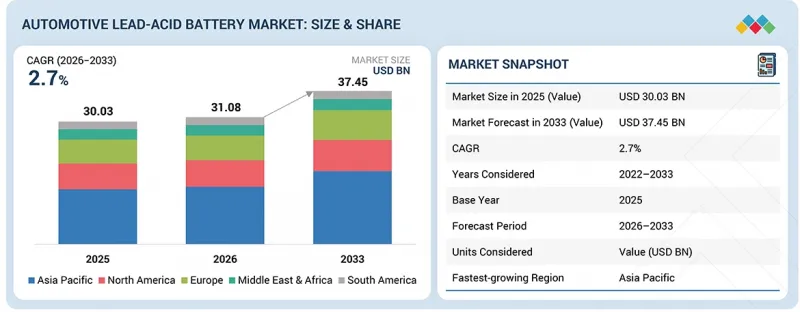
The automotive lead-acid battery market is expected to reach USD 37.45 billion by 2033 from an estimated USD 31.08 billion in 2026, at a CAGR of 2.7% during the forecast period.
| Scope of the Report | |
|---|---|
| Years Considered for the Study | 2022-2033 |
| Base Year | 2025 |
| Forecast Period | 2026-2033 |
| Units Considered | Value (USD Million/Billion) and Volume (MWh) |
| Segments | Type, Product, Customer, End Use, and Region |
| Regions covered | Asia Pacific, Europe, North America, Middle East & Africa, and South America |
As the automotive industry continues to grow, especially in emerging economies like India, China, and Southeast Asia, the need for reliable and cost-effective battery solutions intensifies. Lead-acid batteries are the preferred choice for most vehicles due to their affordability, proven performance, and compatibility with conventional internal combustion engine (ICE) vehicles.
"By product, the micro hybrid batteries segment is estimated to account for the second-largest market share."
Micro-hybrid batteries are estimated to account for the second-largest share of the automotive lead-acid battery market. This is due to their compatibility with start-stop systems and the growing demand for vehicles that offer better fuel economy. The adoption of these technologies has increased in response to stricter emission regulations and advancements in Enhanced Flooded Batteries (EFB) and Absorbent Glass Mat (AGM) technologies. As a result, micro-hybrid batteries are rapidly expanding their market share, driven by the automotive industry's shift toward more sustainable and efficient technologies that reduce environmental impact.
"By type, the flooded batteries segment is estimated to account for the largest market share."
By type, the automotive lead-acid battery market is led by flooded batteries, followed closely by Absorbent Glass Mat (AGM) batteries. Despite their outdated design, flooded batteries remain popular due to their affordability and reliability in standard vehicles. However, their market share has declined as newer battery technologies, such as AGM and Enhanced Flooded Batteries (EFB), offer improved solutions that meet the demands of modern automotive needs, including start-stop systems. Flooded batteries remain the top choice for drivers who regularly operate vehicles in areas where budget-conscious consumers make up the majority of the market.
"By end use, the light & heavy commercial vehicles segment is estimated to account for the second-largest market share."
By end use, the light & heavy commercial vehicles segment is estimated to account for the second-largest share of the automotive lead-acid battery market. Commercial vehicles rely on lead-acid batteries to power their starting, lighting, and ignition (SLI) functions. These vehicles depend on lead-acid batteries due to their affordability, accessibility, and reliable performance, especially in challenging operating conditions. While the market for passenger vehicles remains the largest, the use of lead-acid batteries in commercial vehicles is on the rise, driven by the expansion of the logistics, construction, and transportation industries.
"By customer, the OEM segment is estimated to account for the second-largest market share."
By customer, the OEM (original equipment manufacturer) segment is estimated to hold the second-largest share of the automotive lead-acid battery market. Vehicle manufacturers have consistent requirements for lead-acid batteries, which they utilize to build new vehicles. They select economical yet reliable battery systems that support starting, lighting, and ignition (SLI) functions. The aftermarket segment leads the market because batteries need to be replaced frequently. However, the OEM segment also benefits from the continued production of conventional vehicles and the use of advanced lead-acid battery technologies, such as Absorbent Glass Mat (AGM) and Enhanced Flooded Battery (EFB), in new vehicles equipped with start-stop systems. The OEM segment plays a crucial role in driving overall market expansion.
"North America is estimated to account for the second-largest market share during the forecast period."
North America is estimated to hold the second-largest share of the automotive lead-acid battery market. The market growth in this region is driven by its robust automotive sector, which manufactures traditional vehicles and increasingly incorporates start-stop system technology in new vehicle models. The demand for lead-acid batteries in North America is supported by their extensive use in light vehicles, commercial vehicles, and replacement markets. This region continues to favor lead-acid batteries as the preferred power source due to the affordability and reliability stemming from its strong automotive manufacturing base and aftermarket demand.
Break-up of primary participants for the report:
- By Company Type: Tier 1 - 20%, Tier 2 - 40%, and Tier 3 - 40%
- By Designation: C-Level Executives- 10%, Directors- 70%, and Others - 20%
- By Region: North America - 45%, Asia Pacific - 25%, Europe - 20%, Middle East & Africa - 5%, and South America - 5%
EnerSys (US), Clarios (US), Exide Industries Ltd. (India), GS Yuasa International Ltd. (Japan), and East Penn Manufacturing Company (US) are the key players in the automotive lead-acid battery market. These players have adopted various strategies, including agreements, joint ventures, and expansions, to increase their market share and business revenue.
Research Coverage:
The report defines, segments, and projects the size of the automotive lead-acid battery market by product, type, customer, end use, and region. It strategically profiles the key players and comprehensively analyzes their market share and core competencies. It also tracks and analyzes competitive developments, such as expansions, agreements, and acquisitions undertaken by them in the market.
Reasons to Buy the Report:
The report is expected to help market leaders/new entrants by providing the closest approximations of revenue for the automotive lead-acid battery market and its segments. This report is also expected to help stakeholders gain a deeper understanding of the market's competitive landscape, acquire valuable insights to enhance their business positions, and develop effective go-to-market strategies. It also enables stakeholders to understand the market's pulse and provides information on key market drivers, restraints, challenges, and opportunities.
The report provides insights into the following pointers:
- Analysis of critical drivers (High demand for cost-effective and reliable batteries in automotive industry, Easy recyclability compared with lithium-ion batteries), restraints (Risk of battery explosion due to overcharging, Growing adoption of lithium-ion batteries), opportunities (Technological advancements to enhance durability of lead-acid batteries), and challenges (Limited capacity of lead-acid batteries) influencing the growth of the automotive lead-acid battery market
- Product Development/Innovation: Detailed insights on upcoming technologies, research & development activities in the automotive lead-acid battery market
- Market Development: Comprehensive information about lucrative markets - the report analyzes the automotive lead-acid battery market across varied regions
- Market Diversification: Exhaustive information about new products, various types, untapped geographies, recent developments, and investments in the automotive lead-acid battery market.
- Competitive Assessment: In-depth assessment of market shares, growth strategies, and product offerings of leading players such as EnerSys (US), Clarios (US), Exide Industries Ltd. (India), GS Yuasa International Ltd. (Japan), East Penn Manufacturing Company (US), and others.
TABLE OF CONTENTS
1 INTRODUCTION
- 1.1 STUDY OBJECTIVES
- 1.2 MARKET DEFINITION
- 1.3 STUDY SCOPE
- 1.3.1 MARKETS COVERED AND REGIONAL SCOPE
- 1.3.2 INCLUSIONS AND EXCLUSIONS
- 1.3.3 YEARS CONSIDERED
- 1.3.4 CURRENCY CONSIDERED
- 1.3.5 UNIT CONSIDERED
- 1.4 RESEARCH LIMITATIONS
- 1.5 STAKEHOLDERS
- 1.6 SUMMARY OF CHANGES
2 EXECUTIVE SUMMARY
- 2.1 KEY INSIGHTS AND MARKET HIGHLIGHTS
- 2.2 KEY MARKET PARTICIPANTS: SHARE INSIGHTS AND STRATEGIC DEVELOPMENTS
- 2.3 DISRUPTIVE TRENDS SHAPING THE MARKET
- 2.4 HIGH-GROWTH SEGMENTS & EMERGING FRONTIERS
- 2.5 SNAPSHOT: GLOBAL MARKET SIZE, GROWTH RATE, AND FORECAST
3 PREMIUM INSIGHTS
- 3.1 ATTRACTIVE OPPORTUNITIES FOR PLAYERS IN AUTOMOTIVE LEAD-ACID BATTERY MARKET
- 3.2 AUTOMOTIVE LEAD-ACID BATTERY MARKET, BY REGION
- 3.3 AUTOMOTIVE LEAD-ACID BATTERY MARKET, BY COUNTRY
4 MARKET OVERVIEW
- 4.1 INTRODUCTION
- 4.2 MARKET DYNAMICS
- 4.2.1 DRIVERS
- 4.2.1.1 High demand for cost-effective and reliable batteries in automotive industry and affordability
- 4.2.1.2 Easy recyclability compared with lithium-ion batteries
- 4.2.2 RESTRAINTS
- 4.2.2.1 Risk of battery explosion due to overcharging
- 4.2.2.2 Growing adoption of lithium-ion batteries
- 4.2.3 OPPORTUNITIES
- 4.2.3.1 Technological advancements to enhance durability of lead-acid batteries
- 4.2.4 CHALLENGES
- 4.2.4.1 Limited capacity of lead-acid batteries
- 4.2.1 DRIVERS
- 4.3 UNMET NEEDS AND WHITE SPACES
- 4.3.1 UNMET NEEDS IN AUTOMOTIVE LEAD-ACID BATTERY MARKET
- 4.3.2 WHITE SPACE OPPORTUNITIES
- 4.4 INTERCONNECTED MARKETS AND CROSS-SECTOR OPPORTUNITIES
- 4.4.1 INTERCONNECTED MARKETS
- 4.4.2 CROSS-SECTOR OPPORTUNITIES
- 4.5 EMERGING BUSINESS MODELS AND ECOSYSTEM SHIFTS
- 4.5.1 EMERGING BUSINESS MODELS
- 4.5.2 ECOSYSTEM SHIFTS
- 4.6 STRATEGIC MOVES BY TIER-1/2/3 PLAYERS
5 INDUSTRY TRENDS
- 5.1 PORTER'S FIVE FORCES ANALYSIS
- 5.1.1 BARGAINING POWER OF SUPPLIERS
- 5.1.2 BARGAINING POWER OF BUYERS
- 5.1.3 THREAT OF NEW ENTRANTS
- 5.1.4 THREAT OF SUBSTITUTES
- 5.1.5 INTENSITY OF COMPETITIVE RIVALRY
- 5.2 MACROECONOMIC OUTLOOK
- 5.2.1 INTRODUCTION
- 5.2.2 GDP TRENDS AND FORECAST
- 5.2.3 TRENDS IN GLOBAL AUTOMOTIVE LEAD-ACID BATTERY INDUSTRY
- 5.3 VALUE CHAIN ANALYSIS
- 5.3.1 RESEARCH & DEVELOPMENT
- 5.3.2 RAW MATERIAL
- 5.3.3 MANUFACTURING
- 5.3.4 DISTRIBUTION NETWORK
- 5.3.5 END-USE INDUSTRIES
- 5.4 ECOSYSTEM ANALYSIS
- 5.5 PRICING ANALYSIS
- 5.5.1 AVERAGE SELLING PRICE TREND OF AUTOMOTIVE LEAD-ACID BATTERY, BY REGION
- 5.5.2 AVERAGE SELLING PRICE OF AUTOMOTIVE LEAD-ACID BATTERY (12V, 34 AH), BY KEY PLAYERS
- 5.6 TRADE DATA
- 5.6.1 IMPORT SCENARIO (HS CODE 850720)
- 5.6.2 EXPORT SCENARIO (HS CODE 850720)
- 5.7 KEY CONFERENCES AND EVENTS, 2026
- 5.8 TRENDS/DISRUPTIONS IMPACTING CUSTOMER BUSINESS
- 5.9 INVESTMENT AND FUNDING SCENARIO
- 5.10 US TARIFF IMPACT ON AUTOMOTIVE LEAD-ACID BATTERY MARKET
- 5.10.1 KEY TARIFF RATES IMPACTING THE MARKET
- 5.10.2 PRICE IMPACT ANALYSIS
- 5.10.3 IMPACT ON KEY COUNTRIES/REGIONS
- 5.10.3.1 US
- 5.10.3.2 Europe
- 5.10.3.3 Asia Pacific
- 5.10.4 IMPACT ON END-USE INDUSTRIES OF AUTOMOTIVE LEAD-ACID BATTERY MARKET
- 5.10.4.1 Passenger cars
- 5.10.4.2 Light & heavy commercial vehicles
- 5.10.4.3 Two wheelers
- 5.10.4.4 Three wheelers
- 5.10.4.5 Aftermarket replacement industry
6 TECHNOLOGICAL ADVANCEMENTS, AI-DRIVEN IMPACT, PATENTS, INNOVATIONS, AND FUTURE APPLICATIONS
- 6.1 KEY TECHNOLOGIES
- 6.1.1 ABSORBENT GLASS MAT (AGM) BATTERIES
- 6.2 COMPLEMENTARY TECHNOLOGIES
- 6.2.1 BATTERY MANAGEMENT AND MONITORING SYSTEMS
- 6.3 ADJACENT TECHNOLOGIES
- 6.3.1 ADVANCED LEAD-CARBON BATTERY TECHNOLOGY
- 6.4 TECHNOLOGY/PRODUCT ROADMAP
- 6.4.1 SHORT-TERM (2025-2027) | PERFORMANCE OPTIMIZATION & START-STOP BATTERY EXPANSION
- 6.4.2 MID-TERM (2027-2030) | SMART BATTERY SYSTEMS & SUSTAINABLE MANUFACTURING
- 6.4.3 LONG-TERM (2030-2035+) | CIRCULARITY, LOW-EMISSION SOLVENT SYSTEMS
- 6.5 PATENT ANALYSIS
- 6.5.1 METHODOLOGY
- 6.6 FUTURE APPLICATIONS
- 6.6.1 PASSENGER CARS: START-STOP SYSTEMS & ADVANCED VEHICLE ELECTRIFICATION SUPPORT
- 6.6.2 LIGHT & HEAVY COMMERCIAL VEHICLES: HIGH-DURABILITY ENERGY STORAGE & FLEET RELIABILITY
- 6.6.3 TWO WHEELERS: AFFORDABLE MOBILITY & COMPACT POWER STORAGE
- 6.6.4 THREE WHEELERS: COST-EFFECTIVE URBAN TRANSPORTATION & ELECTRIFICATION SUPPORT
- 6.7 IMPACT OF GENERATIVE AI ON AUTOMOTIVE LEAD-ACID BATTERY MARKET
- 6.7.1 INTRODUCTION
- 6.7.1.1 Battery manufacturing & process optimization
- 6.7.1.2 Supply chain resilience & demand forecasting
- 6.7.1.3 Quality control & consistency
- 6.7.1.4 Innovation in product development & formulation
- 6.7.1.5 Cost, efficiency & competitive advantage
- 6.7.1.6 Challenges & regulatory considerations
- 6.7.1 INTRODUCTION
- 6.8 SUCCESS STORIES AND REAL-WORLD APPLICATIONS
- 6.8.1 ENERSYS: ADVANCING HIGH-PERFORMANCE AGM BATTERY TECHNOLOGY FOR POWERSPORTS APPLICATIONS
- 6.8.2 CLARIOS: EXPANDING ADVANCED VARTA POWERSPORTS BATTERY SOLUTIONS
- 6.8.3 GS YUASA INTERNATIONAL: ENHANCING ECO-FRIENDLY AUTOMOTIVE BATTERY TECHNOLOGIES
7 SUSTAINABILITY AND REGULATORY LANDSCAPE
- 7.1 REGULATORY LANDSCAPE
- 7.1.1 REGULATORY BODIES, GOVERNMENT AGENCIES, AND OTHER ORGANIZATIONS
- 7.1.2 INDUSTRY STANDARDS
- 7.2 SUSTAINABILITY INITIATIVES
- 7.2.1 CARBON IMPACT AND ECO-APPLICATIONS OF AUTOMOTIVE LEAD ACID BATTERY
- 7.2.1.1 Carbon impact reduction
- 7.2.1.2 Eco-applications
- 7.2.1 CARBON IMPACT AND ECO-APPLICATIONS OF AUTOMOTIVE LEAD ACID BATTERY
- 7.3 SUSTAINABILITY IMPACT AND REGULATORY POLICY INITIATIVES
- 7.4 CERTIFICATIONS, LABELING, AND ECO-STANDARDS
8 CUSTOMER LANDSCAPE & BUYER BEHAVIOR
- 8.1 DECISION-MAKING PROCESS
- 8.2 KEY STAKEHOLDERS AND BUYING CRITERIA
- 8.2.1 KEY STAKEHOLDERS IN BUYING PROCESS
- 8.2.2 BUYING CRITERIA
- 8.3 ADOPTION BARRIERS & INTERNAL CHALLENGES
- 8.4 UNMET NEEDS IN VARIOUS END-USE INDUSTRIES
- 8.5 MARKET PROFITABILITY
- 8.5.1 REVENUE POTENTIAL
- 8.5.2 COST DYNAMICS
- 8.5.3 MARGIN OPPORTUNITIES IN KEY APPLICATIONS
9 AUTOMOTIVE LEAD-ACID BATTERY MARKET, BY PRODUCT
- 9.1 INTRODUCTION
- 9.2 SLI BATTERIES
- 9.2.1 CONTINUOUS GROWTH OF AUTOMOTIVE INDUSTRY IN DEVELOPING ECONOMIES TO FUEL DEMAND
- 9.3 MICRO HYBRID BATTERIES
- 9.3.1 RISING DEMAND FOR SUSTAINABLE MOBILITY SOLUTIONS AND FUEL-EFFICIENT VEHICLES TO PROPEL DEMAND
- 9.4 AUXILIARY BATTERIES
- 9.4.1 INCREASING ELECTRIFICATION OF AUTOMOBILES TO BOOST DEMAND
10 AUTOMOTIVE LEAD-ACID BATTERY MARKET, BY TYPE
- 10.1 INTRODUCTION
- 10.2 FLOODED BATTERIES
- 10.2.1 TRADITIONAL FLOODED BATTERIES
- 10.2.1.1 Relatively low initial cost and reliable performance under challenging circumstances to fuel market growth
- 10.2.2 ENHANCED FLOODED BATTERIES
- 10.2.2.1 Improved performance tailored for modern vehicles with start-stop systems to drive market
- 10.2.1 TRADITIONAL FLOODED BATTERIES
- 10.3 VRLA BATTERIES
- 10.3.1 ABSORBED GLASS MAT BATTERIES
- 10.3.1.1 Superior performance and durability to fuel market growth
- 10.3.2 OTHER VRLA BATTERIES
- 10.3.1 ABSORBED GLASS MAT BATTERIES
11 AUTOMOTIVE LEAD-ACID BATTERY MARKET, BY CUSTOMER
- 11.1 INTRODUCTION
- 11.2 OEM
- 11.2.1 INCREASING VEHICLE PRODUCTION TO FUEL MARKET GROWTH
- 11.3 AFTERMARKET
- 11.3.1 RISING BATTERY REPLACEMENTS AND SYSTEM UPGRADES BY VEHICLE OWNERS TO DRIVE MARKET
12 AUTOMOTIVE LEAD-ACID BATTERY MARKET, BY END USE
- 12.1 INTRODUCTION
- 12.2 PASSENGER CARS
- 12.2.1 RISING DISPOSABLE INCOME AND URBANIZATION TO DRIVE MARKET
- 12.3 LIGHT & HEAVY COMMERCIAL VEHICLES
- 12.3.1 HIGH STARTING POWER AND ELECTRICAL SUPPORT TO DRIVE MARKET
- 12.4 TWO WHEELERS
- 12.4.1 COST-EFFECTIVENESS TO SUPPORT MARKET GROWTH
- 12.5 THREE WHEELERS
- 12.5.1 AFFORDABILITY AND WIDESPREAD AVAILABILITY TO PROPEL MARKET
13 AUTOMOTIVE LEAD-ACID BATTERY MARKET, BY REGION
- 13.1 INTRODUCTION
- 13.2 NORTH AMERICA
- 13.2.1 US
- 13.2.1.1 Growing demand for vehicles to drive market growth
- 13.2.2 CANADA
- 13.2.2.1 Rise in commercial motor vehicle production to drive market
- 13.2.3 MEXICO
- 13.2.3.1 Increasing investments in automotive sector to fuel demand
- 13.2.1 US
- 13.3 EUROPE
- 13.3.1 UK
- 13.3.1.1 Increased production of commercial vehicles to drive market
- 13.3.2 GERMANY
- 13.3.2.1 Growth of transportation sector to drive market
- 13.3.3 ITALY
- 13.3.3.1 Rising demand for cars and commercial vehicles to propel market
- 13.3.4 FRANCE
- 13.3.4.1 Growing number of cars with start-stop systems to boost demand
- 13.3.5 REST OF EUROPE
- 13.3.1 UK
- 13.4 ASIA PACIFIC
- 13.4.1 CHINA
- 13.4.1.1 Rising population and increasing demand for cars to propel market
- 13.4.2 JAPAN
- 13.4.2.1 Presence of leading automotive manufacturers to fuel market growth
- 13.4.3 INDIA
- 13.4.3.1 Increasing requirements for passenger cars and government initiatives to boost market growth
- 13.4.4 SOUTH KOREA
- 13.4.4.1 Increasing production of commercial vehicles with internal combustion engines to drive market
- 13.4.5 REST OF ASIA PACIFIC
- 13.4.1 CHINA
- 13.5 MIDDLE EAST & AFRICA
- 13.5.1 GCC COUNTRIES
- 13.5.1.1 UAE
- 13.5.1.1.1 Growth of automotive aftermarket to drive market
- 13.5.1.2 Saudi Arabia
- 13.5.1.2.1 Government policies to boost market growth
- 13.5.1.3 Rest of GCC
- 13.5.1.3.1 Steady vehicle ownership levels, growing urban mobility, and consistent replacement demand to drive growth
- 13.5.1.1 UAE
- 13.5.2 SOUTH AFRICA
- 13.5.2.1 Government initiatives to support market growth
- 13.5.3 REST OF MIDDLE EAST & AFRICA
- 13.5.1 GCC COUNTRIES
- 13.6 SOUTH AMERICA
- 13.6.1 BRAZIL
- 13.6.1.1 Increased production of flexible-fuel vehicles to drive market
- 13.6.2 CHILE
- 13.6.2.1 Shift toward affordable, recyclable, and dependable energy storage options to drive adoption
- 13.6.3 REST OF SOUTH AMERICA
- 13.6.1 BRAZIL
14 COMPETITIVE LANDSCAPE
- 14.1 INTRODUCTION
- 14.2 KEY PLAYERS' STRATEGIES/RIGHT TO WIN (2021-2026)
- 14.3 REVENUE ANALYSIS
- 14.4 MARKET SHARE ANALYSIS
- 14.5 COMPANY VALUATION AND FINANCIAL METRICS
- 14.6 BRAND/PRODUCT COMPARISON
- 14.6.1 ENERSYS
- 14.6.2 CLARIOS
- 14.6.3 EXIDE INDUSTRIES LTD.
- 14.6.4 GS YUASA
- 14.6.5 EAST PENN
- 14.7 COMPANY EVALUATION MATRIX: KEY PLAYERS, 2025
- 14.7.1 STARS
- 14.7.2 EMERGING LEADERS
- 14.7.3 PERVASIVE PLAYERS
- 14.7.4 PARTICIPANTS
- 14.7.5 COMPANY FOOTPRINT: KEY PLAYERS, 2025
- 14.7.5.1 Company footprint
- 14.7.5.2 Region footprint
- 14.7.5.3 Product footprint
- 14.7.5.4 Type footprint
- 14.7.5.5 End use footprint
- 14.7.5.6 Customer footprint
- 14.8 COMPANY EVALUATION MATRIX: STARTUP/SMES, 2025
- 14.8.1 PROGRESSIVE COMPANIES
- 14.8.2 RESPONSIVE COMPANIES
- 14.8.3 DYNAMIC COMPANIES
- 14.8.4 STARTING BLOCKS
- 14.8.5 COMPETITIVE BENCHMARKING: STARTUPS/SMES, 2025
- 14.8.5.1 Detailed list of key startups/SMEs
- 14.8.5.2 Competitive benchmarking of key startups/SMEs
- 14.9 COMPETITIVE SCENARIO AND TRENDS
- 14.9.1 PRODUCT LAUNCHES
- 14.9.2 DEALS
- 14.9.3 EXPANSIONS
15 COMPANY PROFILES
- 15.1 KEY PLAYERS
- 15.1.1 ENERSYS
- 15.1.1.1 Business overview
- 15.1.1.2 Products offered
- 15.1.1.3 Recent developments
- 15.1.1.3.1 Product launches
- 15.1.1.3.2 Deals
- 15.1.1.3.3 Others
- 15.1.1.4 MnM view
- 15.1.1.4.1 Key strengths
- 15.1.1.4.2 Strategic choices
- 15.1.1.4.3 Weaknesses & competitive threats
- 15.1.2 CLARIOS
- 15.1.2.1 Business overview
- 15.1.2.2 Products offered
- 15.1.2.3 Recent developments
- 15.1.2.3.1 Product launches
- 15.1.2.3.2 Deals
- 15.1.2.3.3 Expansions
- 15.1.2.4 MnM view
- 15.1.2.4.1 Key strengths
- 15.1.2.4.2 Strategic choices
- 15.1.2.4.3 Weaknesses & competitive threats
- 15.1.3 EXIDE INDUSTRIES LTD.
- 15.1.3.1 Business overview
- 15.1.3.2 Products offered
- 15.1.3.3 Recent developments
- 15.1.3.3.1 Product launches
- 15.1.3.4 MnM view
- 15.1.3.4.1 Key strengths
- 15.1.3.4.2 Strategic choices
- 15.1.3.4.3 Weaknesses & competitive threats
- 15.1.4 GS YUASA INTERNATIONAL LTD.
- 15.1.4.1 Business overview
- 15.1.4.2 Products offered
- 15.1.4.3 Recent developments
- 15.1.4.3.1 Product launches
- 15.1.4.4 MnM view
- 15.1.4.4.1 Key strengths
- 15.1.4.4.2 Strategic choices
- 15.1.4.4.3 Weaknesses & competitive threats
- 15.1.5 EAST PENN MANUFACTURING COMPANY
- 15.1.5.1 Business overview
- 15.1.5.2 Products offered
- 15.1.5.3 MnM view
- 15.1.5.3.1 Key strengths
- 15.1.5.3.2 Strategic choices
- 15.1.5.3.3 Weaknesses & competitive threats
- 15.1.6 C&D TECHNOLOGIES, INC.
- 15.1.6.1 Business overview
- 15.1.6.2 Products offered
- 15.1.7 CAMEL GROUP CO., LTD.
- 15.1.7.1 Business overview
- 15.1.7.2 Products offered
- 15.1.7.3 Recent developments
- 15.1.7.3.1 Expansions
- 15.1.8 TIANNENG RECHARGEABLE BATTERY MANUFACTURERS
- 15.1.8.1 Business overview
- 15.1.8.2 Products offered
- 15.1.8.3 Recent developments
- 15.1.8.3.1 Expansions
- 15.1.9 LEOCH INTERNATIONAL TECHNOLOGY LIMITED
- 15.1.9.1 Business overview
- 15.1.9.2 Products offered
- 15.1.9.3 Recent developments
- 15.1.9.3.1 Expansions
- 15.1.10 AMARA RAJA ENERGY & MOBILITY LIMITED
- 15.1.10.1 Business overview
- 15.1.10.2 Products offered
- 15.1.10.3 Recent developments
- 15.1.10.3.1 Expansions
- 15.1.11 THE FURUKAWA BATTERY CO., LTD.
- 15.1.11.1 Business overview
- 15.1.11.2 Products offered
- 15.1.12 ROBERT BOSCH LLC
- 15.1.12.1 Business overview
- 15.1.12.2 Products offered
- 15.1.13 REEM BATTERIES
- 15.1.13.1 Business overview
- 15.1.13.2 Products offered
- 15.1.14 CENTURY BATTERIES INDONESIA
- 15.1.14.1 Business overview
- 15.1.14.2 Products offered
- 15.1.15 STRYTEN ENERGY
- 15.1.15.1 Business overview
- 15.1.15.2 Products offered
- 15.1.15.3 Recent developments
- 15.1.15.3.1 Product launches
- 15.1.15.3.2 Deals
- 15.1.15.3.3 Expansions
- 15.1.16 EXIDE TECHNOLOGIES
- 15.1.16.1 Business overview
- 15.1.16.2 Products offered
- 15.1.16.3 Recent developments
- 15.1.16.3.1 Product launches
- 15.1.16.3.2 Deals
- 15.1.17 CROWN BATTERY
- 15.1.17.1 Business overview
- 15.1.17.2 Products offered
- 15.1.18 FIAMM ENERGY TECHNOLOGY S.P.A.
- 15.1.18.1 Business overview
- 15.1.18.2 Products offered
- 15.1.18.3 Recent developments
- 15.1.18.3.1 Product launches
- 15.1.18.3.2 Deals
- 15.1.19 CSB ENERGY TECHNOLOGY CO., LTD.
- 15.1.19.1 Business overview
- 15.1.19.2 Products offered
- 15.1.20 MOURA ACCUMULATORS SA
- 15.1.20.1 Business overview
- 15.1.20.2 Products offered
- 15.1.1 ENERSYS
- 15.2 OTHER PLAYERS
- 15.2.1 MEBCO
- 15.2.2 KOYOSONIC POWER CO., LTD.
- 15.2.3 RITAR INTERNATIONAL GROUP LIMITED
- 15.2.4 JYC BATTERY MANUFACTURER CO., LTD.
- 15.2.5 POWER SONIC CORPORATION
- 15.2.6 XINFU TECHNOLOGY (CHINA) CO., LIMITED
16 RESEARCH METHODOLOGY
- 16.1 RESEARCH DATA
- 16.1.1 SECONDARY DATA
- 16.1.1.1 List of key secondary sources
- 16.1.1.2 Key data from secondary sources
- 16.1.2 PRIMARY DATA
- 16.1.2.1 Key data from primary sources
- 16.1.2.2 List of primary interview participants (demand and supply sides)
- 16.1.2.3 Key industry insights
- 16.1.2.4 Breakdown of interviews with experts
- 16.1.1 SECONDARY DATA
- 16.2 DEMAND-SIDE ANALYSIS
- 16.3 SUPPLY-SIDE ANALYSIS
- 16.3.1 CALCULATIONS FOR SUPPLY-SIDE ANALYSIS
- 16.4 MARKET SIZE ESTIMATION
- 16.4.1 BOTTOM-UP APPROACH
- 16.4.2 TOP-DOWN APPROACH
- 16.5 GROWTH FORECAST
- 16.6 DATA TRIANGULATION
- 16.7 FACTOR ANALYSIS
- 16.8 RESEARCH ASSUMPTIONS
- 16.9 RESEARCH LIMITATIONS
- 16.10 RISK ASSESSMENT
17 APPENDIX
- 17.1 DISCUSSION GUIDE
- 17.2 KNOWLEDGESTORE: MARKETSANDMARKETS' SUBSCRIPTION PORTAL
- 17.3 CUSTOMIZATION OPTIONS
- 17.4 RELATED REPORTS
List of Tables
- TABLE 1 STRATEGIC MOVES BY TIER-1/2/3 PLAYERS
- TABLE 2 AUTOMOTIVE LEAD-ACID BATTERY MARKET: IMPACT OF PORTER'S FIVE FORCES
- TABLE 3 REAL GDP GROWTH (ANNUAL PERCENTAGE CHANGE), BY COUNTRY, 2022-2025 (%)
- TABLE 4 UNEMPLOYMENT RATE, BY COUNTRY, 2022-2025 (%)
- TABLE 5 INFLATION RATE (AVERAGE CONSUMER PRICES), BY COUNTRY, 2022-2025 (%)
- TABLE 6 FOREIGN DIRECT INVESTMENT, BY REGION, 2022-2024 (USD BILLION)
- TABLE 7 AUTOMOTIVE LEAD-ACID BATTERY MARKET: ROLES OF COMPANIES IN ECOSYSTEM
- TABLE 8 AVERAGE SELLING PRICE TREND OF AUTOMOTIVE LEAD-ACID BATTERIES (12V, 34 AH), BY REGION, 2023-2025 (LOWER RANGE)
- TABLE 9 AVERAGE SELLING PRICE TREND OF AUTOMOTIVE LEAD-ACID BATTERIES (12V, 34 AH), BY REGION, 2023-2025 (HIGHER RANGE)
- TABLE 10 AVERAGE SELLING PRICE OF AUTOMOTIVE LEAD-ACID BATTERY (12V, 34 AH), BY KEY PLAYERS, 2025 (USD/UNIT)
- TABLE 11 IMPORT DATA FOR HS CODE 850720-COMPLIANT PRODUCTS, BY KEY COUNTRIES, 2022-2025 (USD THOUSAND)
- TABLE 12 EXPORT DATA FOR HS CODE 850720-COMPLIANT PRODUCTS, BY KEY COUNTRIES, 2022-2025 (USD THOUSAND)
- TABLE 13 AUTOMOTIVE LEAD-ACID BATTERY MARKET: KEY CONFERENCES AND EVENTS, 2026
- TABLE 14 AUTOMOTIVE LEAD-ACID BATTERY MARKET: LIST OF MAJOR PATENTS, 2015-2025
- TABLE 15 NORTH AMERICA: REGULATORY BODIES, GOVERNMENT AGENCIES, AND OTHER ORGANIZATIONS
- TABLE 16 EUROPE: REGULATORY BODIES, GOVERNMENT AGENCIES, AND OTHER ORGANIZATIONS
- TABLE 17 ASIA PACIFIC: REGULATORY BODIES, GOVERNMENT AGENCIES, AND OTHER ORGANIZATIONS
- TABLE 18 GLOBAL STANDARDS IN AUTOMOTIVE LEAD-ACID BATTERY MARKET
- TABLE 19 CERTIFICATIONS, LABELING, AND ECO-STANDARDS IN AUTOMOTIVE LEAD-ACID BATTERY MARKET
- TABLE 20 INFLUENCE OF STAKEHOLDERS ON BUYING PROCESS, BY APPLICATION (%)
- TABLE 21 KEY BUYING CRITERIA, BY APPLICATION
- TABLE 22 AUTOMOTIVE LEAD-ACID BATTERY MARKET: UNMET NEEDS IN KEY END-USE INDUSTRIES
- TABLE 23 AUTOMOTIVE LEAD-ACID BATTERY MARKET, BY PRODUCT, 2022-2025 (USD BILLION)
- TABLE 24 AUTOMOTIVE LEAD-ACID BATTERY MARKET, BY PRODUCT, 2026-2033 (USD BILLION)
- TABLE 25 SLI BATTERIES: AUTOMOTIVE LEAD-ACID BATTERY MARKET, BY REGION, 2022-2025 (USD BILLION)
- TABLE 26 SLI BATTERIES: AUTOMOTIVE LEAD-ACID BATTERY MARKET, BY REGION, 2026-2033 (USD BILLION)
- TABLE 27 MICRO HYBRID BATTERIES: AUTOMOTIVE LEAD-ACID BATTERY MARKET, BY REGION, 2022-2025 (USD BILLION)
- TABLE 28 MICRO HYBRID BATTERIES: AUTOMOTIVE LEAD-ACID BATTERY MARKET, BY REGION, 2026-2033 (USD BILLION)
- TABLE 29 AUXILIARY BATTERIES: AUTOMOTIVE LEAD-ACID BATTERY MARKET, BY REGION, 2022-2025 (USD BILLION)
- TABLE 30 AUXILIARY BATTERIES: AUTOMOTIVE LEAD-ACID BATTERY MARKET, BY REGION, 2026-2033 (USD BILLION)
- TABLE 31 AUTOMOTIVE LEAD-ACID BATTERY MARKET, BY TYPE, 2022-2025 (USD BILLION)
- TABLE 32 AUTOMOTIVE LEAD-ACID BATTERY MARKET, BY TYPE, 2026-2033 (USD BILLION)
- TABLE 33 FLOODED BATTERIES: AUTOMOTIVE LEAD-ACID BATTERY MARKET, BY REGION, 2022-2025 (USD BILLION)
- TABLE 34 FLOODED BATTERIES: AUTOMOTIVE LEAD-ACID BATTERY MARKET, BY REGION, 2026-2033 (USD BILLION)
- TABLE 35 VRLA BATTERIES: AUTOMOTIVE LEAD-ACID BATTERY MARKET, BY REGION, 2022-2025 (USD BILLION)
- TABLE 36 VRLA BATTERIES: AUTOMOTIVE LEAD-ACID BATTERY MARKET, BY REGION, 2026-2033 (USD BILLION)
- TABLE 37 AUTOMOTIVE LEAD-ACID BATTERY MARKET, BY CUSTOMER, 2022-2025 (USD BILLION)
- TABLE 38 AUTOMOTIVE LEAD-ACID BATTERY MARKET, BY CUSTOMER, 2026-2033 (USD BILLION)
- TABLE 39 AUTOMOTIVE LEAD-ACID BATTERY MARKET, BY END USE, 2022-2025 (USD BILLION)
- TABLE 40 AUTOMOTIVE LEAD-ACID BATTERY MARKET, BY END USE, 2026-2033 (USD BILLION)
- TABLE 41 PASSENGER CARS: AUTOMOTIVE LEAD-ACID BATTERY MARKET, BY REGION, 2022-2025 (USD BILLION)
- TABLE 42 PASSENGER CARS: AUTOMOTIVE LEAD-ACID BATTERY MARKET, BY REGION, 2026-2033 (USD BILLION)
- TABLE 43 LIGHT & HEAVY COMMERCIAL VEHICLES: AUTOMOTIVE LEAD-ACID BATTERY MARKET, BY REGION, 2022-2025 (USD BILLION)
- TABLE 44 LIGHT & HEAVY COMMERCIAL VEHICLES: AUTOMOTIVE LEAD-ACID BATTERY MARKET, BY REGION, 2026-2033 (USD BILLION)
- TABLE 45 TWO WHEELERS: AUTOMOTIVE LEAD-ACID BATTERY MARKET, BY REGION, 2022-2025 (USD BILLION)
- TABLE 46 TWO WHEELERS: AUTOMOTIVE LEAD-ACID BATTERY MARKET, BY REGION, 2026-2033 (USD BILLION)
- TABLE 47 THREE WHEELERS: AUTOMOTIVE LEAD-ACID BATTERY MARKET, BY REGION, 2022-2025 (USD BILLION)
- TABLE 48 THREE WHEELERS: AUTOMOTIVE LEAD-ACID BATTERY MARKET, BY REGION, 2026-2033 (USD BILLION)
- TABLE 49 AUTOMOTIVE LEAD-ACID BATTERY MARKET, BY REGION, 2022-2025 (USD BILLION)
- TABLE 50 AUTOMOTIVE LEAD-ACID BATTERY MARKET, BY REGION, 2026-2033 (USD BILLION)
- TABLE 51 AUTOMOTIVE LEAD-ACID BATTERY MARKET, BY REGION, 2022-2025 (MWH)
- TABLE 52 AUTOMOTIVE LEAD-ACID BATTERY MARKET, BY REGION, 2026-2033 (MWH)
- TABLE 53 NORTH AMERICA: AUTOMOTIVE LEAD-ACID BATTERY MARKET, BY COUNTRY, 2022-2025 (USD BILLION)
- TABLE 54 NORTH AMERICA: AUTOMOTIVE LEAD-ACID BATTERY MARKET, BY COUNTRY, 2026-2033 (USD BILLION)
- TABLE 55 NORTH AMERICA: AUTOMOTIVE LEAD-ACID BATTERY MARKET, BY TYPE, 2022-2025 (USD BILLION)
- TABLE 56 NORTH AMERICA: AUTOMOTIVE LEAD-ACID BATTERY MARKET, BY TYPE, 2026-2033 (USD BILLION)
- TABLE 57 NORTH AMERICA: AUTOMOTIVE LEAD-ACID BATTERY MARKET, BY PRODUCT, 2022-2025 (USD BILLION)
- TABLE 58 NORTH AMERICA: AUTOMOTIVE LEAD-ACID BATTERY MARKET, BY PRODUCT, 2026-2033 (USD BILLION)
- TABLE 59 NORTH AMERICA: AUTOMOTIVE LEAD-ACID BATTERY MARKET, BY END USE, 2022-2025 (USD BILLION)
- TABLE 60 NORTH AMERICA: AUTOMOTIVE LEAD-ACID BATTERY MARKET, BY END USE, 2026-2033 (USD BILLION)
- TABLE 61 US: AUTOMOTIVE LEAD-ACID BATTERY MARKET, BY END USE, 2022-2025 (USD BILLION)
- TABLE 62 US: AUTOMOTIVE LEAD-ACID BATTERY MARKET, BY END USE, 2026-2033 (USD BILLION)
- TABLE 63 CANADA: AUTOMOTIVE LEAD-ACID BATTERY MARKET, BY END USE, 2022-2025 (USD BILLION)
- TABLE 64 CANADA: AUTOMOTIVE LEAD-ACID BATTERY MARKET, BY END USE, 2026-2033 (USD BILLION)
- TABLE 65 MEXICO: AUTOMOTIVE LEAD-ACID BATTERY MARKET, BY END USE, 2022-2025 (USD BILLION)
- TABLE 66 MEXICO: AUTOMOTIVE LEAD-ACID BATTERY MARKET, BY END USE, 2026-2033 (USD BILLION)
- TABLE 67 EUROPE: AUTOMOTIVE LEAD-ACID BATTERY MARKET, BY COUNTRY, 2022-2025 (USD BILLION)
- TABLE 68 EUROPE: AUTOMOTIVE LEAD-ACID BATTERY MARKET, BY COUNTRY, 2026-2033 (USD BILLION)
- TABLE 69 EUROPE: AUTOMOTIVE LEAD-ACID BATTERY MARKET, BY TYPE, 2022-2025 (USD BILLION)
- TABLE 70 EUROPE: AUTOMOTIVE LEAD-ACID BATTERY MARKET, BY TYPE, 2026-2033 (USD BILLION)
- TABLE 71 EUROPE: AUTOMOTIVE LEAD-ACID BATTERY MARKET, BY PRODUCT, 2022-2025 (USD BILLION)
- TABLE 72 EUROPE: AUTOMOTIVE LEAD-ACID BATTERY MARKET, BY PRODUCT, 2026-2033 (USD BILLION)
- TABLE 73 EUROPE: AUTOMOTIVE LEAD-ACID BATTERY MARKET, BY END USE, 2022-2025 (USD BILLION)
- TABLE 74 EUROPE: AUTOMOTIVE LEAD-ACID BATTERY MARKET, BY END USE, 2026-2033 (USD BILLION)
- TABLE 75 UK: AUTOMOTIVE LEAD-ACID BATTERY MARKET, BY END USE, 2022-2025 (USD BILLION)
- TABLE 76 UK: AUTOMOTIVE LEAD-ACID BATTERY MARKET, BY END USE, 2026-2033 (USD BILLION)
- TABLE 77 GERMANY: AUTOMOTIVE LEAD-ACID BATTERY MARKET, BY END USE, 2022-2025 (USD BILLION)
- TABLE 78 GERMANY: AUTOMOTIVE LEAD-ACID BATTERY MARKET, BY END USE, 2026-2033 (USD BILLION)
- TABLE 79 ITALY: AUTOMOTIVE LEAD-ACID BATTERY MARKET, BY END USE, 2022-2025 (USD BILLION)
- TABLE 80 ITALY: AUTOMOTIVE LEAD-ACID BATTERY MARKET, BY END USE, 2026-2033 (USD BILLION)
- TABLE 81 FRANCE: AUTOMOTIVE LEAD-ACID BATTERY MARKET, BY END USE, 2022-2025 (USD BILLION)
- TABLE 82 FRANCE: AUTOMOTIVE LEAD-ACID BATTERY MARKET, BY END USE, 2026-2033 (USD BILLION)
- TABLE 83 REST OF EUROPE: AUTOMOTIVE LEAD-ACID BATTERY MARKET, BY END USE, 2022-2025 (USD BILLION)
- TABLE 84 REST OF EUROPE: AUTOMOTIVE LEAD-ACID BATTERY MARKET, BY END USE, 2026-2033 (USD BILLION)
- TABLE 85 ASIA PACIFIC: AUTOMOTIVE LEAD-ACID BATTERY MARKET, BY COUNTRY, 2022-2025 (USD BILLION)
- TABLE 86 ASIA PACIFIC: AUTOMOTIVE LEAD-ACID BATTERY MARKET, BY COUNTRY, 2026-2033 (USD BILLION)
- TABLE 87 ASIA PACIFIC: AUTOMOTIVE LEAD-ACID BATTERY MARKET, BY TYPE, 2022-2025 (USD BILLION)
- TABLE 88 ASIA PACIFIC: AUTOMOTIVE LEAD-ACID BATTERY MARKET, BY TYPE, 2026-2033 (USD BILLION)
- TABLE 89 ASIA PACIFIC: AUTOMOTIVE LEAD-ACID BATTERY MARKET, BY PRODUCT, 2022-2025 (USD BILLION)
- TABLE 90 ASIA PACIFIC: AUTOMOTIVE LEAD-ACID BATTERY MARKET, BY PRODUCT, 2026-2033 (USD BILLION)
- TABLE 91 ASIA PACIFIC: AUTOMOTIVE LEAD-ACID BATTERY MARKET, BY END USE, 2022-2025 (USD BILLION)
- TABLE 92 ASIA PACIFIC: AUTOMOTIVE LEAD-ACID BATTERY MARKET, BY END USE, 2026-2033 (USD BILLION)
- TABLE 93 CHINA: AUTOMOTIVE LEAD-ACID BATTERY MARKET, BY END USE, 2022-2025 (USD BILLION)
- TABLE 94 CHINA: AUTOMOTIVE LEAD-ACID BATTERY MARKET, BY END USE, 2026-2033 (USD BILLION)
- TABLE 95 JAPAN: AUTOMOTIVE LEAD-ACID BATTERY MARKET, BY END USE, 2022-2025 (USD BILLION)
- TABLE 96 JAPAN: AUTOMOTIVE LEAD-ACID BATTERY MARKET, BY END USE, 2026-2033 (USD BILLION)
- TABLE 97 INDIA: AUTOMOTIVE LEAD-ACID BATTERY MARKET, BY END USE, 2022-2025 (USD BILLION)
- TABLE 98 INDIA: AUTOMOTIVE LEAD-ACID BATTERY MARKET, BY END USE, 2026-2033 (USD BILLION)
- TABLE 99 SOUTH KOREA: AUTOMOTIVE LEAD-ACID BATTERY MARKET, BY END USE, 2022-2025 (USD BILLION)
- TABLE 100 SOUTH KOREA: AUTOMOTIVE LEAD-ACID BATTERY MARKET, BY END USE, 2026-2033 (USD BILLION)
- TABLE 101 REST OF ASIA PACIFIC: AUTOMOTIVE LEAD-ACID BATTERY MARKET, BY END USE, 2022-2025 (USD BILLION)
- TABLE 102 REST OF ASIA PACIFIC: AUTOMOTIVE LEAD-ACID BATTERY MARKET, BY END USE, 2026-2033 (USD BILLION)
- TABLE 103 MIDDLE EAST & AFRICA: AUTOMOTIVE LEAD-ACID BATTERY MARKET, BY COUNTRY, 2022-2025 (USD BILLION)
- TABLE 104 MIDDLE EAST & AFRICA: AUTOMOTIVE LEAD-ACID BATTERY MARKET, BY COUNTRY, 2026-2033 (USD BILLION)
- TABLE 105 MIDDLE EAST & AFRICA: AUTOMOTIVE LEAD-ACID BATTERY MARKET, BY TYPE, 2022-2025 (USD BILLION)
- TABLE 106 MIDDLE EAST & AFRICA: AUTOMOTIVE LEAD-ACID BATTERY MARKET, BY TYPE, 2026-2033 (USD BILLION)
- TABLE 107 MIDDLE EAST & AFRICA: AUTOMOTIVE LEAD-ACID BATTERY MARKET, BY PRODUCT, 2022-2025 (USD BILLION)
- TABLE 108 MIDDLE EAST & AFRICA: AUTOMOTIVE LEAD-ACID BATTERY MARKET, BY PRODUCT, 2026-2033 (USD BILLION)
- TABLE 109 MIDDLE EAST & AFRICA: AUTOMOTIVE LEAD-ACID BATTERY MARKET, BY END USE, 2022-2025 (USD BILLION)
- TABLE 110 MIDDLE EAST & AFRICA: AUTOMOTIVE LEAD-ACID BATTERY MARKET, BY END USE, 2026-2033 (USD BILLION)
- TABLE 111 UAE: AUTOMOTIVE LEAD-ACID BATTERY MARKET, BY END USE, 2022-2025 (USD BILLION)
- TABLE 112 UAE: AUTOMOTIVE LEAD-ACID BATTERY MARKET, BY END USE, 2026-2033 (USD BILLION)
- TABLE 113 SAUDI ARABIA: AUTOMOTIVE LEAD-ACID BATTERY MARKET, BY END USE, 2022-2025 (USD BILLION)
- TABLE 114 SAUDI ARABIA: AUTOMOTIVE LEAD-ACID BATTERY MARKET, BY END USE, 2026-2033 (USD BILLION)
- TABLE 115 REST OF GCC: AUTOMOTIVE LEAD-ACID BATTERY MARKET, BY END USE, 2022-2025 (USD BILLION)
- TABLE 116 REST OF GCC: AUTOMOTIVE LEAD-ACID BATTERY MARKET, BY END USE, 2026-2033 (USD BILLION)
- TABLE 117 SOUTH AFRICA: AUTOMOTIVE LEAD-ACID BATTERY MARKET, BY END USE, 2022-2025 (USD BILLION)
- TABLE 118 SOUTH AFRICA: AUTOMOTIVE LEAD-ACID BATTERY MARKET, BY END USE, 2026-2033 (USD BILLION)
- TABLE 119 REST OF MIDDLE EAST & AFRICA: AUTOMOTIVE LEAD-ACID BATTERY MARKET, BY END USE, 2022-2025 (USD BILLION)
- TABLE 120 REST OF MIDDLE EAST & AFRICA: AUTOMOTIVE LEAD-ACID BATTERY MARKET, BY END USE, 2026-2033 (USD BILLION)
- TABLE 121 SOUTH AMERICA: AUTOMOTIVE LEAD-ACID BATTERY MARKET, BY COUNTRY, 2022-2025 (USD BILLION)
- TABLE 122 SOUTH AMERICA: AUTOMOTIVE LEAD-ACID BATTERY MARKET, BY COUNTRY, 2026-2033 (USD BILLION)
- TABLE 123 SOUTH AMERICA: AUTOMOTIVE LEAD-ACID BATTERY MARKET, BY TYPE, 2022-2025 (USD BILLION)
- TABLE 124 SOUTH AMERICA: AUTOMOTIVE LEAD-ACID BATTERY MARKET, BY TYPE, 2026-2033 (USD BILLION)
- TABLE 125 SOUTH AMERICA: AUTOMOTIVE LEAD-ACID BATTERY MARKET, BY PRODUCT, 2022-2025 (USD BILLION)
- TABLE 126 SOUTH AMERICA: AUTOMOTIVE LEAD-ACID BATTERY MARKET, BY PRODUCT, 2026-2033 (USD BILLION)
- TABLE 127 SOUTH AMERICA: AUTOMOTIVE LEAD-ACID BATTERY MARKET, BY END USE, 2022-2025 (USD BILLION)
- TABLE 128 SOUTH AMERICA: AUTOMOTIVE LEAD-ACID BATTERY MARKET, BY END USE, 2026-2033 (USD BILLION)
- TABLE 129 BRAZIL: AUTOMOTIVE LEAD-ACID BATTERY MARKET, BY END USE, 2022-2025 (USD BILLION)
- TABLE 130 BRAZIL: AUTOMOTIVE LEAD-ACID BATTERY MARKET, BY END USE, 2026-2033 (USD BILLION)
- TABLE 131 CHILE: AUTOMOTIVE LEAD-ACID BATTERY MARKET, BY END USE, 2022-2025 (USD BILLION)
- TABLE 132 CHILE: AUTOMOTIVE LEAD-ACID BATTERY MARKET, BY END USE, 2026-2033 (USD BILLION)
- TABLE 133 REST OF SOUTH AMERICA: AUTOMOTIVE LEAD-ACID BATTERY MARKET, BY END USE, 2022-2025 (USD BILLION)
- TABLE 134 REST OF SOUTH AMERICA: AUTOMOTIVE LEAD-ACID BATTERY MARKET, BY END USE, 2026-2033 (USD BILLION)
- TABLE 135 AUTOMOTIVE LEAD-ACID BATTERY MARKET: OVERVIEW OF STRATEGIES ADOPTED BY KEY PLAYERS (2021-2026)
- TABLE 136 DEGREE OF COMPETITION: AUTOMOTIVE LEAD-ACID BATTERY MARKET
- TABLE 137 AUTOMOTIVE LEAD-ACID BATTERY MARKET: REGION FOOTPRINT
- TABLE 138 AUTOMOTIVE LEAD-ACID BATTERY MARKET: PRODUCT FOOTPRINT
- TABLE 139 AUTOMOTIVE LEAD-ACID BATTERY MARKET: TYPE FOOTPRINT
- TABLE 140 AUTOMOTIVE LEAD-ACID BATTERY MARKET: END USE FOOTPRINT
- TABLE 141 AUTOMOTIVE LEAD-ACID BATTERY MARKET: CUSTOMER FOOTPRINT
- TABLE 142 AUTOMOTIVE LEAD-ACID BATTERY MARKET: DETAILED LIST OF KEY STARTUPS/SMES
- TABLE 143 AUTOMOTIVE LEAD-ACID BATTERY MARKET: COMPETITIVE BENCHMARKING OF KEY STARTUPS/SMES
- TABLE 144 AUTOMOTIVE LEAD-ACID BATTERY MARKET: PRODUCT LAUNCHES, JANUARY 2021-APRIL 2026
- TABLE 145 AUTOMOTIVE LEAD-ACID BATTERY MARKET: DEALS, JANUARY 2021-APRIL 2026
- TABLE 146 AUTOMOTIVE LEAD-ACID BATTERY MARKET: EXPANSIONS, JANUARY 2021-APRIL 2026
- TABLE 147 ENERSYS: COMPANY OVERVIEW
- TABLE 148 ENERSYS: PRODUCTS OFFERED
- TABLE 149 ENERSYS: PRODUCT LAUNCHES, JANUARY 2021-APRIL 2026
- TABLE 150 ENERSYS: DEALS, JANUARY 2021-APRIL 2026
- TABLE 151 ENERSYS: OTHERS, JANUARY 2021-APRIL 2026
- TABLE 152 CLARIOS: COMPANY OVERVIEW
- TABLE 153 CLARIOS: PRODUCTS OFFERED
- TABLE 154 CLARIOS: PRODUCT LAUNCHES, JANUARY 2021-APRIL 2026
- TABLE 155 CLARIOS: DEALS, JANUARY 2021-APRIL 2026
- TABLE 156 CLARIOS: EXPANSIONS, JANUARY 2021-APRIL 2026
- TABLE 157 EXIDE INDUSTRIES LTD.: COMPANY OVERVIEW
- TABLE 158 EXIDE INDUSTRIES LTD.: PRODUCTS OFFERED
- TABLE 159 EXIDE INDUSTRIES LTD.: PRODUCT LAUNCHES, JANUARY 2021-APRIL 2026
- TABLE 160 GS YUASA INTERNATIONAL LTD.: COMPANY OVERVIEW
- TABLE 161 GS YUASA INTERNATIONAL LTD.: PRODUCTS OFFERED
- TABLE 162 GS YUASA INTERNATIONAL LTD.: PRODUCT LAUNCHES, JANUARY 2021-APRIL 2026
- TABLE 163 EAST PENN MANUFACTURING COMPANY: COMPANY OVERVIEW
- TABLE 164 EAST PENN MANUFACTURING COMPANY: PRODUCTS OFFERED
- TABLE 165 C&D TECHNOLOGIES, INC.: COMPANY OVERVIEW
- TABLE 166 C&D TECHNOLOGIES, INC.: PRODUCTS OFFERED
- TABLE 167 CAMEL GROUP CO., LTD.: COMPANY OVERVIEW
- TABLE 168 CAMEL GROUP CO., LTD.: PRODUCTS OFFERED
- TABLE 169 CAMEL GROUP CO., LTD.: EXPANSIONS, JANUARY 2021-APRIL 2026
- TABLE 170 TIANNENG RECHARGEABLE BATTERY MANUFACTURERS: COMPANY OVERVIEW
- TABLE 171 TIANNENG RECHARGEABLE BATTERY MANUFACTURERS: PRODUCTS OFFERED
- TABLE 172 TIANNENG RECHARGEABLE BATTERY MANUFACTURERS: EXPANSIONS, JANUARY 2021-APRIL 2026
- TABLE 173 LEOCH INTERNATIONAL TECHNOLOGY LIMITED: COMPANY OVERVIEW
- TABLE 174 LEOCH INTERNATIONAL TECHNOLOGY LIMITED: PRODUCTS OFFERED
- TABLE 175 LEOCH INTERNATIONAL TECHNOLOGY LIMITED: EXPANSIONS, JANUARY 2021-APRIL 2026
- TABLE 176 AMARA RAJA ENERGY & MOBILITY LIMITED: COMPANY OVERVIEW
- TABLE 177 AMARA RAJA ENERGY & MOBILITY LIMITED: PRODUCTS OFFERED
- TABLE 178 AMARA RAJA ENERGY & MOBILITY LIMITED: EXPANSIONS, JANUARY 2021-APRIL 2026
- TABLE 179 THE FURUKAWA BATTERY CO., LTD.: COMPANY OVERVIEW
- TABLE 180 THE FURUKAWA BATTERY CO., LTD.: PRODUCTS OFFERED
- TABLE 181 ROBERT BOSCH LLC: COMPANY OVERVIEW
- TABLE 182 ROBERT BOSCH LLC: PRODUCTS OFFERED
- TABLE 183 REEM BATTERIES: COMPANY OVERVIEW
- TABLE 184 REEM BATTERIES: PRODUCTS OFFERED
- TABLE 185 CENTURY BATTERIES INDONESIA: COMPANY OVERVIEW
- TABLE 186 CENTURY BATTERIES INDONESIA: PRODUCTS OFFERED
- TABLE 187 STRYTEN ENERGY: COMPANY OVERVIEW
- TABLE 188 STRYTEN ENERGY: PRODUCTS OFFERED
- TABLE 189 STRYTEN ENERGY: PRODUCT LAUNCHES, JANUARY 2021-APRIL 2026
- TABLE 190 STRYTEN ENERGY: DEALS, JANUARY 2021-APRIL 2026
- TABLE 191 STRYTEN ENERGY: EXPANSIONS, JANUARY 2021-APRIL 2026
- TABLE 192 EXIDE TECHNOLOGIES: COMPANY OVERVIEW
- TABLE 193 EXIDE TECHNOLOGIES: PRODUCTS OFFERED
- TABLE 194 EXIDE TECHNOLOGIES: PRODUCT LAUNCHES, JANUARY 2021-APRIL 2026
- TABLE 195 EXIDE TECHNOLOGIES: DEALS, JANUARY 2021-APRIL 2026
- TABLE 196 CROWN BATTERY: COMPANY OVERVIEW
- TABLE 197 CROWN BATTERY: PRODUCTS OFFERED
- TABLE 198 FIAMM ENERGY TECHNOLOGY S.P.A.: COMPANY OVERVIEW
- TABLE 199 FIAMM ENERGY TECHNOLOGY S.P.A.: PRODUCTS OFFERED
- TABLE 200 FIAMM ENERGY TECHNOLOGY S.P.A.: PRODUCT LAUNCHES, JANUARY 2021-APRIL 2026
- TABLE 201 FIAMM ENERGY TECHNOLOGY S.P.A.: DEALS, JANUARY 2021-APRIL 2026
- TABLE 202 CSB ENERGY TECHNOLOGY CO., LTD.: COMPANY OVERVIEW
- TABLE 203 CSB ENERGY TECHNOLOGY CO., LTD.: PRODUCTS OFFERED
- TABLE 204 MOURA ACCUMULATORS SA: COMPANY OVERVIEW
- TABLE 205 MOURA ACCUMULATORS SA: PRODUCTS OFFERED
- TABLE 206 MEBCO: COMPANY OVERVIEW
- TABLE 207 KOYOSONIC POWER CO., LTD.: COMPANY OVERVIEW
- TABLE 208 RITAR INTERNATIONAL GROUP LIMITED: COMPANY OVERVIEW
- TABLE 209 JYC BATTERY MANUFACTURER CO., LTD.: COMPANY OVERVIEW
- TABLE 210 POWER SONIC CORPORATION: COMPANY OVERVIEW
- TABLE 211 XINFU TECHNOLOGY (CHINA) CO., LIMITED: COMPANY OVERVIEW
List of Figures
- FIGURE 1 AUTOMOTIVE LEAD-ACID BATTERY MARKET: SEGMENTATION AND REGIONAL SCOPE
- FIGURE 2 KEY INSIGHTS AND MARKET HIGHLIGHTS
- FIGURE 3 GLOBAL AUTOMOTIVE LEAD-ACID BATTERY MARKET, 2026-2033
- FIGURE 4 MAJOR STRATEGIES ADOPTED BY KEY PLAYERS IN AUTOMOTIVE LEAD-ACID BATTERY MARKET (2020-2025)
- FIGURE 5 DISRUPTIVE TRENDS IMPACTING GROWTH OF AUTOMOTIVE LEAD-ACID BATTERY MARKET
- FIGURE 6 HIGH-GROWTH SEGMENTS AND EMERGING FRONTIERS IN AUTOMOTIVE LEAD-ACID BATTERY MARKET
- FIGURE 7 ASIA PACIFIC TO REGISTER HIGHEST GROWTH DURING FORECAST PERIOD
- FIGURE 8 INCREASING DEMAND FOR PASSENGER VEHICLES, COMMERCIAL VEHICLES, AND AFTERMARKET BATTERY REPLACEMENT TO DRIVE MARKET GROWTH
- FIGURE 9 ASIA PACIFIC TO ACCOUNT FOR LARGEST MARKET SHARE DURING FORECAST PERIOD
- FIGURE 10 INDIA TO REGISTER HIGHEST CAGR DURING FORECAST PERIOD
- FIGURE 11 DRIVERS, RESTRAINTS, OPPORTUNITIES, AND CHALLENGES: AUTOMOTIVE LEAD-ACID BATTERY MARKET
- FIGURE 12 AUTOMOTIVE LEAD-ACID BATTERY MARKET: PORTER'S FIVE FORCES ANALYSIS
- FIGURE 13 AUTOMOTIVE LEAD-ACID BATTERY MARKET: VALUE CHAIN ANALYSIS
- FIGURE 14 AUTOMOTIVE LEAD-ACID BATTERY MARKET: ECOSYSTEM MAPPING
- FIGURE 15 AVERAGE SELLING PRICE TREND OF AUTOMOTIVE LEAD-ACID BATTERIES (12V, 34 AH), BY REGION, 2023-2025 (LOWER RANGE)
- FIGURE 16 AVERAGE SELLING PRICE TREND OF AUTOMOTIVE LEAD-ACID BATTERIES (12V, 34 AH), BY REGION, 2023-2025 (HIGHER RANGE)
- FIGURE 17 IMPORT SCENARIO FOR HS CODE 850720-COMPLIANT PRODUCTS, BY KEY COUNTRIES, 2022-2025
- FIGURE 18 EXPORT SCENARIO FOR HS CODE 850720-COMPLIANT PRODUCTS, BY KEY COUNTRIES, 2022-2025
- FIGURE 19 TRENDS/DISRUPTIONS INFLUENCING CUSTOMER BUSINESS
- FIGURE 20 INVESTMENT AND FUNDING SCENARIO, 2021-2025
- FIGURE 21 LIST OF MAJOR PATENTS RELATED TO AUTOMOTIVE LEAD-ACID BATTERY, 2015-2025
- FIGURE 22 FUTURE APPLICATIONS OF AUTOMOTIVE LEAD-ACID BATTERY
- FIGURE 23 AUTOMOTIVE LEAD-ACID BATTERY MARKET: DECISION-MAKING FACTORS
- FIGURE 24 INFLUENCE OF STAKEHOLDERS ON BUYING PROCESS, BY APPLICATION
- FIGURE 25 KEY BUYING CRITERIA, BY APPLICATION
- FIGURE 26 ADOPTION BARRIERS & INTERNAL CHALLENGES
- FIGURE 27 SLI BATTERIES SEGMENT TO ACCOUNT FOR LARGEST MARKET SHARE IN 2033
- FIGURE 28 FLOODED BATTERIES SEGMENT TO LEAD MARKET DURING FORECAST PERIOD
- FIGURE 29 AFTERMARKET SEGMENT TO DOMINATE AUTOMOTIVE LEAD-ACID BATTERY MARKET IN 2033
- FIGURE 30 PASSENGER CARS SEGMENT TO DOMINATE MARKET DURING FORECAST PERIOD
- FIGURE 31 AUTOMOTIVE LEAD-ACID BATTERY MARKET, BY REGION, 2026 VS. 2033
- FIGURE 32 NORTH AMERICA: AUTOMOTIVE LEAD-ACID BATTERY MARKET SNAPSHOT
- FIGURE 33 EUROPE: AUTOMOTIVE LEAD-ACID BATTERY MARKET SNAPSHOT
- FIGURE 34 ASIA PACIFIC: AUTOMOTIVE LEAD-ACID BATTERY MARKET SNAPSHOT
- FIGURE 35 REVENUE ANALYSIS OF KEY COMPANIES (2020-2024)
- FIGURE 36 AUTOMOTIVE LEAD-ACID BATTERY MARKET SHARE ANALYSIS
- FIGURE 37 EV/EBITDA
- FIGURE 38 EV/REVENUE
- FIGURE 39 YEAR-TO-DATE (YTD) PRICE TOTAL RETURN AND FIVE-YEAR STOCK BETA OF KEY MANUFACTURERS
- FIGURE 40 BRAND/PRODUCT COMPARISON
- FIGURE 41 COMPANY EVALUATION MATRIX: AUTOMOTIVE LEAD-ACID BATTERY MARKET (KEY PLAYERS), 2025
- FIGURE 42 AUTOMOTIVE LEAD-ACID BATTERY MARKET: COMPANY FOOTPRINT
- FIGURE 43 COMPANY EVALUATION MATRIX: AUTOMOTIVE LEAD-ACID BATTERY MARKET (STARTUPS/SMES), 2025
- FIGURE 44 ENERSYS: COMPANY SNAPSHOT
- FIGURE 45 EXIDE INDUSTRIES LTD.: COMPANY SNAPSHOT
- FIGURE 46 GS YUASA INTERNATIONAL LTD.: COMPANY SNAPSHOT
- FIGURE 47 LEOCH INTERNATIONAL TECHNOLOGY LIMITED: COMPANY SNAPSHOT
- FIGURE 48 AMARA RAJA ENERGY & MOBILITY LIMITED: COMPANY SNAPSHOT
- FIGURE 49 THE FURUKAWA BATTERY CO., LTD.: COMPANY SNAPSHOT
- FIGURE 50 ROBERT BOSCH LLC: COMPANY SNAPSHOT
- FIGURE 51 AUTOMOTIVE LEAD-ACID BATTERY MARKET: RESEARCH DESIGN
- FIGURE 52 MAIN MATRIX CONSIDERED TO ASSESS DEMAND FOR AUTOMOTIVE LEAD-ACID BATTERIES
- FIGURE 53 SUPPLY-SIDE ANALYSIS
- FIGURE 54 MARKET SIZE ESTIMATION METHODOLOGY: BOTTOM-UP APPROACH
- FIGURE 55 MARKET SIZE ESTIMATION METHODOLOGY: TOP-DOWN APPROACH
- FIGURE 56 METHODOLOGY USED FOR SUPPLY-SIDE SIZING OF AUTOMOTIVE LEAD-ACID BATTERY MARKET
- FIGURE 57 AUTOMOTIVE LEAD-ACID BATTERY MARKET: DATA TRIANGULATION

