
PUBLISHER: MarketsandMarkets | PRODUCT CODE: 2050382
PUBLISHER: MarketsandMarkets | PRODUCT CODE: 2050382
Radioisotope Identification Devices Market by Technology, Application, End User - Global Forecast to 2031
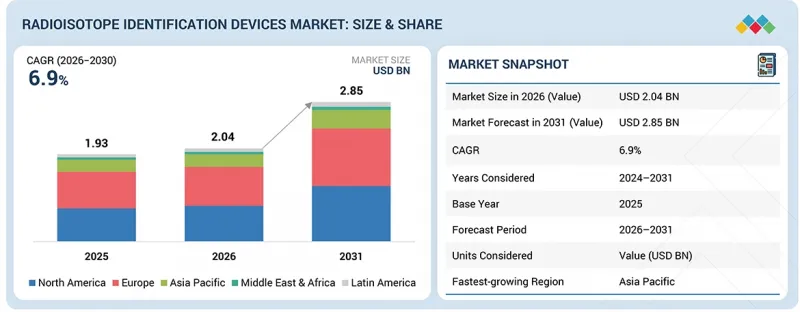
The global radioisotope identification devices market is projected to reach USD 2.85 billion by 2031 from USD 1.93 billion in 2025, at a CAGR of 6.9% from 2026 to 2031. The radioisotope identification devices market is growing due to a global increase in nuclear security and the trafficking of radioactive materials.
| Scope of the Report | |
|---|---|
| Years Considered for the Study | 2025-2031 |
| Base Year | 2025 |
| Forecast Period | 2025-2031 |
| Units Considered | Value (USD billion) |
| Segments | Product Type, Application, End User, and Region |
| Regions covered | North America, Europe, Asia Pacific, Latin America, and the Middle East & Africa |
Governments in particular are investing significantly in advanced technologies that help with radiation detection to make border control, cargo screening, and countering terrorism more effective. As RIIDs are used to quickly and accurately identify radioactive materials, they are crucial for providing security for homes, law enforcement agencies, and for emergency response to incidents involving radiological materials.
By product type, the spectroscopic personal radiation detectors segment is expected to register the highest CAGR during the forecast period.
By product type, the radioisotope identification devices market is segmented into personal radiation detectors, handheld personal radiation detectors, radioisotope identification devices, fixed radiation monitoring systems, spectroscopic personal radiation detectors, and other products. Spectroscopic personal radiation detectors (SPRDs) are expected to register the highest CAGR in the market due to their advanced capability to not only detect radiation but also accurately identify specific isotopes, which is increasingly critical for security, defense, and emergency response applications. Unlike conventional personal radiation detectors, SPRDs provide high-resolution spectral analysis, enabling users to distinguish between benign and threatening radioactive sources, thereby significantly reducing false alarms. Growing concerns around nuclear terrorism, illicit trafficking, and CBRN threats are driving demand for more precise and reliable identification tools. Additionally, advancements in detector materials (such as CdZnTe and LaBr3), miniaturization, and AI-enabled analytics are making SPRDs more portable, user-friendly, and efficient for field deployment. Increasing regulatory requirements and modernization programs across homeland security and defense agencies further support the rapid adoption of these high-performance devices, resulting in their strong projected growth.
By application, the homeland security & border protection segment is projected to register the highest CAGR during the forecast period.
The homeland security & border protection segment is expected to witness the highest CAGR in the radioisotope identification devices (RIID) market due to escalating concerns over nuclear smuggling, radiological terrorism, and illicit trafficking of radioactive materials, which are driving governments to strengthen surveillance and detection capabilities at borders, ports, and airports. Increasing geopolitical tensions and the need for multi-layered security infrastructure are prompting significant investments in advanced radiation detection technologies, including RIIDs, portal monitors, and integrated screening systems. Additionally, international mandates and guidelines from organizations such as the International Atomic Energy Agency (IAEA) are pushing countries to enhance radiation monitoring and compliance frameworks. Continuous modernization of border security systems, coupled with the adoption of AI-enabled and networked detection solutions, is further accelerating demand, making homeland security and border protection the fastest-growing application segment in the market.
By end user, the government & defense agencies segment accounted for the highest market share in 2025.
The government & defense agencies segment accounted for the largest share in the radioisotope identification devices (RIIDs) market in 2025. High and sustained budgets for both defense and homeland security are driving the widespread use of RIIDs. Long-term procurement of RIIDs by government and defense agency customers has created a robust base of RIIDs throughout airports, seaports, and borders. Moreover, increasing global concerns about the illegal transport of nuclear material through smuggling and the increasing threat of radiological weapons of mass destruction have led to strict enforcement mandates (both domestically and internationally). This will continue to fuel strong and consistent demand from this segment.
Asia Pacific is expected to register the highest growth rate in the market during the forecast period.
Asia Pacific is expected to witness the highest growth rate in the radioisotope identification devices (RIIDs) market due to rapid industrialization, expanding nuclear energy programs, and increasing investments in homeland security and radiation safety infrastructure. Countries such as China, India, and Japan are actively strengthening their nuclear capabilities and regulatory frameworks, driving the need for advanced radiation detection and isotope identification systems. Additionally, the growing adoption of nuclear medicine and radiopharmaceuticals in the healthcare sector is further supporting market expansion. Rising awareness of radiological threats, coupled with government initiatives to enhance border security and environmental monitoring, is accelerating the deployment of RIIDs across the region, making Asia Pacific the fastest-growing market globally.
A breakdown of the primary participants referred to for this report is provided below:
- By Company Type: Tier 1 (40%), Tier 2 (30%), and Tier 3 (30%)
- By Designation: C-level Executives (55%), Directors (27%), and Others (18%)
- By Region: North America (35%), Europe (32%), Asia Pacific (25%), Latin America (6%), and the Middle East & Africa (2%)
The prominent players in this market are AMETEK (US), ARKTIS Radiation Detectors (Switzerland), ATOMTEX (Belarus), Bertin Instruments (France), BNC (USA), Fortive (US), H3D (US), Hitachi (Japan), Kromek Group (UK), Landauer (US), Ludlum Measurements (USA), Mirion Technologies (US), Nucsafe (South Korea), Polimaster (Belarus), Radiation Detection Company (US), Rapiscan (US), RSI (US), Smiths Detection (UK), Symetrica (UK), Teledyne FLIR Defense (US), and Thermo Fisher Scientific (US), among others.
Research Coverage
The radioisotope identification devices market is segmented by product type, application, end user, and region. The report reviews the leading companies competing in the radioisotope identification devices market. A micro-level analysis can be conducted to examine trends, growth opportunities, and contributions to the market. Additionally, it highlights potential revenue growth opportunities across various market segments in five major regions.
Key Benefits of Buying the Report
The report is valuable for new entrants in the radioisotope identification devices market as it provides comprehensive information about the market. This information is essential for understanding various investment opportunities. The report provides insights into both key and smaller players in the market, which can help create a solid basis for risk analysis when making investment decisions. It accurately segments the market by end users and regions, providing focused insights into specific market segments. Additionally, the report highlights key trends, challenges, growth drivers, and opportunities to support strategic decision-making through a thorough analysis.
The report provides insights into the following points:
- Key drivers (Rising nuclear security threats and illicit trafficking of radioactive materials, Increasing government spending on homeland security and defense), restraints (High cost of advanced RIIDs and spectroscopic technologies, Stringent regulatory approvals and compliance requirements), opportunities (Expansion of nuclear energy programs in emerging economies, Growing adoption of nuclear medicine and radiopharmaceuticals), and challenges (Technical limitations in detecting mixed or low-intensity isotopes, Shortage of skilled professionals to operate advanced RIIDs)
- Product Development/Innovation: Emerging technologies in space, R&D, recent product launches & approvals in the radioisotope identification devices market
- Market Growth: In-depth insights into the radioisotope identification devices market across varied geographies
- Market Diversification: Detailed analysis of new products, unexplored geographies, latest trends, and investments in the radioisotope identification devices market
- Competitive Assessment: Detailed assessment of market share, service offerings, leading strategies of major players such as Mirion Technologies (US), Nucsafe (South Korea), Polimaster (Belarus), Radiation Detection Company (US), Rapiscan (US), RSI (US), Smiths Detection (UK), Symetrica (UK), Teledyne FLIR Defense (US), and Thermo Fisher Scientific (US).
TABLE OF CONTENTS
1 INTRODUCTION
- 1.1 STUDY OBJECTIVES
- 1.2 MARKET DEFINITION
- 1.3 MARKET SCOPE
- 1.3.1 MARKET SEGMENTATION AND REGIONAL SCOPE
- 1.3.2 INCLUSIONS AND EXCLUSIONS
- 1.3.3 YEARS CONSIDERED
- 1.4 CURRENCY CONSIDERED
- 1.5 STUDY LIMITATIONS
- 1.6 STAKEHOLDERS
2 EXECUTIVE SUMMARY
- 2.1 MARKET HIGHLIGHTS AND KEY INSIGHTS
- 2.2 KEY MARKET PARTICIPANTS: MAPPING OF STRATEGIC DEVELOPMENTS
- 2.3 DISRUPTIVE TRENDS IN RADIOISOTOPE IDENTIFICATION DEVICES MARKET
- 2.4 HIGH-GROWTH SEGMENTS
- 2.5 REGIONAL SNAPSHOT: MARKET SIZE, GROWTH RATE, AND FORECAST
3 PREMIUM INSIGHTS
- 3.1 ATTRACTIVE OPPORTUNITIES FOR PLAYERS IN RADIOISOTOPE IDENTIFICATION DEVICES MARKET
- 3.2 RADIOISOTOPE IDENTIFICATION DEVICES MARKET IN NORTH AMERICA, BY COUNTRY AND PRODUCT TYPE, 2025
- 3.3 GEOGRAPHIC SNAPSHOT OF RADIOISOTOPE IDENTIFICATION DEVICES MARKET
4 MARKET OVERVIEW
- 4.1 INTRODUCTION
- 4.2 MARKET DYNAMICS
- 4.2.1 DRIVERS
- 4.2.1.1 Rising nuclear security threats and illicit trafficking of radioactive materials
- 4.2.1.2 Increasing government spending on homeland security
- 4.2.1.3 Technological advancements in detection materials, embedded electronics, and spectroscopic algorithms
- 4.2.1.4 Increasing defense modernization programs globally
- 4.2.2 RESTRAINTS
- 4.2.2.1 High cost of advanced RIIDs and spectroscopic technologies
- 4.2.2.2 Stringent regulatory approvals and compliance requirements
- 4.2.3 OPPORTUNITIES
- 4.2.3.1 Growing adoption of nuclear medicines and radiopharmaceuticals
- 4.2.3.2 Expansion of nuclear energy programs in emerging economies
- 4.2.3.3 Integration of RIIDs into AI and IoT connectivity frameworks and distributed sensor network architecture
- 4.2.4 CHALLENGES
- 4.2.4.1 Technical limitations in detecting mixed or low-intensity isotopes
- 4.2.4.2 Shortage of skilled professionals to operate advanced RIIDs
- 4.2.1 DRIVERS
- 4.3 UNMET NEEDS
- 4.4 INTERCONNECTED MARKETS AND CROSS-SECTOR OPPORTUNITIES
- 4.5 STRATEGIC MOVES BY TIER 1/2/3 PLAYERS
5 INDUSTRY TRENDS
- 5.1 PORTER'S FIVE FORCES ANALYSIS
- 5.1.1 BARGAINING POWER OF BUYERS
- 5.1.2 BARGAINING POWER OF SUPPLIERS
- 5.1.3 THREAT OF NEW ENTRANTS
- 5.1.4 THREAT OF SUBSTITUTES
- 5.1.5 INTENSITY OF COMPETITIVE RIVALRY
- 5.2 MACROECONOMIC OUTLOOK
- 5.2.1 INTRODUCTION
- 5.2.2 GDP TRENDS AND FORECAST
- 5.2.3 TRENDS IN GLOBAL RADIATION INDUSTRY
- 5.2.4 TRENDS IN GLOBAL RADIOISOTOPE IDENTIFICATION DEVICES INDUSTRY
- 5.3 SUPPLY CHAIN ANALYSIS
- 5.4 VALUE CHAIN ANALYSIS
- 5.5 ECOSYSTEM ANALYSIS
- 5.6 PRICING ANALYSIS
- 5.6.1 PRICING RANGE OF RADIOISOTOPE IDENTIFICATION PRODUCT TYPES, BY KEY PLAYER, 2025
- 5.6.2 PRICING TREND OF RADIOISOTOPE IDENTIFICATION PRODUCT TYPES, BY REGION, 2023-2025
- 5.7 TRADE ANALYSIS
- 5.7.1 IMPORT SCENARIO (HS CODE 2844)
- 5.7.2 EXPORT SCENARIO (HS CODE 2844)
- 5.8 KEY CONFERENCES AND EVENTS, 2026-2027
- 5.9 TRENDS/DISRUPTIONS IMPACTING CUSTOMER BUSINESS
- 5.10 INVESTMENT AND FUNDING SCENARIO
- 5.11 CASE STUDY ANALYSIS
- 5.11.1 STRENGTHENING DOMESTIC MEDICAL RADIONUCLIDE SUPPLY THROUGH COLLABORATIVE INNOVATION
- 5.11.2 ADVANCING PORTABLE RADIATION DETECTION FOR NUCLEAR SECURITY APPLICATIONS
- 5.11.3 ENABLING LARGE-SCALE MEDICAL RADIOISOTOPE PRODUCTION THROUGH ADVANCED SHIELDING INFRASTRUCTURE
- 5.12 IMPACT OF US TARIFF - RADIOISOTOPE IDENTIFICATION DEVICES MARKET
- 5.12.1 INTRODUCTION
- 5.12.2 KEY TARIFF RATES
- 5.12.3 KEY TARIFF RATES
- 5.12.4 PRICE IMPACT ANALYSIS
- 5.12.5 IMPACT ON COUNTRIES/REGIONS
- 5.12.5.1 US
- 5.12.5.2 Europe
- 5.12.5.3 Asia Pacific
- 5.12.6 IMPACT ON END USERS
- 5.13 KEY SALES OPPORTUNITY AREAS FOR TELEDYNE GLOBALLY (2025)
- 5.13.1 WHITE SPACE OPPORTUNITIES
- 5.13.2 REVENUE HOT SPOTS
- 5.13.3 HIGH-GROWTH SALES POCKETS
6 TECHNOLOGICAL ADVANCEMENTS, AI-DRIVEN IMPACT, PATENTS, AND INNOVATIONS
- 6.1 KEY EMERGING TECHNOLOGIES
- 6.1.1 CADMIUM ZINC TELLURIDE (CZT) DETECTOR
- 6.1.2 LANTHANUM BBROMIDE (LABR3) SCINTILLATION
- 6.1.3 HYBRID GAMMA-NEUTRON DETECTION SYSTEMS
- 6.2 COMPLEMENTARY TECHNOLOGIES
- 6.2.1 RADIATION PORTAL MONITORS (RPMS)
- 6.2.2 RADIATION MAPPING AND DATA ANALYTICS PLATFORMS
- 6.3 PATENT ANALYSIS
- 6.4 IMPACT OF AI ON RADIOISOTOPE IDENTIFICATION DEVICES MARKET
- 6.4.1 TOP USE CASES AND MARKET POTENTIAL
- 6.4.2 BEST PRACTICES FOLLOWED BY MANUFACTURERS/OEMS IN RADIOISOTOPE IDENTIFICATION DEVICES MARKET
- 6.4.3 CASE STUDIES RELATED TO AI IMPLEMENTATION IN RADIOISOTOPE IDENTIFICATION DEVICES MARKET
- 6.4.4 INTERCONNECTED/ADJACENT ECOSYSTEMS AND IMPACT ON MARKET PLAYERS
- 6.4.5 CLIENTS' READINESS TO ADOPT AI-INTEGRATED RADIOISOTOPE IDENTIFICATION DEVICES
- 6.5 SUCCESS STORIES AND REAL-WORLD APPLICATIONS
7 REGULATORY LANDSCAPE
- 7.1 REGIONAL REGULATIONS AND COMPLIANCE
- 7.1.1 REGULATORY BODIES, GOVERNMENT AGENCIES, AND OTHER ORGANIZATIONS
- 7.1.2 REGULATIONS
8 CUSTOMER LANDSCAPE AND BUYER BEHAVIOR
- 8.1 INTRODUCTION
- 8.2 DECISION-MAKING PROCESS
- 8.3 KEY STAKEHOLDERS INVOLVED IN BUYING PROCESS AND THEIR EVALUATION CRITERIA
- 8.3.1 KEY STAKEHOLDERS IN BUYING PROCESS
- 8.3.2 BUYING CRITERIA
- 8.4 ADOPTION BARRIERS AND INTERNAL CHALLENGES
- 8.5 UNMET NEEDS OF VARIOUS END USERS
9 RADIOISOTOPE IDENTIFICATION DEVICES MARKET, BY PRODUCT TYPE
- 9.1 INTRODUCTION
- 9.2 PERSONAL RADIATION DETECTORS
- 9.2.1 INCREASING INVESTMENTS IN HOMELAND SECURITY INFRASTRUCTURE TO BOOST DEMAND
- 9.3 HANDHELD PERSONAL RADIATION DETECTORS
- 9.3.1 SHIFT FROM BELT-WORN MONITORS TO INTELLIGENT AND COST-EFFECTIVE HANDHELD RADIATION INTERDICTION TOOLS TO DRIVE SEGMENTAL GROWTH
- 9.4 RADIOISOTOPE IDENTIFICATION DEVICES
- 9.4.1 ABILITY TO ANALYZE FULL GAMMA-RAY ENERGY SPECTRUM FOR ISOTOPE IDENTIFICATION TO ACCELERATE ADOPTION
- 9.5 FIXED RADIATION MONITORING SYSTEMS
- 9.5.1 GROWING FOCUS ON NUCLEAR SAFETY, RADIOACTIVE WASTE MANAGEMENT, AND CRITICAL INFRASTRUCTURE PROTECTION TO STIMULATE DEMAND
- 9.6 SPECTROSCOPIC PERSONAL RADIATION DETECTORS
- 9.6.1 HIGH EMPHASIS ON HOMELAND SECURITY AND CRITICAL INFRASTRUCTURE PROTECTION TO SUPPORT SEGMENTAL GROWTH
- 9.7 OTHER PRODUCTS
10 RADIOISOTOPE IDENTIFICATION DEVICES MARKET, BY APPLICATION
- 10.1 INTRODUCTION
- 10.2 HOMELAND SECURITY & BORDER PROTECTION
- 10.2.1 CONTINUED INVESTMENTS IN RADIOLOGICAL SURVEILLANCE AND HOMELAND SECURITY MODERNIZATION INITIATIVES TO PROPEL MARKET
- 10.3 NUCLEAR POWER PLANTS & FUEL CYCLE FACILITIES
- 10.3.1 RAPID EXPANSION OF NUCLEAR ENERGY INFRASTRUCTURE TO FACILITATE MARKET GROWTH
- 10.4 MEDICAL & HEALTHCARE
- 10.4.1 GROWING ADOPTION OF ADVANCED DIAGNOSTIC IMAGING AND THERAPEUTIC RADIOPHARMACEUTICALS TO CONTRIBUTE TO MARKET GROWTH
- 10.5 ENVIRONMENTAL MONITORING & RADIATION SAFETY
- 10.5.1 RISING ENVIRONMENTAL RADIATION SURVEILLANCE AND NORM MONITORING ACTIVITIES TO SPUR DEMAND
- 10.6 INDUSTRIAL APPLICATIONS
- 10.6.1 ADVANCEMENTS IN CONNECTED RADIATION MONITORING INFRASTRUCTURE TO SPIKE DEMAND
- 10.7 CBRN MISSION USERS
- 10.7.1 STRINGENT MILITARY PERFORMANCE REQUIREMENTS AND RUGGEDIZED OPERATIONAL STANDARDS TO SUPPORT MARKET GROWTH
- 10.8 OTHER APPLICATIONS
11 RADIOISOTOPE IDENTIFICATION DEVICES MARKET, BY END USER
- 11.1 INTRODUCTION
- 11.2 GOVERNMENT & DEFENSE AGENCIES
- 11.2.1 LARGE-SCALE RADIOLOGICAL PREPAREDNESS AND COUNTERTERRORISM PROGRAMS TO ELEVATE DEMAND
- 11.3 NUCLEAR FACILITIES
- 11.3.1 EXPANSION OF NUCLEAR POWER INFRASTRUCTURE TO CREATE GROWTH OPPORTUNITIES
- 11.4 HOSPITALS & DIAGNOSTIC CENTERS
- 11.4.1 INCREASING USE OF RADIOACTIVE ISOTOPES IN ONCOLOGY, CARDIOLOGY, NEUROLOGY, AND TARGETED ALPHA THERAPY TO FUEL MARKET GROWTH
- 11.5 RESEARCH INSTITUTES & UNIVERSITIES
- 11.5.1 SURGING USE OF RIID IN ENVIRONMENTAL MONITORING, ISOTOPE ANALYSIS, FACULTY-LED SCIENTIFIC STUDIES TO FOSTER MARKET GROWTH
- 11.6 INDUSTRIAL FACILITIES
- 11.6.1 TIGHTENING INTERNATIONAL RADIATION SAFETY REGULATIONS TO LEAD TO HIGH DEMAND FOR RIIDS
- 11.7 OTHER END USERS
12 RADIOISOTOPE IDENTIFICATION DEVICES MARKET, BY REGION
- 12.1 INTRODUCTION
- 12.2 NORTH AMERICA
- 12.2.1 US
- 12.2.1.1 Inclination toward advanced technology-driven alternatives in radiation management to drive demand
- 12.2.2 CANADA
- 12.2.2.1 Border security, environmental monitoring, and health physics applications to contribute to market growth
- 12.2.1 US
- 12.3 EUROPE
- 12.3.1 GERMANY
- 12.3.1.1 Ongoing dismantling of multiple reactor sites to accelerate demand
- 12.3.2 UK
- 12.3.2.1 Major nuclear new-built projects and ongoing nuclear decommissioning activities to create lucrative opportunities
- 12.3.3 FRANCE
- 12.3.3.1 Expansion of nuclear ecosystem to fuel demand
- 12.3.4 ITALY
- 12.3.4.1 Nuclear policy shifts and port security initiatives to foster market growth
- 12.3.5 SPAIN
- 12.3.5.1 Strong focus on strengthening security posture through defense and technology modernization programs to propel market
- 12.3.6 REST OF EUROPE
- 12.3.1 GERMANY
- 12.4 ASIA PACIFIC
- 12.4.1 JAPAN
- 12.4.1.1 World-leading nuclear medicine ecosystem to offer growth avenues
- 12.4.2 CHINA
- 12.4.2.1 Heavy investments by government agencies in radiation safety and security systems to accelerate market growth
- 12.4.3 INDIA
- 12.4.3.1 Long-term nuclear energy expansion roadmap to support market growth
- 12.4.4 AUSTRALIA
- 12.4.4.1 Pressing need to identify and intercept illicit trafficking of radioactive and nuclear materials to spur demand
- 12.4.5 SOUTH KOREA
- 12.4.5.1 Nuclear export leadership to strengthen market growth
- 12.4.6 REST OF ASIA PACIFIC
- 12.4.1 JAPAN
- 12.5 LATIN AMERICA
- 12.5.1 BRAZIL
- 12.5.1.1 Emphasis on innovation in nuclear medicine to expedite adoption
- 12.5.2 MEXICO
- 12.5.2.1 Cross-border security requirements to support market growth
- 12.5.3 REST OF LATIN AMERICA
- 12.5.1 BRAZIL
- 12.6 MIDDLE EAST & AFRICA
- 12.6.1 GCC
- 12.6.1.1 Large-scale industrial radiation monitoring needs to facilitate adoption
- 12.6.2 REST OF MIDDLE EAST & AFRICA
- 12.6.1 GCC
13 COMPETITIVE LANDSCAPE
- 13.1 OVERVIEW
- 13.2 KEY PLAYER COMPETITIVE STRATEGIES/RIGHT TO WIN
- 13.3 REVENUE ANALYSIS, 2021-2025
- 13.4 MARKET SHARE ANALYSIS, 2025
- 13.5 COMPANY EVALUATION MATRIX: KEY PLAYERS, 2025
- 13.5.1 STARS
- 13.5.2 EMERGING LEADERS
- 13.5.3 PERVASIVE PLAYERS
- 13.5.4 PARTICIPANTS
- 13.5.5 COMPANY FOOTPRINT: KEY PLAYERS, 2025
- 13.5.5.1 Company footprint
- 13.5.5.2 Region footprint
- 13.5.5.3 Product type footprint
- 13.5.5.4 Application footprint
- 13.5.5.5 End user footprint
- 13.6 COMPANY EVALUATION MATRIX: STARTUPS/SMES, 2023
- 13.6.1 PROGRESSIVE COMPANIES
- 13.6.2 RESPONSIVE COMPANIES
- 13.6.3 DYNAMIC COMPANIES
- 13.6.4 STARTING BLOCKS
- 13.6.5 COMPETITIVE BENCHMARKING: STARTUPS/SMES, 2025
- 13.6.5.1 Detailed list of key startups/SMEs
- 13.6.5.2 Competitive benchmarking of startups/SMEs
- 13.7 COMPANY VALUATION AND FINANCIAL METRICS
- 13.7.1 COMPANY VALUATION
- 13.7.2 FINANCIAL METRICS
- 13.8 BRAND COMPARISON
- 13.8.1 THERMO FISHER SCIENTIFIC INC. (US)
- 13.8.2 TELEDYNE FLIR (US)
- 13.8.3 AMETEK, INC. (US)
- 13.8.4 MIRION TECHNOLOGIES, INC. (US)
- 13.8.5 KROMEK GROUP PLC (UK)
- 13.9 COMPETITIVE SCENARIO
- 13.9.1 PRODUCT LAUNCHES & APPROVALS
- 13.9.2 DEALS
14 COMPANY PROFILES
- 14.1 KEY PLAYERS
- 14.1.1 MIRION TECHNOLOGIES INC.
- 14.1.1.1 Business overview
- 14.1.1.2 Products offered
- 14.1.1.3 Recent developments
- 14.1.1.3.1 Product launches & approvals
- 14.1.1.3.2 Deals
- 14.1.1.3.3 Other developments
- 14.1.1.4 MnM view
- 14.1.1.4.1 Key strengths/Right to win
- 14.1.1.4.2 Strategic choices
- 14.1.1.4.3 Weaknesses and competitive threats
- 14.1.2 THERMO FISHER SCIENTIFIC
- 14.1.2.1 Business overview
- 14.1.2.2 Products offered
- 14.1.2.3 Recent developments
- 14.1.2.3.1 Developments
- 14.1.2.4 MnM view
- 14.1.2.4.1 Key strengths/Right to win
- 14.1.2.4.2 Strategic choices
- 14.1.2.4.3 Weaknesses and competitive threats
- 14.1.3 TELEDYNE FLIR
- 14.1.3.1 Business overview
- 14.1.3.2 Products offered
- 14.1.3.3 MnM view
- 14.1.3.3.1 Key strengths/Right to win
- 14.1.3.3.2 Strategic choices
- 14.1.3.3.3 Weaknesses and competitive threats
- 14.1.4 AMETEK, INC.
- 14.1.4.1 Business overview
- 14.1.4.2 Products offered
- 14.1.4.3 Recent developments
- 14.1.4.3.1 Product launches & approvals
- 14.1.4.3.2 Deals
- 14.1.4.4 MnM view
- 14.1.4.4.1 Key strengths/Right to win
- 14.1.4.4.2 Strategic choices
- 14.1.4.4.3 Weaknesses and competitive threats
- 14.1.5 ARKTIS RADIATION DETECTORS LTD.
- 14.1.5.1 Business overview
- 14.1.5.2 Products offered
- 14.1.5.3 Recent developments
- 14.1.5.3.1 Developments
- 14.1.6 ATOMTEX SPE
- 14.1.6.1 Business overview
- 14.1.6.2 Products offered
- 14.1.7 BERTIN INSTRUMENTS (BERTIN TECHNOLOGIES GROUP)
- 14.1.7.1 Business overview
- 14.1.7.2 Products offered
- 14.1.7.3 Recent developments
- 14.1.7.3.1 Deals
- 14.1.7.3.2 Other developments
- 14.1.8 BERKELEY NUCLEONICS CORPORATION (BNC)
- 14.1.8.1 Business overview
- 14.1.8.2 Products offered
- 14.1.8.3 Recent developments
- 14.1.8.3.1 Developments
- 14.1.9 H3D INC.
- 14.1.9.1 Business overview
- 14.1.9.2 Products offered
- 14.1.9.3 Recent developments
- 14.1.9.3.1 Developments
- 14.1.10 HITACHI, LTD.
- 14.1.10.1 Business overview
- 14.1.10.2 Products offered
- 14.1.11 KROMEK GROUP PLC
- 14.1.11.1 Business overview
- 14.1.11.2 Products offered
- 14.1.11.3 Recent developments
- 14.1.11.3.1 Product launches & approvals
- 14.1.11.3.2 Deals
- 14.1.11.3.3 Other developments
- 14.1.11.4 MnM view
- 14.1.11.4.1 Key strengths/Right to win
- 14.1.11.4.2 Strategic choices
- 14.1.11.4.3 Weaknesses and competitive threats
- 14.1.12 LANDAUER (A FORTIVE COMPANY)
- 14.1.12.1 Business overview
- 14.1.12.2 Products offered
- 14.1.12.3 Recent developments
- 14.1.12.3.1 Developments
- 14.1.13 LUDLUM MEASUREMENTS, INC.
- 14.1.13.1 Business overview
- 14.1.13.2 Products offered
- 14.1.13.3 Recent developments
- 14.1.13.3.1 Deals
- 14.1.14 RAPISCAN
- 14.1.14.1 Business overview
- 14.1.14.2 Products offered
- 14.1.14.3 Recent developments
- 14.1.14.3.1 Deals
- 14.1.14.3.2 Other developments
- 14.1.15 POLIMASTER
- 14.1.15.1 Business overview
- 14.1.15.2 Products offered
- 14.1.15.3 Recent developments
- 14.1.15.3.1 Developments
- 14.1.16 RADIATION DETECTION COMPANY (RDC)
- 14.1.16.1 Business overview
- 14.1.16.2 Products offered
- 14.1.16.3 Recent developments
- 14.1.16.3.1 Deals
- 14.1.16.3.2 Other developments
- 14.1.17 RADIATION SOLUTIONS INC.
- 14.1.17.1 Business overview
- 14.1.17.2 Products offered
- 14.1.17.3 Recent developments
- 14.1.17.3.1 Deals
- 14.1.1 MIRION TECHNOLOGIES INC.
- 14.2 OTHER PLAYERS
- 14.2.1 SMITHS DETECTION (SMITHS GROUP PLC)
- 14.2.2 SYMETRICA LIMITED
- 14.2.3 BUBBLE TECHNOLOGY INDUSTRIES
- 14.2.4 NUCTECH
- 14.2.5 PHDS CO.
- 14.2.6 BALTIC SCIENTIFIC INSTRUMENTS
- 14.2.7 ECOTEST GROUP
- 14.2.8 VNIIA ROSATOM INSTRUMENTS
- 14.2.9 LAURUS SYSTEMS
- 14.2.10 NUCLEONIX
15 RESEARCH METHODOLOGY
- 15.1 RESEARCH DATA
- 15.1.1 SECONDARY DATA
- 15.1.1.1 Key sources of secondary data
- 15.1.1.2 Objectives of secondary research
- 15.1.1.3 Key data from secondary sources
- 15.1.2 PRIMARY DATA
- 15.1.2.1 Key primary sources
- 15.1.2.2 Key objectives of primary research
- 15.1.2.3 Key industry insights
- 15.1.1 SECONDARY DATA
- 15.2 MARKET SIZE ESTIMATION
- 15.2.1 BOTTOM-UP APPROACH (REVENUE SHARE ANALYSIS)
- 15.2.1.1 Company revenue estimation approach
- 15.2.1.2 Customer-based market estimation
- 15.2.2 TOP-DOWN APPROACH
- 15.2.1 BOTTOM-UP APPROACH (REVENUE SHARE ANALYSIS)
- 15.3 DATA TRIANGULATION
- 15.4 MARKET SHARE ASSESSMENT
- 15.5 RESEARCH ASSUMPTIONS
- 15.6 RESEARCH LIMITATIONS
- 15.7 RISK ANALYSIS
16 APPENDIX
- 16.1 DISCUSSION GUIDE
- 16.2 KNOWLEDGESTORE: MARKETSANDMARKETS' SUBSCRIPTION PORTAL
- 16.3 CUSTOMIZATION OPTIONS
- 16.4 RELATED REPORTS
- 16.5 AUTHOR DETAILS
List of Tables
- TABLE 1 REPORT EXCLUSIONS AND INCLUSIONS
- TABLE 2 RADIOISOTOPE IDENTIFICATION DEVICES MARKET: UNMET NEEDS
- TABLE 3 STRATEGIC MOVES BY TIER 1, TIER 2, AND TIER 3 PLAYERS IN RADIOISOTOPE IDENTIFICATION DEVICES MARKET
- TABLE 4 RADIOISOTOPE IDENTIFICATION DEVICES MARKET: PORTER'S FIVE FORCES ANALYSIS
- TABLE 5 PRICING RANGE OF RADIOISOTOPE IDENTIFICATION DEVICES, BY KEY PLAYER, 2025 (USD)
- TABLE 6 PRICING TREND OF RADIOISOTOPE IDENTIFICATION DEVICES, BY REGION, 2023-2025 (USD)
- TABLE 7 IMPORT DATA FOR HS CODE 2844-COMPLIANT PRODUCTS, BY COUNTRY, 2021-2025 (USD THOUSAND)
- TABLE 8 EXPORT DATA FOR HS CODE 2844-COMPLIANT PRODUCTS, BY COUNTRY, 2021-2025 (USD THOUSAND)
- TABLE 9 RADIOISOTOPE IDENTIFICATION DEVICES MARKET: KEY CONFERENCES AND EVENTS, 2026-2027
- TABLE 10 CASE STUDY 1: COLLABORATIVE RESEARCH ADVANCING SUSTAINABLE NUCLEAR MEDICINE INFRASTRUCTURE
- TABLE 11 CASE STUDY 2: DUAL-MODE RADIATION DETECTION SYSTEM FOR ILLICIT TRAFFICKING PREVENTION
- TABLE 12 CASE STUDY 3: HIGH-DENSITY RADIATION SHIELDING INFRASTRUCTURE FOR MEDICAL RADIOISOTOPE PRODUCTION
- TABLE 13 US-ADJUSTED RECIPROCAL TARIFF RATES
- TABLE 14 CASE STUDY 1: AI-ASSISTED RADIOISOTOPE IDENTIFICATION FOR PORTABLE RADIATION DETECTION SYSTEMS
- TABLE 15 NORTH AMERICA: LIST OF REGULATORY BODIES, GOVERNMENT AGENCIES, AND OTHER ORGANIZATIONS
- TABLE 16 EUROPE: LIST OF REGULATORY BODIES, GOVERNMENT AGENCIES, AND OTHER ORGANIZATIONS
- TABLE 17 ASIA PACIFIC: LIST OF REGULATORY BODIES, GOVERNMENT AGENCIES, AND OTHER ORGANIZATIONS
- TABLE 18 LATIN AMERICA: LIST OF REGULATORY BODIES, GOVERNMENT AGENCIES, AND OTHER ORGANIZATIONS
- TABLE 19 MIDDLE EAST & AFRICA: LIST OF REGULATORY BODIES, GOVERNMENT AGENCIES, AND OTHER ORGANIZATIONS
- TABLE 20 US FDA: MEDICAL DEVICE CLASSIFICATION
- TABLE 21 US: MEDICAL DEVICE REGULATORY APPROVAL PROCESS
- TABLE 22 CANADA: MEDICAL DEVICE REGULATORY APPROVAL PROCESS
- TABLE 23 CHINA: CLASSIFICATION OF MEDICAL DEVICES
- TABLE 24 JAPAN: MEDICAL DEVICE CLASSIFICATION UNDER PMDA
- TABLE 25 INFLUENCE OF END USERS ON BUYING PROCESS (%)
- TABLE 26 KEY BUYING CRITERIA, BY END USER
- TABLE 27 RADIOISOTOPE IDENTIFICATION DEVICES MARKET, BY PRODUCT TYPE, 2023-2031 (USD MILLION)
- TABLE 28 PERSONAL RADIATION DETECTORS: RADIOISOTOPE IDENTIFICATION DEVICES MARKET, BY REGION, 2023-2031 (USD MILLION)
- TABLE 29 HANDHELD PERSONAL RADIATION DETECTORS: RADIOISOTOPE IDENTIFICATION DEVICES MARKET, BY REGION, 2023-2031 (USD MILLION)
- TABLE 30 RADIOISOTOPE IDENTIFICATION DEVICES: RADIOISOTOPE IDENTIFICATION DEVICES MARKET, BY REGION, 2023-2031 (USD MILLION)
- TABLE 31 FIXED RADIATION MONITORING SYSTEMS: RADIOISOTOPE IDENTIFICATION DEVICES MARKET, BY REGION, 2023-2031 (USD MILLION)
- TABLE 32 SPECTROSCOPIC PERSONAL RADIATION DETECTORS: RADIOISOTOPE IDENTIFICATION DEVICES MARKET, BY REGION, 2023-2031 (USD MILLION)
- TABLE 33 OTHER PRODUCTS: RADIOISOTOPE IDENTIFICATION DEVICES MARKET, BY REGION, 2023-2031 (USD MILLION)
- TABLE 34 RADIOISOTOPE IDENTIFICATION DEVICES MARKET, BY APPLICATION, 2023-2031 (USD MILLION)
- TABLE 35 HOMELAND SECURITY & BORDER PROTECTION: RADIOISOTOPE IDENTIFICATION DEVICES MARKET, BY REGION, 2023-2031 (USD MILLION)
- TABLE 36 NUCLEAR POWER PLANTS & FUEL CYCLE FACILITIES: RADIOISOTOPE IDENTIFICATION DEVICES MARKET, BY REGION, 2023-2031 (USD MILLION)
- TABLE 37 MEDICAL & HEALTHCARE: RADIOISOTOPE IDENTIFICATION DEVICES MARKET, BY REGION, 2023-2031 (USD MILLION)
- TABLE 38 ENVIRONMENTAL MONITORING & RADIATION SAFETY SYSTEMS: RADIOISOTOPE IDENTIFICATION DEVICES MARKET, BY REGION, 2023-2031 (USD MILLION)
- TABLE 39 INDUSTRIAL APPLICATIONS: RADIOISOTOPE IDENTIFICATION DEVICES MARKET, BY REGION, 2023-2031 (USD MILLION)
- TABLE 40 CBRN MISSION USERS: RADIOISOTOPE IDENTIFICATION DEVICES MARKET, BY REGION, 2023-2031 (USD MILLION)
- TABLE 41 OTHER APPLICATIONS: RADIOISOTOPE IDENTIFICATION DEVICES MARKET, BY REGION, 2023-2031 (USD MILLION)
- TABLE 42 RADIOISOTOPE IDENTIFICATION DEVICES MARKET, BY END USER, 2023-2031 (USD MILLION)
- TABLE 43 GOVERNMENT & DEFENSE AGENCIES: RADIOISOTOPE IDENTIFICATION DEVICES MARKET, BY REGION, 2023-2031 (USD MILLION)
- TABLE 44 NUCLEAR FACILITIES: RADIOISOTOPE IDENTIFICATION DEVICES MARKET, BY REGION, 2023-2031 (USD MILLION)
- TABLE 45 HOSPITALS & DIAGNOSTIC CENTERS: RADIOISOTOPE IDENTIFICATION DEVICES MARKET, BY REGION, 2023-2031 (USD MILLION)
- TABLE 46 RESEARCH INSTITUTES & UNIVERSITIES: RADIOISOTOPE IDENTIFICATION DEVICES MARKET, BY REGION, 2023-2031 (USD MILLION)
- TABLE 47 INDUSTRIAL FACILITIES: RADIOISOTOPE IDENTIFICATION DEVICES MARKET, BY REGION, 2023-2031 (USD MILLION)
- TABLE 48 OTHER END USERS: RADIOISOTOPE IDENTIFICATION DEVICES MARKET, BY REGION, 2023-2031 (USD MILLION)
- TABLE 49 RADIOISOTOPE IDENTIFICATION DEVICES MARKET, BY REGION, 2023-2031 (USD MILLION)
- TABLE 50 NORTH AMERICA: RADIOISOTOPE IDENTIFICATION DEVICES MARKET, BY COUNTRY, 2023-2031 (USD MILLION)
- TABLE 51 NORTH AMERICA: RADIOISOTOPE IDENTIFICATION DEVICES MARKET, BY PRODUCT TYPE, 2023-2031 (USD MILLION)
- TABLE 52 NORTH AMERICA: RADIOISOTOPE IDENTIFICATION DEVICES MARKET, BY APPLICATION, 2023-2031 (USD MILLION)
- TABLE 53 NORTH AMERICA: RADIOISOTOPE IDENTIFICATION DEVICES MARKET, BY END USER, 2023-2031 (USD MILLION)
- TABLE 54 US: RADIOISOTOPE IDENTIFICATION DEVICES MARKET, BY PRODUCT TYPE, 2023-2031 (USD MILLION)
- TABLE 55 CANADA: RADIOISOTOPE IDENTIFICATION DEVICES MARKET, BY PRODUCT TYPE, 2023-2031 (USD MILLION)
- TABLE 56 EUROPE: RADIOISOTOPE IDENTIFICATION DEVICES MARKET, BY COUNTRY, 2023-2031 (USD MILLION)
- TABLE 57 EUROPE: RADIOISOTOPE IDENTIFICATION DEVICES MARKET, BY PRODUCT TYPE, 2023-2031 (USD MILLION)
- TABLE 58 EUROPE: RADIOISOTOPE IDENTIFICATION DEVICES MARKET, BY APPLICATION, 2023-2031 (USD MILLION)
- TABLE 59 EUROPE: RADIOISOTOPE IDENTIFICATION DEVICES MARKET, BY END USER, 2023-2031 (USD MILLION)
- TABLE 60 GERMANY: RADIOISOTOPE IDENTIFICATION DEVICES MARKET, BY PRODUCT TYPE, 2023-2031 (USD MILLION)
- TABLE 61 UK: RADIOISOTOPE IDENTIFICATION DEVICES MARKET, BY PRODUCT TYPE, 2023-2031 (USD MILLION)
- TABLE 62 FRANCE: RADIOISOTOPE IDENTIFICATION DEVICES MARKET, BY PRODUCT TYPE, 2023-2031 (USD MILLION)
- TABLE 63 ITALY: RADIOISOTOPE IDENTIFICATION DEVICES MARKET, BY PRODUCT TYPE, 2023-2031 (USD MILLION)
- TABLE 64 SPAIN: RADIOISOTOPE IDENTIFICATION DEVICES MARKET, BY PRODUCT TYPE, 2023-2031 (USD MILLION)
- TABLE 65 REST OF EUROPE: RADIOISOTOPE IDENTIFICATION DEVICES MARKET, BY PRODUCT TYPE, 2023-2031 (USD MILLION)
- TABLE 66 ASIA PACIFIC: RADIOISOTOPE IDENTIFICATION DEVICES MARKET, BY COUNTRY, 2023-2031 (USD MILLION)
- TABLE 67 ASIA PACIFIC: RADIOISOTOPE IDENTIFICATION DEVICES MARKET, BY PRODUCT TYPE, 2023-2031 (USD MILLION)
- TABLE 68 ASIA PACIFIC: RADIOISOTOPE IDENTIFICATION DEVICES MARKET, BY APPLICATION, 2023-2031 (USD MILLION)
- TABLE 69 ASIA PACIFIC: RADIOISOTOPE IDENTIFICATION DEVICES MARKET, BY END USER, 2023-2031 (USD MILLION)
- TABLE 70 JAPAN: RADIOISOTOPE IDENTIFICATION DEVICES MARKET, BY PRODUCT TYPE, 2023-2031 (USD MILLION)
- TABLE 71 CHINA: RADIOISOTOPE IDENTIFICATION DEVICES MARKET, BY PRODUCT TYPE, 2023-2031 (USD MILLION)
- TABLE 72 INDIA: RADIOISOTOPE IDENTIFICATION DEVICES MARKET, BY PRODUCT TYPE, 2023-2031 (USD MILLION)
- TABLE 73 AUSTRALIA: RADIOISOTOPE IDENTIFICATION DEVICES MARKET, BY PRODUCT TYPE, 2023-2031 (USD MILLION)
- TABLE 74 SOUTH KOREA: RADIOISOTOPE IDENTIFICATION DEVICES MARKET, BY PRODUCT TYPE, 2023-2031 (USD MILLION)
- TABLE 75 REST OF ASIA PACIFIC: RADIOISOTOPE IDENTIFICATION DEVICES MARKET, BY PRODUCT TYPE, 2023-2031 (USD MILLION)
- TABLE 76 LATIN AMERICA: RADIOISOTOPE IDENTIFICATION DEVICES MARKET, BY COUNTRY, 2023-2031 (USD MILLION)
- TABLE 77 LATIN AMERICA: RADIOISOTOPE IDENTIFICATION DEVICES MARKET, BY PRODUCT TYPE, 2023-2031 (USD MILLION)
- TABLE 78 LATIN AMERICA: RADIOISOTOPE IDENTIFICATION DEVICES MARKET, BY APPLICATION, 2023-2031 (USD MILLION)
- TABLE 79 LATIN AMERICA: RADIOISOTOPE IDENTIFICATION DEVICES MARKET, BY END USER, 2023-2031 (USD MILLION)
- TABLE 80 BRAZIL: RADIOISOTOPE IDENTIFICATION DEVICES MARKET, BY PRODUCT TYPE, 2023-2031 (USD MILLION)
- TABLE 81 MEXICO: RADIOISOTOPE IDENTIFICATION DEVICES MARKET, BY PRODUCT TYPE, 2023-2031 (USD MILLION)
- TABLE 82 ROLATAM: RADIOISOTOPE IDENTIFICATION DEVICES MARKET, BY PRODUCT TYPE, 2023-2031 (USD MILLION)
- TABLE 83 MIDDLE EAST & AFRICA: RADIOISOTOPE IDENTIFICATION DEVICES MARKET, BY COUNTRY, 2023-2031 (USD MILLION)
- TABLE 84 MIDDLE EAST & AFRICA: RADIOISOTOPE IDENTIFICATION DEVICES MARKET, BY PRODUCT TYPE, 2023-2031 (USD MILLION)
- TABLE 85 MIDDLE EAST & AFRICA: RADIOISOTOPE IDENTIFICATION DEVICES MARKET, BY APPLICATION, 2023-2031 (USD MILLION)
- TABLE 86 MIDDLE EAST & AFRICA: RADIOISOTOPE IDENTIFICATION DEVICES MARKET, BY END USER, 2023-2031 (USD MILLION)
- TABLE 87 GCC: RADIOISOTOPE IDENTIFICATION DEVICES MARKET, BY PRODUCT TYPE, 2023-2031 (USD MILLION)
- TABLE 88 REST OF MIDDLE EAST & AFRICA: RADIOISOTOPE IDENTIFICATION DEVICES MARKET, BY PRODUCT TYPE, 2023-2031 (USD MILLION)
- TABLE 89 OVERVIEW OF STRATEGIES DEPLOYED BY KEY PLAYERS IN RADIOISOTOPE IDENTIFICATION DEVICES MARKET
- TABLE 90 RADIOISOTOPE IDENTIFICATION DEVICES MARKET: DEGREE OF COMPETITION
- TABLE 91 RADIOISOTOPE IDENTIFICATION DEVICES MARKET: REGION FOOTPRINT
- TABLE 92 RADIOISOTOPE IDENTIFICATION DEVICES MARKET: PRODUCT TYPE FOOTPRINT
- TABLE 93 RADIOISOTOPE IDENTIFICATION DEVICES MARKET: APPLICATION FOOTPRINT
- TABLE 94 RADIOISOTOPE IDENTIFICATION DEVICES MARKET: END USER FOOTPRINT
- TABLE 95 RADIOISOTOPE IDENTIFICATION DEVICES MARKET: DETAILED LIST OF KEY STARTUPS/SMES
- TABLE 96 RADIOISOTOPE IDENTIFICATION DEVICES MARKET: COMPETITIVE BENCHMARKING OF STARTUPS/SMES
- TABLE 97 RADIOISOTOPE IDENTIFICATION DEVICES MARKET: PRODUCT LAUNCHES & APPROVALS, JANUARY 2022-MAY 2026
- TABLE 98 RADIOISOTOPE IDENTIFICATION DEVICES MARKET: DEALS, JANUARY 2022-MAY 2026
- TABLE 99 MIRION TECHNOLOGIES INC.: COMPANY OVERVIEW
- TABLE 100 MIRION TECHNOLOGIES INC.: PRODUCTS OFFERED
- TABLE 101 MIRION TECHNOLOGIES INC.: PRODUCT LAUNCHES & APPROVALS
- TABLE 102 MIRION TECHNOLOGIES INC.: DEALS
- TABLE 103 MIRION TECHNOLOGIES INC.: OTHER DEVELOPMENTS
- TABLE 104 THERMO FISHER SCIENTIFIC: COMPANY OVERVIEW
- TABLE 105 THERMO FISHER SCIENTIFIC: PRODUCTS OFFERED
- TABLE 106 THERMO FISHER SCIENTIFIC: DEVELOPMENTS
- TABLE 107 TELEDYNE FLIR: COMPANY OVERVIEW
- TABLE 108 TELEDYNE FLIR: PRODUCTS OFFERED
- TABLE 109 AMETEK, INC.: COMPANY OVERVIEW
- TABLE 110 AMETEK, INC.: PRODUCTS OFFERED
- TABLE 111 AMETEK, INC.: PRODUCT LAUNCHES & APPROVALS
- TABLE 112 AMETEK, INC.: DEALS
- TABLE 113 ARKTIS RADIATION DETECTORS LTD.: COMPANY OVERVIEW
- TABLE 114 ARKTIS RADIATION DETECTORS LTD.: PRODUCTS OFFERED
- TABLE 115 ARKTIS RADIATION DETECTORS LTD.: DEVELOPMENTS
- TABLE 116 ATOMTEX SPE: COMPANY OVERVIEW
- TABLE 117 ATOMTEX SPE: PRODUCTS OFFERED
- TABLE 118 BERTIN INSTRUMENTS: COMPANY OVERVIEW
- TABLE 119 BERTIN INSTRUMENTS: PRODUCTS OFFERED
- TABLE 120 BERTIN INSTRUMENTS: DEALS
- TABLE 121 BERTIN INSTRUMENTS: OTHER DEVELOPMENTS
- TABLE 122 BERKELEY NUCLEONICS CORPORATION: COMPANY OVERVIEW
- TABLE 123 BERKELEY NUCLEONICS CORPORATION: PRODUCTS OFFERED
- TABLE 124 BERKELEY NUCLEONICS CORPORATION: DEVELOPMENTS
- TABLE 125 H3D INC.: COMPANY OVERVIEW
- TABLE 126 H3D INC.: PRODUCTS OFFERED
- TABLE 127 H3D INC.: DEVELOPMENTS
- TABLE 128 HITACHI, LTD.: COMPANY OVERVIEW
- TABLE 129 HITACHI, LTD.: PRODUCTS OFFERED
- TABLE 130 KROMEK GROUP PLC: COMPANY OVERVIEW
- TABLE 131 KROMEK GROUP PLC: PRODUCTS OFFERED
- TABLE 132 KROMEK GROUP PLC: PRODUCT LAUNCHES & APPROVALS
- TABLE 133 KROMEK GROUP PLC: DEALS
- TABLE 134 KROMEK GROUP PLC: OTHER DEVELOPMENTS
- TABLE 135 FORTIVE: COMPANY OVERVIEW
- TABLE 136 LANDAUER: PRODUCTS OFFERED
- TABLE 137 LANDAUER: DEVELOPMENTS
- TABLE 138 LUDLUM MEASUREMENTS: COMPANY OVERVIEW
- TABLE 139 LUDLUM MEASUREMENTS: PRODUCTS OFFERED
- TABLE 140 LUDLUM MEASUREMENTS: DEALS
- TABLE 141 RAPISCAN: COMPANY OVERVIEW
- TABLE 142 RAPISCAN: PRODUCTS OFFERED
- TABLE 143 RAPISCAN: DEALS
- TABLE 144 RAPISCAN: OTHER DEVELOPMENTS
- TABLE 145 POLIMASTER: COMPANY OVERVIEW
- TABLE 146 POLIMASTER: PRODUCTS OFFERED
- TABLE 147 POLIMASTER: DEVELOPMENTS
- TABLE 148 RADIATION DETECTION COMPANY: COMPANY OVERVIEW
- TABLE 149 RADIATION DETECTION COMPANY: PRODUCTS OFFERED
- TABLE 150 RADIATION DETECTION COMPANY: DEALS
- TABLE 151 RADIATION DETECTION COMPANY: OTHER DEVELOPMENTS
- TABLE 152 RADIATION SOLUTIONS INC.: COMPANY OVERVIEW
- TABLE 153 RADIATION SOLUTIONS INC.: PRODUCTS OFFERED
- TABLE 154 RADIATION SOLUTIONS INC.: DEALS
- TABLE 155 ASSUMPTIONS CONSIDERED DURING REPORT PRODUCTION
- TABLE 156 RADIOISOTOPE IDENTIFICATION DEVICES MARKET: RISK ANALYSIS
List of Figures
- FIGURE 1 MARKETS COVERED AND REGIONAL SCOPE
- FIGURE 2 DURATION CONSIDERED
- FIGURE 3 MARKET SCENARIO
- FIGURE 4 GLOBAL RADIOISOTOPE IDENTIFICATION DEVICES MARKET, 2023-2031
- FIGURE 5 MAJOR STRATEGIES ADOPTED BY KEY PLAYERS IN RADIOISOTOPE IDENTIFICATION DEVICES MARKET, 2022-2025
- FIGURE 6 DISRUPTIONS INFLUENCING RADIOISOTOPE IDENTIFICATION DEVICES MARKET
- FIGURE 7 HIGH-GROWTH SEGMENTS IN RADIOISOTOPE IDENTIFICATION DEVICES MARKET, 2026-2031
- FIGURE 8 ASIA PACIFIC TO REGISTER HIGHEST CAGR IN RADIOISOTOPE IDENTIFICATION DEVICES MARKET, IN TERMS OF VALUE, DURING FORECAST PERIOD
- FIGURE 9 INTEGRATION OF RIIDS WITH DRONES, ROBOTIC PLATFORMS, AND NETWORKED MONITORING SYSTEMS TO DRIVE MARKET
- FIGURE 10 US AND RADIOISOTOPE IDENTIFICATION DEVICES SEGMENT ACCOUNTED FOR LARGEST MARKET SHARE IN 2025
- FIGURE 11 INDIA TO REGISTER HIGHEST GROWTH RATE IN GLOBAL MARKET DURING FORECAST PERIOD
- FIGURE 12 RADIOISOTOPE IDENTIFICATION DEVICES MARKET: DRIVERS, RESTRAINTS, OPPORTUNITIES, AND CHALLENGES
- FIGURE 13 PORTER'S FIVE FORCES ANALYSIS: RADIOISOTOPE IDENTIFICATION DEVICES MARKET
- FIGURE 14 SUPPLY CHAIN ANALYSIS
- FIGURE 15 VALUE CHAIN ANALYSIS
- FIGURE 16 RADIOISOTOPE IDENTIFICATION DEVICES ECOSYSTEM ANALYSIS
- FIGURE 17 PRICING RANGE OF RADIOISOTOPE IDENTIFICATION PRODUCTS, BY REGION, 2025
- FIGURE 18 IMPORT SCENARIO FOR HS CODE 2844-COMPLIANT PRODUCTS IN TOP 5 COUNTRIES, 2021-2025
- FIGURE 19 EXPORT SCENARIO FOR HS CODE 2844-COMPLIANT PRODUCTS IN TOP 5 COUNTRIES, 2021-2025
- FIGURE 20 TRENDS/DISRUPTIONS INFLUENCING CUSTOMER BUSINESS
- FIGURE 21 INVESTMENT AND FUNDING DATA, 2019-2023
- FIGURE 22 PATENT ANALYSIS FOR RADIOISOTOPE IDENTIFICATION DEVICES MARKET (JANUARY 2014-MAY 2026)
- FIGURE 23 INFLUENCE OF STAKEHOLDERS ON BUYING PROCESS, BY END USER
- FIGURE 24 KEY BUYING CRITERIA, BY END USER
- FIGURE 25 NORTH AMERICA: RADIOISOTOPE IDENTIFICATION DEVICES MARKET
- FIGURE 26 ASIA PACIFIC: RADIOISOTOPE IDENTIFICATION DEVICES MARKET
- FIGURE 27 REVENUE ANALYSIS OF TOP PLAYERS IN RADIOISOTOPE IDENTIFICATION DEVICES MARKET, 2021-2025
- FIGURE 28 GLOBAL RADIOISOTOPE IDENTIFICATION DEVICES MARKET SHARE, BY KEY PLAYER, 2025
- FIGURE 29 RADIOISOTOPE IDENTIFICATION DEVICES MARKET: COMPANY EVALUATION MATRIX (KEY PLAYERS), 2025
- FIGURE 30 RADIOISOTOPE IDENTIFICATION DEVICES MARKET: COMPANY FOOTPRINT
- FIGURE 31 RADIOISOTOPE IDENTIFICATION DEVICES MARKET: COMPANY EVALUATION MATRIX (STARTUPS/SMES), 2025
- FIGURE 32 COMPANY VALUATION
- FIGURE 33 EV/EBITDA OF KEY VENDORS
- FIGURE 34 RADIOISOTOPE IDENTIFICATION DEVICES MARKET: BRAND/PRODUCT COMPARATIVE ANALYSIS
- FIGURE 35 MIRION TECHNOLOGIES INC.: COMPANY SNAPSHOT
- FIGURE 36 THERMO FISHER SCIENTIFIC: COMPANY SNAPSHOT
- FIGURE 37 TELEDYNE FLIR: COMPANY SNAPSHOT
- FIGURE 38 AMETEK, INC.: COMPANY SNAPSHOT
- FIGURE 39 HITACHI, LTD.: COMPANY SNAPSHOT
- FIGURE 40 KROMEK GROUP PLC: COMPANY SNAPSHOT
- FIGURE 41 FORTIVE: COMPANY SNAPSHOT
- FIGURE 42 RADIOISOTOPE IDENTIFICATION DEVICES MARKET: RESEARCH DESIGN
- FIGURE 43 MAJOR SECONDARY SOURCES RADIOISOTOPE IDENTIFICATION DEVICES MARKET
- FIGURE 44 DATA OBTAINED FROM SECONDARY SOURCES
- FIGURE 45 RADIOISOTOPE IDENTIFICATION DEVICES: PRIMARY SOURCES
- FIGURE 46 RADIOISOTOPE IDENTIFICATION DEVICES: KEY INDUSTRY INSIGHTS
- FIGURE 47 BREAKDOWN OF PRIMARY INTERVIEWS: BY COMPANY TYPE, DESIGNATION, AND REGION
- FIGURE 48 BREAKDOWN OF PRIMARY INTERVIEWS: SUPPLY- AND DEMAND-SIDE PARTICIPANTS
- FIGURE 49 RESEARCH METHODOLOGY: HYPOTHESIS BUILDING
- FIGURE 50 RADIOISOTOPE IDENTIFICATION DEVICES MARKET SIZE ESTIMATION: BOTTOM-UP APPROACH (REVENUE SHARE ANALYSIS)
- FIGURE 51 RADIOISOTOPE IDENTIFICATION DEVICES MARKET SIZE ESTIMATION: COMPANY REVENUE ESTIMATION
- FIGURE 52 RADIOISOTOPE IDENTIFICATION DEVICES MARKET: TOP-DOWN APPROACH
- FIGURE 53 CAGR PROJECTIONS: SUPPLY-SIDE ANALYSIS
- FIGURE 54 RADIOISOTOPE IDENTIFICATION DEVICES MARKET: DATA TRIANGULATION

